文档文本内容
Unit 8 How do you make a banana milk shake?
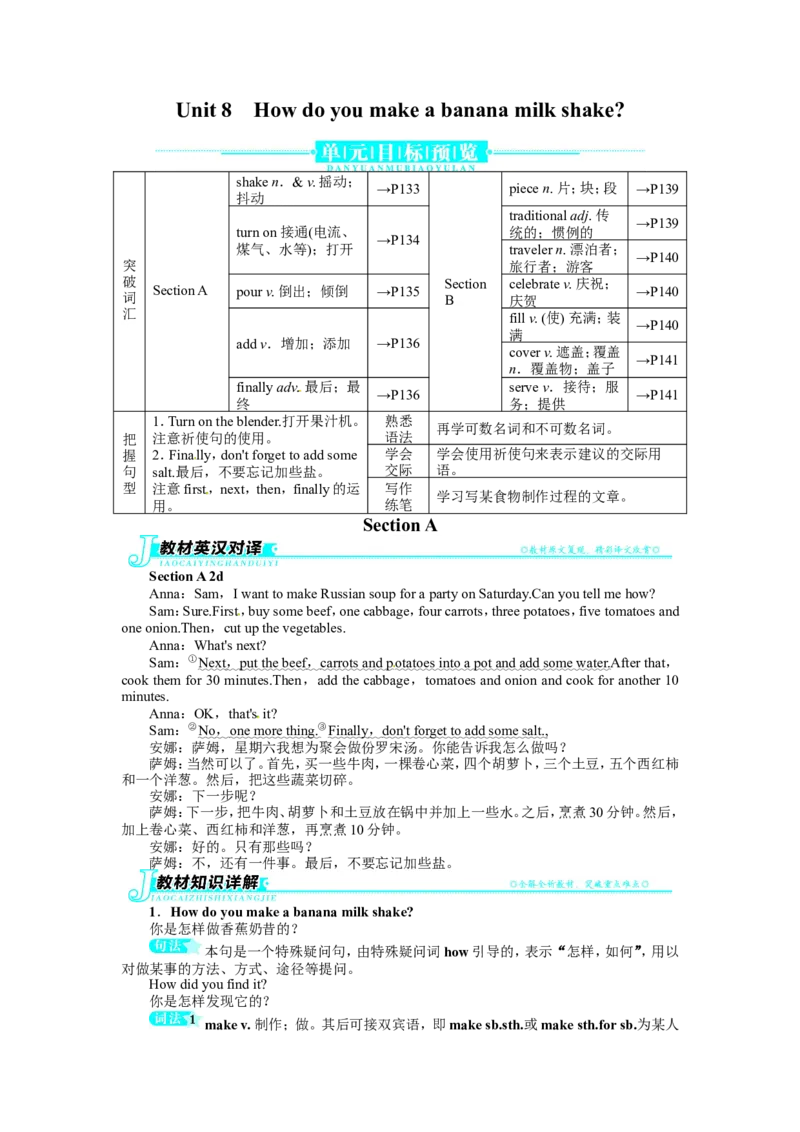
shake n.& v. 摇动;
→P133 piece n. 片;块;段 →P139
抖动 [来
源:学#科#网]
[来源:学*科*网Z*X*X*K]
traditional adj. 传
→P139
turn on 接通(电流、 统的;惯例的
→P134
煤气、水等);打开 traveler n. 漂泊者;
→P140
突 旅行者;游客
破 Section celebrate v. 庆祝;
Section A pour v. 倒出;倾倒 →P135 →P140
词 [来源:学#科 B 庆贺
汇
#网] [来源:学#科#网Z#X#X#K]
fill v. (使) 充满;装
[来源:网学]&科&
满
→P140
add v.增加;添加 →P136
cover v. 遮盖;覆盖
→P141
n.覆盖物;盖子
finally adv. 最后;最 serve v.接待;服
→P136 →P141
终 务;提供
1.Turn on the blender.打开果汁机。 熟悉
再学可数名词和不可数名词。
把 注意祈使句的使用。 语法
握 2.Finally,don't forget to add some 学会 学会使用祈使句来表示建议的交际用
句 salt.最后,不要忘记加些盐。 交际 语。
型 注意first,next,then,finally的运 写作
学习写某食物制作过程的文章。
用。 练笔
Section A
Section A 2d
Anna:Sam,I want to make Russian soup for a party on Saturday.Can you tell me how?
Sam:Sure.First,buy some beef,one cabbage,four carrots,three potatoes,five tomatoes and
one onion.Then,cut up the vegetables.
Anna:What's next?
Sam:① Next , put the beef , carrots and p otatoes into a pot and add some water.After that,
cook them for 30 minutes.Then,add the cabbage,tomatoes and onion and cook for another 10
minutes.
Anna:OK,that's it?
Sam:② No , one more thing .③ Finally , don't forget to add some salt .,
安娜:萨姆,星期六我想为聚会做份罗宋汤。你能告诉我怎么做吗?
萨姆:当然可以了。首先,买一些牛肉,一棵卷心菜,四个胡萝卜,三个土豆,五个西红柿
和一个洋葱。然后,把这些蔬菜切碎。
安娜:下一步呢?
萨姆:下一步,把牛肉、胡萝卜和土豆放在锅中并加上一些水。之后,烹煮30分钟。然后,
加上卷心菜、西红柿和洋葱,再烹煮10分钟。
安娜:好的。只有那些吗?
萨姆:不,还有一件事。最后,不要忘记加些盐。
1.How do you make a banana milk shake?
你是怎样做香蕉奶昔的?
本句是一个特殊疑问句,由特殊疑问词how引导的,表示“怎样,如何”,用以
对做某事的方法、方式、途径等提问。
How did you find it?
你是怎样发现它的?
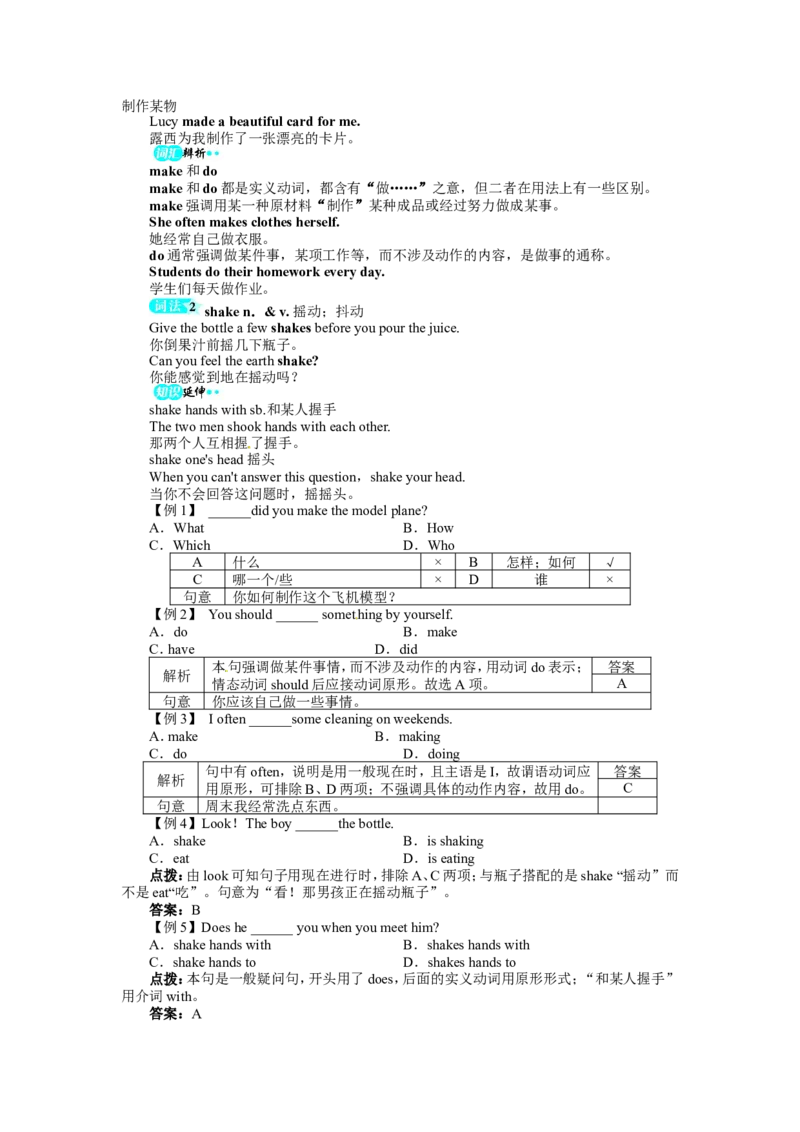
make v. 制作;做。其后可接双宾语,即make sb.sth.或make sth.for sb.为某人制作某物
Lucy made a beautiful card for me.
露西为我制作了一张漂亮的卡片。
make 和do
make 和do都是实义动词,都含有“做……”之意,但二者在用法上有一些区别。
make强调用某一种原材料“制作”某种成品或经过努力做成某事。
She often makes clothes herself.
她经常自己做衣服。
do通常强调做某件事,某项工作等,而不涉及动作的内容,是做事的通称。
Students do their homework every day.
学生们每天做作业。
shake n.& v. 摇动;抖动
Give the bottle a few shakes before you pour the juice.
你倒果汁前摇几下瓶子。
Can you feel the earth shake?
你能感觉到地在摇动吗?
shake hands with sb.和某人握手
The two men shook hands with each other.
那两个人互相握了握手。
shake one's head 摇头
When you can't answer this question,shake your head.
当你不会回答这问题时,摇摇头。
【例1】 ______did you make the model plane?
A.What B.How
C.Which D.Who
A 什么 × B 怎样;如何 √
C 哪一个/些 × D 谁 ×
句意 你如何制作这个飞机模型?
【例2】 You should ______ something by yourself.
A.do B.make
C.have D.did
本句强调做某件事情,而不涉及动作的内容,用动词do表示; 答案
解析
情态动词should后应接动词原形。故选A项。 A
句意 你应该自己做一些事情。
【例3】 I often ______some cleaning on weekends.
A.make B.making
C.do D.doing
句中有often,说明是用一般现在时,且主语是I,故谓语动词应 答案
解析
用原形,可排除B、D两项;不强调具体的动作内容,故用do。 C
句意 周末我经常洗点东西。
【例4】Look!The boy ______the bottle.
A.shake B.is shaking
C.eat D.is eating
点拨:由look可知句子用现在进行时,排除A、C两项;与瓶子搭配的是shake “摇动”而
不是eat“吃”。句意为“看!那男孩正在摇动瓶子”。
答案:B
【例5】Does he ______ you when you meet him?
A.shake hands with B.shakes hands with
C.shake hands to D.shakes hands to
点拨:本句是一般疑问句,开头用了does,后面的实义动词用原形形式;“和某人握手”
用介词with。
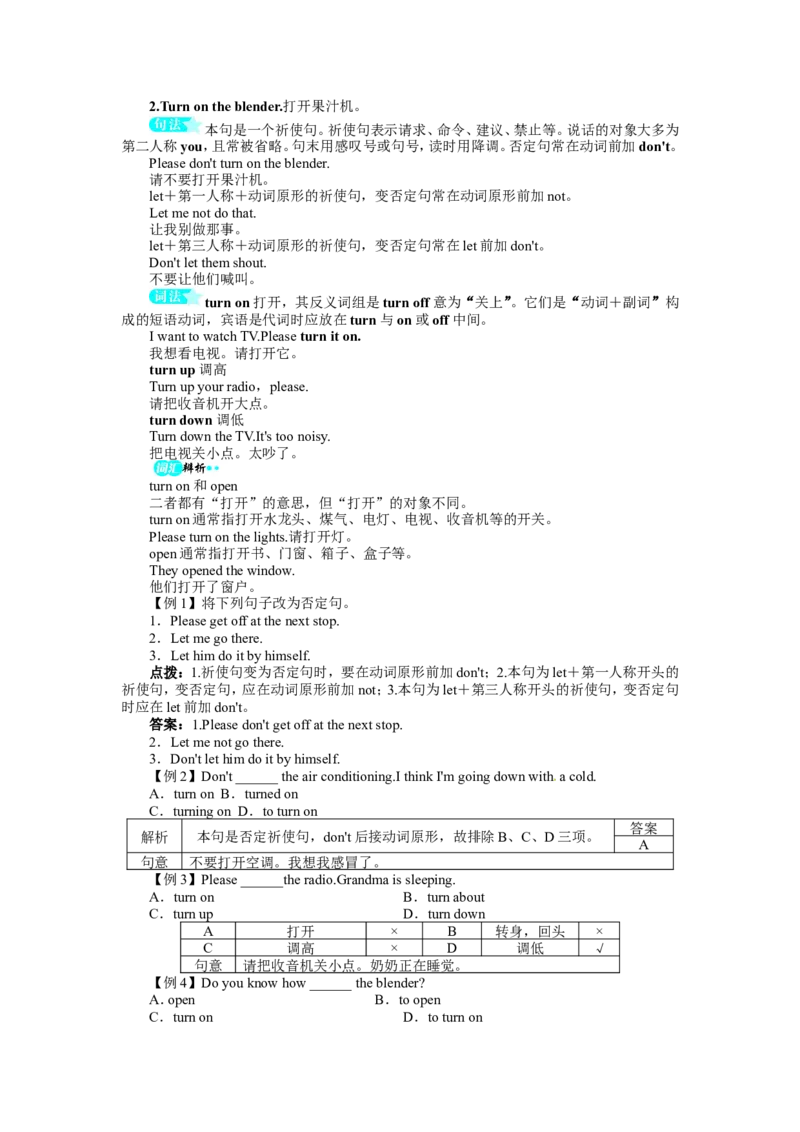
答案:A2.Turn on the blender.打开果汁机。
本句是一个祈使句。祈使句表示请求、命令、建议、禁止等。说话的对象大多为
第二人称you,且常被省略。句末用感叹号或句号,读时用降调。否定句常在动词前加don't。
Please don't turn on the blender.
请不要打开果汁机。
let+第一人称+动词原形的祈使句,变否定句常在动词原形前加not。
Let me not do that.
让我别做那事。
let+第三人称+动词原形的祈使句,变否定句常在let前加don't。
Don't let them shout.
不要让他们喊叫。
turn on 打开,其反义词组是turn off 意为“关上”。它们是“动词+副词”构
成的短语动词,宾语是代词时应放在turn 与on 或off 中间。
I want to watch TV.Please turn it on.
我想看电视。请打开它。
turn up 调高
Turn up your radio,please.
请把收音机开大点。
turn down 调低
Turn down the TV.It's too noisy.
把电视关小点。太吵了。
turn on 和open
二者都有“打开”的意思,但“打开”的对象不同。
turn on通常指打开水龙头、煤气、电灯、电视、收音机等的开关。
Please turn on the lights.请打开灯。
open通常指打开书、门窗、箱子、盒子等。
They opened the window.
他们打开了窗户。
【例1】将下列句子改为否定句。
1.Please get off at the next stop.
2.Let me go there.
3.Let him do it by himself.
点拨:1.祈使句变为否定句时,要在动词原形前加don't;2.本句为let+第一人称开头的
祈使句,变否定句,应在动词原形前加not;3.本句为let+第三人称开头的祈使句,变否定句
时应在let前加don't。
答案:1.Please don't get off at the next stop.
2.Let me not go there.
3.Don't let him do it by himself.
【例2】Don't ______ the air conditioning.I think I'm going down with a cold.
A.turn on B.turned on
C.turning on D.to turn on
答案
解析 本句是否定祈使句,don't后接动词原形,故排除B、C、D三项。
A
句意 不要打开空调。我想我感冒了。
【例3】Please ______the radio.Grandma is sleeping.
A.turn on B.turn about
C.turn up D.turn down
A 打开 × B 转身,回头 ×
C 调高 × D 调低 √
句意 请把收音机关小点。奶奶正在睡觉。
【例4】Do you know how ______ the blender?
A.open B.to open
C.turn on D.to turn on打开果汁机用turn on,排除A、B两项;疑问词后常接不 答案
解析
定式,故排除C项。
D
句意 你知道怎样打开果汁机吗?
3.Pour the milk into the blender.
把牛奶倒入搅拌器中。
pour v. 倒出;倾倒,常用短语为:pour...into,把……倒入……。
Please pour the water into the cup.
请把水倒入杯中。,【例题】根据汉语意思完成下句
我们什么时候该把鸡蛋倒入锅中?
When ______ we ______ the eggs ______ the pot?
答案:should;pour;into
4.How much yogurt do we need?我们需要多少酸奶?
how much 多少,用来修饰不可数名词,询问不可数名词的数量。
How much milk do we need?
我们还需要多少牛奶?
how much 与how many
how much通常询问不可数名词的数量;how many则询问可数名词的数量。
How much water do you need?
你需要多少水?
How many cups of water do you need?
你需要多少杯水?
how much 还可用于询问物品的价格。
How much are they?它们值多少钱?
【例题】 对画线部分提问
1.There are three bottles of orange.
______ ______ bottles of orange are there?
2.You can pour three cups of milk into the blender.
______ ______ milk can we pour into the blender?
点拨:1.three 接的是可数名词bottles,故用 how many来提问。2.three cups of milk表示
不可数名词milk的数量,故用how much来提问。
答案:1.How many 2.How much
5.① Next , put the beef , carrots and potatoes into a pot and add some water.
下一步,把牛肉、胡萝卜和土豆放在锅中并加上一些水。
add v.增加;添加
add...to...意为“把……加到……中去;往……中加……”。
Please add some salt to the food.
请给食物里面加点盐。
If you add 4 to 6,you get 10.
4加6等于10。
add to (add作不及物动词用)表示“增加;添加”,其中to是介词,后接名词或代词。
The flowers add to the beauty of the city.
这些花增添了这所城市的美。
【例1】______some water ______ the soup.
A.Add;to B.Add;up
C.add;to D.Add;up to
点拨:本句是祈使句,开头的单词首字母要大写,排除C项;根据句意“给汤里加些水”
可知A项正确。add...to...意为“往……中加……”。
答案:A
【例2】根据汉语意思完成下句
七加二等于九。
______two ______ seven,and you will get nine.答案:Add;to
6.② No , one more thing .不,还有一件事。
more 又;再,与another同义。
数词+more+ n.=another+数词+n.
They stayed there two more days.=
They stayed there another two days.
他们在那里又待了两天。
【例题】We've got two desks,but we need ______.
A.a desk B.two desks
C.two more D.more two
点拨:根据前半句句意“我们已有两张课桌”可推断“但是我们还需要两张”;浏览选
项含有此意的只有C、D两项,但more要放在数词之后,故选C项。
答案:C
7.③ Finally , don't forget to add some salt .最后,不要忘记加些盐。
finally adv. 最后;最终
同义短语是:at last;in the end。
finally可位于句首、句中或句末。位于句中时,要放在be动词、助动词或情态动词之后,
实义动词之前。表示做某事的先后顺序时可用first,next,then,finally。
I finally finished my homework.
我终于完成了我的作业。
【例题】 First,cut up two apples,then put them into the blender.______ turn on the blender.
A.And B.Next
C.First D.Finally
根据句中的first,then可知,空内要表达的是最后一点,故用finally。其 答案
解析
他三项不合句意。 D
句意 首先切碎两个苹果,然后把它们放进果汁机。最后打开果汁机。
在七年级上册第六单元我们学过可数名词和不可数名词,下面我们回顾一下并进一步
了解:
当表达不可数名词的具体数量时,可以用“数词+单位名词+of”来表示,其单复数通过
单位名词来体现。
I want three glasses of milk.
我想要三杯牛奶。Please give him a piece of paper.
请给他一张纸。
也可以用some,any,a lot of,lots of,much,a little等来修饰表示泛指的数量。
He has a lot of time to study.
他有大量学习的时间。
对数量进行提问时,how many 后接可数名词复数;how much 后接不可数名词。
—How many oranges did he buy?
他买了多少个橘子?
—He bought six oranges.
他买了六个橘子。
【例1】I need two ______.
A.spoon of milk B.spoons of milks
C.spoons milk D.spoons of milk
milk是不可数名词,没有复数形式,故排除B项;two 后接单位名词复 答案
解析 数,故排除A项;表示不可数名词的具体数量时,用数词+单位名词
D
+of表示,故排除C项。只有D项合适。
句意 我需要两匙牛奶。
【例2】—Could I have something to eat?
—Sure,here's some ______.
A.chicken B.tomatoes
C.orange D.water
根据问句“吃点东西”,排除C、D两项,它们是“喝的东西”;又根据 答案
解析
谓语动词is可判断主语用单数形式或不可数名词,故排除B项。 A
句意 “我可以吃点东西吗?”“当然,这儿有些鸡肉。”
【例3】—How many ______ are there in your basket,Jeff?
—Only three.
A.rice B.orange
C.hamburgers D.fruit
根据how many 后跟可数名词复数可知选C项。A项意为“大米;米 答案
解析 饭”,是不可数名词;B项意为“橙子”时,是可数名词;意为“橙
C
汁”时,是不可数名词;D项意为“水果”,也是不可数名词。
句意 “你的篮子里有几个汉堡?”“只有三个。”