Unit 8 How do you make a banana milk shake?
一、单元分析
本单元主要围绕“食物制作”这一话题展开,呈现出了食物制作的动词及短语、食物名词、
调味品名词、容器或器材的名词以及表示制作顺序的副词等。Section A的重点是学习祈使
句以及用How many / How much …?句型,其中还涉及动词和动词短语的使用、量词的表
达等。本部分的难点是表示制作程序的动词和动词短语的表述,另一个难点是量词的准确表
达。学生需要通过大量的开头练习,才能达到对目标语言的准确、熟练运用。Section B呈现
了与三明治制作以及感恩节相关的词汇,让学生通过听、说、读、写活动,进一步巩固食物制
作过程的表达,并了解与美国感恩节有关的文化背景和风俗习惯,同时引导学生用英语正确
表达中国的传统节日和食品名称。该部分的重点是巩固食物制作的相关描述。本部分的学习
难点是了解阅读材料中关于美国感恩节历史文化的相关内容。在情感态度和跨文化交际方
面,让学生通过学习了解美国特定节日的传统食物,引发学生联想中国节日以及家乡的风味
小吃,在语言能力上要求学生能尝试用英语介绍相关内容,旨在激发学生对家乡的热爱之情,
同时体验中西方饮食文化的差异。
二、语法
1、能掌握并使用祈使句
2、能正确区分可数名词与不可数名词
3、能熟练运用句型How much / How many 提问
4、能正确使用表示序列的副词
三、学习策略
1、能通过分类的方法。掌握并正确 运用可数与不可数名词
2、能通过体验,掌握按顺序表达食物制作过程的方法
四、文化知识
1、了解中西方饮食文化的基本差异
2、了解美国的感恩节
3、了解中国传统节日的饮食习俗以及地方风味小吃
五、课时分配
Section A 1a-1c 一课时 Section A 2a-2c 一课时
Section A 2d-3c 一课时 Section B 1a-1e 一课时
Section B 2a- 2e 一课时 Section B 3a- self check一课时
Unit 8 How do you make a banana milk shake?Period 1 Section A 1a-1c
知识目标:
1.熟练掌握词汇:
shake milk shake blender turn on peel pour drink put
2.熟练掌握以下句型:(1)cut up the bananas
(2)pour the milk into the blend
导学重难点:祈使句
【导学过程】
一、自主学习(课前准备)
回顾你所学过的有关食物的单词,并将其分类,比一比谁写的多。
Drink:_______________________________
Fruit:_______________________________
Vegetables:__________________________
[来源:学+科+网Z+X+X+K]
Food:________________________________
二、导入
以与学生谈论“ What’s your favorite food / drink / fruit ?”复习以前学过的有关实
物的词汇。进而引出“How do you make a banana milk shake ?”
三、 交流
1、Do 1a.
Ask Ss to write the names of the actions. Choose the correct words. Ask Ss to fill in the
blanks on their own. Then check the answers.
2、 Teach the names of all items. Point to the pictures of the items and ask students to repeat.
3、Focus on the pictures. Ask the students to tell what they see in the picture. Describe each
action 。
4. Point out the actions in the picture and the list of actions in activity 1b .
Play the recording and check the answers. Ask students to recite the conversation at once.
5、Do 1c.
Cover the instructions above . Ask a student to tell the students how to make it.
四、 总结
观察与思考:
观察1b中所给的句子,它们都是__________。祈使句常用来表达请求、命令、希望、禁止、劝
告定等意思。祈使句的主语常为第二人称you,谓语用____,主语常省略。祈使句的否定结构
是以“________+动词原形”开头。例如:Don't be late. 不要迟到。
五、练评
知识巩固:I. 根据首字母提示补全单词,使句子完整通顺。
1. Look, she is p________ the water into the cup,
2. Sonia is thirsty. Give her some water to d___________.
3. Mother is c_____________ up the meat in the kitchen.
4. We need a banana to make the milk s_____________.
5. You should p__________ the fruits before making the fruit salad.
六、课堂反思
1、.试着描述制作奶昔的步骤吧!________________________________________________。2、通过本课的学习,你还有哪些疑问?_____________________________________。
七、家作
I.熟练掌握新学动词的用法。
II.依据下一个学案的课时目标,完成课前准备。
[来源:学。科。网]
Period 2 Section A 2a-2c
知识目标:
1.熟练掌握词汇:
yogurt, honey, need watermelon spoon pot add finally salt
2.熟练掌握以下句型:
1) Let’s make …
2) How much yogurt do we need ?
3) How many apples do we need ?
导学重难点:
能听懂制作食物所需的食材及操作过程。
能区分可数和不可数名词,并能借助量词表达食物的数量。
【导学过程】
一、导入
以What food do you like to eat ?导入有关食物的话题,并展开问答“ How many/ How
much did you eat / drink ?
二、自主学习
1.把所学食物名词分类。
可数名词:___________________________
不可数名词:_________________________
2. 完成下列短语
1、一杯茶 2、三块西瓜 3、五袋大米
4、两箱梨 5、多少牛肉 6、九床被子
7、四只香蕉 8、 一碗稀饭 9、六条长裤
三、 合作与探究
Work on 2a:
1. Let Ss look at the pictures below. Let one student read the words in the pictures if
necessary.
2. Play the recording for the Ss to listen and complete the chart.
3. Play the recording again to check the answers.
Work on 2b:
1. Let Ss read the chart below. Tell Ss that they should write the ingredient under the
correct amount in the chart.
2. Play the recording for the Ss to write the correct answers in the chart.
3. Play the recording again to check the answers.
Pair work (2C)1. Tell Ss to ask and answer questions about how to make fruit salad.
2. Ask and answer with the words in the box..
Which of the following do we need every day ?
Foods Drinks Fruits
Rice tea apples
Bread coffee oranges
Hamburgers milk pears
Tomatoes cola banana
Rice orange juice …
S1: What food do you need every day ? S2: I think I need rice every day/
S1: How much do you need ? S2: I think I need three bowls of rice .
S1: What fruit do you need every day ? S2: I think I need apples every day.
S1: What food do you need every day ? S2: I think I need rice every day/
S1: How many do you need ? S2: Let me think … I need only one .
四、总结
观察与思考:
1). 你能看出how many和how much的用法吗?
可数名词的复数与many连用,当询问多少时用____ ____;不可数名词没有单、复数变化,
与much连用,询问多少时则用____。
试着用how many和how much填空。
____tomatoes can you see in the picture?
____are the sandwiches?
____yogurt do you need for the milk shake?
____cups of tea do you need?
2). need: vt. 需要 ①+ 名词,如:I need some yogurt.我需要一些酸奶。②+ to do
sth., 表主动,即主语人称是need后面的动词所表示动作的执行者。如:Lucy needs to
buy a book.露西需要买一本书。主语Lucy是buy这个动作的执行者。③+ doing sth.,表
被动,即主语人称是need后面的动词所表示动作的承受着。如:The room needs cleaning.
这个房间需要打扫。主语The room是动词clean 所表示动作的承受着。
五、练评
单项选择:
1. --- _______ yogurt do you want? --- Two cups.
A. How many B. How much C. How long D. How often
2. --- How many _________ do we need? --- Three.
A. an apple B. a apple C. apples D. apple
3. --- Let’s make the salad! --- ___________.
A. No, I am not. B. Thank you. C. That’s all right. D. That is a good
idea.
4. It’s dark(暗的) in the room. Please ____________ the right.
A. turn on B. turn down C. turn up D. turn off
5. --- The banana is too big. --- You can ____________ fruit.
A. cut up them B. cut them up C. cut it up D. cut up it
六、课堂反思
通过本课的学习,你还有哪些疑问?_____________________________________。
七、家庭作业 运用所学的短语搭配句型造10个句子。依据下一个学案的课时目标,完成预习准备。
Section A 2d-3c
知识目标:
1.熟练掌握以下词汇:add,sugar,finally,beef,cheese,popcorn,add…to…,put…into,
forget to do,how many/much
2.熟练掌握以下句型
(1)How do you make…?
(2)How much/many…do we need?
导学重难点:
巩固使用祈使句发布制作步骤的指令
运用表示顺序的副词表达制作步骤的先后顺序
【导学过程】
一、导入
让学生观察图片(2d),明确图片展示的是什么食物。教师在讲Russian soup作为西餐中一
道常见的汤菜进行简要介绍。
二、自主学习
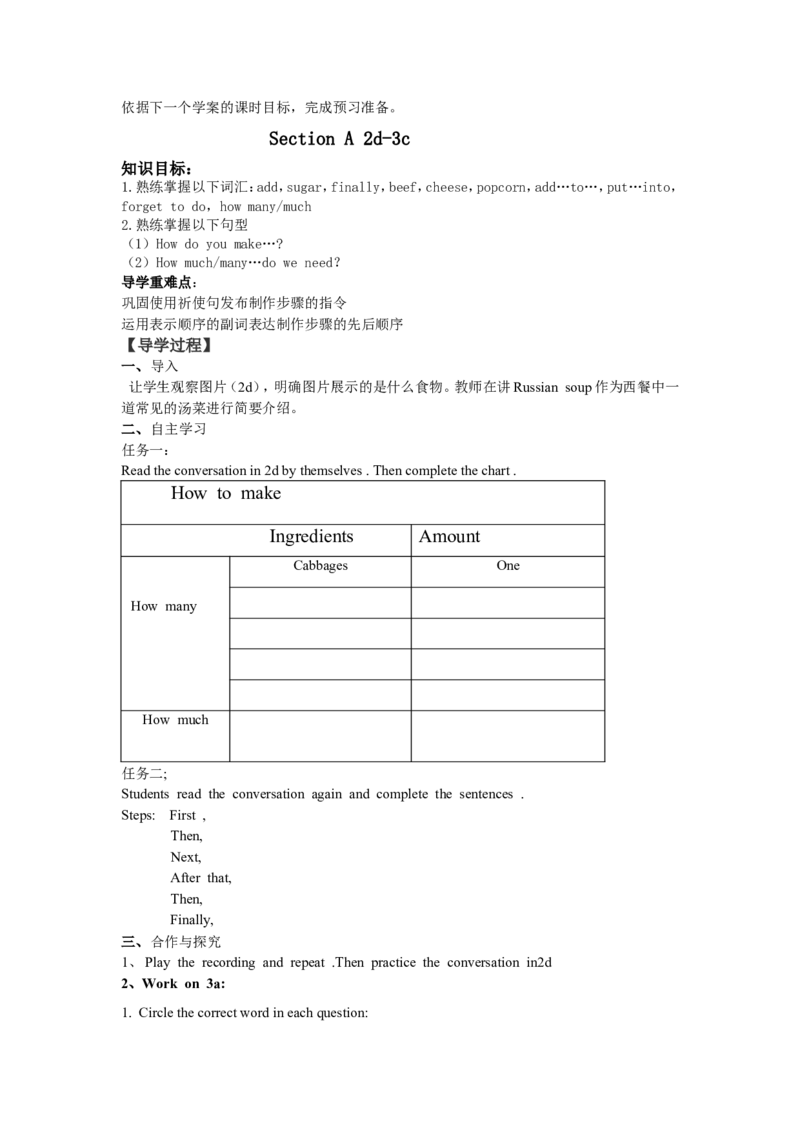
任务一:
Read the conversation in 2d by themselves . Then complete the chart .
How to make
Ingredients Amount
Cabbages One
How
[来源:学 .科.网
m
Z.X.X.K
a
][来源
n
:学科
y
网ZXXK]
[来源:Z&xx&k.Com]
How much
任务二;
Students read the conversation again and complete the sentences .
Steps: First ,
Then,
Next,
After that,
Then,
Finally,
三、合作与探究
1、Play the recording and repeat .Then practice the conversation in2d
2、Work on 3a:
1. Circle the correct word in each question:① 1. How (much/many) bananas do we need?
② How (much/many) sugar do we need?
③ How (much/many) bread do we need?
④ How (much/many) tomatoes do we need?
⑤ How (much/many) cheese do we need?
2. 方法指导:应根据括号后面的名词是可数名词还是不可数名词来确定。
比如,第一句中bananas是可数名词的复数形式,故用how many。其他类似。
3. 最后,教师与同学们一起校对答案,并对学生们有疑问的地方进行解释。
3、Work on 3b:
1. 让学生们阅读对话,整体把握对话的意思。
2. 然后仔细读制作爆米花的过程,根据图片及上下文意及时态来确定空格处所应填的词。
第一句话中句子的主语、谓语、宾语都有,故应用副词how来构成疑问句。
在第二句话中,空格后有名词corn,故前面应用how much来对其数量提问。
第三句中的主语、谓语有,但没有宾语,故应用what 来对接下来做“什么事情”进行询问。
在第四句中,空格后有名词salt,故前面应用how much来提问数量。
3. 和学生们一起校对答案。
4. 让学生们朗读
四、总结
1、one more thing 另外一件事情
another ten minutes 再多十分钟
“数字+ more + 物品” 指“另外的……”
“another + 数字 + 物品” 指“另外的……”
当数字为one时,常与more连用或只用another
Give me two more hamburgers, please. 请再给我两个汉堡。
The boys rode another two hours. 那些男孩子们又骑了两个小时。
Do you want one more cup of tea?
Do you want another cup of tea? 你想再来杯茶吗?
2、forget: v. 忘记
1)后面可以直接跟名词,如:他忘记了他的生日。He forgot his birthday.
2) 后面跟动词不定式,即 forget to do sth, 意思是“忘记要做某事”,如:他忘记做作
业了,老师很生气。He forgot to do his homework, so the teacher was angry.
3) 后面跟v-ing形式,表示“忘记做过某事了”如:他又买了一只钢笔,他忘记已买过一只
了。He bought a pen again, for he forgot buying one,
4) 拓展: forget 的反义词是remember, remember也有常用的三个结构:1)后面可以直接跟名词,如:他记住了汤姆的容貌。He remembered
Tom’s look. 2) 后面跟动词不定式,即 remember to do sth. 意思是“记得要做某
事”3) 后面跟v-ing 形式,表示“记得做过某事了”
五、知识巩固
1.完成下列各句。
① 你怎样做香蕉奶昔? _____ do you _____ banana milk shake?
② 首先,将香蕉剥皮。 ______,_____ the bananas.
③ 接下来,将香蕉放入果汁机中。 ____, _____ the bananas in the blender.
④ 然后,将牛奶倒进果汁机中。 _____, _____ the milk ____ the blender
⑤ 最后,打开果汁机。 ______, _______ ___ the blender.
⑥ 我们需要多少香蕉? ______ _______ bananas do we need?
⑦ 我们需要三只香蕉。 We ______ three _________.
⑧ 我们需要多少酸奶? _____ _______ yogurt do we need?
⑨ 我们需要一茶杯。 We need ___ _____ ____ tea.
2.按要求改写下列各句,每空一词。
1.Pour the tea into the cup.(改为否定句) ________________the tea into the cup.
2.They need some honey.(改为否定句) They________ need_______ honey.
3.She needs three apples.(改为一般疑问句). ___________she__________ three
apples?
4.We need two teaspoons of yogurt.(对划线部分提问) ________ ________yogurt do
you need?
5.There are three cups of milk on the table.(对划线部分提问)
________ __________cups of milk are there on the table?
六、课堂反思
1.想一想:在制作某一事物、食品或做某一件事情时,一般都分为几个步骤。英文中常用来表
示步骤的词语有:____, ____ ,____ ,____ ,意为:____、 ____、 ____、 ____。
2.通过本节课的学习,你还有哪些疑问?写下来吧!
七、家庭作业
1.根据今天所学到的知识,写出制作沙拉的步骤吧。
2.归纳How much\ how many的区别及用法。
3小组合作,依据下一个学案的学习目标,做好课前准备.
Period 4 Section B 1a-1e
一、知识目标:
1) 能掌握以下单词:sandwich, butter, turkey, lettuce, piece, T
2) 能掌握以下句式结构:
─Do you like lettuce in a sandwich?─Yes, I do./ No, I don’t.
二、导学重难点
1. 教学重点:
1) 掌握本课时出现的生词及表达方式。
2) 进行听力训练,提高综合听说能力。
2. 教学难点
听力训练
导学过程
一、自主学习
将下列名词分为可数名词与不可数名词。
1) milk 2) tomato 3)teaspoon
4) popcorn 5) yogurt 6)salt
7) apple 8) onion 9)dumpling
10) shake 11) juice 12)meat
13) cup 14)porridge 15)watermelon 16)mutton
二、导入
The teacher shows a picture to the students . And answer “ Do you know what this
is ?”( Sandwich) “Can you see what is in the sandwich ?” “Can you guess what else
we can put in a sandwich ?”
三、 合作与探究
1、运用所学知识,汇报你喜欢的三明治。In my sandwich, I like..., I don 't like...
2、和同伴仿照1b的对话,互相谈论各自喜欢的三明治。
3、While listening
1).听一遍录音,完成1c。对话中有_______种原料,分______步完成。
2).听第二遍录音,写出1d表格中制作火鸡三明治所需的材料。
温馨提示:在填表之前,一定要浏览1a中的短语及单词哦!它们会帮助你顺利完成任务的。
Ingredients Amount
First …………… Next …………….. ….Then……… Finally ………….
3).再听一遍录音,完成制作火鸡三明治的过程。
First, put a teaspoon of butter on_______ _______ _______bread. Next,
put tomato, an onion and the turkey slices on the sandwich. Then ,
put_________ _________ _________relish and the lettuce on the turkey. Finally,
put another slice of bread on top.
4).模仿秀:听录音,模仿对话中的精彩片段。然后大声朗读。
四、总结:
辨析可数名词和不可数名词:
可数名词________(有/没有)单复数的变化,_______(可以/不可以)
和冠词或数词连用。不可数名词_______(有/没有)单复数的变化,能与________(定冠词/不定冠词)连用,但________(能/不能)与不定冠词或数词连用。
当表达不可数名词的确定数量时,一般用_____等短语,如:两片面包two_______
bread,一汤勺蜂蜜a______ ________honey,当表达不可数名词的不确定的数量时,一般
用some,_______,little,_______等词(组),如:much homework.
对可说名词的数量进行提问时,我们通常用______;对不可数名词的数量进行提问
时,我们通常用______
sandwich ,turkey, slice, lettuce属于________名词。它们的数量可以用其容器的数量
或体积;重量等表示。
如:一杯牛奶_______, 两片面包________, 三片火鸡________。
五、知识巩固
I.根据句意, 用括号内单词的适当形式填空:
1. How many ________(slice) of bread do weekend?
2. I eat two_________(sandwich)for breakfast.
3. Here are some bananas. Please cut________(they)up.
4. I need _________(buy) some flowers.
5._________(final),mix it all up.
6. We need some _______(tomato).
7. Here_______(be) some milk. Drink it please.
8._______(not turn)on the blender.
9. You can make fruit salad following these________(instruction).
10.If you put some _______(butter)on the bread, it will taste more delicious.
II.句型转换:
1.I like lettuce in sandwiches (变一般疑问句)
__________ ____________ ____________lettuce in sandwiches?
2.We need a teaspoon of relish.(对划线部分提问)?
__________ _________relish _________we need?
3.There are fifty students in our class.(对划线部分提问)
__________ _________students__________ ___________in your class?
4.a,of,relish,first,on,bread,put,some,slice(连词成句)
_________________________________________________________
5.Add some salt to the soup.(改为否定句)
______________________________________
六、课堂反思:
通过今天的学习,你还有那些疑问?
_________________________________________________________________。
七、家庭作业
上周六你和你妹妹去看望姨妈,你姨妈教你做牛肉三明治。请你根据下面的配料表来描述一
下姨妈做的三明治的方法。 Ingredients
2 slices of bread Some lettuce 1 teaspoon of butter 4 slices of
beef
1 onion and 1tomato 2teaspoons of relish
要求:1. 语句通顺,内容完整.2.词数:不少于50词。
How to make a beef sandwich
Period 5 Section B (2a-2e)知识目标:
1.熟记掌握以下词汇:traditional,traveler,celebrate,mix,fill,cover,remember
2.掌握并能正确使用本课时重点短语; have a big meal,fill…with…,cover…with…
3.熟练掌握以下句型:
1)It is a time to give thanks for food in the autumn.
2. Here is one way to make turkey for a Thanksgiving dinner.
Next,fill the turkey with this bread mix.
导学重难点:
1. 导学重点:
阅读短文,获得相关信息,提高学生们的综合阅读能力。
2. 导学难点
阅读2b部分的短文并完成相关要求。
导学过程:
一、导入
以 “What day is a special day to you ?” “How do you celebrate it ?”等引出
中国的特殊节日
二、自主学习
1、Read the article ,then number the pictures 1—5 and put then in order in
2d.Write First, Next, Then and Finally
2、Read again . And find out the point and difficult sentences.
三、合作与探究
1、Check the answers in 2d.
2、Read again and talk about the questions in 2c
3、Read the article carefully and put forward problems ,then help each other.
4、 Read 2b aloud for about 5 minutes to recite or retell.
Discussion
1. T Ask: What do you think is the most special day in China? Then Let Ss say the
special food in the special days.
2. Ask the questions in 2e. Ss think and answer the questions.
3. Let some Ss say their answers.
四、知识巩固
I.翻译下列短语或句子。
1. Add some salt to the sandwich. ___________________________________
2. Put another slice of bread on the top.
_____________________________________3. Here's recipe for a great turkey sandwich!
________________________________________
4. Two teaspoons of honey_________
add...to...________________________
turn on the blender__________ pour…into______________________
5. Translate the phrases into Chinese.
切碎___________ 她最喜欢的食物________
混合在一起________ 在顶端__________
II.根据汉意及字母提示,完成句子。
1 .P _______the oranges before you eat them.
2. S _______is important to us. We need it when we cook.
3. On the t ______of the mountain, there is some snow.
4.Please_________(检查)your homework after you finish it.
5.Bill usually has two c_______(面包)and a glass of milk for breakfast.
6. We need two c _____of milk to make the shake.
7. You should follow the i_______ to use the blender.
8.People in the USA usually eat______(火鸡)on thanksgiving Day.
9. The boat is interesting , It looks like a d______.
10.I like putting_______(黄油)into my dishes.
课堂反思:
1. 对食品制作过程进行表达和描述的句式多采用___________, 请根据初一所学知识归纳
总结此句式的用法。
2. 通过本课的学习, 你还有哪些疑问? _____________
家庭作业:
1. 课后阅读短文,试着复述课文,总结课文出现的重难点词组及表达方式。
2. 课下再根据2e部分的内容;选择自己认为重要的节日,并写出你较为熟悉的食物的制作
过程。
3. 依据下一个学案的学习目标,完成课前预习。
Period 6 Section B 3a-self check
知识目标:
1.熟练掌握以下词汇:serve,temperature,wash,enjoy,
2.熟练掌握以下短语:think of,one by one,make a list of,a piece of,
3.熟练掌握以下句型:To make this special food,you need to…
4.通过完成Self check的中练习题来全面复习how much和how many的用法。
导学学重难点
1. 导学重点:
1) 能够综合运用所学的知识以及根据所给的提示词来完成阅读填空的任务。
2) 能够综合运用所学的知识来学习写作自己较为熟悉的食物的制作过程。
2. 到学难点:
能够综合运用所学的知识来学习写作自己较为熟悉的食物的制作过程。
导学过程:一、自主学习
1. Skimming(略读):在3a中作者描述了云南米线的制作过程。快读短文,完成3a
2. Scanning(找读):1)仔细阅读短文,完成3a的填空。
2)再细读短文,在3a中标出过渡性词汇。
3) 大声朗读5分钟。
3. Reading up(研读)
自主学习——找出重、难点。______________________
二、合作与探究
1、回想你最爱的家乡美食,并且在同学之中展开调查,询问他们最爱的家乡美食
并记录下来(If you don’t have any ideas, you may look at the food in P62. )
Name
Food
讨论时可借助如下句型:
A:What do you think of your favorite food?
B: I think it is….
e.g. Mapo toufu, Gongbaojiding, dumplings, …
2、Work on Self check 1
Ss work by themselves the try to number the instructions first.
Then put the words first, next, then, finally in the blanks.
Check the answers and explain some main points.
3、 Work on Self check 2
Write questions and answers using the words in brackets. Then check the answers each
other.
完成下列练习:用所给单词造句,然后回答问题。
(1)Q:_____________________________________________________________________
(how many/eggs/we/need/make/cake)
A:_____________________________________________________________________
(two)
(2)Q:___________________________________________________________________
(how much/milk/we/need)
A:____________________________________________________________________
(three cups)
(3)Q:___________________________________________________________________
(We/have to/add/sugar or honey)
A:_____________________________________________________________________
(two spoons)
三、总结
1. Tell Ss to use the notes in 3b and write a recipe for your favorite food.
(Write about the ingredients you need and how to make it).
2. 写作指导: 本文为写自己所喜欢的食物的食谱。
因此,时态应用一般现在时态;
应先根据3b中的所列的原料清单,说明做此食物所需的原料。
然后,描述一下制作此食物的过程。同学应注意使用first, next, then, finally等表
示做事情的次序的副词来使你的描述更加清晰与明确。
3. 学生们根据写作提示,及指导的内容来试着写自己的食谱。
四、家庭作业:
用英语短文形式写出你自己心中的理想美食及其制作过程。
五、课后反思: