Unit 4 I used to be afraid of the dark.
Section A 1a-2d 教学设计
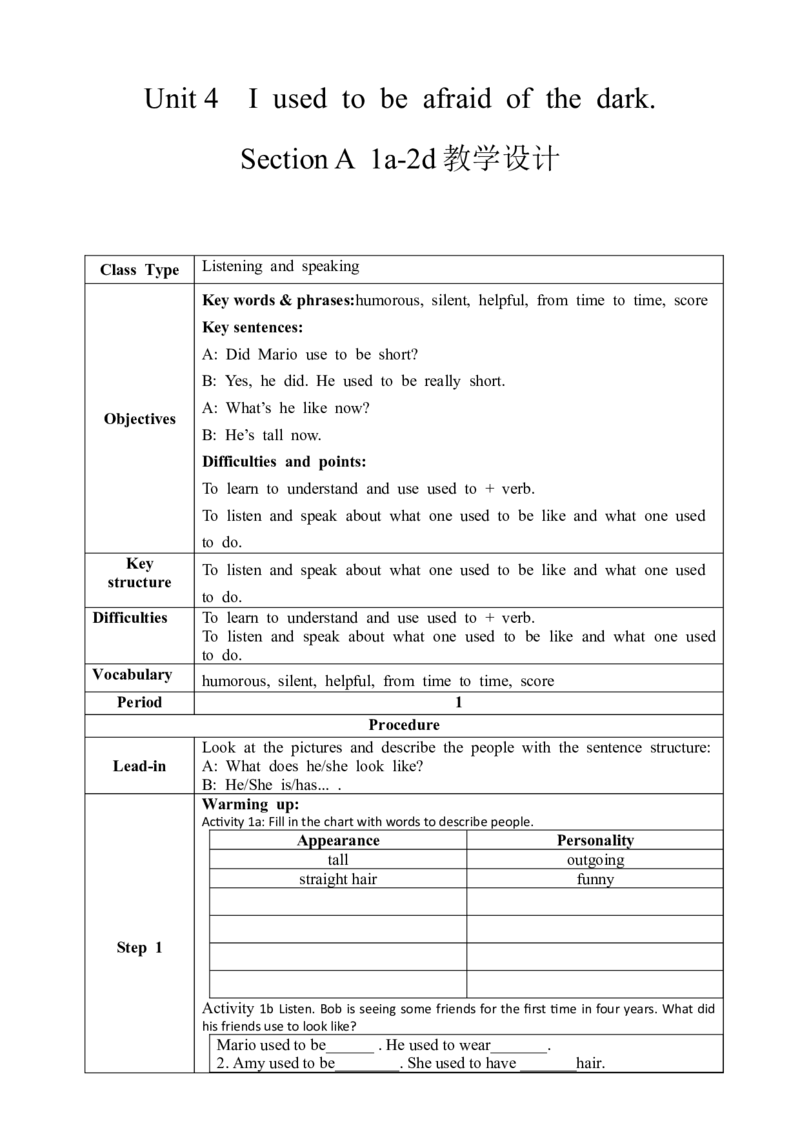
Class Type
Listening and speaking
Key words & phrases:humorous, silent, helpful, from time to time, score
Key sentences:
A: Did Mario use to be short?
B: Yes, he did. He used to be really short.
A: What’s he like now?
Objectives
B: He’s tall now.
Difficulties and points:
To learn to understand and use used to + verb.
To listen and speak about what one used to be like and what one used
to do.
Key
To listen and speak about what one used to be like and what one used
structure
to do.
Difficulties To learn to understand and use used to + verb.
To listen and speak about what one used to be like and what one used
to do.
Vocabulary
humorous, silent, helpful, from time to time, score
Period 1
Procedure
Look at the pictures and describe the people with the sentence structure:
Lead-in A: What does he/she look like?
B: He/She is/has... .
Warming up:
Activity 1a: Fill in the chart with words to describe people.
Appearance Personality
tall outgoing
straight hair funny
Step 1
Activity 1b Listen. Bob is seeing some friends for the first time in four years. What did
his friends use to look like?
Mario used to be______ . He used to wear_______.
2. Amy used to be________. She used to have _______hair.3. Tina used to have_____ and______ hair.
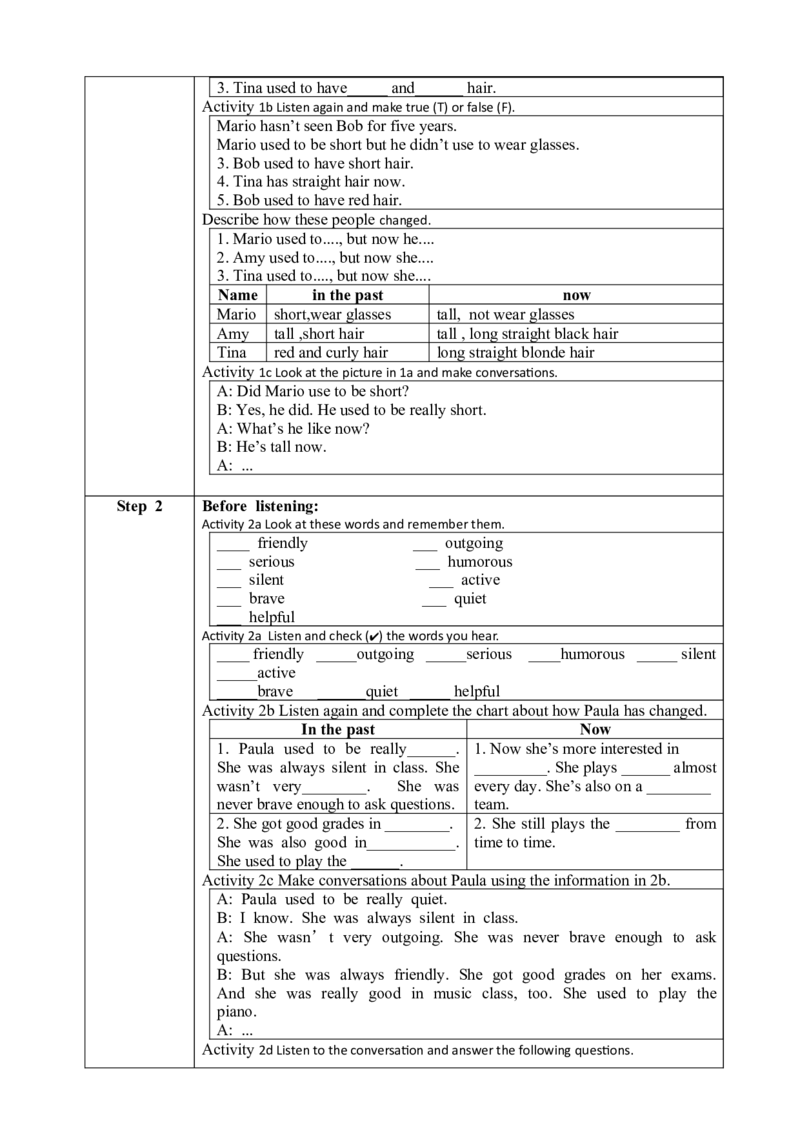
Activity 1b Listen again and make true (T) or false (F).
Mario hasn’t seen Bob for five years.
Mario used to be short but he didn’t use to wear glasses.
3. Bob used to have short hair.
4. Tina has straight hair now.
5. Bob used to have red hair.
Describe how these people changed.
1. Mario used to...., but now he....
2. Amy used to...., but now she....
3. Tina used to...., but now she....
Name in the past now
Mario short,wear glasses tall, not wear glasses
Amy tall ,short hair tall , long straight black hair
Tina red and curly hair long straight blonde hair
Activity 1c Look at the picture in 1a and make conversations.
A: Did Mario use to be short?
B: Yes, he did. He used to be really short.
A: What’s he like now?
B: He’s tall now.
A: ...
Step 2 Before listening:
Activity 2a Look at these words and remember them.
____ friendly ___ outgoing
___ serious ___ humorous
___ silent ___ active
___ brave ___ quiet
___ helpful
Activity 2a Listen and check (✔) the words you hear.
____ friendly _____outgoing _____serious ____humorous _____ silent
_____active
_____brave ______quiet _____ helpful
Activity 2b Listen again and complete the chart about how Paula has changed.
In the past Now
1. Paula used to be really______. 1. Now she’s more interested in
She was always silent in class. She _________. She plays ______ almost
wasn’t very________. She was every day. She’s also on a ________
never brave enough to ask questions. team.
2. She got good grades in ________. 2. She still plays the ________ from
She was also good in___________. time to time.
She used to play the ______.
Activity 2c Make conversations about Paula using the information in 2b.
A: Paula used to be really quiet.
B: I know. She was always silent in class.
A: She wasn’t very outgoing. She was never brave enough to ask
questions.
B: But she was always friendly. She got good grades on her exams.
And she was really good in music class, too. She used to play the
piano.
A: ...
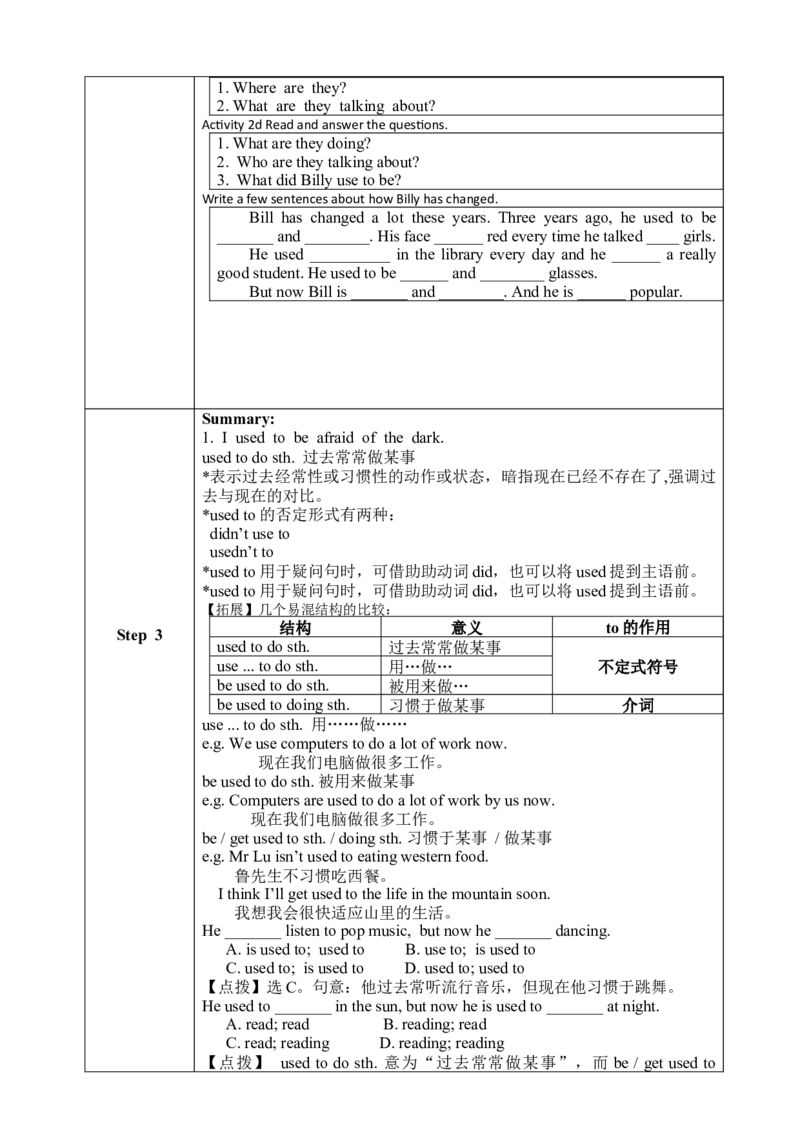
Activity 2d Listen to the conversation and answer the following questions.1. Where are they?
2. What are they talking about?
Activity 2d Read and answer the questions.
1. What are they doing?
2. Who are they talking about?
3. What did Billy use to be?
Write a few sentences about how Billy has changed.
Bill has changed a lot these years. Three years ago, he used to be
_______ and ________. His face ______ red every time he talked ____ girls.
He used __________ in the library every day and he ______ a really
good student. He used to be ______ and ________ glasses.
But now Bill is _______ and ________. And he is ______ popular.
Summary:
1. I used to be afraid of the dark.
used to do sth. 过去常常做某事
*表示过去经常性或习惯性的动作或状态,暗指现在已经不存在了,强调过
去与现在的对比。
*used to的否定形式有两种:
didn’t use to
usedn’t to
*used to用于疑问句时,可借助助动词did,也可以将used提到主语前。
*used to用于疑问句时,可借助助动词did,也可以将used提到主语前。
【拓展】几个易混结构的比较:
结构 意义 to的作用
Step 3
used to do sth. 过去常常做某事
use ... to do sth. 用…做… 不定式符号
be used to do sth. 被用来做…
be used to doing sth. 习惯于做某事 介词
use ... to do sth. 用……做……
e.g. We use computers to do a lot of work now.
现在我们电脑做很多工作。
be used to do sth. 被用来做某事
e.g. Computers are used to do a lot of work by us now.
现在我们电脑做很多工作。
be / get used to sth. / doing sth. 习惯于某事 / 做某事
e.g. Mr Lu isn’t used to eating western food.
鲁先生不习惯吃西餐。
I think I’ll get used to the life in the mountain soon.
我想我会很快适应山里的生活。
He _______ listen to pop music, but now he _______ dancing.
A. is used to; used to B. use to; is used to
C. used to; is used to D. used to; used to
【点拨】选C。句意:他过去常听流行音乐,但现在他习惯于跳舞。
He used to _______ in the sun, but now he is used to _______ at night.
A. read; read B. reading; read
C. read; reading D. reading; reading
【点拨】 used to do sth. 意为“过去常常做某事”,而 be / get used todoing sth.意为“习惯于做某事”。根据本题句意“他过去常常在阳光下
看书,但现在习惯在夜晚看书。”可知,正确答案为C。
用used to 将下列汉语句子翻译成英语。
1. 他过去常常在卧室做作业。
2. 汤姆过去常常去那儿看足球赛,但现在他不去了。
根据所给汉语提示完成英语句子。
1. My uncle ____________________(以前是个公交车司机), but now he
drives a taxi.
2. Tom’s grandfather ____________________(过去常常听音乐) after lunch.
3. Mary’s brother __________________(以前常常骑自行车) to work, but
now he _________________(习惯步行) .
4. The pencil ______________by people(被用来书写).
5. We use pencils _______________.(书写)
2. Mario, you used to be short, didn’t you?
马里奥,你过去很矮,对吗?
本句是一个反义疑问句,反义疑问句的特点是“前否后肯”或“前肯后
否”,而且后半句在
时态、人称和数等方面必须与前半句保持一致。
► You are my teacher’s friend, aren’t you?
你是我们老师的朋友,是吗?
► we can’t park our car here, can we?
我们不能把车停在这里,对吗?
►He likes eating zongzi, doesn’t he?
他喜欢吃粽子,是吗?
反义疑问句用法歌诀
反义问句要点三,前后谓语正相反;
附加问句not现, 必须缩写是习惯;
最后一点应注意,问句主语代词填。
反义疑问句的回答:
1)回答反义疑问句和回答其他一般疑问句的结构一样。
如果答语是肯定的,用“Yes +肯定结构”
如果答语是否定的,用“No +肯定结构”
►-- He enjoys dancing, doesn’t he?
他喜欢跳舞,对吗?
--Yes, he does. / No, he doesn’t.
是的,他喜欢。/不,他不喜欢。
2) 回答陈述部分为否定句的反义疑问句时,Yes或是No的汉语意思与它
们本身的词义相反。
►---You didn’t go to work, did you?
你没有去上班,对吗?
►--- Yes, I did. / No, I didn’t.
不,我上班了。/是的,我没上班。
3. What’s he like now? 他现在什么样子?
What +be +主语+like? 用来询问某人的外貌特征,意为“…长什么
样?”,相当于what do /does +主语+like?
►---What’s your brother like?=What does your brother look like?
你哥哥长什么样?
辨析:be like 和look like
be like: “像…一样”,常指品德、相貌等相像 更侧重人的个性特征。
► The twin sister are like their father.双胞胎很像他们的父亲。
look like: “看起来像…”常指外貌上相像。► I look like my mother. 我长得像我妈。
典例 —What’s Han Mei like?
—_________________.
A. She is a volunteer B. She studies very hard
C. She likes skating D. She is heavy but beautiful
【点拨】用语境分析法解题。be like 意为“什么样子”,用来询问相貌
或性格。
4. This party is such a great idea!
He used to be so shy and quiet.
such与so 辨析
such为adj.,意为“这(那)样的;主要修饰名词;
so是adv.,意为“这(那)么;如此地”,主要修饰形容词、副词和分
词。
e.g. Do you like such a movie?你喜欢这样的电影吗?
I’m so glad to see you.很高兴见到你。
He speaks English so well.他英语讲得那么好。
当名词前有many,much,few或little等词修饰时,要用so而不用such。
e.g. He has so many friends in China.他在中国有这么多朋友。
I have so much work to do today.我今天有这么多工作要做。
“such + a / an +形容词+可数名词单数 形式”相当于“so +形容词+a / an
+可数名词单数形式”,表示“如此……的一个……”。
e.g. Mrs Su has such a lovely girl. = Mrs Su has so lovely a girl.
苏太太有如此可爱的一个女儿。
选用such或so填空。
1. The man told us ____ funny a story.
2. She has _____ a beautiful dress.
3. How can you get ____ much money to buy the car?
4. Don’t go out in ______ cold weather.
5. Don’t eat _____ quickly.
6. The clothes in this store are ______ expensive. I can’t afford to buy them.
7. Bill is _____ a tall boy.
5. She was never brave enough to ask questions.
enough /ɪ'nʌf/ adj. 足够的 adv. 足够地;充分地
e.g. He isn’t old enough to go to school himself.
他还小,不能独自去上学。
Tina isn’t serious enough in class, so she can’t follow the teacher.
蒂娜上课不够认真,所以听不懂老师讲了什么。
—May I be allowed to choose a summer course?
—It’s up to you. You’re ____________ to make your own decision.
A. too old B. enough old C. old enough
【点拨】句意为“——我可以被允许选择一门暑期课程吗?——取决于
你自己,你年龄足够大了,可以自己做决定”。A 选项构成too... to... 结
构,意为太大了不能自己做决定,不符合逻辑,enough old 表达形式不
对,enough 修饰形容词,需放在形容词之后。
Homework:
1.Recite the conversation in 2d.
Step 4
2. Preview the next part.
3.完成跟踪练习题。