Unit 5 What are the shirts made of?
Section A 1a-2d 教学设计
Class Type
Listening and speaking
Key words & phrases:chopstick, coin, fork, blouse, silver, glass, cotton,
steel, fair, grass, leaf, produce, widely, be known for, process
Key sentences:
-What is it/are they made of?
Objectives -It is/They are made of silver.
-Where was it/were they made?
-It was/They were made in Thailand.
Difficulties and points:
Passive Voice:be + v (ed)
Key
-What is it/are they made of?
structure
-It is/They are made of silver.
-Where was it/were they made?
-It was/They were made in Thailand.
Difficulties Passive Voice:be + v (ed)
Vocabulary
chopstick, coin, fork, blouse, silver, glass, cotton, steel, fair, grass, leaf,
produce, widely, be known for, process
Period 1
Procedure
Let students watch a short video and think what it is in the video, then
teach new words-shadow puppet and something about it:
It is made of leather(皮革)and bamboo sticks.
Lead-in It was made in Shanxi province.
It is controlled( 控制)by sticks.
It is played at night.
Presentation:
Teach students the key sentence structures and key words by showing pictures
and conversations:
A: What is it made of?
B: It _______________ leather.
A: Where was it made ?
B: It _______________ China.
A: What is the fork made of?
Step 1
B: It _______________ steel.A: Where was it made ?
B: It _______________ Canada.
A: What are the chopsticks made of?
B: They _______________ silver.
A: Where were they made ?
B: They _______________ Korea.
A: What are the coins made of?
B: They _______________ steel.
A: Where were they made ?
B: They _______________ China.
A: What are the shirts made of?
B: They _______________ cotton.
A: Where were they made ?
B: They _______________ Xinjiang.
Do some development: teach be made of and be made from by conversations.
While practice, students make up conversations according to the pictures and
the sentence structure, they can do it in pairs.
A: What are the books made of?
B: They _______________ paper.
A: What is paper made ?
B: They _______________ wood.
A: What is the bread made from?
B: It _______________ wheat.
Matching activity: students the things with the materials.
1.chopsticks a. chopsticks
2.window b. window
3.coin c. coin
4.stamp d. stamp
5.fork e. fork
6.blouse f. blouse
Summary: let’s find the rules
1. The shadow puppet is made of leather(皮革).
2. The fork is made of steal.
3. The chopsticks are made of silver.
1. The bread is made from wheat.
2. The paper is made from wood.
1. The shadow puppet is made in China.
2. The fork is made in Canada.
3. The shirts are made in Xinjiang.
由......制成: 1)_______________________ (看得出原材料)
2)_______________________ (不能直接看出原材料)
在某地制造: _________________________(后接地点)
Activity 1a What are these things usually made of? Match them with the
materials. More than one answer is possible.
Things Materials
1. chopsticks 4. stamp a. wood d. paper
2. window 5. fork b. gold e. silk
3. coin 6. blouse c. silver f. glass
While listening:
Step 2
Activity 1b Listen and match the products with what they are made of and where theywere made.
____ friendly ___ outgoing
___ serious ___ humorous
___ silent ___ active
___ brave ___ quiet
___ helpful
Activity 2a Listen and check (✔) the words you hear.
Things Made of Made in
shirts cotton Korea
chopsticks silver Thailand
ring steel America
The shirts are made of cotton. They were made in America.
Development: students make up conversations in pairs and then show us.
A: Is it made of...?
B: Yes, it is./ No, it isn’t. It is made of....
A: Are they made of...?
B: Yes, they are./ No, they aren’t. They are made of....
Pair work: students make up similar conversations according to the words
given and the information in the table. They have thirty seconds to get ready.
1. bread 1. wood 1. China
2. stamp 2. silk 2. America
3. coin 3. cotton 3. Japan
4. books 4. paper 4. Canada
5. shirts 5. glass 5. Korea
6. chopsticks 6. steel 6. Thailand
A:Excuse me. Is/Are there_______?
B: Yes, there is/are.
A: Is/ Are _____made of/from________?
B: Yes, it is/they are./ No, it isn’t/they aren’t.
A: What is /are _______ made of/from?
B: It is/ They are made of/from _______.
A: Where was /were ______ made?
B: It was/ They were made in _________.
A: How much is it/ are they?
B: It is/ They are_______ yuan.
A: OK. I’ll take it/ them.
Free talk:
Students look at the pictures and
do some discussion: Do you know
what a fair is? What fair have you
ever heard of?
Fair is an event at which people or
businesses show and sell products.
Then show them two pictures about
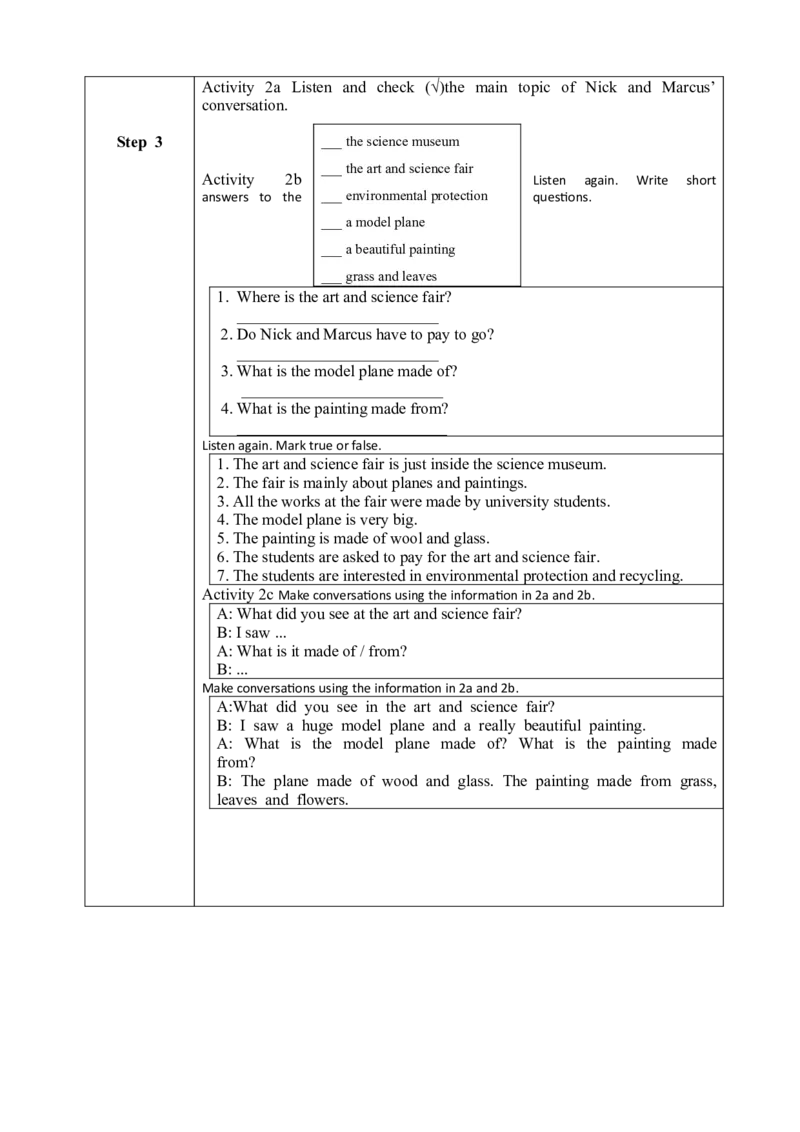
fairs.Activity 2a Listen and check (√)the main topic of Nick and Marcus’
conversation.
Step 3 ___ the science museum
___ the art and science fair
Activity 2b Listen again. Write short
answers to the ___ environmental protection questions.
___ a model plane
___ a beautiful painting
___ grass and leaves
1. Where is the art and science fair?
_________________________
2. Do Nick and Marcus have to pay to go?
_________________________
3. What is the model plane made of?
_________________________
4. What is the painting made from?
__________________________
Listen again. Mark true or false.
1. The art and science fair is just inside the science museum.
2. The fair is mainly about planes and paintings.
3. All the works at the fair were made by university students.
4. The model plane is very big.
5. The painting is made of wool and glass.
6. The students are asked to pay for the art and science fair.
7. The students are interested in environmental protection and recycling.
Activity 2c Make conversations using the information in 2a and 2b.
A: What did you see at the art and science fair?
B: I saw ...
A: What is it made of / from?
B: ...
Make conversations using the information in 2a and 2b.
A:What did you see in the art and science fair?
B: I saw a huge model plane and a really beautiful painting.
A: What is the model plane made of? What is the painting made
from?
B: The plane made of wood and glass. The painting made from grass,
leaves and flowers.Reading:
First, watch a short video and complete the sentences: China is famous
for___.
Activity 2d Listen and answer the questions.
1. What are they talking about?
2. What places are mentioned in their talk?
3. Why do people drink tea according to Liu Jun?
Read 2d in pairs and make T of F.
( )1. China is famous for tea both in the past and now。
( )2. Tea is produced only in Anxi and Hangzhou.
( )3. It seems that Chinese tea is only drunk all over China.
Step 4
( )4. People say that tea is good for health.
Writing practice: Students try to write a short passage according 2d
within 5 minutes.
Imagine some of your foreign friends will come to your school, and you know Chinese tea
well, write a short passage to introduce Chinese tea to them.
China is famous for tea both in the past and now.
______________________________________________________________
______________________________________________________________
______________________________________________________________
______________________________________________________________
Summary:
1. be famous for
意为“因……而出名,以……而闻名”,后面常接名词作宾语。
►The French are famous for their cooking.
法国人以善烹调著称。
►My hometown is famous for a beautiful Fuxian Lake.
我的家乡因美丽的抚仙湖而著名。
be known for “以……闻名”,表示出名的原因
be known as “作为……闻名”,表示出名的形式
be known to “为……所知晓”,表示出名的范围
► Hong Kong is known for its shopping streets.
香港因它的购物街出名。
► Hong Kong is known as a shopping city.
香港作为一个购物城市出名。
► Hong Kong is known to people all over the world.
香港为全世界的人所知晓。
2. both…and…
意为“……和……(两者)都”,用于连接两个并列的句子成分。
当其连接两个并列作主语时,谓语动词用复数形式。
►Both Kate and Tom are from Class Three.
凯特和汤姆都来自三班。
反义词短语为:neither...nor...意为 “既不......也不......;两者都不”.
当其连接两个并列作主语时,谓语动词遵循就近一致原则。
►Neither Kate nor Tom is from Class Three.
凯特和汤姆都来自三班。
3. by hand
意为“用手;手工”。by用作介词,在这里表示方式、手段,意为“通
Step 5
过……的方式”。例如:
►The toy was made by hand. 这个玩具是手工制作的。
与by hand类似的短语:
by reading 通过阅读 by telephone 打电话 by plane 乘飞机by computer 通过电脑 by bike 骑自行车
4. be good for…
是固定短语,意为“对……有好处”。其反义词为 be bad for…,意为
“对……不利;对……有害”。如:
►Enough sleep is good for health. 充足的睡眠对健康有益。
►Drinking too much milk is bad for teeth. 牛奶喝多了对牙齿有害。
【易混辨析】be good for, be good to 与 be good at
词 条 含 义 用 法 例 句
be good for… 对……有好处 后接表示人或 Exercise is good for our
事物的名词 health.
be good to… 对……好/和 后接表示人或 Chinese people are good
善/慈祥 人格化的名词 to foreigners.
be good at… 擅长 后接名词、代 Tony is good at skiing.
词或动名词
5. Is it made of silver? 它是银做的吗?
be made of 为“be+及物动词的过去分词+of”的被动语态结构,意为
“由……制造;由……制作” 。
强调从制成品中仍可以看出它的原材料。
► The bridge is made of stone.
这座桥是用石头砌的。
be made from…意为“由……制成”,
强调从制成品中看不出它的原材料。如:
►Salt is made from sea water. 盐是用海水制成的。
►The bread is made from wheat.
面包是用小麦做成的。
be made in...意为“在……制造”,介词in后常接产地。
►This cars are made in Shanghai. 这些汽车是在上海制造的。
►The color TV is made in the USA. 这台彩电是在美国制造的。
be made by...意为“被某人制造”,介词by后常人。
►This car was made by Uncle Sam. 这辆汽车是山姆叔叔制造的。
►Those wooden chairs were made by Uncle Sam.
那些木椅子都是山姆叔叔制造的。
辨 析
be made of “由……制成”,后接原材料,强调物理变化,能看出
原材料
be made from “由……制成”,后接原材料,强调化学变化,不能看
出原材料
be made into “被制成……”,后接成品,强调被制成什么成品
be made by “被……制造”,后接制作人,强调制作人是谁
be made in “在……制造”,后接地点或场所,强调物品的产地
1. The kite_______________paper.
这个风筝是用纸做的。
2. The wine ______________ wheat.
这种酒是用小麦酿成的。
3. Some of the trees will ___________ paper.
其中一些树将被做成纸。
4. The chair ____________ an old carpenter.
那把椅子是一位老木匠制作的。
5. This car ___________ Shanghai.
这辆车由上海制造。
【观察领悟】
观察下列句子, 你发现红色字体有什么特点呢?① The ring was made in Thailand.
② The tea is produced in China.
③ What is it made from?
④ They are picked by hand.
⑤ The tea plants are grown on the sides of mountains.
【概括总结】
被动语态(Passive Voice)的构成: 主语 + be(am/is/ are) + v(ed ) + by +
宾语
Turn the verbs into past tense and past participle.
动词原形 过去式 过去分词
pick
pack
produce
send
know
grow
Passive Voice: 在英语中,动词有两种语态,即主动语态和被动语态。被动语态的
基本结构是“助动词 be + 及物动词的过去分词”,其中助动词be有人称、数和时
态的变化,其变化规则与be作为连系动 完全一样。
肯定式 否定式 疑问式
一 般 I am asked … I am not asked… Am I asked …?
现 在 He / She is asked He / She is not Is he/she asked …?
时 … asked… Are we/you /they asked
We/You/They We/You/They are …?
are asked … not asked …
Activity 4c Complete the sentences with the correct forms of the verbs in the brackets.
1. Children under 18 _____________(not allow) to watch this show
without their parents.
2. We ________(pay) by the boss on the last Friday of each month.
3. A: What language________ (speak) in Germany ?
B: Most people speak German, but many can speak English, too.
4. Most of the earth’s surface ______________ (cover) by water.
5. The classroom _______________ (clean) by the students every day.
Homework:
Step 6 预习3a课文并完成课前预习部分.
完成本节课课后跟踪练习.