Unit 6 When was it invented ?
Section A 3a-4c 教学设计
Class Type
Reading
Key words & phrases:by accident, ruler, boil, remain, smell, saint,
national, take place, doubt, without doubt, fridge, low, somebody,
translate, lock, earthquake, sudden, all of a sudden, biscuit, cookie,
instrument
Key sentences:
Objectives 1. Do you know that tea, the most popular drink in the world(after
water), was invented by accident?
2. It is believed that tea was brought to Korea and Japan during the 6th
and 7th centuries.
Difficulties and points:
Passive Voice:be(was/were) + v (ed)
Key
1. Do you know that tea, the most popular drink in the world(after
structure
water), was invented by accident?
2. It is believed that tea was brought to Korea and Japan during the 6th
and 7th centuries.
Difficulties 1. Passive Voice:be(was/were) + v (ed)
2. Reading strategies and skills.
Vocabulary
by accident, ruler, boil, remain, smell, saint, national, take place, doubt,
without doubt, fridge, low, somebody, translate, lock, earthquake, sudden,
all of a sudden, biscuit, cookie, instrument
Period 2
Procedure
Let students look at the pictures and talk about what they would like to
Lead-in
drink if they are really thirsty.
Presentation:
Present the main topic of this class by showing them two pictures with
tea leaves and tea.
Lead students to pronounce the new words and expressions of this class
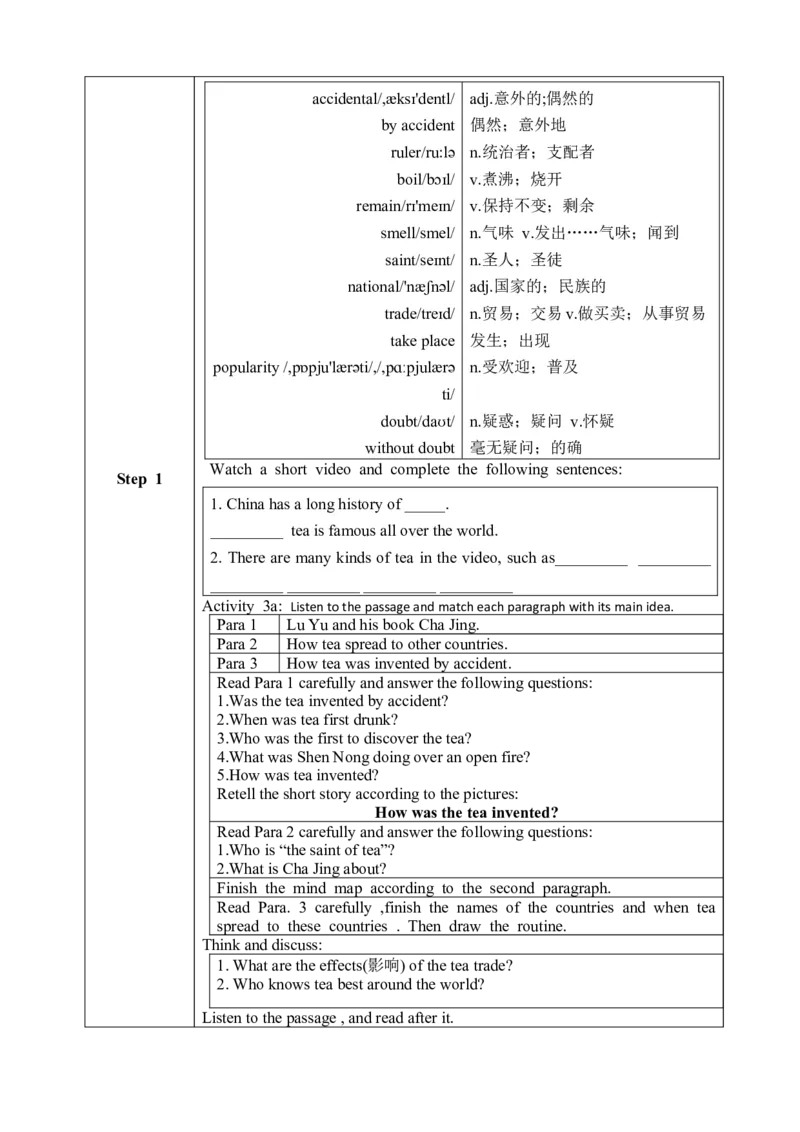
.accidental/,æksɪ'dentl/ adj.意外的;偶然的
by accident 偶然;意外地
ruler/ru:lə n.统治者;支配者
boil/bɔɪl/ v.煮沸;烧开
remain/rɪ'meɪn/ v.保持不变;剩余
smell/smel/ n.气味 v.发出……气味;闻到
saint/seɪnt/ n.圣人;圣徒
national/'næʃnəl/ adj.国家的;民族的
trade/treɪd/ n.贸易;交易v.做买卖;从事贸易
take place 发生;出现
popularity /,pɒpju'lærəti/,/,pɑːpjulærə n.受欢迎;普及
ti/
doubt/daʊt/ n.疑惑;疑问 v.怀疑
without doubt 毫无疑问;的确
Watch a short video and complete the following sentences:
Step 1
1. China has a long history of _____.
_________ tea is famous all over the world.
2. There are many kinds of tea in the video, such as_________ _________
_________ _________ _________ _________
Activity 3a: Listen to the passage and match each paragraph with its main idea.
Para 1 Lu Yu and his book Cha Jing.
Para 2 How tea spread to other countries.
Para 3 How tea was invented by accident.
Read Para 1 carefully and answer the following questions:
1.Was the tea invented by accident?
2.When was tea first drunk?
3.Who was the first to discover the tea?
4.What was Shen Nong doing over an open fire?
5.How was tea invented?
Retell the short story according to the pictures:
How was the tea invented?
Read Para 2 carefully and answer the following questions:
1.Who is “the saint of tea”?
2.What is Cha Jing about?
Finish the mind map according to the second paragraph.
Read Para. 3 carefully ,finish the names of the countries and when tea
spread to these countries . Then draw the routine.
Think and discuss:
1. What are the effects(影响) of the tea trade?
2. Who knows tea best around the world?
Listen to the passage , and read after it.Consolidation:
Step 2 3c Complete the sentences with the correct forms of the verbs in the box.
invent drink bring produce trade
1. One of the world’s favorite drinks was _________ by accident.
2. Tea was first __________ by Shen Nong 5,000 years ago.
3. A nice smell was ________when the tea leaves dropped into the
hot water.
4.Tea was __________to Korea and Japan during the 6th and 7th
centuries.
5. Tea is now ________ between many different countries.
Summary One: Language points
1. Did you know that tea, the most popular drink in the world (after water),
was invented by accident?
你知道茶这种世界上最受欢迎的饮料(仅次于水)是偶然被发明的
吗?
(1)本句是that引导的一个宾语从句,主句是 Did you know,其中从句的
主语是tea, 而the most popular drink in the world (after water), 是tea的同位
语。
(2) by accident意为“偶然;意外地”。
►I met Tom on the street this morning by accident.
今天早上,我偶然间在街上遇到了汤姆。
2. It is said that a Chinese ruler called Shen Nong was the first to discover tea
as a drink.
据说有一位叫神农的中国统治者最早发现了茶可以饮用。
Step 3 (1) It is said that…表示“据说……”,其中it 是形式主语,that引导的从
句为真正的主语。
► It is said that he is the richest man in this small town.
据说他是这个小镇上最富有的人。
(2) ruler名词,意为“统治者;支配者”
► A king is a ruler. 国王是统治者。
其他常见“It is ...that”句式
It is: believed that… “据认为……”
reported that … “据报道……”
known that… “众所周知……”
supposed that… “据推测……”
the first to do sth. 意为“第一个做某事的人”,是“the + 序数词+to do
sth.”结构,动词不定式作定语。
例句:
►Mary is always the first to come to the classroom.
玛丽总是第一个到教室。
►You are the second to sing in the party.
你是第二个向在晚会上唱歌的人。
3. Some leaves from a tea plant fell into the water and remained there
for some time.
一株茶树上的几片叶子落到水里并停留了一段时间。
(l) fall into意为“落人;掉入”。
►He didn’t see the stone on the road and fell into the pool.
他没看见路上的石头,跌落到池子里面。
拓展:fall asleep 睡着
fall behind 落后
fall down 跌倒;倒塌4. less than意为“较少,比……少;不及,不如”。
例句:
►We got there in less than two hours.
不到2个小时我们就到那儿了。
►He sleeps less than seven hours every night.
他每晚的睡眠时间不到7小时。
反义词组为: more than=over 超过;多过
5. take place发生;出现
常指有计划、有安排地“发生”,是不及物动词短语,不能接宾语,一
般也不用作被动结构。例句:
本学期家长会将在大厅举行。
►This term, the parents meeting will take place in the hall.
我们学校每年举行一次运动会。
►The sports meeting takes place every year.
知识链接:
take place 和 happen的用法与区别
1) take place 表示“发生、举行、举办”,一般指非偶然性事件的“发
生”,即这种事件的发生一定有某种原因或事先的安排。
►Great changes have taken place in our hometown during
the past ten years.
►The Olympic Games of 2008 took place in Beijing.
2) happen作“发生、碰巧”解,一般用于偶然或突
发性事件。
►What happened to you? 你怎么了?
►Maybe something good will happen.
注意:happen 与 take place 通常都没有被动语态。
2) happen作“发生、碰巧”解,一般用于偶然或突
发性事件。
►What happened to you? 你怎么了?
►Maybe something good will happen.
注意:happen 与 take place 通常都没有被动语态。
Development: Writing practice
1. Suppose you are Shen Nong from ancient China about 5000 years ago. Tell
Step 4 us about how you invented tea, write your story in a short passage.
2. Suppose you are Lu Yu. You are having a book launch(新书发布会).
Introduce your book to us.
Summary Two: Passive Voice: was/were+v.pp
Read the sentences and pay attention to the red parts.
When was the zipper invented? It was invented in 1893.
Who was it invented by? It was invented in 1893.
When was tea brought to Korea? It was brought to Korea during the
6th and 7th centuries.
What is the hot ice-cream scoop used It’s used for serving really cold ice-
for? cream.
Active voice : Alexander Graham Bell invented the telephone in 1876.
Passive voice : The telephone was invented (by Alexander Graham Bell) in
1876.
一般过去时的被动语态
1. 一般过去时的被动语态的句式结构
肯定句 主语+was/were+及物动词的过去分词( + by…).
否定句 主语+was/were + not+及物动词的过去分词(+ by…) .
疑问句 Was/Were+主语+及物动词的过去分词(+by …)?特殊疑问词+was/were+主语+及物动词的过去分词( + by...)?
2. 一般过去时的被动语态的基本用法
用法 示例
表示过去某一具体时间发生的动 My car was bought in 1990.
作,且句子的主语是谓语动词动作 我的车是1990年买的。
的承受者
动作发生在过去,且不知道动作的 He was given a robot as a birthday
执行者 gift last year.
去年生日,他收到了一份机器人礼
物。
3. 规则动词过去分词构成与动词过去式的构成相同
①一般情况直接在动词末尾+ed:
learn-learned-learned; start-started-started
②以不发音的e结尾的动词,在末尾+d:
like-liked-liked; live-lived-lived
③以辅音字母+y结尾的动词,改y为i再+ed:
study-studied-studied
④重读闭音节词结尾的动词,双写末尾辅音字母再+ed:
stop-stopped-stopped; drop-dropped-dropped
⑤动词原形、过去式和过去分词都一样:
Step 5
cut-cut-cut; put-put-put
4. 不规则动词过去式、过去分词构成参照课本184-185页
am/is-was-been; are-were-been
make-made-made; take-took-take
Fill in the chart and read aloud.
动词原形 过去分词 动词原形 过去分词
find hide
forget hurt
give keep
go know
grow leave
have light
hear make
bring do
build draw
buy dream
catch drink
choose drive
cost eat
cut fall
pay show
put take
read teach
say tellsee think
send wear
set write
4a Rewrite the sentences using the passive voice.
1. They sold the fridge at a low price.
2. Somebody stole my camera from my hotel room.
3. Where did you take these photos?
4. Our parents advised us not to go out alone.
5. Different writers translated the book into different languages.
4b Complete the sentences with the correct forms of the verbs in the box.
eat lock like ring invite break tell bring
1. You __________ to the party last night, weren’t you? Why didn’t you go?
2. The earthquake happened all of a sudden, but luckily the villagers
_____________ to a safe place.
3. The door ___________ when we arrived, so we ______ the bell.
4. The students ________ not to eat or drink in class. But Ruby _______ the
rule when she started eating a biscuit in science class.
5. The cookies _________ by the hungry kids in less than 20 minutes, and
they really _____ them.
4c Decide whether active or passive forms should be used in these sentences. Write the
correct forms in the blanks.
The telephone _____________(invent) by Alexander Graham Bell. He
__________ (born) in 1847. Mr. Bell ________ (work) on the invention of
the telephone with Thomas Watson. In 1875, Mr. Bell_______ (learn) how
to send musical notes through an instrument similar to a telephone. Finally,
the telephone ____________ (invent) in 1876. The first sentence that
________ (say) on the telephone by Mr. Bell was “Mr. Watson, come here; I
want to see you.” Today the telephone ________ (use) around the world.
Homework: Choose one of the materials to write a short passage.
1. Suppose you are Shen Nong from ancient China about 5000 years ago.
Step 6
Tell us about how you invented tea, write your story in a short passage.
2. Suppose you are Lu Yu. You are having a book launch(新书发布会).
Introduce your book to us.