Unit 6 When was it invented ?
Section A 1a-2d 教学设计
Class Type
Listening and speaking
Key words & phrases:heel, style, project, pleasure, daily, website, pioneer,
list, mention,be invented by/in..., be used for/to do...
Key sentences:
1.—When was the telephone invented?
— I think it was invented in 1876.
Objectives 2.—What are they used for?
—They are used for...
Difficulties and points:
1. Talk about who was an invention invented by, when was an invention
invented and what is an invention used for.
2. Passive Voice:be + v (ed)
To know inventions have changed human’s lives.
Key
1.—When was the telephone invented?
structure
— I think it was invented in 1876.
2.—What are they used for?
—They are used for...
Difficulties 3. Talk about who was an invention invented by, when was an invention
invented and what is an invention used for.
4. Passive Voice:be + v (ed)
5. To know inventions have changed human’s lives.
Vocabulary
heel, style, project, pleasure, daily, website, pioneer, list, mention,be
invented by/in..., be used for/to do...
Period 1
Procedure
Let students watch a short video and try to answer the questions:
1. What is huǒ yào in English?
2. When was it invented?
3. What was it used for?
Lead-in
Lead students to talk about the four ancient Chinese inventions and teach the sentence
structure:
What is it? invent, invention
Who was it invented by? paper-making --Cai Lun--105 A.
What is it used for? D.
When was it invented? printing --Bi Sheng --9th century
compass--11th century--tellingpeople directions
gunpowder--9th century--wars
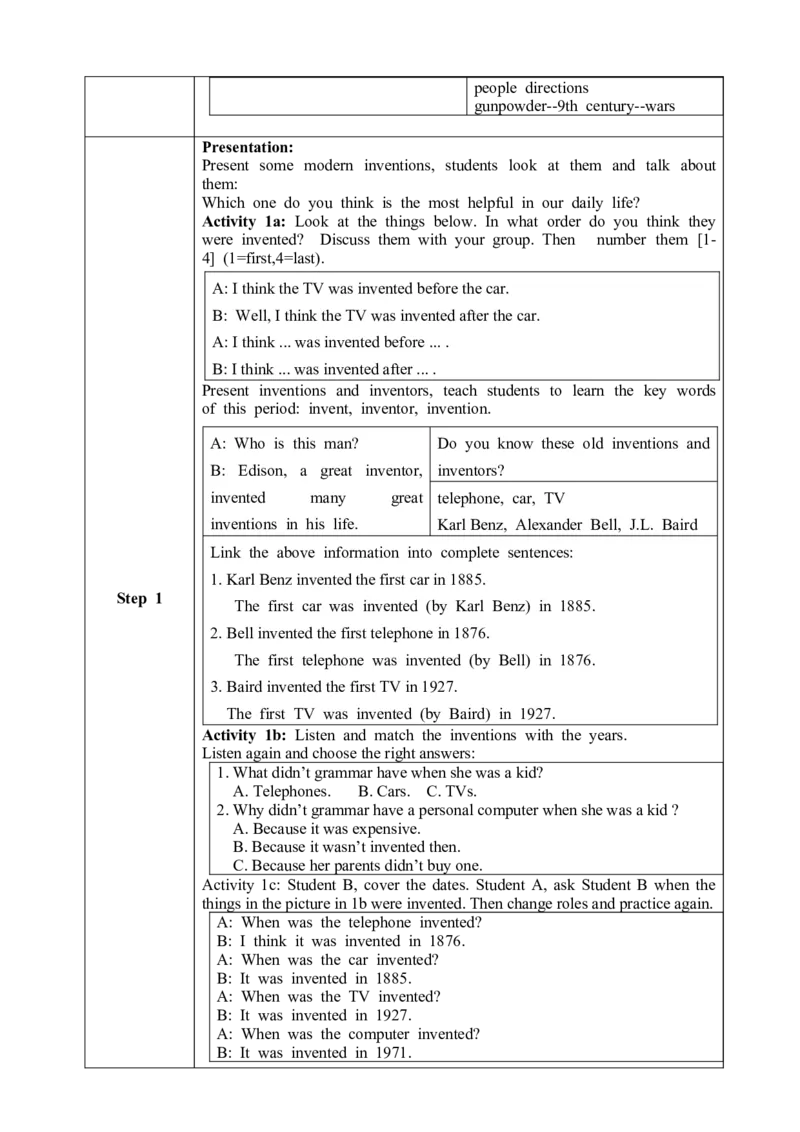
Presentation:
Present some modern inventions, students look at them and talk about
them:
Which one do you think is the most helpful in our daily life?
Activity 1a: Look at the things below. In what order do you think they
were invented? Discuss them with your group. Then number them [1-
4] (1=first,4=last).
A: I think the TV was invented before the car.
B: Well, I think the TV was invented after the car.
A: I think ... was invented before ... .
B: I think ... was invented after ... .
Present inventions and inventors, teach students to learn the key words
of this period: invent, inventor, invention.
A: Who is this man? Do you know these old inventions and
B: Edison, a great inventor, inventors?
invented many great telephone, car, TV
inventions in his life. Karl Benz, Alexander Bell, J.L. Baird
Link the above information into complete sentences:
1. Karl Benz invented the first car in 1885.
Step 1
The first car was invented (by Karl Benz) in 1885.
2. Bell invented the first telephone in 1876.
The first telephone was invented (by Bell) in 1876.
3. Baird invented the first TV in 1927.
The first TV was invented (by Baird) in 1927.
Activity 1b: Listen and match the inventions with the years.
Listen again and choose the right answers:
1. What didn’t grammar have when she was a kid?
A. Telephones. B. Cars. C. TVs.
2. Why didn’t grammar have a personal computer when she was a kid ?
A. Because it was expensive.
B. Because it wasn’t invented then.
C. Because her parents didn’t buy one.
Activity 1c: Student B, cover the dates. Student A, ask Student B when the
things in the picture in 1b were invented. Then change roles and practice again.
A: When was the telephone invented?
B: I think it was invented in 1876.
A: When was the car invented?
B: It was invented in 1885.
A: When was the TV invented?
B: It was invented in 1927.
A: When was the computer invented?
B: It was invented in 1971.Activity 2a: Listen and number the inventions [1-3] in the order you hear
them.
Activity 2b: Listen again and complete the chart below.
Invention What is it/are they used for?
shoes with special heels _________ the style of the shoes
shoes with lights seeing _____________
hot ice-cream scoop ________ really cold ice-cream
Fill in the blanks according to 2a and 2b.
The first invention is shoes with ________. People always hit their toes
on __________ on the way to the bathroom at night. So people can use them
for ________ in the ______.
The second invention is a special ice-cream ______. It runs on
_________ and becomes hot. It’s _____ for serving really _____ ice-cream.
The last invention is shoes with special _____. People can move the
heels _____ and ______. You can _____ the heels if you are going to a
______ or ______ them if you are just going out for _________.
Activity 2c: Make conversations using the information in 2b.
A: What are they used for?
B: They’re used for ...
A: What are the shoes with lights used for?
B: They’re used for seeing in the dark.
A: What are hot ice-cream scoop used for?
B: They’re used for serving for really cold ice-cream.
A: What are shoes with special heels used for?
B: They’re used for changing the style of the shoes.
Activity 2d: Listen to the conversation and answer the following questions.
1.Who was the zipper invented by?
2. When was it invented?
3. Where is it used?
Role-play the conversation.
A: Hey, Roy, the subject for my school project is “Small inventions that
changed the world”. Can you help me think of an invention?
B: With pleasure! Let me think...hmm... I know! The zipper!
...
Fill in the blanks according to the conversation.
Small inventions that changed the world
The zipper is a small but great _______________. It was ________
______ Whitcomb Judson. It was ____________ 1893 and became popular
_______ 1917. Now it is ________ ________ in our daily lives. For
example, we use them _______ dresses, trousers, shoes, bags and so on.
Step 2 Summary:
1. invent v. 发明;创造;在句子当中做谓语。
inventor n. 发明家;创造者。指人的名词,在句中可做主语、表语。
invention n. 发明;发明物。指物的名词,在句中可做主语、表语
用invent的适当形式填空:
1. The boy is so clever, we all believe he will be an
_______________
in the future.
2. There are many great ________________ in human history.
3. Edison ____________ many useful things in his life.
4. He is good at _____________ funny things for little kids.2. be invented by+sb 被某人发明
be invented in+时间或地点 发明与何时或何地
be used for doing sth. 被用来做某事 =be used to do sth.
把下例句句子中的汉语部分译成英语:
1. Cars __________________ 1885. (被发明于)
2. These mini-cars ________________ Shanghai, China. (被发明于)
3. The lights _________________ Edison.(被......发明)
4. The cars are used for _____________ .(驾驶)
5. A knife is used to ___________ things. (切)
3. the style of the shoes 鞋子的款式
style名词,意为“样式;款式”。
常用短语 in style意为“时髦的”,
out of style, 意为“过时的”,
the styel of......的样式,......的款式
►The style of this dress is different from hers.
这条裙子的款式和她的不一样。
► Her clothes are always in style.
她的衣服总是很时髦。
►This song was written 20 years ago, but it is not out of style.
这首歌是20年前写的,但现在并不过时。
4. With pleasure! 非常愿意!
pleasure (a state of feeling or being happy)n. 意为“高兴;愉快”。
pleasure n. “高兴;愉快”。常用短语 My pleasure. / With pleasure. /
It’s a pleasure.
pleased adj. “高兴的”,短语 be pleased to do sth.“乐于做某事”;
be pleased with
“对……满意”,句子的主语通常为人
pleasant adj.“令人愉快的”,可作定语、表语,修饰物
根据句意,选择pleasure、pleased、pleasant完成句子。
1.跟你在一起带给我很多的乐趣。
It gives me much _____________ to be with you.
2.这是一个令人愉快的假期。
It’s a __________________ vacation.
3.见到你我很高兴。
I’m _____________ to see you.
交际用语中考衔接:
1. —I have difficulty learning English well. Could you help me?
— ________.
A. It’s my pleasure B. With pleasure C. No, I couldn’t
2.—Would you please come to the dancing party with me tonight?
— _____. I suppose we shall have a wonderful night!
A. Never mind B. Have a good time
C. Not exactly D. With pleasure
Exercises:
根据句意和所给汉语提示, 完成下列单词的拼写。
1. That book will be _________ (有用的) to you.
2. It is said that Thomas Edison had 1,093___________ (发明) during hislifetime.
3. — What is this kind of machine used for?
— It’s used for _________ (看) movies at home.
4. You should _______ (加热) the food, dont’ eat anything cold.
5. Small children also need much time _________ (玩耍) every day.
单项选择
( ) 1. The lovely cup is used _______ drinking______him.
Step 3
A. to; as B. as; for C. by; for D. for; by
( )2.I think the short story ______by Lu Xun.
A. is writing B. is written
C. written D. was written
( )3.—Who _____ the electric light lamp_____? —Edison.
A. was; invented B. is; invented
C. was; invented by D. did; invented by
把下列句子改写成一般过去时态的被动语态。
1. The lovely cup is used for drinkingby him.
____________________________________________
2.I think the short story is written by Lu Xun.
____________________________________________
3. Who is the electric light lamp invented by?
____________________________________________
4. When is the telephone invented?
____________________________________________
5. The shoes with lights are used for seeing in the dark.
____________________________________________
Homework:
Step 4 1.完成本节课课后跟踪练习;
2.预习3a阅读部分,完成课前预习练习。