文档文本内容
Unit 7
Teenagers should be allowed to choose their
own clothes.
Section A 1a-2d 教学设计
Class Type
Listening and speaking
Key words & phrases:license, safety, smoke, get one’s ears pierced , be
worried about, choose one’s own clothes, be allowed to do sth.
Key sentences:
1. Teenagers should not be allowed to smoke.
Objectives
2. Sixteen-year-olds should be allowed to drive.
Difficulties and points:
1. 1.Talk about agrees and disagrees.
2. Passive Voice:should (not) be + v (ed)
Key
1. Teenagers should not be allowed to smoke.
structure
2. Sixteen-year-olds should be allowed to drive.
Difficulties 1. Talk about agrees and disagrees.
2. Passive Voice:should (not) be + v (ed)
Vocabulary
license, safety, smoke, get one’s ears pierced , be worried about, choose one’s
own clothes, be allowed to do sth.
Period 1
Procedure
Look at the pictures and talk about whether we teenagers should do them or not:
play basketball 1. A: Can we teenagers __________________?
listen to music B: Yes, we can.
study with friends Teenagers should be allowed
travel with friends to______________.
Lead-in make friends 2. A: Can we teenagers __________________?
choose our own B: No, we can’t.
clothes Teenagers should not be allowed to______________.
smoke
drive a car
sleep in class
eat in class
get ears pierced/wear earrings
go out at night
Let students try to use passive voice to describe the pictures.
Teenagers should not be allowed to (get their ears pierced)wear earrings.
...
Presentation:
Lead students to talk about the picture freely. Try to guess what the
relationship between the two people in the picture and why they think
so.
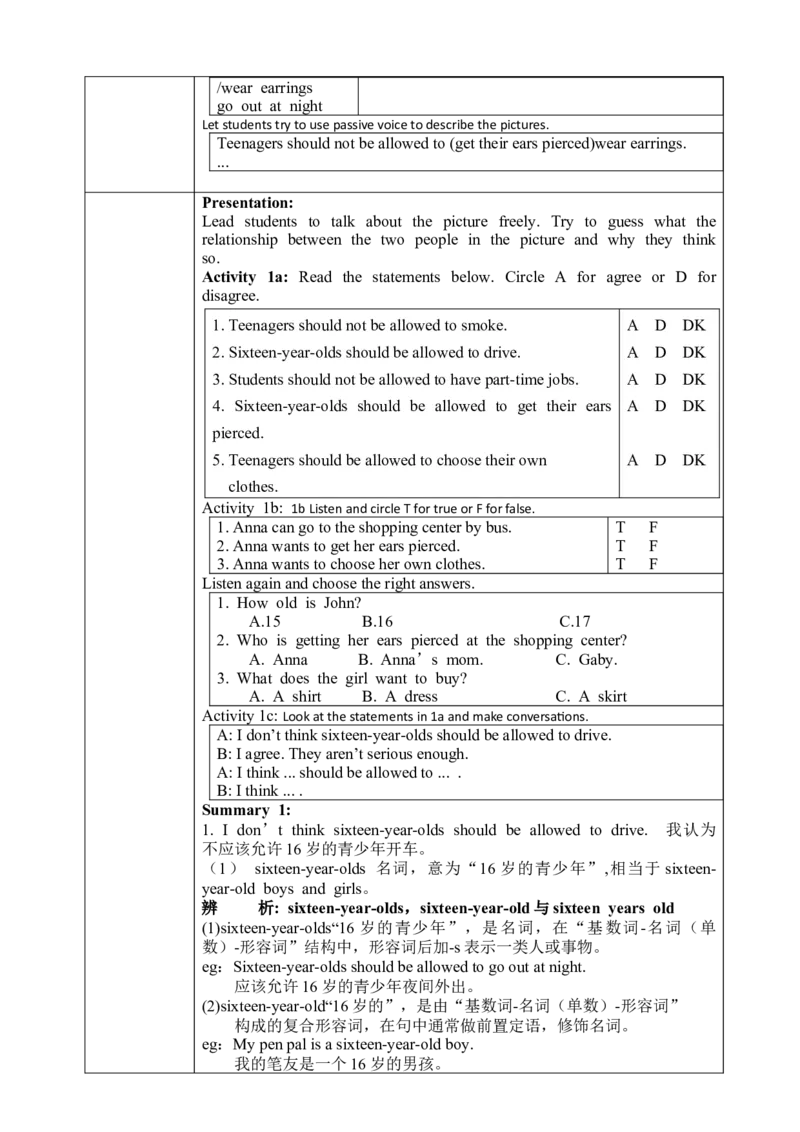
Activity 1a: Read the statements below. Circle A for agree or D for
disagree.
1. Teenagers should not be allowed to smoke. A D DK
2. Sixteen-year-olds should be allowed to drive. A D DK
3. Students should not be allowed to have part-time jobs. A D DK
4. Sixteen-year-olds should be allowed to get their ears A D DK
pierced.
5. Teenagers should be allowed to choose their own A D DK
clothes.
Activity 1b: 1b Listen and circle T for true or F for false.
1. Anna can go to the shopping center by bus. T F
2. Anna wants to get her ears pierced. T F
3. Anna wants to choose her own clothes. T F
Listen again and choose the right answers.
1. How old is John?
A.15 B.16 C.17
2. Who is getting her ears pierced at the shopping center?
A. Anna B. Anna’s mom. C. Gaby.
3. What does the girl want to buy?
A. A shirt B. A dress C. A skirt
Activity 1c: Look at the statements in 1a and make conversations.
A: I don’t think sixteen-year-olds should be allowed to drive.
B: I agree. They aren’t serious enough.
A: I think ... should be allowed to ... .
B: I think ... .
Summary 1:
1. I don’t think sixteen-year-olds should be allowed to drive. 我认为
不应该允许16岁的青少年开车。
(1) sixteen-year-olds 名词,意为“16 岁的青少年”,相当于 sixteen-
year-old boys and girls。
辨 析: sixteen-year-olds,sixteen-year-old与sixteen years old
(1)sixteen-year-olds“16 岁的青少年”,是名词,在“基数词-名词(单
数)-形容词”结构中,形容词后加-s表示一类人或事物。
eg:Sixteen-year-olds should be allowed to go out at night.
应该允许16岁的青少年夜间外出。
(2)sixteen-year-old“16岁的”,是由“基数词-名词(单数)-形容词”
构成的复合形容词,在句中通常做前置定语,修饰名词。
eg:My pen pal is a sixteen-year-old boy.
我的笔友是一个16岁的男孩。(3)sixteen years old“16岁”,用来描述人的年龄,常在句中作表语。
Step 1 eg:My brother is sixteen years old.
我哥哥十六岁了。
2. allow (to let sb. do sth.)及物动词,意为“允许;准许”,
常用于下列结构中:
① allow sb. to do sth. 允许某人做某事
eg: The teacher allowed him to get into the classroom.
老师允许他进教室。
② allow doing sth.允许做某事
eg: We don’t allow sleeping in class.
我们不允许在课堂上睡觉。
③ be (not) allowed to do sth. (不) 被允许做某事
eg:Passengers are not allowed to smoke in the train.
火车上面不允许乘客吸烟。
3. Sixteen-year-olds should be allowed to get their ears pierced.
get one’s ears pierced 扎耳洞
get sth.+动词的过去分词=have sth.+动词的过去分词
使某事被做,让别人做某事
eg: I had my hair cut yesterday.
昨天我把头发剪了。
My father will get my old bike sold.
我爸爸将把我的旧自行车卖了。
Activity 2a: Students look at the picture and guess what the boy is doing, then talk
us what they think the two girls are talking about. Then listen and complete 2a: What
does Molly think of Kathy’s statements? Listen and circle A for Agree, D for Disagree or DK
for Don’t Know.
Kathy Molly
1. Sixteen-year-olds should not be allowed to work
A D DK
at night.
2. Larry shouldn’t work every night. A D DK
3. He should cut his hair. A D DK
4. He should stop wearing that silly earring. A D DK
5. He doesn’t seem to have many friends. A D DK
stop doing sth.停止正在做的事
stop to do sth.停止正在做的事去做另一件事
seem 似乎;好像
seem to do sth. 似乎或好像要做某事
Activity 2b: Listen again. What are Kathy’s and Molly’s reasons? Number their reasons
in the correct order.
___________It looks cool.
___________Young people need to sleep.
___________He needs to spend time with friends.
___________He needs time to do homework.
___________It doesn’t look clean.
Listen again and choose the right answers.
1. Why can’t Larry join them?
A. Because he will do his homework tonight.
B. Because he will sleep early tonight.
C. Because he will work late tonight.
2. What does Larry need to do on weekends?
A. He needs to sleep on weekends.
B. He needs to spend time with friends on weekends.C. He needs to stop wearing that silly earring on weekends.
Activity 2c: Make a list of things teenagers should and should not be allowed to do.
Discuss your list with your partner.
should shouldn’t
1. wear the school uniform 1. arrive late for class
2. keep quiet in the library 2. run in the hallway
3. eat outside of the classroom 3. eat anything in the classroom
4. practice what you have learned 4. watch TV late every night
5. make your bed after getting up 5. leave dirty clothes everywhere in
the home
A: Do you think teenagers should be allowed to...?
B: Yes, I... .
A: Do you think teenagers should be allowed to...?
B: No, I ... .
Activity 2d: Listen and answer the following questions.
1. Where are they going for the school trip this year?
2. How does Sandy feel about the trip?
Step 2 Development:
Read the conversation, find out the main phrases(短语)and sentences.
(1)对…感到兴奋________________
(2)照很多照片_________________
(3)在博物馆不被允许_________________________
(4)使用闪光灯__________
(5)保护油画___________________
(6)对于观赏毕加索的著名油画我感到兴奋.
_____________________________________________________________
_
(7)对于我们今年的假期旅行史密斯先生选择了艺术博物馆我很高
兴 .
_____________________________________________________________
_
( 8 ) 你 认 为 如 果 我 们 不 使 用 闪 光 灯 我 们 可 以 拍 照 吗 ?_____________________________________________________________
_
Fill in the blanks and try to retell the text.
Sandy and Wu Lan are really_________ about ________
the famous paintings by Picasso. Sandy wants to bring her new
camera to take _______, but it is not _________ to take photos in
the museum. Sandy thinks that she may be allowed to take photos
______ she doesn’t _______a flash.
Summary 2:
1. should be allowed to do sth.应该允许某人做某事
should not be allowed to do sth. 不应该允许某人做某事
含有情态动词的被动语态
肯定句 主语+情态动词+be+及物动词的 Teenagers should be allowed
过去分词(+by…) to go shopping.
否定句 主语+情态动词+be+not+及物动 Teenagers should not be
词的过去分词(+by…) allowed to go shopping.
2. He should stop wearing that silly earring.
他应该停止戴那个可笑的耳环。
(1)stop doing sth. 意为“停止做某事”。
例:Let’s stop talking!让我们停止说话吧!
stop doing sth. 与 stop to do sth.
stop doing sth. 指停止正在做的事情。
stop to do sth. 指停止手头所做的事情去做另外一件事情。
eg:The two girls stopped talking when they saw the bus coming.
那两个女孩看到公交车来时停止了讲话。
I stopped to talk to him when I saw him at school.
我在学校看到他时停下来去和他讲话。
3. I’m really excited about seeing the famous paintings by Picasso.
看毕加索的这些著名的油画,我真的很兴奋。
(1)be/get excited about 意为“对……感到兴奋”,其中 about后可接名
词、代词或动词- ing形式。
eg:She got excited about it as soon as she saw the toy dog.
她一看到那只玩具狗就变得很兴奋。
Are you excited about going to Shanghai?
你对去上海感到兴奋吗?
(2)excited意为“兴奋的;激动地”,主语常常为人;
exciting意为“令人激动的”,主语常为物。
eg:We were very excited when our class won the football match.
当我们班赢得足球比赛时,我们很激动。
The football match was very exciting.
那场足球赛非常激动人心的。
Exercises:
选择括号中所给词的适当形式填空。
1. She is _______________ (serious enough / enough serious) to drive a car
herself.
2. I would like to have a _____________(two-month / two months) holiday
Step 3 near a lake.
3. The girl should be __________ (ask / asked) to go home before 9 o’clock.
用所给词的适当形式填空。
I don’t think children should _____________(allow) to go to the Internet
bar.2. Mom doesn’t allow me to get my ears_________ (pierce) because she
doesn’t like that.
3. He never stops __________ (talk). He makes me feel angry.
4. Teenagers should be allowed _________ (choose ) their own friends.
5. I was excited about___________ (watch) a wonderful movie.
Homework:
Step 4 1.完成课后跟踪练习;
2.预习3a阅读部分,完成课前预习练习题。