未得到监考教师指令前,不得翻阅该试题册!
2022年12月大学英语六级考试真题(第一套)
Part ⅠⅠ Writing (30 minutes)
(请于正式开考后半小时内完成该部分,之后将进行听力考试)
Directions: For this part, you are allowed 30 minutes to write an essay that begins with the sentence “Today
increasing importance is being attached to cultivating college students’ team spirit.” You
can make statements, give reasons, or cite examples to develop your essay. You should write at
least 150 words but no more than 200 words.
Part ⅡⅡ Listening Comprehension (30 minutes)
Section A
Directions: In this section, you will hear two long conversations. At the end of each conversation, you will
hear four questions. Both the conversation and the questions will be spoken only once. After you
hear a question, you must choose the best answer from the four choices marked A), B), C) and D).
Then mark the corresponding letter on Answer Sheet 1 with a single line through the centre.
Questions 1 to 4 are based on the conversation you have just heard.
1. A) Prioritizing happiness over money. C)Managing one’s personal finances wisely.
B)Joining the club to get her new book. D)Consuming more only when earning more.
2. A) She was in debt. C)She earned $30,000 a month.
B)She was a financial adviser. D)She enjoyed a happy life.
3. A) It reflects one’s earning power. C)It mirrors one’s sense of wellbeing.
B)It varies with one’s environment. D)It changes with one’s goals in life.
4. A) It would give him more time to be with his loved ones.
B)It would be good for those who value relationships.
C)It would mean major sacrifices for him.
D)It would deprive him of his individuality.
Questions 5 to 8 are based on the conversation you have just heard.
5. A) It was the artist’s first landscape. C)It was donated by the artist herself.
B)It was a painting by Christopher. D)It was displayed at a retirement party.
6. A) It was the painting that instantly made her rich.
B)It has cost him a lot of money to purchase it.
C)It was recently purchased by the gallery.
1大学英语6级真题详解及速刷狂练
D) It is owned by an anonymous collector.
7. A) It reflects her emotions. C) It appears perfectly symmetrical.
B) It contains ample details. D) It depicts the beauty of desolation.
8. A) She is eccentric like any other artist. C) She is as lucky as any acclaimed artist.
B) She is a very nice and intelligent artist. D) She is one of the most productive artist.
Section B
Directions: In this section, you will hear two passages. At the end of each passage, you will hear three or
four questions. Both the passage and the questions will be spoken only once. After you hear a
question, you must choose the best answer from the four choices marked A), B), C) and D). Then
mark the corresponding letter on Answer Sheet 1 with a single line through the centre.
Questions 9 to 11 are based on the passage you have just heard.
9. A) It is vital to one’s mental health. C) It promotes interpersonal relationship.
B) It leads to reconciliation and peace. D) It keeps one from traumatic experience.
10. A)When the offender has power over the victim.
B) When the offender is not willing to apologize.
C) When the offender is not duly penalized.
D) When the offender adds insult to injury.
11. A) Talk with the offender calmly. C) Find out why he committed the offense.
B) Accept the offender’s apology. D) Determine how serious the offense was.
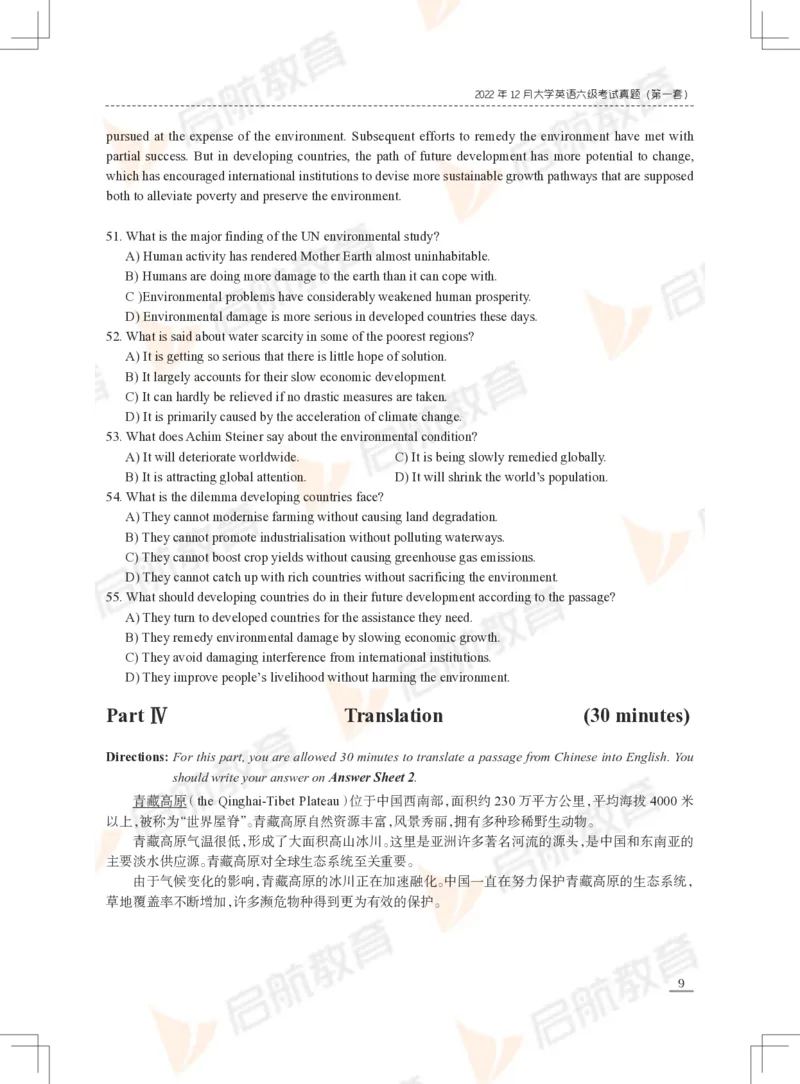
Questions 12 to 15 are based on the passage you have just heard.
12. A) The number of passengers dropped sharply. C) The number of stations increased to 50.
B) It served more and more commuters. D) It became the longest in the United Kingdom.
13. A) To increase capacity to meet growing needs. C) To have its systems modernised.
B) To make way for other means of transport. D) To avoid further financial losses.
14. A) It is generally recognised as a world heritage site.
B) It is the fastest way to reach the city’s south side.
C) It constitutes a source of revenue for the city.
D) It helps reduce traffic jams in the city centre.
15. A) They are usually crowded. C) They accept smartcards only.
B) They use high-tech systems. D) They are colourfully decorated.
Section C
Directions: I n this section, you will hear three recordings of lectures or talks followed by three or four
questions. The recordings will be played only once. After you hear a question, you must choose
the best answer from the four choices marked A), B), C) and D). Then mark the corresponding
letter on Answer Sheet 1 with a single line through the centre.
Questions 16 to 18 are based on the recording you have just heard.
16. A) They are quite friendly to humans. C) They are unafraid of humans.
B) They are shrinking in numbers. D) They are especially fond of garbage.
17. A) It is strictly forbidden. C) It is a gesture of human generosity.
22022年12月大学英语六级考试真题(第一套)
B) It is an uncommon sight. D) It is allowed only in certain areas.
18. A) Share their food with the bear they see. C) Try to be friendly with the bear they meet.
B) Be prepared to run into a hungry bear. D) Refrain from teasing bears with cubs.
Questions 19 to 21 are based on the recording you have just heard.
19. A) It refers to opinions that are radical and widespread.
B) It means making judgments without adequate knowledge.
C) It refers to deep-rooted beliefs about someone or something.
D) It means sticking to one’s judgments even when proved wrong.
20. A) They often lead to war between religious groups.
B) They keep certain occupations from thriving.
C) They allow myths and half-truths to persist.
D) They prevent us from getting to the truth.
21. A) When we start to feel superior. C) When we live in an isolated neighborhood.
B) When we mix with prejudiced people. D) When we try to keep up with those around us.
Questions 22 to 25 are based on the recording you have just heard.
22. A) Motivated. B) Disappointed. C) Perplexed. D) Shocked.
23. A) They would change with the passage of time. C) They would help kids grow.
B) They would benefit young people’s adult life. D) They would last a lifetime.
24. A) He had become mature. C) He had lots of stories to tell.
B) He suffered poor health. D) He regretted leaving Vietnam.
25. A) Make friends with his students. C) Help his students get through the growing pains.
B) Show his students how to do their best. D) Share his personal experience with his students.
Part ⅢⅢ Reading Comprehension (40 minutes)
Section A
Directions: I n this section, there is a passage with ten blanks. You are required to select one word for each
blank from a list of choices given in a word bank following the passage. Read the passage
through carefully before making your choices. Each choice in the bank is identified by a letter.
Please mark the corresponding letter for each item on Answer Sheet 2 with a single line through
the centre. You may not use any of the words in the bank more than once.
During the summer, when I was a visiting poet at a residency out of state, an angry, confused woman
wandered into my class and said: “I have three guns and I want to use them.” We all 26 . It wasn’t clear if
she had the guns, but we each know that, when we teach in America, we are already in danger.
I was dizzy with fear. The woman, who later turned out to be a schizophrenic (精神分裂症患者)
without 27 to her medications, was, by some force, wrestled out and 28 away, then put in a hospital
for observation, in a step that was actually safer for everyone than any one of us pressing charges. My class
went on; we talked about poems. But despite the fact that the rest of our days on campus passed 29 , I
was rattled. I couldn’t shake the sense that in this country we always live at 30 risk.
3大学英语6级真题详解及速刷狂练
A few months later, crisis 31 again. While my husband was locking his bike to drop off our 3-year-old
daughter for her preschool-aged day camp, a different woman approached. Swiftly and for no 32 reason,
she bent down, picked up our daughter, and began to carry her down the street. It was so fast and confusing
that my daughter 33 cried. My husband, in a burst of speed, chased the woman and reclaimed our
daughter. The woman, clearly confused, retreated into the public library. A 34 of homeless people who
generally know the other homeless in the area said they did not recognize the woman. The woman was so
clearly unwell that when she was taken into custody she was incoherent. Heartbreakingly, she called our
daughter by the name of someone else’s child. Each part of the episode was as haunting as it was 35 .
A) access I) network
B) apparent J) overriding
C) barely K) peacefully
D) dedication L) presumably
E) escorted M) stifled
F) froze N) struck
G) incredible O) terrifying
H) indignant
Section B
Directions: In this section, you are going to read a passage with ten statements attached to it. Each statement
contains information given in one of the paragraphs. Identify the paragraph from which the
information is derived. You may choose a paragraph more than once. Each paragraph is marked
with a letter. Answer the questions by marking the corresponding letter on Answer Sheet 2.
This man is running 7 marathons on 7 continents in 7 days
[A] Michael Wardian pushed forward into the penetrating arctic (北极的) wind, fighting the urge to speed
up. Too much effort and he’d begin to sweat, which, he was told, would only increase the risk of
hypothermia (体温过低).
[B] At the 2014 North Pole Marathon, the temperature dipped to minus-22 degrees F, with a wind chill that
made it feel even colder. Along the route, armed guards wandered the large sheets of floating ice to
minimize the risk of polar bear attacks.
[C] “I like to do stuff that scares me,” Wardian said. With ice frozen to his beard, Wardian crossed the finish
line that April afternoon in a winning time of 4 hours 7 minutes and 40 seconds, almost two hours slower
than his personal best over 26.2 miles. The race for Wardian, however, was less about the result than
overcoming his aversion to the cold.
[D] In a few days, Wardian will once again compete in an unfamiliar territory and below-freezing
temperatures. He will line up Monday in Antarctica ( 南极) for the first leg of the World Marathon
Challenge—joining 32 other adventure seekers on an unusual journey where participants travel through
different time zones and climates to run seven marathons on seven continents in seven days.
[E] An elite ultra-runner, Wardian has his sights on breaking the event’s record average marathon time of
3:32:25 set last January by U.S. Marine Corps captain Daniel Cartica. Wardian, a 42-year-old Arlington
resident, is a record-breaking racer, known in the ultra-running community for seeking tough courses and
42022年12月大学英语六级考试真题(第一套)
setting world records. Last year, he ran 1,254.65 miles in 47 races. The World Marathon Challenge, like
most of Wardian’s running goals, will be about pushing his limits. “I love diverse and unique challenges,”
he said. “I’m definitely interested in seeing what I can handle and what my body can accept. That drives
me.”
[F] Something about the way Richard Donovan carried himself appealed to Wardian. Perhaps it was the
sense of adventure Donovan displayed when they first met at the 2010 50K Championships in Galway,
Ireland, where Donovan was the race director. The two hit it off, and soon Wardian was participating in
Donovan’s events. It was at the North Pole Marathon, a race that Donovan organizes, that Wardian first
heard about the Irishman’s plan for the World Marathon Challenge—a challenge that Donovan himself
completed in 2009 and 2012. “I knew that many people had a goal of running seven marathons on seven
continents during any time period,” Donovan, 50, said. “I felt the natural extension to this idea would be
to try to achieve it within a seven-day period.”
[G] Wardian started saving for the trip in 2014, connecting with sponsors and getting approval from his wife,
Jennifer, before committing. Registration for the event costs 36,000 euros, which covers international
charter flights to each of the seven marathon locations: Union Glacier (Antarctica), Punta Arenas, Chile
(South America), Miami (North America), Madrid (Europe), Marrakesh, Morocco (Africa), Dubai (Asia)
and Sydney (Australia). The challenge is a test of both physical strength and mental fitness. Sleeping
on a crammed plane, adjusting to different time zones and finding food to eat (Wardian is a vegetarian)
would make it an exhausting trip over a month, let alone a week. “The key to a race like this is getting
comfortable being uncomfortable,” said Becca Pizzi, last year’s women’s champion. “The highs of the
race are incredibly high, and the lows incredibly low.”
[H] Since turning it into an organized event in 2015, Donovan has attracted a variety of runners. This year’s
challenge will feature a far more elite field, which includes Ryan Hall, America’s fastest marathon
runner. Despite his proven track record, Hall said he has no time goals and that he still suffers from the
same fatigue issues that forced him to leave the professional ranks in 2015. Hall plans to run with his
friend, Pastor Matthew Barnett of The Dream Center in Los Angeles—one of the six American men who
will be competing. “I don’t expect to run a step with Mike, but I will be excited to see how he does,” said
the 34-year-old Hall, who began weight-lifting after retiring. “If I finish within an hour of him in each
marathon, I’d be surprised.”
[I] Instead, 43-year-old Petr Vabrousek, an elite Czech Ironman champion, is expected to be Wardian’s
closest challenger. To others on the trip, simply finishing will be its own reward. Sinead Kane of Ireland
is aiming to become the first blind person to complete the challenge. And Beth Ann Telford, a 47-year-
old federal government worker from Fairfax and the only American female in this year’s mix, is using
the event as a platform to raise money for cancer research. It’s a cause with a personal connection to
Telford, who was diagnosed with brain cancer in 2004. “Doing something like this is definitely the
hardest challenge that I’ve ever done except for the chemotherapy and brain surgery,” she said. “It’s
going to raise awareness... I just wanted to do something that is epic and this certainly is right up there.”
Wardian, too, hopes his involvement will give him a platform to promote a cause. He recently became an
ambassador for the United Nations Women’s HeForShe initiative to fight inequalities faced by women
and girls worldwide.
[J] On a chilly December afternoon, Wardian wove through Washington’s crowded sidewalks on the way
home from his full-time job as an international ship broker. His elastic, 6-foot frame bounced gently and
5大学英语6级真题详解及速刷狂练
efficiently off the ground with each step of the hilly six-mile trip back to Arlington. This is a daily routine
during the week for Wardian, who started racing professionally in 2003 and runs seven days a week,
often multiple times a day. When he travels, he prefers to explore new places on his feet.
[K] But in some ways, Wardian still has trouble thinking of himself as a runner. For the majority of his
childhood, Wardian devoted his energy to becoming a Division Ⅰ lacrosse (长曲棍球) player—a dream he
realized when he was recruited to play at Michigan State University. “Once he decides to do something,
he just works at it until he does it,” Michael’s younger sister, Mariele, said. “Once he decides to do
it, it’s usually something that’s going to happen. He’s always been like that. He’s a very motivated
individual.”
[L] It was only a year or so ago that Wardian realized that he had been a runner longer than a lacrosse player.
It was not until he ran in the 2004 U.S. Olympic Marathon Trials—the first of three for Wardian—that he
felt that he was a legitimate runner. Now more than 10 years and numerous ultra-marathon national titles
and world records later, he embraces that identity. Wardian wants to see how far his legs can take him,
one epic challenge at a time. “I want to always keep doing things that are exciting, adventurous, different
and most importantly, probably things I’m not the best at,” Wardian said, “because if you’re not seeking
things out that are challenging and difficult for you, then you’re not growing... So I hope maybe people
see what I do, and say, ‘Okay, I want to do something different or try something new... I’m going to do
something that scares me.’ That’s what I’m hoping people will take from it.”
36. Wardian regards the various extraordinary challenges as a test of his physical endurance.
37. Wardian hopes his participation in the seven-day marathon series will contribute to a worthy cause.
38. Wardian is going to join over thirty other runners in a week-long marathon series.
39. Over-exertion in extreme cold can lower one’s body temperature to a dangerous point.
40. Wardian was very much impressed by a race director’s sense of adventure.
41. Once Wardian sets his mind on something, he is determined to make it happen.
42. One top American marathoner quit his running career because of his physical condition.
43. To many of the week-long marathon participants, completing the race will be a success in itself.
44. For Wardian, the marathon in the Arctic was more about how to triumph over the extreme cold.
45. To participate in the seven-day marathon series, Wardian had to raise a lot of money and have his wife’s support.
Section C
Directions: There are 2 passages in this section. Each passage is followed by some questions or unfinished
statements. For each of them there are four choices marked A), B), C) and D). You should decide
on the best choice and mark the corresponding letter on Answer Sheet 2 with a single line
through the centre.
Passage One
Questions 46 to 50 are based on the following passage.
Many people associate their self-worth with their work. The more successful their career, the better they
feel about themselves. Work-related self-esteem is therefore a worthy ideal to pursue with vigor, right? Well,
not always. According to recent research, in which psychologists interviewed 370 full-time workers over a
62022年12月大学英语六级考试真题(第一套)
period of three weeks, the reality is a little more complicated. And it involves negative as well as positive
consequences.
It’s natural to be drawn towards pleasure and to step away from pain. In the workplace, if that
pleasure comes from a triumph which swells our self-respect, people will try to repeat the accomplishment.
But repeating that accomplishment is often not realistic, which can lead to severe negative emotional
consequences when it doesn’t reoccur. This form of motivation is widely regarded as a negative type of
motivation. It can hinder other more positive motivation types, such as completing a task purely because it’s
fulfilling or enjoyable.
What consumes the employee instead is a pressing need to feel mighty and sure of themselves. They
then take on only tasks and objectives which serve that ego-driven need. As a result, to avoid feelings of
shame and worthlessness associated with failure, they extend themselves to such a degree that there’s a
subsequent adverse effect on their well-being. This internal pressure to succeed at all costs demands a lot of
effort. It depletes their energy, culminating in disproportionate levels of damaging sentiment.
Those negative emotions mount into heightened anxiety, impacting their ability to make the most of their
personal life. Their desire to avoid feeling inferior ends up making them feel inferior when it comes to their
diminished capacity for friendship and leisure. They end up dissatisfied both at work and outside of it.
But thankfully, for those people compelled almost entirely by this specific form of motivation, the news
isn’t all bad, or bad at all. The study also discovered several positive outcomes that can actually outweigh the
harmful ones. Though these types of employees are motivated by the desire to avoid negative consequences,
they are also motivated by the excitement of pursuing emotional rewards. This excitement makes pursuing
goals enjoyable and stimulates pleasure and pride that would result from success. An effect of the positive
motivation is that it neutralizes the existence of negative motivation.
Sure, it affects people’s personal lives to what could be deemed an unhealthy extent, because leisure
activities are often seen as a part of life that must be sacrificed to manage work and family demands.
However, the way people feel about their work has less to do with whether they’re motivated by the
preservation of self-esteem but more with the fact that they’re simply motivated.
46. What does the author say about the pursuit of work-related self-esteem?
A) It may result in negative motivation.
B) It contributes to one’s accomplishments.
C) It can increase one’s vigor as one keeps trying.
D) It costs too much emotionally and psychologically.
47. What do employees tend to do in pursuing work-related self-esteem?
A) Take on tasks well beyond their actual capabilities.
B) Strive to succeed at the expense of their well-being.
C) Resort to all means regardless of the consequences.
D) Exaggerate their sense of shame and worthlessness.
48. What do we learn about people over-concerned with work-related self-esteem?
A) They may often feel inferior to their colleagues.
B) They cannot enjoy their personal life to the full.
C) They are never satisfied with their achievements.
D)They have their own view of friendship and leisure.
7大学英语6级真题详解及速刷狂练
49. What is the good news we learn from the recent research?
A) The pursuit of goals may turn out to be enjoyable and pleasant.
B) The emotional rewards from goal pursuit are worth the pains taken.
C) The negative consequences of goal pursuit can mostly be avoided.
D) The goal of swelling self-esteem can be achieved if one keeps trying.
50. What can we infer from the last paragraph?
A) Workers have to make sacrifices to preserve self-esteem.
B) Self-esteem swells when workers are strongly motivated.
C) Pursuit of goals affects people’s personal lives to an unhealthy extent.
D) People feel positive about their work as long as they are motivated.
Passage Two
Questions 51 to 55 are based on the following passage.
Degradation of the world’s natural resources by humans is rapidly outpacing the planet’s ability to
absorb the damage, a recent UN environmental study has found. The study concludes that without radical
action the level of prosperity that millions of people in the developed world count on will be impossible to
maintain or extend to poorer countries.
Water scarcity is the curse of some of the poorest regions on Earth, leaving developing countries
increasingly unable to feed themselves, and causing hardship for millions of people. There appears little
prospect of this desperate situation being remedied without radical action being taken. Water resources
are under increasing threat from population growth, climate change, rapid urbanisation, rising levels of
consumption, and the degradation of lands that previously provided a natural replenishment (补充) of water
resources.
The rate of damage to the natural environment was found to increase globally, despite concerted efforts
to persuade governments to take measures to improve the condition. “If current trends continue, and the
world fails to improve patterns of production and consumption, then the state of the world’s environment will
continue to decline,” warned UN executive director Achim Steiner.
He said the tools for improving the environment for millions of people existed in developed countries,
but were in danger of not being used.
The study found that basic measures to tackle some of the key causes of environmental damage were
still not being taken. These included measures to reduce air pollution; to control the damage to marine eco-
systems, which can have a huge effect on fish stocks on which hundreds of millions of people depend; and to
curb the degradation of land where modern agricultural methods were pursued without regard to the longer-
term consequences.
Despite the recent global agreement on cutting greenhouse gas emissions, global carbon output continues
to rise. This will put a long-term strain on the ability of developing economies to feed their own people.
Climate change is aggravated by the emissions of greenhouse gases from chemical and natural fertilisers used
in agriculture which increased by more than a quarter between 2000 and 2010. Other problem areas identified
in the report included glaciers, which provide vital water resources for millions of people, but which are
shrinking as the climate warms.
In rich countries, these problems have built up over decades and centuries while economic growth was
82022年12月大学英语六级考试真题(第一套)
pursued at the expense of the environment. Subsequent efforts to remedy the environment have met with
partial success. But in developing countries, the path of future development has more potential to change,
which has encouraged international institutions to devise more sustainable growth pathways that are supposed
both to alleviate poverty and preserve the environment.
51. What is the major finding of the UN environmental study?
A) Human activity has rendered Mother Earth almost uninhabitable.
B) Humans are doing more damage to the earth than it can cope with.
C )Environmental problems have considerably weakened human prosperity.
D) Environmental damage is more serious in developed countries these days.
52. What is said about water scarcity in some of the poorest regions?
A) It is getting so serious that there is little hope of solution.
B) It largely accounts for their slow economic development.
C) It can hardly be relieved if no drastic measures are taken.
D) It is primarily caused by the acceleration of climate change.
53. What does Achim Steiner say about the environmental condition?
A) It will deteriorate worldwide. C) It is being slowly remedied globally.
B) It is attracting global attention. D) It will shrink the world’s population.
54. What is the dilemma developing countries face?
A) They cannot modernise farming without causing land degradation.
B) They cannot promote industrialisation without polluting waterways.
C) They cannot boost crop yields without causing greenhouse gas emissions.
D) They cannot catch up with rich countries without sacrificing the environment.
55. What should developing countries do in their future development according to the passage?
A) They turn to developed countries for the assistance they need.
B) They remedy environmental damage by slowing economic growth.
C) They avoid damaging interference from international institutions.
D) They improve people’s livelihood without harming the environment.
Part ⅣⅣ Translation (30 minutes)
Directions: F or this part, you are allowed 30 minutes to translate a passage from Chinese into English. You
should write your answer on Answer Sheet 2.
青藏高原(the Qinghai-Tibet Plateau)位于中国西南部,面积约230万平方公里,平均海拔4000米
以上,被称为“世界屋脊”。青藏高原自然资源丰富,风景秀丽,拥有多种珍稀野生动物。
青藏高原气温很低,形成了大面积高山冰川。这里是亚洲许多著名河流的源头,是中国和东南亚的
主要淡水供应源。青藏高原对全球生态系统至关重要。
由于气候变化的影响,青藏高原的冰川正在加速融化。中国一直在努力保护青藏高原的生态系统,
草地覆盖率不断增加,许多濒危物种得到更为有效的保护。
9大学英语6级真题详解及速刷狂练
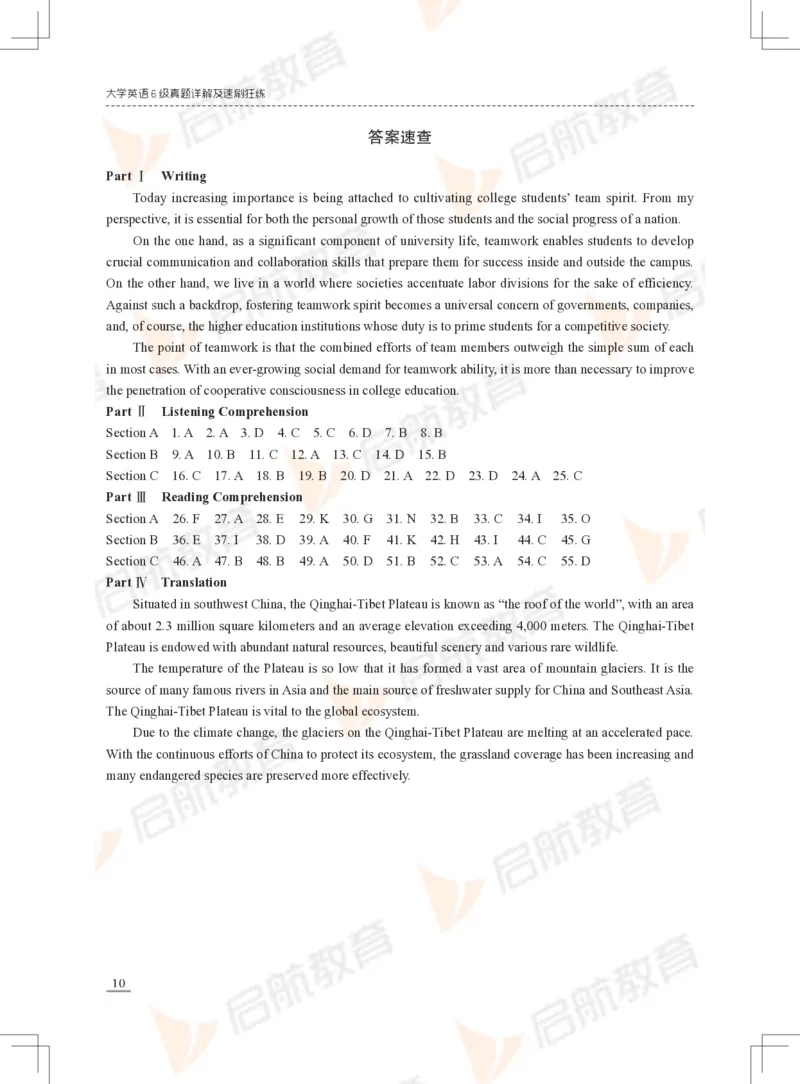
答案速查
Part Ⅰ Writing
Today increasing importance is being attached to cultivating college students’ team spirit. From my
perspective, it is essential for both the personal growth of those students and the social progress of a nation.
On the one hand, as a significant component of university life, teamwork enables students to develop
crucial communication and collaboration skills that prepare them for success inside and outside the campus.
On the other hand, we live in a world where societies accentuate labor divisions for the sake of efficiency.
Against such a backdrop, fostering teamwork spirit becomes a universal concern of governments, companies,
and, of course, the higher education institutions whose duty is to prime students for a competitive society.
The point of teamwork is that the combined efforts of team members outweigh the simple sum of each
in most cases. With an ever-growing social demand for teamwork ability, it is more than necessary to improve
the penetration of cooperative consciousness in college education.
Part Ⅱ Listening Comprehension
Section A 1. A 2. A 3. D 4. C 5. C 6. D 7. B 8. B
Section B 9. A 10. B 11. C 12. A 13. C 14. D 15. B
Section C 16. C 17. A 18. B 19. B 20. D 21. A 22. D 23. D 24. A 25. C
Part Ⅲ Reading Comprehension
Section A 26. F 27. A 28. E 29. K 30. G 31. N 32. B 33. C 34. I 35. O
Section B 36. E 37. I 38. D 39. A 40. F 41. K 42. H 43. I 44. C 45. G
Section C 46. A 47. B 48. B 49. A 50. D 51. B 52. C 53. A 54. C 55. D
Part Ⅳ Translation
Situated in southwest China, the Qinghai-Tibet Plateau is known as “the roof of the world”, with an area
of about 2.3 million square kilometers and an average elevation exceeding 4,000 meters. The Qinghai-Tibet
Plateau is endowed with abundant natural resources, beautiful scenery and various rare wildlife.
The temperature of the Plateau is so low that it has formed a vast area of mountain glaciers. It is the
source of many famous rivers in Asia and the main source of freshwater supply for China and Southeast Asia.
The Qinghai-Tibet Plateau is vital to the global ecosystem.
Due to the climate change, the glaciers on the Qinghai-Tibet Plateau are melting at an accelerated pace.
With the continuous efforts of China to protect its ecosystem, the grassland coverage has been increasing and
many endangered species are preserved more effectively.
10未得到监考教师指令前,不得翻阅该试题册!
2022年12月大学英语六级考试真题(第二套)
Part ⅠⅠ Writing (30 minutes)
(请于正式开考后半小时内完成该部分,之后将进行听力考试)
Directions: For this part, you are allowed 30 minutes to write an essay that begins with the sentence “In an
era of information explosion, it is vitally important to develop the ability to think critically
and make rational choices.” You can make statements, give reasons, or cite examples to develop
your essay. You should write at least 150 words but no more than 200 words.
Part ⅡⅡ Listening Comprehension (30 minutes)
Section A
Directions: In this section, you will hear two long conversations. At the end of each conversation, you will
hear four questions. Both the conversation and the questions will be spoken only once. After you
hear a question, you must choose the best answer from the four choices marked A), B), C) and D).
Then mark the corresponding letter on Answer Sheet 1 with a single line through the centre.
Questions 1 to 4 are based on the conversation you have just heard.
1. A) She hasn’t started writing it. C) She is proofreading the first draft.
B) She hasn’t decided on a topic. D) She is working on the references.
2. A) He lent many books to the man for reference. C) He published a lot in a number of reputable journals.
B) He offered the man advice on resource hunting. D) He told the man to be selective when using e-resources.
3. A) He didn’t think her dissertation topic viable. C) He didn’t want her to rush through her dissertation.
B) He wasn’t interested in her dissertation topic. D) He wasn’t specific about the length of her dissertation.
4. A) Change her research methodology. C) Consult her professor more.
B) Narrow down her dissertation topic. D) Follow the man’s advice.
Questions 5 to 8 are based on the conversation you have just heard.
5. A) He has translated 12 books. C) His books sell well worldwide.
B) He is a well-known nutritionist. D) His latest book sold a million copies.
6. A) The desire of Americans to try exotic cuisines.
B) The demand for information about food safety.
C) The fact that over half of Americans are overweight.
D) The fact that science books are difficult to read.
11大学英语6级真题详解及速刷狂练
7. A) The general public. C) Those who want to lose weight.
B) Those who are overweight. D) The medical community.
8. A) Switch to a vegetarian diet. C) Adhere to doctors’ advice.
B) Follow a personalized diet. D) Cut carbohydrate intake.
Section B
Directions: In this section, you will hear two passages. At the end of each passage, you will hear three or
four questions. Both the passage and the questions will be spoken only once. After you hear a
question, you must choose the best answer from the four choices marked A), B), C) and D). Then
mark the corresponding letter on Answer Sheet 1 with a single line through the centre.
Questions 9 to 11 are based on the passage you have just heard.
9. A) The rate of their growth increased dramatically. C) They began to show signs of depression.
B) The growth of their new brain cells doubled. D) They began to get irritated and restless.
10. A) To avoid them in the future. C) To make good sense of them.
B) To warn others against them. D) To reflect on their causes.
11. A) Produce a surprising healing effect. C) Make people more susceptible to illness.
B) Weaken one’s immunity in the long run. D) Provide protection against mental illnesses.
Questions 12 to 15 are based on the passage you have just heard.
12. A) Placing their own interests over their staff’s. C) Lacking the ability to relate to their staff.
B) Being overwhelmed by their daily routines. D) Spending too much time handling email.
13. A) Their leadership may be challenged. C) Unexpected events may occur.
B) Their companies may go bankrupt. D) Major problems may result.
14. A) Keep an eye on their employees. C) Sacrifice some of the immediate goals.
B) Motivate and inspire their team. D) Have greater ambition in overall planning.
15. A) Cultivate self-control. C) Respond only after work.
B) Filter their email boxes. D) Check only when necessary.
Section C
Directions: I n this section, you will hear three recordings of lectures or talks followed by three or four
questions. The recordings will be played only once. After you hear a question, you must choose
the best answer from the four choices marked A), B), C) and D). Then mark the corresponding
letter on Answer Sheet 1 with a single line through the centre.
Questions 16 to 18 are based on the recording you have just heard.
16. A) The key to increasing healthy food supply. C) The impact of advertisements on consumption.
B) The best way to improve marketing research. D) The importance of the appearance of food.
17. A) By focusing on the nutrients in different foods.
B) By emphasizing the diversity of food.
C) By stressing pleasing aesthetics of food.
D) By winning the support of marketing professors.
18. A) They can attract customers with the healthy qualities of their products.
B) They can boost sales of healthy foods by making them visually appealing.
122022年12月大学英语六级考试真题(第二套)
C) They can turn to marketing professors for advice.
D) They can rely on advertising for sales promotion.
Questions 19 to 21 are based on the recording you have just heard.
19. A) It has witnessed a spectacular surge in demand.
B) It has met much criticism from environmentalists.
C) It has seen more small businesses offering environment-friendly products.
D) It has experienced increasingly fierce competition among global companies.
20. A) Consumers now know much more about technology.
B) Their mass production has sharply reduced the price.
C) Consumers tend to favor all that is novel.
D) Their quality has been greatly improved.
21. A) Purchasing only this kind of products for home cleaning.
B) Writing positive comments about them on social media.
C) Demonstrating on TV how effective these products are.
D) Telling one another about their incomparable virtues.
Questions 22 to 25 are based on the recording you have just heard.
22. A) Increasing cleaners’ workload. C) Breaking a time-honored ritual.
B) Blocking the fountains’ works. D) Polluting the fountains’ water.
23. A) They are occasionally retrieved by curious tourists.
B) They are regularly donated to charity organizations.
C) They are mostly used for the fountains’ maintenance.
D) They are usually used as wages for fountain cleaners.
24. A) It is invested in a series of businesses. C) It is used to run a supermarket for the needy.
B) It is used exclusively for its maintenance. D) It is estimated to be about $40,000 a month.
25. A) He was arrested for stealing money from four fountain cleaners.
B) He was sentenced to 34 years’ imprisonment.
C) He collected rare coins from around the world.
D) He stole a lot of money from a fountain with a magnetic stick.
Part ⅢⅢ Reading Comprehension (40 minutes)
Section A
Directions: I n this section, there is a passage with ten blanks. You are required to select one word for each
blank from a list of choices given in a word bank following the passage. Read the passage
through carefully before making your choices. Each choice in the bank is identified by a letter.
Please mark the corresponding letter for each item on Answer Sheet 2 with a single line through
the centre. You may not use any of the words in the bank more than once.
The task of the global strategist of a business is to build a platform of capabilities derived from the
resources, experiences and innovations of units operating in multiple locations, to transplant those capabilities
wherever 26 , and then to systematically upgrade and renew them—ahead of the competition.
Apple is an outstanding case of a company whose unique capabilities give it a worldwide 27 advantage,
13大学英语6级真题详解及速刷狂练
particularly with respect to its ability to build platforms from a product base that integrates functional
and 28 design. Apple has been able to leverage and exploit its California-based design and
marketing advantages successfully throughout the world. IKEA is another such case. The do-it-yourself
furniture and houseware company first developed a compelling set of capabilities to design, manufacture and
29 furniture at low cost and sell it in a novel way in Sweden. Later, IKEA successfully 30 this formula
in many other countries.
By contrast, Telefónica, a Spanish telecommunications company that is now the world’s fifth largest
telecom by 31 , first developed its special advantage abroad. In 1989 and 1990, Telefónica had the
opportunity to enter Chile and Argentina, countries that shared many institutional and cultural characteristics
with its home country but that were 32 more rapid market reform. Throughout the 1990s, Telefónica
took what it learned in Chile and Argentina about reconstructing former state-owned telecoms to other Latin
American countries that were privatizing their state telecoms and deregulating their telecom markets.
These examples might lead the reader to believe that creating a global advantage is an easy task. But
many other 33 of expensive failed experiments suggest that creating a lasting global advantage actually
requires a great deal of 34 and operational finesse (技巧). Our research suggests that global winners
typically create and sustain their international presence through a systematic process of 35 , renewing and
enhancing their core capabilities.
A) aesthetic I) reproduced
B) appropriate J) revenues
C) clusters K) safeguarding
D) competitive L) ship
E) exploiting M) strategic
F) fiscal N) transcend
G) instances O) undergoing
H) rehabilitated
Section B
Directions: I n this section, you are going to read a passage with ten statements attached to it. Each statement
contains information given in one of the paragraphs. Identify the paragraph from which the
information is derived. You may choose a paragraph more than once. Each paragraph is marked
with a letter. Answer the questions by marking the corresponding letter on Answer Sheet 2.
Fear of Nature: An Emerging Threat to Conservation
[A] What do we lose when natural spaces and species disappear? Increasingly, research has shown that as
species and ecosystems vanish, it also chips away at our ability to preserve what remains—because we
no longer understand what we’re losing.
[B] You probably see it all the time. The neighbor who puts pesticides on his lawn rather than deal with
annoying bees. The politician who votes against wildlife protection because she’s never seen a wolf in
the wild. The corporation that wants to bulldoze (用推土机推平) the habitat of a rare frog.
[C] At best this can be termed “the extinction of experience,” where our cultural and natural histories fade
from our memories and therefore our reality. At its worst it becomes something even more concerning:
“biophobia,” the fear of living things and a complete aversion to nature.
142022年12月大学英语六级考试真题(第二套)
[D] This isn’t the fiction of living in a cold, empty dystopia (绝望的世界). Sadly, it’s becoming a way of life for
too many people—especially children. A recent study in Japan paints a striking portrait of this problem.
A survey of more than 5,300 school children in the Tochigi Prefecture examined their perception of 14
local insect species and one spider. The results? A collective “ew!” Most of the students saw the species
as things to dislike or fear, or even as sources of danger. The less experience the students had with nature,
the more negative their feelings.
[E] The results were published earlier this year in the journal Biological Conservation. Lead researcher
Masashi Soga with the University of Tokyo says the study stemmed from observations about today’s
nature-deficient children. “Humans inherently avoid dangerous organisms such as bees, but children
these days avoid even harmless insects such as butterflies and dragonflies (蜻蜓),” he says. “I have long
wondered why so many of today’s children react like this.”
[F] Although the children’s reactions were somewhat expected, the new study did contain an unexpected
finding: Many of the surveyed children revealed that their parents also expressed fear or disgust of the
same animals. In fact these parental emotions were strong enough to overwhelm any positive experiences
the children might have gained from direct experiences in nature. As Soga and his coauthors wrote in
their paper, “Our results suggest that there is likely a feedback loop in which an increase in people who
have negative attitudes towards nature in one generation will lead to a further increase in people with
similar attitudes in the next generation.”
[G] And that’s possibly the greater threat posed by extinction of experience. Soga suggests the generational
loss—a condition previously dubbed environmental generational amnesia ( 遗忘)—could chip away
at our societal ability to preserve what we’re losing. “I believe that increased biophobia is a major, but
invisible, threat to global biodiversity,” Soga says. “As the number of children who have biophobia
increases, public interest and support for biodiversity conservation will gradually decline. Although many
conservation biologists still consider that preventing the loss of wildlife habitat is the most important way
to conserve biodiversity, I think preventing increased biophobia is also important for conservation.”
[H] What’s to be done about this? The paper makes several recommendations, the most obvious of which is
that children should experience nature more often. The authors also suggest establishing policies to guide
these natural experiences and increasing educational programs about the natural world.
[I] Helping parents to see species around them in a new light would make a difference, too. And, of course, maintaining
support for preserving the wild spaces where these “scary” creatures live is the most important thing of all.
That’s a point reinforced by another recent study, which found that wild spaces located within urban areas—
and the plants and animals that thrive in them—are particularly important for human health and well-being.
[J] Published in the journal Frontiers in Sustainable Cities, the study examined attitudes toward Discovery
Park, the heavily forested 534-acre public park in Seattle, Washington. It found that the public had the
most appreciation for—and gained the most value from—the wildest parts of the park. “I have seen
whales, seals, fish, eagles, shorebirds and many other sea creatures in their natural habitat,” one survey
participant wrote. “Coming here with people has allowed me to connect and talk with them about
conversation that simply does not happen in everyday life,” wrote another.
[K] The participants reported that their most valuable experiences in the park included encountering wildlife,
walking through open spaces, exploring the beach and finding beautiful views. “We saw that a large
majority of participants’ interactions, especially their most meaningful interactions, depended on
Discovery Park’s relative wildness,” says lead author Elizabeth Lev, a master’s student in the University
of Washington’s Human Interaction with Nature Lab. This is only possible because the park is relatively
15大学英语6级真题详解及速刷狂练
wild. After all, you can’t enjoy watching birds if there are no birds to follow; gaze at the sunset if it’s
obscured by skyscrapers; or stop and smell the flowers if they don’t have room to grow.
[L] And yet even this long-protected space could someday become less hospitable to nature. Over the past
few years a lot of people and organizations have suggested developing parts of Discovery Park or the
neighboring area. Most recently a plan proposed building 34 acres of much-needed affordable housing
and parking spaces adjacent to the park, bringing with them noise, traffic and pollution.
[M] If anything like that happened, both the park and the people of Seattle could lose something vital. And
that would continue the trend of chipping away at Seattle’s—and the world’s—natural spaces, leaving
just tiny pocket parks and green-but-empty spaces that offer little real value to wildlife, plants or people.
[N] “It is true that any interaction with nature is better than none, but l don’t want people to be satisfied with
any small bit of grass and trees,” Lev says. “We have been in this cycle of environmental generational
amnesia for a long time, where the baseline keeps shifting and we don’t even realize what we’re losing
until it’s gone. If we can get people to understand how much meaning and value can come from having
more experiences with more wild forms of nature, then maybe we can stop this cycle and move toward
conserving and restoring what we have left.”
[O] Building this understanding in an ever-more fearful and disconnected world may be the biggest challenge.
Peter Kahn, the senior author of Lev’s paper and the director of the Human Interaction with Nature Lab,
made several suggestions for bridging this gap in this 2011 book, Technological Nature. They echo the
recommendation about getting children into nature, but also include telling stories of how things used to
be, imagining what things might be like in the future, and developing a common language about nature, “a
way of speaking about wild and domestic interaction patterns, and the meaningful, deep and often joyful
feelings that they generate.”
[P] No matter what techniques we use, this growing field of research illustrates that saving nature requires
encouraging people to experience it more often and more deeply. That calls for additional research—
Lev and her coauthors have published a toolkit that other municipalities can follow to study the value of
their own wild spaces—and clear communication of the results. “If we can continue to show people the
benefits of these wild spaces,” Lev says, “maybe people will begin to see more value in keeping these
areas undeveloped—for the sake of our mutual benefit.”
36. A new study found parents’ aversion to certain animals would pass on to their children.
37. The disappearance of species and ecological systems erodes our ability to keep what is left.
38. A study showed that the wildest areas of Discovery Park appealed most to the public.
39. The fear of living organisms is becoming more worrisome.
40. Preventing the increase in children’s fear of living creatures is also important for conserving biodiversity.
41. Research shows that more and deeper experience people have with nature will help save it.
42. Though humans naturally tend to avoid dangerous animals, today’s children try to stay away from even
harmless ones.
43. Development in and around Discovery Park could cause heavy losses to the park and the local residents.
44. A large survey of school children found that their negative feelings grew as their experience with nature
diminished.
45. Elizabeth Lev believes increased contact with more wildlife helps conserve biodiversity.
162022年12月大学英语六级考试真题(第二套)
Section C
Directions: T here are 2 passages in this section. Each passage is followed by some questions or unfinished
statements. For each of them there are four choices marked A), B), C) and D). You should decide
on the best choice and mark the corresponding letter on Answer Sheet 2 with a single line
through the centre.
Passage One
Questions 46 to 50 are based on the following passage.
Some people in the US have asserted that forgiving student loan debt is one way to stimulate the
economy and give assistance to those in need. One government proposition is to eliminate $10,000 of debt
for ‘economically distressed’ students. Some in US Congress have gone so far as to suggest forgiving up to
$50,000 in debt per student borrower, but does forgiving student debt necessarily correlate to helping the
economically disadvantaged?
The answer is no. This policy is just giving money away to universities and the most affluent students in
attendance. Federal Reserve data reveals that the highest-income 40 percent of households owe approximately
60 percent of outstanding student debt, while the lowest 40 percent owe just under 20 percent. This could
be due to a combination of factors: students from high-income households are more likely to go to expensive
colleges, less likely to receive financial aid, and more likely to have high incomes post-graduation. Plus, the
majority of student debt is held by graduate degree earners, who earn approximately 25 percent more than their
undergraduate counterparts. Clearly, giving free reign to banks to forgive student debt is a step in the wrong
direction.
Other proposals for broader, long-term student loan plans have some fundamental problems. One idea is
to cancel student debt only for undergraduate degrees and for students making less than $125,000.
This attempts to address the fact that Congress’ previously mentioned student loan forgiveness plan
largely helps out the wealthy, but is an adverse incentive for universities to keep raising tuition and for
students to choose to major in low-earning degree programs. Colleges have no reason to make their programs
more affordable if they believe students will just take out more debt. And, students will feel more comfortable
making the irresponsible decision to go tens of thousands of dollars in debt to major in impractical or
idealistic subjects if they know their loans will be forgiven.
This is especially concerning given the pandemic (大流行病) has rendered a college education
practically worthless. Students are paying tens of thousands of dollars per year to live at home and be lectured
on the Internet. Do we really want to tell colleges that they can get away with providing below-average
service for an outrageous cost?
In the case of any of these student debt plans, working-class Americans who chose not to or could not
afford to go to college will be subsidizing the education of the professional class. Plumbers and retail workers
will be paying for the degrees of doctors and lawyers.
The US government’s effort to help those in debt is commendable but is this really the solution that will
help the poor financially recover?
46. Why do some people advocate forgiving student loan debt?
A) They assert it will narrow the gap between the wealthy and the poor.
B) They believe it will benefit both the economy and the underprivileged.
17大学英语6级真题详解及速刷狂练
C) They claim it will eliminate economic distress among college students.
D) They think the cost of education is the responsibility of the government.
47. What do we learn from the Federal Reserve data?
A) Approximately 60% of student debt remains unpaid.
B) Cancelling student debt benefits wealthy families most.
C) Forgiving student debt provides little benefit to universities.
D) Low-income families owe the biggest amount of student debt.
48. What does the author say students are likely to do if they know they needn’t repay their loans?
A) They will choose to study subjects without considering their job prospects.
B) They will be free to pursue their goals without being burdened financially.
C) They will over-borrow and live beyond their means.
D) They will be able to enroll in expensive universities.
49. What does the author imply about colleges offering online education?
A) They cannot get away with the serious consequences.
B) They have suffered greatly from the current pandemic.
C) The tuition they charge is not justified by the quality of their service.
D) The tuition they charge has surged outrageously during the pandemic.
50. What will happen if any of the proposed student debt plans is implemented?
A) Plumbers and retail workers will have a chance of becoming professionals.
B) Working-class students will have increasing access to subsidized education.
C) Blue-collar workers will have to bear the cost of educating would-be high-earners.
D) A growing number of students will be able to earn degrees in medicine and law.
Passage Two
Questions 51 to 55 are based on the following passage.
If there’s one rule that most parents cling to in the confusing, fast-changing world of kids and media, it’s
“No screens before age 2.”
As of today, that rule has been thrown out the window.
The American Academy of Pediatrics (AAP), which first issued that recommendation back in 1999, has
extensively updated and revised its guidelines for children and adolescents to reflect new research and new habits.
The new guidelines, especially for very young children, shift the focus from WHAT is on the screen to WHO
else is in the room. And in doing so, they raise some intriguing points about the future of learning from media.
For babies younger than 18 months, AAP still says no screens at all are the best idea—with one notable
exception: Live video chat. Surveys indicate that families already popularly believe that “Face time doesn’t
count”, or at least that the benefit of virtual visits with grandparents or other relatives outweighs the potential
cost of exposing babies to the laptop or smartphone.
The AAP doesn’t cite positive evidence that infants actually get something out of this kind of
“conversation”, the way that they clearly do from live social interaction. But there’s some observational
research that infants as young as six months old are emotionally engaged by playing live peekaboo (躲猫猫
游戏) with Grandma online.
For infants and toddlers ( 学步儿童 ),ages 15 months to 2 years old,there’s limited evidence from a
couple of very small studies that they can learn new words from educational media, if and only if parents are
watching alongside them, repeating what the video says and/or drawing attention to what is on the screen. In
182022年12月大学英语六级考试真题(第二套)
other words, treating a video or an app like a picture book is the best bet.
The flip side of this is that many studies have actually shown poorer language skills correlated with
earlier solo viewing of “educational” videos. There’s also research that shows language delays in children
who watch more TV and start watching earlier. In both cases, the problem seems to be media replacing
interaction with people. For this reason, the new AAP guideline has changed from “avoid all screens under
age 2” to “avoid solo media use in this age group.”
For preschoolers ages 2 to 5, there’s more evidence that they have the ability to transfer knowledge
from screens to the real world, including early literacy and math. For this age group, AAP recommends no
more than an hour a day of screen use. And, just as with younger children, they want care-givers to take part
in screen time: “Co-view with your children, help children understand what they are seeing, and help them
apply what they learn to the world around them.”
51. What do we learn about the “No screens under 2” rule?
A) It has met more and more resistance from parents. C) It confuses parents with regard to kids’ education.
B) It has proved helpful to children’s healthy growth. D) It has been discarded in line with recent research.
52. What do the new AAP guidelines advocate?
A) Young children should be accompanied by parents during screen time.
B) Parents should be emotionally involved in their children’s upbringing.
C) Young children should watch videos carefully selected by parents.
D) Parents should protect their children from too much media exposure.
53. What do families think of live video chat according to surveys?
A) It should not be regarded as screen time. C) It is not as harmful as playing games on laptops.
B) It helps babies to develop their verbal skills. D) It is a good substitute for video viewing.
54. What do researches find about kids solo viewing educational videos?
A) It arouses their interest in language learning. C) It hampers their development of language skills.
B) It works no better than reading picture books. D) It helps them acquire independent learning skills.
55. What does the author say about preschoolers ages 2 to 5?
A) They can understand pretty well what they see on the screen.
B) They can learn on their own without much parental guidance.
C) They can make use of educational videos to develop digital literacy.
D) They can relate what they learn on the screen to real life situations.
Part ⅣⅣ Translation (30 minutes)
Directions: F or this part, you are allowed 30 minutes to translate a passage from Chinese into English. You
should write your answer on Answer Sheet 2.
云贵高原(the Yunnan-Guizhou Plateau)大部分位于云南、贵州省境内,总面积约50万平方公里,
平均海拔2000-4000米,是中国第四大高原。云贵高原西高东低,河流众多,形成了许多又深又陡的
峡谷(canyon)。峡谷中许多地方土壤肥沃,非常有利于多种农作物生长。
云贵高原独特的自然环境造就了生物和文化的多样性。它是中国森林和矿产资源类型十分丰富
的地区,也是古人类起源的重要地区。云贵高原是中国少数民族数量最多的地区,各民族都保留了
自己丰富多彩的文化传统。
19大学英语6级真题详解及速刷狂练
答案速查
Part Ⅰ Writing
In an era of information explosion, it is vitally important to develop the ability to think critically
and make rational choices. The devastating impact of the Internet is nothing new—we are exposed to
overwhelming information that cannot always be trusted due to the relative ease of creating and sharing
content online. Therefore, we need to know how to make informed decisions out of critical thinking.
Critical thinking requires subjective initiative, which means reacting to what you hear and read in an
active way rather than just swallowing it all. This kind of passive thinking involves no strenuous mental effort
whereby, along the way toward truth, people seem to fall by the wayside in deference to instant gratification
and confirmation of information. Instead, those critical thinkers distinguish what is useful or valuable from
incorrect or incomplete information through systematic evaluation, and make more rational decisions, as
diligent miners separate the gold from the gravel. That is of paramount importance to helping one stay on
track when suffering from information overload.
In brief, critical thinking is one of the most significant cognitive skills that all should develop nowadays
through the willingness to question instead of blindly confirming available information.
Part Ⅱ Listening Comprehension
Section A 1. A 2. B 3. A 4. D 5. C 6. C 7. D 8. B
Section B 9. B 10. A 11. C 12. D 13. D 14. B 15. A
Section C 16. D 17. A 18. B 19. C 20. A 21. B 22. B 23. C 24. C 25. D
Part Ⅲ Reading Comprehension
Section A 26. B 27. D 28. A 29. L 30. I 31. J 32. O 33. G 34. M 35. E
Section B 36. F 37. A 38. J 39. C 40. G 41. P 42. E 43. M 44. D 45. N
Section C 46. B 47. B 48. A 49. C 50. C 51. D 52. A 53. A 54. C 55. D
Part Ⅳ Translation
Mostly situated in Yunnan and Guizhou Province, the Yunnan-Guizhou Plateau is the fourth largest
plateau in China, with a total area of about 500,000 square kilometers and an average elevation of 2,000 to
4,000 meters. As the Plateau is high in the west and low in the east and has numerous rivers, many deep and
steep canyons have formed here. Fertile lands dotted around those canyons are conducive to growing varieties
of crops.
The unique natural environment of the Yunnan-Guizhou Plateau has created its biological and cultural
diversity. It is not only an area with a very rich collection of forest and mineral resources in China, but also an
important origin of ancient humans. The Plateau is home to the largest number of ethnic minorities in China,
each of which has preserved its own colorful cultural traditions.
20未得到监考教师指令前,不得翻阅该试题册!
2022年12月大学英语六级考试真题(第三套)
Part ⅠⅠ Writing (30 minutes)
(请于正式开考后半小时内完成该部分,之后将进行听力考试)
Directions: F or this part, you are allowed 30 minutes to write an essay that begins with the sentence “With
the application of information technology in education, college students can now learn in
more diverse and efficient ways.” You can make statements, give reasons, or cite examples to
develop your essay. You should write at least 150 words but no more than 200 words.
Part ⅡⅡ Listening Comprehension (30 minutes)
说明:由于2022年12月六级考试全国共考了两套听力,本套真题听力与前两套内容相同,只是
选项顺序不一样,因此在本套真题中不再重复出现。
Part ⅢⅢ Reading Comprehension (40 minutes)
Section A
Directions: In this section, there is a passage with ten blanks. You are required to select one word for each
blank from a list of choices given in a word bank following the passage. Read the passage
through carefully before making your choices. Each choice in the bank is identified by a letter.
Please mark the corresponding letter for each item on Answer Sheet 2 with a single line through
the centre. You may not use any of the words in the bank more than once.
American colleges and universities are using 64 percent less coal than they did a decade ago, burning
700,000 tons last year, down from 2 million tons in 2008, the U.S. Energy Information Administration (EIA)
said in a report 26 yesterday.
All 57 schools that were burning coal in 2008 are using less now, and 20 have 27 coal completely,
EIA found.
Most universities have turned to natural gas as a 28 , with state funding backing the fuel switch.
While academic institutions use less than 0.1 percent of U.S. coal burned for power, campus coal use has
a history dating back to the 1800s when 29 to power was scarce.
Many universities still operate their own power plants. The Public Utility Regulatory Policies Act of
1978 encouraged more electricity generation by allowing institutions to sell 30 power to utilities.
But EIA noted many coal-fired universities have signed onto the American College and University
21大学英语6级真题详解及速刷狂练
Presidents Climate Commitment, which was launched in 2007.
About 665 schools are part of the program, which aims to 31 greenhouse gas emissions. Thirty
percent of the participants have pledged to be carbon 32 within 20 years.
The Sierra Club’s Beyond Coal campaign, which also leads campaigns for universities to withdraw
their 33 in coal and other fossil fuels, lists 22 schools that have pledged to move “beyond coal,”
including Clemson University, Indiana University, Ohio University, Penn State University, the University of
Louisville and the University of Tennessee, Knoxville.
The largest coal use 34 at colleges were in Michigan, Missouri, Tennessee and Indiana. Indiana’s
universities alone cut coal 35 by 81 percent between 2008 and 2015.
During the same period, Michigan made an 80 percent cut and Tennessee cut back by 94 percent at state
institutions.
A) abandoned I) neutral
B) access J) reductions
C) consumption K) released
D) contrive L) replacement
E) duplications M) slash
F) investments N) surplus
G) mobilized O) void
H) negligent
Section B
Directions: In this section, you are going to read a passage with ten statements attached to it. Each statement
contains information given in one of the paragraphs. Identify the paragraph from which the
information is derived. You may choose a paragraph more than once. Each paragraph is marked
with a letter. Answer the questions by marking the corresponding letter on Answer Sheet 2.
Classical music aims to evolve, build audiences without alienating old guard
[A] In 1913, classical music sparked a riot in Paris. Igor Stravinsky was introducing his revolutionary “Rite
of Spring” ballet to the world, with its discordant melodies and unorthodox choreography (编舞),and
the purists in the crowd expressed their disapproval loud and clear. It might have been classical music’s
version of the time Bob Dylan went electric at the Newport Folk Festival. “The noise, fighting, and
shouting in the audience got so loud,” NPR’s music reporter Miles Hoffman said of the Stravinsky debut,
“that the choreographer had to shout out the numbers to the dancers so that they knew what they were
supposed to do.”
[B] It’s difficult to imagine a similar disturbance occurring today within America’s sacred symphony halls.
In fact, it’s hard to picture any kind of disruptive activity at all (unless someone’s cell phone happens
to go off, and then you’d better watch your back). A mannerly aura (氛围) hangs over most classical
proceedings, and many of the genre’s biggest supporters would have it no other way.
[C] Today, Western audiences for classical music and opera and ballet are almost always well dressed, older,
respectful, achingly silent and often very wealthy (one has to be able to afford most tickets). But as many
222022年12月大学英语六级考试真题(第三套)
of America’s most storied “highbrow” ( 高雅的 ) institutions struggle financially—the Philadelphia
Orchestra’s much-publicized rebound from bankruptcy is just one recent example—classical music fans
and theorists are wondering how the medium can weave itself into the 21st century’s cultural fabric
without sacrificing its integrity.
[D] For example, should we feel OK “clapping” during classical music events, even if nobody else is? Why
shouldn’t we cheer for something great, like we do at a rock concert? The Huffington Post recently ran
a Great Debate on this issue and many commenters came out on the side of silence. “There is no more
rewarding experience in life than being part of an audience where everybody is leaning forward in
silence, thoroughly carried away by a great performance of a masterpiece,” one commenter wrote. “Why
is it so difficult for folks to develop an appreciation and understanding for the mannerisms and traditions
of classical music?” asked another.
[E] The truth is that classical music audiences weren’t always so polite. Robert Greenberg, an award-winning
composer, said that when Beethoven first performed his 7th Symphony, audiences forced the orchestra
to perform encores ( 重演 ) of certain movements immediately, applauding wildly. And in the last few
decades, he said, many audiences at opera performances have abandoned pretenses, yelling “Bravo”
when they feel like it.
[F] “I don’t think there’s anything wrong with an audience showing their enthusiasm for a proper moment by
applauding, showing their joy,” Greenberg said, noting that the stuffiness in concert halls is “one aspect
of contemporary concert etiquette” he doesn’t understand. “Instead of waiting half an hour to show
enthusiasm, why not show it every eight or nine minutes?”
[G] Until the rules about behavior and clothing change, it’s hard to imagine multitudes of young people
filling concert halls on their own accord. They’re probably more likely to head to Central Park to watch
a free performance with a bottle of wine and their friends. “I think anyone should be able to come into a
performance dressed any way they like, and be comfortable any way they like, sitting in that seat ready to
enjoy themselves,” Greenberg said. “Because it’s enjoyable.”
[H] Greenberg stressed that he doesn’t want people to start respecting the music less, and he’s not suggesting
that we “dumb down” the experience. Rather, it’s about opening up “access.” When operas first instituted
subtitles ( 字幕 ) during shows, he said, many purists didn’t like the idea, believing that the audience
should instead study the works before attending. But now it’s commonplace to find titles on the seatback
in front of you—choose a language, sit back, and understand what’s going on.
[I] Allison Vulgamore, president of the Philadelphia Orchestra, is certainly looking to the future. She says
certain “classics concerts” dedicated to the old masters will always exist, but not every program has to
feature Beethoven and Brahms—or even a stage and seats. “We’re trying to introduce different kinds of
concerts in different ways,” she said. “We are an interactive society now, where people like to learn.”
[J] As the Philadelphia Orchestra rebounds from its financial straits, it is also aiming to experiment, without
alienating the loyalists. Vulgamore pointed to Cirque de la Symphonie, a recent offering in which
jugglers (玩杂耍的人) and acrobats (杂技演员) interacted with musicians. An upcoming collaboration
with New York City’s Ridge Theatre, meanwhile, will feature a “suspended dance installation” and other
theatrical elements occurring in conjunction with an orchestral piece.
[K] The orchestra also continues to offer $25 annual memberships to Philadelphia students, who can buy rush
23大学英语6级真题详解及速刷狂练
tickets to every concert on the schedule. “Students line up for the concerts they want, and we get roughly
300 or 350 kids a night coming to these. They take any of the open seats available, 5 minutes before the
concert starts,” Vulgamore said. “It’s like the running of the bulls, that energy when the doors open.”
[L] Greenberg thinks that youthful energy needs to be harvested. Conductors don’t have to be arrogant and
untouchable—they can be accessible. Perhaps there could even be a “bit of humor” about them, he suggested,
and an abandoning of pretension within the high-art institutions themselves. “On one hand, these organizations
are all saying the same thing: we want more general audiences, to break down cultural barriers,” he said. “But
then they come up with some very snooty ( 目中无人的 ) thing that makes you crazy.”
[M] John Terauds, a critic who has covered Toronto’s classical music scene extensively, also wants to
do away with the stuffiness. He suggested that the warmer an audience is, the better the musicians
themselves will respond. “But the producer or organizer has to let everyone know it’s OK,” he said. “It’s
OK to enjoy yourself.” At the Toronto Symphony Orchestra, for example, conductor Peter Oundjian often
stops between pieces, taking a moment to talk about the composer or the music in a very amiable way. And
some nights, Terauds said, “at least a third” of the audience consists of students who have purchased cheaper
tickets. On these nights, the energy of the room drastically shifts. It becomes a less intimidating place.
[N] Back in February, Terauds wrote on his blog about how going to classical performances can be
intimidating. Certain people “think they have to dress up,” he wrote. “They think they have to know
something about the music before they go. And, I'm sure, sitting in a seat, trembling in fear that this
might be the wrong time to applaud, is also one of the factors.”
[O] Everyone in the classical world agrees on the need for increased “accessibility,” but achieving it is often
easier said than done. Nowadays, there are unknown, unorthodox opera singers wowing (博得……的喝
彩) viewers on TV programs like “America’s Got Talent” and “The Voice”. What can higher institutions
do with any of that? And if they appeal to these outlets, do they risk compromising the integrity or the
intelligence of the music?
[P] Vulgamore seems to understand this. She thinks an organization can have it both ways, claiming the new
while keeping the old. And as she reorganizes the Philadelphia Orchestra, she will attempt to do just that.
“The world’s most respected musicians brought together as an orchestra will always exist,” she said. “But
it’s essential that we be willing to experiment and fail.”
36. It was not a rare occurrence that audiences behaved wildly while listening to classical music.
37. Some high-art institutions don’t actually mean it when they say they want more general audiences.
38. The theatre was in chaos when an unconventional ballet was first put on stage in the capital of France.
39. According to one critic, the audience’s warm response would encourage the musicians to do a better job.
40. Many commenters argued for the audience enjoying classical music quietly.
41. What appears on the seatback screen makes it unnecessary for the audience to study the works beforehand.
42. It is generally accepted that there should be no disturbance from the audience during classical music performance.
43. Higher institutions will be concerned about compromising the integrity of classical music if they have to
resort to the television medium.
44. Heavily discounted rush tickets help attract many young students to attend classical concerts.
45. The formalities of high-art theatres can intimidate some people attending a performance.
242022年12月大学英语六级考试真题(第三套)
Section C
Directions: There are 2 passages in this section. Each passage is followed by some questions or unfinished
statements. For each of them there are four choices marked A), B), C) and D). You should decide
on the best choice and mark the corresponding letter on Answer Sheet 2 with a single line
through the centre.
Passage One
Questions 46 to 50 are based on the following passage.
How can one person enjoy good health, while another person looks old before her time? Humans
have been asking this question for thousands of years, and recently, it’s becoming clearer and clearer to
scientists that the differences between people’s rates of aging lie in the complex interactions among genes, social
relationships, environments and lifestyles. Even though you were born with a particular set of genes, the way you
live can influence how they express themselves. Some lifestyle factors may even turn genes on or shut them off.
Deep within the genetic heart of all our cells are telomeres, or repeating segments of noncoding DNA
that live at the ends of the chromosomes ( 染色体 ). They form caps at the ends of the chromosomes and
keep the genetic material together. Shortening with each cell division, they help determine how fast a cell
ages. When they become too short, the cell stops dividing altogether. This isn’t the only reason a cell can
age—there are other stresses on cells we don’t yet understand very well—but short telomeres are one of
the major reasons human cells grow old. We’ve devoted most of our careers to studying telomeres, and one
extraordinary discovery from our labs is that telomeres can actually lengthen.
Scientists have learned that several thought patterns appear to be unhealthy for telomeres, and one of
them is cynical hostility. Cynical hostility is defined by high anger and frequent thoughts that other people
cannot be trusted. Someone with hostility doesn’t just think, “I hate to stand in long lines”; they think, “Others
deliberately sped up and beat me to my rightful position in the line!”—and then get violently agitated. People
who score high on measures of cynical hostility tend to get more heart disease, metabolic disease and often
die at younger ages. They also have shorter telomeres. In a study of British civil servants, men who scored
high on measures of cynical hostility had shorter telomeres than men whose hostility scores were low. The
most hostile men were 30% more likely to have short telomeres.
What this means: aging is a dynamic process that could possibly be accelerated or slowed—and, in some
aspects, even reversed. To an extent, it has surprised us and the rest of the scientific community that telomeres
do not simply carry out the commands issued by your genetic code. Your telomeres are listening to you. The
foods you eat, your response to challenges, the amount of exercise you get, and many other factors appear to
influence your telomeres and can prevent premature aging at the cellular level. One of the keys to enjoying
good health is simply doing your part to foster healthy cell renewal.
46. What have scientists come to know better today?
A) Why people age at different rates. C) How various genes express themselves in aging.
B) How genes influence the aging process. D) Why people have long been concerned about aging.
47. Why are some lifestyle factors considered extremely important?
A) They may shorten the process of cell division. C) They may affect the lifespan of telomeres.
B) They may determine how genes function. D) They may account for the stresses on cells.
25大学英语6级真题详解及速刷狂练
48. What have the author and his colleagues discovered about telomeres?
A) Their number affects the growth of cells. C) Their shortening process can be reversed.
B) Their length determines the quality of life. D) Their health impacts the division of cells.
49. What have scientists learned about cynical hostility?
A) It may lead to confrontational thought patterns.
B) It may produce an adverse effect on telomeres.
C) It may cause people to lose their temper frequently.
D) It may stir up agitation among those in long lines.
50. What do we learn from the last paragraph about the process of aging?
A) It may vary from individual to individual. C) It depends on one’s genetic code.
B) It challenges scientists to explore further. D) It may be controlled to a degree.
Passage Two
Questions 51 to 55 are based on the following passage.
Scientists have created by accident an enzyme (酶) that breaks down plastic drinks bottles. The breakthrough
could help solve the global plastic pollution crisis by enabling for the first time the full recycling of bottles.
The new research was spurred by the discovery in 2016 of the first bacterium that had naturally evolved
to eat plastic at a waste dump in Japan. Scientists have now revealed the detailed structure of the crucial
enzyme produced by the bug.
An international team then adjusted the enzyme to see how it had evolved, but tests showed they had
accidentally made the molecule even better at breaking down the plastic used for drinks bottles. “What
actually turned out was we improved the enzyme, which was a bit of a shock,” said head researcher Prof.
McGeehan, at the University of Portsmouth, UK.
Currently, the enzyme takes a few days to start breaking down the plastic, far faster than the centuries it
takes in the oceans, but the researchers are optimistic this can be speeded up even further and become a viable
large-scale process.
“What we are hoping to do is use this enzyme to turn this plastic back into its original components, so
we can literally recycle it back to plastic,” said McGeehan. “It means we won’t need to dig up any more oil
and, fundamentally, it should reduce the amount of plastic in the environment.”
About 1 million plastic bottles are sold each minute around the globe and, with just 14% recycled, many
end up in the oceans where they have polluted even the remotest parts, harming marine life and potentially
people who eat seafood. “Plastic is incredibly resistant to degradation,” said McGeehan. “It is one of these
wonder materials that has been made a little bit too well.”
Currently those bottles that are recycled can only be turned into opaque fibres for clothing or carpets,
while the new enzyme indicates a way to recycle old clear plastic bottles back into new clear plastic bottles.
“You are always up against the fact that oil is cheap, so plastic is cheap,” said McGeehan. “It is so easy
for manufacturers to generate more of that stuff, rather than even try to recycle, but I believe there is a public
interest here: perception is changing so much that companies are starting to look at how they can properly
recycle these bottles.”
262022年12月大学英语六级考试真题(第三套)
Prof. Adisa Azapagic, at the University of Manchester in the UK, agreed the enzyme could be useful
but added: “A full life-cycle assessment would be needed to ensure that the technology does not solve one
environmental problem—waste—at the expense of others, including additional greenhouse gas emissions.”
51. What do we learn from the passage about an enzyme scientists have created?
A) It was identified during a lab experiment accident.
B) It may make full recycling of plastic bottles a reality.
C) It was a breakthrough made with persistent efforts.
D) It may initiate a radical reform in plastic industry.
52. What does the passage say about the bug that produces the important enzyme?
A) It has a natural ability to consume plastics.
B) It is a bacterium that reproduces at a high rate.
C) It is essential to the recycling of plastic bottles.
D) It has a chemical structure unknown to scientists.
53. By adjusting the enzyme produced by the bug, the scientists .
A) made it more effective by chance
B) discovered an extraordinary chemical
C) altered its basic molecular composition
D) found its evolutionary process sped up
54. What does Prof. McGeehan say about the recycling of plastic bottles?
A) Manufacturers are implementing it on an increasingly larger scale.
B) It generates huge business opportunities for plastic manufacturers.
C) It has aroused persistent interest among the general public.
D) Manufacturers are beginning to explore ways of doing it.
55. What is Prof. Adisa Azapagic’s advice concerning the application of the enzyme?
A) Developing technologies to address greenhouse gas emissions.
B) Considering the extra cost involved in producing the enzyme.
C) Assessing its possible negative impact on the environment.
D) Studying the full life cycle of the enzyme as the first step.
Part ⅣⅣ Translation (30 minutes)
Directions: For this part, you are allowed 30 minutes to translate a passage from Chinese into English. You
should write your answer on Answer Sheet 2.
黄土高原(the Loess Plateau)是中国第三大高原,面积约60万平方公里,平均海拔1000-2000米,
绝大部分覆盖着50-80米厚的黄土,是世界上黄土分布最集中、覆盖厚度最大的区域。这是大自然创
造的一个奇迹,在世界上也是绝无仅有的。
黄土高原是中华民族的发祥地之一。早在5500年前,人们就已经在黄土高原上开始农耕。随着
农耕业的持续发展,黄土高原人口不断增加,在秦汉时期就成为中国的政治和经济中心。如今,随
着西部大开发战略的实施,黄土高原地区的经济得到了迅速发展。
27大学英语6级真题详解及速刷狂练
答案速查
Part Ⅰ Writing
With the application of information technology in education, college students can now learn in more
diverse and efficient ways. For example, artificial intelligence, databases, and other technological tools can
not only create engaging learning environments that foster collaboration and communication among students,
but also enable professors to collect data on students’ performance more conveniently.
However, information technology reveals its challenges after an extensive application in education.
Despite the growing availability of online resources, many are drowning in data but starved of the information
they need. Equitable access is another issue since, considering regional economic disparity, not everyone
can afford those educational devices, from laptops and reliable home internet connectivity to virtual reality
goggles and interactive whiteboards. Additional concerns include, just to name a few, the ragged quality of
online educational content and excessive screen time.
Still, we should look favorably at information technology. As merely a tool in education and not an end
in itself, its promising future lies in what college students and educators do with it and how it is used to best
support their needs.
Part Ⅱ Listening Comprehension (略)
Part Ⅲ Reading Comprehension
Section A 26. K 27. A 28. L 29. B 30. N 31. M 32. I 33. F 34. J 35. C
Section B 36. E 37. L 38. A 39. M 40. D 41. H 42. B 43. O 44. K 45. N
Section C 46. A 47. B 48. C 49. B 50. D 51. B 52. A 53. A 54. D 55. C
Part Ⅳ Translation
The Loess Plateau is the third largest plateau in China, with an area of about 600,000 square kilometers
and an average altitude of 1,000 to 2,000 meters. It has the most concentrated and thickest loess deposits in
the world, which are thick as 50 to 80 meters in most of the region. This is a miracle created by nature and is
unique in the world.
The Loess Plateau is one of the birthplaces of the Chinese nation. People began farming here as early
as 5,500 years ago. With the constant development of agriculture, the plateau saw an increasing population
and became the national political and economic center in the Qin and Han Dynasties. Nowadays, with the
implementation of the Western Development Program, the economy of the Loess Plateau has developed
rapidly.
28