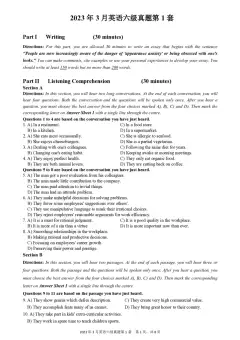
Part I Writing ( 30 minutes)
Directions, For this part, you are allowed 30 minutes to write an essay that begins with the sentence
"Nowadays more and more students are becoming increasingly aware of the importance of developing digital
skills. " You can make comments, cite examples or use your personal experiences to develop your essay. You
should write at least 150 words but no more than 200 words.
Part ][ Listening Comprehension ( 30 minutes)
Section A
Directions: In this section, you will hear two long conversations. At the end of each conversation, you will
hear four questions. Both the conversation and the questions will be spoken only once. After you hear a
question, you must choose the best answer from the four choices marked A), B), C) and D). Then mark
the corresponding letter on Answer Sheet 1 with a single line through the centre.
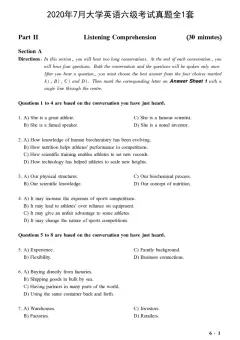
Questions 1 to 4 are based on the conversation you have just heard.
1. A) It enables people to earn more money. C) It helps people with budgeting.
B) It teaches the importance of financing. D) It introduces a novel way to invest.
2. A) Many Americans are not satisfied with their income.
B) Many Americans have no idea about how to invest.
C) Most Americans do not know how to save money.
D) Most Americans do not stick to a budget.
3. A) Keep track of his money. C) Find more sources of income.
B) Live within his means. D) Refrain from buying luxuries.
4. A) It offers a greater variety of items. C) It changes one's way of living.
B) It helps avoid unnecessary spending. D) It saves one's time for shopping.
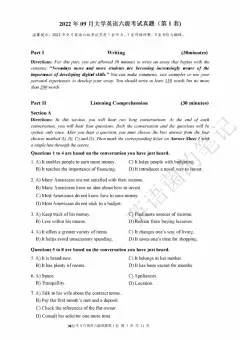
Questions 5 to 8 are based on the conversation you have just heard.
5. A) It is brand-new. C) It belongs to her mother.
B) It has plenty of rooms. D) It has been vacant for months.
6. A) Space. B) Tranquillity. C) Appliances. D) Location.
7. A) Talk to his wife about the contract terms. C) Check the references of the flat owner.
B) Pay the first month's rent and a deposit. D) Consult his solicitor one more time.
8. A) She can have a wonderful view of the pond. C) She can make friends with new neighbours.
B) She will be much closer to her work place. D) She will have plenty of space for her shoes.
Section B
Directions: In this section, you will hear two passages. At the end of each passage, you will hear three or
four questions. &th the passage and the questions will be spoken only once. After you hear a question, you
must choose the best answer from the four choices marked A ) , B) , C) and D ) . Then mark the
corresponding letter on Answer Sheet 1 with a single line through the centre.
Questions 9 to 11 are based on the passage you have just heard.
9. A) The more commercials they see, the more brands they get to know.
B) The more commercials they see, the more they adore celebrities.
第1页C) The more television they watch, the fewer conflicts in the family.
D) The more television they watch, the greater their parents' stress.
10. A) Inform children of the family's financial situation.
B) Shift children's attention to interesting activities.
C) Involve children in making purchasing decisions.
D) Help children understand advertising's intent.
11. A) Their limited cognitive ability. C) Their admiration for celebrities.
B) Their strong natural curiosity. D) Their lack of social experience.
Questions 12 to 15 are based on the passage you have just heard
12. A) Bad guys may do good deeds. C) Good guys may not always cooperate.
B) Bad guys may go unpunished. D) Good guys may get unfair treatment.
13. A) By what we do. C) In comparison with others.
B) By fair evaluation. D) In accordance with set standards.
14. A) Learn from them earnestly. C) Leave them alone temporarily.
B) Compete with them actively. D) Cooperate with them sincerely.
15. A) Being dismissed as hypocritical. C) Having to make too many sacrifices.
B) Not getting the reward they deserve. D) Being misunderstood by people around.
Section C
Directions: In this section, you will hear three recordings of lectures or talks followed by three or four
questions. The recordings will be played only once. After you hear a question, you must choose the best
answer from the four choices marked A), B), C) and D). Then mark the corresponding letter on Answer
Sheet 1 with a single line through the centre.
Questions 16 to 18 are based on the recording you have just heard.
16. A) They are increasingly aware of gender differences.
B) They engage themselves in positive recollection.
C) They begin to see the importance of friendship.
D) They make friends with peers of the same sex.
17. A) Competing for position. C) Forging close ties with friends.
B) Pursuing fashion. D) Fulfilling family obligations.
18. A) They prioritize romance over friendship.
B) They try to strengthen same-sex friendships.
C) They begin to take friendship more seriously.
D) They compete intensely for romantic partners.
Questions 19 to 21 are based on the recording you have just heard.
19. A) They regard it as a matter of sheer privacy.
B) They are worried about being turned down.
C) They fear that their condition will be made widely known.
D) They are afraid to be discriminated against once recruited.
20. A) After receiving a job offer. C) When confirming an interview.
B) During a job interview. D) Upon completing a cover letter.
21. A) Describe the true state of their health.
B) Provide all the information required.
C) Stress the irrelevance of their disability to the job.
D) Avoid mentioning the name of their disability.
Questions 22 to 25 are based on the recording you have just heard.
22. A) Their scores were least affected by music with speech.
B) It was the poorest when there was background speech.
第2页C) Their scores were most depressed with instrumental music.
D) It was disrupted by the sound of an air conditioner or fan.
23. A) It has to do with the type and volume of the background noise.
B) It has to do with short-term memory for listening comprehension.
C) It depends on the overlap in processing different kinds of information.
D) It depends on the participants' ability to concentrate on the task at hand.
24. A) Keep everything as quiet as possible. C) Use vocal material as little as possible.
B) Play nothing but instrumental music. D) Wear a pair of earphones or headphones.
25. A) Sociable people were immune to all distractions.
B) Shy quiet people were most adversely impacted.
C) Less outgoing people were more affected by silence .
. D) Confident people were unaffected by high-arousal music.
Part ][ Reading Comprehension ( 40 minutes)
Section A
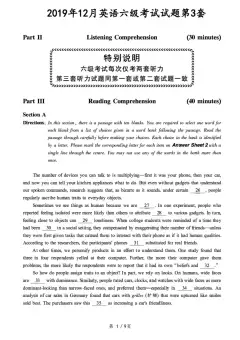
Directions: In this section, there is a passage with ten blanks. You are required to select one word for each
blank from a list of choices given in a word bank following the passage. Read the passage through carefully
before making your choices. &eh choice in the bank is identified by a letter. Please mark the corresponding
letter for each item on Answer Sheet 2 with a single line through the centre. You may not use any of the
words in the bank more than once.
The now extinct passenger pigeon has the dubious honor of being the last species anyone ever expected
to disappear. At one point, there were more passenger pigeons than any other species of bird. Rough
_g§_ of their population went as high as five billion and they accounted for around 40 percent of the
total indigenous bird population of North America in the early 19th century.
Despite their huge population, passenger pigeons were 27 to human intrusion into their nesting
territory. Their nests were shabby things and two weeks after the eggs 28 , the parent pigeons would
abandon their offspring, leaving them to take care of themselves. People discovered that these baby
pigeons were really tasty, and the adult birds were also quite ~. First the Native Americans and then
the transplanted Europeans came to consider the birds a great 30
By the 1850s, commercial trapping of passenger pigeons was proceeding at an __11_ pace. Hundreds
of thousands of the birds were being harvested every day to be made into popular pigeon pies. In addition,
large ___eL of the pigeons' nesting territory were being cleared away for planting crops and creating
pasture land. As numerous as the passenger pigeons were, they were not an ~ resource. By the
1880s, it was noticed that the bird population had become seriously 34 . The last passenger pigeons
killed in the wild were shot in 1899.
Eventually those billions and billions of birds shrank to a single remaining __1L, a passenger pigeon
named Martha, who died on September 1, 1914, in captivity at the Cincinnati Zoo. In addition to being
the end of an era, it was also the first time humans were able to exactly time the extinction of a species.
A) vulnerable F) refuge K) excerpts
B) unprecedented G) plazas L) estimates
C) tracts H) infinite M) edible
D) specimen I) hatched N) depleted
E) robust J) expired 0) delicacy
第3页Section B
Directions: In this section, you are going to read a passage with ten statements attached to it. &eh
statement contains information given in one of the paragraphs. Identify the paragraph from which the
information is derived. You may choose a paragraph more than once. & eh paragraph is marked with a
letter. Answer the questions by marking the corresponding letter on Answer Sheet 2.
Is computer coding a foreign language?
A) As computer coding has become an increasingly sought-after skill, more K-12 schools are working it
into their curriculums. Some states have considered allowing students to forgo <»!l."#) foreign language
for coding classes, despite opposition from educators.
B) There's a debate over whether it's appropriate to teach coding in elementary schools, with fierce
opinions on each side. When it comes to allowing coding to fill foreign language requirements, though,
most educators agree: Coding should be added to curriculums, but not at the expense of foreign
language classes.
C) The idea is that computer programming is a language, allowing people to communicate with machines
and programs. It's the language of the 21st century and more valuable than a natural language, some
advocates argue. The computer science field is growing faster than schools can keep up because of
budget constraints and a lack of skills training for teachers.
D) According to the 2016 U.S. News/Raytheon STEM Index, computer science jobs have helped boost
wages in the U.S., and computer-related jobs hold the top seven positions in STEM fields for highest
number of workers. Foreign language interest, on the other hand, is declining for the first time since
1995. The number of higher education language enrollments declined between 2009 and 2013 by more
than 111,000 spots, according to the Modem Language Association of America.
E) "I think the opportunity to give people a choice is important," says Florida state Senator Jeremy Ring,
who introduced a bill last year that would allow Florida students to choose between foreign language
and coding classes for the purpose of university admissions requirements. "I think if you're going to
give two years of language in high school, you might as well do computer coding."
F) The Florida bill died this year after passing 35: 5 in the state Senate when the full Legislature failed to
take action. It would have been the first state to try this initiative. Ring says that although he will be
out of office, an identical bill will be reintroduced within the next year by others on his behalf. "In the
speech I gave on the Senate floor, I said, 'We can be the first state to do this, or we can be the 50th
state to do it. It's our choice. It's going to happen,'" Ring says.
G) A Kentucky bill similar to the one in Florida was met with complaints from educators, and was then
amended to promote computer science education initiatives with no mention of foreign language
requirements. Instead, the state will provide support for higher quality certified teachers for
programming classes. Under the Washington bill, public universities would accept two years of
computer science classes in place of two years of foreign language for admission purposes. A report
detailing the opinions of state university officials is due to the Legislature by November 2017.
H) Texas passed a bill in 2013 that allows students to substitute computer coding only after they have
attempted and performed poorly in a foreign language class. Srini Mandyam, CTO and co-founder of
kid-friendly instructional coding company Tynker, believes allowing students to forgo foreign language
because they struggle with it is unproductive because every subject, whether art, math or language, is
a significant contribution to a well-rounded existence. "Many students don't fare well with algebra but
we never discuss eliminating it or. .. say chemistry is now counted as an algebra class," he said via
email. "We teach algebra because it's important and we should teach foreign language and coding for
the same reason. Exposure to a wide breadth of subjects and material results in well-rounded students
who are able to make informed decisions ... about what they want to pursue."
I) Computer science courses already fulfill a math or science high school graduation requirement in 28
第4页states and the District of Columbia, up from only 12 states in 2013. And while advocates of the bills
say they should count as foreign language instead, opponents stress the importance of balancing
computer and foreign language skills.
J) Studies show that bilingualism (~lC~) correlates with cognitive development, intelligence, memory
and problem solving abilities, according to the American Council on the Teaching of Foreign
Languages. A 2007 study showed that foreign language students outperformed their non-foreign
language peers on standardized tests after only two to three years of study. And while a 2014 report
from German and American universities suggests that programmers are using language ( but not
mathematical) regions of the brain when understanding code, critics remain wary. They say that
regardless of cognitive functions, being monolingual is a disadvantage in the increasingly international
economy, even if English has become'the de facto ($~_tl'i9) language of business.
K) "Our world is shrinking but its problems are really growing," says ACTFL National Language Teacher
of the Year Ted Zarrow, who teaches high school Latin in Westwood, Massachusetts, and has also
studied Spanish, French, German, Italian and Greek. "We need to find a way to put ourselves at the
global table and to treat each other with mutual respect. And learning languages allows us to do that
because language is not part of culture, language is culture."
L) Even with the benefits and skill sets languages provide, recruiters and employers value computer skills
more. According to the National Association of Colleges and Employers' 2016 report, study abroad and
foreign language fluency were not very influential in the employee hiring processes, but 55 percent of
employers looked for computer skills on applicants' resumes. However, although 2016 computer
science graduates can expect to make the second highest starting salary compared with other jobs this
year, the Bureau of Labor predicts the demand for computer programmers will decrease 8 percent or
by 26,500 jobs by 2024.
M) Ring says foreign language skills are important, but expresses doubt that school districts could work
both coding and language into their curriculum in a significant way because they lack the time in the
school day. "Nothing against language," he says. "I just think it's something you have to start early and
not just have something that you do for a couple of years in high school," he says.
N) Zarrow agrees that foreign language education should begin earlier, but says it is possible to work both
computer programming and foreign language learning into schools evenly. He suggests an immersive,
dual language program where students spend half the day in English and half the day in another
language, as several schools around the country have successfully implemented. "The study of language
fosters a respect for diversity, a respect for ethnicity and really a respect for language," Zarrow says.
0) Though the benefits of computer programming skills are vast, foreign language and coding experts
agree that computer science should be negotiated into curriculums rather than replacing foreign
language outright. Mandyam says the two skill sets are essential but unrelated. "Coding is an incredibly
important 21st century skill for our kids to learn, and that's why we spend so much time trying to teach
it," Mandyam says via email. "But I believe it is the same as or even really comparable to learning a
foreign language. It would be a shame to lose something so important for the sake of adding something
else, even something as important as coding. Clearly, education leaders must figure out a way to teach
both."
36. Employers attach more importance to applicants' computer skills than their language competence.
37. One U.S. state senator proposed that high school students be allowed to study either foreign language
or computer coding.
38. Learning languages broadens students' international perspective and nurtures mutual respect among
peoples, according to a high school language teacher.
39. One U.S. state will see to it that programming classes are taught by quality teachers.
40. Statistics show while computer-related jobs have been on the rise, foreign languages have become less
第5页appealing to American students since mid-1990s.
41. All school subjects are said to be essential to students' well-rounded development.
42. There is consensus among most educators that coding should be taught in schools but should not replace
foreign language.
43. One study showed that foreign language learning improved students' academic performance.
44. Being short of funding and qualified teachers, schools lag behind the fast developing computer science
field.
45. A distinguished high school language teacher also believes it is advisable to start learning a foreign
language at an earlier age.
Section C
Directions: There are 2 passages in this section. Each passage is followed by some questions or unfinished
statements. For each of them there are four choices marked A), B), C) and D). You should decide on the
best choice and mark the corresponding letter on Answer Sheet 2 with a single line through the centre.
Passage One
Questions 46 to 50 are based on the following passage.
The U.S. and China don't agree on much these days. Germany and France share a border and a
currency but are frequently at odds. The U. K. and India like to march to their own drum. But there's one
issue on which all these countries see eye to eye: Technology companies are too big, too powerful, and too
profitable. And that power is only likely to intensify, leaving governments with no choice but to confront
it head-on by taking the companies to court, passing new competition laws, and perhaps even breaking up
the tech giants.
China is the latest to implement an anti-trust crackdown, unveiling anti-monopoly rules last month.
The draft rules followed the surprise suspension of a $ 37 billion stock offering by billionaire Jack Ma's
Ant Group Co., making clear that no company can evade the government's regulation. The moves in
China coincide with accelerating efforts in the U. S. and Europe to rein in Amazon. corn, Apple,
Facebook, and Google.
"The big get bigger and bigger but without being better," says Andreas Schwab, a German member of
the European Parliament who championed a 2014 resolution to break up Google. "Growing economic
power, growing influence on local markets all over the world, and a growing concern of competitors and
consumers altogether have made it happen now. "
In this new anti-trust era, the old focus on pricing power no longer applies, because several of the
biggest tech companies have established trillion-dollar monopolies by charging consumers next to nothing.
Tech giants are increasingly assuming powerful positions in banking, finance, advertising, retail, and
other markets that force smaller businesses to rely on their platforms to reach customers.
For years, Europe alone confronted the power of digital giants. Governments were alarmed that
European companies were failing to match Silicon Valley's innovations or to stop Google and Facebook
from vacuuming up personal data and, with that, advertising revenue. Led by Margrethe Vestager, the
European Union's competition chief, countries have sought to police the market and encourage fair play.
In China the crackdown has been driven at least partly by fear that the homegrown tech industry is
becoming too powerful. The country has long championed Alibaba and Tencent, but their massive
accumulation of data on the Chinese citizenry is a growing concern for Beijing.
In the U.S., a new breed of anti-trust experts argues that consideration should be given to privacy,
control over data, workers' rights, and the overall impact on smaller companies. And the public in general
have grown increasingly skeptical of social media companies. More than 60% say the sector has a negative
effect on the country, and almost half want more regulation for social media, according to a 2020 Pew
Research Center study.
第6页46. What does the author say is the issue all major economic powers have to address?
A) How to ensure the sustainable growth of their tech giants.
B) How to keep the competitiveness of their tech companies.
C) How to break up the powerful giant tech companies.
D) How to stop tech companies from gaining monopoly.
47. What does the suspension of Ant Group Co. 's stock offering suggest?
A) All attempts to evade regulation are doomed to failure.
B) All attempts to monopolize sales must be cracked down.
C) All companies must be regulated by the government.
D) All companies, domestic or foreign, are created equal.
48. How are smaller companies impacted by tech giants' business expansion?
A) They can no longer do business independent of tech giants.
B) They are frequently denied access to tech giants' platforms.
C) They have to change marketing strategies to keep customers.
D) They no longer have the power to price their own products.
49. What have EU countries done to confront the power of digital giants?
A) They have imposed strict regulation over digital giants' advertising.
B) They have considered regulatory action to promote fair competition.
C) They have limited sales of digital giants' products.
D) They have sought to protect consumers' privacy.
50. What do Americans generally think of social media companies according to the author?
A) They are invading people's privacy. C) They are becoming untrustworthy.
B) They are increasingly influential. D) They are growing out of control.
Passage Two
Questions 51 to 55 are based on the following passage.
Born from the accessibility of mass air travel, modem international tourism has been popularized as
"holiday-making" in regions that offer comparative advantages of sand, sun and sea. Travel is often
portrayed as a tool for personal growth and tourism as an economic motor for destination countries and
cities. There is a tendency to assume that tourism is good for everyone involved.
Today the big bang of tourism drives over 1. 2 billion tourists across international borders annually.
Many popular places are literally being loved to death. Recent protests in ports of call like Venice and
Barcelona against disturbances created by cruise ships show the unfortunate consequences of emphasizing
quantity over quality in tourism.
Uncontrolled tourism development has become a primary driver of social and environmental
disruption. Tourism studies provide much documentation of the many negative social impacts of tourism
and resulting resentment that local populations direct toward visitors.
Antagonism toward tourists typically develops in mature, heavily visited destinations. Protests in
heavily visited destinations suggest that traditional tourism has overstayed its welcome.
Residents often become frustrated when the benefits of tourism are not felt locally. Although it can
generate foreign exchange, income and employment, there's no guarantee that multinational hotel chains
will allocate these benefits equitably among local communities.
On the contrary, when people stay at large resorts or on cruise ships, they make most of their
purchases there, leaving local communities little opportunity to benefit from tourist spending. These forms
of tourism widen economic and political gaps between haves and have-nots at local destinations.
In recent decades, local residents in destination communities also have found themselves negotiating
new cultural boundaries, class dynamics, service industry roles and lifestyle transformations. For example,
data show that tourism activity corresponds to increased social problems as local residents adopt the
第7页behaviors of tourists.
What does all this mean for the everyday traveler?
First, all tourists should make every effort to honor their hosts and respect local conditions. This
means being prepared to adapt to local customs and norms, rather than expecting local conditions to adapt
to travelers.
Second, tourism is a market-based activity and works best when consumers reward better performers.
In the information age, there's little excuse for travelers being uninformed about where their vacation
money goes and who it enriches.
Informed travelers also are better able to distinguish between multinational companies and local
entrepreneurs whose businesses provide direct social, environmental, and economic benefits for local
residents. Such businesses are in love with the destination and are therefore deserving of market reward.
In the long run, being a responsible traveler means ensuring net positive impacts for local people and
environments. With the information available at our fingertips, there has never been more opportunity to
do so.
51. What is the popular assumption about international tourism?
A) Its benefits may compensate for the adverse environmental consequences.
B) Its rapid development is attributed to people's improved living standard.
C) It appeals to people in places with favorable geographical conditions.
D) It contributes to the economy of destination countries and regions.
52. What do we learn from some studies about uncontrolled tourism development?
A) It gives rise to an increase in mass confrontations.
B) It incurs local residents' antagonism to tourists.
C) It inhibits the steady growth of local economy.
D) It brings in a large chunk of mobile population.
53. Why does the author say local residents of popular destinations often feel frustrated?
A) They fall victim to social conflicts and environmental disturbances.
B) They have little opportunity to enjoy themselves on cruise ships.
C) They cannot find employment in multinational hotel chains.
D) They do not think they benefit as much as they deserve.
54. How does the author say local residents in destination communities respond to tourism activity?
A) They endeavor to adapt to it. C) They immerse tourists in their culture.
B) They readily adopt new lifestyles. D) They try to upgrade their business models.
55. What can tourists do to exert more positive impacts on the tourist destinations?
A) Show interest in local customs and lifestyles. C) Use the services provided by local businesses.
B) Seek possibilities to invest in local companies. D) Give favorable comments about their services.
Part N Translation ( 30 minutes)
Directions: For this part, you are allowed 30 minutes to translate a passage from Chinese into English. You
should write your answer on Answer Sheet 2.
Ns.*(Spring Festival couplets) Jt. 'f 00 A.51k, ._/t_• ~ €1!;-,t-~~ JJ %-, •* 1£1-zj-it 6J ;fi, Im ~#t~t
(horizontal scrollH.liA, it5J ;fi>#t¥l:.Jfl ½@.A ,W, @.~ ,tH.:i:Jt\,_t, h@.f\:.4..-t ~ ,½@.1\4..~'t, •*m..tLk.
nA~~-;fi>n•_t~, .*a!i#6J~&tf700#~#~~#A,~6J#~~-~~.~~~*, #t~8I
~~~ffm4*
4*~~-.~Jt..-_t~~, •*~~~~k~M~±~a!i~~.#L~M~A~,
at ,A1 /Ji;t½~-if-Jlj. ~ c. ~J1..s(..µjf-;f J-,
第8页