





文档内容
英语四级-长篇阅读-真题
2015.06-2023.12目录
2023年12月大学英语四级长篇阅读第1套………………………………………………………1
2023年12月大学英语四级长篇阅读第2套……………………………………………………3
2023年12月大学英语四级长篇阅读第3套……………………………………………………5
2023年06月大学英语四级长篇阅读第1套……………………………………………………7
2023年06月大学英语四级长篇阅读第2套……………………………………………………9
2023年06月大学英语四级长篇阅读第3套……………………………………………………11
2023年03月大学英语四级长篇阅读全1套……………………………………………………13
2022年12月大学英语四级长篇阅读第1套……………………………………………………15
2022年12月大学英语四级长篇阅读第2套…………………………………………………17
2022年12月大学英语四级长篇阅读第3套……………………………………………………19
2022年09月大学英语四级长篇阅读全1套……………………………………………………21
2022年06月大学英语四级长篇阅读第1套……………………………………………………23
2022年06月大学英语四级长篇阅读第2套…………………………………………………25
2021年12月大学英语四级长篇阅读第1套……………………………………………………27
2021年12月大学英语四级长篇阅读第2套…………………………………………………29
2021年12月大学英语四级长篇阅读第3套……………………………………………………31
2021年06月大学英语四级长篇阅读第1套…………………………………………………33
2021年06月大学英语四级长篇阅读第2套……………………………………………………35
2021年06月大学英语四级长篇阅读第3套……………………………………………………37
2020年12月大学英语四级长篇阅读第1套……………………………………………………39
2020年12月大学英语四级长篇阅读第2套…………………………………………………41
2020年12月大学英语四级长篇阅读第3套…………………………………………………43
2020年09月大学英语四级长篇阅读第1套………………………………………………………45
2020年09月大学英语四级长篇阅读第2套……………………………………………………47
2020年07月大学英语四级长篇阅读全1套………………………………………………49
2019年12月大学英语四级长篇阅读第1套……………………………………………………51
2019年12月大学英语四级长篇阅读第2套……………………………………………………53
2019年12月大学英语四级长篇阅读第3套……………………………………………………55
2019年06月大学英语四级长篇阅读第1套……………………………………………………57
2019年06月大学英语四级长篇阅读第2套……………………………………………………59
2019年06月大学英语四级长篇阅读第3套…………………………………………………61
2018年12月大学英语四级长篇阅读第1套…………………………………………………63
2018年12月大学英语四级长篇阅读第2套…………………………………………………65
2018年12月大学英语四级长篇阅读第3套……………………………………………………67
2018年06月大学英语四级长篇阅读第1套……………………………………………………69
2018年06月大学英语四级长篇阅读第2套……………………………………………………71
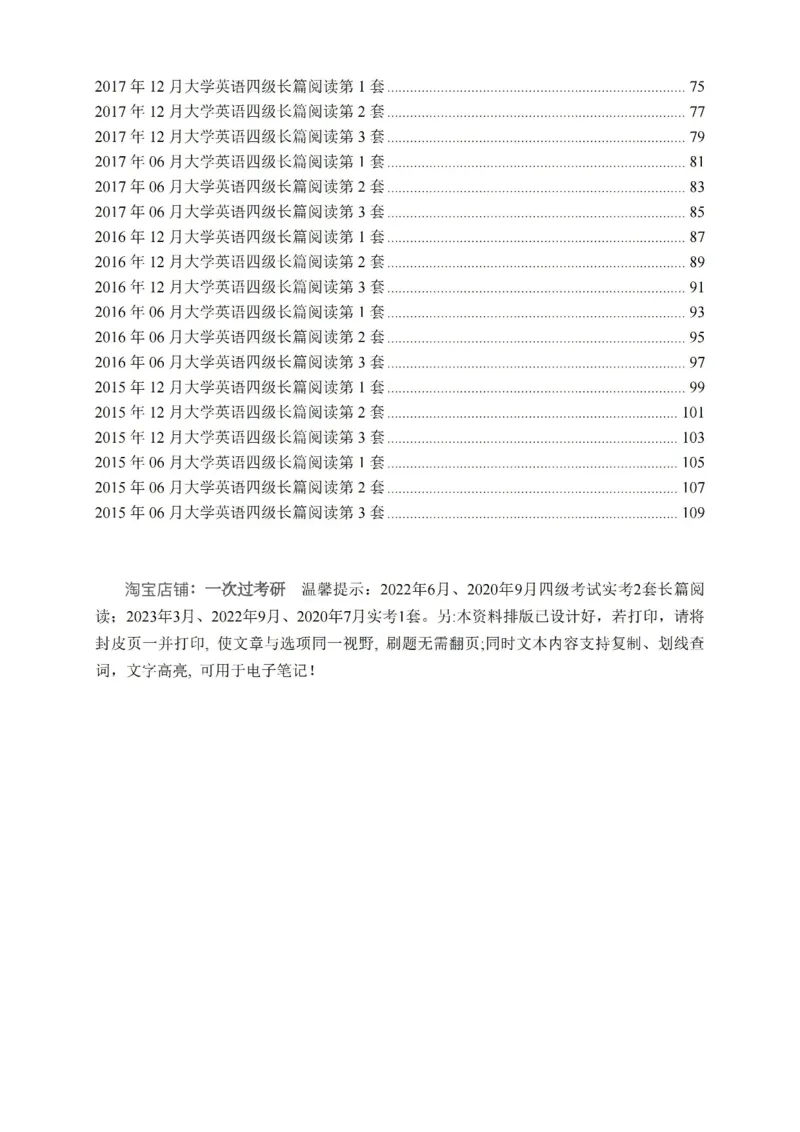
2018年06月大学英语四级长篇阅读第3套……………………………………………………732017年12月大学英语四级长篇阅读第1套……………………………………………………75
2017年12月大学英语四级长篇阅读第2套………………………………………………77
2017年12月大学英语四级长篇阅读第3套…………………………………………………79
2017年06月大学英语四级长篇阅读第1套…………………………………………………81
2017年06月大学英语四级长篇阅读第2套……………………………………………………83
2017年06月大学英语四级长篇阅读第3套………………………………………………………85
2016年12月大学英语四级长篇阅读第1套……………………………………………………87
2016年12月大学英语四级长篇阅读第2套………………………………………………………89
2016年12月大学英语四级长篇阅读第3套……………………………………………………91
2016年06月大学英语四级长篇阅读第1套…………………………………………………93
2016年06月大学英语四级长篇阅读第2套………………………………………………………95
2016年06月大学英语四级长篇阅读第3套………………………………………………………97
2015年12月大学英语四级长篇阅读第1套…………………………………………………99
2015年12月大学英语四级长篇阅读第2套…………………………………………………101
2015年12月大学英语四级长篇阅读第3套…………………………………………………103
2015年06月大学英语四级长篇阅读第1套…………………………………………………105
2015年06月大学英语四级长篇阅读第2套…………………………………………………107
2015年06月大学英语四级长篇阅读第3套…………………………………………………109
淘宝店铺:一次过考研 温馨提示:2022年6月、2020年9月四级考试实考2套长篇阅
读;2023年3月、2022年9月、2020年7月实考1套。另:本资料排版已设计好,若打印,请将
封皮页一并打印,使文章与选项同一视野,刷题无需翻页;同时文本内容支持复制、划线查
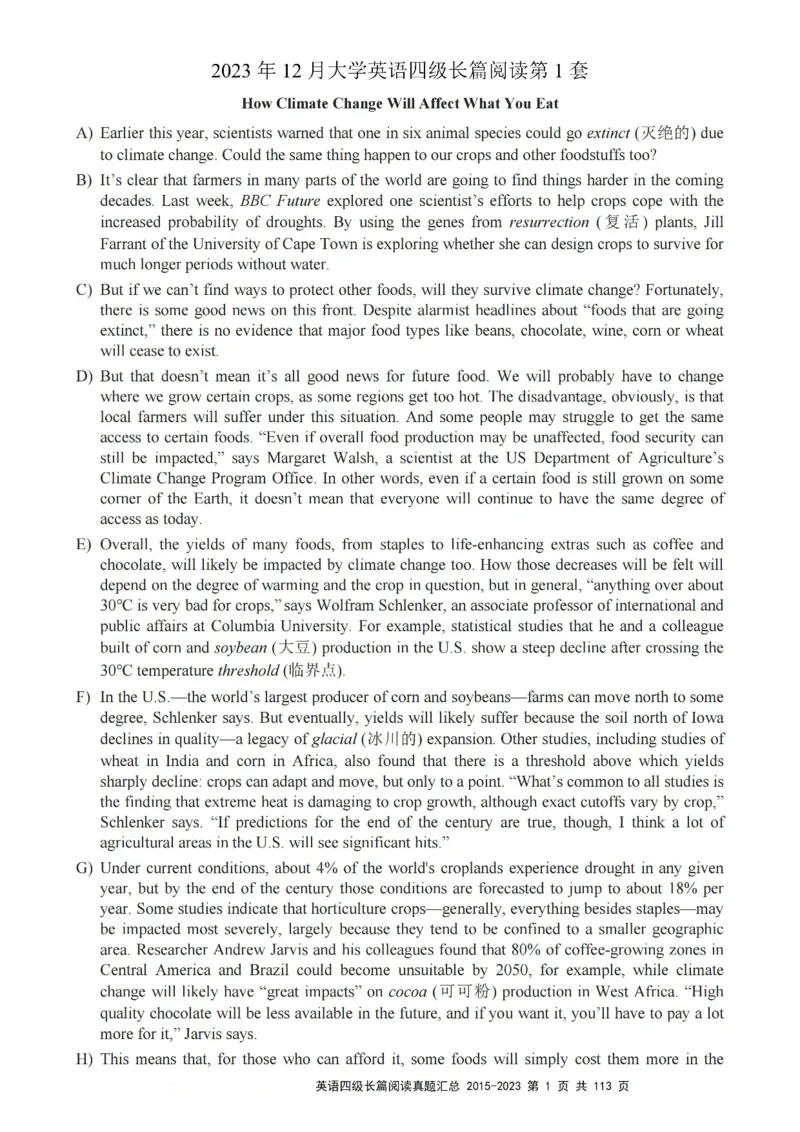
词,文字高亮,可用于电子笔记!2023年12月大学英语四级长篇阅读第1套
How Climate Change Will Affect What You Eat
A)Earlier this year, scientists warned that one in six animal species could go extinct(灭绝的)due
to climate change. Could the same thing happen to our crops and other foodstuffs too?
B)It's clear that farmers in many parts of the world are going to find things harder in the coming
decades. Last week, BBC Future explored one scientist's efforts to help crops cope with the
increased probability of droughts. By using the genes from resurrection(复活)plants, Jill
Farrant of the University of Cape Town is exploring whether she can design crops to survive for
much longer periods without water.
C)But if we can't find ways to protect other foods, will they survive climate change? Fortunately,
there is some good news on this front. Despite alarmist headlines about "foods that are going
extinct,” there is no evidence that major food types like beans, chocolate, wine, corn or wheat
will cease to exist.
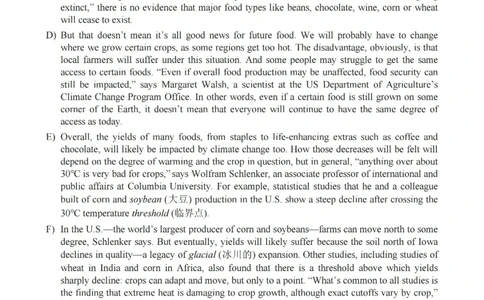
D) But that doesn't mean it's all good news for future food. We will probably have to change
where we grow certain crops, as some regions get too hot. The disadvantage, obviously, is that
local farmers will suffer under this situation. And some people may struggle to get the same
access to certain foods.“Even if overall food production may be unaffected, food security can
still be impacted,”says Margaret Walsh, a scientist at the US Department of Agriculture's
Climate Change Program Office. In other words, even if a certain food is still grown on some
corner of the Earth, it doesn't mean that everyone will continue to have the same degree of
access as today.
E)Overall, the yields of many foods, from staples to life-enhancing extras such as coffee and
chocolate, will likely be impacted by climate change too. How those decreases will be felt will
depend on the degree of warming and the crop in question, but in general,"anything over about
30℃ is very bad for crops,"says Wolfram Schlenker, an associate professor of international and
public affairs at Columbia University. For example, statistical studies that he and a colleague
built of corn and soybean(大豆)production in the U.S. show a steep decline after crossing the
30℃ temperature threshold (临界点).
F)In the U.S.—the world's largest producer of corn and soybeans—farms can move north to some
degree, Schlenker says. But eventually, yields will likely suffer because the soil north of lowa
declines in quality—a legacy of glacial (冰川的) expansion. Other studies, including studies of
wheat in India and corn in Africa, also found that there is a threshold above which yields
sharply decline: crops can adapt and move, but only to a point."What's common to all studies is
the finding that extreme heat is damaging to crop growth, although exact cutoffs vary by crop,"
Schlenker says.“If predictions for the end of the century are true, though, I think a lot of
agricultural areas in the U.S. will see significant hits."
G)Under current conditions, about 4of the world's croplands experience drought in any given
year, but by the end of the century those conditions are forecasted to jump to about 18per
year. Some studies indicate that horticulture crops—generally, everything besides staples—may
be impacted most severely, largely because they tend to be confined to a smaller geographic
area. Researcher Andrew Jarvis and his colleagues found that 80of coffee-growing zones in
Central America and Brazil could become unsuitable by 2050, for example, while climate
change will likely have“great impacts"on cocoa(可可粉)production in West Africa.“High
quality chocolate will be less available in the future, and if you want it, you'll have to pay a lot
more for it,” Jarvis says.
H)This means that, for those who can afford it, some foods will simply cost them more in the
英语四级长篇阅读真题汇总 2015-2023 第 1 页 共 113 页future. But for poorer people, those same price jumps will likely cause certain foods to go
extinct from their diets.“The more you reduce, the shorter the supply, and the higher the price
will jump,”Schlenker says.
I) Another potential climate change-induced problem is our dependence on commodity crops—
wheat, soybeans, corn and rice—which currently provide humanity with 75of its calories,
either directly or indirectly through the animals we raise on those crops. Jarvis and his
colleagues also found that, over the past five decades, the world has seen an increasing
standardisation of diets; the foods we eat globally today are 36more similar than they were in
1961. While this can be good news for the world's poorest people who now consume more
calories, protein and fat than in the past, homogeneity(同一性)and over-dependence on a
handful of staples leaves us vulnerable to threats such as drought, disease and pests—all of
which are predicted to worsen in many parts of the world as a result of climate change.
J) There are ways we could soften the coming blow to the global food supply, however. Like
Farrant's work with resurrection crops, a number of companies, organisations and researchers
are aiming to create drought-and temperature-resistant crops through genetic engineering and
conventional breeding. For now, the jury is still out as to how successful those endeavours will
be.“The people at Monsanto who I've talked to are much more optimistic that they'll be able to
engineer heat-tolerant crops,”Schlenker says.“On the other hand, scientists at the USDA who
I've spoken with are much more cautious.”
K)Until genetic engineering comes to fruition, other strategies might also help in some places,
including applying more fertiliser, implementing better irrigation, using machinery that gets
crops out of the field faster or installing storage facilities to delay spoilage.“Many places could
benefit a great deal just by using technologies that already exist,"Walsh says.“General farm
management can go a long way toward easing changes."
L)Finally, diversifying our diet away from heat-sensitive wheat, corn, rice and other crops could
also help."We've seen profound changes in the last decades in what we eat largely as a result of
international trade, and I think that trend toward more diversification will continue," M Jarvis
says.“Depending on a greater number of plant species creates a more vigorous and less risky
food system—and one that provides a broader range of nutritional requirements."
36.One consequence of climate change is that some people may not have adequate access to certain
foods.
37. People around the world are eating foods more similar than what they used to eat.
38.A recent news report talked about scientific efforts to help crops survive droughts through
genetic engineering.
39. It is predicted that climate change will affect the availability and price of quality chocolate.
40.People wonder if certain crops and foodstuffs could disappear like some animal species due to
climate change
41.Although farms in the U.S. can move a bit northward, crop yields may decrease.
42.One possible solution to the food security problem is diversification of diet.
43.It remains unsettled whether the global food supply problem can be solved by creating heat-
tolerant crops through genetic engineering.
44. Poor people may have to give up eating certain foods because of their high prices.
45.A number of existing farming technologies could be used to reduce the negative effect of
climate change on food production.
英语四级长篇阅读真题汇总 2015-2023 第2 页 共 113 页2023年12月大学英语四级长篇阅读第2套
More fathers are taking paternity leave, but mothers are still doing all the work
A)Attitudes towards paternity leave(陪产假)have drastically changed in America in the last five
years as more fathers feel comfortable taking extended time off, but gender bias persists when it
comes to career prospects and the home, according to a new study of working parents.
B)Research by the Boston College Center for Work & Family, which surveyed new parents at four
large US companies who were qualified for taking at least six weeks paid parental leave, found
that 81of the 1,240 employees surveyed said the notion of fathers taking leave has become
more acceptable.
C) Of those surveyed, 62of fathers took the maximum amount of time off compared to 93of
mothers, and around three-quarters of workers said their employer was equally supportive of
mothers and fathers taking parental leave and over half said leave policies had made workplace
culture better.
D)The US is one of only three countries in the world not to offer statutory(法定的) paid leave,but
increasingly states and companies are starting to take up the issue. So far, eight states and the
District of Columbia have their own paid family leave laws.
E)Brad Harrington, executive director of the center and lead author of the study, estimates only
20to 30of companies in the US offer paid parental leave. He feels the research findings
reflect an obvious change in corporate attitudes to new fathers taking time off.
F)“We did a study on paternity leave five years ago. Compared with those findings, these numbers
were shocking to me. I did not expect 80of people to say the organisation finds dads taking
this leave acceptable and three-quarters to say it's equally supportive of women and men taking
leave," Harrington said.
G)The previous study found that nearly three-quarters of fathers saw two to four weeks as an
appropriate duration for paternity leave and 76said they would prefer not to take all their time
off at once
H)Since then, there have been a number of legal cases against companies involving paternity
leave—including cases against JPMorgan Chase and Estee Lauder—which have helped put
pressure on companies to make their parental leave policies gender neutral.
I) However, the study also shows how traditional gender roles endure both at work, where more
women than men reported changes in their perceived career potential, and at home—even
among workers who claim to have a strong desire for equality.
J) The vast majority of men, 97?said one of the top reasons to take leave was to share caregiving
with their partner. But when they were asked about how caregiving and household tasks were
divided, their answers painted a different picture. While about 75of employees said both
genders should give the same amount of care, the majority of men and nearly half of women
admitted that in reality the female actually did most of it. A tiny fraction, 2?of men said they
did more of the childcare.
K)Men and women's experiences of the return to work following parental leave were also
considerably different. Of the women surveyed,32reported a downturn in their job
satisfaction, while 14said it increased. In comparison, 17of men said their job
satisfaction went down and 20said it went up. Meanwhile, more women reported an
increase in their responsibilities and manager expectations after childbirth. Half of the women
said they used flexible work arrangements after becoming a parent, while just 27of men did.
Similar percentages of men and women said they enjoyed their careers and that it gave them a
sense of achievement, while around half of women and 44of men said it was a key part of
英语四级长篇阅读真题汇总 2015-2023 第 3 页 共 113 页their identity
L) On the subject of career advancement, 59of women and 49of men said leave could be
limiting and both genders said they feared it would have an impact on their progress long-term.
But on opportunity for promotion, more than double the number of women, 30ompared with
15of men, believed their chances to be lower after becoming a parent. Despite progress, the
struggle for women to reach the highest positions of power is demonstrated in this year's
Fortune 500 list, which featured a record 33 female CEOs, but this still represents a tiny fraction
of the total.
M)Harrington said culture change depends on companies putting more focus on men and their
responsibilities.“By that I mean companies need to give men paternity leave and encourage
men to take time off to be with their kids early on in the kids' life. They also need to recognise
that men have to make significant adjustments when they become parents. Companies cannot do
all these things to enhance women's advancement and then turn around and say, ‘Oh, but we
don't expect the men to take over for the women at home.""
N)In May, the American Civil Liberties Union(ACLU) and Outten & Golden LLP announced a
historic class-action $ 5m settlement with JPMorgan Chase on behalf of male employees who
claim they were illegally denied access to paid parental leave. Derek Rotondo, 35, filed the
discrimination charge against his company after he was allegedly told by his HR department
that mothers were considered primary caregivers. Thus, they were allowed to take 16 weeks of
paid parental leave. Fathers, however, could take just two weeks.
O)The father of two from Columbus, Ohio, who still works at the company as an associate and
investigator, said he has witnessed a“domino effect (多米诺效应)”across companies since the
settlement, but that there is still substantial progress to be made towards changing attitudes
towards paternity leave.
P)“I do think there's still some way to go…there's still going to be sort of the unstated expectation
for new dads to essentially come right back to work, but I think the research is showing that's
starting to change.”He said equal parental leave is an essential component to creating gender
equality in the workplace.“The old standard of women staying home, having babies and
cooking doesn't apply and hasn't applied for a long time."
36.In the absence of Federal legislation, some states in the US have passed laws concerning paid
family leave.
37. Most fathers admitted that even during their paternity leave they actually did much less
childcare than the mother.
38.According to one father, equal parental leave is indispensable to achieving gender equality in
the workplace.
39. One survey indicated there is now less objection to paternity leave.
40.Compared to five years ago,according to one researcher, many more people said their
organisation gave the same support to men and women taking parental leave.
41.One study finds that even workers who claim to desire gender equality stick to traditional
gender roles both at work and at home.
42. The majority of workers surveyed said parental leave policies had improved workplace culture.
43. In spite of progress, the number of women in top positions of big companies remains extremely
small.
44. According to one estimate, less than one third of companies in the US provide paid parental
leave
45.A number of lawsuits have pressured companies to formulate gender neutral policies on parental
leave.
英语四级长篇阅读真题汇总 2015-2023 第 4 页 共 113 页2023年12月大学英语四级长篇阅读第3套
Teenagers and social networking
A)As a parent of two boys at primary school, I worry about the issues associated with teenagers
and social media. Newspapers are constantly filled with frightening accounts of drug addiction
and aggressive behaviour supposedly caused by violent videogames. But even when these
accounts touch on real concerns, they do not really reflect the great mass of everyday teenage
social behaviour: the online chat, the texting, the surfing, and the emergence of a new teenage
sphere that is conducted digitally.
B)New technologies always provoke generational panic, which usually has more to do with adult
fears than with the lives of teenagers. In the 1930s, parents worried that radio was gaining “an
irresistible hold of their children”. In the 80s, the great danger was the Sony Walkman(随身
听).When you look at today's digital activity, the facts are much more positive than you might
expect.
C)Indeed, social scientists who study young people have found that their digital use can be
inventive and even beneficial. This is true not just in terms of their social lives, but their
education too. So if you use a ton of social media, do you become unable, or unwilling, to
engage in face-to-face contact? The evidence suggests not. Research by Amanda Lenhart of the
Pew Research Centre, a US think tank, found that the most passionate texters are also the kids
most likely to spend time with friends in person. One form of socialising doesn't replace the
other. It expands it.
D)“Kids still spend time face to face,” Lenhart says. Indeed, as they get older and are given more
freedom, they often ease up on social networking. Early on, the web is their “third space”, but
by the late teens, it's replaced in reaction to greater independence. They have to be on Facebook,
to know what's going on among friends and family, but they are ambivalent(有矛盾心理的)
about it, says Rebecca Eynon, a research fellow at the Oxford Internet Institute, who has
interviewed about 200 British teenagers over three years. As they gain experience with living
online, they begin to adjust their behaviour, struggling with new communication skills, as they
do in the real world.
E)Parents are wrong to worry that kids don't care about privacy. In fact, they spend hours
changing Facebook settings or using quick-delete sharing tools, such as Snapchat, to minimise
their traces. Or they post a photograph on Instagram, have a pleasant conversation with friends
and then delete it so that no traces remain.
F)This is not to say that kids always use good judgment. Like everyone else, they make
mistakes—sometimes serious ones. But working out how to behave online is a new social skill.
While there's plenty of drama and messiness online, it is not, for most teens, a cycle of non-stop
abuse: a Pew study found only 15of teens said someone had bullied them online in the last 12
months
G)But surely all this short-form writing is affecting literacy? Certainly, teachers worry. They say
that kids use overly casual language and text-speak in writing, and don't have as much patience
for long reading and complex arguments. Yet studies of first-year college papers suggest these
anxieties may be partly based on misguided nostalgia(怀旧).When Stanford University scholar
Andrea Lunsford gathered data on the rates of errors in“freshman composition” papers going
back to 1917, she found that they were virtually identical to today.
H)But even as error rates stayed stable, student essays have blossomed in size and complexity.
英语四级长篇阅读真题汇总 2015-2023 第5 页 共 113 页They are now six times longer and, unlike older"what I did this summer" essays, they offer
arguments supported by evidence. Why? Computers have vastly increased the ability of students
to gather information, sample different points of view and write more fluidly.
I) When linguist Naomi Baron studied students, instant messaging even there she found
surprisingly rare usage of short forms such as“u”for“you”, and as students got older, they
began to write in more grammatical sentences. That is because they want to appear more adult,
and they know how adults are expected to write. Clearly, teaching teens formal writing is still
crucial, but texting probably isn't destroying their ability to learn it.
J) It is probably true that fewer kids are heavy readers compared with two generations ago, when
cheap paperbacks boosted rates of reading. But even back then, a minority of people-perhaps
20??were lifelong heavy readers, and it was cable TV, not the internet, that struck a blow at
that culture in the 1980s.Still, 15or more of kids are found to be deeply bookish. In fact, the
online world offers kids remarkable opportunities to become literate and creative because young
people can now publish ideas not just to their friends, but to the world. And it turns out that
when they write for strangers, their sense of “authentic audience” makes them work harder,
push themselves further, and create powerful new communicative forms.
K)Few would deny that too much time online can be harmful. Some of the dangers are emotional:
hurting someone from a distance is not the same as hurting them face to face. If we're lucky, the
legal environment will change to make teenagers' online lives less likely to haunt them later on.
Just last week, California passed a law allowing minors to demand that internet firms erase their
digital past and the EU has considered similar legislation.
L)Distraction is also a serious issue. When kids switch from chat to music to homework, they are
indeed likely to have trouble doing each task well. And studies show that pupils don't fact-
check information online—“smart searching” is a skill schools need to teach urgently. It's also
true that too much social networking and game playing can cut into schoolwork and sleep. This
is precisely why parents still need to set firm boundaries around it, as with any other distraction.
M)So what's the best way to cope?The same boring old advice that applies to everything in
parenting: moderation. Rebecca Eynon argues that it's key to model good behaviour. Parents
who stare non-stop at their phones and don't read books are likely to breed kids who will do the
same. As ever, we ought to be careful about our own behaviour.
36. Research has found the use of digital technology benefits not only teenagers' social lives but
also their studies.
37. It is urgent that schools teach kids how to verify online information.
38.Students now write longer and more complex essays than their counterparts in previous decades
while the error rates remain unchanged.
39. Newspaper reports of teenagers give a false picture of their behaviour.
40.Parents are advised to mind their own digital behaviour and set a good example for their kids.
41. Contrary to parents' belief, kids try hard to leave as few traces as possible on the web.
42. Students' ability to learn formal writing is unlikely to be affected by texting.
43. Historically, new technologies have always caused great fears among parents.
44.The reading culture was seriously affected by cable television some four decades ago.
45.Teachers say that kids' writing is too casual, using language characteristic of text messages.
英语四级长篇阅读真题汇总 2015-2023 第6 页 共 113 页2023年 06月大学英语四级长篇阅读第1套
The spoken web
A)We're growing more used to chatting to our computers, phones and smart speakers through
voice assistants like Amazon's Alexa, Apple's Siri and Microsoft's Cortana. Blind and partially
sighted people have been using text-to-speech converters for decades.
B)Out of these assistants, Siri is the most well-known. The assistant uses voice inquiries and a
natural-language user interface(界面)to answer questions. The software adapts to users’
individual language usages, searches, and preferences, with continuing use.
C)Some think voice could soon take over from typing and clicking as the main way to interact
online. But what are the challenges of moving to "the spoken web"?
D)What use is written online content if you can't read? That is the situation facing illiterate (不识
字的)African farmers. They are often denied crucial information the web offers many others.
With a literacy rate in some parts of Africa at only 22.6?farmers are often"underpaid for their
produce because they might be unaware of the prevailing prices," says Francis Dittoh, a
researcher behind Mr Meteo, a speech-based weather information service.
E)“The most frequently heard complaint is about rainfall predictions,”says Mr Dittoh, who lives
in Tamale, northern Ghana.“They tell us the methods their forefathers used to predict the
weather don't seem to work as well these days." This is down to climate change, he believes.
Yet knowing when it's going to rain is vital for farmers wanting to sow seeds, irrigate crops or
take their animals out to the fields to feed on grass.
F)Mr Dittoh says the idea of converting online weather reports into speech came from the
farmers themselves, after a workshop in the village of Guabuligah.“They came up with this,”
he says. Mr Meteo takes the online weather forecast, converts it to a short recording in the
appropriate language and makes it available on a basic phone. Farmers ring up to receive the
information. The local language Dagbani is spoken by 1.2 million people but is not served by
any online translation applications. The service was designed to be cheap and easy to run, says
Mr Dittoh. He plans to begin field tests this month, working with Tamale's Savanna
Agricultural Research Institute.
G)The spoken web could also help the one-in-five adults in Europe and the U.S. with poor reading
skills. But building the spoken web-web-to-voice and voice-to-web—isn't straightforward. For
software to understand pizza is served at Italian restaurants is easy. To cover multiple domains
and to be able to have a conversation with users on every single topic is still a long way off.
H)So although many computer assistants can answer simple questions about the weather and play
music for us, anything resembling a wide-ranging human conversation is decades away.
Artificial intelligence just isn't smart enough yet. Even turning your voice into text—automatic
speech recognition—is one of the hardest problems to solve,as there are as many ways to
pronounce things as there are people on the planet.
I) Siri has often been praised for its ability to interpret our casual language and deliver very
specific and accurate results, sometimes even providing additional information. But it is still
somewhat restricted, particularly when the language moves away from stiffer commands into
more human interactions. In one example, the phrase"Send a text to Jason, Clint, Sam, and Lee
saying we're having dinner at Silver Cloud restaurant" was interpreted as sending a message to
Jason only, containing the text “Clint Sam and Lee saying we're having dinner at Silver Cloud
英语四级长篇阅读真题汇总 2015-2023 第 7 页 共 113 页restaurant”. It has also been noted that Siri lacks a proper editing function, as saying“Edit
message to say: we're at Silver Cloud restaurant and you should come find us"generates “Clint
Sam and Lee saying we're having dinner at Silver Cloud restaurant to say we're at Silver Cloud
restaurant and you should come find us”.
J) Using voice interaction feels far more intimate than surfing the net the old-fashioned way.
This is intentional as the informal tone of the assistant helps create an emotional attachment.
But if something speaks, it must also listen. Our phones are always near us and they are
collecting data about us all the time. This has already raised privacy concerns. The American
Civil Liberties Union has stated that digital assistants create a threat to privacy from hackers.
Some people have other concerns. They worry assistants will one day be used to deliver
advertising directly to us.
K)But digital voices need more personality to make them popular. Robots are not yet witty, Siri is
boring. The benefits of using voice instead of tapping fingers obviously. depend on the context.
Doctors completing online forms about their patients by speech, for example, can dictate 150
words a minute, three times faster than typing on a keyboard. This enables them to spend less
time on administration and more time with patients.
L) Last year, speech recognition company Nuance helped a doctors'surgery in Dukinfield, near
Manchester, set up a speech system for the practice's six doctors. Now they can dictate notes on
a patient's health condition and treatment and a smart assistant automatically enters the
information into the right fields on a web form. Previously, the doctors made voice recordings
that were then transcribed by secretaries—a process that was costly and likely to cause delays.
The new system means letters to patients now have more detail.
M) Using voice also makes sense when you're doing other things with your hands. Think about
when you're cooking, and you just want to know what the next step in the recipe is. Your hands
are covered with oil; you're not going to get on the iPad, so it's a lot more natural to talk. And
speech obviously makes sense when you're driving. In the U.S., 29of drivers admit they surf
behind the wheel, according to insurance firm State Farm. This is up from 13in 2009. No
wonder using mobile phones while driving causes more crashes a year than drink driving, says
the U.S. National Safety Council.
36.According to Francis Dittoh, their speech-based weather information service was meant to be
inexpensive and easy to use.
37. Using voice instead of typing enables doctors to spend more time taking care of patients.
38.It is extremely difficult to convert voice into text because of different pronunciations.
39.African farmers unable to read often don't have access to important information conveyed
online.
40.Some phone users worry advertisers will take advantage of voice assistants to send ads directly
to them.
41. The spoken web is helpful when one's hands are occupied.
42.Some people believe online interaction would soon depend mainly on voice.
43. Setting up a spoken web is by no means an easy task.
44.Weather information is extremely important to farmers.
45.Some people are concerned about privacy because their phones are constantly collecting their
personal information.
英语四级长篇阅读真题汇总 2015-2023 第 8 页 共 113 页2023年06月大学英语四级长篇阅读第2套
New Formula One Chief Hopes to Grab Americans' Attention
A)For the past four decades, the leader of Formula One car racing, one of the biggest annual
sporting series in the world, was Bernie Ecclestone, a former motorcycle parts dealer who built
it into an international presence essentially on his own.
B)A skilled backroom operator who speaks without a filter, Ecclestone said often that in his
opinion, the sport was at its best when he was allowed to act as “a dictator.”
C)Yet now the dictator is gone. After an American company, Liberty Media, acquired the Formula
One competition recently, Chase Carey—a former executive with Fox Broadcasting Company
and DirecTV who by his own admission is not a fierce racing fan—was named to replace
Ecclestone and to try to renovate the organization's management, reach and ambition.
D)Among the goals, Carey said in an interview on Tuesday, is one that just about every global
sport seems interested in chasing: increasing interest in the United States.“People have said
we're going to 'Americanize'it,"Carey said.“And we're not going to do that totally. But
realistically, there are some elements of Americanization that the sport could use.”
E)While Formula One commands enormous audiences throughout much of the world, many
American sports fans know it as that other motorsport, the one that is not Nascar(纳斯卡车赛).
Formula One teams race far more technologically advanced vehicles around tracks all over the
world-in magnificent events in places like Malaysia, Monaco, Singapore and the United Arab
Emirates, and on tradition-rich tracks like Silverstone in England and Monza in Italy too.
F)The series has an annual race in Austin, Texas. But within "a few years," Carey said, he plans to
bring another to a destination American city, like New York, Los Angeles, Miami or Las Vegas.
Carey's ambitious plan is two-fold: first, change the business model of Formula One, which he
said was a“one-man show”under Ecclestone that had a largely narrow vision when it came to
negotiating partnership deals; and second, alter the way fans experience the sport, both in person
and remotely, so that connections between the audience and people within the series are easier
to make.
G)Increased digital access for fans, a more behind-the-scenes experience for broadcast viewers and
innovation in areas like virtual reality—what is it like to speed around a track inside a
Ferrari?—are among the possibilities.“The sport has clearly been underserved," Carey said.“It
doesn't do anything digitally. There's no marketing. It doesn't tell any stories. The goal in this
is to make the fans connect to the live experience as much as possible, and the tools you have to
do that, we're not using at all."
H)The larger question, though, is a familiar one: Is there room for Formula One in the ever-
crowded sports landscape of the United States? Opinions vary, particularly because viewing
habits among consumers continue to evolve. John Bloom,a professor at Shippensburg
University who has studied American sports history, said the biggest challenge for any sport
trying to increase its presence in the United States was framing itself in a way that had lasting
appeal.“Sports generally become popular in some way because they establish a narrative,”
Bloom said.“When I think of motorsports in the U.S., what we all think of is Nascar, and the
narrative of Nascar is sort of rural, white, working-class Americans, mostly in the South,
connecting with the atmosphere of those races. That's the narrative. When I think of the
narrative of Formula One, it's a very different kind of audience."
英语四级长篇阅读真题汇总 2015-2023 第 9页 共 113 页I) That difference, Carey said, is significant. While some might immediately link Formula One to
Nascar in terms of American growth, Carey said Formula One's brand research had indicated
there was very little crossover; rather, Formula One fans generally cite other so-called elite
events, like Wimbledon or the Ryder Cup, as competitions they enjoy."Other than they're both
cars, the Nascar fan base is a very different fan base," Carey said."It's a very regional fan base.
Formula One is a global, famous brand of stars. These are machines that shock and awe you.”
J) Carey's background is in deal making and innovation. At Fox Broadcasting Company, he was a
top advisor for years, known for his skill in helping to lead the launch of the company into
sports, as well as the start of Fox News Channel. After going to DirecTV, he positioned the
satellite provider as a mainstream option in millions of households.
K)Now, after Liberty Media paid $ 4.4 billion to acquire Formula One, he is charged with making
the investment pay off."I think they can build Formula One in the U.S.," said Patrick Crakes, an
executive at InVivo Media Group who spent 25 years at Fox Broadcasting Company before
leaving in 2016 as a senior manager at Fox Sports.“People don't work on their cars anymore.
They don't want that connection anymore. It's about technology and pushing the limits. It's
about speed, danger and risk. And Formula One has that more than any other racing series."
L)That is what hooked Carey, and he said he thought his experience was not unusual. He recalled
attending Formula One's Monaco race last year and being overwhelmed by the ceremony
leading up to the event, the way the race charmed the city for days ahead of the start. In his
mind, it felt like a Super Bowl (超级碗橄榄球赛).
M) Then, on race day, he watched as the cars rocketed out of a tunnel and went screaming toward a
tight turn with the city's harbor and the Mediterranean Sea in the background framing the scene.
He was fascinated.“You can't help but be awed," he said,"and I think that feeling can be
translated to the viewer.”
N)He added:“The broader sport is a little too inward-looking, and we need to be more open. In
some ways, I'm glad to be coming from the outside. The guys who are in the sport forever are
sitting there saying:‘We can't do that. We can't do that because it's never been done that
way.”
36.Chase Carey believes greater use should be made of digital technology to make Formula One
more accessible to its fans.
37. Chase Carey was deeply impressed by the ceremony preceding last year's Monaco race.
38.One of Chase Carey's goals is to make Formula One more appealing to Americans.
39.A former motorbike parts dealer led Formula One for the past forty years.
40.Chase Carey thought the audience of Formula One could be made to share his feeling about the
race.
41. Chase Carey used to serve as a top advisor for a major broadcasting company.
42.Chase Carey intends to make connections easier between the audience and the Formula One
racers.
43. The new leader of Formula One admitted he was not super interested in car racing.
44.People's opinions differ as to whether Formula One can be promoted in the U.S.
45.Compared with other racing series, Formula One focuses more on speed and involves more
danger
英语四级长篇阅读真题汇总 2015-2023 第10 页 共 113 页2023年06月大学英语四级长篇阅读第3套
A Club Where Lions Dance and Traditions Take Root
A)The first thing you notice in the staircase to the fourth-floor studio on Canal Street in Manhattan,
New York, is the measured thumping(嘭嘭声)coming from behind a metal door. Just beyond
the entrance, large lion masks were twisting and turning to the drum-beat. On a recent Friday
evening, the teenagers made their way across the studio floor as they practiced Chinese lion
dancing
B)“You want to play in a circle,”Victor Fong, aged 24, told his students at the New York Chinese
Freemasons Athletic Club.“Take it slow and do it again.”The dance group, made up of 60
members, performs throughout the year but was now preparing for its biggest events, Chinese
Lunar New Year celebrations, which will begin on Saturday and conclude on February 15.
Teenagers comprise about half of the group, many of whom began lion dancing at the age of 14.
About 100 current and past members of the dance group—which has been performing since
1956—will be among the 220 groups marching through Chinatown in Manhattan for the 18th
Lunar New Year Parade on February 5.
C)Mr.Fong has been involved in the organization since he was 15 and began teaching lion
dancing three years ago. But the club also acts as a recreation center and safe haven(庇护所)
for teenagers, with video games readily available. As many as 20 students show up after
school.“The basic requirement for hanging out here is you have to learn how to lion dance,”
Mr. Fong said. While that is not a formal requirement for being a member, everyone finds a
way to participate in the Lunar New Year Parade, whether it's by dancing, carrying a flag or
beating a drum.
D)Alvin Chau, aged 26, is an environmental consultant by day and a lion dancer on weekends. He
has been a club member for 10 years and joined because of an interest in lion dance.“We're a
big family," he said, shaking hands with other members as they walked through the door.“You
know everyone."
E)It is believed that the lion dance began in the third century. Stories vary about how lion dancing
came to be, but most of them include a monster named Nian who would terrorize a village. The
villagers finally banded together and scared the beast away with firecrackers(爆竹)and drums.
While lions are not native to China, some versions of the story include the villagers creating a
monster of their own in the shape of a lion to fight off the beast.
F)Today, the dancers travel across Chinatown going from business to business to bring good luck
for the coming year. The new year—ac cording to the Chinese lunar calendar—will begin on
Saturday and marks the Year of the Rooster(鸡年), which is thought to be a symbol of positivity.
“It's almost like the dark night is ending and the sun is coming up,” said Ya Yung Teng, the
digital collections coordinator for the Museum of Chinese in America.“It's hopeful that we're
going to have a new day.”Roosters and chickens are not particularly strong creatures, Ms. Teng
said, but they are numerous.“In away,” she said, the rooster.“stands for ‘We the People.””
G)The lion head and tail are operated by two people. As one person controls the head, a second
follows under a train of fabric representing the body. The dancers move in harmony as they
imitate the animal's natural movements in the wild, including the aggressiveness of an attack. A
英语四级长篇阅读真题汇总 2015-2023 第 11 页 共 113 页lion head figure weighs under 10 pounds and sits squarely on the dancer's shoulders. Inside, the
dancer manipulates strings that open and close the lion's eyes, shake its ears and open its mouth
to reveal a fire-orange tongue.
H)“A good lion dancer will imitate a living creature,” said Karlin Chan, aged 59, who heads the
athletic club's community public relations."I started lion dancing when I was a kid," he said.
“Chinatown was much smaller then and it was a celebration with fireworks and firecrackers,
which added a lot of flavor and meaning to it.”
I) Mr.Chan buys a new lion head each year when he travels to China. A head costs about $1,500.
“If you want the good stuff, the quality, you have to see it for yourself," he said.“T'll inspect the
product before we put it in the container and ship it over.” Mr. Chan, who has been involved
with the club for nearly 50 years, said that passing the dance from one generation to the next
was vital."You need to pass on the traditions and the culture, and this is a part of our culture,"
he said.“It's a great way to promote cultural understanding and exchange; we welcome that.”
J) For Sara Pore, aged 17, another club member, lion dance is more than just tradition; it provides
a creative outlet.“Lion dancing started 2,000 years ago—that's incredible," she said.“But what
makes you a competent lion dancer is that there's a sense of imagination involved. Lion dancing
teaches competence in leadership because of this. You're constantly forced to push yourself past
your limit
K)Back at rehearsal (排练), Just in Le,aged 18, tied a red ribbon around his waist to practice
jumping. The dancers use the ribbons to pull themselves up over their partners' heads. The
room's ceilings are too low to wear the lion heads for jumping practice, so once up on his
partner's head, Mr. Le held out his arms as if in offering.
L)Mr. Le comes by the dance as a legacy(传承).“I was born into it,”Mr. Le said, noting that
his uncle and father were club members.“Growing up, I would always watch my family and
see the lion dance, and I slowly grew interested in it." By the age of 14, he was fully enrolled
in the athletic club's lion dance group.“I value my culture and tradition, being Chinese or
Asian-American. I have a lot of pride in that," he said."I want to contribute and give back to
the community."
36. The lion dancers perform from door to door to bring New Year wishes to business people.
37. The New York dance club also serves as a place for entertainment where youngsters can enjoy
themselves safely.
38.Lion dancers need to have a little imagination to perform well.
39.There are a number of different versions about the origin of the lion dance.
40.Some 50of the members of a New York lion dance club are teenagers.
41.One club member says he feels proud of his cultural tradition.
42.Two dancers coordinate their movements, one manipulating the lion's head and the other its body.
43. One lion dancer compares their New York dance club to a family.
44.Lion dance should be handed down to future generations as part of Chinese culture.
45.One lion dancer learned how to perform from his elders.
英语四级长篇阅读真题汇总 2015-2023 第 12 页 共 113 页2023年 03月大学英语四级长篇阅读全1套
Hyphenating your last name after marriage?
A)Congratulations on deciding to get married! While being married is great and wonderful, the act
of getting married can be quite stressful. There is the planning of the ceremony itself, the
merging(合并)of two households and all of the details involved in that.You also have to take
the time to apply for your marriage license and then decide whether or not you are going to keep
your last name or change it.
B)This is where a lot of people have trouble. Once upon a time, it was just customary for a bride to
take her groom's last name as her own and abandon her maiden name completely. The act of
keeping her own last name was considered taboo(禁忌)and people's eyebrows would raise
right off their faces when they found out that the bride was even considering something so
radical.Over time, though, more and more women are deciding to keep their last names.
C)There are a lot of reasons to want to keep your own last name. Hopefully you have a supportive
groom who understands why this idea is the most appealing to you. A lot of times, though, the
act of keeping your name is still something that causes concern. Even if your groom is fine with
it, his family(or your own) might not be so understanding.
D)There are a couple of ways to compromise on the issue.You could choose an entirely new last
name for the two of you to share. This way neither of you gets"your"way and you both have to
deal with the legalities of going through a name change. Most of the time, though, the most
popular compromise is to hyphenate your last name and the last name of your groom. For
example, if your groom's name is John Smith and your name is Kate Jones, you would name
yourself Kate Jones-Smith or Kate Smith-Jones. This allows you to keep going by your own last
name while legally adopting your husband's last name at the same time.
E) The compromise is the biggest reason that so many women choose to hyphenate their last names.
It is a way of you keeping your own identity while also making your future husband happy. It
allows you to stay connected to accomplishments that you achieved before you got married. For
example, many women who choose to hyphenate do so partially because they have earned
higher educational degrees and certifications under their maiden names. They might have also
had things published or publicized and want to stay connected to that identity. Hyphenating your
last name can help you bridge the gap between your personal and professional lives. Many
women who opt to simply keep their own names do so because they don't want to give up all
that they have accomplished professionally. Adopting their husband's last name makes it hard
for them to claim ownership of these accomplishments personally because they happened under
their“other” name.
F) While tradition is one thing, there isn't any logical reason to completely change your name.
Keeping your name and joining it to your husband's through hyphenation is as legal as simply
adopting his name or as simply keeping your own and leaving his out of the picture entirely.
G)Probably the most important reason to consider hyphenation is your identity. You've spent your
whole life building your identity under a certain name. Obviously you will still be you even if
you've taken on your husband's last name and omitted yours entirely. At the same time, your
name is associated with the identity you've built up and hyphenation allows you to respect that
while also respecting tradition and your husband's family's identity.
英语四级长篇阅读真题汇总 2015-2023 第 13 页 共 113 页H)If you care about outside opinions on your name, you should know that a large portion of
today's society is annoyed by the hyphenated name.Some people find it“snobby”(势利的)and
others simply find it irritating because they have a hard time remembering which last name they
are supposed to say first. Some people even believe that not simply adopting your husband's last
name is a huge sign of disrespect and a lack of commitment.
I) It is possible that your future husband will find this choice offensive. Some men, regardless of
how you might feel about such things, are traditionalists and feel that it is simply "right" for the
woman to take the man's last name as her own. Whether your future husband insisting on your
adopting his last name is a red flag to you or not, it is still something that you should take into
consideration.
J) There are all sorts of reasons to hyphenate your name or not to hyphenate your name. The basis
for each of these things, however, is whether or not you are willing to make a compromise when
it comes to changing your name. The hyphenation is the epitome(体现)of a compromise.One
spouse wants a complete name change. The other spouse wants no name change. Hyphenating
the two names is a way for each person to, at least a little bit,"win" the argument.
K)And don't forget the legal stuft! Making the decision is just part of the process. From there you
are going to have to legally change your name all over the place. You'll need to change your
name at the bank,with social security, with your credit cards, on your driver's license, at the
gym…everywhere. It's easy to get overwhelmed just thinking about it.
L)What matters, of course, is that the two of you are going to be happily married—hopefully for
the rest of your lives. At the end of the day, whether you each keep your names, whether you
come up with an entirely new name for the two of you to share or whether you hyphenate your
current last names, what matters is that you love each other and are going to be joining your
lives together. Try to remember that as you are staring at the application for your marriage
license and filling out the portion that reads"name after you get married"(or whatever the
legalese for that might be).
36. Many people today still find name hyphenation upon marriage unacceptable.
37. As a compromise, a bride will in most cases adopt a name that combines the couple's last names.
38.The bride should consider adopting her groom's last name whether he feels strongly about it or
not.
39.Making preparations for marriage causes a lot of stress.
40.Hyphenating the last names could be a win-win solution should arguments arise about what
name to adopt upon marriage.
41. It used to be considered socially unacceptable for a bride to retain her maiden name.
42. The bride who adopts a hyphenated last name after marriage can maintain connections with
their past achievements.
43. Hyphenating names allows the bride to preserve her own identity while respecting tradition.
44.No matter what name the bride adopts, it is most important that the newly weds truly love each
other.
45. Legally speaking, the bride is free to choose whatever name she prefers.
英语四级长篇阅读真题汇总 2015-2023 第 14 页 共 113 页2022年12月大学英语四级长篇阅读第1套
The hidden costs colleges don't want you to know about
A)This fall, thousands of college students from across the country will begin their undergraduate
studies at colleges around the nation. They will inevitably pack too much to fit in their tiny
dorm rooms. They will also carry with them a huge student loan debt, in addition to countless
“hidden”out-of-pocket costs paid for by their bank accounts and the bank accounts of their
families.
B)At my well-respected, private, four-year university in Washington, D.C., which boasts a yearly
tuition of $44,046 not including room and board, I receive over $57,000 yearly in financial aid.
As a student from a family that is struggling to make ends meet, my financial aid package is a
combination of federal grants and federal work study, university merit scholarships and
financial aid awards, and about $8,000 yearly in federally subsidized(有 补 贴 的)and
unsubsidized loans. On paper, my expenses and my financial aid just about even out. Off paper,
they don't
C) Universities today are in the business of making money, and mine is no exception. They hit me
right out of gate with a $160 fee to attend my freshman orientation, a price which does not
include the cost of travel to and from the District. Almost every class has an associated fee not
included in the cost of tuition, most between $40 and $100. Fees for lab science classes are the
highest,and all students at my university are required to take at least one lab before they
graduate. Buying a laptop proved a necessity and, thankfully, a relative bought me one as a gift.
Renting a mini-fridge for my dorm room costs my roommates and me about $140 a year.
D)Schools will charge you whatever they can. The costs of any damage to the dorm, including
elevators, bathrooms, and common areas, are billed to every person on a dorm floor, or even the
entire building if they do not know who caused the damage. After I fell out of my bed twice
during my freshman year, the university installed a railing—for $20, billed to my student
account. My financial aid did not anticipate any of these costs, and so it did not cover them.
E)An Internet search of "hidden costs" of college turns up a host of articles on parent-centered
websites on the college application process. These articles are almost always geared towards
upper-and middle-class families. For students already struggling to pay tuition, these costs may
be the least of their worries.
F)So what hidden costs should low-income students really be paying attention to? My college
experience offers a few examples.
G) If you are a low-income student who will be attending school out-of-state, make sure you know
if you can use your state benefits, such as the Supplemental Nutrition Assistance Program, or
SNAP. It wasn't until after I had accepted admission to an out-of-state school that I learned that
I could not use my Ohio Medicaid on campus for anything other than emergency care. My
benefits became invalid the second I moved out of Ohio. After my freshman year, I had to opt
for the school's insurance plan, which costs around $2,000 a year. Even if your school offers a
flat-rate fee for a doctor's appointment at the student health center (mine is $20 a visit), these
fees often do not include extra fees for lab tests or prescription medications (药物).
H)If you plan on paying off bills in your student account with a credit card, be aware of any
additional costs. My school charges an additional fee for the use of a credit card to settle
outstanding charges, which can add upwards of 3of the balance to your bill.
英语四级长篇阅读真题汇总 2015-2023 第 15 页 共 113 页I) There is another depressing reality hidden within even the largest financial aid packages: Colleges
often offer the most generous packages during freshman year as a way to attract new students. My
family was careful to ask about the chances of financial aid being taken away after my freshman
year. We were assured that, except for low grades or a raise in family income, no money would be
taken away. We did not know to ask—and the school did not readily point out-that even if
tuition rises, my financial aid package will stay the same. So when my university voted to raise
tuition costs 3t the end of my freshman year, my financial aid package remained the same and
I was suddenly responsible for an additional $1,200 for the next year. The university
administration will likely vote to raise costs at least once more before my graduation.
J) Yes, I chose to attend an expensive university far from my hometown. Yes, there were cheaper
options. But there are promising students from struggling families across the nation who should
not rule out their dream schools entirely. All things considered, I am paying significantly less
than the ticket price of my university, and having an educational experience in Washington,
D.C., that I would not have had anywhere else. As a low-income student from a down-and-out
Rust Belt community, these educational experiences have enormous potential to brighten my
future-and my family's future.
K)The key is to make sure that students and their families understand that hidden costs exist, and
that they may prove problematic.Fill out a more comprehensive checklist, and be wary of listed
prices that seem too low. Understand just how complicated the financial aid process is.
L) Students and families must also understand their ability to self-advocate. They should not pay
student bills or excess fees blindly. If something does not look right, ask about it. If it still
doesn't look right, negotiate it. In cases where parents are working multiple jobs, are less
knowledgeable about college bureaucracies, have limited English language skills, or are not
contributing financially to their child's education, the burden of self-advocacy will fall on the
student. I understand the difficulty, and the embarrassment. But it is necessary.
M) In the grand scheme of things, however, colleges also must come to understand that the hidden
fees they ask for may prove unmanageable for the very kinds of low-income or first-generation
students they are trying desperately to attract.
36. Students' financial aid remains unchanged even when tuition rises.
37.Students may not be able to enjoy their state benefits when they go to college out of the state.
38.The financial aid the author receives is supposed to cover all her college expenses.
39.When the person who damages dorm facilities is not identified, students are required to share
the cost.
40.Though it is difficult and embarrassing, students should make inquiries about what fees they
have to pay and why.
41. Today, many Americans have to go to college on student loans.
42.Receiving education in a private university in the nation's capital may change the author's future
life and that of her family's.
43. Students may no longer be qualified for financial aid if they perform poorly in school or if their
family income has increased.
44. In addition to tuition, college students have to pay extra fees for the courses they take.
45.Some schools charge students a fee to their student accounts for using credit cards to pay bills.
英语四级长篇阅读真题汇总 2015-2023 第 16 页 共 113 页2022年12月大学英语四级长篇阅读第2套
Learning to say no
A)Not doing something will always be faster than doing it. This philosophy applies in many areas
of life. For example, there is no meeting that goes faster than not having a meeting at all. This is
not to say you should never attend another meeting, but the truth is that we say "yes" to too
many things we don't actually want to do.
B)How often do people ask you to do something and you just reply,"Sure." Three days later,
you're overwhelmed by how much is on your to-do list. We become frustrated by our
obligations even though we were the ones who said"yes" to them in the first place. Even worse,
people will occasionally fight to do things that waste time. You don't have to do something just
because it exists. It's worth asking if things are necessary. Many of them are not, and a simple
‘no”will be more productive than whatever work the most efficient person can cope with.But if
the benefits of saying“no” are so obvious, then why do we say "yes" so often?
C)We say“yes" to many requests not because we want to do them, but because we don't want to
be seen as rude or unhelpful. Often, we have to consider saying“no” to someone we will
interact with again in the future—our co-worker, our spouse, our family and friends. Saying
“no”to our superiors at work can be particularly difficult. In these situations, I like the approach
recommended in Essentialism by Greg McKeown. He writes,"Remind your superiors what you
would be neglecting if you said 'yes' and force them to deal with the trade-off. For example, if
your manager comes to you and asks you to do X, you can respond with ‘Yes, I'm happy to
make this the priority. Which of these other projects should I deprioritize to pay attention to this
new project?””
D)Collaborating with others is an important element of life. The thought of straining the
relationship outweighs the commitment of our time and energy. For this reason, it can be helpful
to be gracious in your response. Do whatever favors you can, and be warm-hearted and direct
when you have to say no.But even after we have accounted for these social considerations,
many of us still seem to do a poor job of managing the trade-off between yes and no. We find
ourselves over-committed to things that don't meaningfully improve or support those around us,
and certainly don't improve our own lives.
E)Perhaps one issue is how we think about the meaning of yes and no. The words "yes" and "no"
get so often used in comparison with each other that it feels like they carry equal weight in
conversation. In reality, they're not just opposite in meaning, but of entirely different
magnitudes in commitment. When you say“no”, you're only saying"no"to one option. When
you say“yes”, you're saying"no"to every other option. I like how economist Tim Harford put
it,“Every time we say 'yes' to a request, we're also saying'no' to anything else we might
accomplish with the time.” Once you're committed to something, you've already decided how
that future block of time will be spent. In other words, saying"no" saves you time in the future.
Saying“yes” costs you time in the future."No" is a form of time credit. You retain the ability to
spend your future time however you want.“Yes” is a form of time debt. You have to pay back
英语四级长篇阅读真题汇总 2015-2023 第 17 页 共 113 页your commitment at some point.
F)“No”is a decision."Yes" is a responsibility. Saying"no"is sometimes seen as a luxury that
only those in power can afford. And it's true: turning down opportunities is easier when you can
fall back on the safety net provided by power, money, and authority. But it's also true that
saying“no”is not merely a privilege reserved for the successful. It's also a strategy that can
help you become successful. Saying 'no” is an important skill to develop at any stage of your
career because it retains the most important asset in life: your time. As investor Pedro
Sorrentino put it,"If you don't guard your time, people will steal it from you." You need to say
“no” to whatever isn't leading you toward your goals.
G)Nobody embodied this idea better than Steve Jobs, who said,"People think focus means saying
'yes' to the thing you've got to focus on. But that's not what it means at all. It means saying 'no’
to the hundred other good ideas that there are. You have to pick carefully." Jobs had another
great quote about saying“no”:“I'm actually as proud of the things we haven't done as the
things I have done. Innovation is saying 'no'to 1,000 things."
H)Over time,as you continue to improve and succeed, your strategy needs to change. The
opportunity cost of your time increases as you become more successful. At first, you just
eliminate the obvious distractions and explore the rest. As your skills improve and you learn to
separate what works from what doesn't, you have to continually increase your threshold for
saying “yes”. You still need to say "no" to distractions, but you also need to learn to say “no”to
opportunities that were previously good uses of time, so you can make space for better uses of
time. It's a good problem to have, but it can be a tough skill to master.
I) What is true about health is also true about productivity: an ounce of prevention is worth a
pound of cure. More effort is wasted doing things that don't matter than is wasted doing things
inefficiently. And if that is the case, elimination is a more useful skill than optimization. I'm
reminded of the famous Peter Drucker quote,"There is nothing so useless as doing efficiently
that which should not be done at all.”
36. People often grant a request just because they want to appear polite and helpful.
37. It's no easy job learning to say “no"to opportunities that were once considered worth grasping.
38.When you decline a request, you are saving your future time.
39. People sometimes struggle to do things that are simply a waste of time.
40. Doing efficiently what is not worth doing is the most useless effort.
41. It is especially difficult for people to decline to do what their superiors ask them to do.
42. People agree to do too many things they are in fact unwilling to do.
43.According to one famous entrepreneur, innovation means refusal to do an enormous number of
things
44.It is an essential aspect of life to cooperate with other people.
45.Refusing a request is sometimes seen as a privilege not enjoyed by ordinary people
英语四级长篇阅读真题汇总 2015-2023 第 18 页 共 113 页2022年12月大学英语四级长篇阅读第3套
Evil Genius
A)A few years ago I found myself teaching a university class on evil. It was for third-year
criminology students to help them contextualize theory and research within controversial
current topics. It was a huge success. The debates were heated and interesting. I could see
people's views change within the course of a single lecture. Over the past 13 years, as a student,
lecturer and researcher, I've enjoyed discussing the science of evil with anyone willing to listen.
What I like most is destroying the cliche(陈词滥调) of good and evil, and replacing them with
scientific insight. We need a more informed way of discussing behavior that at first we cannot,
or should not, begin to understand.
B)Without understanding, we risk dehumanizing others, writing off human beings simply because
we don't comprehend them. We must try to understand what we have labeled evil. We tend to
think evil is something that other people are. We think of ourselves as"good people", and even
when we do morally wrong things, we understand the context of our decisions. With others,
however, it is far easier to write them off. If their actions deviate(偏离)substantially from what
we consider acceptable, we may label them evil. We need to be careful with this. Calling
someone evil is often similar to saying they cannot change, and perhaps aren't even a human at
all. However, when you actually go monster-hunting, and you look deeply at the people behind
shocking behavior, you may be surprised.
C)As a child I used to love the Scooby-Doo cartoons. Arriving in their"Mystery Machine", the
gang would have to find a monster who was terrorizing a neighborhood. They would run around
looking for clues and at the end unmask the bad guy. It was always a normal person in a
costume. There were no monsters. Like the Scooby crew, we may find ourselves hunting for an
easy fix, one word for people who do bad things. But if we take a good look, the word "evil" is
insufficient—there are no simple explanations for why humans do bad things: instead there are
many, and they are all marvelously different.
D) Evil is typically referred to when there is deviance from social norms: formal deviance is the
violation of laws, like theft, murder, and attacks, while informal deviance involves violations of
social norms, like lying. Evil behavior is typically thought to embrace one or both forms.
However, deviance can also describe a behavior that simply differs from the norm.
E) Perhaps this is where we can find the good side of our bad side. Deviating from the norm can
make us villains(恶棍), but it can also make us heroes. A child deviates from social pressures
when they stand up for another child being bullied in school. A soldier deviates when they
choose not to follow orders to kill an innocent civilian. An employee in a big tech company
deviates when they expose its wrongdoings.
F)Creativity is also a deviation. Here, too, things are complex. Thinking creatively has given us
modern medicine, technology and modern political structures, but it has also given us poison
and nuclear weapons. Great benefit and great harm can come from the same human tendency.
G)In a research paper, Evil Genius, published in 2014, the behavioral scientists Francesca Gino
and Scott Wiltermuth wanted to examine whether people who behave unethically in one task are
more creative than others on a subsequent task, even after controlling for differences in baseline
creative skills. The unethical behavior they chose was dishonesty.
英语四级长篇阅读真题汇总 2015-2023 第 19 页 共 113 页H)Over five experiments researchers gave participants tasks in which they could cheat. In one
study,they were given matrixes(矩阵)and had to find two numbers that added up to 10.
Participants were asked to self-report how well they did at the end of the study: 59heated by
saying that they solved more matrixes than they actually had.
I) After each task, the researchers measured participants' performance on the Remote Associates
Test. This shows participants three words at a time that appear to be unrelated, and the person
has to think of a fourth word that is associated with all of them. For example, you might get
“Fox, Man, Peep", or“Dust, Cereal, Fish". In order to find the linking words ("Hole” for the
first,“Bowl” for the second) you need to be creative. The more you get right, the more creative
you are thought to be because you have come up with uncommon associations.
J) For every one of the five studies, they found the same thing—participants who cheated in the
first task did better on the creativity task. Why? Like other forms of unethical behavior, lying
means breaking rules. It involves being deviant, going against the social principle that people
should tell the truth. Similarly, being creative involves“thinking outside the box”, deviating
from expectations. They involve similar thought patterns, so stimulating one stimulates the
other. Can we learn from this? Perhaps. To be more creative, we could try lying in a controlled
environment. Find online logic games and cheat at them,play Scrabble(拼字游戏)with a
dictionary, or write a story about something that is untrue? Such tasks can get our brains
thinking flexibly, beyond our normal comfort zone. This is not a call to become a compulsive
(强迫性的) liar, but a controlled liar.
K)In addition to benefits for creativity, deviance can be a good thing in other ways. Even Philip
Zimbardo, the author of the Stanford prison experiment, who showed how easily we can be led
to behave badly, believes that the future of deviance research may lie more in understanding
extreme pro-social behavior, such as heroism. Like evil, we often view heroism as only a
possibility for outliers—for people who are abnormal. But Zimbardo asks:“What if the
capability to act heroically is also fundamentally ordinary and available to all of us?" Some say
we should never meet our heroes, lest they disappoint us when we find out how normal they are.
But this should be liberating, not disappointing. We are all capable of behaving like outliers. It's
time for us to understand deviance, and realize its potential for good as well as for harm.
36.A behavior that does not conform to social norms may be described as being deviant.
37.Various experiments found that participants who cheated in the initial task performed better in
the creativity test.
38.People may be simply considered evil if their behaviors are morally unacceptable to us.
39. The research published by two scientists was intended to examine the relationship between
dishonesty and creativity.
40.The author's lectures sparked lively discussions in his class.
41. The researchers tested the participants' creativity by asking them to play a word game.
42. It is time we realized that deviance may be capable of doing both good and harm to individuals
and society
43. The reasons for people's evil behaviors can be explained in more ways than one.
44. The math task in one experiment was designed to test participants' tendency to cheat.
45.Some creative ideas have turned out to do harm to human society.
英语四级长篇阅读真题汇总 2015-2023 第 20 页 共 113 页2022年09月大学英语四级长篇阅读全1套
How a rabbit study and an ex-student boost my hopes for a future of love and dignity'
A)At whatever grade level teachers find themselves, from kindergarten to the final class at medical
or law school, few moments stir the emotions as deeply as when former students reappear years
and often decades later with an update on where their journey has taken them and what
resiliencies(韧性) have been the pavement on which they've traveled.
B) So it was when a recent letter came from Kelli Harding, a student 21 years ago in my Peace
Studies summer course in Washington. The weekly tuition-free class, in a roomy space that
Ralph Nader and his Public Citizen nonprofit group provided,was discussion-based and
required no useless homework or exams. Just come in and figure out how to increase peace and
decrease violence. And do it today, tomorrow is too late. The course attracted mostly
congressional interns(实习生), with a few exceptions like Kelli who was in Washington as an
AmeriCorps volunteer.
C)Her year-long service included comforting AIDs patients at a free health clinic and delivering
meals to the homebound. It was a world apart from her undergraduate days at the University of
California-Berkeley majoring in political science. The Washington experience, which Kelli
would later call “transformative", was the fuel that carried her into medicine to earn a master's
degree in public health from Columbia University and a medical degree from the University of
Rochester, and almost two decades of practice as an emergency-room psychiatrist (精神科医生)
at New York-Presbyterian Hospital and a clinical professor of psychiatry at Columbia
University Irving Medical Center.
D)Kelli's letter, a literate update on both her personal and professional life, touched my heart, and
especially so when saying that two decades later she still has the course text,"Solutions to
Violence,"and that"it remains one of my favorite possessions." She lives in Lower Manhattan
with her husband, Padraic, whom she met on a flight to London, and their three boys.
E) If Kelli stands out, it's because she is also a gifted writer. Last month, Atria Books published
her book The Rabbit Effect: Live Longer; Happier, and Healthier with the Groundbreaking
Science of Kindness
F)With a blending of free-flowing confessional prose and scholarly research found in 461 notes,
Kelli met my expectations that her ideas and ideals would be sound and singular.“Despite our
scientific progress,”she writes,“Americans are remarkably unhealthy. In 2016, the United
States ranked forty-third in the world for life expectancy.…… It is also by far the world's most
expensive place to get sick."
G)Enter the rabbits-not those running around in our woodlands but ones serving in two month-
long medical experiments to test the effects of eating a high-fat diet and the connections
between cholesterol and heart disease. With similar diets, the expectations were that all the
rabbits would have similar cloggings of their arteries (动脉堵塞).Yet one group had 60ewer
of them.
H)The reason?Instead of receiving the standard care given to lab animals, the 60group was
watched over by a newcomer to the lab who, Kelli writes,"handled the animals differently.
When she fed her rabbits she talked to them and petted them. She didn't just pass out food, she
gave them love… The studies indicate something is missing in the traditional biomedical model.
It wasn't diet or genetics that made a difference in which rabbits got sick and which stayed
healthy. It was kindness.”
I) Amid the political noise about Obamacare, Medicare, Medicaid, health insurance and thieving
pharmaceutical(医药的)companies, Kelli Harding stands apart from the crowd calling for
英语四级长篇阅读真题汇总 2015-2023 第 21 页 共 113 页quick fixes, the simpler the better. She has walked too many miles in the halls of hospitals
visiting too many far-gone patients and seeing too many medical mistakes to go along with
conventional thinking.
J)“The rabbit effect,” she explains, means that "when it comes to our health, we've been missing
some crucial pieces: hidden factors behind what really makes us healthy. Factors like love,
friendship, and dignity. The designs of our neighborhoods, schools, and workplaces. There's a
social dimension to health that we've completely overlooked in our efforts to find the best and
most cutting-edge medical care…… Ultimately, what affects our health in the most meaningful
ways has more to do with how we treat one another, how we live, and how we think about what
it means to be human than with anything that happens in the doctor's office."
K)In more than a few passages, she relates the stories of men and women who came up against
assembly-line medicine where patients were treated mostly as pieces of flesh."Clinically,"she
writes,"it's common to see two patients with the same condition, such as recovering from a
heart attack, have two very different courses based on seemingly irrelevant factors, such as their
family relationships or their educational levels. In my practice, the sickest people I see often
share similar backgrounds: loneliness, abuse, poverty, or discrimination. For them, the medical
model isn't enough. It's like fixing up an airplane engine and ignoring that the pilot is on his
third drink at the bar and a massive storm is overhead.… To properly care for patients, we also
need to care about the lives of the people getting the care."
L)Kelli wastes no time taking potshots at(随意批评)the medical establishment and its body-
centered biomedicine methods. Instead, she remains positive, holding up for praise one of her
medical school professors, George Engel,“who always noticed not just a patient's physical
condition but little details about her life, such as if she had family pictures up in her hospital
room or flowers delivered. He was the kind of trusted doctor you'd feel relieved to see and
welcome into the room with a sick family member. He'd sit down to talk with the patient not
just about medical problems, but about her life and priorities. He built a large consultation
service to address the holistic(整体的)needs of hospitalized patients, including psychological
and social factors.”
M) It's a guess how many George Engels in their white jackets are at work these days and another
speculation on the number of Kelli Hardings the nation is blessed with. May the totals be large
and getting larger.
36. Kelli Harding also distinguishes herself by her literary talent.
37.Kelli Harding doesn't think America's medical model is sufficient for patients who need help
most.
38.Kelli Harding differs from those seeking quick and simple solutions to America's medical
problems.
39. Kelli Harding was a participant in a summer course the author taught.
40.According to Kelli Harding, scientific advances have not made Americans healthier, nor
prolonged their life
41. The author was deeply moved by what Kelli Harding wrote about her current life.
42.George Engel, in treating his patients, not only looks into their symptoms but also into things
like the emotional support they receive.
43. According to Kelli Harding, rabbits' health had more to do with humans' kindness to them than
their diet or genetics.
44. What Kelli Harding went through in Washington changed her life.
45.A social aspect to health has not been taken into account in trying to provide the best medical care.
英语四级长篇阅读真题汇总 2015-2023 第 22 页 共 113 页2022年 06月大学英语四级长篇阅读第1套
How to determine if a company is a good fit for you
A)On paper, the job seemed perfect for me: The position was completely in line with my degree,
the duties and responsibilities were compatible with my interests, and the office maintained a
well-stocked kitchen that would satisfy my every snack desire.
B)Sounds like my dream job, right? There was only one small problem:I simply didn't get along
with the company culture. They favored a more rigid, closed-door, corporate atmosphere, while
I would have preferred something more collaborative and open. They were complete clock
watchers, while I would have liked a more flexible schedule. To put it plainly, we just weren't
on the same page
C)When it comes to looking for a new job, you already know that a big part of the interview
process involves the company evaluating whether or not you're a good fit for their open role.
But, it's important to keep in mind that the employer isn't the only one who needs to identify a
good match—you should be looking for that same exact thing. Company culture can have a big
impact on how you feel about your work, so you want to make sure you sign an offer letter with
an organization you're truly excited about.
D)However, figuring out what a company is like before you actually work there can be a bit of a
challenge. Luckily, there are a few things you can do to determine whether or not a company is
a good fit for you—before you ever sign your name on that dotted line.
E)First of all, know what you want. It's hard to make any decisions when you don't really know
what you're looking for. So before you can determine whether you and a specific company
would be compatible together, it's important to have a solid handle on what exactly you want
from your employer. Many of us have an easier time identifying the things that we absolutely
don't want. If those are the only things you can think of, don't worry! That's still a good place
to start.
F)Start by writing down the things you didn't like about previous employers, as well as the parts
you really valued. There's no wrong answer here—so from big things to small details, write
them all down on your list. This will help you immediately identify what you're looking for in
an organization, as well as the things you're trying to stay far, far away from.
G) Make sure to do your research. Now comes the part when you put on your detective hat and do a
little digging. The Internet will be your best friend when you're trying to familiarize yourself
with a company's culture before ever walking through their office doors. And where exactly
should you look for these culture clues? Start with the most obvious place first: the company's
website. Read through their copy and blog. Do they use formal, direct language? Or is it casual,
conversational, and maybe even a little humorous? This can be a big indicator of what sort of
atmosphere the company is trying to cultivate.
H)Next, turn your attention toward their social media outlets. Are they sharing photos of their
team's Thursday afternoon barbeque or Halloween costume contest? Or are their social media
accounts strictly reserved for company-related announcements and product launches?
I) An industry review website like Glassdoor is another spot to check in order to find some insider
information about what you can expect about a company. However, remember to take the
reviews you read with a grain of salt-many of them are written by scorned(被鄙视的)
employees.
J) Finally, you can never fail with personal connections. Send a quick message to a current or
英语四级长篇阅读真题汇总 2015-2023 第 23 页 共 113 页previous company employee on LinkedIn or by email and ask if they would be willing to have a
quick conversation with you about the organization in general. If you get a yes to your request
for a chat, you'll be armed with some pretty powerful and helpful information heading into your
interview!
K)Learn more by asking questions. You know that part at the end of a job interview when the
hiring manager asks if you have any questions, and you just stare across the table blankly with
your mouth hanging open? That's the perfect opportunity to speak up and get your burning
company culture questions answered! So yes, you can definitely ask your interviewer about
what it's like to work for that particular organization. Simple questions like,"What three words
would you use to describe the culture here?" or "What's your favorite part about working for
this company?” can reveal a lot about what it's really like behind closed doors.
L)Prioritize your values. What does my dream company culture look like? Well, I could come and
go as I please, as long as I was getting the work done. My boss would genuinely listen to and
value all of my ideas and suggestions. My co-workers would all be friendly with one another,
without ever falling into the office gossip trap. The kitchen would have endless options of pizza
and cookies. Oh, and they'd give me two months of paid vacation with a very generous salary.
M)What are my chances of finding all of those things with one employer? Slim to none—believe
me, I've looked. This is why it's so important to know which aspects of a company's culture
you value most. Is it an open communication style or a flexible schedule? Focus on the top spots
on your priority list, and ensure a potential employer at least checks those boxes. Unfortunately,
this is reality, you can't have everything you want but a few are certainly achievable.
N)When you're hunting for a new job, you already know that the employer is trying to decide
whether or not you're a good fit for the position. But you should also look at the process
through a similar lens. You may not be the one conducting the actual interview, but you're still
trying to determine whether or not the company is a good fit for you.
O) Keep these tips in mind to figure out whether you and a potential employer are a perfect match
or just a recipe(方案) for disaster. After all, it's a good thing to know before actually accepting
an offer
36. Clues about the culture of a company can be found on its website.
37.It can be difficult to know the real situation in a company until you become part of it.
38.It is impossible for a job applicant to have every expectation met.
39.Simply by reading its description, the author found the job offered ideal.
40.Job applicants are advised to make a written list of their likes and dislikes in their previous
employment
41.At the end of an interview, a job applicant should seize the opportunity to get answers to their
urgent questions
42. To begin with, job applicants should be clear what they expect from their future employer.
43. Job applicants should read with a critical eye what is written about a company on the website.
44. Job satisfaction has a lot to do with company culture.
45.A chat with an insider of a company can give job applicants very useful information when they
prepare for an interview.
英语四级长篇阅读真题汇总 2015-2023 第 24 页 共 113 页2022年 06月大学英语四级长篇阅读第2套
Fake holiday villa websites prompt warning
A)During the British winter, the thought of two weeks in a coastal villa(别墅)with soul-stirring
views of the sea and a huge pool to enjoy is enough to offset (抵消)the labor until the holidays
start. For a growing number of people, however, their yearly break is turning into a nightmare as
they find that the property they have paid thousands for does not exist and the website through
which they booked it has disappeared.
B)Consumers have been warned to be aware of the potential for deception in this market, which is
far from uncommon. In 2017 there were 1,632 cases of reported“villa fraud(诈骗)”,with
victims losing an average of f 2,052,according to Action Fraud, the national center for
reporting such frauds.“Millions of pounds are lost each year by defrauded holidaymakers,” says
Sean Tipton of the Association of British Travel Agents (ABTA).
C)The problem has ballooned in the last 10 years, with frauds becoming more and more
sophisticated. The fake websites have authentic-sounding names involving a mix of keywords,
typically including the place name,“summer”,“villas”or “rentals”, Details of legitimate(合法
的)villas are often stolen from other sites.“When the fraudsters first started it was
unsophisticated—the websites looked amateur and there wasn't a lot of effort,"says Tipton.
“Now they are clever. They extensively rip off legitimate websites and use a different website
name. They'll have pictures of a sales team and it might be a poor actor in New York that is
down as their head of sales.”
D)Fraudsters target popular seaside destinations for British tourists visiting Spain where prices can
soar if demand exceeds supply. Prices are kept within reasonable ranges to avoid arousing
suspicion.“A villa might cost f 5,000 elsewhere and they will offer it at say f 3,500. But a bit
of a giveaway is that the villa will be cheaper than on other websites and there's unlimited
availability," says Tipton. Fraudsters also invest in pay-per-click advertising to feature at the top
of search engines when people type in phrases such as “Spanish seaside villas”,
E)With such a degree of professionalism, how can consumers find out if the website they're
looking to book with is trustworthy?"When people book holiday villas they are doing so
through rose-colored glasses,"says Tony Neate, chief executive of Get Safe Online,"They
should be Googling the property, and looking on websites like Google Maps and StreetView
to see if it's there. Also, speak to the person you're booking the villa with on a landline phone,
as fraudsters tend to only use mobiles." He also suggests asking someone not going on the
holiday to have a look at the website.“They might spot problems you don't spot.”Another
potential red flag is being asked to pay by bank transfer."The problem is that when the money
leaves your account it's in theirs straightaway and it's very hard to track it," says Barclays
Bank head of digital safety, Jodie Gilbert.“We generally recommend other forms of payment,
like credit card."
F)Little seems to be known about these fraudsters,“There is no way to definitely know who they
are,”says Neate.“It could be anyone. It could be your next-door neighbor or organized crime in
Russia.” Action Fraud says people should ensure the company renting the villa is a member of a
recognized trade body such as ABTA.
G)“By working with industry partners such as ABTA and Get Safe Online, we are able to issue
英语四级长篇阅读真题汇总 2015-2023 第 25 页 共 113 页alerts about the latest threats they should be aware of. If you believe you have fallen victim to
fraud or cyber-crime, please report it to Action Fraud," it adds. ABTA says it is trying to combat
the issue by running public awareness campaigns.“It's a growing problem and people can't stop
fraudsters being dishonest," says Tipton.“They're still going to do it. It's not impossible to stop
but as it's internet-based it's harder to pursue."
H)Nick Cooper, the founder and co-owner of villa booking company Villa Plus, estimates his
company has uncovered more than 200 fake villa websites over the past two years, and doesn't
believe enough is being done."It is hopeless to report fake villa websites to the internet giants
who host them," he says.“I found it impossible to speak to anyone. Also, once one bank
account gets reported, they simply use another."
I) For now the only way to stop fraudsters appears ultimately to lie in the hands of the consumer.
“When people book their holidays they get so emotionally involved, and when they find that
villa at a good price with availability in peak season, they are an easy target," says Cooper."The
public has to learn to be far more aware they are a target for these sort of frauds.” But it's not
just the financial cost.“A family will turn up at a villa and find out it doesn't exist or the owner
doesn't know who you are," says Tipton."The problem then is you have to find accommodation
at short notice. It can be incredibly expensive but it's the emotional cost, too."
J) Carla O Shaughnessy from Sydenham was searching last year for a good deal to book a villa in
Majorca for a summer break for the family.“I was comparing prices online and found one that
came in a bit cheaper than others," says O'Shaughnessy. She emailed the company via its
website, asking how far the villa was from the airport and about local restaurants.“They came
back with believable answers; it was all very friendly and professional," she says. Happy with
the responses, O'Shaughnessy paid the full amount of f 3,000 via bank transfer into the travel
agent's account and then forgot about it until a month before the booking.
K)“I tried logging on to the website and couldn't," she recalls."I Googled the agent's name and
there were lots of complaints about him being a fraudster. If only I'd Googled before but I never
thought of it." Although she found another villa in time for their holiday, she admits she was
much more cautious.“I paid through a secure third-party site and had phone conversations with
the agent. But I wasn't able to relax until we turned up and I had the keys.”
36. Fraudsters often steal villa-booking information from authentic holiday websites.
37. Fraudsters keep changing their bank accounts to avoid being tracked.
38.It is suggested that people not going on the holiday might help detect website frauds.
39.More and more British holidaymakers find the seaside villas they booked online actually
nonexistent.
40.By checking an agent's name online before booking a villa, holidaymakers can avoid falling
into traps
41. Fraudsters are difficult to identify, according to an online safety expert.
42. Holidaymakers have been alerted to the frequent occurrence of online villa-booking frauds.
43. It is holidaymakers that can protect themselves from falling victim to frauds.
44. Holidaymakers are advised not to make payments by bank transfer.
45.Fraudsters advertise their villas at reasonable prices so as not to be suspected.
英语四级长篇阅读真题汇总 2015-2023 第 26 页 共 113 页2021年12月大学英语四级长篇阅读第1套
There's a stress gap between men and women
A)“I used to work very hard. I love to create things, grow them and solve problems,”said Meng Li,
a successful app developer in San Francisco."I didn't really care about my mind and my body
until they decided to go on strike.”
B)Ms.Li said her stress led to sleeplessness. When she did sleep, she experienced“problem-
solving dreams,”which left her feeling unrested when she woke up.“After I became a first-time
mother, I quickly realized I was so busy caring for other people and work that I felt like I'd lost
myself,”she said
C)It's a common story- one we frequently ridicule and readily dismiss, for example, by claiming
that women tend to complain more than men, despite the growing sum of research that
underlines the problem. Women are twice as likely to suffer from severe stress and anxiety as
men, according to a 2016 study published in The Journal of Brain & Behavior. The American
Psychological Association reports a gender gap year after year showing that women consistently
report higher stress levels. Clearly, a stress gap exists.
D)"The difference is not really news to me, as a clinical psychologist,"said Erin Joyce, a women
and couples therapist in Los Angeles.“It's been well documented in extensive research over the
years that prevalence rates for the majority of the anxiety disorders are higher in women than
men.” Some people may argue that this is merely reported data, and they say many men feel the
same pressures as women in terms of fulfilling responsibilities at work and home. In other
words, we're all really, really stressed.
E)“The difference, however, is in the nature and scope of these responsibilities in the home
environment in particular,”Dr.Joyce said. For example, the United Nations reported that
women do nearly three times as much unpaid domestic work as men. The problem is,
housework is often overlooked as work, even though it is often as laborious (or in some cases,
more so) as any paid job. As the scholar Silvia Federici put it in 1975, the unpaid nature of
domestic work reinforces the assumption that "housework is not work, thus preventing women
from struggling against it."
F)It's not just inside the home, though. Research from Nova Southeastern University found that
female managers were more likely than male managers to display "surface acting,"or forcing
emotions that are not wholly felt.“They expressed optimism, calmness and sympathy even
when these were not the emotions that they were actually feeling," the study said.
G)Surface acting is a prime example of“emotional labor,”a concept that the writer Jess
Zimmerman made familiar in a 2015 essay. The essay sparked a massive thread on the internet
community blog MetaFilter. Hundreds of women spoke up about their own experience with
emotional labor: the duties that are expected of them, but go unnoticed. These invisible duties
become apparent only when you don't do them. Like domestic labor, emotional labor is
generally dismissed and not labeled work. But research shows it can be just as exhausting as
paid work. Emotional labor can lead to difficulty in sleeping and family conflict. Sure,
circumstantial stress, like losing a job, may lead to these same issues. But emotional labor is not
circumstantial. It's an enduring responsibility based on the socialized gender role of women.
H)Like Ms.Li, many women try to manage the added stress to reach what Dr. Joyce said was an
unattainable ideal.“Some professional women aim to do it all. They want to reach the top of the
corporate ladder and fly like supermom," she said. When women don't reach this ideal, they feel
guilty; and even more stressed. After her own struggle with this, Ms. Li took a step back and
英语四级长篇阅读真题汇总 2015-2023 第 27 页 共 113 页used her experience to build Sanity & Self, a self-care app and platform for overworked women.
“The realizations I had in that process helped me gain insights and ultimately got me ready to
integrate self- care into my daily life," she said.
I) The stress problem extends beyond mental health when you consider the link between stress,
anxiety and heart health. Worse, most of what we know about heart disease comes from studies
involving men. However,"there are many reasons to think that it's different in women,"
Harvard Medical School reported. For example, women are more likely to experience disturbed
sleep, anxiety and unusual fatigue before a heart attack. Stress is so normalized that it is easy for
women to shrug off those symptoms as simply the consequences of stress. Many women also do
not experience chest pain before a heart attack the way men do, which leads to fewer women
discovering problematic heart issues. Harvard reports that women are"much more likely than
men to die within a year of having a heart attack”and“many women say their physicians
sometimes don't even recognize the symptoms.”
J) The good news is, women are more likely than men to take charge of their stress and manage it,
the American Psychological Association reports. The concept of self-care, at its core, is quite
simple.“The basics of adequate sleep, healthy diet and exercise are a good place to start,” Dr.
Joyce said.“Support from trusted relationships is vital. This includes professional support from
various health and wellness providers if stress is becoming increasingly overwhelming."
K)Disconnecting from work and home responsibilities is also obviously important. But it's much
easier said than done. It is important to understand what causes your stress in the first place.
“Get really specific with what's stressing you out,” Ms. Li said.“We often chalk up our stress to
broad experiences like work. But work stress can take many different forms. Is a colleague
being disrespectful of your time? Is a boss undermining your day-to-day control over decision
making? These are different causes of stress and can benefit from different kinds of self-care.”
L)Ideally, your spouse or partner will be supportive, rather than dismissive, of your stress. It is
important to talk through these issues before they come to a head.“Women working outside of
the home should make an effort to have a conscious conversation with their partners about more
equitable sharing of household and family responsibilities," Dr. Joyce said.
36.Some career women who aim high tend to feel guilty if they fail to achieve their goals.
37. The unpaid housework done by women is triple that done by men.
38.It is reported that women consistently suffer more from severe stress than men.
39. Women are advised to identify the specific causes of their stress so that steps can be taken to
deal with it.
40.One study showed that women managers often expressed positive emotions that they didn't really
feel.
41. Women tend to mistake signs of heart attacks for symptoms of stress.
42. For a time an app developer in America was so busy attending to work and family that she
suffered from sleeplessness.
43. The emotional labor women do is noticed only when it is not done.
44.Dr Joyce suggests that apart from self-care, women should seek professional support if they
experience severe stress.
45.Some people believe that there may not exist a stress gap between men and women.
英语四级长篇阅读真题汇总 2015-2023 第 28 页 共 113 页2021年12月大学英语四级长篇阅读第2套
How to not be boring
A)Humans are creatures of habit. We love to establish a routine and stick with it. Then we often
put ourselves on auto-pilot. Routines can be incredibly useful in helping you get things done.
However, too much of a routine can also make you incredibly boring. Nevertheless, many
people live lives that are boringly predictable, or live a life where everything is outlined or
planned
B)To tell the truth, interesting people are more popular among their friends. If you don't arouse
someone's curiosity or brighten someone's day, you probably come across as being a little bit
dull. But that doesn't mean your life has ended and you can't do anything to change it. If you
find yourself searching for something to say beyond small talk, try these tactics to find more
interesting approaches to conversation.
C)Recently, I was at a gathering of colleagues when someone turned to me and asked, "So, what's
new with you?" Ordinarily, I think I'm a good conversationalist. After all, it's literally my job to
talk to people and tell their stories or share their advice. And that's not exactly an unexpected
question. Still, the only “new-to-me"topics that came to mind were my daughter's basketball
tournament(锦标赛)and my feelings about that morning's political headlines- neither amusing
nor appropriate topics at that moment.
D)Oh, no, I thought. Have I become boring? But sharing our experiences in an authentic way to
connect with other people is what makes us interesting, says associate professor Michael Pirson.
The hesitation I felt in not sharing the ordinary things that were happening in my life, and the
wild mental search for something more interesting, may have backfired and made me seem less
interesting
E)“If someone is making up some conversation that might be interesting, it's probably not going
to land well,”says Pirson, whose expertise includes trust and well-being, mindfulness, and
humanistic management.“It's going to feel like a made-up conversation that people don't
necessarily want to tune in to.”
F)The most interesting people aren't those who've gone on some Eat, Pray, Love journey to find
themselves. Instead, Pirson says, they're those who examine the ordinary."Often, the 'boring
things'may not be boring at all. Maybe they are actually little miracles," he says. Share your
observations about the world around you—interesting stories you heard or things you noticed—
and you may be surprised by the universal connection they inspire.
G) This is essentially how Jessica Hagy starts her day. The author of How to Be Interesting: An
Instruction Manual, Hagy spends a lot of time thinking about what's interesting to her. People
who are interesting are persistently curious, she says.
H)Think about the everyday things around you and ask questions about them. What is that
roadside monument I see on my way to work every day? Who built that interesting building in
my city? What nearby attractions haven't I visited? Why do people do things that way? Use
what you find to ask more questions and learn more about the world around you."Having that
sort of curiosity is almost like a protective gear from getting into boredom,"she says. And when
you find things that are truly interesting to you, share them.
I) Television veteran Audrey Morrissey, executive producer of NBC's The Voice, is always
英语四级长篇阅读真题汇总 2015-2023 第 29 页 共 113 页looking for what will make a person or story interesting to viewers: It's usually a matter of
individuality.“Having a strong point of view, signature style, or being a super-enthusiast in a
particular field makes someone interesting," she says. That means embracing what is truly
interesting or unique about yourself.“Many people are'not boring' in the way that they can
carry a conversation or can be good at a social gathering, etc. To be interesting means that you
have lived life, taken risks, traveled, sought out experience to learn for yourself and share with
others,“ she says.
J) Of course, it's possible to be a fountain of knowledge and a boring person, says public relations
consultant Andrea Pass. Paying attention to the listener is an important part of having a
conversation that's interesting to both parties. Talking on and on about what's interesting to you
isn't going to make you an interesting person, she says.
K)“If the listener is not paying attention, it's your sign to shorten the story or change direction.
Make sure to bring the audience into the conversation so that it is not one-sided," Pass says. Be
a better listener yourself, and give others opportunities to participate in the conversation by
inviting them with questions or requests to share their own experiences or thoughts. (e. g.,
“Now, tell me about your favorite book," or “Have you ever been to that attraction?”) Questions
are a powerful tool, especially when they encourage others to disclose information about
themselves. A 2012 study from the University of California, Santa Barbara, found that roughly
40of the time we are talking, we're disclosing subjective information about our experience.
And when we're doing so, our brains are more engaged. So one strategy to leave others with the
impression that you're a sparkling conversation partner is to get others to talk about themselves.
L)Being relatable is also essential, Morrissey says."The best entertainment and storytelling comes
from people who are relatable- those who don't shy away from opening up but freely share who
they are and what they care about. These are the people viewers most relate to and find
interesting. Being authentic, honest, and vulnerable is always interesting."
M) I have now come to realize that being boring, in actuality, is not only about who you are as a
person, but also how you present yourself. No matter what, make sure you are having fun in life.
Because when you are enjoying, people around you will begin to enjoy as well. Show some
interest in them and they will definitely show some in you. If you are a very reserved person,
this could be a little difficult at first. But with a little effort, you can definitely improve.
36. Pirson claims that some ordinary things may often prove to be miraculously interesting.
37. To make a conversation interesting, it is important that you listen to the other party attentively.
38.A person who is unable to stimulate others' curiosity or make their life enjoyable may appear
somewhat boring.
39.Interesting people usually possess certain unique qualities, according to a TV program producer.
40.Be interested in others and they are sure to be interested in you.
41.The author considers himself usually good at conducting conversations.
42. Interesting people are always full of curiosity.
43. Falling into a routine can turn a person into an utter bore.
44.One strategy to be a good conversationalist is to motivate your partner to tell their own stories.
45. Interesting as it might appear, a made-up conversation will probably turn out to be dull.
英语四级长篇阅读真题汇总 2015-2023 第 30 页 共 113 页2021年12月大学英语四级长篇阅读第3套
Why it matters that teens are reading less
A)Most of us spend much more time with digital media than we did a decade ago. But today's
teens have grown up with smartphones. Compared with teens a couple of decades ago, the way
they interact with traditional media like books and movies is fundamentally different.
B)Analysis of surveys of over one million teens in the United States collected since 1976 reveals a
major shift in how teens are spending their leisure time. Paper books are being ignored, in favor
of screens. Digital devices are changing other behaviors, too. More and more, young people
choose spending time on their electronic devices over engaging in other activities, regardless of
the type.Indeed, by 2016, the average American high school senior said they spent six hours a
day writing text messages, on social media, and online during their free time. And that covers
just three activities, and if other digital media activities were included, that estimate would no
doubt rise.
C)Teens did not always spend that much time with digital media. Online time has doubled since
2006,and social media use has moved from a periodic activity to a daily one in the same period.
By 2016, nearly nine out of ten young women in the 12th grade said they visited social media
sites every day. Meanwhile, time spent playing video games rose from under an hour a day to an
hour and a half on average. One out of ten American 8th grade students in 2016 spent 40 hours a
week or more playing video games. Let me emphasize that this is equal to the time most adults
spend per week at work.
D) If teens are spending so much time using electronic devices, does that mean they have to give up
some other activities? Maybe not. Over the years, many scholars have insisted that time online
does not necessarily take away time spent engaging with traditional media or on other activities.
Some people, they argue, are just more interested in certain kinds of media and entertainment.
Thus, using more of one type of media does not necessarily mean less of the other.
E) That may be true, but that still does not tell us much about what happens across a whole
generation of people when time spent on digital media grows. Large surveys conducted over the
course of many years tell us that American youth are not going to the cinema nearly as often as
they did in the past. While 70 percent of 8th and 10th grade students used to go to the movies
once a month or more, now only about half do this. More and more, watching a movie is
something teens choose to do on their electronic devices. Why is this a problem? One reason is
that going to the cinema is generally a social activity. Now, watching movies is something that
most teens do alone. This fits a larger pattern. In another analysis, researchers found that today's
teens go out with their friends much less often than previous generations did.
F)But the trends related to movies are less disturbing compared with the change in how teens
spend their time. Research has revealed an enormous decline in reading. In 1980, about 60
percent of senior high school students said they read a book, newspaper or magazine every day
that was not assigned for school. By 2016, only 16 percent did. This is a huge drop and it is
important to note that this was not merely a decline in reading paper books, newspapers or
magazines. The survey allowed for reading materials on a digital device.
G)Indeed, the number of senior high school students who said they had not read any books for
pleasure in the last year was one out of three by 2016. That is triple the number from two
英语四级长篇阅读真题汇总 2015-2023 第 31 页 共 113 页decades ago. For today's youth, books, newspapers and magazines have less and less of a
presence in their daily lives. Of course, teens are still reading. But they are generally reading
short texts. Most of them are not reading long articles or books that explore deep themes and
require critical thinking and reflection. Perhaps not accidentally, in 2016 reading scores were
the lowest they have ever been since 1972.
H)This might present problems for young people later on.When high school students go on to
college,their past and current reading habits will influence their academic performance.
Imagine going from reading texts as short as one or two sentences to trying to read entire books
written in complex language and containing sophisticated ideas. Reading and comprehending
longer books and chapters takes practice, and American teens are no longer getting that practice.
I) So how can this problem be solved? Should parents and teachers take away teens' smartphones
and replace them with paper books? Probably not. Research has shown that smartphones are
currently American teens'main form of social communication. This means that, without a
smartphone, teens are likely to feel isolated from their peers. However, that does not mean teens
need to use electronic devices as often as they do now. Data connecting excessive digital media
time to mental health issues suggests a limit of two hours a day of free time spent with screens,
a restriction that will also allow time for other activities—like going to the movies with friends
or reading longer, more complicated texts.
J) The latter is especially important. I would argue that of all the changes brought about by the
widespread use of digital devices, the huge decline in reading is likely to have the biggest
negative impact on today's teens because reading books and longer articles is one of the best
ways to learn critical thinking. It helps people to understand complex issues and to separate fact
from fiction. Thus, deep reading is crucial for being a good citizen, a successful college student
and a productive employee. If serious reading dies, a lot will go with it.
36. Many years' surveys reveal that young people in America are going to the cinema much less
often than they used to.
37. Survey analysis shows American teens now spend their leisure time on digital devices rather
than reading printed books.
38.The number of senior high schoolers not reading books for pleasure in a year increased three
times over 20 years.
39.Many scholars claim that spending time on electronic devices doesn't necessarily mean a
decrease of time for other activities.
40.Most people spend much more time interacting with digital media than they did ten years ago.
41.The author claims that it will be a great loss if we no longer read books and longer articles.
42.Over a decade or so, American teens' social media use shifted from an occasional activity to a
routine one.
43.A more disturbing trend in America today is that teens are spending far less time reading than
around four decades ago.
44.Some five years ago, high school seniors in America generally spent more than six hours a day
on electronic devices.
45.It was found that American youngsters today don't socialize nearly as much as the earlier
generations
英语四级长篇阅读真题汇总 2015-2023 第 32 页 共 113 页2021年06月大学英语四级长篇阅读第1套
The start of high school doesn't have to be stressful
A)This month, more than 4 million students across the nation will begin high school. Many will do
well. But many will not. Consider that nearly two-thirds of students will experience the "ninth-
grade shock,” which refers to a dramatic drop in a student's academic performance. Some
students cope with this shock by avoiding challenges. For instance, they may drop difficult
coursework. Others may experience a hopelessness that results in failing their core classes, such
as English, science and math.
B)This should matter a great deal to parents, teachers and policymakers.Ultimately it should
matter to the students themselves and society at large,because students' experience of
transitioning(过渡)to the ninth grade can have long-term consequences not only for the
students themselves but for their home communities. We make these observations as research
psychologists who have studied how schools and families can help young people thrive.
C)In the new global economy, students who fail to finish the ninth grade with passing grades in
college preparatory coursework are very unlikely to graduate on time and go on to get jobs. One
study has calculated that the lifetime benefit to the local economy for a single additional student
who completes high school is half a million dollars or more. This is based on higher earnings
and avoided costs in health care, crime, welfare dependence and other things.
D)The consequences of doing poorly in the ninth grade can impact more than students' ability to
find a good job.It can also impact the extent to which they enjoy life. Students lose many of the
friends they turned to for support when they move from the eighth to the ninth grade. One study
of ninth-grade students found that 50 percent of friendships among ninth graders changed from
one month to the next, signaling striking instability in friendships.
E)In addition, studies find the first year of high school typically shows one of the greatest
increases in depression of any year over the lifespan.Researchers think that one explanation is
that ties to friends are broken while academic demands are rising. Furthermore,most adult cases
of clinical depression first emerge in adolescence(青春期).The World Health Organization
reports that depression has the greatest burden of disease worldwide, in terms of the total cost of
treatment and the loss of productivity.
F)Given all that's riding on having a successful ninth grade experience, it pays to explore what
can be done to meet the academic, social and emotional challenges of the transition to high
school. So far, our studies have yielded one main insight: Students' beliefs about change—their
beliefs about whether people are stuck one way forever, or whether people can change their
personalities and abilities—are related to their ability to cope,succeed academically and
maintain good mental health. Past research has called these beliefs“mindsets (思维模式),”with
a“fixed mindset"referring to the belief that people cannot change and a"growth mindset”
referring to the belief that people can change.
G) In one recent study, we examined 360 adolescents' beliefs about the nature of"smartness"-that
is, their fixed mindsets about intelligence. We then assessed biological stress responses for
students whose grades were dropping by examining their stress hormones(荷尔蒙).Students
who believed that intelligence is fixed—that you are stuck being "not smart" if you struggle in
school—showed higher levels of stress hormones when their grades were declining at the
beginning of the ninth grade. If students believed that intelligence could improve—that is to say,
when they held more of a growth mindset of intelligence—they showed lower levels of stress
hormones when their grades were declining. This was an exciting result because it showed that
英语四级长篇阅读真题汇总 2015-2023 第 33 页 共 113 页the body's stress responses are not determined solely by one's grades. Instead, declining grades
only predicted worse stress hormones among students who believed that worsening grades were
a permanent and hopeless state of affairs.
H)We also investigated the social side of the high school transition. In this study, instead of
teaching students that their smartness can change, we taught them that their social standing—
that is, whether they are bullied or excluded or left out—can change over time. We then looked
at high school students' stress responses to daily social difficulties. That is, we taught them a
growth mindset about their social lives. In this study, students came into the laboratory and were
asked to give a public speech in front of upper-year students. The topic of the speech was what
makes one popular in high school. Following this, students had to complete a difficult mental
math task in front of the same upper-year students.
I) Experiment results showed that students who were not taught that people can change showed
poor stress responses.When these students gave the speech, their blood vessels contracted and
their hearts pumped less blood through the body—both responses that the body shows when it is
preparing for damage or defeat after a physical threat. Then they gave worse speeches and made
more mistakes in math. But when students were taught that people can change, they had better
responses to stress, in part because they felt like they had the resources to deal with the
demanding situation. Students who got the growth mindset intervention(干预)showed less-
contracted blood vessels and their hearts pumped more blood—both of which contributed to
more oxygen getting to the brain, and, ultimately, better performance on the speech and mental
math tasks.
J) These findings lead to several possibilities that we are investigating further. First, we are working
to replicate(复制) these findings in more diverse school communities.We want to know in which
types of schools and for which kinds of students these growth mindset ideas help young people
adapt to the challenges of high school. We also hope to learn how teachers, parents or school
counselors can help students keep their ongoing academic or social difficulties in perspective.We
wonder what would happen if schools helped to make beliefs about the potential for change and
improvement a larger feature of the overall school culture, especially for students starting the
ninth grade.
36. The number of people experiencing depression shows a sharp increase in the first year of high
school.
37. According to one study, students' academic performance is not the only decisive factor of their
stress responses.
38.Researchers would like to explore further how parents and schools can help ninth graders by
changing their mindset.
39.According to one study, each high school graduate contributes at least 500,000 dollars to the
local economy.
40.In one study, students were told their social position in school is not unchangeable.
41.It is reported that depression results in enormous economic losses worldwide.
42.One study showed that friendships among ninth graders were far from stable.
43.More than half of students will find their academic performance declining sharply when they
enter the ninth grade.
44.Researchers found through experiments that students could be taught to respond to stress in a
more positive way.
45.It is beneficial to explore ways to cope with the challenges facing students entering high school.
英语四级长篇阅读真题汇总 2015-2023 第 34 页 共 113 页2021年06月大学英语四级长篇阅读第2套
What happens when a language has no words for numbers?
A)Numbers do not exist in all cultures. There are numberless hunter-gatherers in Amazonia, living
along branches of the world's largest river tree. Instead of using words for precise quantities,
these people rely exclusively on terms similar to “a few”or “some.” In contrast, our own lives
are governed by numbers. As you read this, you are likely aware of what time it is, how old you
are, your checking account balance, your weight and so on. The exact numbers we think with
impact everything in our lives.
B)But, in a historical sense, number-conscious people like us are the unusual ones. For the bulk of
our species’approximately 200,000-year lifespan, we had no means of precisely representing
quantities. What's more, the 7,000 or so languages that exist today vary dramatically in how
they utilize numbers.
C)Speakers of anumeric, or numberless, languages offer a window into how the invention of
numbers reshaped the human experience. Cultures without numbers, or with only one or two
precise numbers, include the Munduruku and Piraha in Amazonia. Researchers have also
studied some adults in Nicaragua who were never taught number words.Without numbers,
healthy human adults struggle to precisely distinguish and recall quantities as low as four. In an
experiment, a researcher will place nuts into a can one at a time and then remove them one by
one. The person watching is asked to signal when all the nuts have been removed. Responses
suggest that anumeric people have some trouble keeping track of how many nuts remain in the
can, even if there are only four or five in total.
D)This and many other experiments have led to a simple conclusion: When people do not have
number words, they struggle to make quantitative distinctions that probably seem natural to
someone like you or me. While only a small portion of the world's languages are anumeric or
nearly anumeric, they demonstrate that number words are not a human universal.
E)It is worth stressing that these anumeric people are cognitively(在认知方面)normal,well-
adapted to the surroundings they have dominated for centuries. As a child, I spent some time
living with anumeric people, the Piraha who live along the banks of the black Maici River. Like
other outsiders, I was continually impressed by their superior understanding of the ecology we
shared. Yet numberless people struggle with tasks that require precise discrimination between
quantities. Perhaps this should be unsurprising. After all, without counting, how can someone
tell whether there are, say, seven or eight coconuts(椰 子)in a tree?Such seemingly
straightforward distinctions become blurry through numberless eyes.
F)This conclusion is echoed by work with anumeric children in industrialized societies. Prior to
being spoon-fed number words, children can only approximately discriminate quantities beyond
three. We must be handed the cognitive tools of numbers before we can consistently and easily
recognize higher quantities. In fact, acquiring the exact meaning of number words is a
painstaking process that takes children years. Initially, kids learn numbers much like they learn
letters. They recognize that numbers are organized sequentially, but have little awareness of
what each individual number means. With time, they start to understand that a given number
represents a quantity greater by one than the number coming before it. This“successor
principle"is part of the foundation of our mumerical (数字的) cognition, but requires extensive
practice to understand.
G) None of us, then, is really a“numbers person.”We are not born to handle quantitative
distinctions skillfully.In the absence of the cultural traditions that fill our lives with numbers
from infancy, we would all struggle with even basic quantitative distinctions. Number words
英语四级长篇阅读真题汇总 2015-2023 第 35 页 共 113 页and their written forms transform our quantitative reasoning as they are introduced into our
cognitive experience by our parents, peers and school teachers. The process seems so normal
that we sometimes think of it as a natural part of growing up, but it is not. Human brains come
equipped with certain quantitative instincts that are refined with age, but these instincts are very
limited.
H)Compared with other mammals, our numerical instincts are not as remarkable as many assume.
We even share some basic instinctual quantitative reasoning with distant non-mammalian
relatives like birds. Indeed, work with some other species suggests they too can refine their
quantitative thought if they are introduced to the cognitive power tools we call numbers.
I) So, how did we ever invent"unnatural" numbers in the first place? The answer is, literally, at
your fingertips. The bulk of the world's languages use base-10, base-20 or base-5 number
systems. That is, these smaller numbers are the basis of larger numbers. English is a base-10 or
decimal(十进制的) language,as evidenced by words like 14(“four”+“10”)and 31(“three”x
“10”+“one”).We speak a decimal language because an ancestral tongue, proto-Indo-European,
was decimally based. Proto-Indo-European was decimally oriented because, as in so many
cultures, our ancestors' hands served as the gateway to the realization that "five fingers on one
hand is the same as five fingers on the other.”Such momentary thoughts were represented in
words and passed down across generations. This is why the word"five" in many languages is
derived from the word for “hand.” Most number systems, then, are the by-product of two key
factors: the human capacity for language and our inclination for focusing on our hands and
fingers. This manual fixation—an indirect by-product of walking upright on two legs—has
helped yield numbers in most cultures, but not all.
J) Cultures without numbers also offer insight into the cognitive influence of particular numeric
traditions. Consider what time it is. Your day is ruled by minutes and seconds, but these
concepts are not real in any physical sense and are nonexistent to numberless people. Minutes
and seconds are the verbal and written representations of an uncommon base-60 number system
used in ancient Mesopotamia. They reside in our minds, numerical artifacts(人工制品) that not
all humans inherit conceptually.
K)Research on the language of numbers shows, more and more, that one of our species'key
characteristics is tremendous linguistic(语言的)and cognitive diversity. If we are to truly
understand how much our cognitive lives differ cross-culturally, we must continually explore
the depths of our species'linguistic diversity.
36.It is difficult for anumeric people to keep track of the change in numbers even when the total is very
small
37. Human numerical instincts are not so superior to those of other mammals as is generally believed.
38.The author emphasizes being anumeric does not affect one's cognitive ability.
39. In the long history of mankind, humans who use numbers are a very small minority.
40.An in-depth study of differences between human languages contributes to a true understanding of
cognitive differences between cultures.
41.A conclusion has been drawn from many experiments that anumeric people have a hard time
distinguishing quantities.
42. Making quantitative distinctions is not an inborn skill.
43. Every aspect of our lives is affected by numbers.
44. Larger numbers are said to be built upon smaller numbers.
45.It takes great efforts for children to grasp the concept of number words.
英语四级长篇阅读真题汇总 2015-2023 第 36 页 共 113 页2021年06月大学英语四级长篇阅读第3套
Science of setbacks: How failure can improve career prospects
A)How do early career setbacks affect our long-term success? Failures can help us learn and
overcome our fears. But disasters can still wound us. They can screw us up and set us
back.Wouldn't it be nice if there was genuine, scientifically documented truth to the expression.
“what doesn't kill you makes you stronger”?
B)One way social scientists have probed the effects of career setbacks is to look at scientists of
very similar qualifications. These scientists, for reasons that are mostly arbitrary, either just
missed getting a research grant or just barely made it. In social sciences, this is known as
examining“near misses”and“narrow wins” in areas where merit is subjective. That allows
researchers to measure only the effects of being chosen or not. Studies in this area have found
conflicting results. In the competitive game of biomedical science, research has been done on
scientists who narrowly lost or won grant money. It suggests that narrow winners become even
bigger winners down the line. In other words, the rich get richer.
C)A 2018 study published in the Proceedings of the National Academy of Sciences, for example,
followed researchers in the Netherlands.Researchers concluded that those who just barely
qualified for a grant were able to get twice as much money within the next eight years as those
who just missed out. And the narrow winners were 50 percent more likely to be given a
professorship.
D) Others in the US have found similar effects with National Institutes of Health early-career
fellowships launching narrow winners far ahead of close losers. The phenomenon is often
referred to as the Matthew effect, inspired by the Bible's wisdom that to those who have, more
will be given, There's a good explanation for the phenomenon in the book The Formula: The
Universal Laws of Success by Albert Laszlo Barabasi. According to Barabasi, it's easier and
less risky for those in positions of power to choose to hand awards and funding to those who've
already been so recognized.
E) This is bad news for the losers. Small early career setbacks seem to have a disproportionate
effect down the line. What didn't kill them made them weaker. But other studies using the same
technique have shown there's sometimes no penalty to a near miss. Students who just miss
getting into top high schools or universities do just as well later in life as those who just manage
to get accepted. In this case, what didn't kill them simply didn't matter. So is there any evidence
that setbacks might actually improve our career prospects? There is now.
F)In a study published in Nature Communications, Northwestern University sociologist Dashun
Wang tracked more than 1,100 scientists who were on the border between getting a grant and
missing out between 1990 and 2005. He followed various measures of performance over the
next decade. These included how many papers they authored and how influential those papers
were, as measured by the number of subsequent citations. As expected, there was a much higher
rate of attrition(减员)among scientists who didn't get grants. But among those who stayed on,
the close losers performed even better than the narrow winners. To make sure this wasn't by
chance, Wang conducted additional tests using different performance measures. He examined
how many times people were first authors on influential studies, and the like.
G)One straightforward reason close losers might outperform narrow winners is that the two groups
have comparable ability. In Wang's study, he selected the most determined, passionate scientists
from the loser group and culled(剔除)what he deemed the weakest members of the winner
英语四级长篇阅读真题汇总 2015-2023 第 37 页 共 113 页group. Yet the persevering losers still came out on top. He thinks that being a close loser might
give people a psychological boost, or the proverbial kick in the pants.
H)Utrecht University sociologist Arnout van de Rijt, who was the lead author on the 2018 paper
showing the rich get richer. He said the new finding is apparently reasonable and worth some
attention. His own work showed that although the narrow winners did get much more money in
the near future, the actual performance of the close losers was just as good.
I) He said the people who should be paying regard to the Wang paper are the funding agents who
distribute government grant money. After all, by continuing to pile riches on the narrow winners,
the taxpayers are not getting the maximum bang for their buck if the close losers are performing
just as well or even better. There's a huge amount of time and effort that goes into the process of
selecting who gets grants, he said, and the latest research shows that the scientific establishment
is not very good at distributing money.“Maybe we should spend less money trying to figure out
who is better than who," he said, suggesting that some more equal dividing up of money might
be more productive and more efficient. Van de Rijt said he's not convinced that losing out gives
people a psychological boost. It may yet be a selection effect. Even though Wang tried to
account for this by culling the weakest winners, it's impossible to know which of the winners
would have quit had they found themselves on the losing side.
J) For his part, Wang said that in his own experience, losing did light a motivating fire. He recalled
a recent paper he submitted to a journal, which accepted it only to request extensive editing, and
then reversed course and rejected it. He submitted the unedited version to a more respected
journal and got accepted.
K)In sports and many areas of life, we think of failures as evidence of something we could have
done better. We regard these disappointments as a fate we could have avoided with more careful
preparation, different training, a better strategy, or more focus. And there it makes sense that
failures show us the road to success. These papers deal with a kind of failure people have little
control over—rejection. Others determine who wins and who loses. But at the very least, the
research is starting to show that early setbacks don't have to be fatal. They might even make us
better at our jobs. Getting paid like a winner, though? That's a different matter.
36. Being a close loser could greatly motivate one to persevere in their research.
37. Grant awarders tend to favor researchers already recognized in their respective fields.
38.Suffering early setbacks might help people improve their job performance.
39.Research by social scientists on the effects of career setbacks has produced contradictory
findings.
40.It is not to the best interest of taxpayers to keep giving money to narrow winners.
41. Scientists who persisted in research without receiving a grant made greater achievements than
those who got one with luck, as suggested in one study.
42.A research paper rejected by one journal may get accepted by another.
43.According to one recent study, narrow winners of research grants had better chances to be
promoted to professors.
44.One researcher suggests it might be more fruitful to distribute grants on a relatively equal basis.
45.Minor setbacks in their early career may have a strong negative effect on the career of close
losers.
英语四级长篇阅读真题汇总 2015-2023 第 38 页 共 113 页2020年12月大学英语四级长篇阅读第1套
The Place Where the Poor Once Thrived
A)This is the land of opportunity. If that weren't already implied by the landscape—rolling green
hills, palm trees,sun-kissed flowers—then it's evident in the many stories of people who grew
up poor in these sleepy neighborhoods and rose to enormous success. People like Tri Tran,who
fled Vietnam on a boat in 1986,showed up in San Jose with nothing,made it to MIT,and then
founded the food-delivery start-up Munchery, which is valued at $ 300 million.
B)Indeed, data suggests that this is one of the best places to grow up poor in America. A child
born in the early 1980s into a low-income family in San Jose had a 12.9 percent chance of
becoming a high earner as an adult, according to a landmark study released in 2014 by the
economist Raj Chetty and his colleagues from Harvard and Berkeley. That number—12.9
percent—may not seem remarkable, but it was: Kids in San Jose whose families fell in the
bottom quintile(五分位数)of income nationally had the best shot in the country at reaching the
top quintile.
C)By contrast, just 4.4 percent of poor kids in Charlotte moved up to the top; in Detroit the figure
was 5.5 percent. San Jose had social mobility comparable to Denmark's and Canada's and
higher than other progressive cities such as Boston and Minneapolis.
D)The reasons kids in San Jose performed so well might seem obvious. Some of the world's most
innovative companies are located here, providing opportunities such as the one seized by a 12-
year-old Mountain View resident named Steve Jobs when he called William Hewlett to ask for
spare parts and subsequently received a summer job. This is a city of immigrants—38 percent of
the city's population today is foreign-born—and immigrants and their children have historically
experienced significant upward mobility in America. The city has long had a large foreign-born
population(26.5 percent in 1990), leading to broader diversity, which, the Harvard and
Berkeley economists say, is a good predictor of mobility.
E)Indeed,the streets of San Jose seem,in some ways,to embody the best of America. It's possible
to drive in a matter of minutes from sleek(光亮的) office towers near the airport where people
pitch ideas to investors, to single-family homes with orange trees in their yards, or to a
Vietnamese mall. The libraries here offer programs in 17 languages, and there are areas filled
with small businesses owned by Vietnamese immigrants, Mexican immigrants, Korean
immigrants, and Filipino immigrants, to name a few.
F)But researchers aren't sure exactly why poor kids in San Jose did so well. The city has a low
prevalence of children growing up in single-parent families,and a low level of concentrated
poverty, both factors that usually mean a city allows for good intergenerational mobility. But
San Jose also performs poorly on some of the measures correlated with good mobility. It is one
of the most unequal places out of the 741 that the researchers measured, and it has high degrees
of racial and economic segregation(隔 离).Its schools underperform based on how much
money there is in the area, said Ben Scuderi, a predoctoral fellow at the Equality of Opportunity
Project at Harvard,which uses big data to study how to improve economic opportunities for low-
income children.“There's a lot going on here which we don't totally understand," he said.“It's
interesting, because it kind of defies our expectations."
G)The Chetty data shows that neighborhoods and places mattered for children born in the San Jose
area of the 1980s.Whether the city still allows for upward mobility of poor kids today, though,
is up for debate. Some of the indicators such as income inequality, measured by the Equality of
Opportunity Project for the year 2000, have only worsened in the past 16 years.
英语四级长篇阅读真题汇总 2015-2023 第 39 页 共 113 页H)Some San Jose residents say that as inequality has grown in recent years,upward mobility has
become much more difficult to achieve. As Silicon Valley has become home to more successful
companies, the flood of people to the area has caused housing prices to skyrocket. By most
measures, San Jose is no longer a place where low-income, or even middle-income families, can
afford to live. Rents in San Jose grew 42.6 percent between 2006 and 2014,which was the
largest increase in the country during that time period. The city has a growing homelessness
problem,which it tried to address by shutting down"The Jungle," one of the largest homeless
encampments(临时 住地)in the nation,in 2014.Inequality is extreme. The Human
Development Index—a measure of life expectancy, education and per capita(人均 的)
income—gives East San Jose a score of 4.85 out of 10, while nearby Cupertino, where Apple's
headquarters sits, receives a 9.26. San Jose used to have a happy mix of factors—cheap housing,
closeness to a rapidly developing industry, tightly-knit immigrant communities—that together
opened up the possibility of prosperity for even its poorest residents. But in recent years,
housing prices have skyrocketed, the region's rich and poor have segregated,and middle-class
jobs have disappeared. Given this, the future for the region's poor doesn't look nearly as bright
as it once did.
I)Leaders in San Jose are determined to make sure that the city regains its status as a place where
even poor kids can access the resources to succeed. With Silicon Valley in its backyard, it
certainly has the chance to do so.“I think there is a broad consciousness in the Valley that we
can do better than to leave thousands of our neighbors behind through a period of extraordinary
success,” San Jose Mayor Sam Liccardo said.
J) But in today's America—a land of rising inequality, increasing segregation, and stagnating(不
增长的)middle-class wages—can the San Jose region really once again become a place of
opportunity?
K)The idea that those at the bottom can rise to the top is central to America's ideas about itself.
That such mobility has become more difficult in San Jose raises questions about the endurance
of that foundational belief. After all, if the one-time land of opportunity can't be fixed, what
does that say for the rest of America?
36. According to some people living in San Jose,it has become much harder for the poor to get
ahead due to the increased inequality.
37. In American history,immigrants used to have a good chance to move upward in society.
38.If the problems of San Jose can't be solved, one of America's fundamental beliefs about itself
can be shaken.
39.San Jose was among the best cities in America for poor kids to move up the social ladder.
40.Whether poor kids in San Jose today still have the chance to move upward is questionable.
41. San Jose's officials are resolved to give poor kids access to the resources necessary for success
in life.
42. San Jose appears to manifest some of the best features of America.
43.As far as social mobility is concerned,San Jose beat many other progressive cities in America.
44.Due to some changes like increases in housing prices in San Jose, the prospects for its poor
people have dimmed.
45.Researchers do not have a clear idea why poor children in San Jose achieved such great success
several decades ago.
英语四级长篇阅读真题汇总 2015-2023 第 40 页 共 113 页2020年12月大学英语四级长篇阅读第2套
Poverty is a story about us, not them
A)Too often still, we think we know what poverty looks like. It's the way we've been taught, the
images we've been force-fed for decades. The chronically homeless. The undocumented
immigrant. The urban poor, usually personified as a woman of color, the"welfare queen"
politicians still too often reference.
B)But as income inequality rises to record levels in the United States, even in the midst of a record
economic expansion, those familiar images are outdated, hurtful, and counterproductive to
focusing attention on solutions and building ladders of opportunity.
C)Today's faces of income inequality and lack of opportunity look like all of us. It's Anna Landre,
a disabled Georgetown University student fighting to keep health benefits that allow her the
freedom to live her life. It's Tiffanie Standard, a counselor for young women of color in
Philadelphia who want to be tech entrepreneurs—but who must work multiple jobs to stay
afloat. It's Ken Outlaw, a welder in rural North Carolina whose dream of going back to school
at a local community college was dashed by Hurricane Florence—just one of the extreme
weather events that have tipped the balance for struggling Americans across the nation.
D)If these are the central characters of our story about poverty, what layers of perceptions, myths,
and realities must we unearth to find meaningful solutions and support? In pursuit of revealing
this complicated reality, Mothering Justice, led by women of color, went last year to the state
capital in Lansing, Michigan, to lobby on issues that affect working mothers. One of the
Mothering Justice organizers went to the office of a state representative to talk about the lack of
affordable childcare—the vestiges(痕迹) of a system that expected mothers to stay home with
their children while their husbands worked. A legislative staffer dismissed the activist's
concerns, telling her"my husband took care of that—1 stayed home."
E)That comment, says Mothering Justice director Danielle Atkinson,"was meant to shame" and
relied on the familiar notion that a woman of color concerned about income inequality and
programs that promote mobility must by definition be a single mom, probably with multiple
kids. In this case, the Mothering Justice activist happened to be married. And in most cases in
the America of 2019, the images that come to mind when we hear the words poverty or income
inequality fail miserably in reflecting a complicated reality: poverty touches virtually all of us.
The face of income inequality, for all but a very few of us, is the one we each see in the mirror.
F)How many of us are poor in the U.S.? It depends on who you ask. According to the Census
Bureau, 38 million people in the U.S.are living below the official poverty thresholds. Taking
into account economic need beyond that absolute measure,the Institute for Policy Studies found
that140 million people are poor or low-income. That's almost half the U.S. population.
G)Whatever the measure, within that massive group, poverty is extremely diverse. We know that
some people are more affected than others, like children, the elderly, people with disabilities,
and people of color
H)But the fact that 4 in 10 Americans can't come up with $ 400 in an emergency is a commonly
cited statistic for good reason: economic instability stretches across race, gender, and geography.
It even reaches into the middle classes, as real wages have stagnated(不增长)for all but the
very wealthy and temporary spells of financial instability are not uncommon.
I)Negative images remain of who is living in poverty as well as what is needed to move out of it.
The big American myth is that you can pull yourself up by your own efforts and change a bad
situation into a good one. The reality is that finding opportunity without help from families,
英语四级长篇阅读真题汇总 2015-2023 第 41页 共 113 页friends, schools, and community is virtually impossible. And the playing field is nothing close
to level.
J) The FrameWorks Institute, a research group that focuses on public framing of issues, has
studied what sustains stereotypes and narratives of poverty in the United Kingdom.“People
view economic success and wellbeing in life as a product of choice, willpower, and drive," says
Nat Kendall-Taylor, CEO of FrameWorks.“When we see people who are struggling,” he says,
those assumptions“lead us to the perception that people in poverty are lazy, they don't care, and
they haven't made the right decisions."
K)Does this sound familiar? Similar ideas surround poverty in the U.S. And these assumptions
give a false picture of reality.“When people enter into that pattern of thinking,” says Kendall-
Taylor,"it's cognitively comfortable to make sense of issues of poverty in that way. It creates a
kind of cognitive blindness—all of the factors external to a person's drive and choices that
they've made become invisible and fade from view."
L)Those external factors include the difficulties accompanying low-wage work or structural
discrimination based on race, gender, or ability. Assumptions get worse when people who are
poor use govermment benefits to help them survive. There is a great tension between "the poor"
and those who are receiving what has become a dirty word:“welfare.”
M) According to the General Social Survey,71 percent of respondents believe the country is
spending too little on“assistance to the poor”. On the other hand, 22 percent think we are
spending too little on“welfare”:37 percent believe we are spending too much.
N)“Poverty has been interchangeable with people of color-specifically black women and black
mothers,”says Atkinson of Mothering Justice. It's true that black mothers are more affected by
poverty than many other groups, yet they are disproportionately the face of poverty. For
example, Americans routinely overestimate the share of black recipients of public assistance
programs
O)In reality, most people will experience some form of financial hardship at some point in their
lives. Indeed, people tend to dip in and out of poverty, perhaps due to unexpected obstacles like
losing a job, or when hours of a low-wage job fluctuate.
P)Something each of us can do is to treat each other with the dignity and sympathy that is
deserved and to understand deeply that the issue of poverty touches all of us.
36. One legislative staffer assumed that a woman of color who advocated affordable childcare must
be a single mother.
37. People from different races, genders and regions all suffer from a lack of financial security.
38.According to a survey, while the majority believe too little assistance is given to the poor, more
than a third believe too much is spent on welfare.
39.A research group has found that Americans who are struggling are thought to be lazy and to
have made the wrong decisions.
40.Under the old system in America, a mother was supposed to stay home and take care of her
children.
41. It was found that nearly 50of Americans are poor or receive low pay.
42.Americans usually overestimate the number of blacks receiving welfare benefits.
43.It is impossible for Americans to lift themselves out of poverty entirely on their own.
44.Nowadays, it seems none of us can get away from income inequality.
45.Assumptions about poor people become even more negative when they live on welfare.
英语四级长篇阅读真题汇总 2015-2023 第 42 页 共 113 页2020年12月大学英语四级长篇阅读第3套
The History of the Lunch Box
A)It was made of shiny, bright pink plastic with a Little Mermaid sticker on the front, and I carried
it with me nearly every single day. My lunch box was one of my first prized possessions, a
proud statement to everyone in my kindergarten:"1 love Mermaid-Ariel on my lunch box."
B)That bulky container served me well through my first and second grades, until the live-action
version of 101 Dalmatians hit theaters, and I needed the newest red plastic box with characters
like Pongo and Perdita on the front.I know I'm not alone here—I bet you loved your first
lunchbox, too.
C) Lunch boxes have been connecting kids to cartoons and TV shows and super-heroes for decades.
But it wasn't always that way. Once upon a time, they weren't even boxes. As schools have
changed in the past century, the midday meal container has evolved right along with them.
D) Let's start back at the beginning of the 20th century—the beginning of the lunch box story,
really. While there were neighborhood schools in cities and suburbs, one-room schoolhouses
were common in rural areas. As grandparents have been saying for generations, kids would
travel miles to school in the countryside (often on foot).
E)“You had kids in rural areas who couldn't go home from school for lunch, so bringing your
lunch wrapped in a cloth, in oiled paper, in a little wooden box or something like that was a very
long-standing rural tradition,” says Paula Johnson, head of food history section at the
Smithsonian National Museum of American History in Washington, D.C.
F)City kids, on the other hand, went home for lunch and came back. Since they rarely carried a
meal, the few metal lunch buckets on the market were mainly for tradesmen and factory workers.
G) After World War II, a bunch of changes reshaped schools—and lunches. More women joined
the workforce. Small schools consolidated into larger ones, meaning more students were farther
away from home. And the National School Lunch Act in 1946 made cafeterias much more
common. Still, there wasn't much of a market for lunch containers—yet. Students who carried
their lunch often did so in a re-purposed bucket or tin of some kind.
H)And then everything changed in the year of 1950.You might as well call it the Year of the
Lunch Box, thanks in large part to a genius move by a Nashville-based manufacturer, Aladdin
Industries. The company already made square metal meal containers, the kind workers carried,
and some had started to show up in the hands of school kids.
I) But these containers were really durable, lasting years on end. That was great for the consumer,
not so much for the manufacturer. So executives at Aladdin hit on an idea that would harness
the newfound popularity of television. They covered lunch boxes with striking red paint and
added a picture of TV and radio cowboy Hopalong Cassidy on the front.
J) The company sold 600,000 units the first year. It was a major “Ah-ha!”moment, and a wave of
other manufacturers jumped on board to capitalize on new TV shows and movies."The Partridge
Family, the Addams Family, the Six Million Dollar Man, the Bionic Woman—everything that
was on television ended up on a lunch box,"says Allen Woodall. He's the founder of the Lunch
Box Museum in Columbus, Georgia.“It was a great marketing tool because kids were taking that
TV show to school with them, and then when they got home they had them captured back on TV,"
he says
英语四级长篇阅读真题汇总 2015-2023 第 43 页 共 113 页K)And yes, you read that right: There is a lunch box museum, right near the Chattahoochee River.
Woodall has more than 2,000 items on display. His favorite? The Green Hornet lunch box,
because he used to listen to the radio show back in the 1940s.
L)The new trend was also a great example of planned obsolescence, that is, to design a
product so that it will soon become unfashionable or impossible to use and will need replacing.
Kids would beg for a new lunch box every year to keep up with the newest characters, even if
their old lunchbox was perfectly usable.
M) The metal lunch box craze lasted until the mid-1980s,when plastic took over. Two theories exist
as to why. The first—and most likely—is that plastic had simply become cheaper. The second
theory—possibly an urban myth—is that concerned parents in several states proposed bans on
metal lunch boxes, claiming kids were using them as“weapons"to hit one another. There's a lot
on the internet about a state-wide ban in Florida, but a few days worth of digging by a historian
at the Florida State Historical Society found no such legislation. Either way, the metal lunch box
was out.
N) The last few decades have brought a new lunch box revolution, of sorts. Plastic boxes changed
to lined cloth sacks, and eventually, globalism brought tiffin containers from India and bento
boxes from Japan. Even the old metal lunch boxes have regained popularity.“I don't think the
heyday(鼎盛时期)has passed,”says D.J.Jayasekara, owner and founder of lunchbox.com, a
retailer in Pasadena, California.“I think it has evolved. The days of the ready-made, you stick
it in a lunchbox and carry it to school' are kind of done.”
O)The introduction of backpacks changed the lunch box scene a bit, he adds. Once kids started
carrying book bags, that bulky traditional lunch box was hard to fit inside.“But you can't just
throw a sandwich in a backpack,”Jayasekara says."It still has to go into a container." That is,
in part,why smaller and softer containers have taken off—they fit into backpacks.
P)And don't worry—whether it's a plastic bento box or a cloth bag, lunch containers can still
easily be covered with popular culture.“We keep pace with the movie industries so we can
predict which characters are going to be popular for the coming months,"Jayasekara says.“You
know, kids are kids."
36. Lunch containers were not necessary for school kids in cities.
37. Putting TV characters on lunch boxes proved an effective marketing strategy.
38.Smaller lunch boxes are preferred because they fit easily into backpacks.
39. Lunch boxes have evolved along with the transformation of schools.
40.Around the beginning of the nineteen fifties, some school kids started to use metal meal
containers.
41.School kids are eager to get a new lunch box every year to stay in fashion.
42.Rural kids used to walk a long way to school in the old days.
43.The author was proud of using a lunch box in her childhood.
44.The most probable reason for the popularity of plastic lunch boxes is that they are less
expensive
45.The durability of metal meal containers benefited consumers.
英语四级长篇阅读真题汇总 2015-2023 第 44 页 共 113 页2020年09月大学英语四级长篇阅读第1套
Doctor's orders: Let children just play
A)Imagine a drug that could enhance a child's creativity and critical thinking. Imagine that this
drug were simple to make,safe to take, and could be had for free. The nation's leading
pediatricians(儿科医生)say this miracle compound exists.In a new clinical report, they are
urging doctors to prescribe it liberally to the children in their care.
B)“This may seem old-fashioned, but there are skills to be learned when kids aren't told what to
do,”said Dr, Michael Yogman, a Harvard Medical School pediatrician who led the drafting of
the call to arms. Whether it's rough physical play, outdoor play or pretend play, kids derive
important lessons from the chance to make things up as they go, he said.
C)The advice, issued Monday by the American Academy of Pediatrics, may come as a shock to
some parents. After spending years fretting(烦恼)over which toys to buy, which apps to
download and which skill-building programs to send their kids to after school, letting them
simply play—or better yet, playing with them—could seem like a step backward. The
pediatricians insist that it's not. The academy's guidance does not include specific
recommendations for the dosing of play. Instead, it asks doctors to advise parents before their
babies turn two that play is essential to healthy development.
D)“Play is not silly behavior,” the academy's report declares. It fosters children's creativity,
cooperation, and problem-solving skills—all of which are critical for a 21st-century workforce.
When parents engage in play with their children, it builds a wall against the harmful effects of
all kinds of stress, including poverty, the academy says. In the pediatricians’ view, essentially
every life skill that's valued in adults can be built up with play."Collaboration, negotiation,
decision-making, creativity, leadership, and increased physical activity are just some of the
skills and benefits children gain through play," they wrote. The pediatricians' appeal comes as
kids are being squeezed by increasing academic demands at school and the constant invasion of
digital media.
E)The trends have been a long time coming. Between 1981 and 1997, detailed time-use studies
showed that the time children spent at play declined by 25 percent. Since the adoption of
sweeping education reforms in 2001, public schools have steadily increased the amount of time
devoted to preparing for standardized tests. The focus on academic“skills and drills” has cut
deeply into recess(课间休息)and other time for free play.
F)By 2009, a study of Los Angeles kindergarten classrooms found that five-year-olds were so
burdened with academic requirements that they were down to an average of just 19 minutes per
day of“choice time,”when they were permitted to play freely with blocks, toys or other
children. One in four Los Angeles teachers reported there was no time at all for "free play."
Increased academic pressures have left 30 percent of U.S. kindergarten classes without any
recess. Such findings prompted the American Academy of Pediatrics to issue a policy statement
in 2013 on the“crucial role of recess in school.”
G) Pediatricians aren't the only ones who have noticed. In a report titled“Crisis in the
Kindergarten," a group of educators, health professionals and child advocates called the loss of
play in early childhood "a tragedy, both for the children themselves and for our nation and the
world.” Kids in play-based kindergartens"end up equally good or better at reading and other
intellectual skills,and they are more likely to become well-adjusted healthy people," the
Alliance for Childhood said in 2009. Indeed, new research demonstrates why playing with
blocks might have been time better spent, Yogman said. The trial assessed the effectiveness of
an early mathematics intervention(干预)aimed at preschoolers. The results showed almost no
英语四级长篇阅读真题汇总 2015-2023 第 45 页 共 113 页gains in math achievement.
H)Another playtime thief the growing proportion of kids' time spent in front of screens and digital
devices, even among preschoolers. Last year, Common Sense Media reported that children up
through age eight spent an average of two hours and 19 minutes in front of screens each day,
including an average of 42 minutes a day for those under two. This increase of digital use comes
with rising risks of obesity, sleep deprivation and cognitive(认 知的), language and social-
emotional delays, the American Academy of Pediatrics warned in 2016.
I)“I respect that parents have busy lives and it's easy to hand a child an iPhone,”Yogman said.
“But there's a cost to that. For young children, it's much too passive. And kids really learn
better when they're actively engaged and have to really discover things."
J) The decline of play is a special hazard for the roughly 1 in 5 children in the United States who
live in poverty. These 14 million children most urgently need to develop the resilience (韧劲)
that is cultivated with play. Instead, Yogman said, they are disproportionately affected by
some of the trends that are making play scarce: academic pressures at schools that need to
improve test scores, outside play areas that are limited or unsafe, and parents who lack the
time or energy to share in playtime.
K)Yogman also worries about the pressures that squeeze playtime for more affluent kids."The
notion that as parents we need to schedule every minute of their time is not doing them a great
service,” he said. Even well-meaning parents may be"robbing them of the opportunity to have
that joy of discovery and curiosity—the opportunity to find things out on their own."
L)Play may not be a hard sell to kids. But UCLA pediatrician Carlos Lerner acknowledged that
the pediatricians'new prescription may meet with skepticism(怀疑)from parents, who are
anxious for advice on how to give their kids a leg up in the world. They should welcome the
simplicity of the message, Lerner said.“It's liberating to be able to offer them this advice: that
you spending time with your child and letting him play is one of the most valuable things you
can do,”he said.“It doesn't have to involve spending a lot of money or time, or joining a
parenting group. It's something we can offer that's achievable. They just don't recognize it right
now as particularly valuable.”
36. Increased use of digital devices steals away children's playtime.
37. Since the beginning of this century, an increasing amount of time has been shifted in public
schools from recess to academic activities.
38.It has been acknowledged that while kids may welcome pediatricians'recommendation, their
parents may doubt its feasibility.
39.According to some professionals, deprivation of young children's playtime will do harm not
only to children themselves but to the country and the world.
40.By playing with children, parents can prevent them from being harmed by stress.
41. Playing with digital devices discourages kids from active discovery, according to pediatrician
Dr.Michael Yogman.
42. The suggestion of letting children simply play may sound like going backwards to parents who
want to help build their children's skills.
43. Dr. Michael Yogman believes the idea that parents should carefully schedule children's time
may not be helpful to their growth.
44.One quarter of teachers in an American city said that children in kindergartens had no time for
playing freely.
45.According to a pediatrician, no matter what kind of play children engage in, they are learning
how to create things
英语四级长篇阅读真题汇总 2015-2023 第 46 页 共 113 页2020年09月大学英语四级长篇阅读第2套
Why Are Asian Americans Missing from Our Textbooks?
A)I still remember my fourth-grade social studies project. Our class was studying the Gold Rush,
something all California fourth-graders learned. I was excited because I had asked to research
Chinese immigrants during that era. Growing up in the San Francisco Bay Area, I had always
known that“San Francisco"translated to “Gold Mountain”in Chinese. The name had stuck
ever since Chinese immigrants arrived on the shores of Northern California in the 1850s, eager
to try their luck in the gold mines. Now I'd have the chance to learn about them.
B)My excitement was short-lived. I remember heading to the library with my class and asking for
help. I remember the librarian's hesitation. She finally led me past row after row of books, to a
corner of the library where she pulled an oversized book off the shelf. She checked the index
and turned over to a page about early Chinese immigrants in California. That was all there was
in my entire school library in San Francisco, home of the nation's first Chinatown. That was it.
C)I finally had the opportunity to learn about Asian Americans like myself, and how we became
part of the fabric of the United States when I took an introductory class on Asian-American
history in college. The class was a revelation. I realized how much had been missing in my
textbooks as I grew up. My identity had been shaped by years of never reading, seeing, hearing,
or learning about people who had a similar background as me. Why, I wondered, weren't the
stories, histories, and contributions of Asian Americans taught in K-12 schools, especially in the
elementary schools? Why are they still not taught?
D)Our students—Asian, Latino, African American, Native American, and, yes, white—stand to
gain from a multicultural curriculum.Students of color are more engaged and earn better grades
when they see themselves in their studies. Research has also found that white students benefit
by being challenged and exposed to new perspectives.
E) For decades,activists have called for schools to offer anti-racism or multicultural curricula. Yet a
traditional American K-12 curriculum continues to be taught from a Eurocentric point of view.
Being multicultural often falls back on weaving children of color into photographs, or creating a
few supporting characters that happen to be ethnic—an improvement, but superficial
nonetheless. Elementary school classrooms celebrate cultural holidays—Lunar New Year! Red
envelopes! Lion dancers!—but they're quick to gloss over(掩饰) the challenges and injustices
that Asian Americans have faced. Most students don't, for example, learn about the laws that for
years excluded Asians from immigrating to the U.S. They don't hear the narratives of how and
why Southeast Asian refugees(难民) had to rebuild their lives here.
F)Research into what students learn in school has found just how much is missing in their studies.
In an analysis, Christine Sleeter, a professor in the College of Professional Studies at California
State University, Monterey Bay, reviewed California's history and social studies framework, the
curriculum determined by state educators that influences what is taught in K-12 classrooms. Of
the nearly 100 Americans recommended to be studied, 77were white, 18frican American,
4Native American, and 1Latino. None were Asian American.
G) Worse, when Asian Americans do make an appearance in lesson books, it is often laced with
problems.“There hasn't been much progress,”says Nicholas Hartlep, an assistant professor at
Metropolitan State University. His 2016 study of K-12 social studies textbooks and teacher
manuals found that Asian Americans were poorly represented at best, and subjected to racist
caricatures(拙劣的模仿)at worst. The wide diversity of Asian Americans was overlooked; there
was very little mention of South Asians or Pacific Islanders, for example. And chances were, in
the images, Asian Americans appeared in stereotypical (模式化的) roles, such as engineers.
英语四级长篇阅读真题汇总 2015-2023 第 47 页 共 113 页H)Teachers with a multicultural background or training could perhaps overcome such curriculum
challenges, but they're few and far between. In California, 65of K-12 teachers are white,
compared with a student population that is 75students of color. Nationwide, the gap is even
greater. It isn't a requirement that teachers share the same racial or ethnic background as their
students, but the imbalance poses challenges, from the potential for unconscious bias to a lack
of knowledge or comfort in discussing race and culture.
I) How race and ethnicity is taught is crucial, says Allyson Tintiangco-Cubales, an Asian-
American studies professor at San Francisco State University. She added that it's not so much
about the teacher's background, but about training."You can have a great curriculum but if you
don't have teachers dedicated (专注于) to teaching it well,"she says,“it won't work as well as
you want it to’
J) Some teachers are finding ways to expose students to Asian-American issues—if not during
school hours, then outside of them. This summer, Wilson Wong will lead a class of rising fifth-
graders at a day camp dedicated to Chinese culture and the Chinese-American community in
Oakland, California. His students, for instance, will learn about how Chinese immigrants built
the railroads in California, and even have a chance to "experience" it themselves: They will race
each other to build a railroad model on the playground, with some students being forced to
“work”longer and faster and at cheaper wages. Wong, a middle school teacher during the
school year, hopes he's exposing the students to how Chinese Americans contributed to the U.S.,
something that he didn't get as a student growing up in the San Francisco Bay Area.“I planted
the seeds early," he says.“That's what I'm hoping for."
K)And, despite setbacks, the tide may finally be turning. California legislators passed a bill last
year that will bring ethnic studies to all its public high schools. Some school districts, including
San Francisco and Los Angeles, already offer ethnic studies at its high schools. High schools in
Portland, Chicago, and elsewhere have either implemented or will soon introduce ethnic studies
classes. And, as more high schools begin teaching it, the door could crack open for middle
schools, and, perhaps inevitably, elementary schools, to incorporate a truly more multicultural
curriculum. Doing so will send an important message to the nation's youngest citizens:
Whatever your race or ethnicity, you matter. Your history matters. Your story matters.
36.While cultural holidays are celebrated, the injustices experienced by Asian Americans are not
exposed in elementary school classrooms.
37. Little information can be found about Chinese immigrants in the author's school library.
38.A middle school teacher is making a great effort to help students learn about the contributions made
by Chinese immigrants to America.
39.No Asian Americans were included in the list of historical figures recommended for study in K-12
classrooms.
40.There is an obvious lack of teachers with a multicultural perspective to meet the curriculum
challenges in America.
41.Students of ethnic backgrounds learn better from a multicultural curriculum.
42. Now more and more high schools in America are including ethnic studies in their curriculums.
43.A study of some K-12 textbooks and teacher manuals showed that Asian Americans were
inadequately and improperly represented in them.
44.When taking a class in college, the author realized that a lot of information about Asian Americans
was left out of the textbooks he studied.
45.An Asian-American studies professor placed greater emphasis on teacher training than on teachers'
background.
英语四级长篇阅读真题汇总 2015-2023 第 48 页 共 113 页2020年07月大学英语四级长篇阅读全1套
How to Eat Well
A)Why do so many Americans eat tons of processed food, the stuff that is correctly called junk (垃
圾)and should really carry warning labels?
B)It's not because fresh ingredients are hard to come by. Supermarkets offer more variety than
ever, and there are over four times as many farmers'markets in the U.S. as there were 20 years
ago.Nor is it for lack of available information. There are plenty of recipes(食谱), how-to
videos and cooking classes available to anyone who has a computer, smartphone or television. If
anything, the information is overwhelming.
C)And yet we aren't cooking. If you eat three meals a day and behave like most Americans, you
probably get at least a third of your daily calories(卡路里) outside the home. Nearly two-thirds
of us grab fast food once a week, and we get almost 25of our daily calories from snacks. So
we're eating out or taking in, and we don't sit down—or we do, but we hurry.
D)Shouldn't preparing — and consuming — food be a source of comfort, pride, health, well-being,
relaxation, sociability? Something that connects us to other humans? Why would we want to
outsource(外包) this basic task, especially when outsourcing it is so harmful?
E)When I talk about cooking, I'm not talking about creating elaborate dinner parties or three-day
science projects. I'm talking about simple, easy, everyday meals. My mission is to encourage
green hands and those lacking time or money to feed themselves. That means we need modest,
realistic expectations, and we need to teach people to cook food that's good enough to share
with family and friends.
F)Perhaps a return to real cooking needn't be far off. A recent Harris poll revealed that 79of
Americans say they enjoy cooking and 30love it"; 14dmit to not enjoying kitchen work
and just 7won't go near the stove at all. But this doesn't necessarily translate to real cooking,
and the result of this survey shouldn't surprise anyone: 52of those 65 or older cook at home
five or more times per week; only a third of young people do.
G)Back in the 1950s most of us grew up in households where Mom cooked virtually every night.
The intention to put a home-cooked meal on the table was pretty much universal. Most people
couldn't afford to do otherwise.
H) Although frozen dinners were invented in the '40s, their popularity didn't boom until televisions
became popular a decade or so later. Since then, packaged, pre-prepared meals have been
what's for dinner. The microwave and fast-food chains were the biggest catalysts (催化剂), but
the big food companies—which want to sell anything except the raw ingredients that go into
cooking—made the home cook an endangered species.
I) Still, I find it strange that only a third of young people report preparing meals at home regularly.
Isn't this the same crowd that rails against processed junk and champions craft cooking? And
isn't this the generation who say they're concerned about their health and the well-being of the
planet? If these are truly the values of many young people, then their behavior doesn't match
their beliefs.
J) There have been half-hearted but well-publicized efforts by some food companies to reduce
calories in their processed foods, but the Standard American Diet is still the polar opposite of
英语四级长篇阅读真题汇总 2015-2023 第 49 页 共 113 页the healthy, mostly plant-based diet that just about every expert says we should be eating.
Considering that the govenment's standards are not nearly ambitious enough, the picture is
clear: by not cooking at home, we're not eating the right things, and the consequences are hard
to overstate.
K)To help quantify(量化) the costs of a poor diet, I recently tried to estimate this impact in terms
of a most famous food, the burger(汉堡包).I concluded that the profit from burgers is more
than offset (抵消) by the damage they cause in health problems and environmental harm.
L)Cooking real food is the best defense—not to mention that any meal you're likely to eat at home
contains about 200 fewer calories than one you would eat in a restaurant.
M) To those Americans for whom money is a concern, my advice is simple: Buy what you can
afford, and cook it yourself. The common prescription is to primarily shop the grocery store,
since that's where fresh produce, meat and seafood, and dairy are. And to save money and still
eat well you don't need local, organic ingredients; all you need is real food. I'm not saying local
food isn't better; it is. But there is plenty of decent food in the grocery stores.
N)The other sections you should get to know are the frozen foods and the canned goods. Frozen
produce is still produce; canned tomatoes are still tomatoes. Just make sure you're getting real
food without tons of added salt or sugar. Ask yourself, would Grandma consider this food?
Does it look like something that might occur in nature? It's pretty much common sense: you
want to buy food, not unidentifiable foodlike objects.
O)You don't have to hit the grocery store daily, nor do you need an abundance of skill. Since fewer
than half of Americans say they cook at an intermediate level and only 20escribe their
cooking skills as advanced, the crisis is one of confidence. And the only remedy for that is
practice. There's nothing mysterious about cooking the evening meal. You just have to do a little
thinking ahead and redefine what qualifies as dinner. Like any skill, cooking gets easier as you
do it more; every time you cook, you advance your level of skills. Someday you won't even need
recipes. My advice is that you not pay attention to the number of steps and ingredients, because
they can be deceiving.
P)Time, I realize, is the biggest obstacle to cooking for most people. You must adjust your
priorities to find time to cook. For instance, you can move a TV to the kitchen and watch your
favorite shows while you're standing at the sink. No one is asking you to give up activities you
like, but if you're watching food shows on TV, try cooking instead.
36. Cooking benefits people in many ways and enables them to connect with one another.
37. Abundant information about cooking is available either online or on TV.
38.Young people do less cooking at home than the elderly these days.
39. Cooking skills can be improved with practice.
40.In the mid-20th century, most families ate dinner at home instead of eating out.
41.Even those short of time or money should be encouraged to cook for themselves and their
family.
42. Eating food not cooked by ourselves can cause serious consequences.
43. To eat well and still save money, people should buy fresh food and cook it themselves.
44.We get a fairly large portion of calories from fast food and snacks.
45.The popularity of TV led to the popularity of frozen food.
英语四级长篇阅读真题汇总 2015-2023 第 50 页 共 113 页2019年12月大学英语四级长篇阅读第1套
The quiet heroism of mail delivery
A)On Wednesday, a polar wind brought bitter cold to the Midwest. Overnight, Chicago reached a
low of 21 degrees Fahrenheit below zero, making it slightly colder than Antarctica(南极洲),
Alaska, and the North Pole. Wind chills were 64 degrees below zero in Park Rapids, Minnesota,
and 45 degrees below zero in Buffalo, North Dakota, according to the National Weather Service.
Schools, restaurants, and businesses closed, and more than 1,000 flights were canceled.
B)Even the United States Postal Service(USPS)suspended mail delivery.“Due to this arctic
outbreak and concerns for the safety of USPS employees," USPS announced Wednesday
morning,"the Postal Service is suspending delivery Jan. 30 in some 3-digit ZIP Code
locations.”Twelve regions were listed as unsafe on Wednesday; on Thursday, eight remained.
C) As global surface temperatures increase, so does the likelihood of extreme weather. In 2018
alone,wildfires, volcanic eruptions, hurricanes, mudslides, and other natural disasters cost at
least $49 billion in the United States. As my colleague Vann Newkirk reported, Puerto Rico is
still confronting economic and structural destruction and resource scarcity from 2017's
Hurricane Maria. Natural disasters can wreck a community's infrastructure, disrupting systems
for months or years. Some services, however, remind us that life will eventually return, in some
form, to normal.
D) Days after the deadly 2017 wildfires in Santa Rosa, California, a drone (无人机) caught footage
(连续镜头)of a USPS worker, Trevor Smith, driving through burned homes in that familiar
white van, collecting mail in an affected area. The video is striking: The operation is familiar,
but the scene looks like the end of the world. According to Rae Ann Haight, the program
manager for the national-preparedness office at USPS, Smith was fulfilling a request made by
some of the home owners to pick up any mail that was left untouched. For Smith, this was just
another day on the job.“I followed my route like I normally do,"Smith told a reporter.“As I
came across a box that was up but with no house, I checked, and there was mail—outgoing
mail—in it. And so I picked those up and carried on.”
E) USPS has sophisticated emergency plans for natural disasters. Across the country, 285
emergency-management teams are devoted to crisis control. These teams are trained annually
using a framework known as the three Ps: people, property, product. After mail service stops
due to weather, the agency's top priority is ensuring that employees are safe. Then it evaluates
the health of infrastructure, such as the roads that mail carriers drive on. Finally, it decides when
and how to re-open operations. If the destruction is extreme, mail addressed to the area will get
sent elsewhere. In response to Hurricane Katrina in 2005, USPS redirected incoming New
Orleans mail to existing mail facilities in Houston. Mail that was already processed in New
Orleans facilities was moved to an upper floor so it would be protected from water damage.
F) As soon as it's safe enough to be outside, couriers(邮递员)start distributing accumulated mail
on the still-accessible routes. USPS urges those without standing addresses to file change-of-
address forms with their new location. After Hurricane Katrina hit in 2005, mail facilities were
set up in dozens of locations across the country in the two weeks that USPS was unable to
provide street delivery.
G) Every day, USPS processes, on average, 493.4 million pieces of mail—anything from postcards
to Social Security checks to medicine. Spokespeople from both USPS and UPS told me all mail
is important. But some mail can be extremely sensitive and timely. According to data released in
英语四级长篇阅读真题汇总 2015-2023 第 51 页 共 113 页January 2017, 56 percent of bills are paid online, which means that just under half of payments
still rely on delivery services to be completed.
H) It can be hard to identify which parcels are carrying crucial items such as Social Security checks,
but USPS and UPS try their best to prioritize sensitive material. They will coordinate with the
Social Security Administration to make sure that Social Security checks reach the right people
in a timely fashion. After Hurricane Florence and Hurricane Michael last fall, USPS worked
with state and local election boards to make sure that absentee ballots were available and
received on time.
I) Mail companies are logistics(物流)companies, which puts them in a special position to help
when disaster strikes. In a 2011 USPS case study, the agency emphasized its massive
infrastructure as a “unique federal asset” to be called upon in a disaster or terrorist attack.“I
think we're unique as a federal agency,"USPS official Mike Swigart told me,"because we're in
literally every community in this country… We're obligated to deliver to that point on a daily
basis.”
J)Private courier companies, which have more dollars to spend, use their expertise in logistics to
help revitalize damaged areas after a disaster. For more than a decade, FedEx has supported the
American Red Cross in its effort to get emergency supplies to areas affected by disasters, both
domestically and internationally. In 2012, the company distributed more than 1,200 MedPacks
to Medical Reserve Corps groups in California. They also donated space for 3.1 million pounds
of charitable shipping globally. Last October, the company pledged $1 million in cash and
transportation support for Hurricanes Florence and Michael. UPS's charitable arm, the UPS
Foundation, uses the company's logistics to help disaster-struck areas rebuild."We realize that
as a company with people, trucks, warehouses, we needed to play a larger role," said Eduardo
Martinez, the president of the UPS Foundation. The company employs its trucks and planes to
deliver food, medicine,and water. The day before I spoke to Martinez in November, he had
been touring the damage from Hurricane Michael in Florida with the American Red Cross.“We
have an obligation to make sure our communities are thriving," he said.
K)Rebuilding can take a long time, and even then, impressions of the disaster may still remain.
Returning to a normal life can be difficult, but some small routines—mail delivery being one of
them—may help residents remember that their communities are still their communities.“When
they see that carrier back out on the street," Swigart said,"that's the first sign to them that life is
starting to return to normal.”
36.The United States Postal Service has a system to ensure its employees'safety.
37.One official says USPS is unique in that it has more direct reach to communities compared with
other federal agencies.
38.Natural disasters can have a long-lasting impact on community life.
39.Mail delivery service is still responsible for the completion of almost half of payments.
40.The sight of a mailman on the street is a reassuring sign of life becoming normal again.
41.After Hurricane Katrina interrupted routine delivery, temporary mail service points were set up.
42.Postal service in some regions in the U.S. was suspended due to extreme cold weather.
43.Private postal companies also support disaster relief efforts by distributing urgent supplies.
44.A dedicated USPS employee was on the job carrying out duties in spite of extreme conditions.
45.Postal services work hard to identify items that require priority treatment
英语四级长篇阅读真题汇总 2015-2023 第 52 页 共 113 页2019年12月大学英语四级长篇阅读第2套
Is Breakfast Really the Most Important Meal of the Day?
A)Along with old classics like “carrots give you night vision"and"Santa doesn't bring toys to
misbehaving children", one of the most well-worn phrases of tired parents everywhere is that
breakfast is the most important meal of the day. Many of us grow up believing that skipping
breakfast is a serious mistake, even if only two thirds of adults in the UK eat breakfast regularly,
according to the British Dietetic Association, and around three-quarters of Americans.
B)“The body uses a lot of energy stores for growth and repair through the night,” explains diet
specialist Sarah Elder.“Eating a balanced breakfast helps to up our energy, as well as make up
for protein and calcium used throughout the night.” But there's widespread disagreement over
whether breakfast should keep its top spot in the hierarchy(等级)of meals. There have been
concerns around the sugar content of cereal and the food industry's involvement in pro-
breakfast research—and even one claim from an academic that breakfast is“dangerous”,
C)What's the reality? Is breakfast a necessary start to the day or a marketing tactic by cereal
companies? The most researched aspect of breakfast (and breakfast-skipping) has been its links
to obesity. Scientists have different theories as to why there's a relationship between the two. In
one US study that analysed the health data of 50,000 people over seven years, researchers found
that those who made breakfast the largest meal of the day were more likely to have a lower body
mass index(BMI)than those who ate a large lunch or dinner. The researchers argued that
breakfast helps reduce daily calorie intake and improve the quality of our diet—since breakfast
foods are often higher in fibre and nutrients.
D)But as with any study of this kind, it was unclear if that was the cause—or if breakfast-skippers
were just more likely to be overweight to begin with. To find out, researchers designed a study
in which 52 obese women took part in a 12-week weight loss programme. All had the same
number of calories over the day, but half had breakfast, while the other half did not. What they
found was that it wasn't breakfast itself that caused the participants to lose weight: it was
changing their normal routine.
E)If breakfast alone isn't a guarantee of weight loss, why is there a link between obesity and
breakfast-skipping?Alexandra Johnstone, professor of appetite research at the University of
Aberdeen, argues that it may simply be because breakfast-skippers have been found to be less
knowledgeable about nutrition and health.“There are a lot of studies on the relationship between
breakfast eating and possible health outcomes, but this may be because those who eat breakfast
choose to habitually have health-enhancing behaviours such as regular exercise and not smoking,"
she says.
F)A 2016 review of 10 studies looking into the relationship between breakfast and weight
management concluded there is"limited evidence" supporting or refuting(反驳)the argument
that breakfast influences weight or food intake, and more evidence is required before breakfast
recommendations can be used to help prevent obesity.
G)Researchers from the University of Surrey and University of Aberdeen are halfway through
research looking into the mechanisms behind how the time we eat influences body weight. Early
findings suggest that a bigger breakfast is beneficial to weight control. Breakfast has been found
to affect more than just weight. Skipping breakfast has been associated with a 27increased
risk of heart disease, a 21higher risk of type 2 diabetes in men, and a 20higher risk of type
2 diabetes in women. One reason may be breakfast's nutritional value—partly because cereal is
英语四级长篇阅读真题汇总 2015-2023 第 53 页 共 113 页fortified(增加营养价值)with vitamins. In one study on the breakfast habits of 1,600 young
people in the UK, researchers found that the fibre and micronutrient intake was better in those
who had breakfast regularly. There have been similar findings in Australia, Brazil, Canada and
the US.
H)Breakfast is also associated with improved brain function, including concentration and language
use.A review of 54 studies found that eating breakfast can improve memory, though the effects
on other brain functions were inconclusive. However, one of the review's researchers, Mary
Beth Spitznagel, says there is“reasonable” evidence breakfast does improve concentration-
there just needs to be more research.“Looking at studies that tested concentration, the number
of studies showing a benefit was exactly the same as the number that found no benefit," she says.
“And no studies found that eating breakfast was bad for concentration.”
I) What's most important, some argue, is what we eat for breakfast. High-protein breakfasts have
been found particularly effective in reducing the longing for food and consumption later in the
day, according to research by the Australian Commonwealth Scientific and Industrial Research
Organisation. While cereal remains a firm favourite among breakfast consumers in the UK and
US, a recent investigation into the sugar content of ‘adult' breakfast cereals found that some
cereals contain more than three-quarters of the recommended daily amount of free sugars in
each portion, and sugar was the second or third highest ingredient in cereals.
J) But some research suggests if we're going to eat sugary foods, it's best to do it early. One study
recruited 200 obese adults to take part in a 16-week-long diet, where half added dessert to their
breakfast, and half didn't. Those who added dessert lost an average of 40 pounds more—
however, the study was unable to show the long-term effects. A review of 54 studies found that
there is no consensus yet on what type of breakfast is healthier, and concluded that the type of
breakfast doesn't matter as much as simply eating something.
K)While there's no conclusive evidence on exactly what we should be eating and when, the
consensus is that we should listen to our own bodies and eat when we're hungry."Breakfast is
most important for people who are hungry when they wake up," Johnstone says."Each body starts
the day differently—and those individual differences need to be researched more closely,"
Spitznagel says.“A balanced breakfast is really helpful, but getting regular meals throughout the
day is more important to leave blood sugar stable through the day, which helps control weight and
hunger levels,"says Elder.“Breakfast isn't the only meal we should be getting right."
36. According to one professor, obesity is related to a lack of basic awareness of nutrition and
health.
37. Some scientists claim that people should consume the right kind of food at breakfast.
38.Opinions differ as to whether breakfast is the most important meal of the day.
39.It has been found that not eating breakfast is related to the incidence of certain diseases in some
countries.
40.Researchers found it was a change in eating habits rather than breakfast itself that induced
weight loss.
41. To keep oneself healthy, eating breakfast is more important than choosing what to eat.
42. It is widely considered wrong not to eat breakfast.
43. More research is needed to prove that breakfast is related to weight loss or food intake.
44.People who prioritise breakfasts tend to have lower calorie but higher nutritional intake.
45.Many studies reveal that eating breakfast helps people memorise and concentrate.
英语四级长篇阅读真题汇总 2015-2023 第 54 页 共 113 页2019年12月大学英语四级长篇阅读第3套
A South Korean city designed for the future takes on a life of its own
A)Getting around a city is one thing—and then there's the matter of getting from one city to
another. One vision of the perfect city of the future is a place that offers easy access to air travel.
In 2011,a University of North Carolina business professor named John Kasarda published a
book called Aerotropolis: The Way We'll Live Next. Kasarda says future cities should be built
intentionally around or near airports. The idea, as he has put it, is to offer businesses “rapid,
long-distance connectivity on a massive scale."
B)“The 18th century really was a waterborne (水运的) century, the 19th century a rail century, the
20th century a highway, car, truck century—and the 21st century will increasingly be an
aviation century, as the globe becomes increasingly connected by air," Kasarda says. Songdo, a
city built from scratch in South Korea, is one of Kasarda's prime examples. It has existed for
just a few years.“From the outset, it was designed on the basis of connectivity and
competitiveness," says Kasarda.“The government built the bridge directly from the airport to
the Songdo International Business District. And the surface infrastructure was built at the same
time as the new airport.”
C)Songdo is a stone's throw from South Korea's Incheon Airport, its main international hub(枢
纽). But it takes a lot more than a nearby airport to be a city of the future. Just building a place
as an“international business district"doesn't mean it will become one. Park Yeon Soo
conceived(构想)this city of the future back in 1986. He considers Songdo his baby. Park sees
himself as a visionary. Thirty years after he imagined the city, Park's baby is close to 70 percent
built, with 36,000 people living in the business district and 90,000 residents in greater Songdo.
It's about an hour outside Seoul, built on former tidal flats along the Yellow Sea. There's a
Coast Guard building and a tall trade tower, as well as a park, golf course and university.
D) Chances are you've actually seen this place. Songdo appears in the most famous music video
ever to come out of South Korea.“Gangnam Style” refers to the fashionable Gangnam district
in Seoul. But some of the video was filmed in Songdo.“I don't know if you remember, there
was a scene in a subway station. That was not Gangnam. That was actually Songdo," says Jung
Won Son, a professor of urban development at London's Bartlett School of Planning.“Part of
the reason to shoot there is that it's new and nice."
E) The city was supposed to be a hub for global companies, with employees from all over the world.
But that's not how it has turned out. Songdo's reputation is as a futuristic ghost town. But the
reality is more complicated. A bridge with big, light-blue loops leads into the business district.
In the center of the main road, there's a long line of flags of the world. On the cormer, there's a
Starbucks and a 7-Eleven—all of the international brands that you see all over the world
nowadays.
F)The city is not empty. There are mothers pushing baby carriages, old women with walkers-
even in the middle of the day, when it's 90 degrees out. Byun Young-Jin chairs the Songdo real
estate association and started selling property here when the first phase of the city opened in
2005.He says demand has boomed in the past couple of years. Most of his clients are Korean.
In fact, the developer says, 99 percent of the homes here are sold to Koreans. Young families
英语四级长篇阅读真题汇总 2015-2023 第 55 页 共 113 页move here because the schools are great. And that's the problem: Songdo has become a popular
Korean city—more popular as a residential area than a business one. It's not yet the futuristic
international business hub that planners imagined.“It's a great place to live. And it's becoming
a great place to work," says Scott Summers, vice-president of Gale International, the developer
of the city. The floor-to-ceiling windows of his company's offices overlook Songdo Central
Park, with a canal full of small boats and people fishing. Shimmering (闪烁的) glass towers line
the canal's edge.
G)“What's happened is that our focus on creating that quality of life first has enabled the residents
to live here," Summers says. But there needs to be strong economic incentives for companies to
locate here. The city is still unfinished, and it feels a bit like a theme park. It doesn't feel all that
futuristic. There's a high-tech underground trash disposal system. Buildings are environmentally
friendly. Everybody's television set is connected to a system that streams personalized language
or exercise classes.
H) But this is not Star Trek. And to some of the residents, Songdo feels hollow.“I'm, like, in prison
for weekdays. That's what we call it in the workplace,” says a woman in her 20s. She doesn't
want to use her name for fear of being fired from her job. She goes back to Seoul every
weekend."I say I'm prison-breaking on Friday nights." But she has to make the prison break in
her own car. There's no high-speed train connecting Songdo to Seoul, just over 20 miles away.
I)Park Y eon Soo, the man who first imagined Songdo, feels frustrated, too. He says he built
South Korea a luxury vehicle,"like Mercedes or BMW. It's a good car now. But we're waiting
for a good driver to accelerate.” But there are lots of other good cars out there, too. The world is
dotted with futuristic, high-tech cities trying to attract the biggest international companies.
J) Songdo's backers contend that it's still early, and business space is filling up—about 70 percent
of finished offices are now occupied. Brent Ryan, who teaches urban design at MIT, says
Songdo proves a universal principle.“There have been a lot of utopian(乌托邦的)cities in
history. And the reason we don't know about a lot of them is that they have vanished entirely."
In other words, when it comes to cities—or anything else—it is hard to predict the future.
36. Songdo's popularity lies more in its quality of life than its business attraction.
37.The man who conceived Songdo feels disappointed because it has fallen short of his
expectations
38.A scene in a popular South Korean music video was shot in Songdo.
39. Songdo still lacks the financial stimulus for businesses to set up shop there.
40.Airplanes will increasingly become the chief means of transportation, according to a professor.
41.Songdo has ended up different from the city it was supposed to be.
42.Some of the people who work in Songdo complain about boredom in the workplace.
43.A business professor says that a future city should have easy access to international
transportation.
44.According to an urban design professor, it is difficult for city designers to foresee what will
happen in the future.
45.Park Y eon Soo, who envisioned Songdo, feels a parental connection with the city.
英语四级长篇阅读真题汇总 2015-2023 第56 页 共 113 页2019年06月大学英语四级长篇阅读第1套
How Work Will Change When Most of Us Live to 100
A)Today in the United States there are 72,000 centenarians(百岁老人).Worldwide, Probably
450,000.If current trends continue, then by 2050 there will be more than a million in the US alone.
According to the work of Professor James Vaupel and his co-researchers, 50of babies born in
the US in 2007 have a life expectancy of 104 or more. Broadly the same holds for the UK,
Germany, France, Italy and Canada, and for Japan 50of 2007 babies can expect to live to 107.
B)Understandably, there are concerns about what this means for public finances given the
associated health and pension challenges. These challenges are real, and society urgently needs
to address them. But it is also important to look at the wider picture of what happens when so
many people live for 100 years. It is a mistake to simply equate longevity (长寿) with issues of
old age. Longer lives have implications for all of life, not just the end of it.
C)Our view is that if many people are living for longer, and are healthier for longer, then this will
result in an inevitable redesign of work and life. When people live longer, they are not only
older for longer, but also younger for longer. There is some truth in the saying that “70 is the
new 60”or“40 the new 30.” If you age more slowly over a longer time period, then you are in
some sense younger for longer.
D)But the changes go further than that. Take, for instance, the age at which people make
commitments such as buying a house, getting married, having children, or starting a career.
These are all fundamental commitments that are now occurring later in life. In 1962, 50of
Americans were married by age 21. By 2014, that milestone(里程碑)had shifted to age 29
E)While there are numerous factors behind these shifts, one factor is surely a growing realization
for the young that they are going to live longer. Options are more valuable the longer they can
be held. So if you believe you will live longer, then options become more valuable, and early
commitment becomes less attractive. The result is that the commitments that previously
characterized the beginning of adulthood are now being delayed, and new patterns of behavior
and a new stage of life are emerging for those in their twenties.
F)Longevity also pushes back the age of retirement, and not only for financial reasons. Yes, unless
people are prepared to save a lot more, our calculations suggest that if you are now in your mid-
40s, then you are likely to work until your early 70s; and if you are in your early 20s, there is a
real chance you will need to work until your late 70s or possibly even into your 80s. But even if
people are able to economically support a retirement at 65, over thirty years of potential
inactivity is harmful to cognitive(认知的) and emotional vitality. Many people may simply not
want to do it.
G)And yet that does not mean that simply extending our careers is appealing. Just lengthening that
second stage of full-time work may secure the financial assets needed for a 100-year life, but
such persistent work will inevitably exhaust precious intangible assets such as productive skills,
vitality, happiness, and friendship.
H)The same is true for education. It is impossible that a single shot of education, administered in
childhood and early adulthood, will be able to support a sustained, 60-year career. If you factor in
the projected rates of technological change, either your skills will become unnecessary, or your
industry outdated. That means that everyone will, at some point in their life, have to make a
英语四级长篇阅读真题汇总 2015-2023 第 57页 共 113 页number of major reinvestments in their skills.
I) It seems likely, then, that the traditional three-stage life will evolve into multiple stages containing
two, three, or even more different careers. Each of these stages could potentially be different. In
one the focus could be on building financial success and personal achievement, in another on
creating a better work/life balance, still another on exploring and understanding options more fully,
or becoming an independent producer, yet another on making a social contribution. These stages
will span sectors, take people to different cities, and provide a foundation for building a wide
variety of skills
J) Transitions between stages could be marked with sabbaticals(休假)as people find time to rest
and recharge their health, re-invest in their relationships, or improve their skills. At times, these
breaks and transitions will be self-determined, at others they will be forced as existing roles,
firms, or industries cease to exist.
K)A multi-stage life will have profound changes not just in how you manage your career, but also
in your approach to life. An increasingly important skill will be your ability to deal with change
and even welcome it. A three-stage life has few transitions, while a multi-stage life has many.
That is why being self-aware, investing in broader networks of friends, and being open to new
ideas will become even more crucial skills.
L)These multi-stage lives will create extraordinary variety across groups of people simply because
there are so many ways of sequencing the stages. More stages mean more possible sequences.
M) With this variety will come the end of the close association of age and stage. I n a three-stage
life, people leave university at the same time and the same age, they tend to start their careers
and family at the same age, they proceed through middle management all roughly the same time,
and then move into retirement within a few years of each other. In a multi-stage life, you could
be an undergraduate at 20,40, or 60; a manager at 30, 50, or 70; and become an independent
producer at any age.
N) Current life structures, career paths, educational choices, and social norms are out of tune with
the emerging reality of longer lifespans. The three-stage life of full-time education, followed by
continuous work, and then complete retirement may have worked for our parents or even
grandparents, but it is not relevant today. We believe that to focus on longevity as primarily an
issue of aging is to miss its full implications. Longevity is not necessarily about being older for
longer. It is about living longer, being older later, and being younger longer.
36. An extended lifespan in the future will allow people to have more careers than now.
37. Just extending one's career may have both positive and negative effects.
38.Nowadays, many Americans have on average delayed their marriage by some eight years.
39. Because of their longer lifespan, young people today no longer follow the pattern of life of their
parents or grandparents.
40.More people will be expected to live over 100 by the mid-21st century.
41.A longer life will cause radical changes in people's approach to life.
42.Fast technological change makes it necessary for one to constantly upgrade their skills.
43.Many people may not want to retire early because it would do harm to their mental and
emotional well-being.
44. The close link between age and stage may cease to exist in a multi-stage life.
45. People living a longer and healthier life will have to rearrange their work and life.
英语四级长篇阅读真题汇总 2015-2023 第 58 页 共 113 页2019年06月大学英语四级长篇阅读第2套
Living with parents edges out other living arrangements for 18-to 34-year-olds
A)Broad demographic(人口的)shifts in marital status, educational attainment and employment
have transformed the way young adults in the U.S. are living, and a new Pew Research Center
analysis highlights the implications of these changes for the most basic element of their lives—
where they call home. In 2014, for the first time in more than 130 years, adults aged 18 to 34
were slightly more likely to be living in their parents' home than they were to be living with a
spouse or partner in their own household.
B)This turn of events is fueled primarily by the dramatic drop in the share of young Americans
who are choosing to settle down romantically before age 35. Dating back to 1880, the most
common living arrangement among young adults has been living with a romantic partner,
whether a spouse or a significant other. This type of arrangement peaked around 1960, when
62of the nation's 18-to 34-year-olds were living with a spouse or partner in their own
household, and only one-in-five were living with their parents.
C)By 2014,31.6of young adults were living with a spouse or partner in their own household,
below the share living in the home of their parent(s)(32.1? Some 14of young adults lived
alone, were a single parent or lived with one or more roommates. The remaining 22lived in
the home of another family member(such as a grandparent, in-law or sibling(兄弟姐妹), a
non-relative, or in group quarters like college dormitories.
D)It's worth noting that the overall share of young adults living with their parents was not at a
record high in 2014. This arrangement peaked around 1940, when about 35of the nation's 18-
to 34-year-olds lived with mom and/or dad (compared with 32in 2014). What has changed,
instead, is the relative share adopting different ways of living in early adulthood, with the
decline of romantic coupling pushing living at home to the top of a much less uniform list of
living arrangements
E)Among young adults, living arrangements differ significantly by gender. For men aged 18 to 34,
living at home with mom and/or dad has been the dominant living arrangement since 2009. In
2014,28of young men were living with a spouse or partner in their own home, while 35%
were living in the home of their parent(s). Young women, however, are still more likely to be
living with a spouse or romantic partner (35?than they are to be living with their parent (s)
(29?
F)In 2014,more young women(16?than young men(13?ere heading up a household
without a spouse or partner. This is mainly because women are more likely than men to be
single parents living with their children. For their part, young men(25?are more likely than
young women(19?to be living in the home of another family member, a non-relative or in
some type of group quarters.
G)A variety of factors contribute to the long-run increase in the share of young adults living with
their parents. The first is the postponement of, if not retreat from, marriage. The average age of
first marriage has risen steadily for decades. In addition, a growing share of young adults may
be avoiding marriage altogether. A previous Pew Research Center analysis projected that as
many as one-in-four of today's young adults may never marry. While cohabitation(同居)has
been on the rise, the overall share of young adults either married or living with an unmarried
英语四级长篇阅读真题汇总 2015-2023 第59 页 共 113 页partner has substantially fallen since 1990.
H)In addition, trends in both employment status and wages have likely contributed to the growing
share of young adults who are living in the home of their parent(s), and this is especially true of
young men. Employed young men are much less likely to live at home than young men without
a job, and employment among young men has fallen significantly in recent decades. The share
of young men with jobs peaked around 1960 at 84?In 2014, only 71of 18-to 34-year-old
men were employed. Similarly with earnings, young men's wages (after adjusting for inflation)
have been on a downward trajectory(轨迹) since 1970 and fell significantly from 2000 to 2010.
As wages have fallen, the share of young men living in the home of their parent(s) has risen.
I) Economic factors seem to explain less of why young adult women are increasingly likely to live
at home. Generally, young women have had growing success in the paid labor market since
1960 and hence might increasingly be expected to be able to afford to afford to live
independently of their parents. For women, delayed marriage—which is related, in part, to labor
market outcomes for men—may explain more of the increase in their living in the family home.
J) The Great Recession(and modest recovery) has also been associated with an increase in young
adults living at home. Initially in the wake of the recession, college enrollments expanded,
boosting the ranks of young adults living at home. And given the weak job opportunities facing
young adults, living at home was part of the private safety net helping young adults to weather
the economic storm.
K)Beyond gender, young adults' living arrangements differ considerably by education—which is
tied to financial means. For young adults without a bachelor's degree, as of 2008 living at home
with their parents was more prevalent than living with a romantic partner. By 2014,36of 18-
to 34-year-olds who had not completed a bachelor's degree were living with their parent(s)
while 27were living with a spouse or partner. Among college graduates, in 2014 46were
married or living with a partner, and only 19were living with their parent(s). Young adults
with a college degree have fared much better in the labor market than their less-educated
counterparts, which has in turn made it easier to establish their own households.
36. Unemployed young men are more likely to live with their parents than the employed.
37.In 2014,the percentage of men aged 18 to 34 living with their parents was greater than that of
their female counterparts.
38. The percentage of young people who are married or live with a partner has greatly decreased in
the past three decades or so.
39.Around the mid-20th century, only 20 percent of 18- to 34-year-olds lived in their parents"
home.
40.Young adults with a college degree found it easier to live independently of their parents.
41.Young men are less likely to end up as single parents than young women.
42.More young adult women live with their parents than before due to delayed marriage.
43. The percentage of young men who live with their parents has grown due to their decreased pay
in recent decades.
44.The rise in the number of college students made more young adults live with their parents.
45.One reason for young adults to live with their parents is that they get married late or stay single
all their lives.
英语四级长篇阅读真题汇总 2015-2023 第 60 页 共 113 页2019年06月大学英语四级长篇阅读第3套
Make Stuff, Fail, And Learn While You're at It
A)We've always been a hands-on, do-it-yourself kind of nation. Ben Franklin, one of America's
founding fathers, didn't just invent the lightning rod. His creations include glasses, innovative
stoves and more.
B)Franklin, who was largely self-taught, may have been a genius, but he wasn't really an
exception when it comes to American making and creativity.
C)The personal computing revolution and philosophy of disruptive innovation of Silicon Valley
grew, in part, out of the creations of the Homebrew Computer Club, which was founded in a
garage in Menlo Park, California, in the mid-1970s. Members—including guys named Jobs and
Wozniak—started making and inventing things they couldn't buy.
D)So it's no surprise that the Maker Movement today is thriving in communities and some schools
across America. Making is available to ordinary people who aren't tied to big companies, big
defense labs or research universities. The maker philosophy echoes old ideas advocated by John
Dewey, Montessori, and even ancient Greek philosophers, as we pointed out recently.
E)These maker spaces are often outside of classrooms, and are serving an important educational
function. The Maker Movement is rediscovering learning by doing, which is Dewey's phrase
from 100 years ago. We are rediscovering Dewey and Montessori and a lot of the practices that
they pioneered that have been forgotten or at least put aside. A maker space is a place which can
be in a school, but it doesn't look like a classroom. It can be in a library. It can be out in the
community. It has tools and materials. It's a place where you get to make things based on your
interest and on what you're learning to do.
F)Ideas about learning by doing have struggled to become mainstream educationally, despite
being old concepts from Dewey and Montessori, Plato and Aristotle, and in the American
Contcxt, Ralph Emerson, on the value of experience and self-reliance. It's not necessarily an
efficient way to learn. We learn, in a sense, by trial and error. Learning from experience is
something that takes time and patience. It's very individualized. If your goal is to have
standardized approaches to learning, where everybody learns the same thing at the same time in
the same way, then learning by doing doesn't really fit that mold anymore. It's not the world of
textbooks. It's not the world of testing.
G)Learning by doing may not be efficient, but it is effective. Project-based learning has grown in
popularity with teachers and administrators. However, project-based learning is not making.
Although there is a connection, there is also a distinction. The difference lies in whether the
project is in a sense defined and developed by the student or whether it's assigned by a teacher.
We'll all get the kids to build a small boat. We are all going to learn about X, Y, and Z. That tends
to be one form of project-based learning.
H)I really believe the core idea of making is to have an idea within your head—or you just borrow
it from someone—and begin to develop it, repeat it and improve it. Then, realize that idea
somehow. That thing that you make is valuable to you and you can share it with others. I'm
interested in how these things are expressions of that person, their ideas, and their interactions
with the world.
I) In some ways, a lot of forms of making in school trivialize(使变得无足轻重)making.The
thing that you make has no value to you. Once you are done demonstrating whatever concept
英语四级长篇阅读真题汇总 2015-2023 第 61页 共 113 页was in the textbook, you throw away the pipe cleaners, the straws, the cardboard tubes.
J) Making should be student-directed and student-led, otherwise it's boring. It doesn't have the
motivation of the student. I'm not saying that students should not learn concepts or not learn
skills. They do. But to really harness their motivation is to build upon their interest. It's to let
them be in control and to drive the car.
K)Teachers should aim to build a supportive, creative environment for students to do this work. A
very social environment, where they are learning from each other. When they have a problem, it
isn't the teacher necessarily coming in to solve it. They are responsible for working through that
problem. It might be they have to talk to other students in the class to help get an answer.
L)The teacher's role is more of a coach or observer. Sometimes, to people, it sounds like this is a
diminished role for teachers. I think it's a heightened role. You're ereating this environment,
like a maker space. You have 20 kids doing different things. You are watching them and really
it's the human behaviors you're looking at. Are they engaged? Are they developing and
repeating their project? Are they stumbling(受挫)?Do they need something that they don't
have? Can you help them be aware of where they are?
M) My belief is that the goal of making is not to get every kid to be hands-on, but it enables us to be
good learners. It's not the knowledge that is valuable; it's the practice of learning new things
and understanding how things work. These are processes that you are developing so that you are
able, over time, to tackle more interesting problems, more challenging problems—problems that
require many people instead of one person, and many skills instead of one.
N)If teachers keep it form-free and student-led, it can still be tied to a curriculum and an
educational plan.I think a maker space is more like a library in that there are multiple subjects
and multiple things that you can learn. What seems to be missing in school is how these subjects
integrate, how they fit together in any meaningful way. Rather than saying, "This is science,
over here is history," I see schools taking this idea of projects and looking at: How do they
support children in higher level learning?
O) I feel like this is a shift away from a subject matter-based curriculum to a more experiential
curriculum or learning. It's still in its early stages, but I think it's shifting around not what kids
learn but how they learn.
36.A maker space is where people make things according to their personal interests.
37. The teachers' role is enhanced in a maker space as they have to monitor and facilitate during the
process.
38.Coming up with an idea of one's own or improving one from others is key to the concept of
making
39.Contrary to structured learning, learning by doing is highly individualized.
40.America is a nation known for the idea of making things by oneself.
41.Making will be boring unless students are able to take charge.
42. Making can be related to a project, but it is created and carried out by students themselves.
43. The author suggests incorporating the idea of a maker space into a school curriculum.
44. The maker concept is a modern version of some ancient philosophical ideas.
45.Making is not taken seriously in school when students are asked to make something
meaningless to them based on textbooks.
英语四级长篇阅读真题汇总 2015-2023 第 62 页 共 113 页2018年12月大学英语四级长篇阅读第1套
Food-as-Medicine Movement Is Witnessing Progress
A)Several times a month, you can find a doctor in the aisles of Ralph's market in Huntington
Beach, Califormia, wearing a white coat and helping people learn about food. On one recent day,
this doctor was Daniel Nadeau, wandering the cereal aisle with Allison Scott, giving her some
ideas on how to feed kids who persistently avoid anything that is healthy."Have you thought
about trying fresh juices in the morning?" he asks her."The frozen oranges and apples are a
little cheaper, and fruits are really good for the brain. Juices are quick and easy to prepare, you
can take the frozen fruit out the night before and have it ready the next morning."
B) Scott is delighted to get food advice from a physician who is program director of the nearby
Mary and Dick Allen Diabetes Center, part of the St. Joseph Hoag Health alliance. The center's
“Shop with Your Doc' program sends doctors to the grocery store to meet with any patients who
sign up for the service, plus any other shoppers who happen to be around with questions.
C)Nadeau notices the pre-made macaroni(通心粉)-and-cheese boxes in Scott's shopping cart and
suggests she switch to whole grain macaroni and real cheese.“So I'd have to make it?”she asks,
her enthusiasm fading at the thought of how long that might take, just to have her kids reject it.
“I'm not sure they'd eat it. They just won't eat it.”
D)Nadeau says sugar and processed foods are big contributors to the rising diabetes rates among
children.“In America, over 50 percent of our food is processed food," Nadeau tells her."And
only 5 percent of our food is plant-based food. I think we should try to reverse that.”Scott
agrees to try more fruit juices for the kids and to make real macaroni and cheese. Score one
point for the doctor, zero for diabetes.
E)Nadeau is part of a small revolution developing across California. The food-as-medicine
movement has been around for decades, but it's making progress as physicians and medical
institutions make food a formal part of treatment, rather than relying solely on medications(药
物).By prescribing nutritional changes or launching programs such as‘Shop with your Doc',
they are trying to prevent, limit or even reverse disease by changing what patients eat.“There's
no question people can take things a long way toward reversing diabetes, reversing high blood
pressure, even preventing cancer by food choices," Nadeau says.
F)In the big picture, says Dr.Richard Afable, CEO and president of St. Joseph Hoag Health,
medical institutions across the state are starting to make a philosophical switch to becoming a
health organization, not just a health care organization. That feeling echoes the beliefs of the
Therapeutic Food Pantry program at Zuckerberg San Francisco General Hospital,which
completed its pilot phase and is about to expand on an ongoing basis to five clinic sites
throughout the city. The program will offer patients several bags of food prescribed for their
condition, along with intensive training in how to cook it."We really want to link food and
medicine, and not just give away food," says Dr. Rita Nguyen, the hospital's medical director of
Healthy Food Initiatives."We want people to understand what they're eating, how to prepare it,
the role food plays in their lives."
G)In Southern California, Loma Linda University School of Medicine is offering specialized
training for its resident physicians in Lifestyle Medicine—that is a formal specialty in using
英语四级长篇阅读真题汇总 2015-2023 第 63 页 共 113 页food to treat disease. Research findings increasingly show the power of food to treat or reverse
diseases, but that does not mean that diet alone is always the solution, or that every illness can
benefit substantially from dietary changes. Nonetheless, physicians say that they look at the
collective data and a clear picture emerges: that the salt, sugar, fat and processed foods in the
American diet contribute to the nation's high rates of obesity, diabetes and heart disease.
According to the World Health Organization, 80 percent of deaths from heart disease and stroke
are caused by high blood pressure, tobacco use, elevated cholesterol and low consumption of
fruits and vegetables.
H)“It's a different paradigm(范式) of how to treat disease,”says Dr. Brenda Rea, who helps run
the family and preventive medicine residency program at Loma Linda University School of
Medicine. The lifestyle medicine specialty is designed to train doctors in how to prevent and
treat disease, in part, by changing patients' nutritional habits. The medical center and school at
Loma Linda also has a food cupboard and kitchen for patients. This way, patients not only learn
about which foods to buy, but also how to prepare them at home.
I) Many people don't know how to cook, Rea says, and they only know how to heat things up.
That means depending on packaged food with high salt and sugar content. So teaching people
about which foods are healthy and how to prepare them, she says, can actually transform a
patient's life.And beyond that, it might transform the health and lives of that patient's family.
“What people eat can be medicine or poison," Rea says.“As a physician, nutrition is one of the
most powerful things you can change to reverse the effects of long-term disease.”
J) Studies have explored evidence that dietary changes can slow inflammation(炎症), for example,
or make the body inhospitable to cancer cells. In general, many lifestyle medicine physicians
recommend a plant-based diet—particularly for people with diabetes or other inflammatory
conditions.
K)“As what happened with tobacco, this will require a cultural shift, but that can happen,” says
Nguyen.“In the same way physicians used to smoke, and then stopped smoking and were able
to talk to patients about it, I think physicians can have a bigger voice in it."
36. More than half of the food Americans eat is factory-produced.
37. There is a special program that assigns doctors to give advice to shoppers in food stores.
38.There is growing evidence from research that food helps patients recover from various illnesses.
39.A healthy breakfast can be prepared quickly and easily.
40. Training a patient to prepare healthy food can change their life.
41.One food-as-medicine program not only prescribes food for treatment but teaches patients how
to cook it.
42. Scott is not keen on cooking food herself, thinking it would simply be a waste of time.
43. Diabetes patients are advised to eat more plant-based food.
44. Using food as medicine is no novel idea, but the movement is making headway these days.
45.Americans' high rates of various illnesses result from the way they eat.
英语四级长篇阅读真题汇总 2015-2023 第 64 页 共 113 页2018年12月大学英语四级长篇阅读第2套
How a Poor,Abandoned Parisian Boy Became a Top Chef
A)The busy streets in Paris were uneven and caked in thick mud, but there was always a
breathtaking sight to see in the shop windows of Patisserie de la Rue de la Paix. By 1814,
people crowded outside the bakery, straining for a glimpse of the latest sweet food created by
the young chef who worked inside.
B) His name was Marie-Antoine Careme, and he had appeared, one day, almost out of nowhere.
But in his short lifetime, which ended exactly 184 years ago today, he would forever
revolutionize French gourmet food(美食),write best-selling cook books and think up magical
dishes for royals and other important people.
C) Carême's childhood was one part tragedy, equal part mystery. Born the 16th child to poor
parents in Paris in either 1783 or 1784, a young Careme was suddenly abandoned at the height
of the French Revolution. At 8 years old, he worked as a kitchen boy for a restaurant in Paris in
exchange for room and board. By age 15, he had become an apprentice (学徒) to Sylvain Bailly,
a well-known dessert chef with a successful bakery in one of Paris's most fashionable
neighborhoods
D) Carême was quick at learning in the kitchen. Bailly encouraged his young apprentice to learn to
read and write. Careme would often spend his free afternoons at the nearby National Library
reading books on art and architecture. In the back room of the little bakery, his interest in design
and his baking talent combined to work wonders—he shaped delicious masterpieces out of flour,
butter and sugar
E) In his teenage years, Careme fashioned eatable copies of the late 18th century's most famous
buildings—cookies in the shape of ruins of ancient Athens and pies in the shape of ancient
Chinese palaces and temples. Sylvain Bailly, his master, displayed these luxuriant creations-
often as large as 4 feet tall—in his bakery windows.
F)Carême's creations soon captured the discriminating eye of a French diplomat, Charles Maurice
de Talleyrand-Perigord. Around 1804, Talleyrand challenged Carême to produce a full menu for
his personal castle, instructing the young baker to use local, seasonal fruits and vegetables and
to avoid repeating main dishes over the course of an entire year. The experiment was a grand
success and Talleyrand's association with French nobility would prove a profitable connection
for Carême.
G)French Emperor Napoleon Bonaparte was known to be unimpressed by the declining taste of
early 18th century cooking, but under pressure to entertain Paris's high society, he too called
Carême to his kitchen at Tuileries Palace. In 1810, Carême designed the extraordinary cake for
the wedding of Napoleon and his second bride, Marie-Louise of Austria. He became one of the
first modern chefs to focus on the appearance of his table, not just the flavor of his dishes.“I
want order and taste. A well-displayed meal is enhanced one hundred percent in my eyes," he
later wrote in one of his cook books.
H)In 1816, Carême began a culinary(烹饪的)journey which would forever mark his place as
history's first top chef. He voyaged to England to cook in the modern Great Kitchen of the
prince regent(摄政王), George IV,and crossed continents to prepare grand banquets for the
tables of Tsar Alexander I of Russia. Never afraid to talk up his own accomplishments, a
英语四级长篇阅读真题汇总 2015-2023 第 65 页 共 113 页boastful Carême made a fortune as wealthy families with social ambitions invited him to their
kitchens. Later, in his cook books, he would often include a sketch of himself, so that people on
the street would be able to recognize—and admire—him.
I) Carême's cooking displays became the symbol of fine French dining, they were plentiful,
beautiful and imposing. Guests would fall silent in wonder as servants carried Careme's fancy
creations into the dining hall. For a banquet celebrating the Grand Duke Nicholas of Russia's
visit to George IV's Brighton Pavillion on Jan.18, 1817, the menu featured 120 different dishes,
highlighting eight different soups, 40 main courses, and 32 desserts.
J) As he traveled through the homes of early 19th century nobility, Careme forged the new art of
French gourmet food. Locked in hot kitchens, Carême created his four“mother sauces.” These
sauces—béchamel, velouté, espagnole and allemande—formed the central building blocks for
many French main courses. He also perfected the souffle—a baked egg dish, and introduced the
standard chef's uniform—the same double-breasted white coat and tall white hat still worn by
many chefs today. The white clothing conveyed an image of cleanliness, according to Careme-
and in his realm, appearance was everything.
K)Between meals, Carême wrote cook books that would be used in European kitchens for the next
century. His manuals including The Royal Parisian Baker and the massive five-volume Art of
French Cooking Series(1833-1847, completed after his death) first systematized many basic
principles of cooking, complete with drawings and step-by-step directions. Long before
television cooking shows, Carême walked readers through common kitchen tasks, instructing
them to "try this for yourself, at home" as famous American Chef Julia Child might do, many
years later
L)In the end, however, it was the kitchen that did Careme in. Decades of working over coal fires
in tight, closed spaces with little fresh air (to ensure his dishes would not get cold) had fatally
damaged his lungs. On Jan.12, 1833, Carême died just before he turned 50.
M) But in his lifetime, Carême, ever confident, could see beyond his short domination in the
kitchen. He wanted to “set the standard for beauty in classical and modern cooking, and prove to
the distant future that the French chefs of the 19th century were the most famous in the world,"
as he wrote in his papers.
N)Decades later, chef Auguste Escoffier would build upon Careme's concept of French cuisine (烹
饪).But in the very beginning, there was just Careme, the top chef who elevated dining into art
36. Carême was among the first chefs who stressed both the appearance and flavor of dishes.
37. Careme wanted to show to later generations that French chefs of his time were most outstanding
in the world.
38.Carême benefited greatly from serving a French diplomat and his connections.
39.Carême learned his trade from a famous dessert chef in Paris.
40.Carême's creative works were exhibited in the shop windows by his master.
41.Carême's knowledge of art and architecture helped him create extraordinary desserts out of
ordinary ingredients.
42.Many people in Paris were eager to have a look at the latest sweet food made by Careme.
43. Carême became extremely wealthy by cooking for rich and socially ambitious families.
44.Carême's writings dealt with fundamental cooking principles in a systematic way.
45.Carême's contribution to French cooking was revolutionary.
英语四级长篇阅读真题汇总 2015-2023 第66 页 共 113 页2018年12月大学英语四级长篇阅读第3套
Is it really OK to eat food that's fallen on the floor?
A)When you drop a piece of food on the floor, is it really OK to eat if you pick it up within five
seconds? An urban food myth contends that if food spends just a few seconds on the floor, dirt
and germs won't have much of a chance to contaminate it. Research in my lab has focused on
how food becomes contaminated, and we've done some work on this particular piece of wisdom.
B)While the 'five-second rule' might not seem like the most pressing issue for food scientists to
get to the bottom of, it's still worth investigating food myths like this one because they shape
our beliefs about when food is safe to eat.
C)So is five seconds on the floor the critical threshold(门槛) that separates a piece of eatable food
from a case of food poisoning? It's a bit more complicated than that. It depends on just how
many bacteria can make it from floor to food in a few seconds and just how dirty the floor is.
D) Wondering if food is still OK to eat after it's dropped on the floor is a pretty common experience.
And it's probably not a new one either. A well-known, but inaccurate, story about Julia Child
may have contributed to this food myth. Some viewers of her cooking show, The French Chef,
insist they saw Child drop lamb on the floor and pick it up, with the advice that if they were
alone in the kitchen, their guests would never know.
E)In fact it was a potato pancake, and it fell on the stovetop, not on the floor. Child put it back in
the pan, saying,“But you can always pick it up and if you're alone in the kitchen, who's going
to see it?”But the misremembered story persists. It's harder to pin down the origins of the oft-
quoted five-second rule, but a 2003 study reported that 70of women and 56of men
surveyed were familiar with the five-second rule and that women were more likely than men to
eat food that had dropped on the floor.
F)So what does science tell us about what a few moments on the floor means for the safety of your
food? The earliest research report on the five-second rule is attributed to Jillian Clarke, a high
school student participating in a research project at the University of Illinois. Clarke and her
colleagues introduced bacteria to floor tiles(瓷砖)and then placed cookies on the tiles for
varying times. They reported bacteria were transferred from the tiles to the cookies within five
seconds, but didn't report the specific amount of bacteria that made it from the tiles to the food.
G)But how many bacteria actually transfer in five seconds? In 2007, my lab at Clemson University
published a study in the Journal of Applied Microbiology. We wanted to know if the length of
time food is in contact with a contaminated surface affected the rate of transfer of bacteria to the
food. To find out, we introduced bacteria to squares of tile, carpet or wood. Five minutes after
that, we placed either bacon or bread on the surface for 5,30 or 60 seconds, and then measured
the number of bacteria transferred to the food. We repeated this exact procedure after the
bacteria had been on the surface for 2,4,8 and 24 hours.
H)We found that the number of bacteria transferred to either kind of food didn't depend much on
how long the food was in contact with the contaminated surface—whether for a few seconds or
for a whole minute. The overall number of bacteria on the surface mattered more, and this
decreased over time after the initial introduction. It looks like what's at issue is less how long
your food stays on the floor and much more how contaminated with bacteria that patch of floor
happens to be.
英语四级长篇阅读真题汇总 2015-2023 第67 页 共 113 页I) We also found that the kind of surface made a difference as well. Carpets, for instance, seem to
be slightly better places to drop your food than wood or tile. When a carpet was contaminated,
less than 1of the bacteria were transferred. But when the food was in contact with tile or
wood,48-70of bacteria were.
J) Last year, a study from Aston University in the UK used nearly identical parameters(参数)to
our study and found similar results. They also reported that 87of people asked either would
eat or had eaten food fallen on the floor.
K)Should you eat food fallen on the floor then? From a food safety standpoint, if you have
millions or more bacteria on a surface,0.1is still enough to make you sick. Also, certain types
of bacteria are extremely harmful, and it takes only a small number to make you sick. For
example,10 bacteria or less of an especially deadly strain of bacteria can cause severe illness
and death in people with compromised immune systems. But the chance of these bacteria being
on most surfaces is very low.
L) And it's not just dropping food on the floor that can lead to bacterial contamination. Bacteria are
carried by various 'media', which can include raw food, moist surfaces where bacteria have
been left, our hands or skin and from coughing or sneezing(打喷嚏). Hands, foods and utensils
(器皿)can carry individual bacteria living in communities contained within a protective film.
These microscopic layers of deposits containing bacteria are known as biofilms and they are
found on most surfaces and objects. Biofilm communities can harbor bacteria longer and are
very difficult to clean. Bacteria in these communities also have an enhanced resistance to
sanitizers(清洁剂) and antibiotics compared to bacteria living on their own.
M) So the next time you consider eating fallen food, the odds are in your favor that you can eat it
without getting sick. But in the rare chance that there is a micro-organism that can make you
sick on the exact spot where the food dropped, you can be fairly sure that the bug is on the food
you are about to put in your mouth.
N)Research or common sense tells us that the best thing to do is keep your hands, utensils and
other surfaces clean.
36.A research project found bacteria made their way to the food on the floor in five seconds.
37. Whether food is contaminated depends much on the number of bacteria that get onto it.
38.Food contamination may result from various factors other than food dropping on the floor.
39. Males are less likely than females to eat food that may have been contaminated.
40.The author's research centers around how food gets contaminated.
41. Keeping everything clean is the best way to stay healthy.
42.Chances are you will not fall sick because of eating food picked up from the floor.
43. For a long time people have had the experience of deciding whether or not to eat food picked up
from the floor.
44.Some strains of bacteria are so harmful that a tiny few can have deadly consequences.
45.Researchers found how many bacteria got onto the food did not have much to do with how long
the food stayed on a contaminated floor.
英语四级长篇阅读真题汇总 2015-2023 第 68 页 共 113 页2018年06月大学英语四级长篇阅读第1套
Some College Students Are Angry That They Have to Pay to Do Their Homework
A)Digital learning systems now charge students for access codes needed to complete coursework,
take quizzes, and turn in homework. As universities go digital, students are complaining of a
new hit to their finances that's replacing—and sometimes joining—expensive textbooks: pricey
online access codes that are required to complete coursework and submit assignments.
B)The codes—which typically range in price from $ 80 to $ 155 per course—give students online
access to systems developed by education companies like McGraw Hill and Pearson. These
companies, which long reaped big profits as textbook publishers, have boasted that their new
online offerings, when pushed to students through universities they partner with, represent the
future of the industry.
C) But critics say the digital access codes represent the same profit-seeking ethos(观念)of the
textbook business, and are even harder for students to opt out of. While they could once buy
second-hand textbooks, or share copies with friends, the digital systems are essentially
impossible to ayoid
D)“When we talk about the access code we see it as the new face of the textbook monopoly (垄断),
a new way to lock students around this system," said Ethan Senack, the higher education
advocate for the U.S. Public Interest Research Group, to BuzzFeed News.“Rather than $250
(for a print textbook) you're paying $ 120,"said Senack.“But because it's all digital it
eliminates the used book market and eliminates any sharing and because homework and tests
are through an access code, it eliminates any ability to opt out."
E)Sarina Harpet, a 19-year-old student at Virginia Tech, was faced with a tough dilemma when
she first started college in 2015—pay rent or pay to turn in her chemistry homework. She told
BuzzFeed News that her freshman chemistry class required her to use Connect, a system
provided by McGraw Hill where students can submit homework, take exams and track their
grades. But the code to access the program cost $ 120—a big sum for Harper, who had already
put down $450 for textbooks, and had rent day approaching.
F)She decided to wait for her next work-study paycheck, which was typically $ 150-$ 200, to pay
for the code. She knew that her chemistry grade may take a dive as a result."It's a balancing
act,”she said."Can I really afford these access codes now?" She didn't hand in her first two
assignments for chemistry, which started her out in the class with a failing grade.
G) The access codes may be another financial headache for students, but for textbook businesses,
they're the future. McGraw Hill, which controls 21of the higher education market, reported
in March that its digital content sales exceeded print sales for the first time in 2015. The
company said that 45of its $ 140 million revenue in 2015“was derived from digital
products.
H)A Pearson spokesperson told BuzzFeed News that"digital materials are less expensive and a
good investment" that offer new features, like audio texts, personalized knowledge checks and
expert videos. Its digital course materials save students up to 60ompared to traditional
printed textbooks, the company added. McGraw Hill didn't respond to a request for comment,
but its CEO David Levin told the Financial Times in August that"in higher education, the era of
the printed textbook is now over."
I) The textbook industry insists the online systems represent a better deal for students.“These
digital products aren't just mechanisms for students to submit homework, they offer all kinds of
features,” David Anderson, the executive director of higher education with the Association of
英语四级长篇阅读真题汇总 2015-2023 第 69 页 共 113 页American Publishers, told BuzzFeed News."It helps students understand in a way that you can't
do with print homework assignments."
J) David Hunt, an associate professor in sociology at Augusta University, which has rolled out
digital textbooks across its math and psychology departments, told BuzzFeed News that he
understands the utility of using systems that require access codes. But he doesn't require his
students to buy access to a learning program that controls the class assignments.“I try to make
things as inexpensive as possible,"said Hunt, who uses free digital textbooks for his classes but
designs his own curriculum.“The online systems may make my life a lot easier but I feel like
I'm giving up control. The discussions are the things where my expertise can benefit the
students most.”
K)A 20-year-old junior at Georgia Southern University told BuzzFeed News that she normally
spends $ 500-$ 600 on access codes for class. In one case, the professor didn't require students
to buy a textbook, just an access code to turn in homework. This year she said she spent $ 900
on access codes to books and programs."That's two months of rent," she said."You can't sell
any of it back. With a traditional textbook you can sell it for $30 -$50 and that helps to pay for
your new semester's books. With an access code, you're out of that money."
L)Benjamin Wolverton, a 19-year-old student at the University of South Carolina, told BuzzFeed
News that "it's ridiculous that after paying tens of thousands in tuition we have to pay for all
these access codes to do our homework.” Many of the access codes he's purchased have been
required simply to complete homework or quizzes."Often it's only 10of your grade in class,"
he said.“You're paying so much money for something that hardly affects your grade—but if
you didn't have it, it would affect your grade enough. It would be bad to start out at a B or C.”
Wolverton said he spent $ 500 on access codes for digital books and programs this semester.
M) Harper, a poultry(家禽)science major, is taking chemistry again this year and had to buy a new
access code to hand in her homework. She rented her economics and statistics textbooks for
about $ 20 each. But her access codes for homework, which can't be rented or bought second-
hand, were her most expensive purchases: $ 120 and $ 85.
N) She still remembers the sting of her first experience skipping an assignment due to the high
prices.“We don't really have a missed assignment policy," she said."If you miss it, you just
miss it. I just got zeros on a couple of first assignments. I managed to pull everything back up.
But as a scared freshman looking at their grades, it's not fun."
36.A student's yearly expenses on access codes may amount to their rent for two months.
37. The online access codes may be seen as a way to tie the students to the digital system.
38.If a student takes a course again, they may have to buy a new access code to submit their
assignments.
39. McGraw Hill accounts for over one-fifth of the market share of college textbooks.
40.Many traditional textbook publishers are now offering online digital products, which they
believe will be the future of the publishing business.
41. One student complained that they now had to pay for access codes in addition to the high tuition.
42.Digital materials can cost students less than half the price of traditional printed books according
to a publisher.
43.One student decided not to buy her access code until she received the pay for her part-time job.
44.Online systems may deprive teachers of opportunities to make the best use of their expertise for
their students.
45.Digital access codes are criticized because they are profit-driven just like the textbook business.
英语四级长篇阅读真题汇总 2015-2023 第 70 页 共 113 页2018年06月大学英语四级长篇阅读第2套
As Tourists Crowd Out Locals, Venice Faces ‘Endangered' List
A)On a recent fall morning, a large crowd blocked the steps at one of Venice's main tourist sites,
the Rialto Bridge. The Rialto Bridge is one of the four bridges spanning the Grand Canal. It is
the oldest bridge across the canal, and was the dividing line between the districts of San Marco
and San Polo. But on this day, there was a twist: it was filled with Venetians, not tourists.
B)“People are cheering and holding their carts in the air,”says Giovanni Giorgio, who helped
organize the march with a grass-roots organization called Generazione ’90. The carts he refers
to are small shopping carts—the symbol of a true Venetian."It started as a joke," he says with a
laugh.“The idea was to put blades on the wheels! You know? Like Ben Hur. Precisely like that,
you just go around and run people down."
C)Venice is one of the hottest tourist destinations in the world. But that's a problem. Up to 90,000
tourists crowd its streets and canals every day—far outnumbering the 55,000 permanent
residents. The tourist increase is one key reason the city's population is down from 175,000 in
the 1950s. The outnumbered Venetians have been steadily fleeing. And those who stick around
are tired of living in a place where they can't even get to the market without swimming through
a sea of picture-snapping tourists. Imagine, navigating through 50,000 people while on the way
to school or to work.
D) Laura Chigi, a grandmother at the march, says the local and national governments have failed to
do anything about the crowds for decades, because they're only interested in tourism—the
primary industry in Venice, worth more than $3 billion in 2015.“Venice is a cash cow,” she
says,“and everyone wants a piece.”
E) Just beyond St. Mark's Square, a cruise ship passes, one of hundreds every year that appear over
their medieval (中世纪的) surroundings. Their massive wake creates waves at the bottom of the
sea, weakening the foundations of the centuries-old buildings themselves.“Every time I see a
cruise ship, I feel sad," Chigi says.“You see the mud it drags; the destruction it leaves in its
wake? That hurts the ancient wooden poles holding up the city underwater. One day we'll see
Venice break down.”
F)For a time, UNESCO, the cultural wing of the United Nations, seemed to agree. Two years ago,
it put Italy on notice, saying the government was not protecting Venice. UNESCO considers the
entire city a World Heritage Site, a great honor that means Venice, at the cultural level, belongs
to all of the world's people. In 2014, UNESCO gave Italy two years to manage Venice's
flourishing tourism or the city would be placed on another list—World Heritage In Danger,
joining such sites as Aleppo and Palmyra, destroyed by the war in Syria.
G) Venice's deadline passed with barely a murmur(嘟哝)this summer, just as UNESCO was
meeting in Istanbul. Only one representative, Jad Tabet from Lebanon, tried to raise the issue.
“For several years, the situation of heritage in Venice has been worsening, and it has now
reached a dramatic situation,”Tabet told UNESCO.“We have to act quickly—there is not a
moment to waste.”
H)But UNESCO didn't even hold a vote.“It's been postponed until 2017,"says Anna Somers, the
founder and CEO of The Art Newspaper and the former head of Venice in Peril, a group
devoted to restoring Venetian art. She says the main reason the U.N. cultural organization didn't
vote to declare Venice a World Heritage Site In Danger is because UNESCO has become
英语四级长篇阅读真题汇总 2015-2023 第 71 页 共 113 页“intensely politicized. There would have been some back-room negotiations.”
I) Italy boasts more UNESCO World Heritage Sites than any other country in the world, granting
it considerable power and influence within the organization. The former head of the UNESCO
World Heritage Centre, which oversees heritage sites, is Francesco Bandarin, a Venetian who
now serves as UNESCO's assistant director-general for culture.
J) Earlier this year, Italy signed an accord with UNESCO to establish a task force of police art
detectives and archaeologists(考古学家)to protect cultural heritage from natural disasters and
terror groups, such as ISIS. The accord underlined Italy's global reputation as a good steward of
art and culture.
K)But adding Venice to the UNESCO endangered list—which is dominated by sites in developing
and conflict-ridden countries—would be an international embarrassment, and could even hurt
Italy's profitable tourism industry. The Italian Culture Ministry says it is unaware of any
government efforts to pressure UNESCO. As for the organization itself, it declined a request for
an interview.
L)The city's current mayor, Luigi Brugnaro, has ridiculed UNESCO and told it to mind its own
business, while continuing to support the cruise ship industry, which employs 5,000 Venice
residents.
M)As for Venetians, they're beyond frustrated and hoping for a solution soon.“It's a nightmare for
me.Some situations are really difficult with tourists around,"says Giorgio as he navigates
around a swelling crowd at the Rialto Bridge.“There are just so many of them. They never
know where they are going, and do not walk in an orderly manner. Navigating the streets can be
exhausting.”
N)Then it hits him: This crowd isn't made up of tourists. They're Venetians. Giorgio says he's
never experienced the Rialto Bridge this way in all his 22 years."For once, we are the ones who
are blocking the traffic,” he says delightedly."It feels unreal. It feels like we're some form of
endangered species. It's just nice. The feeling is just pure." But, he worries, if tourism isn't
managed and his fellow locals continue to move to the mainland, his generation might be the
last who can call themselves native Venetians.
36. The passing cruise ships will undermine the foundations of the ancient buildings in Venice.
37.The Italian government has just reached an agreement with UNESCO to take measures to
protect its cultural heritage.
38.The heritage situation in Venice has been deteriorating in the past few years.
39. The decrease in the number of permanent residents in Venice is mainly due to the increase of
tourists.
40.If tourism gets out of control, native Venetians may desert the city altogether one day.
41. UNESCO urged the Italian government to undertake its responsibility to protect Venice.
42. The participants in the Venetian march used shopping carts to show they were 100local
residents.
43.Ignoring UNESCO's warning, the mayor of Venice maintains his support of the city's tourism
industry
44. One woman says that for decades the Italian government and local authorities have only focused
on the revenues from tourism.
45. UNESCO has not yet decided to put Venice on the list of World Heritage Sites In Danger.
英语四级长篇阅读真题汇总 2015-2023 第 72 页 共 113 页2018年06月大学英语四级长篇阅读第3套
New Jersey School District Eases Pressure on Students, Baring an Ethnic Divide
A)This fall, David Aderhold, the chief of a high-achieving school district near Princeton, New
Jersey, sent parents an alarming 16-page letter. The school district, he said, was facing a crisis. Its
students were overburdened and stressed out, having to cope with too much work and too many
demands. In the previous school year, 120 middle and high school students were recommended
for mental health assessments and 40 were hospitalized. And on a survey administered by the
district, students wrote things like,“I hate going to school,"and "Coming out of 12 years in this
district, I have learned one thing: that a grade, a percentage or even a point is to be valued over
anything else.”
B)With his letter, Aderhold inserted West Windsor-Plainsboro Regional School District into a
national discussion about the intense focus on achievement at elite schools, and whether it has
gone too far. At follow-up meetings, he urged parents to join him in advocating a“whole child”
approach to schooling that respects“social-emotional development"and"deep and meaningful
learning"over academics alone. The alternative, he suggested, was to face the prospect of
becoming another Palo Alto, California, where outsize stress on teenage students is believed to
have contributed to a number of suicides in the last six years.
C)But instead of bringing families together, Aderhold's letter revealed a divide in the district,
which has 9,700 students, and one that broke down roughly along racial lines. On one side are
white parents like Catherine Foley,a former president of the Parent-Teacher-Student
Association at her daughter's middle school, who has come to see the district's increasingly
pressured atmosphere as opposed to learning.“My son was in fourth grade and told me, T'm not
going to amount to anything because I have nothing to put on my résumé,"she said. On the
other side are parents like Mike Jia, one of the thousands of Asian-American professionals who
have moved to the district in the past decade, who said Aderhold's reforms would amount to a
“dumbing down” of his children's education."What is happening here reflects a national anti-
intellectual trend that will not prepare our children for the future," Jia said.
D)About 10 minutes from Princeton and an hour and a half from New York City, West Windsor
and Plainsboro have become popular bedroom communities for technology entrepreneurs,
researchers and engineers, drawn in large part by the public schools. From the last three
graduating classes, 16 seniors were admitted to MIT. It produces Science Olympiad winners,
classically trained musicians and students with perfect SAT scores.
E)The district has become increasingly popular with immigrant families from China, India and
Korea. This year, 65 percent of its students are Asian-American, compared with 44 percent in
2007.Many of them are the first in their families born in the United States. They have had a
growing influence on the district. Asian-American parents are enthusiastic supporters of the
competitive instrumental music program. They have been huge supporters of the district's
advanced mathematics program, which once began in the fourth grade but will now start in the
sixth. The change to the program, in which 90 percent of the participating students are Asian-
American, is one of Aderhold's reforms.
F)Asian-American students have been eager participants in a state program that permits them to
take summer classes off campus for high school credit, allowing them to maximize the number
of honors and Advanced Placement classes they can take, another practice that Aderhold is
limiting this school year. With many Asian-American children attending supplementary
instructional programs, there is a perception among some white families that the elementary
school curriculum is being sped up to accommodate them.
英语四级长篇阅读真题汇总 2015-2023 第 73 页 共 113 页G)Both Asian-American and white families say the tension between the two groups has grown
steadily over the past few years, as the number of Asian families has risen. But the division has
become more obvious in recent months as Aderhold has made changes, including no-homework
nights, an end to high school midterms and finals, and an initiative that made it easier to
participate in the music program.
H)Jennifer Lee, professor of sociology at the University of California, Irvine, and an author of the
Asian American Achievement Paradox, says misunderstandings between first-generation Asian-
American parents and those who have been in this country longer are common. What white
middle-class parents do not always understand, she said, is how much pressure recent immigrants
feel to boost their children into the middle class.“They don't have the same chances to get their
children internships(实习职位).or jobs at law firms,”Lee said.“So what they believe is that their
children must excel and beat their white peers in academic settings so they have the same chances
to excel later.”
I) The issue of the stresses felt by students in elite school districts has gained attention in recent
years as schools in places like Newton, Massachusetts, and Palo Alto have reported a number of
suicides. West Windsor-Plainsboro has not had a teenage suicide in recent years, but Aderhold,
who has worked in the district for seven years and been chief for the last three years, said he had
seen troubling signs. In a recent art assignment, a middle school student depicted(描绘)an
overburdened child who was being scolded for earning an A, rather than an A+, on a math
exam. In the image, the mother scolds the student with the words,"Shame on you!" Further, he
said, the New Jersey Education Department has flagged at least two pieces of writing on state
English language assessments in which students expressed suicidal thoughts.
J) The survey commissioned by the district found that 68 percent of high school honor and
Advanced Placement students reported feeling stressed about school "always or most of the
time.”“We need to bring back some balance," Aderhold said.“You don't want to wait until it's
too late to do something."
K)Not all public opinion has fallen along racial lines. Karen Sue, the Chinese-American mother of
a fifth-grader and an eighth-grader, believes the competition within the district has gotten out of
control. Sue, who was born in the United States to immigrant parents, wants her peers to dial it
back.“It's become an arms race, an educational arms race,"she said."We all want our kids to
achieve and be successful. The question is, at what cost?”
36. Aderhold is limiting the extra classes that students are allowed to take off campus.
37. White and Asian-American parents responded differently to Aderhold's appeal.
38.Suicidal thoughts have appeared in some students'writings
39.Aderhold's reform of the advanced mathematics program will affect Asian-American students
most.
40.Aderhold appealed for parents' support in promoting an all-round development of children,
instead of focusing only on their academic performance.
41.One Chinese-American parent thinks the competition in the district has gone too far.
42.Immigrant parents believe that academic excellence will allow their children equal chances to
succeed in the future.
43.Many businessmen and professionals have moved to West Windsor and Plainsboro because of
the public schools there.
44.A number of students in Aderhold's school district were found to have stress-induced mental
health problems.
45.The tension between Asian-American and white families has increased in recent years.
英语四级长篇阅读真题汇总 2015-2023 第 74 页 共 113 页2017年12月大学英语四级长篇阅读第1套
Do In-Class Exams Make Students Study Harder?
Research suggests they may study more broadly for the unexpected rather than search for answers.
A)I have always been a poor test-taker. So it may seem rather strange that I have returned to
college to finish the degree I left undone some four decades ago. I am making my way through
Columbia University, surrounded by students who quickly supply the verbal answer while I am
still processing the question.
B) Since there is no way for me to avoid exams, I am currently questioning what kind are the most
taxing and ultimately beneficial. I have already sweated through numerous in-class midterms and
finals, and now I have a professor who issues take-home ones. I was excited when I learned this,
figuring I had a full week to do the research, read the texts, and write it all up. In fact, I was still
rewriting my midterm the morning it was due. To say I had lost the thread is putting it mildly.
C)As I was suffering through my week of anxiety, overthinking the material and guessing my
grasp of it, I did some of my own polling among students and professors. David Eisenbach, who
teaches a popular class on U.S. presidents at Columbia, prefers the in-class variety. He believes
students ultimately learn more and encourages them to form study groups."That way they
socialize over history outside the class, which wouldn't happen without the pressure of an in-
class exam,”he explained,"Furthermore, in-class exams force students to learn how to perform
under pressure, an essential work skill.”
D)He also says there is less chance of cheating with the in-class variety. In 2012, 125 students at
Harvard were caught up in a scandal when it was discovered they had cheated on a take-home
exam for a class entitled"Introduction To Congress." Some colleges have what they call an
“honor code,”though if you are smart enough to get into these schools, you are either smart
enough to get around any codes or hopefully, too ethical to consider doing so. As I sat blocked
and clueless for two solid days, I momentarily wondered if I couldn't just call an expert on the
subject matter which I was tackling, or someone who took the class previously, to get me going.
E)Following the Harvard scandal, Mary Miller, the former dean of students at Yale, made an
impassioned appeal to her school's professors to refrain from take-home exams. “Students risk
health and well being, as well as performance in other end-of-term work, when faculty offers
take-home exams without clear, time-limited boundaries," she told me.“Research now shows
that regular quizzes, short essays, and other assignments over the course of a term better
enhance learning and retention.”
F)Most college professors agree the kind of exam they choose largely depends on the subject. A
quantitative-based one, for example, is unlikely to be sent home, where one could ask their older
brothers and sisters to help. Vocational-type classes, such as computer science or journalism, on
the other hand, are often more research-oriented and lend themselves to take-home testing. Chris
Koch, who teaches“History of Broadcast Journalism”at Montgomery Community College in
Rockville, Maryland, points out that reporting is about investigation rather than the memorization
of minute details.“In my field, it's not what you know—it's what you know how to find out,”
says Koch.“There is way too much information, and more coming all the time, for anyone to
remember. I want my students to search out the answers to questions by using all the resources
英语四级长篇阅读真题汇总 2015-2023 第 75页 共 113 页available to them.
G)Students' test-form preferences vary, too, often depending on the subject and course difficulty.
“I prefer take-home essays because it is then really about the writing, so you have time to edit
and do more research,”says Elizabeth Dresser, a junior at Barnard. Then there is the stress
factor. Francesca Haass, a senior at Middlebury, says,“I find the in-class ones are more stressful
in the short term, but there is immediate relief as you swallow information like mad, and then
you get to forget it all. Take-homes require thoughtful engagement which can lead to longer
term stress as there is never a moment when the time is up."Meanwhile, Olivia Rubin, a
sophomore at Emory, says she hardly even considers take-homes true exams.“If you understand
the material and have the ability to articulate(说出)your thoughts, they should be a breeze.”
H) How students ultimately handle tests may depend on their personal test-taking abilities. There
are people who always wait until the last minute, and make it much harder than it needs to be.
And then there are those who, not knowing what questions are coming at them, and having no
resources to refer to, can freeze. And then there are we rare folks who fit both those descriptions.
I) Yes, my advanced age must factor into the equation(等式), in part because of my inability to
access the information as quickly. As another returning student at Columbia, Kate Marber, told
me,“We are learning not only all this information, but essentially how to learn again. Our
fellow students have just come out of high school. A lot has changed since we were last in
school.”
J) If nothing else, the situation has given my college son and me something to share, When I asked
his opinion on this matter, he responded,"I like in-class exams because the time is already
reserved, as opposed to using my free time at home to work on a test," he responded. It seems to
me that a compromise would be receiving the exam questions a day or two in advance, and then
doing the actual test in class with the ticking clock overhead.
K)Better yet, how about what one Hunter College professor reportedly did recently for her final
exam:She encouraged the class not to stress or even study, promising that,"It is going to be
apiece of cake.”When the students came in, sharpened pencils in hand, there was not a
bluebook in sight. Rather, they saw a large chocolate cake and they each were given a slice.
36. Elderly students find it hard to keep up with the rapid changes in education.
37. Some believe take-home exams may affect students' performance in other courses.
38.Certain professors believe in-class exams are ultimately more helpful to students.
39. In-class exams are believed to discourage cheating in exams.
40.The author was happy to learn she could do some exams at home.
41.Students who put off their work until the last moment often find the exams more difficult than
they actually are.
42.Different students may prefer different types of exams.
43. Most professors agree whether to give an in-class or a take-home exam depends on the type of
course being taught.
44.The author dropped out of college some forty years ago.
45.Some students think take-home exams will eat up their free time.
英语四级长篇阅读真题汇总 2015-2023 第 76 页 共 113 页2017年12月大学英语四级长篇阅读第2套
The Health Benefits of Knitting
A)About 15 years ago, I was invited to join a knitting group. I agreed to give it a try.
B)My mother had taught me to knit at 15, and I knitted in class throughout college and for a few
years thereafter. Then decades passed without my touching a knitting needle. But within two
Mondays in the group, I was hooked, not only on knitting but also on crocheting(钩织), and I
was on my way to becoming a highly productive crafter.
C) I've made countless baby blankets, sweaters, scarves, hats and caps for newborns. I take a
knitting project with me everywhere,especially when I have to sit still and listen. As I
discovered in college, when my hands are busy, my mind stays focused on the here and now.
D) It seems, too, that I'm part of a national renewal of interest in needle and other handicrafis (手
工艺).The Craft Yarn Council reports that a third of women ages 25-35 now knit or crochet.
Even men and schoolchildren are swelling the ranks, among them my friend's three small
grandsons. Last April, the council created a"Stitch Away Stress" campaign in honor of National
Stress Awareness Month. Dr. Herbert Benson, a pioneer in mind/body medicine and author of
The Relaxation Response, says that the repetitive action of needlework can induce a relaxed
state like that associated with meditation(沉思)and yoga.Once you get beyond the initial
learning curve, knitting and crocheting can lower heart rate and blood pressure.
E)But unlike meditation, craft activities result in tangible and often useful products that can
enhance self-esteem. I keep photos of my singular accomplishments on my cellphone to boost
my spirits when needed.
F)Since the 1990s, the council has surveyed hundreds of thousands of knitters and crocheters, who
routinely list stress relief and creative fulfillment as the activities' main benefits. Among them is
the father of a prematurely born daughter who reported that during the baby's five weeks in the
intensive care unit,“learning how to knit infant hats gave me a sense of purpose during a time
that I felt very helpless. It's a hobby that I've stuck with, and it continues to help me cope with
stress at work, provide a sense of order in hectic(忙乱的)days, and allow my brain time to
solve problems.”
G)A recent email from the yarn(纺纱)company Red Heart titled "Health Benefits of Crocheting
and Knitting"prompted me to explore what else might be known about the health value of
activities like knitting. My research revealed that the rewards go well beyond replacing stress
and anxiety with the satisfaction of creation.
H)For example,Karen Hayes,a life coach in Toronto, conducts knitting therapy programs,
including Knit to Quit to help smokers give up the habit, and Knit to Heal for people coping
with health crises, like a cancer diagnosis or serious illness of a family member. Schools and
prisons with craft programs report that they have a calming effect and enhance social skills. And
having to follow instructions on complex craft projects can improve children's math skills.
I) Some people find that crafiwork helps them control their weight. Just as it's challenging to
smoke while knitting, when hands are holding needles and hooks, there's less snacking and
mindless eating out of boredom.
J) I've found that my handiwork with yarn has helped my arthritic(患关节炎的)fingers remain
more dexterous(灵巧的)as I age.A woman encouraged to try knitting and crocheting after
英语四级长篇阅读真题汇总 2015-2023 第 77 页 共 113 页developing an autoimmune disease that caused a lot of hand pain reported on the Craft Yarn
Council site that her hands are now less stiff and painful.
K)A 2009 University of British Columbia study of 38 women with an eating disorder who were
taught to knit found that learning the craft led to significant improvements. Seventy-four percent
of the women said the activity lessened their fears and kept them from thinking about their
problem
L)Betsan Corkhill, a wellness coach in Bath, England, and author of the book Knit for Health &
Wellness, established a website, Stitchlinks, to explore the value of what she calls therapeutic
knitting. Among her respondents, 54 percent of those who were clinically depressed said that
knitting made them feel happy or very happy. In a study of 60 self-selected people with
persistent pain, Ms. Corkhill and colleagues reported that knitting enabled them to redirect their
focus, reducing their awareness of pain. She suggested that the brain can process just so much at
once, and that activities like knitting and crocheting make it harder for the brain to register pain
signals. Perhaps most exciting is research that suggests that crafts like knitting and crocheting
may help to keep off a decline in brain function with age. In a 2011 study, researchers led by Dr.
Yonas Geda at the Mayo Clinic in Rochester interviewed a random(随机的)sample of 1,321
people ages 70-89, most of whom were cognitively(在认知方面) normal, about the cognitive
activities they engaged in late in life. The study, published in the Journal of Neuropsychiatry &
Clinical Neurosciences, found that those who engaged in crafts like knitting and crocheting had
a diminished chance of developing mild cognitive disorder and memory loss.
M) Although it is possible that only people who are cognitively healthy would pursue such
activities, those who read newspapers or magazines or played music did not show similar
benefits. The researchers speculate that craft activities promote the development of nerve
pathways in the brain that help to maintain cognitive health.
N)In support of that suggestion, a 2014 study by Denise C. Park of the University of Texas at
Dallas and colleagues demonstrated that learning to knit or do digital photography enhanced
memory function in older adults. Those who engaged in activities that were not intellectually
challenging, either in a social group or alone, did not show such improvements.
O) Given that sustained social contacts have been shown to support health and a long life, those
wishing to maximize the health value of crafts might consider joining a group of like-minded
folks. I for one try not to miss a single weekly meeting of my knitting group.
36. When the author was a college student, she found that knitting helped her concentrate.
37. Knitting can help people stay away from tobacco.
38.Even men and children are now joining the army of knitters
39. Being a member of a crafts group enhances one's health and prolongs one's life.
40.Knitting diverts people's attention from their pain.
41.The author learnt to knit as a teenager, but it was not until she was much older that she became
keenly interested.
42.When people are knitting, they tend to eat fewer snacks.
43. Survey findings show that knitting can help people relieve stress.
44.According to a study, knitters and crocheters are less likely to suffer mild cognitive damage.
45.The products of knitting can increase one's sense of self-respect.
英语四级长篇阅读真题汇总 2015-2023 第 78 页 共 113 页2017年12月大学英语四级长篇阅读第3套
Why aren't you curious about what happened?
A)“You suspended Ray Rice after our video,” a reporter from TMZ challenged National Football
League Commissioner Roger Goodell the other day.“Why didn't you have the curiosity to go to
the casino(赌场)yourself?”The implication of the question is that a more curious commissioner
would have found a way to get the tape.
B)The accusation of incuriosity is one that we hear often, carrying the suggestion that there is
something wrong with not wanting to search out the truth.“I have been bothered for a long time
about the curious lack of curiosity,"said a Democratic member of the New Jersey legislature
back in July, referring to an insufficiently inquiring attitude on the part of an assistant to New
Jersey Governor Chris Christie who chose not to ask hard questions about the George
Washington Bridge traffic scandal.“Isn't the mainstream media the least bit curious about what
happened?" wrote conservative writer Jennifer Rubin earlier this year, referring to the attack on
Americans in Benghazi, Libya.
C)The implication, in each case, is that curiosity is a good thing, and a lack of curiosity is a
problem. Are such accusations simply efforts to score political points for one's party? Or is there
something of particular value about curiosity in and of itself?
D)The journalist lan Leslie, in his new and enjoyable book Curious: The Desire to Know and Why
Your Future Depends on It, insists that the answer to that last question is'Yes'. Leslie argues that
curiosity is a much-overlooked human virtue, crucial to our success, and that we are losing it.
E)We are suffering, he writes, from a“serendipity deficit.” The word"serendipity" was coined by
Horace Walpole in an 1854 letter, from a tale of three princes who“were always making
discoveries, by accident, of things they were not in search of." Leslie worries that the rise of the
Internet, among other social and technological changes, has reduced our appetite for aimless
adventures. No longer have we the inclination to let ourselves wander through fields of
knowledge, ready to be surprised. Instead, we seek only the information we want.
F)Why is this a problem? Because without curiosity we will lose the spirit of innovation and
entrepreneurship. We will see unimaginative governments and dying corporations make
disastrous decisions. We will lose a vital part of what has made humanity as a whole so
successful as a species.
G)Leslie presents considerable evidence for the proposition that the society as a whole is growing
less curious. In the U.S. and Europe, for example, the rise of the Internet has led to a declining
consumption of news from outside the reader's borders. But not everything is to be blamed on
technology. The decline in interest in literary fiction is also one of the causes identified by
Leslie. Reading literary fiction, he says, makes us more curious.
H)Moreover, in order to be curious,“you have to be aware of a gap in your knowledge in the first
place.”Although Leslie perhaps paints a bit broadly in contending that most of us are unaware
of how much we don't know, he's surely right to point out that the problem is growing:"Google
can give us the powerful illusion that all questions have definite answers.”
I) Indeed, Google, for which Leslie expresses admiration, is also his frequent whipping body (替罪
羊). He quotes Google co-founder Larry Page to the effect that the“perfect search engine”will
“understand exactly what I mean and give me back exactly what I want.” Elsewhere in the book,
英语四级长篇阅读真题汇总 2015-2023 第 79 页 共 113 页Leslie writes:“Google aims to save you from the thirst of curiosity altogether.”
J) Somewhat nostalgically(怀旧地),he quotes John Maynard Keynes's justly famous words of
praise to the bookstore:“One should enter it vaguely, almost in a dream, and allow what is there
freely to attract and influence the eye. To walk the rounds of the bookshops, dipping in as
curiosity dictates, should be an afternoon's entertainment.” If only!
K)Citing the work of psychologists and cognitive(认知的) scientists, Leslie criticizes the received
wisdom that academic success is the result of a combination of intellectual talent and hard work.
Curiosity, he argues, is the third key factor—and a difficult one to preserve. If not cultivated, it
will not survive:“Childhood curiosity is a collaboration between child and adult. The surest
way to kill it is to leave it alone.”
L)School education, he warns, is often conducted in a way that makes children incurious. Children
of educated and upper-middle-class parents turn out to be far more curious, even at early ages,
than children of working class and lower class families. That lack of curiosity produces a
relative lack of knowledge,and the lack of knowledge is difficult if not impossible to
compensate for later on.
M)Although Leslie's book isn't about politics, he doesn't entirely shy away from the problem.
Political leaders, like leaders of other organizations, should be curious. They should ask
questions at crucial moments. There are serious consequences, he warns, in not wanting to know.
N)He presents as an example the failure of the George W. Bush administration to prepare properly
for the after-effects of the invasion of Iraq. According to Leslie, those who ridiculed former
Defense Secretary Donald Rumsfeld for his 2002 remark that we have to be wary of the
“unknown unknowns" were mistaken. Rumsfeld's idea, Leslie writes,"wasn't absurd—it was
smart.”He adds,“The tragedy is that he didn't follow his own advice.”
O) All of which brings us back to Goodell and the Christie case and Benghazi. Each critic in those
examples is charging, in a different way, that someone in authority is intentionally being
incurious. I leave it to the reader's political preference to decide which, if any, charges should
stick. But let's be careful about demanding curiosity about the other side's weaknesses and
remaining determinedly incurious about our own. We should be delighted to pursue knowledge
for its own sake—even when what we find out is something we didn't particularly want to know.
36. To be curious, we need to realize first of all that there are many things we don't know.
37. According to Leslie, curiosity is essential to one's success.
38.We should feel happy when we pursue knowledge for knowledge's sake.
39. Political leaders'lack of curiosity will result in bad consequences.
40.There are often accusations about politicians' and the media's lack of curiosity to find out the
truth.
41. The less curious a child is, the less knowledge the child may turn out to have.
42. It is widely accepted that academic accomplishment lies in both intelligence and diligence.
43. Visiting a bookshop as curiosity leads us can be a good way to entertain ourselves.
44. Both the rise of the Internet and reduced appetite for literary fiction contribute to people's
declining curiosity.
45.Mankind wouldn't be so innovative without curiosity.
英语四级长篇阅读真题汇总 2015-2023 第 80 页 共 113 页2017年06月大学英语四级长篇阅读第1套
The Blessing and Curse of the People Who Never Forget
A handful ofpeople can recall almost every day of their lives in enormous detail—and afier years of
research, neuroscientists are finally beginning to understand how they do it.
A)For most of us, memory is a mess of blurred and faded pictures of our lives. As much as we
would like to cling on to our past, even the saddest moments can be washed away with time.
B)Ask Nima Veiseh what he was doing for any day in the past 15 years, however, and he will give
you the details of the weather, what he was wearing, or even what side of the train he was sitting
on his journey to work.“My memory is like a library of video tapes, walk-throughs of every day
of my life from waking to sleeping," he explains.
C)Veiseh can even put a date on when those tapes started recording: 15 December 2000, when he
met his first girlfriend at his best friend's 16th birthday party. He had always had a good memory,
but the thrill of young love seems to have shifted a gear in his mind: from now on, he would start
recording his whole life in detail."I could tell you everything about every day after that."
D)Needless to say, people like Veiseh are of great interest to neuroscientists(神经科学专家)
hoping to understand the way the brain records our lives. A couple of recent papers have finally
opened a window on these people's extraordinary minds. And such research might even suggest
ways for us all to relive our past with greater clarity.
E)“Highly superior autobiographical memory'(or HSAM for short), first came to light in the early
2000s, with a young woman named Jill Price. Emailing the neuroscientist and memory
researcher Jim McGaugh one day, she claimed that she could recall every day of her life since
the age of 12. Could he help explain her experiences?
F)McGaugh invited her to his lab, and began to test her: he would give her a date and ask her to
tell him about the world events on that day. True to her word, she was correct almost every time.
G) It didn't take long for magazines and documentary film-makers to come to understand her “total
recall”, and thanks to the subsequent media interest, a few dozen other subjects(including
Veiseh) have since come forward and contacted the team at the University of California, Irvine.
H)Interestingly, their memories are highly self-centred: although they can remember
“autobiographical” life events in extraordinary detail, they seem to be no better than average at
recalling impersonal information, such as random(任意选取的)lists of words. Nor are they
necessarily better at remembering a round of drinks, say. And although their memories are vast,
they are still likely to suffer from “false memories". Clearly, there is no such thing as a“perfect”
memory—their extraordinary minds are still using the same flawed tools that the rest of us rely on.
The question is, how?
I) Lawrence Patihis at the University of Southern Mississippi recently studied around 20 people
with HSAM and found that they scored particularly high on two measures: fantasy proneness
(倾向)and absorption. Fantasy proneness could be considered a tendency to imagine and
daydream, whereas absorption is the tendency to allow your mind to become fully absorbed in
an activity—to pay complete attention to the sensations(感 受)and the experiences.“I'm
extremely sensitive to sounds, smells and visual detail," explains Nicole Donohue, who has
taken part in many of these studies."I definitely feel things more strongly than the average
person."
J) The absorption helps them to establish strong foundations for recollection, says Patihis, and the
英语四级长篇阅读真题汇总 2015-2023 第81 页 共 113 页fantasy proneness means that they revisit those memories again and again in the coming weeks
and months. Each time this initial memory trace is“replayed”, it becomes even stronger. In
some ways, you probably go through that process after a big event like your wedding day—but
the difference is that thanks to their other psychological tendencies, the HSAM subjects are
doing it day in, day out, for the whole of their lives.
K) Not everyone with a tendency to fantasise will develop HSAM, though, so Patihis suggests that
something must have caused them to think so much about their past.“Maybe some experience
in their childhood meant that they became obsessed (着迷) with calendars and what happened to
them,”says Patihis.
L)The people with HSAM I've interviewed would certainly agree that it can be a mixed blessing.
On the plus side, it allows you to relive the most transformative and enriching experiences.
Veiseh, for instance, travelled a lot in his youth. In his spare time, he visited the local art
galleries, and the paintings are now lodged deep in his autobiographical memories.
M)“Imagine being able to remember every painting, on every wall, in every gallery space, between
nearly 40 countries,” he says."That's a big education in art by itself." With this comprehensive
knowledge of the history of art, he has since become a professional painter.
N)Donohue, now a history teacher, agrees that it helped during certain parts of her education:“I
can definitely remember what I learned on certain days at school. I could imagine what the
teacher was saying or what it looked like in the book."
O) Not everyone with HSAM has experienced these benefits, however. Viewing the past in high
definition can make it very difficult to get over pain and regret."It can be very hard to forget
embarrassing moments,”says Donohue.“You feel the same emotions—it is just as raw, just as
fresh… You can't turn off that stream of memories, no matter how hard you try." Veiseh agrees:
“It is like having these open wounds—they are just a part of you,” he says.
P)This means they often have to make a special effort to lay the past to rest. Bill, for instance,
often gets painful“flashbacks”, in which unwanted memories intrude into his consciousness, but
overall he has chosen to see it as the best way of avoiding repeating the same mistakes."Some
people are absorbed in the past but not open to new memories, but that's not the case for me. I
look forward to each day and experiencing something new.”
36. People with HSAM have the same memory as ordinary people when it comes to impersonal
information.
37. Fantasy proneness will not necessarily cause people to develop HSAM.
38.Veiseh began to remember the details of his everyday experiences after he met his first young
love.
39. Many more people with HSAM started to contact researchers due to the mass media.
40.People with HSAM often have to make efforts to avoid focusing on the past
41.Most people do not have clear memories of past events.
42.HSAM can be both a curse and a blessing.
43.A young woman sought explanation from a brain scientist when she noticed her unusual
memory.
44.Some people with HSAM find it very hard to get rid of unpleasant memories.
45.A recent study of people with HSAM reveals that they are liable to fantasy and full absorption
in an activity.
英语四级长篇阅读真题汇总 2015-2023 第 82 页 共 113 页2017年06月大学英语四级长篇阅读第2套
Team spirit
A)Teams have become the basic building blocks of organisations. Recruitment advertisements
routinely call for“team players”. Business schools grade their students in part on their
performance in group projects. Office managers knock down walls to encourage team building.
Teams are as old as civilisation, of course: even Jesus had 12 co-workers. But a new report by
Deloitte,“Global Human Capital Trends”, based on a survey of more than 7,000 executives in
over 130 countries, suggests that the fashion for teamwork has reached a new high. Almost half
of those surveyed said their companies were either in the middle of restructuring or about to
embark on(开始) it, and for the most part, restructuring meant putting more emphasis on teams.
B) Companies are abandoning conventional functional departments and organising employees into
cross-disciplinary teams that focus on particular products, problems or customers. These teams
are gaining more power to run their own affairs. They are also spending more time working
with each other rather than reporting upwards. Deloitte argues that a new organisational form is
on the rise: a network of teams is replacing the conventional hierarchy (等级体制).
C)The fashion for teams is driven by a sense that the old way of organising people is too rigid for
both the modern marketplace and the expectations of employees. Technological innovation
places greater value on agility(灵活性).John Chambers, chairman of Cisco Systems Inc., a
worldwide leader in electronics products, says that “we compete against market transitions(过
渡), not competitors. Product transitions used to take five or seven years; now they take one or
two.”Digital technology also makes it easier for people to co-ordinate their activities without
resorting to hierarchy. The“millennials”(千禧一代) who will soon make up half the workforce
in rich countries were raised from nursery school onwards to work in groups.
D)The fashion for teams is also spreading from the usual corporate suspects (such as GE and IBM)
to some more unusual ones. The Cleveland Clinic, a hospital operator, has reorganised its
medical staff into teams to focus on particular treatment areas; consultants, nurses and others
collaborate closely instead of being separated by speciality(专业)and rank. The US Army has
gone the same way. In his book, Team of Teams, General Stanley McChrystal describes how the
army's hierarchical structure hindered its operations during the early stages of the Iraq war. His
solution was to learn something from the rebels it was fighting: decentralising authority to self-
organising teams.
E)A good rule of thumb is that as soon as generals and hospital administrators jump on a
management bandwagon(追随一种管理潮流), it is time to ask questions. Leigh Thompson of
Kellogg School of Management in Illinois warns that,'Teams are not always the answer—
teams may provide insight, creativity and knowledge in a way that a person working
independently cannot; but teamwork may also lead to confusion,delay and poor decision-
making.” The late Richard Hackman of Harvard University once argued,"I have no question
that when you have a team, the possibility exists that it will generate magic, producing
something extraordinary… But don't count on it.”
F)Hackman(who died in 2013) noted that teams are hindered by problems of co-ordination and
motivation that chip away at the benefits of collaboration. High-flyers(能干的人)who are
forced to work in teams may be undervalued and free-riders empowered. Group-think may be
unavoidable. In a study of 120 teams of senior executives, he discovered that less than 10of
英语四级长篇阅读真题汇总 2015-2023 第 83 页 共 113 页their supposed members agreed on who exactly was on the team. If it is hard enough to define a
team's membership, agreeing on its purpose is harder still.
G)Profound changes in the workforce are making teams trickier to manage. Teams work best if
their members have a strong common culture. This is hard to achieve when, as is now the case
in many big firms, a large proportion of staff are temporary contractors. Teamwork improves
with time: America's National Transportation Safety Board found that 73of the incidents in
its civil-aviation database occurred on a crew's first day of flying together. However, as Amy
Edmondson of Harvard points out, organisations increasingly use “team” as a verb rather than a
noun: they form teams for specific purposes and then quickly disband them.
H)The least that can be concluded from this research is that companies need to think harder about
managing teams. They need to rid their minds of sentimentalism(感情用事):the most
successful teams have leaders who are able to set an overall direction and take immediate action.
They need to keep teams small and focused: giving in to pressure to be more"inclusive" is a
guarantee of dysfunction. Jeff Bezos, Amazon's boss, says that "If I see more than two pizzas
for lunch, the team is too big.”They need to immunise teams against group-think: Hackman
argued that the best ones contain“deviants”(离经叛道者)who are willing to do something that
maybe upsetting to others.
I) A new study of 12,000 workers in 17 countries by Steelcase, a furniture-maker which also does
consulting, finds that the best way to ensure employees are"engaged" is to give them more
control over where and how they do their work—which may mean liberating them from having
to do everything in collaboration with others.
J) However, organisations need to learn something bigger than how to manage teams better: they
need to be in the habit of asking themselves whether teams are the best tools for the job.
Teambuilding skills are in short supply: Deloitte reports that only 12of the executives they
contacted feel they understand the way people work together in networks and only 21eel
confident in their ability to build cross-functional teams. Loosely managed teams can become
hotbeds of distraction— employees routinely complain that they can't get their work done
because they are forced to spend too much time in meetings or compelled to work in noisy
offices. Even in the age of open-plan offices and social networks some work is best left to the
individual.
36.Successful team leaders know exactly where the team should go and are able to take prompt
action.
37. Decentralisation of authority was also found to be more effective in military operations.
38.In many companies, the conventional form of organisation is giving way to a network of teams.
39. Members of poorly managed teams are easily distracted from their work.
40. Teamwork is most effective when team members share the same culture.
41.According to a report by Deloitte, teamwork is becoming increasingly popular among
companies
42.Some team members find it hard to agree on questions like membership and the team's purpose.
43. Some scholars think teamwork may not always be reliable, despite its potential to work wonders.
44. To ensure employees' commitment, it is advisable to give them more flexibility as to where and
how they work.
45.Product transitions take much less time now than in the past.
英语四级长篇阅读真题汇总 2015-2023 第 84 页 共 113 页2017年06月大学英语四级长篇阅读第3套
From Accountant to Yogi: Making a Radical Career Change
A)At some point, almost all of us will experience a period of radical professional change. Some of
us will seek it out; for others it will feel like an unwelcome intrusion into otherwise stable
careers. Either way, we have choices about how we respond to it when it comes.
B)We recently caught up with yoga entrepreneur Leah Zaccaria, who put herself through the fire
of change to completely reinvent herself. In her search to live a life of purpose, Leah left her
high-paying accounting job, her husband, and her home, In the process, she built a radically new
life and career. Since then, she has founded two yoga studios, met a new life partner, and
formed a new community of people. Even if your personal reinvention is less drastic, we think
there are lessons from her experience that apply.
C)Where do the seeds of change come from? the Native American Indians have a saying:“Pay
attention to the whispers so you won't have to hear the screams." Often the best ideas for big
changes come from unexpected places — it's just a matter of tuning in. Great leaders recognize
the weak signals or slight signs that point to big changes to come. Leah reflects on a time she
listened to the whispers:“About the time my daughter was five years old, I started having a
sense that 'this isn't right.'" She then realized that her life no longer matched her vision for it.
D)Up until that point, Leah had followed traditional measures of success. After graduating with a
degree in business and accounting, she joined a public accounting firm, married, bought a house,
put lots of stuff in it, and had a baby.“I did what everybody else thought looked successful,”
she says. Leah easily could have fallen into a trap of feeling content; instead, her energy sparked
a period of experimentation and renewal.
E)Feeling the need to change, Leah started playing with future possibilities by exploring her
interests and developing new capabilities. First trying physical exercise and dieting, she lost
some weight and discovered an inner strength.“I felt powerful because I broke through my own
limitations,” she recalls.
F)However, it was another interest that led Leah to radically reinvent herself."I remember sitting
on a bench with my aunt at a yoga studio," she said,"and having a moment of clarity right then
and there: Yoga is saving my life. Yoga is waking me up. I'm not happy and I want to change
and I'm done with this."In that moment of clarity Leah made an important leap,conquering her
inner resistance to change and making a firm commitment to take bigger steps.
G) Creating the future you want is a lot easier if you are ready to exploit the opportunities that
come your way. When Leah made the commitment to change, she primed herself to new
opportunities she may otherwise have overlooked. She recalls:
H) One day a man I worked with, Ryan, who had his office next to mine, said,“Leah, let's go look
at this space on Queen Anne.”He knew my love for yoga and had seen a space close to where
he lived that he thought might be good to serve as a yoga studio. As soon as I saw the location, I
knew this was it. Of course I was scared, yet I had this strong sense of"I have to do this." Only
a few months later Leah opened her first yoga studio, but success was not instant.
I) Creating the future takes time. That's why leaders continue to manage the present while
building toward the big changes of the future. When it's time to make the leap, they take action
英语四级长篇阅读真题汇总 2015-2023 第 85 页 共 113 页and immediately drop what's no longer serving their purpose. Initially Leah stayed with her
accounting job while starting up the yoga studio to make it all work.
J) Soon after, she knew she had to make a bold move to fully commit to her new future. Within
two years, Leah shed the safety of her accounting job and made the switch complete. Such
drastic change is not easy.
K)Steering through change and facing obstacles brings us face to face with our fears. Leah reflects
on one incident that triggered her fears, when her investors threatened to shut her down:“I was
probably up against the most fear I've ever had,” she says.“I had spent two years cultivating
this community, and it had become successful very fast, but within six months I was facing the
prospect of losing it all.”
L) She connected with her sense of purpose and dug deep, cultivating a tremendous sense of
strength.“I was feeling so intentional and strong that I wasn't going to let fear just take over. I
was thinking,'OK, guys, if you want to try to shut me down, shut me down.'And I knew it was
a negotiation scheme, so I was able to say to myself,This is not real." By naming her fears and
facing them head-on, Leah gained confidence. For most of us, letting go of the safety and
security of the past gives us great fear. Calling out our fears explicitly, as Leah did,can help us
act decisively.
M) The cycle of renewal never ends. Leah's growth spurred her to open her second studio—and it
wasn't for the money
N) I have no desire to make millions of dollars. It's not about that; it's about growth for me.
Honestly, I didn't need to open a second studio. I was making as much money as I was as an
accountant. But I know if you don't grow, you stand still, and that doesn't work for me.
O)Consider the current moment in your own life, your team or your organization. Where are you
in the cycle of renewal: Are you actively preserving the present, or selectively forgetting the
past, or boldly creating the future? What advice would Leah give you to move you ahead on
your journey? Once we're on the path of growth, we can continually move through the seasons
of transformation and renewal.
36.Readiness to take advantage of new opportunities will make it easier to create one's desired
future.
37. By conventional standards, Leah was a typical successful woman before she changed her career.
38.Leah gained confidence by laying out her fears and confronting them directly.
39. In search of a meaningful life, Leah gave up what she had and set up her own yoga studios.
40 Leah's interest in yoga prompted her to make a firm decision to reshape her life.
41.Small signs may indicate great changes to come and therefore merit attention.
42. Leah's first yoga studio was by no means an immediate success.
43.Some people regard professional change as an unpleasant experience that disturbs their stable
careers.
44.The worst fear Leah ever had was the prospect of losing her yoga business.
45.As she explored new interests and developed new potentials, Leah felt powerful internally.
英语四级长篇阅读真题汇总 2015-2023 第 86 页 共 113 页2016年12月大学英语四级长篇阅读第1套
When Work Becomes a Game
A)What motivates employees to do their jobs well? Competition with coworkers, for some. The
promise of rewards, for others. Pure enjoyment of problem-solving, for a lucky few.
B)Increasingly, companies are tapping into these desires directly through what has come to be
known as“gamification”:essentially, turning work into a game.“Gamification is about
understanding what it is that makes games engaging and what game designers do to create a
great experience in games, and taking those learnings and applying them to other contexts such
as the workplace and education," explains Kevin Werbach, a gamification expert who teaches at
the Wharton School of Business at the University of Pennsylvania in the United States.
C)It might mean monitoring employee productivity on a digital leader board and offering prizes to
the winners, or giving employees digital badges or stars for completing certain activities. It
could also mean training employees how to do their jobs through video game platforms.
Companies from Google to L'Oreal to IBM to Wells Fargo are known to use some degree of
gamification in their workplaces. And more and more companies are joining them. A recent
report suggests that the global gamification market will grow from $1.65 billion in 2015 to
$11.1 billion by 2020.
D)The concept of gamification is not entirely new, Werbach says. Companies, marketers and
teachers have long looked for fun ways to engage people's reward-seeking or competitive spirits.
Cracker Jacks has been "gamifying" its snack food by putting a small prize inside for more than
100 years, headds, and the turn-of-the-century steel magnate(巨头)Charles Schwab is said to
have often come into his factory and written the number of tons of steel produced on the past
shift on the factory floor, thus motivating the next shift of workers to beat the previous one.
E)But the word"gamification"and the widespread, conscious application of the concept only
began in earnest about five years ago, Werbach says. Thanks in part to video games, the
generation now entering the workforce is especially open to the idea of having their work
gamified.“We are at a point where in much of the developed world the vast majority of young
people grew up playing video games, and an increasingly high percentage of adults play these
video games too,”Werbach says.
F)A number of companies have sprung up—GamEffective, Bunchball and Badgeville, to name a
few—in recent years offering gamification platforms for businesses. The platforms that are most
effective turn employees' ordinary job tasks into part of a rich adventure narrative.“What
makes a gamegame-like is that the player actually cares about the outcome,"Werbach says.
“The principle is about understanding what is motivating to this group of players, which
requires some understanding of psychology."
G) Some people, Werbach says, are motivated by competition. Sales people often fall into this
category. For them, the right kind of gamification might be turning their sales pitches into a
competition with other team members, complete with a digital leader board showing who is
winning at all times. Others are more motivated by collaboration and social experiences. One
company Werbach has studied uses gamification to create a sense of community and boost
employees'morale(士气).When employees log in to their computers, they're shown a picture
of one of their coworkers and asked to guess that person's name.
英语四级长篇阅读真题汇总 2015-2023 第 87 页 共 113 页H)Gamification does not have to be digital. Monica Cornetti runs a company that gamifies
employee trainings. Sometimes this involves technology, but often it does not. She recently
designed a gamification strategy for a sales training company with a storm-chasing theme.
Employees formed“storm chaser teams”and competed in storm-themed educational exercises
to earn various rewards.“Rewards do not have to be stuff," Cornetti says.“Rewards can be
flexible working hours." Another training, this one for pay roll law, used a Snow White and the
Seven Dwarfs theme.“Snow White” is available for everyone to use, but the“dwarfs” are still
under copyright, so Cornetti invented sound-alike characters(Grumpy Gus, Dopey Dan) to
illustrate specific pay roll law principles.
I) Some people do not take naturally to gamified work environments, Cornetti says. In her
experience, people in positions of power or people in finance or engineering do not tend to like
the sound of the word.“If we are designing for engineers, I'm not talking about a'game' at all,”
Cornetti says.“I'm talking about a‘simulation3(模拟), I'm talking about ‘being able to solve
this problem."
J) Gamification is“not a magic bullet,”Werbach warns. A gamification strategy that is not
sufficiently thought through or well tailored to its players may engage people for a little while,
but it will not motivate people in the long term. It can also be exploitative, especially when used
with vulnerable populations. For workers, especially low-paid workers, who desperately need
their jobs yet know they can be easily replaced, gamification may feel more like the Hunger
Games. Werbach gives the example of several Disneyland hotels in Anaheim, California, which
used large digital leader boards to display how efficiently laundry workers were working
compared to one another. Some employees found the board motivating. To others, it was the
opposite of fun. Some began to stop taking bathroom breaks, worried that if their productivity
fell they would be fired. Pregnant employees struggled to keep up. In a Los Angeles Times
article, one employee referred to the board as a“digital whip.""It actually had a very negative
effect on morale and performance,"Werbach says.
K)Still, gamification only stands to become more popular, he says,“as more and more people
come into the workforce who are familiar with the structures and expressions of digital games."
“We are far from reaching the peak,” Cornetti agrees.“There is no reason this will go away.”
36. Some famous companies are already using gamification and more are trying to do the same.
37. Gamification is not a miracle cure for all workplaces as it may have negative results.
38.To enhance morale, one company asks its employees to identify their fellow workers when
starting their computers.
39. The idea of gamification was practiced by some businesses more than a century ago.
40.There is reason to believe that gamification will be here to stay.
41.Video games contributed in some ways to the wide application of gamification.
42.When turning work into a game, it is necessary to understand what makes games interesting.
43. Gamification in employee training does not always need technology.
44.The most successful gamification platforms transform daily work assignments into fun
experiences
45.It is necessary to use terms other than"gamification" for some professions.
英语四级长篇阅读真题汇总 2015-2023 第 88 页 共 113 页2016年12月大学英语四级长篇阅读第2套
The Secret to Raising Smart Kids
A)I first began to investigate the basis of human motivation—and how people persevere after
setbacks—as a psychology graduate student at Yale University in the 1960s. Animal
experiments by psychologists at the University of Pennsylvania had shown that after repeated
failures, most animals conclude that a situation is hopeless and beyond their control. After such
an experience an animal often remains passive even when it can effect change—a state they
called learned helplessness.
B)People can learn to be helpless, too. Why do some students give up when they encounter
difficulty, whereas others who are no more skilled continue to strive and learn? One answer, I
soon discovered, lay in people's beliefs about why they had failed.
C)In particular, attributing poor performance to a lack of ability depresses motivation more than
does the belief that lack of effort is to blame. When I told a group of school children who
displayed helpless behavior that a lack of effort led to their mistakes in math, they learned to
keep trying when the problems got tough. Another group of helpless children who were simply
rewarded for their success on easier problems did not improve their ability to solve hard math
problems. These experiments indicated that a focus on effort can help resolve helplessness and
generate success.
D)Later,I developed a broader theory of what separates the two general classes of learners—
helpless versus mastery-oriented. I realized these different types of students not only explain
their failures differently, but they also hold different"theories" of intelligence. The helpless
ones believe intelligence is a fixed characteristic: you have only a certain amount, and that's that.
I call this a “fixed mind-set(思维模式).”Mistakes crack their self-confidence because they
attribute errors to a lack of ability, which they feel powerless to change. They avoid challenges
because challenges make mistakes more likely. The mastery-oriented children, on the other
hand, think intelligence is not fixed and can be developed through education and hard work.
Such children believe challenges are energizing rather than intimidating(令人生畏); they offer
opportunities to learn. Students with such a growth mind-set were destined(注定) for greater
academic success and were quite likely to outperform their counterparts.
E)We validated these expectations in a study in which two other psychologists and I monitored
373 students for two years during the transition to junior high school, when the work gets more
difficult and the grading more strict, to determine how their mind-sets might affect their math
grades. At the beginning of seventh grade, we assessed the students' mind-sets by asking them
to agree or disagree with statements such as“Your intelligence is something very basic about
you that you can't really change."We then assessed their beliefs about other aspects of learning
and looked to see what happened to their grades.
F)As predicted, the students with a growth mind-set felt that learning was a more important goal
than getting good grades. In addition, they held hard work in high regard. They understood that
even geniuses have to work hard. Confronted by a setback such as a disappointing test grade,
students with a growth mind-set said they would study harder or try a different strategy. The
students who held a fixed mind-set, however, were concerned about looking smart with less
regard for learning. They had negative views of effort, believing that having to work hard was a
sign of low ability. They thought that a person with talent or intelligence did not need to work
hard to do well. Attributing a bad grade to their own lack of ability, those with a fixed mind-set
said that they would study less in the future, try never to take that subject again and consider
cheating on future tests.
英语四级长篇阅读真题汇总 2015-2023 第 89 页 共 113 页G) Such different outlooks had a dramatic impact on performance. At the start of junior high, the
math achievement test scores of the students with a growth mind-set were comparable to those
of students who displayed a fixed mind-set. But as the work became more difficult, the students
with a growth mind-set showed greater persistence. As a result, their math grades overtook
those of the other students by the end of the first semester—and the gap between the two groups
continued to widen during the two years we followed them.
H)A fixed mind-set can also hinder communication and progress in the workplace and discourage
or ignore constructive criticism and advice. Research shows that managers who have a fixed
mind-set are less likely to seek or welcome feedback from their employees than are managers
with a growth mind-set.
I) How do we transmit a growth mind-set to our children? One way is by telling stories about
achievements that result from hard work. For instance, talking about mathematical geniuses
who were more or less born that way puts students in a fixed mind-set, but descriptions of
great mathematicians who fell in love with math and developed amazing skills produce a
growth mind-set
J) In addition, parents and teachers can help children by providing explicit instruction regarding
the mind as a learning machine. I designed an eight-session workshop for 91 students whose
math grades were declining in their first year of junior high. Forty-eight of the students received
instruction in study skills only, whereas the others attended a combination of study skills
sessions and classes in which they learned about the growth mind-set and how to apply it to
schoolwork. In the growth mind-set classes, students read and discussed an article entitled "You
Can Grow Your Brain.”They were taught that the brain is like a muscle that gets stronger with
use and that learning prompts the brain to grow new connections. From such instruction, many
students began to see themselves as agents of their own brain development. Despite being
unaware that there were two types of instruction, teachers reported significant motivational
changes in 27of the children in the growth mind-set workshop as compared with only 9of
students in the control group.
K)Research is converging(汇聚) on the conclusion that great accomplishment and even genius is
typically the result of years of passion and dedication and not something that flows naturally
from a gift.
36. The author's experiment shows that students with a fixed mind-set believe having to work hard
is an indication of low ability.
37. Focusing on effort is effective in helping children overcome frustration and achieve success.
38.We can cultivate a growth mind-set in children by telling success stories that emphasize hard
work and love of learning.
39.Students'belief about the cause of their failure explains their attitude toward setbacks.
40.In the author's experiment, students with a growth mind-set showed greater perseverance in
solving difficult math problems.
41.The author conducted an experiment to find out about the influence of students'mind-sets on
math learning.
42.After failing again and again, most animals give up hope.
43.Informing students about the brain as a learning machine is a good strategy to enhance their
motivation for learning.
44.People with a fixed mind-set believe that one's intelligence is unchangeable.
45.In the workplace, feedback may not be so welcome to managers with a fixed mind-set.
英语四级长篇阅读真题汇总 2015-2023 第 90 页 共 113 页2016年12月大学英语四级长篇阅读第3套
Can Burglars Jam Your Wireless Security System?
A)Any product that promises to protect your home deserves careful examination. So it isn't
surprising that you'll find plenty of strong opinions about the potential vulnerabilities of popular
home—security systems.
B) The most likely type of burglary(入室盗窃)by far is the unsophisticated crime of opportunity,
usually involving a broken window or some forced entry. According to the FBI, crimes like
these accounted for roughly two-thirds of all household burglaries in the US in 2013. The wide
majority of the rest were illegal, unforced entries that resulted from something like a window
being left open. The odds of a criminal using technical means to bypass a security system are so
small that the FBI doesn't even track those statistics.
C)One of the main theoretical home—security concerns is whether or not a given system is
vulnerable to being blocked from working altogether. With wired setups, the fear is that a
burglar(入室盗贼)might be able to shut your system down simply by cutting the right cable.
With a wireless setup, you stick battery—powered sensors up around your home that keep an
eye on windows, doors, motion, and more. If they detect something wrong while the system is
armed, they'll transmit a wireless alert signal to a base station that will then raise the alarm.
That approach will eliminate most cord-cutting concerns—but what about their wireless
equivalent, jamming? With the right device tuned to the right frequency, what's to stop a thief
from jamming your setup and blocking that alert signal from ever reaching the base station?
D)Jamming concerns are nothing new, and they're not unique to security systems. Any device
that's built to receive a wireless signal at a specific frequency can be overwhelmed by a stronger
signal coming in on the same frequency. For comparison, let's say you wanted to“jam" a
conversation between two people—all you'd need to do is yell in the listener's ear.
E)Security devices are required to list the frequencies they broadcast on—that means that a
potential thief can find what they need to know with minimal Googling. They will, however,
need to know what system they're looking for. If you have a sign in your yard declaring what
setup you use, that'd point them in the right direction, though at that point, we're talking about a
highly targeted, semi-sophisticated attack, and not the sort of forced—entry attack that makes
up the majority of burglaries. It's easier to find and acquire jamming equipment for some
frequencies than it is for others.
F)Wireless security providers will often take steps to help combat the threat of jamming attacks.
SimpliSafe, winner of our Editors' Choice distinction, utilizes a special system that's capable of
separating incidental RF interference from targeted jamming attacks. When the system thinks
it's being jammed, it'll notify you via push alert (推送警报). From there, it's up to you to sound
the alarm manually
G)SimpliSafe was singled out in one recent article on jamming, complete with a video showing the
entire system being effectively bypassed with hand held jamming equipment. After taking
appropriate measures to contain the RF interference to our test lab, we tested the attack out for
ourselves,and were able to verify that it's possible with the right equipment. However, we also
verified that SimpliSafe's anti-jamming system works. It caught us in the act, sent an alert to my
smart phone, and also listed our RF interference on the system's event log. The team behind the
article and video in question make no mention of the system, or whether or not it detected them.
英语四级长篇阅读真题汇总 2015-2023 第 91 页 共 113 页H)We like the unique nature of that software. It means that a thief likely wouldn't be able to
Google how the system works, then figure out a way around it. Even if they could, SimpliSafe
claims that its system is always evolving, and that it varies slightly from system to system,
which means there wouldn't be a universal magic formula for cracking it. Other systems also
seem confident on the subject of jamming. The team at Front point addresses the issue in a blog
on its site, citing their own jam protection software and claiming that there aren't any
documented cases of a successful jam attack since the company began offering wireless security
sensors in the 1980s
I) Jamming attacks are absolutely possible. As said before, with the right equipment and the right
know—how, it's possible to jam any wireless transmission. But how probable is it that someone
will successfully jam their way into your home and steal your stuff?
J) Let's imagine that you live in a small home with a wireless security setup that offers a
functional anti—jamming system. First, a thief is going to need to target your home, specifically.
Then, he's going to need to know the technical details of your system and acquire the specific
equipment necessary for jamming your specific setup. Presumably, you keep your doors locked
at night and while you're away, so the thief will still need to break in. That means defeating the
lock somehow, or breaking a window. He'1l need to be jamming you at this point, as a broken
window or opened door would normally release the alarm. So, too, would the motion detectors
in your home, so the thief will need to continue jamming once he's inside and searching for
things to steal. However, he'll need to do so without tripping the anti-jamming system, the
details of which he almost certainly does not have access to.
K)At the end of the day, these kinds of systems are primarily designed to protect against the sort of
opportunistic smash—and—grab attack that makes up the majority of burglaries. They're also
only a single layer in what should ideally be a many—sided approach to securing your home,
one that includes commonsense things like sound locks and proper exterior lighting at night. No
system is impenetrable, and none can promise to eliminate the worst case completely. Every one
of them has vulnerabilities that a knowledgeable thief could theoretically exploit. A good
system is one that keeps that worst—case setting as improbable as possible while also offering
strong protection in the event of a less-extraordinary attack
36. It is possible for burglars to make jamming attacks with the necessary equipment and skill.
37. Interfering with a wireless security system is similar to interfering with a conversation.
38.A burglar has to continuously jam the wireless security device to avoid triggering the alarm,
both inside and outside the house.
39.SimpliSafe provides devices that are able to distinguish incidental radio interference from
targeted jamming attacks.
40.Only a very small proportion of burglaries are committed by technical means.
41. It is difficult to crack SimpliSafe as its system keeps changing.
42.Wireless devices will transmit signals so as to activate the alarm once something wrong is
detected.
43. Different measures should be taken to protect one's home from burglary in addition to the
wireless security system.
44.SimpliSafe's device can send a warning to the house owner's cellphone.
45.Burglars can easily get a security device's frequency by Internet search.
英语四级长篇阅读真题汇总 2015-2023 第 92 页 共 113 页2016年06月大学英语四级长篇阅读第1套
Finding the Right Home—and Contentment, Too
A)When your elderly relative needs to enter some sort of long-term care facility—a moment few
parents or children approach without fear-what you would like is to have everything made clear.
B) Does assisted living really mark a great improvement over a nursing home, or has the industry
simply hired better interior designers? Are nursing homes as bad as people fear, or is that an
out-moded stereotype (固定看法)?Can doing one's homework really steer families to the best
places? It is genuinely hard to know.
C)I am about to make things more complicated by suggesting that what kind of facility an older
person lives in may matter less than we have assumed. And that the characteristics adult
children look for when they begin the search are not necessarily the things that make a
difference to the people who are going to move in. I am not talking about the quality of care, let
me hastily add. Nobody flourishes in a gloomy environment with irresponsible staff and a poor
safety record. But an accumulating body of research indicates that some distinctions between
one type of elder care and another have little real bearing on how well residents do.
D) The most recent of these studies, published in The Journal of Applied Gerontology, surveyed
150 Connecticut residents of assisted living, nursing homes and smaller residential care homes
(known in some states as board and care homes or adult care homes). Researchers from the
University of Connecticut Health Center asked the residents a large number of questions about
their quality of life, emotional well-being and social interaction, as well as about the quality of
the facilities.
E)“We thought we would see differences based on the housing types,” said the lead author of the
study,Julie Robison,an associate professor of medicine at the university. A reasonable
assumption—don't families struggle to avoid nursing homes and suffer real guilt if they can't?
F)In the initial results, assisted living residents did paint the most positive picture. They were less
likely to report symptoms of depression than those in the other facilities, for instance, and less
likely to be bored or lonely. They scored higher on social interaction.
G) But when the researchers plugged in a number of other variables, such differences disappeared.
It is not the housing type, they found, that creates differences in residents' responses."It is the
characteristics of the specific environment they are in, combined with their own personal
characteristics—how healthy they feel they are, their age and marital status,” Dr. Robison
explained. Whether residents felt involved in the decision to move and how long they had lived
there also proved significant.
H)An elderly person who describes herself as in poor health, therefore, might be no less depressed
in assisted living(even if her children preferred it) than in a nursing home. A person who had
input into where he would move and has had time to adapt to it might do as well in a nursing
home as in a small residential care home, other factors being equal. It is an interaction between
the person and the place, not the sort of place in itself, that leads to better or worse experiences.
“You can't just say,‘Let's put this person in a residential care home instead of a nursing
home—she will be much better off,"Dr. Robison said. What matters, she added,“is a
combination of what people bring in with them, and what they find there."
1) Such findings, which run counter to common sense, have surfaced before. In a multi-state study
of assisted living, for instance, University of North Carolina researchers found that a host of
英语四级长篇阅读真题汇总 2015-2023 第 93 页 共 113 页variables—the facility's type, size or age; whether a chain owned it; how attractive the
neighborhood was—had no significant relationship to how the residents fared in terms of illness,
mental decline, hospitalizations or mortality.What mattered most was the resident's physical
health and mental status. What people were like when they came in had greater consequence
than what happened once they were there.
J) As I was considering all this, a press release from a respected research firm crossed my desk,
announcing that the five-star rating system that Medicare developed in 2008 to help families
compare nursing home quality also has little relationship to how satisfied its residents or their
family members are. As a matter of fact, consumers expressed higher satisfaction with the one-
star facilities, the lowest rated, than with the five—star ones.(More on this study and the star
ratings will appear in a subsequent post.)
K)Before we collectively tear our hair out—how are we supposed to find our way in a landscape
this confusing?—here is a thought from Dr. Philip Sloane, a geriatrician(老年病学专家) at the
University of North Carolina:"In a way, that could be liberating for families."
L) Of course, sons and daughters want to visit the facilities, talk to the administrators and residents
and other families, and do everything possible to fulfill their duties. But perhaps they don't have
to turn themselves into private investigators or Congressional subcommittees.“Families can
look a bit more for where the residents are going to be happy," Dr. Sloane said. And involving
the future resident in the process can be very important.
M) We all have our own ideas about what would bring our parents happiness. They have their ideas,
too.A friend recently took her mother to visit an expensive assisted living/nursing home near
my town. I have seen this place—it is elegant, inside and out. But nobody greeted the daughter
and mother when they arrived, though the visit had been planned; nobody introduced them to
the other residents. When they had lunch in the dining room, they sat alone at a table.
N)The daughter feared her mother would be ignored there, and so she decided to move her into a
more welcoming facility. Based on what is emerging from some of this research, that might
have been as rational a way as any to reach a decision.
36.Many people feel guilty when they cannot find a place other than a nursing home for their
parents.
37. Though it helps for children to investigate care facilities, involving their parents in the decision-
making process may prove very important.
38. It is really difficult to tell if assisted living is better than a nursing home.
39. How a resident feels depends on an interaction between themselves and the care facility they
live in.
40.The author thinks her friend made a rational decision in choosing a more hospitable place over
an apparently elegant assisted living home.
41.The system Medicare developed to rate nursing home quality is of little help to finding a
satisfactory place.
42.At first the researchers of the most recent study found residents in assisted living facilities gave
higher scores on social interaction.
43.What kind of care facility old people live in may be less important than we think.
44.The findings of the latest research were similar to an earlier multi—state study of assisted living.
45.A resident's satisfaction with a care facility has much to do with whether they had participated
in the decision to move in and how long they had stayed there.
英语四级长篇阅读真题汇总 2015-2023 第 94 页 共 113 页2016年06月大学英语四级长篇阅读第2套
Ancient Greek Wisdom Inspires Guidelines to Good Life
A)Is it possible to enjoy a peaceful life in a world that is increasingly challenged by threats and
uncertainties from wars, terrorism, economic crises and a widespread outbreak of infectious
diseases? The answer is yes, according to a new book The 10 Golden Rules: Ancient Wisdom
from the Greek Philosophers on Living a Good Life. The book is co-authored by Long Island
University's philosophy professor Michael Soupios and economics professor Panos
Mourdoukoutas.
B)The wisdom of the ancient Greek philosophers is timeless, says Soupios. The philosophy
professor says it is as relevant today as when it was first written many centuries ago."There is
no expiration(失效)date on wisdom,”he says.“There is no shelf life on intelligence. I think
that things have become very gloomy these days, lots of misunderstanding, misleading cues, a
lot of what the ancients would have called sophistry(诡辩). The nice thing about ancient
philosophy as offered by the Greeks is that they tended to see life clear and whole, in a way that
we tend not to see life today.”
Examine your life
C)Soupios, along with his co—author Panos Mourdoukoutas, developed their 10 golden rules by
turning to the men behind that philosophy—Aristotle,Socrates, Epictetus and Pythagoras,
among others. The first rule—examine your life—is the common thread that runs through the
entire book. Soupios says that it is based on Plato's observation that the unexamined life is not
worth living.“The Greeks are always concerned about boxing themselves in, in terms of
convictions(信念),”he says.“So take a step back, switch off the automatic pilot and actually
stop and reflect about things like our priorities, our values, and our relationships."
Stop worrying about what you can not control
D)As we begin to examine our life, Soupios says, we come to Rule No.2: Worry only about things
that you can control.“The individual who promoted this idea was a Stoic philosopher. His name
is Epictetus,”he says.“And what the Stoics say in general is simply this: There is a larger plan
in life. You are not really going to be able to understand all of the dimensions of this plan. You
are not going to be able to control the dimensions of this plan."
E)So, Soupios explains, it is not worth it to waste our physical, intellectual and spiritual energy
worrying about things that are beyond our control."I can not control whether or not I wind up
getting the disease swine flu, for example,"he says."I mean, there are some cautious steps I can
take, but ultimately I can not guarantee myself that. So what Epictetus would say is sitting at
home worrying about that would be wrong and wasteful and irrational. You should live your life
attempting to identify and control those things which you can genuinely control."
Seek true pleasure
F)To have a meaningful, happy life we need friends. But according to Aristotle—a student of
Plato and teacher of Alexander the Great—most relationships don't qualify as true friendships.
“Just because I have a business relationship with an individual and I can profit from that
relationship, it does not necessarily mean that this person is my friend,"Soupios says.“Real
friendship is when two individuals share the same soul. It is a beautiful and uncharacteristically
poetic image that Aristotle offers.”
英语四级长篇阅读真题汇总 2015-2023 第 95 页 共 113 页G) In our pursuit of the good life, he says, it is important to seek out true pleasures—advice which
was originally offered by Epicurus. But unlike the modern definition of Epicureanism as a life
of indulgence(放纵)and luxury, for the ancient Greeks, it meant finding a state of calm, peace
and mental ease.
H)“This was the highest and most desirable form of pleasure and happiness for the ancient
Epicureans,” Soupios says.“This is something that is very much well worth considering here in
the modern era. I do not think that we spend nearly enough time trying to concentrate on
achieving a sort of calmness, a sort of contentment in a mental and spiritual way, which was
identified by these people as the highest form of happiness and pleasure."
Do good to others
I) Other golden rules counsel us to master ourselves, to avoid excess and not to be a prosperous
(发迹的)fool. There are also rules dealing with interpersonal relationships: Be a responsible
human being and do not do evil things to others.
J)“This is Hesiod, of course, a younger contemporary poet, we believe, with Homer,” Soupios
says.“Hesiod offers an idea—which you very often find in some of the world's great religions,
in the Judeo-Christian tradition and in Islam and others—that in some sense, when you hurt
another human being, you hurt yourself. That damaging other people in your community and in
your life, trashing relationships, results in a kind of self-inflicted(自己招致的)spiritual
wound.
K)Instead, Soupios says, ancient wisdom urges us to do good. Golden Rule No.10 for a good life is
that kindness toward others tends to be rewarded.
L)“This is Aesop, the fabulist(寓言家), the man of these charming little tales, often told in terms
of animals and animal relationships," he says.“I think what Aesop was suggesting is that when
you offer a good turn to another human being, one can hope that that good deed will come back
and sort of pay a profit to you, the doer of the good deed. Even if there is no concrete benefit
paid in response to your good deed, at the very least, the doer of the good deed has the
opportunity to enjoy a kind of spiritually enlightened moment."
M) Soupios says following the 10 Golden Rules based on ancient wisdom can guide us to the path
of the good life where we stop living as onlookers and become engaged and happier human
beings. And that, he notes, is a life worth living.
36.According to an ancient Greek philosopher, it is impossible for us to understand every aspect of
our life
37. Ancient philosophers saw life in a different light from people of today.
38.Not all your business partners are your soul mates.
39. We can live a peaceful life despite the various challenges of the modern world
40.The doer of a good deed can feel spiritually rewarded even when they gain no concrete benefits.
41. How to achieve mental calmness and contentment is well worth our consideration today.
42. Michael Soupios suggests that we should stop and think carefully about our priorities in life.
43.Ancient philosophers strongly advise that we do good.
44.The wise teachings of ancient Greek thinkers are timeless, and are applicable to contemporary
life.
45. Do harm to others and you do harm to yourself.
英语四级长篇阅读真题汇总 2015-2023 第 96 页 共 113 页2016年06月大学英语四级长篇阅读第3套
Could Food Shortages Bring Down Civilization?
A)For many years I have studied global agricultural, population, environmental and economic
trends and their interactions. The combined effects of those trends and the political tensions they
generate point to the breakdown of governments and societies. Yet I, too, have resisted the idea
that food shortages could bring down not only individual governments but also our global
civilization.
B)I can no longer ignore that risk. Our continuing failure to deal with the environmental declines
that are undermining the world food economy forces me to conclude that such a collapse is
possible
C)As demand for food rises faster than supplies are growing, the resulting food-price inflation puts
severe stress on the governments of many countries. Unable to buy grain or grow their own,
hungry people take to the streets. Indeed, even before the steep climb in grain prices in 2008, the
number of failing states was expanding. If the food situation continues to worsen, entire nations
will break down at an ever increasing rate. In the 20th century the main threat to international
security was superpower conflict; today it is failing states.
D)States fail when national governments can no longer provide personal security,food security and
basic social services such as education and health care. When governments lose their control on
power, law and order begin to disintegrate. After a point, countries can become so dangerous
that food relief workers are no longer safe and their programs are halted. Failing states are of
international concern because they are a source of terrorists, drugs, weapons and refugees(难
民), threatening political stability everywhere.
E)The surge in world grain prices in 2007 and 2008—and the threat they pose to food security-has
a different, more troubling quality than the increases of the past. During the second half of the
20th century, grain prices rose dramatically several times. In 1972, for instance, the Soviets,
recognizing their poor harvest early, quietly cornered the world wheat market. As a result,
wheat prices elsewhere more than doubled, pulling rice and corn prices up with them. But this
and other price shocks were event-driven-drought in the Soviet Union, crop-shrinking heat in
the U.S. Corn Belt. And the rises were short-lived: prices typically returned to normal with the
next harvest.
F)In contrast, the recent surge in world grain prices is trend-driven, making it unlikely to reverse
without a reversal in the trends themselves. On the demand side, those trends include the
ongoing addition of more than 70 million people a year, a growing number of people wanting to
move up the food chain to consume highly grain-intensive meat products, and the massive
diversion(转向) of U.S.grain to the production of bio-fuel.
G)As incomes rise among low-income consumers, the potential for further grain consumption is
huge.But that potential pales beside the never-ending demand for crop-based fuels. A fourth of
this year's U.S. grain harvest will go to fuel cars.
H)What about supply? The three environmental trends-the shortage of fresh water, the loss of
topsoil and the rising temperatures—are making it increasingly hard to expand the world's grain
supply fast enough to keep up with demand. Of all those trends, however, the spread of water
shortages poses the most immediate threat. The biggest challenge here is in irrigation, which
consumes 70of the world's fresh water. Millions of irrigation wells in many countries are
now pumping water out of underground sources faster than rainfall can refill them. The result is
英语四级长篇阅读真题汇总 2015-2023 第 97 页 共 113 页falling water tables(地下水位)in countries with half the world's people, including the three
big grain producers—China, India and the U.S.
I) As water tables have fallen and irigation wells have gone dry, China's wheat crop, the world's
largest, has declined by 8since it peaked at 123 million tons in 1997. But water shortages are
even more worrying in India. Millions of irrigation wells have significantly lowered water tables
in almost every state.
J) As the world's food security falls to pieces, individual countries acting in their own self-interest
are actually worsening the troubles of many. The trend began in 2007, when leading wheat-
exporting countries such as Russia and Argentina limited or banned their exports, in hopes of
increasing local food supplies and thereby bringing down domestic food prices. Vietnam banned
its exports for several months for the same reason. Such moves may eliminate the fears of those
living in the exporting countries, but they are creating panic in importing countries that must
rely on what is then left for export.
K)In response to those restrictions, grain-importing countries are trying to nail down long-term
trade agreements that would lock up future grain supplies. Food-import anxiety is even leading
to new efforts by food-importing countries to buy or lease farmland in other countries. In spite
of such temporary measures, soaring food prices and spreading hunger in many other countries
are beginning to break down the social order.
L)Since the current world food shortage is trend-driven, the environmental trends that cause it
must be reversed. We must cut carbon emissions by 80rom their 2006 levels by 2020,
stabilize the world's population at eight billion by 2040, completely remove poverty, and restore
forests and soils. There is nothing new about the four objectives. Indeed, we have made
substantial progress in some parts of the world on at least one of these-the distribution of
family-planning services and the associated shift to smaller families.
M) For many in the development community, the four objectives were seen as positive, promoting
development as long as they did not cost too much. Others saw them as politically correct and
morally appropriate. Now a third and far more significant motivation presents itself. meeting
these goals may be necessary to prevent the collapse of our civilization. Yet the cost we project
for saving civilization would amount to less than $200 billion a year, 1/6 of current global
military spending. In effect, our plan is the new security budget.
36. The more recent steep climb in grain prices partly results from the fact that more and more
people want to consume meat products.
37. Social order is breaking down in many countries because of food shortages.
38.Rather than superpower conflict, countries unable to cope with food shortages now constitute
the main threat to world security.
39.Some parts of the world have seen successful implementation of family planning.
40.The author has come to agree that food shortages could ultimately lead to the collapse of world
civilization.
41.Increasing water shortages prove to be the biggest obstacle to boosting the world's grain
production.
42.The cost for saving our civilization would be considerably less than the world's current military
spending.
43.To lower domestic food prices, some countries limited or stopped their grain exports.
44.Environmental problems must be solved to ease the current global food shortage.
45.A quarter of this year's American grain harvest will be used to produce bio-fuel for cars.
英语四级长篇阅读真题汇总 2015-2023 第 98 页 共 113 页2015年12月大学英语四级长篇阅读第1套
The Perfect Essay
A)Looking back on too many years of education, I can identify one truly impossible teacher. She
cared about me, and my intellectual life, even when I didn't. Her expectations were high-
impossibly so. She was an English teacher. She was also my mother.
B)When good students turn in an essay, they dream of their instructor returning it to them in
exactly the same condition, save for a single word added in the margin of the final page:
“Flawless.”This dream came true for me one afternoon in the ninth grade. Of course, I had
heard that genius could show itself at an early age, so I was only slightly taken aback that I had
achieved perfection at the tender age of 14. Obviously, I did what any professional writer would
do; I hurried off to spread the good news. I didn't get very far. The first person I told was my
mother.
C)My mother, who is just shy of five feet tall, is normally incredibly soft-spoken, but on the rare
occasion when she got angry, she was terrifying. I am not sure if she was more upset by my
hubris(得意忘形)or by the fact that my English teacher had let my ego get so out of hand. In
any event, my mother and her red pen showed me how deeply flawed a flawless essay could be.
At the time, I am sure she thought she was teaching me about mechanics, transitions(过渡),
structure, style and voice. But what I learned, and what stuck with me through my time teaching
writing at Harvard, was a deeper lesson about the nature of creative criticism.
D) First off, it hurts. Genuine criticism, the type that leaves a lasting mark on you as a writer, also
leaves an existential imprint(印记)on you as a person. I have heard people say that a writer
should never take criticism personally. I say that we should never listen to these people.
E)Criticism, at its best, is deeply personal, and gets to the heart of why we write the way we do.
The intimate nature of genuine criticism implies something about who is able to give it, namely,
someone who knows you well enough to show you how your mental life is getting in the way of
good writing. Conveniently, they are also the people who care enough to see you through this
painful realization. For me it took the form of my first, and I hope only, encounter with writer's
block—I was not able to produce anything for three years.
F)Franz Kafka once said:“Writing is utter solitude(独处), the descent into the cold abyss (深渊)
of oneself.” My mother's criticism had shown me that Kafka is right about the cold abyss, and
when you make the introspective(内省的)descent that writing requires you are not always
pleased by what you find. But, in the years that followed, her sustained tutoring suggested that
Kafka might be wrong about the solitude. I was lucky enough to find a critic and teacher who
was willing to make the journey of writing with me."It is a thing of no great difficulty,"
according to Plutarch,"to raise objections against another man's speech, it is a very easy matter;
but to produce a better in its place is a work extremely troublesome.” I am sure I wrote essays in
the later years of high school without my mother's guidance, but I can't recall them. What I
remember, however, is how she took up the "extremely troublesome" work of ongoing criticism.
G)There are two ways to interpret Plutarch when he suggests that a critic should be able to produce
英语四级长篇阅读真题汇总 2015-2023 第 99 页 共 113 页“a better in its place.”In a straightforward sense, he could mean that a critic must be more
talented than the artist she critiques(评论). My mother was well covered on this count. But
perhaps Plutarch is suggesting something slightly different, something a bit closer to Marcus
Cicero's claim that one should“criticize by creation, not by finding fault." Genuine criticism
creates a precious opening for an author to become better on his own terms—a process that is
often extremely painful, but also almost always meaningful.
H)My mother said she would help me with my writing, but first I had to help myself. For each
assignment, I was to write the best essay I could. Real criticism is not meant to find obvious
mistakes, so if she found any—the type I could have found on my own—I had to start from
scratch. From scratch. Once the essay was "flawless,"she would take an evening to walk me
through my errors. That was when true criticism, the type that changed me as a person, began.
I) She criticized me when I included little-known references and professional jargon(行话). She
had no patience for brilliant but irrelevant figures of speech.“Writers can't bluff (虚张声势)
their way through ignorance.” That was news to me—I would need to find another way to
structure my daily existence.
J) She trimmed back my flowery language, drew lines through my exclamation marks and argued
for the value of restraint in expression.“John," she almost whispered. I leaned in to hear her:“I
can't hear you when you shout at me.”So I stopped shouting and bluffing, and slowly my
writing improved.
K)Somewhere along the way I set aside my hopes of writing that flawless essay. But perhaps I
missed something important in my mother's lessons about creativity and perfection. Perhaps the
point of writing the flawless essay was not to give up, but to never willingly finish. Whitman
repeatedly reworked “Song of Myself” between 1855 and 1891. repeatedly. We do our absolute
best with a piece of writing, and come as close as we can to the ideal. And, for the time being,
we settle. In critique, however, we are forced to depart, to give up the perfection we thought we
had achieved for the chance of being even a little bit better. This is the lesson I took from my
mother: If perfection were possible, it would not be motivating.
36. The author was advised against the improper use of figures of speech.
37.The author's mother taught him a valuable lesson by pointing out lots of flaws in his seemingly
perfect essay.
38.A writer should polish his writing repeatedly so as to get closer to perfection.
39. Writers may experience periods of time in their life when they just can't produce anything.
40.The author was not much surprised when his school teacher marked his essay as “flawless”.
41. Criticizing someone's speech is said to be easier than coming up with a better one.
42. The author looks upon his mother as his most demanding and caring instructor.
43. The criticism the author received from his mother changed him as a person.
44.The author gradually improved his writing by avoiding fancy language.
45.Constructive criticism gives an author a good start to improve his writing.
英语四级长篇阅读真题汇总 2015-2023 第 100 页 共 113 页2015年12月大学英语四级长篇阅读第2套
Joy: A Subject Schools Lack
Becoming educated should not require giving up pleasure
A)When Jonathan Swift proposed, in 1729, that the people of Ireland eat their children, he insisted
it would solve three problems at once: feed the hungry masses, reduce the population during a
severe depression, and stimulate the restaurant business. Even as a satire(讽刺),it seems
disgusting and shocking in America with its child-centered culture. But actually, the country is
closer to his proposal than you might think.
B) If you spend much time with educators and policy makers, you'll hear a lot of the following
words:“standards,”“results,”"skills,"“self-control,""accountability," and so on. I have visited
some of the newer supposedly"effective"schools, where children shout slogans in order to
learn self-control or must stand behind their desk when they can't sit still.
C)A look at what goes on in most classrooms these days makes it abundantly clear that when
people think about education, they are not thinking about what it feels like to be a child, or what
makes childhood an important and valuable stage of life in its own right.
D)I'm a mother of three, a teacher, and a developmental psychologist. So I've watched a lot of
children—talking, playing, arguing, eating, studying, and being young. Here's what I've come
to understand. The thing that sets children apart from adults is not their ignorance, nor their lack
of skills. It's their enormous capacity for joy. Think of a 3-year-old lost in the pleasures of
finding out what he can and cannot sink in the bathtub, a 5-year-old beside herself with the thrill
of putting together strings of nonsensical words with her best friends, or an 11-year-old
completely absorbed in a fascinating comic strip. A child's ability to become deeply absorbed in
something, and derive intense pleasure from that absorption, is something adults spend the rest
of their lives trying to return to.
E)A friend told me the following story. One day, when he went to get his 7-year-old son from
soccer practice, his kid greeted him with a downcast face and a sad voice. The coach had
criticized him for not focusing on his soccer drills. The little boy walked out of the school with
his head and shoulders hanging down. He seemed wrapped in sadness. But just before he
reached the car door, he suddenly stopped, crouching(蹲伏)down to peer at something on the
sidewalk. His face went down lower and lower, and then, with complete joy he called out,"Dad.
Come here. This is the strangest bug I've ever seen. It has, like, a million legs. Look at this. It's
amazing.”He looked up at his father, his features overflowing with energy and delight.“Can't
we stay here for just a minute? I want to find out what he does with all those legs. This is the
coolest ever."
F)The traditional view of such moments is that they constitute a charming but irrelevant byproduct
of youth—something to be pushed aside to make room for more important qualities, like
perseverance(坚持不懈),obligation, and practicality. Yet moments like this one are just the
kind of intense absorption and pleasure adults spend the rest of their lives seeking. Human lives
are governed by the desire to experience joy. Becoming educated should not require giving up
joy but rather lead to finding joy in new kinds of things: reading novels instead of playing with
small figures, conducting experiments instead of sinking cups in the bathtub, and debating
serious issues rather than stringing together nonsense words, for example. In some cases,
英语四级长篇阅读真题汇总 2015-2023 第 101 页 共 113 页schools should help children find new, more grown-up ways of doing the same things that are
constant sources of joy: making art, making friends, making decisions.
G)Building on a child's ability to feel joy, rather than pushing it aside, wouldn't be that hard. It
would just require a shift in the education world's mindset (思维模式).Instead of trying to get
children to work hard, why not focus on getting them to take pleasure in meaningful, productive
activity, like making things, working with others, exploring ideas, and solving problems? These
focuses are not so different from the things in which they delight.
H)Before you brush this argument aside as rubbish, or think of joy as an unaffordable luxury in a
nation where there is awful poverty, low academic achievement, and high dropout rates, think
again. The more horrible the school circumstances, the more important pleasure is to achieving
any educational success.
I) Many of the assignments and rules teachers come up with, often because they are pressured by
their administrators, treat pleasure and joy as the enemies of competence and responsibility. The
assumption is that children shouldn't chat in the classroom because it hinders hard work; instead,
they should learn to delay gratification(快乐) so that they can pursue abstract goals, like going
to college.
J) Not only is this a boring and awful way to treat children, it makes no sense educationally.
Decades of research have shown that in order to acquire skills and real knowledge in school,
kids need to want to learn. You can force a child to stay in his or her seat, fill out a worksheet, or
practice division. But you can't force the child to think carefully, enjoy books, digest complex
information, or develop a taste for learning. To make that happen, you have to help the child
find pleasure in learning—to see school as a source of joy.
K)Adults tend to talk about learning as if it were medicine: unpleasant, but necessary and good for
you. Why not instead think of learning as if it were food—something so valuable to humans that
they have evolved to experience it as a pleasure?
L)Joy should not be trained out of children or left for after-school programs. The more difficult a
child's life circumstances, the more important it is for that child to find joy in his or her
classroom.“Pleasure" is not a dirty word. And it doesn't run counter to the goals of public
education. It is, in fact, the precondition.
36. It will not be difficult to make learning a source of joy if educators change their way of thinking.
37.What distinguishes children from adults is their strong ability to derive joy from what they are
doing
38.Children in America are being treated with shocking cruelty.
39. It is human nature to seek joy in life.
40. Grown-ups are likely to think that learning to children is what medicine is to patients.
41. Bad school conditions make it all the more important to turn learning into a joyful experience.
42.Adults do not consider children's feelings when it comes to education.
43.Administrators seem to believe that only hard work will lead children to their educational goals.
44.In the so-called "effective" schools, children are taught self-control under a set of strict rules.
45.To make learning effective, educators have to ensure that children want to learn.
英语四级长篇阅读真题汇总 2015-2023 第 102 页 共 113 页2015年12月大学英语四级长篇阅读第3套
How to Eat Well
A)Why do so many Americans eat tons of processed food, the stuff that is correctly called junk (垃
圾) and should really carry warning labels?
B)It's not because fresh ingredients are hard to come by. Supermarkets offer more variety than
ever, and there are over four times as many farmers' markets in the U.S. as there were 20 years
ago.Nor is it for lack of available information. There are plenty of recipes(食谱),how-to
videos and cooking classes available to anyone who has a computer, smartphone or television. If
anything the information is overwhelming.
C)And yet we aren't cooking. If you eat three meals a day and behave like most Americans, you
probably get at least a third of your daily calories(卡路里) outside the home. Nearly two-thirds
of us grab fast food once a week, and we get almost 25of our daily calories from snacks. So
we're eating out or taking in, and we don't sit down—or we do, but we hurry.
D)Shouldn't preparing—and consuming—food be a source of comfort, pride, health, well-being,
relaxation, sociability? Something that connects us to other humans? Why would we want to
outsource(外包) this basic task, especially when outsourcing it is so harmful?
E)When I talk about cooking, I'm not talking about creating elaborate dinner parties or three-day
science projects. I'm talking about simple, easy, everyday meals. My mission is to encourage
green hands and those lacking time or money to feed themselves. That means we need modest,
realistic expectations, and we need to teach people to cook food that's good enough to share
with family and friends.
F)Perhaps a return to real cooking needn't be far off.A recent Harris poll revealed that 79of
Americans say they enjoy cooking and 30??love it”; 14dmit to not enjoying kitchen work
and just 7won't go near the stove at all. But this doesn't necessarily translate to real cooking,
and the result of this survey shouldn't surprise anyone: 52of those 65 or older cook at home
five or more times per week; only a third of young people do.
G)Back in the 1950s most of us grew up in households where Mom cooked virtually every night.
The intention to put a home-cooked meal on the table was pretty much universal. Most people
couldn't afford to do otherwise.
H)Although frozen dinners were invented in the '40s, their popularity didn't boom until televisions
became popular a decade or so later. Since then, packaged, pre-prepared meals have been what's
for dinner. The microwave and fast-food chains were the biggest catalysts (催化剂), but the big
food companies—which want to sell anything except the raw ingredients that go into cooking-
made the home cook an endangered species.
I) Still, I find it strange that only a third of young people report preparing meals at home regularly.
Isn't this the same crowd that rails against processed junk and champions craft cooking? And
isn't this the generation who say they're concerned about their health and the well-being of the
planet? If these are truly the values of many young people, then their behavior doesn't match
their beliefs.
J) There have been half-hearted but well-publicized efforts by some food companies to reduce
calories in their processed foods, but the Standard American Diet is still the polar opposite of
the healthy, mostly plant-based diet that just about every expert says we should be eating.
英语四级长篇阅读真题汇总 2015-2023 第 103 页 共 113 页Considering that the government's standards are not nearly ambitious enough, the picture is
clear: by not cooking at home, we're not eating the right things, and the consequences are hard
to overstate.
K)To help quantify(量化) the costs of a poor diet, I recently tried to estimate this impact in terms
of a most famous food, the burger(汉堡包).I concluded that the profit from burgers is more
than offset (抵消) by the damage they cause in health problems and environmental harm.
L) Cooking real food is the best defense—not to mention that any meal you're likely to eat at home
contains about 200 fewer calories than one you would eat in a restaurant.
M)To those Americans for whom money is a concern, my advice is simple: Buy what you can
afford, and cook it yourself. The common prescription is to primarily shop the grocery store,
since that's where fresh produce, meat and seafood, and dairy are. And to save money and still
eat well you don't need local, organic ingredients; all you need is real food. I'm not saying local
food isn't better; it is. But there is plenty of decent food in the grocery stores.
N)The other sections you should get to know are the frozen foods and the canned goods. Frozen
produce is still produce; canned tomatoes are still tomatoes. Just make sure you're getting real
food without tons of added salt or sugar. Ask yourself, would Grandma consider this food? Does
it look like something that might occur in nature? It's pretty much common sense: you want to
buy food, not unidentifiable foodlike objects.
O)You don't have to hit the grocery store daily, nor do you need an abundance of skill. Since fewer
than half of Americans say they cook at an intermediate level and only 20escribe their
cooking skills as advanced, the crisis is one of confidence. And the only remedy for that is
practice. There's nothing mysterious about cooking the evening meal. You just have to do a little
thinking ahead and redefine what qualifies as dinner. Like any skill, cooking gets easier as you
do it more; every time you cook, you advance your level of skills. Someday you won't even
need recipes. My advice is that you not pay attention to the number of steps and ingredients,
because they can be deceiving.
P)Time, I realize, is the biggest obstacle to cooking for most people. You must adjust your
priorities to find time to cook. For instance, you can move a TV to the kitchen and watch your
favorite shows while you're standing at the sink. No one is asking you to give up activities you
like, but if you're watching food shows on TV, try cooking instead.
36. Cooking benefits people in many ways and enables them to connect with one another.
37.Abundant information about cooking is available either online or on TV.
38.Young people do less cooking at home than the elderly these days.
39. Cooking skills can be improved with practice.
40.In the mid-20th century, most families ate dinner at home instead of eating out.
41.Even those short of time or money should be encouraged to cook for themselves and their
family
42. Eating food not cooked by ourselves can cause serious consequences.
43. To eat well and still save money, people should buy fresh food and cook it themselves.
44.We get a fairly large portion of calories from fast food and snacks.
45. The popularity of TV led to the popularity of frozen food.
英语四级长篇阅读真题汇总 2015-2023 第 104 页 共 113 页2015年06月大学英语四级长篇阅读第1套
Reaping the Rewards of Risk-Taking
A)Since Steve Jobs resigned as chief executive of Apple,much has been said about him as a
peerless business leader who has created immense wealth for shareholders, and guided the
design of hit products that are transforming entire industries, like music and mobile
communications.
B) All true, but let's think different, to borrow the Apple marketing slogan of years back. Let's look
at Mr. Jobs as a role model.
C)Above all, he is an innovator(创新者).His creative force is seen in products such as the iPod,
iPhone, and iPad, and in new business models for pricing and distributing music and mobile
software online. Studies of innovation come to the same conclusion: you can't engineer
innovation, but you can increase the odds of it occurring. And Mr. Job's career can be viewed as
a consistent pursuit of improving those odds, both for himself and the companies he has led. Mr.
Job's, of course, has enjoyed singular success. But innovation, broadly defined, is the crucial
ingredient in all economic progress—higher growth for nations, more competitive products for
companies, and more prosperous careers for individuals. And Mr.Jobs, many experts say,
exemplifies what works in the innovation game.
D)“We can look at and learn from Steve Jobs what the essence of American innovation is,” says
John Kao, an innovation consultant to corporations and governments. Many other nations, Mr.
John Kao notes, are now ahead of the United States in producing what are considered the raw
materials of innovation. These include government financing for scientific research, national
policies to support emerging industries, educational achievement, engineers and scientists
graduated, even the speeds of Internet broadband service.
E)Yet what other nations typically lack, Mr. Kao adds, is a social environment that encourages
diversity, experimentation, risk-taking, and combining skills from many fields into products that
he calls“recombinant mash-ups(打碎重组),”like the iPhone, which redefined the smartphone
category.“The culture of other countries doesn't support the kind of innovation that Steve Jobs
exemplifies, as America does,” Mr. John Kao says.
F)Workers of every rank are told these days that wide-ranging curiosity and continuous learning
are vital to thriving in the modern economy. Formal education matters, career counselors say,
but real-life experience is often even more valuable.
G)An adopted child, growing up in Silicon Valley, Mr. Jobs displayed those traits early on. He was
fascinated by electronics as a child, building Heath kit do-it-yourself projects, like radios. Mr.
Jobs dropped out of Reed College after only a semester and traveled around India in search of
spiritual enlightenment, before returning to Silicon Valley to found Apple with his friend,
Stephen Wozniak, an engineering wizard(奇才).Mr.Jobs was forced out of Apple in 1985,
went off and founded two other companies, Next and Pixar, before returning to Apple in 1996
and becoming chief executive in 1997.
H) His path was unique, but innovation experts say the pattern of exploration is not unusual.“It's
often people like Steve Jobs who can draw from a deep reservoir of diverse experiences that
often generate breakthrough ideas and insights,"says Hal Gregersen, a professor at the
European Institute of Business Administration.
I) Mr. Gregersen is a co-author of a new book, The Innovator's DNA, which is based on an eight-
year study of 5,000 entrepreneurs(创业者)and executives worldwide. His two collaborators
and co-authors are Jeff Dyer, a professor at Brigham Young University, and Clayton Christensen,
a professor at the Harvard Business School, whose 1997 book The Innovators Dilemma
英语四级长篇阅读真题汇总 2015-2023 第105 页 共113 页popularized the concept of “disruptive(颠覆性的) innovation.”
J) The academics identify five traits that are common to the disruptive innovators: questioning,
experimenting, observing, associating and networking. Their bundle of characteristics echoes
the ceaseless curiosity and willingness to take risks noted by other experts. Networking, Mr. Hal
Gregersen explains, is less about career-building relationships than a consistent search for new
ideas. Associating, he adds, is the ability to make idea-producing connections by linking
concepts from different disciplines.
K)“Innovators engage in these mental activities regularly," Mr. Gregersen says.“It's a habit for
them.”Innovative companies, according to the authors, typically enjoy higher valuations in the
stock market, which they call an“innovation premium(溢价).” It is calculated by estimating the
share of a company's value that cannot be accounted for by its current products and cash flow.
The innovation premium tries to quantify(量化)investors'bets that a company will do even
better in the future because of innovation.
L)Apple,by their calculations, had a 37 percent innovation premium during Mr. Jobs' first term
with the company. His years in exile resulted in a 31 percent innovation discount. After his
return, Apple's fortunes improved gradually at first, and improved markedly starting in 2005,
yielding a 52 percent innovation premium since then.
M) There is no conclusive proof, but Mr. Hal Gregersen says it is unlikely that Mr. Jobs could have
reshaped industries beyond computing, as he has done in his second term at Apple, without the
experience outside the company, especially at Pixar—the computer-animation(动画制作) studio
that created a string of critically and commercially successful movies, such as "Toy Story"and
“Up.”
N) Mr.Jobs suggested much the same thing during a commencement address to the graduating
class at Stanford University in 2005.“It turned out that getting fired from Apple was the best
thing that could have ever happened to me,” he told the students. Mr. Jobs also spoke of
perseverance(坚持)and will power.“Sometimes life hits you in the head with a brick,” he said.
“Don't lose faith.”
O)Mr.Jobs ended his commencement talk with a call to innovation, both in one's choice of work
and in one's life.Be curious, experiment, take risks, he said to the students. His advice was
emphasized by the words on the back of the final edition of The Whole Earth Catalog, which he
quoted:“Stay hungry, Stay foolish.”“And,” Mr.Jobs said,“I have always wished that for
myself. And now, as you graduate to begin anew, I wish that for you."
36. Steve Jobs called on Stanford graduates to innovate in his commencement address.
37. Steve Jobs considered himself lucky to have been fired once by Apple.
38.Steve Jobs once used computers to make movies that were commercial hits.
39.Many governments have done more than the US govermment in providing the raw materials for
innovation.
40.Great innovators are good at connecting concepts from various academic fields.
41. Innovation is vital to driving economic progress.
42.America has a social environment that is particularly favorable to innovation.
43. Innovative ideas often come from diverse experiences.
44.Real-life experience is often more important than formal education for career success.
45.Apple's fortunes suffered from an innovation discount during Jobs' absence.
英语四级长篇阅读真题汇总 2015-2023 第 106 页 共 113 页2015年06月大学英语四级长篇阅读第2套
The Changes Facing Fast Food
A)Fast-food firms have to be a thick-skinned bunch. Health experts regularly criticise them
severely for selling food that makes people fat. Critics even complain that McDonald's, whose
logo symbolises calorie excess, should not have been allowed to sponsor the World Cup. These
are things fast-food firms have learnt to cope with. But not perhaps for much longer. The burger
business faces more pressure from regulators at a time when it is already adapting strategies in
response to shiftis in the global economy.
B)Fast food was once thought to be recession-proof. When consumers need to cut spending, the
logic goes, cheap meals like Big Macs and Whoppers become even more attractive. Such
“trading down” proved true for much of the latest recession, when fast-food companies picked
up customers who could no longer afford to eat at casual restaurants. Traffic was boosted in
America, the home of fast food, with discounts and promotions, such as $ 1 menus and cheap
combination meals.
C)As a result, fast-food chains have weathered the recession better than their more expensive
competitors. In 2009 sales at full-service restaurants in America fell by more than 6?but total
sales remained about the same at fast-food chains. In some markets, such as Japan, France and
Britain, total spending on fast food increased. Same-store sales in America at McDonald's, the
world's largest fast-food company, did not decline throughout the downturn. Panera Bread, an
American fast-food chain known for its fresh ingredients, performed well, too, because it offers
higher-quality food at lower prices than restaurants.
D)But not all fast-food companies have been as fortunate. Many, such as Burger King, have seen
sales fall. In a severe recession, while some people trade down to fast food, many others eat at
home more frequently to save money. David Palmer, an analyst at UBS, a bank, says smaller
fast-food chains in America, such as Jack in the Box and Carl's Jr., have been hit particularly
hard in this downturn because they are competing with the global giant McDonald's, which
increased spending on advertising by more than 7last year as others cut back.
E)Some fast-food companies also sacrificed their own profits by trying to give customers better
value. During the recession companies set prices low, hoping that once they had tempted
customers through the door they would be persuaded to order more expensive items. But in
many cases that strategy did not work. Last year Burger King franchisees (特许经营人)sued
(起诉) the company over its double-cheeseburger promotion, claiming it was unfair for them to
be required to sell these for $ 1 when they cost $ 1.10 to make. In May a judge ruled in favour
of Burger King. Nevertheless, the company may still be cursing its decision to promote cheap
choices over more expensive ones because items on its"value menu"now account for around
20of all sales, up from 12last October.
F)Analysts expect the fast-food industry to grow modestly this year. But the downturn is making
companies rethink their strategies. Many are now introducing higher-priced items to entice(引
诱)consumers away from $ 1 specials. RFC, a division of Yum! Brands, which also owns Taco
Bell and Pizza Hut, has launched a chicken sandwich that costs around $ 5. And in May Burger
King introduced barbecue(烧烤)pork ribs at $7 for eight.
G) Companies are also trying to get customers to buy new and more items, including drinks.
McDonald's started selling better coffee as a challenge to Starbucks. Its “McCafe” line now
accounts for an estimated 6of sales in America. Starbucks has sold rights to its Seattle's Best
coffee brand to Burger King, which will start selling it later this year.
英语四级长篇阅读真题汇总 2015-2023 第 107 页 共 113 页H)As fast-food companies shift from"super size"to"more buys", they need to keep customer traffic
high throughout the day. Many see breakfast as a big opportunity, and not just for fatty food.
McDonald's will start selling porridge(粥)in America next year. Breakfast has the potential to be
very profitable, says Sara Senatore of Bernstein, a research firm, because the margins can be high.
Fast-food companies are also adding midday and late-night snacks, such as blended drinks and
wraps. The idea is that by having a greater range of things on the menu,"we can sell to consumers
products they want all day," says Rick Carucci, the chief financial officer of Yum! Brands.
I) But what about those growing waistlines? So far, fast-food firms have cleverly avoided
government regulation. By providing healthy options, like salads and low-calorie sandwiches,
they have at least given the impression of doing something about helping to fight obesity (肥胖
症). These offerings are not necessarily loss-leaders, as they broaden the appeal of outlets to
groups of diners that include some people who don't want to eat a burger. But customers cannot
be forced to order salads instead of fries.
J) In the future, simply offering a healthy option may not be good enough."Every packaged-food
and restaurant company I know is concerned about regulation right now," says Mr. Palmer of UBS.
America's health-reform bill, which Congress passed this year, requires restaurant chains with 20
or more outlets to put the calorie-content of items they serve on the menu. A study by the National
Bureau of Economic Research, which tracked the effects on Starbucks of a similar calorie-posting
law in New York City in 2007, found that the average calorie-count per transaction fell 6nd
revenue increased 3t Starbucks stores where a Dunkin Donuts outlet was nearby—a sign, it is
said, that menu-labelling could favour chains that have more healthy offerings.
K)In order to avoid other legislation in America and elsewhere, fast-food companies will have to
continue innovating(创新).Walt Riker of McDonald's claims the change it has made in its
menu means it offers more healthy items than it did a few years ago.“We probably sell more
vegetables, more milk, more salads, more apples than any restaurant business in the world,” he
says. But the recent proposal by a county in California to ban McDonald's from including toys
in its high-calorie“Happy Meals”, because legislators believe it attracts children to unhealthy
food, suggests there is a lot more left to do.
36. Some people propose laws be made to stop MeDonald's from attaching toys to its food specials
for children.
37. Fast-food firms may not be able to cope with pressures from food regulation in the near future.
38.Burger King will start to sell Seattle's Best coffee to increase sales.
39.Some fast-food firms provide healthy food to give the impression they are helping to tackle the
obesity problem.
40.During the recession, many customers turned to fast food to save money.
41.Many people eat out less often to save money in times of recession.
42. During the recession, Burger King's promotional strategy of offering low-priced items often
proved ineffective
43. Fast-food restaurants can make a lot of money by selling breakfast.
44.Many fast-food companies now expect to increase their revenue by introducing higher-priced
items.
45.A newly-passed law asks big fast-food chains to specify the calorie count of what they serve on
the menu.
英语四级长篇阅读真题汇总 2015-2023 第 108 页 共 113 页2015年06月大学英语四级长篇阅读第3套
Essay-Grading Software Offers Professors a Break
A)Imagine taking a college exam, and, instead of handing in a blue book and getting a grade from
a professor a few weeks later, clicking the“send” button when you are done and receiving a
grade back instantly, your essay scored by a software program. And then, instead of being done
with that exam, imagine that the system would immediately let you rewrite the test to try to
improve your grade
B)EdX, the nonprofit enterprise founded by Harvard and the Massachusetts Institute of
Technology(MIT) to offer courses on the Internet, has just introduced such a system and will
make its automated(自动的)software available free on the Web to any institution that wants to
use it. The software uses artificial intelligence to grade student essays and short written answers,
freeing professors for other tasks.
C)The new service will bring the educational consortium(联盟)into a growing conflict over the
role of automation in education. Although automated grading systems for multiple-choice and
true-false tests are now widespread, the use of artificial intelligence technology to grade essay
answers has not yet received widespread acceptance by educators and has many critics.
D)Anant Agarwal, an electrical engineer who is president of EdX, predicted that the instant-
grading software would be a useful teaching tool, enabling students to take tests and write
essays over and over and improve the quality of their answers. He said the technology would
offer distinct advantages over the traditional classroom system, where students often wait days
or weeks for grades.“There is a huge value in learning with instant feedback,” Dr. Agarwal said.
“Students are telling us they learn much better with instant feedback.”
E)But skeptics(怀疑者)say the automated system is no match for live teachers. One longtime
critic , Les Perelman, has drawn national attention several times for putting together nonsense
essays that have fooled software grading programs into giving high marks. He has also been
highly critical of studies claiming that the software compares well to human graders.
F)He is among a group of educators who last month began circulating a petition(呼吁)opposing
automated assessment software. The group, which calls itself Professionals Against Machine
Scoring of Student Essays in High-Stakes Assessment, has collected nearly 2,000 signatures,
including some from famous people like Noam Chomsky.
G)"Let's face the realities of automatic essay scoring," the group's statement reads in part.
“Computers cannot 'read.’ They cannot measure the essentials of effective written communication:
accuracy, reasoning, adequacy of evidence, good sense, ethical(伦理的)position, convincing
argument, meaningful organization, and clarity, among others."
H)But EdX expects its software to be adopted widely by schools and universities. It offers free
online classes from Harvard, MIT and the University of California-Berkeley, this fall, it will add
classes from Wellesley,Georgetown and theUniversity of Texas. In all,12 universities
participate in EdX, which offers certificates for course completion and has said that it plans to
continue to expand next year, including adding international schools.
I) The EdX assessment tool requires human teachers, or graders, to first grade 100 essays or essay
questions. The system then uses a variety of machine-learning techniques to train itself to be
able to grade any number of essays or answers automatically and almost instantly. The software
will assign a grade depending on the scoring system created by the teacher, whether it is a letter
grade or numerical (数字的) rank.
J) EdX is not the first to use the automated assessment technology, which dates to early computers in
the 1960s. There is now a range of companies offering commercial programs to grade written test
英语四级长篇阅读真题汇总 2015-2023 第 109 页 共 113 页answers, and four states—Louisiana, North Dakota, Utah and West Virginia—are using some
form of the technology in secondary schools. A fifth, Indiana, has experimented with it. In some
cases the software is used as a“second reader,” to check the reliability of the human graders.
K)But the growing influence of the EdX consortium to set standards is likely to give the
technology a boost. On Tuesday, Stanford announced that it would work with EdX to develop a
joint educational system that will make use of the automated assessment technology.
L)Two start-ups, Coursera and Udacity, recently founded by Stanford faculty members to create
“massive open online courses,” or MOOCs, are also committed to automated assessment
systems because of the value of instant feedback.“It allows students to get immediate feedback
on their work, so that learning turns into a game, with students naturally gravitating(吸引)
toward resubmitting the work until they get it right," said Daphne Koller, a computer scientist
and a founder of Coursera.
M) Last year the Hewlett Foundation, a grant-making organization set up by one of the Hewlett-
Packard founders and his wife, sponsored two $100,000 prizes aimed at improving software that
grades essays and short answers. More than 150 teams entered each category. A winner of one
of the Hewlett contests, Vik Paruchuri, was hired by EdX to help design its assessment software.
N)"One of our focuses is to help kids learn how to think critically," said Victor Vuchic, a program
officer at the Hewlett Foundation.“It's probably impossible to do that with multiple-choice tests.
The challenge is that this requires human graders, and so they cost a lot more and they take a lot
more time"
O)Mark D.Shermis, a professor at the University of Akron in Ohio, supervised the Hewlett
Foundation's contest on automated essay scoring and wrote a paper about the experiment. In his
view, the technology—though imperfect—has a place in educational settings.
P)With increasingly large classes, it is impossible for most teachers to give students meaningful
feedback on writing assignments, he said. Plus, he noted, critics of the technology have tended
to come from the nation's best universities, where the level of teaching is much better than at
most schools
Q)“Often they come from very famous institutions where, in fact, they do a much better job of
providing feedback than a machine ever could,” Dr. Shermis said.“There seems to be a lack of
appreciation of what is actually going on in the real world."
36. Some professionals in education are collecting signatures to voice their opposition to automated
essay grading.
37. Using software to grade students' essays saves teachers time for other work.
38.The Hewlett contests aim at improving essay grading software.
39.Though the automated grading system is widely used in multiple-choice tests, automated essay
grading is still criticized by many educators.
40.Some people don't believe the software grading system can do as good a job as human graders.
41.Critics of automated essay scoring do not seem to know the true realities in less famous
universities.
42.Critics argue many important aspects of effective writing cannot be measured by computer rating
programs.
43.As class size grows, most teachers are unable to give students valuable comments as to how to
improve their writing.
44. The automated assessment technology is sometimes used to double check the work of human
graders.
45.Students find instant feedback helps improve their learning considerably.
英语四级长篇阅读真题汇总 2015-2023 第110 页 共 113 页