上学期期中模拟卷
九年级•英语
(满分:120分;考试时间:100分钟,其中听力30分钟,笔试90分钟)
注意事项:
1. 本试卷共四部分,共七大题,满分120分,考试时间100分钟。
2. 请务必在答题卡上答题,在试卷上答题无效。
3. 考试结束后,请将试卷和答题卡一并交回。
第I卷
第一部分 听力 (共两节,满分30分)
第一节 (共 5小题,每小题 2 分,满分 10 分)
听下面 5 段对话,每段对话后有一个小题。从题中所给的 A、B、C 三个选项中选出最佳选项,并标在试
题的相应位置。听完每段对话后,你都有 10 秒钟的时间来回答有关小题和阅读下一小题。每段对话仅读
一遍。
一、听短对话选答案(共 5 小题,每小题 2分,满分 10 分)
1.What are the speakers talking about?
A.A test. B.A meeting. C.A teacher.
2.When will the film end?
A.At 5:30 p.m. B.At 7:30 p.m. C.At 9:30 p.m.
3.What did the woman do last Saturday?
A.She had a picnic. B.She drove to a village. C.She did some gardening.
4.Where does the man live now?
A.In the mountains. B.In the city. C.By the sea.
5.How does the woman probably feel now?
A.Worried. B.Excited. C.Tired
二、听对话或对白选答案(共 10 小题,每小题 2分,满分 20分)
听下面一段对话,回答下列三个小题。
6.What program does the woman want to hear?
A.News. B.Sports. C.Weather reports.
7.When will the fog disappear?
A.By noon. B.By afternoon. C.By night.
8.What will the low temperature be during the night?
A.15℃. B.20℃. C.30℃.
听下面一段对话,回答下列三个小题。
9.What does the man want the woman to do?
A.Help him finish homework.B.Give him a ride to the airport. C.Introduce him to a driver.
10.When does the man’s flight take off?
A.On Monday morning. B.On Wednesday afternoon. C.On Sunday morning.11.What might the man do next to get to the airport?
A.Make a call to the woman’s neighbor. B.Ask his own friend to help him. C.Drive to the downtown.
听下面一段独白,回答下列四个小题。
12.How old was the speaker when she became the windsurfing champion (帆板冠军)?
A.Fifteen. B.Sixteen. C.Eighteen.
13.Who taught the speaker windsurfing?
A.Her father. B.Her mother. C.Her cousin.
14.What do we know about Rachel?
A.She started to do windsurfing at the age of ten.
B.She is two years younger than the speaker.
C.She came in second in a windsurfing competition.
15.What does the speaker mainly tell us in the text?
A.How he entered a sport competition.
B.How he decided a number one sport.
C.How he became a sports champion.
第二部分 阅读理解(共两节;满分40分)
第一节 (共15小题;每小题2分,满分30分)
阅读下列短文,从每题所给的四个选项(A、B、C、D)中选出最佳选项。
A
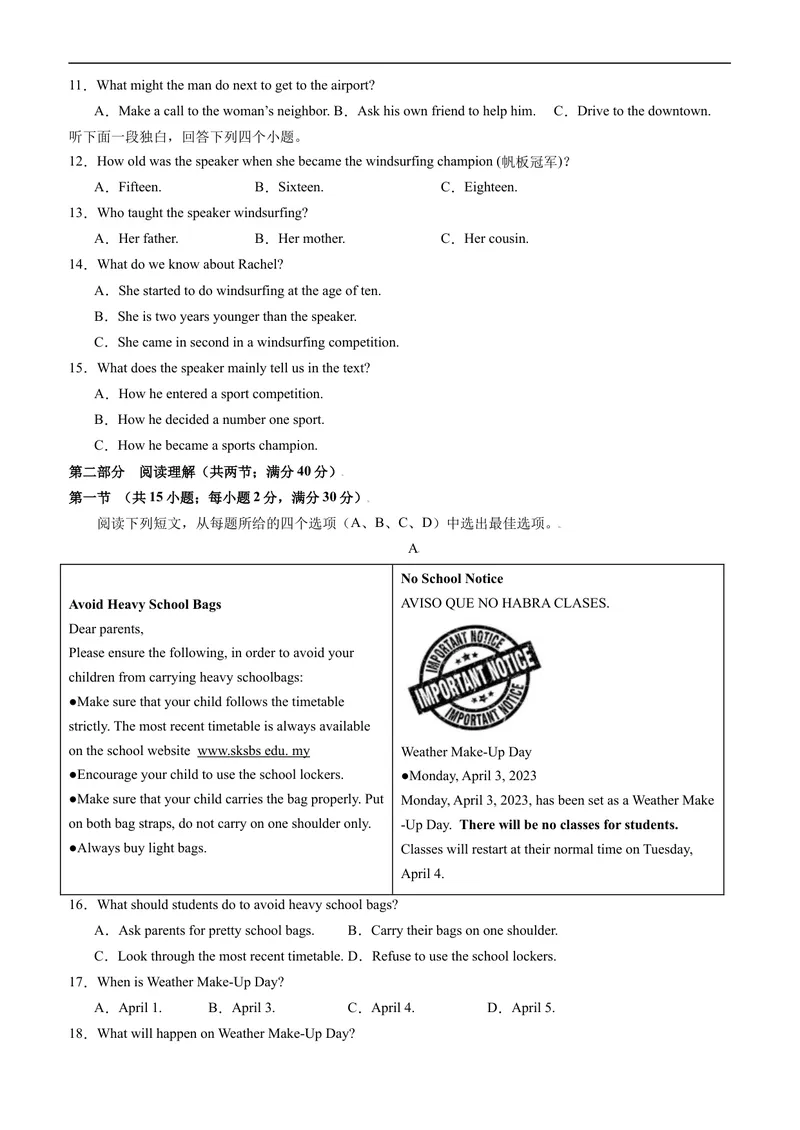
No School Notice
Avoid Heavy School Bags AVISO QUE NO HABRA CLASES.
Dear parents,
Please ensure the following, in order to avoid your
children from carrying heavy schoolbags:
●Make sure that your child follows the timetable
strictly. The most recent timetable is always available
on the school website www.sksbs edu. my Weather Make-Up Day
●Encourage your child to use the school lockers. ●Monday, April 3, 2023
●Make sure that your child carries the bag properly. Put Monday, April 3, 2023, has been set as a Weather Make
on both bag straps, do not carry on one shoulder only. -Up Day. There will be no classes for students.
●Always buy light bags. Classes will restart at their normal time on Tuesday,
April 4.
16.What should students do to avoid heavy school bags?
A.Ask parents for pretty school bags. B.Carry their bags on one shoulder.
C.Look through the most recent timetable.D.Refuse to use the school lockers.
17.When is Weather Make-Up Day?
A.April 1. B.April 3. C.April 4. D.April 5.
18.What will happen on Weather Make-Up Day?A.Students will have one school day off. B.Students will check the school website.
C.Parents will buy a light bag for kids. D.Parents will go to school with kids.
B
Emerson once said, “You can never do a kindness too soon, for you never know how soon it will be too late.”
How many times have we said, “Oh, I’ll do that tomorrow”? Sometimes tomorrow never comes, and we find
ourselves saying, “Boy, I wish I hadn’t put that off.”
Our family has been friends with Betty for many years. Over the years, we shared phone calls and birthday
cards. Betty sent our youngest son Brandon a birthday card with five dollars in it every year until he graduated from
high school.
Last November, I called Betty to see how she was and what she had done on her birthday. I was pretty surprised
when Betty didn’t answer the phone; instead, her daughter Carol did. Carol told me that her mom had gone downhill
fast, and that she was now in hospice care (临终关怀). Carol handed the phone to Betty. I talked briefly (简略地) to
her and let her know we loved her.
As soon as I got off the phone, I sent a message to Brandon to let him know Betty wasn’t doing well. Brandon
stopped what he was doing and immediately sent flowers to Betty.
You can imagine how proud I was of Brandon when Carol called the next day, letting me know how much Betty
loved the flowers Brandon had sent. A few days later, Betty died.
So, my friends, remember next time, try to do what you want to do as soon as possible because you never know
how soon it will be too late.
19.What’s the purpose of the first paragraph?
A.To tell us a famous person. B.To show the importance of being kind.
C.To introduce the theme of the passage. D.To ask people to remember this saying.
20.What’s the main idea of the third paragraph?
A.When the writer met Betty for the first time. B.How the writer’s family kept in touch with Betty.
C.Where the writer’s family and Betty lived. D.Why the writer’s son liked Betty.
21.What’s the meaning of the underlined sentence?
A.Her mom was hurt when she was climbing a hill. B.Her mom had trouble climbing a hill.
C.Her mom didn’t want to answer the phone call. D.Her mom’s health was getting worse and worse.
22.Why was the writer proud of Brandon?
A.Because Brandon showed his care for Betty as soon as he knew the situation.
B.Because Brandon sent presents in return for the birthday cards he received.
C.Because Brandon was kind and helpful to everyone.
D.Because Brandon was good at planting flowers.
C
Everyone knows that friendships are important. We all need our best friends. Best friends share good times and
bad. We tell our close friends our secrets. But what about casual friends? They are the friends we see only now and
then. They are our classmates, the customers at the cafe, or the neighbor walking his dog. When we have a lot of
casual friends, it improves our lives in several ways.
First, casual friends make us happy. We talk to them at the bus stop or the farm stand. We feel like we are part ofa community. Research shows that the more casual friends we have, the more positive we feel. In one study, students
felt much happier when they talked to more classmates than usual. These low-key(低调的) friendships become very
important as we get older. We have the most friends at age 25, but the number goes down after that. As we get older,
we have fewer friendships and can feel alone. But we feel less lonely when we have many casual friends.
Second, casual friends connect us to other groups of people. They tell us about fun activities and possible jobs.
In fact, people are 58 percent more likely to get a job through a casual friend than a close friend. Casual friends
introduce us to their other friends. They help when we want to know about good restaurants or exciting movies.
Research shows that casual friendships are a good way to spread all kinds of information.
Finally, casual friends introduce us to a variety of new ideas. Our best friends often think like us, but casual
friends may have very different opinions. When we talk to different people, we learn new ways of seeing the world.
It makes us kinder and more understanding.
To have a better life, make more casual friends. Talk more to strangers. These people can become casual friends.
Over time, casual friends can become close friends. And the more friends you have, the happier you’ll be. Casual
friends may be the secret to a happy life.
23.What are casual friends?
A.Friends we see only sometimes. B.Friends we share good times with.
C.Friends we often tell our secrets to. D.Friends we have known for a long time.
24.Why are casual friends important as we get older?
A.Because we have more time to spend with them. B.Because they are easier to have than close friends.
C.Because we have fewer friends and may feel alone. D.Because they share other neighbors’ secrets with us.
25.How do casual friends help us get new ways of thinking?
A.By introducing different new ideas to us. B.By making us feel like we are relatives.
C.By providing us with more possible jobs. D.By introducing us to their other friends.
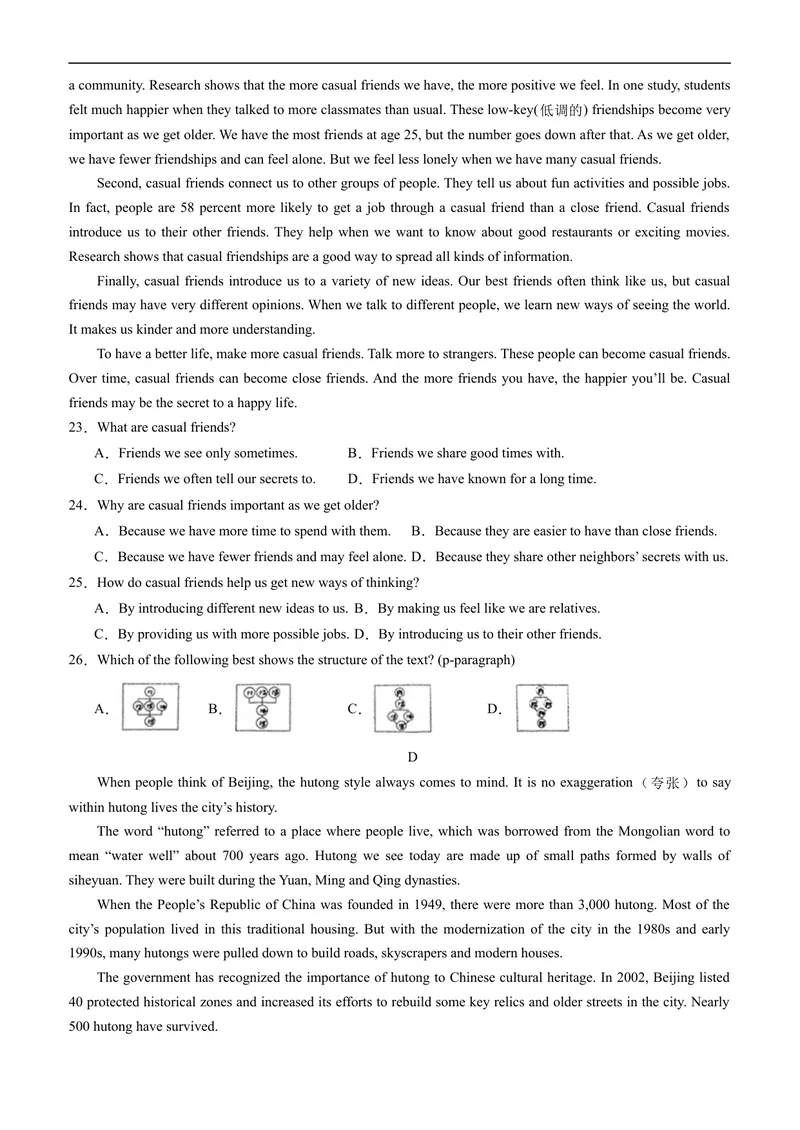
26.Which of the following best shows the structure of the text? (p-paragraph)
A. B. C. D.
D
When people think of Beijing, the hutong style always comes to mind. It is no exaggeration(夸张)to say
within hutong lives the city’s history.
The word “hutong” referred to a place where people live, which was borrowed from the Mongolian word to
mean “water well” about 700 years ago. Hutong we see today are made up of small paths formed by walls of
siheyuan. They were built during the Yuan, Ming and Qing dynasties.
When the People’s Republic of China was founded in 1949, there were more than 3,000 hutong. Most of the
city’s population lived in this traditional housing. But with the modernization of the city in the 1980s and early
1990s, many hutongs were pulled down to build roads, skyscrapers and modern houses.
The government has recognized the importance of hutong to Chinese cultural heritage. In 2002, Beijing listed
40 protected historical zones and increased its efforts to rebuild some key relics and older streets in the city. Nearly
500 hutong have survived.Hutong that still exist are like oases(绿洲)of calm in the noisy city. Walking through them, it’s common to
see groups of elderly people sitting together playing cards, mahjong(麻将)or Chinese chess. In the early mornings
and evenings, they gather to practice traditional forms of exercise such as Taijiquan as well as dancing and singing
folk songs or Peking Opera. Hutong have become a museum of Beijing’s folk customs and history.
27.What is the purpose of paragraph 2?
A.To add background information of hutong. B.To bring in the topic of the context.
C.To stress the importance of hutong. D.To introduce the benefits of hutong.
28.What happened to hutong in Beijing in 2002?
A.More hutong were built. B.Lots of hutong disappeared.
C.Most hutong became historical zones. D.Some hutong were placed under protection.
29.What does the last paragraph mainly talk about?
A.The future of hutong. B.The change of hutong.
C.The beauty of hutong life. D.The history of hutong life.
30.What is the author’s attitude towards Hutong protection?
A.Negative. B.Unclear. C.Supportive. D.Doubtful.
第二节(共5小题,每小题2分,满分10分)
下面文章中有五处需要添加标题。请从以下选项(A、B、 C、D、E和F)中选出符合意思的标题。选
项中有一项是多余选项。
How to avoid careless mistakes?
Careless mistakes can make you feel worse than big mistakes. Everyone makes mistakes from time to time, and
that’s okay. However, there are some ways to get yourself back on track(轨道) after you make mistakes.
31
Don’t worry. We are humans and we all make mistakes sometimes. Avoid putting yourself down when you
make mistakes. A mistake is more like the brain shuts down, notices the inactive feedback you give yourself as
threat, and then avoids thinking about it completely.
32
Ask yourself why you might have made a certain type of mistakes. Write down how you could have avoided
making them. Allow more time to do that, start earlier, and pay more attention to what you are doing, etc.
33
It’s amazing how fast lack of sleep can make people forgetful and cause them to feel stressed, which can lead to
careless mistakes. Get enough sleep and you’ll keep a clear mind all day.
34
When you make a mistake, you should face it bravely. Don’t make excuses that are useless. What you should do
is to review your mistakes and learn from them. As the saying goes, “A fall into the pit, a gain in your wit.”
35
Don’t let a mistake get you down. There’s no need to be a perfectionist. Don’t beat yourself up. Everyone
makes mistakes. It’s how you deal with mistakes that is important. Simply think about how you can solve the
problem and move on. Believe you will do better next time.
A.Be responsible for your mistakes.B.Realize that making mistakes is normal.
C.Tell yourself you will do better next time.
D.Say sorry to yourself and be careful next time.
E.Find out what caused these careless mistakes.
F.Stick to a regular sleeping and resting normally.
第三部分 英语知识运用(共两节,满分25分)
第一节:完形填空(共15小题;每小题1分,满分15分)
阅读下面短文,掌握其大意,然后从每题所给的A、B、C、D四个选项中选出最佳选项。
Once upon a time, there was a man called Joe. His farmland was 36 so he hadn’t had good
harvest(收获) for years. “If God lets me 37 the weather, then everything will get better,” he complained. “I
know better than God does because I am a(an) 38 .”
“Well, I give you one 39 ,” God said. “You will be in charge of all kinds of 40 . Let’s see
what your crops will grow like.”
On hearing this, Joe was excited and immediately shouted, “ 41 !” Suddenly, the clouds went away. He
was 42 and shouted again, “Rain!” The sky was cloudy 43 , then after a while, heavy rain
poured down.
Watching the seeds growing 44 and becoming crops, Joe felt much satisfied. A year later, the harvest
season came. He went to the field to get in his crops. 45 his heart suddenly sank when he found the strong
crops even hadn’t grown a grain (谷粒). He was quite puzzled and started to 46 .
Once again, God heard him. “Do you know why you 47 get the good harvest you want?” God asked.
“That’s because you never 48 wind, rainstorm, snow and ice, or something that could make the air fresher
and the roots stronger. 49 stronger roots, of course the crops won’t grow any fruit.”
After he realized this, Joe asked God to 50 the power. It turned out only through life’s challenges
would get the fruit of life.
36.A.perfect B.proud C.poor D.polite
37.A.punish B.control C.report D.predict
38.A.farmer B.professor C.actor D.inventor
39.A.day B.week C.month D.year
40.A.knowledge B.research C.information D.weather
41.A.Cloudy B.Windy C.Sunny D.Snowy
42.A.angry B.crazy C.pleased D.embarrassed
43.A.just now B.at times C.in the end D.right away
44.A.lighter B.heavier C.bigger D.smaller
45.A.But B.And C.Also D.As
46.A.cry B.laugh C.speak D.relax
47.A.especially B.hardly C.probably D.mostly
48.A.asked for B.looked for C.paid for D.waited for
49.A.Beyond B.Against C.Among D.Without50.A.bring back B.go back C.take back D.give back
第II卷
第三部分 英语知识运用(共两节,满分25分)
第二节:(共10小题;每小题1分,满分10分)
阅读下面材料,在空白处填入适当的内容(1个单词)或括号内单词的正确形式。将答案填写在答题纸
的相应位置。
A few months ago, my friend Henry and I planned to have a pizza at a restaurant in town. My dad kindly took
us there 51 his car. “I can come and get you,” my dad said, “but don’t call too late.”
After finishing the meal at the restaurant, I decided 52 (call) my dad. I entered my PIN (个人识别码),
53 the phone didn’t accept it. I got a wrong message. I tried again, but the same thing happened.
“This is strange,” I said. I tried a third time. Unluckily, the phone became locked. I couldn’t use it. I was a little
54 (worry).
“It’s OK, Emily. You can use my phone.” said Henry.
Amazingly, the same thing happened to him. He tried three 55 (time), but the PIN was wrong and his
phone became locked, too. I wondered 56 was wrong with our phones. Then I remembered something—we
had 57 same type of phone.
“You’ve got my phone and I’ve got 58 (you),” I said. “We exchanged our phones by accident!”
Luckily, we saw a classmate in the restaurant. He 59 (lend)me his phone and I called my dad. So we
got home 60 (safe) in the end—but our phones were locked for three days!
第四部分 写作(共两节,满分25分)
第一节:单词拼写(共10小题;每小题1分,满分10分)
根据首字母提示,正确拼写单词,并将答案填写在答题卡对应的横线上。
61.I’ve grown up. Don’t t me as a child anymore.
62.September is the n month of the year, when the new term starts.
63.It’s usually considered impolite to ask p questions about others.
64.Do you know the s who is giving a speech over there?
65.Bill wonders w they’ll have zongzi again next year.
66.When my brother travelled around the world last year, he sent me several p .
67.France is a beautiful and romantic E country.
68.The two-year-old girl can say her father’s phone number e .
69.It is said that m the words of English pop songs helped a lot.
70.Can you please c your mistakes in your exercise? Come on, try to be careful!
第二节:书面表达(共1小题;满分15分)
71.假如你是李华,收到小学同学李雷的邮件,请阅读邮件进行回复。
Dear Li Ping,
How’s it going? It’s been two years since we left our primary school. We’ve changed a lot in the past two years.
Could you please tell me about your changes? And there will be a party for our primary school classmates. It will
begin at 7:00 p.m. next Saturday. Would you like to attend the party? Please reply in writing to this invitation byNovember 2nd.
Hope you can make it.
Yours,
Li Lei
注意:1.词数80词左右,内容完整,行文连贯得体.
2.根据要求回复并接受邀请,询问至少两个细节。
Dear Li Lei,
_____________________________________________________________________________________________
_____________________________________________________________________________________________
_____________________________________________________________________________________________
___________________________________________________________________________________
Yours,
Li Ping