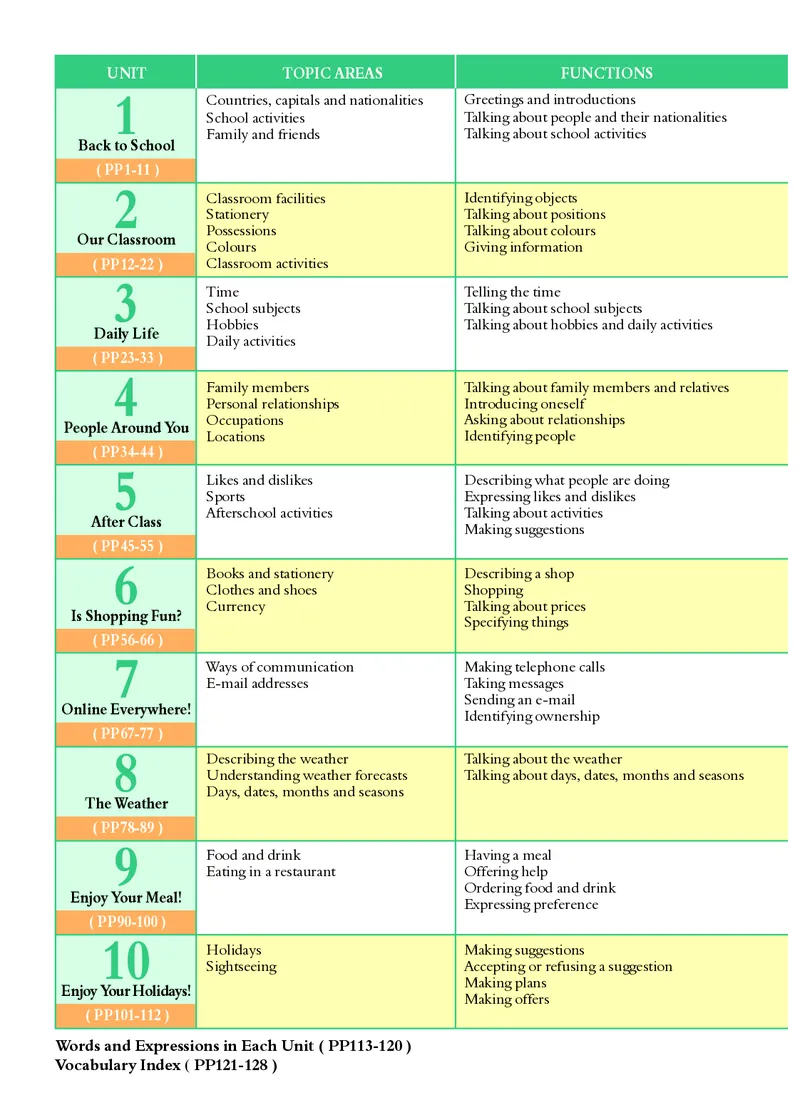
UNIT
TOPIC AREAS
FUNCTIONS
Back to School
Our Classroom
Daily Life
After Class
Is Shopping Fun?
Online Everywhere!
The Weather
Enjoy Your Meal!
Enjoy Your Holidays!
Words and Expressions in Each Unit ( PP113-120 )
Vocabulary Index ��PP121-128 )
( PP1-11 )
( PP12-22 )
( PP23-33 )
( PP34-44 )
( PP45-55 )
( PP56-66 )
( PP67-77 )
( PP78-89 )
( PP90-100 )
( PP101-112 )
Countries, capitals and nationalities
School activities
Family and friends
Classroom facilities
Stationery
Possessions
Colours
Classroom activities
Time
School subjects
Hobbies
Daily activities
Family members
Personal relationships
Occupations
Locations
Likes and dislikes
Sports
Afterschool activities
Books and stationery
Clothes and shoes
Currency
Ways of communication
E-mail addresses
Describing the weather
Understanding weather forecasts
Days, dates, months and seasons
Food and drink
Eating in a restaurant
Holidays
Sightseeing
Greetings and introductions
Talking about people and their nationalities
Talking about school activities
Identifying objects
Talking about positions
Talking about colours
Giving information
Telling the time
Talking about school subjects
Talking about hobbies and daily activities
Talking about family members and relatives
Introducing oneself
Asking about relationships
Identifying people
Describing what people are doing
Expressing likes and dislikes
Talking about activities
Making suggestions
Describing a shop
Shopping
Talking about prices
Specifying things
Making telephone calls
Taking messages
Sending an e-mail
Identifying ownership
Talking about the weather
Talking about days, dates, months and seasons
Having a meal
Offering help
Ordering food and drink
Expressing preference
Making suggestions
Accepting or refusing a suggestion
Making plans
Making offers
1
2
3
4
5
6
7
8
9
10
People Around You
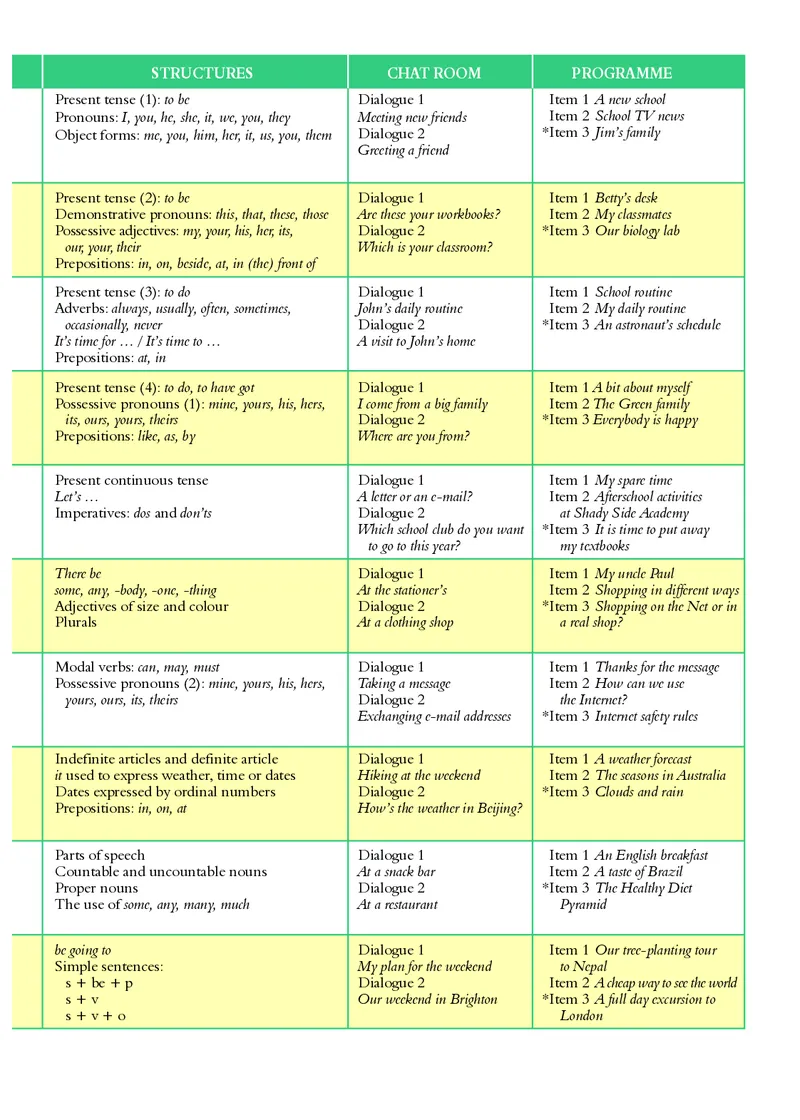
STRUCTURES
CHAT ROOM
PROGRAMME
Present tense (1): to be
Pronouns: I, you, he, she, it, we, you, they
Object forms: me, you, him, her, it, us, you, them
Present tense (2): to be
Demonstrative pronouns: this, that, these, those
Possessive adjectives: my, your, his, her, its,
our, your, their
Prepositions: in, on, beside, at, in (the) front of
Present tense (3): to do
Adverbs: always, usually, often, sometimes,
occasionally, never
It’s time for … / It’s time to …
Prepositions: at, in
Present tense (4): to do, to have got
Possessive pronouns (1): mine, yours, his, hers,
its, ours, yours, theirs
Prepositions: like, as, by
Present continuous tense
Let’s …
Imperatives: dos and don’ts
There be
some, any, -body, -one, -thing
Adjectives of size and colour
Plurals
Modal verbs: can, may, must
Possessive pronouns (2): mine, yours, his, hers,
yours, ours, its, theirs
Indefinite articles and definite article
it used to express weather, time or dates
Dates expressed by ordinal numbers
Prepositions: in, on, at
Parts of speech
Countable and uncountable nouns
Proper nouns
The use of some, any, many, much
be going to
Simple sentences:
s + be + p
s + v
s + v + o
Dialogue 1
Meeting new friends
Dialogue 2
Greeting a friend
Dialogue 1
Are these your workbooks?
Dialogue 2
Which is your classroom?
Dialogue 1
John’s daily routine
Dialogue 2
A visit to John’s home
Dialogue 1
I come from a big family
Dialogue 2
Where are you from?
Dialogue 1
A letter or an e-mail?
Dialogue 2
Which school club do you want
to go to this year?
Dialogue 1
At the stationer’s
Dialogue 2
At a clothing shop
Dialogue 1
Taking a message
Dialogue 2
Exchanging e-mail addresses
Dialogue 1
Hiking at the weekend
Dialogue 2
How’s the weather in Beijing?
Dialogue 1
At a snack bar
Dialogue 2
At a restaurant
Dialogue 1
My plan for the weekend
Dialogue 2
Our weekend in Brighton
Item 1 A new school
Item 2 School TV news
*Item 3 Jim’s family
Item 1 Betty’s desk
Item 2 My classmates
*Item 3 Our biology lab
Item 1 School routine
Item 2 My daily routine
*Item 3 An astronaut’s schedule
Item 1 A bit about myself
Item 2 The Green family
*Item 3 Everybody is happy
Item 1 My spare time
Item 2 Afterschool activities
at Shady Side Academy
*Item 3 It is time to put away
my textbooks
Item 1 My uncle Paul
Item 2 Shopping in different ways
*Item 3 Shopping on the Net or in
a real shop?
Item 1 Thanks for the message
Item 2 How can we use
the Internet?
*Item 3 Internet safety rules
Item 1 A weather forecast
Item 2 The seasons in Australia
*Item 3 Clouds and rain
Item 1 An English breakfast
Item 2 A taste of Brazil
*Item 3 The Healthy Diet
Pyramid
Item 1 Our tree-planting tour
to Nepal
Item 2 A cheap way to see the world
*Item 3 A full day excursion to
London
1
1
. 1 .
Unit
Back to School
1
Topic Areas
Countries, capitals and nationalities
School activities
Family and friends
Functions
Greetings and introductions
Talking about people and their nationalities
Talking about school activities
Structures
Present tense (1): to be
Pronouns: I, you, he, she, it, we, you, they
Object forms: me, you, him, her, it, us, you, them
Chat Room
Dialogue 1 Meeting new friends
Dialogue 2 Greeting a friend
Programme
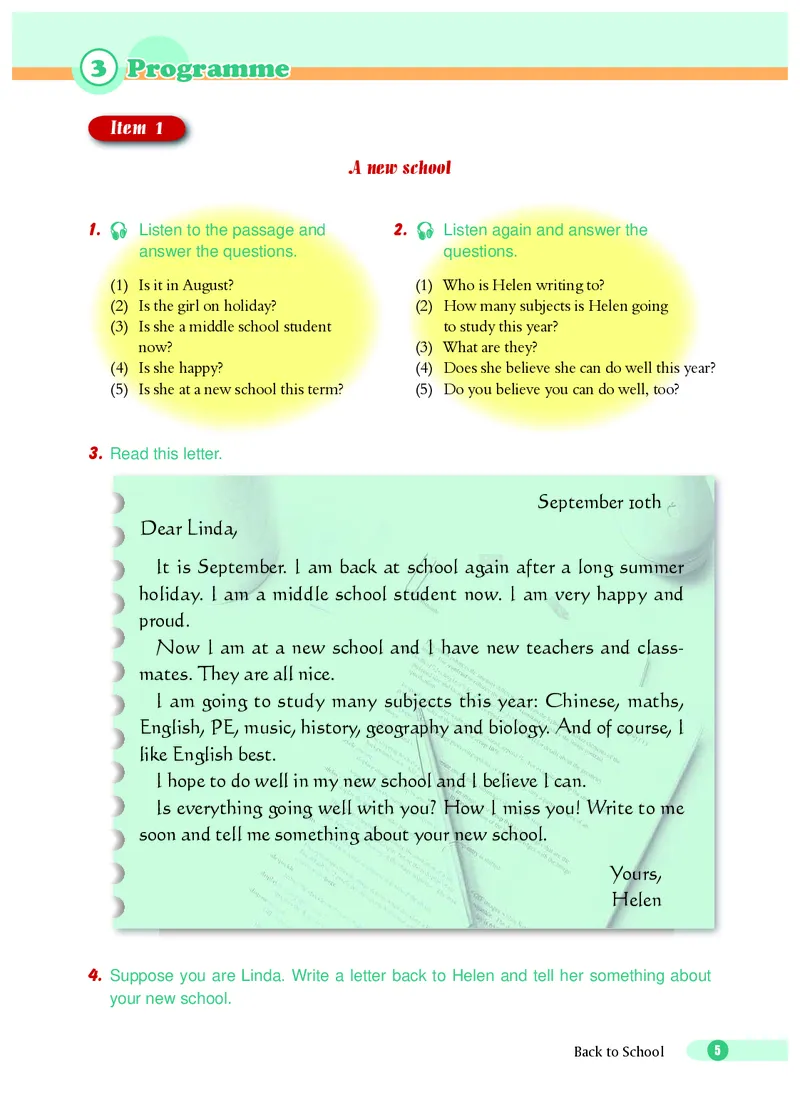
Item 1 A new school
Item 2 School TV news
Item 3 Jim’s family
*
Highlights
2
Getting Started
1
Introduce oneself.
1
– Hello, everyone.
– My name is Li Ning. My English name is Tom.
– I’m a student.
– I’m from China. I’m Chinese.
– I’m twelve.
– Nice to meet you.
– Good morning.
– My name is Mary Green.
– I’m a student, too.
– I come from the USA. I’m American.
– I’m eleven years old.
– Nice to see you.
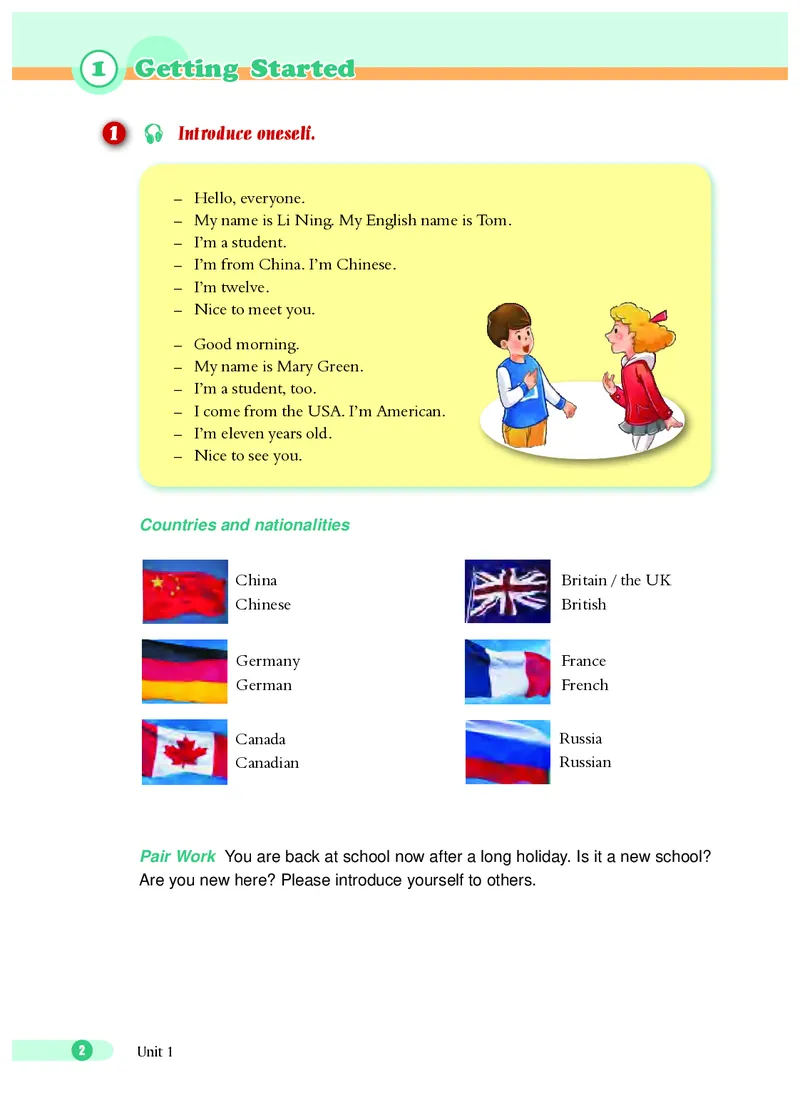
Countries and nationalities
China
Chinese
Britain / the UK
British
Germany
German
Canada
Canadian
France
French
Russia
Russian
Pair Work You are back at school now after a long holiday. Is it a new school?
Are you new here? Please introduce yourself to others.
Unit 1
3
No. Chinese name
English name
Country & Nationality Age
1
2
3
4
Make friends.
Introduce your new friends to the class.
Make more friends.
Guess: Who touched your hand?
2
3
4
5
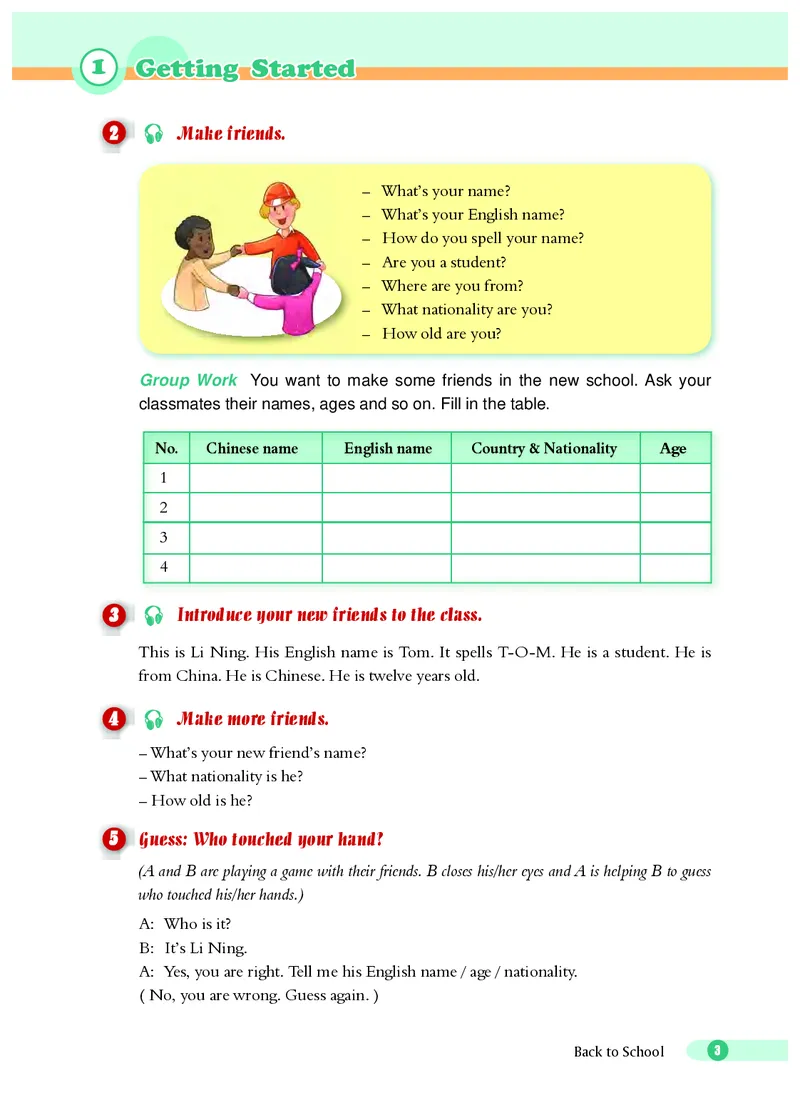
– What’s your name?
– What’s your English name?
– How do you spell your name?
– Are you a student?
– Where are you from?
– What nationality are you?
– How old are you?
Group Work You want to make some friends in the new school. Ask your
classmates their names, ages and so on. Fill in the table.
This is Li Ning. His English name is Tom. It spells T-O-M. He is a student. He is
from China. He is Chinese. He is twelve years old.
– What’s your new friend’s name?
– What nationality is he?
– How old is he?
A: Who is it?
B: It’s Li Ning.
A: Yes, you are right. Tell me his English name / age / nationality.
( No, you are wrong. Guess again. )
(A and B are playing a game with their friends. B closes his/her eyes and A is helping B to guess
who touched his/her hands.)
1
Getting Started
Getting Started
Back to School
4
Chat Room
Chat Room
2
Dialogue 1
Dialogue 2
Meeting new friends
Greeting a friend
John:
Hello, Mary. Come and meet my friend Tim.
We’re in the same class.
Mary:
How do you do? I’m Mary Blake. I’m in Class 4.
Tim:
How do you do? I’m Tim Salmon. I’m John’s neighbour.
I’m very glad to meet you.
Mary:
I’m very glad to meet you, too.
John:
It’s time for class. See you later, Mary.
Mary:
See you.
Mary:
Good afternoon, Tim.
Tim:
Good afternoon, Mary. How are you today?
Mary:
Fine, thank you. And you?
Tim:
I’m fine, too.
Mary:
How is John?
Tim:
He’s ill. He’s absent from class today.
Mary:
Oh, really? I’m sorry to hear that. Let’s go
and see him after school.
Tim:
OK, let’s.
Unit 1
5
3 Programme
Programme
Item 1
A new school
1. Listen to the passage and
answer the questions.
3. Read this letter.
4. Suppose you are Linda. Write a letter back to Helen and tell her something about
your new school.
2. Listen again and answer the
questions.
(1) Is it in August?
(2) Is the girl on holiday?
(3) Is she a middle school student
now?
(4) Is she happy?
(5) Is she at a new school this term?
(1) Who is Helen writing to?
(2) How many subjects is Helen going
to study this year?
(3) What are they?
(4) Does she believe she can do well this year?
(5) Do you believe you can do well, too?
September 10th
Dear Linda,
It is September. I am back at school again after a long summer
holiday. I am a middle school student now. I am very happy and
proud.
Now I am at a new school and I have new teachers and class-
mates. They are all nice.
I am going to study many subjects this year: Chinese, maths,
English, PE, music, history, geography and biology. And of course, I
like English best.
I hope to do well in my new school and I believe I can.
Is everything going well with you? How I miss you! Write to me
soon and tell me something about your new school.
Yours,
Helen
Back to School
6
Item 2
School TV news
1. Listen to the school news on TV
and answer the questions.
3. Read the passage and fi ll in the table.
2. Listen again and answer the
questions.
(1) Are the group of teachers and students
visiting the school this week?
(2) How many teachers and students are
there in the group?
(3) Is the boy in red Japanese?
(1) Who is the head teacher?
(2) Where is Paul from?
(3) What nationality is Hanna?
(4) What’s the name of the tall boy?
(5) Who is the boy in red?
Good afternoon, boys and girls. Here’s today’s school news on TV:
An international group is visiting our school this week. There are three
teachers and four students in the team. Let me introduce them to you.
The gentleman in a blue jacket here is Mr White, the head teacher.
He is from England. Look at the tall man behind him. That’s Paul, a
French teacher from Paris. The beautiful young woman with a big smile
is Hanna. She is from Germany. She is also a language teacher.
Now let’s look at the four students. The tall boy is Daniel from
New York. The girl with glasses is from Italy. Her name is Laura. The
little boy, Dachi, is Japanese. Now look at the boy in red. What na-
tionality is he? Is he Japanese, too? No, he is Mingming and he is also
from New York, the United States. He is an overseas Chinese!
Let’s give them a warm welcome and hope they will have a good time
in our school.
Programme
Programme
3
Name Teacher (T) / Student (S) Sex (F / M) Country / Nationality
Description
Unit 1
7
4. Role-play One of the students is going to stay at your home. Introduce him/her to
your family. You can begin like this:
Hi Mum, this is my new friend Laura. She is …
* Item 3
Jim’s family
1. Listen and fi ll in the blanks.
3. Read the passage and retell it.
4. Pair Work Show your deskmate your family album and talk to him/her about your
family.
2. Listen again and answer the
questions.
(1) There are ___________ people in Jim’s home.
(2) His father is a ___________.
(3) His mother is a ___________.
(4) His sister is a ___________.
(1) How old is Jim?
(2) What is his mother?
(3) Where is his father now?
(4) Who is Jim’s sister?
Look at the picture. This is a British family. Jim is a
British boy. He is 11 years old now. He is a student
of an international school. He is good at all subjects,
and all his teachers like him.
This is Jim’s father. He is a computer engineer. He
is 40 years old. But he is in Germany now.
This is Jim’s mother. She is a teacher. She is 38.
Jim has a sister, Linda. She is a pupil. She is 9
years old.
Jim’s parents love Jim and Linda very much, and the children love them, too.
They are a happy family.
3
Programme
Programme
Back to School
8
Message Box
Message Box
4
Data Bank
Data Bank
5
Box 1
Box 3
Box 2
Person
Be
I
am
you
are
he
is
she
is
it
is
we
are
you
are
they
are
Subjective case
Objective case
I
me
you
you
he
him
she
her
it
it
we
us
you
you
they
them
Subject
Verb
Object
I
like
him.
She
gives
me a book.
They
believe in
him.
1. Learn the English sounds.
2. Read aloud.
/ i� / / i / / e / / � /
/ i� / – e
he
we
/ i� / – e e these
Chinese
/ i� / – ee bee
green
jeep
/ i� / – ea
seat
please
teacher
/ i / – i
ship
thin
sister
/ e / – e
hen
desk
lesson
/ � / – a
fat
man
apple
(1) A hedge between keeps friendship green.
A friend in need is a friend indeed.
Seeing is believing.
(2) It is no use crying over spilt milk.
A fall into a pit, a gain in your wit.
A good beginning makes a good ending.
(3) Good, better, best,
Never let it rest.
Till your good is better,
And your better, best.
(4) I met a little boy Jack
Who came from another land.
I couldn’t speak his language,
But took him by the hand.
Unit 1
9
DIY Lab
DIY Lab
6
1. Oral Presentation There is an English summer camp. You are a group leader.
Introduce members of your group to the others on the camp.
2. Draw your family tree and explain it to others.
3. Topic Discussion Make an English study plan for the term. Discuss it with
your classmates.
4. Problem Solving Here is “An Invitation to Join”. Fill in the form as asked.
I Would Like to Join
FRIENDS OF THE WHITWORTH
Name (Mr Mrs Ms) ________________________ (Block Capitals)
Address ________________________________________________________
Postcode ________________________________________________________
Telephone _______________________________________________________
E-mail Address ___________________________________________________
Fax ____________________________________________________________
Website _________________________________________________________
5. Internet Surfi ng Search online for pictures of families you are interested in, such
as the US president’s family, Hanna Montana’s family, or even families in fairy tales
and cartoons. Introduce these families to your classmates.
Back to School
10
Culture Corner
Culture Corner
7
Britain: ____________________
___________________________
___________________________
China: _____________________
___________________________
___________________________
much homework
little homework
monitor
class teacher
headmaster
fixed classroom
teaching building
school gate
schoolyard
fences
walls
dormitory
playground
many pupils
Young Pioneer
Time for school
1. Guess and fi ll in the blanks with numbers, months and dates.
2. Compare your school with a British school. you can fi nd support from online
information and the keywords below.
3. Draw a school map and explain
your picture to your deskmate.
In China, we start to go to school at the age of six. We finish primary school when we are
twelve. Then we go to middle school. After three years, we go to high school.
If you are in England, the UK, you start to go to school when you are ________ years
old. After ________ years you finish primary school and you go to secondary school at the
age of ________.
In China, every year we go back to school after the Spring Festival or in ________. And
before the start of a new school year on ________, our father or mother will buy us a new
schoolbag, and some new pens or pencils. On the windows of shops we can see these
words: “Back to school.” Our parents may also buy us new school clothes, too.
Which do you like better, a Chinese school or a British school? Why?
Unit 1
11
Game Zone
Game Zone
8
1. Can you guess the letter out?
2. Rhyme.
3. Song.
(1) I arrive once in every second,
once in every minute and once
in every year. What am I?
(2) What always ends everything?
What are little boys made of?
Snips and snails, and puppy dogs’ tails.
That’s what little boys are made of!
What are little girls made of?
Sugar and spice, and all things nice.
That’s what little girls are made of!
Good morning to you
Good morning to you. Good morning to you.
Good morning to you all. Good morning to you.
Good afternoon to you. Good afternoon to you.
Good afternoon to you all. Good afternoon to you.
Good evening to you. Good evening to you.
Good evening to you all. Good evening to you.
Good night to you. Good night to you.
Good night to you all. Good night to you.
Goodbye to you. Goodbye to you.
Goodbye to you all. Goodbye to you.
Back to School
12
. 12 .
Unit
Unit 2
Our Classroom
Our Classroom
Topic Areas
Classroom facilities
Stationery
Possessions
Colours
Classroom activities
Functions
Identifying objects
Talking about positions
Talking about colours
Giving information
Structures
Present tense (2): to be
Demonstrative pronouns: this, that, these, those
Possessive adjectives: my, your, his, her, its, our, your, their
Prepositions: in, on, beside, at, in (the) front of
Chat Room
Dialogue 1 Are these your workbooks?
Dialogue 2 Which is your classroom?
Programme
Item 1 Betty’s desk
Item 2 My classmates
Item 3 Our biology lab
*
Highlights
Highlights
13
1
Getting Started
Getting Started
Listen and talk about the things in the classroom.
Listen and talk about the things in the teachers’ office.
Listen and talk about the things on your desk.
1
2
3
– Is this a TV set?
– No, it isn’t. It’s a computer.
What do you see in the picture?
– What are these?
– They are desks.
– What are those?
– They are chairs.
– What’s this?
– It’s a teacher’s desk.
– What’s that?
– It’s a chair.
pencil – ballpoint pen
CD player – DVD player
pencil box / blue
schoolbag / yellow
ruler / white
textbook – dictionary
copier – printer
pencils
window
rulers
blackboard
pencil boxes
books
il
Our Classroom
14
Getting Started
Getting Started
1
the book
on the desk
the DVD player
in the box
the teacher’s desk
in the front of the classroom
the TV set
on a desk near the window
biology lab
Room 203
computer room
Room 304
teachers’ office
Room 217
Jim:
Where’s the map?
Mike: It’s on the wall.
Jim:
Is this your new classroom?
Mike: No, it isn’t.
Jim:
Where is your new classroom?
Mike: It’s at the end of the corridor.
Jim:
Is it Room 103?
Mike: No, it’s Room 104.
Answer the questions.
Follow Jim and Mike.
Follow Jim and Mike again.
4
5
6
pencil
ruler
eraser
schoolbag
ballpoint pen
pencils
rulers
erasers
schoolbags
ballpoint pens
il
What’s this / that?
What are these / those?
Unit 2
15
2
Dialogue 1
Dialogue 2
Are these your workbooks?
Which is your classroom?
Jim:
Are these your workbooks, Betty?
Betty:
No, they aren’t. My workbooks are pink.
Jim:
Oh, I see. Look at those workbooks on the desk.
Are they John’s workbooks?
Betty:
Yes, they are. His workbooks are brown.
Jim:
Which is your classroom?
Mike:
The one on the left.
Jim:
Let’s go and have a look. Oh, how big! Which is your seat?
Mike:
The third one beside the window.
Jim:
Are these maths books?
Mike:
Yes, they are.
Jim:
Are those maths books, too?
Mike:
No, they aren’t. They are English books.
They are my new English books.
Chat Room
Chat Room
Our Classroom
16
3
Item 1
1. Listen to the tape and do the “True or False” exercise.
3. Pair Work Make a conversation with your deskmate based on the passage above.
4. Talk about a classmate’s desk in 6 to 8 sentences.
2. Look at the picture of Betty’s desk and learn the following passage.
Jim:
Hello, Betty. Is this your classroom?
Betty: Yes, Jim. Good to see you. Come in, please.
Jim:
Is this your desk?
Betty: Yes, it is.
Jim:
It’s nice and new. What’s that on the desk?
Betty: It’s an English dictionary.
Jim:
I see. What are those under the pencil box?
Betty: They are my new textbooks.
Jim:
Let me have a look.
Betty: Here you are.
Betty’s desk
_____ (1) Betty’s desk is beside the door.
_____ (2) Betty’s desk is an old one.
_____ (3) The books on the desk are all textbooks.
_____ (4) Betty’s pencil box is not in her schoolbag.
Programme
Programme
This is my desk. It is by
the window. It is nice and
new. The book on the desk
is an English dictionary. In
front of the dictionary is a
pencil box. The books beside
the pencil box are my new
textbooks. My schoolbag
is in the desk. My desk is
clean and tidy.
Example:
Unit 2
17
3
Programme
Programme
Item 2
My classmates
1. Listen to the tape and answer the following questions.
3. Read the following passage about Sally and learn the possessive adjectives.
2. Listen again and answer the following questions.
(1) Is Sally a student?
(2) Is she in Class Two?
(3) Is her class very big?
(4) Is Jim’s schoolbag new and big?
(5) Is Betty’s father a maths teacher?
(1) Which school is Sally in?
(2) Which grade is Sally in?
(3) Who is Sally’s deskmate?
(4) Who sits behind Sally?
(5) What is Betty’s mother?
I am Sally and I’m a student of Rutland Public School. I
am in Class One, Grade Six. Our class is not very big.
We have twenty students in all. Jim and Betty are my best
friends. Jim is my deskmate. His schoolbag is new and big.
Betty sits behind me. She is a lovely girl. Her mother is an
accountant and her father is a maths teacher.
4. Pair Work Make a conversation based on the passage above with your deskmate.
Our Classroom
18
(1) Where is the biology lab?
(2) Is the lab large and bright?
(3) Where is the projector?
(4) Who is Mrs Dimmer?
(5) What is Mrs Dimmer doing now?
(1) biology lab
a. on the second floor
b. large and bright
c. desks and chairs, and teacher’s desk
d. projector
e. nice pictures
f. many specimens
(2) biology teacher
a. name
b. hair and eyes
c. what she is doing
d. kind to students
e. interesting lessons
*Item 3
Our biology lab
1. Listen to the tape and put
a mark on the specimens
(∆), the teacher’s desk
(□), the pictures (○) and
the projector (✩).
3. Read and retell the passage with the help of the keywords.
4. Underline the prepositions used in the passage above. Then tell your deskmate
what your bedroom looks like using in, on, near, etc.
2. Listen again and answer the following questions.
This is the biology lab. The students have biology lessons here. The lab is on
the second floor. It’s large and bright. There are many desks and chairs in it.
There’s a teacher’s desk in the front of the lab. There’s a projector on a desk
near the front window. There are some nice pictures on the back wall. You can
also see many specimens in the corners of the lab. Mrs Dimmer is the biology
teacher. She has brown hair and grey eyes. She is showing the students some
butterflies. She is kind to students and her lessons are very interesting. The
students like the lab. They also like their biology teacher.
3
Programme
Programme
Unit 2
19
4
Message Box
Message Box
Box 5
Box 3
Box 1
Box 2
Box 4
This is an eraser.
That isn't my ruler.
These are blue pens.
Those are new schoolbags.
this
that
these
those
this
that
Example
Example
Demonstrative
pronoun
Possessive
adjective
Singular
Personal
pronoun
these
those
Plural
Usage
Possessive
adjective
I
you
he
she
it
we
you
they
my
your
his
her
its
our
your
their
my
your
his
her
its
our
your
their
Nearer in space
Farther in space
Negative
Interrogative
Answer
I am not (I’m not) a student.
Am I a student?
Yes, you are (a student).
No, you aren’t (a student).
You are not (aren’t) a student.
Are you a student?
Yes, I am (a student).
No, I am not (a student).
He (She) is not (isn’t) a student. Is he (she) a student? Yes, he (she) is (a student).
No, he (she) isn’t (a student).
It is not (isn’t) a pen.
Is it a pen?
Yes, it is (a pen).
No, it isn’t (a pen).
We (You, They) are not
Are you (we, they)
Yes, we (you, they) are (students).
(aren’t) students.
students?
No, we (you, they) aren’t (students).
Richard is my classmate.
Is Mrs Dimmer your teacher?
His father is a driver.
Her English books are on the desk.
Look at the dog and its nose.
Mr Peterson is our new class teacher.
Are your sisters all in New York?
That is their classroom.
Our Classroom
20
Data Bank
Data Bank
5
1. Learn the English sounds.
2. Read aloud.
3. Study again.
/ p / / b / / t / / d / / k / / � /
/ p / – p
pen
map
people
/ b / – b
bed
black
baby
/ t / – t
ten
Tom
that
/ d / – d
day
read
window
/ k / – c
cap
come
cup
/ k / – k
Kate
week
worker
/ k / – ck
back
cock
chick
/ � / – g
get
bag
glass
(1) Please repeat.
No pain, no gain.
Please keep the peace.
Pay attention to the lamp.
I can see a cap and a map in the picture.
(2) the big book
my brother’s breakfast
a boy with a blue bag
Don’t break the bottle on the bedside table.
(3) on Saturday night
stand the test of time
I’ll eat my hat.
He went without the meat.
They want to test the water.
Let the cat out of the bag.
(4) a dead end
to dance with the daffodils
Every dog has its day.
(5) a piece of cake
Put back the clock.
Keep in touch with Kate.
Don’t look for ways to cut corners.
Dick and Nick often talk until
the cows come home.
(6) Look at the goat on the
green grass.
Grace has lots of get-up-and-go.
The government will get the
plan off the ground soon.
/ i� /
/ i� /
/ i /
/ i /
/ e /
/ e /
/ � /
/ � /
/ i�t /
/ pi�k /
/ bi�d /
/ di�d /
/ si�t /
/ bi�t /
/ ri�d /
/ mi�t /
/ it /
/ pik /
/ bid /
/ did /
/ sit /
/ bit /
/ rid /
/ mid /
/ ef /
/ pek /
/ bed /
/ ded /
/ set /
/ bet /
/ red /
/ met /
/ �t /
/ p�k /
/ b�d /
/ d�d /
/ s�t /
/ b�t /
/ r�d /
/ m�t /
/ i�
/
/
/ i
/
/
/ e
/
/
/ �
/
/
/ i�t
/
/
/ pi�k
/
/
/ bi�d
/
/
/ di�d
/
/
/ it
/
/
/ pik
/
/
/ bid
/
/
/ did
/
/
/ ef
/
/
/ pek
/
/
/ bed
/
/
/ ded
/
/
/ �t
/
/
/ p�k
/
/
/ b�d
/
/
/ d�d
/
/
/ i�
/
/
/ i
/
/
/ e
/
/
/ �
/
/
/ si�t
/
/
/ bi�t
/
/
/ ri�d
/
/
/ mi�t
/
/
/ sit
/
/
/ bit
/
/
/ rid
/
/
/ mid
/
/
/ set
/
/
/ bet
/
/
/ red
/
/
/ met
/
/
/ s�t
/
/
/ b�t
/
/
/ r�d
/
/
/ m�t
/
/
Unit 2
21
DIY Lab
DIY Lab
6
In China all students have a fixed classroom. When the school bell rings,
students go back to their own classroom and wait for their teacher.
In the USA, however, students have no fixed classrooms. Before class begins,
students go and find the right classroom, and usually the teacher is already in
it. At the end of a period the students move to another classroom.
— Things: a national flag, pictures, two maps, a computer, etc.
— Positions: on the front wall, on the back wall, on the side walls, etc.
in China
in the USA
1. Pair Work Work with your deskmate to design a future classroom. Then tell your
class what the classroom is like. You may use the following words:
2. Group Work A new student is joining your class. Take him/her to your classroom
and tell him/her about your class. Make friends with him/her.
3. Problem Solving The school will hold a competition in decorating the classroom.
4. How will you design your bedroom to make it better? Please draw a picture and
introduce your ideas to others. This can be a group project.
How are you going to decorate your classroom? Please draw a picture and paint it. Then in-
troduce your ideas to others.
Culture Corner
Culture Corner
7
Please compare Picture A with Picture B.
In China
In the USA
Students have a fixed classroom.
Teachers change classrooms each lesson.
Students have no fixed classrooms.
Students change classrooms each lesson.
In C
Chi
hina
In the U
USA
SA
Students have a fixed classroom.
Teachers change classrooms each lesson.
Students have no fixed classrooms.
Students change classrooms each lesson.
i
Chi
i
h USA
Our Classroom
22
Game Zone
Game Zone
8
1. Word puzzle. Find the words
in the word square.
2. Rhyme.
3. Song.
b
l
e
n
q
s
f
k
l
w
l
r
s
d
t
r
o
i
c
a
a
x
y
e
i
g
g
k w
s
c
l
a
s
s
h
e m
e
u
k
c
u
k
t
r
z
r
o
l
h
j
n m
y
a
o
i
p
e
o
l
s
k
b
a
p
u
r
p
l
e
s
y
i
f
f
j
t
d
u
Little Boy Blue,
Come blow your horn.
The sheep’s in the meadow,
The cow’s in the corn.
Where is that boy
Who looks after the sheep?
(1) eraser
(2) light
(3) teacher
(4) black
(5) wall
(6) class
(7) book
(8) purple
(9) front
Under the haystack
Fast asleep.
Will you wake him?
Oh no, not I,
For if I do,
He will surely cry.
Song of colours
Blue is the sea. Green is the grass.
White are the clouds, as they slowly pass.
Black are the crows. Brown are the trees.
Red are the sails of a ship in the breeze.
Unit 2
23
Daily Life
Unit
Unit 3
Daily Life
Daily Life
Topic Areas
Time
School subjects
Hobbies
Daily activities
Functions
Telling the time
Talking about school subjects
Talking about hobbies and daily activities
Structures
Present tense (3): to do
Adverbs: always, usually, often, sometimes, occasionally, never
It’s time for … / It’s time to …
Prepositions: at, in
Chat Room
Dialogue 1 John’s daily routine
Dialogue 2 A visit to John’s home
Programme
Item 1 School routine
Item 2 My daily routine
Item 3 An astronaut’s schedule
*
Highlights
Highlights
24
Unit 3
Getting Started
Getting Started
1
Listen and tell the time.
1
(1) What time is it?
It’s two o’clock.
two o’clock
8:11
10:50
7:54
8:20
8:05
five o’clock
9:12
11:55
6:31
8:25
8:10
eight o’clock
10:29
9:45
3:46
8:30
8:15
(3) What time is it?
It’s eleven minutes past eight.
(4) What time is it?
It’s ten minutes to eleven.
(5) What time is it?
It’s six minutes to eight.
(6) What’s the time, please?
(7) It is time for lunch.
(2) What time is it? It’s five past eight.
for class
for bed
for sports
f
l
h
8:05
It’s eight o five.
8:15
It’s eight fifteen.
8:30
It’s eight thirty.
8:45
It’s eight forty-five.
8:50
It’s eight fifty.
...
...
25
Daily Life
Listen, read, and have a conversation of your own.
4
Listen and talk about school subjects.
Find out what your classmates are good at.
2
3
Linda: What do you study, John?
John:
English.
Linda: Do you like it?
John:
Yes, I do.
Linda: Are you good at IT, John?
John:
I’m afraid I’m not.
Linda: Which subject are you good at?
John:
Geography.
A: What do you do at weekends?
B: I read books. Do you read books
at weekends?
A: No, I don’t. I play the piano.
B: What does your father do at weekends?
A: He works in the garden.
Name
Good at (subject)
John
geography
play the piano
play chess
play basketball
ride a horse
go swimming
work in the garden
watch TV
1
Getting Started
Getting Started
Chinese
maths
English
politics
IT
history
music
PE
chemistry
physics
biology
geography
26
Unit 3
Chat Room
Chat Room
2
Dialogue 1
Dialogue 2
John’s daily routine
A visit to John’s home
Linda: When do you get up every morning, John?
John: I usually get up at six.
Linda: Do you go to school at seven?
John: Yes, I do. I am always early. I am never late for school.
Linda: What time does school begin?
John: It begins at eight. I sometimes help to clean
the classroom before eight.
Linda: When and where do you have lunch?
John: I usually have lunch at the school
canteen at eleven thirty.
Linda: When do you go home?
John: We usually have sports after
school and go home at about five.
John: Hi! Linda! Come in and have a cup of tea.
Linda: Thank you, John. What a nice photo!
John: Yes, it is. It’s a family photo. They are my grandparents.
Linda: Do they live with you?
John: No, they don’t. They live in another town.
Linda: Do you often visit them?
John: Yes, we do. We visit them once a month.
Linda: Do they come and stay with
you sometimes?
John: Yes, they often come and spend
weekends and holidays with us.
We always have a good time together.
n
6:00
7:00
8:00
11:30
17:00
27
Daily Life
3
Programme
Programme
Item 1
1. Listen to the tape and fi ll in John’s timetable.
3. Read the following passage and answer the questions.
2. Look at the timetable. Answer the following questions.
(1) How many lessons does John have every day?
(2) How many English lessons does he have every week?
(3) When does the first lesson begin every day?
(4) How long does one lesson last?
(5) When does the last lesson end?
Jimmy, Tommy, Brian and John are both classmates and roommates.
They study at the No. 9 Middle School and they sleep in the school
dorm. They study Chinese, English, maths, history, geography, phys-
ics, PE, art and music. Jimmy likes Chinese, English and history. They
are his favourite subjects. Tommy is good at maths, physics and music.
Brian’s favourite subjects are English, history and art. John seems to be
good at all subjects.
The four boys all like sports. They often play ball games in the play-
ground after class. Sometimes they go swimming in a gym. In the eve-
ning they do their homework or read newspapers together. Sometimes
they watch TV.
School routine
You may need these words to help you: art, biology, chemistry, Chinese, IT, English,
geography, history, maths, music, physics, politics, PE.
Day
Time
8: 00-8: 45
10: 00-10: 45
10: 55-11: 40
14: 00-14: 45
1
2
3
4
5
6
Session
art
Lunch break
politics
computer science
geography chemistry
Chinese
PE
Chinese
maths
Chinese
maths
physics
Friday
Thursday
Wednesday
Tuesday
Monday
English
English
history
Day
Time
8: 00-8: 45
10: 00-10: 45
10: 55-11: 40
14: 00-14: 45
1
2
3
4
5
6
Session
art
Lunch break
politics
computer science
geography chemistry
Chinese
PE
Chinese
maths
Chinese
maths
physics
Friday
Thursday
Wednesday
Tuesday
Monday
English
English
history
28
Unit 3
Item 2
My daily routine
1. Listen to the passage and fi ll in the chart.
2. Listen to it again and answer the questions below.
3. Read the passage and rewrite it. Change “I” to “Robert”. The fi rst two sentences
have been written out for you.
(1) What does the boy do from 6: 00 am to 7: 40 am?
(2) What does the boy do during the day in school?
(3) What does the boy do in the evening?
Questions:
(1) Where do they study?
(2) Are the boys in the same class?
(3) What subjects does Jimmy like?
(4) What subjects is Tommy good at?
(1) classmates and roommates
(2) No. 9 Middle School
(3) 9 subjects
(4) Jimmy likes
(5) Tommy is good at
(5) What are Brian’s favourite subjects?
(6) What do they often do after class?
(7) What do they do in the evening?
(6) Brian’s favourite subjects
(7) sports
(8) after class
(9) in the evening
My alarm clock rings at 6: 00 am. I jump out of bed and do some exer-
cises. I take a quick shower. I have a big breakfast every day. At 7: 00 am I
put on my school uniform and go to school.
I go to school by bus. I usually arrive at school at about 7: 40 am. Class
begins at 8: 00 am. I attend four classes in the morning. After lunch I al-
ways go to the library. I do my homework there.
I usually go home at 5: 00 pm. After supper I watch TV news for half
an hour. Then I usually study for about an hour. Sometimes I read news-
papers or novels. I go to bed at 9: 30 pm.
4. Retell the passage with the help of the keywords.
Time
Activity
Ti
Time
Actiti ivity
_________ am
I jump out of bed and do some exercises.
7: 00 am
______________________________________________
about 7: 40 am
______________________________________________
_________ am
Class begins.
5: 00 pm
______________________________________________
_________ pm
I go to bed.
3
Programme
Programme
Robert’s alarm clock rings at 6: 00 am. He jumps out of bed and does some exercises...
29
Daily Life
Jim lives in a small fl at. He is a clerk in a bank.
Jim gets up at 6: 30 am every morning. He has breakfast and watches TV news at
7: 00 am. After breakfast, he goes to work by bus.
He arrives at the bank at about 8: 25 am. He gets ready to work. He is always
busy. He has lunch in a cafeteria near his bank. He fi nishes work at 4: 30 pm. He
likes to have some exercise, so he walks home.
After supper, he sometimes reads newspapers and magazines; sometimes he
goes surfi ng on the Internet. He goes to bed early. He is tired after a day’s work.
* Item 3
An astronaut’s schedule
1. Listen to the tape.
What does the
astronaut do at
certain times?
Mark the times.
3. Retell the astronaut’s schedule with the help of the following keywords.
4. Write something about a person you know. The following sample may help you.
2. Read the passage and check your answers.
When astronauts are out in space, they have to do things very regularly. The
following is part of the schedule for an astronaut Alex who’s working through
the day on a spaceship called Apex III.
Every day Alex gets up at half past seven. After washing, he has his breakfast
at eight o’clock. After breakfast he has to check the instruments. He has to do
it at exactly nine o’clock every morning. It takes a long time for Alex to check
the instruments properly, but after he’s done it, at about half past ten, he does
some exercise. There’s lots of work to do on board a spaceship, so the astro-
naut is kept busy all day. At exactly a quarter past six, he sends his daily report
to the headquarters on earth. Then he rests from a quarter to seven till a quar-
ter to eight. At a quarter past eight, he has supper, and from nine o’clock to a
quarter to ten, he writes his diary. After that, he goes to bed.
get up (7: 30 am) → have breakfast (8: 00 am) → check the instruments (9: 00 am) → do ex-
ercise (10: 30 am) → send the daily report (6: 15 pm) → rest (6: 45 pm) → have supper (8: 15
pm) → write a diary (9: 00 pm) → go to bed (9: 45 pm)
(1) get up
(2) have breakfast
(3) Check the instruments
(4) do some exercise
(5) send the daily report
(7) have supper
(8) write a dairy
before going to bed
(6) rest
3
Programme
Programme
(3
k h i
(6)
bed
30
Unit 3
Box 5
Message Box
Message Box
4
Box 1
Box 2
Box 3
Box 4
I (You, We, They) play
Do you (I, we, they) play
Yes, I (you, we, they) do.
games every day.
games every day?
No, I (you, we, they) don’t.
He (She, It) plays
Does he (she, it) play
Yes, he (she, it) does.
games every day.
games every day?
No, he (she, it) doesn’t.
+ s
live → lives, listen → listens, read → reads, get → gets
+es o-, s-, x-, ch-, sh-
go → goes, guess → guesses, mix → mixes, watch →
watches, wash → washes
y → i+es
fl y → fl ies, study → studies, but: play → plays
/ s /
likes
helps
keeps
takes
/ z /
does
goes
plays
lives
swims listens
/ iz /
guesses watches wishes
I get up at six every morning.
We listen to the English news at half past six every evening.
He does his homework after supper every day.
I usually have some bread and milk for breakfast.
You always come to school early.
She sometimes plays basketball with us.
The earth goes round the sun.
The sun rises in the east.
The sun sets late in summer.
always, usually, often, sometimes,
occasionally, never
always, usually, often, sometimes,
occasionally, never
I am
I
busy.
go to school early.
31
Daily Life
Box 6
Message Box
Message Box
4
1. Learn the English sounds.
2. Read aloud.
/ u� / / υ / / ɔ� / / ɒ / / ɑ� /
/ u� / – u
blue
ruler
/ u� / – oo
too
school
/ υ / – oo
book
look
/ ɔ� / – or
horse
sport
/ ɔ� / – al
tall
ball
small
/ ɒ / – o
not
cock
doctor
/ ɑ� / – a(ss)
glass
class
/ ɑ� / – ar
car
hard
(1) The bootmaker makes
Shoes and boots!
Boots and shoes!
Come and buy
The sort you use.
Try them on
Before you choose.
Shoes and boots!
Boots and shoes!
(2) At noon I took a book
And sat by a pool in the wood,
And put my foot in the pool.
Oh, how cool.
Data Bank
Data Bank
5
What time is it? What’s the time?
It’s 8:00.
It’s eight o’clock.
It’s eight.
8:05.
fi ve past eight.
eight fi ve.
8:10.
ten past eight.
eight ten.
8:15.
a quarter past eight.
eight fi fteen.
8:30.
half past eight.
eight thirty.
8:40.
twenty to nine.
eight forty.
8:45.
a quarter to nine.
eight forty-fi ve.
8:57.
three minutes to nine.
eight fi fty-seven.
(3) Froggy-boggy sat on a rock;
Froggy-boggy had a great shock!
Froggy-boggy fell off the top;
Into the pond he fell with a plop.
(4) It’s hard to draw a dark red car.
Papa’s barking dog is right around the harp.
32
Unit 3
DIY Lab
DIY Lab
6
What’s Westerners’ routine like?
In many English-speaking countries, people like to take a shower after they
get up. But in China people usually take a bath before they go to bed.
In many Western countries, students of different schools do not use the
same textbooks. Teachers choose textbooks for students.
A: What’s the time? / What time is it?
B: It’s half past six. It’s time to get up.
(1) Which subject do you like best? Why?
(2) What do students do at your school after class?
A: ______________________________
B: ______________________________
A: ______________________________
B: ______________________________
A: ______________________________
B: ______________________________
A: ______________________________
B: ______________________________
A: ______________________________
B: ______________________________
1. Pair Work Follow the example.
2. Oral Presentation Your American teacher drops in at your flat. Show him/her
round and tell him/her what you usually do at home in the evening.
3. Topic Discussion
Culture Corner
Culture Corner
7
(for breakfast)
(for class)
(for sports)
(for lunch)
(for bed)
Example:
33
Daily Life
Game Zone
Game Zone
8
1. Word puzzle.
2. Rhyme.
3. Song.
We go to school several hours a day.
There’s time to learn and there’s time to play.
Lots of other kids are there with me.
We’re like a great big family.
Starting to learn everything I need,
Like how to add, how to write and read.
Lots of other kids are there with me.
We’re like a great big family.
Can you try and find the
following subjects in the
puzzle? The first one has
been picked up for you.
science
art
chemistry
maths
biology
music
physics
psychology
history
computer
Hickory dickory dock
Hickory, dickory, dock.
The mouse ran up the clock.
The clock struck one.
The mouse ran down.
Hickory, dickory, dock.
Hickory, dickory, dock.
(Repeat 3 times)
P
S
Y C H O L O G Y
G
S
F
Z M C
I
S H G W E
A
J
C O S
C
S O W E O
I
X
A H I
W L T C M L
K
I
T S
E O K N O L O
M A
Y
Y
I
M E K M R G
M H M B A
I
I
E P D Y
P X U K C R O S U X
S
T N S
S T C T B T U
I
R O
I O J
D W N E R U
S
J
C H Y
Y
E Z R A
Y
Unit
Unit 4
Topic Areas
Family members
Personal relationships
Occupations
Locations
Functions
Talking about family members and relatives
Introducing oneself
Asking about relationships
Identifying people
Structures
Present tense (4): to do, to have got
Possessive pronouns (1): mine, yours, his, hers, its, ours, yours, theirs
Prepositions: like, as, by
Chat Room
Dialogue 1 I come from a big family
Dialogue 2 Where are you from?
Programme
Item 1 A bit about myself
Item 2 The Green family
Item 3 Everybody is happy
*
People Around You
People Around You
Highlights
Highlights
1
Getting Started
Getting Started
Look at the family tree and the picture. Then fill in the correct member of
the family. Keep to the family tree (picture).
1
(1) My __________ is 75 years old. His name is __________.
(2) My __________ is 72. Her name is __________.
(3) I have got a (an) __________, Jane, she is 37.
(4) My __________ Terry is 53. He is married with two __________,
Ellen and Mark.
(5) I’ve got two children, too. They’re a __________ and a __________.
(6) My __________ is called __________. She is 17 years old.
(7) My __________ is called Joe. He is married.
(8) Joe’s __________ is called __________, the same as my sister’s.
(9) Do you know who I am? My name is __________.
Listen and say.
2
Tom + Sue
Jane
Phil + Anne
Terry + Mary
Tina
Joe + Jane
Ellen
Mark + Gloria
A: Who is she?
B: That’s Tina. She’s Anne and Phil’s daughter.
A: How many brothers does she have?
B: She has one.
A: Does she have any sisters?
B: No, she doesn’t.
35
People Around You
Getting Started
Getting Started
1
Read and learn.
In pairs, complete the questionnaire for yourself and your deskmate.
4
5
(1) We ride downtown in their car. Our car is in the garage. Ours is in the garage.
(2) My father is very tall. Her father is very short. Hers is very short.
(3) Our school is a large one. Their school is small. Theirs is small.
(4) She often speaks to her teacher, but I don’t often speak to my teacher.
I don’t often speak to mine.
(5) I give the teacher my notebook, but you don’t give her your notebook.
You don’t give her yours.
(6) I like my pencil, but I don’t like his pencil. I don’t like his.
A: Do you have a piano at home?
B: Yes, I do.
A: Is it yours?
B: No, it isn’t. It’s my sister’s.
Identify the relationships in Tina’s family.
3
grandmother / grandfather
daughter / son
sister / brother
grandson / granddaughter
husband / wife
mother / father
sister-in-law
daughter-in-law
mother-in-law
cousin
Example: Jane (37) is Phil’s sister.
(1) Sue to Tina
(2) Phil to Anne
(3) Mark to Ellen
(4) Jane (37 years old) to Anne
(5) Tina to Ellen
(6) Anne to Sue
WHO DOES IT REALLY BELONG TO?
Do you have a / an ... at home? Yes / No
Is it yours?
If not, whose is it?
car
piano
alarm clock
bicycle
digital camera
computer
36
Unit 4
2
Chat Room
Chat Room
Dialogue 1
Dialogue 2
I come from a big family
Where are you from?
Jim:
Hello! My name is Jim.
Mary: Hello, I’m Mary. Nice to meet you.
Jim:
Good to meet you, too. Could you tell me a little about yourself?
Mary: Sure. What do you want to know?
Jim:
Well, where are you from?
Mary: The United States. I live in California and I come from a big family
— I have two sisters and two brothers.
Jim:
Oh really? My family is very small. It’s just me, my mum and my dad.
And I don’t even have any aunts or uncles! What about you?
Mary: Oh lots… Um, let me think… nine altogether.
Jim:
Wow!
Tom: Hi, my name is Tom.
Jenny: Hi, Tom. Nice to meet you. My name is Juanita, but everybody
calls me Jenny.
Tom: Nice to meet you, Jenny. Where are you from?
Jenny: Well, originally I’m from New Zealand. My family now lives in Australia.
How about you, Tom?
Tom: I am from New York. I’m a student at Purdue University.
Jenny: Oh, really? What are you studying?
Tom: I’m majoring in finance. How about you?
Jenny: Well, I’m studying at Stanford University.
Tom: No kidding! My brother studies there, too.
37
People Around You
3
3. Pair Work Interview a classmate you don’t know quite well. Ask questions like
the ones below. Start like this:
Hi, my name is Friederike. I’m 18 years old and I’m studying at
International College. My favourite subjects are languages, especially
English. My hobbies are music, fashion, shopping and chatting with
friends. I think I’m an outgoing person, lively and sociable, though
people tell me I can sometimes be a bit moody! I’m looking for friends
of either sex with similar interests, and I would really like to be able to
practise my English conversation with you. If you are interested, please
call me and leave a message! My voice mail number is 419-526-2724.
1. Listen and answer the questions.
2. Read the passage and list all the adjectives used to describe people’s character
in the following box. You can add more adjectives you know.
(1) How old is Friederike?
(2) Where is he studying?
(3) What are his favourite subjects?
A: Hello! My name is…
B: Hello! I’m … . Nice to meet you.
A: Good to meet you, too. Could you
tell me a little about yourself?
B: Sure! What do you want to know?
A: Well, do you like reading?
B: Yes, I do.
…
(4) What are his hobbies?
(5) What is his voicemail number?
Adjectives from the item
Adjectives you know
Ad
Adje t
ctives f from th
the ititem
Ad
Adje t
ctives you k know
Do you have any brothers or sisters?
What's your hobby?
What are your favourite subjects at school?
Item 1
A bit about myself
4. Group Work Work in groups of four. Introduce yourself to the others in the group.
Programme
Programme
38
Unit 4
3
Programme
Programme
Item 2
The Green family
1. Listen and fi ll in the blanks.
1. Listen to Mary Smith talk about her family and answer the questions.
2. Read the passage and answer the questions.
3. Talk about your family:
(1) Where do Mr and Mrs Green live?
(2) Is Mrs Green a dentist?
(3) How do they go to work?
(4) Who drives?
(5) Who doesn’t live with the family?
(1) How many children does Mary Smith have?
(2) Who is Jane’s husband?
(3) Which two look alike?
(4) What’s Jack’s job?
(5) Who loves cooking?
(1) your father and mother: what they look like,
their ages and jobs;
(2) where you live;
(3) how you go to school;
(4) how your parents go to work;
(5) what you usually do at the weekend.
The Green family lives in the ___________ of England. Mr Green is a dentist. His wife is a
___________. They go to work together by car. They have ___________ children. They are
___________, ___________ and Susan. Susan works in a hospital. She is a ___________.
Mr and Mrs Green live in Melksham. Melksham is a small town in the
south of England. Mr Green is a dentist. His wife works in a school. She
teaches history. Mr and Mrs Green go to work together by car.
Mr Green always drives. Mrs Green never drives.
The Greens have two boys and a girl. Peter is fourteen. He is tall and
his hair is black. Martin is sixteen, and he is short. Susan is nineteen.
Susan doesn’t live with her family. She lives in London and works as a
nurse in a hospital.
*Item 3
Everybody is happy
39
People Around You
____ (1) Bob Smith is Jane’s brother-in-law.
____ (2) Sally is Peg’s aunt.
____ (3) Tim is Jimmy’s cousin.
____ (4) Tom is Carter’s father.
____ (5) Elizabeth is Tim’s grandma.
Hi, I’m Mary Smith. I’d like to introduce you to some of the people in my
family. My husband, Bob Smith, is on the right. Bob is a terrific guy. I’m so
glad I’ve married him. We have two lovely children. Our son, Tim, is nine
and our daughter, Sally, is seven. They’re great kids but sometimes … well,
you know. I have a sister, Jane, and she’s married to a sweet guy, Carter.
He’s a lovable brother-in-law. My niece, Peg, is their daughter. People al-
ways say Peg and I look alike.
Do you see my brother, Jack? Jack is a professional singer and a pianist.
My sister-in-law and Jack have the cutest little boy, my nephew, Jimmy. He’s
a nice child, not like my Tim—but still a nice boy. Can you find my father,
Tom? He loves cooking, so when he retires this year he is going to move
into the kitchen. My mum, Elizabeth, is a great lady, but having Dad in the
kitchen is too much for her. Now Mother has a job and everybody is happy.
2. Read the passage. Then write true (T) or false (F) before the statements that follow.
3. Complete the relationship map from Tim’s point of view.
4. Draw up your own family tree and describe your family relationships to your deskmate.
Elizabeth + Tom
Jane + Carter
Mary Smith + Bob Smith
Tim
Sally
Peg
Jimmy
I
Jack + his wife
( ) ( )
( )
( )
( ) ( )
( )
( )
( )
( )
( )
( )
3
Programme
Programme
40
Unit 4
4
Message Box
Message Box
Box 1
Box 2
Box 3
What do you do?
I am a driver.
I’m not a driver.
Where do you work?
I work in a factory.
I don’t work in a factory.
Where do you live?
We live near London.
We don’t live near London.
What does he do?
He teaches French.
He doesn’t teach French.
What does she do?
She drives a taxi.
She doesn’t drive a taxi.
Question
Positive statement
Negative statement with contractions
Answer
Question
Negative statement
Positive statement
Answer
Qu
Q estion
Nega
g tive statement
Positive statement
I → my → mine
It’s my money.
It’s mine.
we → our → ours
It’s our money.
It’s ours.
you → your → yours
It’s your money.
It’s yours.
he → his → his
It’s his money.
It’s his.
she → her → hers
It’s her money.
It’s hers.
they → their → theirs
It’s their money.
It’s theirs.
I (You) study
I (You) do not
Do (Don’t) you (I)
Yes, I (you) do.
English.
(don’t) study
study English?
No, I (you) do not (don’t).
English.
He (She) studies
He (She) does not
Does he (she)
Yes, he (she) does.
English.
(doesn’t) study
study English?
No, he (she) does
English.
not (doesn’t).
We (You, They)
We (You, They) do
Do you (we, they)
Yes, we (you, they) do.
study English.
not (don’t) study
study English?
No, we (you, they)
English.
do not (don’t).
I (You) have got
I (You) haven’t got
Have you (I)
Yes, I (you) have.
a pen.
a pen.
got a pen?
No, I (you) have not
(haven’t).
He (She) has got
He (She) hasn’t
Has he (she)
Yes, he (she) has.
a pen.
got a pen.
got a pen?
No, he (she) has not
(hasn’t).
We (You,
We (You, They)
Have you (we,
Yes, we (you, they)
They) have got
haven’t got pens.
they) got pens?
have.
pens.
No, we (you, they)
have not (haven’t).
41
People Around You
Data Bank
Data Bank
5
1. Learn the English sounds.
2. Read aloud.
3. Study again.
/ f / / v / / m / / n / / ŋ /
/ f / – f
friend knife
fifteen
fast
five
find
flower
floor
/ v / – v
have
over
seven
vast
very
view
village
/ m / – m
me
some
mum
map
moon mirror
mistake mind
/ n / – n
name
nine
and
nap
nose
neither
need
/ ŋ / – ng/n long
young
morning anger
outgoing
monkey donkey
(1) Five fishes swim in the pond.
Fried fish fresh. Fish fried fresh.
Fresh fried fish, fish fresh fried.
Freshly fried fresh flesh.
For him, bread is the best food.
(2) In the merry month of May, all the little birds are gay.
The winter days are far away. Welcome, welcome, the merry May!
(3) Very well, very well, very well.
(4) All day long the sun shines bright. The moon and the stars come out at night.
(5) Evening red and morning gray send the traveller on his way.
Evening gray and morning red bring the rain upon his head.
DIY Lab
DIY Lab
6
/ f /
/ i� /
/ v / / e /
/ m /
/ � /
/ n /
/ əυ /
/ ŋ /
/ i /
feet feast
vet
vest
map
mat
know nose
thing
sting
flee
free
very veg
tram
damp
note
snow
link
string
Is the person a man? / Is the person a woman?
Is he / she an actor / actress?
Does he / she wear glasses?
Is he / she in her twenties (thirties, forties ... )?
The answers are: “Yes, he/she is (does).” or “No, he/she isn’t (doesn’t).”
When you think you know the person’s name, say: Is he John (Mike...)? or Is she Jenny (Mary...)?
1. Pair Work Think of a famous person you know. Ask your deskmate to guess who
he/she is. Ask questions using the following patterns.
42
Unit 4
DIY Lab
DIY Lab
6
1. The word “family” means different things in different countries. In some coun-
tries, grandparents live with the family. In other places, only children and par-
ents live together. In some countries, children live with their parents until they
get married. In others, young people leave their parents’ home after high school.
Do children live together with their parents and grandparents in China?
2. Personal names are people’s names. In both English and Chinese, personal
names have two main components: surnames (family names) and given names.
In Chinese the surname comes first, with the given name placed after it. But in
English the surname is at the end, and the given name is in front.
Pick names of some famous people, Western or Chinese, and ask each other
which is the surname, and which is the given name.
3. Look at some English family names. They’re also names of jobs. What is the
person in each picture? Can you tell? Match the jobs (family names) with the
pictures.
(1) Blacksmith (2) Carpenter (3) Farmer (4) Cook (5) Tailor (6) Baker
2. Problem Solving Complete the application form for your father or mother.
3. Internet Surfi ng Study the family tree of the British royal family of Elizabeth II
on the Internet.
Culture Corner
Culture Corner
7
APPLICATION FORM (Please use BLOCK CAPITALS.)
Surname _________________________________________________________________
First Name _______________________________________________________________
Title (Please tick.)
º�Mr
º�Mrs
º�Miss
º�Ms
State if (Please tick.)
º�Married
º�Single
º�Divorced
Address _______________________________
Postcode _______________________
Telephone number ______________________
Age ___________________________
43
People Around You
Game Zone
Game Zone
8
1. Word puzzle.
2. Rhyme.
3. Song.
Patrick Pole is tall and thin,
With a very small mouth
And a very big chin.
Peter Plump is short and heavy,
With very big knees
And a very small hat.
ACROSS
3. Your father’s mother is your _____ - mother.
5. I’m older than the _____ children of my parents.
8. Your mother’s son is your _____.
11. Your aunt is your mother’s _____.
12. Your aunt’s daughter is your mother’s _____.
DOWN
1. Your dad’s nephew is your _____.
2. This is one of my parents’ children—me.
4. Your mother’s sister is your _____.
6. Your father is your mother’s _____.
7. Your mother’s husband is your _____.
9. Your sister’s mother is your _____.
10. Your mother is your father’s _____.
3
1
7
9
8
10
11
12
2
4
6
The more we get together
The more we get together, together, together.
The more we get together, the happier we’ll be.
For your friends are my friends, and my friends are your friends.
The more we get together, the happier we’ll be.
5
44
Unit 4
45
After Class
Unit
Unit 5
After Class
After Class
Topic Areas
Likes and dislikes
Sports
Afterschool activities
Functions
Describing what people are doing
Expressing likes and dislikes
Talking about activities
Making suggestions
Structures
Present continuous tense
Let’s …
Imperatives: dos and don’ts
Chat Room
Dialogue 1 A letter or an e-mail?
Dialogue 2 Which school club do you want to go to this year?
Programme
Item 1 My spare time
Item 2 Afterschool activities at Shady Side Academy
Item 3 It is time to put away my textbooks
*
Highlights
Highlights
46
Unit 5
Getting Started
Getting Started
1
Ask what the people in the pictures are doing. Use the example
below to help you.
1
Listen and say.
Read the sample. Then have conversations of your own with your
deskmate using the words given in the box.
2
3
Example:
A: Do you like singing?
B: Yes, I do. I like it very much.
A: Is the man/woman playing tennis?
B: Yes, he/she is.
A: Is the man cleaning?
B: No, he isn’t.
A: What’s he doing, then?
B: He is having a shower.
Linda: Hi, Helen! What are you doing?
Helen: I’m reading.
Linda: What are you reading?
Helen: I’m reading a storybook.
drawing a map
writing a letter
playing basketball
(1) having a shower
(2) playing the piano
(3) watching TV
Answer the questions using the correct pronoun.
4
playing tennis
swimming
going to an art club
playing table tennis
skating
hiking
A: Do you like dancing?
B: No, I don’t. I don’t like it at all.
(4) talking on the phone
(5) playing football
47
After Class
Work in groups of four. In each group, put your names in the name
column. Ask each other whether you like the items on the chart or not.
Put a tick (√) if you do and a cross (×) if you don’t.
Your teacher reads these instructions for you to do some exercise.
Listen and follow the instructions.
Listen, repeat, and mime the action.
5
6
7
Ask like this: Do you like … ?
Yes, I do. (No, I don’t.)
Stand with your toes pointing forward.
→ Bend to the left, bringing your head to
the floor and count to ten. → Stand up
straight. → Bend to the right, bringing
your head to the floor and count to ten.
→ Stand up straight again.
A. (1) Stand up.
(2) Move to the side of your desk.
(3) Turn around.
(4) Jump forward.
(5) Turn around and jump back to
your seat.
(6) Sit down.
B. (1) Stand up.
(2) Walk to the door.
(3) Stop and turn around.
(4) March back to your seat and sit down.
(5) Close your eyes.
(6) Raise your hands.
(7) Put down your hands and open
your eyes.
Name
Playing cards
Playing chess
Listening to music
Painting
1
Getting Started
Getting Started
Do you like
your English teacher?
Chinese?
jogging?
swimming?
travelling?
sailing?
drawing?
playing musical instruments?
Do you like
your English teacher?
Chinese?
jogging?
swimming?
travelling?
sailing?
drawing?
playing musical instruments?
48
Unit 5
Chat Room
Chat Room
2
Dialogue 1
Dialogue 2
A letter or an e-mail?
Which school club do you want to go to this year?
Alex: What are you doing, James? Are you doing your homework?
James: No, I’m writing a letter.
Alex: Who are you writing to?
James: My pen pal in England.
Alex: Why don’t you send an e-mail?
James: He likes letters. He doesn’t like e-mails.
Sally: Hi, Harry. Which school club do you want to join this year?
Harry: I’m not sure. What about you?
Sally: As you know, I’m not into sports. I want to stay in the school choir
but they practise twice a week. I want to have more time to relax.
Harry: How about the dance group? They only practise once a week.
Sally: What a great idea! Dancing is great fun and it’s good for our health, too.
Why don’t you join the dance group with me?
Harry: Hmm… isn’t dancing for girls only?
Sally: That’s rubbish. There are many male dancers in the world.
Harry: I think I’m going to join the cooking club. I love food, and cooking is
a useful skill.
49
After Class
3
Programme
Programme
3. Make a comparison of after-class activities between British students and Chinese
students by answering the following questions.
You may also draw a chart like this to do the comparison:
Hi, I’m Ted. Today I want to tell you something about what I do in my
free time. When school is over at 1:00 pm, I go to a club with my class-
mates and friends from other classes.
This kind of club is very common in Britain. In the club, the teacher
arranges activities for us. We bake cakes, play sports or sing songs. We
don’t have to study. Almost all kids go there and play until their parents
come home from work. Sometimes, my parents come and take me home
in our car. Sometimes, I go home by bus by myself. I often bring a friend
home, or go to his place to play. I also go swimming once a week. When
the weather gets warmer, I play football, too!
1. Listen and tick the things they do in the club.
2. Read the passage and answer the questions.
º� bake cakes
º� make potteries
(1) Where do they go after class?
(2) What do they do after class?
British students
Chinese students
(1) Where does Ted go when school is over?
(2) What do the students do in the club?
(3) How does Ted go home?
(4) Does Ted like sports?
Differences
Item 1
My spare time
º� take photos
º� play sports
º� sing songs
º� draw pictures
º� take drama classes
(3) Do they study in the evening?
(4) Do they go out most weekends?
Similarities
Some students go home
on ____________, some
of them take school
_____________and
others are picked up by
their ____________ or
____________.
1. School is over at ___________.
2. The students go to different ___________
after school.
3. They can ___________ sports, ___________
potteries, ___________ drama classes and so on.
1. School is over at 4:30 pm.
2. The students go ___________ after school.
3. They have lots of ___________ to do.
British students
Chinese students
Some students go home
on ____________, some
of them take school
_____________and
others are picked up by
their ____________ or
____________.
1. School is over at ___________.
2. The students go to different ___________
after school.
3. They can ___________ sports, ___________
potteries, ___________ drama classes and so on.
1. School is over at 4:30 pm.
2. The students go ___________ after school.
3. They have lots of ___________ to do.
50
Unit 5
Item 2
Afterschool activities at Shady Side Academy
1. Listen to the passage with your book shut. Then read it and fi ll in the following
table with correct information.
It is three o’clock in the afternoon. The students are leaving their last class.
Some are getting ready for sports and others are attending club meetings.
The soccer players are doing some warm-up exercise at the weight-training
centre. In the school gym, the swimmers are stretching and getting ready for a
long swim. The runners are warming up by the school tracks before a track event.
Many students like club meetings. The members of the school band
are practising their instruments on the second floor. The students in the
ground-floor Spanish club are planning a dinner at a local Spanish restau-
rant. Next to the Spanish club is the chess club; the students are playing
chess with each other by the window. The choir members are practising a
beautiful song in the music club on the first floor.
Afterschool activities develop leadership, teamwork and social skills,
and prepare students for the future.
Categories
Who
Action
Place
Sports
Club
meetings
doing warm-up
exercise
the (1) _________
stretching and getting
ready for a long swim
(6) ______________
practising their
instruments
planning a (7) _____
______at a local
Spanish restaurant
playing chess
practising a song
by the (10) ____________
in the chess club
in the music club on the
first floor
the (2) _________
the students of
the (3) _________
the students in
the Spanish club
the students of
the (4) _________
club
the (5) _________
members
the runners
at the weight-training centre
in the school gym
on the (8) __________ floor
in the (9) __________
Spanish club
by the school tracks
3
Programme
Programme
51
After Class
____ (1) The visit is in the afternoon.
____ (2) The tourists are visiting Picasso Exhibition.
____ (3) Most Dutch people speak some English.
____ (4) The Royal Palace might be located in the centre of Amsterdam.
____ (5) They are going to meet outside the Van Gogh Museum at 9:30 am the next morning.
(1) Meet outside the hotel at ___________.
(2) Bring your ___________ for the Van
Gogh Museum with you.
(3) Be careful of ___________.
(1) Don’t worry if you ________________.
(2) Don’t be ___________.
(3) Don’t take _______________ with you.
(1) What do you think of afterschool activities?
(2) Do you like club meetings?
It is now the spring break. It’s time to put away textbooks and get into the
spirit of the season. Josh Huang is from Hong Kong and is taking a part-time
job in Amsterdam.
Josh Huang is talking to some tourists. They are visiting Holland and are on a
coach from Schiphol Airport to the centre of Amsterdam.
“Good morning. My name is Josh Huang and I’m your travel guide. Welcome
to Amsterdam.
Now, just bits of information for you. Don’t worry if you don’t speak Dutch.
Almost everybody speaks some English in Amsterdam. Most instructions are
usually given in four languages, including English.
About tomorrow’s programme: Let’s meet outside the hotel at 9:30 am.
Bring your tickets for the Van Gogh Museum with you. Please don’t be late.
A word of warning: Be careful of pickpockets. Don’t take too much money
with you.
Now we are just coming to the Royal Palace...”
* Item 3
It is time to put away my textbooks
1. Listen to Josh’s announcement with your book shut. Then read it and decide if
the following statements are true (T) or false (F).
2. Retell the passage with the help of the table on the previous page.
3. Topic Discussion
4. Oral Presentation Describe afterschool activities at your school.
2. Read the passage again and fi ll in the table with DOs and DON’Ts.
(1) Meet outside the hotel at ___________.
(2) Bring your ___________ for the Van
Gogh Museum with you.
(3) Be careful of ___________.
(1) Don’t worry if you ________________.
(2) Don’t be ___________.
(3) Don’t take _______________ with you.
3
Programme
Programme
DOs
DON’Ts
52
Unit 5
Message Box
Message Box
4
Box 1
Box 3
Let’s go.
Turn off the tap.
Don’t use a pencil.
Let’s listen to her.
Stop talking.
Don’t wait for me.
Let’s talk in English.
Make some coffee.
Don’t open the door.
Let’s play football.
Pick up the paper.
Don’t paint it blue.
Let’s ...
Dos
Don’ts
Box 2
come → coming
run → running
lie → lying
smoke → smoking
sit → sitting
die → dying
write → writing
put → putting
make → making
get → getting
Spelling rules
The present continuous tense
am / is / are +v-ing ( doing / eating / raining / running / writing, etc)
I
am (not) +v-ing
I’m (not) working.
He
Tom is (not) writing a letter.
She
is (not) +v-ing
She is (not) eating.
It
The telephone is (not) ringing.
We
We are (not) having dinner.
You
are (not) +v-ing
You are (not) listening to me.
They
The children are (not) doing their homework.
53
After Class
Data Bank
Data Bank
5
1. Learn the English sounds.
2. Read aloud.
3. Study again.
/ � / / �� / / ə / / u� / / υ / / ɔ� / / ɒ /
/ � / – u
bus
cup
rubber
fun
/ �� / – ir
girl
thirty
shirt
skirt
first
/ ə / – er
under
teacher
sister
player
/ u� / – oo
food
school
too
loose
/ υ / – oo
look
book
good
cook
/ ɔ� / – or/aw
short
horse
draw
claw
/ ɒ / – o
block
lock
stock
knock
(1) I have a little brother. His name is Tiny Tim.
I put him in the bathtub.
He ate up all the soup with a bubble in his throat.
(2) Birdie birdie in the sky laid a turdie in my eye.
If cows could fly, I’d have a cow pie in my eye.
(3) Peter Piper picked a peck of pickled peppers.
A peck of pickled peppers Peter Piper picked.
If Peter Piper picked a peck of pickled peppers,
Where’s the peck of pickled peppers Peter Piper picked?
(4) As a rule, Man is fool. When it’s hot, he wants it cool.
When it’s cool, he wants it hot. Always wanting what it’s not.
(5) Mr Cook says to a cook: “Look at this cookbook. It’s very good.”
So the cook takes the book.
(6) Patrick Pole is tall and thin, with a very small mouth and a very big chin.
Peter Plump is short and heavy, with very big knees and a very small hat.
(7) Old Jack Fox keeps his old socks in an old black box.
That’s where Fox keeps his socks near some rocks in a big box.
but
run
mum
cut
term
her
girl
bird
baker
ruler
bitter
finger
two
school
glue
tool
put
foot
good
cook
small
daughter
short
law
warm
lock
hot
not
doctor
/ � /
/ �� /
/ ə /
/ u� /
/ υ /
/ ɔ� /
/ ɒ /
54
Unit 5
DIY Lab
DIY Lab
6
Find out the popular afterschool activities in elementary and secondary schools
in Britain on the Internet.
Culture Corner
Culture Corner
7
1. We can use a “title”( Mr, Mrs, Ms or Miss) before a man’s/woman’s surname or
full name. This is formal, polite and respectful. For example, we can call our
teacher of English Mr or Ms Wang, but never call him or her Teacher Wang.
More examples:
2. The difference between British football and American football.
Can I speak to Mr Lewis, please?
Say hello to Miss Andrews.
We’ve got a new teacher, Mrs Campbell.
Note the pronunciations of the titles:
Mr / mistə/ Mrs / misiz/ Ms /miz/ Miss /mis/
We can call a person by the first name. This is usually friendly and informal.
For example:
Hello, Pamela. How are you?
How’s Maud getting on at school?
Football is an American sport (wearing a helmet and lots of padding, while run-
ning with the ball across the other side of the field). It’s only played in the USA.
Soccer is a different sport. It’s played all over the world. Since people use
their feet to play the game, English speakers usually call it soccer, football,
footie, footy or footer.
Elementary
Schools
Secondary
Schools
Elementary
Schools
Secondary
Schools
55
After Class
Game Zone
Game Zone
8
1. Rhyme.
2. Song.
If one day you lose your way,
Just remember that I’m here to stay.
When things go wrong, just be strong.
Don’t you give up. Keep your chin up.
Don’t you give up. Keep your chin up.
Keep your chin up
And be happy.
I am walking
I am walking. I am walking.
Watch me. Watch me.
You come walking. You come walking.
Walk like me. Walk like me.
I am jumping. I am jumping.
Watch me. Watch me.
You come jumping. You come jumping.
Jump like me. Jump like me.
I am running. I am running.
Watch me. Watch me.
You come running. You come running.
Run like me. Run like me.
I am hopping. I am hopping.
Watch me. Watch me.
You come hopping. You come hopping.
Hop like me. Hop like me.
I am sleeping. I am sleeping.
Watch me. Watch me.
You come sleeping. You come sleeping.
Sleep like me. Sleep like me.
56
Unit 6
Unit 6
Is Shopping Fun?
Topic Areas
Books and stationery
Clothes and shoes
Currency
Functions
Describing a shop
Shopping
Talking about prices
Specifying things
Structures
There be
some, any, -body, -one, -thing
Adjectives of size and colour
Plurals
Chat Room
Dialogue 1 At the stationer’s
Dialogue 2 At a clothing shop
Programme
Item 1 My uncle Paul
Item 2 Shopping in different ways
Item 3 Shopping on the Net or in a real shop?
*
Highlights
57
Is Shopping Fun?
1
Getting Started
Getting Started
Talk about shops.
1
Listen and make similar conversations with your deskmate.
Listen and say.
2
3
What do the following places sell? Do you often go to these places?
A: Where are you going?
B: To the convenience store. I want a raincoat.
Betty: Is there a pencil-box on Jim’s desk?
Helen: Yes, there is.
Betty:
Are there any pens in the pencil-box?
Helen: Yes, there are.
Jane:
Is there a notebook in your package?
Susan: No, there isn’t.
Jane:
Are there any shoes in it?
Susan: No, there aren’t any.
(1) stationer’s, a stapler
(2) supermarket, some tomatoes
Listen and say. (Susan and Jane are going on a trip to New York.)
4
shopping centre
supermarket
convenience store
open market
bookshop
stationer’s
(3) bookshop, a dictionary
(4) shopping centre, a pair of shoes
58
Unit 6
Getting Started
Getting Started
1
Look and say.
Listen and say.
Listen to the dialogues and mark the prices on the tags.
5
6
7
A: What’s there in Susan’s package?
B: There are two skirts.
A: What’s there in Jack’s package?
B: There are two ties.
Susan’s package: silk scarf, blouse, purse, camera, skirts, notebook and pens
Jack’s package: shirts, ties, jacket, MP4, raincoat, jeans, notebook, electronic
dictionary and pens
What’s there in Susan’s package?
What’s there in Jack’s package?
Customer:
I like the backpack over there. How much is it?
Shop assistant: Which one? Each backpack has a different price.
Customer:
The red one.
Shop assistant: It’s £58. The green one is only £35.
(1) Mike: How much is your new sweater, James?
James: It’s _____ dollars.
(2) Betty: Is this English-Chinese dictionary very expensive?
Linda: No, it’s only _____ dollars.
(3) James: Your CD player is pretty nice. How much is it?
Helen: It’s _____ dollars.
(4) Helen: I want to buy a notebook like yours. How much is it?
Linda: It’s _____ dollars.
sweater
CD player
notebook
dictionary
$ _____
$ _______
$ _______
$ ______
A.
B.
C.
D.
59
Is Shopping Fun?
2
Chat Room
Chat Room
Dialogue 1
Dialogue 2
At the stationer’s
At a clothing shop
Tom:
Excuse me, do you have paper clips?
Salesman: Paper clips? Yes, of course.
Tom:
How much is a box of paper clips, please?
Salesman: It’s eighty cents. How many boxes do you want?
Tom:
I want two boxes, please.
Salesman: Anything else?
Tom:
I’d like some postcards. How much are they?
Salesman: Thirty cents each.
Tom:
OK. Give me five.
Salesman: That’s three dollars and ten cents.
Tom:
Here you are.
Salesman: Thanks. And here is your change.
Saleswoman: Hi! Can I help you?
Jane:
Yes, I’d like to try on that dress, please.
Saleswoman: What size are you?
Jane:
Medium.
Saleswoman: Here you are. The changing room is over there.
Jane:
How does it look?
Saleswoman: I think it suits you.
Jane:
How much is it?
Saleswoman: It’s $49.99.
Jane:
That’s a bit expensive.
Saleswoman: Yes, but that’s the fashion now.
Jane:
OK. I’ll take it.
60
Unit 6
3
My uncle Paul is a shopkeeper. He has a shop in an old village by the Riv-
er Thames near Oxford. The shop sells almost everything. There is bread,
milk, vegetables, toothpaste and shampoo. It is also the village post office.
There are stamps, envelopes and newspapers for sale. The children in the
village always stop to spend a few pence on sweets or ice cream on their
way home from school.
My uncle is very proud of his shop because it is the only one in the vil-
lage. He is one of the happiest men I know.
1. Listen to the passage and tick what you hear.
2. Listen again and decide whether the statements are true (T) or false (F).
3. Read the passage and fi ll in the blanks.
4. Read and match.
5. Retell the passage with the help of the questions.
a. ( )
d. ( )
b. ( )
e. ( )
c. ( )
f. ( )
(1) Is there an old village by the River Thames? Yes, there ________.
(2) ______ there many shops in the old village? No, _______ ________.
(3) ______ there any bread in the shop? _______, ______ ______.
(4) ______ there any envelopes in the shop? _______, ______ ______.
(5) _______ _______ any _________ in the shop? _______, ______ _______.
_____ (1) My uncle lives by the River Thames near Oxford.
_____ (2) My uncle has a shop and a post office.
_____ (3) Children always buy sweets or ice cream from Uncle Paul on their way home from school.
(1) have a shop
a. own a shop
(2) spend…on…
b. take pride in
(3) be proud of
c. pay…for…
(1) Where is Paul’s shop?
(2) What does it sell?
(3) Is it also the village post office?
(4) Do the children stop here on their way home from school?
(5) What does Paul think about his shop?
Item 1
My uncle Paul
Programme
Programme
61
Is Shopping Fun?
3
Programme
Programme
Item 2
Shopping in different ways
2. Listen to the passage and decide whether the statements are true (T) or false (F).
3. Listen again and fi ll in the blanks.
4. Read the passage and check your answers.
5. Match each word or phrase with a defi nition on the right.
_____ (1) Only women love shopping now.
_____ (2) Men and women are different when shopping.
_____ (3) Men spend much more time shopping than women.
(1) hobby
a. sb who serves in a shop
(2) try on
b. sth that you enjoy doing when you are not working
(3) assistant
c. to put on a piece of clothing in order to see how it looks and whether it fits
(4) medium
d. likely, or maybe so, but not definitely so
(5) possibly
e. neither large nor small
(1) Where do you usually go for shopping?
(2) How often do you go shopping?
(3) When do you usually go shopping?
Not only women love shopping – today men like it, too. Some men say
it’s their favourite hobby. But men and women shop in very different ways.
Where do they go? Women go to clothes shops, clothes shops, and more
clothes shops, while men go to clothes shops, electronic shops and music
shops. Women love looking at everything, trying on clothes, and talking to
the shop assistants. They love finding that they can wear a “small” when
they are usually a “medium.” However, men love getting home! They love
trying on their new clothes and playing with their new “toys.” That’s why
men spend an hour, possibly two shopping, while women, a day!
6. Ask your classmates questions about shopping.
Women
Men
Go to clothes shops, electronic shops, and (6)_____ shops.
Love getting (7)_____!
Love trying on their new clothes and playing (8)_____
their new “toys.”
Spend (9)_____ _____ or (10)_____ shopping.
Go to (1)_____ shops.
Love looking at (2)_____, trying
(3)_____ clothes, and talking to the
(4)_____ assistants.
Spend (5) _____ _____ shopping.
(4) With whom do you often go shopping?
(5) What shops do you often go to?
1. Discuss with your deskmate “How are men and women different in shopping?”
62
Unit 6
2. Listen to the passage and decide whether the statements are true (T) or false (F).
Shopping on the Net will be more popular. It will cost less and will
be more convenient than “real” shopping. In the future, most of us
will use computers to look for and buy things online. We won’t need
to move away from the sofa in our sitting room! Isn’t it true that we
are already able to order food from online when we need it?
Shopping malls won’t disappear! A lot of people love shopping in
shopping malls! And in the future shopping malls will be more accessible
to people than they are now. There will be more cinemas, fast food bars
and cafés. The relaxation areas will provide better service and there will
be bigger and more interesting places for young children to play.
I like traditional shops! People will always want to go into real
shops. The local corner shops won’t close down. In fact, there will
be more local shops where people can get newspapers, bread and
milk, batteries, etc.
* Item 3
Shopping on the Net or in a real shop?
1. The following words can all be found in the reading. What do you think they mean?
3. Read and match the persons with what they say.
4. Topic Discussion How do you think people will go shopping in the future?
5. Match the following words with their defi nitions.
3
popular
relaxation
convenient
traditional
provide
local
disappear
service
_____ (1) “Real” shopping will cost more but will be more convenient.
_____ (2) Shopping malls will finally disappear because shopping on the Net will be more popular.
_____ (3) People will always like traditional shops even though shopping on the Net will be more popular.
(1) popular
a. being part of the traditions of a country or group of people
(2) convenient
b. to become invisible or unnoticeable
(3) provide
c. liked by a lot of people
(4) disappear
d. a way of resting and enjoying yourself
(5) relaxation
e. helpful for you because it saves your time
(6) traditional
f. connected with a particular place or area
(7) local
g. to give sth to sb
(8) service
h. a particular type of help or work given by a business to customers
( 1 )
( 2 )
( 3 )
a
b
c
Programme
Programme
63
Is Shopping Fun?
4
Message Box
Box 1
Box 1
Box 3
Box 4
There is…
There’s…
There is not…
There isn’t…
There are…
There’re…
There are not…
There aren’t…
- body
somebody
anybody
everybody
nobody
- one
someone
anyone
everyone
no one
- thing
something
anything
everything
nothing
Full form
Indefinite pronouns
Short form
Box 2
some
There are some…
We don’t need eggs, as there are some in the fridge.
There is some…
There is some butter in the bowl.
Can I have some milk in my coffee?
Would you like some tea?
Are there any ...?
Are there any eggs in the basket?
There aren’t any…
No, there aren’t any eggs in it.
Is there any ...?
Is there any butter in the fridge?
There isn’t any…
No, there isn’t any butter in it.
He never eats any pork.
Singular
Plural
foot
feet
tooth
teeth
man
men
woman
women
child
children
mouse
mice
sheep
sheep
any
64
Unit 6
Data Bank
Data Bank
5
1. Learn the English sounds.
1. Read and match.
2. Study again.
3. Read aloud.
/ s / / z / / θ / / ð /
/ s / – s
sit
bus
/ s / – c
nice
pencil
/ z / – z
zoo
zebra
/ sin /
/ θin /
/ t�n /
/ skin /
/ siŋ /
/ θiŋ /
/ t�ŋ /
/ kiŋ /
/ n /
/ ŋ /
/ dɑ�k /
/ kɑ�m /
/ bɑ�n /
/ �ɑ�d /
/ bɔ�d /
/ tɔ�n /
/ θɔ�t /
/ nɔ�θ /
/ d�k /
/ k�m /
/ b�n /
/ ��n /
/ b
�d /
/ t
�n /
/ �θ
�ti /
/ n
�s /
/ ɑ� /
/ ɔ� /
/ � /
/ bi� /
/ s�d /
/ nais /
/ dɑ�k /
/ �bi�ə /
/ �s�də /
/ �naisə /
/ �dɑ�kə /
/ ə /
/
� /
/ zi� /
/ zed /
/ zip /
/ zəυn /
/ ði� /
/ ðen /
/ ðis /
/ ðəυ /
/ z /
/ ð /
/ z / – s
nose
please
/ θ / – th
thank
month
/ ð / – th
this
other
DIY Lab
DIY Lab
6
Oxford Street •
•
Milan
•
• France
Champs – Élysées •
• New York •
• UK
Fifth Avenue •
• London
•
• Italy
Via Monte Napoleone •
•
Paris
•
• USA
It’s your turn to introduce the best shopping street in your city. Make a list of
your favourite stores and the products in the stores.
(1) HOUSES AND MICE
A house and mouse,
Draw both of them twice:
Two little houses
And two little mice;
Not two little mouses
And two little hice,
But two little houses
And two little mice.
(2) THE BUSY BEE
Please to think that I’m a bee
Flitting to and fro.
I have busy gauzy wings,
And this is how they go:
Z ...
There’s a flower. I will go
Right inside its cup.
You will hear me buzzing still,
But rather higher up:
Z ...
Street
City
Country
65
Is Shopping Fun?
DIY Lab
DIY Lab
6
Culture Corner
Culture Corner
7
Kate:
I am happy. I have my own credit card now.
Henry: Why is that, Kate? Do you do shopping with it?
Kate:
Sure. I can now pay by card.
Henry: You have to be careful. Don’t lose it and use it wisely.
Kate:
You are right, Henry. I’ll remember that.
2. Pair Work Talk to your deskmate about the shopping centre nearest to your home.
Talk to him / her about your favourite shops in the shopping centre.
3. Topic Discussion Which do you prefer, shopping in a real shop or on the Internet?
Why?
4. Internet Surfi ng Can you shop online?
Please browse in the shops on the Internet for a bicycle. First download three adver-
tisements for bicycles, and then bring them to the class and see who’s found the best bi-
cycle in terms of both cost and quality.
Americans spend a lot of money on entertainment.
Many Americans don’t pay cash or write checks for these things.
More and more, they pay for things by credit card.
How do people in China pay for what they buy?
Good
points
Bad
points
On the Internet
In a real shop
Good
points
Bad
points
p
a. not having to wait in lines to pay;
b. not having to carry shopping bags;
c. be able to shop 24 hours;
d. be able to shop goods from around the
world;
e. be able to wear whatever you want to
while shopping
...
a. not be able to see or feel the goods
before buying them;
b. be likely to feel lost or tired while
shopping online
...
a. good shopping atmosphere;
b. be able to join friends and
spend time together;
c. be able to try on clothes or see
how gadgets work before
buying them
...
a. having to wait in lines to pay;
b. having to carry shopping bags;
c. having to shop during business
time
...
66
Unit 6
Game Zone
Game Zone
8
1. The great shopping race.
3. Song.
2. Rhyme.
Teddy bear
Rain
Teddy bear, teddy bear, turn around.
Teddy bear, teddy bear, touch the ground.
Teddy bear, teddy bear, show your shoe.
Teddy bear, teddy bear, that will do.
Teddy bear, teddy bear, go upstairs.
Teddy bear, teddy bear, say your prayers.
Teddy bear, teddy bear, switch off the light.
Teddy bear, teddy bear, say goodnight.
Rain on the flowers,
Rain on the tree,
Rain on the green grass,
But not on me!
Rain on the mountains,
Rain on the sea,
Rain on the golden pond,
But not on me!
Rain on the skyscrapers,
Rain on the street,
Rain on the stop sign,
But not on me!
a. Divide your class into groups.
b. Seat each group around a table.
c. Give each group a shop name. Put the name on their table.
d. Give each group the product cards for their shop.
e. Give each group a shopping list.
f. Each group sends out a shopper to the other groups (shops)
in search of an item on the shopping list. When he / she gets
the product, he / she can return to the group’s table and
the next person can go off in search of another item.
g. The group which first finishes shopping wins.
h. The whole buying process should be conducted in English only.
How to play the game?
Reference structures:
Have you got any…?
Here you are.
How much / many … do you want?
67
Online Everywhere!
Unit
Unit 7
Online Everywhere!
Online Everywhere!
Topic Areas
Ways of communication
E-mail addresses
Functions
Making telephone calls
Taking messages
Sending an e-mail
Identifying ownership
Structures
Modal verbs: can, may, must
Possessive pronouns (2): mine, yours, his, hers, its, ours,
yours, theirs
Chat Room
Dialogue 1 Taking a message
Dialogue 2 Exchanging e-mail addresses
Programme
Item 1 Thanks for the message
Item 2 How can we use the Internet?
Item 3 Internet safety rules
*
Highlights
Highlights
68
Unit 7
Getting Started
Getting Started
1
Look and say.
Listen and talk.
1
2
A: How can you keep in touch with friends far away?
B: I can write a letter.
(1) speak to him by telephone
(telephone booth)
(3) fax a copy of the letter
(fax machine)
(2) make a telephone call
(cell phone)
(4) chat online
(laptop)
(1) e-mail address
(2) fax number
A: What’s your phone number?
B: My phone number is 5867-6633.
A: Mine is 6633-5867.
B: Let’s keep in touch.
69
Online Everywhere!
Listen and write the telephone numbers.
3
A: Hello. May I speak to John, please?
B: I’m sorry. He’s not in.
A: Will he be back soon?
B: He’s now on a trip, but he’ll be
home tonight.
(1) San Francisco, the USA
_______________________________________
(2) Beijing, China
_______________________________________
(3) Barcelona, Spain
_______________________________________
(4) Cairo, Egypt
_______________________________________
(5) Paris, France
_______________________________________
(6) Moscow, Russia
_______________________________________
A: Hello?
B: Is Emi there?
A: Who is that?
B: Silvia.
(1)
(3)
(4)
(2)
A: Hello.
B: Hello. May I speak to Jack, please?
A: Could you hold for a minute, please?
A: Hello. May I speak to Andy, please?
B (Receptionist): Just a minute… he’s not in at the moment.
A: Thank you. I will call back later.
Listen and say.
4
1
Getting Started
Getting Started
70
Unit 7
Chat Room
Chat Room
2
Dialogue 1
Dialogue 2
Taking a message
Exchanging e-mail addresses
A: Good morning. Holiday Inn.
B: Good morning. Tony White, please.
A: One moment, please.
I’m sorry. He’s not in. May I take a message?
B: Yes, please. Tell him that Yuka called.
A: Yuka. How do you spell that?
B: It’s spelled Y-U-K-A.
A: OK. Does Mr White have your telephone number?
B: Yes, he does.
A: OK, Yuka. I’ll give him the message.
B: Thanks a lot.
Barbara: Who is it?
Fred:
It’s me, Fred!
Barbara: Hi! Fred. How are you?
Fred:
Fine. I must say good-bye to you. I am going to the United States
next Monday.
Barbara: For how long?
Fred:
I don’t know. My mum and dad want me to finish my college there.
Barbara: Oh! I am so sorry. You are going away for such a long time.
Fred:
Don’t worry. We can send each other e-mails, and we can even chat
on the Net.
Barbara: Good idea. May I have your e-mail address?
Fred:
Sure. It’s Fred8@yahoo.com. What’s yours?
Barbara: Mine is Barbarachen@iquest.net.
Fred:
Keep in touch. I’ll miss you.
Barbara: Me, too. Take care!
(Phone rings.)
(Door bell rings.)
71
Online Everywhere!
3
Programme
Programme
Dear Wang Lei,
Thanks for the message. I am always very happy to receive your e-
mails. And I am very glad that you are enjoying your new school year.
My new school is an international one – the students and teach-
ers come from all over the world. We have students from the United
States, Canada, France, New Zealand and India! I’ve made lots of
new friends and everyone is really friendly to me. You can see our pho-
tos attached.
All my lessons are in English. We also use computers often in all our
lessons. We use the Internet to search for information and we go to the
library and read books as well.
Please let me know more about your school life.
Li Gang
1. Listen to the passage and answer the questions.
2. Read the letter and change it into a telephone conversation between Wang Lei and
Li Gang.
3. Read and match.
4. Reply to this e-mail to tell about your school life.
(1) message
a. to fasten or join one thing to another
(2) international
b. to meet people and become friendly with them
(3) make friends
c. a piece of written or spoken information that you send to sb,
(4) attach
especially when you cannot speak to them directly
(5) information
d. facts or details that tell you sth about a situation, person, event etc
e. involving two or more countries or their citizens
(1) Does Wang Lei enjoy his new school year?
(2) Is Li Gang’s new school an international one?
(3) Can Wang Lei see some photos when he receives this e-mail?
(4) Are all Li Gang’s lessons in English?
Item 1
Thanks for the message
72
Unit 7
Item 2
How can we use the Internet?
1. The following words and phrases can all be found in the passage. What do you
think they mean?
2. Listen to the passage and fi ll in the blanks.
3. Read the passage and retell the paragraphs with the help of the keywords given.
4. Topic Discussion What are the disadvantages of using the Internet?
We can use the Internet to find (1)________, get in (2)________ with others, play online
(3)________, and (4)________ online.
FIND INFORMATION
Search engines…type in…receive…
GET IN TOUCH WITH OTHERS
E-mails… the best ways… And we stay in touch with…
PLAY ONLINE GAMES
Playing games… popular…download…visit a website…
BUY ONLINE
We can buy…even…, although…a credit card…
We can use the Internet to:
FIND INFORMATION
Search engines allow us to type in a few keywords, names or dates and
receive thousands of links to the subject we are interested in.
GET IN TOUCH WITH OTHERS
E-mails, instant messaging and chat rooms are the best known ways for
making online friends. And we stay in touch with people over the Internet.
PLAY ONLINE GAMES
Playing games is one of the most popular reasons for us to use the Internet.
We can either download a game from a website to play or visit a website to
play with others online.
BUY ONLINE
We can buy books, CDs, videos, clothes and even food online, although
we usually need a credit card to do this.
3
Programme
Programme
search engine
chat room
keyword
download
link
website
instant messaging
credit card
73
Online Everywhere!
2. Use the above phrases to complete the following sentences.
3. Group discussion.
* Item 3
Internet safety rules
1. Listen to the passage with your book shut. Then read it paying attention to the
underlined phrases. Match the phrases with their meanings in the context.
3 Programme
Programme
(1) They will never _________ _________ the plan.
(2) I _________ _________an old friend I hadn’t seen for years on the street yesterday.
(3) Let’s _________ _________for a drink sometime in the evening.
(4) It was _________ _________ that the government would enter into talks with the rebels.
(5) One must get enough data in order to _________ _________ a theory.
(6) I phoned the doctor and he said that he’d come_________ _________.
(1) It’s safe for us to give out our address and telephone number on the Net.
(2) When I come across information that makes me feel uncomfortable, I’ll forward it to others.
(3) I’ll agree to meet someone I’ve got to know online, because that shows I’m quite brave.
The Internet is a wonderful place and has many interesting things. Just as we all have safety rules
that we live by in our everyday lives, there are also safety rules for the road on the Internet.
a. I will not give out personal information such as my address, telephone number, parents’
work address/telephone number, or the name and location of my school without my
parents’ permission.
b. I will tell my parents right away if I come across any information that makes me feel
uncomfortable.
c. I will never get together with someone I “meet” online without first checking with my
parents. If my parents agree to the meeting, I will be sure that it is in a public place and
bring my mother or father along.
d. I will talk with my parents so that we can set up rules for going online. We will decide
upon the time of day I can be online, and right areas for me to visit. I will not visit other
areas or break these rules without their permission.
(1) give out
a. to advance or propose
(2) set up
b. to announce something, especially officially
(3) right away
c. to say yes to an idea, plan, suggestion etc
(4) agree to
d. immediately and without any delay
(5) get together
e. to meet, find or discover someone or something by chance
(6) come across
f. to meet in order to spend time with each other
74
Unit 7
Message Box
Message Box
4
1. Learn the English sounds.
2. Study again.
/ ei / / ai / / ɔi /
/ ei / – a e
face
plane
grade
/ ai / – i e
bike
five
beside
/ ai / – y
my
why
/ ɔi / – oy
boy
toy
/ iə / / eə / / υə /
/ iə / – ear
near
ear
/ eə / – air
hair
chair
/ υə / – ure
sure
Box 1
Box 2
Box 4
Box 6
Box 3
Box 5
/ mi� /
/ i�t /
/ wi�k /
/ �ri�d /
/ e� /
/ tel /
/ wet /
/ pen /
/ sin /
/ s�ŋk /
/ pɑ�s /
/ maυs /
/ mei /
/ eit /
/ weik /
/ �reid /
/ eit /
/ teil /
/ weit /
/ pein /
/ θin /
/ θ�ŋk /
/ pɑ�θ /
/ maυθ /
/ i� /
/ e /
/ s /
/ ei /
/ ei /
/ θ /
Whose computer is this?
�
Data Bank
Data Bank
5
mine.
yours.
his.
hers.
ours.
theirs.
It’s
Can I borrow your pen? Yours writes
better.
Ours is a boarding school.
Can you answer this question?
Yes, I can. / No, I can’t.
What can you do?
I can answer this question.
What must you do?
I must send him an e-mail.
Must I finish it today?
Yes, you must. / No, you needn’t.
I forget to bring my pen. Can I borrow
yours?
Do you need a bicycle? I’ll lend you
mine.
May I have your telephone number?
Yes, you may. It’s 330-5687.
May I speak to Linda, please?
Hold on, please.
my
your
his, her, its
mine
yours
his, hers, its
our
your
their
ours
yours
theirs
75
Online Everywhere!
Data Bank
Data Bank
5
1. Survey Work in groups of six. Have one student interview your group members and
record their answers in the spaces provided. Then have him / her present your
results to the class.
a. a few minutes
b. about an hour
c. one to two hours
d. more than two hours
a. play games
b. communicate with friends
c. watch MTVs
d. surf websites
e. do shopping
f. learn from educational websites
g. download music
(1) How much time do you usually spend surfing the Internet every day?
(2) What do you do most frequently on the Internet?
Numbers of votes
Numbers of votes
DIY Lab
DIY Lab
6
3. Read aloud.
(1) “Cook, Cook,
Will you make me a cake?
Please make it quickly
And put it to bake.”
“Look! Look! Here is your cake.
I think it’s the very best
Cake I can make.”
(2) I’m flying my kite high in the sky,
Bright in the shining light;
Then I’ll wind my string, and try
To guide it nicely down for the night.
(3) Oh joy, oh joy,
A child with his toy,
Shouting at the top of his voice,
Making such a terrible noise,
Oh joy, oh joy.
(4) Oh dear, dear!
What bitter beer!
What sweet beer!
Drink all the beer! Oh dear, dear!
(5) Outside,
The world is fresh air,
And trees and flowers everywhere.
76
Unit 7
DIY Lab
DIY Lab
6
Culture Corner
Culture Corner
7
In China, when people make telephone calls, they usually say “喂, 我是……”;
but in English-speaking countries, people usually say “Hello! This is Tom.”
When people answer the door, instead of saying “Who are you?”, they say
“Who is it?”.
(1) In an English class, a teacher is teaching the students how to identify and describe
stationery. He collects some from the students. Please help the teacher to return each
item to its owner.
(2) You are living and studying in Shanghai. Your parents give you 2,000 yuan for travel,
and you want to take a trip to Beijing. Find a travel agency on the Internet, and make
a plan and hotel reservations on the Internet.
a. easy to get first-hand information
b. an easy way to meet new friends
c. fun to play online games
d. a convenient way to communicate
e. trendy
(3) Why do you think the Internet is so popular?
Numbers of votes
2. Listen and take the messages.
3. Problem Solving
To: Linda
Caller: (1) ____________
Message: He wants to
borrow your (2)________
_____________________
about (3)_____________,
Please (4)_____________
_____________________.
To: (1) ________________
Caller: (2) _____________
Message: She wants to go
(3) _______________with
you on (4) ____________.
Please call her (5) _______.
Her number is (6) ______
_________________.
To: (1) ________________
Caller: (2) _____________
Message: He wants to talk
about your (3) _________
_____________________.
Please (4) _________ him
back before (5) _________.
His number is (6) ______
___________________.
Message one
Message two
Message three
77
Online Everywhere!
Game Zone
Game Zone
8
1. Proverb.
3. Song.
2. Poem.
I can
Holding hands
I can clap, and I can jump, and stamp my feet.
One, two, three. One, two, three.
I can hop and I can stop
And sit quiet as quiet can be, as can be.
Tomorrow never comes again.
One can’t put back the clock.
Elephants walking
Elephants work
Along the trails
And elephants play.
Are holding hands
And elephants walk
By holding tails.
And feel so gay.
Trunks and tails
And when they walk —
Are handy things
It never fails
When elephants walk
They’re holding hands
In circus rings.
By holding tails.
— Lenore M. Link
78
Unit 8
Unit
Unit 8
The Weather
The Weather
Topic Areas
Describing the weather
Understanding weather forecasts
Days, dates, months and seasons
Functions
Talking about the weather
Talking about days, dates, months and seasons
Structures
Indefi nite articles and defi nite article
it used to express weather, time or dates
Dates expressed by ordinal numbers
Prepositions: in, on, at
Chat Room
Dialogue 1 Hiking at the weekend
Dialogue 2 How’s the weather in Beijing?
Programme
Item 1 A weather forecast
Item 2 The seasons in Australia
Item 3 Clouds and rain
*
Highlights
Highlights
79
The Weather
rain
1
Getting Started
Getting Started
Listen and say.
Fill in the blanks according to the tape. Then make conversations in
pairs with the help of the pictures.
1
2
A: What’s the weather like today?
B: It’s warm.
A: We’re __________ tomorrow. Why don’t you come with us?
B: I’d like to, but it’s going to __________.
sunny
going to the movies
but
but
but
rainy
drizzle
cloudy
snowy
windy
having a picnic
foggy
snow
hiking in the countryside
80
Unit 8
Getting Started
Getting Started
1
Listen and read.
3
A: How’s the weather? Is it
B: Yes, it is. The radio says the
raining
snowing
drizzling
rain
snow
drizzle
A: What day is today?
B: Today is Monday.
A: What day is tomorrow?
B: Tomorrow is Tuesday.
A: What’s the date today?
B: It’s May 1st.
Look at the calendar and
answer the questions.
Look at the calendar. Ask and answer the question.
4
5
is going to stop later
in the day.
now?
Sun Mon Tue Wed Thur Fri Sat
1
2
3
4
5
6
7
8
9
10
11 12
13
14
15
16
17
18 19
20
21
22
23
24
25 26
27
28
29
30
January
February
March
April
May
June
July
August
September
October
November
December
S
M
T W T
F
S
1
2
3
4
5
6
7
8
9
10 11 12
13
14
15 16 17 18 19
20
21
22 23 24 25 26
27
28
29 30 31
May
81
The Weather
2
Chat Room
Chat Room
Dialogue 1
Dialogue 2
Hiking at the weekend
How’s the weather in Beijing?
A: Let’s go hiking this weekend, Bob.
B: What about the weather? What did the weather forecast say?
A: Clear skies for the weekend.
B: I hope the weather stays this way.
A: I think it will. Do you want to go?
B: I don’t know. I have a lot of work.
A: Come on. The break will do you good.
B: Yes. You are right. Okay. I’ll go.
A: What’s the weather like in spring in Beijing?
B: It’s often windy in March. It’s always mild in April and May and really nice.
It rains sometimes and everything looks fresh and green in May.
A: What’s the weather like in summer in Beijing?
B: It’s hot in the day and cool at night. It rains a lot in July and August.
The days are long and the nights are short.
A: Is autumn the best season in Beijing?
B: I think so. It’s warm and sunny in September and October. We often go for
an outing on Sundays.
A: What’s it like in winter in Beijing?
B: It’s very cold. It snows sometimes. The sun always rises late and sets early.
A: How long does winter last here?
B: Three months, from December to February.
82
Unit 8
3
Now here is the weather forecast for some major cities. Well, as you can
see from the weather map, it will be clear in Beijing. The high will be 6
degrees and the low will be minus 5. Changchun will have light snow to
drizzle, with a high of minus 5 and a low of minus 17. In Dalian it will be
overcast to clear. The temperature will be minus 6 to 2 degrees. Drizzle
and overcast is forecast for Fuzhou, but we expect the thermo- meter to
reach a top of 16 degrees and a low of 9 degrees. Moderate rain to drizzle
is forecast in Xiamen, but warmer weather is on the way. The tempera-
ture will be 19 degrees with a low of 14 degrees.
1. Listen to the weather forecast and fi ll in the table.
2. Here are some of the symbols you may come across in newspapers or while
watching television. Can you guess what they mean? You can look at the choices
in the brackets.
3. Read the passage and change it into a telephone conversation between
Wang Lei and Li Gang.
What will the weather be like in Beijing? (Changchun, Dalian, Fuzhou, Xiamen) What
will be the temperature there?
Item 1
A weather forecast
Beijing
-5
clear
Changchun
-5
________________ to drizzle
Dalian
overcast to clear
Fuzhou
16
9
________________ and overcast
Xiamen
moderate rain to drizzle
City
Max
Min
Weather
( 1 )
( 2 )
( 3 )
(light snow, overcast, clear, moderate rain, drizzle)
( 4 )
( 5 )
Programme
Programme
83
The Weather
3
Programme
Programme
Item 2
The seasons in Australia
1. Listen to the passage and fi ll in the blanks.
2. Read the passage and check your answer.
3. Retell the passage with the help of the diagram.
Southern Australia has four distinct seasons. Winter is ___________ and ___________. It
lasts from ___________ through ___________. Summer is ___________ and ___________. It
lasts from ___________ through ___________. Northern Australia has only two seasons – a
___________ season and a ___________ season.
Australia lies south of the equator. The southern part of Australia has four
distinct seasons. Winter is wet and cool. It lasts from June through Au-
gust. Summer is hot and dry. It lasts from December through February.
Northern Australia has only two seasons – a wet season and a dry sea-
son. The wet season lasts from November through April. It brings heavy
rain. The dry season lasts from May through October. There are droughts
during the dry season.
4. Topic Discussion Why are Australia’s seasons opposite those in the Northern
Hemisphere? You may consult your teacher of geography before having a discussion.
Australia
(south of
the equator)
southern
(four seasons)
winter
wet and cool
June through August
hot and dry
December through February
November through April
heavy rain
May through October
droughts
summer
wet season
dry season
northern
(two seasons)
84
Unit 8
3. Do you know it?
Rain comes from the sea. As the sun heats the surface of the ocean, some
seawater turns into water vapour and rises into the air. As it rises, it cools
and turns back into water droplets. Lots of water droplets make clouds. The
droplets join together and make bigger and bigger drops. The drops even-
tually fall as rain. Some rain seeps into the land, but a lot finds its way back
to the sea. We call this the water cycle. The water cycle involves all the wa-
ter on earth. Water vapour rises from lakes, rivers and the sea. Clouds form
and rain falls.
* Item 3
Clouds and rain
1. Listen to the passage with your book shut. Then read it and put the statements
on the left in the circle.
3
When it is very cold, around 0˚C, the water droplets in the clouds freeze and make tiny ice
crystals. The crystals join together into snowflakes.
Programme
Programme
Water turns
into vapour
from the sea.
A
B
C
D
E
2. An oral presentation on “the water cycle” with the help of the diagram above.
(1) The rivers run to
the sea, and the cycle
starts again.
(2) Clouds form.
(3) Lots of water droplets
join together to make
bigger drops.
(4) Rain falls, filling
rivers.
85
The Weather
4
Message Box
Message Box
Box 5
�
Box 1
Box 2
Box 3
Box 4
�
�
�
�
a
a man
a boy
a road
an
an apple
an egg
an island
an hour
an uncle
a
a European
a one-way street
a
a hundred
a thousand
the sun
the moon
the earth
the sky
the girl in blue
the photo of the boy
the
the first week
the fifth year
the Great Wall
the Summer Palace
in the morning
on the afternoon of May 3rd
1 one
11 eleven
21 twenty-one
40 forty
2 two
12 twelve
22 twenty-two
50 fifty
3 three 13 thirteen
23 twenty-three
60 sixty
4 four 14 fourteen
24 twenty-four
70 seventy
5 five
15 fifteen
25 twenty-five
80 eighty
6 six
16 sixteen
26 twenty-six
90 ninety
7 seven 17 seventeen 27 twenty-seven
8 eight 18 eighteen
28 twenty-eight
9 nine
19 nineteen
29 twenty-nine
10 ten
20 twenty
30 thirty
in
on
in 1985
on February 7th
in 1969
on April 2nd
in January
on New Year’s Day
in October
on Tuesday
in the morning
on Monday morning
in the evening
on Saturday afternoon
1st
first
2nd
second
3rd
third
4th
fourth
5th fifth
6th
sixth
7th
seventh
8th
eighth
9th
ninth
10th tenth
11th eleventh
12th twelfth
13th thirteenth
14th fourteenth
15th fifteenth
16th sixteenth
17th seventeenth
18th eighteenth
19th nineteenth
20th twentieth
100
one hundred
101
one hundred and one
210
two hundred and ten
890
eight hundred
and ninety
999
nine hundred and
ninety-nine
1,000 one thousand
86
Unit 8
Data Bank
Data Bank
5
1. Learn the English sounds.
3. Study again.
2. Read aloud.
/ l / / r / / h / / w / / j /
/ l / – l
like
look
play
lake
lady
all
ball
girl
people
little
/ r / – r
room red
run
grade
write
/ h / – h
he
hand
hike
hello
history
– wh who
whose
/ w / – w
we
work
wall
wind
woman
– wh what
when
white where
why
/ j / – y
your
yellow yes
year
young
(1) Live and learn.
Live and let live.
Look before you leap.
Like father, like son.
Let sleeping dogs lie.
A little pill cures a great ill.
(2) Sorry, I’m in a hurry.
When in Rome, do as Romans do.
Richard is a good reader and a good writer.
I’ll see Richard through.
The bride carries a pretty red rose.
/ ɑ�m /
/ lɑ�k /
/ �ɑ�d /
/ mɑ�tʃ /
/ sei /
/ meik /
/ weit /
/ teim /
/ wi� /
/ wet /
/ weit /
/ w��d /
/ aim /
/ laik /
/ �aid /
/ main /
/ sai /
/ maik /
/ wait /
/ taim /
/ vi� /
/ vet /
/ vei� /
/ v��b /
/ ɑ� /
/ ei /
/ w /
/ ai /
/ ai /
/ v /
(3) Henry looks happy.
How handsome Henry is!
He is holding a hat in his hand.
A cold hand and a warm heart.
(4) I want to drink some water.
No sweet without sweat.
I can’t wait. My mouth waters.
Where there’s a will, there’s a way.
(5) Do you have any plan for the New Year?
The young man is having some
yellow juice.
/ li�k /
/ hi�t /
/ wi�d /
/ mi�t /
/ rei /
/ feil /
/ kein /
/ hei /
/ le� /
/ hed /
/ wet /
/ met /
/ rɔi /
/ fɔil /
/ kɔin /
/ hɔist /
/ leik /
/ heit /
/ weid /
/ meit /
/ rai /
/ fail /
/ kaind /
/ hai /
/ i� /
/ ei /
/ e /
/ ɔi /
/ ei /
/ ai /
87
The Weather
DIY Lab
DIY Lab
6
(1) the temperature;
(3) the seasons;
(2) the rainfall;
(4) Britain’s fog.
It
can skate
early
Everything
go for an outing
from June through August
People
greet a new year
in February
The rain
be going to stop
in May
The sun
last
in summer
Winter
look fresh
in winter
often go swimming
late
often snow
later
rain
on New Year’s Day
rise
on Sundays
set
this weekend
You like spring and summer. (The days are long and the nights are short. The
sun rises early and sets late. It’s warm in spring. It’s hot in summer.) But your
deskmate likes autumn and winter. (It’s cool in autumn. Autumn is a harvesting
season. It’s cold in winter. That’s the football season. It often snows in the north.
We can make a snowman.)
1. Group Work Work in groups. Each student in your group will take turns to make
out a sentence by using items from each of the three columns. The group that
makes more sentences than other groups will be the winner.
2. Pair Work Have a debate with your deskmate.
3. Oral Presentation Your British teacher is coming to your home city for a visit. He /
She wants to know about the climate in your country. Tell him / her something about
the weather in spring, summer, autumn and winter here.
4. Internet Surfi ng Study the climate of the British Isles on the Internet, including
88
Unit 8
Culture Corner
Culture Corner
7
2. Fahrenheit or centigrade?
If you ask someone “What’s the temperature today?”, in some countries
people will probably tell you “It’s about seventy degrees Fahrenheit this
evening.” Don’t be afraid when you hear the answer. Fahrenheit is a scale
of temperature. On the Fahrenheit scale, the freezing point of water is 32
degrees and the boiling point is 212 degrees. Centigrade (also Celsius) is
another temperature scale in which water freezes at 0 degrees and boils at
100 degrees. Fahrenheit is commonly used in England, the USA and some
other Western countries while in China people usually use Centigrade.
1. How to start a conversation?
Mark Twain, an American author, said: “Everybody talks about the weath-
er, but nobody does anything about the weather.” It is the most common
subject of conversation.
“Isn’t it a nice day?”
“Do you think it is going to rain?”
“I think it’s going to snow.”
These are common ways of starting a conversation.
89
The Weather
Game Zone
Game Zone
8
1. Rhymes.
(1)
(2)
2. Song.
Rain, rain, go away
Rain, rain, go away, go away.
Rain, rain, go away.
Please come another day.
Please come another day.
Little Johnny wants to play,
wants to play, wants to play.
Thirty days has September,
April, June and November.
All the rest have thirty-one
Excepting February alone
Which has but 28 days clear
And 29 in each leap year.
Thirty days has September
May
In the merry Month of May,
All the little birds are gay.
They all hop and sing and say:
“Winter days are far away,
Welcome, welcome, merry May!”
In the merry month of May,
All the kids are gay.
They all dance and sing and say:
“Winter days are far away,
Welcome, welcome, First of May!”
90
Unit 9
Unit
Unit 9
Enjoy Your Meal!
Enjoy Your Meal!
Topic Areas
Food and drink
Eating in a restaurant
Functions
Having a meal
Offering help
Ordering food and drink
Expressing preference
Structures
Parts of speech
Countable and uncountable nouns
Proper nouns
The use of some, any, many, much
Chat Room
Dialogue 1 At a snack bar
Dialogue 2 At a restaurant
Programme
Item 1 An English breakfast
Item 2 A taste of Brazil
Item 3 The Healthy Diet Pyramid
*
Highlights
Highlights
91
Enjoy Your Meal!
1
Getting Started
Getting Started
Match the words to the pictures. Which words are NOT shown
in the pictures?
Can you name these vegetables? Practise after the example.
1
2
bowl
chopsticks
cup
fork
glass
knife
mug
napkin
plate
saucer
spoon
tissue
A: What would you like to have?
B: Beans.
(I’d like some beans.)
(I’d like to have some beans.)
(1) _____________
(2) _____________
(3) _____________
(4) _____________
(5) _____________
(6) _____________
92
Unit 9
Getting Started
Getting Started
1
Learn to say.
Listen and repeat (offering help).
3
4
A: Would you like a drink?
B: Yes, I’ll have an orange
juice please.
A: What size would you like?
B: Small,
Medium, please.
Large,
(2) Waitress: Would you like something to drink?
Man:
Yes, I’d like a cup of coffee.
(3) Waiter:
What would you like to drink?
Woman: I’d like a cola, please.
(1) Waitress: Can I help you?
Man:
I’d like some cabbage.
(2) Waitress: Can I help you?
Man:
Yes, please. I’d like some eggplant.
(3) Waitress: Would you like me to help you?
Man:
Yes, I’d like some spinach, please.
(4)
tea or coffee?
steak or fish?
rice or noodles?
orange juice
cola
coffee
A: Which do you prefer,
B: I prefer
(1)
tea.
steak.
noodles.
93
Enjoy Your Meal!
2
Chat Room
Chat Room
Dialogue 1
Dialogue 2
At a snack bar
At a restaurant
John:
Good afternoon.
Waiter: Good afternoon. Can I help you, sir?
John:
Yes, I’d like a chicken sandwich and a small salad, please.
Waiter: For here or to go?
John:
To go.
Waiter: Anything to drink?
John:
Could I have a cola, please?
Waiter: Yes. What size?
John:
Large.
Waiter: Anything else?
John:
No, that’s all.
Waiter: Five dollars, please.
Waiter: Would you like to order, please?
Diner: Yes, I’d like a steak and chips, please.
Waiter: How would you like the steak? Rare, medium or well-done?
Diner: Rare.
Waiter: Would you like a salad, too?
Diner: Yes, please.
Waiter: Our house salad today is lettuce with some cucumber and tomato
slices. How does that sound?
Diner: Great!
Waiter: What dressing would you care for your salad? We have Italian,
French, Ranch, Greek ...
Diner: Greek.
Waiter: Excellent! Would you like anything to drink?
Diner: Yes. A glass of soda water, please.
Waiter: Yes, sir.
94
Unit 9
Programme
Programme
3
An English breakfast is a __________ meal and could include sausages, bacon,
__________, __________, mushrooms and fried __________. However, most people
now just have cereal and __________, or __________ and marmalade. Most people drink
either __________ or __________.
A traditional English breakfast is a big meal and could include sau-
sages, bacon, eggs, tomatoes, mushrooms and fried bread. This is filling
and tasty! However, most people now just have cereal and milk, or toast
and marmalade (made from oranges) or jam (made from other fruits).
People often drink fruit juice with breakfast. Most people drink either
tea or coffee. Both are served with cold milk.
1. Do you know anything about an English
breakfast? Can you mention something that
a typical English breakfast has got?
2. Listen and fi ll in the blanks.
3. Read the passage and answer the questions.
4. Topic Discussion Which do you prefer, a traditional English breakfast or a
continental breakfast consisting of coffee and bread with butter and jam? Why?
(1) What is a traditional English breakfast?
(2) Is it popular with most people now?
(3) Do people drink tea or coffee with milk at breakfast?
Item 1
An English breakfast
95
Enjoy Your Meal!
3
Programme
Programme
Item 2
A taste of Brazil
1. Listen to the passage with your book shut. Then scan it and fi ll in the blanks.
2. Pair Work Ask your deskmate about Brazilian food. Either you or your deskmate
should ask at least six questions. You may ask questions like: “Why is Brazilian food
like Brazil itself ?” or “Why are some Brazilian dishes like Portuguese ones?”
3. Oral Presentation Tell the class what you know about foreign food and drink. You may
use the information from the passage. You may also borrow information from other sources.
Brazilian food is like Brazil itself. It’s a rich mixture of many things
from many places. Some Brazilian dishes are like Portuguese dishes.
Many Portuguese people go to live in Brazil. Other dishes are not like
any European dishes.
Brazilian cooks are lucky. They can get excellent fish from the ocean.
They can get good meat from the farms. And they can get all kinds of
tropical fruits and vegetables.
Brazil is a large country. Each area has its own history and traditions,
and so each area also has its own way of cooking.
* Item 3
The Healthy Diet Pyramid
1. Listen to the passage
with your book shut.
Then read it and
complete the diagram.
(1) Brazilian food is like ___________________________________________________.
(2) Some Brazilian dishes are like ___________________________________________.
(3) Other dishes are not like any ____________________________________________.
(4) Brazilian cooks are ____________________________________________________.
(5) They can get good meat from ___________________________________________.
FOOD TYPES
PROVIDE
%
%
50%
%
carbohydrates
fibre and energy
96
Unit 9
2. Put each of the following foods on the different levels of the pyramid.
3. Read again and fi ll in the chart.
4. Discuss these questions.
Here is the Healthy Diet Pyramid. It’s a diet for a healthy life. The diet pyra-
mid is very simple. Different kinds of food are at different levels of the pyra-
mid. At the bottom of the pyramid are carbohydrates like bread, pasta and
potatoes. These provide fibre and energy. About 50% of your diet should be
carbohydrates. At the second level are fruit and vegetables, such as apples
and carrots. These should be 30% of your diet. They provide vitamins and
minerals. Above fruit and vegetables are the protein-rich foods like meat,
fish, beans and cheese. These also provide a lot of calcium. These protein-
rich foods should be about 18% of your diet. At the top of the pyramid are
fat, oil and sugar. We should eat as little as possible of things at this level.
3
(1) Is the Healthy Diet Pyramid sensible?
(2) Is it good for everyone?
(3) Would it provide an interesting diet?
(4) Which type of food do you like best?
beef
cabbages
candies
chicken
chips
chocolate
eggs
grapes
lamb
lemons
noodles
nuts
onions
pasta
potatoes
rice
toast
watermelons
Programme
Programme
Top
The 3d level
The 2nd level
Bottom
Level
Food type
Example
Provide
Percentage
97
Enjoy Your Meal!
4
Message Box
Message Box
Box 2
Box 1
� Part of speech
Example
Box 5
�
noun (n.)
apple
milk
David
pronoun (pron.)
I
our
yours
this
those
verb (v.)
have
ask
go
enjoy
adjective (adj.)
fast
small
white
favourite
adverb (adv.)
well
slowly
there
article (art.)
a
an
the
preposition (prep.)
in
on
for
of
conjunction (conj.)
and
but
or
numeral (num.)
one
four
twenty-nine
interjection (int.)
oh
ah
hello
I’d like some milk.
some
Would you like some French fries?
I want some oranges.
any
Have you got any rice?
We haven’t got any green beans today.
many
How many pounds of potatoes do you want?
Fast food is part of everyday life for many people.
much
How much is all the food?
milk
map
→ maps
lake
→ lakes
coffee
egg
→ eggs
banana → bananas
rice
glass
→ glasses
box
→ boxes
tea
watch
→ watches
brush
→ brushes
lemonade
man
→ men
woman → women
beef
housewife → housewives
knife
→ knives
bread
city
→ cities
baby
→ babies
Uncountable nouns
Countable nouns
Box 4
David
Britain
London
China
Brazil
California
Proper nouns
Box 3
Measure words used with uncountable nouns
�
a bottle of mineral water
a pound of French fries
one packet of rice
a loaf of bread
a bar of chocolate
half a pound of pork
98
Unit 9
Data Bank
Data Bank
5
1. Learn the English sounds.
3. Study again.
2. Read aloud.
/ ʃ / / � / / tʃ / / d� /
/ ʃ /
– sh
sheep
English
/ � /
– s
usually
/ tʃ / – ch
China
teacher
(1) Shoulder to shoulder.
Measure for measure.
It was a pleasure to see the fashion show.
These kinds of shorts and shoes are fashionable this year.
The two families share a garage.
(2) Great changes have taken place in China.
Jenny had chicken and French fries for lunch.
Jim urged Uncle John to buy a digital watch.
Jane enjoyed sandwiches very much.
/ m�tʃ /
/ k�p /
/ b�k /
/ h�nd /
/ mɑ�tʃ /
/ kɑ�p /
/ bɑ�k /
/ hɑ�d /
/ ʃi� /
/ ʃain /
/ ʃɔ�t /
/ �ʃ /
/ m tʃ /
/ k p /
/ b t /
/ h t /
/ si� /
/ sain /
/ sɔ�t /
/ �s /
/ � /
/ ɑ� /
/ ʃ /
/ /
/ s /
/ hiə /
/ fiə /
/ ʃiə /
/ tʃiə /
/ pɔ� /
/ bɔ� /
/ mɔ� /
/ ʃɔ� /
/ heə /
/ feə /
/ ʃeə /
/ tʃeə /
/ pυə /
/ tυə /
/ lυə /
/ ʃυə /
/ iə /
/ ɔ� /
/ eə /
/ υə /
/ ʃiə /
/ piə /
/ tiə /
/ ʃυə /
/ pυə /
/ tυə /
/ ʃeə /
/ peə /
/ teə /
/ iə /
/ υə /
/ eə /
/ d� / – g
page
orange
/ d� / – j
jeep
Jack
99
Enjoy Your Meal!
DIY Lab
DIY Lab
6
Topic Discussion
Culture Corner
Culture Corner
7
1. If a Westerner invites you to dinner at 6:15 pm, which of the following times
will be suitable for you to arrive? Why?
A. 6:15 pm B. 6:20 pm C. 6:00 pm D. 6:10 pm E. 6:40 pm F. 6:30 pm
Usually in the West it is impolite for guests to arrive earlier than the stated
time. The host is still busy preparing. So people arrive either on time or
about five minutes later.
2. In Western countries, when people have a meal at a restaurant, they keep
quiet. They do not share the same plate or dish. What is a meal like in a res-
taurant in China?
3. The Chinese eat jiaozi at the Spring Festival. Do you know why? Can you
make jiaozi yourself? (Jiaozi is in the shape of a new moon. It means farewell
to the old year.)
(1) starters;
(2) main courses;
(3) drinks;
(4) dessert.
(1) What shape are they in?
(2) How to cook them?
(3) Compare them with Chinese noodles and rice-flour noodles.
Example:
Waiter: Good evening. Are you ready to order now, please?
Customer: Yes, I’d like…
2. Pair Work Work with your deskmate to make a menu. Then role-play with him/her:
one is a customer and the other is a waiter or waitress.
3. Topic Discussion What food and drink do you like best? Why?
4. Problem Solving You are going to entertain your friends with a big meal. Write a
shopping list for your meal before doing the shopping:
5. Internet Surfi ng Find information online about macaroni and spaghetti:
1. Oral Presentation Make sandwiches or noodles by yourself and then tell your
classmates how you made them.
100
Unit 9
Game Zone
Game Zone
8
1. Rhyme.
2. Song.
Apple song
An apple a day
I have an apple and you have two.
You give me one apple and I have two.
I eat one apple and give one back to you.
I don’t have any apple.
You still have two.
An apple a day
Sends the doctor away.
Apple in the morning,
Doctor’s warning.
Roast apple at night
Starves the doctor outright.
Eat an apple going to bed,
Knock the doctor on the head.
Three each day, seven days a week,
Ruddy apple, ruddy cheek.
101
Enjoy Your Holidays!
Unit
Unit 10
10
Enjoy Your Holidays!
Enjoy Your Holidays!
Topic Areas
Holidays
Sightseeing
Functions
Making suggestions
Accepting or refusing a suggestion
Making plans
Making offers
Structures
be going to
Simple sentences: s + be + p
s + v
s + v + o
Chat Room
Dialogue 1 My plan for the weekend
Dialogue 2 Our weekend in Brighton
Programme
Item 1 Our tree-planting tour to Nepal
Item 2 A cheap way to see the world
Item 3 A full day excursion to London
*
Highlights
Highlights
102
Unit 10
Make suggestions.
Make plans.
1
2
go and have a look.
go out to dinner.
meet at the exit.
have a rest.
this weekend?
the summer vacation?
the Easter holidays?
visit some friends.
camp by the riverside.
stay at home and watch TV.
Why don’t you
Why not
What
How
call him?
buy a computer?
go to a movie?
stay and have lunch with me?
a drink with me?
a walk this afternoon?
coming round for a meal later?
going to Wimbledon to watch the tennis matches?
Let’s
(1)
(2)
(3)
A: What are you going to do for
B: I’m going to
have a family gathering
camp in the mountains
watch TV at home
about
Getting Started
Getting Started
1
103
Enjoy Your Holidays!
1
Getting Started
Getting Started
Read the dialogue and then make similar ones.
3
dancing
skating
having a party
Jim:
Let’s go dancing.
Linda: I’d love to. When?
Jim:
How about this evening?
Linda: I’m afraid I can’t. I’m going to write some letters to my friends.
Jim: How about Friday?
Linda: Yes, that’s fine.
Jim:
I’ll get the tickets.
(1) A: ______________________________ go skating.
B: ____________________________________?
A: ______________________________ Saturday afternoon?
B: ______________________________ going to visit my sister.
A: ______________________________ Sunday?
B: ____________________________________.
A: ______________________________ get the tickets.
(2) A: ______________________________ have a party.
B: ____________________________________?
A: ______________________________ next Friday?
B: ______________________________ be in the countryside.
A: ______________________________ Saturday evening?
B: ____________________________________.
A: ______________________________ buy something to eat and drink.
104
Unit 10
Dialogue 1
My plan for the weekend
Jim:
What are your plans for the weekend, Tom?
Tom: The office is going to have a picnic at the Long Lake. I plan to go there.
Jim: That’s a wonderful idea.
Tom: Why don’t you come with me? You know almost everyone in my office
and we can bring our friends.
Jim: Thanks, Tom, but I’m going to the mountains for the weekend.
Dialogue 2
Our weekend in Brighton
Tom: I’m going to Brighton for the weekend. Would you like to come?
Jim: Oh, yes, I’d love to.
Tom: Good. I’m going to catch the 10:00 am train on saturday morning. Is
that OK?
Jim: That’s fine.
Tom: Don’t be late. It’s the only fast train.
Jim: Don’t worry. I’m always punctual.
Tom: How about us meeting at the ticket office at half past nine?
Jim: OK. See you at the ticket office then.
Chat Room
Chat Room
2
105
Enjoy Your Holidays!
3
Programme
Programme
3. Read the passage and check your answers.
4. Topic Discussion Talk in groups about the plan of the tour and give a presentation.
Doug: Hello, everyone. Welcome to this information meeting. I’m
Doug, and this is Lisa. The two of us are your guides for this excit-
ing tree-planting tour to Nepal. Let’s start with the tour schedule.
This is a 14-day tour. We’re going to leave on March 9th and come
back on March 22nd. Now let’s move on to lodging. In Kathmandu,
we’re going to stay in a nice hotel for a few days. When we go on our
hike, we’re going to camp in tents. OK. Now Lisa is going to tell
you about the activities we’re going to do.
Lisa: Thanks, Doug. We’re going to spend four days hiking and
camping in the Himalayas. We will learn about the plants and ani-
mals in the mountains. On the ninth day of the tour, we are going to
arrive at a small village. We’ll spend three days planting trees there
with the local people. Next, I’m going to talk about the food. We’re
going to try some local food. Meat dishes are popular, but if any of
you don’t eat meat, the rice curry with fresh vegetables is wonderful.
Doug is going to take over.
Doug: Be quiet. I’m going to tell you about the cost. The trip costs
$2,700. That price includes hotels and all meals…
( ) Schedule
( ) Activities
( ) Lodging
( ) Cost
( ) Food
1. Listen to two tour guides give information about a tour to Nepal. Number the
topics in order.
2. Listen again and fi ll in the following forms.
Item 1
Our tree-planting tour to Nepal
When to leave
How many days to spend
Where to stay
March 9th
(1) ___________________ days
in a nice hotel for a few days and then (2) ___________ while
going on our hike
Tree-planting tour schedule
How long to hike and camp
What to eat
How much to pay
What to learn
(3) ___________________ days
local food: meat dishes or (4) ___________________________
(5) ____________________
plants and animals in the mountains
Hiking and camping
106
Unit 10
Item 2
A cheap way to see the world
1. What’s the cheapest way to travel round the world? Listen to the passage and fi nd out.
Sightseeing abroad can be expensive. But there is one type of inter-
national vacation almost anyone can afford. Why not travel with a
group of friends and stay at a youth hostel?
What is a hostel? It’s a friendly, inexpensive type of hotel. In hos-
tels, several people share a room together – mostly students from
different countries. The International Hostelling Association (IHA)
says its goal is “to help all people, especially the young, gain a great-
er understanding of the world and its people…” It’s also a great way
to meet new friends.
Hostels are found in 70 countries around the world. Some hostels
have cafeterias and libraries. Most just have a kitchen and everyone
prepares meals there together.
2. Read the passage and decide whether the statements are true (T) or false (F).
3. Choose the correct answer.
4. Answer the following questions.
______ (1) Youth hostels are cheap.
______ (2) People who stay at hostels are mostly students from different countries.
______ (3) All hostels offer single rooms.
______ (4) There are youth hostels in 100 countries.
______ (5) Most hostels have libraries.
______ (6) Most hostels have common kitchens.
(1) What’s the main idea of the first paragraph? ___________
A. Sightseeing is expensive.
B. Travelling is fun.
C. Most people can afford a youth hostel vacation.
(2) The second paragraph mainly tells us that ___________.
A. people share rooms in a hostel
B. hostels are friendly and inexpensive, and they help us understand people from other countries
C. students usually stay at hostels on vacation
(1) Is there a type of international vacation that anyone can afford?
(2) What is the goal of the IHA?
(3) Can students prepare and cook food while staying at a hostel?
3
Programme
Programme
107
Enjoy Your Holidays!
3
Programme
Programme
Sunday, 23rd August
TIMETABLE FOR TRAVEL
7:45 am Meet at Studio Main School on Station Road and get on the coach.
DO NOT BE LATE!
10:00 am Arrive at the British Museum for a two-hour visit (free of charge).
12:00 am Meet your teachers at the exit of the British Museum.
12:15 pm The coach departs from the British Museum.
12:30 pm Arrive at Hyde Park – have lunch and enjoy the park.
1:30 pm The coach departs from Hyde Park Corner and takes you via
St Paul’s Cathedral (10 minutes, for photo stop) to Greenwich Park.
(Entrance fee to St Paul’s Cathedral: £2.00)
2:15 pm Arrive at Greenwich Park. Walk up the hill to the Greenwich
Observatory. (Entrance fee: £2.50)
3:30 pm Meet your teachers and walk back with them to the coach.
4:00 pm The coach departs from Greenwich Park.
6:00 pm Arrive back at Studio School in Cambridge. ( Coach return ticket:
£11.00 )
If you get lost, you should call 0403 499040.
Total time
Total cost
Means of transport
* Item 3
A full day excursion to London
1. With your book shut, listen to the following plan to visit some places in London
for a group of Chinese students staying at Studio School in Cambridge. Then
fi ll in the following chart.
PLACES TO VISIT
The British Museum
Hyde Park
St Paul’s Cathedral
Greenwich Observatory
THINGS YOU NEED
Studio School Identity Card
Packed lunch (provided by Studio School)
Camera
Comfortable shoes
Raincoat (check the weather report)
108
Unit 10
2. Read the plan and answer the questions.
3. Match the time with where the students will probably be.
(1) Where does the journey begin?
(2) How long are they going to stay at the British Museum?
(3) Where are they going to have their lunch?
(4) How long are they going to stay at St Paul’s Cathedral?
(5) When does the coach depart from Greenwich Park?
(6) What should they do if they get lost?
8:30 am
at Greenwich Park
11:00 am
on the way to the British Museum
12:40 pm
on the way back to Studio School in Cambridge
3:10 pm
at Hyde Park
5:00 pm
at the British Museum
4. Suppose a student is 10 minutes late for the coach to London in the morning. Use
the information below to help him/her meet his/her classmates at the British Museum.
(1) Coach service to Victoria Coach Station in London
(2) Train service to London King’s Cross railway station
Notes: (1) Both coach service and train service are within ten minutes’ walk from Studio School.
(2) It takes £ 5.00 (about 7 minutes) from Victoria Coach Station to the British Museum
by taxi or £ 1.70 (about 5 minutes) by underground.
(3) It takes £ 7.00 (about 10 minutes) from London King’s Cross railway station to the
British Museum by taxi or £ 2.30 (about 7 minutes) by underground.
0700
0945
Adult return
£ 11.00
0800
1045
Adult single
£ 10.00
0900
1145
Discount return
£ 9.00
1000
1245
Discount single
£ 8.00
…
…
Depart
Arrive
Fare
0730
0900
Adult return
£ 18.00
0800
0930
Adult single
£ 16.50
0830
1000
Discount return
£ 15.00
0900
1030
Discount single
£ 13.50
…
…
Depart
Arrive
Fare
3
Programme
Programme
109
Enjoy Your Holidays!
4
Message Box
Message Box
1. Learn the English sounds.
2. Study again.
/ əυ / / aυ /
/ əυ / – o
go
no
/ əυ / – o e
rose
those
/ əυ / – oa
coat
Joan
/ aυ / – ou
house
trousers
/ aυ / – ow
now
down
/ tr / / dr / / ts / / dz /
/ tr / – tr
tree
trousers
/ dr / – dr
driver
hundred
/ ts / – ts
goats
nuts
/ dz / – ds
heads
blackboards
/ d�� /
/ n�t /
/ b�s /
/ r�n /
/ tʃik /
/ tʃi�t /
/ tʃein /
/ tʃi�z /
/ dɒ� /
/ nɒt /
/ bɒs /
/ rɒŋ /
/ trik /
/ tri�t /
/ trein /
/ tri�z /
/ � /
/ tʃ /
/ ɒ /
/ tr /
Box 1
Box 2
�
�
Subject
Subject
Link verb
Verb
I
am
a student.
His eyes
are
black.
The book
is
on the desk.
The bus
arrives.
They
run
quickly.
My father works
in a company.
He
is writing
on the blackboard.
My friends are going to have a party next week.
Predicative
Box 3
Box 4
�
�
Subject
There be
Verb
Subject
Propositional phrase
We
don’t watch
TV
every day.
Li Ming
likes
tea.
Her mother
is going to see
her
this evening.
They
can speak
English
well.
He
is reading
a book
under a tree.
There is
a book
on the desk.
There are
some apples
in the basket.
There is
some tea
in the cup.
There is going to be
a meeting
in the hall.
Object
Adverb (or Adverbial clause)
Adverb (or Adverbial clause)
Data Bank
Data Bank
5
110
Unit 10
3. Read aloud.
/ bɔ� /
/ d�ɔ� /
/ nɔ�θ /
/ spɔ�t /
/ nəυ /
/ rəυz /
/ ʃəυd /
/ fəυn /
/ ʃu� /
/ ʃi�p /
/ ʃ��t /
/ fiʃ /
/ bɔi /
/ d�ɔi /
/ nɔiz /
/ spɔil /
/ naυ /
/ raυz /
/ ʃaυt /
/ faυnd /
/ tʃu� /
/ tʃi�p /
/ tʃ��p /
/ fetʃ /
/ ɔ� /
/ əυ /
/ ʃ /
/ ɔi /
/ aυ /
/ tʃ /
DIY Lab
DIY Lab
6
1. Oral Presentation It is your mother’s birthday. You are going to have a party for
her at home. Talk about your plan.
(1) If the clouds are up high,
It is sure to be dry.
If they're heavy and low,
Rain is coming, or snow.
Children are happy
To see the snow fall,
But the poor little birds
Are not happy at all.
(2) Cow, cow,
Proud and brown.
Come down to be milked
For the hungry town.
(3) The tram passed by.
The tramp passed by.
He tried to blow the trumpet properly.
The people pretend to be pleased.
2. Topic Discussion What do you know about the twelve Chinese zodiac animals?
The Rat
The Dragon
The Monkey
The Ox
The Snake
The Rooster
The Tiger
The Horse
The Dog
The Rabbit
The Goat
The Boar
Data Bank
Data Bank
5
111
Enjoy Your Holidays!
DIY Lab
DIY Lab
6
You can say:
(1) 2012 is a Year of the Dragon.
(2) I was born in the Year of the Horse.
Culture Corner
Culture Corner
7
One of the important customs is giving and receiving gifts. People in different
countries do it differently. In China, it’s not polite to open a gift in the pres-
ence of the giver. But in the West, people are supposed to open their gifts in
the presence of family and friends who have given them the gifts. They want to
show how much they like the gifts. If you don’t open your gift upon receiving
it, Westerners may think you don’t like it.
When you open your gift, you should express your appreciation by saying, “It’s
great!” “How beautiful! I really love it!” or “It’s lovely. Thank you so much.” The
giver will say, “I am so glad you like it.”
The boy and the pig weigh as much as five boxes.
The pig weighs as much as four cats.
Two cats and the pig weigh as much as three boxes.
3. Problem Solving How many cats weigh as much as the boy?
112
Unit 10
1. What do you think these eight people do for a living? You can fi nd out by rearranging
the letters in their names. If you can’t, the sentences below the pictures can help you.
3. Song.
2. Rhyme.
Old MacDonald had a farm
Growing
1. Old MacDonald had a farm E-I-E-I-O.
And on his farm he had a cat, E-I-E-I-O.
With a meow, meow here, and a meow,
meow there
Here a meow, there a meow
everywhere a meow, meow
Old MacDonald had a farm E-I-E-I-O.
I grow,
Puppies become dogs.
So do you.
Kittens become cats.
Sister grows,
Corn on the farm gets taller,
Brother too.
Even the grass.
Everybody in the family
Everything on the earth
grows and grows.
Grows and grows.
2. Dog—Au
3. Duck—Quack
4. Cow—Moo
5. Turkey—Boo-Hoo
6. Pig—Quell
7. Sheep—Baa
(1) He is a sportsman. He kicks a ball.
(2) She works in a place where you can get food.
(3) He is a doctor. You go to see him when there
is something wrong with your teeth.
(4) He can make a wooden table or chair.
(5) She works in an office and types letters.
(6) He delivers milk from door to door.
(7) He works in a factory but he is not a worker.
(8) He helps you when you have difficulties.
1.
Game Zone
Game Zone
8
(1) ROLF BATOLE
(5) TERRY CASE
(2) RITA WESS
(6) NIK LAMM
(3) SID TENT
(7) ERNIE GEN
(4) PETER CARN
(8) PAN MICELO
113
Words and Expressions in Each Unit
Words and Expressions in Each Unit
Words and Expressions in Each Unit
Item 1
�September /sep�tembə/ n. ࣼᄍ
�middle school ᇗ࿘ĩྲྀĪ
�proud /praυd/ adj. ϔ֭ļሹݿ֭
�history /�histəri/ n. ৭ൖ
�geography /d�i�ɒ�rəfi/ n. ׁৠ
�of course ֚ಞ
�believe /bi�li v/ v. ཕ
�everything /�evriθiŋ/ pron. ൡൡļ၊ౕ
�miss /mis/ v. ה
Item 2
�news /nju z/ n. ྕໜĭ༗
�international /�intə�n
ʃənəl/ adj. ݛࡅ֭
�group /�ru p/ n. เļ
�team /ti m/ n. ؚļؚ
�introduce /�intrə�dju s/ v. ࣂഝ
�gentleman /�d�entlmən/ n. റ൞ļ༽഻
�head teacher /hed �ti tʃə/ ྲྀӑ
� Paris /�p
ris/ n. Ϡ
�language /�l
ŋ�wid�/ n. ნစ
� New York ୯ᄇ
�glasses /�lɑ siz/ n. ŜڷŞဌ࣬
� Italy /�itəli/ n. ၱվ৮
� overseas /�əυvəsi z/ adj.Ŝ࣏ႰჇଈՕవŞᄥ
ݢປ֭ĭᄥݛປ֭
� sex /seks/ n. ྦྷѡ
* Item 3
�engineer /�end�i�niə/ n. ܅ӹ
� album /�
lbəm/ n. ཕҰ
Unit 2
Getting Started
�teacher’s desk ࢋฃ
�pencil box /�pensəl bɒks/ ఫлޏ
� ballpoint pen ჽᇰл
Unit 1
Getting Started
�student /�stju dənt/ n. ࿘഻
�
�the United States of America (the USA) ્ݛ
�American /ə�merikən/ adj. & n. ્ݛ֭ļ્
ݛಮ
�country /�k�ntri/ n. ݛࡍ
�nationality /�n
ʃə�n
liti/ n. ݛࠩ
�Britain /�britn/ n. ႏݛ
�British /�britiʃ/ adj. & n. ႏݛ֭ļႏݛಮ
�Germany /�d�� məni/ n. ֫ݛ
�German /�d�� mən/ adj. & n. ֫ݛ֭ļ֫ݛಮ
�France /fra ns/ n. ٍݛ
�French /frentʃ/ adj. & n. ٍݛ֭ļٍნļ
Ŝthe~Şٍݛಮ
�Japan /d�ə�p
n/ n. ಸЯ
�Japanese /�d�
pə�ni z/ adj. & n. ಸЯ֭ļಸ
ნļŜthe~ŞಸЯಮ
�Canada /�k
nədə/ n. ࡎମվ
�Canadian /kə�neidiən/ adj. & n. ࡎମվ֭ļ
ࡎମվಮ
�yourself /jɔ �self/ pron. ሹ࠵
�spell /spel/ v. ྇
�classmate /�klɑ smeit/ n. ࿘
�age /eid�/ n. ୕ਵ
Chat Room
Dialogue 1
�same /seim/ adj. ཕ֭ļ၊֭
�neighbour /�neibə/ n. ਫऊ
Dialogue 2
� greet /�ri t/ v. սᅹ
�absent /�
bsənt/ adj. ಔ༤֭
�really /�riəli/ adv. ᆏᆦׁĭಚൔļ֚ᆏĭ
ݜᆏ
Programme
ŜሇĻћΔ֎Օແ{ၴ༈ࢥცႏნॣӹћሡ|ĩ����୕ϹĪu࠱Օࠀўvᇗ֭֎ՕŞ
114
Words and Expressions in Each Unit
� DVD player DVD Ѵ٪ࠗ
�textbook /�tekstbυk/ n. ॣЯ, ࢥज़ඈ
�dictionary /�dikʃənəri/ n. ሻ, Օ
printer /�printə/ n. սႎࠗ
�schoolbag /�sku lb
�/ n. ඈЏ
�eraser /i�reizə/ n. ཥோ
�wall /wɔ l/ n. ూы
�in the front of ᄥrrవҎ
�over there ᄥଲѐ
�classroom /�klɑ srυm/ n. ࢥ൱
�end /end/ n. ଔؒļࣘ
corridor /�kɒridɔ / n. ቄ
Chat Room
Dialogue 1
�workbook /�w� kbυk/ n. ਈ༥Я
�pink /piŋk/ adj. & n. ڀޫ೬֭ļڀޫ೬
Dialogue 2
�which /witʃ/ pron. ଯ۹
�on the left ᄥቘѐ
�seat /si t/ n. ໒
Programme
Item 1
�tidy /�taidi/ adj. ᆤࢹ֭
Item 2
�public /�p�blik/ adj. ܌ܓ֭ļ܌৳֭
�grade /�reid/ n. ୕࠱
�in all ቁࡁ
deskmate /�deskmeit/ n. ሥĩ࿘Ī
�lovely /�l�vli/ adj. फ़ρ֭
accountant /ə�kaυntənt/ n. ߾ࡁ
* Item 3
�round /raυnd/ adj. ჽ֭
�lab /l
b/ n. ൔယ൱
�second /�sekənd/ adj. ׃م֭�
specimen /�spesimin/ n. ћЯ
�show /ʃəυ/ v. ԣ൝ļᅢ൝
butterfl y /�b�təflai/ n. פ
Unit 3
Getting Started
�o’clock rrᇚ
�two /tu / num. 2
�fi ve /faiv/ num. 5
�eight /eit/ num. �
�eleven /i�levən/ num. ��
�minute /�minit/ n. ٻ
�past /pɑ st/ prep.ĩĪݞĭĩ࠳Īا
�ten /ten/ num. 10
�six /siks/ num. 6
�fi fteen /�fif�ti n/ num. 15
�thirty /�θ� ti/ num. 30
�forty-fi ve /�fɔ ti faiv/ num. 45
�fi fty /�fifti/ num. 50
�sport /spɔ t/ n. ᄖ
� politics /�pɒlitiks/ n. ᆧᇕ
�chemistry /�kemistri/ n. ߌ࿘
�be good at ഇჇrr
�physics /�fiziks/ n. ༆ৠ࿘
� biology /bai�ɒləd�i/ n. ഻༆࿘
�weekend /�wi k�end/ n. ᇣଔ
� piano /pi�
nəυ/ n. ۙ
�garden /��ɑ dn/ n. ߅჻
�chess /tʃes/ n. ݛࡅཨఌ
Chat Room
Dialogue 1
�daily /�deili/ adj. ಸӐ֭
routine /ru �ti n/ n. ಸӐᆵൡ
�get up గԽ
�seven /�sevən/ num. 7
�never /�nevə/ adv. ՞ҊĭयҊ
canteen /k
n�ti n/ n. พ
Dialogue 2
�cup /k�p/ n. Оļ၊О
�grandparent /��r
n�peərənt/ n.ĩປĪቋڻĭ
ĩປĪቋଣ
�once /w�ns/ adv. ၊ՙ
�stay /stei/ v. ᄨሆĭ
�spend /spend/ v. ؏ݞ
�together /tə��eðə/ adv. ၊ĭܓ
Programme
Item 1
115
Words and Expressions in Each Unit
�favourite /feivərit/ adj. & n. ቓ༧ߓ֭ļำѡ
༧ρ֭ಮࠏ༆
�go swimming ಈႻႫ
�homework /�həυmw� k/ n. ࡍቜ၄
�newspaper /�nju s�peipə/ n. ЙĭЙᇄ
Item 2
chart /tʃɑ t/ n. ў
�during /�djυəriŋ/ prep. ᄥrrఁļᄥrr
ޱ
� alarm clock ୁᇚ
�ring /riŋ/ v. ཡĩਸ਼Ī
�jump out of (one’s) bed ූగԽ
�quick /kwik/ adj. ঁ֭ĭූ֭
�shower /�ʃaυə/ n. ਭწ
�put on Դഐ��
uniform /�ju nəfɔ m/ n. ᇍڣ
�by bus Ӹ܌ܓఢӢ
�arrive /ə�raiv/ v. ֦պ
�attend /ə�tend/ v. ҝࡎ
�library /�laibrəri/ n. ඈܾ
� supper /�s�pə/ n. Ҝ
novel /�nɒvəl/ n. ུ
�go to bed ಈඬब
* Item 3
astronaut /�
strənɔ t/ n. მݼჼ
�space /speis/ n. ฆ४
�check /tʃek/ v. ࡧҸļފ؛
�instrument /�instrυmənt/ n. ၖўĭၖఞ�
�exactly /i��z
ktli/ adv.�దނļಚׁ
�properly /�prɒpəli/ adv. ᆦಚׁļຣಎׁ
�lots of վਐĭ࿀ا
�on board ᄥԷĩࠏٮࠗĪഐ
�spaceship /�speis�ʃip/ n. მᇭٮԷ
�quarter /�kwɔ tə/ n. ශٻᆵ၊ļ၊ॡᇚĭ��
ٻᇚ
�till /til/ prep. ᆸ֦
�diary /�daiəri/ n. ಸࡂ
Unit 4
Getting Started
�married /�m
rid/ adj. ၠࠆ֭
�daughter /�dɔ tə/ n. ୷ـ
�granddaughter /��r
n�dɔ tə/ n.ĩປĪ෬୷
�husband /�h�zbənd/ n. ᅲڗ
�wife /waif/ n. అሸ
�sister-in-law /�sistə in lɔ / n. ೪ሸļׅૐ
�daughter-in-law /�dɔ tə in lɔ / n. ـ༦
�mother-in-law /�m�ðə in lɔ / n. ௬௬ļᅲଣ
�cousin /�k�zən/ n. พྩĩૐĪļўྩĩૐĪ
Chat Room
Dialogue 1
�sure /ʃɔ / adv. ֚ಞ
�just /d��st/ adv. ࣏࣏
�even /�i vən/ adv. ശᇈ
�nine /nain/ num.
wow /waυ/ int. ດ
Dialogue 2
�everybody /�evribɒdi/ pron. ૌ۹ಮ
originally /ə�rid�inəli/ adv. ቓԢׁ
New Zealand ྕ༎য
�Australia /ɒ�streiliə/ n. ϗվ৮
Purdue Universityĩ્ݛĪؐվ࿘
major /�meid�ə/ v. ᇾྱ
fi nance /�fain
ns/ n. ࣤ࠾
Stanford Universityĩ્ݛĪබดڦվ࿘
�kid /kid/ v. िຟཹ
Programme
Item 1
�college /�kɒlid�/ n. վ࿘
�subject /�s�bd�ikt/ n. ज़ପ
�especially /i�speʃəli/ adv. ำѡ൦ĭႵఋ൦
�hobby /�hɒbi/ n. ρނ
fashion /�f
ʃən/ n.
chat /tʃ
t/ v. ਕ็
outgoing /�aυt��əυiŋ/ adj. ປཧ֭
�lively /�laivli/ adj. ࠋᄉ֭ĭࠋ௪֭
�sociable /�səυʃəbəl/ adj. ނന֭
�though /ðəυ/ conj. ࣘܽ
�a bit കູĭႽ
moody /�mu di/ adj. ౮࿊ߌ֭
�either /�aiðə/ adj.ĩمᆈᇗĪಱ၊֭
116
Words and Expressions in Each Unit
�similar /�simələ/ adj. ཕස֭
�interest /�intrist/ n. ྞಇĭρނ
�able /�eibəl/ adj. େrr֭ļႽҔେ֭
�practise /�pr
ktis/ v. ਈ༥
�conversation /�kɒnvə�seiʃən/ n. ؛ߍ
�interested /�intristid/ adj. ۓྞಇ֭
�leave /li v/ v. ༷
�message /�mesid�/ n. ༗
voice mail /vɔis meil/ אߍစĭნႃཙ
Item 2
Melksham /�melkʃ
m/ n.ĩႏ۴যҎུ
ᆛĪૄقॠഢଢ
�town /taυn/ n. ᆛ
� dentist /�dentist/ n. ၌
�teach /ti tʃ/ v. ࢥ
�drive /draiv/ v. िӢ
�fourteen /�fɔ �ti n/ num. 14
�nineteen /�nain�ti n/ num. 19
�London /�l�ndən/ n. આ؟
* Item 3
terrifi c /tə�rifik/ adj. ࠦނ֭
�glad /�l
d/ adj. ۢྞ֭
�sweet /swi t/ adj. फ़ρ֭ĭัಮ༧ߓ֭
guy /�ai/ n. ࡍࠌ
alike /ə�laik/ adj.ŜҊେႰჇଈՕవŞཕ֭ļ
ཕස֭
professional /prə�feʃənəl/ adj. ᆷ၄֭
�singer /�siŋə/ n. ۫൵
pianist /�pi ənist/ n. ۙဎቅᆈļۙࡍ
�cute /kju t/ adj. फ़ρ֭
retire /ri�taiə/ v. ຄྰ
�move /mu v/ v.�ၕ
�lady /�leidi/ n. ୷൞
�job /d�ɒb/ n. ܅ቜ
Unit 5
Getting Started
�tennis /�tenis/ n. ັ౷
�table tennis ౷
�skating /�skeitiŋ/ n. ߉ѪĩᄖĪ
� hiking /�haikiŋ/ n. ᄁቈ
�phone /fəυn/ n. אߍ
�storybook /�stɔ ribυk/ n. ܫൡඈ
�point /pɔint/ v. ᆿļᆿཧ�
�raise /reiz/ v. ऐగ
Chat Room
Dialogue 1
pen pal /pen p
l / лႾ
�send /send/ v. ه්
Dialogue 2
�club /kl�b/ n. चҎ
�join /d�ɔin/ v. ҝࡎĭࡎ
choir /kwaiə/ n. ގӗ
�twice /twais/ adv. ՙ
�relax /ri�l
ks/ v. ٪ෆ
�fun /f�n/ n. ނຟĭಇ
�health /helθ/ n. ࡺॊ
�only /�əυnli/ adv. ᇂႽĭ࣏࣏
�rubbish /�r�biʃ/ n. টࠕ
� male /meil/ adj. ྦྷ֭
�cooking /�kυkiŋ/ n. ழᘩ
�useful /�ju sfəl/ adj. ႽႰ֭
�skill /skil/ n. ࠷େ
Programme
Item 1
� drama /�drɑ mə/ n. ༬ञ
�free /fri / adj. ሹႶ֭ĭཅ༳֭
�over /�əυvə/ adj. ࢺ֭ĭຣਜ֭
�common /�kɒmən/ adj. Ӑࡶ֭
� arrange /ə�reind�/ v. υஎ
�activity /
k�tiviti/ n. ࠋ
bake /beik/ v. ॓
�similarity /�simi�l
riti/ n. ཕසᆵԱĭཕසྦྷ
�difference /�difərəns/ n. ҽၻĭҽѡ
Item2
�afterschool /�ɑ ftə�sku l/ adj. ॣປ֭
Shady Side Academy ָೞ֫࿘ᄅĩ્ݛௌ
ርЕۀࣕ၊ᇿଈۢᇗĪ
academy /ə�k
dəmi/ n. ය৳࿘ྲྀ
�last /lɑ st/ adj. ቓ֭
�ready /�redi/ adj. ሡЩނ֭
117
Words and Expressions in Each Unit
�meeting /�mi tiŋ/ n. ऒ߾
�weight-training centre ऐᇟਈᇗྗ
�swimmer /�swimə/ n. ႻႫᆈ
stretch /stretʃ/ v. අᅢĩമเࠏܹࢳĪ
�warm up ಫമࠋ
track /tr
k/ n. ֩
event /i�vent/ n. йལପ
� band /b
nd/ n. ؚ
Spanish /�sp
niʃ/ adj. ༎ϳ֭
�plan /pl
n/ v. ࡁߋ
�dinner /�dinə/ n. ٞ
�local /�ləυkəl/ adj. ׁ֚֭
�restaurant /�restərɒnt/ n. ٞד
�develop /di�veləp/ v. هᅢ
�leadership /�li dəʃip/ n. ֥େ৷
�teamwork /�ti mw� k/ n. ؚྀቜ
�prepare /pri�peə/ v. ĩ൘ĪቛሡЩ
�future /�fju tʃə/ n. ໋ধĭࢄধ
* Item 3
�break /breik/ n. ᇗؖĭཽ
�spirit /�spirit/ n. ല
�season /�si zən/ n. ࠹ࢳ
Hong Kong མ۞
�part-time /�pɑ t�taim/ adj.Ŝ࣏ႰჇଈՕవŞ
၄Ⴭ֭
�tourist /�tυərist/ n. Ⴛॢ
Holland /�hɒlənd/ n. ވয
�coach /kəυtʃ/ n. ӑॢӢ
� airport /�eəpɔ t/ n. ࠗӎ
Amsterdam /�
mstəd
m/ n. ĩވয൶Ī
εଢබำ֍
�guide /�aid/ n. ཧ֥
�welcome /�welkəm/ v. ߓႚ
Dutch /d�tʃ/ n. ވযნ
�almost /�ɔ lməυst/ adv. ࠳
�instruction /in�str�kʃən/ n. ᆿ൝ნ
�programme /�prəυ�r
m/ n. ࡁߋĭυஎ
�outside /�aυtsaid/ prep. ᄥrrປ
�ticket /�tikit/ n.
Van Gogh ᦏۢ
�museum /mju �ziəm/ n. Ѹ༆ܾ
�warning /�wɔ niŋ/ n. ࣦ۩
�careful /�keəfəl/ adj. ུྗ֭
�pickpocket /�pik�pɒkit/ n. Ϛ൵
royal /�rɔiəl/ adj. ߧࡍ֭
�palace /�p
lis/ n. ܍ח
Picasso /pi�kɑ səυ/ n. рࡎ෴ĩ��ൟࡈ༎ϳ
ߊࡍĪ
�capital /�k
pitl/ n. ൶
Unit 6
Getting Started
convenience /kən�vi niəns/ n. є৮ĭඅ൩
stationer /�steiʃənə/ n. खד
stapler /�steiplə/ n. װඈࠗ
� package /�p
kid�/ n. Џݝ
�electronic /i�lektrɒnik/ adj. אሸ֭
backpack /�b
kp
k/ n. ඨࡢФЏ
� assistant /ə�sistənt/ n. ሁ൵ļŜZOVWeŞדჼ
�different /�difərənt/ adj. Ҋ֭ĭႽҽၻ֭
Chat Room
Dialogue 1
�change /tʃeind�/ n. ᅻ
Dialogue 2
�try on ൳Դ
�changing room ۿၑ൱
suit /sju t/ v. ൩ގ
�expensive /ik�spensiv/ adj. ύݔ֭
Programme
Item 1
�shopkeeper /�ʃɒp�ki pə/ n. דᇾ, ൺಮ
the River Thames ค༅൞ޒ
Oxford ୬࣋ĩׁଈĪ
� toothpaste /�tu θpeist/ n. ۣ
shampoo /ʃ
m�pu: / n. ༩ه࠼
�stamp /st
mp/ n. Ⴗļᅫĭႎ
� envelope /�envələυp/ n. ڇ
Item 2
medium /�mi diəm/ adj. ᇗֱ֭��൩ᇗ֭
�possibly /�pɒsibli/ adv. फ़େĭࠏ࿀
* Item 3
118
Words and Expressions in Each Unit
convenient /kən�vi niənt/ adj. є৮֭ĭ٢є֭
�traditional /trə�diʃənəl/ adj. Զ֭
Unit 7
Getting Started
laptop /�l
ptɒp/ n. єྂ൜אି
Chat Room
Dialogue 1
inn /in/ n. ུੲܾĭॢᅤ
Programme
Item 1
�receive /ri�si v/ v. ൴֦��ࢬ֦
attach /ə�t
tʃ/ v. ϤrrۀᄥĩrrഐĪ
�information /�infə�meiʃən/ n. ༗
Item 2
�engine /�end�in/ n. هࠗ��ႌ౫
�link /liŋk/ n. ਅࢬ
�online /�ɒnlain/ adj. & adv. ৻֭ࠗļ৻ׁࠗ
download /�daυn�ləυd/ v. ༷ᄣ
website /�websait/ n. ັᅧᅧ
* Item 3
�personal /�p� sənəl/ adj. ۹ಮ֭ĭයಮ֭
�uncomfortable /�n�k�mftəbəl/ adj. Ҋඅڣ֭
Unit 8
Getting Started
�weather /�weðə/ n. ็ట
�like /laik/ prep. སĭೊ
�sunny /�s�ni/ adj. ဥ݃ԑቈ֭
�cloudy /�klɑυdi/ adj. اᄑ֭
�windy /�windi/ adj. Ⴝڌ֭
�rainy /�reini/ adj. ༷თ֭
�snowy /�snəυi/ adj. ༷࿚֭
�foggy /�fɒ�i/ adj. Ⴝ༄֭
�picnic /�piknik/ n. ဿҜ
drizzle /�drizəl/ v. ༷સસთ
�later /�leitə/ adv.
�calendar /�k
ləndə/ n. ಸ৭
�date /deit/ n. ಸఁ
Chat Room
Dialogue 1
� weather forecast ็టჯЙ
�clear /kliə/ adj. ౬ঽ֭
�hope /həυp/ v. ༘ິ
�know /nəυ/ v. ᆱ֩
Dialogue 2
�fresh /freʃ/ adj. ྕ༿֭
�cool /ku l/ adj. ਊඩ֭
�outing /�aυtiŋ/ n. ປԣ
�rise /raiz/ v. ാగ
�set /set/ v. ĩฆဥĪઓ༷
�last /lɑ st/ v. ԃ࿋
Programme
Item 1
moderate /�mɒdərit/ adj. ᇗֱ֭ĭ൩؏֭
overcast /�əυvə�kɑ st/ adj. ႄ็֭
�city /�siti/ n. Ӵ൯
�high /hai/ n. ቓۢණ
�degree /di��ri / n. ؏ĭ؏ග
�low /ləυ/ n. ቓֶණ
minus /�mainəs/ adj. ڽ֭
�light snow ུ࿚
�temperature /�tempritʃə/ n. ໙؏�
�expect /ik�spekt/ v. ఁֈ
thermometer /θə�mɒmitə/ n. ໙؏ࡁ
�reach /ri tʃ/ v. ֦պ
�top /tɒp/ n. Ҏ
Item 2
�lie /lai/ v. ฤ
equator /i�kweitə/ n.�ԍ֩
�southern /�s�ðən/ adj. ٢֭
�part /�pɑ t/ n. Ҏٻ
distinct /di�stiŋkt/ adj. Ⴝ౽ѡ֭
�through /θru / prep. Դݞ�
�northern /�nɔ ðən/ adj. Т٢֭
�dry /drai/ adj. ی֭
drought /draυt/ n. یݴ
Northern Hemisphere /�heməsfiə/ ТϾ౷
* Item 3
�heat /hi t/ v. ࡎಫ
119
Words and Expressions in Each Unit
�surface /�s� fis/ n. ў
�ocean /�əυʃən/ n. ݢဤ
�turn into ѕӶ
vapour /�veipə/ n. ණᆝట
droplet /�drɒplit/ n. ַུ
�drop /drɒp/ n. ַሙ༆
eventually /i�ventʃυəli/ adv. ቓ
seep /si p/ v. ഹ�
�land /l
nd/ n. ੬ׁ
cycle /�saikəl/ n. ᇣఁĭߔ
involve /in�vɒlv/ v. నധ
�form /fɔ m/ v. ྡӶ
Unit 9
Getting Started
�bowl /bəυl/ n.
�chopsticks /�tʃɒpstiks/ n. ŜڷŞॿሸ
mug /m��/ n. Ⴝ൵ѫ֭վО
napkin /�n
pkin/ n. ҜࣆĭҜࣆᇄ
saucer /�sɔ sə/ n. ףሸ
tissue /�tiʃu / n. ൵ࣆᇄļ໗഻ᇄ
�bean /bi n/ n. ሸĭ
cola /�kəυlə/ n. फ़ႊਠ
cabbage /�k
bid�/ n. तྗҚ
� eggplant /�e�plɑ nt/ n. ౖሸ
� spinach /�spinid�/ n. ѳҚ
� prefer /pri�f� / v. ۿ༧ߓ
steak /steik/ n. ୬எ
�noodle /�nu dl/ n.ŜӐႰڷගŞ๐
Chat Room
Dialogue 1
�sandwich /�s
nwid�/ n. ೠᇕ
�salad /�s
ləd/ n. ೬ঠ
�anything /�eniθiŋ / pron. ಱލൡ
�could /kυd/ v. aux.Ŝcan֭ݞಈ൜ĭႰჇў൝
િࠏສሏŞେ
�else /els/ adj.ŜӐႰჇၘօՕgҊׯօՕ
Şఋ֭ĭѡ֭
� dollar /�dɒlə/ n. ્ჵ
Dialogue 2
�order /�ɔ də/ v. Қ
chip /tʃip/ ŜاႰჇႏݛŞᅑ๐
rare /reə/ adj.ĩĪϾඋ֭
well-done /�wel-�d�n/ adj.ĩֱĪᇺ֬
֭ĭഖ֬শ֭
lettuce /�letis/ n. ഻Қ
cucumber /�kju k�mbə/ n. ߣܰ
�tomato /tə�mɑ təυ/ n. ّౖĭ༎ޫൠ
� slice /�slais/ n.ĩౕ༷֭ĪВĭ
dressing /�dresiŋ/ n.ĩϻᇍ೬ঠֱႰ֭Īנ
ਠ
�excellent /�eksələnt/ adj. ࠦނ֭
� soda water ිսණ
�sir /s� , sə/ n. ༽഻
Programme
Item 1
�include /in�klu d/ v. Џছ
� sausage /�sɒsid�/ n. མӓ
� bacon /�beikən/ n. ཁĭ
mushroom /�m�ʃru m/ n. ܞ
fried /fraid/ adj. Ⴚᅑ֭
�tasty /�teisti/ adj. ނԁ֭ĭफ़९֭
�however /haυ�evə/ adv. ಞؿ
�most /məυst/ adj. վاග֭
cereal /�siəriəl/ n. ܩ
� toast /təυst/ n. ॓Џ
marmalade /�mɑ məleid/ n.ĩᣕሸࠏ୦ֱ
ණݜᇍӶ֭Īݜࢍ
� jam /d�
m/ n. ݜࢍ
�serve /s� v/ v. ܊ĭ܊႓
Item 2
Brazilian /brə�ziliən/ n. Ϡ༎ಮ
Brazil /brə�zil/ n. Ϡ༎
�itself /it�self/ pron. Яമ
mixture /�mikstʃə/ n. ࠉގ༆
Portuguese /�pɔ tʃυ��i z/ adj. ௶ฬ֭
�other /��ðə/ adj. ఋ֭
�European /�jυərə�pi ən/ adj. ᇥ֭
�dish /diʃ/ n. Қᦀĭ
�lucky /�l�ki/ adj. ྥᄖ֭
�kind /kaind/ n. ᇝ
120
Words and Expressions in Each Unit
tropical /�trɒpikəl/ adj. ಫփ֭
�each /i tʃ/ adj. ۺሹ֭
�area /�eəriə/ n. ౽ჟ
�own /əυn/ adj. ሹ࠵֭
�tradition /trə�diʃən/ n. Զ
* Item 3
�healthy /�helθi/ adj. ࡺॊ֭
diet /�daiət/ n. ಸӐႊ
pyramid /�pirəmid/ n. ࣉሻ
�life /laif/ n. ഻ࠋ
�simple /�simpəl/ adj. ֎֭
�level /�levəl/ n. ණ
�bottom /�bɒtəm/ n. ׀Ҏ
carbohydrate /�kɑ bəυ�haidreit/ n. ทණߌގ༆
�should /ʃυd/ v. aux. ႓ۆ
�such as ৰೊ
vitamin /�vitəmin/ n. ໃ഻
mineral /�minərəl/ n. ঈ༆
protein /�prəυti n/ n. ֙Ϫᇑ
� cheese /tʃi z/ n. ی
calcium /�k
lsiəm/ n. ۉ
�oil /ɔil/ n. Ⴚ
�beef /bi f/ n. ୬
�candy /�k
ndi/ n. ยݜ
�grape /�reip/ n. ௶ฬ
� lamb /l
m/ n. ۤဣ"�ۤဣ
�lemon /�lemən/ n. ୦
nut /n�t/ n. ݜ
onion /��njən/ n. ဤ՛
pasta /�p
stə/ n. ၱվ৮ĩྗڀࠫ
๐ֱĪ
�watermelon /�wɔ tə�melən/ n. ༎ܰ
Unit 10
Getting Started
� exit /�e�zit/ n. ԣ९
�come round ϰ٨ĭᄷ٨
Wimbledon /�wimbəldən/ n. ໙ҋق؟ĩׁ
ଈĪ
Easter /�i stə/ n. ڷࠋࢳ
�riverside /�rivəsaid/ n. ޒѐ
�camp /k
mp/ v. ဿ႗
Chat Room
Dialogue 1
�offi ce /�ɒfis/ n. Ͽ܌൱
�mountain /�maυntin/ n. ĭથ
Dialogue 2
Brighton /�braitn/ n. ҋদؠચĩႏݛҎ
ݢωэඍൃׁĪ
punctual /�p�ŋktʃυəl/ adj. ሡ֭
�ticket offi ce ൺԱ
Programme
Item 1
�tour /tυə/ n. ੲႻĭੲྣ
Nepal /ni�pɔ l/ n. ୌ҃ق
schedule /�ʃedju l/ n. ॡўĭў
lodging /�lɒd�iŋ/ n. ෛԱ
� Kathmandu /�k
tm
n�du / n. ࡎ֫ĩୌ
҃ق൶Ī
tent /tent/ n. ᅳ
Himalayas /�himə�leiəz/ n. ༧જঠથ
�village /�vilid�/ n. հሔ
�plant /plɑ nt/ v. ᇝ
�try /trai/ v. ൳ԁ
curry /�k�ri/ n.ĩႎ؏֭Ī़ᕚҚᦀ
�take over ࢬ൴ĭࢬܽ
Item 2
� sightseeing /�sait�si iŋ/ n. ܼ݃ĭႻ
�afford /ə�fɔ d/ v. ڽ֬గĭડ֬గ
hostel /�hɒstl/ n.ĩແ࿘഻ࠏ୕౦ಮ܊ࡖ
ෛ֭Īੲഢĭᅹֈ
�mostly /�məυstli/ adv. ᇾ္ׁļӐ
goal /�əυl/ n. ପћļପ֭
* Item 3
Hyde Park ĩႏݛઆ؟֭Īݢ֫܌჻
cathedral /kə�θi drəl/ n. վࢥพ
�main /mein/ adj. ᇾ္֭
�entrance /�entrəns/ n. ९ļ࣑
� fee /fi / n. ٶႰ
Greenwich Observatory ۴ਧୌᇕ็ฃ
Cambridge /�keimbrid�/ n. ࡼొĩׁଈĪ
121
Vocabulary Index
Vocabulary Index
Vocabulary Index
� ballpoint pen ჽᇰл 2
� band /b�nd/ n. ؚ 5
�be good at ഇჇrr 3
�bean /bi�n/ n. ሸĭ 9
�beef /bi�f/ n. ୬ 9
�believe /bi�li�v/ v. ཕ 1
� biology /bai�ɒləd�i/ n. ഻༆࿘ 3
�bottom /�bɒtəm/ n. ׀Ҏ 9
�bowl /bəυl/ n. 9
Brazil /brə�zil/ n. Ϡ༎ 9
Brazilian /brə�ziliən/ n. Ϡ༎ಮ 9
�break /breik/ n. ᇗؖĭཽ 5
Brighton /�braitn/ n. ҋদؠચĩႏݛҎ
ݢωэඍൃׁĪ 10
�Britain /�britn/ n. ႏݛ 1
�British /�britiʃ/ adj. & n. ႏݛ֭ļႏݛಮ 1
butterfl y /�b�təflai/ n. פ 2
�by bus Ӹ܌ܓఢӢ 3
C
cabbage /�k�bid�/ n. तྗҚ 9
�calendar /�k�ləndə/ n. ಸ৭ 8
calcium /�k�lsiəm/ n. ۉ 9
Cambridge /�keimbrid�/ n. ࡼొĩׁଈĪ 10
�camp /k�mp/ v. ဿ႗ 10
�Canada /�k�nədə/ n. ࡎମվ 1
�Canadian /kə�neidiən/ adj. & n. ࡎମվ֭ļ
ࡎମվಮ 1
�candy /�k�ndi/ n. ยݜ 9
canteen /k�n�ti�n/ n. พ 3
�capital /�k�pitl/ n. ൶ 5
carbohydrate /�kɑ�bəυ�haidreit/ n. ทණߌގ
༆ 9
�careful /�keəfəl/ adj. ུྗ֭ 5
cathedral /kə�θi�drəl/ n. վࢥพ 10
A
�a bit കູĭႽ� 4
�able /�eibəl/ adj. େrr֭ļႽҔେ֭ 4
�absent /��bsənt/ adj. ಔ༤֭ 1
academy /ə�k�dəmi/ n. ය৳࿘ྲྀ 5
accountant /ə�kaυntənt/ n. ߾ࡁ 2
�activity /�k�tiviti/ n. ࠋ 5
�afford /ə�fɔ�d/ v. ڽ֬గĭડ֬గ 10
�afterschool /�ɑ�ftə�sku�l/ adj. ॣປ֭ 5
�age /eid�/ n. ୕ਵ 1
� airport /�eəpɔ�t/ n. ࠗӎ 5
� alarm clock ୁᇚ 3
� album /��lbəm/ n. ཕҰ 1
alike /ə�laik/ adj.ŜҊେႰჇଈՕవŞཕ֭ļ
ཕස֭ 4
�almost /�ɔ�lməυst/ adv. ࠳ 5
�American /ə�merikən/ adj. & n. ્ݛ֭ļ્
ݛಮ 1
Amsterdam /��mstəd�m/ n. ĩވয൶Ī
εଢබำ֍ 5
�anything /�eniθiŋ / pron. ಱލൡ 9
�area /�eəriə/ n. ౽ჟ 9
� arrange /ə�reind�/ v. υஎ 5
�arrive /ə�raiv/ v. ֦պ 3
� assistant /ə�sistənt/ n. ሁ൵ļŜZOVWeŞדჼ 6
astronaut /��strənɔ�t/ n. მݼჼ 3
attach /ə�t�tʃ/ v. ϤrrۀᄥĩrrഐĪ 7
�attend /ə�tend/ v. ҝࡎ 3
�Australia /ɒ�streiliə/ n. ϗվ৮ 4
B
backpack /�b�kp�k/ n. ඨࡢФЏ 6
� bacon /�beikən/ n. ཁĭ 9
bake /beik/ v. ॓ 5
ŜሇĻћΔ֎Օແ{ၴ༈ࢥცႏნॣӹћሡ|ĩ����୕ϹĪu࠱Օࠀўvᇗ֭֎ՕļՕ๐ଔ້
ගሻў൝ۆՕ๐ᄥ֭֎ჵගŞ
122
Vocabulary Index
cereal /�siəriəl/ n. ܩ 9
�change /tʃeind�/ n. ᅻ 6
�changing room ۿၑ൱ 6
chart /tʃɑ�t/ n. ў 3
chat /tʃ�t/ v. ਕ็ 4
�check /tʃek/ v. ࡧҸļފ؛ 3
� cheese /tʃi�z/ n. ی 9
�chemistry /�kemistri/ n. ߌ࿘ 3
�chess /tʃes/ n. ݛࡅཨఌ 3
chip /tʃip/ ŜاႰჇႏݛŞᅑ๐ 9
choir /kwaiə/ n. ގӗ 5
�chopsticks /�tʃɒpstiks/ n. ŜڷŞॿሸ 9
�city /�siti/ n. Ӵ൯ 8
�classmate /�klɑ�smeit/ n. ࿘ 1
�classroom /�klɑ�srυm/ n. ࢥ൱ 2
�clear /kliə/ adj. ౬ঽ֭ 8
�cloudy /�klɑυdi/ adj. اᄑ֭ 8
�club /kl�b/ n. चҎ 5
�coach /kəυtʃ/ n. ӑॢӢ 5
� cola /�kəυlə/ n. फ़ႊਠ 9
�college /�kɒlid�/ n. վ࿘ 4
�come round ϰ٨ĭᄷ٨ 10
�common /�kɒmən/ adj. Ӑࡶ֭ 5
convenience /kən�vi�niəns/ n. є৮ĭඅ൩ 6
convenient /kən�vi�niənt/ adj. є৮֭ĭ٢є֭ 6
�conversation /�kɒnvə�seiʃən/ n. ؛ߍ 4
�cooking /�kυkiŋ/ n. ழᘩ 5
�cool /ku�l/ adj. ਊඩ֭ 8
corridor /�kɒridɔ�/ n. ቄ 2
�could /kυd/ v. aux.Ŝcan֭ݞಈ൜ĭႰჇў൝
િࠏສሏŞେ 9
�country /�k�ntri/ n. ݛࡍ 1
�cousin /�k�zən/ n. พྩĩૐĪļўྩĩૐĪ 4
cucumber /�kju�k�mbə/ n. ߣܰ 9
�cup /k�p/ n. Оļ၊О 3
curry /�k�ri/ n.ĩႎ؏֭Ī़ᕚҚᦀ 10
�cute /kju�t/ adj. फ़ρ֭ 4
cycle /�saikəl/ n. ᇣఁĭߔ 8
D
�daily /�deili/ adj. ಸӐ֭ 3
�date /deit/ n. ಸఁ 8
�daughter /�dɔ�tə/ n. ୷ـ 4
�daughter-in-law /�dɔ�tə in lɔ�/ n. ـ༦ 4
�degree /di��ri�/ n. ؏ĭ؏ග 8
� dentist /�dentist/ n. ၌ 4
deskmate /�deskmeit/ n. ሥĩ࿘Ī 2
�develop /di�veləp/ v. هᅢ 5
�diary /�daiəri/ n. ಸࡂ 3
�dictionary /�dikʃənəri/ n. ሻ, Օ 2
diet /�daiət/ n. ಸӐႊ 9
�difference /�difərəns/ n. ҽၻĭҽѡ 5
�different /�difərənt/ adj. Ҋ֭ĭႽҽၻ֭ 6
�dinner /�dinə/ n. ٞ 5
�dish /diʃ/ n. Қᦀĭ 9
distinct /di�stiŋkt/ adj. Ⴝ౽ѡ֭ 8
� dollar /�dɒlə/ n. ્ჵ 9
download /�daυn�ləυd/ v. ༷ᄣ 7
� drama /�drɑ�mə/ n. ༬ञ 5
dressing /�dresiŋ/ n.ĩϻᇍ೬ঠֱႰ֭Īנ
ਠ 9
�drive /draiv/ v. िӢ 4
drizzle /�drizəl/ v. ༷સસთ 8
�drop /drɒp/ n. ַሙ༆ 8
droplet /�drɒplit/ n. ַུ 8
drought /draυt/ n. یݴ 8
�dry /drai/ adj. ی֭ 8
�during /�djυəriŋ/ prep. ᄥrrఁļᄥrr
ޱ 3
Dutch /d�tʃ/ n. ވযნ 5
� DVD player DVD Ѵ٪ࠗ 2
E
�each /i�tʃ/ adj. ۺሹ֭ 9
Easter /�i�stə/ n. ڷࠋࢳ 10
� eggplant /�e�plɑ�nt/ n. ౖሸ 9
�eight /eit/ num. � 3
�either /�aiðə/ adj.ĩمᆈᇗĪಱ၊֭ 4
123
Vocabulary Index
�electronic /i�lektrɒnik/ adj. אሸ֭ 6
�eleven /i�levən/ num. �� 3
�else /els/ adj.ŜӐႰჇၘօՕgҊׯօՕ
Şఋ֭ĭѡ֭ 9
�end /end/ n. ଔؒļࣘ 2
�engine /�end�in/ n. هࠗ��ႌ౫ 7
�engineer /�end�i�niə/ n. ܅ӹ 1
�entrance /�entrəns/ n. ९ļ࣑ 10
� envelope /�envələυp/ n. ڇ 6
equator /i�kweitə/ n.�ԍ֩ 8
�eraser /i�reizə/ n. ཥோ 2
�especially /i�speʃəli/ adv. ำѡ൦ĭႵఋ൦ 4
�European /�jυərə�pi�ən/ adj. ᇥ֭ 9
�even /�i�vən/ adv. ശᇈ 4
event /i�vent/ n. йལପ 5
eventually /i�ventʃυəli/ adv. ቓ 8
�everybody /�evribɒdi/ pron. ૌ۹ಮ 4
�everything /�evriθiŋ/ pron. ൡൡļ၊ౕ 1
�exactly /i��z�ktli/ adv.�దނļಚׁ 3
�excellent /�eksələnt/ adj. ࠦނ֭ 9
� exit /�e�zit/ n. ԣ९ 10
�expect /ik�spekt/ v. ఁֈ 8
�expensive /ik�spensiv/ adj. ύݔ֭ 6
F
fashion /�f�ʃən/ n. 4
�favourite /feivərit/ adj. & n. ቓ༧ߓ֭ļำѡ
༧ρ֭ಮࠏ༆ 3
� fee /fi�/ n. ٶႰ 10
�fi fteen /fifti�n/ num. 15 3
�fi fty /�fifti/ num. 50 3
fi nance /�fain�ns/ n. ࣤ࠾ 4
�fi ve /faiv/ num. 5 3
�foggy /�fɒ�i/ adj. Ⴝ༄֭ 8
�form /fɔ�m/ v. ྡӶ 8
�forty-fi ve /�fɔ�ti faiv/ num. 45 3
�fourteen /�fɔ��ti�n/ num. 14 4
�France /fra�ns/ n. ٍݛ 1
�free /fri�/ adj. ሹႶ֭ĭཅ༳֭ 5
�French /frentʃ/ adj. & n. ٍݛ֭ļٍნļ
Ŝthe~Şٍݛಮ 1
�fresh /freʃ/ adj. ྕ༿֭ 8
fried /fraid/ adj. Ⴚᅑ֭ 9
�fun /f�n/ n. ނຟĭಇ 5
�future /�fju�tʃə/ n. ໋ধĭࢄধ 5
G
�garden /��ɑ�dn/ n. ߅჻ 3
�gentleman /�d�entlmən/ n. റ൞ļ༽഻ 1
�geography /d�i�ɒ�rəfi/ n. ׁৠ 1
�German /�d���mən/ adj. & n. ֫ݛ֭ļ֫ݛಮ 1
�Germany /�d���məni/ n. ֫ݛ 1
�get up గԽ 3
�glad /�l�d/ adj. ۢྞ֭ 4
�glasses /�lɑ�siz/ n. ŜڷŞဌ࣬ 1
�go swimming ಈႻႫ 3
�go to bed ಈඬब 3
goal /�əυl/ n. ପћļପ֭ 10
�grade /�reid/ n. ୕࠱ 2
�granddaughter /��r�n�dɔ�tə/ n.ĩປĪ෬୷ 4
�grandparent /��r�n�peərənt/ n.ĩປĪቋڻĭ
ĩປĪቋଣ 3
�grape /�reip/ n. ௶ฬ 9
Greenwich Observatory ۴ਧୌᇕ็ฃ 10
� greet /�ri�t/ v. սᅹ 1
�group /�ru�p/ n. เļ 1
�guide /�aid/ n. ཧ֥ 5
guy /�ai/ n. ࡍࠌ 4
H
�head teacher /hed �ti�tʃə/ ྲྀӑ 1
�health /helθ/ n. ࡺॊ 5
�healthy /�helθi/ adj. ࡺॊ֭ 9
�heat /hi�t/ v. ࡎಫ 8
�high /hai/ n. ቓۢණ 8
� hiking /�haikiŋ/ n. ᄁቈ 5
Himalayas /�himə�leiəz/ n. ༧જঠથ 10
�history /�histəri/ n. ৭ൖ 1
�hobby /�hɒbi/ n. ρނ 4
124
Vocabulary Index
Holland /�hɒlənd/ n. ވয 5
�homework /�həυmw��k/ n. ࡍቜ၄ 3
Hong Kong མ۞ 5
�hope /həυp/ v. ༘ິ 8
hostel /�hɒstl/ n.ĩແ࿘഻ࠏ୕౦ಮ܊ࡖ
ෛ֭Īੲഢĭᅹֈ 10
�however /haυ�evə/ adv. ಞؿ 9
�husband /�h�zbənd/ n. ᅲڗ 4
Hyde Park ĩႏݛઆ؟֭Īݢ֫܌჻ 10
I
�in all ቁࡁ 2
�in the front of ᄥrrవҎ 2
�include /in�klu�d/ v. Џছ 9
�information /�infə�meiʃən/ n. ༗ 7
inn /in/ n. ུੲܾĭॢᅤ 7
�instruction /in�str�kʃən/ n. ᆿ൝ნ 5
�instrument /�instrυmənt/ n. ၖўĭၖఞ 3�
�interest /�intrist/ n. ྞಇĭρނ 4
�interested /�intristid/ adj. ۓྞಇ֭ 4
�international /�intə�n�ʃənəl/ adj. ݛࡅ֭ 1
�introduce /�intrə�dju�s/ v. ࣂഝ 1
involve /in�vɒlv/ v. నധ 8
� Italy /�itəli/ n. ၱվ৮ 1
�itself /it�self/ pron. Яമ 9
J
� jam /d��m/ n. ݜࢍ 9
�Japan /d�ə�p�n/ n. ಸЯ 1
�Japanese /�d��pə�ni�z/ adj. & n. ಸЯ֭ļಸ
ნļŜthe~ŞಸЯಮ 1
�job /d�ɒb/ n. ܅ቜ 4
�join /d�ɔin/ v. ҝࡎĭࡎ 5
�jump out of (one’s) bed ූగԽ 3
�just /d��st/ adv. ࣏࣏ 4
K
� Kathmandu /�k�tm�n�du�/ n. ࡎ֫ĩୌ
҃ق൶Ī 10
�kid /kid/ v. िຟཹ 4
�kind /kaind/ n. ᇝ 9
�know /nəυ/ v. ᆱ֩ 8
L
�lab /l�b/ n. ൔယ൱ 2
�lady /�leidi/ n. ୷൞ 4
� lamb /l�m/ n. ۤဣ"�ۤဣ 9
�land /l�nd/ n. ੬ׁ 8
�language /�l�ŋ�wid�/ n. ნစ 1
laptop /�l�ptɒp/ n. єྂ൜אି 7
�last /lɑ�st/ adj. ቓ֭ 5
v. ԃ࿋ 8
�later /�leitə/ adv. 8
�leadership /�li�dəʃip/ n. ֥େ৷ 5
�leave /li�v/ v. ༷ 4
�lemon /�lemən/ n. ୦ 9
lettuce /�letis/ n. ഻Қ 9
�level /�levəl/ n. ණ 9
�library /�laibrəri/ n. ඈܾ 3
�lie /lai/ v. ฤ 8
�life /laif/ n. ഻ࠋ 9
�light snow ུ࿚ 8
�like /laik/ prep. སĭೊ 8
�link /liŋk/ n. ਅࢬ 7
�lively /�laivli/ adj. ࠋᄉ֭ĭࠋ௪֭ 4
�local /�ləυkəl/ adj. ׁ֚֭ 5
lodging /�lɒd�iŋ/ n. ෛԱ 10
�London /�l�ndən/ n. આ؟ 4
�lots of վਐĭ࿀ا 3
�lovely /�l�vli/ adj. फ़ρ֭ 2
�low /ləυ/ n. ቓֶණ 8
�lucky /�l�ki/ adj. ྥᄖ֭ 9
M
�main /mein/ adj. ᇾ္֭ 10
major /�meid�ə/ v. ᇾྱ 4
� male /meil/ adj. ྦྷ֭ 5
125
Vocabulary Index
marmalade /�mɑ�məleid/ n.ĩᣕሸࠏ୦ֱ
ණݜᇍӶ֭Īݜࢍ 9
�married /�m�rid/ adj. ၠࠆ֭ 4
medium /�mi�diəm/ adj. ᇗֱ֭��൩ᇗ֭ 6
�meeting /�mi�tiŋ/ n. ऒ߾ 5
Melksham /�melkʃ�m/ n.ĩႏ۴যҎུ
ᆛĪૄقॠഢଢ 4
�message /�mesid�/ n. ༗ 4
�middle school ᇗ࿘ĩྲྀĪ 1
mineral /�minərəl/ n. ঈ༆ 9
minus /�mainəs/ adj. ڽ֭ 8
�minute /�minit/ n. ٻ 3
�miss /mis/ v. ה 1
mixture /�mikstʃə/ n. ࠉގ༆ 9
moderate /�mɒdərit/ adj. ᇗֱ֭ĭ൩؏֭ 8
moody /�mu�di/ adj. ౮࿊ߌ֭ 4
�most /məυst/ adj. վاග֭ 9
�mostly /�məυstli/ adv. ᇾ္ׁļӐ 10
�mother-in-law /�m�ðə in lɔ�/ n. ௬௬ļᅲଣ
4
�mountain /�maυntin/ n. ĭથ 10
�move /mu�v/ v.�ၕ 4
mug /m��/ n. Ⴝ൵ѫ֭վО 9
�museum /mju��ziəm/ n. Ѹ༆ܾ 5
mushroom /�m�ʃru�m/ n. ܞ 9
N
napkin /�n�pkin/ n. ҜࣆĭҜࣆᇄ 9
�nationality /�n�ʃə�n�liti/ n. ݛࠩ 1
�neighbour /�neibə/ n. ਫऊ 1
Nepal /ni�pɔ�l/ n. ୌ҃ق 10
�never /�nevə/ adv. ՞ҊĭयҊ 3
� New York ୯ᄇ 1
New Zealand ྕ༎য 4
�news /nju�z/ n. ྕໜĭ༗ 1
�newspaper /�nju�s�peipə/ n. ЙĭЙᇄ 3
�nine /nain/ num. 4
�nineteen /�nain�ti�n/ num. 19 4
�noodle /�nu�dl/ n.ŜӐႰڷගŞ๐ 9
�northern /�nɔ�ðən/ adj. Т٢֭ 8
Northern Hemisphere /�heməsfiə/ ТϾ౷ 8
novel /�nɒvəl/ n. ུ 3
nut /n�t/ n. ݜ 9
O
�o’clock rrᇚ 3
�ocean /�əυʃən/ n. ݢဤ 8
�of course ֚ಞ 1
�offi ce /�ɒfis/ n. Ͽ܌൱ 10
�oil /ɔil/ n. Ⴚ 9
�on board ᄥԷĩࠏٮࠗĪഐ 3
�on the left ᄥቘѐ 2
�once /w�ns/ adv. ၊ՙ 3
onion /��njən/ n. ဤ՛ 9
�online /�ɒnlain/ adj. & adv. ৻֭ࠗļ৻ׁࠗ 7
�only /�əυnli/ adv. ᇂႽĭ࣏࣏ 5
�order /�ɔ�də/ v. Қ 9
originally /ə�rid�inəli/ adv. ቓԢׁ 4
�other /��ðə/ adj. ఋ֭ 9
outgoing /�aυt��əυiŋ/ adj. ປཧ֭ 4
�outing /�aυtiŋ/ n. ປԣ 8
�outside /�aυtsaid/ prep. ᄥrrປ 5
�over /�əυvə/ adj. ࢺ֭ĭຣਜ֭ 5
�over there ᄥଲѐ 2
overcast /�əυvə�kɑ�st/ adj. ႄ็֭ 8
� overseas /�əυvəsi�z/ adj.Ŝ࣏ႰჇଈՕవŞᄥ
ݢປ֭ĭᄥݛປ֭ 1
�own /əυn/ adj. ሹ࠵֭ 9
Oxford ୬࣋ĩׁଈĪ 6
P
� package /�p�kid�/ n. Џݝ 6
�palace /�p�lis/ n. ܍ח 5
� Paris /�p�ris/ n. Ϡ 1
�part /�pɑ�t/ n. Ҏٻ 8
�part-time /�pɑ�t�taim/ adj.Ŝ࣏ႰჇଈՕవŞ
၄Ⴭ֭ 5
�past /pɑ�st/ prep.ĩĪݞĭĩ࠳Īا 3
pasta /�p�stə/ n. ၱվ৮ĩྗڀࠫ๐
126
Vocabulary Index
ֱĪ 9
pen pal /pen p�l / лႾ 5
�pencil box /�pensəl bɒks/ ఫлޏ 2
�personal /�p��sənəl/ adj. ۹ಮ֭ĭයಮ֭ 7
�phone /fəυn/ n. אߍ 5
�physics /�fiziks/ n. ༆ৠ࿘ 3
pianist /�pi�ənist/ n. ۙဎቅᆈļۙࡍ 4
� piano /pi��nəυ/ n. ۙ 3
Picasso /pi�kɑ�səυ/ n. рࡎ෴ĩ��ൟࡈ༎ϳ
ߊࡍĪ 5
�pickpocket /�pik�pɒkit/ n. Ϛ൵ 5
�picnic /�piknik/ n. ဿҜ 8
�pink /piŋk/ adj. & n. ڀޫ೬֭ļڀޫ೬ 2
�plan /pl�n/ v. ࡁߋ 5
�plant /plɑ�nt/ v. ᇝ 10
�point /pɔint/ v. ᆿļᆿཧ 5�
� politics /�pɒlitiks/ n. ᆧᇕ 3
Portuguese /�pɔ�tʃυ��i�z/ adj. ௶ฬ֭ 9
possibly /�pɒsibli/ adv. फ़େĭࠏ࿀ 6
�practise /�pr�ktis/ v. ਈ༥ 4
� prefer /pri�f��/ v. ۿ༧ߓ 9
�prepare /pri�peə/ v. ĩ൘ĪቛሡЩ 5
printer /�printə/ n. սႎࠗ 2
professional /prə�feʃənəl/ adj. ᆷ၄֭ 4
�programme /�prəυ�r�m/ n. ࡁߋĭυஎ 5
�properly /�prɒpəli/ adv. ᆦಚׁļຣಎׁ 3
protein /�prəυti�n/ n. ֙Ϫᇑ 9
�proud /praυd/ adj. ϔ֭ļሹݿ֭ 1
�public /�p�blik/ adj. ܌ܓ֭ļ܌৳֭ 2
punctual /�p�ŋktʃυəl/ adj. ሡ֭ 10
Purdue Universityĩ્ݛĪؐվ࿘ 4
�put on Դഐ 3��
pyramid /�pirəmid/ n. ࣉሻ 9
Q
�quarter /�kwɔ�tə/ n. ශٻᆵ၊ļ၊ॡᇚĭ��
ٻᇚ 3
�quick /kwik/ adj. ঁ֭ĭූ֭ 3
R
�rainy /�reini/ adj. ༷თ֭ 8
�raise /reiz/ v. ऐగ 5
rare /reə/ adj.ĩĪϾඋ֭ 9
�reach /ri�tʃ/ v. ֦պ 8
�ready /�redi/ adj. ሡЩނ֭ 5
�really /�riəli/ adv. ᆏᆦׁĭಚൔļ֚ᆏĭݜ
ᆏ 1
�receive /ri�si�v/ v. ൴֦��ࢬ֦ 7
�relax /ri�l�ks/ v. ٪ෆ 5
�restaurant /�restərɒnt/ n. ٞד 5
retire /ri�taiə/ v. ຄྰ 4
�ring /riŋ/ v. ཡĩਸ਼Ī 3
�rise /raiz/ v. ാగ 8
�riverside /�rivəsaid/ n. ޒѐ 10
�round /raυnd/ adj. ჽ֭ 2
routine /ru��ti�n/ n. ಸӐᆵൡ 3
royal /�rɔiəl/ adj. ߧࡍ֭ 5
�rubbish /�r�biʃ/ n. টࠕ 5
S
�salad /�s�ləd/ n. ೬ঠ 9
�same /seim/ adj. ཕ֭ļ၊֭ 1
�sandwich /�s�nwid�/ n. ೠᇕ 9
saucer /�sɔ�sə/ n. ףሸ 9
� sausage /�sɒsid�/ n. མӓ 9
� schedule /�ʃedju�l/ n. ॡўĭў 10
�schoolbag /�sku�lb��/ n. ඈЏ 2
�season /�si�zən/ n. ࠹ࢳ 5
�seat /si�t/ n. ໒ 2
�second /�sekənd/ adj. ׃م֭ 2�
seep /si�p/ v. ഹ 8�
�send /send/ v. ه් 5
�September /sep�tembə/ n. ࣼᄍ 1
�serve /s��v/ v. ܊ĭ܊႓ 9
�set /set/ v. ĩฆဥĪઓ༷ 8
�seven /�sevən/ num. 7 3
� sex /seks/ n. ྦྷѡ 1
Shady Side Academy ָೞ֫࿘ᄅĩ્ݛௌ
127
Vocabulary Index
ርЕۀࣕ၊ᇿଈۢᇗĪ 5
shampoo /ʃ�m�pu: / n. ༩ه࠼ 6
�shopkeeper /�ʃɒp�ki�pə/ n. דᇾ, ൺಮ 6
�should /ʃυd/ v. aux. ႓ۆ 9
�show /ʃəυ/ v. ԣ൝ļᅢ൝ 2
�shower /�ʃaυə/ n. ਭწ 3
� sightseeing /�sait�si�iŋ/ n. ܼ݃ĭႻ 10
�similar /�simələ/ adj. ཕස֭ 4
�similarity /�simi�l�riti/ n. ཕසᆵԱĭཕසྦྷ 5
�simple /�simpəl/ adj. ֎֭ 9
�singer /�siŋə/ n. ۫൵ 4
�sir /s��, sə/ n. ༽഻ 9
�sister-in-law /�sistə in lɔ�/ n. ೪ሸļׅૐ 4
�six /siks/ num. 6 3
�skating /�skeitiŋ/ n. ߉ѪĩᄖĪ 5
�skill /skil/ n. ࠷େ 5
� slice /�slais/ n.ĩౕ༷֭ĪВĭ 9
�snowy /�snəυi/ adj. ༷࿚֭ 8
�sociable /�səυʃəbəl/ adj. ނന֭ 4
� soda water ිսණ 9
�southern /�s�ðən/ adj. ٢֭ 8
�space /speis/ n. ฆ४ 3
�spaceship /�speis�ʃip/ n. მᇭٮԷ 3
Spanish /�sp�niʃ/ adj. ༎ϳ֭ 5
specimen /�spesimin/ n. ћЯ 2
�spell /spel/ v. ྇ 1
�spend /spend/ v. ؏ݞ 3
� spinach /�spinid�/ n. ѳҚ 9
�spirit /�spirit/ n. ല 5
�sport /spɔ�t/ n. ᄖ 3
�stamp /st�mp/ n. Ⴗļᅫĭႎ 6
Stanford Universityĩ્ݛĪබดڦվ࿘ 4
stapler /�steiplə/ n. װඈࠗ 6
stationer /�steiʃənə/ n. खד 6
�stay /stei/ v. ᄨሆĭ 3
steak /steik/ n. ୬எ 9
�storybook /�stɔ�ribυk/ n. ܫൡඈ 5
stretch /stretʃ/ v. අᅢĩമเࠏܹࢳĪ 5
�student /�stju�dənt/ n. ࿘഻ 1
�
�subject /�s�bd�ikt/ n. ज़ପ 4
�such as ৰೊ 9
suit /sju�t/ v. ൩ގ 6
�sunny /�s�ni/ adj. ဥ݃ԑቈ֭ 8
� supper /�s�pə/ n. Ҝ 3
�sure /ʃɔ�/ adv. ֚ಞ 4
�surface /�s��fis/ n. ў 8
�sweet /swi�t/ adj. फ़ρ֭ĭัಮ༧ߓ֭ 4
�swimmer /�swimə/ n. ႻႫᆈ 5
T
�table tennis ౷ 5
�take over ࢬ൴ĭࢬܽ 10
�tasty /�teisti/ adj. ނԁ֭ĭफ़९֭ 9
�teach /ti�tʃ/ v. ࢥ 4
�teacher’s desk ࢋฃ 2
�team /ti�m/ n. ؚļؚ 1
�teamwork /�ti�mw��k/ n. ؚྀቜ 5
�temperature /�tempritʃə/ n. ໙؏ 8�
�ten /ten/ num. 10 3
�tennis /�tenis/ n. ັ౷ 5
tent /tent/ n. ᅳ 10
terrifi c /tə�rifik/ adj. ࠦނ֭ 4
�textbook /�tekstbυk/ n. ॣЯ, ࢥज़ඈ 2
the River Thames ค༅൞ޒ 6
�the United States of America (the USA) ્ݛ 1
thermometer /θə�mɒmitə/ n. ໙؏ࡁ 8
�thirty /��ti/ num. 30 3
�though /ðəυ/ conj. ࣘܽ 4
�through /θru�/ prep. Դݞ 8�
�ticket /�tikit/ n. 5
�ticket offi ce ൺԱ 10
�tidy /�taidi/ adj. ᆤࢹ֭ 2
�till /til/ prep. ᆸ֦ 3
tissue /�tiʃu�/ n. ൵ࣆᇄļ໗഻ᇄ 9
� toast /təυst/ n. ॓Џ 9
�together /tə��eðə/ adv. ၊ĭܓ 3
�tomato /tə�mɑ�təυ/ n. ّౖĭ༎ޫൠ 9
� toothpaste /�tu�θpeist/ n. ۣ 6
�top /tɒp/ n. Ҏ 8
�tour /tυə/ n. ੲႻĭੲྣ 10
�tourist /�tυərist/ n. Ⴛॢ 5
128
Vocabulary Index
�town /taυn/ n. ᆛ 4
track /tr�k/ n. ֩ 5
�tradition /trə�diʃən/ n. Զ 9
�traditional /trə�diʃənəl/ adj. Զ֭ 6
tropical /�trɒpikəl/ adj. ಫփ֭ 9
�try /trai/ v. ൳ԁ 10
�try on ൳Դ 6
�turn into ѕӶ 8
�twice /twais/ adv. ՙ 5
�two /tu�/ num. 2 3
U
�uncomfortable /�n�k�mftəbəl/ adj. Ҋඅڣ֭ 7
uniform /�ju�nifɔ�m/ n. ᇍڣ 3
�useful /�ju�sfəl/ adj. ႽႰ֭ 5
V
Van Gogh ᦏۢ 5
vapour /�veipə/ n. ණᆝట 8
�village /�vilid�/ n. հሔ 10
vitamin /�vitəmin/ n. ໃ഻ 9
voice mail /vɔis meil/ אߍစĭნႃཙ 4
W
�wall /wɔ�l/ n. ూы 2
�warm up ಫമࠋ 5
�warning /�wɔ�niŋ/ n. ࣦ۩ 5
�watermelon /�wɔ�tə�melən/ n. ༎ܰ 9
�weather /�weðə/ n. ็ట 8
weather forecast ็టჯЙ 8
website /�websait/ n. ັᅧᅧ 7
�weekend /�wi�k�end/ n. ᇣଔ 3
�weight-training centre ऐᇟਈᇗྗ 5
�welcome /�welkəm/ v. ߓႚ 5
well-done /�wel-�d�n/ adj.ĩֱĪᇺ֬
֭ĭഖ֬শ֭ 9
�which /witʃ/ pron. ଯ۹ 2
�wife /waif/ n. అሸ 4
Wimbledon /�wimbəldən/ n. ໙ҋق؟ĩׁ
ଈĪ 10
�windy /�windi/ adj. Ⴝڌ֭ 8
�workbook /�w��kbυk/ n. ਈ༥Я 2
wow /waυ/ int. ດ 4
Y
�yourself /jɔ��self/ pron. ሹ࠵ 1
���ࡂ
ഐݢປნࢥცԣϹന{ၴ༈ࢥცࢥज़ඈ�ႏნ|ĩఆ୕࠱ഐҰeࣼ୕࠱༷ҰĪ൦ЯനԣϹ֭{ႏნĩಎ
ݛປݛნ࿘ྲྀ༪ਡࢥғĪቀގࢥӹ|ĩ�p�Ī֭ྱװЯĭۼऔࢥცҎቓྕϷҋ֭{ၴ༈ࢥცႏნॣӹћ
ሡ|ĩ����୕ϹĪྱװؿӶh
ЯࢥғႶಎݛປݛნ࿘ྲྀ܅ቜခࣶ߾gഐݢປݛნվ࿘ᆶё྇ĭࣤࢥცҎࠖԬࢥცॣӹࢥғልࡍ܅
ቜໆჼ߾ഴҸݞሡვ൘Ⴐh
ЯҰࢥғ܊ࣼ୕ၴ༈ࢥცఆ୕࠱׃၊࿘ఁ൘Ⴐh
ЯҰࢥғ֭ё྇ಮჼႽĻ
ቁᇾёĻႾھ
ᇾ����ёĻထ߇ྞ
ڴᇾёĻᅽर୩����״ቖཞ
ё����ᆈĻĩχྨ൮лߊஎਡĪ
� �
၅����ۍ����্��������႞����ආड����ᅮՅ����ᅮ����ᄈ�
� �
ৡឥឥ����״ቖཞ����ܽ��������ထ߇ྞ
ЯҰඈ׃၊Ϲё྇ಮჼແĻ
ቁᇾёĻւ᧕����Ⴞھ
ᇾ����ёĻထ߇ྞ
ڴᇾёĻ಼ྕ૾
ё����ᆈĻᅽर୩����ളࢁ����ܽ��������಼ྕ૾����״ቖཞ����٢ྕި
� �
ආड��������႞����ᅮ����ᄈ����ಠഝॊ����፳ཱི����ߣുᆓ
� �
ᅮՅ����ထ߇ྞ
ߓႚ݄վ഻ধאধݮᆿԣࢥғ֭ҽոތҊቈĭԣЗݔၱࡶh
ഐݢປნࢥცԣϹനࠖԬࢥცൡ၄Ҏ
ׁᆾĻഐݢ൯վ৽༎੦���ބഐݢປნࢥცԣϹന���൱
ႷᆧёચĻ������
৻༪אߍĻ��������ሏ����
ഺ��χᅾᇗ߇ಮ૾ܓތݛuᇿቜಋٍv׃م്ೠ๐ᇗܹჇuແൔൈࣼ୕ᇍၴ༈ࢥცތݛࡍࢥც݇ߋؿ
ё྇ԣϹࢥज़ඈĭԪቜᆈൡ༽ഺҊ࿀൘Ⴐ֭ປĭफ़ၣҊࣤᇿቜಋಮ࿀फ़ĭᄥࢥज़ඈᇗࠀёၠࣤهў֭ቜ
ؕࠏᆈུ֭ؓሻቜgႃቜࠏ֎ڞ્֭ඔቜgതႝቜĭ֔႓֚χᅾ݇ׯᆮڹЙԗĭᆿቜ
ᆈྨଈgቜଈӳv֭Ⴝܹ݇ׯĭၠࣘਐᅻჸቜᆈᆮڹЙԗhჸቜᆈೊႽܹჇᆮڹЙԗൡၚफ़ࠫ
იԣϹന৻༪h
ກሞӲՊణ!(CIP)!ຕ
ᅭခঞᇣঞກ!ᆈᇕბิᆩກ/ प/ ฉ֩Njᄊࣀ႗ዷՊ/
Ċฉ࡛ǖฉ࡛ྔᇕঞᇣӲมLj2018
ISBN 978-7-5446-4185-2
I. Ɨᅭč II. Ɨᄊč III. ƗᆈᇕੜĊ؛ዐĊঞ
IV. ƗG634.411
ዐࡔӲԨກ࠷CIPຕࢃጴDŽ2015Džڼ288724ࡽ
7.84
8.5
ISBN 978-7-5446-4185-2 G • 1322
2015
8
1
2018
8
4
211
߬�⩳
䰩㽓ѨѠϝ᭛࣪Ӵ᪁᳝䰤݀ৌ