高 2027 届高二上学期第二次月考 英语学科答案
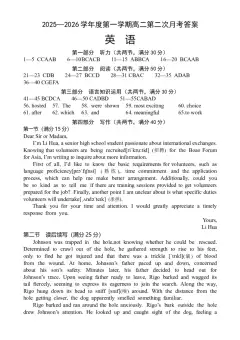
第一部分 听力
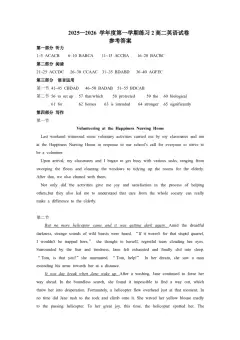
1-5 CAACA 6-10 BCBAB
11-15 CAACB 16-20 BCACC
第二部分 阅读理解
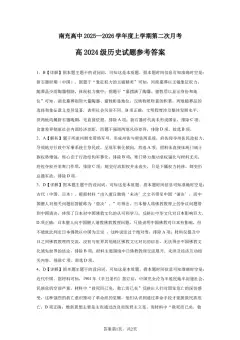
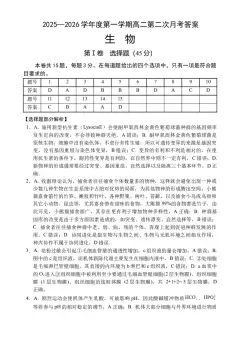
21-23 DCB 24-27 CDAA 28-31 DCCB 32-35 CADD
36-40 DECGB
第三部分 语言运用
完形填空
41—45 DBBCA 46—50 CABAC 51—55 CDDAB
语法填空
41. named 57. have seen 58. what 59. a 60. Its
61. appearance 62. but 63.purely 64. for 65. to connect
第四部分 写作
第一节
Dear Jim,
I was thrilled to hear about your plan to organize a “Chinese and Western Cultural Exchange”
event. As your friend and a fellow student at Hongxing High School, I’m more than happy to share
my ideas with you.
Regarding the form, I propose a combination of lectures and workshops. As for the content, in
the morning, experts can be invited to deliver lectures on the history and customs of both China and
Western countries. In the afternoon, we could switch to interactive workshops. This way, participants
can not only gain knowledge but also experience the cultures firsthand.
I believe this mix of learning and doing will make the event both educational and enjoyable.
Looking forward to your success.
Yours,
Li Hua
第二节
One afternoon, I gathered Mike and Lily to discuss how to manage the garden better.
Everyone shared ideas seriously this time. Mike suggested removing weeds to keep the garden in
good condition, while Lily proposed making a duty schedule so each volunteer would take turns
watering and cleaning. I recommended inviting more residents to join, especially families with
children, to keep the garden lively. After the discussion, we divided tasks and started to take
action. Over the next few weeks, we repaired broken tools, cleared the weeds, and built a watering
system together. Slowly, the garden began to recover its energy and beauty.
Months later, l walked through the garden again and was amazed by its beauty. Bright flowers
were blooming beside rows of vegetables, and butterflies danced freely in the air. Children were
laughing as they watered the plants, while elderly neighbors rested on benches, sharing stories
under the trees. Mike was painting a signboard that read “Our Shared Garden”, and Lily was
teaching a little girl how to plant seeds. Standing there, I felt proud and moved. The garden had
survived because we never gave up—it had become not only a green space but also the beating
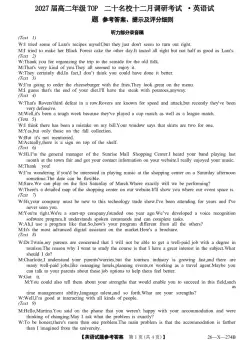
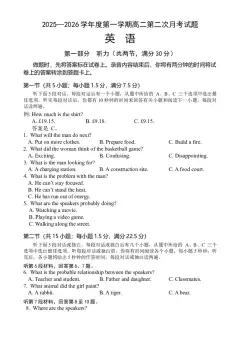
heart of our community.Text 1 通勤方式
M: The train has been late every day this week. I need to look at other ways of getting to work.
W: I used to have the same problem with the bus, so I choose to ride a bike now. (1)
Text 2 分类回收垃圾
M: I’m doing a survey about recycling. Do you recycle at home?
W: Yes, I have the habit of sorting rubbish, (2) and also try to use less plastic.
M: Great! Participating in some clean-up events is also a good choice if time permits.
Text 3 去森林远足
M: I’m going to Green Forest with my hiking club this weekend. Do you want to join us?
W: Sure. (3) I love being surrounded by trees and fresh air.
M: ①I know what you mean. Nature is a perfect place to relax and get your energy back.
①本句中what you之间存在“同化”现象:/wɒt/+/ju/=/wɒˈtʃu/。
Text 4 买衣服
W: Look! How about this shirt?
M: You always spend lots of hours choosing clothes in different shops but never find anything you really want. (4)
W: Come on, honey. You never know which one fits you best until you shop around.
Text 5 周末同去美食节
M: Mary, would you like to try some new foods?
W: Yes! ②I love tasting different dishes from different countries. You can learn a lot about their cultures that
way.
M: I agree. There’s a food festival taking place this weekend. We can go there together if you want. (5)
②本句中different dishes之间存在“失去爆破”现象:different最后一个音为爆破音/t/,dishes第一个音为爆破音/d/,两
者遇到一起,前面的爆破音做出发音的准备,但并不发音。
Text 6 广告频繁
M: It’s nice to see you reading a book for a change, Chloe.
W: Well, I was trying to watch a live stream online, but it kept getting cut off by those advertisements. ③I just
gave up in the⌒end. (6)
M: Yes. This morning, I watched TV but was interrupted by 5-minute-long ads every 15 minutes. After 40
minutes, I decided to stop. (7)
W: Like, I get that’s how people make money, but they’re not even funny or clever.
M: I know. They seem to have lost the art of selling a product.
W: Exactly. At least reading books doesn’t have the same problem.
③本句中the end之间存在“元音和元音的连读”现象:/ði (j)end/。
Text 7 向往太空
M: Do you think humans will ever visit Mars?
W: Of course. Space technology is improving so fast that it’s certain to make it in the future.
M: Do you think it will happen in our lifetime? I’d love to set foot in another world. (8)
W: Yes, I believe it will. Why are you so thirsty for a chance to go into space?
M: I grew up with my grandma. (9) We used to watch the stars at night.
W: That’s nice.
M: Yeah. We lived on a farm, (9) so there was no light pollution. It was perfect for seeing all the stars.
W: I bet that was some sight!
M: It was. In fact, I have some pictures we took — they’re in my room somewhere. Let me find them for you now.
(10)
W: Thanks.Text 8 (第11题为总结题) 各国送礼文化差异
M: Jen, (12) could I ask you some questions about my paper?
W: Sure, what’s it on?
M: Since you’re an exchange student, I was hoping to learn more about your culture.
W: Of course, I’d be happy to share. Is there a specific topic you’re looking at?
M: Yes. I’m looking at how different cultures give gifts. For example, in America, we give them on birthdays or
other special occasions like Christmas, Mother’s Day, and so on.
W: It’s funny that you mention Christmas. In Russia, we focus on New Year’s Eve for gifts. (12) Some celebrate
Christmas on January 7th, but it’s less common.
M: Oh, I didn’t know that.
W: Have you looked at Japanese culture yet?
M: No, do they have special traditions around gifts?
W: Yes. I spent three months traveling in East Asia before I started university. In Japan, people often give gifts that
are packed carefully. The package design matters as much as the gift itself. (13)
M: Perfect. I’ll need to look into that more. Thanks for your help.
W: No problem.
Text 9 (第14题为推断题) 孩子过度使用手机
M: Joanne, (15) (16) (17) I need to have a word with you about your social media usage.
W: Is this because I was using my phone in class?
M: Sort of. Mrs. Smith called to tell me she had to take your phone away from you.
W: But that’s because I had to reply to an important email.
M: Although that may be true, it’s still against school policies. (15) I also looked at your social media activity. Do
you know how many times you post each day? (16)
W: Maybe five times? (16)
M: Double that number. (16)
W: No way!
M: I’ve gone back through the last month across all of your accounts.
W: I’m sorry. I didn’t realize I was using it that much.
M: I know. Overuse of mobile phones is becoming a real problem, not just with children but with adults too.
However, you can try to avoid this issue by focusing on your studies. (17)
W: I will. I promise.
M: At the same time, we’ll set a new family rule. Mom and I will keep your phone on weekdays. You can have it
on Sunday mornings, but only for an hour.
Text 10 英国圣迈克尔山
I think everyone is on board, so we’ll head off shortly. Let me tell you a bit about where we’re heading today.
We’re going to transport you to a place called St. Michael’s Mount, which is one of the most southern and western
points of England. This historic site is home to an ancient castle that sits on top of a rocky hill that rises from the
sea. (18) The bus will stop in the lovely small town of Marazion, where you can find food and gift shops. We will
then need to wait for the sea to go back so that we can walk on the stones to the island. (19) According to our
experience, the waiting time won’t be too long. When the sea comes in, the path disappears, and the only way to get
to and from the island is by boat. Don’t worry! We have already booked a boat for you to come back on. Once you
are there, you can tour the 800-year-old castle, which has several hidden rooms to discover, beautiful gardens to
relax in, (20) and excellent views of the surrounding ocean. We will arrive in Marazion in an hour, so make
yourselves comfortable.