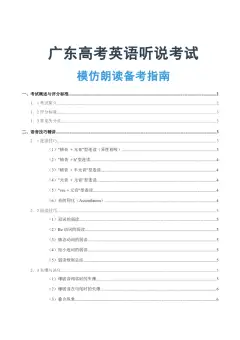
广东高考英语听说考试
Part C 故事复述
目 录
一、考试概述与核心挑战
二、缩写方法(Abbreviation)—— 五大策略全解
三、符号速记(Symbols)—— 体系化符号表
四、笔记排版法 —— 竖记·分栏·逻辑线
五、听记实战步骤 —— 两遍听记法 + 故事预测 + 实战示例
六、复述策略 —— 四大句型 + 万能句式 + 完整示例
七、高频词专属速记表
八、日常训练建议一、考试概述与核心挑战
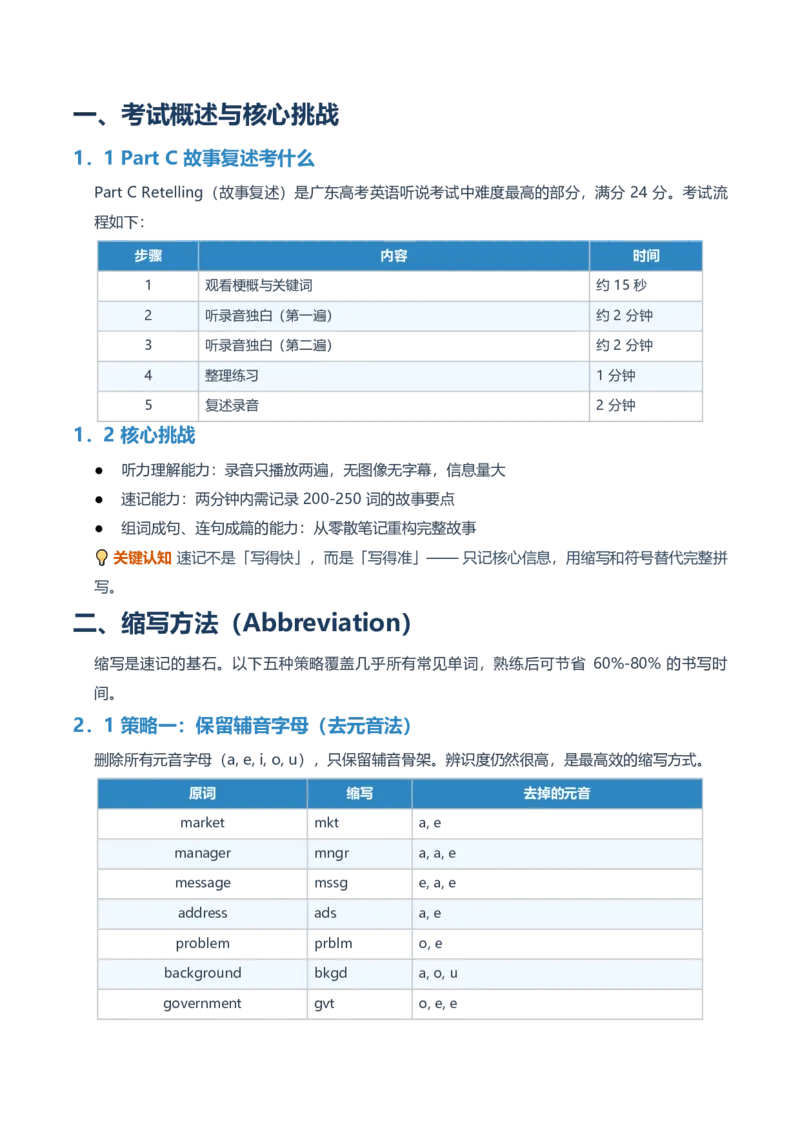
1.1 Part C 故事复述考什么
Part C Retelling(故事复述)是广东高考英语听说考试中难度最高的部分,满分 24 分。考试流
程如下:
步骤 内容 时间
1 观看梗概与关键词 约 15 秒
2 听录音独白(第一遍) 约 2 分钟
3 听录音独白(第二遍) 约 2 分钟
4 整理练习 1 分钟
5 复述录音 2 分钟
1.2 核心挑战
● 听力理解能力:录音只播放两遍,无图像无字幕,信息量大
● 速记能力:两分钟内需记录 200-250 词的故事要点
● 组词成句、连句成篇的能力:从零散笔记重构完整故事
💡 关键认知 速记不是「写得快」,而是「写得准」—— 只记核心信息,用缩写和符号替代完整拼
写。
二、缩写方法(Abbreviation)
缩写是速记的基石。以下五种策略覆盖几乎所有常见单词,熟练后可节省 60%-80% 的书写时
间。
2.1 策略一:保留辅音字母(去元音法)
删除所有元音字母(a, e, i, o, u),只保留辅音骨架。辨识度仍然很高,是最高效的缩写方式。
原词 缩写 去掉的元音
market mkt a, e
manager mngr a, a, e
message mssg e, a, e
address ads a, e
problem prblm o, e
background bkgd a, o, u
government gvt o, e, e原词 缩写 去掉的元音
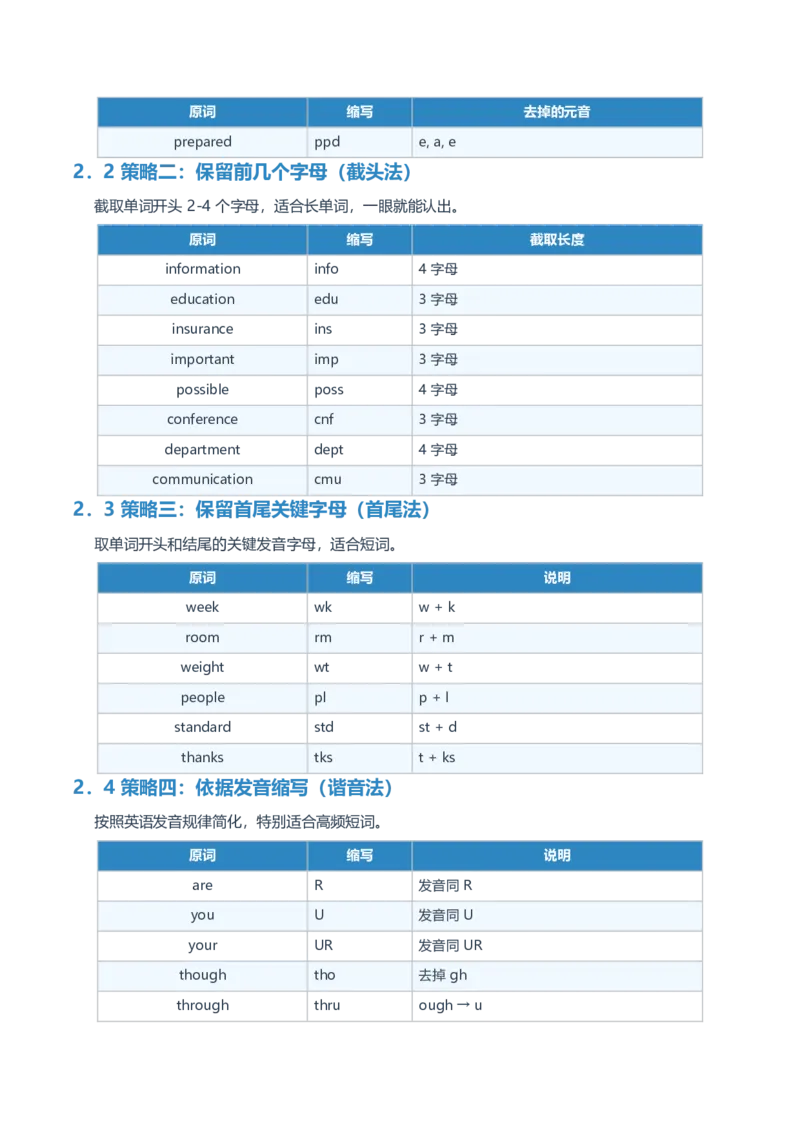
prepared ppd e, a, e
2.2 策略二:保留前几个字母(截头法)
截取单词开头 2-4 个字母,适合长单词,一眼就能认出。
原词 缩写 截取长度
information info 4 字母
education edu 3 字母
insurance ins 3 字母
important imp 3 字母
possible poss 4 字母
conference cnf 3 字母
department dept 4 字母
communication cmu 3 字母
2.3 策略三:保留首尾关键字母(首尾法)
取单词开头和结尾的关键发音字母,适合短词。
原词 缩写 说明
week wk w + k
room rm r + m
weight wt w + t
people pl p + l
standard std st + d
thanks tks t + ks
2.4 策略四:依据发音缩写(谐音法)
按照英语发音规律简化,特别适合高频短词。
原词 缩写 说明
are R 发音同 R
you U 发音同 U
your UR 发音同 UR
though tho 去掉 gh
through thru ough → u原词 缩写 说明
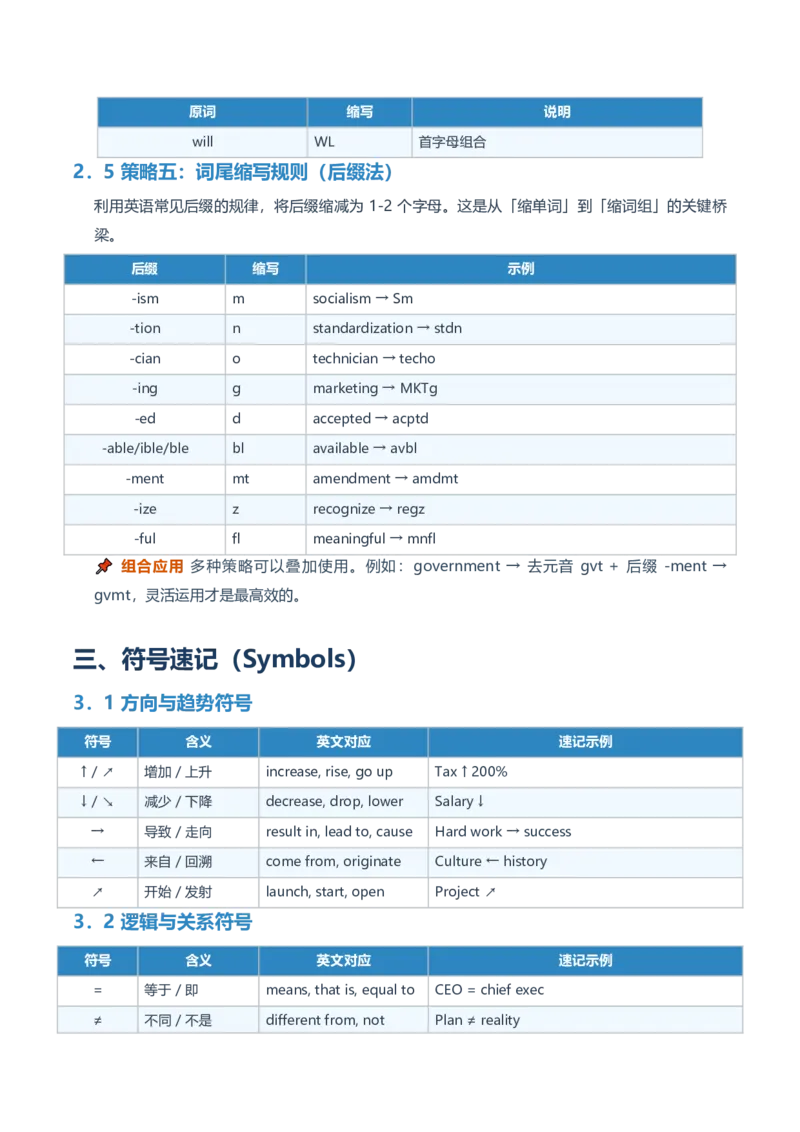
will WL 首字母组合
2.5 策略五:词尾缩写规则(后缀法)
利用英语常见后缀的规律,将后缀缩减为 1-2 个字母。这是从「缩单词」到「缩词组」的关键桥
梁。
后缀 缩写 示例
-ism m socialism → Sm
-tion n standardization → stdn
-cian o technician → techo
-ing g marketing → MKTg
-ed d accepted → acptd
-able/ible/ble bl available → avbl
-ment mt amendment → amdmt
-ize z recognize → regz
-ful fl meaningful → mnfl
📌 组合应用 多种策略可以叠加使用。例如:government → 去元音 gvt + 后缀 -ment →
gvmt,灵活运用才是最高效的。
三、符号速记(Symbols)
3.1 方向与趋势符号
符号 含义 英文对应 速记示例
↑ / ↗ 增加 / 上升 increase, rise, go up Tax ↑ 200%
↓ / ↘ 减少 / 下降 decrease, drop, lower Salary ↓
→ 导致 / 走向 result in, lead to, cause Hard work → success
← 来自 / 回溯 come from, originate Culture ← history
↗ 开始 / 发射 launch, start, open Project ↗
3.2 逻辑与关系符号
符号 含义 英文对应 速记示例
= 等于 / 即 means, that is, equal to CEO = chief exec
≠ 不同 / 不是 different from, not Plan ≠ reality符号 含义 英文对应 速记示例
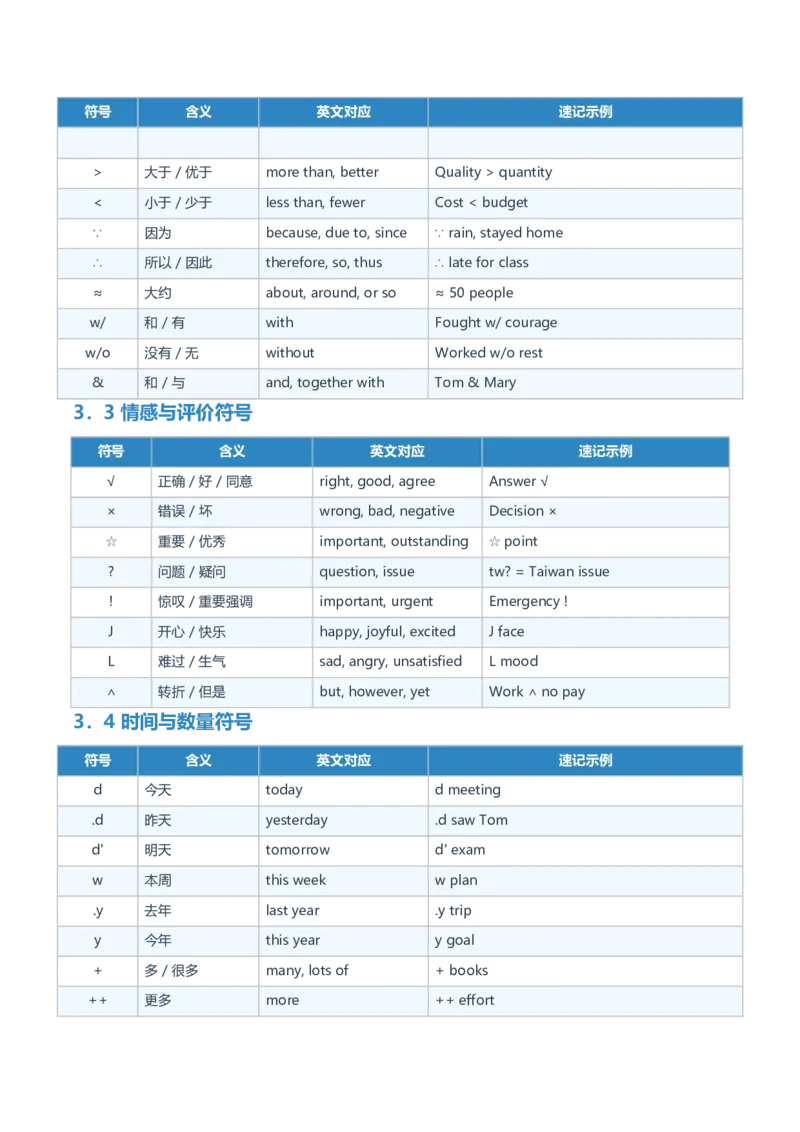
> 大于 / 优于 more than, better Quality > quantity
< 小于 / 少于 less than, fewer Cost < budget
∵ 因为 because, due to, since ∵ rain, stayed home
∴ 所以 / 因此 therefore, so, thus ∴ late for class
≈ 大约 about, around, or so ≈ 50 people
w/ 和 / 有 with Fought w/ courage
w/o 没有 / 无 without Worked w/o rest
& 和 / 与 and, together with Tom & Mary
3.3 情感与评价符号
符号 含义 英文对应 速记示例
√ 正确 / 好 / 同意 right, good, agree Answer √
× 错误 / 坏 wrong, bad, negative Decision ×
☆ 重要 / 优秀 important, outstanding ☆ point
? 问题 / 疑问 question, issue tw? = Taiwan issue
! 惊叹 / 重要强调 important, urgent Emergency !
J 开心 / 快乐 happy, joyful, excited J face
L 难过 / 生气 sad, angry, unsatisfied L mood
∧ 转折 / 但是 but, however, yet Work ∧ no pay
3.4 时间与数量符号
符号 含义 英文对应 速记示例
d 今天 today d meeting
.d 昨天 yesterday .d saw Tom
d' 明天 tomorrow d' exam
w 本周 this week w plan
.y 去年 last year .y trip
y 今年 this year y goal
+ 多 / 很多 many, lots of + books
++ 更多 more ++ effort符号 含义 英文对应 速记示例
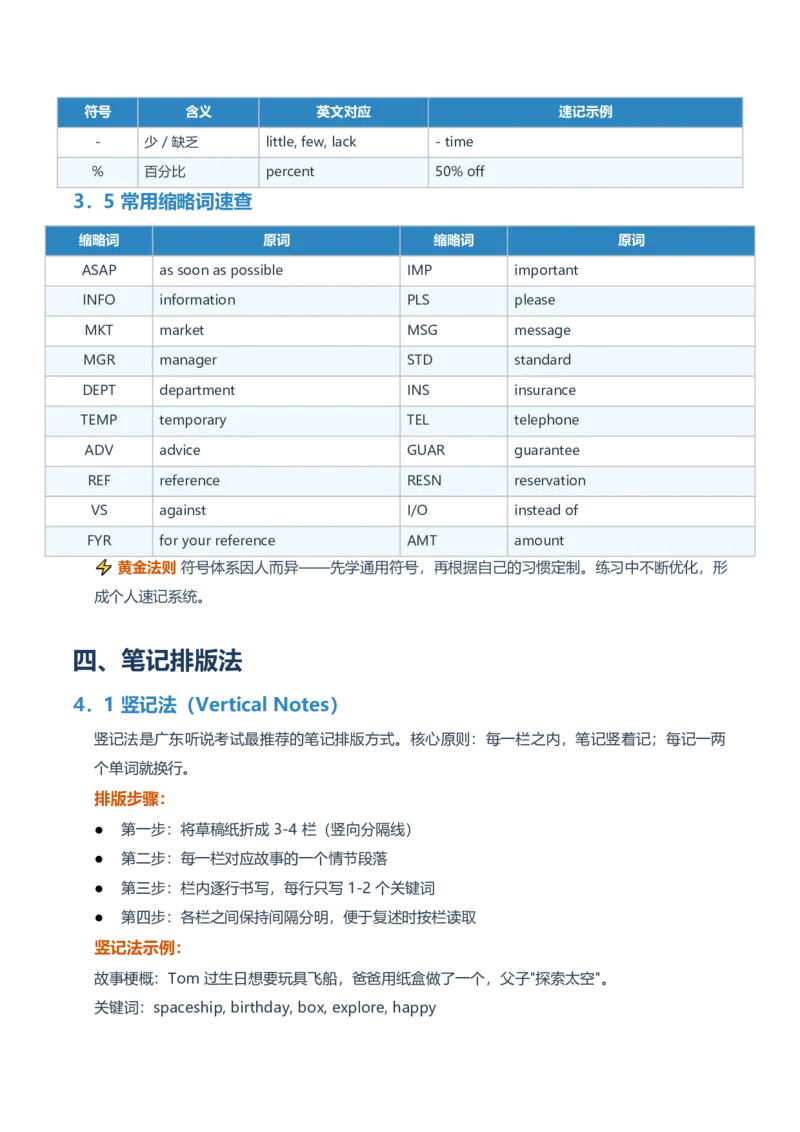
- 少 / 缺乏 little, few, lack - time
% 百分比 percent 50% off
3.5 常用缩略词速查
缩略词 原词 缩略词 原词
ASAP as soon as possible IMP important
INFO information PLS please
MKT market MSG message
MGR manager STD standard
DEPT department INS insurance
TEMP temporary TEL telephone
ADV advice GUAR guarantee
REF reference RESN reservation
VS against I/O instead of
FYR for your reference AMT amount
⚡ 黄金法则 符号体系因人而异——先学通用符号,再根据自己的习惯定制。练习中不断优化,形
成个人速记系统。
四、笔记排版法
4.1 竖记法(Vertical Notes)
竖记法是广东听说考试最推荐的笔记排版方式。核心原则:每一栏之内,笔记竖着记;每记一两
个单词就换行。
排版步骤:
● 第一步:将草稿纸折成 3-4 栏(竖向分隔线)
● 第二步:每一栏对应故事的一个情节段落
● 第三步:栏内逐行书写,每行只写 1-2 个关键词
● 第四步:各栏之间保持间隔分明,便于复述时按栏读取
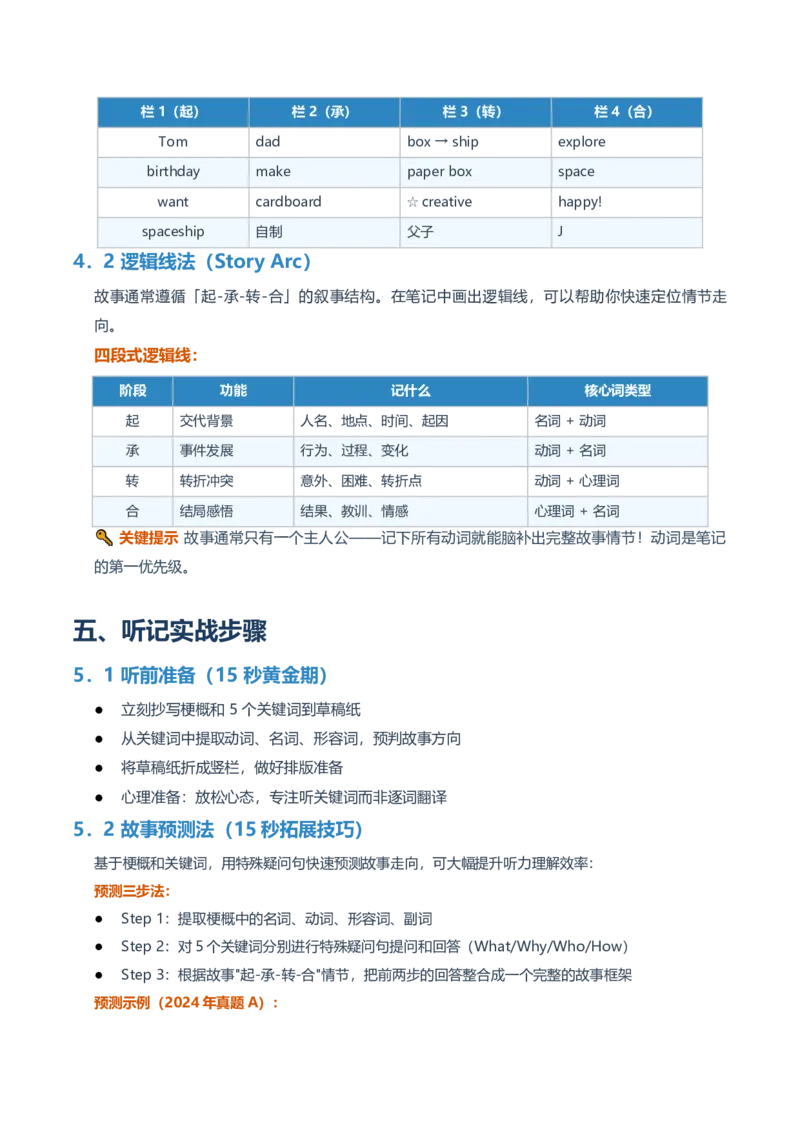
竖记法示例:
故事梗概:Tom 过生日想要玩具飞船,爸爸用纸盒做了一个,父子"探索太空"。
关键词:spaceship, birthday, box, explore, happy栏 1(起) 栏 2(承) 栏 3(转) 栏 4(合)
Tom dad box → ship explore
birthday make paper box space
want cardboard ☆ creative happy!
spaceship 自制 父子 J
4.2 逻辑线法(Story Arc)
故事通常遵循「起-承-转-合」的叙事结构。在笔记中画出逻辑线,可以帮助你快速定位情节走
向。
四段式逻辑线:
阶段 功能 记什么 核心词类型
起 交代背景 人名、地点、时间、起因 名词 + 动词
承 事件发展 行为、过程、变化 动词 + 名词
转 转折冲突 意外、困难、转折点 动词 + 心理词
合 结局感悟 结果、教训、情感 心理词 + 名词
🔑 关键提示 故事通常只有一个主人公——记下所有动词就能脑补出完整故事情节!动词是笔记
的第一优先级。
五、听记实战步骤
5.1 听前准备(15 秒黄金期)
● 立刻抄写梗概和 5 个关键词到草稿纸
● 从关键词中提取动词、名词、形容词,预判故事方向
● 将草稿纸折成竖栏,做好排版准备
● 心理准备:放松心态,专注听关键词而非逐词翻译
5.2 故事预测法(15秒拓展技巧)
基于梗概和关键词,用特殊疑问句快速预测故事走向,可大幅提升听力理解效率:
预测三步法:
● Step 1:提取梗概中的名词、动词、形容词、副词
● Step 2:对5个关键词分别进行特殊疑问句提问和回答(What/Why/Who/How)
● Step 3:根据故事"起-承-转-合"情节,把前两步的回答整合成一个完整的故事框架
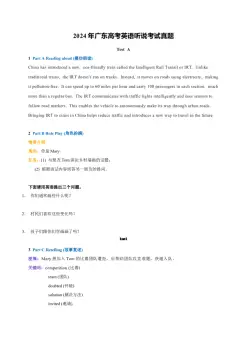
预测示例(2024年真题A):梗概:Mary想加入Tom的比赛团队遭拒,后帮助团队攻克难题,获邀入队。
关键词:competition (比赛) team (团队) doubted (怀疑) solution (解决方法) invited (邀请)
What competition? → Why did Mary want to join? → What team? → What's the matter? →
Who doubted what? → Why was she rejected? → Why was she invited?
预测内容:Mary wanted to take part in Tom's competition team, but she was refused. The
problem was that Tom doubted her ability. Later, the team met a problem. After thinking
carefully, Mary tried to deal with the problem. Finally, she found a solution to help the team
solve the difficulty. She was invited to join the team in the end.
5.3 两遍听记法
遍数 目标 记什么 不记什么
理解大意 + 抓主 动词(谓语)、表语、心理词、人名地名时 修饰性副词、重复信息、细节数
第一遍
干 间 字
补充细节 + 修正 已在第一遍记下的内容(不重复
第二遍 第一遍漏掉的关键信息、转折点、结局
笔记 写)
5.4 听记实战示例(2024年真题A)
以下展示同一篇真题的完整听记过程,帮助理解如何在实战中运用两遍听记法:
Step 1:巧记动词(动词短语),抓住故事发展情节
…went …didn't have …holding…interested…won…take part in…find out…formed…join…
didn't know…doubted…turned down…heard…discussing…had no idea…deal with…did…
worked out…solve…told…decided…give…turned out…worked…invited…join…
improved…won…
Step 2:巧记重要名词、形容词、副词,补充时间和地点
…went a new school …didn't have friends…recently…holding science competition…
interested robot design…won prizes…take part in competition…find out Tom formed
team 2 boys…robot project competition…join…boys didn't know…doubted ability…
turned down politely…one day…school bus…heard Tom classmates discussing problem…
design…had no idea…deal with…home…did research…worked out way…solve problem…
next day…told…solution…first…not sure…decided…give try…turned out…solution really
worked…glad…Mary helpful…invited…join team…improved robot design…won
competition
通过先记动词抓主干、再补充名形副完善细节,两遍即可构建完整故事框架。
5.3 笔记优先级排序
在有限时间内,不是什么都记,而是按优先级筛选:优先级 词类 理由 示例
故事靠动作推进,记动词就能串联情
★★★ 最高 动词(谓语) ran, found, decided
节
★★☆ 高 心理词/情感词 得分点,体现人物情感变化 happy, sad, excited
★☆☆ 中 名词(关键事物) 支撑情节的实体要素 spaceship, box, letter
☆☆☆ 低 修饰词/细节 复述时可用自己的话替代 quickly, very, beautiful
六、复述策略
6.1 从笔记到篇章的转化步骤
整理练习阶段只有 1 分钟,必须高效完成以下四步:
步骤 动作 耗时
Step 1 在笔记中标出要说的时间顺序 10 秒
Step 2 用基本句型(主谓、主谓宾、主系表)完善每条笔记 20 秒
Step 3 添加过渡词使句子连贯 15 秒
Step 4 脑补未记内容,尝试口头说一遍 15 秒
6.2 四大基本句型完善复述内容
整理笔记后,用以下四大基本句型将零散信息转化为完整故事:
句型一:主语 + 系动词 + 表语
常用于复述人物身份、所处状态和人物情感。常用系动词:be, became, felt。
● Mary was interested in robot design.
● First, they were not sure about it.
● They were glad that Mary was so helpful.
句型二:主语 + 谓语(+ 宾语)
常用于描述故事发展过程和结局。
● Mary went to a new school.
● She didn't have many friends there.
● Mary wanted to take part in the competition.
● They turned her down politely.
句型三:主语 + 谓语 + 间接宾语 + 直接宾语
● The next day, Mary told the boys about her solution.
句型四:长难句拆分成短句遇到复杂长句时,拆分为多个简单句,既便于记忆又保证复述流畅。
● 原句:Mary had always been interested in robot design and had won some prizes
before.
● 拆分:Mary was interested in robot design. She won some prizes before.
● 原句:She happened to find out that her classmate Tom had formed a team with two
other boys on a robot project for the competition.
● 拆分:She found out something. Tom had formed a team with 2 boys. They worked
on a robot project for the competition.
6.3 必用关键词 + 过渡词
复述的硬性要求:必须用到所给的全部关键词。同时,使用过渡词让故事连贯流畅。
常用过渡词速记表:
功能 过渡词 速记写法
时间顺序 first, then, next, finally 1st → then → nxt → fin
因果关系 because, so, therefore, as a result ∵ → ∴ → result
转折对比 but, however, yet, although ∧ / tho
补充说明 and, also, moreover, in addition & / +
举例说明 for example, such as eg / s.a.
6.3 复述核心原则
原则 具体要求 常见错误
关键词必须用 5 个关键词一个都不能漏 忘用关键词 → 扣分严重
人称理清楚 he/she/they 不能混淆 he 说成 she → 逻辑混乱
说得慢一点 给自己思考时间 急着说 → 卡壳 + 漏信息
用自己的话 理解后重新表达更顺畅 背原文 → 记不住反而卡壳
保持连贯 用过渡词串联,不要碎片化 停顿重复 → 流利度扣分
6.4 故事复述万能句式储备(问题解决型)
广东高考Part C故事多为"问题解决型"叙事结构。熟练运用以下句式模板,可确保复述时语句连
贯、结构完整。
1. 开头引入背景
● One sunny/rainy afternoon, … (在一个晴朗/下雨的下午,…)
● Tom still remembered the day when… (Tom依然记得那一天,当…)● Tom never thought he would face such a challenge until… (Tom决没想到会面对这样一
个挑战,直到……)
2. 提出问题
● Suddenly, … / To his surprise, … (突然,…/让他惊讶的是,…)
● The problem was that… (这个问题是……)
● Tom was shocked to see/find… (Tom很震惊地看到/发现…)
3. 尝试解决(失败尝试)
● At first, Tom tried to… but… (首先,Tom试着…但是…)
● Tom thought… might work, but it didn't. (Tom认为…可能有作用,但它没用。)
● His first idea was to…, however, … (他的第一个主意是去…,然而,…)
4. 转折与成功解决
● Just then, … / Luckily, … (正在那时,…/幸运地是,…)
● After thinking carefully, Tom decided to… (在仔细思考后,Tom决定…)
● With the help of…, Tom finally… (在…的帮助下,Tom最终…)
5. 结尾(感悟或成长)
● That day, Tom learned that… (那天,Tom学到了…)
● From this experience, Tom understood… (从这次经历,Tom理解了…)
● Tom will never forget the lesson that… (Tom决不会忘记这个教训…)
6.5 完整参考答案示例(2024年真题A)
Super Mary
Mary went to a new school. She didn't have many friends there. Recently, the school was holding a science
competition. Mary was always interested in robot design. She won some prizes before. So Mary wanted to take
part in the competition. She found out something. Tom had formed a team with 2 boys. They worked on a robot
project for the competition. Mary wanted to join them, but the boys didn't know her well. They doubted her
ability. So they turned her down politely. One day on the school bus, Mary heard Tom and his teammates
discussing a problem with their robot design. They had no idea how to deal with it. Back at home, Mary did some
research. She worked out a good way to solve the problem. The next day, Mary told the boys about her solution.
At first, they were not sure about it, but they decided to give it a try. It turned out that Mary's solution really
worked. They were glad that Mary was so helpful. So they invited her to join their team. Together, they improved
their robot design. They won the competition.
🎯 复述公式 记动词 → 抓心理词 → 用关键词 → 理清人称 → 慢说 + 过渡词 → 用自己的话
七、高频词专属速记表
以下词汇在广东高考英语听说考试 Part C 中反复出现。建议将其速记形式背熟,考前可直接使用。
7.1 动词类(最高优先级 ★★★)
原词 速记 原词 速记 原词 速记
find fnd lose ls decide dcid
discover dscv realize rlz remember rmb
believe blv understand udst explain expln
suggest sgst agree agr refuse rfus
borrow brr return rtn invite inv
surprise srps imagine img consider cnsdr
complain cmpln apologize aplgz encourage ncrg
announce nns celebrate clbrt examine xmn
7.2 心理词/情感词(高优先级 ★★☆)
原词 速记 原词 速记 原词 速记
happy J sad L excited exc
surprised srpsd angry ang afraid afrd
worried wrrd grateful grtfl proud prd
embarrassed embrsd confused cfusd disappointed dspntd
delighted dltd lonely lnly nervous nrvs
unwilling unwl confident cnfdnt curious crs
7.3 名词/关键事物(中优先级 ★☆☆)
原词 速记 原词 速记 原词 速记
birthday bday gift/present gft letter ltr
money mny ticket tkt passport pspt
photograph photo camera cmra newspaper npr
competition cmpn exhibition exhbn invitation invtn
restaurant rstnt hospital hsptl university unv
supermarket smkt library lbr neighbor nbr
八、日常训练建议8.1 四步训练法
阶段 训练内容 时长 目标
每天 30 分
第 1-3 天 熟悉缩写 5 大策略 + 背诵高频词速记表 形成缩写肌肉记忆
钟
每天 40 分 符号反应速度 ≤ 0.5
第 4-7 天 符号速记专项练习:听短文 → 用符号记笔记
钟 秒
每天 45 分
第 8-12 天 竖记法排版练习:听完整故事 → 分栏竖记 排版清晰 + 信息完整
钟
每天 60 分
第 13-15 天 全流程模拟:听记 + 整理 + 复述 综合实战能力
钟
8.2 日常速记练习技巧
● 提前熟悉考试常见词汇,针对这些词汇制定速记符号
● 平时练习中坚持用速记记录,增强符号的记忆和应用熟练度
● 速记不能一味追求速度——识别时不能产生歧义才是关键
● 每天用 5 分钟做「符号闪测」:看符号 → 说出含义,反复训练反应速度
● 过一遍 800 高频词,设计属于自己的缩记方案
8.3 备考清单
项目 完成标准 ☐
缩写 5 大策略 每种策略 10 个以上实例可脱口而出 ☐
符号体系 30+ 常用符号 0.5 秒内识别 ☐
高频词速记表 动词 + 心理词 + 名词各 20+ 词汇已背熟 ☐
竖记排版 3 栏清晰 + 每行 1-2 词 ☐
过渡词 时间/因果/转折/补充 4 类各 3+ 个 ☐
全流程模拟 至少 5 次完整 Part C 模拟训练 ☐