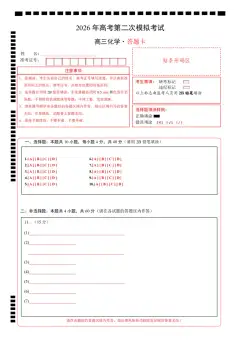
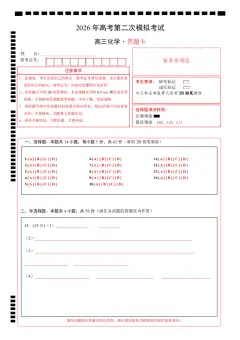
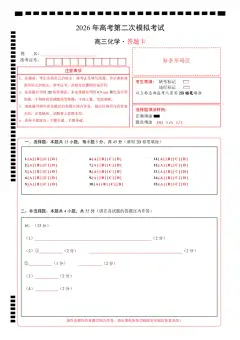
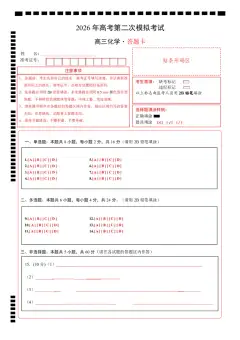
2026 年高考第二次模拟考试(浙江专用)02
高三英语
(考试时间:120 分钟  试卷满分:150 分)
注意事项:
1.答卷前,考生务必将自己的姓名、准考证号等填写在答题卡和试卷指定位置上。
2.回答选择题时,选出每小题答案后,用铅笔把答题卡上对应题目的答案标号涂黑。
如需改动,用橡皮擦干净后,再选涂其他答案标号。回答非选择题时,将答案写在答
题卡上。写在本试卷上无效。
3.考试结束后,将本试卷和答题卡一并交回
第一部分 听力(共两节,满分30 分)
做题时,先将答案标在试卷上,录音内容结束后,你有两分钟的时间将试卷上的答案转涂
到答题卡上。
第一节(共5 小题:每小题1.5 分,满分7.5 分)
听下面5 段对话。每段对话后有一个小题,从题中所给的A、B、C 三个选项中选出最佳选
项。听完每段对话后,你都有10 秒钟的时间来回答有关小题和阅读下一小题。每段对话读
两遍。
1.What will Eddy do probably next month?
A.Travel to Mexico.
B.Celebrate his birthday.
C.Return home.
【答案】A
【原文】M: Time is too fast. By next Sunday, Eddy will have been in New York for six months. I
wish he could come back home to celebrate his birthday with us next month.
W: Unfortunately, his plan is to visit Mexico at that time.
2.What surprises the man?
A.Fireworks are used for many events.  B.Fireworks are rarely seen at weddings.
C.Fireworks are most popular on Diwali.
【答案】A
【原文】W: It feels like we celebrate everything with fireworks nowadays, the Wall, Chinese
New Year, and even weddings.
M: Wow, really? I always thought they were just for New Year and bonfire nights.
3. What does the woman mean?
A.The man is pretty lazy.
B.The man needs exercise.
C.The man needs a bicycle.
【答案】B
【原文】W: How did you go to the Space Museum yesterday?
M: I took a lift.
W: You should have ridden your bike. You lack enough exercise.
M: You are right.
4.What does the man think about Thanksgiving?
A.It’s a chance to visit friends.  B.It’s a good time to enjoy turkey.
C.It’s a moment to express thanks.
【答案】C
【原文】M: Are you celebrating Thanksgiving this year?
W: Yes, we’re having a big family gathering with turkey and all the traditional dishes.
M: That sounds lovely, even though I’m a vegetarian! It’s great to take a moment and be thankful
for everything we have.
5.Why did the woman make the call?
A.To change an appointment.  B.To get some comfort.
C.To ask about a book.
【答案】A
【原文】W: Hi, I have a hairdresser’s appointment booked for Thursday afternoon.
M: Yes, I’ve found your booking. Would you like to change something?
W: Could I move it to Wednesday morning? There’s something important afterwards, and I want
to feel my best.
第二节(共15 小题;每小题1.5 分,满分22.5 分)
听下面5 段对话或独白。每段对话或独白后有几个小题,从题中所给的A、B、C 三个选项
中选出最佳选项。听每段对话或独白前,你将有时间阅读各个小题,每小题5 秒钟;听完
后,各小题将给出5 秒钟的作答时间。每段对话或独白读两遍。
听第6 段材料,回答第6、7 题。
6.How long has it been since the Campus Film Festival started?
A.A month.
B.A year.
C.Two years.
7.What does the man need to watch the films?
A.A ticket.
B.An invitation card.
C.His student ID card.
【答案】6.C    7.C
【原文】M: I heard that you were busy preparing for next month’s campus film festival.
W: Yeah. Are you interested in that?
M: I don’t really know about that. Can you tell me more?
W: Sure, it started two years ago. The films are shot by students from different universities.
M: Cool! Then, who picks up the films?
W: It’s up to the organization committee.
M: I see. Well, can I watch the films there? Should I buy a ticket?
W: Actually not. You can watch any film there for free with your student ID card.
听第7 段材料,回答第8 至10 题。
8.Why is the man returning the book early?
A.He found it too boring.
B.He’s read something similar.
C.He finished reading it in no time.
9.How long did the breathing exercise take the man in total?
A.14 seconds.
B.50 seconds.
C.70 seconds.
10.What does the man think of the book?
A.Helpful.
B.Challenging.
C.Humorous.
【答案】8.C    9.C    10.A
【原文】W: So, what did you think of the mindfulness book?
M: I thought it would be boring, but it actually helped. That’s why I’m returning it early. I read it
quickly.
W: Was there anything in particular that stood out?
M: The breathing exercises. I used one before my presentation last week.
W: Did it help you calm down?
M: Yeah. The book suggests breathing in for 4 seconds, pausing for 4, and then breathing out for
6, which adds up to 14 seconds per cycle. I tried that 5 times, it really worked.
W: I try that. I only do it once, and it still makes a difference.
M: I might try that gratitude journal idea next.
W: It’s worth a try.
M: I think more students should read that book. It felt real.
听第8 段材料,回答第11 至13 题。
11.Where does the conversation probably take place?
A.At a travel fair.
B.At a school.
C.At a temple.
12.What made Ms. Tomlinson’s holiday rewarding?
A.Physical activities.
B.Luxurious experience.
C.Strong friendships.
13.What will the man probably do next summer?
A.Take a business trip.
B.Volunteer with family.
C.Explore foreign markets.
【答案】11.A    12.C    13.B
【原文】M: (Surprised. ) Ms. Tomlinson! I didn’t think I’d see you at a travel fair. Are you
booking another luxury holiday?
W: Actually, I just come to give feedback about a volunteering holiday in Nepal. No luxury this
time — it was about building schools and supporting communities.
M: Volunteering? Did you still feel like you’d had a holiday?
W: Definitely! Although the days involved physical labor and teaching, it was incredibly
rewarding. The locals were so welcoming, and working with others created strong friendships.
Honestly, it was one of my best trips.
M: Interesting. Did you have any free time?
W: We had free evenings and weekends, exploring temples and markets. The balance was perfect.
It was meaningful work plus experiencing local culture. The holiday somehow felt better knowing
I had done something for the community.
M: You’ve made me reconsider my own holiday plans. Perhaps volunteering could be good for the
family next summer.
W: You won’t regret it.
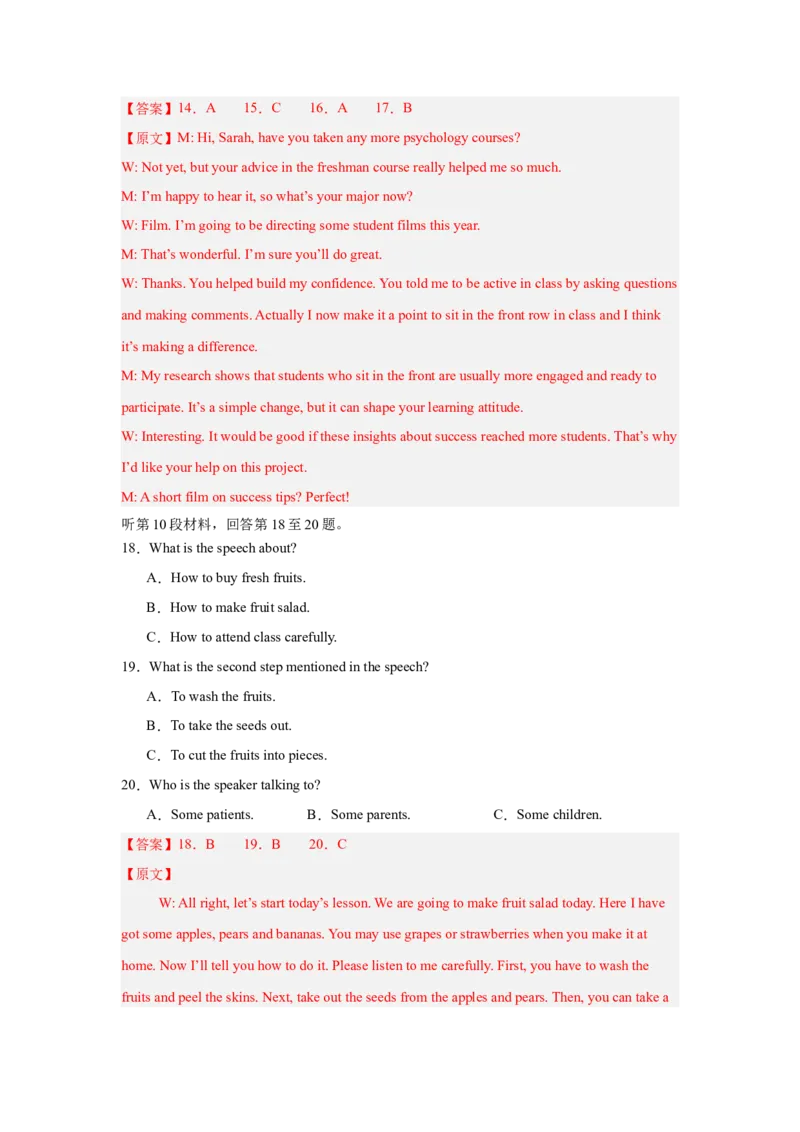
听第9 段材料,回答第14 至17 题。
14.Who are the speakers?
A.Teacher and student.
B.Fellow researchers.
C.Classmates.
15.What will the woman do this year?
A.Learn psychology.
B.Change her major.
C.Direct some films.
16.What did the man advise the woman to do?
A.Engage in class more.
B.Seek insights about success.
C.Interact with more students.
17.What does the woman invite the man to do?
A.Offer film-making tips.
B.Get involved in her project.
C.Make comments on her project.
【答案】14.A    15.C    16.A    17.B
【原文】M: Hi, Sarah, have you taken any more psychology courses?
W: Not yet, but your advice in the freshman course really helped me so much.
M: I’m happy to hear it, so what’s your major now?
W: Film. I’m going to be directing some student films this year.
M: That’s wonderful. I’m sure you’ll do great.
W: Thanks. You helped build my confidence. You told me to be active in class by asking questions
and making comments. Actually I now make it a point to sit in the front row in class and I think
it’s making a difference.
M: My research shows that students who sit in the front are usually more engaged and ready to
participate. It’s a simple change, but it can shape your learning attitude.
W: Interesting. It would be good if these insights about success reached more students. That’s why
I’d like your help on this project.
M: A short film on success tips? Perfect!
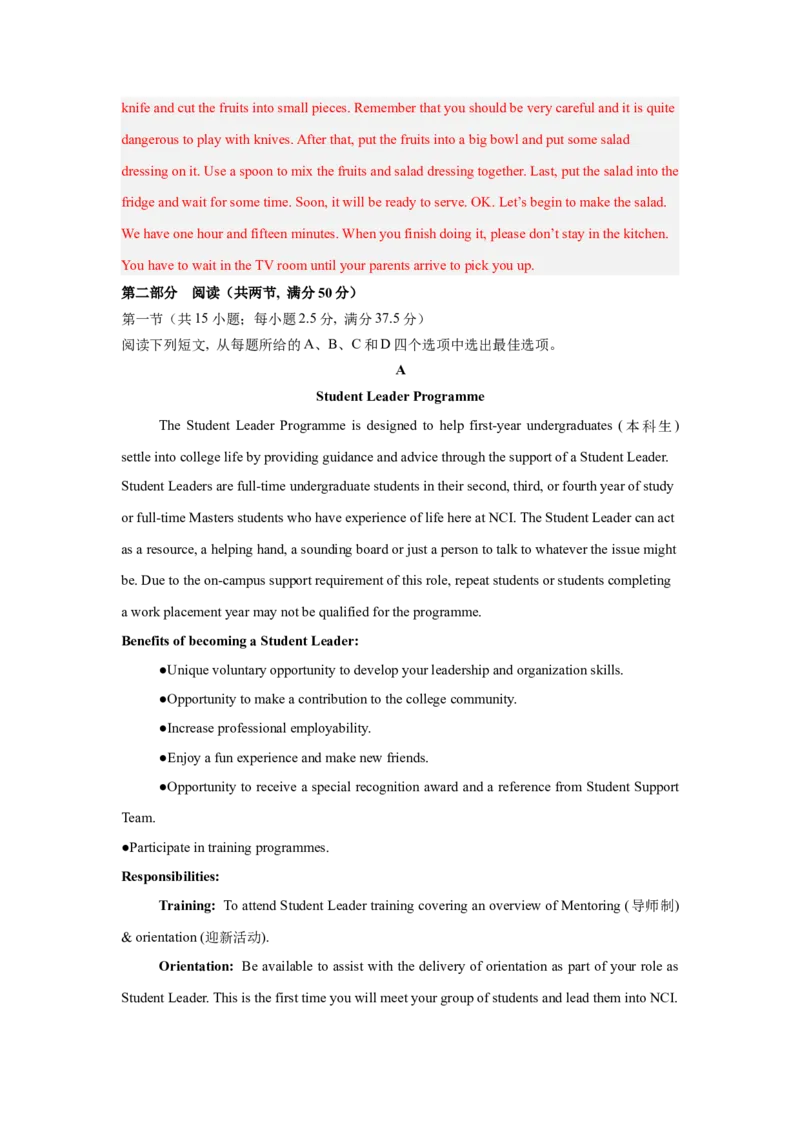
听第10 段材料,回答第18 至20 题。
18.What is the speech about?
A.How to buy fresh fruits.
B.How to make fruit salad.
C.How to attend class carefully.
19.What is the second step mentioned in the speech?
A.To wash the fruits.
B.To take the seeds out.
C.To cut the fruits into pieces.
20.Who is the speaker talking to?
A.Some patients.
B.Some parents.
C.Some children.
【答案】18.B    19.B    20.C
【原文】
W: All right, let’s start today’s lesson. We are going to make fruit salad today. Here I have
got some apples, pears and bananas. You may use grapes or strawberries when you make it at
home. Now I’ll tell you how to do it. Please listen to me carefully. First, you have to wash the
fruits and peel the skins. Next, take out the seeds from the apples and pears. Then, you can take a
knife and cut the fruits into small pieces. Remember that you should be very careful and it is quite
dangerous to play with knives. After that, put the fruits into a big bowl and put some salad
dressing on it. Use a spoon to mix the fruits and salad dressing together. Last, put the salad into the
fridge and wait for some time. Soon, it will be ready to serve. OK. Let’s begin to make the salad.
We have one hour and fifteen minutes. When you finish doing it, please don’t stay in the kitchen.
You have to wait in the TV room until your parents arrive to pick you up.
第二部分  阅读(共两节, 满分50 分)
第一节(共15 小题;每小题2.5 分, 满分37.5 分)
阅读下列短文, 从每题所给的A、B、C 和D 四个选项中选出最佳选项。
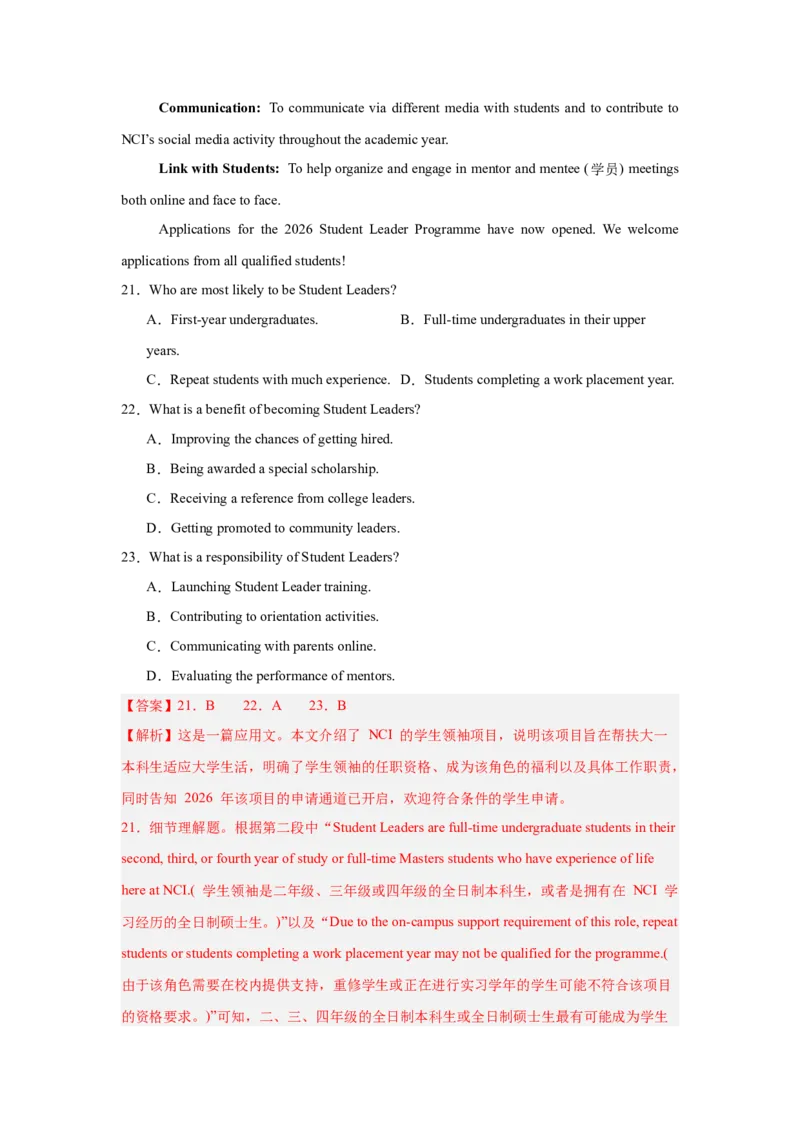
A
Student Leader Programme
The Student Leader Programme is designed to help first-year undergraduates ( 本科生)
settle into college life by providing guidance and advice through the support of a Student Leader.
Student Leaders are full-time undergraduate students in their second, third, or fourth year of study
or full-time Masters students who have experience of life here at NCI. The Student Leader can act
as a resource, a helping hand, a sounding board or just a person to talk to whatever the issue might
be. Due to the on-campus support requirement of this role, repeat students or students completing
a work placement year may not be qualified for the programme.
Benefits of becoming a Student Leader:
●Unique voluntary opportunity to develop your leadership and organization skills.
●Opportunity to make a contribution to the college community.
●Increase professional employability.
●Enjoy a fun experience and make new friends.
●Opportunity to receive a special recognition award and a reference from Student Support
Team.
●Participate in training programmes.
Responsibilities:
Training: To attend Student Leader training covering an overview of Mentoring (导师制)
& orientation (迎新活动).
Orientation: Be available to assist with the delivery of orientation as part of your role as
Student Leader. This is the first time you will meet your group of students and lead them into NCI.
Communication: To communicate via different media with students and to contribute to
NCI’s social media activity throughout the academic year.
Link with Students: To help organize and engage in mentor and mentee (学员) meetings
both online and face to face.
Applications for the 2026 Student Leader Programme have now opened. We welcome
applications from all qualified students!
21.Who are most likely to be Student Leaders?
A.First-year undergraduates.
B.Full-time undergraduates in their upper
years.
C.Repeat students with much experience. D.Students completing a work placement year.
22.What is a benefit of becoming Student Leaders?
A.Improving the chances of getting hired.
B.Being awarded a special scholarship.
C.Receiving a reference from college leaders.
D.Getting promoted to community leaders.
23.What is a responsibility of Student Leaders?
A.Launching Student Leader training.
B.Contributing to orientation activities.
C.Communicating with parents online.
D.Evaluating the performance of mentors.
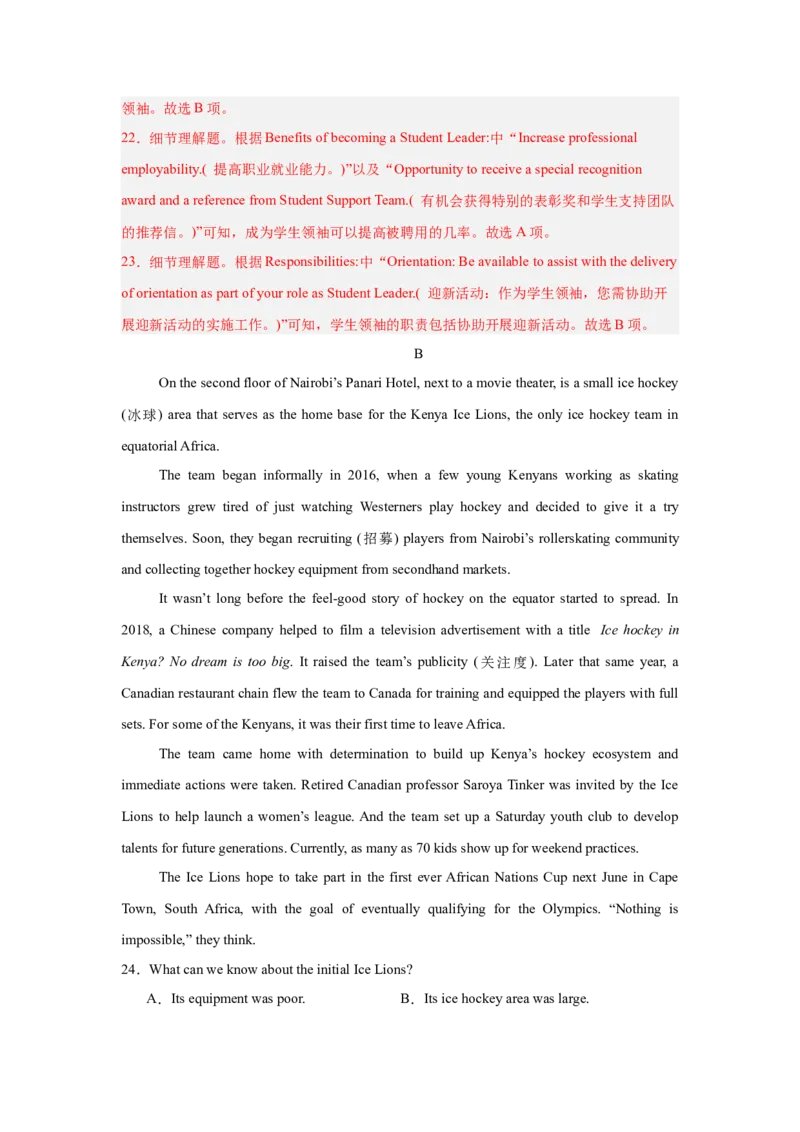
【答案】21.B    22.A    23.B
【解析】这是一篇应用文。本文介绍了 NCI 的学生领袖项目,说明该项目旨在帮扶大一
本科生适应大学生活,明确了学生领袖的任职资格、成为该角色的福利以及具体工作职责,
同时告知 2026 年该项目的申请通道已开启,欢迎符合条件的学生申请。
21.细节理解题。根据第二段中“Student Leaders are full-time undergraduate students in their
second, third, or fourth year of study or full-time Masters students who have experience of life
here at NCI.( 学生领袖是二年级、三年级或四年级的全日制本科生,或者是拥有在 NCI 学
习经历的全日制硕士生。)”以及“Due to the on-campus support requirement of this role, repeat
students or students completing a work placement year may not be qualified for the programme.(
由于该角色需要在校内提供支持,重修学生或正在进行实习学年的学生可能不符合该项目
的资格要求。)”可知,二、三、四年级的全日制本科生或全日制硕士生最有可能成为学生
领袖。故选B 项。
22.细节理解题。根据Benefits of becoming a Student Leader:中“Increase professional
employability.( 提高职业就业能力。)”以及“Opportunity to receive a special recognition
award and a reference from Student Support Team.( 有机会获得特别的表彰奖和学生支持团队
的推荐信。)”可知,成为学生领袖可以提高被聘用的几率。故选A 项。
23.细节理解题。根据Responsibilities:中“Orientation: Be available to assist with the delivery
of orientation as part of your role as Student Leader.( 迎新活动:作为学生领袖,您需协助开
展迎新活动的实施工作。)”可知,学生领袖的职责包括协助开展迎新活动。故选B 项。
B
On the second floor of Nairobi’s Panari Hotel, next to a movie theater, is a small ice hockey
(冰球) area that serves as the home base for the Kenya Ice Lions, the only ice hockey team in
equatorial Africa.
The team began informally in 2016, when a few young Kenyans working as skating
instructors grew tired of just watching Westerners play hockey and decided to give it a try
themselves. Soon, they began recruiting (招募) players from Nairobi’s rollerskating community
and collecting together hockey equipment from secondhand markets.
It wasn’t long before the feel-good story of hockey on the equator started to spread. In
2018, a Chinese company helped to film a television advertisement with a title Ice hockey in
Kenya? No dream is too big. It raised the team’s publicity ( 关注度). Later that same year, a
Canadian restaurant chain flew the team to Canada for training and equipped the players with full
sets. For some of the Kenyans, it was their first time to leave Africa.
The team came home with determination to build up Kenya’s hockey ecosystem and
immediate actions were taken. Retired Canadian professor Saroya Tinker was invited by the Ice
Lions to help launch a women’s league. And the team set up a Saturday youth club to develop
talents for future generations. Currently, as many as 70 kids show up for weekend practices.
The Ice Lions hope to take part in the first ever African Nations Cup next June in Cape
Town, South Africa, with the goal of eventually qualifying for the Olympics. “Nothing is
impossible,” they think.
24.What can we know about the initial Ice Lions?
A.Its equipment was poor.
B.Its ice hockey area was large.
C.It consisted of volunteers.
D.It was created by Westerners.
25.What did the Chinese company do to help the Ice Lions?
A.Flew the team abroad.
B.Recruited voluntary players.
C.Filmed an advertisement.
D.Provided training and full sets.
26.What is the main idea of Paragraph 4?
A.The bright future of hockey in Kenya.
B.The biggest challenge of hockey in Kenya.
C.The setup of women’s hockey team in Kenya.
D.The team’s efforts to develop hockey in Kenya.
27.What does the author think of the hockey team in Kenya?
A.Weak but smart.
B.Young but promising.
C.Professional but modest.
D.Unknown but competitive.
【答案】24.A    25.C    26.D    27.B
【解析】本文是一篇记叙文。主要讲述了赤道非洲唯一的冰球队肯尼亚冰狮队的创立、发
展历程,球队获中加助力后积极培育冰球人才,还怀揣参赛奥运的梦想并坚信一切皆有可
能。
24.细节理解题。根据第二段“Soon, they began recruiting (招募) players from Nairobi’s
rollerskating community and collecting together hockey equipment from secondhand markets. (不
久,他们开始从内罗毕的轮滑队社区招募球员,并从二手市场收集冰球设备)”可知,最初
的冰狮队冰球装备是从二手市场收集的,装备简陋。故选A 项。
25.细节理解题。根据第三段“In 2018, a Chinese company helped to film a television
advertisement with a title Ice hockey in Kenya? No dream is too big.(2018 年,一家中国公司协
助拍摄了一则电视广告,标题为Ice hockey in Kenya? No dream is too big.)”可知,中国公司
为冰狮队拍摄了一则电视广告。故选C 项。
26.主旨大意题。根据第四段“The team came home with determination to build up Kenya’s
hockey ecosystem and immediate actions were taken. Retired Canadian professor Saroya Tinker
was invited by the Ice Lions to help launch a women’s league. And the team set up a Saturday
youth club to develop talents for future generations. (球队带着建立肯尼亚冰球生态系统的决心
回家,并立即采取了行动。加拿大退休教授Saroya Tinker 受冰狮邀请,帮助发起女子联盟。
该团队成立了一个周六青年俱乐部,为子孙后代培养人才)”可知,球队创办女子联赛、设
立青年俱乐部,由此可知,该段核心是冰狮队为发展肯尼亚冰球所做出的各项努力。故选
D 项。
27.推理判断题。根据第二段“The team began informally in 2016, (球队2016 年才非正式创
立)”可知,这支队伍十分年轻,根据最后一段“The Ice Lions hope to take part in the first
ever African Nations Cup next June in Cape Town, South Africa, with the goal of eventually
qualifying for the Olympics. “Nothing is impossible,” they think.(冰狮队希望参加明年6 月在南
非开普敦举行的首届非洲国家杯,最终获得奥运会参赛资格。“没有什么是不可能的,”
他们认为)”可知,球队怀揣参加奥运会的梦想且坚信一切皆有可能,由此推知,作者认为
这支球队年轻但有前途。故选B 项。
C
( 原创题)The rapid rise of electric vehicles and portable electronics has made lithium a
critical resource. As the world moves toward clean energy, recycling used lithium batteries has
become essential. New research from Edith Cowan University (ECU) shows that using old
batteries as a secondary source of lithium not only reduces environmental harm but also ensures a
steady supply of this valuable material, supporting a sustainable future.
Experts predict the global lithium-ion battery market will grow quickly, reaching billions of
dollars in value within a few years. However, most batteries are discarded while still holding a
large amount of usable energy. In fact, when batteries are no longer suitable for electric vehicles,
they often retain up to 80 percent of their lithium capacity. Instead of being wasted, these batteries
could be recycled to recover lithium, nickel, and cobalt.
Recycling offers clear environmental advantages compared to traditional mining. Mining
lithium causes significant land damage, water pollution, and high carbon emissions. In contrast,
recycling produces far fewer greenhouse gases, uses less energy and water, and avoids harmful
chemical releases. Additionally, the lithium recovered through recycling is already highly purified,
saving further processing costs.
Despite these benefits, challenges remain. The fast pace of technological innovation makes it
difficult for policies and recycling methods to keep up. Moreover, the changing chemical
composition of batteries complicates the recycling process. To build a successful circular
economy, investment in proper infrastructure is urgently needed. Fortunately, some companies are
already exploring effective ways to recycle batteries and turn waste into wealth.
In conclusion, recycling “dead” batteries is not just an environmental necessity but also an
economic opportunity. By addressing current challenges and investing in better systems, we can
reduce pollution, save resources, and create a cleaner, more sustainable world.
28. What is the main advantage of recycling lithium batteries mentioned in the text?
A. It increases the speed of electric vehicles.
B. It reduces environmental harm and saves resources.
C. It makes batteries last longer in devices.
D. It lowers the cost of producing new electronics.
29. Why are many discarded batteries still valuable?
A. They contain rare metals like gold and silver.
B. They can be directly reused in electric vehicles.
C. They still hold a large amount of usable energy.
D. They are easier to transport than new batteries.
30.. What challenge does the text highlight about battery recycling?
A. There is not enough demand for recycled materials.
B. Recycling plants are too far from battery users.
C. People are unwilling to return old batteries.
D. Policies and technology struggle to keep up with changes.
31.. What can be inferred about the future of battery recycling?
A. It will replace all traditional mining activities soon.
B. It requires cooperation between companies and governments.
C. It will become unnecessary as new energy sources emerge.
D. It is only profitable in countries with large lithium reserves.
【答案】28.B    29.C    30.D    31.B
【解析】本文主要讲述了随着电动汽车和电子设备的普及,锂资源变得至关重要。文章指
出,回收废旧锂电池不仅能减少环境污染,还能有效利用剩余资源,具有巨大的经济和环
境价值。然而,技术更新快和政策滞后等问题仍是当前面临的挑战,需要加大基础设施投
资以实现可持续发展。
28.细节理解题。根据第二段“recycling used lithium batteries has become essential... reduces
environmental harm but also ensures a steady supply of this valuable material”可知,回收电池的
主要优势是减少环境危害并节约资源。选项A、C、D 均未在文中提及或与文意不符。
29.细节理解题。第三段提到“when batteries are no longer suitable for electric vehicles, they
often retain up to 80 percent of their lithium capacity”,说明许多被丢弃的电池仍含有大量可
用能量。选项A 错误,因为文中未提到金和银;选项B 错误,因为这些电池不能直接再
用;选项D 无依据。
30. 细节理解题。第四段明确指出“The fast pace of technological innovation makes it difficult
for policies and recycling methods to keep up”,即技术和政策难以跟上变化是主要挑战。选
项A、B、C 均未在文中体现。
31. 推理判断题。最后一段提到“investment in proper infrastructure is urgently needed”以及
“some companies are already exploring effective ways”,暗示未来需要企业与政府合作推动
回收体系建设。选项A 过于绝对;选项C 与文意相反;选项D 无依据。
D
(原创题)A recent study from the University of California San Diego reveals a surprising
factor affecting global crop stability: the original source of rainfall. Published in Nature
Sustainability, the research tracks atmospheric moisture back to where it first evaporated, whether
from oceans or land surfaces like soil, lakes, and forests. Sunlight heats these surfaces, turning
water into vapor that rises and eventually returns as rain. While ocean-derived moisture often
travels across continents in large weather systems, land-based moisture, known as recycled
rainfall, fuels more localized storms. The study finds that the balance between ocean and land
moisture strongly influences regional drought risk and farm productivity.
"Our work changes how we view drought risk," said Yan Jiang, the study's lead author. "It is
not just about the amount of rain, but where that rain comes from." Using nearly 20 years of
satellite data, researchers discovered that when more than one-third of precipitation originates
from land, croplands become significantly more vulnerable to drought. Ocean-driven systems
usually bring heavier, consistent rain, whereas land-driven systems produce lighter, less
predictable showers. This makes crops especially weak during critical growth stages when water is
most needed.
The research highlights two high-risk areas: the U.S. Midwest and tropical East Africa. In the
Midwest, frequent droughts may be worsened by a reliance on land-sourced moisture. When soil
dries out, evaporation decreases, leading to less future rain—a self-reinforcing cycle known as a
"rainfall feedback loop." Since this region supplies much of the world's grain, such disruptions
affect global food markets. Farmers there may need to focus on saving soil moisture and
improving irrigation efficiency to break this cycle.
East Africa faces a different challenge. Rapid expansion of farmland and loss of nearby
rainforests threaten the very moisture sources that sustain local rainfall. "Farmers are clearing
forests to grow crops, but those forests help generate the rain the crops need," Jiang explained. If
these moisture sources disappear, local food security will be at greater risk. However, smarter land
management, such as conserving forests, can still protect rainfall patterns.
Ultimately, the study emphasizes that forests act as natural rainmakers. By releasing water
vapor through transpiration, they help form clouds that rain over surrounding fields. Protecting
these ecosystems is not just about biodiversity; it is essential for sustaining agriculture. This new
framework links land use decisions with rainfall patterns, offering a vital tool for climate-smart
planning and drought resilience in a changing world.
32. What makes crops more likely to suffer from drought according to the study?
A. The total amount of annual rainfall.
B. The distance moisture travels from oceans.
C. A high proportion of rain coming from land.
D. The speed at which water evaporates from soil.
33. What can be inferred about the "rainfall feedback loop" in the Midwest?
A. It helps farmers predict weather changes accurately.
B. It creates a cycle where dry land leads to less rain.
C. It increases the consistency of ocean-driven storms.
D. It reduces the need for irrigation in grain production.
34. What is the main conflict facing farmers in East Africa?
A. They lack technology to track satellite data.
B. They must choose between growing crops and preserving rain sources.
C. They rely too heavily on ocean-derived moisture for farming.
D. They are forced to move their farms to coastal regions.
35. What is the author's purpose in mentioning forests in the last paragraph?
A. To argue for stopping all agricultural expansion.
B. To explain how biodiversity protects animal habitats.
C. To highlight the role of ecosystems in maintaining rainfall.
D. To suggest replacing forests with more efficient irrigation systems.
【答案】32.C    33.B    34.B    35.C
【解析】本文介绍了一项来自加州大学圣地亚哥分校的新研究,该研究发现降雨的来源
(海洋或陆地)对全球农作物稳定性和干旱风险有重大影响。研究指出,当超过三分之一
的降水来自陆地蒸发时,农田更容易遭受干旱。文章重点分析了美国中西部和东非两个高
风险地区,指出了“降雨反馈循环”和森林砍伐带来的挑战,并强调保护森林等自然生态
系统对于维持农业降雨和粮食安全至关重要。
32. 细节理解题。根据第二段中 "They found that when more than roughly one-third of
precipitation originates from land, croplands become significantly more susceptible to drought..."
可知,当大部分降水来自陆地时,作物更容易受干旱影响。A 项文中明确说 "it's not just
about how much it rains";B 项和D 项并非导致易受干旱的主要直接原因。故选C。
33.推理判断题。根据第三段中 "When the land dries out, it reduces evaporation, which in turn
reduces future rainfall -- creating a self-reinforcing drought cycle." 可推断,这种反馈循环是指
土地干燥导致蒸发减少,进而导致降雨减少的恶性循环。A、C、D 项均与文意相反或无
关。故选B。
34. 细节理解题(因果/矛盾分析)。根据第四段中 "Farmers are clearing forests to grow
more crops, but those forests help generate the rainfall that the crops depend on." 可知,东非农
民面临的冲突是为了种庄稼而砍伐森林,但森林又是降雨的来源,即耕种需求与保持水源
之间的矛盾。A、C、D 项文中未提及或与事实不符。故选B。
35.写作意图题。最后一段提到 "Forests act as natural generators of rainfall" 和 "Protecting
these ecosystems isn't just about biodiversity -- it's about sustaining agriculture." 作者提及森林
是为了强调生态系统在维持降雨模式和支持农业方面的关键作用,而非单纯为了保护生物
多样性或停止农业。故选C。
第二节(共5 小题;每小题2. 5 分, 满分12. 5 分)
阅读下面短文, 从短文后的选项中选出可以填入空白处的最佳选项。选项中有两项为多余
选项。
What to Do When You Think Others Are Better than You
When you think others are better than you, it can be easy to be in low spirits. It’s important
to remember that everyone has their own strengths and weaknesses. Remember that everyone has
their own journey and experiences, and it’s okay not to be the best at everything.    36
Instead, face your individuality and strive for (争取) personal growth. Here are some tips for what
to do when you think others are better than you.
   37    Comparison is a very common thing people do, but it’s unfortunately “one of the
most helpless things you can do in life,” says Chronister. To try to break the comparison habit,
stop accessing social media and unfollow accounts that make you feel envious.
Identify the root causes of your feelings and accept them. Take some time to reflect on why
you feel like other people are better than you. Try journaling your negative thoughts.    38
However, once you understand the reasons behind your feelings, you’ll be able to accept your past
for what it was and begin to move forward.
Reframe (再构造) your negative thoughts and look for evidence to disprove them.    39
Then how can you get rid of them? To start reframing your negative thoughts, stop every time
you’re talking down to yourself. Consider what exactly you’re thinking about yourself, then try to
find evidence to support those “claims“. If there’s no evidence, it’s not true.
Take steps towards loving and accepting yourself in spite of your weaknesses. Practising
self-acceptance can help you internalize (内化) the knowledge that you are uniquely beautiful.
Nobody’s perfect. So it’s not the end of the world even when you realize your weaknesses.    40
A.Stop comparing yourself to others.
B.This process may take time.
C.Live your life with a sense of purpose.
D.It’s easy to get stuck in these negative thoughts.
E.There is no need to constantly compare yourself to others.
F.You should try your best to follow and copy excellent people.
G.On the contrary, it will help you to feel at ease and move forward.
【答案】36.E    37.A    38.B    39.D    40.G
【解析】这是一篇说明文。文章指出,当觉得别人比自己优秀时,不应盲目比较,而应停
止攀比,反思并接纳负面情绪,重构消极想法,最终学会自我接纳与成长。
36.前文“Remember that everyone has their own journey and experiences, and it’s okay not to
be the best at everything.( 要知道每个人都有自己的经历和旅程,不必在所有事情上都做到
最好。)”提到“每个人都有自己的旅程,不一定要事事最好”,后文“Instead, face your
individuality and strive for (争取) personal growth.( 相反,要面对自己的独特性,并努力实现
个人成长。)”说“相反,要面对你的独特性”。E 项“There is no need to constantly compare
yourself to others.( 没有必要不断和别人比较。)”承上启下,符合语境。故选E 项。
37.下文“Comparison is a very common thing people do, but it’s unfortunately “one of the most
helpless things you can do in life,” says Chronister. To try to break the comparison habit, stop
accessing social media and unfollow accounts that make you feel envious.( 比较是人们经常做的
事情,但正如克里斯滕斯特所说,不幸的是“这是生活中你所能做的最无助的事情之一”。
为了尝试打破这种比较的习惯,停止访问社交媒体,并取消关注那些让你感到嫉妒的账
号。)”本段主要讲“比较是常见的,但也是最无助的事情之一”,并建议停止刷社交媒体。
A 项“Stop comparing yourself to others.( 停止拿自己和别人比较。)”作为本段主题句最合适。
故选A 项。
38.前文“Take some time to reflect on why you feel like other people are better than you. Try
journaling your negative thoughts.( 花些时间反思为什么你会觉得别人比你优秀。试着把你
的负面想法写下来。)”建议写日记反思负面想法,后文“However, once you understand the
reasons behind your feelings, you’ll be able to accept your past for what it was and begin to move
forward.( 但是,一旦你理解了这些感受背后的原因,你就能接受过去的自己,开始向前迈
进。)”说 “一旦你理解了背后的原因,就能接受过去并前进”。B 项“This process may
take time.( 这个过程可能需要时间。)”符合逻辑过渡。故选B 项。
39.上文“Reframe (再构造) your negative thoughts and look for evidence to disprove them.(
重新调整你的负面想法,并寻找证据来反驳它们。)”可知,本段讲“重构负面想法,寻找
证据反驳它们”。下文“Then how can you get rid of them?( 那么,你如何才能摆脱它们
呢?)”D 项“It’s easy to get stuck in these negative thoughts.( 人很容易陷入这些负面想
法。)”承接上文内容,且引出下文“如何摆脱它们”,衔接自然。故选D 项。
40.前文“Nobody’s perfect. So it’s not the end of the world even when you realize your
weaknesses.( 没有人是完美的。所以即便你意识到自己的弱点,这也不是世界末日。)”说
“意识到自己的弱点不是世界末日”。G 项“On the contrary, it will help you to feel at ease
and move forward.( 相反,它会帮助你感到自在并继续前进。)”与前文形成对比,总结全段。
故选G 项。
第三部分 语言运用(共两节,满分30 分)
第一节(共15 小题,每小题1 分,满分15 分)
阅读下面短文, 从每题所给的A、B、C 和D 四个选项中选出可以填入空白处的最佳选项。
When I was 16, I signed up for a community theater program, thinking it would be an easy
way to earn some extra credit.     41     I had no acting experience, and my only public
speaking had been a nervous class presentation in eighth grade. On the first day of rehearsal, I
stood in the back of the room,     42     and unsure of what to do. The director, Ms.
Henderson, noticed my hesitation and     43     me to join a group scene practice.
At first, my lines felt stiff and unnatural. I would forget my cues and     44     my
words halfway through. Other cast members tried to help, but I was convinced I would     45
the entire play. One evening, after everyone left, Ms. Henderson pulled me aside. She didn’t scold
me;     46     , she told me about her first acting role, where she’d frozen on stage for 10
seconds. “Mistakes are just     47     to do better next time,” she smiled.
Her words gave me confidence. I practiced nightly, recording myself and     48     my
tone and gestures. Slowly, the lines felt like my own. On opening night, my hands sweated as I
walked on stage. But when I saw Ms. Henderson nodding     49     , I breathed deep and
began.
When the play ended, the crowd cheered. I felt a pride I’d never known. That experience
taught me to     50     my fears and try new things. Years later, facing a(n)     51     task,
I still     52     her advice. The “easy credit” I sought was trivial. What truly     53

was the courage I found.
Growth rarely comes from comfort. It comes from     54     the unfamiliar, from
stumbling and rising again. Sometimes, the most unexpected opportunities are the ones that     55
us the most.
41.A.Above all
B.In fact
C.By contrast
D.On the whole
42.A.delighted
B.relaxed
C.anxious
D.ashamed
43.A.invited
B.forced
C.forbade
D.begged
44.A.pass
B.invent
C.repeat
D.mumble
45.A.cancel
B.ruin
C.direct
D.watch
46.A.instead
B.besides
C.therefore
D.otherwise
47.A.excuses
B.barriers
C.chances
D.goals
48.A.analyzing
B.copying
C.hiding
D.ignoring
49.A.secretly
B.encouragingly
C.impatiently
D.awkwardly
50.A.feel
B.face
C.forget
D.share
51.A.boring
B.dangerous
C.tough
D.urgent
52.A.act on
B.laugh at
C.show off
D.give up
53.A.mattered
B.improved
C.appeared
D.changed
54.A.exploring
B.avoiding
C.accepting
D.doubting
55.A.satisfy
B.confuse
C.frighten
D.shape
【答案】
41.B    42.C    43.A    44.D    45.B    46.A    47.C    48.A    49.
B    50.B    51.C    52.A    53.A    54.A    55.D
【解析】本文是一篇记叙文。文章讲述了作者16 岁时参加社区戏剧项目,从最初紧张不安、
担心搞砸演出,到在导演鼓励下逐渐进步,最终成功完成演出并获得自信的经历。
41.考查介词短语辨析。句意:事实上,我没有表演经验,我唯一一次公开演讲是在八年
级时一次紧张的课堂展示。A. Above all 首先;B. In fact 事实上;C. By contrast 相比之下;
D. On the whole 大体上。根据前文“When I was 16, I signed up for a community theater
program, thinking it would be an easy way to earn some extra credit.”可知作者以为参加社区戏
剧项目能轻松获得额外学分和后文“I had no acting experience”作者没有表演经验,前后是
转折关系,此处用“事实上”来引出实际情况,符合语境。故选B 项。
42.考查形容词词义辨析。句意:排练的第一天,我站在房间后面,焦虑不安,不知道该
做什么。A. delighted 高兴的;B. relaxed 放松的;C. anxious 焦虑的;D. ashamed 羞愧的。
根据后文“and unsure of what to do”可知,作者站在房间后面,不知道做什么,由此可知作
者很焦虑。故选C 项。
43.考查动词词义辨析。句意:导演亨德森女士注意到了我的犹豫,邀请我参加一个小组
场景练习。A. invited 邀请;B. forced 强迫;C. forbade 禁止;D. begged 恳求。根据前文
“Ms. Henderson, noticed my hesitation”可知,亨德森女士注意到作者的犹豫,邀请作者参
加小组场景练习,符合语境。故选A 项。
44.考查动词词义辨析。句意:一开始,我的台词生硬不自然。我会忘记提示,中途含糊
不清地说着台词。A. pass 通过;B. invent 发明;C. repeat 重复;D. mumble 含糊不清地说。
根据前文“my lines felt stiff and unnatural”可知,因为台词生硬不自然,所以作者会中途含
糊不清地说着台词。故选D 项。
45.考查动词词义辨析。句意:其他演员试图帮忙,但我确信我会毁了整部戏。A. cancel
取消;B. ruin 毁坏;C. direct 指导;D. watch 观看。根据前文“my lines felt stiff and
unnatural”以及“my words halfway through”可知,作者台词说得不好,所以确信会毁了整部
戏。故选B 项。
46.考查副词词义辨析。句意:她没有责骂我;相反,她给我讲了她第一次演戏的经历,
当时她在舞台上僵住了10 秒钟。A. instead 相反;B. besides 此外;C. therefore 因此;D.
otherwise 否则。根据前文“She didn’t scold me”以及后文“she told me about her first acting
role”可知,亨德森女士没有责骂作者,而是给作者讲了她第一次演戏的经历,前后是转折
关系,用instead 符合语境。故选A 项。
47.考查名词词义辨析。句意:“错误只是下次做得更好的机会,”她微笑着说。A.
excuses 借口;B. barriers 障碍;C. chances 机会;D. goals 目标。根据后文“to do better next
time”可知,亨德森女士认为错误是下次做得更好的机会。故选C 项。
48.考查动词词义辨析。句意:我每晚都练习,给自己录音,分析自己的语气和手势。A.
analyzing 分析;B. copying 复制;C. hiding 隐藏;D. ignoring 忽视。根据前文“recording
myself”可知,作者给自己录音,然后分析自己的语气和手势。故选A 项。
49.考查副词词义辨析。句意:开幕之夜,当我走上舞台时,我的手心出汗了。但当我看
到亨德森女士鼓励地点头时,我深吸一口气,开始了表演。A. secretly 秘密地;B.
encouragingly 鼓励地;C. impatiently 不耐烦地;D. awkwardly 笨拙地。根据后文“I
breathed deep and began”可知,看到亨德森女士鼓励地点头,作者深吸一口气,开始了表演。
故选B 项。
50.考查动词词义辨析。句意:那次经历教会我面对恐惧,尝试新事物。A. feel 感觉;B.
face 面对;C. forget 忘记;D. share 分享。根据后文“my fears and try new things”可知,那
次经历教会作者面对恐惧,尝试新事物。故选B 项。
51.考查形容词词义辨析。句意:多年后,面对一项艰巨的任务,我仍然按照她的建议去
做。A. boring 无聊的;B. dangerous 危险的;C. tough 艰巨的;D. urgent 紧急的。根据前文
“That experience taught me to   my fears and try new things.”可知,多年后面对一项艰巨的
任务,作者仍然按照她的建议去做。故选C 项。
52.考查动词短语辨析。句意:多年后,面对一项艰巨的任务,我仍然按照她的建议去做。
A. act on 按照……行动;B. laugh at 嘲笑;C. show off 炫耀;D. give up 放弃。根据“her
advice”可知,“我”仍然按照她的建议去做。故选A 项。
53.考查动词词义辨析。句意:我寻求的“轻松学分”微不足道。真正重要的是我找到的
勇气。A. mattered 重要;B. improved 改善;C. appeared 出现;D. changed 改变。根据后文
“the courage I found”可知,真正重要的是作者找到的勇气。故选A 项。
54.考查动词词义辨析。句意:成长很少来自舒适。它来自探索不熟悉的事物,来自跌倒
后再次站起来。A. exploring 探索;B. avoiding 避免;C. accepting 接受;D. doubting 怀疑。
根据后文“from stumbling and rising again”可知,成长来自探索不熟悉的事物。故选A 项。
55.考查动词词义辨析。句意:有时候,最意想不到的机会恰恰是最能塑造我们的机会。
A. satisfy 满足;B. confuse 使困惑;C. frighten 使害怕;D. shape 塑造。根据前文“the most
unexpected opportunities are the ones that   us the most”可知,最意想不到的机会恰恰是最能
塑造我们的机会。故选D 项。
第二节(共10 小题;每小题1.5 分 ,满分15 分)
阅读下面短文,在空白处填入1 个适当的单词或括号内单词的正确形式。
When I arrived in China to teach law, I didn’t expect tea to become such a significant part
of my journey.
It began as simple gifts from students—Yunnan Pu’er, Zhejiang Longjing, and Henan tea sourced
by a student’s grandfather—soon revealed deeper meanings. In a country where many students
live far from home, tea serves as a     56     (port) bridge to their childhood, family, and
heritage. It transformed me from a tourist into a respected guest.
Some of my most memorable moments were spent with a teacup in hand. In Chengdu,
students rinsed (冲洗) cups and discarded the first brew, not for hygiene ( 卫生), but to honor
ancestral     57     (continue). In Beijing, a professor taught me that     58     tea
ceremony emphasizes mindfulness over rigid mastery. Even in a tiny porcelain studio in
Quanzhou, tea became a universal language of friendship, connecting strangers through shared
stories rather than commercial transactions.
Chinese teahouses,     59     (locate) in bustling cities, offer a rare sanctuary to slow
down.Had it not been for those warm tea-sharing moments, I     60     (miss) the chance to
feel the genuine kindness of the Chinese people.     61     the West,     62     tea is often
functional, Chinese tea is relational and ceremonial. It commands reverence, much like French
wine or Scotch whisky, embodying terroir, lineage, and regional identity.
Tea     63     (journey) from an enigma to a beloved responsibility, emerged     64
stories that span cultures and generations . Now, it is my go-to gift for loved ones back home.
These leaves are no longer just souvenirs; they are tokens of a shared journey and a profound
appreciation for the history, hospitality, and human connection that Chinese tea       65

(represent).
【答案】
56.portable    57.continuity/continuation    58.the    59.located    60.would have
missed    61.Unlike    62.where    63.has journeyed    64.in    65.represents
【解析】本文是一篇记叙文。文章主要讲述了作者在中国任教期间,通过茶感受中国文化、
人情与传承。
56.考查形容词。句意:在这个国家,许多学生远离家乡,茶是一座便携的桥梁,连接着
他们的童年、家庭与文化传承。修饰名词用形容词形式,意为“便携的”。故填portable。
57.考查名词。句意:在成都,学生们冲洗茶杯、倒掉头道茶,并非为了卫生,而是为了
传承祖辈的习俗。空处为名词形式担当宾语,意为“延续”,不可数名词continuity/
continuation 符合句意。故填continuity/continuation。
58.考查冠词。句意:在北京,一位教授告诉我,茶道重的是心境,而非刻板的技法。名
词“tea ceremony”,意为“茶道”,为特指,所以用定冠词the。故填the。
59.考查非谓语动词。句意:坐落于繁华都市中的中国茶馆,提供了一处难得的慢生活净
土。空处为非谓语动词形式担当定语;被修饰词“Chinese teahouses”和动词“locate”之间
存在被动关系,用过去分词形式。故填located。
60.考查虚拟语气。句意:若不是那些温暖的奉茶瞬间,我便无缘感受中国人民最真挚的
善意。本句考查虚拟语气;根据“Had it not been for those warm tea-sharing moments”可知,
本句是对过去的虚拟,主句谓语动词用“would have done”;主语“I”和动词“miss”之间为
主动关系。故填would have missed。
61.考查介词。句意:与西方不同,西方的茶往往注重实用,而中国的茶关乎情感与礼仪。
空处考查介词形式;根据句意可知,空处意为“和……不同”,用介词“unlike”;出现在
句首,首字母大写。故填Unlike。
62.考查定语从句。句意:与西方不同,西方的茶往往注重实用,而中国的茶关乎情感与
礼仪。空处为定语从句的关系词;先行词“the West”在非限制性定语从句中担当地点状语,
用关系副词where 引导。故填where。
63.考查谓语动词。句意:茶从一个神秘的存在逐渐演变成了一份备受珍视的责任,它出
现在跨越不同文化与世代的故事之中。空处为本句谓语动词;根据句意可知,本句时态为
现在完成时;主语“tea”,单数,和动词“journey”(旅行、历经)之间为主动关系。故填
has journeyed。
64.考查介词。句意:茶从一个神秘的存在逐渐演变成了一份备受珍视的责任,它出现在
跨越不同文化与世代的故事之中。空处为介词形式,意为“在……之中”,用介词“in”,
符合句意。故填in。
65.考查谓语动词。句意:这些茶叶不再只是纪念品,而是共同旅程的见证,也承载着我
对中国茶所代表的历史、好客之情与人情联结的深深敬意。空处为从句谓语动词;根据主
句时态可知,从句时态为一般现在时;主语“Chinese tea”,单数,和动词“represent”之间
为主动关系。故填represents。
第四部分 写作(共两节, 满分40 分)
第一节(满分15 分)
66.假定你是李华,你校外教Jenny 喜欢打太极拳。下周,学校武术社团将进行展示
交流活动,请给她写一封邮件,邀请她参加活动,内容包括:
(1)时间地点;
(2)活动形式。
注意:
(1)词数80 左右;
(2)请按如下格式在答题卡的相应位置作答。
Dear Jenny,
I’m writing to invite you to attend a Chinese martial art activity to be held next week.
_______________________________________________________________________________
_______________________________________________________________________________
_______________________________________________________________________________
_______________________________________________________________________________
_______________________________________________________________________________
________________________________________________________
Yours,
Li Hua
【参考范文】
Dear Jenny,
I’m writing to invite you to attend a Chinese martial art activity to be held next week.
The activity will take place at the school playground from 2:00 pm to 4:00 pm on Saturday.
As you love tai chi, it’s a great chance for you to communicate with fellow enthusiasts.
During the event, members of the martial art club will show tai chi, kung fu and other
forms. There will also be an exchange session where you can share your experience and even try
practicing together.
I sincerely hope you can come and enjoy it. Looking forward to your reply.
Yours,
Li Hua
【写作解析】本篇书面表达属于应用文。要求考生以李华的的名义给喜欢打太极拳的外教
Jenny 写一封邮件,邀请她参加学校武术社团下周举行的展示交流活动。
1.词汇积累
举行:take place → be launched
机会:chance → opportunity
衷心地:sincerely → earnestly
回复:reply → response
2.句式拓展
简单句变复合句
原句:The activity will take place at the school playground from 2:00 pm to 4:00 pm on
Saturday.
拓展句:The activity will take place at the school playground, which will last for 2 hours from
2:00 pm to 4:00 pm on Saturday.
【高分句型1】As you love tai chi, it’s a great chance for you to communicate with fellow
enthusiasts.(运用了as 引导的原因状语从句)
【高分句型】There will also be an exchange session where you can share your experience and
even try practicing together.(运用了where 引导的定语从句)
第二节(满分25 分)
67.阅读下面材料,根据其内容和所给段落开头语续写两段,使之构成一篇完整的短文。
Sophie, a quiet tenth- grader, found comfort in watercolor painting. She took the
sketchbook (速写本) everywhere with her, capturing moments others often missed — the sunset
after school, the potted plant by the window, and her classmates’ warm smiles. Yet these paintings
remained hidden in her drawer.
When the annual art festival approached, Sophie hesitated. No one had ever seen her work,
and the thought of displaying it in public made her nervous. But her piece “Morning Mist,”
showing the fog lifting from the soccer field, felt different. She had spent weeks perfecting it, and
Ms. Chen, her art teacher, had encouraged her. Finally, she decided to submit it.
However, her name wasn’t on the selected list. “Rejected, huh?” Ryan teased (取笑) . “It’s
so pale — did you forget to finish it?” Some students laughed. Sophie’s face burned. Before she
could stop herself, she tore the painting into pieces and ran away before tears fell.
Ms. Chen witnessed everything. She sighed, knowing that Ryan himself had been rejected
the year before, though few knew. She wondered if he made fun of others to hide his own
disappointment. The next morning, she found Sophie in an empty classroom. “I’ve kept every
rejection letter I’ve ever received,” she said softly, producing a worn folder. “Each one reminded
me that rejection isn’t about being wrong — it’s about growing and finding the right audience.”
She pressed a flyer (宣传单) into Sophie’s hand. “The festival has an open show. No judges —
just artists sharing their vision. The deadline is Friday.”
Walking home, Sophie held the flyer, thinking about the paintings in her drawer —
moments preserved simply because she loved them. The show was in three days. That night, she
stood before her art supplies, torn between fear and desire. Her drawer stayed closed, guarding the
works she’d never shown. Yet the thought of the open show kept returning, whispering in her
mind.
注意:
(1)续写词数应为150 左右;
(2)请按如下格式在答题卡的相应位置作答。
After a moment of hesitation, Sophie opened the drawer.
_______________________________________________________________________________
_______________________________________________________________________________
_______________________________________________________________________________
_______________________________________________________________________________
_______________________________________________________________________________
_____________________________________________________________________________
Three days later, at the open show, Ryan stopped at her display.
_______________________________________________________________________________
_______________________________________________________________________________
_______________________________________________________________________________
_______________________________________________________________________________
_______________________________________________________________________________
_______________________________________________________________________________
_
【参考范文】
Version I:
After a moment of hesitation, Sophie opened the drawer. Inside lay her watercolors — quiet
memories she’d never shared. Ms. Chen’s words echoed — rejection isn’t the end but a chance to
grow; every painting deserves its right audience. Regret filled her as she remembered tearing up
“Morning Mist”, the work she’d spent weeks perfecting. Taking a deep breath, she turned to a
draft of the soccer field and decided to repaint it with bolder strokes. By the next evening, the new
“Morning Mist” glowed softly on the paper. She gathered her works and walked steadily toward
the open show.
Three days later, at the open show, Ryan stopped at her display. Sophie’s heart tightened,
expecting another tease. He scanned the paintings, then froze at the new Morning Mist, his smirk
fading. “These are yours?” he asked softly. When Sophie nodded, he scratched his neck. “Sorry. I
joked because I still hadn’t gotten over being rejected last year.” He pointed at the painting. “It
feels just like the soccer field at dawn — quiet and magical.” Nearby, some students exclaimed in
admiration. Warmth melted her last bit of shame. A bright, confident smile spread across her face
— she had finally found her audience.
Version Ⅱ:
After a moment of hesitation, Sophie opened the drawer. Those hidden paintings lay quietly
inside, each recording beautiful moments. She recalled the torn painting “Morning Mist”, which
used to be her favorite, and decided to recreate it. Memories flooding back, she painted the misty
soccer field at dawn, fog curling over grass and faint golden light filtering through clouds. When
she completed the painting, a sense of satisfaction welled up inside her. The next day, she selected
other wonderful works, heart full of courage, ready to share.
Three days later, at the open show, Ryan stopped at her display. He stared at the paintings in
surprise, eyes fixed on the brand-new “Morning Mist”. His face flushed with guilt. “I shouldn’t
have laughed at you,” he apologized sincerely. “This is amazing. It is extremely vivid and
incredibly charming.” Nearby, some students gathered and admired the artwork, their praise filling
the air. Sophie smiled, feeling a warm glow. She realized Ms. Chen was right — being rejected
means a chance to grow and art is meant to be shared with those who appreciate it.
【写作解析】本文以人物为线索展开。Sophie 热爱水彩画,作品却未入选艺术节。遭同学
嘲笑后她撕画落泪,老师安慰并推荐她参加无评委的开放展。Sophie 回家后内心在恐惧与
渴望间挣扎,对是否参展犹豫不决。
1.段落续写
①由第一段句首内容“犹豫片刻后,Sophie 打开了抽屉。”可知,第一段可以描写Sophie
打开抽屉后看到画作的心理活动,回忆老师的开导,后悔撕碎之前的作品,进而决定重新
绘制“晨雾”,最后鼓起勇气准备前往开放展的动作与决心。
②由第二段句首内容“三天后,在开放展上,Ryan 停在了她的展品前。”可知,第二段可
以描写Sophie 看到Ryan 时的紧张与担忧,Ryan 看到画作后的态度转变、真诚道歉与赞美,
其他同学的赞赏,以及Sophie 内心羞耻感的消散,最终收获自信、找到属于自己的观众的
过程。
2.续写线索:Sophie 犹豫后打开抽屉回忆过往——受老师鼓励,决定重绘作品并准备参展
——偶遇 Ryan,内心紧张——Ryan 看到画作后道歉并真诚赞美——其他同学赞赏Sophie
的作品——Sophie 消散羞耻,收获自信,找到自己的观众。
3.词汇激活
行为类
①深呼吸:take a deep breath/breathe deeply/draw a deep breath
②重绘:repaint/redraw/paint again
③走向:walk toward/move toward/head for
情绪类
①后悔:regret/feel remorseful/be sorry
②欣赏:admiration/appreciation
【高分句型1】Regret filled her as she remembered tearing up “Morning Mist”, the work she’d
spent weeks perfecting. (运用了as 引导的时间状语从句、省略引导词that/which 的定语从句)
【高分句型2】When Sophie nodded, he scratched his neck. (运用了When 引导的时间状语从
句)