绝密★考试结束前
2025 年高考第一次模拟考试(北京专用)02
英语
(考试时间:100 分钟  试卷满分:100 分)
注意事项:
1.本试卷分第Ⅰ卷(选择题)和第Ⅱ卷(非选择题)两部分。答卷前,考生务必将自己的姓名、
准考证号填写在答题卡上。
2.回答第Ⅰ卷时,选出每小题答案后,用2B 铅笔把答题卡上对应题目的答案标号涂黑。如需改
动,用橡皮擦干净后,再选涂其他答案标号。写在本试卷上无效。
3.回答第Ⅱ卷时,将答案写在答题卡上。写在本试卷上无效。
4.考试结束后,将本试卷和答题卡一并交回。
第一部分:知识运用(共两节,30 分)
第一节 完型填空(共10 小题:每小题1.5 分,共15 分)
阅读下面短文,掌握其大意,从每题所给的A、B、C、D 四个选项中,选出最佳选项,并在答题
纸上将该选项涂黑。
I grasped a sandwich as I tried to finish my work during lunch. My company, like many companies, had    1
costs by not replacing people as they left. The survivors had to take up the work. For me and my co-workers,
this meant no lunch hour. I wanted to quit, but given the economy, it was hard to find another job. I felt     2
. Then a conversation with a six-year-old girl changed my     3    .
The young girl was standing in line with her mom at the supermarket.
“Good day at school?” I asked.
A nod.
“What’s your favorite subject?”
“Lunch.”
I smiled. That had been my    4     too. At lunch, I could talk with my friends, draw pictures or play games.
There were no adults to tell me what to do. The time was mine.
But what happened to lunch time now?
I knew I was entitled to a lunch break at work. So I decided to     5     it. Our office was located in the
downtown and I set out to    6     the area. A few blocks away was an art museum with free admission. At
the end of another street, I was surprised to discover some horses eating grass in a field.
At the beginning of my tours during lunch, I received some     7     stares from my co-workers, but I chose
to ignore them. In fact, I watched in amazement that some of them started to    8     their work during
lunch.     9    , we started inviting each other out for walks and discovered we had other topics of
conversation beyond the common complaints about work.
I’m still looking for a new position, but with less anxiety than before. If we can’t change our     10    , we
can change our attitude.
1.A.counted
B.cut
C.paid
D.raised
2.A.trapped
B.fearful
C.shocked
D.hurt
3.A.work
B.way
C.view
D.plan
4.A.decision
B.explanation
C.secret
D.answer
5.A.take
B.make
C.find
D.stop
6.A.explore
B.measure
C.develop
D.identify
7.A.innocent
B.determined
C.sympathetic
D.unpleasant
8.A.carry on
B.take over
C.put aside
D.go through
9.A.Generally
B.Gradually
C.Accidentally
D.Obviously
10.A.strategies
B.circumstances
C.responsibilities
D.principles
第二节 语法填空(共10 小题,每小题1.5 分,共15 分)
阅读下列短文,根据短文内容填空,在未给提示词的空白处仅填写1 个适当的单词,在给出提示
词的空白处用括号内所给词的正确形式填空。
A
Not long ago, my daughter’s shoes     11     (damage) with a knife. She burst into tears. I took them to the
shoemaker’s. The man said he would add more scratches on both shoes as if the openings were made on
purpose for a special style. I didn’t fully understand him, but I decided to leave the shoes. Two days later I
dropped by from work     12     (collect) the shoes. I found more scratches on each shoe, but all the
openings were patched by red leather and the stitches were twisted. The appearance looked     13

(interesting) than ever.
B
阅读下面短文,根据短文内容填空。在未给提示词的空白处仅填写1 个恰当的单词,在给出提示词的
空白处用括号内所给词的正确形式填空。
The African penguin is expected to go extinct in the wild in just over a decade, given its current population
decline. The main reason is a lack of food caused by disturbance to ocean conditions from global heating and
14     (compete) from the commercial fishing industry. According to a study, recently scientists     15

(identify) a possible additional cause, one that is an entirely new threat and that further     16     (prevent)
the penguins from finding food: noise pollution from marine ships in a bay.
C
阅读下面短文,根据短文内容填空。在未给提示词的空白处仅填写1 个恰当的单词,在给出提示词的
空白处用括号内所给词的正确形式填空。
Crying is a natural response to emotions. Regardless of     17     causes the tears to flow, the physical
reaction is usually the same with puffy cheeks and tight eyes     18     (lead) to streaming tears down
one’s face. Despite its stigma (污名), crying can be an act     19     relieves tension and clears feelings of
negativity and sadness. Crying can communicate our emotions to others and foster greater understanding and
compassion. Ultimately, crying is a powerful tool we ought to use to free ourselves     20     negativity.
第二部分:阅读理解(共两节,38 分)
第一节(共14 小题,每小题2 分,共28 分)
阅读下列短文,从每题所给的A、B、C、D 四个选项中,选出最佳选项,并在答题卡上将该项涂黑。
A
How to Use a Modern Public Library
Has it been a while since your last visit to a public library? If so, you may be surprised to learn that libraries
have changed for the better. It’s been years since they were dusty little rooms with books. They have
transformed themselves into places where you can develop your love of knowledge, meet interesting people,
or find out how to start a business.
Check out a book. While libraries still lend books, you’ll find it easier to get a copy of whatever you’re
looking for, thanks to a cooperative network of area libraries. Via such networks, libraries share their books
with each other through the use of delivery vehicles. Once the book you’ve requested is delivered to the
nearest branch, they will inform you by e-mail, so you can pick it up.
Check out other items. The library is now a multimedia zone, loaded within formation in many formats. You
can borrow movies on DVDs, music on CDs, and popular magazines. Some libraries even lend toys and
games. If a popular magazine you want isn’t offered and the library keeps a list of such requests, they may
bring it in when enough interest is shown.
Join targeted reading groups. Libraries will often hold reading-group sessions targeted to various age
groups. Perhaps you’d like to learn a language or improve your English. The library may sponsor a language
group you could join. If you have difficulties reading, ask about special reading opportunities. Your library
might be able to accommodate you. And you might find it relaxing to bring your small kid to a half-hour Story
Time while you sit quietly in a corner with a good book.
Start a business using the help of your local library. If you want to have a business of your own, your local
library can become a launch space for it. In library books and computers, you can find information on starting
a business. Many libraries will help you with locally supplied information about business management shared
through chambers of commerce and government agencies, and they will offer printing, faxing and database
services you need.
21.Public libraries connected by a cooperative network benefit readers by .
A.sharing their books on the Internet
B.giving access to online reading at a library branch
C.sending a needed book to a library branch nearby
D.making the checkout procedures diverse
22.According to Paragraph 3, what items may be checked out from a public library?
A.A magazine and an e-book.
B.A game and an oil painting.
C.A music CD and a kid’s toy.
D.A DVD and a video player.
23.As is described in Paragraph 4, taking a small kid to a half-hour Story Time allows .
A.the kid to learn a new language
B.the parent to enjoy quiet reading
C.the kid to overcome reading difficulties
D.the parent to meet their program sponsor
B
An Art Class
When Kelly was twelve, she started taking classes at Miss Grace’s School for Art. She didn’t like it at first: the
“novice artists” — the kids who hadn’t really done art before-worked mostly with clay, and Kelly was a
terrible sculptor.
It wasn’t until her third year that Kelly found something she was really good at-charcoal drawing (素描). She
loved watching the lines spread unevenly across the page as she moved the bits of charcoal back and forth
over the paper.
One day, Sophia, the best artist in her class, sat down and set up her easel ( 画架) next to Kelly. Kelly felt a
sinking feeling in her stomach. She’d actually found an art form that she enjoyed and was good at-and now
Sophia was going to outshine her again? Kelly fought back tears when Miss Grace entered the room.
“Hello class, Miss Grace said.” We’ll continue to work on the project today. What masterpiece would Sophia
have come up with?
Kelly looked at Sophia’s easel and she couldn’t believe it-it was a mess! For a brief moment, Kelly couldn’t
actually believe her drawing was better than Sophia’s.
But then she looked at Sophia, who was watching Kelly with an anxious expression. “I…. I couldn’t decide
what to do,” Sophia said. “And you’re so good. Sometimes I feel like my stuff is just so bad in comparison.”
Kelly looked to see if Sophia was joking, but she seemed completely serious. Now Kelly was shocked. “I’m
not talented ... Miss Grace seldom praises me. You’re the best one in our class!”
Sophia raised her eyebrows. “I might be a really good copier of the stuff, but I have no idea what to do when it
comes to making up my own images. You are so great at making new things out of the old stuff. I’ve loved
your works.”
“I’ve loved yours, too,” Kelly said.
“Well, definitely not this one,” Sophia said.
Kelly smiled. “Maybe not right now. But if you move these lines up...” she said, pointing her finger on
Sophia’s paper.
Sophia was quiet for a moment. “That’s a great idea!” she said finally.
Kelly smiled and turned back to her drawing, looking every so often at Sophia’s work to see that she was
taking her advice, down to the last line.
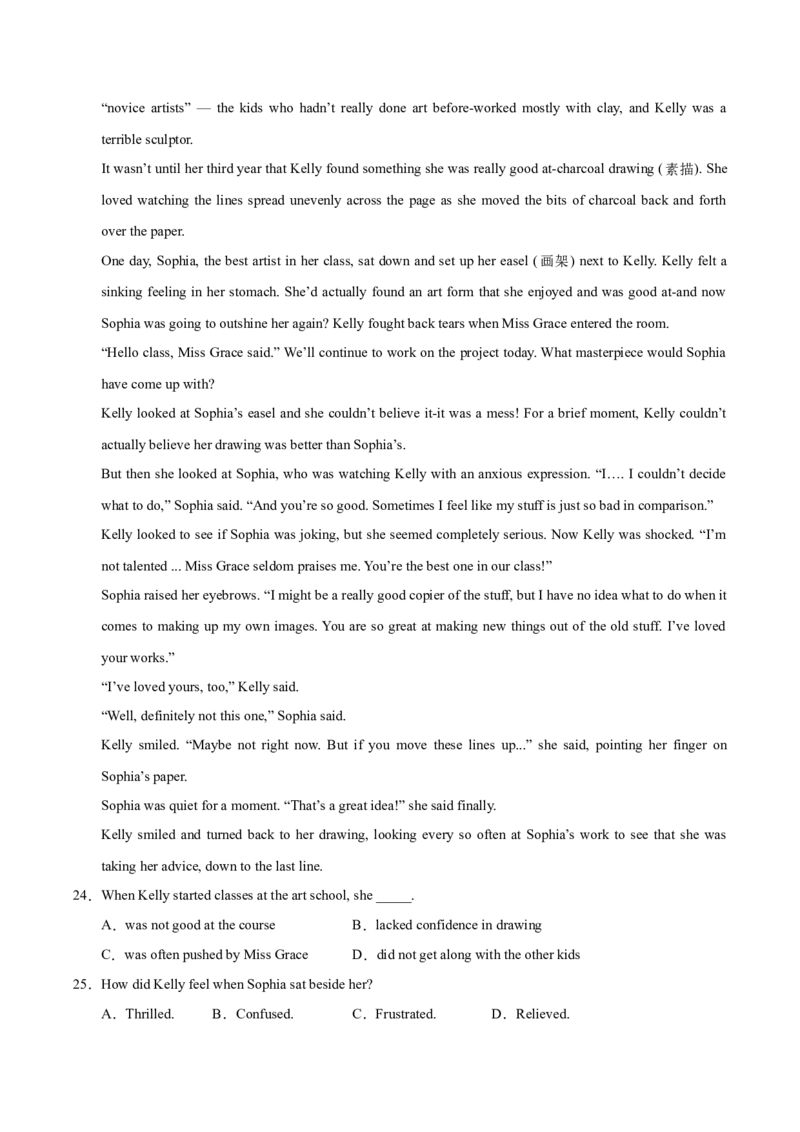
24.When Kelly started classes at the art school, she _____.
A.was not good at the course
B.lacked confidence in drawing
C.was often pushed by Miss Grace
D.did not get along with the other kids
25.How did Kelly feel when Sophia sat beside her?
A.Thrilled.
B.Confused.
C.Frustrated.
D.Relieved.
26.What did Kelly do in the art class?
A.She inspired Sophia.
B.She praised Sophia’s creativity.
C.She decided to outshine Sophia.
D.She finished the drawing for Sophia.
27.What can we learn from the passage?
A.Interest is the best teacher.
B.You are what you believe to be.
C.Everyone has their own strengths.
D.Hard work will eventually pay off.
C
Researchers hope brain implants will one day help people with aphasia (失语症) to get their voice back — and
maybe even to sing. Now, for the first time, scientists have demonstrated that the brain’s electrical activity can
be decoded and used to reconstruct music.
A new study analyzed data from 29 people monitored for epileptic seizures (癫痫发作), using electrodes (电
极) on the surface of their brain. As participants listened to a selected song, electrodes captured brain activity
related to musical elements, such as tone, rhythm, and lyrics. Employing machine learning, Robert Knight
from UC Berkeley and his colleagues reconstructed what the participants were hearing and published their
study results. The paper is the first to suggest that scientists can “listen secretly to” the brain to synthesize (合
成) music.
To turn brain activity data into musical sound, researchers trained an artificial intelligence (AI)model to
decode data captured from thousands of electrodes that were attached to the participants as they listened to the
song while undergoing surgery. Once the brain data were fed through the model, the music returned. The
model also revealed some brain parts responding to different musical features of the song.
Although the findings focused on music, the researchers expect their results to be most useful for translating
brain waves into human speech. Ludovic Bellier, the study’s lead author, explains that speech, regardless of
language, has small melodic differences — tempo, stress, accents, and intonation — known as prosody (韵律).
These elements carry meaning that we can’t communicate with words alone. He hopes the model will improve
brain-computer interfaces (BCI), assistive devices that record speech-associated brain waves and use
algorithms to reconstruct intended messages. This technology, still in its infancy, could help people who have
lost the ability to speak because of aphasia.
Future research should investigate whether these models can be expanded from music that participants have
heard to imagined internal speech. If a brain-computer interface could recreate someone’s speech with the
prosody and emotional weight found in music, it could offer a richer communication experience beyond mere
words.
Several barriers remain before we can put this technology in the hands — or brains — of patients. The current
model relies on surgical implants. As recording techniques improve, the hope is to gather data non-invasively,
possibly using ultrasensitive electrodes. However, under current technologies, this approach might result in a
lower speed of decoding into natural speech. The researchers also hope to improve the playback clarity by
packing the electrodes closer together on the brain’s surface, enabling an even more detailed look at the
electrical symphony the brain produces.
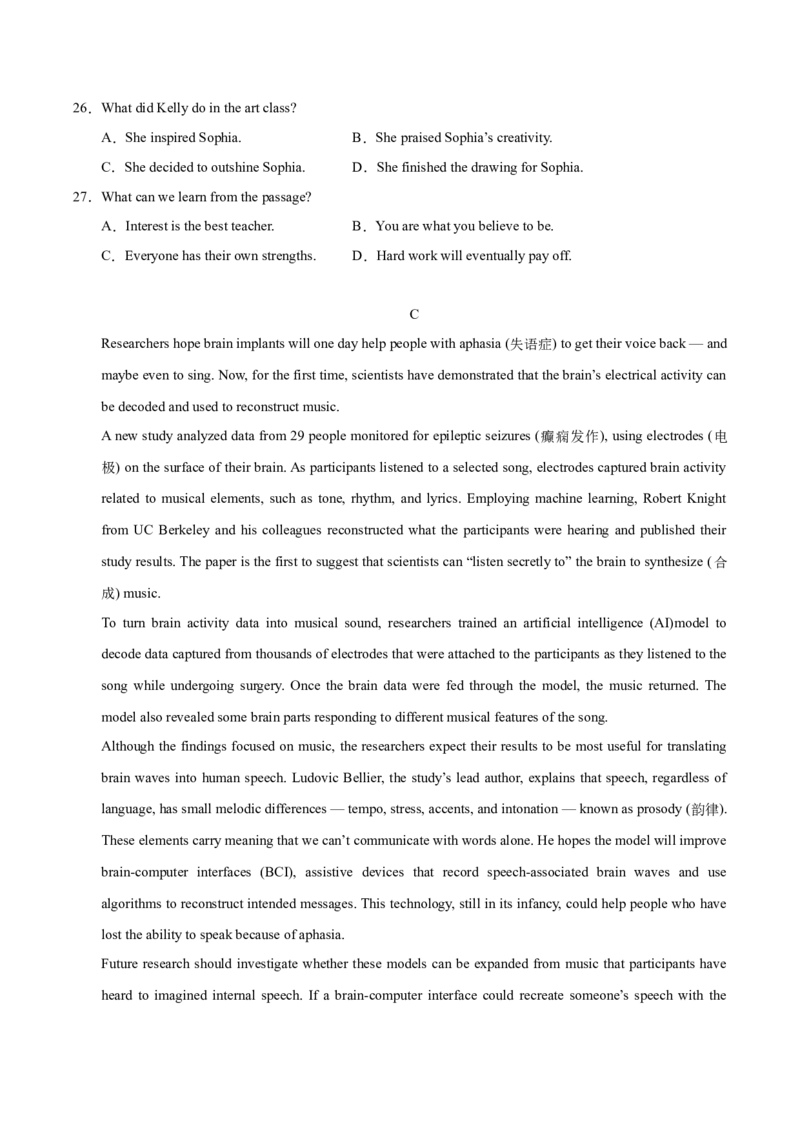
28.What can we learn from the study?
A.Electrodes can analyze musical elements.
B.The decoding of brain data helps recreate music.
C.Machine learning greatly enhances brain activity.
D.The AI model monitors music-responsive brain regions.
29.What hopefully makes it possible to expand the model to speech?
A.The prosody of speech.
B.The collection of brain waves.
C.The emotional weight of music.
D.The reconstruction of information.
30.Which of the following would be the best title for the passage?
A.Unlocking the Secrets of Melodic Mind B.Brain Symphony: Synthesized Human Speech
C.BCI Brings Hope to People with AphasiaD.Remarkable Journey: Decoding Brain with AI
D
Researchers from a U.K. plant research institute have found a way to provide plants with an antibody-based
defense for a specific threat, potentially speeding the creation of crops resistant to any kind of emerging virus,
or bacterium (细菌). The strategy is to inoculate a protein from the plant pathogen (病原体) to be targeted to
a camel or other camel relatives, purify the unusually small antibodies the camels produce, and engineer the
corresponding gene section for them into a plant’s own immune gene.
Farmers lose many billions of dollars to plant diseases each year, and emerging pathogens pose new threats to
food security in the developing world. Plants have evolved their own immune system, kick-started by cell
receptors that recognize general pathogen features, such as a bacterial cell wall, as well as intracellular
receptors for molecules (分子) produced by specific pathogens. If a plant cell detects these molecules, it may
trigger its own death to save the rest of the plant. But plant pathogens often evolve and escape from those
receptors.
A long-standing dream in plant biotechnology is to create designer disease resistance genes that could be
produced as fast as pathogens emerge. One approach is to edit the gene for a plant immune receptor, changing
the protein’s shape to recognize a particular pathogenic molecule.
Instead, Sophien Kamoun, a molecular biologist at the Sainsbury Laboratory, and his colleagues used an
animal immune system to help make the receptor adjustments. During an infection with a new pathogen,
animals produce billions of slightly different antibodies, ultimately selecting and mass-producing those that
best target the virus.
Camelids, which include camels, are workhorses for antibody design because their immune systems create
unusually small versions, called nano-bodies. As a proof of principle of the new plant defense strategy,
Kamoun’s group turned to two standard camelid nano-bodies that recognize two different molecules, including
one called green fluorescent protein (GFP), to detect test viruses, in this case a potato virus, engineered to
make the fluorescent proteins. They investigated how well plants with the nano-body-enhanced receptors
detected the changed potato viruses. It was found that the plants increased an active immune response and
experienced almost no viral reproduction.
“The exciting part about this technology is that we have the potential of made-to-order resistance genes and
keeping up with a pathogen,” Kamoun says. “This technology is a potential game changer,” says Jeff Dangl, a
plant researcher at the University of North Carolina. Ksenia Krasileva, a scientist at the University of
California, Berkeley, says the mixture of nano-bodies with plant immune receptors opens up a vast body of
biomedical knowledge for plant scientists. “We can now dig into all of that research and translate it to save
crops.”
31.What does the underlined word “inoculate” in Paragraph 1 probably mean?
A.Compare.
B.Restore.
C.Introduce.
D.Label.
32.What is the main purpose of Paragraph 2?
A.To illustrate the function of cells in saving the plant.
B.To explain how to strengthen plant receptors effectively.
C.To demonstrate the solutions to farmers’ annual heavy losses.
D.To reveal why plants fail to handle constantly-updated diseases.
33.What can we learn from the passage?
A.Editing plant receptors is to match the shape of pathogens.
B.Nano-bodies can help plants catch up with pathogen changes.
C.Plants select the best antibodies from animals to fight viruses.
D.Plants with nano-bodies respond actively in massive virus copying.
34.According to the passage, scientists will .
A.apply the outcome in the real world
B.prove the findings of resistance genes
C.identify similar means to fight diseases D.seek more support for the new strategy
第二节(共5 小题;每小题2 分,共10 分)
根据短文内容,从短文后的七个选项中选出能填入空白处的最佳选项。选项中有项为多余选项。
It’s fair to say that many parents focus a lot of energy — and worry! — on protecting their small kids from
risky situations. But this past weekend, reporter Ellen Barry published a piece about a growing movement in
Britain: people are bringing risk into the playground experience.
    35     It contrasts with sheltering kids with the less demanding facilities typical of playgrounds. As
Barry puts it, including limited risk into our kids’ playtime may be taking a step toward healthier child
development. He cites a sign posted outside the Princess Diana Playground in London’s Kensington Gardens.
36     They are intentionally provided, so that your kids can develop an appreciation of risk in a controlled
play environment.
    37     Communities in Australia, Canada, and Sweden are making similar changes to their playgrounds.
They want kids to learn and grow by facing challenges they can handle, Barry reports.
Controlled risk at play time — where, after all, the children are still under close supervision (监护) — would
seem a good addition to the free-range child movement. In that initiative, it’s suggested that free-range kids
take walks in nature or ride public transportation on their own.     38
Besides, considering child development from an evolutionary (进化的) view offers more backing. Our long
journey through time and nature has made us who we are today, with behaviors, thoughts and bodies shaped.
39     Looking at this bigger picture helps us understand why people make such a choice.
A.Kids learn best while playing.
B.More exploration is expected.
C.It says it’s okay for kids to take some risks.
D.Limited-risk playgrounds begin to catch on.
E.The idea is to help kids become tough and strong.
F.Generally, they are encouraged to get outside and acquire independent skills.
G.It is therefore important to let kids do things that match how they naturally grow.
第三部分 书面表达(共两节,共32 分)
第一节 阅读表达(共4 小题,第40、41 题各2 分,第42 题3 分,第43 题5 分,共12 分)
阅读下面短文,根据题目要求回答问题。
There’s a difference between being nice and being kind. Being nice involves being polite and pleasing to
others. If you’re people pleasing, you’re placing an expectation on the person you’re being nice to that they
respond to you in a certain way. Being kind is less self-serving. On the one hand, kindness involves being
generous without expecting anything in return. The other half is the purpose behind the action. A kind person
is acting out of sympathy and genuine concern for another.
The difference is intentionality, said Dr. Catherine Franssen, an associate professor of psychology at
Longwood University in Virginia, noting that a kind person tries to really understand what someone else is
going through.
Practicing kindness rather than niceness allows people to develop deeper genuine connections with others,
said Franssen. The more you do it, the easier it will get to relate to others and build more meaningful
relationships in all aspects of life.
The warm feeling you get from performing an act of kindness is your brain releasing a ton of feel-good
chemicals. Franssen said being kind boosts production of serotonin, a neurotransmitter (神经传递素) involved
in mood, including happiness. Kindness also releases dopamine, a brain chemical in charge of reward and
pleasure. It’s the reason why doing one act of kindness feels so good that you want to do another.
Being kind gives the same health benefits, regardless of how big or small the gesture. Acts of kindness might
feel strange and out-of-character at first. However, this feeling goes away the more you keep practicing. Soon
enough, it becomes so familiar you’ll notice the benefits on yourself and others.
40.What does being kind involve?

41.Why do you get warm feeling when showing kindness?

42.Please decide which part is false in the following statement, then underline it and explain why.
> The more you practice niceness, the easier you will connect with others and establish more meaningful
relationships in all aspects of life.

43.In your daily life, what can you do to show kindness? (In about 40 words)

第二节: 书面表达(共一题,20 分)
44.假设你是红星中学高三学生李华,你和你校交换生Jim 准备联合参加学校组织的校园文创设计大赛
(Campus Cultural and Creative Design Competition), 请给Jim 发邮件,内容包括:
1. 分享你的创意;
2. 询问Jim 的建议。
注意:1. 词数100 左右;
2. 开头和结尾已给出,不计入总词数。
Dear Jim,
________________________________________________________________________________________
________________________________________________________________________________________
________________________________________________________________________________________
________________________________________________________________________________________
________________________________________________________________________________________
______________
Yours,
Li Hua