北京市仁爱教育研究所 编著
主 编
副主编
编 者
科学普及出版社
. 北 京.
九年级 上册
王德春
Jim Greenlaw(加拿大)
杨晓钰
Robert White(加拿大)
Martin McDonald(加拿大)
杨晓钰 周 澜 王惠静
张 翼 万 普
义 务 教 育 教 科 书
价格批准文号: 价格投诉举报电话:12315
著作权所有,请勿擅用本书制作各类出版物,违者必究。
如有质量问题,影响阅读,请与北京市仁爱教育研究所联系调换。
地址: 北京市海淀区北四环西路68号左岸工社12层 邮编: 100080
电话: 4008100168 010-82676936 13911468415
邮箱:editor@renai-edu.com
义务教育教科书
英 语
九年级 上册
北京市仁爱教育研究所 编著
*
科学普及出版社
(北京市海淀区中关村南大街16号)
邮政编码:100081
福建新华发行(集团)有限责任公司发行
福建新华联合印务集团有限公司
*
787mm×1092mm 16开 10印张 200千字
2014年7月第1版 2025年7月第123次印刷
定价:9.90 元
图书在版编目(CIP)数据
英语. 九年级. 上册 / 北京市仁爱教育研究所
编著. -北京 : 科学普及出版社, 2014.7 (2025.7重印)
义务教育教科书
ISBN 978-7-110-08573-8
Ⅰ. ①英... Ⅱ. ①北... Ⅲ. ①英语课-初中-教材
Ⅳ. ①G634.411
中国版本图书馆CIP数据核字(2014)第058779号
ISBN 978-7-110-08573-8/G·3623
王 颖
责任编辑
徐 飞
责任印制
前 言
亲爱的同学们:
你们好!欢迎你们学习使用仁爱版初中英语教材,让我们一起徜徉于知识的海洋!
仁爱版初中英语教材是由上海外国语大学王德春教授、加拿大英语专家Jim Greenlaw博士
和北京市仁爱教育研究所数十位英语专家及中国优秀的英语教师依据教育部《义务教育英
语课程标准(2011年版)》,针对中国广大初中学生的英语学习现状编写而成的初中英语
教材,它将陪伴你们度过绚丽斑斓的初中生活。
通过七、八年级的学习,你们已经具备了一定的英语语言知识和技能。在九年级阶
段,你们的综合语言运用能力将得到进一步的提升。在本册教材中,共有四个话题与大家
分享:家乡的变化、环境与环保、英语学习和新奇的科学技术。新的学期到了,康康和他
的小伙伴儿们各自在假期做了哪些有意义的事情呢?康康参加了环保小组,你们想知道如
何成为一名环保者吗?康康他们班在班会上交流了一些学习英语的好方法,都是哪些方法
呢?迈克尔和简参观了科学博物馆,他们都了解了哪些发明呢?通过本册教材的学习,你
们就会得到答案了。相信你们会乐意融入他们的学习、生活中,并逐步地学会用英语谈论
这些话题;你们还将有很多机会参与到双人或小组活动中去,与同伴们一起用英语完成任
务,如角色表演、海报制作、学习评价等有趣的活动,并在每个话题结束时表演或展示自
己的作品。
伴随这些有趣的故事和活动,你们将学到一些比前几册教材里更为复杂的语言结构,
如现在完成时、被动语态和定语从句等。这些知识会使你们能运用更丰富的英语语言来进
行表达。教材的语音学习部分将着重展现语篇中的语音,帮助你们运用七、八年级所学的
语音知识进行综合的训练。你们熟悉的金钥匙会依然给出一些有效的学习方法。
此外,现阶段我国还有少部分地区师资欠缺、开课不足,一些孩子的英语基础相对薄
弱,为此我们在七年级上册设计并调整了第一单元作为预备学习单元,供你们选用。
同学们,希望你们能积极热情地参与教材中的活动、享受英语学习的乐趣,使你们的
听说读写能力得到全面的提高!我们相信只要认真地将整套六册仁爱版初中英语教材学
完,你们都能达到教育部《义务教育英语课程标准(2011年版)》的五级英语水平要求,
并能满怀信心地迎接未来每一天的挑战。
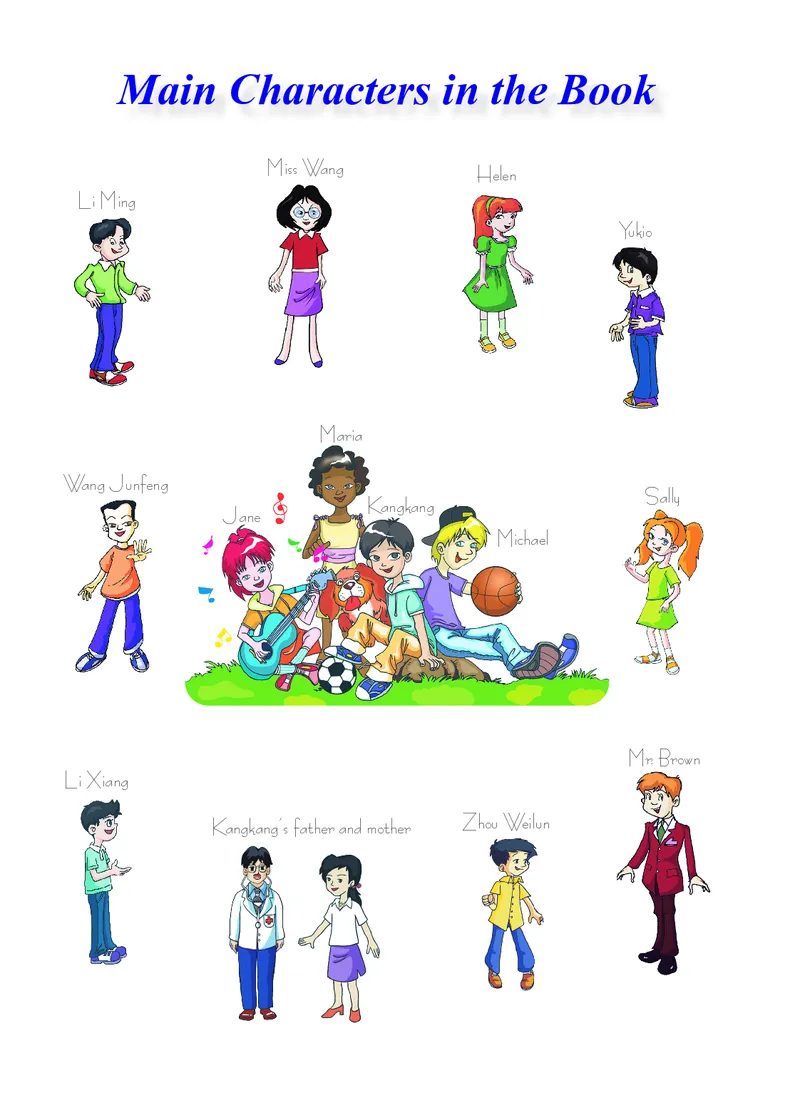
Miss Wang
Mr. Brown
Yukio
Li Ming
Helen
Li Xiang
Jane
Kangkang
Michael
Maria
Sally
Wang Junfeng
Zhou Weilun
Kangkang’s father and mother
Main Characters in the Book
I
使用指南
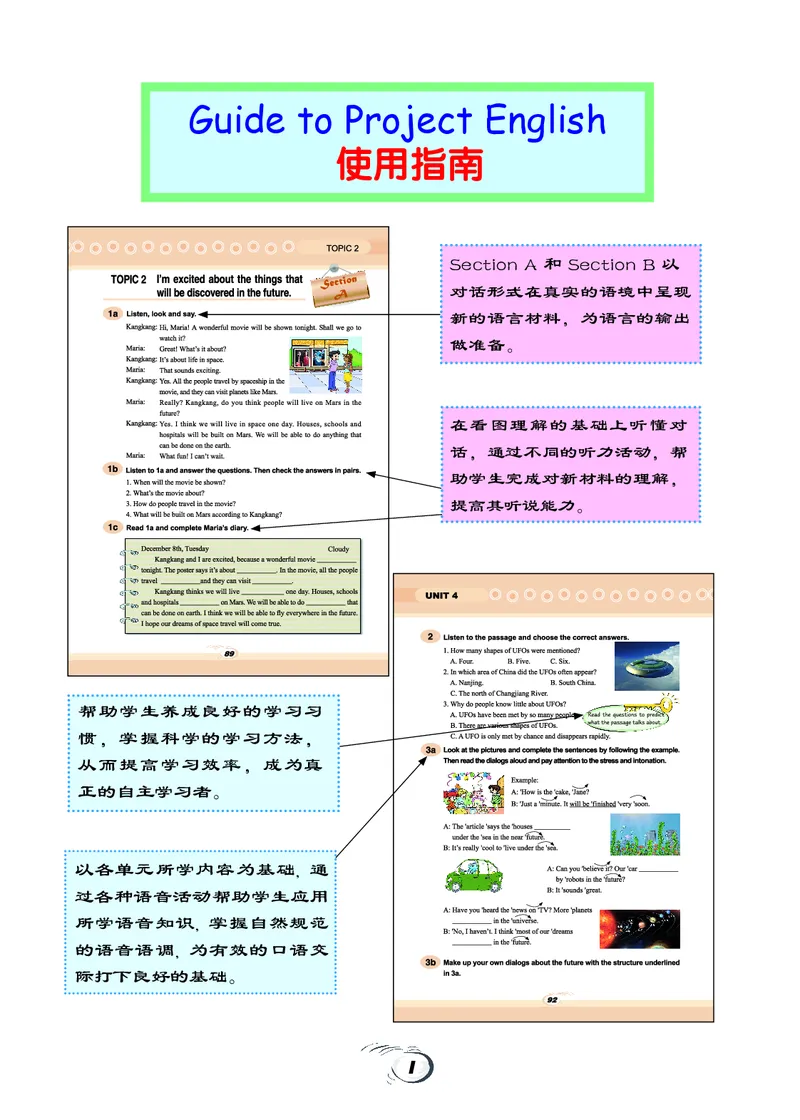
Guide to Project English
在看图理解的基础上听懂对
话,通过不同的听力活动,帮
助学生完成对新材料的理解,
提高其听说能力。
Section A 和 Section B 以
对话形式在真实的语境中呈现
新的语言材料,为语言的输出
做准备。
帮助学生养成良好的学习习
惯,掌握科学的学习方法,
从而提高学习效率,成为真
正的自主学习者。
以各单元所学内容为基础, 通
过各种语音活动帮助学生应用
所学语音知识, 掌握自然规范
的语音语调, 为有效的口语交
际打下良好的基础。
II
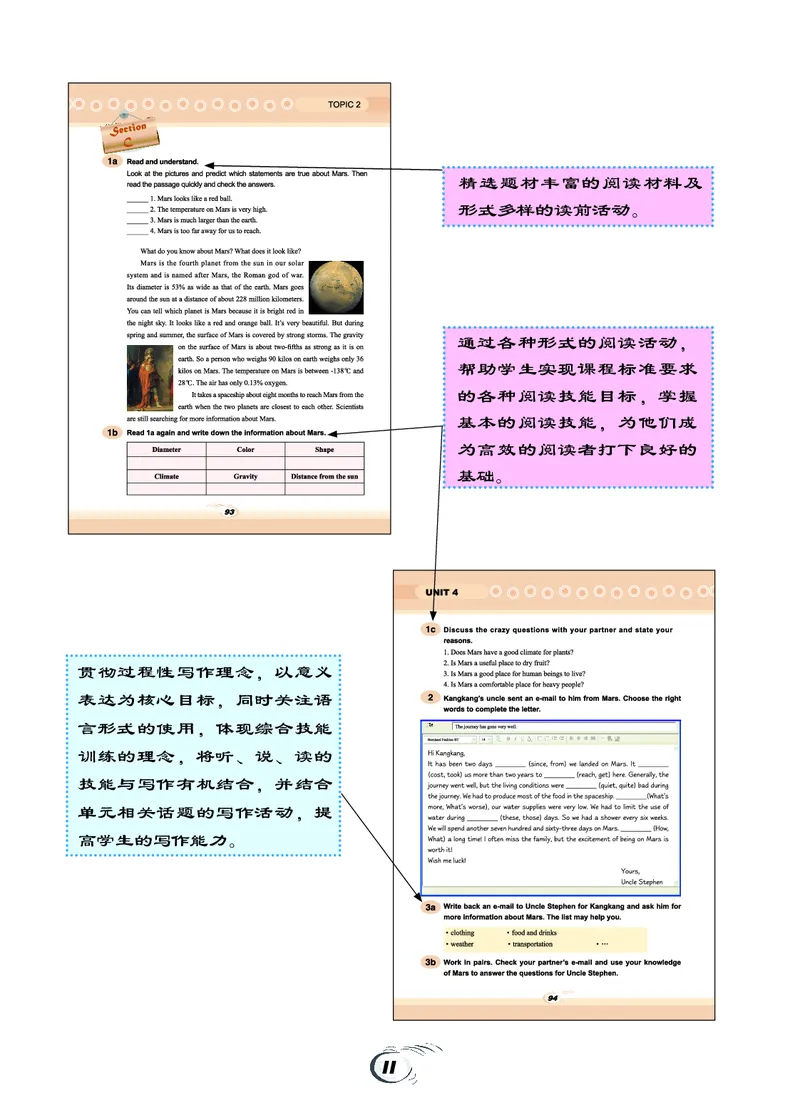
精选题材丰富的阅读材料及
形式多样的读前活动。
通过各种形式的阅读活动,
帮助学生实现课程标准要求
的各种阅读技能目标,掌握
基本的阅读技能,为他们成
为高效的阅读者打下良好的
基础。
贯彻过程性写作理念,以意义
表达为核心目标,同时关注语
言形式的使用,体现综合技能
训练的理念,将听、说、读的
技能与写作有机结合,并结合
单元相关话题的写作活动,提
高学生的写作能力。
III
95
TOPIC 2
Grammar
Functions
How well do you know Sections A-C ? Now do the following tasks and check.
Read through Sections A-C and understand the underlined parts.
Section
D
Passive Voice (Ⅲ)
A wonderful movie will be shown tonight.
I’m excited about the things that will be discovered in the future.
Read the passage and choose a proper title.
1. Is There Life Out There?
Scientists think that there has been life on
earth for millions of years. However, we haven’t
found life on other planets yet. The earth is a planet
and it goes around the sun. And there are seven
other planets that also go around the sun. The sun
and its planets are called the solar system. The
solar system is a small part of the universe.
Scientists have launched many spaceships to explore other planets in the solar
system. Some spaceships have gone beyond the solar system. However, no one
has discovered any life in space yet.
Why has no one from other planets sent us a message? Have they tried to
send information to us? With so many stars in space, are we alone, or is there life
on other planets in space?
2. Our Planet
3. The Stars at Night
1a
We will be able to do anything that can be done on the earth.
I think you should first master some basic computer skills.
Let’s work hard. Then our dreams will be realized.
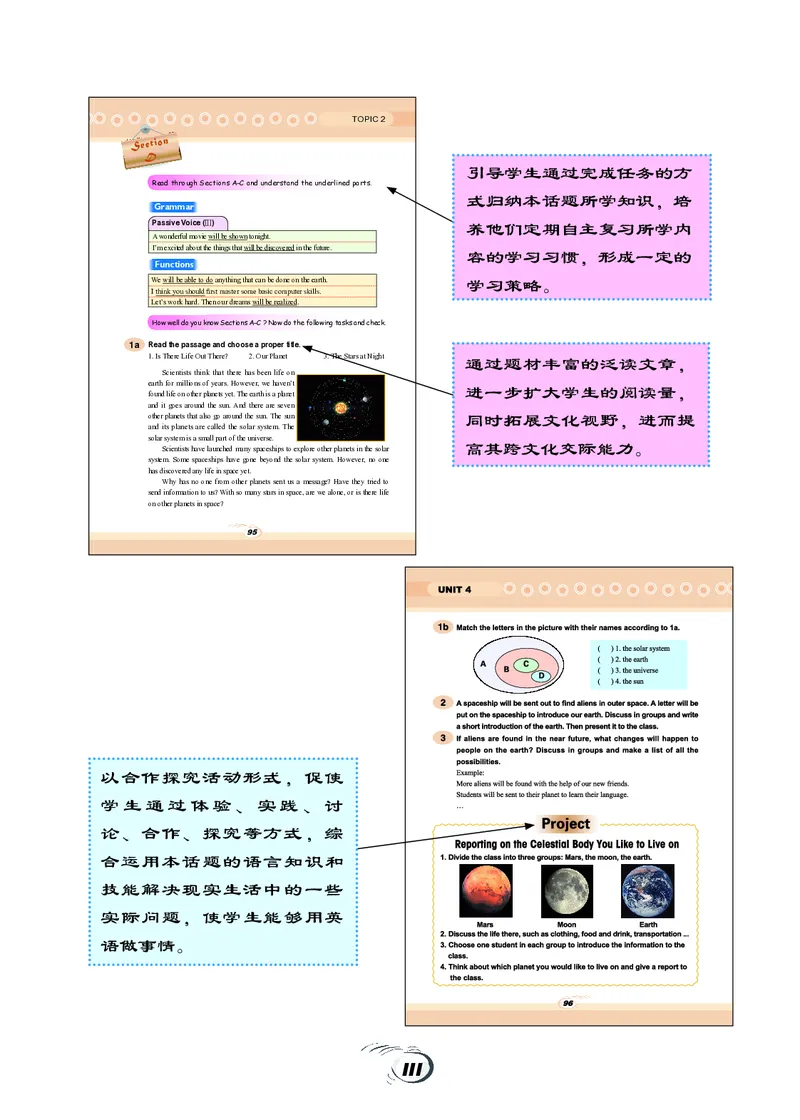
引导学生通过完成任务的方
式归纳本话题所学知识,培
养他们定期自主复习所学内
容的学习习惯,形成一定的
学习策略。
通过题材丰富的泛读文章,
进一步扩大学生的阅读量,
同时拓展文化视野,进而提
高其跨文化交际能力。
以合作探究活动形式,促使
学生通过体验、实践、讨
论、合作、探究等方式,综
合运用本话题的语言知识和
技能解决现实生活中的一些
实际问题,使学生能够用英
语做事情。
Scope and Sequence
1. �Our country has developed
rapidly.
2. �The population in developing
countries is growing faster.
3. The world has changed
for the better.
1. �Pollution has caused too
many problems.
2. �All these problems
are very serious.
3. �What can we do at home to
protect the environment?
Talking about ability
Giving advice
Talking about cause and effect
Making comparison
Talking about health condition
Talking about suggestions
Telling others what one has read
Making comparison
Talking about cause and effect
Talking about duration
Expressing emotions
The Changing
World
Saving the Earth
Review of Unit 1
Review of Units 1-2
Page 9
Page 17
Page 27
Page 35
Page 43
Page 1
2
1
Topic
Function
Unit/Title
25
51
IV
Present perfect ( II )
already, yet, just,
ever, never
Present perfect ( III )
for, since
Indefinite pronoun and
adverb
Simple past and present
perfect
Compound sentence
or, and, while, but
Paying attention to the
pronunciation
Guessing words
Organizing your thoughts
Present perfect ( I )
have/has done ...
have/has been to ...
have/has gone to ...
Words for leisure
activities
Words for communication
Words related to the
population
Words for numbers
Developing listening
skill
Analyzing expressions
Using imagery
Paying attention to the
pronunciation
Names of organizations
Words for social services
Using topic sentences
Listening for the main
idea
Taking notes
Words for environmental
protection
Words for energy
Words for natural
resources
Words to describe
pollution
Names of different kinds
of pollution
Words to describe causes
of pollution
Stress, liaison,
intonation and
incomplete plosion
Remembering English
idioms
Paying attention to the
pronunciation
Structure
Pronunciation
Vocabulary
Strategy
V
Stress, liaison and
pause
Weak form, liaison
and intonation
Intonation
Intonation
Stress, weak form,
liaison and pause
Scope and Sequence
2. �Some things usually have
different meanings in
different cultures.
3. �Could you give us some
advice on how to learn
English well?
1. When was it invented?
Talking about the events in the
past and expressing hope
Giving advice and expressing
thanks
Talking about the events
in the future
Expressing possibility and
impossibility
Expressing hope and wish
Talking about the events in the
past
Expressing happiness,
encouragement and
reassurance
Making polite requests
Talking about the problems
in communication
Talking about how to learn
English
2. �I’m excited about the things
that will be discovered in the
future.
3. �China is the third nation
that sent a person into
space.
1. �English is widely spoken
throughout the world.
Talking about future intention
Expressing wishes
Amazing Science
English Around
the World
Review of Units 3-4
Page 97
Page 89
Page 81
Page 71
Page 63
Page 55
Topic
Unit/Title
4
3
Review of Unit 3
Function
79
105
VI
Appendices
109
Expressing the future by
present continuous
How/Wh- + to do
Word formation:
Derivations
Compounds
Passive voice(Ⅱ)
was/were+past
participle
Passive voice (Ⅲ)
will+be+past
participle
Attributive clauses(Ⅰ)
that, which, who
Passive voice (Ⅰ)
am/is/are+past participle
Discovering a rule
Finding the information
you need
Names of countries
Words for English use
Using gestures
Paying attention to the
pronunciation
Names of animals and
plants
Words for gestures
Finding out about
English learning
Words to describe
the way of English
learning
Focusing on meanings
in communication
Writing a definition
passage
Listening for
key words
Predicting by questions
Using what you already
know to predict
Using formulas
Words for materials
Words to express
inventions
Words about Mars
Words for space
description
Words about the
development of spaceship
Words about the use of
computers
Structure
Pronunciation
Vocabulary
Strategy
VII
Stress and weak form
Liaison, pause and
intonation
Stress and liaison
Vowels
Stress and intonation
Stress and intonation
Pause, weak form
and intonation
1
UNIT 1
The Changing World
Our country has
developed rapidly.
Section
A
TOPIC 1
1a
Listen, look and say.
(After a long holiday, Kangkang is happy to see his friends.)
Kangkang:
Jane:
Kangkang:
Rita:
Jane:
Kangkang:
Rita:
Hi, Jane! Did you have a good
summer holiday?
Yes. What about you?
Not bad. Rita, you have just come
back from your hometown. How
was your trip?
Great! I went to many places near my
home in India. Great changes have
taken place there and my hometown
has become more and more beautiful. Where have you been, Jane?
I have been to Mount Huang with my parents. It’s a beautiful place.
There were so many kinds of trees and rocks that it was difficult for
me to choose to take photos. And where have you been, Kangkang?
I have been to Yan’an to visit with my grandfather. By the way,
where’s Maria?
She has gone to Cuba to be a volunteer and she will be back tomorrow.
Listen! There goes the bell.
1b
Listen to 1a and complete the table.
1c
Retell the main information of 1a based on 1b.
Rita
has been to
many near her
home in
her has become
more and more
Jane
Mount with her
it is beautiful and there were
so many
Kangkang
to with his grandfather
Maria
has gone to to be a volunteer and she will be back
UNIT 1
2
Example:
A: Where have you been?
B: I have been to Mount Huang. How about Maria?
A: She has gone to Cuba. She is still there and will be back tomorrow.
Look at the pictures and make conversations with your partner with
have/has been/gone to.
3
Listen to the conversation and fill in the blanks. Then practice it with your partner.
Work in groups and find out the differences between have/has been to
and have/has gone to.
2a
2b
Michael: Hi, Maria, long time no see. Where ________ you ________?
Maria: I ________ to Cuba to be a volunteer.
Michael: Really? It must be fun.
Maria: � Yeah, I enjoyed the work. Do you know where Jane ________ for
her summer holiday?
Michael: She ________ to Mount Huang for vacation.
Maria: Have you seen her this morning?
Michael: Oh, she ________ to the library.
Maria: I will go and find her. By the way, where is Kangkang?
Michael: He _______ to the library, too. Let’s go and find them.
Mount Huang Cuba
London America
Australia Africa
the Great Wall Hangzhou
1
2
3
TOPIC 1
3
1a
Look, listen and say.
Section
B
Kangkang:
Maria:
Kangkang:
Maria:
Kangkang:
Maria:
Kangkang:
Maria:
Kangkang:
Maria:
Kangkang:
Maria:
Hi, Maria! I haven’t seen you for a long time. You took part in some
volunteer activities during the summer holidays, didn’t you?
Yes. I was a volunteer in a disabled children’s home.
Cool! Did you clean rooms for the disabled children?
Yes, I did.
Did you feed them?
No, I didn’t. But I cooked for them.
What a wonderful experience!
Yes, it really was. I’ve learnt a lot from
it. I think it makes me happy to help
others.
That’s great! Have you been to any other
place?
No, I haven’t. Though I had no time to travel, I still felt very happy.
What about you?
You’re so kind. I have been to Yan’an to visit with my grandfather. It
made me excited. And I also made some new friends there.
Great! What a meaningful holiday!
Both Maria and Kangkang have done something meaningful. Maria has
______ some volunteer activities to help some disabled ______. She ______
a lot from it, and she said ______ others made her happy. Kangkang ______
to Yan’an to visit with his grandfather. It made him ______. And he also ______
some new friends there.
1c
Read 1a and complete the following passage.
1b
Listen to 1a and mark T (True) or F (False).
1. Maria helped the disabled children to clean the rooms and fed them. ( )
2. Maria thinks her experience as a volunteer was wonderful. ( )
3. Maria felt very happy because she helped others. ( )
4. Kangkang has been to Yan’an to visit with his father. ( )
5. Kangkang made some new friends in Yan’an. ( )
UNIT 1
4
2c
Work in groups and survey your group members about their vacation
experiences based on 2b. Then report it to the class.
2a
2b
Fill in the blanks with the different forms of the verbs. Read them aloud
and pay attention to the underlined parts. Then listen and check.
Listen and read the example sentences aloud, paying attention to the
pronunciation and intonation. Then make up more based on the table.
Example:
A: Has Ann ever cleaned rooms?
B: Yes, she has.
A: Has Ann chatted online?
B: No, she hasn’t.
clean rooms jump rope chat online
fly a kite do farm work ...
Ann
Zhang Yang
...
Name
Activity
clean
jump
fly
do
am/is/are
shut
...
cleaned
jumped
chatted
did
...
cleaned
chatted
flown
shut
...
was/were
The pronunciation of "ed" is “/t/, /d/,
or /Id/” when it is added to the verbs
ending with different sounds, such
as help/jump, play/turn or wait/end.
You may begin like this:
Jane has done some farm work …
TOPIC 1
5
1a
Read and understand.
Section
C
Look at the pictures of Beijing
in the past and at present. Then
guess the meaning of each word
and the main idea of the text.
roads — narrow
houses — small, crowded
ring roads — wide
houses — comfortable
communications —
simple, slow
communications —
various, quick, easy
I’m Kangkang. For this report I have interviewed my grandmother about
the life in Beijing. She has lived here for over 60 years and has seen a lot of
changes.
Back in the 1960s, things were difficult. The roads were narrow and there
weren’t many ring roads. Families lived in small houses, and people were very
close to each other. Almost all children could go to school but they did not have a
lot of books to read. People could go to see a doctor, and the medicines were very
cheap but there were not many good medicines back then. People kept in touch
with their friends and relatives far away mainly by letter or telegram.
Changes in Beijing
When reading a passage, try to
figure out the meaning of each new
word by looking at the pictures or
the context of the word.
UNIT 1
6
2
3
1b
China has developed rapidly since the reform and opening-up. More and more
ring roads and subways have appeared and buildings in Beijing are becoming
taller and brighter. People’s living conditions have improved a lot. And there are
more kinds of food and clothes to satisfy people’s needs. Children can study not
only in modern schools but also on the internet. People can enjoy good medical care.
What’s more, communications are becoming easier and quicker — people can use
telephones, cellphones, fax machines and the internet.
Beijing has made rapid progress and it has already succeeded in hosting the
2008 Olympic Games. I think it is important to remember the past, live in the
present and dream about the future.
Read 1a and match the words and phrases with their meanings.
1. What was/were ... like in the past?
2. What has happened to ... nowadays?
3. What will ... be like in the future?
Work in groups and talk about the changes in your hometown.
Then report it to the class.
Write a short passage on the topic Changes in ... You should write its
situation in the past and at present based on 2.
It is important to write a topic
sentence for each paragraph to
help organize your thoughts.
1c
1. Underline the topic sentence of each paragraph.
2. List four changes in Beijing.
1)
2)
Read 1a again and complete the tasks.
3)
4)
1. communication
2. keep in touch
3. far away
4. progress
5. rapid
6. satisfy
A. not near
B. the course of improving or developing
C. way of sending information
D. to make sb. pleased by doing or giving
them what they want
E. write or phone or visit very often
F. happening very quickly or in a short time
TOPIC 1
7
Grammar
1a
Functions
How well do you know Sections A-C ? Now do the following tasks and check.
Read the following passage and complete the table on Page 8.
Section
D
Leisure activities are the kinds of things people like to do to relax and enjoy
themselves when they are not working or going to school. Leisure activities play an
important part in people’s lives. In the past, there were few leisure activities. Children
often got together to play hide-and-seek. People met to play cards or chess in the
street. Few people had chances to travel. Watching operas and listening to the radio
were the main activities in their spare time.
Since the reform and opening-up, Chinese people have had more time to spend
on various kinds of leisure activities. A lot of people love both to play and to watch
team sports like basketball or football. Many people stay at home having a rest,
Changing Leisure Activities
Present Perfect (I)
I have been to Mount Huang with my parents.
She has gone to Cuba to be a volunteer.
China has developed rapidly since the reform and opening-up.
It has already succeeded in hosting the 2008 Olympic Games.
Great changes have taken place there ...
I haven’t seen you for a long time.
Have you been to any other place? Yes, I have./No, I haven’t.
Read through Sections A-C and understand the underlined parts.
There goes the bell.
What a wonderful experience!
Though I had no time to travel, I still felt very happy.
I think it makes me happy to help others.
I think it is important to remember the past, live in the present and dream about
the future.
UNIT 1
8
reading books and watching TV. Young people like to search for information or chat
on the internet. In recent years, more and more people love to travel during vacation.
They go to visit some places of interest, and some people even make a tour abroad
to see the world. Chinese people now have the time and chance to do more kinds of
leisure activities.
1b
Read 1a and answer the following questions.
1. When do people usually have their leisure activities?
2. �How many kinds of leisure activities do you know? Give some examples.
3. What are your favorite leisure activities?
Making a Poster About Changing Leisure Activities
1. �Leisure activities for children have changed a lot. Look at the table
below and talk about them in groups.
2. �Try to find out more changes in leisure activities and their pictures. You
can ask your parents or grandparents for help if necessary.
3.
�Make a poster to show the changes with the topic Different Times,
Different Leisure Activities. Choose the best one in each group and
display it on the wall.
Project
In the past
Now
watch movies in the open air
fly paper planes
roll iron rings
...
watch movies at home
fly model planes
go roller skating
...
In the past
Leisure activity
At present
TOPIC 2
9
TOPIC 2
Section
A
The population in developing
countries is growing faster.
Correcting a passage is a
good way to develop writing
skills.
Maria:
Michael:
Maria:
Michael:
Maria:
Michael:
Maria:
Hello, Michael. I have just called you, but you weren’t in. Where have
you been?
I have just been to a shopping center with Kangkang. I’ve never been
there before, but I don’t want to go there any more.
Why not?
Because there were too many people. We
got lost and couldn’t find each other.
Bad luck! Have you found him yet?
No, he has probably gone home. Let’s
call him up now. I really don’t like going
to a place like that.
Neither do I.
1a
1b
1c
Listen, look and say.
Listen to 1a and mark T (True) or F (False).
Read 1a and correct the five mistakes in
the passage.
1. Michael has just been to a shopping center. ( )
2. Michael doesn’t like to go to the place because he couldn’t buy anything. ( )
3. Kangkang and Michael went back home together. ( )
4. Maria likes going there. ( )
Michael and Kangkang have just gone to a shopping center. They
have never been there before, but they don’t want to go there some more
because there were such many people that they couldn’t find each
other. Michael hasn’t found Kangkang already. Maybe Kangkang has
been home already. Michael and Maria don’t like going to a place like that.
1. _____
2. _____
3. _____
4. _____
5. _____
been
UNIT 1
10
B. Listen again and fill in the blanks. Then practice the conversation
with your partner.
3
Read and understand the first sentence. Then complete the second one.
1. I always lose my way in New York.
I always ______ in New York.
2. Yesterday Maria made a telephone call to Michael, but he wasn’t at home.
Yesterday Maria ______ Michael ______, but he wasn’t ______.
3. Mr. Brown is such a kind teacher that we all like him.
This teacher is so ______ that we all like him.
4. I don’t like to go to such a crowded place.
I ______ going to a crowded place ______ this.
(Steve and Helen are talking on the phone.)
Steve: �I have just been living here for a few days. Could
you tell me some interesting places around here?
Helen: Have you ______ been to the new shopping center?
Steve: �No. I’ve ______ been there before. But I’ve
______ been to a department store.
Helen: Then you can go there to do some shopping. By
the way, have you ______ been to the cinema
nearby?
Steve: Yes, I’ve ______ watched a movie there. It is wonderful.
Helen: Have you been to the central park?
Steve: No, I haven’t been there ______.
Helen: Then, you can have a walk there.
Steve: Thank you.
shopping center
cinema
central park
department store
2
A. Look at the pictures and listen to the conversation. Then tick the
places Steve has visited.
11
TOPIC 2
Section
B
Look, listen and say.
1a
(Kangkang is reading a report on population in the newspaper.)
1b
Listen to 1a and match the information.
1. the world 2. China 3. India 4. the USA
A. 323 million B. 7.2 billion C. 1.36 billion D. 1.27 billion
1c
Read 1a and fill in the blanks.
The world has a population of 7.2 billion in 2014 and it is increasing by
_______ every year. China’s population has already reached _______ and India
has _______ of 1.27 billion. As the population _______, there will be more
pollution and other serious problems. We should find new ways to _______ the
environment, for example, making new rules and policies.
Maria:
Kangkang:
Maria:
Kangkang:
Maria:
Kangkang:
Maria:
Kangkang:
Maria:
Kangkang:
Maria:
Kangkang:
Maria:
Hi, Kangkang, what are you reading?
I am reading a report about world population.
What does it say?
It says the world has a population of 7.2 billion in 2014. And it is
increasing by 82 million every year.
Mmm, that’s really a lot.
Yes. China’s population has already
reached 1.36 billion, and India has a
population of 1.27 billion.
What’s the population of the USA?
323 million.
Oh, I see. What else does it say?
It also says that as the population increases, there will be more
pollution and other serious problems.
So, what should we do with the problems?
There are a lot of things we should do. We should find new ways to
protect the environment, for example, making new rules and policies.
That’s great! Only by working together can we create a better future.
(Data from: UN, Worldometer and National Bureau of Statistics, 2014)
UNIT 1
12
First, try to separate the number
in groups of three from right to
left. Then read it in order from
billion to million and thousand.
3
Work in groups and discuss the population of the world. The following
chart and questions may help you.
2
Listen and read the numbers, paying
special attention to the intonation.
Then read the other numbers with
your partner.
1. Which of these 5 countries has the largest/smallest population? What’s the population
of it?
2. What problems does the large population cause?
3. What measures do you think should be taken to solve the population problem?
543.7
1 562
6 004 001
7 198 764 502
768 540
2 346 780
82 364 580
405 000 000
5 555 555 555
973
3 980 98 721
five hundred and forty-three
point seven
one thousand, five hundred and
sixty-two
six million, four thousand and one
seven billion, one hundred and
ninety-eight million, seven hundred
and sixty-four thousand, five
hundred and two
(Data from: UN, Worldometer and National Bureau of Statistics, 2014)
13
TOPIC 2
1a
1b
Read and understand.
1.Before you read the passage, discuss the question with your partner.
2.Write the title of the passage.
The more people, the better? Not necessarily. Some countries have large
populations. This has been both good and bad for these countries. The large pop
ulations have helped them develop, but have
caused them some serious problems as well.
Because of the large populations, there
was less living space for each family in some
countries. And what was worse, it was difficult
for lots of people to find jobs. At the same
time, the large population caused many other difficulties. For example, it
was hard for the countries to supply water and energy to satisfy people’s
daily needs. Many cities are more crowded and the traffic is much heavier,
too.
So far, some governments have taken many measures to solve the problems.
And they worked well. Thanks to the efforts of the governments, people’s living
conditions are improving rapidly. The natural environment is becoming better
and better.
Read 1a and match the main idea with each paragraph.
Section
C
1. ______ Paragraph 1
2. ______ Paragraph 2
3. ______ Paragraph 3
A. the better situation now
B. two sides of large populations
C. the problems caused by large populations
What social problems do you think large populations caused?
UNIT 1
14
2
3a
3b
Sometimes, it is bad for countries to have large populations.
First, some people are short of living because of large popula
tions. They have no but to live with their relatives or friends. Second,
there are not job opportunities for people to choose from. Some of
them can’t get jobs, and some others may their jobs. Third, the streets
in the cities get dirtier for littering.
Luckily, a number of countries have great efforts to deal with
such kinds of problems. People’s living conditions are getting and the
natural environment is more beautiful than before.
Complete the following passage with the correct forms of the given
words.
Work in groups and search for the information about the following
questions. Then share your idea with your group members.
Write a short passage of three paragraphs based on 3a.
1. How do you think we can get more living space?
2. �What should the government do to offer more job opportunities?
3. Water and energy are less and less. What should we do to deal with it?
4. The traffic in cities is much heavier than before. How can we solve the problem?
1c
Read 1a again and complete the table.
lose choice enough make space good
Large Population
social problem
less _______
fewer _______ opportunities
less _______ and _______
more crowded _______
heavier _______
situation now
Living conditions _______
The natural environment _______
15
TOPIC 2
I really don’t ______ going to a place like that.
______ do I.
It is increasing ______ 82 million every year.
We should find new ways to ______ the environment, for example, making ...
The large populations have ______ them develop, but have ______ them some
serious problems as well.
______ to the efforts of the governments, people’s living conditions are ...
1
Section
D
Hello, everyone! My name is Zhou Lei. I live
in a small mountain village called Green Forest in
Chongqing, China. I have lived here since I was three.
Fewer than 600 people live here. The small village is
surrounded by trees. The air is clean and fresh. People
live close to nature and try to protect it. They are careful with garbage and
discourage cutting trees. The village is really like one big family. The local
people often help each other and have fun together. But sometimes it is hard to
see friends because they live so far away.
Grammar
Read through Sections A-C and fill in the blanks with the correct words.
Present Perfect (Ⅱ)
I have ______ called you.
I’ve ______ been there before.
Have you ______ been to the cinema nearby?
It has ______ reached 1.36 billion, ...
Have you found him ______?
Functions
How well do you know Sections A-C ? Now do the following tasks and check.
Read the two short passages and take notes based on the table on Page 16.
UNIT 1
16
Hi, I’m Li Ming. I live in Beijing, the capital of China. My city has a long
history and many places of interest. We have big shopping centers and huge
markets. Our public transportation is excellent, too. Buses, taxis, and subways can
take my friends and me to any part of the city. We can
play sports, see Beijing operas, go to movie theaters, and
eat delicious food. There are many fine places such as
Beihai Park and Tian’anmen Square where we can meet
with friends to dance or listen to music. I love my city of Beijing because I have
so many friends here and we have so many interesting places to visit together. But
now the large population in Beijing has caused some problems.
2
Write a short passage about the place you would like to live based on 1.
1. �Look at the different types of families below and discuss the advantages
and disadvantages of each type of family.
2. Which kind of family do you belong to and which one do you like better? Why?
3. Report the result to the class.
extended family
nuclear family
Project
You may begin like this:
I’m … I would like to live in … First of all, …
Making a Report on Different Types of Families
Name
Zhou Lei
Li Ming
Place
Green Forest,a small mountain
village, in Chongqing
in Beijing, a large city
Advantage
Disadvantage
TOPIC 3
17
Section
A
TOPIC 3
The world has changed for the better.
Environment
It has improved a lot.
·The air is .
·The sky is .
Transportation
It is very .
·The streets are very .
·People are very .
Living condition
It’s a place to live.
·
1a
Listen, look and say.
You have been in New York for a long time. How do you like living there?
It’s great. I really love it.
What’s the environment like in New York?
Well ... I heard that it used to be very polluted, but now it has improved a
lot since I came here. The air is fresher, and the sky is bluer.
How about the transportation in New York?
It is very convenient. I like to travel by public transportation, especially the
underground. The streets in New York are very clean, and people are very
friendly.
That’s great! How about the living conditions there?
As a matter of fact, it’s a wonderful place to live. Near our block, there are
beautiful parks, good schools, famous museums and excellent restaurants.
And you can go to plays, concerts and operas every day if you like. You
must come for a visit. Then you can see New York yourself.
Helen:
Bob:
Helen:
Bob:
Helen:
Bob:
Helen:
Bob:
(Helen and Bob are talking on the phone.)
1b
Listen to 1a and complete the table about New York.
1c
Work in pairs and describe New York to your partner based on 1b. You
may start like this:
A: How much do you know about the transportation in New York?
B: The transportation is very convenient. I like to travel ...
UNIT 1
18
It is helpful to express
past, present and future
with a time axis in
learning tense.
4
Work in groups and talk about the place you live. Compare today’s
situation with that of the past. The following dialogs may help you.
A: I have been in … for/since …
B: How do you like living there?
A: It is …/Very good./I really …
B: What’s the environment like in ... ?
A: Well ... I heard that it used to be ... but now …
B: …
Look carefully and think about the differences between since and for in 1a.
Then complete the sentences with since or for and listen and check.
3
1. I have lived in Beijing
three years.
2021.
2. He has waited for Tom
two hours ago.
two hours.
3. We have learned chemistry
one month.
the new term began.
Past
Present
Bobby has been away from the park since
8 o’clock/for two hours.
for 2 hours
10:00
8:00
since 8 o’clock
2
Listen to the passage and fill in the blanks with the correct forms of
the given words or phrases.
Broadway is a street in New York. It has been there
1811. It
be dirty. But it
since the 1920s. The area near Times Square is
the home of Broadway theaters. There have been many famous
along
the street for many years. A lot of artists perform plays, concerts and operas there.
Every year millions of visitors come to enjoy the
music and dance on
Broadway.
, Broadway stands for the American theater industry.
theater used to improve wonderful as a matter of fact since
19
TOPIC 3
1a
1c
1b
Look, listen and say.
Section
B
What are you reading, Jane?
I’m reading a newspaper from Canada. Martin showed me an interesting
article. It is about a program that helps homeless people.
Are there homeless people in Canada?
Oh, yes. Many countries have homeless people.
The article says one city has a wonderful program.
Since it started, it has helped hundreds of people
return to work and live a normal life.
That sounds great! How do they manage it?
Well, once they find people in need, they decide on
suitable ways to offer them help.
Can the homeless people get enough food, homes and medical treatment?
Yes. And it’s not only that. The program also provides them with job
training so that they can find jobs again.
I think it is important for these people to feel good about themselves.
You are right. The world has changed for the better.
Maria:
Jane:
Maria:
Jane:
Maria:
Jane:
Maria:
Jane:
Maria:
Jane:
Read 1a and fill in the blanks.
Listen to 1a and mark T (True) or F (False).
There is a wonderful program that helps
people in Canada.
The program not only
enough food,
and homes for the
homeless people, but also
them in order to help them
again. Thanks to the program, the homeless people feel
about themselves.
1. Maria and Jane are talking about a program in Japan. ( )
2. The program helps the homeless people in many ways. ( )
3. �The program also trains those people in need to help them find jobs again. ( )
4. It is important to let homeless people feel good about themselves. ( )
5. The world has not changed people’s lives. ( )
UNIT 1
20
3a
3b
4
Review the differences between since and for. Read Xiao Lin’s
experiences and fill in the blanks with since or for.
Xiao Lin is not only the secretary of the Helpers’ Club but also an excellent
computer engineer. He’s the son of a fisherman ...
1992 his father died
2002 left the army because
of a leg wound
2003 came to Beijing
2004 joined the Helpers’ Club
2005 bought a house
2012 borrowed a car
His father has been dead
many years.
He has been away from the army
21
years because of a leg wound.
He has been in Beijing
2003.
He has been a member of Helpers’ Club
2004.
He has had a house
2005.
He has kept the car
11 years.
→
→
→
→
→
→
→
...
...
Retell Xiao Lin’s experiences to your partner based on the box in 3a.
Work in pairs and make a similar box about your partner.
Listen and read the following sentences with since and for, paying
attention to the stress, weak form, liaison and pause.
2
Complete the passage with the correct forms of the given phrases in
the box.
1. 'I have 'lived in 'New 'York for 'three years.
2. �'He has been 'away from 'home for 'twelve days.
3. Since it 'started,/it has 'helped 'hundreds of 'people
'return to work/and 'live a 'normal life.
get used to feel good provide...with in need decide on medical treatment
The heaviest rainstorm since 1951 hit Beijing and caused floods in some
areas on July 21, 2012. Many people got in trouble and some even lost their homes.
Our government
them
tents and
immediately.
Some volunteers drove to pick up the people
. They
many
different ways to help the homeless. The whole city was in a helpful mood.
“I
because I could help so many people out and I hope they will
the new life,” said the farm worker, Li Chuannan.
Since and for are
often unstressed
in a sentence.
21
TOPIC 3
1a
1b
Read and understand.
Section
C
One of the most basic human needs is a home. A home is a safe place. While
most people around the world value their homes, there are many people in every
country who are homeless.
Some people are homeless for a short period of time because they are
moving from one place to another, and other people are not able to find a home.
They must live on the streets or in a shelter.
There are many causes of homelessness. Sometimes people can not keep a
home because they do not earn enough money, or because they do not have a job.
Sometimes people are homeless because they have a problem with drugs or
because they have a mental illness. No one is ever homeless on purpose.
Whatever the cause of homelessness is, the effects are the same. Homeless
people must work very hard to live. They can not raise their children. Sometimes
they must steal food just to eat. The government in every country has worked for
many years to support the homeless but more needs to be done. We must think
of the homeless as people, not just as problems.
A. A Serious Problem — Homelessness
B. The Causes and Effects of Homelessness
C. A Home is a Safe Place
Read 1a and choose the best title.
1c
Read 1a again and complete the table.
Cause of short-time homelessness Cause of homelessness Effect of homelessness
Are there any homeless people in your hometown? Try to list the reasons
you know for the homelessness.
1) __________
2) __________
1) __________
2) __________
3) __________
4) __________
1) __________
2) __________
3) __________
UNIT 1
22
2
Work in groups. Look at the pictures and discuss the causes and effects
of homelessness, child labor, or war. The following may help you.
3
Write a Cause and Effect passage based on 2. The sentences below
may help you.
homeless people
child laborers
cruel wars
1d
Read 1a again and answer the questions.
1. What does the phrase “on purpose” mean according to the context?
2. What does the word “support” mean according to the context?
3. �Have governments done enough to help the homeless people? What else can
we do to help them?
A: What are the causes of …?
B: There are many causes of … Some causes are …
A: What are the effects of …?
B: Whatever the cause is, the effects are the same …/The effects are different.
Some are …
A: What have governments/people done to help?
B: They have …
A: Have they done enough?
B: ...
A: What can we do now?
B: ...
The world has many problems such as
.
Some causes of
are
.
happens because
.
Some effects of
are
and
.
The governments have
.
People have
. There is hope that there will be less
_______________ in the future.
●
●
●
●
●
●
23
TOPIC 3
Read the passage and underline the topic sentence for each paragraph.
Grammar
Functions
How well do you know Sections A-C ? Now do the following tasks and check.
Read through Sections A-C and fill in the blanks with the correct words.
Section
D
Present Perfect (Ⅲ )
You
(have gone/have been) in New York for a long time.
(Since/For) it
(have started/started), it
(helped/has helped) hundreds of people return to work and live a normal life.
Well ... I heard that it used to be very polluted, but now it
(has
improved/improved) a lot
(since/for) I came here.
How ______ the transportation in New York?
______ a matter of fact, it’s a wonderful place to live.
You must come for a ______.
Well, once they find people in need, they decide ______ suitable ways to offer
them help.
The program also provides them ______ job training so that they can find jobs again.
1a
Project Hope
Project Hope is a program to help students. It builds
schools in the poorest parts of China and it helps poor families
afford an education for their children.
Since Project Hope started in 1989, it has done very well.
By 2012, Project Hope had raised 8.73 billion yuan. With this
money, it aided 4.5 million children to go to schools and it built
18 002 Hope Primary Schools.
Project Hope has made important contributions to both the education and the health
of children. For many years, Project Hope has encouraged the moral development
and modern thinking of students. As a result, the students in Hope schools respect
UNIT 1
24
be start change work pay leave
Complete the passage with the correct forms of the given words.
2
Minmin comes from a poor family. She has received help from Project Hope.
Without the help of Project Hope, she couldn’t continue her studies. Project Hope
her life. She
a college student for two years. After
the college, she will
for Project Hope. Project Hope
for the
education of millions of poor students like Minmin since it
. Are there any
children like her around you? What difficulties do they have? Project Hope
can help them.
Read 1a again and answer the questions.
1b
their teachers, aid the poor, and help one another. Project Hope is one of the
best-known and most successful programs in China. Without Project Hope, there
is a risk that many children would have an unhappy future.
1. What is Project Hope?
2. What has Project Hope done?
3. What’s the importance of Project Hope?
4. What can you do for Project Hope?
Project
Making a Speech About an Organization
1. �Work in groups and collect information about one of the organizations:
what it is, what it has done, what the effects of it are and so on.
World Health
Organization
China Children
and Teenagers’ Fund
International Committee
of the Red Cross
Chinese Young
Volunteers Association
2. Make a short speech about the organization you have discussed.
25
Review of Unit 1
Listen and read the sentences, paying special attention to the weak form
and intonation.
1
Fill in the blanks with the correct forms of the given phrases.
Choose the correct words to complete the sentences.
3
2
thanks to provide … with in need on purpose as well
1) A friend _______ is a friend indeed.
2) He speaks Chinese and English _______ .
3) I came up here _______ to tell you what happened to her.
4) �After the earthquake, the government tried to _______ people _______ food and
fresh water.
5) _______ this method, his English has improved a lot.
1) have been have gone
A. I _______ to Italy three times.
B. Lily is not here now. She _______ to the railway station to meet her mother.
2) ever never already yet
A. I have _______ been to the new museum in my city, so I know nothing about it at all.
B. — Have you _______ watched the film, Avatar?
— Not _______. I’ll watch it this weekend.
C. He has _______ made some plans to spend his holiday.
3) since for
A. Our country has developed rapidly _______ the reform and opening-up.
B. John’s father has been in the small town _______ quite a long time.
1. A: Did you have a good summer holiday?
B: Yes. What about you?
2. Many people stay at home having a rest, reading books and watching TV.
3. A: Have you found him yet?
B: No, he has probably gone home.
4. A: Where have you been, Jane?
B: I have been o Mount Huang with my parents.
26
Review of Unit 1
Read the passage and complete the table.
4
5
Write a short passage for your school newspaper. Tell everybody about
the changes in Chinese teenagers’ leisure life.
Chinese Teenagers’ Leisure Life
Nowadays, Chinese teenagers have many outdoor and indoor activities.
They have plenty of chances to go outside and join in all kinds of outdoor
activities. They can enjoy the fun of teenager life as well as the sunshine. During their
holidays, they may get close to nature to enjoy its beauty. They can go to the seaside
to swim in the sea, sunbathe and play beach volleyball. They can go climbing to share
fresh air with the singing birds. Sometimes, they might go out for a picnic to have
fun together. They can also get close to culture by going to cultural parks and visiting
museums. In their spare time, teenagers often play team sports together, like football
and basketball. But their grandparents hardly had any chance to do these in their
childhood.
Teenagers also enjoy many indoor activities. They can have a party with their
friends at weekends. If they don’t want to go out, they may surf the internet to chat
with others. They may watch their favorite TV programs or movies without leaving
their homes.
How happy the Chinese teenagers are!
Chinese teenagers’ leisure life
outdoor activity
get close to nature:
1. ________________________________________________
2. ________________________________________________
3. ________________________________________________
get close to culture:___________________________________
play team sports:_____________________________________
indoor activity
have a ____________________________________________
surf the
to
watch
or
27
UNIT 2
Saving the Earth
TOPIC 1
Pollution has caused
too many problems.
Section
A
1a
1b
1c
Listen, look and say.
(Kangkang, Jane, Maria and Michael are planning a picnic for Sunday.)
Jane and Maria:
Kangkang:
Jane:
Maria:
Kangkang:
Michael:
Maria:
Kangkang:
Michael:
Jane:
Kangkang, where shall we go?
What about the West Hill?
I went there two years ago. It was a
mess. There were several chemical
factories pouring waste water into
the stream.
What a shame!
I have heard it has become a beautiful place. There are lots of
flowers and grass.
Sounds great! Let’s go there.
Oh, what a beautiful place! The air is
fresh and the water is clean, and you
can see bees and butterflies dancing.
Everything has changed.
Do you want to have a picnic here?
Of course.
(On Sunday, they come to the West Hill.)
Listen to 1a and mark the words with P (Past) or N (Now).
Read 1a and complete the sentences in the table. Then retell 1a to
your partner.
____ beautiful ____ butterflies ____ grass
____ factory
____ bees
____ fresh
____ clean ____ waste water
Two years ago
Now
1. It was a ____.
2. There were several _______________
pouring __________ into the stream.
1. The air is ____ and the water is ____.
2. You can see _____________ dancing.
3. ______________ has changed.
UNIT 2
28
3
A. Listen to the sentences and number the pictures.
Example:
A: �The villagers destroyed the flowers and grass when
I visited the village last year.
B: But now the flowers and grass have come back.
A: What has happened here?
B: �The villagers have learned that they were wrong. And
they have done a lot to make the village a better place.
4
1. People _____ _____ _____ trees. Now I have enough leaves to eat.
2. I live in trees. People have stopped _____ _____ trees. So I have more family members.
3. Leaves and grass _____ many years ago. But now they have come back. I can
have enough food.
4. I have found more bamboo on the mountain. I don’t have to _____ _____ _____
any more.
5. In recent years, I _____ _____ _____ _____ to make the sea clean again.
6. I couldn’t live in the river because it _____ _____ _____ for me to live in. Now
it has become clean again, so I am safe.
B. Listen again and complete the sentences.
Work in groups and talk about pollution in a place you are familiar
with. The following sentences may help you.
Oh, my goodness! ... ago, it was ... Now, ... have/has come back.
What has happened? Everything has changed.
2
Work in pairs. Look at the pictures and make up conversations similar
to the example with your partner.
village/flowers and grass
villagers/destroy
hill/trees
farmers/cut down
city/lake/fish
factory/pollute
2
1
TOPIC 1
29
Section
B
1b
1c
1a
Look, listen and say.
Kangkang:
Mrs. Zhou:
Kangkang:
Mrs. Zhou:
Kangkang:
Mrs. Zhou:
Kangkang:
Mrs. Zhou:
Kangkang:
Good morning, Mrs. Zhou. How have you been?
Oh, Kangkang. I’m OK. I have coughed less. You know I had a pain in
my throat before. It was difficult for me to breathe.
Have you seen a doctor?
Yes. The doctor says I’m better.
What caused your cough?
The chemical factory produced terrible gas before, and the bad air made
my chest hurt. What was worse, the factory made too much noise and I
couldn’t sleep well at night.
How terrible for you!
Yes, it was really awful. I was always in a bad mood because I couldn’t
bear the environment here. Luckily, the government has solved the
problem. By the way, have you noticed there are more fish in the river?
Yes, I have. The river is cleaner and clearer. The environment has
become good. I think I should write to the newspaper to show my thanks.
(Mrs. Zhou meets Kangkang on the street. She looks good.)
A. Listen to 1a and check the questions you hear.
B. Listen again and match each question above with an answer below.
Read 1a and answer the questions.
1. Why couldn’t Mrs. Zhou sleep well at night?
2. What will Kangkang do?
3. Do you have any other ways to solve the air pollution?
a. The bad air made my chest hurt. c. I’m OK. I have coughed less.
b. Yes, I have. d. Yes, the doctor says I’m better.
Question Answer
1. ____ How have you been? _______
2. ____ Have you seen a doctor? _______
3. ____ Where have you been? _______
4. ____ What caused your cough? _______
5. ____ Have you noticed there are more fish in the river? _______
UNIT 2
30
3a
Look at the pictures and read the words and phrases, paying attention
to the sounds and stress.
2
Choose the correct words to complete the passage.
'air po'llution
'water po'llution
'noise po'llution
'litter
'light po'llution
3b
Complete the sentences with the words and phrases in 3a. Then read them
aloud, paying special attention to the pronunciation, liaison and pause.
Example:
�People use chemicals too much in their fields, /and soil pollution causes unhealthy food.
1. The chemical factory pours waste water into the river, /so _______ is almost
everywhere in this village.
2. ___________ makes people sick. /It causes breathing problems and even cancer.
3. In some cities, /there’s too much ___________ caused by many cars.
4. ___________ is harmful to birds. /Also, /when we use too many lights at night, we
waste energy.
5. ___________makes a mess of our environment, /so people shouldn’t throw it around.
'soil po'llution
Dear editor,
I’m writing to show my thanks for the better environment near my house.
The factory caused _______ (too many / too much) problems before. It produced
terrible gas, and it was hard for us to _______ (breathe / breath). What was worse,
the factory made a lot of noise. We couldn’t sleep well at night. It also polluted
the river nearby. Now there aren’t any _______ (die / dead) fish in the river. It is
cleaner and clearer. I think our government has made great efforts to solve the
problems. Thanks again for giving us a better living place.
Yours,
Kangkang
TOPIC 1
31
Section
C
1a
Read and understand.
In today’s world, almost everyone knows air pollution is harmful to
people’s health. However, not all people know noise is
also a kind of pollution and is harmful to humans’ health.
People who work and live in noisy conditions often
go deaf. For example, many of the workers who print
newspapers and books lose their hearing. Quite a few
people living near airports also have hearing loss. Recently, it was reported
that many teenagers in America can hear no better than 65-year-old people do,
because these young people always listen to loud pop music.
Making a loud noise in public is also a kind of pollution. It not only disturbs
others but also does great harm to people’s hearing. Cars and machines also produce
too much noise. Such pollution makes people feel
uncomfortable and unpleasant, and it can even cause
them to become sick or deaf. Nowadays, many countries
are trying to solve all sorts of environmental problems,
including noise pollution.
Before you read, write down the things that can make noises. Then read
the passage and check.
bus
noises made by
piano
cat
wind
1. produce
A. to hurt someone
2. deaf
B. a type or a kind
3. print
C. not be able to hear
4. harm
D. to grow or make something
5. sort
E. to put words or pictures onto paper using a machine
1b
Read 1a and match the words with their meanings.
UNIT 2
32
1. Underline the topic sentence of the passage in 1a.
2. How does noise harm people’s health?
a. People often ________.
b. People often feel ________ and ________.
c. People may become ________ or ________.
d. Your point: _______________________________.
3. Which phrase has the same meaning as “is harmful to”?
4. �Which sentence shows that many teenagers’ hearing in America is not good?
5. Why is the hearing of many young Americans not good?
6. �Has noise pollution caused you any problems? If yes, share your feelings with
your classmates.
Try to find out the topic
sentence to understand
the content of a paragraph.
1c
3
2
4
Read 1a again and complete the following tasks.
Choose one kind of pollution and discuss it in groups. The following
questions may help you.
Complete the following passage with the correct form of each word.
Write a short report about a kind of pollution based on 2 and 3. The
topic sentence of each paragraph is given below.
1. What is … pollution?
2. What makes the … pollution?
3. What problems does it cause?
4. In what way is it harmful to people’s life?
5. What has been done to solve these problems?
…
... pollution is …
... pollution is harmful to people’s health ...
The government has tried many ways to solve the problem ...
Noise is a kind of ___________ (pollute). Cars and machines produce too
much noise. It makes people feel ___________ (comfortable) and ___________
(pleasant). It also does great ___________ (harm) to people’s ___________ (hear).
Noise is very ___________ (harm) to humans’ ___________ (healthy).
TOPIC 1
33
Section
D
Read the passage and complete the table on Page 34.
1a
Grammar
Functions
How well do you know Sections A-C ? Now do the following tasks and check.
Read through Sections A-C and fill in the blanks with the correct words.
Oh, what a ______ !
There were several chemical factories ______ waste water into the stream.
What was ______ , the factory made too much noise ...
Noise is ______ to humans’ health.
People who work and live in noisy conditions often ______ deaf.
… many teenagers in America can hear no ______ than 65-year-old people do, …
… does great ______ to people’s hearing.
Recently, people and the governments have worked together to make the en
vironment better. They have used new technologies and have taken steps to deal
with pollution. This has made the environment healthier. All these show that the
world is becoming greener and more environmentally friendly.
However, in the past, there was a lot of pollution, including air pollution, soil
pollution, noise pollution, and light pollution.
Burning gas, oil, and coal created air pollution. It caused sore eyes and
breathing problems. With the increase in population and the development of in
dustry, people had to put lots of litter into the land. In the fields, farmers used too
many chemicals which destroyed the soil. Soil pollution led to unhealthy food.
Noise pollution harmed people’s hearing. People would become deaf if they
worked in a noisy place for a long time. Too much noise could cause high blood
pressure as well.
Simple Past & Present Perfect
I ______ (go) there two years ago.
How have you ______ (be)?
It ______ (be) difficult for me to breathe.
What ______ (cause) your cough?
Luckily, the government has ______
(solve) the problem.
UNIT 2
34
1b
Read and understand the first sentence. Then complete the second one.
Project
Making a Wall Newspaper About Pollution
1. Collect some pictures about pollution.
2. �What kind of pollution does each picture show? Work in groups and
discuss its bad effects.
3. �Make a wall newspaper about different kinds of pollution and the
harm caused by them.
Pollution
Cause
Effect
air pollution
burning ________, ________
and ________
________ eyes and ________
problems
soil pollution used too many ________
which destroyed the soil
________ food
noise pollution ________ in a noisy place for
a long time
made people ________ and caused
________ pressure
light pollution ________ light
bad for _______
1. They are bad for our health in many ways.
They _______ to our health in different ways.
2. People may lose their hearing if they work in a noisy place for a long time.
�If people work in noisy conditions for a long time they may have _______.
3. Noise pollution can make people deaf.
People may _______ deaf _______ noise pollution.
Light pollution was caused by strong light. It could make people feel terrible
and was especially bad for eyes.
With less pollution, our planet will become greener and our health will be
better. Let’s be greener people.
35
Section
A
TOPIC 2
TOPIC 2
All these problems are very serious.
1a
1c
1b
Listen, look and say.
Maria:
Kangkang:
Maria:
Jane:
Kangkang:
Jane:
Maria:
Kangkang:
(Kangkang, Maria and Jane are talking in a room. The wind outside is blowing strongly.)
What a strong wind!
Yes. But it’s better than the last few years. There were sandstorms before.
While I was walking down the street, I couldn’t see anything. The sand
really hurt my face.
Why was the weather so bad?
People cut down too many trees. As a result,
a lot of rich land changed into desert. Trees can
stop the wind from blowing the earth away.
And a lot of water can be saved by forests.
Trees can also stop the water from washing the earth away.
Cutting down trees affects the weather so much.
Yes. It is harmful to human beings, animals and plants. Although there
were sandstorms before, now we have built “The Green Great Wall” .
Our environment has become much better.
Read 1a and complete the
trees’ functions.
Listen to 1a and choose the best answer.
A.
Trees' functions
B. A lot of water
saved by
C.
can be
forests.
The boy and girls are talking about ______.
A. different types of sandstorms
B. the reasons for sandstorms
C. sandstorms in different cities
Focus on the main idea of the
conversation when you listen
for the first time.
UNIT 2
36
3
4
2
Do you know how sandstorms come into being? Number the pictures
and talk about the sandstorm in groups.
A. Listen to the passage and circle the phrases you hear.
Complete the sentences with the correct forms of the given phrases
in the box.
1. Now some kinds of animals are becoming
.
2. Some animals are
dying out completely.
3. In the past, pandas lived a quiet life and had
food.
4. Humans have
the importance of protecting animals.
5. We should
to protect them.
B. Listen again and fill in the blanks.
disappear rapidly
become weaker
on the earth
destroy the environment
enough bamboo to eat
as a result change into do something stop… from blow... away
1. People have cut down such a large number of trees that the land _________ desert.
2. There are fewer trees left, so the wind always _________ the earth _________.
3. Air pollution has become a serious problem, so we must _________ to reduce it.
4. We should try our best to _________ people _________ cutting down trees.
5. �In the future, human beings can protect the trees well. _________, animals will
live a happy life in the forest.
forests gone
cut down trees
sandstorms come into being
wash the earth away
many trees
change into desert
1
37
TOPIC 2
1a
1b
1c
Look, listen and say.
Section
B
Michael:
Kangkang:
Michael:
Kangkang:
Michael:
Kangkang:
Michael:
Kangkang, read this article.
What’s it about?
It’s about the environment in our
city. It says that the condition of the
air has become better than before.
Although we are one of the largest
producers and users of coal, the
air pollution has been under control.
Yeah. The government has done something useful to protect the
environment.
That’s great. None of us likes pollution.
Yes. We shouldn’t leave rubbish here and there. Don’t spit anywhere
in public. Don’t walk on grass or pick flowers. Everyone should care
for wild animals and plant more trees.
That’s right. We should do everything we can to protect the environment.
Listen to 1a and number the following pictures.
Read 1a and complete the table.
Should do
Shouldn’t do
1. _________ wild animals
2. plant _________
3. do _________ we can
1. _________ rubbish here and there
2. _________ anywhere in public
3. _________ on grass
4. pick _________
( )
( )
( )
( )
( )
UNIT 2
38
2
Listen to the letter and help Kangkang to complete it. Then read it aloud
as accurately as possible.
Dear Headmaster,
I’m writing to tell you
important. Nobody likes to be untidy.
However, some students throw waste paper and bottles
. We all need a
quiet place to study, but some students often make too much noise at school.
Worst of all, some of them are quite rude when talking to
.
knows their behavior is bad, but
of us knows how to stop them.
I think we should make rules to change the situation.
who breaks
the rules will be punished. Perhaps it will be hard for us to obey the rules in the
beginning, but if
does his or her best to follow the rules, our school
environment will improve.
Sincerely,
Kangkang
Discuss the following questions in groups and try to find the solutions.
4
3
Read and understand the first sentence. Then complete the second one and
read them aloud, paying attention to the weak form, liaison and intonation.
Example:
As we all know, air pollution has become a serious problem.
Everybody knows air pollution has become a serious problem.
1. None of us would like to see dirty water and rubbish lying around.
would like to see dirty water and rubbish lying around.
2. We should follow social rules and spit nowhere in public.
We should follow social rules and not spit
in public.
3. We should do everything to protect the environment in our daily lives.
We shouldn’t do
to destroy the environment in our daily lives.
1. Do you have any bad habits when you are at school? What are they?
_______________________________________________________
2. How can you make your school look better?
_______________________________________________________
39
TOPIC 2
1a
Read and understand.
Section
C
Look at the following pictures and predict the main idea of the passage.
______ All over the world, people have cut down millions of trees. When it rains
or when the wind blows, the earth is taken away. Forests have become deserts, so
many kinds of animals and plants are disappearing.
______ In big cities, cars and buses have polluted the air. Now many people in
cities have health problems.
______ Factories have also polluted the land and the water. As a result, many
rivers and lakes are now dead.
______ Around the earth, there’s a special kind of oxygen called “ozone”(O3). It
is important to the earth. But now air pollution is destroying it and making a very
big hole in the ozone layer. Too much harmful radiation from the sun passes through
the hole and reaches the earth directly. This is very dangerous because this kind of
radiation can cause cancer.
______ Carbon dioxide (CO2) in the air has increased a lot. It mainly comes
from burning oil, coal and wood. This has formed a blanket around the earth. The
heat from the sun can’t escape so the temperature is rising. This is called “the
greenhouse effect”. It causes the level of the oceans to rise and the climate of the
earth to change.
All these problems are very serious, so we must do something now.
The earth is 4.6 billion years old. We humans have lived on the earth for only 35 000
years, but during this period, we have changed our planet a lot in many ways. Some
things we have done are very good for the earth while others are bad.
UNIT 2
40
2
3
1b
Read 1a and complete the following tasks.
1. �Choose suitable titles for Paragraphs 2-6. Then write it down in front of each
paragraph.
A. Traffic pollution B. Factory pollution C. Fewer trees
D. The ozone hole E. More carbon dioxide
2. What does our planet mean here?
A. The sun. B. Mars. C. The moon. D. The earth.
3. In the passage, blanket refers to
.
A. carbon dioxide around the earth
B. the ozone layer in the sky
C. the forests around the world
D. pollution all over the world
4. The word it in Paragraph 5 refers to
.
A. CO2 B. O3 C. O2 D. H2O
5. What is the best title for this passage?
A. Environmental Problems
B. Pollution on the Earth
C. Hope for the Future
D. The Greenhouse Effect
1c
Complete the notes according to 1a.
Write down only the key
words when taking notes.
Surf the internet to collect more information about environmental problems
and effects. Then discuss the information in groups and take notes.
Combine the key points in 1c and 2 to form a short passage and pay
attention to the proper linking words.
Problem
Effect on the environment
forests become deserts, animals and plants disappear
traffic pollution
fewer trees
greenhouse effect, level of oceans rising, climate change
...
...
41
TOPIC 2
Read the passage and put the following paragraphs in the correct order.
1a
Functions
Grammar
How well do you know Sections A-C ? Now do the following tasks and check.
Read through Sections A-C and fill in the blanks with the correct words.
Section
D
Indefinite Pronoun and Adverb
________ of us likes pollution.
Don’t spit ________ in public.
________ should care for wild animals and plant more trees.
We should do ________ we can to protect the environment.
________ a result, a lot of rich land has changed ________ desert.
Trees can stop the wind from blowing the earth ________.
We shouldn’t leave rubbish ________.
All these problems are very serious, ________ we must do something now.
( ) The sea seems to have the best answer. There is plenty of water in the sea.
But we need to take the salt away from the sea water. This is very expensive. If
scientists can find cheaper ways to do it, we can solve the problem of the shortage
of water.
( ) How can we avoid a serious water shortage? First, we should save water
and not waste it. Second, we should protect our water resources and not pollute
them. Third, we should discover ways to reuse water. Scientists have made some
progress in this field. Today, some large cities are reusing their water. But people’s
need for water is increasing day by day. We still don’t have enough water. What
else can we do?
( ) Although the world is hungry, it is even thirstier. While nearly 3/4 of the
earth is covered with water, we are still short of drinking water. This is because
about 97% of the water on the earth is sea water. So we can’t use it for watering
plants or drinking directly. Humans can only drink and use fresh water from
places including rivers, lakes and underground.
UNIT 2
42
2
3
1b
Read 1a again and answer the questions.
Discuss in groups different ways of protecting and saving water. Write
down the key information.
Write a proposal about saving water to all the students in your school.
Project
Making Posters About Natural Resources
1. Divide the class into several groups: Water Group, Tree Group, Soil Group ...
2. Each group should discuss their own uses, the problems that they face
and their wishes. Then give a report in class.
Example:
Uses: I am soil. Plants can’t grow without me. People use me to make many things ...
Problems: Sometimes people use too many chemicals in the fields. What’s worse,
they put waste into the land ... So I’m hurt. Please help me.
Wishes: I hope human beings can protect and take care of me. And then I could do
more useful things for them ...
3. Make some posters with the results.
1. Why is our world thirsty when 3/4 of the earth is covered with water?
2. What can we do now to avoid the water shortage?
3. What will be the best way to solve the problem in the future in the passage?
4. Do you know any other ways to solve the problem? What are they?
Example:
1. Pass laws against water pollution.
2. Collect and reuse waste water.
…
My dear friends,
Water is very important to human beings. Let’s do something to protect
and save it.
First, ___________. Second, ___________. Third, ___________.
Let’s try our best to save water and our planet.
______
43
Section
A
TOPIC 3
TOPIC 3
What can we do at home to protect
the environment?
1b
1c
1a
Listen, look and say.
Listen to 1a and complete the table.
Read 1a and complete the sentences.
(A journalist is interviewing Kangkang about environmental protection.)
Journalist:
Kangkang:
Journalist:
Kangkang:
Journalist:
Kangkang:
Journalist:
Kangkang:
Journalist:
Kangkang:
Hi, Kangkang. Could I ask you a few questions?
Certainly.
We all know that you’re working for an
organization that protects the environment.
Can you tell us what you are doing there?
Well, my main job is to help spread the
message about protecting the environment.
For example, it’s important to reduce, reuse and recycle the litter.
So what can we do at home to protect the environment?
We should reduce the waste we produce. For example, we should use
both sides of paper and reuse plastic bags.
What can students do at school?
Recycling can protect the environment, and it can save money, too. So
we encourage students to collect waste paper and soft drink cans. Then
we sort them so that they can be recycled.
Wonderful ideas! Thank you!
It’s a pleasure.
1. It’s important to ______, ______ and ______ the litter.
2. At home, we can, for example, use both ______ of paper and reuse ______ bags.
3. �At school, students are encouraged to ______ waste paper and ______ because
recycling can protect the ______ and ______ money.
4. Then we ______ them ______ they can be recycled.
An interview with Kangkang
where Kangkang works
in an ______________ to ______________
what Kangkang is doing helping ______________ about protecting the environment
what we can do at home
______________ we produce
what students can do at
school
collect ______________ and soft drink cans
UNIT 2
44
4
Listen to the conversation and check your answers in 3a.
3b
Suppose you will have a Clean-up Day. Work in groups and find out
the garbage. Then sort them based on 3a and talk about them.
3a
Read the table and write the correct letter under each picture. Then
sort the garbage based on your own knowledge.
Type of garbage
Recycled
Reused
Reduced
a. plastic bags
√
b. paper cups
c. cans
d. newspapers
e. glass bottles
A: I think lunch boxes should be reused.
B: What about waste paper?
A: I think…
Wow! We’ve got so much garbage! Soft
drink cans, lunch boxes, plastic bottles,
batteries, waste paper, paper bags and
cups, ...
1. Noise is a kind of pollution. It’s harmful to our hearing.
2. Work hard. You will fail the exam.
3. �Nodding the head means agreement. Shaking the head means disagreement.
4. Hurry up. You will miss the bus.
5. He has failed several times. He never gives up.
2
Combine the sentences with or, and, but or while, making some changes
if necessary.
45
TOPIC 3
1a
1b
1c
Look, listen and say.
Section
B
Hi, Michael. Would you like to be a greener person?
Of course, I’d love to. But what should I do?
First, you ought to shut off the electricity when
you leave a room.
Oh, that’s easy. What’s next?
Second, you’d better walk or ride a bike instead
of taking a bus or a taxi if you travel a short
distance.
That’s right. It will save energy and reduce air pollution.
Third, take a cloth bag when you go shopping. Don’t use plastic bags.
It’s so easy to be a greener person.
Easier said than done.
Well, actions speak louder than words.
Jane:
Michael:
Jane:
Michael:
Jane:
Michael:
Jane:
Michael:
Jane:
Michael:
Listen to 1a and choose the correct answers.
Read 1a and complete the table.
1. Jane and Michael are mainly talking about ________.
A. why we should shut off the electricity when we leave
B. what we should use when we go shopping
C. how to be a greener person
2. “Actions speak louder than words” means________.
A. words are not as loud as actions
B. to do well is better than to say well
C. actions can speak, but words can’t do it
To be a greener person
1. _________when you leave the room.
2.� If you travel a short _________, you shouldn’t _________, but _________. So
this helps to _________ and _________.
3. When you go shopping, you’d better _________ instead of using ___________.
Remember some English
idioms and try to use
them often.
UNIT 2
46
Choose the correct verbs or phrases to complete the statements. Then
match them with the right pictures.
2
3
4
Read the passage and fill in the blanks with the correct words. Then
listen and check. The first letter of each word is given.
Work in groups and survey your group members about what they do
to be greener people. Then report it to your class. Pay attention to
the stress, liaison, incomplete plosion and intonation.
shut off reduce grow recycle
ride cover use
1. �______ waste. Don’t buy cups or boxes
which can be used only once.
2. �Save electricity. ______ the electricity
when you are not using it.
3. ______ boxes and plastic bottles.
4. ______ fruit and vegetables yourself.
5. Try to _____ a bike when you travel.
6. _____ both sides of the paper.
7. _____ pans when you are cooking.
The earth is our home. Some things we have done are good for the earth
w______ some are bad. We have polluted the earth, a______ it is sick now. We
c______ down too many trees, so lots of rich land has c______ into desert. Factories
p______ waste water into rivers. Pollution has caused many s______ problems. The
earth is crying for help.
What shall we do to save it? We should plant more trees, r______ the waste
we produce, r______ the waste paper and soft drink cans, and ride bikes to reduce
air pollution. I think we should try to be g______ people to protect our earth.
After all, we have only one earth. We should do e______ to protect it, or we’ ll be
punished and lose our home.
A.
B.
D.
C.
E.
F.
G.
A: 'Wha(t) do you 'often 'do to be a 'greener person?
B: Well, 'I 'always 'shut off the electricity when I 'am not 'using it.
A: 'Good. 'What about you, 'John?
C: …
Example:
47
TOPIC 3
Read and understand.
Read 1a and answer the questions.
1a
1b
Section
C
�Look at the pictures. Do you know what they are? Choose the right picture
for each paragraph.
A
B
C
China is using new technology to make energy. They built big solar farms,
like the Longyangxia Dam Solar Park, to produce electricity from the sun.
Thanks to solar energy, it requires less coal and oil. It is a good way to protect our
earth from pollution.
China is also making more electric vehicles. Since these vehicles don’t
need petrol, they are better for the environment and make transportation cleaner.
China’s fast trains, like the Beijing-Shanghai high-speed train, are
making travel easier. Though they have wheels, there is no wheel noise inside.
Even German experts think highly of the technology of China’s high-speed train.
All of these show that China is working hard to find new and better ways to
produce energy and make travel easier without harm to the earth. China serves as
a good guide for other countries in using cheap and green energy.
1. What is the Longyangxia Dam Solar Park for?
2. Why are the electric vehicles better for the environment?
3. Who thinks highly of the technology of China’s high-speed train?
4. What’s the passage mainly about?
UNIT 2
48
2a
2b
1c
Read 1a again and complete the table.
Read the passage below and match the pictures with the sentences.
Then discuss in detail the use of one energy source.
Take notes on your discussion and write a passage with them.
You may begin like this:
( )
( )
( )
( )
1. Wind can produce electricity in many places.
2. People use sunlight to produce electricity.
3. Sea waves are used for producing electricity.
4. �People use hot water or steam from deep in the earth to produce electricity and
heat for factories, schools and homes.
Sunlight can produce a lot of energy. People began to use the energy from the
sunlight in different ways many years ago…
The sun, wind, waves and heat from deep in the earth are energy sources.
They will never run out so they are called renewable sources. In 2011, about
16% of energy used worldwide came from renewable sources. The use of it is
increasing rapidly each year.
Item
Advantage
solar energy
It requires less coal and to produce
electricity.
It is a good way to protect our earth from .
electric vehicles
They don’t need .
They are better for the environment and make
transportation .
high-speed train
It’s making easier.
49
TOPIC 3
Functions
Grammar
How well do you know Sections A-C ? Now do the following tasks and check.
Read through Sections A-C and fill in the blanks with the correct words.
Section
D
Recycling can protect the environment, ______ it can save money, too.
Some things we have done are good for the earth ______ some are bad.
We should do everything to protect it, ______ we’ll be punished and lose our home.
Actions can speak, ______ words can’t do it.
Compound Sentence
Would you like to be a ______ person?
First, you ought to ______ the electricity when you leave a room.
______ said than done.
Actions speak ______ than words.
Even German experts think ______ of the technology of China’s high-speed train.
Forests are the lungs of the earth. Without them, it cannot breathe. It needs its
forests to remove carbon dioxide from the air and to make oxygen. In many
countries, such as New Zealand, Canada, and Brazil, forests were cut down to
provide wood to build houses. Many volunteers around the world are working in
their holidays to plant new trees to replace them.
They face many difficulties when planting new trees. The weather may be
very hot and dry or it may be very cold and wet. There are often many insects
that bite these planters on their legs, arms, and faces while they work. They carry
heavy bags of small trees, and working in the mountains can be dangerous.
Chinese volunteers have helped plant lots of trees around the world. They have
big plans to grow more forests and have used new technologies to reach their
goals. By planting millions of trees every year, they are not only making their own
environment better but also helping the whole world. This shows that Chinese
really care about the earth.
Read the passage and answer the questions on Page 50.
UNIT 2
50
1. How do you understand “Forests are the lungs of the earth”?
2. What difficulties do tree planters face when they plant trees?
3. What will happen if we do not plant new forests?
4. Would you like to be a tree planter when you are older? Why or why not?
Project
1. Answer the following questions to see how green you are.
1) Do you recycle newspapers or cans?
A. Often. (2)
B. Seldom. (1)
C. Never. (0)
2) What do you usually take?
A. A bath. (0)
B. A shower. (2)
3) When you have a short journey, how do you usually go there?
A. Walk or ride a bike. (3)
B. Go by car. (0)
C. Go by bus. (2)
4) What do you usually do when you see others littering?
A. Stop them. (2)
B. Pick the litter up. (1)
C. Do nothing. (0)
5) How often do you use paper towels?
A. Often. (0)
B. Seldom. (1)
C. Never. (2)
6) How often do you eat fast food?
A. Often. (0)
B. Seldom. (1)
C. Never. (2)
7) What type of bags do you use for shopping?
A. Baskets or cloth bags.(3) B. Reused plastic bags. (1) C. New plastic bags. (0)
8) How often do you turn off the lights when you leave a room?
A. Nearly always. (2)
B. Seldom. (1)
C. Never. (0)
2. Give your points for your answers. What is your total? Compare
your result with your group members’ and tell the class who is the
greenest in your group and give reasons.
Finding the Greenest Person
Scores:
0_4
You have not started turning green yet!
5_9
You are pale green.
10_13 You are medium green. Try harder.
14_18 You are bright green, but do not stop trying.
51
Review of Units 1-- 2
3 �
Read and complete the sentences. The first letters are given. Then listen
and check your answers.
1) The main p_________ of the activity is to raise money for children in poor areas.
2) Our country provides good m_________ treatment for homeless people.
3) I think the government should o_________ us more job opportunities.
4) A_________ the sun was shining, it wasn’t very warm.
5) With his help, I’ve made great p_________ in English learning.
6) With the development of science and t_________, our country is getting stronger and stronger.
7) If you want to go on the trip, you must get your parents’ a_________.
8) Someone s_________ my bicycle while I was shopping yesterday.
9) Sweets are h_________ to children’s teeth.
10) In Sweden, it is against the l_________ to hit a child.
Complete the conversation with the given words.
already yet
just
ever never
for since
Bob: Hi, Jim! Have you
seen the movie, The 11th hour?
Jim: No, I haven’t seen it
. What’s it mainly about?
Bob: Environmental problems. I have
seen it twice and I think it’s wonderful.
Jim: � �Oh, I haven’t seen a movie
a long time and I like the movie about environmental
problems.
2 �
Listen and read the following sentences and pay attention to the pause, weak
form, liaison and incomplete plosion. Then read after the tape and imitate.
1 �
1) None of us likes pollution.
2) We shouldn’(t) spit in public.
3) Everyone shoul(d) care for wild animals and plant more trees.
4) I have been to London this summer holiday with my parents.
5) Maria has gone to Paris./She is still there an(d) will be bac(k) nex(t) week.
52
Review of Units 1 - 2
4 �
5 �
Bob: �So you can go to the cinema near my home. The movie will be on there this Sunday.
Jim: But I have
been to that cinema. I don’t know how to get there.
Bob: Come to see me on Sunday and I will show you the way.
Mary lives about five miles from her work. She used to take a bus there. now
there are no buses travelling that way. So she rides to work, her colleagues
drive their cars. she could afford a car, she did not want to add to the
earth’s pollution. she bought an electric bike. The bike does not pollute
Mary does not need to pay for gasoline. She is happy that her bike is not
polluting the environment.
Complete the passage with and, but, so, while or although.
Complete the sentences with the given words from the box.
1) I think
should care for animals.
2)
of us likes loud noise.
3) My neighbor is sure that
has just stolen the new garbage can.
4) I have never heard
about light pollution.
5) We plan to go for the picnic. Does
else want to come?
6) Don’t spit
in public or you’ll be punished.
7) The government is doing
useful to protect the environment.
8) If
litters, our world will be more beautiful.
9) Kangkang has gone
warm for his holidays.
10)
is difficult if you set your mind on it.
somebody
nobody
none
everybody
anybody
something
anything
anywhere
nothing
somewhere
6
A. Listen to the conversation and check the problems Li Fei mentioned.
( ) 1) I can’t sleep well at night.
( ) 2) I’m always in a bad mood.
( ) 3) The heavy traffic makes too much noise.
( ) 4) The water is very dirty.
( ) 5) There are too many people.
53
Review of Units 1 - 2
( ) 1) A. man
B. doctor
C. girl
D. woman
( ) 2) A. for
B. in
C. during
D. on
( ) 3) A. everything
B. nothing
C. anything
D. something
( ) 4) A. what
B. where
C. why
D. when
( ) 5) A. before
B. early
C. later
D. ago
( ) 6) A. because of
B. because
C. as
D. since
( ) 7) A. get in
B. get on
C. get up
D. get off
( ) 8) A. was
B. has been
C. have been
D. is
( ) 9) A. has looked
B. looked
C. was looking
D. will look
( )10) A. a lot of
B. many
C. a few
D. a number of
Doctor Smith took over a medical clinic
in Toronto. One day, he visited a
74-year-old
, Mrs. Wilson, in her home in the village nearby. She had stayed
in bed
40 years. The doctor examined her but couldn’t find
wrong.
He asked her daughter
she was in bed. To his surprise, 40 years
a
village doctor asked Mrs. Wilson to stay in bed
a bad cold. He told her not
to
until he returned. The village doctor never returned, so she
in
bed ever since. Her daughter
after her up to now. The daughter has never
married. She has never had any job except taking care of her mother. Now Mrs.
Wilson’s muscles
are weak. And she has put on
weight. She may never
walk again.
(1)
(2)
(3)
(5)
(4)
(6)
(7)
(9)
(10)
(8)
7 � Cloze test.
B. Listen again and complete the passage.
Li Fei can’t sleep well at night and is always ____________. Because the heavy
traffic makes ____________. It keeps him ____________ until midnight. And it’s
always ___________ when he waits for a bus. Luckily, the government ___________
many measures to solve the problems. Li Fei and Wei Hua decide to help protect the
environment.
8
Read the passage and complete the following tasks.
In China, the government is doing a lot to protect the environment. It encourages
people to use electric cars, travel by public transportation, and plant more trees in
the parks. In many cities of China, people are really working hard to make the cities
54
Review of Units 1 - 2
Work in groups. Try to search for pictures and information about greener
ways of transportation, such as walking on foot and riding a bicycle.
Then exchange your information with your partners and have a discussion.
Write a short passage to a magazine to introduce greener methods of
transportation.
9
10
healthier and nicer.
Shanghai: Over-Packaging
In recent years, the packaging for certain products, for example, mooncakes, has become
very beautiful but excessive. The cost of the packaging is often higher than that of the
product. The over-packaging of goods creates a lot of waste, seriously wastes our natural
resources and pollutes our environment. This new video, produced in Shanghai, visits markets…
Kunming: No Car Day
September 22 is “No Car Day” around the world, but Kunming is the only Chinese
city to have “No Car Day” every month. It is on the last Saturday from 9:00 a.m. to 5:00 p.m.
The policy requires that only taxis, buses, bikes and special purpose vehicles are allowed
to travel anywhere in the city. On September 22, the air quality in Kunming was reported
to be much better because of fewer vehicles.
1) What does Chinese government encourage people to do?
_____________________________________________________
_____________________________________________________
2) According to Paragraph 2, over-packaging means_____.
A. large package
B. too many packages
C. use too many materials to make the goods look wonderful
D. use too many materials to protect the goods from damage (/ d2mIdE/n. harm)
3) What is the traffic policy on “No Car Day” in Kunming?
_____________________________________________________
_____________________________________________________
4) What should we do to protect our environment?
_____________________________________________________
_____________________________________________________
'
55
UNIT 3
English Around the World
TOPIC 1 English is widely spoken
throughout the world.
Section
A
1a
1b
Listen, look and say.
Kangkang:
Li Xiang:
Wang Junfeng:
Kangkang:
Li Xiang:
Wang Junfeng:
Kangkang:
Wang Junfeng:
Li Xiang:
Wang Junfeng:
Kangkang:
Wang Junfeng:
Listen to 1a and choose the correct answers.
( ) 1. Who is going to Disneyland?
A.Wang Junfeng.
B. Wang Junfeng’s parents.
C. Wang Junfeng and his parents.
( ) 2. What language is widely used throughout the world now?
A. Chinese.
B. English.
C. French.
( ) 3. What are the boys mainly talking about?
A. English.
B. Visiting Disneyland. C. A poster.
Hi, boys, come and have a look! I have a poster of Mickey Mouse
and Donald Duck.
Oh, it’s so nice! You can
stick it on the wall.
That’s a good idea. Guess
what! My parents and I are
going to visit Disneyland,
near Los Angeles. I will be
able to see more cartoon characters.
Oh, you’re so lucky! Disneyland is enjoyed by millions of people
from all over the world. I hope I can go there one day.
Me, too. Are you ready for your trip?
Yes, of course. I can’t wait to fly there!
You’ll have a good chance to practice English there.
You’re right. English is spoken as the main language in America.
Yeah. It is also widely used throughout the world now.
But I’m not good at English. I’m a little afraid.
Don’t worry. Try your best and work much harder from now on.
Thanks. I will.
I have a poster of Mickey
Mouse and Donald Duck.
Oh, it’s
so nice!
UNIT 3
56
UNIT 3
56
Before listening, try to
guess the pronunciations
and meanings of the new
words in the statements.
2a
3
Listen to the passage and mark T (True) or F (False).
1. Walt Disney was a great film-maker as well as an artist.
2. Walt used to sit in the family garage and draw pictures.
3. One day, a mouse came and played on the floor of the garage.
4. When he first met the mouse, Walt was afraid.
5. �At last, he was pleased with one of his pictures of the mouse.
He called it Mickey Mouse.
( )
( )
( )
( )
( )
Study the example and find out how to change the active voice into
the passive voice. Then complete the sentences.
1c
Read 1a again and fill in the blanks.
Wang Junfeng and his parents will go to Disneyland in America next week.
Disneyland ____________ by millions of people throughout the world. He
will have a good chance to ____________ because English is important for
communication there. English ____________ as the main language in America. It
____________ also widely ____________ around the world.
1. Many people use computers.
→Computers ______ ______ by ______ ______.
2. The workers plant trees in the garden.
→Trees ______ ______ in the garden ______ the workers.
3. Lots of foreigners enjoy Beijing Opera.
→Beijing Opera ______________________________________.
4. Many visitors visit the Great Wall every year.
→The Great Wall _____________________________________.
2b
Work in groups of three and play the game by the following example.
They
make
bikes.
Bikes
are made
by them.
③
①
②
Many people
speak English.
English is
spoken.
English is spoken
by many people.
Example:
57
TOPIC 2
TOPIC 1
57
1a
1c
1b
Look, listen and say.
Section
B
(Jane is talking with her father before he goes to Cuba.)
Jane:
Father:
Jane:
Father:
Jane:
Father:
Jane:
Father:
Jane:
Father:
Jane:
Dad, why are you packing your bags?
I’m going to Cuba on business tonight. Have
you seen my passport?
It’s in your night table. Dad, is English spoken
as the official language in Cuba?
No, Spanish is spoken as the official language there.
Is Spanish similar to English?
Not really. Perhaps a few words are the same.
Oh, I see. Is it possible for you to have trouble communicating?
Yes. I don’t think I will have any long conversations in Spanish. If
necessary, I’ll ask an interpreter for help.
Will the interpreter explain the culture of the country to you?
Of course. Understanding the language and the culture can help me work well.
Have a good trip. I wish you success!
Practice the conversation in 1a. Then complete the table and make
up a new conversation based on 1a.
Listen to 1a and mark T (True) or F (False).
Country
Official language
France
Japan
Singapore
Canada
What language is
spoken there?
Spanish.
1. Jane’s father is going to Cuba on business tonight. ( )
2. English is spoken as the official language in Cuba. ( )
3. English is not similar to Spanish. ( )
4. It is impossible for Jane’s father to have trouble in Cuba. ( )
5. An interpreter can help Jane’s father understand Spanish and the culture. ( )
UNIT 3
58
UNIT 3
58
4
3
Listen to the passage and answer the questions.
Make sentences with the passive voice after the example. Then read
them aloud, paying attention to the stress and weak form.
Fuwa / love / people
Example:
many problems / cause /
large population
4.
cake / divide into pieces / she
1.
carrots / dig / rabbit
2.
5.
flowers / water / he
The 'flowers are
'watered by him
'every 'day.
baby / lay in the bed / woman
3.
2
Complete the sentences with the given phrases.
on business a few the same have trouble ask… for help similar to
1. His new pen looks ____________ one of mine.
2. There are only _____________ potatoes left.
3. The twin sisters have ____________ nose.
4. Bob is coming to Beijing _____________ next Sunday.
5. Many kids ____________ getting along with their parents nowadays.
6. When you are in trouble, you can ____________ your teacher ____________.
1. What does Mary do?
______________________________________________________________
2. Why does Mary have no trouble understanding people from different countries?
______________________________________________________________
3. Where is English used as a second language?
______________________________________________________________
4. Where did Mary go last month?
______________________________________________________________
5. Can Mary speak Chinese?
______________________________________________________________
59
TOPIC 2
TOPIC 1
59
Read and understand.
1a
Section
C
Discuss the two questions before reading.
English Around the World (Ⅰ)
Welcome ...
There are thousands of languages spoken in the world. Of all these languages,
English is the most widely used. Recent surveys show that more than 500 million
people speak English as their mother tongue.
From its roots in England, the language was
spread around the world by English traders and
English governments in new lands. One of these
new lands became the United States of America.
The population of the United States is 309 million,
making it the country with the largest number of
native English speakers.
About 300 million people speak English as their
second language. There are even more people, like
some in Europe as well as in China and Japan, who
study English as a foreign language.
English has become the base language for
international business, for the world’s airlines and
even for the internet. Whatever language people speak, they need to know some
English if they work in these fields. It is clear that the English language is becoming
more important.
Hello! Today
we’re ...
Hello!
1b
Read 1a and complete the following tasks.
1. �Underline the topic sentence of the passage.
2. Find out what the red numbers refer to.
1. Is English spoken by the largest number of people in the world?
2. When and where do you use English?
Just find the numbers
and read the information
around them.
UNIT 3
60
UNIT 3
60
1c
3a
3b
Read 1a again and fill in the blanks.
2
Complete the passage with the correct forms of the verbs.
English is the most widely used international language nowadays. It
(speak) as the mother tongue in such countries as the United Kingdom, the
United States, Canada, Australia and New Zealand. In many other countries,
people
(speak) English as their second language. There are about
750 million English speakers in the world. English
(use) in many
different fields of life, such as business, tourism and technology. Business
people
(use) English at international conferences, and tourists
(speak) English when they go abroad. Many English signs
(see) in public places. A wide knowledge of English helps us follow English
television programs and
(enjoy) interesting films. The English
language
(play) an important part in our lives.
Work in groups and find the answers to the questions on the internet.
Then share the information with your group members.
Write a passage based on the study in 3a.
1. a native language, such as in ________ and ________
2. the ________ language
3.� a foreign language, such as in some European countries, ________
and ________
4.� �the ________ language for international business, the world’s
airlines and the ________
English is
used as
1. �Where is Chinese mainly spoken?
2. �How many people speak Chinese as their second
language? Where are these people from?
3. �How many people are learning Chinese as a foreign
language? Why are they learning Chinese?
You may start like this:
Nowadays Chinese is becoming more and more popular all over the world.
It’s mainly spoken in ...
61
TOPIC 2
TOPIC 1
61
1a
Grammar
Functions
How well do you know Sections A-C ? Now do the following tasks and check.
Read through Sections A-C and fill in the blanks with the correct words.
Section
D
Disneyland ______ by millions of people from all over the world.
______ English ______ as the official language in Cuba?
Of all these languages, English ______ the most widely ______.
Passive Voice (Ⅰ)
I can’t ______ to fly there!
Try your ______ and work much harder from now on.
______ a good trip. I ______ you success!
English has been widely used around the world. Why has this happened? We
may find the answer from history.
In the nineteenth century, Great Britain became a
powerful country, so English became an international
language. Then, since the 1950s, the USA has become
more and more powerful. The American computer and
internet industry have taken the leading position in the world. As a result, the
internet has helped English to become much more popular.
China, a country with the largest population in the world, has encouraged more
people to learn English since the 1970s. Since the 1990s, English learning has been
very popular with Chinese people. Many of them have done well in English and
have made great progress in speaking it.
English Around the World (Ⅱ)
Read the passage and complete the table on Page 62.
UNIT 3
62
1b
Now, students are required to learn English, and
English is regarded as a very important subject in China
as well as in the rest of the world.
Retell the passage in pairs based on the table in 1a.
Debating Which Language Will Be More Widely Used
Project
1. �The topic of the debate is “Which language will be more widely used
in the world, Chinese or English?”.
2. �Divide the class into two groups and each group holds different opinions.
3. �Discuss in groups and list your opinions. The following information
may help you.
4. Debate between two groups.
Importance
Advantage
Development
Conclusion
Why has English become so popular?
in the 19th century
Great Britain _______________________________.
English became _____________________________.
since the 1950s
The USA __________________________________.
The internet ________________________________.
since the 1970s
China _____________________________________.
now
English ____________________________________.
Some things usually have different
meanings in different cultures.
63
TOPIC 2
Section
A
TOPIC 2
1b
1a
Listen, look and say.
Wang Junfeng:
Kangkang:
I can’t believe that I’m flying to Disneyland. I’m so excited.
Of course you are.
(Wang Junfeng and his parents are going to the USA. Michael and Kangkang are
going to see them off. Now they are on their way to the airport.)
Michael:
Driver:
Michael:
Stop, please!
What’s up?
The stranger is asking for a ride. Look at his gesture!
(The driver stops the minibus.)
Stranger:
Driver:
Stranger:
Excuse me, could you please give me a ride to the airport?
Sure. We’re going to the same place. Get on, please.
Thank you very much.
(They reach the airport twenty minutes later.)
Kangkang:
Wang Junfeng:
Kangkang:
Wang Junfeng:
Michael:
Wang Junfeng:
What time is your flight?
At 5 o’clock. My uncle is meeting us tomorrow. But I’m still
worried about my English.
No need to worry. You can buy the guidebook, A Tour in the USA.
Good idea. I hope I won’t have many difficulties in communicating.
Whenever you need help, send me an e-mail or call me.
Thank you very much. I have to go now. Bye!
(Michael sees a stranger putting out his hand with his thumb raised.)
1c
Read 1a and mark T (True) or F (False).
Listen to 1a and number the following pictures.
1. Michael and Kangkang are going to see Wang Junfeng’s family off at a bus station.( )
2. Wang Junfeng’s family and the stranger are leaving for Disneyland. ( )
( )
( )
( )
( )
①
UNIT 3
64
4
Make up conversations in pairs by following the example.
2
Listen to the passage and choose the correct answers.
( ) 1. Where does Bob come from?
A. London.
B. America.
C. Australia.
( ) 2. When is he going to London?
A. On Sunday.
B. Next Saturday.
C. Next Sunday.
( ) 3. How many people are going to see him off?
A. Two.
B. Three.
C. Four.
( ) 4. Who is meeting Bob at the airport?
A. His uncle.
B. His aunt.
C. His classmate.
3
Study the sentences carefully and pay attention to the verbs and the
time. Then choose the correct answers to complete the sentences.
1. When is Bob going to London? He is going to London next Sunday.
2. When is Wang Junfeng’s uncle meeting him? He is meeting him tomorrow.
3. When is Wang Junfeng leaving? He is leaving in an hour.
A. I __________ ( move/am moving) to Shanghai next month.
B. They ____________ (start/are starting) at 8:00 a.m. tomorrow.
C. We are traveling to Beijing ______________ (next Sunday/on Sundays).
Example:
A: When are you traveling to Canada?
B: I’m traveling tomorrow.
A: Who are you going with?
B: I’m going with my friends.
travel to Canada/tomorrow/go with
arrive at/at 7 o’clock/
give ... a speech
board/
in several minutes/pick... up
go to the central park/
this weekend/give... a ride
3. The driver stops the minibus and gives the stranger a ride. ( )
4. Michael tells Wang Junfeng to send him an e-mail or call him if he needs any help. ( )
1
2
3
65
TOPIC 2
1a
Look, listen and say.
Section
B
(Jane meets Kangkang and Yukio at the school gate.)
Jane: (Waving) Hi, Kangkang and Yukio!
Yukio: (Bowing) Hello, Jane!
Kangkang: �Yukio, when Jane says “Hi” she
waves her hand, but when you say
“Hello” you bow.
Yukio: � In Japan, we bow when we are saying
hello as a sign of respect.
Jane: In Canada, we wave as a sign of
peace and friendship.
Kangkang: � I think that is known as body language. We use body language to
communicate how we feel, even if there is silence.
Yukio: � Did you notice that Miss Wang smiles when she is happy, and when
she is angry she puts her hands on her hips? Then I know whether
she will praise or punish us.
Jane: �(Laughing) When my little sister is angry, she crosses her arms and
stamps her foot!
Kangkang: I wonder if body language means the same thing in all cultures.
Jane: �We should do some research. People could communicate better if they
knew more about their body language.
Yukio: �Let’s ask Miss Wang and Ms. Jones if they will help us with our
research.
Jane: �That is a good idea. Goodbye, Kangkang. Goodbye, Yukio.
Kangkang and Yukio: (Waving) Goodbye, Jane.
Hello,
Jane.
Hi, Kangkang
and Yukio.
1b
Listen to 1a and mark T (True) or F (False).
1. When Yukio says “Hi” he waves his hand. ( )
2. Bowing is a sign of peace. ( )
3. When Miss Wang puts her hands on her hips, she will punish students. ( )
4. When Jane’s sister stamps her foot, she may be angry.
( )
5. The three kids are talking about body language.
( )
Use your body language to
help express yourself.
UNIT 3
66
2a
2b
Put these sentences in the correct order to form a passage.
3
4
Waving and bowing are examples of________ language. In Japan, people
bow as a sign of ________. In Canada, people wave as a sign of ________ and
________. In all cultures, people smile when they are ________. Body language
can mean different things in different ________. If we understood body language
from different countries, we could ________ better.
Look at these gestures that are common in the USA. Discuss and
match each gesture with its meaning below.
Good luck.
I’m puzzled.
It’s a secret.
I’m just kidding.
Calm down.
Have a victory.
a
b
d
e
c
f
Do you know any other gestures? In groups, act them out and guess what
they mean.
Discuss the typical body language your teachers/classmates often
use with the following questions. Then report to the whole class,
paying attention to the pause, liaison and intonation.
1c
Read 1a and fill in the blanks.
( ) Body language means different things in different cultures.
( ) In Canada, nodding your head shows agreement.
( ) But people shake their heads from side to side to show agreement in India.
( ) �So, to avoid misunderstandings, you should study both spoken and body languages.
( ) However, in India, men often hold hands as a sign of friendship.
( ) North American men seldom hold hands in public.
( ) For example, the signs of showing agreement and friendship are different
from culture to culture.
1
1. What is his/her body language?
2. When is it used?
3. What does it show?
You may begin like this:
Miss Wang’s typical body language is… It is a sign of… When she…, she
often uses this body language…
67
TOPIC 2
Section
C
Read and understand.
Do you know the meaning of each phrase about dogs?
1a
a homeless dog a mad dog a running dog a dog catching a mouse
Some things usually have different meanings in different cultures. Here
are some words about animals that are used differently in western cultures and
Chinese culture.
Most phrases in Chinese about the dog, such as “a homeless dog”, “a mad
dog”, “a running dog” and “a dog catching a
mouse”, have negative meanings. But in western
countries, dogs are considered honest and good
friends of humans. The word, “dog”, has positive
meanings. For example, “you are a lucky dog”
means you are a lucky person. And “every dog
has its day” means each person has good luck at
times.
As we know, dragons are very important in Chinese culture. In ancient times,
dragons were regarded as strong and magical creatures. They brought hope and
good luck. The ancient emperors compared themselves to dragons. Nowadays,
many parents want their children to become “dragons”. But in western cultures,
dragons were dangerous animals. Heroes killed them to protect people.
Some things have similar meanings in Chinese culture and western cultures.
The rose is regarded as a symbol of love in both China and some western
countries. People in China and the West think the rose also stands for peace,
courage and friendship. When we pay attention to the cultural meanings of words,
we will understand them better.
1b
Read 1a and choose the correct answers.
1. The title of the passage may be
.
A. Animals and Plants
B. China and Foreign Countries
C. Different Cultures, Different Meanings
D. Positive and Negative Meanings
UNIT 3
68
2
3
Complete the sentences with the correct forms of the given phrases.
Write a passage with the title Different Cultures, Different Meanings based
on the table. You can add more items.
pay attention to stand for at times regard as compare … to
1c
Complete the table based on 1a. You can also add something else.
Plant and animal
In Chinese culture
In western culture
dog
dragon
rose
Plant and animal
In Chinese culture
In western culture
peacock
goodness/beauty/peace
pride
bat
long life/happiness
bad luck
bamboo
happiness/peace
wisdom/power
...
2. In China, many parents want their children to become “dragons”. The “dragons”
here mean
.
A. successful people B. children
C. strong people
D. creatures
3. �In western countries, heroes killed dragons to protect people. This shows
dragons are considered to be
.
A. brave
B. strong
C. lovely
D. dangerous
4. In Paragraph 3, the underlined word “regarded” means
.
A. considered
B. given
C. looked
D. watched
1. People say the rose often _____________ love.
2. Dogs are _____________ honest and good friends of humans.
3. You need to _____________ the difference more.
4. Robert Burns _____________ his love _____________ a red rose.
5. Everybody makes mistakes _____________.
69
TOPIC 2
Grammar
Functions
How well do you know Sections A-C ? Now do the following tasks and check.
Read through Sections A-C and understand the usage of the underlined parts.
Section
D
English is spoken by people in many places. It began in England but spread
as the British people left their country and made new homes. _______
After many years, the English language began to change. The changes were
mainly expressions and spellings. _______ People in England say “underground”
while people in America say “subway”. In America an elevator starts on the first
floor, but in Britain it starts on the ground floor. “Colour” and “centre” are British
spellings while “color” and “center” are American spellings for the same words.
Pronunciation of words and ways of speaking have changed as well. _______
Showing the Future by Present Continuous
I’m flying to Disneyland.
My uncle is meeting us tomorrow.
He is going to London next Sunday.
When is Bob going to London?
What’s ?
No need to worry.
Excuse me, could you please give me a to the airport?
you need help, send me an e-mail or call me.
up
ride
Whenever
1a
Read the passage and put the sentences in the correct places.
A. �It is possible to tell whether a person is American or British by
listening to his or her speech.
B. �Now, English is the language spoken by most people in countries like
Canada, America and Australia.
C. They also borrowed “tofu” and “kowtow” from Chinese.
D. �Sometimes different people use different words to mean the same thing.
UNIT 3
70
Project
1b
The English language has also changed by borrowing words from other
languages. The Americans borrowed “cent” from old French and “cookbook” from
German. _______
The English language is changing all the time, but people from English-speaking
countries are still able to understand each other.
Read 1a again and mark T (True) or F (False).
1. English is the language spoken by most people in Canada, America and Australia.
2. The English language has changed little in the past few centuries.
3. American English is totally different from British English.
4. �It’s possible for people from English-speaking countries to understand
each other in English.
( )
( )
( )
( )
1. �Read the letter and find out Wang Junfeng’s difficulties in English
communication.
2. Discuss how to deal with Wang Junfeng’s difficulties.
3. Help Michael write back to him.
Dear Michael,
How are you doing? I’m writing to you from California. I want to know some
differences between British English and American English, especially in expressions,
because I have difficulty in understanding the people here. Sometimes I can’t follow
them. Even worse, I can’t understand some of their body language and spelling.
Please write back to me soon.
Best wishes to you and your family!
Yours,
Wang Junfeng
A. Expressions B. Body language
C. Accent
D. Spelling
Dealing With Wang Junfeng’s Difficulties
71
Could you give us some advice
on how to learn English well?
TOPIC 3
Section
A
TOPIC 3
1a
1b
Listen, look and say.
Li Ming:
Wang Junfeng:
Li Hong:
Wang Junfeng:
Li Ming:
Li Hong:
Wang Junfeng:
Li Hong:
How nice to see you back, Junfeng! How was your trip?
Wonderful! I’ve been to many places of interest and I enjoyed
myself in Disneyland.
Could you make yourself
understood in the USA?
Not really. Sometimes I got
into trouble. They spoke
too quickly for me and there
were many different accents.
I couldn’t have long conversations with the people there. I think I
should work harder at English.
Yes, I agree. I know oral English is very important, but I dare
not speak English in public. And I always feel sleepy in English
classes. I’m really afraid of the final exam.
I’m afraid, too. And it’s very difficult for me to remember new words.
Me, too. I’ve worked hard at it for a whole week, but it seems that
I haven’t made any progress. I don’t know what to do. At times I
feel like giving up.
Please don’t let these difficulties discourage you. Perhaps we can ask
Kangkang for help. He is good at English.
Listen to 1a and number the problems.
It seems that I haven’t made any progress, though I work hard.
It’s too difficult for me to remember new words.
I dare not speak English in public.
Americans spoke too quickly.
I couldn’t have long conversations with American people.
I always feel sleepy in English classes.
UNIT 3
72
3a
3b
Listen to the conversation and check Li Ming’s difficulties. Then listen
again and match them with Miss Wang’s suggestions.
Make up conversations in pairs based on 1a and 3a.
Li Ming’s difficulty
( ) 1. can’t read English news
( ) 2. can’t pronounce well
( ) 3. forgets new words
( ) 4. can’t always understand the dialog
when watching English movies
( ) 5. isn’t good at grammar
( ) 6. isn’t good at writing compositions
Miss Wang’s suggestion
____
____
____
____
____
____
a. take part in the English Corner
b. copy new words in a notebook
and take it with him
c. keep a diary in English
d. listen to the tape
e. sing English songs
f. buy a grammar book
2
Write down new words in the brackets by following the example.
re + tell
dis + cover
dis + like
in + direct
im + possible
un + healthy
un + happy
head + ache
grand + daughter
fire + place
direct + tion
ill + ness
develop + ment
wonder + ful
home + less
excite + ing
snow + y
main + ly
film + maker
down + stairs
( )
( )
( )
( )
( )
( )
( )
( )
( )
( )
( )
( )
( )
( )
( )
( )
( )
( )
( )
( )
retell
direction
1c
Read 1a and tick the words you find in it. Study the words and pay
attention to the word formation.
( ) wonder ( ) wonderful ( ) under ( ) understand
( ) quick ( ) quickly ( ) courage ( ) discourage
( ) real
( ) really ( ) sleep ( ) sleepy
73
TOPIC 3
1a
1b
Look, listen and say.
Section
B
Kangkang, could you give us some advice
on how to learn English well?
Sure. Two years ago, I was also weak in
English. How to improve it was my biggest
problem. So I turned to Mr. Brown and I’ve
learned a lot from him.
Great. How do you remember new words?
I always copy new words on pieces of paper, stick them on the
walls in my bedroom or in the living room, and read the words
aloud when I see them. I change them often. Also, I always read
the English words on the objects I see.
That sounds interesting. I’ll try it. I always read English textbooks,
but some texts are difficult for me. Could you please tell me how
to improve my reading ability?
Do more reading. Try to guess the meanings of new words, and
get the main idea of the article.
Kangkang, I dare not answer questions in class because I’m afraid
of making mistakes.
Don’t be shy. Think about your answer, take a deep breath and
smile, and then answer the question. Smiling is always helpful.
Thank you. I’ll give it a try.
Wang Junfeng:
Kangkang:
Wang Junfeng:
Kangkang:
Li Hong:
Kangkang:
Li Ming:
Kangkang:
Li Ming:
Listen to 1a and fill in the blanks. Then check the sentences which
use wh-/how + to do.
1. Could you give us some advice on _________ to learn English well?
2. How to _________ it was my biggest problem.
3. How do you _________ new words?
4. Could you please tell me how to _________ my reading ability?
5. Try to _________ the meanings of new words, and get the _________
idea of the article.
( )
( )
( )
( )
( )
UNIT 3
74
'
2
3
1c
Study the sentences with how to in 1a and complete the sentences with
the phrases in the box. Then read them and pay attention to the stress
and liaison.
Work in pairs and make up a conversation. One of you talks about your
difficulties in learning English and the other gives some suggestions.
Read 1a and complete the passage.
4. He 'has a lot of 'work to do.
He is 'wondering
.
3. There are 'many 'kinds of
'toothpaste.
He can’t 'decide
.
1. He has 'difficulty in
'learning 'English.
He 'asks Kangkang
.
2. He is 'going to 'meet his
'friends.
But he 'forgot
.
He wants to go on
a trip.
He is thinking about
.
What time?
what time to meet them
where to go
whether to go to the party
what to do
which one to buy
where to go
Example:
Kangkang gives his friends some ______ on how to learn English well. Wang
Junfeng thinks it is difficult to ______ new words, so Kangkang advises him to
______ new words on pieces of ______ and ______ them on the wall.
Li Hong says she always reads the English textbook but some texts are ______,
so she wants to ask about how to ______ her reading ability. Kangkang’s suggestion
is to read more, ______ the meanings of new words, and get the ______ of the
article.
Li Ming dare not answer questions in class because he is afraid of making
______. “Think about your answer, take a deep ______ and ______” is Kangkang ’s
answer.
'
'
'
'
'
75
TOPIC 3
Read and understand.
1a
Section
C
(Miss Wang is holding a class meeting on how to learn English. She asks two
students to report the results of their discussion.)
Underline the phrases or sentences related to the following words in the
passage. Then guess the meanings of these words.
preview review
retell translate stick
I’m very glad to share our group’s
opinions with you. Kangkang said that he
previewed the day’s lesson before class,
took notes in class and reviewed them after
class. Lin Ping said, “Read a passage. Then
try to retell it yourself.” Yu Zhen thought
studying grammar was important when
learning English. I myself prefer watching
English movies, though sometimes I can’t
understand them exactly. These are our
opinions. Thank you for listening!
It’s an honor to talk with all of you
here. Our group agrees with some of Group
One’s opinions. However, we have some
other ideas. Xu Duoduo said that joining an
English club was the best way to improve
her English. Cheng Le advised us to read a
good English newspaper. But she said, “We
shouldn’t translate every word when we are
reading.” Shu Yan told us we should speak
English with our teachers, classmates and
even with foreigners as often as possible.
That’s all. Thanks.
Good job! You two have told us many good methods. Each of us can
use one or more of them. But remember to choose the ones that suit you
best. I’m sure that you will make great progress as long as you stick to
them. And I think keeping a diary in English is a good way to improve your
writing. Also, the chants, songs and riddles in our textbooks are helpful.
Try to talk about English learning
problems, ask questions and share ideas
with your teachers and classmates.
UNIT 3
76
1b
1c
2
3
Work in pairs and discuss how to learn English based on the table in 1b.
You can also add some new approaches of your own.
Complete the conversation with the correct forms of the given words or
phrases in the box.
Read Li Ming’s question in “Ask About English” column from the
website BBC Learning English and write back to help him.
Who
Approach
Your opinion
preview, take notes, review
Lin Ping
Yu Zhen
Student 1
watch English movies
join the English club
Cheng Le
speak English with others
Miss Wang
agree with share … with review preview advise … to (do) as … as possible
( Helen is ______ her study experience ______ Li Hong.)
Helen: I think ______ can help us better understand a new lesson.
Li Hong: I ______ you. I also take a lot of notes in class.
Helen: We need to ______ what we have learned ______ often ______.
Li Hong: �Yeah. Miss Wang always ______ us ______ review our lessons before
doing homework.
Helen: Good study methods can help us achieve better results with less effort.
I’m a shy boy, and I don’t like to talk. My spoken English is not good
because I’m afraid of answering the teacher’s questions in English class. And
after class, I have no chance to practice speaking English. What should I do?
Li Ming
Answer:
Hello, Li Ming. It’s an interesting question ...
Question:
Read 1a and fill in the first two columns. Then tick the approaches you agree with.
77
TOPIC 3
1a
Functions
Grammar
How well do you know Sections A-C ? Now do the following tasks and check.
Read through Sections A-C. Then group the words and fill in the blanks.
Section
D
Read the passage and write a proper title on the line.
Wh-/How + to do
I don’t know ______ (what/what to) do.
He is thinking about ______ (where to/where) go.
Could you give us some advice on ______ (what to/how to) learn English well?
______ (How to/Where to) improve it was my biggest problem.
Could you make yourself ______ (understand/understood) in the USA?
I ______ (dare/dared) not speak English in public.
I’m sure that you will ______(make/made) great progress as long as you stick to them.
Are you facing problems in learning English? If so, the following two ways
will help you to learn it more easily and with more fun!
“I download English songs from the internet. It has really improved my listening.
What’s more, I am happier when I study this way,” said one junior student. Listening
to your favorite English songs is actually an effective way. Before you listen, you can
read first and find out what the song is about. While listening, pick some useful words
or phrases. A dictionary may also be helpful if necessary.
________________________
Compounds
Derivations
Word Formation
fireplace, discover, impossible, homeless, development, indirect, exciting,
illness, film-maker, retell, unhappy, downstairs, snowy, granddaughter
UNIT 3
78
1b
Read 1a and complete the table.
Watching a movie is another good and interesting way. “It is wonderful to
watch movies, and it can help your English a lot!” said a junior three student. “You
can also imitate the pronunciation of the actors.” So choose your favorite movie
before watching. Then have paper and a pen ready as you may want to write down
useful words or phrases. In this way, you can increase the number of words and
understand the dialogs better.
Enjoy using the two ways, and you are sure to learn faster and do better!
Project
1. �Work in groups of four to discuss your English learning problems and
give advice based on the table.
2. �Each group member should choose one skill and then write a paragraph
based on your discussion.
3. Each group should combine four paragraphs to form a passage and share
it in class.
Solving English Learning Problems
Skill
Problem
Advice
listening
speaking
reading
writing
Way
Step
Effect
listening
to songs
1. �_______ first and find out _______ the
song is about.
2. �_______ some words or phrases.
3. Use a _______ if necessary.
1. _______ the listening.
2. Be _______ to study.
watching
movies
1. _______ favorite movies.
2. �Imitate the _______ pronunciation.
3. Have paper and a pen _______.
4. �Write down _______ words or phrases.
�Increase the number of
_______ and understand
_______ better.
By doing so, you will learn English _______ and do _______.
79
Review of Unit 3
Complete the passage with the correct forms of the given words or phrases
in the box.
Fill in the blanks with the correct forms of the given words in the brackets.
1
2
3
method as long as be weak in communicate take a deep breath retell
1) Lily’s dad _____________ (leave for) Japan on business next Monday.
2) They were lost. They didn’t know _____________ (how, get) to the bus station.
3) Many buildings _____________ (build) by the company every year.
4) The new movie, Avatar, _____________ (enjoy) by lots of children.
5) Chinese _____________ (speak) by a large number of people in the world.
6) Mary has to learn _____________ (what, do) first.
Oral English is an important part of learning English. If you _____________ it,
the following advice may help you. First, you should try your best to speak English in
class. Don’t be shy. If necessary, just _____________ and smile before speaking. Second,
you’d better take part in the English Corner and _____________ with others as often
as possible. Finally, it’s also a good way to read aloud or _____________ a passage
yourself to practice more. _____________ you stick to these _____________, you will
make progress.
Tick the number of different pronunciations the underlined letter has in each
sentence. Then listen and check your answer. You should also pay attention
to the liaison in each sentence.
4
Fill in the blanks with the correct forms of the given words.
1) �Speech is the fastest method of __________ (communicate) between people.
2) I find it __________ (possible) to finish so much work in such a short time.
1) Please wave your hands after you pack your bag.
4 3 2 1
2) He smiles when he finds the answer to the riddle.
3 2 1
3) I decided to listen to his advice about road accidents.
4 3 2 1
4) Students can communicate with foreigners if they study English well.
3 2 1
5) The model rocket is made of cotton and plastic bottles.
4 3 2 1
6) Nick has lots of maps and dreams of seeing aliens with his own eyes. 4 3 2 1
80
Review of Unit 3
Body part
The way to move
Meaning
head
nodding the head
“Yes” in most countries; “No” in some parts of
Greece, Bulgaria, and Turkey
eye
closing eyes
“I’m bored.” or “I’m sleepy.” in America; “I’m listening
and concentrating.” in Thailand, Japan, and China
ear
cupping the ear
“I can’t hear you.” in all countries
pulling the ear
“You are in my heart.” for Navajo Indians
nose
holding the nose
“Something smells bad.” in the whole world
pointing to the nose “It’s me.” in Japan
arm
folding arms
“I disagree with what I am hearing.”
hand
waving hands
“Hello!” or “Goodbye!”
1)Who did the survey?
2)What does it mean in Japan if somebody closes his eyes when someone else talks?
3)When something smells bad, what do people usually do?
4) How many body languages are mentioned in the passage? What else can you think of?
Do you believe that your body talks? Body language seems to be more important
than spoken or written language. According to a survey by Edward T. Hall in India,
in a daily conversation between two persons, less than 35% of the meaning is
communicated by words. So, at least 65% of the meaning is shown by our bodies. The
following table shows how each body part communicates, according to the survey.
Read the passage and answer the questions.
5
3) �We had a __________ (discuss) about the differences between British English and
American English last week.
4) �You can speak English very well if you pay more attention to your __________
(pronounce).
5)� �My parents always __________ (courage) me in my choice of jobs.
81
UNIT 4
Amazing Science
TOPIC 1 When was it invented?
Section
A
1a
1b
Listen, look and say.
Jane, why are you unhappy?
Because I was not allowed to play computer games last night.
It’s bad for your health if you spend too much time on them.
Maybe you’re right.
Look at this.
A model rocket! Who made it?
It was made by me.
Wow! What’s it made of?
It’s made of metal. Do you know what a rocket
is used for?
Sure. It’s used for sending satellites or spaceships into space.
You’re right. I’ve learned a lot about spaceships from Mr. Brown and
then I made this model rocket. I wish I could go into space some day.
I hope your dream will come true.
Kangkang:
Jane:
Kangkang:
Jane:
Kangkang:
Jane:
Kangkang:
Jane:
Kangkang:
Jane:
Kangkang:
Jane:
(Kangkang shows a model to Jane.)
1c
Read 1a and answer the following questions.
Listen to 1a and mark T (True) or F (False).
1. Jane is unhappy because she was not allowed to go to a party last night.
2. Kangkang’s father made a model rocket for him.
3. The rocket is made of metal.
4. A rocket is used for sending satellites or spaceships into space.
1. Why did Kangkang ask Jane not to spend too much time on computer games?
2. What’s a rocket used for?
3. Who taught Kangkang some knowledge about spaceships?
4. What’s Kangkang’s dream?
( )
( )
( )
( )
UNIT 4
82
Focus on the meaning in
communication. Don’t be
afraid of making mistakes.
Work in pairs. Ask and answer questions based on the table
in 3a with passive voice.
3b
watch/metal
sweater/cotton
chopsticks/bamboo
1.
Example:
A: What’s the lock made of?
B: It’s made of metal.
A: What’s it used for?
B: It’s used for locking the door.
lock/metal
paper/wood
2. A: What’s the paper made from?
B: It’s made from wood.
A: What’s it used for?
B: It’s used for writing on.
3a
A. Listen to the conversations and number the following pictures.
B. Listen again and complete the table.
Invention
Item
laptop
cellphone
digital camera
Material
Usage
Year
Country
2
Follow the examples to make up similar conversations.
Example:
A: What is a laptop made of?
B: It is made of plastic.
A: What is it used for?
B: It is used for studying.
A: When and where was it developed?
B: It was developed in Japan in 1985.
computer desk/wood
TOPIC 1
83
1a
1b
1c
1d
Look, listen and say.
Section
B
Michael:
Jane:
Michael:
Jane:
Michael:
Jane:
Michael:
Jane:
Look, a light bulb!
Yeah. It is widely used by people everywhere. Do you know when it
was invented?
It was invented in 1879.
Who invented it?
Thomas Edison. It’s said that he invented
more than two thousand things during his
life.
What about the radio?
The radio was invented by Guglielmo Marconi in 1895. Jane, let’s go
this way. Look! An airplane, but it’s different from today’s.
Yes. It was invented by Wilbur and Orville Wright in 1903.
Invention
Inventor
Year
1903
Guglielmo Marconi
light bulb
Listen to 1a and choose the correct answers.
Read 1a and complete the table.
Discuss with your classmates the inventions listed in 1c. Let them guess
which invention you are describing.
( ) 1. Where are Michael and Jane?
A. In the science museum.
B. At the school library.
C. In the zoo.
D. In the park.
( ) 2. Which object is not mentioned in the conversation?
A. Light bulb.
B. Airplane.
C. Television.
D. Radio.
You may begin like this:
It is widely used by people everywhere. It was invented in 1879 by Thomas
Edison. It’s said that…
UNIT 4
84
4b
4a
Read the following words. Listen and check the vowels.
Listen and read the following sentences aloud, paying attention to the stress
and intonation. Then use the words in 4a to make up similar conversations.
2
Fill in the blanks with the proper forms of the given words.
rocket
cotton
hospital
model
/D/
/D/
/D/
/D/
satellite
camera
laptop
plastic
/æ/
/æ/
/æ/
/æ/
A: 'When was the 'digital camera 'developed?
B: It was 'developed in the '1970s.
A: Was the 'digital camera 'developed in 'Korea?
B: 'No.
A: 'Where was it 'developed?
B: It was 'developed in 'Japan.
3
Listen to the three passages. Match the pictures with the following
information.
Inventor
A. Karl Benz
B. John Baird
C. Alexander Graham Bell
Year
a. 1926
b. 1876
c. 1885
Invention
The first jeans were produced in 1855. At that time, they ________ (not
call) jeans and they were just hard-wearing pants designed for workers. The
pants ________ (make) of the brown cloth. This kind of cloth ________ usually
________ (use) for making tents. Nowadays, their materials have been changed
so that it feels more comfortable. And many different jeans styles ________ also
________ (create). They ________ (design) not only for workers but also for
teenagers and women. Later jeans are popular all over the world.
TOPIC 1
85
1a
Read and understand.
Section
C
Work in groups and discuss the questions before reading. Then read and
check.
1. What is an invention?
2. List some inventions that you know and their inventors.
3. Do you think you can be an inventor? Why?
An invention may be a new product or a new way of doing things. Inventions
come about in many ways. Most of the time, inventions happen because someone
works to solve a problem. Sometimes inventions are the result of accidents. Look
at your schoolbags. You have pencils, pens, crayons, rulers and some books. None
of these things was planted in fields. They were made in factories and invented by
someone. Inventing is interesting and exciting and everyone can be an inventor.
Do you want to be an inventor? There are a few simple steps to follow in the
invention process.
◆ �______ You can have wild and crazy thoughts. Remember that no idea is too
silly. Many people laughed at the Wright brothers and said they would never
fly. But they weren’t discouraged by what people said. That’s why now we
have planes.
◆ �______ Careful planning is important in the invention process. This is the time
to brainstorm for ideas and to evaluate them.
◆ �______ Make a detailed drawing of your invention so others will understand
how your invention works.
◆ Make a model of your invention.
◆ �______ See if your invention works as it is planned. If not, do more research,
redesign it, and test it again.
◆ ______ Every invention needs a name.
◆ Share your inventions with others.
UNIT 4
86
Before writing, think more clearly
and tell about the looks, uses,
advantages and disadvantages
of an object.
3
2
1c
1b
Read 1a again and fill in the blanks.
When you want to have an invention, first you must use your . Then
you should plan and design it. Careful planning is very in the invention.
Third, you should make a drawing of your invention and make a model of
it. If you want to make your invention more successful, you must it again
and again. After that, you your invention. Last, remember that you should
your invention with others.
Example:
I think zero is the most important invention. It is said that it was invented by
an Indian. It is a very interesting number. For example, I have only ten yuan. If
you add five zeros after it for me, haha, I will be a rich man.
Discuss with your partner which of the following are the top 3 most
important inventions and which is the least important invention.
Then explain your choice to the class.
candy
computer medicine
balloon
gun
robot
lock
scissors
spaceship
zero
chopsticks
light bulb keyboard
television
X-ray machine
1. How did you come up with the idea of your invention?
2. What does it look like?
3. What is it made of/from?
4. What’s it used for?
5. What are you going to name it?
Do you know how to be an inventor? Do you want to invent something?
Write a passage about your invention. The following questions may
help you.
Read 1a and put the sentences in the correct places.
A. Draw your invention.
B. Name your invention. C. Test your invention.
D. Use your imagination.
E. Plan and design your invention.
TOPIC 1
87
Grammar
Functions
How well do you know Sections A-C ? Now do the following tasks and check.
Read through Sections A-C and pay attention to the underlined parts.
Section
D
I wish I could go into space some day.
I hope your dream will come true.
It’s said that he invented more than two thousand things during his life.
Inventing is interesting and exciting and everyone can be an inventor.
Where Are We?
Where are we? That was a big question when we first explored our world long
ago. The early explorers found that the stars in the sky were good guiding marks.
Using the stars, they could find out where they were
and in which direction they were going. This method
worked well at night as long as the weather was good
and the stars could be seen. But it didn’t work so well
during the rest of the time. That was a problem.
Passive Voice (Ⅱ)
When was the digital camera developed?
Where was it developed?
It was developed in the 1970s.
It was developed in Japan.
The radio was invented by Guglielmo Marconi in 1895.
What is a rocket used for?
It is used for sending satellites
or spaceships into space.
Read the passage and discuss the questions on Page 88.
UNIT 4
88
Today, the problem has been solved by the Global Positioning System(GPS). It
is like a man-made star. We can use it at any time, in any place and in any weather to
find out our position. It can also be used to study the shape of the earth. The GPS is a
great invention that helps us explore our planet and discover where we are.
1. How did the early explorers know where they were?
2. What’s the disadvantage of using the stars as guiding marks?
3. What is a GPS? Is it useful to us?
4. What do you think the GPS will be used for in the future?
Project
1. �This is Kangkang’s invention. Look at the information and the picture.
What do you think of it? Discuss with your partners.
2. �Design your own invention. Draw a picture of it and write down the
information about it.
3. Show the picture of your invention and describe it to the class.
4. Discuss in groups to decide which is the most useful/interesting/funny
invention.
Name: Plar (Plane-car)
Inventor: Kangkang
Year: 2014
Use: Both flying and driving
Name:
Inventor:
Year:
Use:
Describing Your Invention
89
TOPIC 2
Section
A
I’m excited about the things that
will be discovered in the future.
TOPIC 2
1a
Listen, look and say.
Kangkang:
Maria:
Kangkang:
Maria:
Kangkang:
Maria:
Kangkang:
Maria:
Hi, Maria! A wonderful movie will be shown tonight. Shall we go to
watch it?
Great! What’s it about?
It’s about life in space.
That sounds exciting.
Yes. All the people travel by spaceship in the
movie, and they can visit planets like Mars.
Really? Kangkang, do you think people will live on Mars in the
future?
Yes. I think we will live in space one day. Houses, schools and
hospitals will be built on Mars. We will be able to do anything that
can be done on the earth.
What fun! I can’t wait.
1c
1b
Read 1a and complete Maria’s diary.
Listen to 1a and answer the questions. Then check the answers in pairs.
1. When will the movie be shown?
2. What’s the movie about?
3. How do people travel in the movie?
4. What will be built on Mars according to Kangkang?
December 8th, Tuesday
Kangkang and I are excited, because a wonderful movie
tonight. The poster says it’s about . In the movie, all the people
travel and they can visit .
Kangkang thinks we will live one day. Houses, schools
and hospitals on Mars. We will be able to do that
can be done on Earth. I think we will be able to fly everywhere in the
future. I hope our dreams of space travel will come true.
Cloudy
UNIT 4
90
If you can’t follow a certain
point in listening, just write
down the key words.
2a
2b
3
Study the rules carefully and complete the table.
Work in pairs. Look at the picture and talk about what will happen on
Mars in 2048. Then complete the passage with the correct forms of
the given words.
A. Listen to the conversation and answer the following questions.
B. Listen again and fill in the blanks.
Look at the picture of what will happen in 2048.
Many tall buildings
(build) under the sea.
A lot of animals
(keep) in the water. Now
books
(print) on the paper. But in 2048
books
(display) on soft screens. Schoolbags
and pens
(use) at schools now. But,
computers
(use) by teachers and students
in the future. Many spaceships
(send) into
space. Some scientists believe that aliens
(find) in outer space.
1. �Does Kangkang believe there are aliens? What about Maria?
2. What does the American scientist think about aliens?
Maria:
Kangkang:
Maria:
Kangkang:
Maria:
Do you believe there are aliens?
I’m
.
But some scientists think there are aliens. One American scientist
thinks they have already
, and they are reading information
in order to learn about human culture.
Aliens are described and discussed by many people. But I don’t
think aliens
in space.
You’re probably right. I won’t believe there are aliens until I see them
.
Now
2048
Houses and hospitals
are built on the earth.
will be built on Mars.
Buses and taxis
___________ by men (drive).
___________ by robots.
Trees and flowers
_________________________
(plant, in the soil).
___________________
(in the air).
Item
Year
(Maria and Kangkang are talking after watching
the movie.)
91
TOPIC 2
Listen to 1a and mark T (True) or F (False).
1a
1b
1c
Look, listen and say.
Section
B
Kangkang:
Maria:
Kangkang:
Maria:
Kangkang:
Maria:
Kangkang:
Maria:
Kangkang:
Maria, have you heard the news on TV about the space flight to Mars?
No, I haven’t. Who will take part in the space flight?
Astronauts from China, the United States and Russia. They will travel
into space and discover something new about Mars. I really admire
them. I’d like to be an astronaut
when I grow up.
It’s really cool. However, I
think you should first master
some basic computer skills.
Sure. Maria, what are you
going to be?
Mm, I am not sure. Sometimes
I want to be a dancer, but I think I’m going to be a scientist in the
future.
Why? I think you dance very well.
Yes, I’m sure I can perform ballet on the stage in the future. But I
prefer science to dance. It is my favorite subject in school. I’m excited
about the things that will be discovered in the future.
That’s wonderful! Let’s work hard. Then our dreams will be realized.
Read 1a and complete the sentences.
1. Something new about Mars
by the astronauts.
2. Some basic computer skills
by Kangkang.
3. I’m excited about the things
in the future.
4. Their dreams
if they work hard.
1. �Astronauts from China, the United States and Russia will take part in the
space flight.
2. Kangkang wants to be a scientist in the future.
3. Kangkang thinks Maria can dance very well.
4. Maria prefers dance to science.
( )
( )
( )
( )
UNIT 4
92
Read the questions to predict
what the passage talks about.
2
3a
3b
Listen to the passage and choose the correct answers.
Look at the pictures and complete the sentences by following the example.
Then read the dialogs aloud and pay attention to the stress and intonation.
1. How many shapes of UFOs were mentioned?
A. Four.
B. Five.
C. Six.
2. In which area of China did the UFOs often appear?
A. Nanjing.
B. South China.
C. The north of Changjiang River.
3. Why do people know little about UFOs?
A. UFOs have been met by so many people.
B. There are various shapes of UFOs.
C. A UFO is only met by chance and disappears rapidly.
A: The 'article 'says the 'houses
under the 'sea in the near 'future.
B: It’s really 'cool to 'live under the 'sea.
A: Can you 'believe it? Our 'car
by 'robots in the 'future?
B: It 'sounds 'great.
A: Have you 'heard the 'news on 'TV? More 'planets
in the 'universe.
B: 'No, I haven’t. I think 'most of our 'dreams
in the 'future.
Example:
A: 'How is the 'cake, 'Jane?
B: 'Just a 'minute. It will be 'finished 'very 'soon.
Make up your own dialogs about the future with the structure underlined
in 3a.
93
TOPIC 2
Read and understand.
Look at the pictures and predict which statements are true about Mars. Then
read the passage quickly and check the answers.
1a
Section
C
What do you know about Mars? What does it look like?
Mars is the fourth planet from the sun in our solar sys
tem and is named after Mars, the Roman god of war. Its di
ameter is 53% as wide as that of the earth. Mars goes around
the sun at a distance of about 228 million kilometers. You
can tell which planet is Mars because it is bright red in the
night sky. It looks like a red and orange ball. It’s very beautiful. But during spring
and summer, the surface of Mars is covered by strong storms. The gravity on
the surface of Mars is about two-fifths as strong as it is on
Earth. So a person who weighs 90 kilos on Earth weighs only 36
kilos on Mars. The temperature on Mars is between -138℃ and
28℃. The air has only 0.13% oxygen.
It takes a spaceship about eight months to reach Mars from the
earth when the two planets are closest to each other. Scientists
are still searching for more information about Mars.
______ 1. Mars looks like a red ball.
______ 2. The temperature on Mars is very high.
______ 3. Mars is much larger than the earth.
______ 4. Mars is too far away for us to reach.
1b
Read 1a again and write down the information about Mars.
Diameter
Color
Shape
Climate
Gravity
Distance from the sun
UNIT 4
94
3a
2
1c
Discuss the crazy questions with your partner and state your
reasons.
1. Does Mars have a good climate for plants?
2. Is Mars a useful place to dry fruit?
3. Is Mars a good place for human beings to live?
4. Is Mars a comfortable place for heavy people?
Kangkang’s uncle sent an e-mail to him from Mars. Choose the right
words to complete the letter.
Write back an e-mail to Uncle Stephen for Kangkang and ask him for
more information about Mars. The list may help you.
3b
Work in pairs. Check your partner’s e-mail and use your knowledge
of Mars to answer the questions for Uncle Stephen.
·clothing ·food and drinks
·weather ·transportation
· …
Hi Kangkang,
It has been two days
(since, from) we landed on Mars. It
(cost,
took) us more than two years to
(leave, get) here. Generally, the journey
went well, but the living conditions were
(quiet, quite) bad during the
journey. We had to produce most of the food in the spaceship.
(What’s
more, What’s worse), our water supplies were very low. We had to limit the use of
water during
(these, those) days. So we had a shower every six weeks.
We will spend another seven hundred and sixty-three days on Mars.
(How,
What) a long time! I often miss the family, but the excitement of being on Mars is
worth it!
Wish me luck!
Yours,
Uncle Stephen
The journey has gone very well.
Bernhard Fashion BT
14
95
TOPIC 2
Grammar
Functions
How well do you know Sections A-C ? Now do the following tasks and check.
Read through Sections A-C and understand the underlined parts.
Section
D
Passive Voice (Ⅲ)
A wonderful movie will be shown tonight.
I’m excited about the things that will be discovered in the future.
Read the passage and choose a proper title.
1. Is There Life Out There?
Scientists think that there has been life on
Earth for millions of years. However, we haven’t
found life on other planets yet. The earth is a planet
and it goes around the sun. And there are seven
other planets that also go around the sun. The sun
and its planets are called the solar system. The
solar system is a small part of the universe.
Scientists have launched many spaceships to explore other planets in the solar
system. Some spaceships have gone beyond the solar system. However, no one
has discovered any life in space yet.
Why has no one from other planets sent us a message? Have they tried to
send information to us? With so many stars in space, are we alone, or is there life
on other planets in space?
2. Our Planet
3. The Stars at Night
1a
We will be able to do anything that can be done on the earth.
I think you should first master some basic computer skills.
Let’s work hard. Then our dreams will be realized.
UNIT 4
96
1b
2
3
Project
Match the letters in the picture with their names according to 1a.
A spaceship will be sent out to find aliens in outer space. A letter will be
put on the spaceship to introduce our earth. Discuss in groups and write
a short introduction of the earth. Then present it to the class.
If aliens are found in the near future, what changes will happen to
people on the earth? Discuss in groups and make a list of all the
possibilities.
( ) 1. the solar system
( ) 2. the earth
( ) 3. the universe
( ) 4. the sun
A
B
C
D
Reporting on the Celestial Body You Like to Live on
1. Divide the class into three groups: Mars, the moon, the earth.
2. �Discuss the life there, such as clothing, food and drink, transportation ...
3. Choose one student in each group to introduce the information to the
class.
4. Think about which celestial body you would like to live on and give a
report to the class.
Mars
Moon
Earth
Example:
More aliens will be found with the help of our new friends.
Students will be sent to their planet to learn their language.
…
97
China is the third nation that
sent a person into space.
TOPIC 3
Section
A
TOPIC 3
1a
1b
1c
Listen, look and say.
(Michael and Kangkang are in the Science Museum.)
Kangkang, who is the first Chinese to travel into space?
Yang Liwei. He is our national hero who traveled
around the earth in Shenzhou V for 21 hours in
2003. China is the third nation that sent a person
into space.
Wonderful! All of you must be very proud.
Of course we are. What’s more, we have launched an
other four spaceships in the past few years.
That’s great! It proves that China has made great progress in its space
industry.
That’s right. I’m sure that China will send more spaceships into space.
Look, what a large crowd! Let’s go and see.
Wow! Chang’e I. It’s a spaceship which was
launched as China’s first lunar probe. I hope I
can travel to the moon one day.
I think your dream will be realized in the future.
Michael:
Kangkang:
Michael:
Kangkang:
Michael:
Kangkang:
Michael:
Kangkang:
Michael:
Listen to 1a and tick the expressions you hear.
Read 1a and answer the questions.
1. Who is Yang Liwei?
2. How long did Shenzhou V travel around the earth?
3. How many spaceships has China sent into space?
4. What is Chang’e I ?
5. Do you know the legend of Chang’e? Please tell it to your partner.
_____ travel into space
_____ make great progress
_____ aliens
_____ lunar probe
_____ Shenzhou V
_____ travel to the moon
_____ launched
_____ space walk
UNIT 4
98
2
Listen to the passage and fill in the blanks.
China’s First Man-made Satellite Dongfanghong I
Launch time:
Launch place:
Satellite Launch Center
Significance:
Development team: many scientists under
• �becoming the
country to independently launch
a satellite
• stepping into
• being a landmark of China’s
3
4
Choose the correct forms of the given words to complete the passage.
Neil Alden Armstrong was born on August 5, 1930. He
was an American astronaut
(which/who) was the
first man to set foot on the moon. During his life, he took part
in two space flights. On July 20, 1969, his second and last
space flight was in a famous spaceship
(which/
who) was named Apollo 11. Along with his partner, Buzz Al
drin, Armstrong had a spacewalk and then
(lands/
landed) on the lunar surface. They spent 2.5 hours
(exploring/to explore) and collecting soil and rocks to take
back to Earth. On July 24, they returned to the Earth
(safe/safely).
Study the change of the following sentences. Then try to find the
rules and fill in the blanks.
1. Yang Liwei is our national hero.
He traveled around the earth in Shenzhou V for 21 hours in 2003.
Yang Liwei is our national hero who/that traveled around the earth in Shenzhou V
for 21 hours in 2003.
2. Wang Yaping is a woman astronaut.
She gave us a lesson in Shenzhou X spaceship.
Wang Yaping is a woman astronaut __________________________________.
3. Shenzhou X is a spaceship.
It was launched with three astronauts in 2013.
_______________________________________________________________.
99
TOPIC 3
Make predictions based on
what you know.
1a
1c
1b
Look, listen and say.
Section
B
Read 1a and fill in the blanks.
What can computers do to spaceships? Tick the possibilities and then
listen to 1a to check your answers.
Kangkang wanted to know something about recent spaceship developments.
Mr. Brown told him that spaceships used to be ________ by astronauts and now
mainly use _______ controls. Then he explained to Kangkang that the speed and
_______ of spaceships as well as the temperature are controlled by computers.
Kangkang then realized he knew little about computer technology. Mr. Brown
( ) 1. make food for astronauts
( ) 2. change the speed of spaceships
( ) 3. control the direction of spaceships
( ) 4. control the temperature of spaceships
(Kangkang is asking Mr. Brown something about spaceships.)
Kangkang:
Mr. Brown:
Kangkang:
Mr. Brown:
Kangkang:
Mr. Brown:
Kangkang:
Spaceships are so amazing. Mr. Brown, could you please tell me some
recent spaceship developments?
OK. Spaceships which now mainly use electronic controls
used to be controlled by astronauts.
But how do they work?
Astronauts use computers to control the
speed and direction of their spaceships,
even the temperature.
Perfect! But I know so little about
computer technology.
It’s important to master computer technology.
So I advise you to discover new ways to
make computers serve us better.
Good idea. Thanks for your introduction, Mr. Brown. I think that if I
work hard then nothing is impossible.
UNIT 4
100
3
4
2
A. �Listen to four short passages and number the pictures. The words
below the pictures may help you.
B. Listen again and fill in the blanks.
Read the following sentences and complete them with that, which,
who.
Listen and read the attributive clauses, paying attention to the pause,
weak form and intonation.
________ him to learn to use computers well and make computers ________
us better in the future. Kangkang made up his mind to work hard to________
computer technology.
food ( ) spacesuit ( ) telescope ( ) machine ( )
1. A spacesuit is like a very small
.
2. Astronauts add
to
to make it bigger.
3. On Earth, we can look at the
through telescopes.
4.
are training on a special machine. It
them through the air.
1. Do you know Neil Armstrong _______ was the first man to set foot on the moon?
2. This is the spaceship _______ the astronauts use in space.
3. In all big cities, there are things _______ tourists shouldn’t miss!
4. He is a man _______ means what he says.
1. China is the third nation/that sent a person into space.
2. Yang Liwei is our national hero/who traveled around the earth in Shenzhou V for 21
hours in 2003.
3. Spaceships/which use electronic controls/used to be controlled by astronauts.
4. Chang’e I is a spaceship/which was launched as China’s first lunar probe.
5. More and more people have personal computers/that are used to search for
information and watch movies.
101
TOPIC 3
The Importance of Computers
Since computers were invented in the USA in the 1950s, they have become
very important in many areas of work and leisure. There is no doubt that computers
are very useful in technology and business.
In space, computers have been used
to control the speed and direction of a
spaceship. With the help of computers,
doctors can find diseases easily and
solve other problems. For example, tiny
computers which are inside patients’
bodies can keep their hearts beating normally. In factories, robots are controlled by
computers that are like human brains. They can do work that is dangerous to humans.
In business, computers are used to place and cancel orders. They are also making the
workplace safer and better.
Since the internet came into being, people’s lives at home have been changed,
too. More and more people have personal computers that are used to search for
information and watch movies. Thanks to the internet, people can do shopping and
do business at home. Instead of writing letters on paper, people communicate by
sending e-mails and chatting online. The whole world is connected. The internet is
making the world smaller, like a village.
Computers have improved our lives, but they have brought problems,
too. For instance, if we work on computers too long, we may get headaches or
sore eyes, and we won’t have enough time to study or exercise. Besides, not
Section
C
Read and understand.
1.Tick the fields we use the computer in.
2. �Can you give an example of the use of the computer in one of the fields
above?
1a
education
business
industry
communication
daily life
medical care
entertainment
sports
UNIT 4
102
1b
2
Read 1a and complete the following tasks.
1. Underline the topic sentence of each paragraph.
2. Complete the following diagram.
Write a short passage with the title One Day Without Computers. The
following information may help you.
Suppose you were on a special day in 2030. During the day, there were no
computers in the world. What trouble would you have? You may begin like this:
Expressions like “for instance”,
“for example”, “besides”, etc. are
helpful when giving examples.
everything we read on the internet is
true or good for us. Computers help us
at work and at home, but they must be
used properly.
One Day Without Computers
computers
daily life
usage
work
1. __________ of a spaceship
2. help doctors __________
3. __________ in factories
4. help businessmen __________
1. search for information and __________
2. __________ and __________ at home
3. __________ by sending e-mails and __________
1. get headaches or __________
2. don’t have enough time __________
3. something on the internet is not __________
problem
Today, when I got up, I just turned on the computer as usual, but it didn’t work.
Then I tried my brother’s PC, my parents’, even my dog’s, but none of them worked.
Later, it was reported on TV that all of the computers in the world broke down
today ...
103
TOPIC 3
1a
Grammar
Functions
How well do you know Sections A-C ? Now do the following tasks and check.
Read through Sections A-C and understand the colored parts.
Section
D
What will our future be like? No one knows for certain, but most people think
that robots will be part of our lives. Will they be friendly or unfriendly?
So far, robots haven’t caused us any problems. They work for us like servants
all the time. They help us do dangerous and difficult work.
People are surprised at the rapid development of robots. In a few years,
perhaps robots will think on their own, just as people use their brains and act for
themselves. However, once robots can think for themselves, problems may appear.
One scientist warns that if robots start to think for themselves, they will no longer
Robots—Our Servants in the Future?
Discuss the following questions before reading. Then read and check.
1. Do you like robots? Why or why not?
2. If you had a robot, what would you like it to do for you?
He is our national hero who/that traveled around the earth in Shenzhou V for
21 hours in 2003.
China is the third nation that sent a person into space.
More and more people have personal computers that/which are used to search
for information and watch movies.
All of you must be very proud.
It proves that China has made great progress in its space industry.
There is no doubt that computers are very useful in technology and business.
The internet is making the world smaller, like a village.
Computers help us at work and at home, but they must be used properly.
Attributive Clause (Ⅰ)
UNIT 4
104
Project
want to be our servants, but our masters. The scientist also warns that if we are
lucky, they might treat us as we now treat our pets; if we are not lucky, who knows
what will happen? Perhaps there will be a war between human beings and robots.
1b
1c
Read 1a again and discuss the questions with your partner.
Find the words in the passage according to the following meanings. The
first letter is given to help you.
1. �to tell somebody about danger or about something bad that may
happen
2. to make something happen or appear
3. a person who is paid to do housework for a family
4. sure and confident, without any doubts
5. used to say that something may be true, but you are not sure
w
c
s
c
p
1. Do you think that robots will be part of our lives in the future? Why?
2. Robots are considered to be our servants, aren’t they?
3. Do you think robots can think or act for themselves?
4. Why does the title have a question mark?
1. �Collect the following information from books, newspapers, the
internet and so on.
☆ the parts of the computer
☆ the kinds of computers
☆ the development of the computer
2. �Discuss the uses of computers in daily life and technology in groups.
3. Design a wall newspaper about the computer.
Making a Wall Newspaper About Computer Information
105
Review of Units 3 -- 4
1
2
realize dry search silence offer communicate
1) Shh! Keep
! The headmaster is speaking.
2) He
some useful advice on how to solve this problem.
3) Be careful. The paint hasn’t
yet.
4) He spent a lot of time
for information about Canada last night.
5) She feels upset because she hasn’t
her dream.
6) She is shy. She doesn’t know how
with others.
Fill in the blanks with the correct forms of the given words in the box.
Listen to the joke and mark the intonation of the questions. Then practice
telling the joke and pay attention to the sense group.
A Story of a French Student
A French student went to London on vacation. He thought, “I know a little English.
Can people understand me?”
One morning, he went to a restaurant and sat down at the table. Soon the waitress came
to him. “Can I help you, sir?” asked the waitress. “I’d like a cup of tea and…” He could not
remember the English word “egg”. He looked around, but nobody was eating eggs.
Then he saw a magazine on the table next to him. There was a picture of a rooster on
its cover. “What’s the English for this?” the student asked. “A rooster, sir.” “What do you
call a rooster’s wife?” “A hen, sir,” answered the waitress. “And what do you call a hen’s
children?” “Do you mean chicks, sir?” “Yes. Before chicks are born, what do you call
them?” “Eggs, sir.” “Very well. Bring me two eggs and a cup of tea, please.”
He sat back with a smile on his face.
Complete the passage with that, which or who.
3
Have you seen the film ______ is called Kungfu Panda? This
film mainly tells us a story ______ happened in ancient China. One
of the main characters in it is a panda ______ is very fat but cute.
He has quite a few friends ______ helped him struggle to bring
106
Review of Units 3-4
5
Fill in the blanks with the given words, using the passive voice.
1)
2)
3)
4)
5)
6
Listen to the passage and mark T (True) or F (False).
1) Li Hua likes reading English newspapers and magazines.
2) Li Hua is good at grammar.
3) Li Hua has difficulty in writing.
4) �Li Hua writes twelve new words on pieces of paper and sticks them on the
walls in her bedroom to remember them.
5) Li Hua changes the learning method if it doesn’t work.
4
1) I don’t know what I shall do next.
I don’t know
next.
2) Mr. Green hasn’t decided when he leaves for Canada.
Mr. Green hasn’t decided
Canada.
3) Do you know where we’re going to meet tomorrow?
Do you know
tomorrow?
4) The man asked which bus he would take to the Summer Palace.
The man asked
to the Summer Palace.
Change the following sentences into ones that have the same meaning.
( )
( )
( )
( )
( )
peace back to the land. Many people ______ have seen the film like it very much.
A:
he
to Lily’s birthday party last night? (invite)
B: Sorry, I don’t know.
A: Have you watered those flowers, Tim?
B: �No, I haven’t. But those flowers
by my grandpa yesterday morning.
(water)
A: What do you think of this book?
B: Wonderful! It
by many teenagers. (enjoy)
A: The class meeting
this afternoon. Are you ready for it? (hold)
B: Yes. We’re all ready for it.
A: Where would you like to go?
B: �I’d like to go to the Tower of London
. Long ago, it
as a prison
for important prisoners. (use)
107
Review of Units 3-4
8
Choose the correct sentences from the box to complete the conversation
and practice it with your partner.
Lily: Why are you unhappy today, Tom?
Tom:
It’s hard for me to learn English.
Lily: Yes, I’d love to. What’s your problem?
Tom:
Lily: �Don’t be shy. You should be brave and believe in yourself. You can often go to the
English Corner to practice your oral English. Once you say out loud what you learn,
you won’t easily forget it.
Tom: Really? I’ll try that way.
Lily: �I often read English stories and novels. They not only improve my reading but also
enlarge (make something bigger) my vocabulary. Reading is an important way to learn
English well.
Tom:
But I’m still ...
Lily: Cheer up. You can do a good job.
Tom: OK, I’ll do as you said and never give up.
A. My pronunciation is poor.
B. I did badly in the English exam.
C. Thank you for your advice.
D. Then, how do you improve your reading?
E. First, I’m always afraid of speaking English in public.
F. How can you improve your writing ability?
G. Could you help me with it?
7
Listen to the conversation and complete the sentences.
1) Kris thinks the light bulb is the
invention.
2) Anna thinks inventions make our life
.
3) Anna thinks more inventions are needed to
social problems like
pollution.
4) Kris wants to invent a car that doesn’t produce
.
5) The car named Go-Car would run on
instead of gas.
108
Review of Units 3-4
10
9
Read the passage and answer the questions.
1) Are there many words in English borrowed from French?
2) What’s the Chinese meaning of “fiancé”?
3) What is the English meaning of the word “bouquet”?
4) What other English words are borrowed from other languages?
There are many words in the English language
that have been borrowed from the French language.
Some of the words are so common in English that
people think they are English words. These words
are used in English around the world, not just in
Canada where English and French are used side by
side. An example of this sort of word is “fiancé” (/finseI/). It means the man that
a woman has agreed to marry. Another example is the word “bouquet” (/bKkeI/).
It means a bunch of cut flowers. The English language has become more interesting
because it has borrowed some French words.
Written work.
A. �Work in groups and describe the following pictures to your group members.
B. �Write a passage with the title Chinese Around the World.
STUDY IN CHINA?
Appendices附录
NotestotheTexts课文注释
Unit1 TheChangingWorld
Topic1
Ourcountryhasdevelopedrapidly.
SectionA
1.— Wherehaveyoubeen,Jane?你去了哪里,简?
— IhavebeentoMountHuangwithmyparents.我和我的父母去了黄山。
have/hasbeento意为“(某人)曾经到过……”。如:
ShehasbeentoBeijing.她曾经去过北京。
2.ShehasgonetoCubatobeavolunteer她去古巴当志愿者了……
have/hasgoneto表示“(某人)已经去……了,现在不在这里(说话的地点)”。如:
— Whereisyourbrother?你哥哥去哪儿了?
— Hehasgonetothesupermarket.他去超市了。(他现在不在这里)
SectionB
1.Youtookpartinsomevolunteeractivitiesduringthesummerholidays,didntyou?你在暑假参
加了一些志愿者活动,是吗?
此句为反意疑问句。反意疑问句即附加疑问句,由两部分构成:前一部分是对事物的陈述,后
一部分是简略的问句。前者用肯定形式,后者一般用否定形式;反之亦然。如:
Itsaniceday,isntit?今天天气不错,不是吗?
Anndidntusetolivethere,didshe?安过去不曾住在那儿,对吗?
2.ThoughIhadnotimetotravel,Istillfeltveryhappy.虽然我没有时间去旅行,但我仍然感到
很开心。
连词though/although和eventhough/evenif意为“虽然,尽管,即使”,引导让步状语从句,通常
不与but连用。如:
Though/Althoughmydaughterisonlytenyearsold,sheknowsalot.虽然我的女儿只有十岁,但
她懂得很多事情。
Eventhough/Eveniftheworkwashard,theyenjoyedthemselves.尽管这工作很辛苦,他们还是
自得其乐。
evenif和eventhough带有强调的意味,语气较强;though和although语气较弱,而though比
although更口语化,不如although正式。
SectionC
Peoplekeptintouchwiththeirfriendsandrelativesfarawaymainlybyletterortelegram.人们主
要通过信件或电报与远方的亲戚朋友保持联系。
keepintouchwith与……保持联系
getintouchwith与……取得联系
losetouchwith与……失去联系 如:
Youcangetintouchwithmeatanytimeifnecessary.如果有必要,你可以随时与我取得联系。
9
0
1
Ivelosttouchwithmostofmyfriendsincollege.我已经和大学时的大多数朋友失去了联系。
SectionD
1.Leisureactivitiesarethekindsofthingspeopleliketodotorelaxandenjoythemselveswhenthey
arenotworkingorgoingtoschool.休闲活动是人们不上班或不上学的时候用以放松和自娱的活动。
peopleliketodotorelaxandenjoythemselves是定语从句,修饰things。
2.Manypeoplestayathomehavingarest,readingbooksandwatchingTV.很多人待在家里休
息、看书和看电视。
havingarest,readingbooksandwatchingTV是现在分词短语作伴随状语。
Topic2
Thepopulationindevelopingcountriesisgrowingfaster.
SectionA
— Ireallydontlikegoingtoaplacelikethat.我真的不喜欢去那种地方。
— NeitherdoI.我也不喜欢。
NeitherdoI.是倒装句,表示前面提到的否定情况也同样适合另外一个人或物,结构为
“neither/nor+be/情态动词/助动词+主语”。如:
— Idontliketheweatherhere.我不喜欢这儿的天气。
— Neither/Nordoesshe.她也不喜欢。
如果表示上文提到的肯定情况也同样适合另外一个人或物,则用“so+be/情态动词/助动词+
主语”。如:
— Theycanswimwell.他们游泳很棒。
— Socanwe.我们也游得很好。
SectionB
1.Anditisincreasingby82millioneveryyear.它(世界人口)在以每年八千两百万的幅度增长。
increaseby意为“增加了,增长了”。如:
Thepriceofoilincreasedby2%.石油的价格增长了2%。
2.Italsosaysthatasthepopulationincreases,therewillbemorepollutionandotherseriousprob⁃
lems.报纸上还说随着人口的增长,将会有更多的污染和其他严重的问题。
此句是包含宾语从句的复合句,句子的主语是it,谓语是says,that引导宾语从句,此处that无
词义,只起连接作用,常省略。在宾语从句中,as引导从句,意为“随着”,therebe结构是主句。
3.Onlybyworkingtogethercanwecreateabetterfuture.只有通过合作,我们才能创造更好的未
来。
以“only+状语”起始的句子由于修辞的要求,应使用倒装语序。在这种倒装句中,助动词和情
态动词位于主语之前,主动词位于主语之后。如:
OnlythendidIrealizetheimportanceofeducation.那时我才意识到教育的重要性。
SectionC
1.Thelargepopulationshavehelpedthemdevelop,buthavecausedthemsomeseriousproblemsas
well.庞大的人口有助于这些国家的发展,但是也造成了一些严重的问题。
aswell意为“也;还”,aswellas意为“除……之外(也);也”。如:
Aretheycomingaswell?他们也来吗?
Theysellbooksaswellasnewspapers.他们既卖报也卖书。
2.Andwhatwasworse,itwasdifficultforlotsofpeopletofindjobs.
并且更糟糕的是,找工作对于很多人来说是困难的。
0
1
1
whatis/wasworse为固定短语,意为“更糟糕的是”。如:
Noisedisturbstheneighbors.Whatsworse,itsharmfulforourhealth.
噪音打扰邻居。更糟糕的是,它对我们的健康有害。
SectionD
1.IliveinasmallmountainvillagecalledGreenForestinChongqing,China.我住在中国重庆一
个叫绿森林的小山村。
calledGreenForest是过去分词短语作定语,修饰village。
2.Thesmallvillageissurroundedbytrees.小村庄四周绿树环绕。
besurroundedby意为“被……所环绕”。如:
Thecityissurroundedbymountains.那座城市四面环山。
Topic3
Theworldhaschangedforthebetter.
SectionA
1.YouhavebeeninNewYorkforalongtime.你在纽约已很长时间了。
(1)have/hasbeenin表示到目前为止状态的持续。如:
Hehasbeeninthiscompanyforthreeyears.他已经在这家公司三年了。
(2)for和表示一段时间的词组连用时,句中谓语动词通常使用延续性动词(否定式除外)。如:
Ihavebeenhereforafewdays.我已经到这儿几天了。
2.Asamatteroffact,itsawonderfulplacetolive.实际上,这是个居住的好地方。
动词不定式tolive在此作place的定语。动词不定式作定语时,它与所修饰的词之间往往有
动宾关系,如果该不定式是不及物动词,或者其本身有宾语,后面应有必要的介词。如:
Ihavenofriendstotalkwith.我没有可以交谈的朋友。
但当动词不定式所修饰的名词是place时,不定式后面通常没有介词。如:
TwodaysafterIarrivedinNewYork,Ifoundaplacetolive.到达纽约两天后,我找到了住的地方。
文化背景知识
百老汇(Broadway)
百老汇,原意为“宽阔的街”,是纽约市重要的南北向街道,南起巴特里公园(BatteryPark),由
南向北纵贯曼哈顿岛。百老汇两旁分布着为数众多的剧院,是美国戏剧和音乐剧的重要发源地。
SectionB
oncetheyfindpeopleinneed,theydecideonsuitablewaystoofferthemhelp.……他们一旦发
现有人身处困境,就选定适当的方式来帮助他们。
(1)once在本句中是连词,引导时间状语从句,意为“一旦……就……”。
(2)inneed意为“在困难时;在贫困之中”。如:
Wearecollectingmoneyforchildreninneed.我们正在为贫困儿童募捐。
SectionC
1.Whilemostpeoplearoundtheworldvaluetheirhomes,therearemanypeopleineverycountry
whoarehomeless.尽管世界上大多数人都珍视他们的家,但是每个国家却总有很多无家可归的人。
此句中whoarehomeless是定语从句,修饰people。
2.Wemustthinkofthehomelessaspeople,notjustasproblems.我们必须关心无家可归的人,
而不是仅仅把无家可归视为(社会)问题。
thinkofas意为“把……视为……;把……看成是……”。如:
Ithinkofthisplaceasmyhome.我把这个地方当成了家。
1
1
1
SectionD
By2012,ProjectHopehadraised8.73billionyuan.到2012年,希望工程筹集的资金已有87.3亿
元。
此句用的是过去完成时。过去完成时由“had+动词的过去分词” 构成,表示在过去某个动作
或某个具体时间之前已经发生、完成的动作或情况。
文化背景知识
世界卫生组织
(WorldHealthOrganization)
世界卫生组织(英文缩写WHO)是联合国属下的专门机构,国际最大的公共卫生组织,总部设
于瑞士日内瓦。世界卫生组织的宗旨是使全世界人民获得尽可能高水平的健康。该组织给健康
下的定义为“身体、精神及社会生活中的完美状态”。其主要职能包括:促进流行病和地方病的防
治;提供和改进公共卫生,疾病医疗和有关事项的教学与训练;推动确定生物制品的国际标准。
中国儿童少年基金会
(ChinaChildrenandTeenagersFund)
中国儿童少年基金会是经中共中央书记处第100次会议通过,于1981年7月28日正式成立
的中国第一家基金会。作为中国公益基金会的先驱,中国儿童少年基金会自成立以来,恪守为儿
童少年教育福利事业竭诚服务的宗旨,紧紧围绕儿童的真实需求,不断创新募捐救助理念、探索公
益项目运作长效机制,充分发挥公益组织在社会保障体系中的重要补充作用。该基金会以女童为
救助对象的“春蕾计划”和以儿童安全健康为资助重点的“安康计划”为探索慈善事业运作模式,
丰富慈善事业的发展理论,推进我国慈善事业的蓬勃发展起到了非常重要的作用。
红十字国际委员会
(InternationalCommitteeoftheRedCross)
红十字国际委员会是总部设于瑞士日内瓦的人道主义机构。根据《日内瓦公约》的有关规
定,红十字国际委员会以中立团体身份对战争受难者进行保护和救济,并为由于上述原因而失散
的人查人转信;受理有关违反人道主义公约的申诉;致力于发展和传播人道主义法律,与各国红十
字会、红新月会、武装部队和医疗部门合作培训医务人员。历次的《日内瓦公约》和附加议定书,
都是由红十字国际委员会起草的,它对改进、发展、完善和传播《日内瓦公约》等起到了重要作用;
世界上新成立红十字会或经过改组的红十字会须经红十字国际委员会正式承认,方能加入国际红
十字组织。迄今为止,连同1901年红十字会的创始者亨利·杜南荣获的第一个诺贝尔和平奖,红
十字国际委员会已四次获得诺贝尔和平奖。
中国青年志愿者协会
(ChineseYoungVolunteersAssociation)
中国青年志愿者协会成立于1994年12月5日,是中国共产主义青年团团中央指导下的,由
志愿从事社会公益事业与社会保障事业的各界青年组成的全国性社会团体。协会旨在通过组织
和指导全国青年志愿服务活动,为社会提供志愿服务,推动社会主义精神文明建设,促进社会主义
市场经济体制的建立和完善,提高青年的整体素质,为经济社会的协调发展和全面进步作出贡献。
Unit2 SavingtheEarth
Topic1
Pollutionhascausedtoomanyproblems.
SectionB
—Howhaveyoubeen?您最近怎么样?
—Oh,Kangkang.ImOK.Ihavecoughedless.噢,康康。我很好。我咳嗽得少了。
2
1
1
Howhaveyoubeen?意为“你最近怎么样?”,用来问候有一段时间没见面的朋友,答语通常不
仅用Good,Great等回答,还要简短补充个人近况。答语后也可用for,since等引导的时间状语,谓
语动词必须为延续性动词。如:
—Howhaveyoubeen?你最近过得如何?
—Good.Ihavebeenbusysincewemetlasttime.挺好的。自从我们上次见面以来,我就一直比较忙。
文化背景知识
光污染(LightPollution)
光污染一般分为白亮污染、人工白昼和彩光污染。它主要包括城市建筑的玻璃幕墙、磨光大
理石等反射的强烈日光;汽车夜间行驶时的照明灯和某些工作场所内过多、过分复杂的信号灯;夜
幕下的广告灯、霓虹灯,以及舞厅、夜总会里的黑光灯、荧光灯等。光污染会导致眼睛灼伤、神经紊
乱、身体组织癌变等。光污染不仅损害人的生理功能,而且影响人的心理健康。光污染还会伤害
鸟类和昆虫,强光可能破坏昆虫在夜间的正常繁殖过程。
SectionC
1.However,notallpeopleknownoiseisalsoakindofpollutionandisharmfultohumanshealth.
然而,并非所有的人都知道噪音也是一种污染,而且也会对人类健康造成危害。
notall表示部分否定,意为“不是所有的都……”。not与both,all,every以及every的派生
词连用时表示部分否定。如:
NoteverybodylikeswatchingTV.并非人人都爱看电视。
neither,none,nothing,nobody,noone等表示全部否定。如:
Neitherofthestudentslikesreading.这两个学生都不喜欢读书。
Ithinknothingisdifficultforme.我认为对我来说一切都不难。
2.Recently,itwasreportedthatmanyteenagersinAmericacanhearnobetterthan65⁃year⁃old
peopledo,becausetheseyoungpeoplealwayslistentoloudpopmusic.据报道,近来许多美国青少年
的听力几乎和65岁老人的听力一样差,这是因为这些年轻人总听劲爆的流行音乐。
nobetterthan意为“同……(几乎)一样;和……(几乎)一样坏”。如:
Thepathisnobetterthanasheeptrack.那条路简直就是一条羊肠小道。
3.Whathasbeendonetosolvetheseproblems?为解决这些问题采取了什么措施?
hasbeendone是现在完成时的被动语态形式。
SectionD
1.Inthefields,farmersusedtoomanychemicalswhichdestroyedthesoil.在地里,农民使用了太
多对土壤起破坏作用的化肥和农药。
chemical作名词时,意为“化学品”,在此指“化肥和农药”。
whichdestroyedthesoil是定语从句,修饰chemicals。
2.Letsbegreenerpeople.让我们成为更环保的人吧。
green意为“绿色的;草绿色的”。在此句中的意思是“环保的;赞成环保的”。
Topic2
Alltheseproblemsareveryserious.
SectionA
Andalotofwatercanbesavedbyforests.森林可以贮存大量的水分。
(1)save意为“贮存,保留,保存”。如:
Welleatsomenowandsavesomefortomorrow.我们现在吃一些并给明天留一些。
(2)canbesaved是含有情态动词的被动语态。
3
1
1
文化背景知识
绿色长城(theGreenGreatWall)
绿色长城即三北防护林工程,始建于1978年,是中国政府为改善生态环境建设的大型人工林
业生态工程。该工程跨东北西部、华北北部和西北大部分地区,包括我国北方13个省(自治区、直
辖市),东西长4480千米,南北宽560至1460千米,总面积4069000平方千米。在国际上被誉为
“中国的绿色长城”。
沙暴(Sandstorm)
沙暴(sandstorm)指大风把大量沙粒吹入近地层所形成的挟沙风暴;尘暴(duststorm)则是大风
把大量尘埃及其他细粒物质卷入高空所形成的风暴。沙尘暴(sandduststorm)是沙暴和尘暴两者
兼有的总称,是指强风把地面大量沙尘物质吹起并卷入空中,使空气特别浑浊,水平能见度小于
1000米的严重风沙天气现象。
SectionB
1.Everyoneshouldcareforwildanimalsandplantmoretrees.每个人都应该关爱野生动物,并且
多种树。
everyone是不定代词,意为“每个人,人人,大家”,后不能接of短语。
everyone中的every是形容词,修饰one,作定语,意为“每个”,后面常接of短语,表示范围,意
为“其中之一”。如:
Everyoneloveshim.人人都喜欢他。
Everyoneofyoumustgotoschool.你们每个人都必须上学。
2.Weshoulddoeverythingwecantoprotecttheenvironment.我们应该尽一切努力保护环境。
(1)everything是不定代词,意为“每件事物,一切”,不特指哪一个事物。everything作主语
时,谓语用单数。如:
Everythinggoeswell.一切安好。/一切顺利。
(2)修饰everything的定语从句wecan后省略了谓语动词do。
3.whobreakstheruleswillbepunished.破坏规则的……将会受到惩罚。
willbepunished是一般将来时的被动语态形式。
SectionC
Somethingswehavedoneareverygoodfortheearthwhileothersarebad.我们做的一些事情对
地球有益,而另一些是有害的。
while表示对比,意思是“然而”。如:
HelikessportswhileIlikecollectingstamps.他喜欢运动而我则爱好集邮。
文化背景知识
臭氧层(OzoneLayer)
臭氧层是平流层中臭氧浓度相对较高的部分,距地面20~25千米。太阳射向地球的紫外线
大部分被臭氧层吸收,因此臭氧层是地球不可缺少的保护层。但是,由于人们大量使用的氟利昂
制剂散逸到大气层中,破坏了臭氧层。目前,南极地区臭氧层已经出现了一个大洞。
温室效应(theGreenhouseEffect)
温室效应,又称“花房效应”,是大气保温效应的俗称。大气能使太阳短波辐射到达地面,但
地表向外放出的长波热辐射线却被大气吸收,这样就使地表与低层大气温度增高,因其作用类似
于栽培农作物的温室,故名温室效应。温室效应主要是由于现代化工业社会过多燃烧煤炭、石油
和天然气,这些燃料燃烧后放出大量的二氧化碳气体进入大气造成的。自工业革命以来,人类向
大气中排入的二氧化碳等吸热性强的温室气体逐年增加,大气的温室效应也随之增强,并导致产
生全球气候变暖等一系列严重问题,引起了世界各国的关注。
4
1
1
Topic3
Whatcanwedoathometoprotecttheenvironment?
SectionA
Well,mymainjobistohelpspreadthemessageaboutprotectingtheenvironment.Forexample,
itsimportanttoreduce,reuseandrecyclethelitter.嗯,我的主要工作是帮助宣传一些环保方面的知
识。例如,减少使用、再次使用和回收再利用垃圾是十分重要的。
SectionC
1.Itisagoodwaytoprotectourearthfrompollution.这是一种保护我们地球免于污染的好方法。
protectsb./sth./yourselffromsth.表示保护某人/某物/自己免遭某事。如:
Hetriedtoprotecthissonfromtheattack.他尽力保护他儿子不受袭击。
2.Sincethesevehiclesdontneedpetrol,theyarebetterfortheenvironmentandmaketransporta⁃
tioncleaner.因为这些电车不需要汽油,所以它们对环境更好,并且让出行更加环保。
since意为“因为;由于;既然”。如:
Sincewewereinthearea,wedstopbyandseethem.既然我们到了这个地方,就该顺便去看看
他们。
since意为“从……以后,自……以来”,所引导的从句一般要用非延续性动词,主句用完成时
态。如:
Shehasbeenworkingsinceshefinishedschool.她从学校毕业以后一直在工作。
since作介词时,后面要接时间点,不接时间段。如:
Wevelivedheresince1990.自1990年以来我们一直住在这里。
3.EvenGermanexpertsthoughthighlyofthetechnologyofChinashigh⁃speedtrain.甚至德国专
家们对中国的高铁技术大加称赞。
thinkhighlyof表示评价很高,很欣赏。如:
Histeachersthinkhighlyofhim.老师们很欣赏他。
Unit3 EnglishAroundtheWorld
Topic1
Englishiswidelyspokenthroughouttheworld.
SectionA
Youcanstickitonthewall.你可以把它贴在墙上。
stick作名词时,意为“枝条;棍”。而在此句中作动词,意为“粘贴,粘住”。如:
Hestuckamapoftheworldonthewall.他把一张世界地图贴到墙上。
SectionB
1.IdontthinkIwillhaveanylongconversationsinSpanish.我想我不会用西班牙语进行长谈的。
如果主句谓语动词是think,consider,suppose,believe,expect,guess,imagine,feel,seem等,
其后的宾语从句若含有否定意义,一般要把否定词移到主句谓语中,从句谓语用肯定式。如:
Idontbelievehetreatedthechildlikethat.我相信他不会那样对待那孩子的。
2.Willtheinterpreterexplainthecultureofthecountrytoyou?翻译会给你解释这个国家的文
化吗?
explainsth.tosb.意为“向某人解释/说明某事”。如:
Heexplainedthesystemtome.他向我介绍了这个系统。
5
1
1
文化背景知识
官方语言(OfficialLanguage)
官方语言是一个国家通用的正式语言或认定的正式语言。它是为适应管理国家事务的需要,
在国家机关、正式文件、法律裁决及国际交往等官方场合中规定一种或几种语言为有效语言的现
象。官方语言也是一个国家公民与其政府机关通信时使用的语言。
SectionD
andEnglishisregardedasaveryimportantsubjectinChinaaswellasintherestoftheworld.
……无论在中国还是在世界上其他国家,英语都被当作一个非常重要的学科。
regardas意为“将……视为……;把……看作……”。如:
Dontregardhimasafool.别把他当作傻瓜。
Topic2
Somethingsusuallyhavedifferentmeanings
indifferentcultures.
SectionC
1.ahomelessdog丧家犬
amaddog疯狗
arunningdog走狗
adogcatchingamouse狗拿耗子多管闲事
2.Theancientemperorscomparedthemselvestodragons.古代的皇帝把他们自己比作龙。
compareto意为“把……比作……”。如:
Hecomparedthegirltothemooninthepoem.他在诗中把那姑娘比作月亮。
comparewith意为“把……和……作比较”。如:
Ifyoucompareherworkwithhis,youllfindhersismuchbetter.如果把他俩的工作比较一下,你
就会发现她的好很多。
SectionD
1.tofu读作/ˈtəʊfuː/意为“豆腐”,根据汉语拼音转变而成,在英语中有些词就是这样得来的。
如:“磕头”在英语中为kowtow/ˌkaʊˈtaʊ/。
2.InAmericaanelevatorstartsonthefirstfloor,butinBritainitstartsonthegroundfloor.在美
国,电梯从“firstfloor(一楼)”开始。在英国,电梯从“groundfloor(一楼)”开始。
美式英语中,firstfloor指一楼,secondfloor指二楼。
英式英语中,groundfloor指一楼,firstfloor指二楼。
Topic3
CouldyougiveussomeadviceonhowtolearnEnglishwell?
SectionA
1.CouldyoumakeyourselfunderstoodintheUSA?在美国,别人能听懂你说的话吗?
短语makeoneselfdone的基本意思是“使自己被……”。如:makeoneselfunderstood指使自己
被(别人)理解,即把自己的意思说清楚;makeoneselfheard指使自己被听到,即使别人听见自己说
的话。
CanyoumakeyourselfunderstoodattheEnglishCorner?在英语角别人能听懂你的话吗?
2.butIdarenotspeakEnglishinpublic.…… 但我不敢当众讲英语。
dare在这里是情态动词,意为“敢于”,与need的用法一样,既可用作情态动词,亦可用作实义
动词。用作情态动词时,它只有一种形式,后跟动词原形,主要用于否定句和疑问句。用作实义动
6
1
1
词时,它有动词的全部形式,可用于一切句式。如:
Shedoesntdaretosayanything.她什么都不敢说。(实义动词)
Howdareyouspeaktomelikethat!你怎么敢那样对我说话!(情态动词)
3.AttimesIfeellikegivingup.有时我想要放弃。
feellike(doing)sth.意为“想要(做)某事”。如:
Hedidntfeellikegoingtowork.他不想去上班。
Doyoufeellikeanotherdrink?你想再喝一杯吗?
SectionB
1.IwasalsoweakinEnglish.……我的英语也不好。
beweakin意为“不善于,不擅长”,相当于bepoorin。其反义词组为dowellin/begoodat。
如:
Imweakinthesciencesubjects.=Imnotgoodatthesciencesubjects.我的理科不好。
2.Thinkaboutyouranswer,takeadeepbreathandsmile思考你的答案,深呼吸并且面带微
笑……
takeadeepbreath意为“深呼吸”。如:
Takeadeepbreath,andthenyouwillfeelrelaxed.深呼吸,那样你会觉得轻松。
SectionC
1.Itsanhonortotalkwithallofyouhere.能与在座的各位交谈是我的荣幸。
Itsanhonortodo意为“做……感到很荣幸”。如:
Itisagreathonortobeinvitedheretoday.今天承蒙邀请到此,深感荣幸。
2.Imsurethatyouwillmakegreatprogressaslongasyousticktothem.我相信只要你们坚持下
去就会取得很大进步。
(1)aslongas意为“只要”,引导条件状语从句。如:
Wellgoaslongastheweatherisfine.只要天气好我们就去。
(2)stickto意为“坚持”,后接名词、代词或动名词。如:
Hepromisedtohelpusandhestucktohisword.他答应过帮助我们,他没有失信。
Shehasstucktoreadingaloudinthemorningalltheseyears.这些年她一直坚持晨读。
SectionD
Thenhavepaperandapenreadyasyoumaywanttowritedownusefulwordsorphrases.接下来,
把纸和笔准备好,因为你也许想把有用的单词或短语记下来。
as在此处作连词,意为“因为”。
Unit4 AmazingScience
Topic1
Whenwasitinvented?
SectionA
1.Itsmadeofmetal.它是用金属做的。
bemadeof意为“用……制造的(从成品中仍可看得出原材料)”。
bemadefrom意为“用……制造的(从成品中看不出原材料)”。
bemadeby意为“由(被)……制作”,后接表示人的名词或代词。
bemadein意为“在……制造”,后接表示地点或时间的名词。
bemadeinto意为“(某物)被制成……”。如:
Thedeskismadeofwood.这张桌子是用木头做的。
7
1
1
Thepaperismadefromwood.纸是用木头做的。
Wasthiscakemadebyyourmother?这蛋糕是你妈妈做的吗?
ThiscellphoneismadeinAmerica.这部手机是美国制造的。
Metalcanbemadeintoallkindsofthings.金属可以制成各种各样的物品。
2.Itsusedforsendingsatellitesorspaceshipsintospace.它用来向太空发射卫星或宇宙飞船。
beusedfor意为“(被)用来……”(强调用途或作用)。
beusedtodo意为“(被)用来做……”(强调目的)。
beusedas意为“(被)用作……”(强调被当做工具或手段来用)。
beusedby意为“被……使用”,by后接人或物(强调使用者)。如:
Stampsareusedforsendingletters.邮票是用来寄信的。
Thesamewordswereusedtodescribehisfeelings.同样的语言被用来描述他的感情。
“Swim” canbeusedasanoun.单词swim可作为名词使用。
RecordersareoftenusedbyEnglishteachers.英语老师经常使用录音机。
3.IwishIcouldgointospacesomeday.我梦想有一天可以遨游太空。
这个句子表达了康康的主观愿望和对未来的梦想,由于此愿望不一定能够实现,所以从句用
了情态动词can的过去式could,这是虚拟语气的一种用法。
SectionB
Itssaidthatheinventedmorethantwothousandthingsduringhislife.据说他(托马斯·爱迪生)
一生中发明了两千多种东西。
Itssaidthat意为“据说……”。如:
Itssaidthatshelivedtobeover100.据说她活了100多岁。
SectionC
1.Inventionscomeaboutinmanyways.发明有多种产生方式。
comeabout意为“发生,产生”。如:
Canyoutellmehowtheaccidentcameabout?
你能告诉我事故是怎样发生的吗?
2.Thisisthetimetobrainstormforideasandtoevaluatethem.这时你应该多想主意,并对它们
进行评估。
brainstorm意为“集思广益;集体献计”。如:
Brainstormasmanyideasaspossible.大家尽量动脑筋想办法。
SectionD
文化背景知识
GPS,即全球定位系统(GlobalPositioningSystem),它是一个中距离圆形轨道卫星定位系统,
可以为地球表面绝大部分地区提供准确的定位和高精度的时间基准。该系统空间部分包括24颗
卫星。最少需要其中3颗卫星,就能迅速确定你在地球上的位置。所能接收到的卫星数越多,译
码出来的位置就越精确。
Topic2
Imexcitedaboutthethingsthatwillbediscoveredinthe
future.
SectionC
1.andisnamedafterMars,theRomangodofwar.……它是以罗马战神玛尔斯的名字命名的。
nameafter意为“以……命名”。如:
Hewasnamedafterhisfather.他以其父亲的名字命名。
8
1
1
2.Itsdiameteris53%aswideasthatoftheearth.它的直径是地球直径的53%。
倍数的表示法:倍数+as+形容词或副词原级+as。如:
Thisboxisfourtimesasheavyasthatone.这个盒子是那个盒子的4倍重。
3.Marsgoesaroundthesunatadistanceofabout228millionkilometers.火星在距太阳大约
228000000千米处环绕着太阳转。
atadistanceof意为“相隔……”。
at/fromadistance意为“在远处”。如:
Thepolicefollowedhimatadistance.警察远远地跟着他。
4.IttakesaspaceshipabouteightmonthstoreachMarsfromtheearthwhenthetwoplanetsare
closesttoeachother.当两个星球(地球和火星)距离最近时,宇宙飞船从地球驶到火星要花费大约
八个月的时间。
closest是close的最高级形式,当形容词的最高级作表语时,定冠词the可以省略。
5.IthasbeentwodayssincewelandedonMars.我们登上火星已经两天了。
it用作主语谈论时间,与since连用的常见结构有两种形式:
(1)Ithasbeen+一段时间+since+从句
(2)Itis+一段时间+since+从句如:
Ithasbeenalongtimesincetheyleft.=Itisalongtimesincetheyleft.他们已经离开很久了。
Howlonghasitbeensincewelasttimewenttothetheater?我们多久没去看戏了?
SectionD
Somespaceshipshavegonebeyondthesolarsystem.一些飞船已到了太阳系以外的地方。
beyond意为“在(向)……较远的一边;超出,除……之外;晚于,迟于”。如:
Oursuccesswasfarbeyondwhatwethought.我们的成功远远超出我们的预想。
文化背景知识
太阳系的八大行星
(EightplanetsoftheSolarSystem)
太阳系八大行星分别是:水星、金星、地球、火星、木星、土星、天王星和海王星。太阳系最大的
行星是木星,最小的是水星。行星按照与太阳的距离由近及远排列,依次为水星(Mercury)、金星
(Venus)、地球(Earth)、火星(Mars)、木星(Jupiter)、土星(Saturn)、天王星(Uranus)、海王星(Nep⁃
tune)。这些行星都以太阳为中心沿椭圆轨道公转。
Topic3
Chinaisthethirdnationthatsentapersonintospace.
SectionA
ItprovesthatChinahasmadegreatprogressinitsspaceindustry.那证明中国已在航天事业上取
得了巨大进步。
prove意为“证明;证实”。常用于以下两种形式:
(1)prove+(that)从句意为“证明……”。如:
ThisprovesthatIwasright.这证明我是对的。
(2)proveto意为“向……证明……;给……证实……”。如:
JustgivemeachanceandIllproveittoyou.只要给我个机会,我就会证明给你看。
文化背景知识
神舟五号(ShenzhouⅤ)
2003年10月15日9时0分,神舟五号载人飞船发射成功,将中国第一名航天英雄杨利伟送
上太空,中国成为世界上第三个能够独立开展载人航天活动的国家。飞船环绕地球14圈后返回
地面。继神舟五号之后,我国在2005年、2008年、2012年和2013年分别成功发射了神舟六号、神
9
1
1
舟七号、神舟九号和神舟十号载人飞船,标志着我国航天事业再上新台阶。
嫦娥一号(ChangeⅠ)
2007年10月24日18时5分,嫦娥一号卫星被成功送入太空。它是由我国自主研制的第一
颗月球探测卫星,它的成功发射,标志着中国成为世界上第五个发射月球探测器的国家。
东方红一号(DongfanghongⅠ)
东方红一号卫星是我国的第一颗人造地球卫星,由以钱学森为首任院长的中国空间技术研究
院研制,于1970年4月24日在酒泉卫星发射中心发射升空。东方红一号卫星的发射标志着我国
成为世界上继前苏联、美国、法国和日本之后第五个能独立发射人造卫星的国家。
尼尔·奥尔登·阿姆斯特朗
(NeilAldenArmstrong)
尼尔·奥尔登·阿姆斯特朗(1930—2012年),美国著名宇航员。1969年7月16日,同奥尔
德林和柯林斯(由他担任指令长)乘阿波罗11号宇宙飞船,飞向月球。7月20日,阿姆斯特朗飞
鹰号登月舱在月球表面着陆。阿姆斯特朗率先踏上月球表面,成为第一个在月球上行走的人。
当时他说出了无数场合常被引用的一句名言:“这是个人迈出的一小步,但却是人类迈出的一大
步。”
SectionC
1.Thereisnodoubtthatcomputersareveryusefulintechnologyandbusiness.毫无疑问,电脑在
技术和商业领域中很有使用价值。
Thereisnodoubtthat意为“无疑,毫无疑问……”。如:
Thereisnodoubtatallthatwedidtherightthing.毫无疑问,我们做得对。
2.Besides,noteverythingwereadontheinternetistrueorgoodforus.此外,我们在互联网上所
读到的一切对我们来说并非都是真实或有益的。
besides作副词,意为“而且,还有”。如:
Idontreallywanttogo.Besides,itstoolatenow.我真的不想去。而且现在太晚了。
besides还可作介词,意为“除……之外”,表示都在范围之内。如:
BesidesEnglish,westudymanyothersubjects.除了英语,我们还学许多其他课程。(也学英语)
except意为“除……之外”,强调所排除的不在范围之内。如:
TheyallwentthereexceptLiMing.除了李明之外,他们都去那儿了。(李明没去)
SectionD
Nooneknowsforcertain,butmostpeoplethinkthatrobotswillbepartofourlives.没人确切地知
道(未来会是什么样),但是大多数人认为机器人将会成为我们生活的一部分。
know/sayforcertain意为“确切地知道/肯定地说”。如:
Iknowforcertainthathesthere,buthedoesntanswerme.虽然我知道他肯定就在那儿,但他就
是不回应。
0
2
1
Grammar语法
Ⅰ. 数词(Numerals)
1.英语中百位数与十位数之间要用and连接(美国英语中and可省略),在千位数中,如果百
位数为零,要在千位数的后面加and,千位数与百位数之间不用任何词或符号连接。如:
129 onehundredandtwenty⁃nine 1015 onethousandandfifteen
103 onehundredandthree
2468 twothousand,fourhundredandsixty⁃eight
2.英语中表示数词“万”要在thousand前加上十位数或百位数,“万”为tenthousand,“十万”为one/
ahundredthousand。如:
11321 eleventhousand,threehundredandtwenty⁃one
123456
onehundredandtwenty⁃threethousand,fourhundredandfifty⁃six
2432529twomillion,fourhundredandthirty⁃twothousand,fivehundredandtwenty⁃nine
Ⅱ. 不定代词(Indefinite Pronouns)
不明确指代某(些)事物或某(些)人的代词叫做不定代词。
可 数
不 可 数
许 多
many
much
一 些
some,any
afew
alittle
几乎没有
few
little
每 个
任何一个
全 都
都 不
另一个
指两者
each
either
both
neither
(the)other
两者以上
each/every
any
all
none/no
another
some⁃
any⁃
no⁃
every⁃
人
someone
anyone
noone/none
everyone
somebody
anybody
nobody
everybody
物
something
anything
nothing
everything
1.some⁃/any⁃复合代词的用法与some/any的用法基本一致。肯定句以及期待肯定回答的疑
问句中通常用前者;否定句和疑问句通常用后者。如:
Isawsomeoneintheroom.我看见房间里有人。
Wouldyoulikesomethingtodrink?你要点儿喝的东西吗?
Shedidntsayanything.她什么也没说。
2.不定代词在句中可以作主语、表语和宾语。如:
Everyoneinourclasslikessports.我们班的每个人都喜欢运动。(作主语)
Iknownothingaboutthis.我对此事一无所知。(作宾语)
Moneyisnteverything.金钱不是一切。(作表语)
3.不定代词作主语时,谓语动词用单数形式。如:
Somebodyhasturnedoffthelight.有人把灯关了。
Everythinggoeswell.一切进展顺利。
4.形容词修饰不定代词时应该放在不定代词之后。如:
1
2
1
Hedideverythingpossibletomakeherhappy.他做了他所能做的一切事情逗她开心。
Ihavesomethingimportanttotellyou.我有重要的事要告诉你。
Ⅲ. 构词法(Word Formation)
语言按一定的规律和习惯创造新词。英语的构词方法主要有四种:合成、派生、转化和缩略。
合成是指由两个或两个以上的词构成一个新词;派生是指一个词通过加前缀或后缀构成一个
新词;转化是指由一类词转化为另一类或几类词;缩略是指一个词通过缩略方法构成一个新词。
通过前三种方法构成的新词词义有变化,而第四种方法不改变原词义。
1.合成法(Compounding)
(1)合成名词,如:classroom(教室),spaceship(宇宙飞船),blackboard(黑板),firewood
(木柴),toothbrush(牙刷)
(2)合成形容词,如:overtime(超时的),good⁃looking(好看的),handmade(手工制作的),
hard⁃working(勤劳的),kind⁃hearted(好心的)
(3)合成代词,如:herself(她自己),ourselves(我们自己),somebody/someone(某人),
nothing(没有东西),anything(任何东西)
(4)合成动词,如:sleepwalk(梦游),whitewash(粉刷),underline(在……下画线),overcome
(克服)
(5)合成副词,如:everywhere(到处),somewhere(某处),downstairs(在楼下)
2.派生法(Derivation)
(1)前缀(Prefix)
前缀
含 义
例 词
dis⁃
表示“不”
dislike(不喜欢),disappear(消失),disagreement(不同意),
disappointed(失望的),discover(发现)
im⁃
表示“不”
impossible(不可能的),impolite(不礼貌的)
in⁃
表示“不”
incorrect(不正确的),indirect(间接的),incomplete(不完整的)
inter⁃
表示“互相”,“在……之间”
international(国际的),Internet(因特网),interview(采访)
mini⁃
表示“小”
minibus(小型公共汽车,中巴),miniskirt(超短裙)
mis⁃
表示“错误”
mistake(错误),misunderstand(误解)
non⁃
表示“不”
non⁃fiction(非小说类文学作品),non⁃cooperation(不合作)
pre⁃
表示“在……之前”
pre⁃school(学前),pre⁃reading(读前的),preview(预习)
re⁃
表示“重复”
retell(复述),rewrite(重写),return(返回),review(复习)
sub⁃
表示“在……下面”
subway(地铁)
super⁃
表示“超”
supermarket(超市),superman(超人),superstar(超级明星)
tele⁃
表示“远”
telephone(电话),telescope(望远镜)
un⁃
表示“不”,“非”
unhappy(不幸福的),unfair(不公平的),unlike(不像),
uncertain(不确信的),unknown(未知的),unusual(不同寻常的)
(2)后缀(Suffix)
后缀通常使词由一种词类转为另一种词类。常见的后缀有:
①构成名词常用的后缀
⁃an:American(美国人),Italian(意大利人)
2
2
1
⁃er:worker(工人),driver(司机),teacher(教师),player(选手),painter(绘画者)
⁃ess:actress(女演员),waitress(女服务员)
⁃or:actor(演员),visitor(参观者),sailor(海员)
⁃ian:musician(音乐家)
⁃ist:artist(艺术家),scientist(科学家)
⁃ance:appearance(出现),performance(表演)
⁃ing:reading(阅读),swimming(游泳),hearing(听力)
⁃ment:agreement(同意),basement(地下室),announcement(通知),entertainment(娱乐)
⁃ness:illness(疾病),homelessness(无家可归),kindness(慈祥),happiness(幸福)
⁃sion:decision(决定),discussion(讨论),conclusion(结论)
⁃tion:education(教育),organization(组织),invention(发明)
⁃th:truth(事实)
②构成形容词常用的后缀
⁃al:national(民族的),environmental(环境的),personal(个人的),educational(有教育意义的)
⁃able:countable(可数的),changeable(易变的),reusable(可循环利用的)
⁃ed:surprised(惊奇的),fried(油煎的)
⁃en:woolen(羊毛的),wooden(木料的),golden(金黄色的)
⁃ful:useful(有用的),beautiful(美丽的),successful(成功的),harmful(有害的)
⁃ing:interesting(有趣的),exciting(令人兴奋的)
⁃ic/⁃cal:heroic(英雄的),historic(有历史意义的),historical(历史上的)
⁃ive:creative(创造性的)
⁃less:homeless(无家可归的),useless(无用的)
⁃ly:friendly(友好的),lovely(可爱的)
⁃ous:dangerous(危险的)
⁃y:cloudy(阴天的),windy(有风的)
③构成动词常用的后缀
⁃en:deepen(加深)
⁃ize:apologize(道歉),modernize(使现代化)
④构成副词常用的后缀
⁃ly:carefully(小心地),quickly(迅速地),orally(口头地)
3.转化法(Conversion)
(1)名词转化为动词:water(水➝浇水),hand(手➝传递),color(颜色➝染色)
(2)形容词转化为名词:daily(日常的➝日报),high(高的➝最高水平)
(3)动词转化为名词:look(看,瞧),talk(谈话),swim(游泳)
(4)形容词转化为动词:clean(清洁的➝清扫),slow(慢的➝放慢)
(5)副词转化为动词:down(向下➝打倒,放下)
注:一个词也可以不经过任何变化由一种词类转化为另外几种词类。如like既可以作动词,
又可以作名词、介词、连词、形容词和副词。
4.缩略法(AcronymFormation)
TV=television(电视),ad=advertisement(广告),WWW=WorldWideWeb(万维网)
DIY=doityourself(自己动手),WTO=WorldTradeOrganization(世贸组织)
HK=HongKong(香港),BBC=BritishBroadcastingCorporation(英国广播公司)
3
2
1
Ⅳ. 现在完成时(Present Perfect)
1.现在完成时的构成
现在完成时由“助动词have/has+动词的过去分词”构成。现以动词work为例,将现在完成
时的肯定式、否定式和疑问式及其简略答语列表如下:
肯 定 式
否 定 式
I/Youhaveworked.
He/She/Ithasworked.
We/You/Theyhaveworked.
I/Youhavenotworked.
He/She/Ithasnotworked.
We/You/Theyhavenotworked.
疑问式和简略答语
HaveI/youworked?
Hashe/she/itworked?
Havewe/you/theyworked?
Yes,you/Ihave.
Yes,he/she/ithas.
Yes,you/we/theyhave.
No,you/Ihavent.
No,he/she/ithasnt.
No,you/we/theyhavent.
注:规则动词的过去分词的构成与过去式相同;不规则动词的过去分词见本书《不规则动词表》。
2.现在完成时的用法
用 法
例 句
表示过去发生或已经完成的某一动作对
现在造成的影响或结果。
—Haveyoufoundhimyet?
—No,hehasprobablygonehome.(现在不在这里)
表示开始于过去并持续到现在的动作或
状态,可以和表示从过去某一时刻延续到
现在(包括“现在” 在内)的一段时间的状
语连用。表示持续动作或状态的动词多
是延续性动词。
Ihaventseenherthesedays.
HehastaughtussinceIcametothisschool.
Howlonghaveyoubeenlikethis?
Ihavebeenlikethissincelastmonth.
Shehaslivedhereforthreeyears.
现在完成时可以和just,already,yet,ever,
never,before等词连用。
Ivejustcalledyou.
Shehasalreadyfinishedit.
HasKangkangcomebackyet?
Haveyouevercookedathome?
Ihaveneverseensuchabeautifulplacebefore.
have/hasbeento和have/hasgoneto的
区别:
have/hasbeento表示“曾经到过某地”。
have/hasgoneto表示“已经去某地了”。
—Wherehaveyoubeen?
—IhavebeentoBeijing.(去过北京,已经回来)
—WhereisJane?
—ShehasgonetoBeijing.(去北京了,不在此处)
3.短暂性动词的完成时态不能和表示一段时间的时间状语连用,当它需要与表示一段时间的
时间状语连用时,通常要进行词语转化,其转化形式为:
buy— have come— be gettoknow— know
begin— beon
catchacold— haveacold
marry— bemarried
borrow— keep
die— bedead
leave— beaway(from)
close— beclosed
fallill— beill
join— beamemberof/bein
Thefilmhasbeenonforhalfanhour.(正) Thefilmhasbegunforhalfanhour.(误)
Thebookstorehasbeenclosedsincelastmonth.(正) Thebookstorehasclosedsincelastmonth.(误)
注:短暂性动词的完成时态在否定句中可以和表示一段时间的状语连用。如:
4
2
1
Ihaventseenhimforalongtime.我已经好久没有看到他了。
4.现在完成时和一般过去时的区别
现在完成时表示过去发生或已经完成的动作对现在造成的影响或结果,强调的是现在的情
况,所以它不能直接和表示过去某一时间的时间状语连用,如:yesterday,lastnight,threeweeks
ago,in2007等。而一般过去时只表示过去的动作或状态,和现在不发生联系,强调的是过去的情
况,它可以和表示过去某一时间的时间状语连用。如:
IhavebeentoBeijing.我去过北京。(我对北京有所了解)
IwenttoBeijinglastyear.我去年去过北京。(只说我去年去过北京,不涉及现在的情况)
Shehaslivedheresince2000.2000年以来她一直住在这里。(她现在还住在这里)
Shelivedherein2000.2000年她住在这里。(不涉及现在她是否还住在这里)
Ⅴ. 被动语态(The Passive Voice)
英语动词有两种语态,即主动语态(TheActiveVoice)和被动语态(ThePassiveVoice)。主动
语态表示主语是动作的执行者,被动语态表示主语是动作的承受者。如:
Grannytakescareofthegirl.奶奶照顾小女孩。
(Granny是动作takecareof的执行者,属主动语态)
ThegirlistakencareofbyGranny.小女孩由奶奶来照顾。
(thegirl是动作takecareof的承受者,属被动语态)
1.被动语态的构成
被动语态由“be+及物动词的过去分词” 构成。be有人称、数和时态的变化,其肯定式、否定
式、疑问式的变化规则与be作为系动词时完全一样。如:
Englishiswidelyusedaroundtheworld.英语在世界上被广泛使用。
Englishisnotwidelyusedaroundtheworld.英语在世界上不被广泛使用。
IsEnglishwidelyusedaroundtheworld?英语在世界上被广泛使用吗?
Yes,itis./No,itisnt.是的。/不,不被广泛使用。
WhyisEnglishusedwidely?为什么英语被广泛使用?
Thebulbwasinventedin1879.灯泡是1879年发明的。
Wherewerelaptopsinvented?笔记本电脑在哪发明的?
Idontthinkalienswillbefoundinspace.我认为在太空中不会发现外星人。
Whenwillthemoviebeshown?电影何时上映?
2.被动语态的用法
当我们只需强调动作的承受者,或者不知道谁是动作的执行者,或者没有必要指出谁是动作
的执行者时,要用被动语态。动作的执行者一般由by引出或省略。如:
Spanishisspokenastheofficiallanguagethere.在那儿,西班牙语是官方语言。
ItwascreatedbyAmericanscientistsin1997.它于1997年由美国科学家创建。
Theproblemhasbeensolved.(现在完成时)这个问题已经得到了解决。
Iwasboughtacellphonebymyfatherlastweek.=Acellphonewasboughtformebymyfather
lastweek.上周我父亲给我买了一部手机。
注:(1)不及物动词不能直接用于被动语态。如:
Thegirlwillbewellcaredfor.这个女孩将被很好地照顾。
(2)主动句中的宾语补足语如果是不带to的不定式,如make/see/feel/hear/noticesb.dosth.
等,在变被动句时,要加上to。如:
Theyheardagirlsinginthenextroom.他们听到隔壁房间有个女孩在唱歌。
→Agirlwasheardtosinginthenextroom(bythem).
5
2
1
Ⅵ. 并列句(Compound Sentences)
并列句是由并列连词把两个或两个以上的简单句连在一起构成的句子,连词前可用逗号,也可
不用逗号。
1.表示并列关系,常用连接词有and等。如:
Hisfatherisateacherandhismotherisadoctor.他的父亲是一位老师,母亲是一位医生。
2.表示转折关系,常用连词but,while等。如:
Iboughtmysisterapresent,butshedidntlikeit.我给妹妹买了一件礼物,但是她并不喜欢。
Tomdoeshouseworkeverydaywhilehissisterdoesnothing.汤姆每天都做家务活,而他的妹妹
什么也不做。
3.表示选择关系,常用连词or,eitheror等。如:
Doityourselforasksomebodyelsetodoit.你自己做这件事,或者请别人做也可以。
Eitherhecouldnotcomeorhedidnotwantto.他要么是不能来,要么是不想来。
4.表示因果关系,常用连词so,for等。如:
Hermotherisill,soshehastostayathomeandlookafterher.她的母亲病了,所以她不得不待在家
里照顾她。
Thegroundisverywet,foritrainedlastnight.地面很湿,因为昨晚下雨了。
Ⅶ. 定语从句Ⅰ(Attributive ClausesⅠ)
在复合句中,修饰某一名词或代词的从句叫做定语从句,被修饰的名词或代词叫做先行词。
从句放在所修饰词(即先行词)之后,由关系代词引导。如:
Thestory(that)youreadisTheRescue.你读的故事是《营救》。
Hewholaughslastlaughsbest.笑到最后的人笑得最好。
以上两句中的story和he是先行词,that和who为关系代词,分别在定语从句中充当宾语
和主语。
由关系代词引导的定语从句
引导词
所修饰的先行词
在从句中所作的成分
例句
who
人
主语、宾语、表语
TheforeignerwhovisitedourschoolyesterdayisfromCanada.
(作主语)
whom
人
宾语
Theboy(whom)wemetisLiMingsbrother.(作宾语)
which
物
主语、宾语
Thefishwhichweboughtwerenotfresh.(作宾语)
whose
人或物
定语
Hangistheboywhosemotherisourmathsteacher.(作
定语)
that
人或物
主语、宾语、表语
Aplaneisamachinethatcanfly.(作主语)
6
2
1
WordsandExpressionsinEachUnit各单元词汇表
注:黑体词为《英语课程标准》要求掌握的词,白体词为课文中要求理解的词。
单词后的数字是指此词第一次出现的页码。本词汇表采用IPA(InternationalPhonetic
Alphabet国际音标)标注系统。
Unit1
Topic1 Ourcountryhasdeveloped
rapidly.
takeplace发生,进行
(1)
volunteer/ˌvɒlənˈtIə(r)/n.志愿者
(1)
bell/bel/n.钟(铃)声;铃,钟
(1)
Africa/ˈæfrIkə /n.非洲
(2)
disabled/dIsˈeIbld/adj.残疾的,残废的
(3)
shut/ʃʌt/v.关闭,关上
(4)
ever/ˈevə(r)/adv.在任何时候,从来
(4)
rope/rəʊp/n.绳子,绳索
(4)
narrow/ˈnærəʊ/adj.狭窄的
(5)
communication/kəˌmjuːnIˈkeIʃn/n.通信;
交流;交往
(5)
various/ˈveriəs/;/ˈveəriəs/adj.各种各样的;
多姿多彩的
(5)
report/rIˈpɔː(r)t/n.&v.报告,汇报
(5)
keepintouchwith跟……保持联系
(5)
relative/ˈrelətIv/n.亲属,亲戚
(5)
telegram/ˈtelIræm/n.电报;电文
(5)
rapidly/ˈræpIdli/adv.快速地,迅速地
(6)
since/sIns/prep.自……以后,从……以来(6)
conj.从……以后;既然,因为
reform/rIˈfɔː(r)m/n.改革,改良
(6)
reformandopening⁃up改革开放
(6)
satisfy/ˈsætIsfaI/v.使满意,使满足
(6)
medical/ˈmedIkl/adj.医学的;医疗的
(6)
cellphone/ˈselfəʊn/=mobilephone
n.移动电话,手机
(6)
fax/fæks/n.传真;传真机
(6)
machine/məˈʃiːn/n.机器,机械
(6)
rapid/ˈræpId/adj.迅速的,快速的
(6)
progress/ˈprːres/;/ˈprəʊres/n.进步(6)
v.进展;逐步发展
makeprogress取得进展,取得进步
(6)
already/ɔːlˈredi/adv.已经,早已
(6)
succeedindoingsth.成功地做了某事
(6)
pleased/pliːzd/adj.高兴的
(6)
leisure/ˈliːʒər/;/ˈleʒə(r)/n.闲暇,空闲
(7)
hide/haId/v.躲藏;遮挡;隐瞒
(7)
hide⁃and⁃seek/ˌhaIdnˈsiːk/n.捉迷藏游戏(7)
chess/tʃes/n.国际象棋
(7)
radio/ˈreIdiəʊ/n.收音机
(7)
spare/speə(r)/adj.空闲的;空余的
(7)
recent/ˈriːsnt/adj.近来的,最近的
(8)
abroad/əˈbrɔːd/adv.在国外;到国外
(8)
Topic2 Thepopulationindeveloping
countriesisgrowingfaster.
yet/jet/adv.还,仍
(9)
probably/ˈprːbəbli/;/ˈprɒbəbli/adv.
很可能,大概
(9)
neither/ˈniːðər/;/ˈnaIðə(r)/adv.也不(9)
det,pron.两者都不
cinema/ˈsInəmə /n.电影院
(10)
department/dIˈpː(r)tmənt/store百货公司
(10)
nearby/ˌnIəˈbaI/adj.附近的,邻近的
(10)
adv.在附近,不远
population/ˌpːpjuˈleIʃn/;/ˌpɒpjuˈleIʃn/
n.人口,人数
(11)
billion/ˈbIljən/num.十亿
(11)
7
2
1
increase/Inˈkriːs/v.(使)增加,(使)增大(11)
/ˈIkriːs/n.增加,增多,增大
reach/riːtʃ /v.实现;达到;够得着;到达(11)
policy/ˈpːləsi/;/ˈpɒləsi/n.政策,方针(11)
create/kriˈeIt/v.造成;创造
(11)
Russia/ˈrʌʃə /n.俄罗斯
(12)
measure/ˈmeʒə(r)/n.措施,方法
(12)
social/ˈsəʊʃl/adj.社会的;社交的
(13)
necessarily/ˌnesəˈserəli;ˈnesəsərəli/adv.
必然地
(13)
worse/wɜː(r)s/adj.更差的,更糟的
(13)
adv.更差,更糟
supply/səˈplaI/v.提供,供应
(13)
n.供应量;补给;供应
sofar到目前为止
(13)
government/ˈʌvə(r)nmənt/n.政府,内阁(13)
takemeasurestodosth.采取措施做某事
(13)
thanksto幸亏,由于
(13)
natural/ˈnætʃrəl/adj.天然的;天生的
(13)
paragraph/ˈpærəræf/;/ˈpærərːf/
n.段;段落
(13)
opportunity/ˌːpərˈtuːnəti/;/ˌɒpəˈtjuːnəti/
n.机会,时机
(14)
luckily/ˈlʌkIli/adv.幸运地,运气好地
(14)
offer/ˈɔːfə(r)/;/ˈɒfə(r)/v.提供(东西或
机会);主动提出
(14)
surround/səˈraʊnd/v.围绕,环绕
(15)
garbage/ˈː(r)bIdʒ /n.(生活)垃圾,废物;
垃圾场
(15)
discourage/dIsˈkɜːrIdʒ /;/dIsˈkʌrIdʒ /
v.阻拦,阻止;使灰心
(15)
local/ˈləʊkl/adj.当地的,本地的
(15)
capital/ˈkæpItl/n.首都;资本
(16)
huge/hjuːdʒ /adj.巨大的,极多的
(16)
market/ˈmː(r)kIt/n.集市,市场
(16)
transportation/ˌtrænspɔː(r)ˈteIʃn/n.运输
(16)
excellent/ˈeksələnt/adj.优秀的,杰出的(16)
Topic3 Theworldhaschangedfor
thebetter.
pollute/pəˈluːt/v.污染
(17)
convenient/kənˈviːniənt/adj.便利的;方便的
(17)
asamatteroffact事实上,其实
(17)
block/blːk/;/blɒk/n.街道(区);(方形平面)
大块
(17)
artist/ˈː(r)tIst/n.艺术家,(尤指)画家
(18)
millionsof大量;数以百万计
(18)
visitor/ˈvIzItə(r)/n.游客;来访者;参观者(18)
industry/ˈIndəstri/n.行业;工业
(18)
chemistry/ˈkemIstri/n.化学;化学物质
(18)
term/tɜː(r)m/n.学期;词语;措辞
(18)
program/ˈprəʊræm/n.计划,方案;节目(19)
homeless/ˈhəʊmləs/adj.无家的
(19)
manage/ˈmænIdʒ /v.完成(困难的事);
能解决(问题)
(19)
treatment/ˈtriːtmənt/n.疗法,治疗
(19)
training/ˈtreInI/n.训练,培训
(19)
immediately/Iˈmiːdiətli/adv.立刻,立即
(20)
conj.一……就,即刻
secretary/ˈsekrəteri/;/ˈsekrətri/n.秘书(20)
helper/ˈhelpə(r)/n.帮手,助手
(20)
club/klʌb/n.俱乐部
(20)
engineer/ˌendʒIˈnIə(r)/n.工程师,设计师(20)
wound/wuːnd/n.创伤;伤口
(20)
v.伤,伤害
basic/ˈbeIsIk/adj.基本的,基础的
(21)
human/ˈhjuːmən/adj.人的 n.人
(21)
value/ˈvæljuː/v.重视,珍视
(21)
n.价值
period/ˈpIəriəd/n.一段时间,时期
(21)
shelter/ˈʃeltə(r)/n.收容所;遮蔽物
(21)
homelessness/ˈhəʊmləsnəs/n.无家可归
(21)
earn/ɜː(r)n/v.挣钱;挣得,赢得
(21)
drug/drʌ/n.毒品;药,药物
(21)
mental/ˈmentl/adj.精神健康的;思想的
(21)
onpurpose故意,有意地
(21)
whatever/wətˈevə(r)/;/wɒtˈevə(r)/pron.
无论什么,不管什么;任何事物
(21)
effect/Iˈfekt/n.影响,结果;效果
(21)
steal/stiːl/v.偷,窃取
(21)
support/səˈpɔː(r)t/v.帮助,援助;支持
(21)
phrase/freIz/n.短语,词组
(22)
according/əˈkɔː(r)dI/to据……所说,
按……所报道
(22)
context/ˈkːntekst/;/ˈkɒntekst/n.上下文;
8
2
1
语境;背景
(22)
laborer/ˈleIbərə(r)/n.体力劳动者,劳工,工人
(22)
cruel/kruːəl/adj.残酷的,冷酷的
(22)
project/ˈprːdʒekt/;/ˈprɒdʒekt/n.专题研究;
项目;方案
(23)
primary/ˈpraImeri/;/ˈpraIməri/adj.小学
教育的;主要的;最初的
(23)
contribution/ˌkːntrIˈbjuːʃn/;/ˌkɒntrIˈbjuːʃn/
n.贡献;捐款
(23)
makeacontributionto为……作贡献
(23)
encourage/InˈkɜːrIdʒ/;/InˈkʌrIdʒ/v.鼓励(23)
moral/ˈmɔːrəl/;/ˈmɒrəl/adj.道德(上)的(23)
development/dIˈveləpmənt/n.发展;开发(23)
respect/rIˈspekt/v.尊敬,尊重
(23)
best⁃known最知名的
(24)
importance/Imˈpɔː(r)tns/n.重要性,重要(24)
continue/kənˈtInjuː/v.持续,继续做
(24)
college/ˈkːlIdʒ /;/ˈkɒlIdʒ /n.(美国)大学;
(英国)学院
(24)
ReviewofUnit1
indeed/Inˈdiːd/adv.真正地;实际上
(25)
method/ˈmeəd/n.方法,办法
(25)
teenager/ˈtiːneIdʒə(r)/n.(13~19岁之间的)
青少年
(26)
plenty/ˈplenti/pron.大量,众多,充足
(26)
n.充足,大量
plentyof大量的
(26)
sunshine/ˈsʌnʃaIn/n.阳光,日光
(26)
sunbathe/ˈsʌnbeIð/v.沐日光浴;晒太阳(26)
beach/biːtʃ /n.海滩,海滨
(26)
volleyball/ˈvːlibɔːl/;/ˈvɒlibɔːl/n.排球(26)
cultural/ˈkʌltʃərəl/adj.文化的
(26)
hardly/ˈhː(r)dli/adv.几乎不
(26)
surf/sɜː(r)f/v.(互联网上)冲浪,浏览(26)
Unit2
Topic1 Pollutionhascausedtoo
manyproblems.
mess/mes/n.肮脏,杂乱;困境
(27)
several/ˈsevrəl/det.&pron.几个,数个
(27)
pour/pɔː(r)/v.倒出;倾泻;不断流出
(27)
waste/weIst/adj.废弃的,丢弃的,无用的(27)
v.浪费
shame/ʃeIm/n.羞耻,羞愧
(27)
bee/biː/n.蜜蜂
(27)
butterfly/ˈbʌtə(r)flaI/n.蝴蝶;蝶泳
(27)
villager/ˈvIlIdʒə(r)/n.村民,乡下人
(28)
destroy/dIˈstrɔI/v.摧毁,破灭
(28)
cutdown砍倒
(28)
goodness/ˈʊdnəs/n.天啊;啊呀
(28)
pain/peIn/n.疼,痛,痛苦
(29)
breathe/briːð/v.呼吸
(29)
produce/prəˈduːs/;/prəˈdjuːs/
v.生产,制造
(29)
chest/tʃest/n.胸部,胸膛
(29)
awful/ˈɔːfl/adj.很坏的,极讨厌的
(29)
bear/beə(r)/v.承受,忍受
(29)
editor/ˈedItə(r)/n.主编,编辑
(30)
breath/bre/n.一次吸入的空气
(30)
soil/sɔIl/n.土壤;土地
(30)
harmful/ˈhː(r)mfl/adj.有害的
(30)
beharmfulto(尤指对健康或环境)有害的,
导致损害的
(30)
deaf/def/adj.聋的
(31)
print/prInt/v.印刷
(31)
hearing/ˈhIərI/n.听力,听觉
(31)
loss/lɔːs/;/lɒs/n.丧失;损失;丢失
(31)
recently/ˈriːsntli/adv.不久前;最近
(31)
disturb/dIˈstɜː(r)b/v.打扰;扰乱
(31)
doharmto伤害,损害
(31)
uncomfortable/ʌnˈkʌmftəbl/adj.使人不舒服的;
令人不舒适的
(31)
unpleasant/ʌnˈplezənt/adj.令人不快的;
不舒服的
(31)
sort/sɔː(r)t/n.种类,类别;品种
(31)
v.整理;把……分类
environmental/InˌvaIrənˈmentl/adj.环境的(31)
including/InˈkluːdI/prep.包括……在内(31)
onto/ˈːntə /;/ˈɒntə /prep.向,朝
(31)
sentence/ˈsentəns/n.句子;判决,宣判(32)
9
2
1
technology/tekˈnːlədʒi/;/tekˈnɒlədʒi/
n.技术
(33)
step/step/n.台阶;梯级;脚步
(33)
v.踩;走;跨步
environmentally/InˌvaIrənˈmentəli/adv.
环境地
(33)
coal/kəʊl/n.煤;煤块
(33)
lead/liːd/v.率领,领导;引领
(33)
blood/blʌd/n.血
(33)
highbloodpressure/ˈpreʃə(r)/高血压(33)
planet/ˈplænIt/n.行星
(34)
Topic2 Alltheseproblemsare
veryserious.
sandstorm/ˈsændstɔː(r)m/n.沙暴
(35)
sand/sænd/n.沙
(35)
changeinto转换成,变成
(35)
desert/ˈdezə(r)t/n.沙漠
(35)
/dIˈzɜː(r)t/v.舍弃,遗弃
humanbeing/ˈbiːI/n.人
(35)
although/ɔːlˈðəʊ/conj.虽然,尽管,即使(35)
reduce/rIˈduːs/;/rIˈdjuːs/v.减少;减轻(36)
completely/kəmˈpliːtli/adv.彻底地;完整地(36)
user/ˈjuːzə(r)/n.使用者;用户
(37)
none/nʌn/pron.没有一个;毫无
(37)
rubbish/ˈrʌbIʃ /n.垃圾;废弃物
(37)
hereandthere在各处;到处
(37)
spit/spIt/v.吐,唾
(37)
wild/waIld/adj.野的,野生的
(37)
nobody/ˈnəʊbədi/pron.没有人
n.小人物,无足轻重的人
(38)
untidy/ʌnˈtaIdi/adj.不整洁的,凌乱的(38)
worst/wɜː(r)st/adj.最差的,最糟的
(38)
rude/ruːd/adj.无礼的,粗鲁的
(38)
behavior/bIˈheIvjə(r)/n.行为,举止
(38)
situation/ˌsItʃuˈeIʃn/n.状况;形势;局面(38)
punish/ˈpʌnIʃ /v.处罚,惩罚
(38)
perhaps/pə(r)ˈhæps/adv.可能,大概
(38)
everybody/ˈevribːdi/;/ˈevribɒdi/
pron.人人,每个人
(38)
nowhere/ˈnəʊweə(r)/adv.无处;哪里都不(38)
takeaway拿走
(39)
oxygen/ˈːksIdʒən/;/ˈɒksIdʒən/n.氧气(39)
hole/həʊl/n.洞,坑
(39)
ozonelayer/ˈəʊzəʊnˈleIə(r)/臭氧层
(39)
radiation/ˌreIdIˈeIʃn/n.放射,放射物
(39)
directly/dəˈrektli/adv.直接地
(39)
carbondioxide/ˈkː(r)bəndaIˈːksaId/
二氧化碳
(39)
form/fɔː(r)m/v.(使)出现;(使)形成
(39)
n.种类;形式
blanket/ˈblækIt/n.毛毯,毯子
(39)
escape/IˈskeIp/v.渗出;逃跑;逃脱
(39)
rise/raIz/v.上升;起床;升起
(39)
thegreenhouseeffect温室效应
(39)
refer/rIˈfɜː(r)/to提到,涉及,有关
(40)
shortage/ˈʃɔː(r)tIdʒ/n.不足;缺少;短缺(41)
avoid/əˈvɔId/v.防止,避免
(41)
resource/ˈriːsɔːrs/;/rIˈsɔːs/n.资源;财力(41)
discover/dIˈskʌvə(r)/v.发现,找到
(41)
reuse/ˌriːˈjuːz/v.再次使用;重复使用
(41)
thirsty/ˈɜː(r)sti/adj.缺水的;(口)渴的(41)
nearly/ˈnIəli/adv.几乎,将近
(41)
law/lɔː/n.法律,法令;定律
(42)
Topic3 Whatcanwedoathometo
protecttheenvironment?
protection/prəˈtekʃn/n.保护;防卫
(43)
organization/ˌɔːrənəˈzeIʃn/;/ˌɔːənaIˈzeIʃn/
n.组织;团体;机构
(43)
recycle/ˌriːˈsaIkl/v.回收利用;再利用
(43)
plastic/ˈplæstIk/adj.塑料的
(43)
can/kæn/n.(美)罐子;罐头
(43)
nod/nːd/;/nɒd/v.点头
(44)
agreement/əˈriːmənt/n.同意;一致;协议(44)
disagreement/ˌdIsəˈriːmənt/n.分歧;争论(44)
hurry/ˈhɜːri/;/ˈhʌri/v.&n.赶快,匆忙(44)
hurryup赶快,快点
(44)
giveup放弃
(44)
0
3
1
battery/ˈbætri/;/ˈbætəri/n.电池
(44)
oughtto/ˈɔːttu/modalv.应该
(45)
shutoff停止,关掉
(45)
electricity/IˌlekˈtrIsəti/n.电;电能
(45)
distance/ˈdIstəns/n.距离
(45)
cloth/klɔː/;/klɒ/n.织物,布料
(45)
action/ˈækʃn/n.行动;行为
(45)
afterall毕竟;归根结底
(46)
solar/ˈsəʊlə(r)/adj.太阳能的;太阳的(47)
dam/dæm/n.水坝
(47)
require/rIˈkwaIə(r)/v.需要;要求
(47)
electric/IˈlektrIk/adj.用电的;电动的
(47)
petrol/ˈpetrəl/n.汽油
(47)
high⁃speedadj.高速的
(47)
wheel/wiːl/n.轮,车轮,轮子
(47)
inside/ˌInˈsaId/adv.在里面
(47)
prep.在……内;在……里
German/ˈdʒɜː(r)mən/n.德国人;德语(47)
expert/ˈekspɜːrt/;/ˈekspɜːt/n.专家
(47)
highly/ˈhaIli/adv.很,非常
(47)
guide/aId/n.向导,导游;指南,手册
(47)
wave/weIv/n.挥手;招手;海浪
(48)
v.招手;摆手
deep/diːp/adj.深的;厚的
(48)
adv.深深地;在深处
source/sɔː(r)s/n.来源,出处;起源;源头
(48)
runout用完,耗尽
(48)
renewable/rIˈnuːəbl/;/rIˈnjuːəbl/
adj.可更新的,可再生的
(48)
worldwide/ˈwɜː(r)ldwaId/adv.全世界,
世界各地
(48)
sunlight/ˈsʌnlaIt/n.阳光,日光
(48)
steam/stiːm/n.水蒸气,蒸汽;水汽
(48)
remove/rIˈmuːv/v.去除,使消失;移开
(49)
replace/rIˈpleIs/v.代替,取代
(49)
dry/draI/adj.干燥的,雨少的;干性的(49)
v.使……干;弄干,擦干
(94)
insect/ˈInsekt/n.昆虫
(49)
bite/baIt/v.咬;叮
(49)
planter/ˈplæntə(r)/;/ˈplːntə(r)/
n.种植园主
(49)
ReviewofUnits1-2
colleague/ˈkːliː/;/ˈkɒliː/n.同事,同僚(52)
motorbike/ˈməʊtə(r)baIk/n.摩托车
(52)
gasoline/ˈæsəliːn/n.汽油
(52)
anybody/ˈenibːdi/;/ˈenibɒdi/pron.
任何人,无论谁
(52)
examine/IˈzæmIn/v.检查,调查
(53)
marry/ˈmæri/v.嫁;娶;结婚
(53)
weight/we(I)t/n.重量;分量
(53)
package/ˈpækIdʒ /n.一包,一袋,一盒
(54)
v.将……包装好
product/ˈprːdʌkt/;/ˈprɒdʌkt/n.产品,
制品
(54)
excessive/ikˈsesiv/adj.过度的;过分的(54)
goods/ʊdz/n.商品;货品
(54)
seriously/ˈsIəriəsli/adv.严重地;严肃地(54)
video/ˈvIdiəʊ/n.录像带;录像
(54)
allow/əˈlaʊ/v.允许,准许
(54)
quality/ˈkwːləti/;/ˈkwɒləti/n.质量;
品质;人品
(54)
Unit3
Topic1 Englishiswidelyspoken
throughouttheworld.
cartoon/kː(r)ˈtuːn/n.漫画
(55)
character/ˈkærəktə(r)/n.(书、剧本、电影等
中的)人物,角色;(汉)字,字体;品格(55)
widely/ˈwaIdli/adv.普通地;广泛地
(55)
throughout/ruːˈaʊt/prep.遍及;贯穿
(55)
fromnowon从今往后,从现在开始
(55)
foreigner/ˈfɔːrənə(r)/;/ˈfɒrənə(r)/
n.外国人
(56)
film⁃maker电影制作人
(56)
1
3
1
garage/əˈrːʒ /;/ˈærːʒ /n.停车房;车库
(56)
bepleasedwith对……感到高兴;
满意于……
(56)
onbusiness出差
(57)
tonight/təˈnaIt/adv.在今晚
(57)
Spanish/ˈspænIʃ /n.西班牙语
(57)
adj.西班牙人的;西班牙的;西班牙语的
besimilarto与……相似,与……相像
(57)
communicate/kəˈmjuːnIkeIt/v.沟通,交流(57)
conversation/ˌkːnvərˈseIʃn/;/ˌkɒnvəˈseIʃn/
n.对话;谈话
(57)
interpreter/Inˈtɜː(r)prItə(r)/n.口译译员(57)
explain/IkˈspleIn/v.解释,说明
(57)
impossible/Imˈpːsəbl/;/Imˈpɒsəbl/
adj.不可能存在的;不可能的
(57)
twin/twIn/adj.双胞胎之一的
(58)
n.双胞胎之一
divide/dIˈvaId/v.分,划分
(58)
divideinto把……分成……
(58)
dig/dI/v.掘(地);凿(洞);挖(土)
(58)
lay/leI/v.放置,安放,搁
(58)
mothertongue/tʌ/母语
(59)
root/ruːt/n.起源,根源;根;词根
(59)
trader/ˈtreIdə(r)/n.商人,买卖人
(59)
native/ˈneItIv/adj.出生地的,当地的
(59)
speaker/ˈspiːkə(r)/n.讲(某种语言)的人;
发言者
(59)
foreign/ˈfɔːrən/;/ˈfɒrən/adj.外国的(59)
base/beIs/n.根据;根基;总部
(59)
v.以……为基础(或根据)
European/ˌjʊ(ə)rəˈpiːən/adj.欧洲的(60)
kingdom∕ˈkIdəm∕n.王国;管辖范围;领域(60)
tourism/ˈtʊ(ə)rIzəm;ˈtɔːrIzəm/n.旅游业;观光
(60)
conference/ˈkːnfərəns/;/ˈkɒnfərəns/
n.(正式的)会议;商谈
(60)
tourist/ˈtʊrIst/;/ˈtʊərIst/n.旅游者;游客
(60)
Britain/ˈbrItn/n.英国;不列颠
(61)
powerful∕ˈpaʊə(r)fl∕adj.强大的;
有权势的;有影响力的
(61)
leading/ˈliːdI/adj.最重要的,最成功的(61)
position/pəˈzIʃn/n.位置;方位
(61)
Topic2 Somethingsusuallyhave
differentmeaningsin
differentcultures.
seeoff为……送行;送别
(63)
stranger/ˈstreIndʒə(r)/n.陌生人
(63)
thumb/ʌm/n.拇指
(63)
askforaride搭乘,搭车
(63)
minibus/ˈmInibʌs/n.小型公共汽车;中巴(63)
givesb.aride让某人搭便车
(63)
geton上车
(63)
flight/flaIt/n.航班飞机;空中航行
(63)
guidebook/ˈaIdbʊk/n.旅游指南(或手册)
(63)
whenever/wenˈevə(r)/conj.无论何时,
在任何……的时候
(63)
board/bɔː(r)d/v.上(船、火车、飞机等);
住宿
(64)
bow/baʊ/v.点头,鞠躬
(65)
silence/ˈsaIləns/n.沉默;无声
(65)
v.使安静;压制
hip/hIp/n.臀部;髋
(65)
praise/preIz/v.&n.表扬,赞扬
(65)
research/rIˈsɜː(r)tʃ/n.研究,调查,探索(65)
dosomeresearch做调查
(65)
secret/ˈsiːkrət/n.秘密
(66)
puzzled/ˈpʌzld/adj.困惑的
(66)
victory/ˈvIktəri/n.胜利
(66)
misunderstanding/ˌmIsʌndə(r)ˈstændI/
n.误解,误会
(66)
typical/ˈtIpIkl/adj.典型的,有代表性的
(66)
differently/ˈdIfrəntli/adv.不同地,有差异地
(67)
negative/ˈneətIv/adj.负面的,消极的(67)
consider/kənˈsIdə(r)/v.认为,以为;考虑到
(67)
honest/ˈːnIst/;/ˈɒnIst/adj.诚实的,
老实的;坦率的
(67)
positive/ˈpːzətIv/;/ˈpɒzətIv/adj.正面的;
乐观的
(67)
2
3
1
attimes有时;间或
(67)
ancient/ˈeInʃənt/adj.古代的;古老的
(67)
magical/ˈmædʒIkl/adj.奇妙的;有魔力的
(67)
creature/ˈkriːtʃə(r)/n.生物;动物
(67)
emperor/ˈempərə(r)/n.皇帝
(67)
compare/kəmˈpeə(r)/v.比较,对比
(67)
compareto把……比作……
(67)
courage/ˈkɜːrIdʒ/;/ˈkʌrIdʒ/n.勇气;胆略(67)
underline/ˌʌndə(r)ˈlaIn/v.在(词语等下)
画线;画底线标出
(68)
difference/ˈdIfrəns/n.差别;差异
(68)
mistake/mIˈsteIk/n.错误,失误
(68)
v.误会,误解
makemistakes犯错误
(68)
peacock/ˈpiːkːk/;/ˈpiːkɒk/n.雄孔雀(68)
pride/praId/n.骄傲,自豪
(68)
wisdom/ˈwIzdəm/n.智慧,精明
(68)
British/ˈbrItIʃ/adj.英国的,英国人的
(69)
kowtow/ˌkaʊˈtaʊ/v.叩头,磕头;唯命是从(69)
expression/Ikˈspreʃn/n.词语;表达;表情
(69)
spelling/ˈspelI/n.拼写;拼法
(69)
elevator/ˈelIveItə(r)/n.电梯;升降机
(69)
pronunciation/prəˌnʌnsIˈeIʃn/n.发音(69)
cent/sent/n.分
(70)
cookbook/ˈkʊkbʊk/n.烹饪书,烹饪菜谱(70)
totally/ˈtəʊtəli/adv.完全,全部地,整个地(70)
Topic3 Couldyougiveussome
adviceonhowtolearn
Englishwell?
accent/ˈæksənt/;/ˈæksent/n.口音,腔调(71)
oral/ˈɔːrəl/adj.口头的
(71)
dare/deə(r)/modalv.敢,敢于
(71)
sleepy/ˈsliːpi/adj.想睡的,困倦的,瞌睡的(71)
final/ˈfaInl/adj.最终的,最后的
(71)
real/ˈriːəl/adj.真实的,实际存在的;真正的(72)
retell/ˌriːˈtel/v.复述,重新讲述
(72)
indirect/ˌIndaIˈrekt;ˌIndəˈrekt/adj.间接的,
附带的
(72)
granddaughter/ˈrændɔːtə(r)/n.(外)孙女(72)
pronounce/prəˈnaʊns/v.发音,读(音)(72)
dialog/ˈdaIəlɔː/;/ˈdaIəlɒ/n.对话,对白(72)
composition/ˌkːmpəˈzIʃn/;/ˌkɒmpəˈzIʃn/
n.作文;作曲;构成
(72)
copy/ˈkːpi/;/ˈkɒpi/v.抄写;复印
(72)
notebook/ˈnəʊtbʊk/n.笔记本
(72)
diary/ˈdaIəri/n.记事簿;日记,日记簿(72)
keepadiary写日记
(72)
tape/teIp/n.磁带,录音带
(72)
aloud/əˈlaʊd/adv.大声地
(73)
object/ˈːbdʒekt/;/ˈɒbdʒIkt/n.物品,
东西;目的,目标
(73)
textbook/ˈtekstbʊk/n.教科书,课本
(73)
ability/əˈbIləti/n.能力;才能
(73)
takeabreath吸一口气
(73)
toothpaste/ˈtuːpeIst/n.牙膏
(74)
preview/ˈpriːvjuː/v.预习;预告
(75)
review/rIˈvjuː/v.复习;回顾
(75)
n.复习;复查;评论
translate/trænsˈleIt/v.翻译
(75)
discussion/dIˈskʌʃn/n.讨论,谈论,商讨(75)
exactly/Iˈzæktli/adv.精确地,确切地(75)
honor/ˈːnər/;/ˈɒnə(r)/n.尊敬,荣幸(75)
v.给予表扬(或者奖励、头衔、称号);尊
敬,尊重
aslongas只要
(75)
stickto(doing)sth.坚持(做)某事
(75)
chant/tʃænt/;/tʃːnt/n.重复唱的歌词;
圣歌
(75)
achieve/əˈtʃiːv/v.达到,获得;成功
(76)
easily/ˈiːzəli/adv.容易地,轻易地
(77)
download/ˌdaʊnˈləʊd/v.下载
(77)
actually/ˈæktʃuəli/adv.的确,事实上
(77)
effective/IˈfektIv/adj.有效的,产生预期
效果的
(77)
imitate/ˈImIteIt/v.模仿,仿效
(78)
ReviewofUnit3
company/ˈkʌmpəni/n.公司
(79)
bored/bɔː(r)d/adj.厌倦的,烦闷的
(80)
concentrate/ˈkːnsntreIt/;/ˈkɒnsntreIt/
v.集中(注意力),聚精会神
(80)
pull/pʊl/v.拉;拽;扯;拖
(80)
fold/fəʊld/v.折叠;包
(80)
3
3
1
mention/ˈmenʃn/v.提到,说到
(80)
Unit4
Topic1 Whenwasitinvented?
rocket/ˈrːkIt/;/ˈrɒkIt/n.火箭
(81)
metal/ˈmetl/n.金属
(81)
satellite/ˈsætəlaIt/n.卫星
(81)
spaceship/ˈspeIsʃIp/n.宇宙飞船
(81)
lock/lːk/;/lɒk/n.锁
(82)
v.(用锁)锁上,被锁住
laptop/ˈlæptːp/;/ˈlæptɒp/n.手提电脑(82)
digital/ˈdIdʒItl/adj.数码的,数字的
(82)
bulb/bʌlb/n.电灯泡
(83)
airplane/ˈeəpleIn/n.飞机
(83)
hard⁃wearingadj.耐磨的
(84)
Korea/kəˈrIə /n.朝鲜;韩国
(84)
invention/Inˈvenʃn/n.发明,创造
(85)
list/list/v.列清单,把……列表
(85)
n.名单;目录;清单
crayon/ˈkreIən/n.彩色铅笔(粉笔、蜡笔)等(85)
process/ˈprːses/;/ˈprəʊses/n.步骤,过程
v.加工,处理
(85)
thought/ɔːt/n.想法,看法,主意
(85)
silly/ˈsIli/adj.愚蠢的,傻的
(85)
brainstorm/ˈbreInstɔː(r)m/v.集思广益,
动脑筋
(85)
evaluate/IˈvæljueIt/v.估值,评价,评估
(85)
detailed/dIˈteIld/;/ˈdiːteIld/adj.详细的
(85)
redesign/ˌriːdIˈzaIn/v.重新设计
(85)
imagination/IˌmædʒIˈneIʃn/n.想象力;想象(86)
balloon/bəˈluːn/n.气球;热气球
(86)
gun/ʌn/n.枪,炮
(86)
robot/ˈrəʊbːt/;/ˈrəʊbɒt/n.机器人
(86)
keyboard/ˈkiːbɔː(r)d/n.键盘
(86)
explorer/Ikˈsplɔːrə(r)/n.探险者,勘探者(87)
mark/mː(r)k/n.标示;记号;符号
(87)
v.做记号,做标记
system/ˈsIstəm/n.体系,方法,制度
(88)
man⁃madeadj.人造的;非天然的
(88)
disadvantage/ˌdIsədˈvæntIdʒ/;/ˌdIsədˈvːntIdʒ/
n.不利因素;障碍;不便之处
(88)
Topic2 Imexcitedaboutthethingsthat
willbediscoveredinthefuture.
display/dIˈspleI/v.显示,显露;展示
(90)
screen/skriːn/n.屏幕;银幕
(90)
alien/ˈeIliən/n.外星人
(90)
adj.陌生的;外国的;外星的
outerspace外层空间
(90)
describe/dIˈskraIb/v.描述;形容;把……称为
(90)
astronaut/ˈæstrənɔːt/n.宇航员
(91)
admire/ədˈmaIə(r)/v.钦佩,羡慕
(91)
master/ˈmæstə(r)/;/ˈmːstə(r)/
v.掌握,精通
(91)
n.主人
dancer/ˈdænsə(r)/;/ˈdːnsə(r)/n.跳舞者,
舞蹈演员
(91)
realize/ˈriːəlaIz/;/ˈriəlaIz/v.(realiseBrE)
意识到,领会;实现
(91)
universe/ˈjuːnIvɜː(r)s/n.宇宙
(92)
solar/ˈsəʊlə(r)/system太阳系
(93)
Roman/ˈrəʊmən/adj.古罗马的,古罗马帝国的
(93)
god/ːd/;/ɒd/n.上帝;神
(93)
diameter/daIˈæmItə(r)/n.直径
(93)
storm/stɔː(r)m/n.风暴,暴(风)雨
(93)
gravity/ˈrævəti/n.重力;引力
(93)
weigh/weI/v.重,有……重
(93)
generally/ˈdʒenrəli/adv.一般地,通常
(94)
journey/ˈdʒɜː(r)ni/n.(尤指长途)旅行(94)
limit/ˈlImIt/v.限制,限定
(94)
n.限度;限制
excitement/IkˈsaItmənt/n.激动;令人激
动的事
(94)
launch/lɔːntʃ /v.发射;发起;发行
(95)
beyond/bIˈjːnd/;/bIˈjɒnd/prep.超出;
除……之外
(95)
Topic3 Chinaisthethirdnationthat
sentapersonintospace.
prove/pruːv/v.证明,证实
(97)
lunarprobe/prəʊb/月球探测器
(97)
legend/ˈledʒənd/n.传说,传奇故事
(97)
significance/sIˈnIfIkəns/n.重要性,意义(98)
independently/ˌIndIˈpendəntli/adv.独立地,
自主地
(98)
4
3
1
landmark/ˈlændmː(r)k/n.里程碑;陆标(98)
spacewalk/ˈspeIswɔːk/n.太空漫步
(98)
electronic/IˌlekˈtrːnIk/;/IˌlekˈtrɒnIk/adj.
电子的
(99)
spacesuit/ˈspeIssuːt;ˈspeIssjuːt/n.航天服
(100)
telescope/ˈtelIskəʊp/n.望远镜
(100)
entertainment/ˌentə(r)ˈteInmənt/n.娱乐;
招待
(101)
doubt/daʊt/n.&v.怀疑,疑惑
(101)
nodoubt无疑地
(101)
tiny/ˈtaIni/adj.极小的,微小的
(101)
normally/ˈnɔː(r)məli/adv.通常,正常情况下
(101)
brain/breIn/n.脑;智力;脑力
(101)
cancel/ˈkænsl/v.取消,撤销;废止
(101)
workplace/ˈwɜː(r)kpleIs/n.工作场所
(101)
connect/kəˈnekt/v.连接;把……联系起来(101)
forinstance例如
(101)
besides/bIˈsaIdz/adv.而且,再说
(102)
prep.除……之外(还)
properly/ˈprːpərli/;/ˈprɒpəli/adv.
正确地,恰当地
(102)
servant/ˈsɜː(r)vənt/n.仆人,佣人
(103)
certain/ˈsɜː(r)tn/adj.确定的,无疑的;
一定会……
(103)
forcertain肯定,确定,无疑
(103)
ononesown独自,单独
(103)
warn/wɔː(r)n/v.警告,告诫
(103)
might/maIt/modalv.可以,可能
(104)
housework/ˈhaʊswɜː(r)k/n.家务劳动,家务事
(104)
ReviewofUnits3-4
waitress/ˈweItrəs/n.女服务员
(105)
magazine/ˈmæəziːn/;/ˌmæəˈziːn/n.杂志
(105)
rooster/ˈruːstə(r)/n.公鸡
(105)
wife/waIf/n.妻子,太太
(105)
chick/tʃIk/n.小鸡
(105)
paint/peInt/n.油漆;油漆涂层
(105)
v.在……刷油漆;用颜料画
struggle/ˈstrʌl/v.奋斗;努力;争取
(105)
palace/ˈpæləs/n.王宫,宫殿
(106)
theSummerPalace颐和园
(106)
tower/ˈtaʊə(r)/n.塔
(106)
prison/ˈprIzn/n.监狱
(106)
prisoner/ˈprIznə(r)/n.囚犯;俘虏
(106)
vocabulary/vəˈkæbjəleri/;/vəˈkæbjələri/n.
词汇;词汇量
(107)
abunch/bʌntʃ /of一束;一串
(108)
说明:本词汇表音标根据《牛津高阶英汉双解词典》(第6版)标注。
5
3
1
Vocabulary词汇表
注:黑体词为《英语课程标准》要求掌握的词,白体词为课文中要求理解的词。
单词后的数字是指此词第一次出现的页码。本词汇表采用IPA(InternationalPhonetic
Alphabet国际音标)标注系统。
A
ability/əˈbIləti/n.能力;才能
(73)
abroad/əˈbrɔːd/adv.在国外;到国外
(8)
abunch/bʌntʃ /of一束;一串
(108)
accent/ˈæksənt/;/ˈæksent/n.口音,腔调
(71)
according/əˈkɔː(r)dI/to据……所说,
按……所报道
(22)
achieve/əˈtʃiːv/v.达到,获得;成功
(76)
action/ˈækʃn/n.行动;行为
(45)
actually/ˈæktʃuəli/adv.的确,事实上
(77)
admire/ədˈmaIə(r)/v.钦佩,羡慕
(91)
Africa/ˈæfrIkə /n.非洲
(2)
afterall毕竟;归根结底
(46)
agreement/əˈriːmənt/n.同意;一致;协议(44)
airplane/ˈeəpleIn/n.飞机
(83)
alien/ˈeIliən/n.外星人
(90)
adj.陌生的;外国的;外星的
allow/əˈlaʊ/v.允许,准许
(54)
aloud/əˈlaʊd/adv.大声地
(73)
already/ɔːlˈredi/adv.已经,早已
(6)
although/ɔːlˈðəʊ/conj.虽然,尽管,即使
(35)
ancient/ˈeInʃənt/adj.古代的;古老的
(67)
anybody/ˈenibːdi/;/ˈenibɒdi/pron.
任何人,无论谁
(52)
artist/ˈː(r)tIst/n.艺术家,(尤指)画家
(18)
asamatteroffact事实上,其实
(17)
askforaride搭乘,搭车
(63)
aslongas只要
(75)
astronaut/ˈæstrənɔːt/n.宇航员
(91)
attimes有时;间或
(67)
avoid/əˈvɔId/v.防止,避免
(41)
awful/ˈɔːfl/adj.很坏的,极讨厌的
(29)
B
balloon/bəˈluːn/n.气球;热气球
(86)
base/beIs/n.根据;根基;总部
(59)
v.以……为基础(或根据)
basic/ˈbeIsIk/adj.基本的,基础的
(21)
battery/ˈbætri/;/ˈbætəri/n.电池
(44)
beach/biːtʃ /n.海滩,海滨
(26)
bear/beə(r)/v.承受,忍受
(29)
bee/biː/n.蜜蜂
(27)
beharmfulto(尤指对健康或环境)有害的,
导致损害的
(30)
behavior/bIˈheIvjə(r)/n.行为,举止
(38)
bell/bel/n.钟(铃)声;铃,钟
(1)
bepleasedwith对……感到高兴;
满意于……
(56)
besides/bIˈsaIdz/adv.而且,再说
(102)
prep.除……之外(还)
besimilarto与……相似,与……相像
(57)
best⁃known最知名的
(24)
beyond/bIˈjːnd/;/bIˈjɒnd/prep.超出;
除……之外
(95)
billion/ˈbIljən/num.十亿
(11)
bite/baIt/v.咬;叮
(49)
blanket/ˈblækIt/n.毛毯,毯子
(39)
block/blːk/;/blɒk/n.街道(区);(方形平面)
6
3
1
大块
(17)
blood/blʌd/n.血
(33)
board/bɔː(r)d/v.上(船、火车、飞机等);
住宿
(64)
bored/bɔː(r)d/adj.厌倦的,烦闷的
(80)
bow/baʊ/v.点头,鞠躬
(65)
brain/breIn/n.脑;智力;脑力
(101)
brainstorm/ˈbreInstɔː(r)m/v.集思广益,
动脑筋
(85)
breath/bre/n.一次吸入的空气
(30)
breathe/briːð/v.呼吸
(29)
Britain/ˈbrItn/n.英国;不列颠
(61)
British/ˈbrItIʃ/adj.英国的,英国人的
(69)
bulb/bʌlb/n.电灯泡
(83)
butterfly/ˈbʌtə(r)flaI/n.蝴蝶;蝶泳
(27)
C
can/kæn/n.(美)罐子;罐头
(43)
cancel/ˈkænsl/v.取消,撤销;废止
(101)
capital/ˈkæpItl/n.首都;资本
(16)
carbondioxide/ˈkː(r)bəndaIˈːksaId/
二氧化碳
(39)
cartoon/kː(r)ˈtuːn/n.漫画
(55)
cellphone/ˈselfəʊn/=mobilephone
n.移动电话,手机
(6)
cent/sent/n.分
(70)
certain/ˈsɜː(r)tn/adj.确定的,无疑的;
一定会……
(103)
changeinto转换成,变成
(35)
chant/tʃænt/;/tʃːnt/n.重复唱的歌词;
圣歌
(75)
character/ˈkærəktə(r)/n.(书、剧本、电影等
中的)人物,角色;(汉)字,字体;品格
(55)
chemistry/ˈkemIstri/n.化学;化学物质
(18)
chess/tʃes/n.国际象棋
(7)
chest/tʃest/n.胸部,胸膛
(29)
chick/tʃIk/n.小鸡
(105)
cinema/ˈsInəmə /n.电影院
(10)
cloth/klɔː/;/klɒ/n.织物,布料
(45)
club/klʌb/n.俱乐部
(20)
coal/kəʊl/n.煤;煤块
(33)
colleague/ˈkːliː/;/ˈkɒliː/n.同事,同僚
(52)
college/ˈkːlIdʒ /;/ˈkɒlIdʒ /n.(美国)大学;
(英国)学院
(24)
communicate/kəˈmjuːnIkeIt/v.沟通,交流(57)
communication/kəˌmjuːnIˈkeIʃn/n.通信;
交流;交往
(5)
company/ˈkʌmpəni/n.公司
(79)
compare/kəmˈpeə(r)/v.比较,对比
(67)
compareto把……比作……
(67)
completely/kəmˈpliːtli/adv.彻底地;完整地
(36)
composition/ˌkːmpəˈzIʃn/;/ˌkɒmpəˈzIʃn/
n.作文;作曲;构成
(72)
concentrate/ˈkːnsntreIt/;/ˈkɒnsntreIt/v.
集中(注意力),聚精会神
(80)
conference/ˈkːnfərəns/;/ˈkɒnfərəns/
n.(正式的)会议;商谈
(60)
connect/kəˈnekt/v.连接;把……联系起来(101)
consider/kənˈsIdə(r)/v.认为,以为;考虑到(67)
context/ˈkːntekst/;/ˈkɒntekst/n.上下文;
语境;背景
(22)
continue/kənˈtInjuː/v.持续,继续做
(24)
contribution/ˌkːntrIˈbjuːʃn/;/ˌkɒntrIˈbjuːʃn/
n.贡献;捐款
(23)
conversation/ˌkːnvərˈseIʃn/;/ˌkɒnvəˈseIʃn/
n.对话;谈话
(57)
convenient/kənˈviːniənt/adj.便利的;方便的
(17)
cookbook/ˈkʊkbʊk/n.烹饪书,烹饪菜谱
(70)
copy/ˈkːpi/;/ˈkɒpi/v.抄写;复印
(72)
courage/ˈkɜːrIdʒ/;/ˈkʌrIdʒ/n.勇气;胆略(67)
crayon/ˈkreIən/n.彩色铅笔(粉笔、蜡笔)等(85)
create/kriˈeIt/v.造成;创造
(11)
creature/ˈkriːtʃə(r)/n.生物;动物
(67)
cruel/kruːəl/adj.残酷的,冷酷的
(22)
cultural/ˈkʌltʃərəl/adj.文化的
(26)
cutdown砍倒
(28)
D
dam/dæm/n.水坝
(47)
dancer/ˈdænsə(r)/;/ˈdːnsə(r)/n.跳舞者,
7
3
1
舞蹈演员
(91)
dare/deə(r)/modalv.敢,敢于
(71)
deaf/def/adj.聋的
(31)
deep/diːp/adj.深的;厚的
(48)
adv.深深地;在深处
department/dIˈpː(r)tmənt/store百货公司
(10)
describe/dIˈskraIb/v.描述;形容;把……
称为
(90)
desert/ˈdezə(r)t/n.沙漠
(35)
/dIˈzɜː(r)t/v.舍弃,遗弃
destroy/dIˈstrɔI/v.摧毁,破灭
(28)
detailed/dIˈteIld/;/ˈdiːteIld/adj.详细的
(85)
development/dIˈveləpmənt/n.发展;开发
(23)
dialog/ˈdaIəlɔː/;/ˈdaIəlɒ/n.对话,对白(72)
diameter/daIˈæmItə(r)/n.直径
(93)
diary/ˈdaIəri/n.记事簿;日记,日记簿
(72)
difference/ˈdIfrəns/n.差别;差异
(68)
differently/ˈdIfrəntli/adv.不同地,有差异地
(67)
dig/dI/v.掘(地);凿(洞);挖(土)
(58)
digital/ˈdIdʒItl/adj.数码的,数字的
(82)
directly/dəˈrektli/adv.直接地
(39)
disabled/dIsˈeIbld/adj.残疾的,残废的
(3)
disadvantage/ˌdIsədˈvæntIdʒ/;/ˌdIsədˈvːntIdʒ/
n.不利因素;障碍;不便之处
(88)
disagreement/ˌdIsəˈriːmənt/n.分歧;争论
(44)
discourage/dIsˈkɜːrIdʒ /;/dIsˈkʌrIdʒ /v.
阻拦,阻止;使灰心
(15)
discover/dIˈskʌvə(r)/v.发现,找到
(41)
discussion/dIˈskʌʃn/n.讨论,谈论,商讨
(75)
display/dIˈspleI/v.显示,显露;展示
(90)
distance/ˈdIstəns/n.距离
(45)
disturb/dIˈstɜː(r)b/v.打扰;扰乱
(31)
divide/dIˈvaId/v.分,划分
(58)
divideinto把……分成……
(58)
doharmto伤害,损害
(31)
dosomeresearch做调查
(65)
doubt/daʊt/n.&v.怀疑,疑惑
(101)
download/ˌdaʊnˈləʊd/v.下载
(77)
drug/drʌ/n.毒品;药,药物
(21)
dry/draI/adj.干燥的,雨少的;干性的
(49)
v.使……干;弄干,擦干
(94)
E
earn/ɜː(r)n/v.挣钱;挣得,赢得
(21)
easily/ˈiːzəli/adv.容易地,轻易地
(77)
editor/ˈedItə(r)/n.主编,编辑
(30)
effect/Iˈfekt/n.影响,结果;效果
(21)
effective/IˈfektIv/adj.有效的,产生预期
效果的
(77)
electric/IˈlektrIk/adj.用电的;电动的
(47)
electricity/IˌlekˈtrIsəti/n.电;电能
(45)
electronic/IˌlekˈtrːnIk/;/IˌlekˈtrɒnIk/adj.
电子的
(99)
elevator/ˈelIveItə(r)/n.电梯;升降机
(69)
emperor/ˈempərə(r)/n.皇帝
(67)
encourage/InˈkɜːrIdʒ/;/InˈkʌrIdʒ/v.鼓励(23)
engineer/ˌendʒIˈnIə(r)/n.工程师,设计师(20)
entertainment/ˌentə(r)ˈteInmənt/n.娱乐;
招待
(101)
environmental/InˌvaIrənˈmentl/adj.环境的
(31)
environmentally/InˌvaIrənˈmentəli/adv.
环境地
(33)
escape/IˈskeIp/v.渗出;逃跑;逃脱
(39)
European/ˌjʊ(ə)rəˈpiːən/adj.欧洲的
(60)
evaluate/IˈvæljueIt/v.估值,评价,评估
(85)
ever/ˈevə(r)/adv.在任何时候,从来
(4)
everybody/ˈevribːdi/;/ˈevribɒdi/
pron.人人,每个人
(38)
exactly/Iˈzæktli/adv.精确地,确切地
(75)
examine/IˈzæmIn/v.检查,调查
(53)
excellent/ˈeksələnt/adj.优秀的,杰出的
(16)
excessive/ikˈsesiv/adj.过度的;过分的
(54)
excitement/IkˈsaItmənt/n.激动;令人激
动的事
(94)
expert/ˈekspɜːrt/;/ˈekspɜːt/n.专家
(47)
explain/IkˈspleIn/v.解释,说明
(57)
explorer/Ikˈsplɔːrə(r)/n.探险者,勘探者(87)
expression/Ikˈspreʃn/n.词语;表达;表情
(69)
8
3
1
F
fax/fæks/n.传真;传真机
(6)
film⁃maker电影制作人
(56)
final/ˈfaInl/adj.最终的,最后的
(71)
flight/flaIt/n.航班飞机;空中航行
(63)
fold/fəʊld/v.折叠;包
(80)
forcertain肯定,确定,无疑
(103)
foreign/ˈfɔːrən/;/ˈfɒrən/adj.外国的
(59)
foreigner/ˈfɔːrənə(r)/;/ˈfɒrənə(r)/n.
外国人
(56)
forinstance例如
(101)
form/fɔː(r)m/v.(使)出现;(使)形成
(39)
n.种类;形式
fromnowon从今往后,从现在开始
(55)
G
garage/əˈrːʒ/;/ˈærːʒ/n.停车房;车库
(56)
garbage/ˈː(r)bIdʒ /n.(生活)垃圾,废物;
垃圾场
(15)
gasoline/ˈæsəliːn/n.汽油
(52)
generally/ˈdʒenrəli/adv.一般地,通常
(94)
German/ˈdʒɜː(r)mən/n.德国人;德语
(47)
geton上车
(63)
givesb.aride让某人搭便车
(63)
giveup放弃
(44)
god/ːd/;/ɒd/n.上帝;神
(93)
goodness/ˈʊdnəs/n.天啊;啊呀
(28)
goods/ʊdz/n.商品;货品
(54)
government/ˈʌvə(r)nmənt/n.政府,内阁(13)
granddaughter/ˈrændɔːtə(r)/n.(外)孙女(72)
gravity/ˈrævəti/n.重力;引力
(93)
guide/aId/n.向导,导游;指南,手册
(47)
guidebook/ˈaIdbʊk/n.旅游指南(或手册)
(63)
gun/ʌn/n.枪,炮
(86)
H
hardly/ˈhː(r)dli/adv.几乎不
(26)
hard⁃wearingadj.耐磨的
(84)
harmful/ˈhː(r)mfl/adj.有害的
(30)
hearing/ˈhIərI/n.听力,听觉
(31)
helper/ˈhelpə(r)/n.帮手,助手
(20)
hereandthere在各处;到处
(37)
hide/haId/v.躲藏;遮挡;隐瞒
(7)
hide⁃and⁃seek/ˌhaIdnˈsiːk/n.捉迷藏游戏
(7)
highbloodpressure/ˈpreʃə(r)/高血压
(33)
highly/ˈhaIli/adv.很,非常
(47)
high⁃speedadj.高速的
(47)
hip/hIp/n.臀部;髋
(65)
hole/həʊl/n.洞,坑
(39)
homeless/ˈhəʊmləs/adj.无家的
(19)
homelessness/ˈhəʊmləsnəs/n.无家可归
(21)
honest/ˈːnIst/;/ˈɒnIst/adj.诚实的,
老实的;坦率的
(67)
honor/ˈːnər/;/ˈɒnə(r)/n.尊敬,荣幸
(75)
v.给予表扬(或者奖励、头衔、称号);尊敬,
尊重
housework/ˈhaʊswɜː(r)k/n.家务劳动,家务事
(104)
huge/hjuːdʒ /adj.巨大的,极多的
(16)
human/ˈhjuːmən/adj.人的 n.人
(21)
humanbeing/ˈbiːI/n.人
(35)
hurry/ˈhɜːri/;/ˈhʌri/v.&n.赶快,匆忙
(44)
hurryup赶快,快点
(44)
I
imagination/IˌmædʒIˈneIʃn/n.想象力;想象(86)
imitate/ˈImIteIt/v.模仿,仿效
(78)
immediately/Iˈmiːdiətli/adv.立刻,立即
(20)
conj.一……就,即刻
importance/Imˈpɔː(r)tns/n.重要性,重要
(24)
impossible/Imˈpːsəbl/;/Imˈpɒsəbl/adj.
不可能存在的;不可能的
(57)
including/InˈkluːdI/prep.包括……在内
(31)
increase/Inˈkriːs/v.(使)增加,(使)增大
(11)
/ˈIkriːs/n.增加,增多,增大
indeed/Inˈdiːd/adv.真正地;实际上
(25)
independently/ˌIndIˈpendəntli/adv.独立地,
9
3
1
自主地
(98)
indirect/ˌIndaIˈrekt;ˌIndəˈrekt/adj.间接的,
附带的
(72)
industry/ˈIndəstri/n.行业;工业
(18)
insect/ˈInsekt/n.昆虫
(49)
inside/ˌInˈsaId/adv.在里面
(47)
prep.在……内;在……里
interpreter/Inˈtɜː(r)prItə(r)/n.口译译员(57)
invention/Inˈvenʃn/n.发明,创造
(85)
J
journey/ˈdʒɜː(r)ni/n.(尤指长途)旅行(94)
K
keepadiary写日记
(72)
keepintouchwith跟……保持联系
(5)
keyboard/ˈkiːbɔː(r)d/n.键盘
(86)
kingdom∕ˈkIdəm∕n.王国;管辖范围;领域
(60)
Korea/kəˈrIə /n.朝鲜;韩国
(84)
kowtow/ˌkaʊˈtaʊ/v.叩头,磕头;唯命是从
(69)
L
laborer/ˈleIbərə(r)/n.体力劳动者,劳工,工人(22)
landmark/ˈlændmː(r)k/n.里程碑;陆标(98)
laptop/ˈlæptːp/;/ˈlæptɒp/n.手提电脑(82)
launch/lɔːntʃ /v.发射;发起;发行
(95)
law/lɔː/n.法律,法令;定律
(42)
lay/leI/v.放置,安放,搁
(58)
lead/liːd/v.率领,领导;引领
(33)
leading/ˈliːdI/adj.最重要的,最成功的
(61)
legend/ˈledʒənd/n.传说,传奇故事
(97)
leisure/ˈliːʒər/;/ˈleʒə(r)/n.闲暇,空闲
(7)
limit/ˈlImIt/v.限制,限定
(94)
n.限度;限制
list/list/v.列清单,把……列表
(85)
n.名单;目录;清单
local/ˈləʊkl/adj.当地的,本地的
(15)
lock/lːk/;/lɒk/n.锁
v.(用锁)锁上,被锁住
(82)
loss/lɔːs/;/lɒs/n.丧失;损失;丢失
(31)
luckily/ˈlʌkIli/adv.幸运地,运气好地
(14)
lunarprobe/prəʊb/月球探测器
(97)
M
machine/məˈʃiːn/n.机器,机械
(6)
magazine/ˈmæəziːn/;/ˌmæəˈziːn/n.杂志(105)
magical/ˈmædʒIkl/adj.奇妙的;有魔力的
(67)
makeacontributionto为……作贡献
(23)
makemistakes犯错误
(68)
makeprogress取得进展,取得进步
(6)
manage/ˈmænIdʒ /v.完成(困难的事);
能解决(问题)
(19)
man⁃madeadj.人造的;非天然的
(88)
mark/mː(r)k/n.标示;记号;符号
(87)
v.做记号,做标记
market/ˈmː(r)kIt/n.集市,市场
(16)
marry/ˈmæri/v.嫁;娶;结婚
(53)
master/ˈmæstə(r)/;/ˈmːstə(r)/v.掌握,精通(91)
n.主人
measure/ˈmeʒə(r)/n.措施,方法
(12)
medical/ˈmedIkl/adj.医学的;医疗的
(6)
mental/ˈmentl/adj.精神健康的;思想的
(21)
mention/ˈmenʃn/v.提到,说到
(80)
mess/mes/n.肮脏,杂乱;困境
(27)
metal/ˈmetl/n.金属
(81)
method/ˈmeəd/n.方法,办法
(25)
might/maIt/modalv.可以,可能
(104)
millionsof大量;数以百万计
(18)
minibus/ˈmInibʌs/n.小型公共汽车;中巴
(63)
mistake/mIˈsteIk/n.错误,失误
(68)
v.误会,误解
misunderstanding/ˌmIsʌndə(r)ˈstændI/
n.误解,误会
(66)
moral/ˈmɔːrəl/;/ˈmɒrəl/adj.道德(上)的
(23)
mothertongue/tʌ/母语
(59)
motorbike/ˈməʊtə(r)baIk/n.摩托车
(52)
0
4
1
N
narrow/ˈnærəʊ/adj.狭窄的
(5)
native/ˈneItIv/adj.出生地的,当地的
(59)
natural/ˈnætʃrəl/adj.天然的;天生的
(13)
nearby/ˌnIəˈbaI/adj.附近的,邻近的
(10)
adv.在附近,不远
nearly/ˈnIəli/adv.几乎,将近
(41)
necessarily/ˌnesəˈserəli;ˈnesəserəli/adv.
必然地
(13)
negative/ˈneətIv/adj.负面的,消极的
(67)
neither/ˈniːðər/;/ˈnaIðə(r)/adv.也不
(9)
det,pron.两者都不
nobody/ˈnəʊbədi/pron.没有人
n.小人物,无足轻重的人
(38)
nod/nːd/;/nɒd/v.点头
(44)
nodoubt无疑地
(101)
none/nʌn/pron.没有一个;毫无
(37)
normally/ˈnɔː(r)məli/adv.通常,正常情况下(101)
notebook/ˈnəʊtbʊk/n.笔记本
(72)
nowhere/ˈnəʊweə(r)/adv.无处;哪里都不(38)
O
object/ˈːbdʒekt/;/ˈɒbdʒIkt/n.物品,东西;
目的,目标
(73)
offer/ˈɔːfə(r)/;/ˈɒfə(r)/v.提供(东西
或机会);主动提出
(14)
onbusiness出差
(57)
ononesown独自,单独
(103)
onpurpose故意,有意地
(21)
onto/ˈːntə /;/ˈɒntə /prep.向,朝
(31)
opportunity/ˌːpərˈtuːnəti/;/ˌɒpəˈtjuːnəti/
n.机会,时机
(14)
oral/ˈɔːrəl/adj.口头的
(71)
organization/ˌɔːrənəˈzeIʃn/;/ˌɔːənaIˈzeIʃn/
n.组织;团体;机构
(43)
oughtto/ˈɔːttu/modalv.应该
(45)
outerspace外层空间
(90)
oxygen/ˈːksIdʒən/;/ˈɒksIdʒən/n.氧气
(39)
ozonelayer/ˈəʊzəʊnˈleIə(r)/臭氧层
(39)
P
package/ˈpækIdʒ /n.一包,一袋,一盒
(54)
v.将……包装好
pain/peIn/n.疼,痛,痛苦
(29)
paint/peInt/n.油漆;油漆涂层
(105)
v.在……刷油漆;用颜料画
palace/ˈpæləs/n.王宫,宫殿
(106)
paragraph/ˈpærəræf/;/ˈpærərːf/
n.段;段落
(13)
peacock/ˈpiːkːk/;/ˈpiːkɒk/n.雄孔雀
(68)
perhaps/pə(r)ˈhæps/adv.可能,大概
(38)
period/ˈpIəriəd/n.一段时间,时期
(21)
petrol/ˈpetrəl/n.汽油
(47)
phrase/freIz/n.短语,词组
(22)
planet/ˈplænIt/n.行星
(34)
planter/ˈplæntə(r)/;/ˈplːntə(r)/n.种植园主
(49)
plastic/ˈplæstIk/adj.塑料的
(43)
pleased/pliːzd/adj.高兴的
(6)
plenty/ˈplenti/pron.大量,众多,充足
(26)
n.充足,大量
plentyof大量的
(26)
policy/ˈpːləsi/;/ˈpɒləsi/n.政策,方针
(11)
pollute/pəˈluːt/v.污染
(17)
population/ˌpːpjuˈleIʃn/;/ˌpɒpjuˈleIʃn/
n.人口,人数
(11)
position/pəˈzIʃn/n.位置;方位
(61)
positive/ˈpːzətIv/;/ˈpɒzətIv/adj.正面的;
乐观的
(67)
pour/pɔː(r)/v.倒出;倾泻;不断流出
(27)
powerful∕ˈpaʊə(r)fl∕adj.强大的;
有权势的;有影响力的
(61)
praise/preIz/v.&n.表扬,赞扬
(65)
preview/ˈpriːvjuː/v.预习;预告
(75)
pride/praId/n.骄傲,自豪
(68)
1
4
1
primary/ˈpraImeri/;/ˈpraIməri/adj.小学
教育的;主要的;最初的
(23)
print/prInt/v.印刷
(31)
prison/ˈprIzn/n.监狱
(106)
prisoner/ˈprIznə(r)/n.囚犯;俘虏
(106)
probably/ˈprːbəbli/;/ˈprɒbəbli/adv.
很可能,大概
(9)
process/ˈprːses/;/ˈprəʊses/n.步骤,过程
v.加工,处理
(85)
produce/prəˈduːs/;/prəˈdjuːs/
v.生产,制造
(29)
product/ˈprːdʌkt/;/ˈprɒdʌkt/n.产品,
制品
(54)
program/ˈprəʊræm/n.计划,方案;节目(19)
progress/ˈprːres/;/ˈprəʊres/n.进步
(6)
v.进展;逐步发展
project/ˈprːdʒekt/;/ˈprɒdʒekt/n.专题研究;
项目;方案
(23)
pronounce/prəˈnaʊns/v.发音,读(音)
(72)
pronunciation/prəˌnʌnsIˈeIʃn/n.发音
(69)
properly/ˈprːpərli/;/ˈprɒpəli/adv.
正确地,恰当地
(102)
protection/prəˈtekʃn/n.保护;防卫
(43)
prove/pruːv/v.证明,证实
(97)
pull/pʊl/v.拉;拽;扯;拖
(80)
punish/ˈpʌnIʃ /v.处罚,惩罚
(38)
puzzled/ˈpʌzld/adj.困惑的
(66)
Q
quality/ˈkwːləti/;/ˈkwɒləti/n.质量;
品质;人品
(54)
R
radiation/ˌreIdIˈeIʃn/n.放射,放射物
(39)
radio/ˈreIdiəʊ/n.收音机
(7)
rapid/ˈræpId/adj.迅速的,快速的
(6)
rapidly/ˈræpIdli/adv.快速地,迅速地
(6)
reach/riːtʃ /v.实现;达到;够得着;到达
(11)
real/ˈriːəl/adj.真实的,实际存在的;真正的(72)
realize/ˈriːəlaIz/;/ˈriəlaIz/v.(realiseBrE)
意识到,领会;实现
(91)
recent/ˈriːsnt/adj.近来的,最近的
(8)
recently/ˈriːsntli/adv.不久前;最近
(31)
recycle/ˌriːˈsaIkl/v.回收利用;再利用
(43)
redesign/ˌriːdIˈzaIn/v.重新设计
(85)
reduce/rIˈduːs/;/rIˈdjuːs/v.减少;减轻
(36)
refer/rIˈfɜː(r)/to提到,涉及,有关
(40)
reform/rIˈfɔː(r)m/n.改革,改良
(6)
reformandopening⁃up改革开放
(6)
relative/ˈrelətIv/n.亲属,亲戚
(5)
remove/rIˈmuːv/v.去除,使消失;移开
(49)
renewable/rIˈnuːəbl/;/rIˈnjuːəbl/adj.
可更新的,可再生的
(48)
replace/rIˈpleIs/v.代替,取代
(49)
report/rIˈpɔː(r)t/n.&v.报告,汇报
(5)
require/rIˈkwaIə(r)/v.需要;要求
(47)
research/rIˈsɜː(r)tʃ /n.研究,调查,探索(65)
resource/ˈriːsɔːrs/;/rIˈsɔːs/n.资源;财力
(41)
respect/rIˈspekt/v.尊敬,尊重
(23)
retell/ˌriːˈtel/v.复述,重新讲述
(72)
reuse/ˌriːˈjuːz/v.再次使用;重复使用
(41)
review/rIˈvjuː/v.复习;回顾
(75)
n.复习;复查;评论
rise/raIz/v.上升;起床;升起
(39)
robot/ˈrəʊbːt/;/ˈrəʊbɒt/n.机器人
(86)
rocket/ˈrːkIt/;/ˈrɒkIt/n.火箭
(81)
Roman/ˈrəʊmən/adj.古罗马的,古罗马帝国的(93)
rooster/ˈruːstə(r)/n.公鸡
(105)
root/ruːt/n.起源,根源;根;词根
(59)
rope/rəʊp/n.绳子,绳索
(4)
rubbish/ˈrʌbIʃ /n.垃圾;废弃物
(37)
rude/ruːd/adj.无礼的,粗鲁的
(38)
runout用完,耗尽
(48)
Russia/ˈrʌʃə /n.俄罗斯
(12)
2
4
1
S
sand/sænd/n.沙
(35)
sandstorm/ˈsændstɔː(r)m/n.沙暴
(35)
satellite/ˈsætəlaIt/n.卫星
(81)
satisfy/ˈsætIsfaI/v.使满意,使满足
(6)
screen/skriːn/n.屏幕;银幕
(90)
secret/ˈsiːkrət/n.秘密
(66)
secretary/ˈsekrəteri/;/ˈsekrətri/n.秘书(20)
seeoff为……送行;送别
(63)
sentence/ˈsentəns/n.句子;判决,宣判
(32)
seriously/ˈsIəriəsli/adv.严重地;严肃地
(54)
servant/ˈsɜː(r)vənt/n.仆人,佣人
(103)
several/ˈsevrəl/det.&pron.几个,数个
(27)
shame/ʃeIm/n.羞耻,羞愧
(27)
shelter/ˈʃeltə(r)/n.收容所;遮蔽物
(21)
shortage/ˈʃɔː(r)tIdʒ/n.不足;缺少;短缺
(41)
shut/ʃʌt/v.关闭,关上
(4)
shutoff停止,关掉
(45)
significance/sIˈnIfIkəns/n.重要性,意义(98)
silence/ˈsaIləns/n.沉默;无声
(65)
v.使安静;压制
silly/ˈsIli/adj.愚蠢的,傻的
(85)
since/sIns/prep.自……以后,从……以来
(6)
conj.从……以后;既然,因为
situation/ˌsItʃuˈeIʃn/n.状况,形势,局面
(38)
sleepy/ˈsliːpi/adj.想睡的,困倦的,瞌睡的
(71)
social/ˈsəʊʃl/adj.社会的;社交的
(13)
sofar到目前为止
(13)
soil/sɔIl/n.土壤;土地
(30)
solar/ˈsəʊlə(r)/adj.太阳能的;太阳的
(47)
solar/ˈsəʊlə(r)/system太阳系
(93)
sort/sɔː(r)t/n.种类,类别;品种
(31)
v.整理;把……分类
source/sɔː(r)s/n.来源,出处;起源;源头
(48)
spaceship/ˈspeIsʃIp/n.宇宙飞船
(81)
spacesuit/ˈspeIssuːt;ˈspeIssjuːt/n.航天服(100)
spacewalk/ˈspeIswɔːk/n.太空漫步
(98)
Spanish/ˈspænIʃ /n.西班牙语
(57)
adj.西班牙人的;西班牙的;西班牙语的
spare/speə(r)/adj.空闲的;空余的
(7)
speaker/ˈspiːkə(r)/n.讲(某种语言)的人;
发言者
(59)
spelling/ˈspelI/n.拼写;拼法
(69)
spit/spIt/v.吐,唾
(37)
steal/stiːl/v.偷,窃取
(21)
steam/stiːm/n.水蒸气,蒸汽;水汽
(48)
step/step/n.台阶;梯级;脚步
(33)
v.踩;走;跨步
stickto(doing)sth.坚持(做)某事
(75)
storm/stɔː(r)m/n.风暴,暴(风)雨
(93)
stranger/ˈstreIndʒə(r)/n.陌生人
(63)
struggle/ˈstrʌl/v.奋斗;努力;争取
(105)
succeedindoingsth.成功地做了某事
(6)
sunbathe/ˈsʌnbeIð/v.沐日光浴;晒太阳
(26)
sunlight/ˈsʌnlaIt/n.阳光,日光
(48)
sunshine/ˈsʌnʃaIn/n.阳光,日光
(26)
supply/səˈplaI/v.提供,供应
(13)
n.供应量;补给;供应
support/səˈpɔː(r)t/v.帮助,援助;支持
(21)
surf/sɜː(r)f/v.(互联网上)冲浪,浏览
(26)
surround/səˈraʊnd/v.围绕,环绕
(15)
system/ˈsIstəm/n.体系,方法,制度
(88)
T
theSummerPalace颐和园
(106)
takeabreath吸一口气
(73)
takeaway拿走
(39)
takemeasurestodosth.采取措施做某事
(13)
takeplace发生,进行
(1)
tape/teIp/n.磁带,录音带
(72)
technology/tekˈnːlədʒi/;/tekˈnɒlədʒi/
n.技术
(33)
teenager/ˈtiːneIdʒə(r)/n.(13~19岁之间的)
青少年
(26)
telegram/ˈtelIræm/n.电报;电文
(5)
telescope/ˈtelIskəʊp/n.望远镜
(100)
term/tɜː(r)m/n.学期;词语;措辞
(18)
textbook/ˈtekstbʊk/n.教科书,课本
(73)
3
4
1
thanksto幸亏,由于
(13)
thegreenhouseeffect温室效应
(39)
thirsty/ˈɜː(r)sti/adj.缺水的;(口)渴的
(41)
thought/ɔːt/n.想法,看法,主意
(85)
throughout/ruːˈaʊt/prep.遍及;贯穿
(55)
thumb/ʌm/n.拇指
(63)
tiny/ˈtaIni/adj.极小的,微小的
(101)
tonight/təˈnaIt/adv.在今晚
(57)
toothpaste/ˈtuːpeIst/n.牙膏
(74)
totally/ˈtəʊtəli/adv.完全,全部地,整个地
(70)
tourism/ˈtʊ(ə)rIzəm;ˈtɔːrIzəm/n.旅游业;观光(60)
tourist/ˈtʊrIst/;/ˈtʊərIst/n.旅游者;游客
(60)
tower/ˈtaʊə(r)/n.塔
(106)
trader/ˈtreIdə(r)/n.商人,买卖人
(59)
training/ˈtreInI/n.训练,培训
(19)
translate/trænsˈleIt/v.翻译
(75)
transportation/ˌtrænspɔː(r)ˈteIʃn/n.运输
(16)
treatment/ˈtriːtmənt/n.疗法,治疗
(19)
twin/twIn/adj.双胞胎之一的
(58)
n.双胞胎之一
typical/ˈtIpIkl/adj.典型的,有代表性的
(66)
U
uncomfortable/ʌnˈkʌmftəbl/adj.使人不舒服的;
令人不舒适的
(31)
underline/ˌʌndə(r)ˈlaIn/v.在(词语等下)
画线;画底线标出
(68)
universe/ˈjuːnIvɜː(r)s/n.宇宙
(92)
unpleasant/ʌnˈplezənt/adj.令人不快的;
不舒服的
(31)
untidy/ʌnˈtaIdi/adj.不整洁的,凌乱的
(38)
user/ˈjuːzə(r)/n.使用者;用户
(37)
V
value/ˈvæljuː/v.重视,珍视
(21)
n.价值
various/ˈveriəs/;/ˈveəriəs/adj.各种各样的;
多姿多彩的
(5)
victory/ˈvIktəri/n.胜利
(66)
video/ˈvIdiəʊ/n.录像带;录像
(54)
villager/ˈvIlIdʒə(r)/n.村民,乡下人
(28)
visitor/ˈvIzItə(r)/n.游客;来访者;参观者
(18)
vocabulary/vəˈkæbjəleri/;/vəˈkæbjələri/n.
词汇;词汇量
(107)
volleyball/ˈvːlibɔːl/;/ˈvɒlibɔːl/n.排球
(26)
volunteer/ˌvɒlənˈtIə(r)/n.志愿者
(1)
W
waitress/ˈweItrəs/n.女服务员
(105)
warn/wɔː(r)n/v.警告,告诫
(103)
waste/weIst/adj.废弃的,丢弃的,无用的
(27)
v.浪费
wave/weIv/n.挥手;招手;海浪
(48)
v.招手;摆手
weigh/weI/v.重,有……重
(93)
weight/we(I)t/n.重量;分量
(53)
whatever/wətˈevə(r)/;/wɒtˈevə(r)/pron.
无论什么,不管什么;任何事物
(21)
wheel/wiːl/n.轮,车轮,轮子
(47)
whenever/wenˈevə(r)/conj.无论何时,
在任何……的时候
(63)
widely/ˈwaIdli/adv.普通地;广泛地
(55)
wife/waIf/n.妻子,太太
(105)
wild/waIld/adj.野的,野生的
(37)
wisdom/ˈwIzdəm/n.智慧,精明
(68)
workplace/ˈwɜː(r)kpleIs/n.工作场所
(101)
worldwide/ˈwɜː(r)ldwaId/adv.全世界,
世界各地
(48)
worse/wɜː(r)s/adj.更差的,更糟的
(13)
adv.更差,更糟
worst/wɜː(r)st/adj.最差的,最糟的
(38)
wound/wuːnd/n.创伤;伤口
(20)
v.伤,伤害
Y
yet/jet/adv.还,仍
(9)
4
4
1
AttachedWordList附表单词
(注:本词汇表仅供参阅,不要求学生掌握)
accurately/ˈækjərətli/adv.正确无误地;
精确地
approach/əˈprəʊtʃ /n.方式,方法;接近
attributive/əˈtrIbjətIv/clause定语从句
axis/ˈæksIs/n.坐标轴;轴心
belong/bIˈlɔː/;/bIˈlɒ/v.属于
celestial/səˈlestʃl/;/səˈlestiəl/body天体
combine/kəmˈbaIn/v.合并;组合,联合
committee/kəˈmIti/n.委员会
compound
/ˈkːmpaʊnd/;/ˈkɒmpaʊnd/
n.
复合词
debate/dIˈbeIt/n.辩论,争论,讨论
derivation/ˌderIˈveIʃn/n.派生词
figure/ˈfIə(r)/out弄清楚,弄明白
formation/fɔː(r)ˈmeIʃn/n.组成,形成
fund/fʌnd/n.基金,专款
idiom/ˈIdIəm/n.习语,成语
indefinite/InˈdefInət/pronoun不定代词
iron/ˈaIə(r)n/n.铁
medium/ˈmiːdiəm/adj.中等的
pale/peIl/adj.浅色的;苍白的
passive/ˈpæsIv/adj.被动的
pause/pɔːz/n.停顿,停顿的时间
v.暂停,停顿
possibility/ˌpːsəˈbIləti/;/ˌpɒsəˈbIləti/n.
可能,可能性
relate/rIˈleIt/v.有关;涉及
roll/rəʊl/v.滚动;翻转
roller/ˈrəʊlə(r)/skating滑旱冰
separate/ˈseprət/v.(使)分开,分离
state/steIt/v.陈述,说明,声明
tense/tens/n.(动词的)时,时态
EnglishNames英文姓名表
MaleNames男名
Alexander/ˌælIˈzːndə(r)/亚历山大
Elliot/ˈelIət/埃利奥特
Buzz/bʌz/巴兹
Graham/ˈreIəm/格雷厄姆
Guglielmo/ʊlIˈelməʊ/古尔亚莫
Karl/kːl/卡尔
Kris/krIs/克里斯
Martin/ˈmːrtn/马丁
Neil/niːl/尼尔
Orville/ˈɔːvIl/奥维尔
Robert/ˈrɒbət/罗伯特
Thomas/ˈtɒməs/托马斯
Tim/tIm/帝姆
Walt/wɔːlt/沃尔特
Wilbur/ˈwIlbə(r)/威尔伯
FemaleNames女名
Anna/ˈænə /安娜
Rita/ˈriːtə /丽塔
Sue/suː/;/sjuː/苏
FamilyNames姓
Aldrin/ˈældrIn/奥尔德林
Armstrong/ˈːmstrɒ/阿姆斯特朗
Baird/ˈbeIəd/贝尔德
Bell/bel/贝尔
Benz/benz/本茨
Burns/bɜːnz/伯恩斯(彭斯)
Disney/ˈdIzni/迪斯尼
Edison/ˈedIsn/爱迪生
Marconi/mːˈkəʊni/马克尼
Wilson/ˈwIlsn/威尔逊
Wright/raIt/莱特
NamesofPlaces地名表
Bulgaria/bʌlˈeriə /;/bʌlˈeəriə /保加利亚
Scotland/ˈskːtlənd/苏格兰
Singapore/ˈsIəpɔː(r)/;/ˈsIəpɔː(r)/
新加坡
Sweden/ˈswiːdn/瑞典
5
4
1
IrregularVerbs不规则动词表
Verb动词
PastTense过去式
PastParticiple过去分词
be(am,is,are)
was/wɒz/,were/wɜː(r)/
been/biːn/
bear
bore/bɔː(r)/
borne/bɔː(r)n/
beat
beat/biːt/
beaten/ˈbiːtn/
become
became/bIˈkeIm/
become/bIˈkʌm/
begin
began/bIˈæn/
begun/bIˈʌn/
blow
blew/bluː/
blown/bləʊn/
break
broke/brəʊk/
broken/ˈbrəʊkən/
bring
brought/brɔːt/
brought/brɔːt/
build
built/bIlt/
built/bIlt/
burn
burnt/bɜː(r)nt/,burned/bɜː(r)nd/
burnt/bɜː(r)nt/,burned/bɜː(r)nd/
buy
bought/bɔːt/
bought/bɔːt/
can
could/kʊd/
—
catch
caught/kɔːt/
caught/kɔːt/
choose
chose/tʃəʊz/
chosen/ˈtʃəʊzn/
come
came/keIm/
come/kʌm/
cost
cost/kɔːst//kɒst/
cost/kɒst/
cut
cut/kʌt/
cut/kʌt/
dig
dug/dʌ/
dug/dʌ/
do
did/dId/
done/dʌn/
draw
drew/druː/
drawn/drɔːn/
dream
dreamt/dremt/,dreamed/driːmd/dreamt/dremt/,dreamed/driːmd/
drink
drank/dræk/
drunk/drʌk/
drive
drove/drəʊv/
driven/ˈdrIvn/
eat
ate/eIt/
eaten/ˈiːtn/
fall
fell/fel/
fallen/ˈfɔːlən/
feed
fed/fed/
fed/fed/
feel
felt/felt/
felt/felt/
fight
fought/fɔːt/
fought/fɔːt/
find
found/faʊnd/
found/faʊnd/
fly
flew/fluː/
flown/fləʊn/
forget
forgot/fərˈːt//fəˈɒt/
forgotten/fərˈːtn//fəˈɒtn/
get
got/ːt//ɒt/
got/ɒt/
6
4
1
Verb动词
PastTense过去式
PastParticiple过去分词
give
gave/eIv/
given/ˈIvn/
go
went/went/
gone/ɒn/
grow
grew/ruː/
grown/rəʊn/
hang
hung/hʌ/
hung/hʌ/
have(has)
had/hæd/
had/hæd/
hear
heard/hɜː(r)d/
heard/hɜː(r)d/
hide
hid/hId/
hidden/ˈhIdn/
hold
held/held/
held/held/
hurt
hurt/hɜː(r)t/
hurt/hɜː(r)t/
keep
kept/kept/
kept/kept/
know
knew/nuː//njuː/
known/nəʊn/
learn
learnt/lɜː(r)nt/,learned/ˈlɜː(r)nd/learnt/lɜː(r)nt/,learned/ˈlɜː(r)nd/
leave
left/left/
left/left/
lend
lent/lent/
lent/lent/
let
let/let/
let/let/
lie
lay/leI/
lain/leIn/
light
lit/lIt/,lighted/ˈlaItId/
lit/lIt/,lighted/ˈlaItId/
lose
lost/lɒst/
lost/lɒst/
make
made/meId/
made/meId/
may
might/maIt/
—
mean
meant/ment/
meant/ment/
meet
met/met/
met/met/
mistake
mistook/mIˈstʊk/
mistaken/mIˈsteIkən/
must
must/mʌst/
—
pay
paid/peId/
paid/peId/
put
put/pʊt/
put/pʊt/
read
read/red/
read/red/
ride
rode/rəʊd/
ridden/ˈrIdn/
ring
rang/ræ/
rung/rʌ/
rise
rose/rəʊz/
risen/ˈrIzn/
run
ran/ræn/
run/rʌn/
say
said/sed/
said/sed/
see
saw/sɔː/
seen/siːn/
sell
sold/səʊld/
sold/səʊld/
send
sent/sent/
sent/sent/
set
set/set/
set/set/
shake
shook/ʃʊk/
shaken/ˈʃeIkən/
7
4
1
Verb动词
PastTense过去式
PastParticiple过去分词
shall
should/ʃʊd/
—
shine
shone/ʃɒn/
shone/ʃɒn/
show
showed/ʃəʊd/
shown/ʃəʊn/
shut
shut/ʃʌt/
shut/ʃʌt/
sing
sang/sæ/
sung/sʌ/
sit
sat/sæt/
sat/sæt/
sleep
slept/slept/
slept/slept/
smell
smelt/smelt/,smelled/smeld/
smelt/smelt/,smelled/smeld/
speak
spoke/spəʊk/
spoken/ˈspəʊkən/
speed
sped/sped/
sped/sped/
spell
spelt/spelt/,spelled/speld/
spelt/spelt/,spelled/speld/
spend
spent/spent/
spent/spent/
spread
spread/spred/
spread/spred/
stand
stood/stʊd/
stood/stʊd/
steal
stole/stəʊl/
stolen/ˈstəʊlən/
stick
stuck/stʌk/
stuck/stʌk/
swim
swam/swæm/
swum/swʌm/
take
took/tʊk/
taken/ˈteIkən/
teach
taught/tɔːt/
taught/tɔːt/
tell
told/təʊld/
told/təʊld/
think
thought/ɔːt/
thought/ɔːt/
throw
threw/ruː/
thrown/rəʊn/
understand
understood/ˌʌndə(r)ˈstʊd/
understood/ˌʌndə(r)ˈstʊd/
wake
woke/wəʊk/
woken/ˈwəʊkən/
wear
wore/wɔː(r)/
worn/wɔː(r)n/
will
would/wʊd/
—
win
won/wʌn/
won/wʌn/
write
wrote/rəʊt/
written/ˈrItn/
8
4
1
本册教科书由北京市仁爱教育研究所依据教育部《义务教育英语课程标准
(2011年版)》编写。
自教育部2011年7月下发《义务教育英语课程标准》之日起,北京市仁爱教
育研究所的数十位英语教材编写专家及近百位教材编写人员在中方主编王德春
教授和加拿大主编Jim Greenlaw博士、副主编杨晓钰教授的带领下,对仁爱版初
中英语教材进行了深入、细致的修订改编工作。
修订后的仁爱版初中英语教材更加注重培养学生的语感和良好的语音、语
调基础,使他们形成用英语进行日常交际的思维和能力;注重培养学生良好的
学习习惯,提高他们自主学习的能力;注重培养学生的观察、记忆、思维、想
象和创造能力,促进心智和综合人文素养的全面发展。同时,仁爱版初中英语
教材还注重培养学生的爱国主义精神及跨文化交际意识,为学生的进一步学习
奠定良好的基础。
仁爱版初中英语教材在编写及数百次的修改、审校过程中得到了全国诸多
英语教育专家、教研员和优秀一线教师的指导与帮助,其中有:任正康、李
琨、张红祥、金颖、宗泽、黄明玉(按姓氏笔画排序)等同志。同时,仁爱版初中
英语教材的每一次修改、审校还吸纳了很多教研员和一线教师的宝贵意见。在
此,北京市仁爱教育研究所向他们表示诚挚的谢意!
由于时间的关系,教材中可能还存在不足及需要完善之处,衷心希望广大
英语专家、教研员、一线教师、在校学生及学生家长等来电来函批评指正,以
便下次修订时改正。
教科书使用过程中,如有任何意见和建议,欢迎随时联系我们。
电子邮箱:zks_zongbianshi@163.com
联系电话:(010)63581202
后 记