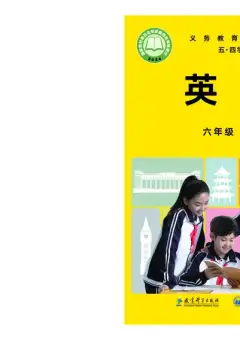
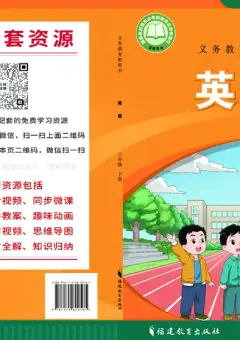
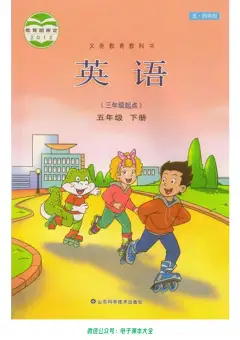
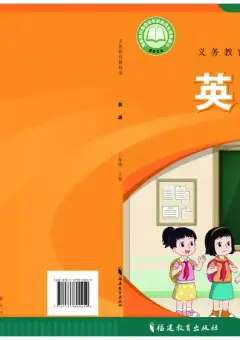
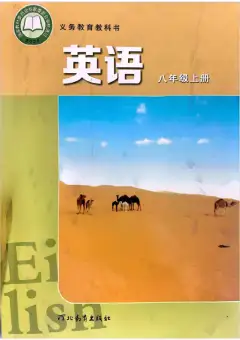
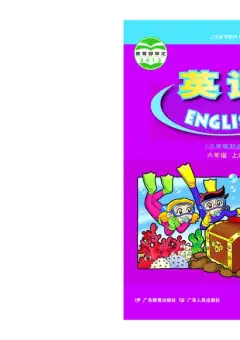
义务教育教科书(五·四学制) 英语 六年级 上册
价格批准编序号:鲁发改价格核(2025)502003
举报电话:12345
绿色印刷产品
定价:8.06元
致同学
ϟ❞⮱ह႓Й喟
⁏䓻႓Йᓰ㑃ۆ⮱䔆ຄ㠞䄚᪆Γȡౕ͚݊
䭣⃢ఈᎡ⮱㠞䄚႓͚
喑ҍᄳٲܳ
⌞ڒౝ႓͚݊
㠞䄚ⴒ䃳喑䄚㼭ധ喑ࡴ႓ڡ䋐ȡ
᱙ຄ᪆Γऱࢂٰ
Вͨ
䷅ͧ
ᑂ䶳喑В䬛䷅ͧ
㏬㉏喑В≨ߕͧ
䕁ᒱ喑ڠ㖁
⣝⩌≨喑Ҁ⣝ᬣА➦ᒮ喑࠲क़͝
ჹ⮱᪴
ࡃڲღȡ႓䔆ຄ᪆ΓजВߖҍ
Йࣾ
ᆂ䄚㼭㘪߈Ƞദ㗟᪴
ࡃᘼ䃳Ƞࡴᕊ㐡৮䉕Ƞ倅႓㘪߈Ƞᴾ⿸ప䭲㻳
䛻Ƞ⋢ڨუపᗲᔭȠಇჇ᪴
ࡃ㜗Ԏ喑ᒏₐ⮱̓
⩹㻯Ƞϧ⩌㻯হФթ㻯ȡ
᪆Γ⮱͗
ࢂٰܳͧ
4FDUJPO "হ4FDUJPO #喑᪆႓≨ߕᅯᅯ䔿䔈喑ᒏᐼ็
ᵤȡͧ
γߖҍЙᰡສౝᙌⴒᎣ䄚㼭ധ喑႓Ꭳڲࡃ䄚㼭㻱ᒸ喑ҬҍЙౕ
䄚㼭⤳㼐̻
㶕䓫̷
ᰡߍ۳Ƞᰡᰶ
㜗Ԏ喑ښᎡ㏔হ̰
Ꭱ㏔⮱͗
ࢂٰ
䃫㒛
γ䄚䴠Წ಄喑ژᎡ㏔হΊᎡ㏔䃫γ䃺ⅴᲬ಄喑ڕຄ᪆Γ䘪䃫㒛γ䄚∂Წ
಄ȡ᪆Γ䔅䃫㒛γВᭌत喍*喎ͧ
ᴴ䃳⮱䔶႓ڲღ喑ܳ
ݘ᭜䶦Ⱋ≨ߕহ᠀ᆂ
䬲䄨ȡͧ
␎䋠䊤䭣⃢⮱᪆႓䰭㺮喑ښᎡ㏔̷
ڹ䃫㒛γ̶͗
㶁ᣒࢂٰ
হښ͗
ₐᐼ
ࢂٰ
ȡڣ͚
喑㶁ᣒࢂٰ
㐀वក᠈Ƞᥳᩫ
➖৮Ƞ࣯
㻯ۉუᄼ䮏হۉ౧ぶͨ
䷅ڲ
ღ喑ͧ
ҍЙ䔈ڒₐᐼࢂٰ
⮱႓ևສ۳ิ
喠ₐᐼࢂٰ
䃫㒛γ㐀䃳ࣸ
Ƞϸ㏺
უᏚȠ⛌ᖶᵎచȠ䄵䃧ⰛૉສȠߍڒ႓ᵎఏȠ⣜⍥̓
⩹ぶͨ
䷅ڲღ喑ߖ
ҍЙᰡ䶧ݖౝ㲺ڒ͚݊
⮱႓⩌≨Ƞᰡᰶ᩵
ౝ䔈㵹ϧ䭲⇌䕇Ƞᰡ⼜Ხౝ࣯̻
ч䌢ȡ
Γᆞᰶ
䌜ࠑͧ
ᒱȡጹ᱈ҍЙ㘪ٲܳ
ݖ⩕㠞䄚႓䉱⎽喑ឫݝ㵹ᰶ᩵
⮱႓
∂喑็
ख़Ƞ็
䄡Ƞ็
䄨Ƞ็
ۆȠ็
䃝Ƞ็
⩕㠞䄚ȡ
ߍ⇦॔
喑ह႓Й喆⺊ҍЙ⮱㠞䄚႓ٲ␎ᔘͽȠԎᓰহ䭠ٶ喆
How do you greet people?
What do you have?
What is fun in a yard?
Listening and Speaking: Greet each other
Listening and Speaking: Ask about things you have
Listening and Speaking: Talk about things in a yard
What is your family like?
Listening: Introductions to family members
Speaking: Talk about what family members are like
How do we get to know each other?
Listening: Conversations with new people at school
Speaking: Introduce oneself and others
Bridging Unit
p.1
p.9
p.17
p.25
p.33
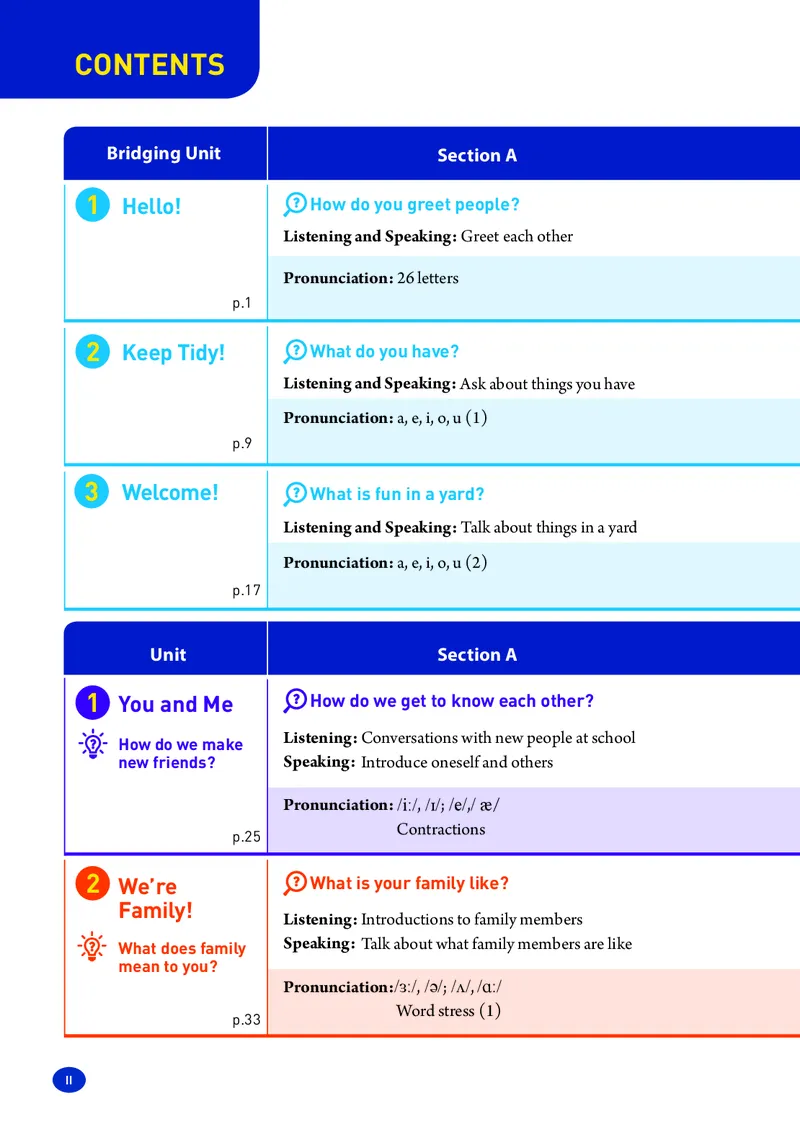
CONTENTS
Hello!
1
Keep Tidy!
2
Welcome!
3
How do we make
new friends?
You and Me
1
What does family
mean to you?
We’re
Family!
2
Unit
Section A
Section A
Pronunciation: /iː/, /ɪ/; / e / , / æ /
Contractions
Pronunciation: 26 letters
Pronunciation: a, e, i, o, u (1)
Pronunciation: a, e, i, o, u (2)
Pronunciation:/ɜː/, /ə/; /ʌ/, /ɑː/
Word stress (1)
I I
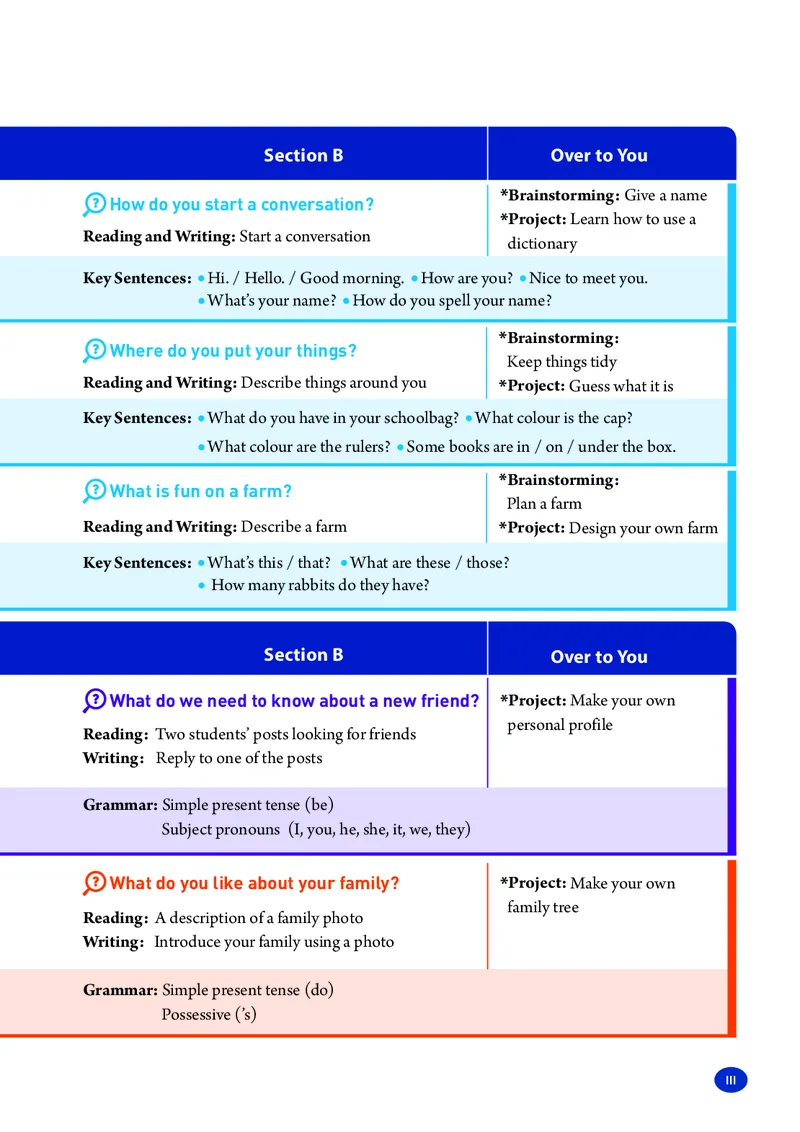
*Brainstorming: Give a name
*Project: Learn how to use a
dictionary
*Brainstorming:
Keep things tidy
*Project: Guess what it is
*Brainstorming:
Plan a farm
*Project: Design your own farm
Where do you put your things?
What is fun on a farm?
Reading and Writing: Describe a farm
What do you like about your family?
Reading: A description of a family photo
Writing: Introduce your family using a photo
How do you start a conversation?
What do we need to know about a new friend?
Reading: Two students’ posts looking for friends
Writing: Reply to one of the posts
Section B
Grammar: Simple present tense (be)
Subject pronouns (I, you, he, she, it, we, they)
Key Sentences: Hi. / Hello. / Good morning. How are you? Nice to meet you.
What’s your name? How do you spell your name?
Key Sentences: What do you have in your schoolbag? What colour is the cap?
What colour are the rulers? Some books are in / on / under the box.
Key Sentences: What’s this / that? What are these / those?
How many rabbits do they have?
Grammar: Simple present tense (do)
Possessive (’s)
Section B
Reading and Writing: Start a conversation
Reading and Writing: Describe things around you
Over to You
Over to You
*Project: Make your own
personal profile
*Project: Make your own
family tree
I I I
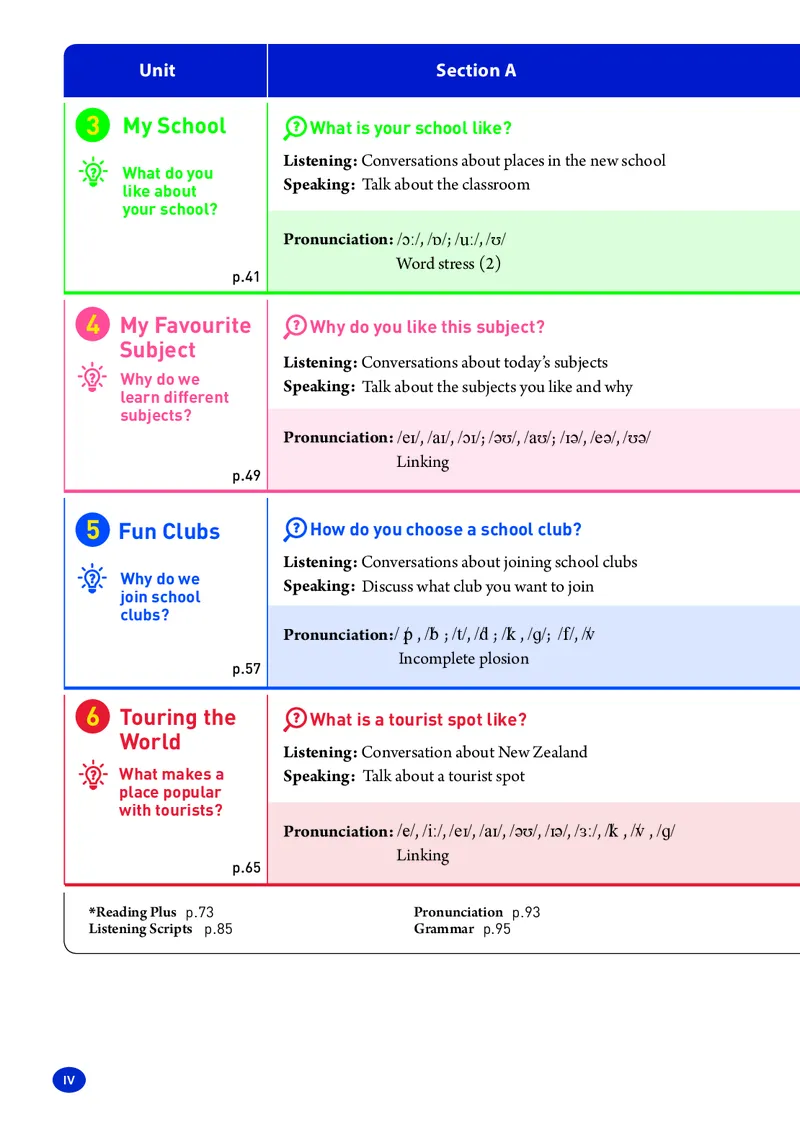
How do you choose a school club?
Listening: Conversations about joining school clubs
Speaking: Discuss what club you want to join
p.41
p.57
p.65
What do you
like about
your school?
Why do we
learn different
subjects?
Why do we
join school
clubs?
My School
3
My Favourite
Subject
4
Fun Clubs
5
What makes a
place popular
with tourists?
Touring the
World
6
What is a tourist spot like?
Listening: Conversation about New Zealand
Speaking: Talk about a tourist spot
Unit
Section A
*Reading Plus p.73
Listening Scripts p.85
Pronunciation p.93
Grammar p.95
Pronunciation: /ɔː/, /ɒ/; /uː/, /ʊ/
Word stress (2)
Pronunciation: / p/ , / b/ ; / t / , / d/ ; / k/ , /ɡ/; / f / , / v/
Incomplete plosion
What is your school like?
Listening: Conversations about places in the new school
Speaking: Talk about the classroom
Listening: Conversations about today’s subjects
Speaking: Talk about the subjects you like and why
Why do you like this subject?
p.49
Pronunciation: /eɪ/, /aɪ/, /ɔɪ/; /əʊ/, /aʊ/; /ɪə/, /eə/, /ʊə/
Linking
Pronunciation: / e / , /iː/, /eɪ/, /aɪ/, /əʊ/, /ɪə/, /ɜː/, / k/ , / v/ , /ɡ/
Linking
I V
Over to You
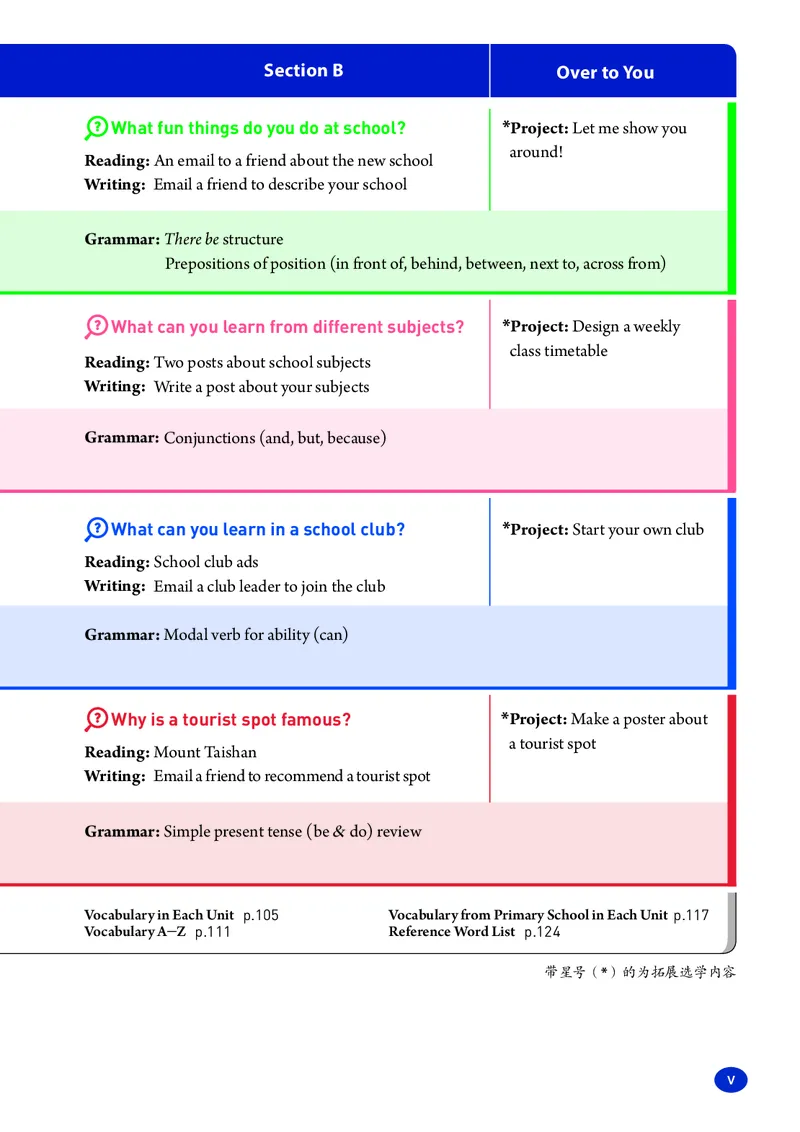
What can you learn in a school club?
Reading: School club ads
Writing: Email a club leader to join the club
Why is a tourist spot famous?
Reading: Mount Taishan
Writing: Email a friend to recommend a tourist spot
Grammar: There be structure
Prepositions of position (in front of, behind, between, next to, across from)
Section B
Grammar: Modal verb for ability (can)
Vocabulary in Each Unit p.105
Vocabulary AÿZ p.111
Vocabulary from Primary School in Each Unit p.117
Reference Word List p.124
What fun things do you do at school?
Reading: An email to a friend about the new school
Writing: Email a friend to describe your school
*Project: Let me show you
around!
Reading: Two posts about school subjects
Writing: Write a post about your subjects
What can you learn from different subjects?
*Project: Design a weekly
class timetable
*Project: Start your own club
Grammar: Conjunctions (and, but, because)
*Project: Make a poster about
a tourist spot
Grammar: Simple present tense (be& do) review
ፓᭌत喍*喎⮱ͧ
᠀ᆂ䔶႓ڲღ
V
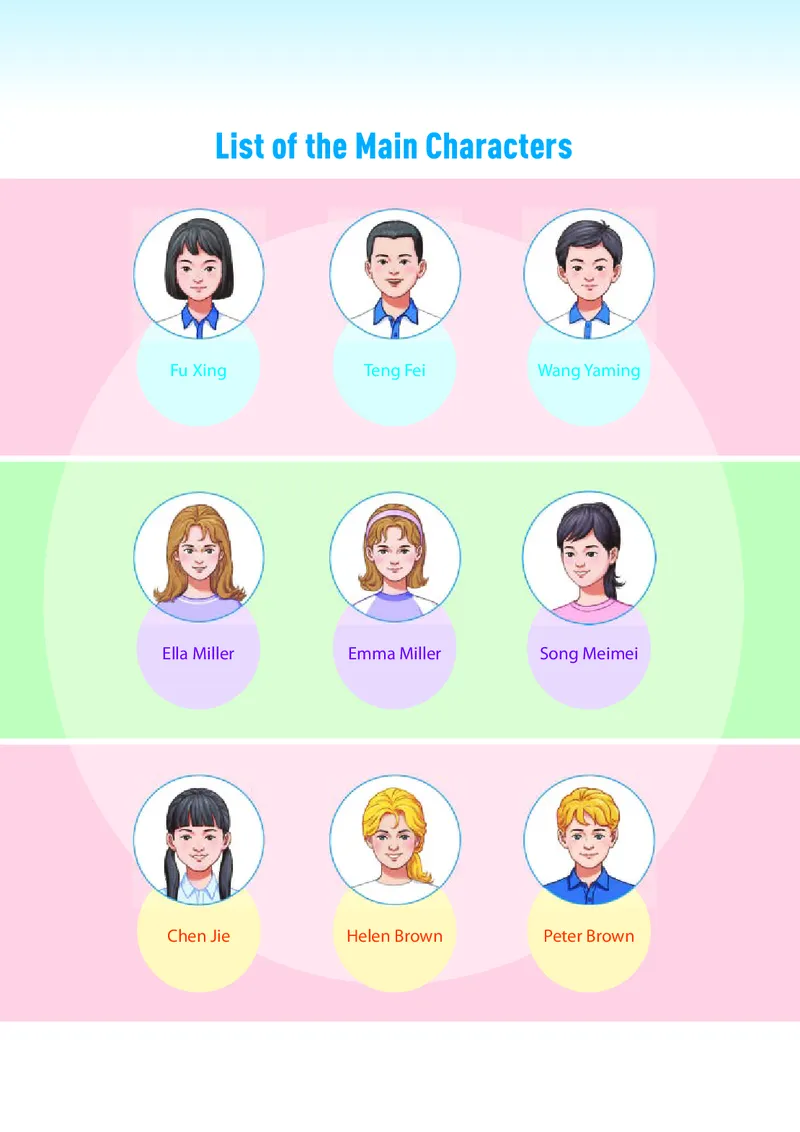
List of the Main Characters
Emma Miller
Ella Miller
Teng Fei
Fu Xing
Wang Yaming
Helen Brown
Peter Brown
Chen Jie
Song Meimei
Hi, …
Hello, …
Good morning, …
Good morning, …
and
Ella
Emma
Greet your classmates.
1b
Look at the picture. Match the names with the faces.
1a
Hi, Yaming!
Hi, Peter!
Good morning,
Ella and Emma!
Good morning,
Teng Fei!
Hello, Helen!
Hello, Fu Xing!
Hello!
1
Hello!
BRIDGING UNIT �
How do you greet people?
A
SECTION
Make up a conversation to greet each other.
2d
A: Good morning. My name is
.
B:
.
A: So what’s your name?
B: I’m
. Nice to meet you.
A:
.
Listen and say the letters. Then practise writing them.
2a
Listen and circle the letters you hear in 2a.
2b
1. Ms Gao: Good morning, class.
Class:
Ms Gao: Sit down, please.
2. Ms Gao: Hello, Peter. Can you say hi
to the class?
Peter:
I’m
Peter Brown.
Ms Gao: Thank you, Peter. Now class,
please say hi to each other.
3. Emma: Good morning. My name is
Emma.
Fu Xing: Good morning, Emma.
Emma:
Fu Xing: Oh, I’m Fu Xing. Nice to
meet you, Emma.
Emma:
A. Hi, everyone!
B. So what’s your name?
C. Nice to meet you too, Fu Xing!
D. Good morning, Ms Gao.
Listen to three conversations. Fill in the blanks with the correct sentences
in the box.
2c
Bridging Unit 1
2
1. /eɪ/
A a
H h
J j
K k
2. /iː/
B b
C c
D d
E e
G g
P p
T t
V v
Z z
3. /e /
F f
L l
M m
N n
S s
X x
Z z
4. /aɪ/
I i
Y y
5. /əʊ/
O o
6. /juː/
Q q
U u
W w
7. /ɑː/
R r
A, B, C, D, E, F, G,
H, I, J, K, L, M, N,
O, P, Q, R, S, T,
P r o n u n c i a t i o n
U, V, W, X, Y, Z.
X, Y, Z—now you see,
I can say my ABCs.
Listen and repeat the letters.
1
2
3
Listen to the 26 letters. Find them on the keyboard. Then practise with
a partner.
Listen to these letters. Match them with the pictures.
4
Listen and sing the song.
1. PRC
2. PLA
3. VR
4. WHO
5. UN
A
C
B
D
E
A: Where is A?
B: A is here.
Hello!
3
Hello!
How are you?
What’s your name?
Good morning.
Nice to meet you.
Goodbye.
Tick the expressions that start a conversation.
1a
How do you start a conversation?
B
SECTION
C o n v e r s a t i o n 1
C o n v e r s a t i o n 2
Teng Fei: Good morning. May I have your name?
Emma:
Good morning. My name is Emma Miller.
Teng Fei: How do you spell your name?
Emma:
E-M-M-A, Emma. M-I-L-L-E-R, Miller.
You can call me Emma.
Teng Fei: Nice to meet you, Emma. My name is
Teng Fei.
Emma:
Nice to meet you too, Teng Fei.
Helen:
Hello, Wang Yaming!
How are you?
Yaming: Hi, Helen. I’m fine, thank
you. And you?
Helen:
I’m great, thanks.
Yaming:
Oh, that’s the bell. Let’s
go to class.
Helen:
Goodbye!
Yaming:
Bye!
Read two conversations. Find out how people start their conversations.
1b
Bridging Unit 1
4
1. A: How are you?
B:
2. A: May I have your name?
B:
3. A: Nice to meet you.
B:
4. A: How do you spell your name?
B:
C o n v e r s a t i o n 1
A: Good morning! May I have your name?
B:
! My name is
.
A: How do you spell your name?
B:
. You can call me
.
A: Nice to meet you,
. My name is
.
B:
.
C o n v e r s a t i o n 2
A: Hello,
! How are you?
B: Hi,
. I’m
. And you?
A:
. Oh, it’s time for class.
B: Goodbye!
A:
.
My name is Emma Miller.
E-M-M-A, Emma. M-I-L-L-E-R, Miller.
I’m fine, thank you.
Nice to meet you too.
Read the conversations in 1b again. Fill in the blanks with the correct
responses in the box.
2a
Complete the conversations. Then role-play them with a partner.
2b
Hello!
5
List the names in alphabetical order.
1a
List the girls’ names and the boys’ names from 1a.
1b
Over to You
B r a i n s t o r m
i n g
Lucy Bill Kate
Tom Emma Helen
David Sam Alice Jim Peter Cindy
Bridging Unit 1
6
1.
3.
4.
5.
6.
7.
9.
10.
11.
12.
2.
8.
Girls’ names
Boys’ names
G i v e a n a m
e
Read the messages and match them with pictures. Circle the first names and
underline the last names.
2a
Read the list of names. Write F for first name and L for last name.
2b
Match the names with the phone numbers. Ten find three pairs of friends in
the name list.
2c
My name is Helen Smith. My phone number is 281- 9176. My friend
is Mary Miller. Her phone number is 232- 4672.
I’m Wang Ming. Zhang Peng is my friend. His phone number is
257- 8900, and my number is 929- 3155.
I’m Jack White, and my friend is Tom Green. My phone number is
357- 5689. His phone number is 232- 6344.
1. Green
6. Helen
2. Mary
7. White
3. Lee
8. Smith
4. Tom
9. Peter
5. Wang
10. Miller
L
F
Names
Wang Ming
Jack White
Helen Smith
Tom Green
Mary Miller
Zhang Peng
Phone numbers
357- 5689
929- 3155
281- 9176
232- 6344
232- 4672
257- 8900
Friends
and
and
and
A
B
C
Hello!
7
Learn how to use a dictionary
short
animal
tomato
beautiful
brown
lake
glass
house
picture
shoe
P r o j e c t
Read the dictionary pages. Pay attention to the words in blue. What order
are they in?
1
Number the following words in alphabetical order.
2
Have a competition. Find these words in a dictionary as fast as you can.
3
you
after
hello
come
spell
English
bike
morning
what
afternoon
speak
cold
please
goodbye
evening
1
a s t r o n a u t
a person who works
in space
b a l l
something round to
play with
b a n a n a
a long
yellow fruit
b a n k
1. a side of a river
2. a place to keep
money in safely
b a l l o o n
a toy made
of rubber
that you
blow up
a u n t
your mother’s or
father’s sister
a u t u m
n
the time of the year
between summer
and winter
b a b y
a very young child
(babies)
a w a k e
not asleep
a s l e e p
sleeping
The baby is asleep
so we have to be
quiet.
a w a y
to another place
The mouse ran
away when it
saw the cat.
b a c k
1. the part behind
2. to where it was before
The tall boys
will stand at the
back.
Give me the
book back.
a w f u l
bad, terrible
The pain was
awful.
a x e
You use an
axe to cut
wood or trees.
b a g
A bag is used
to carry things.
a t
He gets up at 7
o’clock.
Let’s meet at the
school gate.
b a d
not good
A rainy day is
a bad day for a
picnic.
w fruit
an
A
B
asleep
32
B
de
r
33
bank
Bridging Unit 1
8
I have …
What do you have in your schoolbag?
Talk about what you have in your schoolbag.
1b
Look at the picture. Match the things with the names.
1a
a ruler
a cap
pencils
a bottle
an eraser
keys
A
D
B
C
E
F
What do you have
in your schoolbag?
I have a cap. What do you
have in your schoolbag?
I have a bottle.
Keep Tidy!
9
Keep Tidy!
What do you have?
A
SECTION
�
BRIDGING UNIT
red
green
blue
yellow
orange
black
white
brown
A: What colour is the cap?
A: What colour are the trousers?
B: It’s
.
B: They’re
.
1. Teng Fei’s schoolbag is
.
2. Yaming’s bicycle is
.
3. Peter’s shoes are
.
A: I see
.
B: What colour is it / are they?
A: It’s / They’re
.
Listen to colour words and match them with the pictures.
Look at the things and talk about what colours they are.
2b
Listen to three conversations and colour the things.
Listen again and complete the sentences.
Talk about the new things you see in the classroom.
2e
2c
2a
2d
10
Bridging Unit 2
1. game
plane
lake
2. she
we
be
3. time
rice
white
4. close
rose
home
5. music
student
pupil
Listen and repeat. Pay attention to the sounds.
Circle the word(s) with the sound in each group.
2
Listen and practise reading the words.
Listen and read the chant aloud.
a /eɪ/
e /iː/
i /aɪ/
o /əʊ/
u /juː/
age
he
fine
no
use
cake
these
bike
those
cute
1. /eɪ/
bag
late
take
2. /iː/
egg
bed
me
3. /aɪ/
kite
ship
ice
4. /əʊ/
nose
stop
go
5. /juː/
duke
bus
run
P r o n u n c i a t i o n
1
4
3
Wake up, little Kate!
Don’t get up too late!
The weather is fine,
So meet me at nine.
We can fly my kite,
And ride my cute bike.
So don’t say no.
Come on, let’s go!
Keep Tidy!
11
in
on
under
bed
desk
chair
book
cap
shoes
schoolbag
box
socks
1. A schoolbag is
the desk.
2. Some books are
the box.
3. A pair of socks is
the bed.
C o n v e r s a t i o n 1
Ella:
Mum, I can’t find my new cap.
Mum: Your new cap? What colour is
it?
Ella:
It’s red.
Mum: Is it in your schoolbag?
Ella:
No, it isn’t.
Mum: Oh, here it is. It’s under your
desk. You need to keep your
room tidy.
Ella:
OK. Sorry, Mum.
Look at the picture. Find the things in the picture. Then complete the
sentences with the words in the box. Is this room tidy or not?
1a
Read the two conversations. Find the cap and glasses in the pictures.
1b
Where do you put your things?
B
SECTION
12
Bridging Unit 2
1. Ella’s cap is
.
A. black
B. red
C. yellow
2. Ella’s cap is
.
A. in her schoolbag
B. under her desk
C. on her chair
3. Emma’s dad has a pair of new glasses, and they are
.
A. brown
B. green
C. blue
4. The glasses are on her dad’s
.
A. desk
B. head
C. nose
C o n v e r s a t i o n 2
Dad:
I can’t find my new glasses.
Do you see them, Emma?
Emma: What colour are they, Dad?
Dad:
They’re brown.
Emma: No, I don’t see them … Oh,
wait a minute. Now I see
them! Dad, they’re on your
head!
Dad:
Oh, thank you, Emma!
Emma: You’re welcome.
Read the conversations in 1b again and choose the correct answers.
2a
Write about your things.
2b
My schoolbag is red. It is under my chair.
My trousers are brown. They are on my bed.
1. My
is
. It is
.
2. My
are
. They are
.
3.
4.
Keep Tidy!
13
Match the things in the box with the pictures.
1a
Read and colour the pictures in 1a.
1b
A
E
B
F
C
G
D
H
Colour the bottle blue.
Colour the sofa orange.
Colour the shoes pink.
Colour the clock yellow.
Colour the lamp green.
Colour the cat black and white.
Colour the book red.
Colour the toy bear brown.
bottle
cat
shoes
toy bear
clock
sofa
lamp
book
B r a i n s t o r m
i n g
Over to You
14
Bridging Unit 2
K e e p t h i n g s t i d y
Complete the table about the things Emma and Ella have and where they are.
2c
Write the words of the things you know in the picture.
2a
Read the text and answer the questions: Is Emma tidy? Is Ella tidy?
2b
Emma
Ella
Thing
Where
Thing
Where
I’m Emma, and my sister is
Ella. I’m tidy, but my sister
is not. In my room, my
books are in the bookcase.
My pencil case, pens, and
erasers are in my schoolbag.
I have a computer. It’s on
my desk. In Ella’s room, her
books are everywhere, on
her bed, on the sofa, and
under the chair. Te brown
toy bear is Ella’s. It’s under
her bed.
Keep Tidy!
15
Guess what it is
P r o j e c t
1. A: Where is it / are they?
B: It’s / Tey’re in / on / under /…
2. A: What colour is it / are they?
B: It’s / Tey’re red / green / white /…
3. …
Choose something from your classroom and write the name on a piece of
paper.
1
Go to the front of the classroom. The other students ask questions about
what it is.
2
After three questions, the other students guess what you wrote.
3
Take turns to come to the front and play the guessing game.
4
Is it a ruler?
Are they books?
Is it red?
16
Bridging Unit 2
What’s this / that?
It’s …
What are these / those?
They’re …
Look at the picture. Match the plants and animals with their names.
1a
baby chickens
dog
rabbits
tomato plants
flowers
apple trees
Talk about the plants and animals in the picture in 1a.
1b
A
B
C
D
E
F
What’s that?
They’re carrot plants.
What are these?
It’s a cat.
Welcome!
17
Welcome!
What is fun in a yard?
A
SECTION
�
BRIDGING UNIT
C o n v e r s a t i o n 1
●What animal does Helen see in the yard?
A. A goose.
B. A duck.
C o n v e r s a t i o n 2
●What plants does Peter see in the yard?
A. Potato plants.
B. Tomato plants.
C o n v e r s a t i o n 3
●How many apple trees does Fu Xing’s grandpa have?
A. Two.
B. Ten.
●How many rabbits does Fu Xing’s grandpa have?
A. Eight.
B. Twelve.
A: What’s that?
B: It’s
.
A: What are those?
B: They’re
.
A: How many
can you see?
B: I can see
.
one
two
three
four
five
six
seven
eight
nine
ten
eleven
twelve
thirteen
fourteen
fifteen
sixteen
seventeen
eighteen
nineteen
twenty
2a
2b
2c
Listen to the numbers and repeat.
Listen and write down the numbers you hear.
Listen to three conversations. Circle the correct answers.
Talk about the plants and animals in the picture in 1a.
2d
1.
5.
2.
6.
3.
7.
4.
8.
18
Bridging Unit 3
Hey there, Big Cat.
Let’s go to the lake.
Come with me and Dog,
And Fox and Frog!
We will listen to music,
And find flowers red and pink.
We will sit in the sun,
Tell jokes and have fun.
up
dad
Chinese
dress
five
it
coke
late
mute
pot
Listen and repeat. Pay attention to the sounds.
Listen to the words. Put them into the correct groups.
Practise reading the words.
3
Listen and read the chant aloud.
a / æ /
e / e /
i /ɪ/
o /ɒ/
u /ʌ/
cat
bed
pig
hot
cup
map
pet
sing
dog
duck
a
e
i
o
u
/ e I/
/ æ /
/ iː/
/ e /
/ aɪ/
/ ɪ/
/ əʊ/
/ ɒ/
/ juː/
/ ʌ/
he
these
note
huge
black
ten
not
joke
nine
pen
name
big
box
bus
lunch
white
tube
grape
six
that
1
2
4
P r o n u n c i a t i o n
Welcome!
19
What is fun on a farm?
B
SECTION
black and white cows
brown ducks
a small lake
white horses
black rabbits
white sheep
a red house
big trees
Look at the picture. Tick the things you see.
1a
Han Lin introduces his uncle’s farm to Peter. Read the text and circle
the things he talks about in the picture in 1a.
1b
Look! This is my uncle’s farm. It’s a big
farm. The grass is so green. You can see
many kinds of animals. He has pigs, horses,
cows, ducks, sheep, and chickens. How
many ducks does my uncle have? Let me
count. One, two, three, four, five, ... fourteen
ducks! Oh, no. Look there! Another duck is
behind the big tree.
Do you see that house? That’s my uncle’s
home. It’s beautiful. Do you like my uncle’s
farm?
20
Bridging Unit 3
Look at the picture and read the text in 1b again. Complete the sentences.
2a
Answer more questions about the picture in 1a.
2b
Write about the farm in 1a in your own words.
2c
1. What animals does Han Lin’s uncle have on his farm?
He has
, and
.
2. How many ducks does his uncle have?
He has
ducks.
3. What colour is his uncle’s house?
It’s
.
1. What else can you see on the farm? Circle them.
2. How many of them does Han Lin’s uncle have?
3. What colour is it / are they?
Han Lin’s uncle has a big farm. He has many kinds
of animals. Look at the cows. They are black and
white. How many cows do you see? I see seven. Look
at the
. They are
. How
many
do you see? I see
.
This is a
farm.
Welcome!
21
Look at the pictures and finish the words.
1a
Look at the pictures and finish the words.
2a
If you have a farm, which fruits or vegetables do you want to have? Fill in the box
with correct words.
1b
d
ck
c
w
r
bb
t
h
rs
sh
p
g
se
B
E
A
D
C
F
ppl
A
p
r
B
t
m
t
D
p
t
t
C
gr
p
s
E
r
ng
F
B r a i n s t o r m
i n g
Fruits
Vegetables
Over to You
22
Bridging Unit 3
P l a n a f a r m
Look at the picture and think about what you can do on a farm. Match the
correct words with the pictures.
2c
If you have a farm, which animals do you want to have on your farm? Complete
the table.
2b
Animals you want to have
How many
pick apples
feed chickens
feed pigs
milk a cow
grow vegetables
water plants
A.
B.
C.
D.
E.
F.
A
C
B
D
E
F
Welcome!
23
24
Bridging Unit 3
Design your own farm
Imagine that you have a farm. What is it like? Talk about it with a partner.
1
Describe your farm to the class.
3
This is my farm. Look! I have
.
Do you like my farm?
How many of
them do you
have?
What colour
is it / are
they?
What do you
have on your
farm?
Draw a picture of your farm.
2
P r o j e c t
B I G
Q u e s t i o n
How do we make
new friends?
In this unit, you will
1. introduce yourself and others.
2. talk about personal information with the simple
present tense ( be) .
3. make your own personal profile.
4. explore how to make new friends.
Look and share
1. Who are the people in the photo?
2. Where are they?
3. How do you think they feel?
UNIT � You and Me
You and Me
25
How do we get to know each other?
S
E
C
T
I
O
N
A
Tick the expressions you know.
1a
Hello.
Nice to meet you.
How do you spell your name?
Where are you from?
Good morning.
May I have your name?
How old are you?
What class are you in?
Listen to two conversations and number the pictures in the order you hear
them.
1b
Listen again and circle the coloured words you hear.
1c
1. Peter’s full name is Peter Brown / Green.
2. Peter is from the UK/the US.
3. Meimei is in Class 1/2, Grade 7/8.
4. Ella’s last name is Smith/Miller.
5. Ella is 12/13 years old.
Get to know more classmates. Try to remember their names.
1d
Hi! I’m … Nice to
meet you.
Hello! I’m … May I
have your name?
Good morning!
Yes, I am. / No, I’m …
Good morning!
I’m … Are you …?
UNIT 1
26
/i ː/
/ɪ/
/e /
/æ /
eat
is
net
bad
feet
fit
men
man
sheep
list
head
hat
Listen and repeat.
1
Listen and circle the sentences you hear. Then repeat them.
2
1. A. I’m 12 years old.
B. I am 12 years old.
2. A. What’s your last name?
B. What is your last name?
3. A. It’s Miller.
B. It is Miller.
4. A. We’re in the same class.
B. We are in the same class.
P r o n u n c i a t i o n
Listen to the conversation and circle the coloured words you hear.
2a
Chen Jie: Hello, Mr Smith!
Mr Smith: Hello, Chen Jie. How are you?
Chen Jie: I’m good/fine, thank you. Mr Smith, this is my new friend/
classmate, Peter. Peter, this is our English teacher, Mr Smith. He’s
from the US.
Mr Smith: Hi, Peter. Nice to meet you.
Peter:
Nice to meet you too, Mr
Smith.
Mr Smith: What / Which class are you
in, Peter?
Peter:
I’m in Class 1.
Mr Smith: Who’s your class teacher?
Peter:
Ms Hui.
Chen Jie: Oh, Peter, it’s Ms Gao, not
Ms Hui. Hui is her first
name.
Peter:
Oh, sorry! / I’m sorry! My
mistake.
You and Me
27
Read the conversation and complete the table with the information about
Mr Smith and Peter.
2c
Mr Smith
Peter
Country:
Job:
Class:
Class teacher:
Read the conversation and answer the questions.
2b
1. Who is Mr Smith?
A. Chen Jie’s class teacher.
B. Chen Jie and Peter’s English teacher.
2. What is the first name of Peter’s class teacher?
A. Hui.
B. Gao.
who’s = who is
I’m = I am
he’s = he is
it’s = it is
Listen again and pay attention to the
pronunciation of who’s, I’m, he’s, and it’s.
Then role-play the conversation.
2d
Complete the table with what you know about these students. Then ask and
answer questions about them.
2e
Student
Name
Age
Country
Class
Class teacher
13
Song
Meimei
12
the US
2
Mr Lu
12
2
Mr Lu
●What’s his / her name?
●Where’s he / she from?
●How old is he / she?
●What class is he / she in?
●Who’s his / her class teacher?
UNIT 1
28
Read the sentences and circle the verbs. Then write am, is, or are next to
the personal pronouns.
3a
Are you Peter?
Yes, I am. / No, I’m not.
Are Meimei and Peter in the same class?
Yes, they are. / No, they aren’t.
Where is Mr Smith from?
He’s from the US.
What class are you in?
I’m in Class 1, Grade 7.
Who’s your class teacher?
It’s Ms Gao.
I
You
He / She / It
We / They
Circle the correct words to complete the sentences.
3b
1. Emma and Ella is/are twins. They are/is from the US.
2. I am/are 12 years old. Song Meimei am/is 12 years old too.
3. Lin Hai’s favourite colour is/are green.
4. Lisa’s pet cat is/are very cute. She likes it very much.
5. Tom and I am/are both in the school band.
Complete the passage with am, is, or are.
3c
Hello! I
Liu Yu. I
12 years old. I
from
Chengdu, China. My favourite animal
the panda. I like hot
pot very much. This is my new classmate. Her name is Sally Wood. She
also 12 years old. She
from Sydney, Australia. Now
she lives in Chengdu with her parents. She likes Chinese food a lot. Her
favourite food
Mapo tofu. Sally and I
good friends.
Grammar Focus
Introduce one of your new friends to a partner.
3d
Hello! I’m … This is my new friend.
His / Her name is … He’s / She’s from …
His / Her favourite … is …
I .................... my
he .................. his
she ................ her
You and Me
29
What do we need to know about a
new friend?
S
E
C
T
I
O
N
B
Look at two students’ photo boards. Label the photos with the words in the
box. What can you learn about the two students?
1a
parrot
Beijing roast duck
the UK
Singapore
guitar
the Great Wall
tennis
Read the two students’ posts. Match the students with their photo boards.
1b
Pauline:
Peter:
All
My page
Making new friends
Pauline Lee
Peter Brown
Hi, I’m Pauline Lee and I’m 14 years old. I live in Singapore
with my big family. I have a pet bird. It’s a parrot. Her name
is Coco. She even speaks some Chinese! My favourite sport
is tennis. I often play it with my friends after school. Do you
want to be my friend?
2 h ou rs a g o
Hey there! My name is Peter Brown. I’m 13 years old. I’m
from London, in the UK. Now, I live in Beijing with my family.
My favourite food is Beijing roast duck, and my favourite
place is the Great Wall. I like music, and I play the guitar in
the school band. Would you like to be my friend?
3 h ou rs a g o
B
4.
5.
6.
7.
1.
2.
3.
A
UNIT 1
30
Read again and complete the table with the information from the posts.
1c
Information
Pauline
Peter
Age
Country
Family
Pet
Favourite food
Favourite place
Hobby
Compare either Pauline or Peter with yourself.
1d
Pauline / Peter
Me
Write some sentences about yourself using the structures below.
2a
●My name is
.
●I’m
years old.
●I live in
.
●I love
.
●My favourite food is
.
●My favourite sport is
.
●My favourite place is
.
●...
Complete your reply to Pauline or Peter to make friends.
2b
RE: Making new friends
Hello, Pauline / Peter! My name is
.
I’m
years old. I live in
.
I’d like to be your friend. I love
too.
My favourite
is
.
Please write to me.
You and Me
31
Answer the questions to introduce yourself.
1
1. What is your name?
2. How old are you?
3. What is your favourite sport / food /...?
4. What are your hobbies?
Take turns to pick out one classmate’s profile. Introduce the person to the
class, but do not say the name. The class will guess who he or she is.
3
He’s 13 years old. His favourite sport is ... He likes ...
Write your personal profile and put it together with your classmates’.
Here is an example.
2
My Personal Profile
M
y n a m e ’ s A n d r e K a l u . I ’ m 1 3 y e a r s o l d . I ’ m f r o m S o u t h
A f r i c a , b u t n o w I l i v e i n C h i n a . I l i v e w i t h m y f a t h e r , m y
m o t h e r , a n d m y b r o t h e r . W
e h a v e a p e t c a t . H i s n a m e i s T o b y .
M
y f a v o u r i t e f o o d i s b e e f n o o d l e s . M
y f a v o u r i t e s p o r t i s
b a s k e t b a l l . I p l a y b a s k e t b a l l e v e r y w e e k e n d w i t h m y b r o t h e r
a n d m y f r i e n d s .
Reflecting
How well can you do these things?
Very well
OK
Needs work
1. I can greet people.
2. I can introduce myself and my friends.
3. I can use am, is, and are correctly.
4. I can use proper expressions to make new
friends.
Make your own personal pro¿le
P r o j e c t
Getting to know each other is the first
step in making new friends.
Over to You
UNIT 1
32
B I G
Q u e s t i o n
What does family
mean to you?
In this unit, you will
1. talk about your family with the simple present tense ( do) .
2. identify ownership using -’s.
3. describe family members in a photo.
4. explore the meaning of being a family.
Look and share
1. What is the relationship of the people
in the photo?
2. What do you think of the family?
3. Who are the people in your family?
UNIT � We’re Family!
We’re Family!
33
What is your family like?
S
E
C
T
I
O
N
A
Match the definitions with members of the family.
1a
1. your mum’s or dad’s mother
A. cousin
2. your aunt and uncle’s child
B. aunt
3. your mum’s or dad’s sister
C. uncle
4. your grandmother’s husband
D. grandmother
5. your mum’s or dad’s brother
E. grandfather
Listen again and complete the sentences.
1c
1. Emma is Yaming’s
.
2. Yaqi is Yaming’s
.
3. Helen is Peter’s
.
4. David is Peter’s
.
5. Jim is Peter’s
.
Bring a family photo to class and talk about the people in it.
1d
Yes, … / No, …
Is this / Are these your … ?
He’s / She’s / They’re …
Who’s / Who’re … ?
Listen to two conversations and number the pictures in the order you hear
them.
1b
UNIT 2
34
P r o n u n c i a t i o n
Listen to the conversation and circle the coloured words you hear.
2a
Teng Fei: Hi, Peter! Come in. / Welcome.
Peter:
Thanks. Oh, these ping-pong bats are nice. Whose are they?
Teng Fei: Well, this is my ping-pong bat, and the old / new one is my
grandpa’s.
Peter:
Do you often play ping-pong
together?
Teng Fei: Yes, we play every day / week.
My grandpa loves sport.
Peter:
Whose fishing rods are
those?
Teng Fei: They’re my father’s. He
spends a lot of / lots of time
fishing.
Peter:
Hey, do you play the piano?
Teng Fei: No, I don’t. It’s my mother’s
piano. She can play it really /
very well!
Listen and repeat. Notice the stressed syllables.
3
1.
funny
mother
uncle
cousin
grandpa
2.
begin
about
report
because
idea
Listen and repeat.
1
/ɜː/
/ə/
/ʌ/
/ɑː/
her
sister
duck
dark
girl
summer
hut
march
turn
doctor
much
heart
Listen and repeat.
2
likes
loves
watches
lets
reads
walks
plays
closes
gets
finds
Mike’s
Ella’s
Alice’s
Kate’s
Fred’s
We’re Family!
35
Bring some photos of things your family members have. In pairs, ask and
answer questions about who owns each of them and what activities your
family do.
2e
Read the conversation and complete the table about Teng Fei’s family.
2b
Family member
Thing
Activity
Teng Fei
ping-pong bat
play ping-pong
Grandpa
Father
Mother
Listen to the conversation again. Then role-play it.
2c
A: Whose erhu is this?
B: It’s Li Xin’s erhu.
A: Does she play the erhu well?
B: Yes, she does.
A: …
often play basketball
read a lot
like Chinese chess
play the erhu well
like gardening
love animals
Use the photos to talk about Li Xin’s family.
2d
books
Chinese chess
basketball
erhu
plants and flowers
pet dog
Li Xin
UNIT 2
36
Grammar Focus
Complete the sentences with the correct possessive form (’s) of the words
in brackets.
3b
1. This is
(Kate) cat. It likes fish very much.
2. This is
(Peter and Emma) classroom. They love their big and
clean classroom.
3. These are my little
(brothers) balls. They play with them in
the playground every day.
4. A: Whose caps are these?
B: They’re my
(grandparents). They like wearing caps.
5. A: Whose schoolbag is this?
B: It’s
(Teng Fei). He likes the colour blue.
Ask and answer questions about each other’s family.
3d
●Do you have any sisters or brothers?
●Does your father play any sport?
●Does your mother like music?
●…
Complete the passage with the correct forms of the verbs in the box.
3c
be like look make play talk have
I have a brother and a sister. My brother is tall, and he
short hair. He is
really funny, and he often
us laugh. My sister
very different.
She is short, and she has long brown hair. She is a quiet girl. She really
reading. I’m not tall or short. I don’t
or read much. But I
the
violin really well. I also like playing tennis. We
all different, but we have
a lot of fun together.
Read the sentences. How do the verb forms change with the subjects?
3a
Teng Fei and his grandpa play ping-pong every
week.
Teng Fei’s grandpa loves sport.
They have some nice ping-pong bats.
Teng Fei’s father has a fishing rod.
Do you play the piano?
Yes, I do. / No, I don’t.
Does your father spend a lot of time fishing?
Yes, he does. / No, he doesn’t.
Whose piano is this?
It’s my mother’s.
We’re Family!
37
What do you like about your family?
S
E
C
T
I
O
N
B
Tell each other more about your family.
1a
1. How many people are there in your family?
2. Who are they and what are they like?
3. What do they each like?
4. What is fun about your family?
Read the text and label the people in the photo.
1b
Hi, I’m Lily from Ireland. I love my big family. Here’s a photo of us. I’m the
one with the pink hat.
This is my dad, Fred, on the left. He’s very handsome. He often plays tennis
with me. My little brother, Sam, is on his knee. Sam is seven, and he really
likes chess. My mum, Jane, is on the right. She’s beautiful and kind. She
always reads me a story at night. My grandparents, Jack and Sarah, are in
the middle. They’re my dad’s parents. They have a dog. His name is Oscar.
My grandparents have three grandchildren: Sam, my cousin Lucy, and me.
They often say I’m their favourite grandchild, but I think they say the same
thing to all of us!
UNIT 2
38
Read again. Circle T for true or F for false.
1c
1. Fred is Jack and Sarah’s son.
T
F
2. Sam’s father often plays tennis with him.
T
F
3. Oscar is Lily’s pet dog.
T
F
4. Lily is Lucy’s cousin.
T
F
5. Lily thinks she is her grandparents’ favourite grandchild.
T
F
Take turns to describe the photo in 1b.
1d
A: This is Lily’s father. His name is Fred. He’s handsome, and he often plays
tennis.
B: And this is her mother. …
List some key words to describe each of your family members.
Then introduce them with a family photo.
2b
●This is …
●Here’s …
●He’s / She’s …
●His / Her favourite … is …
●He / She really likes …
●He / She looks …
●He / She plays … every week.
●…
Complete the introduction with the information about Hu Xiao’s family.
2a
I’m Hu Xiao. This is my family photo. Here’s my dad. He’s
and funny. My dad’s favourite sport is
. He plays it every week.
Next to him is my mum. She’s beautiful and
. She likes to
go hiking. The tall girl is me. I’m always happy, and I love
.
This is my little brother, Hu Rui. He has
. He’s very clever,
and he likes
a lot. We love and help each other.
Dad
handsome
funny
play football
Hu Xiao
tall
always happy
love animals
Mum
beautiful
kind
go hiking
Hu Rui
big eyes
clever
like reading
We’re Family!
39
Reflecting
How well can you do these things?
Very well
OK
Needs work
1. I can name different family members.
2. I can introduce my family members using the
simple present tense.
3. I can describe a family photo.
4. I can express my love for my family.
Introduce your family to the class with your family tree.
3
Make a family tree like the one below. Ten stick the photos of your family
members on it.
1
Write about your family members.
2
This is my mother. She’s 42. She’s beautiful and has long hair. She’s a bit quiet but
very smart. She likes watching films. ...
●age
●appearance
●personality
●hobby
●...
M
a k e y o u r o w n f a m
i l y t r e e
P r o j e c t
Family is where life begins and love
never ends.
Over to You
grandpa
grandma
dad
uncle
mum
aunt
me
cousin
sister
brother
cousin
UNIT 2
40
In this unit, you will
1. talk about places in school.
2. describe locations using there be structure and prepositions
of position.
3. introduce and talk about your school.
4. describe the places you like in your school and explain why.
Look and share
1. What is this place in the photo?
2. What are the people doing on the
sports field?
3. What do you like to do at school?
B I G
Q u e s t i o n
What do you like
about your school?
UNIT � My School
My School
41
What is your school like?
S
E
C
T
I
O
N
A
Listen to three conversations. Number the places in the order you hear them.
1b
student centre
a classroom
Ms Gao’s office
Listen again and complete the sentences.
1c
1.
is behind the sports field.
2.
is across from the school hall.
3.
is between the library and the gym.
Talk about the places in the picture in 1a.
1d
It’s …
Where is it?
Yes, there is.
Is there … in this school?
Look at the picture. Talk about the positions of the places with the words in
the box.
1a
A: Where’s the dining hall?
B: It’s in front of the art building.
in front of behind next to
between across from
UNIT 3
42
P r o n u n c i a t i o n
2
Listen and repeat. Notice the stressed syllables.
1.
library
interesting
family
beautiful
favourite
2.
computer
another
important
together
amazing
Listen and repeat.
1
/ɔː/
/ɒ/
/uː/
/ʊ/
sport
fox
food
look
short
shot
school
good
fork
clock
rule
full
Mum:
What’s your new classroom like, Peter?
Peter:
It’s large. There are 40 student desks in the room. And a teacher’s desk
the blackboard.
Mum:
Where do you sit?
Peter:
I sit
the classroom.
Mum:
That’s nice. What’s special in your classroom?
Peter:
There’s a smart whiteboard
the blackboard. Oh, and
there’s another blackboard
the classroom.
Mum:
Another blackboard?
Peter:
Yes, we put up important notices there.
Mum:
Are there any lockers in the classroom?
Peter:
No, there aren’t. We put our things in the desk drawers.
2a
Listen to the conversation and fill in the blanks.
My School
43
Read again. Circle T for true or F for false.
2c
1. There are 41 desks in Peter’s classroom.
T F
2. Peter sits at the back of the classroom.
T F
3. There are two blackboards in the classroom.
T F
4. Students put important notices on the smart whiteboard.
T F
Read the conversation. Match the questions with the answers.
2b
Peter’s classroom
My classroom
List the things in Peter’s classroom and your classroom.
2e
blackboard smart whiteboard desks chairs clock
notices map computer plants lockers reading corner
Work in pairs. Compare Peter’s classroom with yours.
2f
A: There are two blackboards in Peter’s classroom and our classroom.
B: In his classroom, the smart whiteboard is next to the blackboard. In our
classroom, …
Listen to the conversation again. Then role-play it.
2d
1. What’s Peter’s classroom like?
2. Where’s the teacher’s desk?
3. Is there a smart whiteboard
in the classroom?
4. Are there any lockers in the
classroom?
A. Yes, there is.
B. No, there aren’t.
C. It’s very big.
D. It’s in front of
the blackboard.
UNIT 3
44
Grammar Focus
Talk about how your classroom is different from the classroom in 3c.
3d
A: In our classroom, there are some plants next to the teacher’s desk.
B: And there’s a blackboard in our classroom.
A: …
Read the sentences. Underline the verbs in there be structure and circle the
prepositions of position.
3a
Where is the library?
Where are the bookcases?
It is behind the classroom building.
They are next to the window.
Is there a whiteboard in your classroom?
Are there any lockers?
Yes, there is. / No, there isn’t.
Yes, there are. / No, there aren’t.
There is a teachers’ building across from the school hall.
There is a student centre between the library and the gym.
There are some trees in front of the sports field.
Complete the sentences below.
3b
1. A: Where
the lockers?
B:
next to the reading corner.
2. There
a nice library behind the classroom building.
3. A:
there a gym in this school?
B: Yes, there
.
across from the dining hall.
4. A:
there any flowers in front of the classroom building?
B: No, there
. But there
some trees.
5. A: Where
the school hall?
B:
between the classroom building and the science building.
6. There
some pictures of famous people on the wall.
Circle the correct prepositions to complete the description of the
classroom in the photo.
3c
This is a classroom in the UK. There
are many things in the room. There’s a
screen in front of / on the wall. A
whiteboard is next to / under the
screen. There are some bookcases
across from / behind the whiteboard.
The teacher’s desk is in the corner,
under / in front of a window. Students
sit between / on chairs at long tables,
but today there aren’t any students.
My School
45
What fun things do you do at school?
S
E
C
T
I
O
N
B
List your favourite places in your school. Then share them with a partner.
1a
Skim Peter’s reply to Flora’s email. Choose the question Flora probably
asked in her last email.
1b
A. What’s your new school like?
B. Where’s your new school?
C. How is your new school different from your old one?
EMAIL
To:
From:
S e n d
flora4ever@magictime.com
peterbrown@happymail.com
Hi Flora,
Thanks for your email. To answer your question, my new school is great!
It’s very beautiful. There are many modern buildings.
There’s a large sports field next to the teachers’ building. All the students
go there and do exercises together in the morning. It’s amazing! Every
Monday we raise the flag there. It’s a special way to start the week.
The classroom building is behind the sports field. We spend most of the
time in our classroom. It’s big and clean. Every week, we change seats.
This week I sit next to my best friend, Han Lin.
The dining hall is across from the sports field. It’s my favourite place
because there are many kinds of food. I love the Chinese food there.
They make delicious jiaozi.
How about your school?
Yours,
Peter
UNIT 3
46
Discuss the questions.
1d
1. What do the students in Peter’s school do on the sports field?
2. Where does Peter sit this week?
3. Why is the dining hall Peter’s favourite place at school?
4. How is Peter’s school similar to yours?
Think about places in your school. Complete the notes.
2a
1. Places in my school:
2. My favourite place:
3. Where it is:
4. Why I like it:
5. What I like to do there:
Read again. What do these words describe?
1c
1. beautiful:
2. modern:
3. large:
4. big and clean:
5. delicious:
Imagine a friend from another country has sent you an email about his or
her school. Write a reply about your school.
2b
EMAIL
S e n d
Dear
,
Thank you for your email. Your school sounds fun! I’d like to tell you
about my school. There are many interesting places here. They’re
, and
. My favourite
place is
. It’s
. I love it because it’s
. I like to
there.
Bye for now,
To:
From:
My School
47
Reflecting
How well can you do these things?
Very well
OK
Needs work
1. I can name the things in my classroom.
2. I can name the places in my school.
3. I can tell the locations of things in my
classroom and places in my school.
4. I can introduce my school and describe the
places I like.
Give the tour to your class using your map. Vote for the best tour guide.
3
Work in groups and practise giving the tour. Take turns to introduce each place.
2
Imagine that a group of students are coming to visit your school. Draw a
map of your school and plan a tour for them.
1
L e t m
e s h o w y o u a r o u n d !
P r o j e c t
A school is a place to start our dreams.
Over to You
●This is …
●There is / are …
●The big building behind it is …
●This is an interesting place because …
●The next place on our tour is …
Hello and welcome to our school!
My name is ..., and I’m your guide
today. Let’s begin the tour. This
is our classroom building. It’s
really big. We spend most of our
time here. Look, there is/are ...
UNIT 3
48
UNIT 4 M
y F a v o u r i t e
S u b j e c t
B I G
Q u e s t i o n
Why do we learn
different subjects?
In this unit, you will
1. talk about school subjects.
2. name your favourite subject and explain why.
3. use conjunctions and, but, and because to join information
together.
4. discover the importance of learning different school
subjects.
Look and share
1. What class are the students having
in the photo?
2. What do you think of this subject?
3. What is your favourite subject?
My Favourite Subject
49
Why do you like this subject?
S
E
C
T
I
O
N
A
1d Talk about your favourite subject at school. Say why you like it.
1c
Listen again. Circle the coloured words you hear.
1. Ella doesn’t like history / geography because it’s hard / boring.
2. Ella’s favourite subject is art / maths because it’s fun / important.
3. Peter doesn’t like maths / IT because it’s boring / difficult.
4. Peter’s favourite subject is Chinese / PE because it’s useful / exciting.
Match the school subjects in the box with the pictures. Some subjects are extra.
1a
Listen to two conversations. Tick the subjects Ella and Peter talk about.
1b
My favourite subject is …
What’s your favourite subject?
art
biology
Chinese
IT
English
geography
history
maths
music
PE
A
B
E
F
Because it’s …
Why do you like …?
C
D
Chinese
maths
biology
IT
PE
history
maths
art
music
geography
Ella
Peter
a
2+ b
2= c
2
S= 1
2ab
a
b
c
UNIT 4
50
/eɪ/
/aɪ/
/ɔɪ/
/əʊ/
/aʊ/
/ɪə/
/eə/
/ʊə/
name
nice
boy
note
now
ear
hair
sure
face
why
toy
road
mouth
near
wear
tour
day
China
point
sofa
about
here
share
poor
P r o n u n c i a t i o n
Listen and repeat.
1
2
Read, listen, and repeat. Notice how the words link together.
Wake up! Wake up!
It’s time to get up.
What time is it?
I don’t want to get up.
Come on! Get up!
I don’t want to get up.
Get up! You’re going to be late.
Late for what?
Late for school.
But it is Sunday, Mum!
2a
Listen to the conversation and fill in the blanks.
Binbin:
What’s your next class?
Emma:
History. It’s my favourite subject.
Binbin:
Why do you like it?
Emma:
It’s
to learn about the past.
Binbin:
What’s your favourite subject, Meimei?
Meimei: My favourite subject is English. It’s
, and my
English teacher is really nice. How about you, Binbin?
Binbin:
I like all the subjects, but my
favourite is maths.
Meimei: Why?
Binbin:
Because I’m good with numbers.
Emma:
Oh, it’s
for
me. Can you help me with
this subject?
Binbin:
Sure!
Meimei: Hey, look at the time. Let’s go
to class!
My Favourite Subject
51
Read the conversation and complete the table.
2b
Name
Favourite subject
Reason
Emma
Meimei
Binbin
Question
Classmate 1:
Classmate 2:
1. What’s your favourite subject?
2. Why do you like it?
3. What other subjects do you like?
Interview two classmates and take notes.
2e
What do you think of your school subjects? Put them in different groups.
2d
Give a report on the interview. Use your notes in 2e.
2f
2c
Listen to the conversation again and pay attention to the words that link
together. Then role-play the conversation.
… ’s favourite subject is … He / She likes
it because it’s … He / She also likes …
easy
difficult
School
subjects
fun
important
useful
…
UNIT 4
52
Do a survey in class using the questions below.
3d
● Which is your favourite school day?
● What subjects do you have that day?
● What subjects on that day do you like and why?
● Who likes the same subjects as you and why?
Match the two parts to make sentences.
3b
1. I have a bicycle,
2. I like to learn about IT
3. She likes to listen to music
4. He is good at English,
5. My favourite subject is geography
6. I don’t like drawing,
A. and he often helps me with my English.
B. because I like travelling.
C. but I like my art teacher a lot.
D. and draw pictures.
E. but I often walk to school.
F. because it’s fun to learn to use
computers.
Complete the passage with and, but, and because.
3c
I love Thursday afternoons
we have a fun class then. It’s biology class,
it’s exciting! Miss Baker is the teacher,
she works hard to
make the class interesting. I’m not good at science,
I like the class very
much. We learn about different plants
animals. Sometimes it’s
difficult to remember all the information,
Miss Baker helps me.
She’s my favourite teacher
she makes everyone in the class feel special.
Read the sentences. Find out when to use and, but, and because. Then complete
the statements with and, but, and because.
3a
Grammar Focus
I have art and geography today.
English is important, and my English teacher is really nice.
Biology is difficult but important.
History is my favourite subject, but my sister doesn’t like it.
I like Chinese because it’s fun.
He doesn’t like maths because it’s boring to him.
1. We use “
” to give a reason.
2. We use “
” to give another idea.
3. We use “
” to give different ideas.
My Favourite Subject
53
What can you learn from different
subjects?
S
E
C
T
I
O
N
B
What’s your class timetable today? Write down the subjects.
1a
Read the message board about the students’ favourite subjects. Underline all
the school subjects each student has.
1b
Class (AM)
1
2
3
4
Subject
Class (PM)
5
6
7
…
Subject
I’m a student in Canada. I’m very busy this year. I study maths, music,
French, history, English, IT, science, and have gym. My favourite subject
is music because the class is fun, and we learn a lot of new songs. Music
always makes me happy. My music teacher is excellent. He lets us play all
kinds of interesƟng instruments. I want to be a singer in the future. How
about you? What do you study? What’s your favourite class and why?
I’m from China. This term, I have subjects like Chinese, history, maths,
English, PE, and IT. I like all the subjects, but my favourite is maths. I like it
because I’m good with numbers. We learn how to work out maths problems
in class. It feels like magic and is really fun. Maths is very useful in our life,
and I want to be a scienƟst in the future.
Mike Davis
@musicfan
Wu Binbin
@mathswhiz
7:09 PM 19 October
8:12 PM 19 October
UNIT 4
54
Read again and complete the table.
1c
Name
Favourite subject
Reason
Mike Davis
Wu Binbin
Read again and answer the questions.
1d
1. What subjects do Mike and Binbin both have?
2. How does Mike feel about music?
3. What does Binbin learn in his maths class?
4. Do you like music or maths? Why?
Complete the mind map with your own information.
2a
Write a message using your information and post it on the board.
2b
I’m from
. This term, I have
, and
. I like
, but my favourite subject is
.
I like it because
. In the class,
.
.
Reason
The subject:
The teacher:
The class:
Future job:
Subjects in this term:
Favourite subject:
My Favourite Subject
55
Reflecting
How well can you do these things?
Very well
OK
Needs work
1. I can name my school subjects.
2. I can use adjectives to describe subjects.
3. I can use and, but, and because to join
information together.
4. I can explain why I learn different subjects.
Talk about the subjects you learn every week. Say one thing you like about
each subject.
1
Introduce your group’s timetable to the class and explain your reasons.
3
Work in groups. Make your own weekly timetable with different subjects.
2
Class
Monday
Tuesday
Wednesday
Thursday
Friday
1
2
3
4
Lunchtime
5
6
7
…
Design a weekly class timetable
P r o j e c t
Interest is the best teacher.
Over to You
UNIT 4
56
B I G
Q u e s t i o n
Why do we join
school clubs?
In this unit, you will
1. talk about clubs at school.
2. talk about abilities using can.
3. find out what people do in different clubs.
4. discover your interests and talents.
Look and share
1. What are the students in the photo
doing?
2. What club do you think they are in?
3. Do you want to join this club?
Fun Clubs
UNIT 5
Fun Clubs
57
How do you choose a school club?
S
E
C
T
I
O
N
A
…
Yes, I can. / No, I can’t.
Role-play a conversation between a club leader and a student.
1d
Match the pictures with the clubs.
1a
art club
science club
drama club
music club
chess club
ping-pong club
Listen to three conversations. Which club does each student want to join?
1b
Name
Club
Teng Fei
Sam
Lin Hua
Listen again and complete the sentences with can or can’t.
1c
1. Teng Fei
play ping-pong.
2. Sam
play Chinese chess.
3. Lin Hua
read with feeling.
Great! Can you …?
Hello! I want to join …
A
B
C
D
E
F
UNIT 5
58
Listen to the conversation and fill in the blanks.
2a
Teng Fei: Hi there! What club do you want to join?
Peter:
.
Teng Fei: Here’s some good news! Our school wants to start a music club.
Do you want to join?
Peter:
Sure. I can play the guitar.
, Emma?
Emma:
, but I can’t play any musical instruments.
Peter:
Oh, but you can sing well.
Teng Fei: Exactly! How about Ella? She
can play the violin, right?
Emma:
Yes, she can.
Peter:
What instruments can you play,
Teng Fei?
Teng Fei: I can play the drums.
Peter:
! Let’s go
to the music room after school!
P r o n u n c i a t i o n
2
Listen and repeat. Notice how the letters in brackets are pronounced.
1. a bla(ck) cat an ol(d) kite a bla(ck)board si(t) down
2. Wha(t) club do you wan(t) to join?
3. Here’s some goo(d) news!
4. Our school wants to start a musi(c) club.
Listen and repeat.
1
/ p/
/ b/
/ t /
/ d/
/ k/
/ɡ/
/ f /
/ v/
park
bird
talk
day
kite
great
fine
very
cap
club
boat
band
cake
dog
safe
love
apple
rabbit
water
garden
black
tiger
office
every
Fun Clubs
59
Discuss what clubs you want to join.
2e
A: What club do you want to join?
B: I want to join the sports club.
A: Can you …?
B: Yes, I can. / No, I can’t. How about you?
A: I …
Read the conversation and complete the table.
2b
Name
Ability
Peter
Emma
Ella
Teng Fei
Circle can or can’t with your own information. Then tick the club(s) you
want to join. You can add more.
2d
Listen to the conversation again and pay attention to the letters that are
silent. Then role-play the conversation.
2c
Ability
Club
I (can / can’t) play a musical instrument.
I (can / can’t) sing well.
the music club
I (can / can’t) swim.
I (can / can’t) run fast.
the sports club
I (can / can’t) play chess.
the chess club
I (can / can’t) paint well.
the art club
I (can / can’t) dance well.
the dance club
I (can / can’t) read with feeling.
the drama club
UNIT 5
60
Grammar Focus
Match the two parts to make sentences. Then make more sentences with can.
3b
1. A fish
2. A duck
3. A parrot
4. A dog
5. A cat
A. can speak.
B. can fly.
C. can swim.
D. can run fast.
E. can climb trees.
Look at the verbs in bold. Do they change form?
3a
Can you play ping-pong?
Yes, I can. / No, I can’t.
Can he play the violin?
Yes, he can. / No, he can’t.
Can they play chess?
Yes, they can. / No, they can’t.
I can run fast, but I can’t swim.
Emma can sing well, but she can’t play any musical instruments.
Ability
Student 1:
Student 2:
play a musical instrument
swim
cook
Interview your classmates and tick what he or she can do. Then give a report.
3d
Complete the passage with the words in the box.
3c
My best friend is Linda. She
good at so many things! She
English, French, and some Chinese. I
French, but I’d
like to learn. Linda
the guitar and the violin too. I like to watch
her play. And she can do so much more. She
ping-pong and tennis.
She
delicious cakes! Everyone in our class likes her.
is likes to play can play can speak
can’t speak can even make
Fun Clubs
61
What can you learn in a school club?
S
E
C
T
I
O
N
B
Read the comments from some students and discuss what clubs they should
join.
1a
Alice:
I’m good at telling stories. I often act out stories with my brother at
home.
Lin Hui: I’m interested in nature. I love hiking, and I can read maps.
Jack: I can’t cook, but I love great food. I want to cook for my family.
Read the ads. Choose a suitable club for each student in 1a and tell your reasons.
1b
We Want You!
W
e
W
a
n
t
Y
o
u
!
Cooking Club
Nature Club
Book Club
Do you love nature? Can you take good
photos? Come hiking with us every Sunday
afternoon! We watch birds, take photos,
and collect plants and insects. We also visit
nature parks. Discover wildlife right under
your nose!
Email Jenny at
jenny66@happymail.com
for more information.
Do you like reading? Join our book
club! It’s more than reading. We act
out stories, talk about books, and
make new friends. Books can open
your mind and make you think.
Come to the library on Tuesdays
after school and fall in love with
books!
Email Bill at
billwhite@happymail.com
for more information.
Do you love Chinese food? Can you
cook? Join our cooking club! Let’s
learn to cook your favourite Chinese
food. Mapo tofu, beef noodles, jiaozi,
baozi … You name it! You can soon
cook for your family. Join us in Room
303 at 4:30 p.m. on Wednesdays.
Email Ma Xiaohui at
maxh.food@happymail.com
for more information.
UNIT 5
62
Choose one club from 1b. Write an email to the organizer and say why you’d
like to join the club.
2b
1. What food can you cook? What other food do you want to learn to cook?
2. What can you learn from a book club?
3. What do you want to do in a nature club?
4. Which of the clubs do you want to join and why?
5. Which club are you in at school? What do you do there?
Discuss the questions.
1d
Read again and complete the table below.
1c
Club
What to do
Where to
meet / go
When to meet
Who to write to
Complete the email with the words in the box.
2a
Email
Toğ
Fromğ
billwhite@happymail.com
xucong@student.com
Dear Bill,
your club.
reading all kinds of books.
read fast, but
Įnd many good books
to read.
read more and share what I think with others.
join your club?
Best,
Xu Cong
S e n d
I love I’d love to I’m really interested in
Can I I can I can’t
Fun Clubs
63
Think of a club you would like
to set up in your school.
1
Make a poster to find new
members.
2
Interview your classmates. Find new members for your club.
3
A: Can you work well with your hands?
B: Yes, I can.
A: Can you come at 12:30 p.m. on Tuesdays?
B: Yes, I can. / No, I can’t.
Your poster should include:
●The name of the club
●What club members can do
●Meeting time and place
●Contact information
Reflecting
How well can you do these things?
Very well
OK
Needs work
1. I can name different school clubs.
2. I can talk about people’s abilities using can.
3. I can describe what people do in different
school clubs.
4. I can explain the benefits of different clubs.
Robotics Club
Are you interested in robotics? We are
looking for new members who can:
• work well with their hands
• think up new ideas
• work as a team
When: Tuesdays,12:30 p.m.
Where: robotics lab
Who to contact:
ma.li8@happyschool.com
Start your own club
P r o j e c t
Our interests make us interesting.
Over to You
Name
Can
Can’t
Can he / she join the
club? (Yes √ or No ×)
UNIT 5
64
BIG
Question
What makes a place
popular with tourists?
Touring the World
UNIT
In this unit, you will
1. learn about several tourist spots.
2. share some information about a tourist spot.
3. recommend a tourist spot to others.
4. explore what makes a tourist spot famous.
Look and share
1. What do you see in the photo?
2. How do you describe this place?
3. What do you think about this place?
6
Touring the World
65
What is a tourist spot like?
S
E
C
T
I
O
N
A
Match the words with the pictures.
1a
mountain kiwi bird forest lake
Listen to the conversation and complete the following sentences.
1b
1. There’s lots of snow on the top of the
.
2. The
water is clear.
3. Emma wants to see
birds.
4. In the picture, the trees are so tall and green in the
.
Listen to the conversation again and answer the questions.
1c
1. What does Emma show Teng Fei?
2. What is the lake water like?
3. What do kiwi birds look like?
4. Where does the name “kiwi fruit” come from?
Talk about the following tourist spots with a partner.
1d
What is / are … like?
What do / does … look like?
It’s / They’re …
It’s / They’re …
A
B
C
D
UNIT 6
66
P r o n u n c i a t i o n
2a
Listen to the conversation and fill in the blanks.
Emma:
Teng Fei, I hear that Daming Lake
is very famous. Where is it?
Teng Fei: It’s in the
of Jinan.
Emma:
Jinan? I know the name of the city.
Teng Fei: We
it “Quan Cheng”.
Emma:
“Quan Cheng”? What does it mean?
Teng Fei: “Quan” means spring, and “Cheng” means city. Jinan is famous for
72 springs.
Emma:
Oh, I see. It sounds interesting.
Teng Fei: The water in Daming Lake comes from
of the famous
springs.
Emma:
What is Daming Lake like?
Teng Fei: It’s very
. There are many green trees and lotus flowers
here in summer.
Emma:
I can’t wait to go there.
Listen and repeat. Then put the words into the correct groups.
1
bird
see
tree
friend
place
kind
very
dog
lake
know
great
clear
get
hear
kite
also
live
like
club
turn
/ e /
/ i ː/
/ eɪ/
/ aɪ/
/ ə /
/ ɪə/
/ ɜː/
/ k/
/ v/
/ ɡ/
Read, listen and repeat. Notice how the words link together.
2
Look at these pictures of New Zealand.
New Zealand is so beautiful!
They want to see kiwi birds.
There’s lots of snow on the top of the mountain.
Touring the World
67
It’s in …
It’s … / It has …
Read the conversation and complete the table.
2b
What’s the place?
Where is it?
Where is the water from?
What is it like?
Daming Lake
Draw a picture of Daming Lake based on the information in 2a and describe
it to your partner.
2c
Do you know the following tourist spots? Talk about them with your
classmates. Use the words in the box.
2e
Tourist spot
What is it like?
Mount Huangshan
West Lake
Zhangjiajie National Forest Park
lovely / beautiful / wonderful / clear /
high / big / …
Listen to the conversation again and pay attention to the words that link
together. Then role-play it.
2d
Where is … ?
What is it like?
UNIT 6
68
Read the sentences below and pay attention to the words in bold.
3a
Grammar Focus
What is the lake water like?
It’s so clear.
What do kiwi birds look like?
They’re small, brown, and they can’t fly.
Where does the name “kiwi fruit”
come from?
The name of the kiwi fruit comes from kiwi
birds.
Do you have any friends living in
New Zealand?
No, I don’t, but my cousin lives there.
Complete the following conversations with correct words.
3b
1. A: What is the forest like?
B: It’s
.
2. A:
your cousin live in New Zealand?
B:
.
3. A: What
pandas look like?
B:
black and white.
4. A:
they get the name from the kiwi fruit?
B: Yes, they
. / No, they
.
Complete the following passage with the correct words in the box.
3c
are have see and while because
Chengdu is a popular city in China. It’s famous for its tea house culture,
delicious food,
a very long history. Most tourists go to Chengdu
they want to see pandas. In
summer or autumn, you can
baby pandas. They look different from
adult pandas. Adult pandas
black and white, while baby pandas are
pink. An adult panda is about 150 cm
long,
a baby panda is only
about 15 cm long. One interesting thing
is that newborn baby pandas can’t see and
no teeth. Do you want to see
pandas? Come to Chengdu and see them!
Touring the World
69
Why is a tourist spot famous?
S
E
C
T
I
O
N
B
List three pieces of information about Mount Taishan. Then share them
with a partner.
1a
Read the introduction of Mount Taishan and choose the best title.
1b
A. A Trip to Mount Taishan
B. Mount Taishan
C. Sunrise at Mount Taishan
Read again and answer the questions.
1c
Complete the passage with the proper words.
1d
Mount Taishan is in Shandong
. It’s a
place in
China. We can see beautiful
, trees,
, and flowers
there. When the sun
or sets, the sky over the
turns
, and the clouds turn
and red. The
of the mountain is a
place to see the beautiful views. Lots of
climb to the top of Mount Taishan for the views.
What’s the view
like when the
sun rises or sets?
Mount Taishan
What’s it
famous for?
Where is it?
Why do lots of
tourists climb
the mountain?
Mount Taishan is in Shandong Province. It’s one of the Five Great Mountains
in China. Mount Taishan is famous for its wonderful views: springs, trees,
birds, and flowers. then the sun rises or sets, the sky over the mountain
turns orange, and the clouds turn pink and red. The top of the mountain is
a wonderful place to enjoy the views. Lots of tourists climb Mount Taishan
each year for the views.
UNIT 6
70
Read the email and answer the questions.
2a
1. Where is Waikiki Beach?
2. What’s the colour of the sea there?
3. What can people do on Waikiki Beach?
4. What sea animals are there?
Think about a tourist spot. Complete the table with your own information.
2b
Write an email to your friend using the information from 2b.
2c
EMAIL
To:
From:
Dear Teng Fei,
I’m on Waikiki Beach now. It’s in Hawaii. The beach has white sand and the
sea is amazing! The water is usually blue and green, but when the sky turns
pink, the water turns pink too. When the sun sets, the water turns yellow,
orange, or purple.
People can swim, pick seashells, play beach volleyball, or have a picnic there.
There’re also many interesting sea animals, such as sea lions, flying fish, and
sea horses. I’m having a wonderful time here. Hope to see you soon!
Yours,
Lily
lily@happymail.com
tengfei@magictime.com
Tourist spot
Location
Things to do
Things to see
EMAIL
S e n d
Dear
,
Now I’m in
. It’s in
. You can see
. You can do many great things here. People can
. I think this place is very
.
Yours,
To:
From:
Touring the World
71
Work in groups and find out some information about a tourist spot.
1
Share the information you have collected with your partner.
2
Make a poster to recommend a tourist spot.
3
Reflecting
How well can you do these things?
Very well
OK
Needs work
1. I can name some tourist spots.
2. I can describe what a tourist spot is like.
3. I can introduce a tourist spot.
4. I can explain why a tourist spot is famous.
Your poster should include:
●What’s the name of the place?
●What is it like?
●What can people do there?
●Why do you like it?
A tourist spot:
Things to do
Things to see
Things to know
● It has beautiful views …
● The sky is blue …
● …
● I can climb the mountain …
● I can …
● …
● It has a long history …
● It’s one of the oldest …
● …
Make a poster about a tourist spot
P r o j e c t
Mother nature is full of beauty.
Over to You
UNIT 6
72
Unit 1
Can you think of another piece of advice about how to make new friends?
Write it below.
2
Your advice:
Find the three pieces of advice from the text and write them below.
1
First
Second
Last
Hello, boys and girls! Do you like to make new friends
at school? Yes? Here’s some of my advice.
First, don’t be shy! Try to talk to all of your classmates.
Smile and say, “Hello! What’s your name?” If you
didn’t hear the name clearly, try, “Sorry, can you repeat that for me, please?” Then
give your name and say, “Nice to meet you!” It’s really as simple as that! It’s important
to get people’s names right. If you get them wrong, they might feel sad!
Second, ask questions! Ask about school, sport, music, and more! As you listen, think
of more questions to ask. So when your classmate stops talking, you can jump in and
ask another question! But remember, you have to be a good listener before you can
ask good questions.
Last, don’t forget to share! Tell your classmates something interesting about yourself.
Then your new friends can get to know you too! Soon enough, you’ll be the best of
friends!
I hope you find my advice helpful! Now go make some new friends!
Making New
Friends at School
Reading Plus
A
Reading Plus
73
Once upon a time, the world was very young and
there was no people on the earth. One day, the
goddess N wa sat by the river. After washing her
face and tidying her hair, she decided to make
something special. She took some clay from the
river bank and made a tiny figure like herself. She
put the clay figure on the ground and gave it life.
The clay figure grew up day by day, but it had no one
to play with. Then N wa made more clay figures:
some boys and some girls. They could run, laugh
and play with each other. As they grew up, they
enjoyed a happy life.
N wa gave them life, and they saw her as their
mother. They loved her so deeply.
N wa
Word Bank:
goddess /ˈɡɒdes/ n.ݘᇷ
figure /ˈfɪgə(r)/ n.ᬾϷ;܇Ϸ
clay /kleɪ/ n.ชڗ
B
Read the story and try to make some sentences. The following words may help you.
●no people
●sit by the river
●take some clay
●make a tiny figure
●boys and girls
●see her as their mother
74
*Reading Plus
Unit 2
Hello! My name is Alan, and I’m from the UK. Here most people have a first, middle,
and last name. My full name is Alan Luke Wood. Alan is my first name, Luke is my
middle name, and Wood is my last name. We also call the last name a “family name”
or “surname”.
My grandfather also has three names. His full name is George Charles Wood. My
father’s name is the same as my grandfather’s. Can you guess why? It shows great
respect to my grandfather. People call my father George Charles Wood Junior, and
they call my grandfather George Charles Wood Senior.
My mother’s name was Linda Grant, but now
her name is Linda Wood. Why is that? Because
in the UK, a woman often changes her family
name to her husband’s family name. Sometimes,
however, the woman’s last name and the man’s
last name are joined together. This allows both
family names to live on.
Names show family ties. What do you think?
Family Ties in Names
1. In English names, which is the surname, the first or the last name?
How about Chinese names?
2. How do Chinese parents come up with names for their children?
3. What is the meaning of your name?
Discuss the questions.
2
Read the text and circle the correct words to complete the sentences.
1
1. Luke is Alan’s middle name / family name.
2. In the UK, most / all people have three names.
3. Alan’s father’s last name is Junior / Wood.
4. Alan’s mother’s family name is now Grant / Wood.
5. In the UK, women often / never change their family names when they marry.
A
Reading Plus
75
Mulan, the eldest daughter in her family,
loved her family very much. When she was
young, her dad taught her how to fight and
be strong.
One day, the emperor made a rule that
every family had to send at least one boy
to be in the army. But in Mulan’s family, her
brother was still a little kid and couldn’t go,
and her father wasn’t healthy.
“What can I do to help?” Mulan thought. “Well, I know! I can fight too. I can go in
place of my dad and join the army.”
To join the army, Mulan dressed up like a boy. She was brave on the battlefield for a
long, long time. No one in the army knew she was a girl.
Mulan’s love for her family and her country inspired a lot of people.
Mulan
Word Bank:
fight /faɪt/ v. &
n.੩̵
;ੌ
;ͺੌ
emperor /ˈempərə(r)/ n. ᄋࣚ
army /ˈɑːmi/ n. 䭳军部队
brave /ˈbreɪv/ adj. ߴ的;无⩼的
battlefield /ˈbætlfiːld/ n. ᝅ场
dress up 打扮
in place of 代ᰬ
inspire /ɪnˈspaɪə(r)/ v. 激ߞ;鼓舞
B
Read the story and try to make some sentences. The following words may help you.
●the eldest; daughter
●young; fight
●at least; army
●in place of her dad
●brave; battlefield
76
*Reading Plus
Unit 3
My name is Sadia Khatun. I’m from
Bangladesh. It’s difficult to walk on
some roads in the rainy season here.
So how do I go to school? It’s easy!
The school comes to me! I study on
a “floating school”.
My floating school is a “school bus”
and classroom all in one. The boat
picks me up early in the morning.
Our classroom is on the boat too.
There are several boats on the river at the same time. Each boat has one teacher and
one class. The teacher teaches us all the subjects.
The boat is long and wide. We sit at wooden desks. Big windows bring in lots of
sunlight and fresh air. There’s a blackboard at the front. There’s a computer next to
it, and it gets its power from the sun. At the end of the school day, the boat takes me
home.
I learn a lot at my school and have fun too. I love my floating school!
My Floating School
Discuss the questions.
2
What is true about Sadia’s floating school? Tick the correct statements.
1
The “floating school” is open in the rainy season.
The boat picks students up in the morning.
There are two teachers on each boat.
Every student on the boat has a computer.
Sadia sleeps on the boat at night.
1. How is the floating school important to students in Bangladesh?
2. What difficulties might the floating school have?
A
Reading Plus
77
B
Read the story and put the following events in order.
During the Song Dynasty, there lived a
clever boy named Sima Guang. One sunny
day, he was having fun with his friends in a
beautiful garden. One boy saw a big water
vat. He tried to climb to the top of it, but
he didn’t know how much water was in it.
Suddenly, he lost his balance and fell into
the water.
The water inside was deep, and the boy could not swim. He started crying for help.
“We should run and get someone for help!” said a girl looking worried.
“No!” said Sima Guang. “That would take too long!”
“But what can we do?” the girl asked.
Just then, Sima Guang found a stone. He got an idea. He picked up the stone and
hit the vat. The vat was broken and the water gushed out. The boy was saved and
everyone was no longer worried.
Thanks to Sima Guang’s clever idea and courage, he became a young hero.
Sima Guang: The Young Hero
Word Bank:
vat /væt/ n. 大㑥;大ᶣ
balance /ˈbæləns/ n. 㶎;Ꭰ㶎
v. 使……保持Ꭰ㶎
stone /stə n/ n. ⴠ头;ⴠ಄
pick up 拿起;ᠫ起
gush /gʌʃ/ v. ⊹出;出;ڿ出
save /seɪv/ v. 助;搭
courage /ˈkʌrɪdʒ/ n. ߴ气;㗳量
thanks to Ꭵμ;由于
( ) A. Sima Guang picked up a stone and hit the vat.
( ) B. The boy lost his balance and fell into the vat.
( ) C. Sima Guang and his friends were playing in the garden.
( ) D. The water gushed out, and the boy was saved.
Correct order:
78
*Reading Plus
Unit 4
Read the ads and complete the sentences.
1
1. There are
classes on Fridays.
2. Students in Show Choir meet at the
.
3. You can develop
and
skills in
Podcasting 101.
4. Yoga and You lasts for
minutes each time.
Discuss the questions.
2
1. Mike likes making things. Which class do you advise him to go to?
2. Which class would you like to take and why?
-
Show Choir
Easy Carpentry
Podcasting 101
Yoga and You
Learn to sing
and dance to
fun songs.
Work as a team to
put on a big show at the
end of the term. It’s a great way to
make new friends too!
Podcasting is an
excellent way
to develop your
speaking and
computer skills. Learn how to make
short but interesting videos. You
choose the topic!
Do you want to relax but
don’t know how? Then
join us for a yoga class.
Learn to stand like a tree, a
mountain, and more! Yoga
helps you sleep better and
build a good body.
Age: all
Where: music studio
When: Wednesdays and Fridays, 4:00 p.m.—
5:00 p.m.
Things to bring: nothing
Are you good with
your hands? Come
and learn how to
make a table, a
chair, or maybe a
birdhouse. In this class, you learn to
use different tools in a safe way.
Age: 14+
Where: Classroom 4
When: Mondays, 3:30 p.m.—4:30 p.m.
Things to bring: safety glasses
Age: all
Where: IT room
When: Fridays, 4:30 p.m.—5:15 p.m.
Things to bring: USB stick
Age: all
Where: gym
When: Thursdays, 12:00 p.m.—12:45 p.m.
Things to bring: towel and mat
A
ax but
hen
ass.
a tree, a
! Y
Reading Plus
79
B
When Cao Chong was five or six years
old, his father, Cao Cao, received a
gift—an elephant. Cao Cao wanted
to know the elephant’s weight, but it
wasn’t easy to find out. Just then, Cao
Chong got a great idea. He said to his
father, “Give me a big boat and lots
of stones. I can weigh the elephant.
First, lead the elephant onto the boat.
When the boat starts to sink a bit,
draw a line on the side to show the
water level. Next, lead the elephant off the boat. Then, put the stones on the boat
until the water reaches the line. Finally, weigh the stones. This way, we’ll know the
elephant’s weight.”
Cao Chong: A Smart Boy
Word Bank:
weight /weɪt/ n. 重量;分量
weigh /weɪ/ v. 称;称……的重量
lead /liːd/ v. 引领;带路
sink /sɪŋk/ v. 下↶;下䮤
until /ənˈtɪl/ conj. 到……时;直到……为
reach /riːtʃ/ v. 到达;២达
Read the story and try to make some sentences. The following words may help you.
● gift; elephant
● boat; stone
● sink; draw
● weigh
● know the elephant’s weight
80
*Reading Plus
Hello! My name is Alice. Welcome to my drama club!
This is Mr Ford, our drama teacher. Mr Ford is very nice, and he always has great ideas.
He helps me so much!
And these are my friends at the drama club.
We always have a good time! After practice,
we often have pizza. Check out this photo!
Mmm … Yummy!
My parents often come to our shows. They
record the shows, and we watch them on TV
later. Hereʼs a clip from our last show. Thatʼs
me with the blonde hair! I look cute, donʼt I?
The drama club can be hard when I have to remember a lot of lines, but it helps me to
understand a lot more about the plays. I am usually very shy, but when I am in a play,
I no longer feel afraid. Now I’m brave enough to talk, and even sing, in front of lots of
people.
I love my drama club—it’s never boring.
Read the vlog script. Write T for true, F for false, or NG for not given.
1
1. Mr Ford is a good drama teacher.
( )
2. Students often go to a pizza restaurant after practice.
( )
3. Alice’s parents often make videos of their drama shows.
( )
4. It’s always easy for Alice to remember her lines.
( )
5. Alice still feels afraid to go on stage.
( )
1. How does Alice like her drama club?
2. Do you want to join a drama club? Why?
Discuss the questions.
2
Unit 5
Alice’s Vlog: My Drama Club
A
Reading Plus
81
B
On 24th April 1970, China launched its very
first satellite, Dongfanghong-1! China became
the fifth country in the world to have its own
satellites in space.
People were so excited when they heard the
news. They looked up at the night sky to see
Dongfanghong-1. The satellite stayed up there
for 28 days, and collected lots of important
information for scientists to research.
Zhou Zhicheng was just a 7-year-old boy when Dongfanghong-1 was launched.
He remembered, “I can hear the song The East Is Red on the radio. When
Dongfanghong-1 flew over China, my parents and grandparents were very happy.”
As he grew older, Zhou Zhicheng followed in the footsteps of those who worked on
Dongfanghong-1. He became a scientist and even joined the team which researched
Dongfanghong-5.
China Enters Space Club
Word Bank:
launch /lɔːntʃ/ v. 发ᄱ
satellite /ˈsætəlaɪt/ n. 人造卫星
information /ˌɪnfəˈmeɪʃn/ n. 信息;䉱料
research /rɪːˈsɜːtʃ/ v. 研究;䄰ᴒ
n. 研究;ᣏ㉏
radio /ˈreɪdiə / n. 无㏬Ꭼ᧚;收音ᱧ
Dongfanghong-1 东方红 1 号
Te East Is Red《东方红》(歌曲)
Read the story and try to make some sentences. The following words may help you.
● launch; first satellite
● excited; news
● collect; information
● a scientist
● research
82
*Reading Plus
Unit 6
The World’s Longest Rivers
The Nile River is the longest river in the world. It
has a length of about 6,671 kilometers and enters
the Mediterranean Sea. Many people live along the
banks of the Nile River. It’s also one of the most
famous rivers in the world.
The Amazon River is the second longest river in
the world. It runs about 6,480 kilometers to the
Atlantic Ocean. Its waters feed the world’s largest
tropical rainforest, which is full of monkeys, birds,
and giant fish.
Read the following statements. Tick the correct ones.
1
The Yellow River is the longest river in the world.
The Yellow River is called “Mother River” of China.
The Nile River is thought to be longer than the Amazon River.
The Nile River is the second longest river in the world.
The Amazon Rainforest is the largest tropical rainforest.
Discuss the questions.
2
1. Do you know any other rivers in the world? What are they?
2. What do you know about these rivers?
The Yellow River is one of the longest rivers in the
world. It’s about 5,464 kilometers long and flows
into the Bohai Sea. It’s the second longest river in
China. It is called “Mother River” of China because
it brought yellow silt from the mountains, creating
fertile land for farming.
A
Reading Plus
83
B
Read the text and fill in the blanks.
China has a long history of canals. The people
living along these canals are very proud of
them. One of the most famous is the Beijing-
Hangzhou Canal. It’s one of the longest and
the oldest canals in the world, and still used.
It runs from Beijing to Hangzhou.
It connects five big river systems in China,
including the Changjiang River Basin and the
Yellow River Basin. For thousands of years,
it helped people move food, silk, and other goods. Even now, boats carry things
like coal and wood along it. The Grand Canal is like a “living bridge” . It shows how
clever and hard-working Chinese people are!
The Grand Canal: A Marvel of China
Word Bank:
grand /ɡrænd/ adj. ป丽的;(用于大建筑
等的名称)大
marvel /ˈmɑːvl/ n. 奇䔦;成ᅞ
canal /kəˈnæl/ n. 运⇠
proud /pra d/ adj. 侱ן的
connect /kəˈnekt/ v. 连接
basin /ˈbeɪsn/ n. ≮ഌ
carry /ˈkæri/ v. э䓀;运送;ᥧ带
along /əˈlɒŋ/ prep. ⇬着
Te Grand Canal 大运⇠
Te Changjiang River 长
1. China has a long history of canals, and the people living along these canals are very
of them.
2. The Beijing-Hangzhou Canal runs from
to
.
3. It connects five big river systems, including
and
.
4. For thousands of years, the canal helped people move
,
, and
other goods.
5. The Beijing-Hangzhou Canal is one of
and
canals in the world.
84
*Reading Plus
Bridging Unit 1 Hello!
Section A, 2b
b, c, g, h, j, l, n, q, r, v, x, z
Section A, 2c
Conversation 1
Ms Gao: Good morning, class.
Class:
Good morning, Ms Gao.
Ms Gao: Sit down, please.
Conversation 2
Ms Gao: Hello, Peter. Can you say hi to the class?
Peter:
Hi, everyone! I’m Peter Brown.
Ms Gao: Thank you, Peter. Now class, please say hi to each other.
Conversation 3
Emma:
Good morning. My name is Emma.
Fu Xing: Good morning, Emma.
Emma:
So what’s your name?
Fu Xing: Oh, I’m Fu Xing. Nice to meet you, Emma.
Emma:
Nice to meet you too, Fu Xing!
Bridging Unit 2 Keep Tidy!
Section A, 2c and 2d
Conversation 1
Teng Fei: Hi, Ella! I have a new schoolbag.
Ella:
Cool! What colour is it, Teng Fei?
Teng Fei: It’s blue. Blue is my favourite colour.
Ella:
I like blue too.
Conversation 2
Yaming: Hello, Emma! I have a new bicycle.
Emma:
Really? What colour is it?
Yaming: It’s black and orange.
Emma:
Great. Can you show me tomorrow?
Listening Scripts
Listening Scripts
85
Yaming: Sure, I’ll be happy to!
Conversation 3
Fu Xing: Hey, Peter! Look at my new shoes.
Peter:
Oh, they look great. I have new shoes too.
Fu Xing: Really? What colour are they?
Peter:
They’re red.
Fu Xing: That’s cool!
Bridging Unit 3 Welcome!
Section A, 2b
three eight eleven twelve thirteen fifteen eighteen twenty
Section A, 2c
Conversation 1
Fu Xing:
Hello, Peter and Helen! This is my grandpa.
Peter & Helen: Hello, Mr Fu. Nice to meet you!
Mr Fu:
Nice to meet you too. Welcome to my house. Let me show you around.
Helen:
Thank you. Oh, what’s that, Mr Fu? Is that a goose?
Mr Fu:
No, it isn’t. It’s a duck.
Conversation 2
Peter:
Mr Fu, what are those plants? Are they potato plants?
Mr Fu:
No, Peter, they aren’t. They’re carrot plants.
Peter:
What about these plants? Are they tomato plants?
Mr Fu:
Yes, they are!
Conversation 3
Helen:
What kind of tree is this?
Mr Fu:
It’s an apple tree.
Helen:
How many apple trees do you have?
Mr Fu:
Only two.
Helen:
Look at those rabbits. They’re cute! How many rabbits do you have?
Mr Fu:
I have 12 rabbits. Eight are white, and four are black.
Unit 1 You and Me
Section A, 1b and 1c
Conversation 1
Meimei: Hello, I’m Song Meimei. May I have your name?
Peter:
Hi, I’m Peter Brown. Nice to meet you.
86
Listening Scripts
Meimei: Nice to meet you too. How do you spell your name?
Peter:
P-E-T-E-R, Peter. B-R-O-W-N, Brown.
Meimei: Where are you from?
Peter:
I’m from London, in the UK.
Meimei: Wow, that’s far. What class are you in?
Peter:
I’m in Class 1, Grade 7.
Meimei: Wow, we’re in the same class!
Conversation 2
Ella:
Good morning, Ms Li.
Ms Li:
Good morning! Are you Emma?
Ella:
No, Ms Li. I’m Ella.
Ms Li:
Sorry, Ella. What’s your last name?
Ella:
It’s Miller.
Ms Li:
How old are you, Ella?
Ella:
I’m 12 years old.
Ms Li:
Well, it’s nice to meet you.
Ella:
Nice to meet you too.
Section A, 2a and 2d
Chen Jie:
Hello, Mr Smith!
Mr Smith: Hello, Chen Jie. How are you?
Chen Jie:
I’m good, thank you. Mr Smith, this is my new friend, Peter. Peter, this is our English
teacher, Mr Smith. He’s from the US.
Mr Smith: Hi, Peter. Nice to meet you.
Peter:
Nice to meet you too, Mr Smith.
Mr Smith: What class are you in, Peter?
Peter:
I’m in Class 1.
Mr Smith: Who’s your class teacher?
Peter:
Ms Hui.
Chen Jie:
Oh, Peter, it’s Ms Gao, not Ms Hui. Hui is her first name.
Peter:
Oh, sorry! My mistake.
Unit 2 We’re Family!
Section A, 1b and 1c
Conversation 1
Yaming:
Morning, Emma.
Emma:
Oh, hi, Yaming! Glad to see you here in the park!
Listening Scripts
87
Yaming:
Me too. Emma, these are my parents. Dad and Mum, this is my classmate,
Emma.
Mr & Mrs Wang: Nice to meet you, Emma.
Emma:
Nice to meet you too, Mr and Mrs Wang.
Yaming:
And this is my sister, Yaqi.
Emma:
Hi, Yaqi!
Yaqi:
Hi, Emma!
Conversation 2
Teng Fei: Is this your family photo, Peter?
Peter:
Yes, it is.
Teng Fei: Are these your parents?
Peter:
Yes, they are.
Teng Fei: Who’s he?
Peter:
He’s my father’s brother, my uncle. And this is my aunt.
Teng Fei: Who’s she?
Peter:
She’s my sister, Helen.
Teng Fei: Is this your brother?
Peter:
No, it’s my cousin, David. This is my brother, Jim.
Teng Fei: Who are they?
Peter:
They’re my grandparents. They’re my father’s parents.
Teng Fei: What a happy family!
Section A, 2a and 2c
Teng Fei: Hi, Peter! Come in.
Peter:
Thanks. Oh, these ping-pong bats are nice. Whose are they?
Teng Fei: Well, this is my ping-pong bat, and the old one is my grandpa’s.
Peter:
Do you often play ping-pong together?
Teng Fei: Yes, we play every week. My grandpa loves sport.
Peter:
Whose fishing rods are those?
Teng Fei: They’re my father’s. He spends a lot of time fishing.
Peter:
Hey, do you play the piano?
Teng Fei: No, I don’t. It’s my mother’s piano. She can play it really well!
Unit 3 My School
Section A, 1b and 1c
Conversation 1
Boy 1: Can I help you?
88
Listening Scripts
Ella:
Oh, yes. I’m looking for my classroom.
Boy 1: OK. What class are you in?
Ella:
I’m in Class 2, Grade 7.
Boy 1: Oh, it’s in that building, behind the sports field.
Ella:
Behind the sports field. Oh, I see! Thanks!
Conversation 2
Peter:
Excuse me. Where’s Ms Gao’s office?
Woman: Her office is in the teachers’ building.
Peter:
And where’s that?
Woman: The teachers’ building is across from the school hall.
Peter:
Great. Thank you.
Conversation 3
Emma:
Excuse me. Is there a student centre in this school?
Boy 2:
Yes, there is.
Emma:
Oh, good. Where is it?
Boy 2:
It’s between the library and the gym.
Emma:
Ah, yes. I can see it. Thank you!
Section A, 2a and 2d
Mum:
What’s your new classroom like, Peter?
Peter:
It’s large. There are 40 student desks in the room. And a teacher’s desk in front of the
blackboard.
Mum:
Where do you sit?
Peter:
I sit in the middle of the classroom.
Mum:
That’s nice. What’s special in your classroom?
Peter:
There’s a smart whiteboard next to the blackboard. Oh, and there’s another
blackboard at the back of the classroom.
Mum:
Another blackboard?
Peter:
Yes, we put up important notices there.
Mum:
Are there any lockers in the classroom?
Peter:
No, there aren’t. We put our things in the desk drawers.
Unit 4 My Favourite Subject
Section A, 1b and 1c
Conversation 1
Fu Xing: Hi, Ella. Are you OK?
Ella:
Hi, Fu Xing. Not really. Today is Tuesday.
Listening Scripts
89
Fu Xing: So?
Ella:
I have history on Tuesday mornings.
Fu Xing: You don’t like history?
Ella:
No, it’s hard for me.
Fu Xing: So, what’s your favourite subject?
Ella:
Maths.
Fu Xing: Why?
Ella:
Because it’s fun.
Fu Xing: What other classes do you have today?
Ella:
I have art and geography. I like those subjects too.
Conversation 2
Ms Gao: Good morning, Peter.
Peter:
Good morning, Ms Gao.
Ms Gao: What classes do you have today?
Peter:
I have Chinese and maths first.
Ms Gao: Do you like those subjects?
Peter:
I like Chinese because it’s fun, but I don’t like maths.
Ms Gao: Why?
Peter:
Because maths is boring to me.
Ms Gao: But every subject is important. What other classes do you have today?
Peter:
IT and PE.
Ms Gao: What’s your favourite class?
Peter:
PE, because it’s exciting.
Section A, 2a and 2c
Binbin: What’s your next class?
Emma: History. It’s my favourite subject.
Binbin: Why do you like it?
Emma: It’s interesting to learn about the past.
Binbin: What’s your favourite subject, Meimei?
Meimei: My favourite subject is English. It’s useful, and my English teacher is really nice. How
about you, Binbin?
Binbin: I like all the subjects, but my favourite is maths.
Meimei: Why?
Binbin: Because I’m good with numbers.
Emma: Oh, it’s difficult for me. Can you help me with this subject?
Binbin: Sure!
Meimei: Hey, look at the time. Let’s go to class!
90
Listening Scripts
Unit 5 Fun Clubs
Section A, 1b and 1c
Conversation 1
Teng Fei: Hello! My name is Teng Fei, and I want to join the ping-pong club.
Girl 1:
Great! Can you play ping-pong?
Teng Fei: Yes, I can.
Girl 1:
We meet at 5 o’clock every Tuesday. Can you come?
Teng Fei: Oh, I have drum class on Tuesday afternoons.
Girl 1:
I’m sorry. You can’t make it.
Conversation 2
Sam:
Hello! My name is Sam. I want to join the chess club.
Girl 2: Can you play Chinese chess?
Sam:
No, I can’t.
Girl 2: It’s OK. You can learn it here.
Sam:
Can I learn to play weiqi too?
Girl 2: Sure, you can!
Conversation 3
Lin Hua: Morning! My name is Lin Hua, and I want to join the drama club.
Boy:
Can you read these words with feeling?
Lin Hua: Let me have a try. “To be or not to be, that is the question.”
Boy:
Great! Come to Room 11 at 12:00 every Thursday.
Section A, 2a and 2c
Teng Fei: Hi there! What club do you want to join?
Peter:
I have no idea.
Teng Fei: Here’s some good news! Our school wants to start a music club. Do you want to join?
Peter:
Sure. I can play the guitar. What about you, Emma?
Emma:
I’d love to, but I can’t play any musical instruments.
Peter:
Oh, but you can sing well.
Teng Fei: Exactly! How about Ella? She can play the violin, right?
Emma:
Yes, she can.
Peter:
What instruments can you play, Teng Fei?
Teng Fei: I can play the drums.
Peter:
That’s great! Let’s go to the music room after school!
Listening Scripts
91
Unit 6 Touring the World
Section A, 1b and 1c
Emma:
Teng Fei, look at these pictures of New Zealand.
Teng Fei: Wow! New Zealand is so beautiful!
Emma:
Look at this picture! There’s lots of snow on the top of the mountain. The lake water
is so clear.
Teng Fei: Cool! And the forest looks lovely. The trees are so tall and green.
Emma:
I can’t wait to go there! I also want to see kiwi birds.
Teng Fei: Kiwi birds? What do they look like?
Emma:
They are small, brown, and they can’t fly.
Teng Fei: Interesting! Do they get their name from the kiwi fruit?
Emma:
No, they don’t. People say the name of the kiwi fruit comes from kiwi birds.
Teng Fei: Oh, I see. Do you have any friends living in New Zealand?
Emma:
No, I don’t, but my cousin lives there.
Teng Fei: That’s great! I hope one day he can give us a tour.
Section A, 2a and 2d
Emma:
Teng Fei, I hear that Daming Lake is very famous. Where is it?
Teng Fei: It’s in the city of Jinan.
Emma:
Jinan? I know the name of the city.
Teng Fei: We call it “Quan Cheng”.
Emma:
“Quan Cheng”? What does it mean?
Teng Fei: “Quan” means spring and “Cheng” means city. Jinan is famous for 72 springs.
Emma:
Oh, I see. It sounds interesting.
Teng Fei: The water in Daming Lake comes from some of the famous springs.
Emma:
What is Daming Lake like?
Teng Fei: It’s very beautiful. There are many green trees and lotus flowers here in summer.
Emma:
I can’t wait to go there.
92
Listening Scripts
ఴݒஓ在Нࣱ
ጞ上Njʽб֖
ʸࣱ
ጞ上Njʽб˿þᮂገߥ˷úၿߙආߙආ
ጷՋҁឳᮂúၿឳᮂҁߙආԢߙආጷՋÿ的ૂ
ឳѶᝪጶḼ̾
Ԣʶ̎
۲ఴ的బឳࢻᝪ
ጶḼࣞ
үՎߥ͂
੩ݝឥᮂ۲ᆨnj
一、26个字母的发音
二、音素
ᔭឥРథ44 ˓ᮂገḼФ˖Њᮂ20 ˓Ḽᣘᮂ24 ˓njᔭឥᣘᮂ֖
Њᮂ的ͺၸᄰॆ̅
ල
ឥ˖的ܥආ֖
ᮃආnjे
ᔭឥᮂገ的ቿՁԶͺᮂಕḼᮂಕஉ在ˏ్
னጲḸ/ /ḹЮḼ̾
Б֖
ߙආຈnj
1. 元音
/iː/
/I/
/e/ /{/
/3ː/ /@/
/Aː/ /V/ /Oː/ /Q/ /uː/ /ʊ/
/eI/ /aI/ /OI/ /@ʊ/ /aʊ/ /I@/ /e@/ /ʊ@/
注:/i/是/I/的音位变体,/u/是/U/的音位变体,这两个变体音/i/和/u/是ᑞ读
音,出现在非重读音㞯中。
2. 辅音
ຌᮂ� /p/
/t/
/k/ /f/
/T/
/s/
/S/
/tS/
/h/
ᮂ� /b/
/d/
/g/ /v/
/D/
/z/
/Z/
/dZ/
/m/ /n/
/N/ /l/
/r/
/w/
/j/
三、朗读基本知识
1. 单词重音(Word Stress)
ᔭឥӬជథӬᮂᓫជNjԤᮂᓫជ֖ܲ
ᮂᓫជ˧ѫnjդథʶ˓ֽ̜
ᮂገ的ܥᮂྞ
ൿԶ
ͺʶ˓ᮂᓫnjᔭឥ᧖的Њᮂᦏ௦ֽ̜
的ᮂገnjၿʶ˓ᮂᓫౝ的ជԶͺӬᮂᓫជḼݟṊ
hiNjmumNjdadNjfirstNjmeetnjၿˏ˓ˏ˓̾
上ᮂᓫౝ的ជሥ˝Ԥᮂᓫជܲ
ᮂᓫ
Pronunciation
Aa /eI/
Bb /biː/
Cc /siː/
Dd /diː/
Ee /iː/
Ff /ef/
Gg /dZiː/
Hh /eItS/
Ii /aI/
Jj /dZeI/
Kk /keI/
Ll /el/
Mm /em/
Nn /en/
Oo /@U/
Pp /piː/
Qq /kjuː/
Rr /Aː(r)/
Ss /es/
Tt /tiː/
Uu /juː/
Vv /viː/
Ww /ˈdVbljuː/
Xx /eks/
Yy /waI/
Zz /zed/ (/ziː/)
Pronunciation
93
ជnjࠪ̅
Ԥᮂᓫជܲ
ᮂᓫជḼథ的ᮂᓫᮋឳ३᧗̎
ḼԶͺ᧗ឳᮂᓫ;థ的ᮂᓫ᜵ឳ३
ᣏ̎
ḼԶͺ᭣᧗ឳᮂᓫnj᧗ឳᮂᓫၸ᧗ᮂቿՁþ ˈ ÿಕ出nj
Ḹ�ḹԤᮂᓫជ的᧗ᮂʶᓉᖿ在ኃʶ˓ᮂᓫ上ḼݟṊjacket /ˈdZ{kIt/Njquestion /ˈkwestS@n/Nj
sweater /ˈswet@(r)/nj
Ḹ�ḹ࠵ஜԤᮂᓫជ的᧗ᮂ在ኃ̃
˓ᮂᓫ上ḼݟṊexcuse /Ikˈskjuːz/NjJuly /dZuˈlaI/Nj
about /@ˈbaUt/ nj
Ḹ�ḹʻᮂᓫជ的᧗ᮂʶᓉ˶在ኃʶ˓ᮂᓫ上ḼݟṊfavourite /ˈfeIv@rIt/Njvegetable
/ˈvedZt@bl/Njinteresting /ˈIntr@stIN/nj
Ḹ�ḹ࠵ஜʻᮂᓫជ的᧗ᮂ在ኃ̃
˓ᮂᓫ上ḼݟṊcomputer /k@mˈpjuːt@(r)/Njtomato
/t@ˈmAːt@U/NjDecember /dIˈsemb@(r)/nj
Ḹ�ḹథ的Ԥᮂᓫជ֖ܲ
ᮂᓫជథˏ˓᧗ᮂḼʶ˓௦˞᧗ᮂḼԲʶ˓௦᧗ᮂnj᧗ᮂ
ၸþ ˌ ÿᛪᇧḼಕ在᧗ᮂ的ࢺʽழnjݟṊthirteen /ˌT3ːˈtiːn/Njfifteen /ˌfIf ˈtiːn/Njafternoon
/ˌAːft@ˈnuːn/nj
2. 连读(Linking)
在Վʶ˓Ꮕ˖ḼґՐᄰᤋ的ˏ˓Ӭជ˧ᫍ
Ḽґʶ˓Ӭជళࡊ的ᣘᮂ֖
Րʶ˓Ӭជជ
ᯪ的ЊᮂథௐԺᤋᡐឳḼᤇሗဗ៵ᜁሥ˝ᤋឳnjᤋឳဗ៵௦在ឥᝒ̓
ᬄ˖Ḽྱ
Ѿ௦ᬣᅋ
ឥᤳ的ҪঋᏪᒬཨ̖
ၶ的ḼԺၸቿՁþ ÿᛪᇧnj࣡
的ᤋឳৰхథ̾
ʽˏሗnj
Ḹ�ḹᣘᮂ�Њᮂॆ
ґʶ˓ជ的ជࡊ௦ᣘᮂḼՐʶ˓ជ̾
Њᮂधܿ
ௐḼᤇˏ˓ជԺ̾
ᤋឳnjΒݟṊ
It’s a good idea.
Come on, Jack!
Is it on the desk?
���������
� � � � � � � �
Look at it.
Let me get it.
Can you play games with us?
� �� ��
� � � � � � � � � � �
Ḹ�ḹr / re �Њᮂॆ
ґʶ˓ជ的ជࡊ௦rreḼՐʶ˓ជ的ជᯪ௦ЊᮂௐḼᤇˏ˓ជԺ̾
ᤋឳḼ˖ᫍ
ܘ
Ҫʶ˓/r/ ᮂnjΒݟṊ
Ask the teacher for it.
I need a pair of sports shoes for school.
�
�
�
�
Tere are 40 student desks in the room.
����������
3. 不完全爆破(Incomplete Plosion)
在ӬជឥԱ˖Ḽॆ
ʻࠪྏ
ᆠᮂ/p/֖
/b/Nj/t/֖
/d/Nj/k/֖
/g/ ˧˖͉
ʹˏ˓ᄰ
ௐḼॆྏ
ᆠᮂˀʶ̎
Ѿ的ᣘᮂᄰௐḼኃʶ˓ྏ
ᆠᮂԵԦᮂᦉ्ͮ
ᆽḼͭ
ʿԦ
ၶྏ
ᆠḼሮϢԀԦ出Րʶ˓ᣘᮂḼᤇሗဗ៵ᜁሥ˝ʿ߸Кྏ
ᆠnjΒݟṊ
a do(c)tor /@ ˈdQkt@(r)/
an ol(d) cat /@n ˈ@Uld k{t/
si(t) down /ˈsIt ˈdaUn/
a bi(g) bla(ck)board /@ ˈbIg ˈbl{kbOːd/
Goo(d)bye! /gUd ˈbaI/
Sto(p) talking. /ˈstQp ˈtOːkIN/
94
Pronunciation
一、词类(Parts of Speech)
表1 词类
词类
英语名称
意义
例词
名词
Noun (n.)
表示人或事物的名称
son、tennis、family、
idea
ۍ词
Article (art.)
用于名词前,帮助䭽定名词所指的
人或事物
a、an、the
代词
Pronoun
(pron.)
用于代ᰬ
名词以ࣷ
起名词作用的短
语、分句或句子等
we、her、that、what
形容词
Adjective
(adj.)
用于ԛ亝名词,表示人或事物的特ᒮ
funny、different、
excited、amazing
数词
Numeral
(num.)
表示数量或䶧Ꮌ
nine、thirteen、first、
twentieth
动词
Verb (v.)
表示动作或⟣ᔮ
be (am、is、are)、
play、think、have
ޜ词
Adverb (adv.)
用于ԛ亝动词、形容词或其他ޜ词
not、too、there、
usually
ϸ词
Preposition
(prep.)
表示名词、代词等与句中其他词的
关㈨
in、on、at、of
连词
Conjunction
(conj.)
用于连接单词、短语或句子
and、but、because、
when
感叹词
Interjection
(interj.)
表示说话时的喜ᗓ、惊䃣等情感
well、hello、oh、hey
二、名词(Nouns)
名词是指人或事物的名称。
1. 名词的种类
名词可分为̀
有名词和ᮛ通名词两类。̀
有名词是特定的人、事件、ᱧ构、地点等̀
有的名称,如:Peter、January、Singapore。̀
有名词的第一个字母一般要大写。
Grammar
Grammar
95
2. 名词的可数性
名词ᠶ其可数ᕔ可分为可数名词和不可数名词。可数名词有复数形式,如:eight
rabbits、some trees。不可数名词一般没有复数形式,如Ṋmilk、bread、yogurt。
3. 名词所有格
名词所有格表示所属关㈨,其构成情ۢ
如下表所示。
表2 名词所有格的构成
类别
构成方法
例词
读音
Ӭஜ名ជ
Ҫ ’s
Mike’s /maIks/ basketball
your group’s /gruːps/ ideas
your mum’s /mVmz/ birthday
his uncle’s /ˈVŋklz/ farm
Lily’s /ˈlIliz/ family
Kate’s /keIts/ cat
her dad’s /d{dz/ glasses
Alice’s /ˈ{lIsIz/ vlog
the actress’s /ˈ{ktr@sIz/ name
George’s /ˈdZɔːdZIz/ father
在ຌᣘᮂՐឳ/s/Ḽ
在ᣘᮂ֖
ЊᮂՐឳ
/z/Ḽ在/s/Nj/z/Nj
/S/Nj/tS/Nj/dZ/
ኍՐឳ/Iz/
ܬ
ஜ
名
ជ
ʿ̾
ߙආ
s ፆࡊ
Ҫ ’s
Children’s /ˈtSIldr@nz/ Day̾
ߙආs
ፆࡊ
Ҫ ’
her grandparents’/ˈgr{npe@r@nts/
favourite grandchild
ឳᮂʿԪ
三、冠词(Articles)
ۍ词是置于名词之前,䭽定名词所表示的人或事物的一种虚词。ۍ词不能⻨开名词
单⠙使用。ۍ词分为定ۍ词(the)、不定ۍ词(a / an)和䰣ۍ词。
1. 定冠词
定ۍ词的基本ắᔢ是Ą特指ą,用于指说话人和听话人已知的人或事物,可与单数可
数名词、复数可数名词或不可数名词一起使用。例如:Ą Where is the library?ąĄThe
glasses are on her dad’s nose.ąĄThe milk is on the table.ą。定ۍ词在䒲音前读�D@�,
在元音前读�Di�,特别强䄰时可读作�Diː�。
2. 不定冠词
不定ۍ词的基本ắᔢ是Ą非特指ą,用于指某类人或物中的任何一个或某一个。其中
96
Grammar
an放在以元音(音㉍)开头的名词前面,如an eraser。不定ۍ词ग能与单数可数名词一
起使用,其基本क़义有Ą该类中的一例ąĄग有一个ąĄ每一个ą等。例如:ĄI have a pet
dog.ąĄSometimes I play basketball for an hour.ąĄWe have seven lessons a day.ą。
3. 零冠词
䰣ۍ词指名词前不加ۍ词的情ۢ
。例如:ĄMy favourite subject is English�ąĄBinbin
is good with numbers.ąĄIt’s time for me to go to bed.ą。有的语法书Ꭳ不把䰣ۍ词݄
为ۍ
词的一种。
四、代词(Pronouns)
代词是代ᰬ
名词以ࣷ
起名词作用的短语、分句或句子的词,它们的词义ᓲ䶨通过上
下文来确定。此处重点ϸ㏺人称代词、形容词ᕔ物主代词和指示代词。
1. 人称代词
人称代词表示人称㠰⪡ࣷ
其ᅵៅ变化形式,有人称、数、格等变化。
表3 人称代词
人称
单数
复数
主格
宾格
主格
宾格
第一人称
I(我)
me
we(我们)
us
第二人称
you(你)
you
you(你们)
you
第三人称
he(他)
him
they(他们�
她们� 它们)
them
she(她)
her
it(它)
it
2. 形容词性物主代词
物主代词是表示所有关㈨的代词,分为形容词ᕔ物主代词和名词ᕔ物主代词,此处重
点ϸ㏺形容词ᕔ物主代词,它们相当于形容词,置于名词之前作定语,如:my name、
your schoolbag、her favourite subject、their children。
表4 形容词性物主代词
人称
单数
复数
第一人称
my(我的)
our(我们的)
第二人称
your(你的)
your(你们的)
第三人称
his(他的)
their(他们的� 她们的� 它们的)
her(她的)
its(它的)
Grammar
97
3. 指示代词
指示代词是̀
䬕用来指出或标示人或物的一类代词,常见指示代词有this、these、
that、those 等。
表5 指示代词
指示代词
用法
例句
this(这个)
用于指时间或空间
上较近的人或事物
Tis is my uncle’s farm.
Tese are my friends at the drama club.
these(这些)
that(那个)
用于指时间或空间
上较远的人或事物
Look at that man over there.
Tose ping-pong bats in the corner are my
grandpa’s.
those(那些)
五、动词(Verbs)
动词表示动作或⟣ᔮ。动词的人称和数一般ᓲ䶨与主语的人称和数一㜡。动词是词
类中最复ᱯ的一种,不同语法书的动词分类有所不同。此处简要ϸ㏺㈨动词(linking
verb)、实义动词(full verb)、助动词(auxiliary verb)和情ᔮ动词(modal verb)。
1. 系动词
㈨动词是连接主语和表语的动词,不能⠙⿸作䅀语,ᓲ䶨与其后的表语一起构成䅀语。
常见的㈨动词有be(am、is、are)、look、get、turn 等。例如:
I am 12 years old.
Maths is very useful in our life.
They are carrot plants.
You look happy today.
The day gets longer in summer.
Trees turn green in spring.
2. 实义动词
实义动词意义完全,能⠙⿸作䅀语。例如:
I play tennis with my friends after school.
My father likes fishing a lot.
What time do you usually get up?
3. 助动词
助动词本身无词汇意义或意义不完全,不能⠙⿸作䅀语,它们ग能和实义动词一起构成
各种时ᔮ、语ᔮ、语气,以ࣷ
否定和疑问结构。常见的助动词有be、do、have、will 等。例如:
Do you want to be my friend?
I don’t have a brother.
98
Grammar
Where does Peter spend most of his time at school?
4. 情态动词
情ᔮ动词表示说话人的语气和情ᔮ,不能⠙⿸作䅀语,ग能和主要动词一起构成䅀语。
常见的情ᔮ动词有can、may、could、must、should、would 等,其后动词使用原形。
情ᔮ动词一般没有人称和数的变化,它的否定式一般是在其后加not 构成,在一般疑问
句中通常将其提到句首。例如:
She can speak a little French.
He can’t swim.
Can you come to my party?
May I have your name?
本ڹ主要学习情ᔮ动词can 表示Ą能力ą的用法。该情ᔮ动词在不同句式中的用法
如下表所示。
表6 情态动词can的肯定式、否定式、疑问式和回答
句式
例句
㗜定式
Linda can swim really well.
Cats can climb trees.
否定式
I can’t (cannot) cook.
My parents can’t (cannot) speak English.
疑问式和回答
Can you play ping-pong?
Yes, I can. / No, I can’t.
What instruments can Teng Fei play?
He can play the drums.
六、介词(Prepositions)
ϸ词一般用于名词或代词前,表示该词与句中其他成分的关㈨。ϸ词后面的名词或
代词称为ϸ词宾语。ϸ词宾语㠒是人称代词,݆
要用宾格。ϸ词和ϸ词宾语合在一起构
成ϸ词短语。
1. 表示时间的介词
表示时间的ϸ词主要有at、on 和in,它们的用法多样。
表7 表示时间的介词at、on和in
at
on
in
钟点
at 3 o’clock
用餐
at lunchtime
㞯日
at Christmas
年龄
at the age of 20
时间
at the same time
一天中的某⃢时间
at night
日期
on 22nd November
星期几
on Tursday
㞯մ日
on New Year’s Day
某一天的某⃢时间
on Sunday mornings
月份
in April
季㞯
in spring
年份
in 1949
一天中的某⃢时间
in the afernoon
Grammar
99
其他表示时间的ϸ词䔅有before、after 等,如:before breakfast、after schoolb
2. 表示地点的介词
表示地点的ϸ词很多,其中最常用、最灵活的是at、in 和on。
Ḹ�ḹat 表示在某个地点,例如:
at school
at the music studio
at home
at his house
at the bus stop
at the shop
Ḹ�ḹon 表示在某个表面上,例如:
on a board
on the door
on the desk
on the sports field
on his head
on the river
Ḹ�ḹin 表示在某个㠰డڲ,例如:
in the photo
in your schoolbag
in the garden
in Class 2
in China
in the world
Ḹ�ḹ䮑了at、in 和on 这三个ϸ词,常见的方位ϸ词䔅有以下几个。
under: 在……下面
The shoes are under the bed.
in front of: 在……前面
Are there any flowers in front of their classroom?
behind: 在……后面
A baby duck is behind the big tree.
next to: 紧邻;在……近旁
This week I sit next to my best friend, Han Lin.
across from: 在……对面
The dining hall is across from our classroom building.
between: 在……中间
The student centre is between the library and the gym.
3. 与其他词的连用
(�)ϸ词与名词连用
on duty�թ日;թ班
on the way to�在去……的路上
on the farm 在农场
on the left 在左面
in the middle�在中间
in the future�将来
(2)动词与ϸ词连用
look at 看
talk about�谈论
100
Grammar
think of�想到
learn from 向……学习
listen to 听
ask for 请求
(�)形容词与ϸ词连用
be good at 在某方面擅长
be famous for 因……而出名
be similar to�与……相似
be interested in 对……感兴趣
七、一般现在时(Simple Present Tense)
1. 一般现在时的意义
一般现在时可以表示现在的⟣ᔮ。例如:
Where are the twins from?
She doesn’t have a brother.
一般现在时䔅可以表示㏼常发生的或习ᘜᕔ的动作。例如:
My school begins at 9:00.
I often listen to music on the way.
一般现在时也可以表示主语具ิ
的ᕔ格和能力等。例如:
Colin’s father works hard.
I like all my classes, but my favourite is maths.
2. 一般现在时的构成
此处重点ϸ㏺㈨动词be 和实义动词在一般现在时中的基本用法,其相关构成与变化
形式如下。
(�)㈨动词be
表8 含有系动词be的一般现在时的肯定式、否定式、疑问式和简略回答
肯定式
否定式
I am …
You are …
He / She / It is …
We / You / Tey are …
I am not …
You are not …
He / She / It is not …
We / You / Tey are not …
疑问式和简略回答
Am I …?
Yes, you are.
No, you are not.
Are we …?
Yes, we / you are.
No, we / you are not.
Are you …?
Yes, I am.
No, I am not.
Are you …?
Yes, we are.
No, we are not.
Is he / she / it …?
Yes, he / she / it is.
No, he / she / it is not.
Are they …?
Yes, they are.
No, they are not.
Grammar
101
表9 一般现在时中系动词be的缩略形式
肯定式
否定式
其他
I’m = I am
you’re = you are
he’s = he is
she’s = she is
it’s = it is
we’re = we are
they’re = they are
isn’t = is not
aren’t = are not
that’s = that is
what’s = what is
who’s = who is
who’re = who are
where’s = where is
where’re = where are
(2)实义动词
表10 含有实义动词的一般现在时的肯定式、否定式、疑问式和简略回答
肯定式
否定式
I like oranges.
You like oranges.
He / She likes oranges.
We / You / Tey like oranges.
I do not like oranges.
You do not like oranges.
He / She does not like oranges.
We / You / Tey do not like oranges.
疑问式和简略回答
Do I like oranges?
Yes, you do.
No, you do not.
Do we like oranges?
Yes, we/you do.
No, we/you do not.
Do you like oranges?
Yes, I do.
No, I do not.
Do you like oranges?
Yes, we do.
No, we do not.
Does he/she like oranges?
Yes, he/she does.
No, he/she does not.
Do they like oranges?
Yes, they do.
No, they do not.
注:在口语中,do not ㏼常㑖⪒为don’t,does not ㏼常㑖⪒为doesn’t。
表11 主语是第三人称单数时作谓语的实义动词的变化形式
类别
构成方法
例词
读音
一般情ۢ
加s
help—helps /helps/
like—likes /laIks/
come—comes /kVmz/
know—knows /n@Uz/
play—plays /pleIz/
get—gets /gets/
find—finds /faIndz/
在ຌᣘᮂՐឳ/s/Ḽ
在ᣘᮂ֖
ЊᮂՐឳ
/z/Ḽ在/s/Nj/z/Nj
/S/Nj/tS/Nj/dZ/ ኍ
Րឳ/Iz/
以字母s、x、
ch、sh 等结
尾的动词
加es
guess—guesses /ˈgesIz/
fix—fixes /ˈfIksIz/
teach—teaches /ˈtiːtSIz/
finish—finishes /ˈfInISIz/
以䒲音字母加
y 结尾的动词
变y 为i,
再加es
study—studies /ˈstVdIz/
注:动词第三人称单数的变化形式䔅有一些例外情ۢ
,如:have—has、go—goes、
do—does。
102
Grammar
八、句子种类(Sentence Types)
英语句子ᠶ照用途可分为䭵䔝句、疑问句、使句和感叹句四类,此处重点ϸ㏺䭵
䔝句和疑问句。
1. 陈述句
䭵䔝句包᠙㗜定结构和否定结构。在㗜定结构中,䅀语动词不क़否定词,在否定结
构中,㈨动词be、助动词或情ᔮ动词后加not(常用㑖⪒形式),或用no、never 等词
表示。䭵䔝句句末用句号。
᛫��� ᬈᤘԲᄊᐰࠀर֗
աࠀर
㗜定式
否定式
Ella’s cap is in her schoolbag.
Ella’s cap is not in her schoolbag.
He has some ping-pong bats.
He doesn’t have any ping-pong bats.
Tey usually take showers in the morning.
Tey never take showers in the afernoon.
I can run fast.
I can’t run fast.
2. 疑问句
疑问句包᠙一般疑问句、特殊疑问句、选择疑问句和䭱加疑问句。疑问句句末用问号。
六年级上ڹ主要学习一般疑问句。
一般疑问句是用提问的方式提供一些信息,要求对方用Yes 或No 回答的一种疑问句。
答语中通常重复问句里的㈨动词be、助动词或情ᔮ动词,完全否定时口语中通常使用㑖
⪒形式,如:aren’t、doesn’t、can’t。例如:
A: Is this your brother?
B: Yes, it is. / No, it isn’t.
A: Do they have a pet dog?
B: Yes, they do. / No, they don’t.
A: Does she like maths?
B: Yes, she does. / No, she doesn’t.
A: Can you help me with this subject?
B: Yes, I can. / No, I can’t.
一般疑问句的回答有时可以省去Yes 或No,或者㶒ٲ更多信息。例如:
A: Can I learn to play weiqi?
B: Sure, you can.
A: Do you want to join a club?
B: Yes, I want to join the music club.
Grammar
103
九、存现句(There be Structure)
ĄThere is / are喐某物(某人)喐某地(某时)ą结构表示Ą某地或某时有某物或某人ą。
在这一结构中,there 没有实际意义,常ᑞ读成�D@�。句子中的㈨动词be 和后面的名词
在数的方面ᓲ䶨保持一㜡。
表13 一般现在时中存现句的肯定式、否定式、疑问式和简略回答
句式
例句
㗜定式
Tere is a nice library behind
the classroom building.
Tere are some pictures of
famous people on the wall.
否定式
Tere is not (isn’t) any water
in the bottle.
Tere are not (aren’t) any
students in the classroom today.
疑问式和简⪒回答
Is there a whiteboard in your
classroom?
Yes, there is.
No, there is not (isn’t).
Are there any plants or flowers
in the room?
Yes, there are.
No, there are not (aren’t).
注:在存现句中,在有Ꭳ݄
主语的情ۢ
下,ᒭᒭᵦ据第一个主语的单复数来确定㈨
动词be 的形式。例如:
There is a pen and two books on the desk.
There are two boys and a girl in the room.
104
Grammar
Vocabulary in Each Unit
Bridging Unit 1
unit /ˈjuːnɪt/ n. 单元
p.1
bridging /ˈbrɪdʒɪŋ/ unit 衔接单元
p.1
section /ˈsekʃn/ n. 部分;地区
p.1
greet /ɡriːt/ v. 招呼;问候
p.1
each /iːtʃ/ adj. & pron.每个;各自
p.2
other /ˈʌðə(r)/ pron. 另外的人(或物)
adj. 另外的;其他的
p.2
each other 互相;彼此
p.2
oh /əʊ/ interj. 哦;啊
p.2
everyone /ˈevriwʌn/
pron. 每人;所有人
p.2
start /stɑːt/ v. 开始;着手
p.4
conversation /ˌkɒnvəˈseɪʃn/
n. 谈话;交谈
p.4
spell /spel/ v. 用字母拼;拼写
p.4
bell /bel/ n. 铃(声);钟(声)
p.4
Helen /ˈhelən/ 海伦
p.1
Ella /ˈelə/ 埃拉
p.1
Emma /ˈemə/ 埃玛
p.1
Peter /ˈpiːtə(r)/ 彼得
p.1
Brown /braʊn/ 布朗
p.2
PRC /ˌpiːɑː(r)ˈsiː/ 中华人民共和国
p.3
PLA /ˌpiːelˈeɪ/ 中国人民解放军
p.3
VR /ˌviːˈɑː(r)/ 虚拟现实
p.3
WHO /ˌdʌbljuː eɪtʃ ˈəʊ/ 世界卫生组织 p.3
UN /ˌjuːˈen/ 联合国
p.3
Miller /ˈmɪlə(r)/ 米勒
p.4
注:依据《义务教育英语课程标准(2022年版)》,本词表中的重点词汇用粗体显示。
Bridging Unit 2
bottle /ˈbɒtl/ n. 瓶子
p.9
eraser /ɪˈreɪzə(r)/ n. 橡皮
p.9
key /kiː/ n. 钥匙;关键
p.9
thing /θɪŋ/ n. 东西;事情
p.12
need /niːd/ n. & v. 需要
p.12
You’re welcome. 别客气;不用谢。 p.13
Bridging Unit 3
fun /fʌn/ n. 乐趣;快乐
adj. 有趣的;使人快乐的
p.17
yard /jɑːd/ n. 院子;园圃
p.17
carrot /ˈkærət/ n. 胡萝卜
p.17
goose /ɡuːs/ n. (pl. geese /ɡiːs/)鹅
p.18
count /kaʊnt/ v. 数数
p.20
another /əˈnʌðə(r)/ adj. & pron. 另一;
又一(人或事物)
p.20
else /els/ adv. 其他的;别的
p.21
circle /ˈsɜːkl/ v.圈出
n.圆形;圆圈
p.21
look at 看;瞧
p.21
Unit 1
make friends 交朋友
p.25
get to know 认识;了解
p.26
full /fʊl/ adj. 完整的;满的
p.26
full name 全名
p.26
grade /ɡreɪd/ n. 年级;等级
p.26
last name 姓氏
p.26
classmate/ˈklɑːsmeɪt/n. 同班同学
p.26
Vocabulary in Each Unit
105
Vocabulary in Each Unit
class teacher 班主任
p.27
first name 名字
p.27
mistake /mɪˈsteɪk/ n. 错误;失误
p.27
country /ˈkʌntri/ n. 国家
p.28
same /seɪm/ adj. 相同的
p.29
twin /twɪn/ n. 双胞胎之一
adj. 双胞胎之一的
p.29
both /bəʊθ/ adj. & pron. 两个;
两个都
p.29
band /bænd/ n. 乐队
p.29
pot /pɒt/ n. 锅
p.29
a lot 很;非常
p.29
tofu /ˈtəʊfuː/ n. 豆腐
p.29
parrot /ˈpærət/ n. 鹦鹉
p.30
guitar /ɡɪˈtɑː(r)/ n. 吉他
p.30
tennis /ˈtenɪs/ n. 网球运动
p.30
page /peɪdʒ/ n. 页面;(书刊或纸张)页 p.30
even /ˈiːvn/ adv. 甚至;连;愈加
p.30
hey /heɪ/ interj. 嘿;喂
p.30
play the guitar 弹吉他
p.30
would /wʊd; wəd/ modal v. 想
(用于礼貌地邀请或向某人
提供某物);将会
p.30
would(’d)like to表示愿意、喜欢
p.30
information /ˌɪnfəˈmeɪʃn/
n. 信息;消息
p.31
hobby /ˈhɒbi/ n. 业余爱好
p.31
re /riː/ prep. (用于回复电子邮件)
关于;事由
p.31
Green /ɡriːn/ 格林
p.26
UK /ˌjuːˈkeɪ/ 英国
p.26
US /ˌjuːˈes/ 美国
p.26
Smith /smɪθ/ 史密斯
p.26
Lisa /ˈliːsə/ 莉萨
p.29
Tom /tɒm/ 汤姆
p.29
hot pot 火锅
p.29
Sally /ˈsæli/ 萨莉
p.29
Wood /wʊd/ 伍德
p.29
Sydney /ˈsɪdni/ 悉尼(澳大利亚城市)p.29
Australia /ɒˈstreɪliə/ 澳大利亚
p.29
Mapo tofu 麻婆豆腐
p.29
Beijing roast /rəʊst/ duck
北京烤鸭
p.30
Singapore /ˌsɪŋəˈpɔː(r)/ 新加坡
p.30
Pauline /ˈpɔːliːn/ 保利娜
p.30
Lee /liː/ 李
p.30
Coco /ˈkəʊkəʊ/ 科科
p.30
London /ˈlʌndən/ 伦敦(英国首都)
p.30
Unit 2
mean /miːn/ v. 意思是;打算
p.33
husband /ˈhʌzbənd/ n. 丈夫
p.34
bat /bæt/ n. 球棒;球拍
p.35
ping-pong bat 乒乓球拍
p.35
play ping-pong 打乒乓球
p.35
together /təˈɡeðə(r)/
adv. 在一起;共同
p.35
every day 每天
p.35
fishing rod /rɒd/钓竿
p.35
spend /spend/ v. 花(时间、钱等)
p.35
a lot of / lots of 大量;许多
p.35
really /ˈriːəli/ adv. 真正地;确实;
非常
p.35
member /ˈmembə(r)/ n. 成员;会员
p.36
activity /ækˈtɪvəti/ n. 活动
p.36
106
Vocabulary in Each Unit
chess /tʃes/ n. 国际象棋
p.36
Chinese chess 中国象棋
p.36
grandparent /ˈɡrænpeərənt/
n. 祖父(母);外祖父(母)
p.37
funny /ˈfʌni/ adj. 好笑的;奇怪的
p.37
laugh /lɑːf/ v. 笑;发笑
n. 笑声
p.37
different /ˈdɪfrənt/ adj. 不同的
p.37
violin /ˌvaɪəˈlɪn/ n. 小提琴
p.37
have fun 玩得高兴
p.37
hat /hæt/ n. 帽子
p.38
handsome /ˈhænsəm/ adj. 英俊的
p.38
knee /niː/ n. 膝;膝盖
p.38
at night 在夜晚
p.38
in the middle 中间;中部
p.38
grandchild /ˈɡræntʃaɪld/
n.(pl. grandchildren /ˈɡrænˌtʃɪldrən/)
(外)孙子;(外)孙女
p.38
son /sʌn/ n. 儿子
p.39
hike /haɪk/ v. & n. 远足;徒步旅行
p.39
go hiking 远足;徒步旅行
p.39
next to 紧邻;在……近旁
p.39
David /ˈdeɪvɪd/ 戴维
p.34
Jim /dʒɪm/ 吉姆
p.34
Kate /keɪt/ 凯特
p.37
Lily /ˈlɪli/ 莉莉
p.38
Ireland /ˈaɪələnd/ 爱尔兰
p.38
Fred /fred/ 弗雷德
p.38
Sam /sæm/ 萨姆
p.38
Jane /dʒeɪn/ 简
p.38
Jack /dʒæk/ 杰克
p.38
Sarah /ˈseərə/ 萨拉
p.38
Oscar /ˈɒskə(r)/ 奥斯卡
p.38
Lucy /ˈluːsi/ 露西
p.38
Unit 3
hall /hɔːl/ n. 礼堂;大厅
p.42
dining /ˈdaɪnɪŋ/ hall 餐厅
p.42
in front of 在……前面
p.42
building /ˈbɪldɪŋ/ n. 建筑物;房子
p.42
across /əˈkrɒs/ adv. & prep.
在(……)对面;横过
p.42
across from 在对面
p.42
centre /ˈsentə(r)/(= center)n. 中心;
中央
p.42
gym /dʒɪm/(= gymnasium
/dʒɪmˈneɪziəm/)n. 体育馆;健身房;
(尤指学校的)体育活动
p.42
field /fiːld/ n. 场地;田地
p.42
sports field 运动场
p.42
office /ˈɒfɪs/ n. 办公室
p.42
large /lɑːdʒ/ adj. 大的;大号的
p.43
special /ˈspeʃl/ adj. 特别的;特殊的 p.43
smart /smɑːt/ adj. 智能的;聪明的
p.43
whiteboard /ˈwaɪtbɔːd/
n. 白板;白色书写板
p.43
put up 张贴;搭建
p.43
important /ɪmˈpɔːtnt/ adj. 重要的
p.43
notice /ˈnəʊtɪs/ n. 通知;注意
v. 注意到;意识到
p.43
locker /ˈlɒkə(r)/
n.有锁存物柜;寄物柜
p.43
drawer /drɔː(r)/ n. 抽屉
p.43
at the back(of)在(……)后面
p.44
corner /ˈkɔːnə(r)/ n. 角;墙角;街角 p.44
bookcase /ˈbʊkkeɪs/ n. 书架;书柜
p.45
screen /skriːn/ n. 屏幕;银幕
p.45
at school 在学校
p.46
different from 与……不一样
p.46
Vocabulary in Each Unit
107
modern /ˈmɒdn/ adj. 现代的;当代的p.46
do exercises 做体操
p.46
amazing /əˈmeɪzɪŋ/ adj. 令人惊奇
(惊喜或惊叹)的
p.46
raise /reɪz/ v. 使升高;提高
p.46
flag /flæɡ/ n. 旗;旗帜
p.46
most /məʊst/ adj. & pron. 大多数;
最多;最大
adv. 最
p.46
change /tʃeɪndʒ/ v. & n. 改变;变化
p.46
seat /siːt/ n. 座位
p.46
delicious /dɪˈlɪʃəs/
adj. 美味的;可口的
p.46
How about ...? ……怎么样?
p.46
yours /jɔːz/ pron.(通常写作Yours,
用于书信结尾的签名前)你的;
您的
p.46
send /send/ v. 发送;邮寄
p.46
similar /ˈsɪmələ(r)/
adj. 类似的;相像的
p.47
similar to 类似的;相像的
p.47
sound /saʊnd/ v. 听起来;好像
n. 声音;响声
p.47
bye for now 再见
p.47
Flora /ˈflɔːrə/ 弗洛拉
p.46
Unit 4
biology /baɪˈɒlədʒi/ n. 生物学
p.50
IT /ˌaɪˈtiː/(= information
technology /tekˈnɒlədʒi/)
n. 信息技术
p.50
geography /dʒiˈɒɡrəfi/ n. 地理(学) p.50
history /ˈhɪstri/ n. 历史;历史课
p.50
boring /ˈbɔːrɪŋ/ adj. 乏味的;
令人生厌的
p.50
useful /ˈjuːsfl/ adj. 有用的;有益的
p.50
exciting /ɪkˈsaɪtɪŋ/ adj. 令人激动的;
使人兴奋的
p.50
past /pɑːst/ n. 过去;过去的事情
adj.过去的
prep.在……之后
p.51
good with 灵巧的;善于应付……的 p.51
number /ˈnʌmbə(r)/ n. 数字;号码
p.51
help sb with 帮助某人做(某事)
p.51
reason /ˈriːzn/ n. 原因;理由
p.52
listen to 听;倾听
p.53
good at 在某方面擅长
p.53
remember /rɪˈmembə(r)/
v. 记住;记起
p.53
as /æz; əz / prep. 如同;作为
conj. 当……时;由于
p.53
AM(= a.m.)上午
p.54
PM(= p.m.)下午;午后
p.54
French /frentʃ/ n. 法语
adj. 法国的;法国人的;法语的 p.54
excellent /ˈeksələnt/
adj. 优秀的;极好的
p.54
instrument /ˈɪnstrəmənt/
n. 乐器;器械;工具
p.54
singer /ˈsɪŋə(r)/ n. 歌手
p.54
future /ˈfjuːtʃə(r)/ n. 将来;未来
p.54
in the future 将来;未来
p.54
term /tɜːm/ n. 学期
p.54
work out 计算出;解决
p.54
problem /ˈprɒbləm/ n. 难题;困难
p.54
in class 课堂上
p.54
magic /ˈmædʒɪk/ n. 魔法;魔力;魔术
adj. 有魔力的;有神奇力量的
p.54
life /laɪf/ n. 生活;生命
p.54
scientist /ˈsaɪəntɪst/ n. 科学家
p.54
108
Vocabulary in Each Unit
Baker /ˈbeɪkə(r)/ 贝克
p.53
Mike /maɪk/ 迈克
p.54
Davis /ˈdeɪvɪs/ 戴维斯
p.54
Canada /ˈkænədə/ 加拿大
p.54
Unit 5
club /klʌb/ n. 俱乐部;社团
p.57
join /dʒɔɪn/ v. 参加;加入
p.57
choose /tʃuːz/ v. 选择;挑选
p.58
drama /ˈdrɑːmə/ n. 戏剧;戏剧表演
p.58
play Chinese chess 下中国象棋
p.58
feeling /ˈfiːlɪŋ/ n. 感觉;情感
p.58
news /njuːz/ n. 消息;新闻
p.59
musical /ˈmjuːzɪkl/ adj. 音乐的;
有音乐天赋的
p.59
musical instrument 乐器
p.59
exactly /ɪɡˈzæktli/
adv. 正是如此;准确地
p.59
drum /drʌm/ n. 鼓
p.59
ability /əˈbɪləti/ n. 能力;才能
p.60
paint /peɪnt/ v. 用颜料画;在……上
刷油漆
n. 油漆;涂料
p.60
climb /klaɪm/ v. 攀登;爬
p.61
more /mɔː(r)/ adj. & pron. 更多(的) p.61
act /ækt/ v. 扮演;行动
n.(戏剧等)一幕;行动
p.62
act out 表演
p.62
at home 在家里
p.62
interested /ˈɪntrəstɪd/ adj. 感兴趣的
p.62
interested in 对……感兴趣
p.62
nature /ˈneɪtʃə(r)/ n. 自然界;大自然 p.62
beef /biːf/ n. 牛肉
p.62
soon /suːn/ adv. 不久;很快
p.62
than /ðæn; ðən/ prep. & conj.
(用以引出比较的第二部分)比
p.62
more than 多于
p.62
mind /maɪnd/ n. 头脑;心思
p.62
fall /fɔːl/ v. & n. 进入;掉落;跌倒
n.(美式)秋天
p.62
fall in love with 爱上……
p.62
take photos 拍照
p.62
collect /kəˈlekt/ v. 收集;采集
p.62
insect /ˈɪnsekt/ n. 昆虫
p.62
discover /dɪˈskʌvə(r)/ v. 发现;发觉 p.62
wildlife /ˈwaɪldlaɪf/
n. 野生动物;野生生物
p.62
Linda /ˈlɪndə/ 琳达
p.61
Alice /ˈælɪs/ 爱丽丝
p.62
Bill /bɪl/ 比尔
p.62
Jenny /ˈdʒeni/ 珍妮
p.62
Unit 6
tour /tʊə(r)/ n. 旅行;参观
v.(在……)旅游
p.65
popular /ˈpɒpjələ(r)/ adj. 受欢迎的;
受喜爱的
p.65
tourist /ˈtʊərɪst/ n. 旅行者;游客
p.65
spot /spɒt/ n. 地点;场所
p.65
mountain /ˈmaʊntən/ n. 山;高山
p.66
forest /ˈfɒrist/ n. 森林;林区
p.66
clear /klɪə(r)/ adj. 透明的;清澈的
p.66
come from 来自
p.66
spring /sprɪŋ/ n. 春天;春季;泉
p.67
famous for 因……而出名
p.67
lotus /ˈlə təs/ n. 莲花
p.67
mount /maʊnt/ n.(在现代英语里仅
用于地名)山;山峰
p.68
Vocabulary in Each Unit
109
west /west/ adj. 西方的;西部的
n. 西;西方
p.68
national /ˈnæʃnəl/ adj. 国家的
p.68
high /haɪ/ adj. 高的
adv. 在高处
p.68
culture /ˈkʌltʃə(r)/ n. 文化;文明
p.69
adult /ˈædʌlt/ adj. 成年的;成人的
n. 成人;成年动物
p.69
while /waɪl/ conj. 然而;而;
当……时候
p.69
tooth /tuːθ/ n.(pl. teeth /tiːθ/)牙;齿p.69
province /ˈprɒvɪns/ n. 省份
p.70
view /vjuː/ n.风景;景色
p.70
rise /raɪz/ v.起床;升起;增长
n.增加;增强
p.70
set /set/ v. 落(下);设置;分配
p.70
sky /skaɪ/ n.天空;天
p.70
cloud /klaʊd/ n. 云;云朵;阴影
p.70
enjoy /ɪnˈdʒɔɪ/ v. 享受……的乐趣;
欣赏;喜爱
p.70
trip /trɪp/ n. 旅行;出行
p.70
sunrise /ˈsʌnraɪz/ n. 日出
p.70
sand /sænd/ n.沙;沙滩
p.71
usually /ˈjuːʒuəli/ adv. 通常地;一般地p.71
purple /ˈpɜːpl/ adj. 紫色的
n.紫色
p.71
volleyball /ˈvɒlibɔːl/ n. 排球
p.71
picnic /ˈpɪknɪk/ n. 野餐
p.71
have a picnic 去野餐
p.71
such as 例如
p.71
hope /həʊp/ v. 希望;期望(某事发生)
n. 希望;愿望
p.71
location /ləʊˈkeɪʃn/ n. 地点;位置
p.71
New Zealand /ˌnjuːˈziːlənd/ 新西兰
p.66
kiwi /ˈkiːwi/ bird 几维鸟
p.66
kiwi /ˈkiːwi/ fruit(pl.)猕猴桃;
奇异果
p.66
Daming Lake 大明湖
p.67
Mount Huangshan 黄山
p.68
West Lake 西湖
p.68
Zhangjiajie National Forest Park
张家界国家森林公园
p.68
tea house 茶馆
p.69
Mount Taishan 泰山
p.70
Five Great Mountains 五岳
p.70
Waikiki /ˌwaɪkɪˈkɪ/ Beach 威基基;
威基基海滩
p.71
Hawaii /həˈwaɪi/ 夏威夷;夏威夷岛
p.71
sea lion海狮
p.71
flying fish(pl. flying fish)飞鱼
p.71
sea horse 海马
p.71
110
Vocabulary in Each Unit
A
a lot 很;非常
p.29
a lot of / lots of 大量;许多
p.35
ability /əˈbɪləti/ n. 能力;才能
p.60
across /əˈkrɒs/ adv. & prep.
在(……)对面;横过
p.42
across from 在对面
p.42
act /ækt/ v. 扮演;行动
n.(戏剧等)一幕;行动
p.62
act out 表演
p.62
activity /ækˈtɪvəti/ n. 活动
p.36
adult /ˈædʌlt/ adj. 成年的;成人的
n. 成人;成年动物
p.69
AM(= a.m.)上午
p.54
amazing /əˈmeɪzɪŋ/ adj. 令人惊奇
(惊喜或惊叹)的
p.46
another /əˈnʌðə(r)/ adj. & pron. 另一;
又一(人或事物)
p.20
as /æz; əz / prep. 如同;作为
conj. 当……时;由于
p.53
at home 在家里
p.62
at night 在夜晚
p.38
at school 在学校
p.46
at the back(of)在(……)后面
p.44
B
band /bænd/ n. 乐队
p.29
bat /bæt/ n. 球棒;球拍
p.35
beef /biːf/ n. 牛肉
p.62
(注:依据《义务教育英语课程标准(2022年版)》,本词表中的重点词汇用粗体显示。)
bell /bel/ n. 铃(声);钟(声)
p.4
biology /baɪˈɒlədʒi/ n. 生物学
p.50
bookcase /ˈbʊkkeɪs/ n. 书架;书柜
p.45
boring /ˈbɔːrɪŋ/ adj. 乏味的;
令人生厌的
p.50
both /bəʊθ/ adj. & pron. 两个;
两个都
p.29
bottle /ˈbɒtl/ n. 瓶子
p.9
bridging /ˈbrɪdʒɪŋ/ unit 衔接单元
p.1
building /ˈbɪldɪŋ/ n. 建筑物;房子
p.42
bye for now 再见
p.47
C
carrot /ˈkærət/ n. 胡萝卜
p.17
centre /ˈsentə(r)/(= center)n. 中心;
中央
p.42
change /tʃeɪndʒ/ v. & n. 改变;变化
p.46
chess /tʃes/ n. 国际象棋
p.36
Chinese chess 中国象棋
p.36
choose /tʃuːz/ v. 选择;挑选
p.58
circle /ˈsɜːkl/ v.圈出
n.圆形;圆圈
p.21
class teacher 班主任
p.27
classmate/ˈklɑːsmeɪt/n. 同班同学
p.26
clear /klɪə(r)/ adj. 透明的;清澈的
p.66
climb /klaɪm/ v. 攀登;爬
p.61
cloud /klaʊd/ n. 云;云朵;阴影
p.70
club /klʌb/ n. 俱乐部;社团
p.57
collect /kəˈlekt/ v. 收集;采集
p.62
come from 来自
p.66
Vocabulary A—Z
111
Vocabulary A—Z
conversation /ˌkɒnvəˈseɪʃn/
n. 谈话;交谈
p.4
corner /ˈkɔːnə(r)/ n. 角;墙角;街角 p.44
count /kaʊnt/ v. 数数
p.20
country /ˈkʌntri/ n. 国家
p.28
culture /ˈkʌltʃə(r)/ n. 文化;文明
p.69
D
delicious /dɪˈlɪʃəs/
adj. 美味的;可口的
p.46
different /ˈdɪfrənt/ adj. 不同的
p.37
different from 与……不一样
p.46
dining /ˈdaɪnɪŋ/ hall 餐厅
p.42
discover /dɪˈskʌvə(r)/ v. 发现;发觉 p.62
do exercises 做体操
p.46
drama /ˈdrɑːmə/ n. 戏剧;戏剧表演
p.58
drawer /drɔː(r)/ n. 抽屉
p.43
drum /drʌm/ n. 鼓
p.59
E
each /iːtʃ/ adj. & pron.每个;各自
p.2
each other 互相;彼此
p.2
else /els/ adv. 其他的;别的
p.21
enjoy /ɪnˈdʒɔɪ/ v. 享受……的乐趣;
欣赏;喜爱
p.70
eraser /ɪˈreɪzə(r)/ n. 橡皮
p.9
even /ˈiːvn/ adv. 甚至;连;愈加
p.30
every day 每天
p.35
everyone /ˈevriwʌn/
pron. 每人;所有人
p.2
exactly /ɪɡˈzæktli/
adv. 正是如此;准确地
p.59
excellent /ˈeksələnt/
adj. 优秀的;极好的
p.54
exciting /ɪkˈsaɪtɪŋ/ adj. 令人激动的;
使人兴奋的
p.50
F
fall /fɔːl/ v. & n. 进入;掉落;跌倒
n.(美式)秋天
p.62
fall in love with 爱上……
p.62
famous /ˈfeɪməs/ adj. 著名的;出名的p.67
famous for 因……而出名
p.67
feeling /ˈfiːlɪŋ/ n. 感觉;情感
p.58
field /fiːld/ n. 场地;田地
p.42
first name 名字
p.27
fishing rod /rɒd/钓竿
p.35
flag /flæɡ/ n. 旗;旗帜
p.46
forest /ˈfɒrist/ n. 森林;林区
p.66
French /frentʃ/ n. 法语
adj. 法国的;法国人的;法语的 p.54
full /fʊl/ adj. 完整的;满的
p.26
full name 全名
p.26
fun /fʌn/ n. 乐趣;快乐
adj. 有趣的;使人快乐的
p.17
funny /ˈfʌni/ adj. 好笑的;奇怪的
p.37
future /ˈfjuːtʃə(r)/ n. 将来;未来
p.54
G
geography /dʒiˈɒɡrəfi/ n. 地理(学) p.50
get to know 认识;了解
p.26
go hiking 远足;徒步旅行
p.39
good at 在某方面擅长
p.53
good with 灵巧的;善于应付……的 p.51
goose /ɡuːs/ n. (pl. geese /ɡiːs/)鹅
p.18
112
Vocabulary A—Z
grade /ɡreɪd/ n. 年级;等级
p.26
grandchild /ˈɡræntʃaɪld/
n.(pl. grandchildren /ˈɡrænˌtʃɪldrən/)
(外)孙子;(外)孙女
p.38
grandparent /ˈɡrænpeərənt/
n. 祖父(母);外祖父(母)
p.37
greet /ɡriːt/ v. 招呼
p.1
guitar /ɡɪˈtɑː(r)/ n. 吉他
p.30
gym /dʒɪm/(= gymnasium
/dʒɪmˈneɪziəm/)n. 体育馆;健身房;
(尤指学校的)体育活动
p.42
H
hall /hɔːl/ n. 礼堂;大厅
p.42
handsome /ˈhænsəm/ adj. 英俊的
p.38
hat /hæt/ n. 帽子
p.38
have a picnic 去野餐
p.71
have fun 玩得高兴
p.37
help sb with 帮助某人做(某事)
p.51
hey /heɪ/ interj. 嘿;喂
p.30
high /haɪ/ adj. 高的
adv. 在高处
p.68
hike /haɪk/ v. & n. 远足;徒步旅行
p.39
history /ˈhɪstri/ n. 历史;历史课
p.50
hobby /ˈhɒbi/ n. 业余爱好
p.31
hope /həʊp/ v. 希望;期望(某事发生)
n. 希望;愿望
p.71
How about ...? ……怎么样?
p.46
husband /ˈhʌzbənd/ n. 丈夫
p.34
I
important /ɪmˈpɔːtnt/ adj. 重要的
p.43
in class 课堂上
p.54
in front of 在……前面
p.42
in the future 将来;未来
p.54
in the middle 中间;中部
p.38
information /ˌɪnfəˈmeɪʃn/
n. 信息;消息
p.31
insect /ˈɪnsekt/ n. 昆虫
p.62
instrument /ˈɪnstrəmənt/
n. 乐器;器械;工具
p.54
interested /ˈɪntrəstɪd/ adj. 感兴趣的
p.62
interested in 对……感兴趣
p.62
IT /ˌaɪˈtiː/(= information
technology /tekˈnɒlədʒi/)
n. 信息技术
p.50
J
join /dʒɔɪn/ v. 参加;加入
p.57
K
key /kiː/ n. 钥匙;关键
p.9
knee /niː/ n. 膝;膝盖
p.38
L
large /lɑːdʒ/ adj. 大的;大号的
p.43
last name 姓氏
p.26
laugh /lɑːf/ v. 笑;发笑
n. 笑声
p.37
life /laɪf/ n. 生活;生命
p.54
listen to 听;倾听
p.53
location /ləʊˈkeɪʃn/ n. 地点;位置
p.71
locker /ˈlɒkə(r)/
n.有锁存物柜;寄物柜
p.43
look at 看;瞧
p.21
lotus /ˈlə təs/ n. 莲花
p.67
Vocabulary A—Z
113
M
magic /ˈmædʒɪk/ n. 魔法;魔力;魔术
adj. 有魔力的;有神奇力量的
p.54
make friends 交朋友
p.25
mean /miːn/ v. 意思是;打算
p.33
member /ˈmembə(r)/ n. 成员;会员
p.36
mind /maɪnd/ n. 头脑;心思
p.62
mistake /mɪˈsteɪk/ n. 错误;失误
p.27
modern /ˈmɒdn/ adj. 现代的;当代的p.46
more /mɔː(r)/ adj. & pron. 更多(的) p.61
more than 多于
p.62
most /məʊst/ adj. & pron. 大多数;
最多;最大
adv. 最
p.46
mount /maʊnt/ n.(在现代英语里仅
用于地名)山;山峰
p.68
mountain /ˈmaʊntən/ n. 山;高山
p.66
musical /ˈmjuːzɪkl/ adj. 音乐的;
有音乐天赋的
p.59
musical instrument 乐器
p.59
N
national /ˈnæʃnəl/ adj. 国家的
p.68
nature /ˈneɪtʃə(r)/ n. 自然界;大自然 p.62
need /niːd/ n. & v. 需要
p.12
news /njuːz/ n. 消息;新闻
p.59
next to 紧邻;在……近旁
p.39
notice /ˈnəʊtɪs/ n. 通知;通告;注意
v. 注意到;意识到
p.43
number /ˈnʌmbə(r)/ n. 数字;号码
p.51
O
office /ˈɒfɪs/ n. 办公室
p.42
oh /əʊ/ interj. 哦;啊
p.2
other /ˈʌðə(r)/ pron. 另外的人(或物)
adj. 另外的;其他的
p.2
P
page /peɪdʒ/ n. 页面;(书刊或纸张)页 p.30
paint /peɪnt/ v. 用颜料画;在……上
刷油漆
n. 油漆;涂料
p.60
parrot /ˈpærət/ n. 鹦鹉
p.30
past /pɑːst/ n. 过去;过去的事情
adj.过去的
prep.在……之后
p.51
picnic /ˈpɪknɪk/ n. 野餐
p.71
ping-pong bat 乒乓球拍
p.35
play Chinese chess 下中国象棋
p.58
play ping-pong 打乒乓球
p.35
play the guitar 弹吉他
p.30
PM(= p.m.)下午;午后
p.54
popular /ˈpɒpjələ(r)/ adj. 受欢迎的;
受喜爱的
p.65
pot /pɒt/ n. 锅
p.29
problem /ˈprɒbləm/ n. 难题;困难
p.54
province /ˈprɒvɪns/ n. 省份
p.70
purple /ˈpɜːpl/ adj. 紫色的
n.紫色
p.71
put up 张贴;搭建
p.43
R
raise /reɪz/ v. 使升高;提高
p.46
re /riː/ prep. (用于回复电子邮件)
关于;事由
p.31
really /ˈriːəli/ adv. 真正地;确实;
非常
p.35
reason /ˈriːzn/ n. 原因;理由
p.52
remember /rɪˈmembə(r)/
v. 记住;记起
p.53
114
Vocabulary A—Z
rise /raɪz/ v.起床;升起;增长
n.增加;增强
p.70
S
same /seɪm/ adj. 相同的
p.29
sand /sænd/ n.沙;沙滩
p.71
scientist /ˈsaɪəntɪst/ n. 科学家
p.54
screen /skriːn/ n. 屏幕;银幕
p.45
seat /siːt/ n. 座位
p.46
section /ˈsekʃn/ n. 部分;地区
p.1
send /send/ v. 发送;邮寄
p.46
set /set/ v. 落(下);设置;分配
p.70
similar /ˈsɪmələ(r)/
adj. 类似的;相像的
p.47
similar to 类似的;相像的
p.47
singer /ˈsɪŋə(r)/ n. 歌手
p.54
sky /skaɪ/ n.天空;天
p.70
smart /smɑːt/ adj. 智能的;聪明的
p.43
son /sʌn/ n. 儿子
p.39
soon /suːn/ adv. 不久;很快
p.62
sound /saʊnd/ v. 听起来;好像
n. 声音;响声
p.47
special /ˈspeʃl/ adj. 特别的;特殊的 p.43
spell /spel/ v. 用字母拼;拼写
p.4
spend /spend/ v. 花(时间、钱等)
p.35
sports field 运动场
p.42
spot /spɒt/ n. 地点;场所
p.65
spring /sprɪŋ/ n. 春天;春季;泉
p.67
start /stɑːt/ v. 开始;着手
p.4
such as 例如
p.71
sunrise /ˈsʌnraɪz/ n. 日出
p.70
T
take photos 拍照
p.62
tennis /ˈtenɪs/ n. 网球运动
p.30
term /tɜːm/ n. 学期
p.54
than /ðæn; ðən/ prep. & conj.
(用以引出比较的第二部分)比
p.62
thing /θɪŋ/ n. 东西;事情
p.12
tofu /ˈtəʊfuː/ n. 豆腐
p.29
together /təˈɡeðə(r)/
adv. 在一起;共同
p.35
tooth /tuːθ/ n.(pl. teeth /tiːθ/)牙;齿p.69
tour /tʊə(r)/ n. 旅行;参观
v.(在……)旅游
p.65
tourist /ˈtʊərɪst/ n. 旅行者;游客
p.65
trip /trɪp/ n. 旅行;出行
p.70
twin /twɪn/ n. 双胞胎之一
adj. 双胞胎之一的
p.29
U
unit /ˈjuːnɪt/ n. 单元
p.1
useful /ˈjuːsfl/ adj. 有用的;有益的
p.50
usually /ˈjuːʒuəli/ adv. 通常地;一般地p.71
V
view /vjuː/ n.风景;景色
p.70
violin /ˌvaɪəˈlɪn/ n. 小提琴
p.37
volleyball /ˈvɒlibɔːl/ n. 排球
p.71
W
west /west/ adj. 西方的;西部的
n. 西;西方
p.68
while /waɪl/ conj. 然而;而;
当……时候
p.69
whiteboard /ˈwaɪtbɔːd/
n. 白板;白色书写板
p.43
Vocabulary A—Z
115
wildlife /ˈwaɪldlaɪf/
n. 野生动物;野生生物
p.62
work out 计算出;解决
p.54
would /wʊd; wəd/ modal v. 想
(用于礼貌地邀请或向某人
提供某物);将会
p.30
would(’d)like to表示愿意、喜欢
p.30
Y
yard /jɑːd/ n. 院子;园圃
p.17
You’re welcome. 别客气;不用谢。 p.13
yours /jɔːz/ pron.(通常写作Yours,
用于书信结尾的签名前)你的;
您的
p.46
116
Vocabulary A—Z
Bridging Unit 1
hello /həˈləʊ/ interj. 你好;喂
p.1
how /haʊ/ adv. 怎样;如何
p.1
do /duː; də/ aux v. & v. (第三人称单数
形式does /dʌz/)用于构成
否定句和疑问句;做;干
p.1
you /juː; ju/ pron. 你;您;你们
p.1
people /ˈpiːpl/ n. 人;人们
p.1
hi /haɪ/ interj. 嗨;喂
p.1
good /ɡʊd/ adj. 好的
p.1
morning /ˈmɔːnɪŋ/ n. 早晨;上午
p.1
and /ænd; ənd/ conj. 和;又
p.1
Ms /mɪz; məz/(用于女子的姓氏或姓
名前,不指明婚否)女士
p.2
class /klɑːs/ n. 班级;课
p.2
sit /sɪt/ v. 坐
p.2
down /daʊn/ adv. 下;向下
p.2
please /pliːz/ interj. (用于客气地请求
或吩咐)请
p.2
can /kæn; kən/ modal v. 能;会
p.2
say /seɪ/ v. 说
p.2
to /tuː; tə/ prep.(常用于原形动词之前,
表示该动词为不定式)朝;至
p.2
the /ðiː; ðə, ði/ art.(指已提到或
易领会到的人或事物)
p.2
I /aɪ/ pron. 我
p.2
am /æm; əm/ v. 是
p.2
thank /θæŋk/ v. 感谢;谢谢
p.2
now /naʊ/ adv. 现在;目前
p.2
my /maɪ/ pron. 我的
p.2
name /neɪm/ n. 名字;名称
p.2
is /ɪz/ v. 是
p.2
nice /naɪs/ adj. 令人愉快的;宜人的
p.2
meet /miːt/ v. 遇见;相逢
p.2
so /səʊ/ conj. 用来引出评论或问题;所以
adv. 这么;那么
p.2
what /wɒt/ pron. & adj. 什么
p.2
your /jɔː(r); jə(r)/ pron. 你的;您的;
你们的
p.2
too /tuː/ adv. 也;又;太
p.2
a /eɪ; ə/ (an /æn; ən/) art.(用于单数
可数名词前,表示未曾提到的)
一(人、事、物)
p.4
are /ɑː(r); ə(r)/ v. 是
p.4
goodbye /ˌɡʊdˈbaɪ/ interj. & n. 再见;
再会
p.4
may /meɪ/ modal v. 可以;可能
p.4
have /hæv; həv/ v.(第三人称单数形式
has /hæz; həz/)有
p.4
call /kɔːl/ v. 把……叫作;(给……)
打电话;呼唤
n. 打电话;大声呼叫
p.4
me /miː; mi/ pron.(I的宾格)我
p.4
fine /faɪn/ adj. 健康的;美好的
p.4
great /ɡreɪt/ adj. 美妙的;伟大的
p.4
that /ðæt/ pron. 那;那个
p.4
let /let/ v. 允许;让
p.4
us /ʌs; əs/ pron.(we的宾格)我们
p.4
go /ɡəʊ/ v. 去;走
p.4
bye /baɪ/ (= goodbye) interj. 再见
p.4
Vocabulary from Primary School in Each Unit
117
Vocabulary from Primary School in Each Unit
it /ɪt/ pron. 它
p.5
time /taɪm/ n. 时间;次
p.5
for /fɔː(r); fə(r)/ prep. 为了;给;对
p.5
Bridging Unit 2
keep /kiːp/ v.(使)保持;保留
p.9
tidy /ˈtaɪdi/ adj. 整洁的;井井有条的
p.9
in /ɪn/ prep. 在……里;表示某事完成
或发生的方式
p.9
schoolbag /ˈskuːlbæɡ/ n. 书包
p.9
cap /kæp/ n.(无帽边或有帽舌的)帽子;
棒球帽
p.9
ruler /ˈruːlə(r)/ n. 尺;直尺
p.9
pencil /ˈpensl/ n. 铅笔
p.9
brown /braʊn/ adj. & n. 棕色(的);
褐色(的)
p.10
black /blæk/ adj. & n. 黑色(的)
p.10
yellow /ˈjeləʊ/ adj. & n. 黄色(的)
p.10
orange /ˈɒrɪndʒ/
adj. & n. 橙红色(的);橘黄色(的)
n. 橙子;柑橘
p.10
green /ɡriːn/ adj. & n. 绿色(的)
p.10
blue /bluː/ adj. & n. 蓝色(的)
p.10
white /waɪt/ adj. & n. 白色(的)
p.10
red /red/ adj. & n. 红色(的)
p.10
colour /ˈkʌlə(r)/ (= color) n. 颜色
p.10
trousers /ˈtraʊzəz/ n. (pl.) 裤子
p.10
they /ðeɪ/ pron. 他(她、它)们
p.10
bicycle /ˈbaɪsɪkl/ (= bike /baɪk/)
n. 自行车;脚踏车
p.10
shoe /ʃuː/ n. 鞋
p.10
where /weə(r)/ adv. 在哪里;到哪里
p.12
put /pʊt/ v. 放
p.12
bed /bed/ n. 床
p.12
desk /desk/ n. 书桌
p.12
chair /tʃeə(r)/ n. 椅子
p.12
book /bʊk/ n. 书
p.12
box /bɒks/ n. 箱;盒;方框
p.12
sock /sɒk/ n. 短袜
p.12
some /sʌm; səm/ adj. 一些;某些
pron. 有些;有的
p.12
pair /peə(r)/ n. 一双;一对
p.12
of /ɒv; əv/ prep. 属于(某人);
关于(某人)
p.12
on /ɒn/ prep. 在……上
p.12
under /ˈʌndə(r)/ prep. 在……下
p.12
mum /mʌm/ (= mom /mɒm/) n. 妈妈p.12
not /nɒt/ adv. 不;没有
p.12
find /faɪnd/ v. 找到;发现
p.12
new /njuː/ adj. 新的;刚出现的
p.12
no /nəʊ/ interj. 不;不要
adj. 没有;不是
p.12
here /hɪə(r)/ adv. 在这里
p.12
room /ruːm/ n. 房间
p.12
OK /əʊˈkeɪ/ interj. 好;行
adj. & adv. 可以(的)
p.12
sorry /ˈsɒri/ adj. 抱歉的;惋惜的
p.12
dad /dæd/ n. 爸爸
p.13
glasses /ˈɡlɑːsɪz/ n. (pl.) 眼镜
p.13
see /siː/ v. 看见
p.13
them /ðem; ðəm/ pron.(they的宾格)
他(她、它)们
p.13
wait /weɪt/ v. 等待;等候
p.13
minute /ˈmɪnɪt/ n. 分;分钟
p.13
head /hed/ n. 头
p.13
118
Vocabulary from Primary School in Each Unit
welcome /ˈwelkəm/ adj. 受欢迎的
interj., v. & n. 欢迎
p.13
her /hɜː(r); hə(r)/ pron. 她的
p.13
nose /nəʊz/ n. 鼻子
p.13
Bridging Unit 3
cat /kæt/ n. 猫
p.17
these /ðiːz/ pron. 这些
p.17
plant /plɑːnt/ n. 植物
v. 种植
p.17
baby /ˈbeɪbi/ n. 动物幼崽;婴儿
p.17
chicken /ˈtʃɪkɪn/ n. 鸡;鸡肉
p.17
dog /dɒɡ/ n. 狗
p.17
rabbit /ˈræbɪt/ n. 兔子
p.17
tomato /təˈmɑːtəʊ; təˈmeɪtəʊ/
n. (pl. tomatoes) 西红柿
p.17
flower /ˈflaʊə(r)/ n. 花
p.17
apple /ˈæpl/ n. 苹果
p.17
tree /triː/ n. 树
p.17
this /ðɪs/ pron. 这;这个
p.17
those /ðəʊz/ pron. 那些
p.17
animal /ˈænɪml/ n. 动物
p.18
duck /dʌk/ n. 鸭子
p.18
potato /pəˈteɪtəʊ/ n. (pl. potatoes)
土豆
p.18
many /ˈmeni/ adj. & pron. 许多
p.18
grandpa /ˈɡrænpɑː/ (= grandfather
/ˈɡrænfɑːðə(r)/ ) n. 爷爷;外公
p.18
farm /fɑːm/ n. 农场
p.20
cow /kaʊ/ n. 奶牛
p.20
small /smɔːl/ adj. 小的
p.20
lake /leɪk/ n. 湖
p.20
house /haʊs/ n. 房子
p.20
horse /hɔːs/ n. 马
p.20
sheep /ʃiːp/ n. (pl. sheep) 羊;绵羊
p.20
big /bɪɡ/ adj. 大的
p.20
look /lʊk/ v. 看
p.20
uncle /ˈʌŋkl/ n. 舅父;叔父;伯父;
姑父;姨父
p.20
grass /ɡrɑːs/ n. 草
p.20
kind /kaɪnd/ n. 种类
adj. 体贴的;亲切的
p.20
he /hiː; hi/ pron. 他
p.20
pig /pɪɡ/ n. 猪
p.20
there /ðeə(r)/ adv. 在那里
p.20
behind /bɪˈhaɪnd/ prep. 在……的后面p.20
home /həʊm/ n. 家
p.20
beautiful /ˈbjuːtɪfl/ adj. 美丽的
p.20
like /laɪk/ v. 喜欢
prep. 例如;像……一样
p.20
his /hɪz; ɪz/ pron. 他的
p.21
at /æt; ət/ prep. 向;朝;在(某处、
某时间或时刻)
p.21
Unit 1
we /wiː; wi/ pron. 我们
p.25
make /meɪk/ v. 使成为;制造
p.25
friend /frend/ n. 朋友
p.25
get /ɡet/ v. 去取(或带来);得到
p.26
know /nəʊ/ v. 知道
p.26
from /frɒm; frəm/ prep. 从……来;
从……开始
p.26
old /əʊld/ adj. 老的;旧的
p.26
last /lɑːst/ adj. 最后的;末尾的
p.26
year /jɪə(r); jɜː(r)/ n. 年
p.26
yes /jes/ interj. 是的;可以
p.26
Vocabulary from Primary School in Each Unit
119
Mr /ˈmɪstə(r)/(用于男子的姓氏或
姓名前)先生
p.27
our /ɑː(r); ˈaʊə(r)/ pron. 我们的
p.27
English /ˈɪŋɡlɪʃ/ n. 英语;英格兰人
adj. 英语的;英格兰的
p.27
teacher /ˈtiːtʃə(r)/ n. 教师
p.27
which /wɪtʃ/ pron. 哪一个;哪一些
p.27
who /huː/ pron. 谁;什么人
p.27
job /dʒɒb/ n. 工作
p.28
student /ˈstjuːdnt/ n. 学生
p.28
age /eɪdʒ/ n. 年龄
p.28
she /ʃiː; ʃi/ pron. 她
p.28
favourite /ˈfeɪvərɪt/ (= favorite)
adj. 最喜欢的;最爱的
p.29
pet /pet/ n. 宠物
p.29
very /ˈveri/ adv. 很;非常
p.29
cute /kjuːt/ adj. 可爱的
p.29
much /mʌtʃ/ adv. 非常;十分
pron. & adj. 许多;大量;多少
p.29
school /skuːl/ n. 学校
p.29
China /ˈtʃaɪnə/ 中国
p.29
panda /ˈpændə/ n. 熊猫
p.29
hot /hɒt/ adj. 热的;炎热的
p.29
also /ˈɔːlsəʊ/ adv. 也;而且
p.29
live /lɪv/ v. 居住;生活
p.29
with /wɪð; wɪθ/ prep. 和……在一起;
带有;使用
p.29
parent /ˈpeərənt/ n. 父(母)亲
p.29
Chinese /ˌtʃaɪˈniːz/ adj. 中国的
n. 中国人;汉语
p.29
food /fuːd/ n. 食物
p.29
lot /lɒt/ pron. 大量;许多
p.29
about /əˈbaʊt/ prep. 关于
adv. 大约
p.30
wall /wɔːl/ n. 墙
p.30
all /ɔːl/ pron. & adj. 所有(的);
全部(的)
p.30
hour /ˈaʊə(r)/ n. 小时
p.30
ago /əˈɡəʊ/ adv. 以前
p.30
family /ˈfæməli/ n. 家庭
p.30
bird /bɜːd/ n. 鸟
p.30
speak /spiːk/ v. 说(某种语言);说话p.30
sport /spɔːt/ n. 运动
p.30
often /ˈɒfn; ˈɒftən/ adv. 时常;常常
p.30
play /pleɪ/ v. 玩
p.30
after /ˈɑːftə(r)/ prep. & conj. 在……以后p.30
want /wɒnt/ v. 想要
p.30
be /biː; bi/ v. 是
p.30
place /pleɪs/ n. 地方;地点
p.30
music /ˈmjuːzɪk/ n. 音乐
p.30
love /lʌv/ v. & n. 喜爱;爱
p.31
write /raɪt/ v. 写
p.31
Unit 2
or /ɔː(r)/ conj. 或者;也不(用于否定句)p.34
mother /ˈmʌðə(r)/ n. 母亲
p.34
child /tʃaɪld/ n. (pl. children /ˈtʃɪldrən/)
儿童;小孩
p.34
sister /ˈsɪstə(r)/ n. 姐;妹
p.34
brother /ˈbrʌðə(r)/ n. 兄;弟
p.34
cousin /ˈkʌzn/ n. 堂兄(弟、姊、妹);
表兄(弟、姊、妹)
p.34
aunt /ɑːnt/ n. 姑(姨、伯、婶、舅)母 p.34
grandmother /ˈɡrænmʌðə(r)/
(= grandma /ˈɡrænmɑː/ )
n. 奶奶;外婆
p.34
come /kʌm/ v. 来;来到
p.35
120
Vocabulary from Primary School in Each Unit
ping-pong /ˈpɪŋpɒŋ/ n. 乒乓球运动
p.35
whose /huːz/ pron. 谁的
p.35
well /wel/ interj. 嗯;好吧
adv. 好;令人满意地
adj. 健康的p.35
every /ˈevri/ adj. 每一;每个
p.35
day /deɪ/ n. 一天;白天
p.35
week /wiːk/ n. 周
p.35
fish /fɪʃ/ v. 钓鱼
n. 鱼;鱼肉
p.35
father /ˈfɑːðə(r)/ n. 父亲;爸爸
p.35
piano /piˈænəʊ/ n. (pl. pianos) 钢琴
p.35
basketball /ˈbɑːskɪtbɔːl/ n. 篮球;
篮球运动
p.36
read /riːd/ v. 读;阅读
p.36
garden /ˈɡɑːdn/ v. 做园艺工作;
种植花木
n. 园圃;庭园
p.36
classroom /ˈklɑːsruːm/ n. 教室
p.37
their /ðeə(r)/ pron. 他(她、它)们的 p.37
clean /kliːn/ adj. 干净的
v. 使……干净;打扫
p.37
little /ˈlɪtl/ adj. 小的;年幼的
p.37
ball /bɔːl/ n. 球
p.37
playground /ˈpleɪɡraʊnd/
n. 游乐场;操场
p.37
wear /weə(r)/ v. 穿;戴
p.37
talk /tɔːk/ v. & n. 说话;交谈
p.37
tall /tɔːl/ adj. 高的
p.37
short /ʃɔːt/ adj. 短的;矮的
p.37
hair /heə(r)/ n. 头发
p.37
long /lɒŋ/ adj. 长的
p.37
quiet /ˈkwaɪət/ adj. 安静的
p.37
girl /ɡɜːl/ n. 女孩
p.37
but /bʌt; bət/ conj. 但是
p.37
any /ˈeni/ adj. & pron. 任何(的);
任一(的)
p.37
photo /ˈfəʊtəʊ/ (= photograph
/ˈfəʊtəɡrɑːf/) n. (pl. photos) 照片p.38
pink /pɪŋk/ adj. & n. 粉红色(的)
p.38
left /left/ n. 左边
adv. 向左边
p.38
right /raɪt/ n. 右边
adv. 向右边
adj. 正确的;适当的
p.38
always /ˈɔːlweɪz/ adv. 总是
p.38
story /ˈstɔːri/ n. 故事
p.38
night /naɪt/ n. 夜晚
p.38
middle /ˈmɪdl/ n. 中间
adj. 中间的
p.38
think /θɪŋk/ v. 思考
p.38
football /ˈfʊtbɔːl/ n. 足球;足球运动
p.39
happy /ˈhæpi/ adj. 快乐的
p.39
eye /aɪ/ n. 眼睛
p.39
clever /ˈklevə(r)/ adj. 聪明的
p.39
next /nekst/ adj., adv. & n.
下一个(的)
p.39
him /hɪm; ɪm/ pron.(he的宾格)他
p.39
help /help/ v. & n. 帮助
p.39
Unit 3
front /frʌnt/ n. 前面
p.42
art /ɑːt/ n. 艺术;美术
p.42
between /bɪˈtwiːn/ prep. 在……之间
p.42
library /ˈlaɪbrəri/ n. 图书馆
p.42
blackboard /ˈblækbɔːd/ n. 黑板
p.43
up /ʌp/ adv. 向上
p.43
back /bæk/ n. 后面;背部
adj. 后面的;背后的
adv. 回来;回原处
p.44
clock /klɒk/ n. 时钟;钟
p.44
Vocabulary from Primary School in Each Unit
121
map /mæp/ n. 地图
p.44
computer /kəmˈpjuːtə(r)/ n. 电脑
p.44
window /ˈwɪndəʊ/ n. 窗户
p.45
science /ˈsaɪəns/ n. 科学
p.45
picture /ˈpɪktʃə(r)/ n. 照片;图画
p.45
famous /ˈfeɪməs/ adj. 著名的
p.45
table /ˈteɪbl/ n. 桌子
p.45
today /təˈdeɪ/ adv. 在今天
n. 今天
p.45
email /ˈiːmeɪl/ n. 电子邮件
v.(给某人)发电子邮件
p.46
answer /ˈɑːnsə(r)/ v. 回答;答复
n. 答案
p.46
question /ˈkwestʃən/ n. 问题
p.46
exercise /ˈeksəsaɪz/
n. & v. 运动;锻炼;练习
p.46
way /weɪ/ n. 方式;道路
p.46
best /best/ adj. 最好的
adv. 最
p.46
because /bɪˈkɒz/ conj. 因为
p.46
why /waɪ/ adv. 为什么
p.47
dear /dɪə(r)/ adj. 亲爱的
p.47
tell /tel/ v. 告诉
p.47
interesting /ˈɪntrəstɪŋ/ adj. 有趣的
p.47
Unit 4
subject /ˈsʌbdʒɪkt/ n. 学科;科目
p.49
learn /lɜːn/ v. 学习;得知
p.49
maths /mæθs/ (= mathematics
/ˌmæθəˈmætɪks/, math /mæθ/)
n. 数学
p.50
PE /ˌpiːˈiː/ (= physical /ˈfɪzɪkl/,
education /ˌedʒuˈkeɪʃn/) n. 体育
p.50
hard /hɑːd/ adj. 困难的
adv. 努力地p.50
difficult /ˈdɪfɪkəlt/ adj. 困难的
p.50
sure /ʃʊə(r)/ adv. 当然;一定
p.51
easy /ˈiːzi/ adj. 容易的
p.52
use /juːz/ v. 使用;利用
/juːs/ n. 使用;用途
p.53
give /ɡɪv/ v. 给;送给;供给
p.53
idea /aɪˈdɪə/ n. 想法;主意
p.53
listen /ˈlɪsn/ v. 听
p.53
draw /drɔː/ v. 画画
p.53
travel /ˈtrævl/ v. & n. 旅行;游历
p.53
walk /wɔːk/ v. & n. 行走;步行
p.53
afternoon /ˌɑːftəˈnuːn/ n. 下午
p.53
then /ðen/ adv. 那时;然后;那么
p.53
Miss /mɪs/(对未婚女子的礼貌称呼)
小姐;女士
p.53
work /wɜːk/ v. & n. 工作
p.53
sometimes /ˈsʌmtaɪmz/ adv. 有时
p.53
feel /fiːl/ v. 感觉;觉得
p.53
busy /ˈbɪzi/ adj. 忙碌的;无暇的
p.54
study /ˈstʌdi/ v. & n. 学习;研究
p.54
song /sɒŋ/ n. 歌曲
p.54
out /aʊt/ adv. & prep.(从……里)
出来;出去
p.54
Unit 5
sing /sɪŋ/ v. 唱歌
p.59
swim /swɪm/ v. & n. 游泳
p.60
run /rʌn/ v. & n. 跑;跑步
p.60
fast /fɑːst/ adv. 快地
adj. 快的
p.60
dance /dɑːns/ v. & n. 跳舞
p.60
fly /flaɪ/ v. 飞
p.61
watch /wɒtʃ/ v. 注视;观看
n. 表;手表
p.61
cake /keɪk/ n. 蛋糕
p.61
122
Vocabulary from Primary School in Each Unit
cook /kʊk/ v. 做饭
n. 厨师
p.61
noodle /ˈnuːdl/ n. (usually pl.) 面条
p.62
open /ˈəʊpən/ v. 打开
adj. 开放的;敞开的
p.62
take /teɪk/ v. 拍照;拿;取;买下
p.62
visit /ˈvɪzɪt/ v. & n. 参观;拜访
p.62
park /pɑːk/ n. 公园
p.62
when /wen/ adv. 什么时候
p.63
share /ʃeə(r)/ v. 分享;合用;分担
p.63
Unit 6
world /wɜːld/ n. 地球;世界
p.65
fruit /fruːt/ n. 水果;果实
p.66
hear /hɪə(r)/ v. 听见;听到
p.67
summer /ˈsʌmə(r)/ n. 夏天;夏季
p.67
lovely /ˈlʌvli/ adj. 优美的;迷人的;
美丽的
p.68
wonderful /ˈwʌndəfl/ adj.精彩的;
绝妙的
p.68
autumn /ˈɔːtəm/ n. 秋天;秋季
p.69
sun /sʌn/ n. 太阳;阳光
p.70
top /tɒp/ n.顶端;顶部
p.70
over /ˈəʊvə(r)/ prep. 在……上面
adv. 穿过;翻倒
p.70
turn /tɜːn/ v. 转动
p.70
beach /biːtʃ/ n. 海滩;沙滩
p.71
Vocabulary from Primary School in Each Unit
123
Vocabulary in Each Unit
数词
基数词
one /wʌn/ num. 一
two /tuː/ num. 二
three /θriː/ num. 三
four /fɔː(r)/ num. 四
five /faɪv/ num. 五
six /sɪks/ num. 六
seven /ˈsevn/ num. 七
eight /eɪt/ num. 八
nine /naɪn/ num. 九
ten /ten/ num. 十
eleven /ɪˈlevn/ num. 十一
twelve /twelv/ num. 十二
thirteen /ˌθɜːˈtiːn/ num. 十三
fourteen /ˌfɔːˈtiːn/ num. 十四
fifteen /ˌfɪfˈtiːn/ num. 十五
sixteen /ˌsɪksˈtiːn/ num. 十六
seventeen /ˌsevnˈtiːn/ num.十七
eighteen /ˌeɪˈtiːn/ num. 十八
nineteen /ˌnaɪnˈtiːn/ num. 十九
twenty /ˈtwenti/ num. 二十
thirty /ˈθɜːti/ num. 三十
forty /ˈfɔːti/ num. 四十
fifty /ˈfɪfti/ num. 五十
sixty /ˈsɪksti/ num. 六十
seventy /ˈsevnti/ num. 七十
eighty /ˈeɪti/ num. 八十
ninety /ˈnaɪnti/ num. 九十
hundred /ˈhʌndrəd/ num. 百
thousand /ˈθaʊznd/ num. 千
million /ˈmɪljən/ num. 百万
序数词
first /fɜːst/ num. 第一
second /ˈsekənd/ num. 第二
third /θɜːd/ num. 第三
fourth /fɔːθ/ num. 第四
fifth /fɪfθ/ num. 第五
sixth /sɪksθ/ num. 第六
seventh /ˈsevnθ/ num. 第七
eighth /eɪtθ/ num. 第八
ninth /naɪnθ/ num. 第九
tenth /tenθ/ num. 第十
eleventh /ɪˈlevnθ/ num. 第十一
twelfth /twelfθ/ num. 第十二
thirteenth /ˌθɜːˈtiːnθ/ num. 第十三
fourteenth /ˌfɔːˈtiːnθ/ num. 第十四
fifteenth /ˌfɪfˈtiːnθ/ num. 第十五
sixteenth /ˌsɪksˈtiːnθ/ num. 第十六
seventeenth /ˌsevnˈtiːnθ/ num. 第十七
eighteenth /eɪˈtiːnθ/ num. 第十八
nineteenth /ˌnaɪnˈtiːnθ/ num. 第十九
twentieth /ˈtwentiəθ/ num. 第二十
thirtieth /ˈθɜːtiəθ/ num. 第三十
fortieth /ˈfɔːtiəθ/ num. 第四十
fiftieth /ˈfɪftiəθ/ num. 第五十
sixtieth /ˈsɪkstiəθ/ num. 第六十
seventieth /ˈsevntiəθ/ num. 第七十
eightieth /ˈeɪtiəθ/ num. 第八十
ninetieth /ˈnaɪntiəθ/ num. 第九十
hundredth /ˈhʌndrədθ/ num. 第一百
thousandth /ˈθaʊzndθ/ num. 第一千
millionth /ˈmɪljənθ/ num. 第一百万
124
Reference Word List
Reference Word List
月份
January /ˈdʒænjuəri/ n. 一月
February /ˈfebruəri/ n. 二月
March /mɑːtʃ/ n. 三月
April /ˈeɪprəl/ n. 四月
May /meɪ/ n. 五月
June /dʒuːn/ n. 六月
July /dʒuˈlaɪ/n. 七月
August /ˈɔːɡəst/n. 八月
September /sepˈtembə(r)/n. 九月
October /ɒkˈtəʊbə(r)/n. 十月
November /nəʊˈvembə(r)/n. 十一月
December /dɪˈsembə(r)/n. 十二月
星期
Monday /ˈmʌndeɪ; -di/ n. 星期一
Tuesday /ˈtjuːzdeɪ; -di/ n. 星期二
Wednesday /ˈwenzdeɪ; -di/ n. 星期三
Thursday /ˈθɜːzdeɪ; -di/ n. 星期四
Friday /ˈfraɪdeɪ; -di/ n. 星期五
Saturday /ˈsætədeɪ; -di/ n. 星期六
Sunday /ˈsʌndeɪ; -di/ n. 星期天
Reference Word List
125
《义务教育教科书(五·四学制)·英语》(六至九年级)由人民教育
出版社和山东教育出版社合作编写,是在刘道义、郑旺全主编的人教版六·三
学制《义务教育教科书·英语》(七至九年级)的基础上改编而成的,供五·四
学制地区师生使用。
本套教科书以教育部《义务教育英语课程标准(2022 年版)》为依据,
吸取了五·四学制地区多年来在教学实践中探索、积累的丰富经验,凝聚了
教育专家、学科专家、教材编写人员、教研人员及一线教师的集体智慧,集
中反映了基础教育课程改革的最新成果。教科书的修订,得到了五·四学制
地区教育行政部门、教研部门,特别是人民教育出版社的大力帮助和支持,
衷心感谢所有关心和支持本套教科书编写、审读、试教、出版、发行的单位、
同仁和社会各界朋友!
教科书出版之前,我们通过多种渠道与教科书选用作品的作者进行了联
系,得到了他们的大力支持。对此,我们表示诚挚的感谢!
我们真诚地希望广大教师、学生及家长在使用本套教科书过程中提出宝
贵的意见和建议。我们将本着精益求精的态度,集思广益,不断修订,努力
使教科书日趋完善。
联系电话:0531-82092610;电子邮箱:jiaocai@sjs.com.cn。
山东教育出版社
后记