T8 联考
NEW PRACTICE TESTS 1
READING A
Costa Rica is full of unique animals found nowhere else on Earth. And you could help nurse
some of these injured forest animals back to health while you live and volunteer in Costa Rica for up
to 10 weeks!
On this all-inclusive volunteer trip, not only do you get to live and volunteer with a trusted wild-
life rehabilitation (康复) organisation in Costa Rica. When you go with Global, you get:
Pre-Departure Guide—Our in-depth pre-departure guide will have all the information you need
about your trip & destination, at your fingertips.
Dedicated Trip Coordinator—Hand-picked from an experienced team who’ve been there, done
that and ready to guide you through your entire journey.
Accommodation Meals—Relax in your shared dorm accommodation on-site, with free Wi-Fi
and a community atmosphere, and enjoy nutritious Costa Rican cuisine.
Certificate of Completion—In recognition of your hard work and dedication throughout the
experience, and it goes very well with your future résumé.
Can you picture it? You spend your days doing various tasks around the sanctuary (禁猎区).
Anything from repairing enclosures, feeding the animals, maintaining gardens, or taking photos of
the animals.
For most people, getting to see one of these animals is a bucket-list experience. Especially if
they get to interact and help with the rehabilitation of these injured forest animals. Seeing a sloth
pick its way through the canopy is one thing. But interacting with a sloth every day, and watching it
make progress as it heals from its injuries, is a once-in-a-lifetime experience.
2
2024 年高三第一次学业质量评价(T8 联考)
21.
What is a unique experience for volunteers in Costa Rica?

A. Doing wildlife research.

B. Admiring forest scenery.

C. Attending to injured animals.

D. Taking photos for social media.
22.
What is guaranteed for volunteers in Costa Rica?

A. Training before departure.

B. Certificate of participation.

C. Single-room accommodation.

D. Hand-picked travel companions.
23.
What is the main purpose of the text?

A. To persuade.

B. To entertain.

C. To analyze.

D. To report.
NMET PRACTICE TESTS 22 VOLUME 1
3
READING B
Michael and his wife, new residents in a San Francisco apartment, learned about their neighbor
Jeff Dunan’s volunteer work for Bangladesh Relief, an organization that provides food, clothing and
essential supplies for disadvantaged people in northern Bangladesh. Inspired, Michael donated $150
to Dunan’s GoFundMe campaign. However, a credit card notification alerted him to an unintended
$15,041 charge.
When he saw the five-figure number, he was confused. Soon, it all made sense. Michael’s
credit card number started with four and one. Clearly, he accidentally began typing his credit card
information while his cursor (光标) was still in the donation box.
Michael planned to call Dunan to explain, but before he had the chance to do that, he started
receiving Facebook messages from Shohag Chandra, the charity’s Bangladesh-based program
manager, thanking him for his generous donation. After he looked through the photos of people
holding thank-you signs that read his name, Michael’s heart sank. He felt terrible that he had to
withdraw his handsome donation. Once his original contribution was refunded, he decided to donate
$1,500.
Although Michael had told his family and friends about the tale, he decided to share it publicly
on social media, after Dunan told him the organization was desperately in need of funds. “The least I
could do was take the time to post this story online and see if I could inspire other people to donate
to the cause,” Michael said.
Little did he know, though, that the story would be seen far and wide, ending up raising more
than $120,000 for Bangladesh Relief in the span of only a few weeks—about eight times Michael’s
mistaken donation. According to Dunan, more than 3,700 people have contributed because of
Michael’s post. Michael has been stunned (震惊) by the ongoing outpouring of support. “Never in
my wildest dreams did I imagine this reaction,” he said. “People can be amazing when they come
together for something like this.”
4
2024 年高三第一次学业质量评价(T8 联考)
24.
How did Michael make the large donation?

A. He input an incorrect amount.

B. He encountered a system error.

C. He was greatly inspired by Dunan.

D. He entered wrong credit card details.
25.
Why did Michael’s heart sink according to Paragraph 3?

A. He saw people in despair.

B. He failed to offer enough money.

C. He didn’t receive the full refund.

D. He realized the scale of his mistake.
26.
What motivated Michael to share the story on social media?

A. Dunan’s request for publicity.

B. A desire for personal recognition.

C. The organization’s urgent need for funds.

D. Pressure from his family and friends.
27.
What message does the story convey?

A. Actions speak louder than words.

B. Many hands make light work.

C. Always prepare for a rainy day.

D. A good beginning is half of victory.
NMET PRACTICE TESTS 22 VOLUME 1
5
READING C
Carl Wieman, a Nobel Prize-winning physicist at Stanford University, excelled in the lab, where
he created the Bose-Einstein condensate (玻色-爱因斯坦凝聚态). However, his mastery in the lab
did not extend to the classroom. For years, he wrestled with what seemed to be a straightforward
task: making undergraduates comprehend physics as he did. Laying it out for them—explaining, even
demonstrating the core concepts of the discipline—was not working. Despite his clear explanations,
his students’ capacity to solve the problems he posed to them remained inadequate.
It was in an unexpected place that he found the key to the problem: not in his classrooms but
among the graduate students (研究生) who came to work in his lab. When his PH. D. candidates
entered the lab, Wieman noticed, their habits of thought were no less narrow and rigid than the
undergraduates. Within a year or two, however, these same graduate students transformed into
the flexible thinkers he was trying so earnestly, and unsuccessfully, to cultivate. “Some kind of
intellectual process must have been missing from the traditional education,” Wieman recounts.
A major factor in the graduate students’ transformation, Wieman concluded, was their
experience of intense social engagement around a body of knowledge—the hours they spent
advising, debating with, and recounting anecdotes to one another. In 2019, a study published in the
Proceedings of the National Academy of Sciences backed this idea. Tracking the intellectual advancement
of several hundred graduate students in the sciences over the course of four years, its authors found
that the development of crucial skills such as generating hypotheses (假设), designing experiments,
and analyzing data was closely related to the students’ engagement with their peers in the lab, rather
than the guidance they received from their faculty mentors (导师).
Wieman is one of a growing number of Stanford professors who are bringing this “active
learning” approach to their courses. His aspiration is to move science education away from the
lecture format, toward a model that is more active and more engaged.
6
2024 年高三第一次学业质量评价(T8 联考)
28.
What problem did Carl Wieman have with his undergraduates?

A. Making them excel in the lab.

B. Demonstrating lab experiments.

C. Facilitating their all-round development.

D. Enhancing their physics problem-solving.
29.
Which of the following best describes the graduate students who first joined Wieman’s lab?

A. Limited in thinking.

B. Resistant to new ideas.

C. Flexible and earnest.

D. Experienced and cooperative.
30.
What is crucial for developing students’ intelligent thought according to the 2019 study?

A. Intense lab work.

B. Peer pressure and evaluation.

C. Academic interaction with fellows.

D. Engagement with external society.
31.
Which of the following can be a suitable title for the text?

A. Transforming Graduates’ Habits

B. Carl Wieman’s Nobel Prize Journey

C. The Nobel-Prize Winner’s Struggles

D. Carl Wieman’s Education Innovation
NMET PRACTICE TESTS 22 VOLUME 1
7
READING D
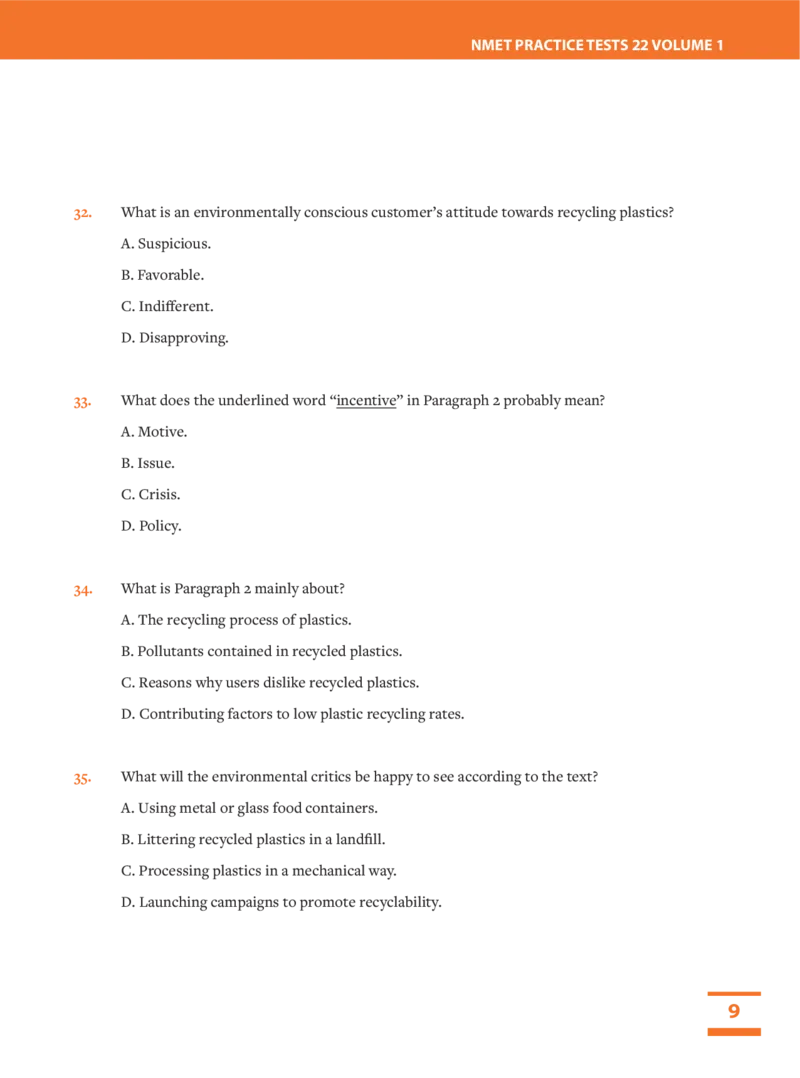
Since the 1950s, some 9.2 billion tonnes of plastic have been produced globally, of which
only about 10% has ever been recycled. Yet environmentally conscious companies and consumers
continue to look to recycling as a way to ease the plastic problem. Manufacturing giants claim to be
committed to making more of their products and packaging from recycled materials. However, this
confidence masks (掩饰) a complex web of issues around plastic recycling. Recycling rates remain
extremely low and critics argue that we should look at alternative ways to tackle plastic pollution.
While many plastics have the potential to be recycled, most are not because the process is costly,
complicated and the resulting product of a lower quality than the original. Despite rising demand
for recycled plastic, few waste companies turn a profit. Part of this is because virgin plastic—linked
to oil prices—is often cheaper than recycled plastic, meaning there is little economic incentive to
use it. Worse yet, much of our plastic waste is difficult to recycle. Lightweight food packaging, like
a mozzarella packet, contains different plastics, dyes and toxic additives (添加剂). This dirty mix
means plastic recycled through mechanical methods—the most common form—can only be melted
down and moulded again a couple of times before it becomes too fragile to be reused. And the nature
of the process means plastic recycling has a carbon footprint of its own.
Given all of these difficulties, environmental critics say recycling is not the solution—and argue
that creating more products from recycled material to attract environmental consciousness merely
worsens the problem. “The solution is to use less plastic and to stop misleading the public about the
recyclability,” says Enck, president of Beyond Plastics, a US campaign group with a mission to end
single-use plastic. “They should stop making false claims about the recyclability of plastics since they
know most will either be littered or burned or landfilled (填埋). Using less plastics means shifting
to reusable products and relying more on paper, cardboard, glass and metal—all of which should be
made from recycled content.”
8
2024 年高三第一次学业质量评价(T8 联考)
32.
What is an environmentally conscious customer’s attitude towards recycling plastics?

A. Suspicious.

B. Favorable.

C. Indifferent.

D. Disapproving.
33.
What does the underlined word “incentive” in Paragraph 2 probably mean?

A. Motive.

B. Issue.

C. Crisis.

D. Policy.
34.
What is Paragraph 2 mainly about?

A. The recycling process of plastics.

B. Pollutants contained in recycled plastics.

C. Reasons why users dislike recycled plastics.

D. Contributing factors to low plastic recycling rates.
35.
What will the environmental critics be happy to see according to the text?

A. Using metal or glass food containers.

B. Littering recycled plastics in a landfill.

C. Processing plastics in a mechanical way.

D. Launching campaigns to promote recyclability.
NMET PRACTICE TESTS 22 VOLUME 1
9
Have you ever caught a smell of something and been strongly reminded of a person or place?
There seems to be a deep psychological link between smells and our memory. Some research even
suggests that smells can influence our cognition (认知、感知).
(36) __________ Roja Dove, a perfumer, informed the BBC that when we are born, the olfactory
bulb (嗅球), which is the area in our brain that processes smell, is empty, without pre-existing
information or association. (37) __________ When we smell an odour again, the original and unique
memory comes flooding back because of the association acquired in our previous experience.
Our awareness of smells is primarily unconscious. (38) __________ But, low-level smells are still
picked up because the scent receptors (感受器) in our brain are so powerful that we unconsciously
register them. In fact, various studies have found the olfactory bulb sends more neurons (神经元) to
more areas of our brain than our hearing or vision.
Research suggests that the power of smell can also affect how the brain performs. (39)
__________ Mark Moss at Northumbria University’s Psychology Department discovered that certain
essential oils, such as peppermint, positively impact cognition, and rosemary’s scent can enhance
memory. He also studied lavender, which he says “tends to impair memory and slow reaction time.”
But research by others has shown it to be useful in reducing pre-treatment anxiety in dental and
medical situations.
(40) __________ The next time a familiar smell brings back a special memory, just remember
that your nose is working wonders.
COMPLETION
10
2024 年高三第一次学业质量评价(T8 联考)
A.
Why do smells take us back?
B.
So, don’t take your nose for granted.
C.
How is the sense of smell connected to your brain?
D.
Scents can revive memories that have been long forgotten.
E.
We are not actively aware of them unless they are extremely strong.
F.
This is especially true when it comes to the fragrance of essential oils.
G.
Therefore, our responses to smells are learnt and highly individualized.
NMET PRACTICE TESTS 22 VOLUME 1
11
CLOZE
Jen is a 39-year-old community dancer with Down’s Syndrome (唐氏综合征). She is the founder
of DanceSyndrome, a non-profit organization that brings together (41) __________ dancers and make
them feel equal to everyone.
Dancing has always been in her veins. As a young girl, Jen seized every opportunity to dance
with full (42) __________ both in the morning and during her 10 minutes of (43) __________ before
bedtime. The dynamic workout would keep her (44) __________ all day long.
Life hasn’t been straightforward for Jen. She was (45) __________ by a number of dance clubs in
primary school and encountered numerous (46) __________ while pursuing her passion for dance.
Despite these challenges, her ambition to share her love for dance and (47) __________ disabled
individuals in the art grew stronger.
After leaving school at 18, Jen spent over 10 years searching (48) __________ for opportunities
to be trained as a dance leader. Eventually, she had to give up and decided to try her own way, not
knowing where it might lead!
Despite the (49) __________, DanceSyndrome was established in 2009. Jen and her fellow
disabled dance leaders took (50) __________ of the charitable organization, working alongside non-
disabled dance artists who helped them work more professionally.
Over the decade, DanceSyndrome has (51) __________ thousands of disabled dancers, cultivating
an environment where every person is recognized as equal, (52) __________ and accepted for who
they are. The year 2019 witnessed Jen (53) __________ for the third time as a member of Shaw
Trust’s Disability Power 100. She is a living proof that (54) __________ can come from unexpected
places and that disabled individuals can (55) __________ society in extraordinary ways.
12
2024 年高三第一次学业质量评价(T8 联考)
41.
A. confusing
B. disabled
C. talented
D. clumsy
42.
A. energy
B. fear
C. speed
D. courage
43.
A. concentration
B. imagination
C. relaxation
D. celebration
44.
A. exhausted
B. astonished
C. motivated
D. refreshed
45.
A. held back
B. left alone
C. looked after
D. turned down
46.
A. consequences
B. barriers
C. friends
D. experiences
47.
A. discover
B. employ
C. engage
D. entertain
48.
A. in particular
B. in return
C. in vain
D. in advance
49.
A. frustration
B. progress
C. curiosity
D. uncertainty
50.
A. possession
B. charge
C. advantage
D. control
51.
A. supported
B. praised
C. paid
D. added
52.
A. valued
B. envied
C. united
D. rewarded
53.
A. regarded
B. listed
C. interviewed
D. expected
54.
A. inspiration
B. friendship
C. teamwork
D. leadership
55.
A. contribute to
B. adapt to
C. belong to
D. live up to
NMET PRACTICE TESTS 22 VOLUME 1
13
The Sanya Nanfan (南繁) Seed Breeding (繁殖) Base, located in south China’s Hainan Province,
plays a vital role as a seed centre in China. (56) __________ (unique) blessed with nature’s gifts
and a wealth of the country’s resources, it serves as the dedicated ground (57) __________ skilled
agricultural experts contribute to feeding our nation and addressing global hunger.
Dr. Xiao Feng stands at the forefront of agricultural innovation in Nanfan. Jokingly (58)
__________ (refer) to himself as a “mudskipper”, he is often spotted with rolled-up trouser legs
knee-deep in the (59) __________ (mud) fields. Dr. Xiao, along with other Nanfan researchers, (60)
__________ (commit) whole-heartedly to improving grain production, ensuring that people’s dinner
tables are filled.
“Life can be compared to a seed, remarks Dr. Xiao. “Occasionally, it may either not grow as
expected (61) __________ remain inactive. Nevertheless, hope and opportunity persist. The seed of
life will always manage (62) __________ (emerge) through the ground.”
The term “Nanfan” itself implies to the practice of transplanting summertime crops from
northern latitudes to Hainan during its winter. This makes for an (63) __________ (extend) of
growing seasons. Shortening the breeding cycle (64) __________ half or more, Nanfan accelerates
the breeding process.
Hope is a humble seed, when (65) __________ (plant) in fertile ground, it transfigures (美化…
的外表) into new life bearing fruits of change. The researchers at Nanfan are those seeds of hope.
GRAMMAR
14
2024 年高三第一次学业质量评价(T8 联考)
WRITING
假定你是李华,在外教课期末考试中发现有人作弊,你认为这会影响考试公平。请你给外
教John 写一封邮件,内容包括:
1. 情况描述;
2. 你的看法;
3. 你的请求。
SAMPLE WRITING
Dear John,
I hope this email finds you well. I’m Li Hua, one of your students, and I am writing to report an
incident of cheating that I witnessed during the final exam.
Regrettably, I noticed several students engage in dishonest behavior during the exam, such as
exchanging answers and using electronic devices. In my opinion, these cheating behavior has the
potential to impact the overall fairness of the exam. Therefore, I kindly request that you look into
this matter and reconsider the scores already given.
Thank you for your attention to this matter.
Looking forward to your reply.
Yours,
Li Hua
NMET PRACTICE TESTS 22 VOLUME 1
15
My mother believed in using things up. Last year, our cornfield had a bad harvest because
birds feasted on the crops. It was probably then that Mom’s frugality (节俭) became even more
extraordinary. She began keeping everything that seemed useless in the attic (阁楼)—worn-
out clothes, old sheets, broken umbrellas, and some other old items. Mom’s favorite saying was
“waste not, want not”. My brother Josh and I weren’t sure what that meant until the “Affair of the
Scarecrow (稻草人)”, which, as it later became known, left a lasting impression on us.
The story began with a pretty hat that Mom received as a gift to protect her from the sun.
However, Josh and I could see that Mom’s frugal nature and fashion sense were in battle. Mom really
didn’t want to get rid of the hat—it was new and had a lot of use left in it—but neither could she
stand wearing it. She tried to take off the fancy decorations, but they were stuck on tight. She’d have
to find some other solution.
Josh and I watched as Mom headed upstairs to the attic with the hat. “Waste not, want not,” she
called back down. We heard boxes being moved around. Moments later, Mom leaned out, holding a
flour bag full of straw, and with a mysterious smile, she placed the hat on it.
“What is that for?” I asked, confused. “A scarecrow!” Mom exclaimed. “But not a good one yet.
It needs a strong body to stand firm in the field,” she said with a frown. “And it doesn’t look scary
enough,” Josh remarked. I had to admit that Josh, though younger than I was, could sometimes be
more imaginative. Josh and I turned to each other, searching for a good idea. Soon enough, Josh’s
eyes lit up with inspiration.
CONTINUATION
16
2024 年高三第一次学业质量评价(T8 联考)
“Come with me!” Josh called out. The next instant, he raced upstairs with lightning speed. I
hurried to follow him into the attic, where we began a thorough search. Mom was amused by our
excitement when we found the broke numbrellas and used them as the backbone of the scarecrow.
After that, we sorted out some old sheets and tied them on. The scarecrow now looked even scarier.
We dragged our creation to the cornfield and planted it firmly in the mud. Our hearts full of hope.
In the days that followed, the scarecrow stood tall. Serving as a silent guardian, it successfully
scared the birds away. Under its watchful eyes, our cornfield flourished this year. To our amazement,
Mom’s useless things from the attic had come together to create something extraordinary. As we
enjoyed a good harvest, her favorite saying, “waste not, want not”, echoed in our hearts. The “Affair
of the Scarecrow” has taught us the value of creatively transforming seemingly useless items into
treasure, making us aware that frugality is a good quality after all.
SAMPLE WRITING
NMET PRACTICE TESTS 22 VOLUME 1
17
READING
A
21. C
22. B
23. A
B
24. A
25. D
26. C
27. B
C
28. D
29. A
30. C
31. D
D
32. B
33. A
34. D
35. A
COMPLETION
36. A
37. G
38. E
39. F
40. B
CLOZE
41. B
42. A
43. C
44. D
45. D
46. B
47. C
48. C
49. D
50. B
51. A
52. A
53. B
54. D
55. A
GRAMMAR
56. Uniquely
57. where
58. referring
59. muddy
60. is committed / commits
61. or
62. to emerge
63. extension
64. by
65. planted
ANSWER KEY
18
2024 年高三第一次学业质量评价(T8 联考)