专题 01 阅读理解
命题分析
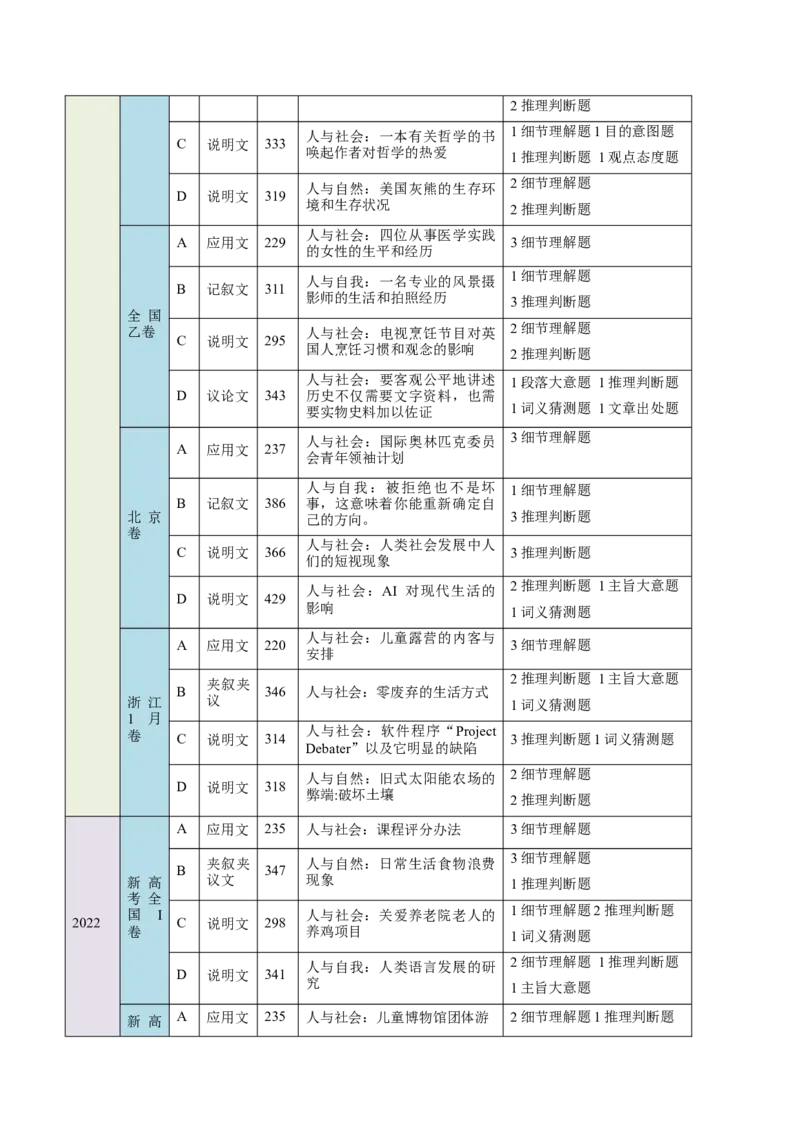
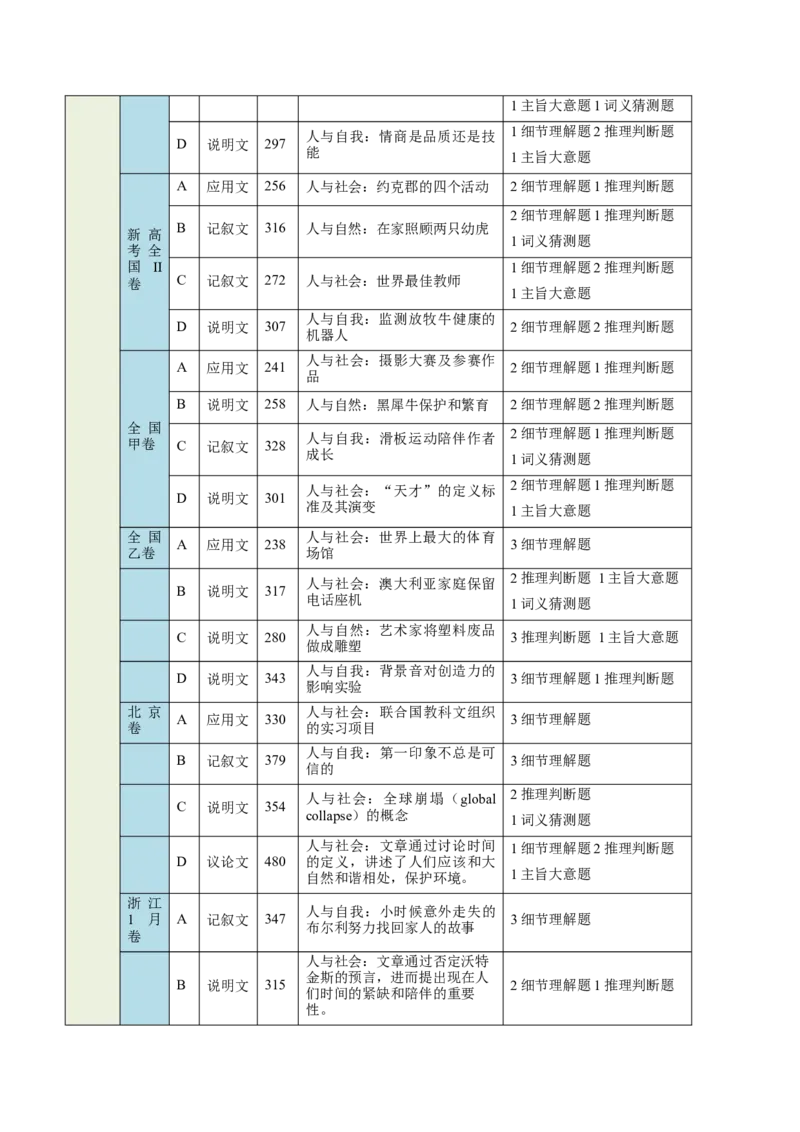
2024年高考英语阅读理解还是延续以往的风格,考察细节理解,推理判断,词义猜测以及主旨要义四大题
型,其总体难度和往年持平,学生想要得高分,需要在阅读理解上下功夫。
以下近十年(2015—2024年)阅读理解命题考点情况:
试卷 篇 词
年份 体裁 话题 考点分布
类型 序 数
人与社会:栖息地修复工作队
A 应用文 199 3细节理解题
志愿者招募
1观点态度题 1 推理判断题
夹叙来 人与社会:美国兽医采用针灸
新 高 B 296
议文 技术治疗动物
考 全
1段落大意题 1目的意图题
国 I 1词义猜测题1 推理判断题
人与社会:纸质阅读与数字阅
卷 C 说明文 339
读在学习效果上的差异
1细节理解题 1推理判断题
人与自然:现代生物采样数据
D 说明文 358 1细节理解题 3推理判断题
的科学性
( 应 用
A 290 人与自然:四种徒步活动 3细节理解题
文
2细节理解题 1推理判断题
人与社会::旧金山湾区快速
B 说明文 276
新 高 交通引入短篇故事自助服务亭
2024 1观点态度题
考 全
国 II 2细节理解题 1推理判断题
卷 C 说明文 268 人与社会:巴比伦微农场
1主旨大意题
人与社会:图书《人工智能设
1词义猜测题 2推理判断题
D 说明文 321
计:与人工智能共生的计划》
1写作意图题
人与社会:哈佛社区的 ARTS
1推理判断题
A 应用文 226
FIRST艺术节
2细节理解题
1推理判断题 2细节理解题
全 国
B 说明文 302 人与自然:了解猫的行为
甲卷
1词义猜测题 1标题概括题
2推理判断题1细节理解题
人与社会:提供医疗服务的圣
C 说明文 267
卢卡斯列车
1观点态度题3推理判断题
人与社会:谈论文学作品的最
D 说明文 348
佳结局
1细节理解题
A 应用文 240 人与自我:语言交流项目 3细节理解题
人与自我:作者重拾画油画的
3推理判断题
B 记叙文 354
信心并接受了自身局限性 1细节理解题
北 京 人与社会:讨论科学问题: 3推理判断题
C 议论文 408 宇宙是否是由计算机模拟生
卷
成的
1词义猜测题
1推理判断题
人与社会:人类道德准则的
D 说明文 384 形成过程及人类建立道德准 1细节理解题
则的标准
1主旨大意题
人与社会:音乐剧《汤姆·索
A 应用文 233 3细节理解题
亚:河流历险记》
B 记叙文 338 人与社会:感受电话亭变迁 3细节理解题 1词义猜测题
浙 江
1 月 C 议论文 313
人与自然:加拿大Alberta防雹 3细节理解题 1推理判断
千预计划之争 题
卷
1细节理解题 1推理判断
D 说明文 339 人与自我:儿童棉花糖实验引 题
发思考
1主旨大意题
A 应用文 209 人与社会:自行车租赁广告 3细节理解题
人与自然:微生物处理净化废
B 记叙文 340 1细节理解题3推理判断题
新 高 水
考 全
2推理判断题 1词义猜测题
人与社会:数字时代如何做到
国 I C 说明文 322
极简生活
卷 1细节理解题
1段落大意題1细节理解题
人与社会:“群体智慧”效应
D 说明文 339
的基本原理
1推理判断题 1观点态度题
人与自然:今年息季在黄石国
A 应用文 256 家公园举办的一系列护林员项 3细节理解题
目
2023
人与社会:Urban Sprouts学校
2细节理解题 1推理判断题
新 高 B 记叙文 273
考 全 园艺项目 1标题椴括题
国 II
卷 C 说明文 321
人与社会:图书《阅读艺术:图
1文章出处题1细节理解题
书爱好者的艺术》 1词义猜测题 1推理判断题
3细节理解题
人与自然:城市中自然场所的
D 说明文 320
存在对居民的健康至关重要
1推理判断题
人与社会:开启曼谷美食之旅
A 应用文 263 3细节理解题
的建议
全 国
甲卷 人 与 社 会 : DIY 能 手 Terri
B 记叙文 277 1词义猜测题 1细节理解题
Bolton的故事2推理判断题
1细节理解题1目的意图题
人与社会:一本有关哲学的书
C 说明文 333
唤起作者对哲学的热爱
1推理判断题 1观点态度题
2细节理解题
人与自然:美国灰熊的生存环
D 说明文 319
境和生存状况
2推理判断题
人与社会:四位从事医学实践
A 应用文 229 3细节理解题
的女性的生平和经历
1细节理解题
人与自我:一名专业的风景摄
B 记叙文 311
影师的生活和拍照经历
3推理判断题
全 国
乙卷 人与社会:电视烹饪节目对英 2细节理解题
C 说明文 295
国人烹饪习惯和观念的影响
2推理判断题
人与社会:要客观公平地讲述 1段落大意题 1推理判断题
D 议论文 343 历史不仅需要文字资料,也需
要实物史料加以佐证 1词义猜测题 1文章出处题
人与社会:国际奥林匹克委员
3细节理解题
A 应用文 237
会青年领袖计划
人与自我:被拒绝也不是坏 1细节理解题
B 记叙文 386 事,这意味着你能重新确定自
北 京 己的方向。 3推理判断题
卷
人与社会:人类社会发展中人
C 说明文 366 3推理判断题
们的短视现象
人与社会:AI 对现代生活的
2推理判断题 1主旨大意题
D 说明文 429
影响 1词义猜测题
人与社会:儿童露营的内客与
A 应用文 220 3细节理解题
安排
2推理判断题 1主旨大意题
夹叙夹
B 346 人与社会:零废弃的生活方式
浙 江 议 1词义猜测题
1 月
人与社会:软件程序“Project
卷 C 说明文 314 3推理判断题1词义猜测题
Debater”以及它明显的缺陷
人与自然:旧式太阳能农场的
2细节理解题
D 说明文 318
弊端:破坏土壤
2推理判断题
A 应用文 235 人与社会:课程评分办法 3细节理解题
3细节理解题
夹叙夹 人与自然:日常生活食物浪费
B 347
新 高 议文 现象 1推理判断题
考 全
国 I 人与社会:关爱养老院老人的
1细节理解题2推理判断题
2022 C 说明文 298
卷 养鸡项目 1词义猜测题
2细节理解题 1推理判断题
人与自我:人类语言发展的研
D 说明文 341
究
1主旨大意题
新 高 A 应用文 235 人与社会:儿童博物馆团体游 2细节理解题1推理判断题2细节理解题1推理判断题
人与社会:媒体记者对新媒体
B 记叙文 324
时代的感悟
1词义猜测题
考 全
1细节理解题1推理判断题
国 II
C 说明文 289 人与社会:禁止开车使用手机
卷 1主旨大意题1词义猜测题
人与自我:有氧运动延缓甚至
D 说明文 356 2细节理解题2推理判断题
逆转心脏衰老
人与社会:英国卡迪夫市艺术
A 应用文 287 3细节理解题
剧院
2细节理解题1推理判断题
人与自然:鹦鹉识别物体形状
B 说明文 255
的实验
1主旨大意题
全 国
甲卷 1细节理解题1推理判断题
C 记叙文 305 人与社会:难忘的南极之旅
1主旨大意题1词义猜测题
2细节理解题1推理判断题
D 说明文 340 人与社会:悉尼新旧文化冲突
1主旨大意题
人与社会:苏格兰画家画展信
A 应用文 194 3细节理解题
息
人 与 社 会 : 介 绍 Dorothy
B 说明文 319 2细节理解题2推理判断题
Wickenden的书籍
全 国
乙卷 2推理判断题1主旨大意题
人与社会:无人机在铁路交通
C 说明文 314
中的应用
1词义猜测题
人与社会:英国征收糖税的起
D 说明文 325 3细节理解题1推理判断题
因及效果
A 应用文 281 同伴辅助学习课程(PASS) 3细节理解题
参加保护自然活动治愈好了焦
B 记叙文 348 3细节理解题1推理判断题
虑
北 京
解决全球挑战的重要方法——
卷 C 说明文 415 1细节理解题2推理判断题
系统思维
1细节理解题1推理判断题
量子计算真的会像它的宣传那
D 议论文 400
样成功吗?
1主旨大意题1词义猜测题
Merebeth--自营宠 物运输 专
2推理判断题
A 记叙文 353
家。 1词义猜测题
浙 江
文章按照时间顺序讲述了蒸汽
1 月 B 说明文 283 3推理判断题
时代和电力时代的联系。
卷
经常锻炼的中年女性在老年时 3细节理解题1推理判断题
C 说明文 342 罹患失智症的几率会大大降
低。
A 应用文 288 人与社会:罗马的四个旅馆 3细节理解题
新 高
考 全 人与社会:介绍钢琴翻页的职
2021 B 记叙文 323 2细节理解题2推理判断题
国 I 业
卷
C 说明文 296 人与自然:湿地破坏,保护环 2细节理解题
境1主旨大意题1词义猜测题
1细节理解题2推理判断题
人与自我:情商是品质还是技
D 说明文 297
能
1主旨大意题
A 应用文 256 人与社会:约克郡的四个活动 2细节理解题1推理判断题
2细节理解题1推理判断题
B 记叙文 316 人与自然:在家照顾两只幼虎
新 高
1词义猜测题
考 全
国 II 1细节理解题2推理判断题
卷 C 记叙文 272 人与社会:世界最佳教师
1主旨大意题
人与自我:监测放牧牛健康的
D 说明文 307 2细节理解题2推理判断题
机器人
人与社会:摄影大赛及参赛作
A 应用文 241 2细节理解题1推理判断题
品
B 说明文 258 人与自然:黑犀牛保护和繁育 2细节理解题2推理判断题
全 国
2细节理解题1推理判断题
人与自我:滑板运动陪伴作者
甲卷 C 记叙文 328
成长
1词义猜测题
2细节理解题1推理判断题
人与社会:“天才”的定义标
D 说明文 301
准及其演变
1主旨大意题
全 国 人与社会:世界上最大的体育
A 应用文 238 3细节理解题
乙卷 场馆
2推理判断题 1主旨大意题
人与社会:澳大利亚家庭保留
B 说明文 317
电话座机
1词义猜测题
人与自然:艺术家将塑料废品
C 说明文 280 3推理判断题 1主旨大意题
做成雕塑
人与自我:背景音对创造力的
D 说明文 343 3细节理解题1推理判断题
影响实验
北 京 人与社会:联合国教科文组织
A 应用文 330 3细节理解题
卷 的实习项目
人与自我:第一印象不总是可
B 记叙文 379 3细节理解题
信的
人与社会:全球崩塌(global
2推理判断题
C 说明文 354
collapse)的概念
1词义猜测题
人与社会:文章通过讨论时间 1细节理解题2推理判断题
D 议论文 480 的定义,讲述了人们应该和大
自然和谐相处,保护环境。 1主旨大意题
浙 江
人与自我:小时候意外走失的
1 月 A 记叙文 347 3细节理解题
布尔利努力找回家人的故事
卷
人与社会:文章通过否定沃特
金斯的预言,进而提出现在人
B 说明文 315 2细节理解题1推理判断题
们时间的紧缺和陪伴的重要
性。1细节理解题1推理判断题
人与自然:黑猩猩用来交流的
C 说明文 344
手势含义。
1主旨大意题1词义猜测题
A 应用文 193 人与社会:诗歌邀请赛 3细节理解题1
人与自我:半工半读,凭借毅
3细节理解题1推理判断题
B 记叙文 322
新 高 力实现目标
考 全
1细节理解题2推理判断题
国 I 人与社会:介绍一本有关乌兹
C 说明文 302
卷 别克斯坦游记的书 1词义猜测题
1细节理解题2推理判断题
人与社会:就餐同伴对饮食习
D 说明文 325
惯的影响
1词义猜测题
1细节理解题1推理判断题
人与社会:四个不同类型的夏
A 应用文 307
令营
1主旨大意题1词义猜测题
2细节理解题1推理判断题
新 高 人与社会:巧妙处理学生带到
B 记叙文 256
考 全 学校的“禁果” 1词义猜测题
国 II
人与社会:《原谅设计:理解
卷 C 说明文 336 2细节理解题2推理判断题
失败》的评论
2细节理解题1推理判断题
人与自然:热带雨林的特性和
D 说明文 344
作用
1主旨大意题
199
A 人与社会: 3细节理解题
2020
2细节理解题1推理判断题
B 286 人与自我:
1词义猜测题
全 国
I卷 3细节理解题
人与社会:竞走运动及其与跑
C 303
步的不同之处
1推理判断题
2细节理解题
人与自然:对发光植物的科学
D 330
研究
2主旨大意题
人与自然:英国某湖区的文化
A 222 3细节理解题
类旅游景点
3细节理解题
人与社会:儿童玩拼图游戏研
B 297
究
1主旨大意题
全 国
II卷
人与自然:希望重振海狸泉皮
2细节理解题1推理判断题
C 329 310
草市场
1词义猜测题
2推理判断题
人与自我:对图书馆的热爱并
D 339
传递这份热爱
1主旨大意题1词义猜测题
人与社会:四个不同国家的文
A 234 3细节理解题
化之旅
全 国
III卷
人与自然:监督电影拍摄中虑
1细节理解题1推理判断题
B 240
待动物的行为
1主旨大意题1词义猜测题309 2细节理解题1推理判断题
人与社会:多代同堂居住的家
C
庭数量逐渐增加
1主旨大意题
2细节理解题1推理判断题
D 298 339 人与自然:人类进化
1主旨大意题
人与社会:一款语言学习软件
A 应用文 298 的优势、特点和费用等相关情 3细节理解题
况
人与自然:om Hunt设计的安
B 说明文 360 1细节理解题3推理判断题
装在狗狗项圈上的监测器
北 京
卷 2细节理解题1推理判断题
夹叙夹 人与自我:重视手工技能,将
C 403
议文 手工技能和科学结合在一起
1主旨大意题
1细节理解题2推理判断题
D 议论文 433 人与社会:通用人工智能技术
1词义猜测题
人与自我:保持着在图书馆中
A 记叙文 298 2推理判断题1词义猜测题
阅读和借阅书籍的习惯
浙 江 人与社会:新的路面防冻方法 1细节理解题2推理判断题
B 说明文 310
1 月 ——奶酪盐水
卷
2细节理解题1推理判断题
人与自我:由父亲抚养长大的
C 说明文 362
孩子更有毅力
1主旨大意题
人与社会:2020年5月7日前
新闻报
A 209 中国抗击新冠肺炎过程中的重 1细节理解题1推理判断题
道
要事件及举措
人与社会:消失的电话亭重新
B 说明文 398 2细节理解题1推理判断题
回到了英国人的视野中
江 苏
卷 2细节理解题1推理判断题
人与自我:早餐前锻炼益处更
C 说明文 405
多
1词义猜测题
2细节理解题3推理判断题
夹叙夹 人与社会:“已知”和“未
D 646
议文 知”
1主旨大意题
人与社会:大学生暑期工作项
A 应用文 263 3细节理解题
目
1细节理解题2推理判断题
人与社会:通过演讲提高学生
B 记叙文 316
的自信
全 国
1词义猜测题
I卷
人与社会:一种低成本的智能
C 说明文 252 2细节理解题2推理判断题
键盘
2019
2推理判断题
人与社会:个体受欢迎程度的
D 议论文 360
因素和影响
2主旨大意题
人与自我:作者最喜欢的四本
A 应用文 252 3细节理解题
书
全 国
II卷
夹叙夹
3推理判断题
B 335 人与社会:志愿者工作的意义
议文
1词义猜测题1细节理解题2推理判断题
人与社会:人们越来越喜欢一
C 说明文 326
个人吃饭的现象
1主旨大意题
人与社会:NASA与学生联手
1细节理解题2推理判断题
D 说明文 309
进行科研项目 1主旨大意题
人与社会:四部文化剧以及相
A 应用文 205 1细节理解题2推理判断题
关的预售信息
1细节理解题1推理判断题
人与社会:中国的文化是西方
B 说明文 287
创作的灵感来源
全 国
1主旨大意题1词义猜测题
III卷
4推理判断题
C 说明文 291 人与社会:报纸的发展史
人与自然:研究人员测试猴子
D 说明文 329 3细节理解题1推理判断题
的数字能力
A 应用文 284 人与社会:招聘志愿者的广告 3细节理解题
人与社会:创业者的故事:积
B 记叙文 354 2细节理解题2推理判断题
极的思考和行动会带来成功
北 京
1细节理解题1推理判断题
人与社会:机器人电话问题在
卷 C 说明文 452
未来会变得越来越严重
1主旨大意题1观点态度题
1目的意图题1推理判断题
人与自然:气候变化对海洋的
D 说明文 302
影响
1主旨大意题1词义猜测题
人与自我:Zachariah Fike不同
A 记叙文 338 1细节理解题2推理判断题
寻常的业余爱好
1细节理解题1推理判断题
新闻报 人与社会:洛杉矶的联合车站
浙 江 B 284
道 慈善活动
卷 1词义猜测题
1细节理解题1推理判断题
人与自然:气候变化使加州已
C 说明文 308
经失去了一半的大树
2主旨大意题
人与社会:布克斯顿旅游一些
A 应用文 170 2细节理解题
景点的相关信息
1细节理解题
人与社会:黄石公园的火山的
B 说明文 357
特殊之处
1主旨大意题1词义猜测题
江 苏
卷
人与社会:对信息技术的过分
C 议论文 422 1细节理解题3推理判断题
迷恋的坏处
1细节理解题4推理判断题
人与社会:钢琴师帮助一个患
D 记叙文 614
老年痴呆症的老人录制音乐
1主旨大意题
人与社会:Washington, D.C.旅
A 应用文 264 3细节理解题
游的四种路线
全 国 人与社会:英国美食电视节目
1细节理解题2推理判断题
2018 B 说明文 274
I卷 介绍
1主旨大意题
人与社会:语言的发展过程及
C 说明文 304 1细节理解题1推理判断题
现状1主旨大意题1词义猜测题
人与社会:使用过时旧设备给
D 说明文 363 1细节理解题3推理判断题
环境带来的影响
人与社会:学校暑假课外活动
A 应用文 293 2细节理解题1推理判断题
的相关内容
1细节理解题2推理判断题
人与自然:不同水果对身体的
B 说明文 258
益处
1词义猜测题
全 国
II卷
人与社会:少年快乐阅读的人
1细节理解题3推理判断题
C 说明文 295
数呈下降趋势
1细节理解题2推理判断题
人与社会:闲谈在社会生活中
D 议论文 309
的益处
1主旨大意题
人 与 社 会 : 去 Hoikey
A 应用文 199 3细节理解题
Hall&Garden旅游的一些信息
2细节理解题1推理判断题
人与社会:加拿大西部城市道
B 说明文 310
森市发展的兴衰
1主旨大意题
全 国
III卷
人与社会:中国著名建筑师王
3细节理解题1推理判断题
C 记叙文 367
澍荣获全球建筑领
2细节理解题
人与社会:精简主义使人更快
D 议论文 306
乐
1主旨大意题1词义猜测题
人与社会:到太平洋科学中心
A 应用文 223 2细节理解题 1目的意图题
的旅游指南
人与自然:作者救助猫头鹰雏
B 记叙文 293 2细节理解题2推理判断题
鸟的故事
全 国
1细节理解题1推理判断题
I卷
C
新闻报
338
人与社会:探讨爵士乐未来的
道 发展
1主旨大意题1词义猜测题
人与社会:自制便携式太阳能 1细节理解题2推理判断题
D 说明文 307 蒸馏器,从而在野外获取饮用
水 1词义猜测题
A 应用文 298 人与社会:剧院的演出信息 3细节理解题
2017 人 与 社 会 : 作 者 与 Paul 2细节理解题1词义猜测题
B 记叙文 287
Newman之间持久的友谊
1写作意图题
全 国
II卷 人与社会:新型交通工具--飞
1细节理解题1推理判断题
C 说明文 317
行汽车 2主旨大意题
2细节理解题1推理判断题
人与自然:植物在受到攻击时
D 说明文 291
是如何进行自我保护的
1词义猜测题
人与社会:圣弗朗西斯科的四
A 应用文 244 3细节理解题
个旅游活动
全 国
III卷 人与社会:一家有75年历史的 2细节理解题2推理判断题
B 记叙文 275 剧院因失去竞争力而关闭的故
事1细节理解题1观点态度题
人与自然:美国黄石公园重新
C 说明文 291
引进灰狼
1主旨大意题1词义猜测题
人与社会:一项由一个研究团 1细节理解题1推理判断题
D 说明文 318 队研发的旨在帮助老年司机继
续驾驶的助驾技术 1主旨大意题1词义猜测题
人与社会:几位著名的女性在
A 记叙文 267 各自的领域做出了非凡的贡 3细节理解题1推理判断题
献。
人与社会:很多老年人搬到离
B 议论文 287 子女近的地方居住的一种趋 3细节理解题1推理判断题
全 国 势。
I卷
2细节理解题
人与社会:作者在一次运送造
C 记叙文 262
血干细胞途中的一段经历。
1词义猜测题
3细节理解题
人与社会:沉默在不同文化背
D 说明文 327
景下的不同内涵。
1主旨大意题
人与社会:四则广告的具体内
A 应用文 281 4细节理解题
容及细节信息
人与社会:通过让学生拼装玩 1细节理解题2推理判断题
B 记叙文 280 具发现并鼓励学生的创造性和
想象力。 1词义猜测题
2016 全 国
II卷 人与社会:BookCrossing.com 2推理判断题
C 说明文 249 所进行的分享图书活动的目的
及具体过程
1主旨大意题1词义猜测题
人与社会:Frank 的图片记录
D 记叙文 278 3细节理解题
了一次海难
人与社会:介绍五个与音乐有
A 应用文 189 2细节理解题1推理判断题
关的活动
1细节理解题1推理判断题
人与社会:一位女作家请纽约
B 记叙文 311
的朋友吃饭时发生的故事。
1词义猜测题
全 国
III卷 人与社会:介绍了一个节日- 1细节理解题1推理判断题
C 说明文 280
-Apple Day。
1写作意图题1词义猜测题
人与社会:好消息比坏消息传 2细节理解题1推理判断题
D 说明文 341 得更快、更远,越积极乐观的
消息越容易被大众分享。 1主旨大意题
人与社会:主要介绍伦敦博物
A 应用文 235 3细节理解题
馆。
人与社会:享受佛罗里达的萨
B 记叙文 354 1细节理解题3推理判断题
全 国 拉索塔的时光。
I卷
人与社会:介绍萨尔瓦多·达
2015 C 记叙文 220 3细节理解题1词义猜测题
利。
D 说明文 334 人与社会:咖啡馆的冲突 2细节理解题2推理判断题
全 国 人与社会:作者被愚弄以高价
2细节理解题1推理判断题
A 记叙文 246
II卷 买了电视机
1词义猜测题1细节理解题2推理判断题
人与社会:房子对身材有影
B 说明文 312
响。
1主旨大意题
人与社会:大学生做兼职或专
C 说明文 261 3细节理解题1推理判断题
职挣钱
人与社会:介绍四个旅游目的
D 应用文 269 3细节理解题
地
近十年高考全国卷阅读选材地道,贴近学生实际,体裁多样。强调关键能力考查,引导教学聚焦语用能力,
回归语言本质,充分发挥高考育人功能。试卷结构和试题难度稳定,命题质量有提升。在选材上保持了知
识性、趣味性强,信息量不是很大,语篇长度适中,题材与体裁广泛的特点,彰显文化特色,考查考生快
速获取、处理、分析信息的能力。4篇文章按难度渐进排列,阅读总量1100-1200词(不含选项)之间,细
节题多于推断题试题数量。
一、阅读理解之细节理解题
应试技巧
规律方法1: 如何解决事实细节题?
事实细节题,关键词定位式最基本也是最常见的方法。一般根据题干中的关键词,如时间,地点和人
物等,在原文中找到相关的句子,然后进行比较和分析,便可确定答案。此类题通常用一些疑问词 when /
where / what / who / why / how (many)….来提问,或是判断正误。
规律方法2:如何解决细节转换题?
细节理解题也叫间接理解题,包括语意转换题、图文转换题和是非判断题。
1. 语意转换题,需要将题目信息与原文相关信息进行语意上的转换,两者存在表述上的差异,可理解
为同义改写,如原文出现30minutes,选项出现half an hour; 原文出现underground,选项则出现beneath
the ground等。解答这类题目时可根据题干,有针对性地扫读全文,迅速锁定相关语句,再对相关部分进
行分析,对比答案,一般正确答案是原文的同义改写,找出答案。
2. 图文转换题,在阅读理解题中,有的图表、图画出现在阅读理解题的正文中。在解答这类题时,
可采用"文字锁定法",找出描述图形中的句段,采用按图寻找答案的方法,按图索骥,图文互相参照、
互相验证,便可确定正确答案。
规律方法3:如何解决数字计算题?
先理解文章的大意,然后经过对比、分析、计算等就能够得出正确的答案。1. 仔细阅读文字说明部分,准确把握图表信息。
2. 仔细分析题干,抓牢关键词。
3. 运用数学公式计算,注意巧算。
规律方法4:如何解决细节排序题?
做此类题目可采用"首尾定位法",即先找出第一个事件和最后一个事件,这样可以迅速缩小选择范
围,从而迅速找到答案。阅读理解的文章如果是记叙文,排序题通常以事件发生的时间为线索;如果是说
明文,排序题通常以说明的先后顺序为线索;如果是议论文,排序题通常以逻辑顺序为线索。从近几年高
考试题来看,这类试题主要出现在记叙文和说明文中。
真题回顾
典例一 (2024•全国新高考I卷,A)
HABITAT RESTORATION TEAM
Help restore and protect Marin's natural areas from the Marin Headlands to Bolinas Ridge. We'll explore
beautiful park sites while conducting invasive (侵入的) plant removal, winter planting, and seed collection. Habitat
Restoration Team volunteers play a vital role in restoring sensitive resources and protecting endangered species
across the ridges and valleys.
GROUPS
Groups of five or more require special arrangements and must be confirmed in advance. Please review the List
of Available Projects and fill out the Group Project Request Form.
AGE, SKILLS, WHAT TO BRING
Volunteers aged 10 and over are welcome. Read our Youth Policy Guidelines for youth under the age of 15.
Bring your completed Volunteer Agreement Form. Volunteers under the age of 18 must have the
parent/guardian approval section signed.
We'll be working rain or shine. Wear clothes that can get dirty. Bring layers for changing weather and a
raincoat if necessary.
Bring a personal water bottle, sunscreen, and lunch.
No experience necessary. Training and tools will be provided. Fulfills (满足) community service requirements.
UPCOMING EVENTSTime Meeting Location
Sunday, Jan. 15 10:00 am — 1:00 pm Battery Alexander Trailhead
Sunday, Jan. 22 10:00 am — 2:30 pm Stinson Beach Parking Lot
Sunday, Jan. 29 9:30 am — 2:30 pm Coyote Ridge Trailhead
21. What is the aim of the Habitat Restoration Team?
A. To discover mineral resources. B. To develop new wildlife parks.
C. To protect the local ecosystem. D. To conduct biological research.
22. What is the lower age limit for joining the Habitat Restoration Team?
A. 5. B. 10. C. 15. D. 18.
23. What are the volunteers expected to do?
A. Bring their own tools. B. Work even in bad weather.
C. Wear a team uniform. D. Do at least three projects.
典例二 (2024•新课标II卷,A)
Choice of Walks for Beginner and Experienced Walkers
The Carlow Autumn Walking Festival is a great opportunity for the beginner, experienced or advanced walker
to enjoy the challenges of Carlow’s mountain hikes or the peace of its woodland walks.
Walk 1 — The Natural World
With environmentalist Éanna Lamhna as the guide, this walk promises to be an informative tour. Walkers are
sure to learn lots about the habitats and natural world of the Blackstairs.
Date and Time: Saturday, 1st October, at 09:00
Start Point: Scratoes Bridge
Walk Duration: 6 hours
Walk 2 — Introduction to Hillwalking
Emmanuel Chappard, an experienced guide, has a passion for making the great outdoors accessible to all. This
mountain walk provides an insight into the skills required for hillwalking to ensure you get the most from future
walking trips.
Date and Time: Sunday, 2nd October, at 09:00
Start Point: Deerpark Car Park
Walk Duration: 5 hoursWalk 3 — Moonlight Under the Stars
Walking at night-time is a great way to step out of your comfort zone. Breathtaking views of the lowlands of
Carlow can be enjoyed in the presence of welcoming guides from local walking clubs. A torch (手电筒) along with
suitable clothing is essential for walking in the dark. Those who are dressed inappropriately will be refused
permission to participate.
Date and Time: Saturday, 1st October, at 18:30
Start Point: The Town Hall
Walk Duration: 3 hours
Walk 4 — Photographic Walk in Kilbrannish Forest
This informative walk led by Richard Smyth introduces you to the basic principles of photography in the wild.
Bring along your camera and enjoy the wonderful views along this well-surfaced forest path.
Date and Time: Sunday, 2nd October, at 11:45
Start Point: Kilbrannish Forest Recreation Area
Walk Duration: 1.5 hours
1. Which walk takes the shortest time?
A. The Natural World. B. Introduction to Hillwalking.
C. Moonlight Under the Stars. D. Photographic Walk in Kilbrannish Forest.
2. What are participants in Walk 3 required to do?
A. Wear proper clothes. B. Join a walking club.
C. Get special permits. D. Bring a survival guide.
3. What do the four walks have in common?
A. They involve difficult climbing. B. They are for experienced walkers.
C. They share the same start point. D. They are scheduled for the weekend.
典例三 (2024•北京卷,A)
The Language Exchange Programme allows students in pairs to communicate in two different languages they
wish to share and learn each week. Students record short entries after each partner meeting noting the language
skills practised and the topics discussed. Each pair of students meets three times throughout the term with a teacher
who decides if the exchange is effective. Students who successfully complete the programme will receive one credit
each.
Requirements for completion:
•One welcoming session on the second Friday of the term•18 weekly one-hour pair meetings
•Weekly progress reports for all pair meetings
•At least three pair-teacher meetings
•One five-minute final video
Sign up!
The sign-up and registration process is as follows:
•Students sign up and indicate the languages they can share and languages they are interested in learning.
•Based on the information entered by each student, potential pairs are identified.
•Proficiency (熟练) levels are confirmed through coursework or placement tests.
•Once a pair has been determined to be suitable, the students will be contacted individually with a special
permission number to register for the programme.
Reminders:
Signing up for the programme does not automatically mean that you will be able to register and participate.
Pairs are matched by languages of interest and proficiency levels. Since there are many factors involved in the
pairing process, not all students who sign up will be matched with a partner and be able to register for the
programme.
21. In the programme, students will _________.
A. chair daily meetings B. evaluate the exchange
C. meet teachers each week D. practise their language skills
22. To complete the programme, students are required to _________.
A. development tests B. participate in pair meetings
C. welcome new students D. work on weekly videos
23. What do students need to do during the registration?
A. Indicate their languages of interest. B. Select their own coursework.
C. Make individual contact. D. Choose their partners.
典例四 (2024•浙江1月卷,C)
On September 7, 1991, the costliest hailstorm (雹暴) in Canadian history hit Calgary’s southern suburbs. As a
result, since 1996 a group of insurance companies have spent about $2million per year on the Alberta Hail
Suppression Project. Airplanes seed threatening storm cells with a chemical to make small ice crystals fall as rain
before they can grow into dangerous hailstones. But farmers in east-central Alberta — downwind of the hail project
flights — worry that precious moisture (水分) is being stolen from their thirsty land by the cloud seeding.Norman Stienwand, who farms in that area, has been addressing public meetings on this issue for years
“Basically, the provincial government is letting the insurance companies protect the Calgary-Edmonton urban area
from hail,” Mr. Stienwan d says, “but they’re increasing drought risk as far east as Saskatchewan.”
The Alberta hail project is managed by Terry Krauss, a cloud physicist who works for Weather Modification
Inc. of Fargo, North Dakota. “We affect only a very small percentage of the total moisture in the air, so we cannot
be cousing drought.” Dr. Krauss says. “In fact, we may be helping increase the moisture downwind by creating
wetter ground.”
One doubter about the safety of cloud seeding is Chuck Doswell, a research scientist who just retired from the
University of Oklahoma. “In 1999, I personally saw significant tornadoes (龙卷风) form from a seeded storm cell
in Kansas,” Dr. Doswell says. “Does cloud seeding create killer storms or reduce moisture downwind? No one
really knows, of course, but the seeding goes on.”
Given the degree of doubt, Mr. Stienwand suggests, “it would be wise to stop cloud seeding.” In practice,
doubt has had the opposite effect. Due to the lack of scientific proof concerning their impacts, no one has succeeded
in winning a lawsuit against cloud-seeding companies. Hence, private climate engineering can proceed in relative
legal safety.
8. What does the project aim to do?
A. Conserve moisture in the soil. B. Prevent the formation of hailstones.
C. Forecast disastrous hailstorms. D. Investigate chemical use in farming.
9. Who are opposed to the project?
A. Farmers in east-central Alberta. B. Managers of insurance companies.
C. Provincial government officials. D. Residents of Calgary and Edmonton
10. Why does Dr. Doswell mention the tornadoes he saw in 1999?
A. To compare different kinds of seeding methods.
B. To illustrate the development of big hailstorms.
C. To indicate a possible danger of cloud seeding.
D. To show the link between storms and moisture.
11. What can we infer from the last paragraph?
A. Scientific studies have proved Stienwand right.
B. Private climate engineering is illegal in Canada.
C. The doubt about cloud seeding has disappeared.D. Cloud-seeding companies will continue to exist.
典例五 (2023•新高考全国Ⅱ卷,D)
As cities balloon with growth, access to nature for people living in urban areas is becoming harder to find. If
you’re lucky, there might be a pocket park near where you live, but it’s unusual to find places in a city that are
relatively wild.
Past research has found health and wellness benefits of nature for humans, but a new study shows that
wildness in urban areas is extremely important for human well-being.
The research team focused on a large urban park. They surveyed several hundred park-goers, asking them to
submit a written summary online of a meaningful interaction they had with nature in the park. The researchers then
examined these submissions, coding (编码) experiences into different categories. For example, one participant’s
experience of “We sat and listened to the waves at the beach for a while” was assigned the categories “sitting at
beach” and “listening to waves.”
Across the 320 submissions, a pattern of categories the researchers call a “nature language” began to emerge.
After the coding of all submissions, half a dozen categories were noted most often as important to visitors. These
include encountering wildlife, walking along the edge of water, and following an established trail.
Naming each nature experience creates a usable language, which helps people recognize and take part in the
activities that are most satisfying and meaningful to them. For example, the experience of walking along the edge
of water might be satisfying for a young professional on a weekend hike in the park. Back downtown during a
workday, they can enjoy a more domestic form of this interaction by walking along a fountain on their lunch break.
“We’re trying to generate a language that helps bring the human-nature interactions back into our daily lives.
And for that to happen, we also need to protect nature so that we can interact with it,” said Peter Kahn, a senior
author of the study.
12. What phenomenon does the author describe at the beginning of the text?
A. Pocket parks are now popular. B. Wild nature is hard to find in cities.
C. Many cities are overpopulated. D. People enjoy living close to nature.
13. Why did the researchers code participant submissions into categories?
A. To compare different types of park-goers. B. To explain why the park attracts tourists.
C. To analyze the main features of the park. D. To find patterns in the visitors’ summaries.
14. What can we learn from the example given in paragraph 5?
A. Walking is the best way to gain access to nature.B. Young people are too busy to interact with nature.
C. The same nature experience takes different forms.
D. The nature language enhances work performance.
15. What should be done before we can interact with nature according to Kahn?
A. Language study. B. Environmental conservation.
C. Public education. D. Intercultural communication.
典例六 (2022•全国乙卷,C)
Can a small group of drones(无人机)guarantee the safety and reliability of railways and, at the same time,
help railway operators save billions of euros each year? That is the very likely future of applying today’s “eyes in
the sky” technology to making sure that the millions of kilometres of rail tracks and infrastructure( 基础设
施)worldwide are safe for trains on a 24/7 basis.
Drones are already being used to examine high-tension electrical lines. They could do precisely the same thing
to inspect railway lines and other vital aspects of rail infrastructure such as the correct position of railway tracks
and switching points. The more regularly they can be inspected, the more railway safety, reliability and on-time
performance will be improved. Costs would be cut and operations would be more efficient(高效)across the board.
That includes huge savings in maintenance costs and better protection of railway personnel safety. It is
calculated that European railways alone spend approximately 20 billion euros a year on maintenance, including
sending maintenance staff, often at night, to inspect and repair the rail infrastructure. That can be dangerous work
that could be avoided with drones assisting the crews’ efforts.
By using the latest technologies, drones could also start providing higher-value services for railways, detecting
faults in the rail or switches, before they can cause any safety problems. To perform these tasks, drones for rail
don’t need to be flying overhead. Engineers are now working on a new concept: the rail drones of the future. They
will be moving on the track ahead of the train, and programmed to run autonomously. Very small drones with
advanced sensors and AI and travelling ahead of the train could guide it like a co-pilot. With their ability to see
ahead, they could signal any problem, so that fast-moving trains would be able to react in time.
8. What makes the application of drones to rail lines possible?
A. The use of drones in checking on power lines. B. Drones’ ability to work at high altitudes.
C. The reduction of cost in designing drones. D. Drones’ reliable performance in remote areas.
9. What does “maintenance” underlined in paragraph 3 refer to?
A. Personnel safety. B. Assistance from drones.C. Inspection and repair. D. Construction of infrastructure.
10. What function is expected of the rail drones?
A. To provide early warning. B. To make trains run automatically.
C. To earn profits for the crews. D. To accelerate transportation.
11. Which is the most suitable title for the text?
A. What Faults Can Be Detected with Drones
B. How Production of Drones Can Be Expanded
C. What Difficulty Drone Development Will Face
.
D How Drones Will Change the Future of Railways
典例七 (2024•新课标Ⅰ卷卷,D)
In the race to document the species on Earth before they go extinct, researchers and citizen scientists have
collected billions of records. Today, most records of biodiversity are often in the form of photos, videos, and other
digital records. Though they are useful for detecting shifts in the number and variety of species in an area, a new
Stanford study has found that this type of record is not perfect.
“With the rise of technology it is easy for people to make observations of different species with the aid of a
mobile application,” said Barnabas Daru, who is lead author of the study and assistant professor of biology in the
Stanford School of Humanities and Sciences. “These observations now outnumber the primary data that comes
from physical specimens (标本), and since we are increasingly using observational data to investigate how species
are responding to global change, I wanted to know: Are they usable?”
Using a global dataset of 1.9 billion records of plants, insects, birds, and animals, Daru and his team tested
how well these data represent actual global biodiversity patterns.
“We were particularly interested in exploring the aspects of sampling that tend to bias (使有偏差) data, like
the greater likelihood of a citizen scientist to take a picture of a flowering plant instead of the grass right next to it,”
said Daru.
Their study revealed that the large number of observation-only records did not lead to better global coverage.
Moreover, these data are biased and favor certain regions, time periods, and species. This makes sense because the
people who get observational biodiversity data on mobile devices are often citizen scientists recording their
encounters with species in areas nearby. These data are also biased toward certain species with attractive or eye-
catching features.
What can we do with the imperfect datasets of biodiversity?“Quite a lot,” Daru explained. “Biodiversity apps can use our study results to inform users of oversampled
areas and lead them to places — and even species — that are not well-sampled. To improve the quality of
observational data, biodiversity apps can also encourage users to have an expert confirm the identification of their
uploaded image.”
32. What do we know about the records of species collected now?
A. They are becoming outdated. B. They are mostly in electronic form.
C. They are limited in number. D. They are used for public exhibition.
33. What does Daru’s study focus on?
A. Threatened species. B. Physical specimens.
C. Observational data. D. Mobile applications.
34. What has led to the biases according to the study?
A. Mistakes in data analysis. B. Poor quality of uploaded pictures.
C. Improper way of sampling. D. Unreliable data collection devices.
35. What is Daru’s suggestion for biodiversity apps?
A. Review data from certain areas. B. Hire experts to check the records.
C. Confirm the identity of the users. D. Give guidance to citizen scientists.
典例八 (2024•浙江1月卷卷,D)
The Stanford marshmallow (棉花糖) test was originally conducted by psychologist Walter Mischel in the late
1960s. Children aged four to six at a nursery school were placed in a room. A single sugary treat, selected by the
child, was placed on a table. Each child was told if they waited for 15 minutes before eating the treat, they would be
given a second treat. Then they were left alone in the room. Follow-up studies with the children later in life showed
a connect ion between an ability to wait long enough to obtain a second treat and various forms of success.
As adults we face a version of the marshmallow test every day. We’ re not tempted (诱惑) by sugary treats, but
by our computers, phones, and tablets — all the devices that connect us to the global delivery system for various
types of information that do to us what marshmallows do to preschoolers.
We are tempted by sugary treats because our ancestors lived in a calorie-poor world, and our brains developed
a response mechanism to these treats that reflected their value — a feeling of reward and satisfaction. But as we’ve
reshaped the world around us, dramatically reducing the cost and effort involved in obtaining calories, we still have
the same brains we had thousands of years ago, and this mismatch is at the heart of why so many of us struggle to
resist tempting foods that we know we shouldn’t eat.
A similar process is at work in our response to information. Our formative environment as a species wasinformation-poor, so our brains developed a mechanism that prized new information. But global connectivity has
greatly changed our information environment. We are now ceaselessly bombarded (轰炸) with new information.
Therefore, just as we need to be more thoughtful about our caloric consumption, we also need to be more
thoughtful about our information consumption, resisting the temptation of the mental “junk food” in order to
manage our time most effectively.
12. What did the children need to do to get a second treat in Mischel’s test?
A. Take an examination alone. B. Show respect for the researchers.
C. Share their treats with others. D. Delay eating for fifteen minutes.
13. According to paragraph 3, there is a mismatch between ___________.
A. the calorie-poor world and our good appetites
B. the shortage of sugar and our nutritional needs
C. the rich food supply and our unchanged brains
D. the tempting foods and our efforts to keep fit
14. What does the author suggest readers do?
A. Absorb new information readily. B. Be selective information consumers.
C. Use diverse information sources. D. Protect the information environment.
15. Which of the following is the best title for the text?
A. Eat Less, Read More B. The Bitter Truth about Early Humans
C. The Later, the Better D. The Marshmallow Test for Grownups
典例九 (2022•全国甲卷,A)
Theatres and Entertainment
St David’s Hall
St David’s Hall is the award winning National Concert Hall of Wales standing at the very heart of Cardiff’s
entertainment centre. With an impressive 2,000-seat concert hall, St David’s Hall is home to the annual Welsh
Proms Cardiff. It presents live entertainment, including pop, rock, folk, jazz, musicals, dance, world music, films
and classical music.
The Hayes, Cardiff CF 10 1 AH
www.stdavidshallcardiff.co.uk
The Glee Club
Every weekend this is “Wales” premier comedy club where having a great time is the order for both audiences
and comedy stars alike. It is hard to name a comedy star who hasn’t been on the stage here. If you are looking forthe best comedies on tour and brilliant live music, you should start here.
Mermaid Quay, Cardiff Bay, Cardiff CF 10 5 BZ
www.glee.co.uk/cardiff
Sherman Cymru
Sherman Cymru’s theatre in the Cathays area of Cardiff reopened in February 2012. This special building is a
place in which theatre is made and where children, artists, writers and anyone else have the opportunity (机会) to
do creative things. Sherman Cymru is excited to present a packed programme of the very best theatre, dance, family
shows and music from Wales and the rest of the world.
Senghennydd Road, Cardiff CF 24 4 YE
www.shermancymru.co.uk
New Theatre
The New Theatre has been the home of quality drama, musicals, dance and children’s shows for more than 100
years. Presenting the best of the West End along with the pick of the UK’s touring shows, the New Theatre is
Cardiff’s oldest surviving traditional theatre. Be sure to pay a visit as part of your stay in the city.
Park Place, Cardiff CF 10 3 LN
www.newtheatrecardiff.co.uk
1. Where is the Welsh Proms Cardiff hosted?
A. At the New Theatre. B. At the Glee Club.
C. At Sherman Cymru. D. At St David’s Hall.
2. What can people do at the Glee Club?
A. Watch musicals. B. Enjoy comedies.
C. See family shows. D. Do creative things.
3. Which website can you visit to learn about Cardiff’s oldest surviving theatre?
A. www.newtheatrecardiff.co.uk B. www.shermancymru.co.uk
C. www.glee.co.uk/cardiff D. www.stdavidshalleardiff.co.uk
典例十 (2022•新高考全国II卷,B)
We journalists live in a new age of storytelling, with many new multimedia tools. Many young people don’t
even realize it’s new. For them, it’s just normal.
This hit home for me as I was sitting with my 2-year-old grandson on a sofa over the Spring Festival holiday.
I had brought a children’s book to read. It had simple words and colorful pictures — a perfect match for his age.
Picture this: my grandson sitting on my lap as I hold the book in front so he can see the pictures. As I read, hereaches out and pokes (戳) the page with his finger.
What’s up with that? He just likes the pictures, I thought. Then I turned the page and continued. He poked the
page even harder. I nearly dropped the book. I was confused: Is there something wrong with this kid?
Then I realized what was happening. He was actually a stranger to books. His father frequently amused the
boy with a tablet computer which was loaded with colorful pictures that come alive when you poke them. He
thought my storybook was like that.
Sorry, kid. This book is not part of your high-tech world. It’s an outdated, lifeless thing. An antique, like your
grandfather. Well, I may be old, but I’m not hopelessly challenged, digitally speaking. I edit video and produce
audio. I use mobile payment. I’ve even built websites.
There’s one notable gap in my new-media experience, however: I’ve spent little time in front of a camera,
since I have a face made for radio. But that didn’t stop China Daily from asking me last week to share a personal
story for a video project about the integration of Beijing, Tianjin and Hebei province.
Anyway, grandpa is now an internet star — two minutes of fame! I promise not to let it go to my head. But I
will make sure my 2-year-old grandson sees it on his tablet.
4. What do the underlined words “hit home for me” mean in paragraph 2?
A. Provided shelter for me. B. Became very clear to me.
C. Took the pressure off me. D. Worked quite well on me.
5. Why did the kid poke the storybook?
A. He took it for a tablet computer. B. He disliked the colorful pictures.
C. He was angry with his grandpa. D. He wanted to read it by himself.
6. What does the author think of himself?
A. Socially ambitious. B. Physically attractive.
C. Financially independent. D. Digitally competent.
7. What can we learn about the author as a journalist?
A. He lacks experience in his job. B. He seldom appears on television.
C. He manages a video department. D. He often interviews internet stars.
典例十一 (2021•全国乙卷,A)
The Biggest Stadiums in the World
People have been pouring into stadiums since the days of ancient Greece. In around 80 A.D., the Romans built
the Colosseum, which remains the world’s best-known stadium and continues to inform contemporary design.
Rome’s Colosseum was 157 feet tall and had 80 entrances, seating 50,000 people. However, that was small frycompared with the city’s Circus Maximus, which accommodated around 250,000 people.
These days, safety regulations-not to mention the modern sports fan’s desire for a good view and comfortable
seat—tend to keep stadium capacities(容量) slightly lower. Even soccer fans tend to have a seat each; gone are
the days of thousands standing to watch the match.
For the biggest stadiums in the world, we have used data supplied by the World Atlas list so far, which ranks
them by their stated permanent capacity, as well as updated information from official stadium websites.
All these stadiums are still functional, still open and still hosting the biggest events in world sport.
·Rungrado 1st of May Stadium, Pyongyang D.P.R. Korea. Capacity: 150,000. Opened: May 1,1989.
·Michigan Stadium, Ann Arbor, Michigan, U. S. Capacity: 107,601. Opened: October 1, 1927.
·Beaver Stadium, State College, Pennsylvania, U. S. Capacity: 106,572. Opened: September 17, 1960.
·Ohio Stadium, Columbus, Ohio, U. S. Capacity: 104,944. Opened: October 7,1922.
·Kyle Field, College Station, Texas, U. S. Capacity: 102,512. Opened: September 24, 1927.
21. How many people could the Circus Maximus hold?
A. 104,944. B. 107,601. C. About 150,000. D. About 250,000.
22. Of the following stadiums, which is the oldest?
A. Michigan Stadium. B. Beaver Stadium. C. Ohio Stadium. D. Kyle Field.
23. What do the listed stadiums have in common?
A. They host big games. B. They have become tourist attractions.
C. They were built by Americans. D. They are favored by architects.
典例十二 (2021·全国甲卷,A)
A Take a view, the Landscape(风景)Photographer of the Year Award, was the idea of Charlie Waite, one of
today's most respected landscape photographers.Each year, the high standard of entries has shown that the Awards
are the perfect platform to showcase the very best photography of the British landscape.Take a view is a desirable
annual competition for photographers from all comers of the UK and beyond.
It was an extremely cold winter's evening and freezing fog hung in the air. I
Mike Shepherd(2011) climbed to the top of a small rise and realised that the mist was little more than a few
feet deep, and though it was only a short climb, I found myself completely above it and
Skiddaw in Winter
looking at a wonderfully clear view of Skiddaw with the sum setting in the west. I used
Cumbria, England classical techniques, translated from my college days spent in the darkroom into
Photoshop, to achieve the black—and—white image(图像).
Timothy Smith(2014) I was back in my hometown of Macclesfield to take some winter images. Walking
up a path through the forest towards Shutlingsloe. a local high point, I came across a
Macclesfield Forest
small clearing and immediately noticed the dead yellow grasses set against the fresh
Cheshire, England snow. The small pine added to the interest and I placed it centrally to take the view fromthe foreground right through into the forest.
1. Who would most probably enter for Take a view?
A. Writers. B. Photographers. C. Painters. D. Tourists.
2. What do the works by Shepherd and Smith have in common?
A. They are winter images.
B. They are in black and white.
C. They show mountainous scenes.
D. They focus on snow—covered forests.
3. Where can the text be found?
A. In a history book. B. In a novel. C. In an art magazine. D. In a biography.
典例十三 (2024•浙江1月卷,B)
When was the last time you used a telephone box? I mean to make an actual phone call — not to shelter from
,
the rain. Ages ago right? The last time I used a phone box for its intended purpose was…2006. I was conducting
auditions (试演) for my play in my tiny old shared house in London. Hoping to impress some talented actors to
come and work for me for nothing, I spread some throws over the sofas and lit candles to make it seem a bit more
”young professional”.
As I rushed outdoors to empty the wastepaper baskets, the door swung shut behind me. Suddenly I was locked
outside. My mobile phone was inside, but luckily there was a telephone box across the street. So, I called Directory
Assistance, got put through to our landlady’s managing agent, and had a spare key sent to me with just enough time
to get back in before the actors arrived.
As it has been many years since I last used one, I should hardly be surprised that then are no longer any public
telephones near my house. The last one standing has just been turn into a “mini community library”: any passer-by
can “borrow” a book from its shelves return it later, or replace it with another title from their own collection.
For a few months after the “library” opened, I didn’t bother taking a look, as I had assumed that it would be
stuffed full of cheese love stories. Then I noticed fork conducting spring cleans dropping boxes of voluminous
books on various subjects there. And these books were free. This unbeatable price-point encouraged me to
experiment with dozens of titles that I would never normally consider buying. And I’ve discovered some great
books!
If I ever get trapped outside my house again, my local telephone box will, sadly no longer be able to connect
me with my keys. But it can certainly keep me entertained while I wait for my wife to rescue me.4. What does the underlined word “it” in the first paragraph refer to?
A. The play. B. The shared house.
C. The sofa. D. The telephone box.
5. Why did the author use the telephone box in 2006?
A. To place an urgent call. B. To put up a notice.
C. To shelter from the rain. D. To hold an audition.
6. What do we know about the “mini community library”?
A. It provides phone service for free. B. Anyone can contribute to its collection.
C. It is popular among young readers. D. Books must be returned within a month.
7. Why did the author start to use the “library”?
A. He wanted to borrow some love stories.
B. He was encouraged by a close neighbour.
C. He found there were excellent free books.
D. He thought it was an ideal place for reading.
典例十四 (2021•新高考全国Ⅰ卷,A)
Rome can be pricey for travelers, which is why many choose to stay in a hostel ( 旅 社 ). The hostels in
Rome offer a bed in a dorm room for around $25 a night, and for that, you’ll often get to stay in a central location
(位置) with security and comfort.
Yellow Hostel
If I had to make just one recommendation for where to stay in Rome, it would be Yellow Hostel. It’s one of the
best-rated hostels in the city, and for good reason. It’s affordable, and it’s got a fun atmosphere without being too
noisy. As an added bonus, it’s close to the main train station.
Hostel Alessandro Palace
If you love social hostels, this is the best hostel for you in Rome. Hostel Alessandro Palace is fun. Staff
members hold plenty of bar events for guests like free shots, bar crawls and karaoke. There’s also an area on the
rooftop for hanging out with other travelers during the summer.
Youth Station Hostel
If you’re looking for cleanliness and a modern hostel, look no further than Youth Station. It offers beautiful
furnishings and beds. There are plenty of other benefits, too; it doesn’t charge city tax; it has both air conditioning
and a heater for the rooms; it also has free Wi-Fi in every room.
Hotel and Hostel Des ArtistesHotel and Hostel Des Artistes is located just a 10-minute walk from the central city station and it’s close to all
of the city’s main attractions. The staff is friendly and helpful, providing you with a map of the city when you
arrive, and offering advice if you require some. However, you need to pay 2 euros a day for Wi-Fi.
21. What is probably the major concern of travelers who choose to stay in a hostel?
A. Comfort. B. Security.
C. Price. D. Location.
22. Which hotel best suits people who enjoy an active social life?
A. Yellow Hostel. B. Hostel Alessandro Palace.
C. Youth Station Hostel. D. Hotel and Hostel Des Artistes.
23. What is the disadvantage of Hotel and Hostel Des Artistes?
A. It gets noisy at night. B. Its staff is too talkative.
C. It charges for Wi-Fi. D. It’s inconveniently located.
典例十五 (2021•全国乙卷,A)
The Biggest Stadiums in the World
People have been pouring into stadiums since the days of ancient Greece. In around 80 A.D., the Romans built
the Colosseum, which remains the world’s best known stadium and continues to inform contemporary design.
Rome’s Colosseum was 157 feet tall and had 80 entrances, seating 50,000 people. However, that was small fry
compared with the city’s Circus Maximus, which accommodated around 250,000 people.
These days, safety regulations-not to mention the modern sports fan’s desire for a good view and comfortable
seat—tend to keep stadium capacities(容量) slightly lower. Even soccer fans tend to have a seat each; gone are
the days of thousands standing to watch the match.
For the biggest stadiums in the world, we have used data supplied by the World Atlas list so far, which ranks
them by their stated permanent capacity, as well as updated information from official stadium websites.
All these stadiums are still funtiona1, still open and still hosting the biggest events in world sport.
·Rungrado 1st of May Stadium, Pyongyang D.P.R. Korea. Capacity: 150,000. Opened: May 1,1989.
·Michigan Stadium, Ann Arbor, Michigan, U. S. Capacity: 107,601. Opened: October 1, 1927.
·Beaver Stadium, State College, Pennsylvania, U. S. Capacity: 106,572. Opened: September 17, 1960.
·Ohio Stadium, Columbus, Ohio, U. S. Capacity: 104,944. Opened: October 7,1922.
·Kyle Field, College Station, Texas, U. S. Capacity: 102,512. Opened: September 24, 1927.
21. How many people could the Circus Maximus hold?
A. 104,944. B. 107,601. C. About 150,000. D. About 250,000.22. Of the following stadiums, which is the oldest?
A. Michigan Stadium. B. Beaver Stadium. C. Ohio Stadium. D. Kyle Field.
23. What do the listed stadiums have in common?
A. They host big games. B. They have become tourist attractions.
C. They were built by Americans. D. They are favored by architects.
典例十六 (2021•全国乙卷,D)
During an interview for one of my books, my interviewer said something I still think about often. Annoyed by
the level of distraction(干扰)in his open office, he said, “That’s why I have a membership at the coworking
space across the street — so I can focus”. His comment struck me as strange. After all, coworking spaces also
typically use an open office layout(布局). But I recently came across a study that shows why his approach
works.
The researchers examined various levels of noise on participants as they completed tests of creative thinking.
They were randomly divided into four groups and exposed to various noise levels in the background, from total
silence to 50 decibels(分贝), 70 decibels, and 85 decibels. The differences between most of the groups were
statistically insignificant; however, the participants in the 70 decibels group — those exposed to a level of noise
similar to background chatter in a coffee shop — significantly outperformed the other groups. Since the effects
were small, this may suggest that our creative thinking does not differ that much in response to total silence and 85
decibels of background noise.
But since the results at 70 decibels were significant, the study also suggests that the right level of background
noise — not too loud and not total silence — may actually improve one’s creative thinking ability. The right level
of background noise may interrupt our normal patterns of thinking just enough to allow our imaginations to wander,
without making it impossible to focus. This kind of “distracted focus” appears to be the best state for working on
creative tasks.
So why do so many of us hate our open offices? The problem may be that, in our offices, we can’t stop
ourselves from getting drawn into others’ conversations while we’re trying to focus. Indeed, the researchers found
that face-to-face interactions and conversations affect the creative process, and yet a coworking space or a coffee
shop provides a certain level of noise while also providing freedom from interruptions.
32. Why does the interviewer prefer a coworking space?
A. It helps him concentrate. B. It blocks out background noise.
C. It has a pleasant atmosphere. D. It encourages face-to-face interactions.33. Which level of background noise may promote creative thinking ability?
A. Total silence. B. 50 decibels C. 70 decibels. D. 8 5 decibels.
34. What makes an open office unwelcome to many people?
A. Personal privacy unprotected. B. Limited working space.
C. Restrictions on group discussion. D. Constant interruptions.
35. What can we infer about the author from the text?
A. He’s a news reporter.
B. He’s an office manager.
C. He’s a professional designer.
D. He’s a published writer.
典例十七 (2020•新高考全国Ⅰ卷(山东卷),B)
Jenifer Mauer has needed more willpower than the typical college student to pursue her goal of earning a
nursing degree. That willpower bore fruit when Jennifer graduated from University of Wisconsin-Eau Claire and
became the first in her large family to earn a bachelor's degree.
Mauer, of Edgar, Wisconsin, grew up on a farm in a family of 10 children. Her dad worked at a job away from
the farm, and her mother ran the farm with the kids. After high school, Jennifer attended a local technical college,
working to pay her tuition(学费), because there was no extra money set aside for a college education. After
graduation, she worked to help her sisters and brothers pay for their schooling.
Jennifer now is married and has three children of her own. She decided to go back to college to advance her
career and to be able to better support her family while doing something she loves: nursing. She chose the UW-Eau
Claire program at Ministry Saint Joseph's Hospital in Marshfield because she was able to pursue her four-year
degree close to home. She could drive to class and be home in the evening to help with her kids. Jenifer received
great support from her family as she worked to earn her degree: Her husband worked two jobs to cover the bills,
and her 68-year-old mother helped take care of the children at times.
Through it all, she remained in good academic standing and graduated with honors. Jennifer sacrificed(牺牲)to
achieve her goal, giving up many nights with her kids and missing important events to study. ''Some nights my
heart was breaking to have to pick between my kids and studying for exams or papers,'' she says. However, her
children have learned an important lesson witnessing their mother earn her degree. Jennifer is a first-generation
graduate and an inspiration to her family-and that's pretty powerful.
4. What did Jennifer do after high school?A. She helped her dad with his work.
B. She ran the family farm on her own.
C. She supported herself through college.
D. She taught her sisters and brothers at home.
5. Why did Jennifer choose the program at Ministry Saint Joseph's Hospital in Marshfield?
A. To take care of her kids easily. B. To learn from the best nurses.
C. To save money for her parents. D. To find a well-paid job there.
6. What did Jennifer sacrifice to achieve her goal?
A. Her health. B. Her time with family.
C. Her reputation. D. Her chance of promotion.
7. What can we learn from Jenifer's story?
A. Time is money. B. Love breaks down barriers.
C. Hard work pays off. D. Education is the key to success.
典例十八 (2020•新课标Ⅰ卷,C)
Race walking shares many fitness benefits with running, research shows, while most likely contributing to
fewer injuries. It does, however, have its own problem.
Race walkers are conditioned athletes. The longest track and field event at the Summer Olympics is the 50-
kilometer race walk, which is about five miles longer than the marathon. But the sport’s rules require that a race
walker’s knees stay straight through most of the leg swing and one foot remain in contact (接触) with the ground at
all times. It’s this strange form that makes race walking such an attractive activity, however, says Jaclyn Norberg,
an assistant professor of exercise science at Salem State University in Salem, Mass.
Like running, race walking is physically demanding, she says, According to most calculations, race walkers
moving at a pace of six miles per hour would burn about 800 calories(卡路里) per hour, which is approximately
twice as many as they would burn walking, although fewer than running, which would probably burn about 1,000
or more calories per hour.
However, race walking does not pound the body as much as running does, Dr. Norberg says. According to her
research, runners hit the ground with as much as four times their body weight per step, while race walkers, who do
not leave the ground, create only about 1.4 times their body weight with each step.
As a result, she says, some of the injuries associated with running, such as runner’s knee, are uncommon
among race walkers. But the sport’s strange form does place considerable stress on the ankles and hips, so people
with a history of such injuries might want to be cautious in adopting the sport. In fact, anyone wishing to try racewalking should probably first consult a coach or experienced racer to learn proper technique, she says. It takes
some practice.
28. Why are race walkers conditioned athletes?
A. They must run long distances.
B. They are qualified for the marathon.
C. They have to follow special rules.
D. They are good at swinging their legs.
29. What advantage does race walking have over running?
A. It’s more popular at the Olympics.
B. It’s less challenging physically.
C. It’s more effective in body building.
D. It’s less likely to cause knee injuries.
30. What is Dr. Norberg’s suggestion for someone trying race walking?
A. Getting experts’ opinions.
B. Having a medical checkup.
C. Hiring an experienced coach.
D. Doing regular exercises.
31. Which word best describes the author’s attitude to race walking?
A. Skeptical. B. Objective.
C. Tolerant. D. Conservative.
典例十九 (2019•全国卷 Ⅰ卷,C)
As data and identity theft becomes more and more common, the market is growing for biometric(生物测
量)technologies—like fingerprint scans—to keep others out of private e-spaces. At present, these technologies are
still expensive, though.
Researchers from Georgia Tech say that they have come up with a low-cost device(装置)that gets around this
problem: a smart keyboard. This smart keyboard precisely measures the cadence(节奏)with which one types and
the pressure fingers apply to each key. The keyboard could offer a strong layer of security by analyzing things like
the force of a user's typing and the time between key presses. These patterns are unique to each person. Thus, the
keyboard can determine people's identities, and by extension, whether they should be given access to the computer
it's connected to—regardless of whether someone gets the password right.
It also doesn't require a new type of technology that people aren't already familiar with. Everybody uses akeyboard and everybody types differently.
In a study describing the technology, the researchers had 100 volunteers type the word “touch”four times
using the smart keyboard. Data collected from the device could be used to recognize different participants based on
how they typed, with very low error rates. The researchers say that the keyboard should be pretty straightforward to
commercialize and is mostly made of inexpensive, plastic-like parts. The team hopes to make it to market in the
near future.
28. Why do the researchers develop the smart keyboard?
A. To reduce pressure on keys. B. To improve accuracy in typing
C. To replace the password system. D. To cut the cost of e-space protection.
29. What makes the invention of the smart keyboard possible?
A. Computers are much easier to operate.
B. Fingerprint scanning techniques develop fast.
C. Typing patterns vary from person to person.
D. Data security measures are guaranteed.
30. What do the researchers expect of the smart keyboard?all 1o soisgitieoco oll.
A. It'll be environment-friendly. B. It'll reach consumers soon.
C. It'll be made of plastics. D. It'll help speed up typing.
31. Where is this text most likely from?
A. A diary. B. A guidebook C. A novel. D. A magazine.
典例二十 (2019•全国III卷,D)
Monkeys seem to have a way with numbers.
A team of researchers trained three Rhesus monkeys to associate 26 clearly different symbols consisting of
numbers and selective letters with 0-25 drops of water or juice as a reward. The researchers then tested how the
monkeys combined—or added—the symbols to get the reward.
Here's how Harvard Medical School scientist Margaret Livingstone, who led the team, described the
experiment: In their cages the monkeys were provided with touch screens. On one part of the screen, a symbol
would appear, and on the other side two symbols inside a circle were shown. For example, the number 7 would
flash on one side of the screen and the other end would have 9 and 8. If the monkeys touched the left side of the
screen they would be rewarded with seven drops of water or juice; if they went for the circle, they would be
rewarded with the sum of the numbers—17 in this example.
After running hundreds of tests, the researchers noted that the monkeys would go for the higher values morethan half the time, indicating that they were performing a calculation, not just memorizing the value of each
combination.
When the team examined the results of the experiment more closely, they noticed that the monkeys tended to
underestimate(低估)a sum compared with a single symbol when the two were close in value—sometimes choosing,
for example, a 13 over the sum of 8 and 6. The underestimation was systematic: When adding two numbers, the
monkeys always paid attention to the larger of the two, and then added only a fraction(小部分)of the smaller
number to it.
"This indicates that there is a certain way quantity is represented in their brains, "Dr. Livingstone says. “But
in this experiment what they're doing is paying more attention to the big number than the little one.”
32. What did the researchers do to the monkeys before testing them?
A. They fed them. B. They named them.
C. They trained them. D. They measured them.
33. How did the monkeys get their reward in the experiment?
A. By drawing a circle. B. By touching a screen.
C. By watching videos. D. By mixing two drinks.
34. What did Livingstone's team find about the monkeys?
A. They could perform basic addition. B. They could understand simple words.
C. They could memorize numbers easily. D. They could hold their attention for long.
35. In which section of a newspaper may this text appear?
A. Entertainment. B. Health. C. Education. D. Science.
二、阅读理解篇之推理判断题
应试技巧
推理判断题的设题形式有很多,不同的题型对应不同的技巧。如下表所示:
推断内容 考查点 解题方法
推断隐含 考查考生透过词语的字面 1. 跳读,找到相关信息点(推理的依据);2. 细读,理解相关
含义 意思去理解作者的言外之 信息点的字面意义;3. 结合语境和常识,在字面意义的基础
意或弦外之音的能力 上进行符合逻辑的推断,理解作者的言外之意。
考查考生根据短文内容推 根据文体的特点和用途来推断作者的写作目的:1.记叙文,
断作者写该文章的目的的 特别是个人的有趣经历或幽默故事类的文章——娱乐读者;
推断写作
能力 2. 夹叙夹议文——让读者得到某种启示或教育;3. 广告和
意图
议论文——说服读者接受某种产品、服务或接受某种观点;4. 科普说明文或新闻报道——告知读者某些信息。
推断下段 考查考生通过阅读材料, 1. 根据文章的内容或结构来推断;2. 根据各种文体的特征
内容、文 预测内容及推断材料的来 来判断其出处:如广告的用词和格式非常特殊,因此容易辨
章出处 源的能力 认;报纸的前面会出现日期、地点或通讯社名称;产品说明
的特点也比较明显,一般会介绍其名称、作用、操作方式
等。
推断目标 考查考生根据短文内容推 根据文章内容,特别是从作者使用的词语和语气来判断。
读者 断此篇文章主要是写给谁
看的能力
真题回顾
典例一 (2022•新课标Ⅰ卷,D)
In the race to document the species on Earth before they go extinct, researchers and citizen scientists have
collected billions of records. Today, most records of biodiversity are often in the form of photos, videos, and other
digital records. Though they are useful for detecting shifts in the number and variety of species in an area, a new
Stanford study has found that this type of record is not perfect.
“With the rise of technology it is easy for people to make observations of different species with the aid of a
mobile application,” said Barnabas Daru, who is lead author of the study and assistant professor of biology in the
Stanford School of Humanities and Sciences. “These observations now outnumber the primary data that comes
from physical specimens (标本), and since we are increasingly using observational data to investigate how species
are responding to global change, I wanted to know: Are they usable?”
Using a global dataset of 1.9 billion records of plants, insects, birds, and animals, Daru and his team tested
how well these data represent actual global biodiversity patterns.
“We were particularly interested in exploring the aspects of sampling that tend to bias (使有偏差) data, like
the greater likelihood of a citizen scientist to take a picture of a flowering plant instead of the grass right next to it,”
said Daru.
Their study revealed that the large number of observation-only records did not lead to better global coverage.
Moreover, these data are biased and favor certain regions, time periods, and species. This makes sense because the
people who get observational biodiversity data on mobile devices are often citizen scientists recording their
encounters with species in areas nearby. These data are also biased toward certain species with attractive or eye-catching features.
What can we do with the imperfect datasets of biodiversity?
“Quite a lot,” Daru explained. “Biodiversity apps can use our study results to inform users of oversampled
areas and lead them to places — and even species — that are not well-sampled. To improve the quality of
observational data, biodiversity apps can also encourage users to have an expert confirm the identification of their
uploaded image.”
32. What do we know about the records of species collected now?
A. They are becoming outdated. B. They are mostly in electronic form.
C. They are limited in number. D. They are used for public exhibition.
33. What does Daru’s study focus on?
A. Threatened species. B. Physical specimens.
C. Observational data. D. Mobile applications.
34. What has led to the biases according to the study?
A. Mistakes in data analysis. B. Poor quality of uploaded pictures.
C. Improper way of sampling. D. Unreliable data collection devices.
35. What is Daru’s suggestion for biodiversity apps?
A. Review data from certain areas. B. Hire experts to check the records.
C. Confirm the identity of the users. D. Give guidance to citizen scientists.
典例二 (2023•新高考全国Ⅰ卷,B)
When John Todd was a child, he loved to explore the woods around his house, observing how nature solved
problems. A ditry stream, for example, often became clear after flowing through plants and along rocks where tiny
creatures lived. When he got older, John started to wonder if this process could be used to clean up the messes
people were making.
After studying agriculture, medicine, and fisheries in college, John went back to observing nature and asking
questions. Why can certain plants trap harmful bacteria (细菌)? Which kinds of fish can eat cancer-causing
chemicals? With the right combination of animals and plants, he figured, maybe he could clean up waste the way
nature did. He decided to build what he would later call an eco-machine.
The task John set for himself was to remove harmful substances from some sludge (污泥). First, he
constructed a series of clear fiberglass tanks connected to each other. Then he went around to local ponds and
streams and brought back some plants and animals. He placed them in the tanks and waited. Little by little, these
different kinds of life got used to one another and formed their own ecosystem. After a few weeks, John added thesludge.
He was amazed at the results. The plants and animals in the eco-machine took the sludge as food and began to
eat it! Within weeks, it had all been digested, and all that was left was pure water.
,
Over the years John has taken on many big jobs. He developed a greenhouse-like facility that treated sewage
(污水) from 1,600 homes in South Burlington. He also designed an eco-machine to clean canal water in Fuzhou, a
city in southeast China.
“Ecological design” is the name John gives to what he does. “Life on Earth is kind of a box of spare parts for
the inventor,” he says. “You put organisms in new relationships and observe what’s happening. Then you let these
new systems develop their own ways to self-repair.”
4. What can we learn about John from the first two paragraphs?
A. He was fond of traveling. B. He enjoyed being alone.
C. He had an inquiring mind. D. He longed to be a doctor.
5. Why did John put the sludge into the tanks?
A. To feed the animals. B. To build an ecosystem.
C. To protect the plants. D. To test the eco-machine.
6. What is the author’s purpose in mentioning Fuzhou?
A. To review John’s research plans. B. To show an application of John’s idea.
C. To compare John’s different jobs. D. To erase doubts about John’s invention.
7. What is the basis for John’s work?
A. Nature can repair itself. B. Organisms need water to survive.
C. Life on Earth is diverse. D. Most tiny creatures live in groups.
典例三 (2023•全国甲卷,D)
Grizzly bears, which may grow to about 2.5 m long and weigh over 400 kg, occupy a conflicted corner of the
American psyche — we revere (敬畏) them even as they give us frightening dreams. Ask the tourists from around
the world that flood into Yellowstone National Park what they most hope to see, and their answer is often the same:
a grizzly bear.
“Grizzly bears are re-occupying large areas of their former range,” says bear biologist Chris Servheen. As
grizzly bears expand their range into places where they haven’t been seen in a century or more, they’re increasingly
being sighted by humans.
The western half of the U.S. was full of grizzlies when Europeans came, with a rough number of 50,000 or
more living alongside Native Americans. By the early 1970s, after centuries of cruel and continuous hunting bysettlers, 600 to 800 grizzlies remained on a mere 2 percent of their former range in the Northern Rockies. In 1975,
grizzlies were listed under the Endangered Species Act.
Today, there are about 2,000 or more grizzly bears in the U.S. Their recovery has been so successful that the
U.S. Fish and Wildlife Service has twice attempted to de-list grizzlies, which would loosen legal protections and
allow them to be hunted. Both efforts were overturned due to lawsuits from conservation groups. For now, grizzlies
remain listed.
Obviously, if precautions (预防) aren’t taken, grizzlies can become troublesome, sometimes killing farm
animals or walking through yards in search of food. If people remove food and attractants from their yards and
campsites, grizzlies will typically pass by without trouble. Putting electric fencing around chicken houses and other
farm animal quarters is also highly effective at getting grizzlies away. “Our hope is to have a clean, attractant-free
place where bears can pass through without learning bad habits,” says James Jonkel, longtime biologist who
manages bears in and around Missoula.
32. How do Americans look at grizzlies?
A. They cause mixed feelings in people.
B. They should be kept in national parks.
C. They are of high scientific value.
D. They are a symbol of American culture.
33. What has helped the increase of the grizzly population?
A. The European settlers’ behavior.
B. The expansion of bears’ range.
C. The protection by law since 1975.
D. The support of Native Americans.
34. What has stopped the U. S. Fish and Wildlife Service from de-listing grizzlies?
A. The opposition of conservation groups.
B. The successful comeback of grizzlies.
C. The voice of the biologists.
D. The local farmers’ advocates.
35. What can be inferred from the last paragraph?
A. Food should be provided for grizzlies.
B. People can live in harmony with grizzlies.
C. A special path should be built for grizzlies.D. Technology can be introduced to protect grizzlies.
典例四 (2022·新高考全国卷I,B)
Like most of us, I try to be mindful of food that goes to waste. The arugula(芝麻菜)was to make
a nice green salad, rounding out a roast chicken dinner. But I ended up working late. Then friends called
with a dinner invitation. I stuck the chicken in the freezer. But as days passed, the arugula went bad. Even
worse, I had unthinkingly bought way too much; I could have made six salads with what I threw out.
In a world where nearly 800 million people a year go hungry, "food waste goes against the moral
grain," as Elizabeth Royte writes in this month's cover story. It's jaw-dropping how much perfectly good
food is thrown away—from “ugly"(but quite eatable)vegetables rejected by grocers to large amounts of
uneaten dishes thrown into restaurant garbage cans.
Producing food that no one eats wastes the water, fuel, and other resources used to grow it. That
makes food waste an environmental problem. In fact, Royte writes, "if food waste were a country, it
would be the third largest producer of greenhouse gases in the world."
If that's hard to understand, let's keep it as simple as the arugula at the back of my refrigerator.
Mike Curtin sees my arugula story all the time — but for him, it's more like 12 bones of donated
strawberries nearing their last days. Curtin is CEO of DC Central Kitchen in Washington, D.C., which recovers
food and turns it into healthy meals. Last year it recovered more than 807,500 pounds of food by taking
donations and collecting blemished(有瑕疵的)produce that otherwise would have rotted in fields. And
the strawberries? Volunteers will wash, cut, and freeze or dry them for use in meals down the road.
Such methods seem obvious, yet so often we just don't think. "Everyone can play a part in reducing
waste, whether by not purchasing more food than necessary in your weekly shopping or by asking
restaurants to not include the side dish you won't eat," Curtin says.
24. What does the author want to show by telling the arugula story?
A. We pay little attention to food waste. B. We waste food unintentionally at times.
C. We waste more vegetables than meat. D. We have good reasons for wasting food.
25. What is a consequence of food waste according to the test?
A. Moral decline. B. Environmental harm.
C. Energy shortage. D. Worldwide starvation.
26. What does Curtin's company do?
A. It produces kitchen equipment. B. It turns rotten arugula into clean fuel.C. It helps local farmers grow fruits D. It makes meals out of unwanted food.
27. What does Curtin suggest people do?
A. Buy only what is needed. B. Reduce food consumption.
C. Go shopping once a week. D. Eat in restaurants less often.
典例五 (2020·全国甲卷,B)
Goffin’s cockatoos, a kind of small parrot native to Australasia, have been shown to have similar shape-
recognition abilities to a human two-year-old. Though not known to use tools in the wild, the birds have proved
skilful at tool use while kept in the cage. In a recent experiment, cockatoos were presented with a box with a nut
inside it. The clear front of the box had a “keyhole” in a geometric shape, and the birds were given five differently
shaped “keys” to choose from. Inserting the correct “key” would let out the nut.
In humans, babies can put a round shape in a round hole from around one year of age, but it will be another
year before they are able to do the same with less symmetrical (对称的) shapes. This ability to recognize that a
shape will need to be turned in a specific direction before it will fit is called an “allocentric frame of reference”. In
the experiment, Goffin’s cockatoos were able to select the right tool for the job, in most cases, by visual recognition
alone. Where trial-and-error was used, the cockatoos did better than monkeys in similar tests. This indicates that
Goffin’s cockatoos do indeed possess an allocentric frame of reference when moving objects in space, similar to
two-year-old babies.
The next step, according to the researchers, is to try and work out whether the cockatoos rely entirely on visual
clues (线索), or also use a sense of touch in making their shape selections.
4. How did the cockatoos get the nut from the box in the experiment?
A. By following instructions. B. By using a tool.
C. By turning the box around. D. By removing the lid.
5. Which task can human one-year-olds most likely complete according to the text?
A. Using a key to unlock a door. B. Telling parrots from other birds.
C. Putting a ball into a round hole. D. Grouping toys of different shapes.
6. What does the follow-up test aim to find out about the cockatoos?
A. How far they are able to see. B. How they track moving objects.
C. Whether they are smarter than monkeys. D. Whether they use a sense of touch in the test.
7. Which can be a suitable title for the text?
A. Cockatoos: Quick Error Checkers B. Cockatoos: Independent Learners
C. Cockatoos: Clever Signal-Readers D. Cockatoos: Skilful Shape-Sorters典例六 (2020·全国卷I,B)
Returning to a book you’ve read many times can feel like drinks with an old friend. There’s a welcome
familiarity — but also sometimes a slight suspicion that time has changed you both, and thus the relationship. But
books don’t change, people do. And that’s what makes the act of rereading so rich and transformative.
The beauty of rereading lies in the idea that our bond with the work is based on our present mental register. It’s
true, the older I get, the more I feel time has wings. But with reading, it’s all about the present. It’s about the
now and what one contributes to the now, because reading is a give and take between author and reader. Each has
to pull their own weight.
There are three books I reread annually. The first, which I take to reading every spring, is Ernest
Hemingway’s A Moveable Feast. Published in 1964, it’s his classic memoir of 1920s Paris. The language is almost
intoxicating (令人陶醉的),an aging writer looking back on an ambitious yet simpler time. Another is Annie
Dillard’s Holy the Firm, her poetic 1975 ramble (随笔) about everything and nothing. The third book is Julio
Cortazar’s Save Twilight: Selected Poems, because poetry. And because Cortazar.
While I tend to buy a lot of books, these three were given to me as gifts, which might add to the meaning I
attach to them. But I imagine that, while money is indeed wonderful and necessary, rereading an author’s work is
the highest currency a reader can pay them. The best books are the ones that open further as time passes. But
remember, it’s you that has to grow and read and reread in order to better understand your friends.
24. Why does the author like rereading?
A. It evaluates the writer-reader relationship.
B. It’s a window to a whole new world.
C. It’s a substitute for drinking with a friend.
D. It extends the understanding of oneself.
25. What do we know about the book A Moveable Feast?
A. It’s a brief account of a trip.
B. It’s about Hemingway’s life as a young man.
C. It’s a record of a historic event.
D. It’s about Hemingway’s friends in Paris.
26. What does the underlined word "currency" in paragraph 4 refer to?
A. Debt. B. Reward. C. Allowance. D. Face value.
27. What can we infer about the author from the text?A. He loves poetry. B. He’s an editor. C. He’s very ambitious. D. He teaches reading.
典例七 (2020·全国卷II,C)
When you were trying to figure out what to buy for the environmentalist on your holiday list, fur probably
didn’t cross your mind. But some ecologists and fashion (时装)enthusiasts are trying to bring back the market for
fur made from nutria(海狸鼠).
Unusual fashion shows in New Orleans and Brooklyn have(showcased)nutria fur made into clothes in
different styles. “It sounds crazy to talk about guilt-free fur-unless you understand that the nutria are destroying vast
wetlands every year”, says Cree McCree, project director of Righteous Fur.
Scientists in Louisiana were so concerned that they decided to pay hunters $5 a tail. Some of the fur ends up
in the fashion shows like the one in Brooklyn last month.
Nutria were brought there from Argentina by fur farmers and let go into the wild. “The ecosystem down
there can’t handle this non-native species(物种).It’s destroying the environment. It’s them or us." says Michael
Massimi, an expert in this field.
The fur trade kept nutria check for decades,but when the market for nutria collapsed in the late 1980s,the
cat-sized animals multiplied like crazy.
Biologist Edmond Mouton runs the nutria control program for Louisiana. He says it’s not easy to convince
people that nutria fur is green, but he has no doubt about it. Hunters bring in more than 300,000 nutria tails a year,
so part of Mouton’s job these days is trying to promote fur.
Then there’s Righteous Fur and its unusual fashion. Morgan says,“To give people a guilt-free option that
they can wear without someone throwing paint on them—1 think that’s going to be a massive thing, at least here in
New York.” Designer Jennifer Anderson admits it took her a while to come around to the opinion that using nutria
fur for her creations is morally acceptable. She trying to come up with a lable to attach to nutria fashions to show it
is eco-friendly.
28. What is the purpose of the fashion shows in New Orleans and Brooklyn?
A. To promote guilt-free fur.
B. To expand the fashion market.
C. To introduce a new brand.
D. To celebrate a winter holiday.
29. Why are scientists concerned about nutria?
A. Nutria damage the ecosystem seriously.B. Nutria are an endangered species.
C. Nutria hurt local cat-sized animals.
D. Nutria are illegally hunted.
30. What does the underlined word “collapsed” in paragraph 5 probably mean?
A. Boomed. B. Became mature. C. Remained stable. D. Crashed.
31. What can we infer abouf wearing fur in New York according to Morgan?
A. It’s formal. B. It’s risky. C. It’s harmful. D. It’s traditional.
典例八 (2019•全国Ⅱ卷,B)
“You can use me as a last resort(选择), and if nobody else volunteers,then I will do it.” This was an actual reply
from a parent after I put out a request for volunteers for my kids lacrosse(长曲棍球)club.
I guess that there's probably some demanding work schedule, or social anxiety around stepping up to help for
an unknown sport. She may just need a little persuading. So I try again and tug at the heartstrings. I mention the
single parent with four kids running the show and I talk about the dad coaching a team that his kids aren’t even on
… At this point the unwilling parent speaks up,“Alright. Yes, I’ll do it.”
I’m secretly relieved because I know there’s real power in sharing volunteer responsibilities among many. The
unwilling parent organizes the meal schedule, sends out emails, and collects money for end-of-season gifts.
Somewhere along the way, the same parent ends up becoming an invaluable member of the team. The coach is able
to focus on the kids while the other parents are relieved to be off the hook for another season. Handing out sliced
oranges to bloodthirsty kids can be as exciting as watching your own kid score a goal.
Still, most of us volunteers breathe a sigh of relief when the season comes to a close. That relief is coupled
with a deep understanding of why the same people keep coming back for more: Connecting to the community(社
区)as you freely give your time, money, skills, or services provides a real joy. Volunteering just feels so good.
In that sense, I’m pretty sure volunteering is more of a selfish act than I’d freely like to admit. However, if
others benefit in the process, and I get some reward too, does it really matter where my motivation lies?
24. What can we infer about the parent from her reply in paragraph l?
A. She knows little about the club.
B. She isn't good at sports.
C. She just doesn't want to volunteer.
D. She's unable to meet her schedule.
25. What does the underlined phrase“tug at the heartstrings”in paragraph 2 mean ?
A. Encourage team work.B. Appeal to feeling.
C. Promote good deeds.
D. Provide advice.
26. What can we learn about the parent from paragraph 3?
A. She gets interested in lacrosse.
B. She is proud of her kids.
C. She’ll work for another season.
D. She becomes a good helper.
27. Why does the author like doing volunteer work?
A. It gives her a sense of duty.
B. It makes her very happy.
C. It enables her to work hard.
D. It brings her material rewards.
典例九 (2019•全国III卷,D)
,
Before the 1830s most newspapers were sold through annual subscriptions in America, usually $8 to $10 a
year. Today $8 or $10 seems a small amount of money, but at that time these amounts were forbidding to most
citizens. Accordingly, newspapers were read almost only by rich people in politics or the trades. In addition, most
newspapers had little in them that would appeal to a mass audience. They were dull and visually forbidding. But the
revolution that was taking place in the 1830s would change all that.
The trend, then, was toward the "penny paper"-a term referring to papers made widely available to the public.
It meant any inexpensive newspaper; perhaps more importantly it meant newspapers that could be bought in single
copies on the street.
This development did not take place overnight. It had been possible(but not easy)to buy single copies of
newspapers before 1830,but this usually meant the reader had to go down to the printer's office to purchase a copy.
Street sales were almost unknown. However, within a few years, street sales of newspapers would be commonplace
in eastern cities. At first the price of single copies was seldom a penny-usually two or three cents was charged-and
some of the older well-known papers charged five or six cents. But the phrase "penny paper " caught the public's
fancy, and soon there would be papers that did indeed sell for only a penny.
This new trend of newspapers for "the man on the street" did not begin well. Some of the early ventures(企
业)were immediate failures. Publishers already in business, people who were owners of successful papers, had little
desire to change the tradition. It took a few youthful and daring businessmen to get the ball rolling.28. Which of the following best describes newspapers in America before the 1830s?
A. Academic. B. Unattractive. C. Inexpensive. D. Confidential.
29. What did street sales mean to newspapers?
A. They would be priced higher. B. They would disappear from cities.
C. They could have more readers. D. They could regain public trust.
30. Who were the newspapers of the new trend targeted at?
A. Local politicians. B. Common people.
C. Young publishers. D. Rich businessmen.
31. What can we say about the birth of the penny paper?
A. It was a difficult process. B. It was a temporary success.
C. It was a robbery of the poor. D. It was a disaster for printers.
典例十 (2019•北京卷,B)
Alice Moore is a teenager entrepreneur(创业者), who in May 2015 set up her business AilieCandy. By the
time she was 13,her company was worth millions of dollars with the invention of a super-sweet treat that could
save kids' teeth,instead of destroying them.
It all began when Moore visited a bank with her dad. On the outing, she was offered a candy bar. However, her
dad reminded her that sugary treats were bad for her teeth. But Moore was sick of missing out on candies. So she
desired to get round the warning, "Why can't I make a healthy candy that's good for my teeth so that my parents
can't say no to it?" With that in mind, Moore asked her dad if she could start her own candy company. He
recommended that she do some research and talk to dentists about what a healthier candy would contain.
With her dad's permission, she spent the next two years researching online and conducting trials to get a recipe
that was both tasty and tooth-friendly. She also approached dentists to learn more about teeth cleaning.
Consequently, she succeeded in making a kind of candy only using natural sweeteners, which can reduce oral
bacteria.
Moore then used her savings to get her business of the ground. Afterwards, she and her father secured their
first business meeting with a supermarket owner, who finally agreed to sell Moore's product-Cancandy.
As CanCandy's success grows, so does Moore's credibility as a young entrepreneur. Moore is enthusiastic
about the candy she created, and she's also positive about what the future might bring. She hopes that every kid can
have a clean mouth and a broad smile.
Meanwhile, with her parents' help, Moore is generally able to live a normal teenage life. Although she founded
her company early on in life, she wasn't driven primarily by profit. Moore wants to use her unique talent to helpothers find their smiles. She donates 10% of AilicCandy's profits to Big Smiles. With her talent and determination,
it appears that the sky could be the limit for Alice Moore.
34. How did Moore react to her dad's warning?
A. She argued with him. B. She tried to find a way out.
C. She paid no attention. D. She chose to consult dentists.
35. What is special about CanCandy?
A. It is beneficial to dental health. B. It is free of sweeteners.
C. It is sweeter than other candies. D. It is produced to a dentists' recipe.
36. What does Moore expect from her business?
A. To earn more money. B. To help others find smiles.
C. To make herself stand out. D. To beat other candy companies.
37. What can we learn from Alice Moore's story?
A. Fame is a great thirst of the young.
B. A youth is to be regarded with respect.
C. Positive thinking and action result in success.
D. Success means getting personal desires satisfied
典例十一 (2018•浙江卷11月卷,A)
The most welcome sight on a cold, wet winter night in London is the familiar shape of a London taxi cab
approaching with its yellow “for hire” sign shining brightly. That shows it is ready to pick you up. Travelling by
taxi in London is not just a way of going from one place to another. It is an experience to be enjoyed and
remembered.
The main reason for this is the drivers, who are called "cabbies." Many of them are true Cockneys. This means
they were born in the heart of London and speak their own special dialect(方言) of English. All of them know
every street and famous building in the city, and all of them love to talk. A simple twenty-minute Journey across
town can become very interesting. You may have a discussion about the government and its leaders or a friendly
talk about the driver’s Aunty Nellie! One thing is for sure, it will never be boring. Cabbies know all the latest news
about film stars, the Royal Family, government leaders, and popular singers or actors and actresses.
They also know the best places to eat, shop and relax. And they can take you straight to any large hotel,
department store, theatre or museum. They know the shortest way possible without even looking at a map, because
everyone who wants to become a taxi driver must pass a very difficult examination in order to get a license to drive
a taxi. The exam is called “The Knowledge.” It is a written test, and in it drivers are asked the shortest way fromone place to another. They must take into account the time of day—in rush hour, a longer route(路线) may be
quicker—and describe the best way. Moreover they must never forget the one-way streets!
21.From what can we tell that someone is a Cockney?
A.Their interest. B.Their manners. C.Their speech. D.Their appearance.
22.What does the author suggest by mentioning "Aunty Nellie" in paragraph 2?
A.Passengers are full of curiosity.
B.Cabbies’ topics are wide-ranging.
C.Aunty Nellie is popular in London.
D.Londoners are friendly to each other.
23.What is the purpose of "The Knowledge"?
A.To qualify one to drive a taxi. B.To assess one’s driving skills.
C.To test drivers’ ability to write. D.To check taxi drivers memory.
典例十二 (2019•北京卷,C)
Alice Moore is a teenager entrepreneur(创业者), who in May 2015 set up her business AilieCandy. By the time she
was 13,her company was worth millions of dollars with the invention of a super-sweet treat that could save kids'
teeth,instead of destroying them.
It all began when Moore visited a bank with her dad. On the outing, she was offered a candy bar. However, her
dad reminded her that sugary treats were bad for her teeth. But Moore was sick of missing out on candies. So she
desired to get round the warning, "Why can't I make a healthy candy that's good for my teeth so that my parents
can't say no to it?" With that in mind, Moore asked her dad if she could start her own candy company. He
recommended that she do some research and talk to dentists about what a healthier candy would contain.
With her dad's permission, she spent the next two years researching online and conducting trials to get a recipe
that was both tasty and tooth-friendly. She also approached dentists to learn more about teeth cleaning.
Consequently, she succeeded in making a kind of candy only using natural sweeteners, which can reduce oral
bacteria.
Moore then used her savings to get her business of the ground. Afterwards, she and her father secured their
first business meeting with a supermarket owner, who finally agreed to sell Moore's product-Cancandy.
As CanCandy's success grows, so does Moore's credibility as a young entrepreneur. Moore is enthusiastic
about the candy she created, and she's also positive about what the future might bring. She hopes that every kid can
have a clean mouth and a broad smile.Meanwhile, with her parents' help, Moore is generally able to live a normal teenage life. Although she founded
her company early on in life, she wasn't driven primarily by profit. Moore wants to use her unique talent to help
others find their smiles. She donates 10% of AilicCandy's profits to Big Smiles. With her talent and determination,
it appears that the sky could be the limit for Alice Moore.
34. How did Moore react to her dad's warning?
A. She argued with him. B. She tried to find a way out.
C. She paid no attention. D. She chose to consult dentists.
35. What is special about CanCandy?
A. It is beneficial to dental health. B. It is free of sweeteners.
C. It is sweeter than other candies. D. It is produced to a dentists' recipe.
36. What does Moore expect from her business?
A. To earn more money. B. To help others find smiles.
C. To make herself stand out. D. To beat other candy companies.
37. What can we learn from Alice Moore's story?
A. Fame is a great thirst of the young.
B. A youth is to be regarded with respect.
C. Positive thinking and action result in success.
D. Success means getting personal desires satisfied
典例十三 (2019•江苏卷,D)
The 65-year-old Steve Goodwin was found suffering from early Alzheimer’s(阿尔楚海默症). He was losing
his memory.
A software engineer by profession, Steve was a keen lover of the piano, and the only musician in his family.
Music was his true passion, though he had never performed outside the family.
Melissa, his daughter, felt it more than worthwhile to save his music, to which she fell asleep catch night when
she was young. She thought about hiring a professional pianist to work with her father.
Naomi, Melissa’s best friend and a talented pianist, got to know about this and showed willingness to help.
“Why do this?” Steve wondered.
“Because she cares.” Melissa said.
Steve nodded, tears in eye.
Naomi drove to the Goodwin home. She told Steve she’d love to hear him play. Steve moved to the piano and
sat at the bench, hands trembling as he gently placed his fingers on the keys.Naomi put a small recorder near the piano, Starts and stops and mistakes. Long pauses, heart sinking. But
Steve pressed on, playing for the first time in his life for a stranger.
“It was beautiful." Naomi said after listening to the recording. “The music was worth saving.”
Her responsibility, her privilege, would be to rescue it. The music was still in Steve Goodwin. It was bidden in
rooms with doors about to be locked.
Naomi and Steve met every other week and spent hours together. He’d move his fingers clumsily on the piano,
and then she’d take his place. He struggled to explain what he heard in his head. He stood by the piano, eyes closed,
listening for the first time to his own work being played by someone else.
Steve and Naomi spoke in musical code lines, beats, intervals, moving from the root to end a song in a new
key. Steve heard it. All of it. He just couldn’t play it.
Working with Naomi did wonders for Steve. It had excited within him the belief he could write one last song.
One day, Naomi received an email. Attached was a recording, a recording of loss and love, of the fight. Steve called
it “Melancholy Flower”.
Naomi heard multiple stops and starts, Steve struggling, searching while his wife Joni called him “honey” and
encouraged him. The task was so hard, and Steve, angry and upset, said he was quitting. Joni praised him, telling
her husband this could be his signature piece.
Naomi managed to figure out 16 of Steve’s favorite, and most personal songs. With Naomi’s help, the
Goodwin family found a sound engineer to record Naomi playing Steve’s songs. Joni thought that would be the
end. But it wasn’t.
In the months leading up to the 2016 Oregon Repertory Singers Christmas concert, Naomi told the director she
had a special one in mind: “Melancholy Flower”
She told the director about her project with Steve. The director agreed to add it to the playing list. But Naomi
would have to ask Steve’s permission. He considered it an honor.
After the concert, Naomi told the family that Steve’s music was beautiful and professional. It needed to be
shared in public.
The family rented a former church in downtown Portland and scheduled a concert. By the day of the show,
more than 300 people had said they would attend.
By then, Steve was having a hard time remembering the names of some of his friends. He knew the path his
life was now taking. He told his family he was at peace.
Steve arrived and sat in the front row, surrounded by his family. The house lights faded. Naomi took the stage.Her fingers. His heart.
65. Why did Melissa want to save her father’s music?
A. His music could stop his disease from worsening.
B. She wanted to please her dying old father.
C. His music deserved to be preserved in the family.
D. She wanted to make her father a professional.
66. After hearing Steve’s playing, Naomi ________.
A. refused to make a comment on it
B. was deeply impressed by his music
C. decided to free Steve from suffering
D. regretted offering help to her friend
67. How can the process of Steve’s recording be described?
A. It was slow but productive.
B. It was beneficial to his health.
C. It was tiresome for Naomi.
D. It was vital for Naomi’s career.
68. Before Steve finished “Melancholy Flower," his wife Joni _______.
A. thought the music talent of Steve was exhausted
B. didn’t expect the damage the disease brought about
C. didn’t fully realize the value of her husband’s music
D. brought her husband’s music career to perfection
69. How did Steve feel at the concert held in downtown Portland?
A. He felt concerned about his illness.
B. He sensed a responsibility for music.
C. He regained his faith in music.
D. He got into a state of quiet.
70. What can be a suitable title for the passage?
A. The Kindness of Friends B. The Power of Music
C. The Making of a Musician D. The Value of Determination
典例十四 (2018•全国Ⅰ卷,D)
We may think we’re a culture that gets rid of our worn technology at the first sight of something shiny and
new, but a new study shows that we keep using our old devices (装置) well after they go out of style. That’s badnews for the environment – and our wallets – as these outdated devices consume much more energy than the newer
ones that do the same things.
To figure out how much power these devices are using, Callie Babbitt and her colleagues at the Rochester
Institute of Technology in New York tracked the environmental costs for each product throughout its life – from
when its minerals are mined to when we stop using the device. This method provided a readout for how home energy
use has evolved since the early 1990s. Devices were grouped by generation. Desktop computers, basic mobile
phones, and box-set TVs defined 1992. Digital cameras arrived on the scene in 1997. And MP3 players, smart phones,
and LCD TVs entered homes in 2002, before tablets and e-readers showed up in 2007.
As we accumulated more devices, however, we didn’t throw out our old ones. “The living-room television is
replaced and gets planted in the kids’ room, and suddenly one day, you have a TV in every room of the house,” said
one researcher. The average number of electronic devices rose from four per household in 1992 to 13 in 2007.
We’re not just keeping these old devices – we continue to use them. According to the analysis of Babbitt’s team, old
desktop monitors and box TVs with cathode ray tubes are the worst devices with their energy consumption and
contribution to greenhouse gas emissions (排放) more than doubling during the 1992 to 2007 window.
So what’s the solution (解决方案)? The team’s data only went up to 2007, but the researchers also explored
what would happen if consumers replaced old products with new electronics that serve more than one function,
such as a tablet for word processing and TV viewing. They found that more on-demand entertainment viewing on
tablets instead of TVs and desktop computers could cut energy consumption by 44%.
32. What does the author think of new devices?
A. They are environment-friendly. B. They are no better than the old.
C. They cost more to use at home. D. They go out of style quickly.
33. Why did Babbitt’s team conduct the research?
A. To reduce the cost of minerals.
B. To test the life cycle of a product.
C. To update consumers on new technology.
D. To find out electricity consumption of the devices.
34. Which of the following uses the least energy?
A. The box-set TV. B. The tablet. C. The LCD TV. D. The desktop computer.
35. What does the text suggest people do about old electronic devices?
A. Stop using them. B. Take them apart.C. Upgrade them. D. Recycle them.
典例十五 (2017•新课标Ⅰ卷,B)
I work with Volunteers for Wildlife, a rescue and education organization at Bailey Arboretum in
Locust Valley. Trying to help injured, displaced or sick creatures can be heartbreaking; survival is never
certain. However, when it works, it is simply beautiful.
I got a rescue call from a woman in Muttontown. She had found a young owl(猫头鹰) on the
ground. When I arrived, I saw a 2-to 3-week-old owl. It had already been placed in a carrier for safety.
I examined the chick(雏鸟) and it seemed fine. If I could locate the nest, I might have been able to
put it back, but no luck. My next work was to construct a nest and anchor it in a tree.
The homeowner was very helpful. A wire basket was found. I put some pine branches into the
basket to make this nest safe and comfortable. I placed the chick in the nest, and it quickly calmed
down.
Now all that was needed were the parents, but they were absent. I gave the homeowner a recording
of the hunger screams of owl chicks. These advertise the presence of chicks to adults; they might also
encourage our chick to start calling as well. I gave the owner as much information as possible and
headed home to see what news the night might bring.
A nervous night to be sure, but sometimes the spirits of nature smile on us all! The homeowner called to say
that the parents had responded to the recordings. I drove over and saw the chick in the nest looking healthy and
active. And it was accompanied in the nest by the greatest sight of all — LUNCH! The parents had
done their duty and would probably continue to do so.
24. What is unavoidable in the author’s rescue work according to paragraph 1?
A. Efforts made in vain.
B. Getting injured in his work.
C. Feeling uncertain about his future.
D. Creatures forced out of their homes.
25. Why was the author called to Muttontown?
A. To rescue a woman.
B. To take care of a woman.
C. To look at a baby owl.
D. To cure a young owl.26. What made the chick calm down?
A. A new nest. B. Some food. C. A recording. D. Its parents.
27. How would the author feel about the outcome of the event?
A. It’s unexpected. B. It’s beautiful.
C. It’s humorous. D. It’s discouraging.
典例十六 (2015•新课标Ⅰ卷,D)
Conflict is on the menu tonight at the café La Chope. This evening, as on every Thursday night, psychologist
Maud Lehanne is leading two of France’s favorite pastimes, coffee drinking and the "talking cure". Here they
are learning to get in touch with their true feelings. It isn’t always easy. The customers—some thirty Parisians who
pay just under $2 (plus drinks) per session—care quick to intellectualize (高谈阔论), slow to open up and connect.
"You are forbidden to say ‘one feels’ or ‘people think’"Lehanne told them. "Say ‘I think,’ ‘Think me’."
A café society where no intellectualizing is allowed? It couldn’t seem more un-French. But Lehanne’s
psychology café is about more than knowing oneself: It’s trying to help the city’s troubled neighborhood cafes.
Over the years, Parisian cafes have fallen victim to changes in the French lifestyle—longer working hours, a fast
food boom and a younger generation’s desire to spend more time at home. Dozens of new theme cafes appear to
change the situation. Cafes focused around psychology, history, and engineering are catching on, filling tables well
into the evening.
The city’s "psychology cafes", which offer great comfort, are among the most popular places. Middle-aged
homemakers, retirees, and the unemployed come to such cafes to talk about love, anger, and dreams with a
psychologist. And they come to Lehanne’s group just to learn to say what they feel."There’s a strong need in Paris
for communication,"says Maurice Frisch, a café La Chope regular who works as a religious instructor in a nearby
church."People have few real friends. And they need to open up". Lehanne says she’d like to see psychology
cafes all over
France."If people had normal lives, these cafes wouldn’t exist,"she says."If life weren’t a battle, people
wouldn’t need a special place just to speak."But then, it wouldn’t be France.
32. What are people encouraged to do at the cafe La Chope?
A. Learn a new subject. B. Keep in touch with friends.
C. Show off their knowledge. D. Express their true feelings.
33. How are cafes affected by French lifestyle changes?
A. They are less frequently visited. B. They stay open for longer hours.C. They have bigger night crowds. D. They start to serve fast food.
34. What are theme cafes expected to do?
A. Create more jobs. B. Supply better drinks.
C. Save the cafe business. D. Serve the neighborhood.
35. Why are psychology cafes becoming popular in Paris?
A. They bring people true friendship. B. They give people spiritual support.
C. They help people realize their dreams. D. They offer a platform for business links.
三、阅读理解篇之词义猜测题
应试技巧
猜词是应用英语的重要能力,也是高考中常用的题型。它不但需要准确无误地理解上下文,而且要有
较大的泛读量,掌握或认识较多的课外词汇。词义猜测题要根据词、词组、句子所在的上下文语境来判断
其意义,我们要特别注意熟词生义,切不可脱离语境主观臆断。我们要学会"顺藤摸瓜",通过构词、语
法、定义、同位、对比、因果、常识、上下文等线索确定词义。
1. 定义法。
Annealing is a way of making metal softer by heating it and then letting it cool very slowly.
句子给予annealing 以明确的定义,即"退火"。
It will be very hard but also very brittle — that is, it will break easily.
从后面的解释中我们可以了解到brittle 是"脆"的意思。
The herdsman, who looks after sheep, earns about 650 yuan a year.
定语从句中 looks after sheep 就表明了 herdsman 的词义为"牧人"。
2. 同位法。
They traveled a long way and at last got to a castle, a large building in old times.
同位语部分a large building in old times 给出了 castle 的确切词义,即"城堡"。
We are on the night shift—from midnight to 8 a.m.—this week.
两个破折号之间的短语很清楚地表明night shift 是"夜班"的意思。
3. 对比法。
She is usually prompt for all her class, but today she arrived in the middle of her first class.but一词表转折,因此but 前后的意思正相反。后半句的意思是"她今天第一节上了一半才来",因
此反向推理,可得出她平时一向"准时"的结论。
4. 构词法(前缀、后缀、复合、派生等)。
Perhaps, we can see some possibilities for next fifty years. But the next hundred?
possibility 是 possible 的同根名词,据此可以判断定 possibility 意思是"可能性"。
5. 因果法。
The lack of movement caused the muscles to weaken. Sometimes the weakness was permanent. So the player
could never play the sport again.
从后面的结果"永远不能再运动"中,可以推测 permanent 的意思为"永远的,永久"。
真题回顾
典例一 (2024•新课标Ⅰ卷卷,C)
Is comprehension the same whether a person reads a text onscreen or on paper? And are listening to and
viewing content as effective as reading the written word when covering the same material? The answers to both
questions are often “no”. The reasons relate to a variety of factors, including reduced concentration, an
entertainment mindset (心态) and a tendency to multitask while consuming digital content.
When reading texts of several hundred words or more, learning is generally more successful when it’s on
paper than onscreen. A large amount of research confirms this finding. The benefits of print reading particularly
shine through when experimenters move from posing simple tasks — like identifying the main idea in a reading
passage — to ones that require mental abstraction — such as drawing inferences from a text.
The differences between print and digital reading results are partly related to paper’s physical properties. With
paper, there is a literal laying on of hands, along with the visual geography of distinct pages. People often link their
memory of what they’ve read to how far into the book it was or where it was on the page.
But equally important is the mental aspect. Reading researchers have proposed a theory called “shallowing
hypothesis (假说)”. According to this theory, people approach digital texts with a mindset suited to social media,
which are often not so serious, and devote less mental effort than when they are reading print.
Audio (音频) and video can feel more engaging than text, and so university teachers increasingly turn to these
technologies — say, assigning an online talk instead of an article by the same person. However, psychologists havedemonstrated that when adults read news stories, they remember more of the content than if they listen to or view
identical pieces.
Digital texts, audio and video all have educational roles, especially when providing resources not available in
print. However, for maximizing learning where mental focus and reflection are called for, educators shouldn’t
assume all media are the same, even when they contain identical words.
28. What does the underlined phrase “shine through” in paragraph 2 mean?
.
A Seem unlikely to last. B. Seem hard to explain.
C. Become ready to use. D. Become easy to notice.
29. What does the shallowing hypothesis assume?
A. Readers treat digital texts lightly. B. Digital texts are simpler to understand.
C. People select digital texts randomly. D. Digital texts are suitable for social media.
30. Why are audio and video increasingly used by university teachers?
A. They can hold students' attention. B. They are more convenient to prepare.
C. They help develop advanced skills. D. They are more informative than text.
31. What does the author imply in the last paragraph?
A. Students should apply multiple learning techniques.
B. Teachers should produce their own teaching material.
C. Print texts cannot be entirely replaced in education.
D. Education outside the classroom cannot be ignored.
典例二 (2024•新课标II卷,D )
Given the astonishing potential of AI to transform our lives, we all need to take action to deal with our AI-
powered future, and this is where AI by Design: A Plan for Living with Artificial Intelligence comes in. This
absorbing new book by Catriona Campbell is a practical roadmap addressing the challenges posed by the
forthcoming AI revolution (变革).
In the wrong hands, such a book could prove as complicated to process as the computer code (代码) that
powers AI but, thankfully, Campbell has more than two decades’ professional experience translating the heady into
the understandable. She writes from the practical angle of a business person rather than as an academic, making for
a guide which is highly accessible and informative and which, by the close, will make you feel almost as smart as
AI.
As we soon come to learn from AI by Design, AI is already super-smart and will become more capable,
moving from the current generation of “narrow-AI” to Artificial General Intelligence. From there, Campbell says,will come Artificial Dominant Intelligence. This is why Campbell has set out to raise awareness of AI and its future
now-several decades before these developments are expected to take place. She says it is essential that we keep
control of artificial intelligence, or risk being sidelined and perhaps even worse.
Campbell’s point is to wake up those responsible for AI-the technology companies and world leaders-so they
are on the same page as all the experts currently developing it. She explains we are at a “tipping point” in history
and must act now to prevent an extinction-level event for humanity. We need to consider how we want our future
with Al to pan out. Such structured thinking, followed by global regulation, will enable us to achieve greatness
rather than our downfall.
AI will affect us all, and if you only read one book on the subject, this is it.
12. What does the phrase “In the wrong hands” in paragraph 2 probably mean?
A. If read by someone poorly educated. B. If reviewed by someone ill-intentioned.
C. If written by someone less competent. D. If translated by someone unacademic.
13. What is a feature of AI by Design according to the text?
A. It is packed with complex codes. B. It adopts a down-to-earth writing style.
C. It provides step-by-step instructions. D. It is intended for AI professionals.
14. What does Campbell urge people to do regarding AI development?
A. Observe existing regulations on it.
B. Reconsider expert opinions about it.
C. Make joint efforts to keep it under control.
D. Learn from prior experience to slow it down.
15. What is the author’s purpose in writing the text?
A. To recommend a book on AI. B. To give a brief account of AI history.
C. To clarify the definition of AI. D. To honor an outstanding AI expert.
典例三 (2024•全国甲卷,B)
Animals can express their needs using a lot of ways. For instance, almost all animals have distinct vocals (声
音) that they rely on to either ask for help, scare away any dangerous animals or look for shelter. But cats are
special creatures who possess amazing vocalization skills. They are able to have entire conversations with humans
using meows and you're able to interpret it. If a pet cat is hungry, it will keep meowing to attract attention and find
food. However, when a cat is looking for affection, they tend to produce stretched and soft meows. Meowing starts
as soon as a baby cat is brought to life and uses it to get the mother's attention and be fed.
Cats have many heightened senses, but their sense of smell is quite impressive. They use their noses to assesstheir environment and look out for any signs of danger. They will sniff out specific areas before they choose a place
to relax. However, another way the cats are able to distinguish between situations is by looking for familiar smells.
Your cat will likely smell your face and store the smell in its memory and use it to recognize you in the future.
That's why most pet cats are able to tell immediately if their owners were around any other cats, which they don't
usually like.
Dogs are known for their impressive fetching habit, but cats take this behavior up a notch. Many cats will find
random objects outside and bring them to their owners. This is a very old habit that's been present in all kinds of
predators (食肉动物). Cats bring gifts for their owners to show they love you. These adorable little hunters are just
doing something that it's been in their nature since the beginning of time. So just go along with it!
4. What can be learned about cats' meowing from the first paragraph?
A. It's a survival skill. B. It's taught by mother cats.
C. It's hard to interpret. D. It's getting louder with age.
5. How does a pet cat assess different situations?
A. By listening for sounds. B. By touching familiar objects.
C. By checking on smells. D. By communicating with other cats.
6. Which best explains the phrase "take. . . up notch" in paragraph 3?
A. Perform appropriately. B. Move faster. C. Act strangely. D. Do better.
7. What is a suitable title for the text?
A. Tips on Finding a Smart Cat B. Understanding Your Cat's Behavior
C. Have Fun with Your Cat D. How to Keep Your Cat Healthy
典例四 (2024•北京卷,C)
The notion that we live in someone else’s video game is irresistible to many. Searching the term “simulation
hypothesis” (模拟假说) returns numerous results that debate whether the universe is a computer simulation —— a
concept that some scientists actually take seriously. Unfortunately, this is not a scientific question. We will probably
never know whether it’s true. We can, instead, use this idea to advance scientific knowledge.
The 18th-century philosopher Kant argued that the universe ultimately consists of things-in-themselves that
are unknowable. While he held the notion that objective reality exists, he said our mind plays a necessary role in
structuring and shaping our perceptions. Modern sciences have revealed that our perceptual experience of the world
is the result of many stages of processing by sensory systems and cognitive (认知的) functions in the brain. No one
knows exactly what happens within this black box. If empirical (实证的) experience fails to reveal reality,reasoning won’t reveal reality either since it relies on concepts and words that are contingent on our social,
cultural and psychological histories. Again, a black box.
So, if we accept that the universe is unknowable, we also accept we will never know if we live in a computer
simulation. And then, we can shift our inquiry from “Is the universe a computer simulation?” to “Can we model the
universe as a computer simulation? ” Modelling reality is what we do. To facilitate our comprehension of the world,
we build models based on conceptual metaphors (隐喻) that are familiar to us. In Newton’s era, we imagined the
universe as a clock. In Einstein’s, we uncovered the standard model of particle (粒子) physics.
Now that we are in the information age, we have new concepts such as the computer, information processing,
virtual reality, and simulation. Unsurprisingly, these new concepts inspire us to build new models of the universe.
Models are not the reality, however. There is no point in arguing if the universe is a clock, a set of particles or an
output of computation. All these models are tools to deal with the unknown and to make discoveries. And the more
tools we have, the more effective and insightful we can become.
It can be imagined that comparable to the process of building previous scientific models, developing the
“computer simulation” metaphor-based model will also be a hugely rewarding exercise.
28. What does the author intend to do by challenging a hypothesis?
A. Make an assumption. B. Illustrate an argument.
C. Give a suggestion. D. Justify a comparison.
29. What does the phrase “contingent on” underlined in Paragraph 2 probably mean?
A. Accepted by. B. Determined by. C. Awakened by. D. Discovered by.
30. As for Kant’s argument, the author is _________.
A. appreciative B. doubtful C. unconcerned D. disapproving
31. It is implied in this passage that we should _________.
A. compare the current models with the previous ones
B. continue exploring the classical models in history
C. stop arguing whether the universe is a simulation
D. turn simulations of the universe into realities up.
典例五 (2024•浙江1月卷,B)
When was the last time you used a telephone box? I mean to make an actual phone call — not to shelter from
,
the rain. Ages ago right? The last time I used a phone box for its intended purpose was…2006. I was conducting
auditions (试演) for my play in my tiny old shared house in London. Hoping to impress some talented actors to
come and work for me for nothing, I spread some throws over the sofas and lit candles to make it seem a bit more”young professional”.
As I rushed outdoors to empty the wastepaper baskets, the door swung shut behind me. Suddenly I was locked
outside. My mobile phone was inside, but luckily there was a telephone box across the street. So, I called Directory
Assistance, got put through to our landlady’s managing agent, and had a spare key sent to me with just enough time
to get back in before the actors arrived.
As it has been many years since I last used one, I should hardly be surprised that then are no longer any public
telephones near my house. The last one standing has just been turn into a “mini community library”: any passer-by
can “borrow” a book from its shelves return it later, or replace it with another title from their own collection.
For a few months after the “library” opened, I didn’t bother taking a look, as I had assumed that it would be
stuffed full of cheese love stories. Then I noticed fork conducting spring cleans dropping boxes of voluminous
books on various subjects there. And these books were free. This unbeatable price-point encouraged me to
experiment with dozens of titles that I would never normally consider buying. And I’ve discovered some great
books!
If I ever get trapped outside my house again, my local telephone box will, sadly no longer be able to connect
me with my keys. But it can certainly keep me entertained while I wait for my wife to rescue me.
4. What does the underlined word “it” in the first paragraph refer to?
A. The play. B. The shared house.
C. The sofa. D. The telephone box.
5. Why did the author use the telephone box in 2006?
A. To place an urgent call. B. To put up a notice.
C. To shelter from the rain. D. To hold an audition.
6. What do we know about the “mini community library”?
A. It provides phone service for free. B. Anyone can contribute to its collection.
C. It is popular among young readers. D. Books must be returned within a month.
7. Why did the author start to use the “library”?
A. He wanted to borrow some love stories.
B. He was encouraged by a close neighbour.
C. He found there were excellent free books.
D. He thought it was an ideal place for reading.
典例六 (2023•新高考Ⅰ卷,C)
The goal of this book is to make the case for digital minimalism, including a detailed exploration of what itasks and why it works, and then to teach you how to adopt this philosophy if you decide it’s right for you.
To do so, I divided the book into two parts. In part one, I describe the philosophical foundations of digital
minimalism, starting with an examination of the forces that are making so many people’s digital lives increasingly
intolerable, before moving on to a detailed discussion of the digital minimalism philosophy.
Part one concludes by introducing my suggested method for adopting this philosophy: the digital declutter.
This process requires you to step away from optional online activities for thirty days. At the end of the thirty days,
you will then add back a small number of carefully chosen online activities that you believe will provide massive
benefits to the things you value.
In the final chapter of part one, I’ll guide you through carrying out your own digital declutter. In doing so, I’ll
draw on an experiment I ran in 2018 in which over 1,600 people agreed to perform a digital declutter. You’ll hear
these participants’ stories and learn what strategies worked well for them, and what traps they encountered that you
should avoid.
The second part of this book takes a closer look at some ideas that will help you cultivate (培养) a sustainable
digital minimalism lifestyle. In these chapters, I examine issues such as the importance of solitude (独处) and the
necessity of cultivating high-quality leisure to replace the time most now spend on mindless device use. Each
chapter concludes with a collection of practices, which are designed to help you act on the big ideas of the chapter.
You can view these practices as a toolbox meant to aid your efforts to build a minimalist lifestyle that words for
your particular circumstances.
8. What is the book aimed at?
A. Teaching critical thinking skills. B. Advocating a simple digital lifestyle.
C. Solving philosophical problems. D. Promoting the use of a digital device.
9. What does the underlined word “declutter” in paragraph 3 mean?
A. Clear-up. B. Add-on. C. Check-in. D. Take-over.
10. What is presented in the final chapter of part one?
A. Theoretical models. B. Statistical methods.
C. Practical examples. D. Historical analyses.
11. What does the author suggest readers do with the practices offered in part two?
A. Use them as needed. B. Recommend them to friends.
C. Evaluate their effects. D. Identify the ideas behind them.
典例七 (2023•新高考全国Ⅱ卷,C)
Reading Art: Art for Book Lovers is a celebration of an everyday object — the book, represented here inalmost three hundred artworks from museums around the world. The image of the reader appears throughout
history, in art made long before books as we now know them came into being. In artists’ representations of books
and reading, we see moments of shared humanity that go beyond culture and time.
In this “book of books,” artworks are selected and arranged in a way that emphasizes these connections
between different eras and cultures. We see scenes of children learning to read at home or at school, with the book
as a focus for relations between the generations. Adults are portrayed (描绘) alone in many settings and poses —
absorbed in a volume, deep in thought or lost in a moment of leisure. These scenes may have been painted hundreds
of years ago, but they record moments we can all relate to.
Books themselves may be used symbolically in paintings to demonstrate the intellect (才智), wealth or faith of
the subject. Before the wide use of the printing press, books were treasured objects and could be works of art in
their own right. More recently, as books have become inexpensive or even throwaway, artists have used them as the
raw material for artworks — transforming covers, pages or even complete volumes into paintings and sculptures.
Continued developments in communication technologies were once believed to make the printed page
outdated. From a 21st-century point of view, the printed book is certainly ancient, but it remains as interactive as
any battery-powered e-reader. To serve its function, a book must be activated by a user: the cover opened, the pages
parted, the contents reviewed, perhaps notes written down or words underlined. And in contrast to our increasingly
networked lives where the information we consume is monitored and tracked, a printed book still offers the chance
of a wholly private, “off-line” activity.
8. Where is the text most probably taken from?
A. An introduction to a book. B. An essay on the art of writing.
C. A guidebook to a museum. D. A review of modern paintings.
9. What are the selected artworks about?
A. Wealth and intellect. B. Home and school.
C. Books and reading. D. Work and leisure.
10. What do the underlined words “relate to” in paragraph 2 mean?
A. Understand. B. Paint.
C. Seize. D. Transform.
11. What does the author want to say by mentioning the e-reader?
A. The printed book is not totally out of date.
B. Technology has changed the way we read.C. Our lives in the 21st century are networked.
D. People now rarely have the patience to read.
典例八 (2023•全国甲卷,C)
I was about 13 when an uncle gave me a copy of Jostein Gaarder’s Sophie’s World. It was full of ideas that
were new to me, so I spent the summer with my head in and out of that book. It spoke to me and brought me into a
world of philosophy (哲学).
That love for philosophy lasted until I got to college. Nothing kills the love for philosophy faster than people
who think they understand Foucault, Baudrillard, or Confucius better than you — and then try to explain them.
Eric Weiner’s The Socrates Express: In Search of Life Lessons from Dead Philosophers reawakened my love
for philosophy. It is not an explanation, but an invitation to think and experience philosophy.
Weiner starts each chapter with a scene on a train ride between cities and then frames each philosopher’s work
in the context (背景) of one thing they can help us do better. The end result is a read in which we learn to wonder
like Socrates, see like Thoreau, listen like Schopenhauer, and have no regrets like Nietzsche. This, more than a
book about understanding philosophy, is a book abour learning to use philosophy to improve a life.
He makes philosophical thought an appealing exercise that improves the quality of our experiences, and he
does so with plenty of humor. Weiner enters into conversation with some of the most important philosophers in
history, and he becomes part of that crowd in the process by decoding (解读) their messages and adding his own
interpretation.
The Socrates Express is a fun, sharp book that draws readers in with its apparent simplicity and gradually
pulls them in deeper thoughts on desire, loneliness, and aging. The invitation is clear: Weiner wants you to pick up
a coffee or tea and sit down with this book. I encourage you to take his offer. It’s worth your time, even if time is
something we don’t have a lot of.
28. Who opened the door to philosophy for the author?
A. Foucault. B. Eric Weiner.
C. Jostein Gaarder. D. A college teacher.
29. Why does the author list great philosophers in paragraph 4?
A. To compare Weiner with them.
B. To give examples of great works.
C. To praise their writing skills.
D. To help readers understand Weiner’s book.30. What does the author like about The Socrates Express?
A. Its views on history are well-presented.
B. Its ideas can be applied to daily life.
C. It includes comments from readers.
D. It leaves an open ending.
31. What does the author think of Weiner’s book?
A. Objective and plain.
B. Daring and ambitious.
C. Serious and hard to follow.
D. Humorous and straightforward.
D. Humorous and straightforward.
典例九 (2022·全国乙卷,C)
Can a small group of drones(无人机)guarantee the safety and reliability of railways and, at the same time,
help railway operators save billions of euros each year? That is the very likely future of applying today’s “eyes in
the sky” technology to making sure that the millions of kilometres of rail tracks and infrastructure( 基础设
施)worldwide are safe for trains on a 24/7 basis.
Drones are already being used to examine high-tension electrical lines. They could do precisely the same thing
to inspect railway lines and other vital aspects of rail infrastructure such as the correct position of railway tracks
and switching points. The more regularly they can be inspected, the more railway safety, reliability and on-time
performance will be improved. Costs would be cut and operations would be more efficient(高效)across the board.
That includes huge savings in maintenance costs and better protection of railway personnel safety. It is
calculated that European railways alone spend approximately 20 billion euros a year on maintenance, including
sending maintenance staff, often at night, to inspect and repair the rail infrastructure. That can be dangerous work
that could be avoided with drones assisting the crews’ efforts.
By using the latest technologies, drones could also start providing higher-value services for railways, detecting
faults in the rail or switches, before they can cause any safety problems. To perform these tasks, drones for rail
don’t need to be flying overhead. Engineers are now working on a new concept: the rail drones of the future. They
will be moving on the track ahead of the train, and programmed to run autonomously. Very small drones with
advanced sensors and AI and travelling ahead of the train could guide it like a co-pilot. With their ability to see
ahead, they could signal any problem, so that fast-moving trains would be able to react in time.8. What makes the application of drones to rail lines possible?
A. The use of drones in checking on power lines. B. Drones’ ability to work at high altitudes.
C. The reduction of cost in designing drones. D. Drones’ reliable performance in remote areas.
9. What does “maintenance” underlined in paragraph 3 refer to?
A. Personnel safety. B. Assistance from drones.
C. Inspection and repair. D. Construction of infrastructure.
10. What function is expected of the rail drones?
A. To provide early warning. B. To make trains run automatically.
C. To earn profits for the crews. D. To accelerate transportation.
11. Which is the most suitable title for the text?
A. What Faults Can Be Detected with Drones
B. How Production of Drones Can Be Expanded
C. What Difficulty Drone Development Will Face
D. How Drones Will Change the Future of Railways
典例十 (2021·新高考全国卷I,C)
When the explorers first set foot upon the continent of North America, the skies and lands were alive with an
astonishing variety of wildlife. Native Americans had taken care of these precious natural resources wisely.
Unfortunately, it took the explorers and the settlers who followed only a few decades to decimate a large part of
these resources. Millions of waterfowl ( 水 禽 ) were killed at the hands of market hunters and a handful of overly
ambitious sportsmen. Millions of acres of wetlands were dried to feed and house the ever-increasing populations,
greatly reducing waterfowl habitat.
In 1934, with the passage of the Migratory Bird Hunting Stamp Act (Act), an increasingly concerned nation
took firm action to stop the destruction of migratory ( 迁徙的) waterfowl and the wetlands so vital to their
survival. Under this Act, all waterfowl hunters 16 years of age and over must annually purchase and carry a Federal
Duck Stamp. The very first Federal Duck Stamp was designed by J.N. “Ding” Darling, a political cartoonist from
Des Moines, lowa, who at that time was appointed by President Franklin Roosevelt as Director of the Bureau of
Biological Survey. Hunters willingly pay the stamp price to ensure the survival of our natural resources.
About 98 cents of every duck stamp dollar goes directly into the Migratory Bird Conservation Fund to
purchase wetlands and wildlife habitat for inclusion into the National Wildlife Refuge System — a fact that ensures
,
this land will be protected and available for all generations to come. Since 1934 better than half a billion dollars
has gone into that Fund to purchase more than 5 million acres of habitat. Little wonder the Federal Duck StampProgram has been called one of the most successful conservation programs ever initiated.
28. What was a cause of the waterfowl population decline in North America?
A. Loss of wetlands. B. Popularity of water sports.
C. Pollution of rivers. D. Arrival of other wild animals.
29. What does the underlined word “decimate” mean in the first paragraph?
A. Acquire. B. Export.
C. Destroy. D. Distribute.
30. What is a direct result of the Act passed in 1934?
A. The stamp price has gone down. B. The migratory birds have flown away.
C. The hunters have stopped hunting. D. The government has collected money.
31. Which of the following is a suitable title for the text?
A. The Federal Duck Stamp Story B. The National Wildlife Refuge System
C. The Benefits of Saving Waterfowl D. The History of Migratory Bird Hunting
典例十一 (2021·全国甲卷,C)
When I was 9, we packed up our home in Los Angeles and arrived at Heathrow, London on a gray January
morning. Everyone in the family settled quickly into the city except me. Without my beloved beaches and endless
blue—sky days, I felt at a loss and out of place. Until I made a discovery.
Southbank, at an eastern bend in the Thames, is the center of British skateboarding, where the continuous
crashing of skateboards left your head ringing .I loved it. I soon made friends with the local skaters. We spoke our
own language. And my favorite: Safe. Safe meant cool. It meant hello. It meant don't worry about it. Once, when
trying a certain trick on the beam(横杆), I fell onto the stones, damaging a nerve in my hand, and Toby came
over, helping me up: Safe, man. Safe. A few minutes later, when I landed the trick, my friends beat their boards
loud, shouting: “ Safe! Safe! Safe!” And that's what mattered—landing tricks, being a good skater.
When I was 15, my family moved to Washington. I tried skateboarding there, but the locals were far less
welcoming. Within a couple of years, I'd given it up.
When I returned to London in 2004, I found myself wandering down to Southbank, spending hours there. I've
traveled back several times since, most recently this past spring. The day was cold but clear: tourists and Londoners
stopped to watch the skaters. Weaving(穿梭)among the kids who rushed by on their boards, I found my way to
the beam. Then a rail—thin teenager, in a baggy white T—shirt, skidded(滑)up to the beam. He sat next to me.
He seemed not to notice the man next to him. But soon I caught a few of his glances. “I was a local here 20 years
ago,” I told him. Then, slowly, he began to nod his head. “Safe, man. Safe.”“Yeah,” I said. “Safe.”
8. What can we learn about the author soon after he moved to London?
A. He felt disappointed. B. He gave up his hobby.
C. He liked the weather there. D. He had disagreements with his family.
9. What do the underlined words “Safe! Safe! Safe!” probably mean?
A. Be careful! B. Well done! C. No way! D. Don't worry!
10. Why did the author like to spend time in Southbank when he returned to London?
A. To join the skateboarding. B. To make new friends.
C. To learn more tricks. D. To relive his childhood days
11. What message does the author seem to convey in the text?
A. Children should learn a second language.
B. Sport is necessary for children's health.
C. Children need a sense of belonging
D. Seeing the world is a must for children.
典例十二 (2021•全国乙卷,C)
When almost everyone has a mobile phone, why are more than half of Australian homes still paying for a
landline(座机)?
These days you’d be hard pressed to find anyone in Australia over the age of 15 who doesn’t own a mobile
phone. In fact plenty of younger kids have one in their pocket. Practically everyone can make and receive calls
anywhere, anytime.
Still, 55 percent of Australians have a landline phone at home and only just over a quarter (29%) rely only
on their smartphones according to a survey (调查). Of those Australians who still have a landline, a third
concede that it’s not really necessary and they’re keeping it as a security blanket — 19 percent say they never use it
while a further 13 percent keep it in case of emergencies. I think my home falls into that category.
More than half of Australian homes are still choosing to stick with their home phone. Age is naturally a factor
(因素)— only 58 percent of Generation Ys still use landlines now and then, compared to 84 percent of Baby
Boomers who’ve perhaps had the same home number for 50 years. Age isn’t the only factor; I’d say it’s also to do
with the makeup of your household.
Generation Xers with young families, like my wife and I, can still find it convenient to have a home phone
rather than providing a mobile phone for every family member. That said, to be honest the only people who ever
ring our home phone are our Baby Boomers parents, to the point where we play a game and guess who is callingbefore we pick up the phone(using Caller ID would take the fun out of it).
How attached are you to your landline? How long until they go the way of gas street lamps and morning milk
deliveries?
24. What does paragraph 2 mainly tell us about mobile phones?
A. Their target users. B. Their wide popularity.
C. Their major functions. D. Their complex design.
25. What does the underlined word “concede” in paragraph 3 mean?
A. Admit. B. Argue.
C. Remember. D. Remark.
26. What can we say about Baby Boomers?
A. They like smartphone games. B. They enjoy guessing callers’ identity.
C. They keep using landline phones. D. They are attached to their family.
27. What can be inferred about the landline from the last paragraph?
A. It remains a family necessity.
B. It will fall out of use some day.
C. It may increase daily expenses.
D. It is as important as the gas light.
典例十三 (2021•北京卷,C)
Hundreds of scientists, writers and academics sounded a warning to humanity in an open letter published last
December: Policymakers and the rest of us must engage openly with the risk of global collapse. Researchers in
many areas have projected the widespread collapse as “a credible scenario(情景) this century”.
A survey of scientists found that extreme weather events, food insecurity, and freshwater shortages might
create global collapse. Of course, if you are a non-human species, collapse is well underway.
The call for public engagement with the unthinkable is especially germane in this moment of still-
uncontrolled pandemic and economic crises in the world's most technologically advanced nations. Not very long
ago, it was also unthinkable that a virus would shut down nations and that safety nets would be proven so
disastrously lacking in flexibility.
The international scholars’ warning letter doesn't say exactly what collapse will look like or when it might
happen. Collapseology, the study of collapse, is more concerned with identifying trends and with them the dangers
of everyday civilization. Among the signatories(签署者) of the warning was Bob Johnson, the originator of the
“ecological footprint” concept, which measures the total amount of environmental input needed to maintain a givenlifestyle. With the current footprint of humanity, “it seems that global collapse is certain to happen in some form,
possibly within a decade, certainly within this century,” Johnson said in an email.
“Only if we discuss the consequences of our biophysical limits,” the December warning letter says, “can we
have the hope to reduce their speed, severity and harm”. And yet messengers of the coming disturbance are likely to
be ignored. We all want to hope things will turn out fine. As a poet wrote,
Man is a victim of dope(麻醉品)
In the incurable form of hope.
The hundreds of scholars who signed the letter are intent(执着) on quieting hope that ignores preparedness.
“Let's look directly into the issue of collapse,” they say, “and deal with the terrible possibilities of what we see there
to make the best of a troubling future.”
28. What does the underlined word “germane” in Paragraph 3 probably mean?
A. Scientific. B. Credible.
C. Original. D. Relevant.
29. As for the public awareness of global collapse, the author is________.
A. worried B. puzzled
C. surprised D. scared
30. What can we learn from this passage?
A. The signatories may change the biophysical limits.
B. The author agrees with the message of the poem.
C. The issue of collapse is being prioritized.
D. The global collapse is well underway.
典例十四 (2021•新高考全国Ⅰ 卷(山东卷),C)
In the mid-1990s, Tom Bissell taught English as a volunteer in Uzbekistan. He left after seven months,
physically broken and having lost his mind. A few years later, still attracted to the country, he returned to
Uzbekistan to write an article about the disappearance of the Aral Sea.
His visit, however, ended up involving a lot more than that. Hence this book, Chasing the Sea: Lost Among
the Ghosts of Empire in Central Asia, which talks about a road trip from Tashkent to Karakalpakstan, where
millions of lives have been destroyed by the slow drying up of the sea. It is the story of an American travelling to a
strange land, and of the people he meets on his way: Rustam, his translator, a lovely 24-year-old who picked up his
colorful English in California, Oleg and Natasha, his hosts in Tashkent, and a string of foreign aid workers.
This is a quick look at life in Uzbekistan, made of friendliness and warmth, but also its darker side of society.In Samarkand, Mr Bissell admires the architectural wonders, while on his way to Bukhara he gets a taste of police
methods when suspected of drug dealing. In Ferghana, he attends a mountain funeral(葬礼)followed by a strange
drinking party. And in Karakalpakstan, he is saddened by the dust storms, diseases and fishing boats stuck miles
from the sea.
Mr Bissell skillfully organizes historical insights and cultural references, making his tale a well-rounded
picture of Uzbekistan, seen from Western eyes. His judgment and references are decidedly American, as well as his
delicate stomach. As the author explains, this is neither a travel nor a history book, or even a piece of reportage.
Whatever it is, the result is a fine and vivid description of the purest of Central Asian traditions.
8. What made Mr Bissell return to Uzbekistan?
A. His friends' invitation. B. His interest in the country.
C. His love for teaching. D. His desire to regain health.
9. What does the underlined word “that” in paragraph 2 refer to?
A. Developing a serious mental disease.
B. Taking a guided tour in Central Asia.
C. Working as a volunteer in Uzbekistan.
D. Writing an article about the Aral Sea.
10. Which of the following best describes Mr Bissell's road trip in Uzbekistan?
A. Romantic. B. Eventful. C. Pleasant. D. Dangerous.
11. What is the purpose of this text?
A. To introduce a book. B. To explain a cultural phenomenon.
C. To remember a writer. D. To recommend a travel destination.
典例十五 (2020•年新高考全国Ⅰ 卷(山东卷),D)
According to a recent study in the Journal of Consumer Research, both the size and consumption habits of
our eating companions can influence our food intake. And contrary to existing research that says you should avoid
eating with heavier people who order large portions(份), it's the beanpoles with big appetites you really need to
avoid.
To test the effect of social influence on eating habits, the researchers conducted two experiments. In the first,
95 undergraduate women were individually invited into a lab to ostensibly(表面上)participate in a study about
movie viewership. Before the film began, each woman was asked to help herself to a snack. An actor hired by the
researchers grabbed her food first. In her natural state, the actor weighed 105 pounds. But in half the cases she wore
a specially designed fat suit which increased her weight to 180 pounds.Both the fat and thin versions of the actor took a large amount of food. The participants followed suit, taking
more food than they normally would have. However, they took significantly more when the actor was thin.
For the second test, in one case the thin actor took two pieces of candy from the snack bowls. In the other case,
she took 30 pieces. The results were similar to the first test: the participants followed suit but took significantly
more candy when the thin actor took 30 pieces.
The tests show that the social environment is extremely influential when we're making decisions. If this fellow
participant is going to eat more, so will I. Call it the “I’ll have what she's having” effect. However, we'll adjust the
influence. If an overweight person is having a large portion, I'll hold back a bit because I see the results of his
eating habits. But if a thin person eats a lot, I'll follow suit. If he can eat much and keep slim, why can't I?
12. What is the recent study mainly about?
A. Food safety. B. Movie viewership.
C. Consumer demand. D. Eating behavior.
13. What does the underlined word “beanpoles” in paragraph 1 refer to?
A. Big eaters. B. Overweight persons.
C. Picky eaters. D. Tall thin persons.
14. Why did the researchers hire the actor?
A. To see how she would affect the participants.
B. To test if the participants could recognize her.
C. To find out what she would do in the two tests.
D. To study why she could keep her weight down.
15. On what basis do we “adjust the influence” according to the last paragraph?
A. How hungry we are. B. How slim we want to be.
C. How we perceive others. D. How we feel about the food.
典例十六 (2020•新高考全国Ⅱ 卷(海南卷),B)
The end of the school year was in sight and spirits were high. I was back teaching after an absence of 15 years,
dealing with the various kinds of "forbidden fruit" that come out of book bags. Now was the spring of the water
pistol.
I decided to think up a method of dealing with forbidden fruit.
"Please bring that pistol to me," I said. "I'm going to put it in my Grandma's Box."
"What's that?" they asked.
"It's a large wooden chest full of toys for my grandchildren," I replied,,
"You don't have grandchildren " someone said.
"I don't now." I replied. "But someday I will. When I do, my box will be full of wonderful things for them."
My imaginary Grandma's Box worked like magic that spring, and later. Sometimes. students would ask me to
describe all the things I had in it. Then I would try to remember the different possessions I supposedly had taken
away—since I seldom actually kept them. Usually the offender would appear at the end of the day, and I would
return the belonging.
The-years went by, and my first grandchild Gordon was born. I shared my joy with that year's class. Then
someone said, "Now you can use your Grandma's Box." From then on instead of coming to ask their possessions
back, the students would say, "That's okay. Put it in your Grandma's Box for Gordon."
I loved talking about the imaginary box, not only with my students but also with my own children. They
enjoyed hearing about all the forbidden fruit I had collected. Then one Christmas I received a surprise gift—a large,
beautifully made wooden chest. My son Bruce had made my Grandma's Box a reality.
4. What was the author's purpose in having the conversation with the students?
A. To collect the water pistol. B. To talk about her grandchildren.
C. To recommend some toys. D. To explain her teaching method.
5. What do the underlined words "the offender" in paragraph 8 refer to?
A. The student's parent. B. The maker of the Grandma's Box.
C. The author's grandchild D. The owner of the forbidden fruit.
6. What did the students do after they learned about the birth of Gordon?
A. They went to play with the baby. B. They asked to see the Grandma's Box.
C. They made a present for Gordon. D. They stopped asking their toys back.
7. What can we infer about the author?
A. She enjoys telling jokes. B. She is a strict and smart teacher.
C. She loves doing woodwork. D. She is a responsible grandmother
典例十七 (2020•新课标Ⅰ卷, B)
Returning to a book you’ve read many times can feel like drinks with an old friend. There’s a welcome
familiarity - but also sometimes a slight suspicion that time has changed you both, and thus the relationship. But
books don’t change, people do. And that’s what makes the act of rereading so rich and transformative.
The beauty of rereading lies in the idea that our bond with the work is based on our present mental register. It’s
true, the older I get, the more I feel time has wings. But with reading, it’s all about the present. It’s about the now
and what one contributes to the now, because reading is a give and take between author and reader. Each has to pulltheir own weight.
There are three books I reread annually .The first, which I take to reading every spring is Emest
Hemningway’s A Moveable Feast. Published in 1964, it’s his classic memoir of 1920s Paris. The language is
almost intoxicating (令人陶醉的),an aging writer looking back on an ambitious yet simpler time. Another is
Annie Dillard’s Holy the Firm, her poetic 1975 ramble (随笔) about everything and nothing. The third book is
Julio Cortazar’s Save Twilight: Selected Poems, because poetry. And because Cortazar.
While I tend to buy a lot of books, these three were given to me as gifs, which might add to the meaning I
attach to them. But I imagine that, while money is indeed wonderful and necessary, rereading an author’s work is
the highest currency a reader can pay them. The best books are the ones that open further as time passes. But
remember, it’s you that has to grow and read and reread in order to better understand your friends.
24. Why does the author like rereading?
A. It evaluates the writer-reader relationship.
B. It’s a window to a whole new world.
C. It’s a substitute for drinking with a friend.
D. It extends the understanding of oneself.
25. What do we know about the book A Moveable Feast?
A. It’s a brief account of a trip.
B. It’s about Hemingway’s life as a young man.
C. It’s a record of a historic event.
D. It’s about Hemingway’s friends in Paris.
26. What does the underlined word "currency" in paragraph 4 refer to?
A. Debt B. Reward. C. Allowance. D. Face value.
27. What can we infer about the author from the text?
A. He loves poetry. B. He’s an editor. C. He’s very ambitious. D. He teaches reading.
典例十八 (2020•全国新课标Ⅱ卷,B)
When you were trying to figure out what to buy for the environmentalist on your holiday list, fur probably
didn’t cross your mind. But some ecologists and fashion (时装)enthusiasts are trying to bring back the market for
fur made from nutria(海狸鼠).
Unusual fashion shows in New Orleans and Brooklyn have(showcased)nutria fur made into clothes in different
styles. “It sounds crazy to talk about guilt-free fur-unless you understand that the nutria are destroying vast
wetlands every year”, says Cree McCree, project director of Righteous Fur.Scientists in Louisiana were so concerned that they decided to pay hunters $5 a tail. Some of the fur ends up in
the fashion shows like the one in Brooklyn last month.
Nutria were brought there from Argentina by fur farmers and let go into the wild. “The ecosystem down there
can’t handle this non-native species(物种).It’s destroying the environment. It’s them or us.” says Michael Massimi,
an expert in this field.
The fur trade kept nutria check for decades,but when the market for nutria collapsed in the late 1980s,the
cat-sized animals multiplied like crazy.
Biologist Edmond Mouton runs the nutria control program for Louisiana. He says it’s not easy to convince
people that nutria fur is green, but he has no doubt about it. Hunters bring in more than 300,000 nutria tails a year,
so part of Mouton’s job these days is trying to promote fur.
Then there’s Righteous Fur and its unusual fashion. Model Paige Morgan says,”To give people a guilt-free
option that they can wear without someone throwing paint on them-1 think that’s going to be a massive thing, at
least here in New York.” Designer Jennifer Anderson admits it took her a while to come around to the opinion that
using nutria fur for her creations is morally acceptable. She trying to come up with a lable to attach to nutria
fashions to show it is eco-friendly.
28. What is the purpose of the fashion shows in New Orleans and Brooklyn?
A. To promote guilt-free fur.
B. To expand the fashion market.
C. To introduce a new brand.
D. To celebrate a winter holiday.
29. Why are scientists concerned about nutria?
A. Nutria damage the ecosystem seriously.
B. Nutria are an endangered species.
C. Nutria hurt local cat-sized animals.
D. Nutria are illegally hunted.
30. What does the underlined word “collapsed” in paragraph 5 probably mean?
A. Boomed. B. Became mature. C. Remained stable. D. Crashed.
31. What can we infer abouf wearing fur in New York according to Morgan?
A. It’s formal. B. It’s risky. C. It’s harmful. D. It’s traditional.
典例十九 (2019•全国Ⅰ卷,B)
For Canaan Elementary’s second grade in Patchogue, N.Y.,today is speech day ,and right now it’s ChrisPalaez’s turn. The 8-year-old is the joker of the class. With shining dark eyes, he seems like the of kid who would
enjoy public speaking.
But he’s, nervous.“I’m here to tell you today why you should … should…”Chris trips on the“-ld,”a.
pronunciation difficulty for many non-native English speakers. His teacher ,Thomas Whaley ,is next to him,
whispering support.“…Vote for …me …”Except for some stumbles, Chris is doing amazingly well. When he
brings his speech to a nice conclusion ,Whaley invites the rest of the class to praise him.
A son of immigrants, Chris stared learning English a little over three years ago. Whaley recalls(回想起)how at
the beginning of the year,when called upon to read,Chris would excuse himself to go to the bathroom.
Learning English as a second language can be a painful experience. What you need is a great teacher who lets
you make mistakes. “It takes a lot for any student,” Whaley explains,“especially for a student who is learning
English as their new language,to feel confident enough to say,‘I don’t know,but I want to know.’”
Whaley got the idea of this second-grade presidential campaign project when he asked the children one day to
raise their hands if they thought they could never be a president. The answer broke his heart. Whaley says the
project is about more than just learning to read and speak in public. He wants these kids to learn to boast(夸
耀)about themselves.
“Boasting about yourself,and your best qualities,” Whaley says,“is very difficult for a child who came into
the classroom not feeling confident.”
24. What made Chris nervous?
A. Telling a story. B. Making a speech.
C. Taking a test. D. Answering a question.
25. What does the underlined word “stumbles” in paragraph 2 refer to?
A. Improper pauses. B. Bad manners. C. Spelling mistakes. D. Silly jokes.
26. We can infer that the purpose of Whaley’s project is to _________.
A. help students see their own strengths
B. assess students’ public speaking skills
C. prepare students for their future jobs
D. inspire students’ love for politics
27. Which of the following best describes Whaley as a teacher?
A. Humorous. B. Ambitious. C. Caring. D. Demanding.
典例二十 (2018•全国Ⅰ卷,C)
Languages have been coming and going for thousands of years, but in recent times there has been less comingand a lot more going. When the world was still populated by hunter-gatherers, small, tightly knit (联系) groups
developed their own patterns of speech independent of each other. Some language experts believe that 10,000 years
ago, when the world had just five to ten million people, they spoke perhaps 12,000 languages between them.
Soon afterwards, many of those people started settling down to become farmers, and their languages too
became more settled and fewer in number. In recent centuries, trade, industrialisation, the development of the
nation-state and the spread of universal compulsory education, especially globalisation and better communications
in the past few decades, all have caused many languages to disappear, and dominant languages such as English,
Spanish and Chinese are increasingly taking over.
At present, the world has about 6,800 languages. The distribution of these languages is hugely uneven. The
general rule is that mild zones have relatively few languages, often spoken by many people, while hot, wet zones
have lots, often spoken by small numbers. Europe has only around 200 languages; the Americas about 1,000; Africa
2,400; and Asia and the Pacific perhaps 3,200, of which Papua New Guinea alone accounts for well over 800. The
median number (中位数) of speakers is a mere 6,000, which means that half the world’s languages are spoken by
fewer people than that.
Already well over 400 of the total of 6,800 languages are close to extinction (消亡), with only a few elderly
speakers left. Pick, at random, Busuu in Cameroon (eight remaining speakers), Chiapaneco in Mexico (150), Lipan
Apache in the United States (two or three) or Wadjigu in Australia (one, with a question-mark): none of these seems
to have much chance of survival.
28. What can we infer about languages in hunter-gatherer times?
A. They developed very fast. B. They were large in number.
C. They had similar patterns. D. They were closely connected.
29. Which of the following best explains “dominant” underlined in paragraph 2?
A. Complex. B. Advanced.
C. Powerful. D. Modern.
30. How many languages are spoken by less than 6,000 people at present?
A. About 6,800. B. About 3,400.
C. About 2,400. D. About 1,200.
31. What is the main idea of the text?
A. New languages will be created.
B. People’s lifestyles are reflected in languages.C. Human development results in fewer languages.
D. Geography determines language evolution.
典例二十一 (2018•全国Ⅱ卷,C)
Teens and younger children are reading a lot less for fun, according to a Common Sense Media report
published Monday.
While the decline over the past decade is steep for teen readers, some data in the report shows that reading
remains a big part of many children’s lives, and indicates how parents might help encourage more reading.
According to the report’s key findings, “the proportion (比例) who say they ‘hardly ever’ read for fun has
gone from 8 percent of 13-year-olds and 9 percent of 17-year-olds in 1984 to 22 percent and 27 percent respectively
today.”
The report data shows that pleasure reading levels for younger children, ages 2—8, remain largely the same.
But the amount of time spent in reading each session has declined, from closer to an hour or more to closer to a half
hour per session.
When it comes to technology and reading, the report does little to counsel(建议) parents looking for data about
the effect of e-readers and tablets on reading. It does point out that many parents still limit electronic reading,
mainly due to concerns about increased screen time.
The most hopeful data shared in the report shows clear evidence of parents serving as examples and
important guides for their kids when it comes to reading. Data shows that kids and teens who do read frequently,
compared to infrequent readers, have more books in the home, more books purchased for them, parents who read
more often, and parents who set aside time for them to read.
As the end of school approaches, and school vacation reading lists loom(逼近) ahead, parents might take this
chance to step in and make their own summer reading list and plan a family trip to the library or bookstore.
28. What is the Common Sense Media report probably about?
A. Children’s reading habits.
B. Quality of children’s books.
C. Children’s after-class activities.
D. Parent-child relationships.
29. Where can you find the data that best supports "children are reading a lot less for fun"?
A. In paragraph 2. B. In paragraph 3.
C. In paragraph 4. D. In paragraph 5.
30. Why do many parents limit electronic reading?A. E-books are of poor quality.
B. It could be a waste of time.
C. It may harm children’s health.
D. E-readers are expensive.
31. How should parents encourage their children to read more?
A. Act as role models for them.
B. Ask then to write book reports.
C. Set up reading groups for them.
D. Talk with their reading class teachers.
典例二十二 (2017•全国I卷,D)
A build-it-yourself solar still(蒸馏器) is one of the best ways to obtain drinking water in areas
where the liquid is not readily available. Developed by two doctors in the U.S. Department of
Agriculture, it’s an excellent water collector. Unfortunately, you must carry the necessary equipment with
you, since it’s all but impossible to find natural substitutes. The only components required, though, are a
5' 5' sheet of clear or slightly milky plastic, six feet of plastic tube, and a container — perhaps just
a drinking cup — to catch the water. These pieces can be folded into a neat little pack and fastened on
your belt.
To construct a working still, use a sharp stick or rock to dig a hole four feet across and three feet
deep. Try to make the hole in a damp area to increase the water catcher ’ s productivity. Place your cup in
the deepest part of the hole. Then lay the tube in place so that one end rests all the way in the cup and
the rest of the line runs up — and out — the side of the hole.
Next, cover the hole with the plastic sheet, securing the edges of the plastic with dirt and weighting
the sheet’s center down with a rock. The plastic should now form a cone(圆锥体) with 45-degree-angled
sides. The low point of the sheet must be centered directly over, and no more than three inches above,
the cup.
The solar still works by creating a greenhouse under the plastic. Ground water evaporates(蒸发) and
collects on the sheet until small drops of water form, run down the material and fall off into the cup.
When the container is full, you can suck the refreshment out through the tube, and won’t have to break
down the still every time you need a drink.
32. What do we know about the solar still equipment from the first paragraph?A. It’s delicate. B. It’s expensive.
C. It’s complex. D. It’s portable.
33. What does the underlined phrase "the water catcher" in paragraph 2 refer to?
A. The tube. B. The still.
C. The hole. D. The cup.
34. What is the last step of constructing a working solar still?
A. Dig a hole of a certain size. B. Put the cup in place.
C. Weight the sheet’s center down. D. Cover the hole with the plastic sheet.
35. When a solar still works, drops of water come into the cup from .
A. the plastic tube B. outside the hole
C. the open air D. beneath the sheet
典例二十三 (2017•全国Ⅱ卷,B)
I first met Paul Newman in 1968, when George Roy Hill, the director of Butch Cassidy and the Sundance Kid,
introduced us in New York City. When the studio didn’t want me for the film — it wanted somebody as well
known as Paul — he stood up for me. I don’t know how many people would have done that; they would have
listened to their agents or the studio powers.
The friendship that grew out of the experience of making that film and The Sting four years later had its root in
the fact that although there was an age difference, we both came from a tradition of theater and live TV. We were
respectful of craft(技艺) and focused on digging into the characters we were going to play. Both of us had the
qualities and virtues that are typical of American actors: humorous, aggressive, and making fun of each other — but
always with an underlying affection. Those were also at the core(核心) of our relationship off the screen.
We shared the belief that if you’re fortunate enough to have success, you should put something back — he
with his Newman’s Own food and his Hole in the Wall camps for kids who are seriously ill, and me with Sundance
and the institute and the festival. Paul and I didn’t see each other all that regularly, but sharing that brought us
together. We supported each other financially and by showing up at events.
I last saw him a few months ago. He’d been in and out of the hospital. He and I both knew what the deal was,
and we didn’t talk about it. Ours was a relationship that didn’t need a lot of words.
24. Why was the studio unwilling to give the role to the author at first?
A. Paul Newman wanted it.
B. The studio powers didn’t like his agent.C. He wasn’t famous enough.
D. The director recommended someone else.
25. Why did Paul and the author have a lasting friendship?
A. They were of the same age.
B. They worked in the same theater.
C. They were both good actors.
D. They had similar characteristics.
26. What does the underlined word "that" in paragraph 3 refer to?
A. Their belief.
B. Their care for children.
C. Their success.
D. Their support for each other.
27. What is the author’s purpose in writing the text?
A. To show his love of films.
B. To remember a friend.
C. To introduce a new movie.
D. To share his acting experience.
典例二十四 (2016•全国Ⅰ卷,C)
I am Peter Hodes, a volunteer stem cell courier. Since March 2012, I’ve done 89 trips—of those , 51 have
been abroad. I have 42 hours to carry stem cells(干细胞)in my little box because I’ve got two ice packs and
that’s how long they last. In all, from the time the stem cells are harvested from a donor(捐献者) to the time they
can be implanted in the patient, we’ve got 72 hours at most. So I am always conscious of time.
I had one trip last year where I was caught by a hurricane in America. I picked up the stem cells in Providence,
Rhode Island, and was meant to fly to Washington then back to London. But when I arrived at the check-in desk at
Providence, the lady on the desk said:"Well, I’m really sorry, I’ve got some bad news for you—there are no flights
from Washington." So I took my box and put it on the desk and I said:"In this box are some stem cells that are
urgently needed for a patient-please, please, you’ve got to get me back to the United Kingdom." She just dropped
everything. She arranged for a flight on a small plane to be held for me,re-routed(改道)me through Newark and
got me back to the UK even earlier than originally scheduled.
For this courier job, you’re consciously aware that in that box you’re got something that is potentially going to
save somebody’s life.29. Which of the following can replace the underlined word "courier" in Paragraph1?
A. provider B. delivery man C. collector D. medical doctor
30. Why does Peter have to complete his trip within 42hours?
A. He cannot stay away from his job too long.
B. The donor can only wait for that long.
C. The operation needs that much time.
D. The ice won’t last any longer.
31. Which flight did the woman put Peter on first?
A. To London. B. To New York. C. To Providence. D. To Washington.
典例二十五 (2015•全国Ⅰ卷,B)
Salvador Dali (1904—1989)was one of the most popular of modern artists. The Pompidou Centre in Paris is
showing its respect and admiration for the artist and his powerful personality with an exhibition bringing together
over 200 paintings, sculptures, drawings and more. Among the works and masterworks on exhibition the visitor
will find the best pieces, most importantly The Persistence of Memory. There is also L’ Enigme sans Fin from
1938, works on paper, objects, and projects for stage and screen and selected parts from television programmes
reflecting the artist’s showman qualities.
The visitor will enter the World of Dali through an egg and is met with the beginning, the world of birth. The
exhibition follows a path of time and subject with the visitor exiting through the brain.
The exhibition shows how Dali draws the viewer between two infinities(无限), "From the infinity small to the
infinity large, contraction and expansion coming in and out of focus: amazing Flemish accuracy and the showy
Baroque of old painting that he used in his museum-theatre in Figueras," explains the Pompidou Centre.
The fine selection of the major works was done in close collaboration(合作)with the Museo Nacional Reina
Sofia in Madrid, Spain, and with contributions from other institutions like the Salvador Dali Museum in St.
Petersburg, Florida.
28. Which of the following best describes Dali according to Paragraph 1?
A. Optimistic. B. Productive. C. Generous. D. Traditional.
29. What is Dali’s The Persistence of Memory considered to be?
A. One of his masterworks. B. A successful screen adaptation.
C. An artistic creation for the stage. D. One of the best TV programmes.
30. How are the exhibits arranged at the World of Dali?
A. By popularity. B. By importance.C. By size and shape. D. By time and subject.
31. What does the word "contributions" in the last paragraph refer to?
A. Artworks. B. Projects. C. Donations. D. Documents.
四、阅读理解篇之观点态度题
应试技巧
高考阅读测试中有些题目考查学生对文章作者的主导思想、被描写人物语气、言谈话语中流露的情绪、
性格倾向和作用或文中人物的态度、观点等方面的理解。做这一类题时一定注意:
1. 由表及里地准确把握字里行间的意思,切勿用自己的主观想法或观点代替作者的思想观点。 不要把自
己的态度揉入其中,还要注意区分问题目的是作者的态度还是别人的态度。
2. 特别注意那些描写环境气氛的语言,以及表达感情、态度观点的词语。要特别注意作者在文章中的措辞,
尤其是感情色彩的形容词。还要特别留意那些描写环境气氛的语言以及表达感情、态度或观点的词语。
当作者的态度没有明确提出时,要学会根据作者在文章中所运用的具有褒贬含义的语言去判断作者的态度。
作者的观点态度大致分为三种:(1)褒义——支持或赞同;(2)中立或客观;(3)贬义——怀疑、批评或反对。
作者的观点态度还可以从词的内涵上判断。如果作者对某个话题、事件、行为持肯定的态度或观点,那么
他肯定用褒义词;相反,则用贬义词。
表示贬义 negative, doubtful, disgust, critical, disappointed, disapproval,
pessimistic, subjective, sarcastic, hostile等
表示褒义 positive, enthusiastic, supportive, approval, optimistic, objective,
satisfied, friendly等
表示中立 neutral, indifferent, impassive, uninterested等
3. 问作者对某事物的态度时,表示"客观"的词多为正确选项,如objective, impartial, unbiased 等;问作者
对文中提到的人/物或其观点态度时,答案多是肯定或否定、支持或反对。
4. 能结合自己平时积累的有关英语国家的文化传统、风俗习惯等背景知识来识别评价。
真题回顾
典例一 (2024·新课标Ⅰ卷,B)“I am not crazy,” says Dr. William Farber, shortly after performing acupuncture (针灸) on a rabbit. “I am
ahead of my time.” If he seems a little defensive, it might be because even some of his coworkers occasionally
laugh at his unusual methods. But Farber is certain he’ll have the last laugh. He’s one of a small but growing
number of American veterinarians (兽医) now practicing “holistic” medicine-combining traditional Western
treatments with acupuncture, chiropractic (按摩疗法) and herbal medicine.
Farber, a graduate of Colorado State University, started out as a more conventional veterinarian. He became
interested in alternative treatments 20 years ago when he suffered from terrible back pain. He tried muscle-relaxing
drugs but found little relief. Then he tried acupuncture, an ancient Chinese practice, and was amazed that he
improved after two or three treatments. What worked on a veterinarian seemed likely to work on his patients. So,
after studying the techniques for a couple of years, he began offering them to pets.
Leigh Tindale’s dog Charlie had a serious heart condition. After Charlie had a heart attack, Tindale says, she
was prepared to put him to sleep, but Farber’s treatments eased her dog’s suffering so much that she was able to
keep him alive for an additional five months. And Priscilla Dewing reports that her horse, Nappy, “moves more
easily and rides more comfortably” after a chiropractic adjustment.
Farber is certain that the holistic approach will grow more popular with time, and if the past is any indication,
he may be right: Since 1982, membership in the American Holistic Veterinary Medical Association has grown from
30 to over 700. “Sometimes it surprises me that it works so well,” he says. “I will do anything to help an animal.
That’s my job.”
24. What do some of Farber’s coworkers think of him?
A. He’s odd. B. He’s strict. C. He’s brave. D. He’s rude.
25. Why did Farber decide to try acupuncture on pets?
A. He was trained in it at university. B. He was inspired by another veterinarian.
C. He benefited from it as a patient. D. He wanted to save money for pet owners.
26. What does paragraph 3 mainly talk about?
A. Steps of a chiropractic treatment. B. The complexity of veterinarians’ work.
C. Examples of rare animal diseases. D. The effectiveness of holistic medicine.
27. Why does the author mention the American Holistic Veterinary Medical Association?
A. To prove Farber’s point. B. To emphasize its importance.
C. To praise veterinarians. D. To advocate animal protection.
典例二 (2024•新课标II卷,B)Do you ever get to the train station and realize you forgot to bring something to read? Yes, we all have our
phones, but many of us still like to go old school and read something printed.
Well, there’s a kiosk (小亭) for that. In the San Francisco Bay Area, at least.
“You enter the fare gates (检票口) and you’ll see a kiosk that is lit up and it tells you can get a one-minute, a
three-minute, or a five-minute story,” says Alicia Trost, the chief communications officer for the San Francisco Bay
Area Rapid Transit — known as BART. “You choose which length you want and it gives you a receipt-like short
story.”
It’s that simple. Riders have printed nearly 20,000 short stories and poems since the program was launched last
March. Some are classic short stories, and some are new original works.
Trost also wants to introduce local writers to local riders. “We wanted to do something where we do a call to
artists in the Bay Area to submit stories for a contest,” Trost says. “And as of right now, we’ve received about 120
submissions. The winning stories would go into our kiosk and then you would be a published artist.”
Ridership on transit (交通) systems across the country has been down the past half century, so could short
stories save transit?
Trost thinks so.
“At the end of the day all transit agencies right now are doing everything they can to improve the rider
experience. So I absolutely think we will get more riders just because of short stories,” she says.
And you’ll never be without something to read.
4. Why did BART start the kiosk program?
A. To promote the local culture. B. To discourage phone use.
C. To meet passengers’ needs. D. To reduce its running costs.
5. How are the stories categorized in the kiosk?
A. By popularity. B. By length.
C. By theme. D. By language.
6. What has Trost been doing recently?
A. Organizing a story contest. B. Doing a survey of customers.
C. Choosing a print publisher. D. Conducting interviews with artists.
7. What is Trost’s opinion about BART’s future?
A. It will close down. B. Its profits will decline.
C. It will expand nationwide. D. Its ridership will increase.
典例三 (2024•全国甲卷,C)The Saint Lukas train doesn’t accept passengers—it accepts only the sick. The Saint Lukas is one of five
government-sponsored medical trains that travel to remote towns in central and eastern Russia. Each stop lasts an
average of two days, and during that time the doctors and nurses on board provide rural(乡村)populations with
basic medical care, X-ray scans and prescriptions.
“People started queuing to make an appointment early in the morning,” says Emile Ducke, a German
photographer who traveled with the staff of the Saint Lukas for a two-week trip in November through the vast
regions(区域)of Krasnoyarsk and Khakassia.
Russia’s public health care service has been in serious need of modernization. The government has struggled
to come up with measures to address the problem, particularly in the poorer, rural areas east of the Volga River,
including arranging doctor’s appointments by video chat and expanding financial aid programs to motivate doctors
to practice medicine in remote parts of the country like Krasnoyarsk.
The annual arrival of the Saint Lukas is another attempt to improve the situation. For 10 months every year,
the train stops at about eight stations over two weeks, before returning to the regional capital to refuel and
restock(补给). Then it starts all over again the next month. Most stations wait about a year between visits.
Doctors see up to 150 patients every day. The train’s equipment allows for basic checkups. “I was very
impressed by the doctors and their assistants working and living in such little space but still staying focused and
very concerned,” says Ducke. “They were the best chance for many rural people to get the treatment they want. ”
8. How is the Saint Lukas different from other trains?
A. It runs across countries. B. It reserves seats for the seniors.
C. It functions as a hospital. D. It travels along a river.
9. What can we infer from paragraph 3 about Krasnoyarsk?
A. It is heavily populated. B. It offers training for doctors.
C. It is a modern city. D. It needs medical aid.
10. How long can the Saint Lukas work with one supply?
A. About a year. B. About ten months.
C. About two months. D. About two weeks.
11. What is Ducke’s attitude toward the Saint Lukas’ services?
A. Appreciative. B. Doubtful C. Ambiguous. D. Cautious.
典例四 (2023•新高考Ⅰ卷,D)
On March 7, 1907, the English statistician Francis Galton published a paper which illustrated what has come
to be known as the “wisdom of crowds” effect. The experiment of estimation he conducted showed that in somecases, the average of a large number of independent estimates could be quite accurate.
This effect capitalizes on the fact that when people make errors, those errors aren’t always the same. Some
people will tend to overestimate, and some to underestimate. When enough of these errors are averaged together,
they cancel each other out, resulting in a more accurate estimate. If people are similar and tend to make the same
errors, then their errors won’t cancel each other out. In more technical terms, the wisdom of crowds requires that
people’s estimates be independent. If for whatever reasons, people’s errors become correlated or dependent, the
accuracy of the estimate will go down.
But a new study led by Joaquin Navajas offered an interesting twist (转折) on this classic phenomenon. The
key finding of the study was that when crowds were further divided into smaller groups that were allowed to have a
discussion, the averages from these groups were more accurate than those from an equal number of independent
individuals. For instance, the average obtained from the estimates of four discussion groups of five was
significantly more accurate than the average obtained from 20 independent individuals.
,
In a follow-up study with 100 university students the researchers tried to get a better sense of what the group
members actually did in their discussion. Did they tend to go with those most confident about their estimates? Did
they follow those least willing to change their minds? This happened some of the time, but it wasn’t the dominant
response. Most frequently, the groups reported that they “shared arguments and reasoned together.” Somehow,
these arguments and reasoning resulted in a global reduction in error. Although the studies led by Navajas have
limitations and many questions remain the potential implications for group discussion and decision-making are
enormous.
12. What is paragraph 2 of the text mainly about?
A. The methods of estimation. B. The underlying logic of the effect.
C. The causes of people’s errors. D. The design of Galton’s experiment.
13. Navajas’ study found that the average accuracy could increase even if ________.
A. the crowds were relatively small B. there were occasional underestimates
C. individuals did not communicate D. estimates were not fully independent
14. What did the follow-up study focus on?
A. The size of the groups. B. The dominant members.
C. The discussion process. D. The individual estimates.
15. What is the author’s attitude toward Navajas’ studies?
A. Unclear. B. Dismissive. C. Doubtful. D. Approving.典例五 (2023•全国甲卷,C)
I was about 13 when an uncle gave me a copy of Jostein Gaarder’s Sophie’s World. It was full of ideas that
were new to me, so I spent the summer with my head in and out of that book. It spoke to me and brought me into a
world of philosophy (哲学).
That love for philosophy lasted until I got to college. Nothing kills the love for philosophy faster than people
who think they understand Foucault, Baudrillard, or Confucius better than you — and then try to explain them.
Eric Weiner’s The Socrates Express: In Search of Life Lessons from Dead Philosophers reawakened my love
for philosophy. It is not an explanation, but an invitation to think and experience philosophy.
Weiner starts each chapter with a scene on a train ride between cities and then frames each philosopher’s work
in the context (背景) of one thing they can help us do better. The end result is a read in which we learn to wonder
like Socrates, see like Thoreau, listen like Schopenhauer, and have no regrets like Nietzsche. This, more than a
book about understanding philosophy, is a book abour learning to use philosophy to improve a life.
He makes philosophical thought an appealing exercise that improves the quality of our experiences, and he
does so with plenty of humor. Weiner enters into conversation with some of the most important philosophers in
history, and he becomes part of that crowd in the process by decoding (解读) their messages and adding his own
interpretation.
The Socrates Express is a fun, sharp book that draws readers in with its apparent simplicity and gradually
pulls them in deeper thoughts on desire, loneliness, and aging. The invitation is clear: Weiner wants you to pick up
a coffee or tea and sit down with this book. I encourage you to take his offer. It’s worth your time, even if time is
something we don’t have a lot of.
28. Who opened the door to philosophy for the author?
A. Foucault. B. Eric Weiner.
C. Jostein Gaarder. D. A college teacher.
29. Why does the author list great philosophers in paragraph 4?
A. To compare Weiner with them.
B. To give examples of great works.
C. To praise their writing skills.
D. To help readers understand Weiner’s book.
30. What does the author like about The Socrates Express?
A. Its views on history are well-presented.
B. Its ideas can be applied to daily life.C. It includes comments from readers.
D. It leaves an open ending.
31. What does the author think of Weiner’s book?
A. Objective and plain.
B. Daring and ambitious.
C. Serious and hard to follow.
D. Humorous and straightforward.
D. Humorous and straightforward.
典例六 (2022·全国甲卷,C)
As Ginni Bazlinton reached Antarctica, she found herself greeted by a group of little Gentoo penguins(企鹅)
longing to say hello. These gentle, lovely gatekeepers welcomed her and kick-started what was to be a trip Ginni
would never forget.
Ever since her childhood, Ginni, now 71, has had a deep love for travel. Throughout her career(职业) as a
professional dancer, she toured in the UK, but always longed to explore further When she retired from dancing and
her sons eventually flew the nest, she decided it was time to take the plunge.
After taking a degree at Chichester University in Related Arts, Ginni began to travel the world, eventually
getting work teaching English in Japan and Chile. And it was in Chile she discovered she could get last-minute
cheap deals on ships going to Antarctica from the islands off Tierra del Fuego, the southernmost tip of the South
American mainland. “I just decided wanted to go,” she says. “I had no idea about what I’d find there and I wasn’t
nervous, I just wanted to do it. And I wanted to do it alone as I always prefer it that way.”
In March 2008, Ginni boarded a ship with 48 passengers she’d never met before, to begin the journey towards
Antarctica. “From seeing the wildlife to witnessing sunrises, the whole experience was amazing. Antarctica left an
impression on me that no other place has,” Ginni says. “I remember the first time I saw a humpback whale; it just
rose out of the water like some prehistoric creature and I thought it was smiling at us. You could still hear the
operatic sounds it was making underwater.”
The realization that this is a precious land, to be respected by humans, was one of the biggest things that hit
home to Ginni.
8. Which of the following best explains “take the plunge” underlined in paragraph 2?
A. Try challenging things. B. Take a degree.
C. Bring back lost memories. D. Stick to a promise.
9. What made Ginni decide on the trip to Antarctica?A. Lovely penguins. B. Beautiful scenery.
C. A discount fare. D. A friend’s invitation.
10. What does Ginni think about Antarctica after the journey?
A. It could be a home for her. B. It should be easily accessible.
C. It should be well preserved. D. It needs to be fully introduced.
.
11 What is the text mainly about?
A. A childhood dream. B. An unforgettable experience.
C. Sailing around the world. D. Meeting animals in Antarctica.
典例七 (2020•全国卷I,C)
Race walking shares many fitness benefits with running, research shows, while most likely contributing to
fewer injuries. It does, however, have its own problem.
Race walkers are conditioned athletes. The longest track and field event at the Summer Olympics is the 50-
kilometer race walk, which is about five miles longer than the marathon. But the sport’s rules require that a race
walker’s knees stay straight through most of the leg swing and one foot remain in contact(接触) with the ground at
all times. It’s this strange form that makes race walking such an attractive activity, however, says Jaclyn Norberg,
an assistant professor of exercise science at Salem State University in Salem, Mass.
Like running, race walking is physically demanding, she says. According to most calculations, race walkers
moving at a pace of six miles per hour would burn about 800 calories(卡路里) per hour, which is approximately
twice as many as they would burn walking, although fewer than running, which would probably burn about 1,000
or more calories per hour.
However, race walking does not pound the body as much as running does, Dr. Norberg says. According to her
research, runners hit the ground with as much as four times their body weight per step, while race walkers, who do
not leave the ground, create only about 1.4 times their body weight with each step.
As a result, she says, some of the injuries associated with running, such as runner’s knee, are uncommon among
race walkers. But the sport’s strange form does place considerable stress on the ankles and hips, so people with a
history of such injuries might want to be cautious in adopting the sport. In fact, anyone wishing to try race walking
should probably first consult a coach or experienced racer to learn proper technique, she says. It takes some
practice.
28. Why are race walkers conditioned athletes?
A. They must run long distances.B. They are qualified for the marathon.
C. They have to follow special rules.
D. They are good at swinging their legs.
29. What advantage does race walking have over running?
A. It’s more popular at the Olympics.
B. It’s less challenging physically.
C. It’s more effective in body building.
D. It’s less likely to cause knee injuries.
30 What is Dr. Norberg’s suggestion for someone trying race walking?
A. Getting experts’ opinions. B. Having a medical checkup.
C. Hiring an experienced coach. D. Doing regular exercises.
31. Which word best describes the author’s attitude to race walking?
A. Skeptical. B. Objective. C. Tolerant. D. Conservative.
典例八 (2019•北京卷,C)
The problem of robocalls has gotten so bad that many people now refuse to pick up calls from numbers they
don't know. By next year,half of the calls we receive will be scams(欺诈).We are finally waking up to the severity
of the problem by supporting and developing a group of tools,apps and approaches intended to prevent scammers
from getting through. Unfortunately,it's too little,too late. By the time these “solutions"(解决方案)become
widely available,scammers will have moved onto cleverer means. In the near future,it's not just going to be the
number you see on your screen that will be in doubt. Soon you will also question whether the voice you're hearing
is actually real.
That's because there are a number of powerful voice manipulation ( 处理 ) and automation technologies that
are about to become widely available for anyone to use .At this year's I/O Conference ,a company showed a new
voice technology able to produce such a convincing human –sounding voice that it was able to speak to a
receptionist and book a reservation without detection.
These developments are likely to make our current problems with robocalls much worse. The reason that
robocalls are a headache has less to do with amount than precision A decade of data breaches(数据侵入)of personal
information has led to a situation where scammers can easily learn your mother 's name ,and far more. Armed
with this knowledge. they're able to carry out individually targeted campaigns to cheat people. This means. for
example,that a scammer could call you from what looks to be a familiar number and talk to you using a voice thatsounds exactly like your bank teller 's,ricking you into "confirming " your address,mother's name,and card
number. Scammers follow money,so companies will be the worst hit. A lot of business is still done over the
phone,and much of it is based on trust and existing relationships. Voice manipulation technologies may weaken
that gradually.
We need to deal with the insecure nature of our telecom networks. Phone carriers and consumers need to work
together to find ways of determining and communicating what is real. That might mean either developing a uniform
way to mark videos and images, showing when and who they were made by. or abandoning phone calls altogether
and moving towards data-based communications—using apps like Face Time or WhatsApp, which can be tied to
your identity.
Credibility is hard to earn but easy to lose, and the problem is only going to harder from here on out.
38. How does the author feel about the solutions to problem of robecalls?
A. Panicked. B. Confused. C. Embarrassed. D. Disappointed.
39. taking advantage of the new technologies,scammer can______.
A. aim at victims precisely B. damage databases easily
C. start campaigns rapidly D. spread information widely
40. What does the passage imply?
A. Honesty is the best policy.
B. Technologies can be double-edited.
C. There are more solutions than problems.
D. Credibility holds the key to development.
41. Which of the following would be the best title for the passage?
A. Where the Problem of Robocalls Is Rooted
B. Who Is to Blame for the Problem of Roboealls
C. Why Robocalls Are About to Get More Dangerous
D. How Robocalls Are Affecting the World of Technology
典例九 (2017•全国Ⅲ卷,C)
After years of heated debate, gray wolves were reintroduced to Yellowstone National Park. Fourteen wolves
were caught in Canada and transported to the park. By last year, the Yellowstone wolf population had grown to
more than 170 wolves.
Gray wolves once were seen here and there in the Yellowstone area and much of the continental United States,
but they were gradually displaced by human development. By the 1920s, wolves had practically disappeared fromthe Yellowstone area. They went farther north into the deep forests of Canada, where there were fewer humans
around.
The disappearance of the wolves had many unexpected results. Deer and elk populations — major food
sources (来源) for the wolf — grew rapidly. These animals consumed large amounts of vegetation (植被), which
reduced plant diversity in the park. In the absence of wolves, coyote populations also grew quickly. The coyotes
killed a large percentage of the park’s red foxes, and completely drove away the park’s beavers.
As early as 1966, biologists asked the government to consider reintroducing wolves to Yellowstone Park.
They hoped that wolves would be able to control the elk and coyote problems. Many farmers opposed the plan
because they feared that wolves would kill their farm animals or pets.
The government spent nearly 30 years coming up with a plan to reintroduce the wolvers. The U.S. Fish and
Wildlife Service carefully monitors and manages the wolf packs in Yellowstone. Today, the debate continues over
how well the gray wolf is fitting in at Yellowstone. Elk, deer, and coyote populations are down, while beavers
and red foxes have made a comeback. The Yellowstone wolf project has been a valuable experiment to help
biologists decide whether to reintroduce wolves to other parts of the country as well.
28. What is the text mainly about?
A. Wildlife research in the United States.
B. Plant diversity in the Yellowstone area.
C. The conflict between farmers and gray wolves.
D. The reintroduction of wolves to Yellowstone Park.
29. What does the underlined word "displaced" in paragraph 2 mean?
A. Tested. B. Separated. C. Forced out. D. Tracked down.
30. What did the disappearance of gray wolves bring about?
A. Damage to local ecology. B. A decline in the park’s income.
C. Preservation of vegetation. D. An increase in the variety of animals.
31. What is the author’s attitude towards the Yellowstone wolf project?
A. Doubtful. B. Positive. C. Disapproving. D. Uncaring.
五、阅读理解之主旨大意题
应试技巧规律方法一、如何概括文章大意?
1. 做概括文章大意题时,有效的方法就是辨认主题句。主题句具有简洁性、概括性的特点,
文章的中心思想往往是每段主题句的综合。若文章无主题句,这就需要我们依据文中的事实、
细节、观点去进行分析、推断和归纳,从而概括出文章大意。
2. 在选择答案时,根据自己总结的大意,就可以用排除法将干扰项逐个排除。
规律方法二、如何总结段落大意?
段落大意即某一段的中心思想,通常中心思想会在首句体现出来,这就是常说的段落主题句。主题句
具有鲜明的概括性,句子结构简单,段落中其他句子均用来解释、支撑或扩展主题句所表达的主题思想。
主题句通常位于段首,也可位于段尾、段中。有时作者没有写出明显的主题句,要学会根据段落内容去概
括主题句。
规律方法三、如何总结总结最佳标题?
最佳标题通常是根据选项的关键词来判断,选项中的中心词就是原文反复出现的关键词,通过对比分
析可以确定最佳选项。有时候最佳标题会有两个部分,需同时满足前后两个部分的条件才可以定位原文重
复词。如A. Be Nice—You Won’t Finish Last 要满足nice和finish两个关键词才可以。
真题回顾
典例一 (2024•新课标II卷,C)
We all know fresh is best when it comes to food. However, most produce at the store went through weeks of
travel and covered hundreds of miles before reaching the table. While farmer’s markets are a solid choice to reduce
the journey, Babylon Micro-Farm (BMF) shortens it even more.
BMF is an indoor garden system. It can be set up for a family. Additionally, it could serve a larger audience
such as a hospital, restaurant or school. The innovative design requires little effort to achieve a reliable weekly
supply of fresh greens.
Specifically, it’s a farm that relies on new technology. By connecting through the Cloud, BMF is remotely
monitored. Also, there is a convenient app that provides growing data in real time. Because the system is
automated, it significantly reduces the amount of water needed to grow plants. Rather than watering rows of soil,
the system provides just the right amount to each plant. After harvest, users simply replace the plants with a new
pre-seeded pod (容器) to get the next growth cycle started.Moreover, having a system in the same building where it’s eaten means zero emissions (排放) from
transporting plants from soil to salad. In addition, there’s no need for pesticides and other chemicals that pollute
traditional farms and the surrounding environment.
BMF employees live out sustainability in their everyday lives. About half of them walk or bike to work. Inside
the office, they encourage recycling and waste reduction by limiting garbage cans and avoiding single-use plastic.
“We are passionate about reducing waste, carbon and chemicals in our environment,” said a BMF employee.
8. What can be learned about BMF from paragraph 1?
A. It guarantees the variety of food. B. It requires day-to-day care.
C. It cuts the farm-to-table distance. D. It relies on farmer’s markets.
9. What information does the convenient app offer?
A. Real-time weather changes. B. Current condition of the plants.
C. Chemical pollutants in the soil. D. Availability of pre-seeded pods.
10. What can be concluded about BMF employees?
A. They have a great passion for sports.
B. They are devoted to community service.
C. They are fond of sharing daily experiences.
D. They have a strong environmental awareness.
11. What does the text mainly talk about?
A. BMF’s major strengths. B. BMF’s general management.
C. BMF’s global influence. D. BMF’s technical standards.
典例二 (2024•全国甲卷,B)
Animals can express their needs using a lot of ways. For instance, almost all animals have distinct vocals (声
音) that they rely on to either ask for help, scare away any dangerous animals or look for shelter. But cats are
special creatures who possess amazing vocalization skills. They are able to have entire conversations with humans
using meows and you're able to interpret it. If a pet cat is hungry, it will keep meowing to attract attention and find
food. However, when a cat is looking for affection, they tend to produce stretched and soft meows. Meowing starts
as soon as a baby cat is brought to life and uses it to get the mother's attention and be fed.
Cats have many heightened senses, but their sense of smell is quite impressive. They use their noses to assess
their environment and look out for any signs of danger. They will sniff out specific areas before they choose a place
to relax. However, another way the cats are able to distinguish between situations is by looking for familiar smells.
Your cat will likely smell your face and store the smell in its memory and use it to recognize you in the future.That's why most pet cats are able to tell immediately if their owners were around any other cats, which they don't
usually like.
Dogs are known for their impressive fetching habit, but cats take this behavior up a notch. Many cats will find
random objects outside and bring them to their owners. This is a very old habit that's been present in all kinds of
predators (食肉动物). Cats bring gifts for their owners to show they love you. These adorable little hunters are just
doing something that it's been in their nature since the beginning of time. So just go along with it!
4. What can be learned about cats' meowing from the first paragraph?
A. It's a survival skill. B. It's taught by mother cats.
C. It's hard to interpret. D. It's getting louder with age.
5. How does a pet cat assess different situations?
A. By listening for sounds. B. By touching familiar objects.
C. By checking on smells. D. By communicating with other cats.
6. Which best explains the phrase "take. . . up notch" in paragraph 3?
A. Perform appropriately. B. Move faster. C. Act strangely. D. Do better.
7. What is a suitable title for the text?
A. Tips on Finding a Smart Cat B. Understanding Your Cat's Behavior
C. Have Fun with Your Cat D. How to Keep Your Cat Healthy
典例三 (2024•北京卷,D)
Franz Boas’s description of Inuit (因纽特人) life in the 19th century illustrates the probable moral code of
early humans. Here, norms (规范) were unwritten and rarely expressed clearly, but were well understood and taken
to heart. Dishonest and violent behaviours were disapproved of; leadership, marriage and interactions with other
groups were loosely governed by traditions. Conflict was often resolved in musical battles. Because arguing angrily
leads to chaos, it was strongly discouraged. With life in the unforgiving Northern Canada being so demanding, the
Inuit’s practical approach to morality made good sense.
The similarity of moral virtues across cultures is striking, even though the relative ranking of the virtues may
vary with a social group’s history and environment. Typically, cruelty and cheating are discouraged, while
cooperation, humbleness and courage are praised. These universal norms far pre-date the concept of any moralising
religion or written law. Instead, they are rooted in the similarity of basic human needs and our shared mechanisms
for learning and problem solving. Our social instincts (本能) include the intense desire to belong. The approval of
others is rewarding, while their disapproval is strongly disliked. These social emotions prepare our brains to shapeour behaviour according to the norms and values of our family and our community. More generally, social instincts
motivate us to learn how to behave in a socially complex world.
The mechanism involves a repurposed reward system originally used to develop habits important for self-care.
Our brains use the system to acquire behavioural patterns regarding safe routes home, efficient food gathering and
dangers to avoid. Good habits save time, energy and sometimes your life. Good social habits do something similar
in a social context. We learn to tell the truth, even when lying is self-serving; we help a grandparent even when it is
inconvenient. We acquire what we call a sense of right and wrong.
Social benefits are accompanied by social demands: we must get along, but not put up with too much. Hence
self-discipline is advantageous. In humans, a greatly enlarged brain boosts self-control, just as it boosts problem-
solving skills in the social as well as the physical world. These abilities are strengthened by our capacity for
language, which allows social practices to develop in extremely unobvious ways.
32. What can be inferred about the forming of the Inuit’s moral code?
A. Living conditions were the drive. B. Unwritten rules were the target.
C. Social tradition was the basis. D. Honesty was the key.
33. What can we learn from this passage?
A. Inconveniences are the cause of telling lies. B. Basic human needs lead to universal norms.
C. Language capacity is limited by self-control. D. Written laws have great influence on virtues.
34. Which would be the best title for this passage?
A. Virtues: Bridges Across Cultures B. The Values of Self-discipline
C. Brains: Walls Against Chaos D. The Roots of Morality
典例四 (2023•全国新高考II卷,B)
Turning soil, pulling weeds, and harvesting cabbage sound like tough work for middle and high school kids.
And at first it is, says Abby Jaramillo, who with another teacher started Urban Sprouts, a school garden program at
four low-income schools. The program aims to help students develop science skills, environmental awareness, and
healthy lifestyles.
Jaramillo’s students live in neighborhoods where fresh food and green space are not easy to find and fast food
restaurants outnumber grocery stores. “The kids literally come to school with bags of snacks and large bottles of
soft drinks,” she says. “They come to us thinking vegetables are awful, dirt is awful, insects are awful.” Though
some are initially scared of the insects and turned off by the dirt, most are eager to try something new.
Urban Sprouts’ classes, at two middle schools and two high schools, include hands-on experiments such as soiltesting, flower-and-seed dissection, tastings of fresh or dried produce, and work in the garden. Several times a year,
students cook the vegetables they grow, and they occasionally make salads for their entire schools.
Program evaluations show that kids eat more vegetables as a result of the classes. “We have students who say
they went home and talked to their parents and now they’re eating differently,” Jaramillo says.
She adds that the program’s benefits go beyond nutrition. Some students get so interested in gardening that
they bring home seeds to start their own vegetable gardens. Besides, working in the garden seems to have a calming
effect on Jaramillo’s special education students, many of whom have emotional control issues. “They get outside,”
she says, “and they feel successful.”
4. What do we know about Abby Jaramillo?
A. She used to be a health worker. B. She grew up in a low-income family.
C. She owns a fast food restaurant. D. She is an initiator of Urban Sprouts.
5. What was a problem facing Jaramillo at the start of the program?
A. The kids’ parents distrusted her. B. Students had little time for her classes.
C. Some kids disliked garden work. D. There was no space for school gardens.
6. Which of the following best describes the impact of the program?
A. Far-reaching. B. Predictable.
C. Short-lived. D. Unidentifiable.
7. What can be a suitable title for the text?
A. Rescuing School Gardens B. Experiencing Country Life
C. Growing Vegetable Lovers D. Changing Local Landscape
典例五 (2022•新高考全国卷II,C)
Over the last seven years, most states have banned texting by drivers, and public service campaigns have tried
a wide range of methods to persuade people to put down their phones when they are behind the wheel.
Yet the problem, by just about any measure, appears to be getting worse. Americans are still texting while
driving, as well as using social networks and taking photos. Road accidents, which had fallen for years, are now
rising sharply.
That is partly because people are driving more, but Mark Rosekind, the chief of the National Highway Traffic
Safety Administration, said distracted(分心)driving was "only increasing, unfortunately. "
"Big change requires big ideas. " he said in a speech last month, referring broadly to the need to improve road
safety. So to try to change a distinctly modern behavior, lawmakers and public health experts are reaching back to
an old approach: They want to treat distracted driving like drunk driving.An idea from lawmakers in New York is to give police officers a new device called the Textalyzer. It would
work like this: An officer arriving at the scene of a crash could ask for the phones of the drivers and use the
Textalyzer to check in the operating system for recent activity. The technology could determine whether a driver
had just texted, emailed or done anything else that is not allowed under New York's hands-free driving laws.
"We need something on the books that can change people's behavior,” said Félix W. Ortiz, who pushed for the
state's 2001 ban on hand-held devices by drivers. If the Textalyzer bill becomes law, he said, "people are going to
be more afraid to put their hands on the cell phone. "
8. Which of the following best describes the ban on drivers' texting in the US?
A. Ineffective. B. Unnecessary.
C. Inconsistent. D. Unfair.
9. What can the Textalyzer help a police officer find out?
A. Where a driver came from. B. Whether a driver used their phone.
C. How fast a driver was going. D. When a driver arrived at the scene.
10. What does the underlined word "something" in the last paragraph refer to?
A. Advice. B. Data. C. Tests. D. Laws.
11. What is a suitable title for the text?
A. To Drive or Not to Drive? Think Before You Start
B. Texting and Driving? Watch Out for the Textalyzer
C. New York Banning Hand-Held Devices by Drivers.
D. The Next Generation Cell Phone: The Textalyzer-
典例六 (2020•全国甲卷,D)
Sometime in the early 1960s, a significant thing happened in Sydney, Australia. The city discovered its harbor.
Then, one after another, Sydney discovered lots of things that were just sort of there — broad parks, superb
beaches, and a culturally diverse population. But it is the harbor that makes the city.
Andrew Reynolds, a cheerful fellow in his early 30s, pilots Sydney ferryboats for a living. I spent the whole
morning shuttling back and forth across the harbor. After our third run Andrew shut down the engine, and we went
our separate ways — he for a lunch break, I to explore the city.
“I’ll miss these old boats,” he said as we parted.
“How do you mean?” I asked.
“Oh, they’re replacing them with catamarans. Catamarans are faster, but they’re not so elegant, and they’re not
fun to pilot. But that’s progress, I guess.”Everywhere in Sydney these days, change and progress are the watchwords (口号), and traditions are
increasingly rare. Shirley Fitzgerald, the city’s official historian, told me that in its rush to modernity in the 1970s,
Sydney swept aside much of its past, including many of its finest buildings. “Sydney is confused about itself,” she
said. “We can’t seem to make up our minds whether we want a modern city or a traditional one. It’s a conflict that
we aren’t getting any better at resolving (解决).”
On the other hand, being young and old at the same time has its attractions. I considered this when I met a
thoughtful young businessman named Anthony. “Many people say that we lack culture in this country,” he told me.
“What people forget is that the Italians, when they came to Australia, brought 2000 years of their culture, the
Greeks some 3000 years, and the Chinese more still. We’ve got a foundation built on ancient cultures but with a
drive and dynamism of a young country. It’s a pretty hard combination to beat.”
He is right, but I can’t help wishing they would keep those old ferries.
12. What is the first paragraph mainly about?
A. Sydney’s striking architecture. B. The cultural diversity of Sydney.
C. The key to Sydney’s development. D. Sydney’s tourist attractions in the 1960s.
13. What can we learn about Andrew Reynolds?
A. He goes to work by boat. B. He looks forward to a new life.
C. He pilots catamarans well. D. He is attached to the old ferries.
14. What does Shirley Fitzgerald think of Sydney?
A. It is losing its traditions. B. It should speed up its progress.
C. It should expand its population. D. It is becoming more international.
15. Which statement will the author probably agree with?
A. A city can be young and old at the same time.
B. A city built on ancient cultures is more dynamic.
C. modernity is usually achieved at the cost of elegance.
D. Compromise should be made between the local and the foreign.
典例七 (2019•全国卷II,D)
Bacteria are an annoying problem for astronauts. The microorganisms(微生物) from our bodies
grow uncontrollably on surfaces of the International Space Station, so astronauts spend hours cleaning
them up each week. How is NASA overcoming this very tiny big problem? It’s turning to a bunch of
high school kids. But not just any kids. It is depending on NASA HUNCH high school classrooms, like
the one science teachers Gene Gordon and Donna Himmelberg lead at Fairport High School in Fairport,New York.
HUNCH is designed to connect high school classrooms with NASA engineers. For the past two
years, Gordon’s students have been studying ways to kill bacteria in zero gravity, and they think they’re
close to a solution(解决方案). “We don’t give the students any breaks. They have to do it just like
NASA engineers,” says Florence Gold, a project manager.
"There are no tests," Gordon says. "There is no graded homework. There almost are no grades, other
than 'Are you working towards your goal?' Basically, it’s 'I’ve got to produce this product and then, at
the end of year, present it to NASA.' Engineers come and really do an in-person review, and... it’s not a
very nice thing at times. It’s a hard business review of your product."
Gordon says the HUNCH program has an impact(影响) on college admissions and practical life
skills. "These kids are so absorbed in their studies that I just sit back. I don’t teach." And that annoying
bacteria? Gordon says his students are emailing daily with NASA engineers about the problem, readying a
workable solution to test in space.
32. What do we know about the bacteria in the International Space Station?
A. They are hard to get rid of. B. They lead to air pollution.
C. They appear in different forms. D. They damage the instruments.
33. What is the purpose of the HUNCH program?
A. To strengthen teacher-student relationships. B. To sharpen students’ communication skills.
C. To allow students to experience zero gravity. D. To link space technology with school education.
34. What do the NASA engineers do for the students in the program?
A. Check their product. B. Guide project designs.
C. Adjust work schedules.D. Grade their homework.
35. What is the best title for the text?
A. NASA: The Home of Astronauts B. Space: The Final Homework Frontier
C. Nature: An Outdoor Classroom D. HUNCH: A College Admission Reform
典例八 (2020•新高考II卷,D)
I have a special place in my heart for libraries. I have for as long as I can remember. I was always an
enthusiastic reader, sometimes reading up to three books a day as a child. Stories were like air to me and while
other kids played ball or went to parties, I lived out adventures through the books I checked out from the library.
My first job was working at the Ukiah Library when I was 16 years old .It was a dream job and I dideverything from shelving books to reading to the children for story time.
As I grew older and became a mother, the library took on a new place and an added meaning in my life. I had
several children and books were our main source(来源) of entertainment. It was a big deal for us to load up and go
to the local library, where my kids could pick out books to read or books they wanted me to read to them.
I always read ,using different voices ,as though I were acting out the stories with my voice and they loved it !It
was a special time to bond with my children and it filled them with the wonderment of books .
Now, I see my children taking their children to the library and I love that the excitement of going to the library
lives on form generation to generation.
As a novelist, I’ve found a new relationship with libraries. I encourage readers to go to their local library when
they can’t afford to purchase a book. I see libraries as a safe haven(避风港) for readers and writers, a bridge that
helps put together a reader with a book. Libraries, in their own way, help fight book piracy(盗版行为) and 1 think
all writers should support libraries in a significant way when they can. Encourage readers to use the library. Share
library announcements on your social media. Frequent them and talk about them when you can.
32. Which word best describes the author’s relationship with books as a child?
A. Cooperative. B. Uneasy. C. Inseparable. D. Casual.
33. What does the underlined phrase “an added meaning” in paragraph 3 refer to?
A. Pleasure from working in the library.
B. Joy of reading passed on in the family.
C. Wonderment from acting out the stories.
D. A closer bond developed with the readers.
34. What does the author call on other writers to do?
A. Sponsor book fairs. B. Write for social media.
C. Support libraries. D. Purchase her novels.
35. Which can be a suitable title for the text?
A. Reading: A Source of Knowledge
B. My Idea about writing
C. Library: A Haven for the Young
D. My Love of the Library
典例九 (2020•全国I卷,D)
The connection between people and plants has long been the subject of scientific research. Recent studies
have found positive effects. A study conducted in Youngstown,Ohio,for example, discovered that greener areasof the city experienced less crime. In another,employees were shown to be 15% more productive when their
workplaces were decorated with houseplants.
The engineers at the Massachusetts Institute of Technology(MIT)have taken it a step further changing the
actual composition of plants in order to get them to perform diverse,even unusual functions. These include plants
that have sensors printed onto their leaves to show when they’re short of water and a plant that can detect harmful
chemicals in groundwater. "We’re thinking about how we can engineer plants to replace functions of the things
that we use every day,"explained Michael Strano, a professor of chemical engineering at MIT.
One of his latest projects has been to make plants glow(发光)in experiments using some common vegetables.
Strano’s team found that they could create a faint light for three-and-a-half hours. The light,about one-thousandth
of the amount needed to read by,is just a start. The technology, Strano said, could one day be used to light the
rooms or even to turn trees into self-powered street lamps.
In the future,the team hopes to develop a version of the technology that can be sprayed onto plant leaves in a
one-off treatment that would last the plant’s lifetime. The engineers are also trying to develop an on and off"
switch"where the glow would fade when exposed to daylight.
Lighting accounts for about 7% of the total electricity consumed in the US. Since lighting is often far removed
from the power source(电源)-such as the distance from a power plant to street lamps on a remote highway-a lot of
energy is lost during transmission(传输).Glowing plants could reduce this distance and therefore help save energy.
32. What is the first paragraph mainly about?
A. A new study of different plants.
B. A big fall in crime rates.
C. Employees from various workplaces.
D. Benefits from green plants.
33. What is the function of the sensors printed on plant leaves by MIT engineer?
A. To detect plants’ lack of water
B. To change compositions of plants
C. To make the life of plants longer.
D. To test chemicals in plants.
34. What can we expect of the glowing plants in the future?
A. They will speed up energy production.
B. They may transmit electricity to the home.
C. They might help reduce energy consumption.D. They could take the place of power plants.
35. Which of the following can be the best title for the text?
A. Can we grow more glowing plants?
B. How do we live with glowing plants?
C. Could glowing plants replace lamps?
D. How are glowing plants made pollution-free?
典例十 (2020•全国II卷,B)
Some parents will buy any high-tech toy if they think it will help their child, but researchers said puzzles help
children with math-related skills.
Psychologist Susan Levine, an expert on mathematics development in young children the University of
Chicago, found children who play with puzzles between ages 2 and 4 later develop better spatial skills. Puzzle play
was found to be a significant predictor of cognition(认知) after controlling for differences in parents’ income,
education and the amount of parent talk, Levine said.
The researchers analyzed video recordings of 53 child-parent pairs during everyday activities at home and
found children who play with puzzles between 26 and 46 months of age have better spatial skills when assessed at
54 months of age.
“The children who played with puzzles performed better than those who did not, on tasks that assessed their
ability to rotate(旋转)and translate shapes,” Levine said in a statement.
The parents were asked to interact with their children as they normally would, and about half of children in the
study played with puzzles at one time. Higher-income parents tended to have children play with puzzles more
frequently, and both boys and girls who played with puzzles had better spatial skills. However, boys tended to play
with more complex puzzles than girls, and the parents of boys provided more spatial language and were more
active during puzzle play than parents of girls.
The findings were published in the journal Developmental Science.
24. In which aspect do children benefit from puzzle play?
A. Building confidence. B. Developing spatial skills.
C. Learning self-control. D. Gaining high-tech knowledge.
25. What did Levine take into consideration when designing her experiment?
A. Parents’ age. B. Children’s imagination.
C. Parents’ education. D. Child-parent relationship.
26. How do boy differ from girls in puzzle play?A. They play with puzzles more often.
B. They tend to talk less during the game.
C. They prefer to use more spatial language.
D. They are likely to play with tougher puzzles.
27. What is the text mainly about?
A. A mathematical method. B. A scientific study.
C. A woman psychologist D. A teaching program.
典例十一 (2020•全国III卷,B)
When “Rise of the Planet of the Apes” was first shown to the public last month, a group of excited animal
activists gathered on Hollywood Boulevard. But they weren’t there to throw red paint on fur-coat-wearing film
stars. Instead, one activist, dressed in a full-body monkey suit, had arrived with a sign praising the filmmakers:
“Thanks for not using real apes (猿)!”
The creative team behind “Apes” used motion-capture (动作捕捉) technology to create digitalized animals,
spending tens of millions of dollars on technology that records an actor’s performance and later processes it with
computer graphics to create a final image (图像). In this case, one of a realistic-looking ape.
Yet “Apes” is more exception than the rule. In fact, Hollywood has been hot on live animals lately. One
nonprofit organization, which monitors the treatment of animals in filmed entertainment, is keeping tabs on more
than 2,000 productions this year. Already, a number of films, including “Water for Elephants,” “The Hangover Part
Ⅱ” and “Zookeeper,” have drawn the anger of activists who say the creatures acting in them haven’t been treated
properly.
In some cases, it’s not so much the treatment of the animals on set in the studio that has activists worried; it’s
the off-set training and living conditions that are raising concerns. And there are questions about the films made
outside the States, which sometimes are not monitored as closely as productions filmed in the States.
24. Why did the animal activists gather on Hollywood Boulevard?
A. To see famous film stars.
B. To oppose wearing fur coats.
C. To raise money for animal protection.
D. To express thanks to some filmmakers.
25. What does paragraph 2 mainly talk about?
A. The cost of making “Apes.”
B. The creation of digitalized apes.C. The publicity about “Apes.”
D. The performance of real apes.
26. What does the underlined phrase “keeping tabs on” in paragraph 3 probably mean?
A. Listing completely.
B. Directing professionally.
C. Promoting successfully.
D. Watching carefully.
27. What can we infer from the last paragraph about animal actors?
A. They may be badly treated.
B. They should take further training.
C. They could be traded illegally
D. They would lose popularity.
典例十二 (2020•全国III卷,C)
With the young unable to afford to leave home and the old at risk of isolation(孤独), more families are
choosing to live together.
The doorway to peace and quiet, for Nick Bright at least, leads straight to his mother-in-law, she lives on the
ground floor, while he lives upstairs with his wife and their two daughters.
Four years ago they all moved into a three-storey Victorian house in Bristol - one of a growing number of
multigenerational families in the UK living together under the same roof. They share a front door and a washing
machine, but Rita Whitehead has her own kitchen, bathroom, bedroom and living room on the ground floor.
“We floated the idea to my mum of sharing at a house,” says Kathryn Whitehead. Rita cuts in: “We spoke
more with Nick because I think it’s a big thing for Nick to live with his mother-in-law.”
And what does Nick think? “From my standpoint, it all seems to work very well. Would I recommend it? Yes,
I think I would.”
It’s hard to tell exactly how many people agree with him, but research indicates that the numbers have been
rising for some time. Official reports suggest that the number of households with three generations living together
had risen from 325,000 in 2001to 419,000 in 2013.
Other varieties of multigenerational family are more common. Some people live with their elderly parents;
many more adult children are returning to the family home, if they ever left. It is said that about 20% of 25-34-year-
olds live with their parents, compared with 16% in 1991.The total number of all multigenerational households in
Britain is thought to be about 1.8 million.Stories like that are more common in parts of the world where multigenerational living is more firmly rooted.
In India, particularly outside cities, young women are expected to move in with their husband’s family when they
get married.
28. Who mainly uses the ground floor in the Victorian house in Bristol?
A. Nick. B. Rita. C. Kathryn D. The daughters.
29. What is Nick’s attitude towards sharing the house with his mother-in -law?
A. Positive. B. Carefree. C. Tolerant. D. Unwilling.
30. What is the author’s statement about multigenerational family based on?
A. Family traditions. B. Financial reports. C. Published statistics. D. Public opinions.
31. What is the text mainly about?
A. Lifestyles in different countries. B. Conflicts between generations.
C. A housing problem in Britain. D. A rising trend of living in the UK.
典例十三 (2019•全国I卷,D)
During the rosy years of elementary school(小学), I enjoyed sharing my dolls and jokes, which allowed me to
keep my high social status. I was the queen of the playground. Then came my tweens and teens, and mean girls and
cool kids. They rose in the ranks not by being friendly but by smoking cigarettes, breaking rules and playing jokes
on others, among whom I soon found myself.
Popularity is a well-explored subject in social psychology. Mitch Prinstein, a professor of clinical psychology
sorts the popular into two categories: the likable and the status seekers. The likables’ plays-well-with-others
qualities strengthen schoolyard friendships, jump-start interpersonal skills and, when tapped early, are employed
ever after in life and work. Then there’s the kind of popularity that appears in adolescence: status born of power and
even dishonorable behavior.
Enviable as the cool kids may have seemed, Dr. Prinstein’s studies show unpleasant consequences. Those who
were highest in status in high school, as well as those least liked in elementary school, are “most likely to
engage(从事)in dangerous and risky behavior.”
In one study, Dr. Prinstein examined the two types of popularity in 235 adolescents, scoring the least liked, the
most liked and the highest in status based on student surveys(调查研究). “We found that the least well-liked teens
had become more aggressive over time toward their classmates. But so had those who were high in status. It clearly
showed that while likability can lead to healthy adjustment, high status has just the opposite effect on us."
Dr. Prinstein has also found that the qualities that made the neighbors want you on a play date-sharing,kindness, openness — carry over to later years and make you better able to relate and connect with others.
In analyzing his and other research,Dr. Prinstein came to another conclusion: Not only is likability related to
positive life outcomes, but it is also responsible for those outcomes, too. "Being liked creates opportunities for
learning and for new kinds of life experiences that help somebody gain an advantage, ” he said.
32. What sort of girl was the author in her early years of elementary school?
A. Unkind. B. Lonely. C. Generous. D. Cool.
33. What is the second paragraph mainly about?
A. The classification of the popular.
B. The characteristics of adolescents.
C. The importance of interpersonal skills.
D. The causes of dishonorable behavior
34. What did Dr. Prinstein’s study find about the most liked kids?
A. They appeared to be aggressive.
B. They tended to be more adaptable.
C. They enjoyed the highest status.
D. They performed well academically.
35. What is the best title for the text?
A. Be Nice-You Won’t Finish Last
B. The Higher the Status, the Beer
C. Be the Best-You Can Make It
D. More Self-Control, Less Aggressiveness
典例十四 (2019•全国Ⅱ卷,C)
Marian Bechtel sits at West Palm Beach’s Bar Louie counter by herself, quietly reading her e-book as she
waits for her salad. What is she reading? None of your business! Lunch is Bechtel’s “me” time. And like more
Americans, she’s not alone.
A new report found 46 percent of meals are eaten alone in America. More than half(53 percent)have breakfast
alone and nearly half(46 percent)have lunch by themselves. Only at dinnertime are we eating together anymore,
74 percent,according to statistics from the report.
“I prefer to go out and be out. Alone,but together,you know?”Bechtel said,looking up from her book.
Bechtel,who works in downtown West Palm Beach,has lunch with coworkers sometimes,but like many ofus,too often works through lunch at her desk. A lunchtime escape allows her to keep a boss from tapping her on
the shoulder. She returns to work feeling energized. “Today,I just wanted some time to myself,”she said.
Just two seats over,Andrew Mazoleny,a local videographer,is finishing his lunch at the bar. He likes that
he can sit and check his phone in peace or chat up the barkeeper with whom he's on a first-name basis if he wants to
have a little interaction(交流). “I reflect on how my day's gone and think about the rest of the week,” he said. “It's a
chance for self-reflection, You return to work recharged and with a plan.”
That freedom to choose is one reason more people like to eat alone. There was a time when people may have
felt awkward about asking for a table for one,but those days are over. Now,we have our smartphones to keep us
company at the table. “It doesn't feel as alone as it may have before al the advances in technology,” said Laurie
Demerit, whose company provided the statistics for the report.
28. What are the statistics in paragraph 2 about?
A. Food variety B. Eating habits.
C. Table manners. D. Restaurant service.
29. Why does Bechtel prefer to go out for lunch?
A. To meet with her coworkers.
B. To catch up with her work.
C. To have some time on her own.
D. To collect data for her report.
30. What do we know about Mazoleny?
A. He makes videos for the bar.
B. He’s fond of the food at the bar.
C. He interviews customers at the bar.
D. He’s familiar with the barkeeper.
31. What is the text mainly about?
A. The trend of having meals alone.
B. The importance of self-reflection.
C. The stress from working overtime.
D. The advantage of wireless technology.
典例十五 (2019•全国II卷,D)
Bacteria are an annoying problem for astronauts. The microorganisms( 微生物) from our bodies grow
uncontrollably on surfaces of the International Space Station, so astronauts spend hours cleaning them up eachweek. How is NASA overcoming this very tiny big problem? It’s turning to a bunch of high school kids. But not
just any kids. It depending on NASA HUNCH high school class, like the one science teachers Gene Gordon and
Donna Himmelberg lead at Fairport High School in Fairport, New York.
HUNCH is designed to connect high school classrooms with NASA engineers. For the past two years,
Gordon’s students have been studying ways to kill bacteria in zero gravity, and they think they’re close to a
solution(解决方案). “We don’t give the students any breaks. They have to do it just like NASA engineers,” says
Florence Gold, a project manager.
“There are no tests,” Gordon says. “There is no graded homework. There almost are no grades, other
than‘Are you working towards your goal?’ Basically, it’s ‘I’ve got to produce this product and then, at the
end of year, present it to NASA.’ Engineers come and really do an in-person review, and…it’s not a very nice
thing at time. It’s a hard business review of your product.”
Gordon says the HUNCH program has an impact(影响) on college admissions and practical life skills. “These
kids are so absorbed in their studies that I just sit back. I don’t teach.” And that annoying bacteria? Gordon says his
students are emailing daily with NASA engineers about the problem, readying a workable solution to test in space.
32. What do we know about the bacteria in the International Space Station?
A. They are hard to get rid of. B. They lead to air pollution.
C. They appear different forms. D. They damage the instruments.
33. What is the purpose of the HUNCH program?
A. To strengthen teacher-student relationships. B. To sharpen students’ communication skills.
C. To allow students to experience zero gravity. D. To link space technology with school education
34. What do the NASA engineers do for the students in the program?
A. Check their product. B. Guide project designs
C. Adjust work schedules. D. Grade their homework.
35. What is the best title for the text?
A. NASA: The Home of Astronauts.
B. Space: The Final Homework Frontier.
C. Nature: An Outdoor Classroom.
D. HUNCH:A College Admission Reform.
典例十六 (2019•浙江卷,C)
California has lost half its big trees since the 1930s, according to a study to be published Tuesday and climate
change seems to be a major factor(因素).The number of trees larger than two feet across has declined by 50 percent on more than 46, 000 square miles
of California forests, the new study finds. No area was spared or unaffected, from the foggy northern coast to the
Sierra Nevada Mountains to the San Gabriels above Los Angeles. In the Sierra high country, the number of big
trees has fallen by more than 55 percent; in parts of southern California the decline was nearly 75 percent.
Many factors contributed to the decline, said Patrick Mclntyre, an ecologist who was the lead author of the
study. Woodcutters targeted big trees. Housing development pushed into the woods. Aggressive wildfire control has
left California forests crowded with small trees that compete with big trees for resources(资源).
But in comparing a study of California forests done in the 1920s and 1930s with another one between 2001
and 2010, Mclntyre and his colleagues documented a widespread death of big trees that was evident even in
wildlands protected from woodcutting or development.
The loss of big trees was greatest in areas where trees had suffered the greatest water shortage. The researchers
figured out water stress with a computer model that calculated how much water trees were getting in comparison
with how much they needed, taking into account such things as rainfall, air temperature, dampness of soil, and the
timing of snowmelt(融雪).
Since the 1930s, Mclntyre said, the biggest factors driving up water stress in the state have been rising
temperatures, which cause trees to lose more water to the air, and earlier snowmelt, which reduces the water supply
available to trees during the dry season.
27. What is the second paragraph mainly about?
A. The seriousness of big-tree loss in California.
B. The increasing variety of California big trees.
C. The distribution of big trees in California forests.
D. The influence of farming on big trees in California.
28. Which of the following is well-intentioned but may be bad for big trees?
A. Ecological studies of forests.
B. Banning woodcutting.
C. Limiting housing development.
D. Fire control measures.
29. What is a major cause of the water shortage according to Mclntyre?
A. Inadequate snowmelt. B. A longer dry season.
C. A warmer climate. D. Dampness of the air.
30. What can be a suitable title for the text?A. California's Forests: Where Have All the Big Trees Gone?
B. Cutting of Big Trees to Be Prohibited in California Soon
C. Why Are the Big Trees Important to California Forests?
D. Patrick Mclntyre: Grow More Big Trees in California
典例十七 (2018•全国I卷,B)
Good Morning Britain’s Susanna Reid is used to grilling guests on the sofa every morning, but she is cooking
up a storm in her latest role – showing families how to prepare delicious and nutritious meals on a tight budget.
In Save Money: Good Food, she visits a different home each week and with the help of chef Matt Tebbutt
offers top tips on how to reduce food waste, while preparing recipes for under £5 per family a day. And the Good
Morning Britain presenter says she’s been able to put a lot of what she’s learnt into practice in her own home,
preparing meals for sons, Sam, 14, Finn, 13, and Jack, 11.
“We love Mexican churros, so I buy them on my phone from my local Mexican takeaway restaurant,” she
explains. “I pay £5 for a portion (一份), but Matt makes them for 26p a portion, because they are flour, water, sugar
and oil. Everybody can buy takeaway food, but sometimes we’re not aware how cheaply we can make this food
ourselves.”
The eight-part series (系列节目), Save Money: Good Food, follows in the footsteps of ITV’s Save Money:
Good Health, which gave viewers advice on how to get value from the vast range of health products on the market.
With food our biggest weekly household expense, Susanna and Matt spend time with a different family each
week. In tonight’s Easter special they come to the aid of a family in need of some delicious inspiration on a budget.
The team transforms the family’s long weekend of celebration with less expensive but still tasty recipes.
24. What do we know about Susanna Reid?
A. She enjoys embarrassing her guests. B. She has started a new programme.
C. She dislikes working early in the morning. D. She has had a tight budget for her family.
25. How does Matt Tebbutt help Susanna?
A. He buys cooking materials for her. B. He prepares food for her kids.
C. He assists her in cooking matters. D. He invites guest families for her.
26. What does the author intend to do in paragraph 4?
A. Summarize the previous paragraphs. B. Provide some advice for the readers.
C. Add some background information. D. Introduce a new topic for discussion.
27. What can be a suitable title for the text?
A. Keeping Fit by Eating Smart B. Balancing Our Daily DietC. Making Yourself a Perfect Chef D. Cooking Well for Less
典例十八 (2018•全国II卷,B)
We’ve all been there: in a lift, in line at the bank or on an airplane, surrounded by people who are, like us,
deeply focused on their smartphones or, worse, struggling with the uncomfortable silence.
What’s the problem? It’s possible that we all have compromised conversational intelligence. It’s more likely
that none of us start a conversation because it’s awkward and challenging, or we think it’s annoying and
unnecessary. But the next time you find yourself among strangers, consider that small talk is worth the trouble.
Experts say it’s an invaluable social practice that results in big benefits.
Dismissing small talk as unimportant is easy, but we can’t forget that deep relationships wouldn’t
even exist if it weren’t for casual conversation. Small talk is the grease(润滑剂) for social communication, says
Bernardo Carducci, director of the Shyness Research Institute at Indiana University Southeast. "Almost every
great love story and each big business deal begins with small talk," he explains. "The key to successful small
talk is learning how to connect with others, not just communicate with them."
In a 2014 study, Elizabeth Dunn, associate professor of psychology at UBC, invited people on their way into
a coffee shop. One group was asked to seek out an interaction(互动) with its waiter; the other, to speak only when
necessary. The results showed that those who chatted with their server reported significantly higher positive
feelings and a better coffee shop experience. "It’s not that talking to the waiter is better than talking to your
husband," says Dunn. "But interactions with peripheral(边缘的) members of our social network matter for our
well-being also."
Dunn believes that people who reach out to strangers feel a significantly greater sense of belonging, a bond
with others. Carducci believes developing such a sense of belonging starts with small talk. "Small talk is the basis
of good manners," he says.
32. What phenomenon is described in the first paragraph?
A. Addiction to smartphones.
B. Inappropriate behaviours in public places.
C. Absence of communication between strangers.
D. Impatience with slow service.
33. What is important for successful small talk according to Carducci?
A. Showing good manners. B. Relating to other people.
C. Focusing on a topic. D. Making business deals.34. What does the coffee-shop study suggest about small talk?
A. It improves family relationships. B. It raises people’s confidence.
C. It matters as much as a formal talk. D. It makes people feel good.
35. What is the best title for the text?
A. Conversation Counts B. Ways of Making Small Talk
C. Benefits of Small Talk D. Uncomfortable Silence
典例十九 (2018•全国III卷, B)
Cities usually have a good reason for being where they are, like a nearby port or river. People settle in these
places because they are easy to get to and naturally suited to communications and trade. New York City, for
example, is near a large harbour at the mouth of the Hudson River. Over 300 years its population grew gradually
from 800 people to 8 million. But not all cities develop slowly over a long period of time. Boom towns grow from
nothing almost overnight. In 1896, Dawson, Canada, was unmapped wilderness(荒野). But gold was discovered
there in 1897, and two years later, it was one of the largest cities in the West, with a population of 30,000.
Dawson did not have any of the natural conveniences of cities like London or Paris. People went there for
gold. They travelled over snow-covered mountains and sailed hundreds of miles up icy rivers. The path to Dawson
was covered with thirty feet of wet snow that could fall without warming. An avalanche(雪崩) once closed the path,
killing 63 people. For many who made it to Dawson, however, the rewards were worth the difficult trip. Of the first
20,000 people who dug for gold, 4,000 got rich. About 100 of these stayed rich men for the rest of their lives.
But no matter how rich they were, Dawson was never comfortable. Necessities like food and wood were very
expensive. But soon, the gold that Dawson depended on had all been found. The city was crowded with
disappointed people with no interest in settling down, and when they heard there were new gold discoveries in
Alaska, they left Dawson City as quickly as they had come. Today, people still come and go — to see where the
Canadian gold rush happened. Tourism is now the chief industry of Dawson City — its present population is 762.
24. What attracted the early settlers to New York City?
A. Its business culture.
B. Its small population.
C. Its geographical position.
D. Its favourable climate.
25. What do we know about those who first dug for gold in Dawson?
A. Two-thirds of them stayed there.
B. One out of five people got rich.C. Almost everyone gave up.
D. Half of them died.
26. What was the main reason for many people to leave Dawson?
A. They found the city too crowded.
B. They wanted to try their luck elsewhere.
C. They were unable to stand the winter.
D. They were short of food.
27. What is the text mainly about?
A. The rise and fall of a city.
B. The gold rush in Canada.
C. Journeys into the wilderness.
D. Tourism in Dawson.
典例二十 (2017•新课标I卷,C)
Some of the world’s most famous musicians recently gathered in Paris and New Orleans to celebrate
the first annual International Jazz Day. UNESCO(United Nations Educational, Scientific and Cultural
Organization) recently set April 30 as a day to raise awareness of jazz music, its significance, and its
potential as a unifying(联合) voice across cultures.
Despite the celebrations, though, in the U.S. the jazz audience continues to shrink and grow older,
and the music has failed to connect with younger generations.
It’s Jason Moran’s job to help change that. As the Kennedy Center’s artistic adviser for jazz, Moran
hopes to widen the audience for jazz, make the music more accessible, and preserve its history and
culture.
"Jazz seems like it’s not really a part of the American appetite," Moran tells National Public
Radio’s reporter Neal Conan. "What I’m hoping to accomplish is that my generation and younger start
to reconsider and understand that jazz is not black and white anymore. It’s actually color, and it’s actually
digital."
Moran says one of the problems with jazz today is that the entertainment aspect of the music has
been lost.
"The music can’t be presented today the way it was in 1908 or 1958. It has to continue to move,
because the way the world works is not the same," says Moran.
Last year, Moran worked on a project that arranged Fats Waller’s music for a dance party, "just tokind of put it back in the mind that Waller is dance music as much as it is concert music," says
Moran. "For me, it’s the recontextualization. In music, where does the emotion(情感) lie? Are we, as
humans, gaining any insight(感悟) on how to talk about ourselves and how something as abstract as a
Charlie Parker record gets us into a dialogue about our emotions and our thoughts? Sometimes we lose
sight that the music has a wider context," says Moran, "so I want to continue those dialogues. Those
are the things I want to foster."
28. Why did UNESCO set April 30 as International Jazz Day?
A. To remember the birth of jazz.
B. To protect cultural diversity.
C. To encourage people to study music.
D. To recognize the value of jazz.
29. What does the underlined word "that" in paragraph 3 refer to?
A. Jazz becoming more accessible.
B. The production of jazz growing faster.
C. Jazz being less popular with the young.
D. The jazz audience becoming larger.
30. What can we infer about Moran’s opinion on jazz?
A. It will disappear gradually.
B. It remains black and white.
C. It should keep up with the times.
D. It changes every 50 years.
31. Which of the following can be the best title for the text?
A. Exploring the Future of Jazz
B. The Rise and Fall of Jazz
C. The Story of a Jazz Musician
D. Celebrating the Jazz Day