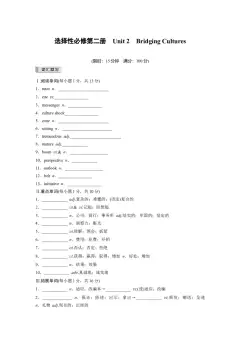
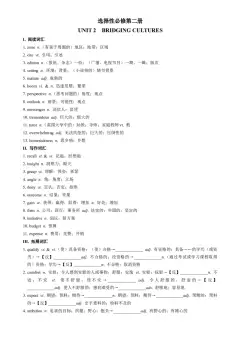
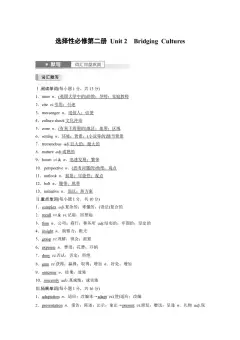
Unit2 Bridging Cultures
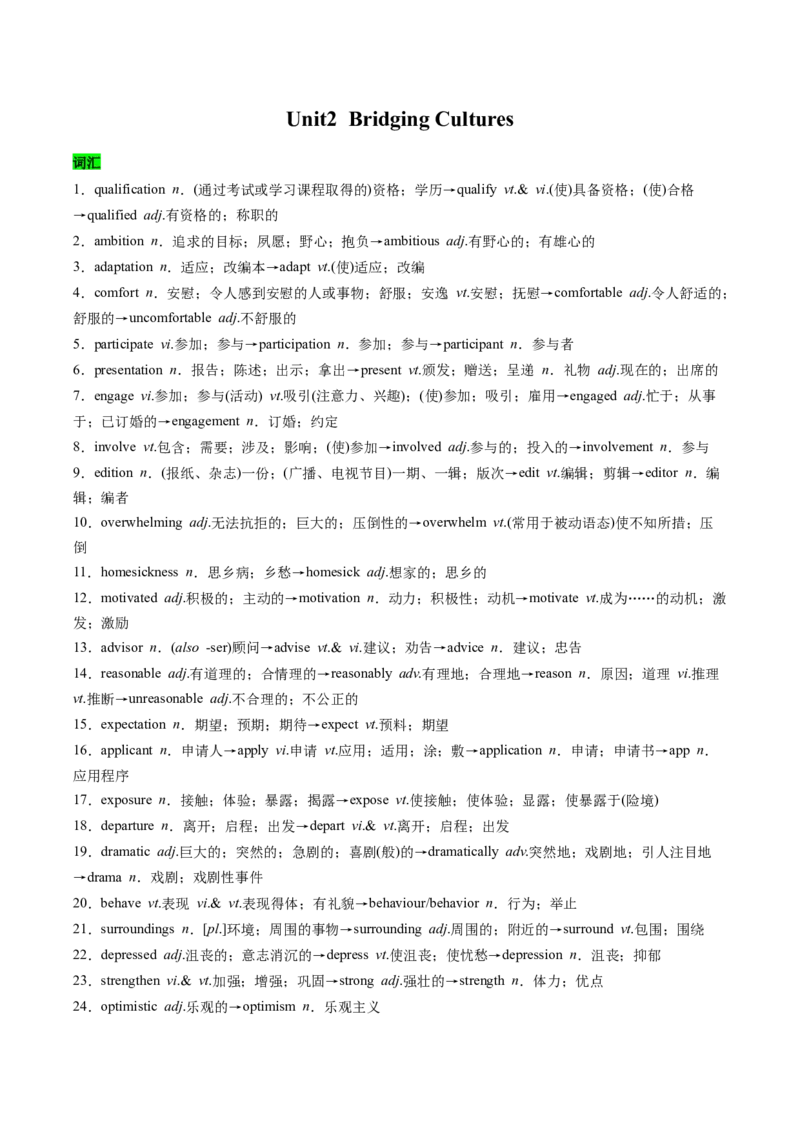
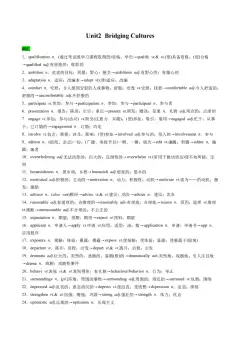
词汇
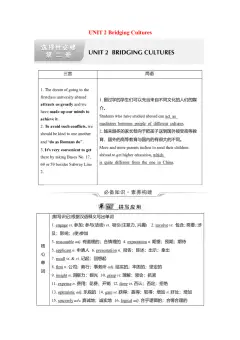
1.qualification n.(通过考试或学习课程取得的)资格;学历→qualify vt.& vi.(使)具备资格;(使)合格
→qualified adj.有资格的;称职的
2.ambition n.追求的目标;夙愿;野心;抱负→ambitious adj.有野心的;有雄心的
3.adaptation n.适应;改编本→adapt vt.(使)适应;改编
4.comfort n.安慰;令人感到安慰的人或事物;舒服;安逸 vt.安慰;抚慰→comfortable adj.令人舒适的;
舒服的→uncomfortable adj.不舒服的
5.participate vi.参加;参与→participation n.参加;参与→participant n.参与者
6.presentation n.报告;陈述;出示;拿出→present vt.颁发;赠送;呈递 n.礼物 adj.现在的;出席的
7.engage vi.参加;参与(活动) vt.吸引(注意力、兴趣);(使)参加;吸引;雇用→engaged adj.忙于;从事
于;已订婚的→engagement n.订婚;约定
8.involve vt.包含;需要;涉及;影响;(使)参加→involved adj.参与的;投入的→involvement n.参与
9.edition n.(报纸、杂志)一份;(广播、电视节目)一期、一辑;版次→edit vt.编辑;剪辑→editor n.编
辑;编者
10.overwhelming adj.无法抗拒的;巨大的;压倒性的→overwhelm vt.(常用于被动语态)使不知所措;压
倒
11.homesickness n.思乡病;乡愁→homesick adj.想家的;思乡的
12.motivated adj.积极的;主动的→motivation n.动力;积极性;动机→motivate vt.成为……的动机;激
发;激励
13.advisor n.(also -ser)顾问→advise vt.& vi.建议;劝告→advice n.建议;忠告
14.reasonable adj.有道理的;合情理的→reasonably adv.有理地;合理地→reason n.原因;道理 vi.推理
vt.推断→unreasonable adj.不合理的;不公正的
15.expectation n.期望;预期;期待→expect vt.预料;期望
16.applicant n.申请人→apply vi.申请 vt.应用;适用;涂;敷→application n.申请;申请书→app n.
应用程序
17.exposure n.接触;体验;暴露;揭露→expose vt.使接触;使体验;显露;使暴露于(险境)
18.departure n.离开;启程;出发→depart vi.& vt.离开;启程;出发
19.dramatic adj.巨大的;突然的;急剧的;喜剧(般)的→dramatically adv.突然地;戏剧地;引人注目地
→drama n.戏剧;戏剧性事件
20.behave vt.表现 vi.& vt.表现得体;有礼貌→behaviour/behavior n.行为;举止
21.surroundings n.[pl.]环境;周围的事物→surrounding adj.周围的;附近的→surround vt.包围;围绕
22.depressed adj.沮丧的;意志消沉的→depress vt.使沮丧;使忧愁→depression n.沮丧;抑郁
23.strengthen vi.& vt.加强;增强;巩固→strong adj.强壮的→strength n.体力;优点
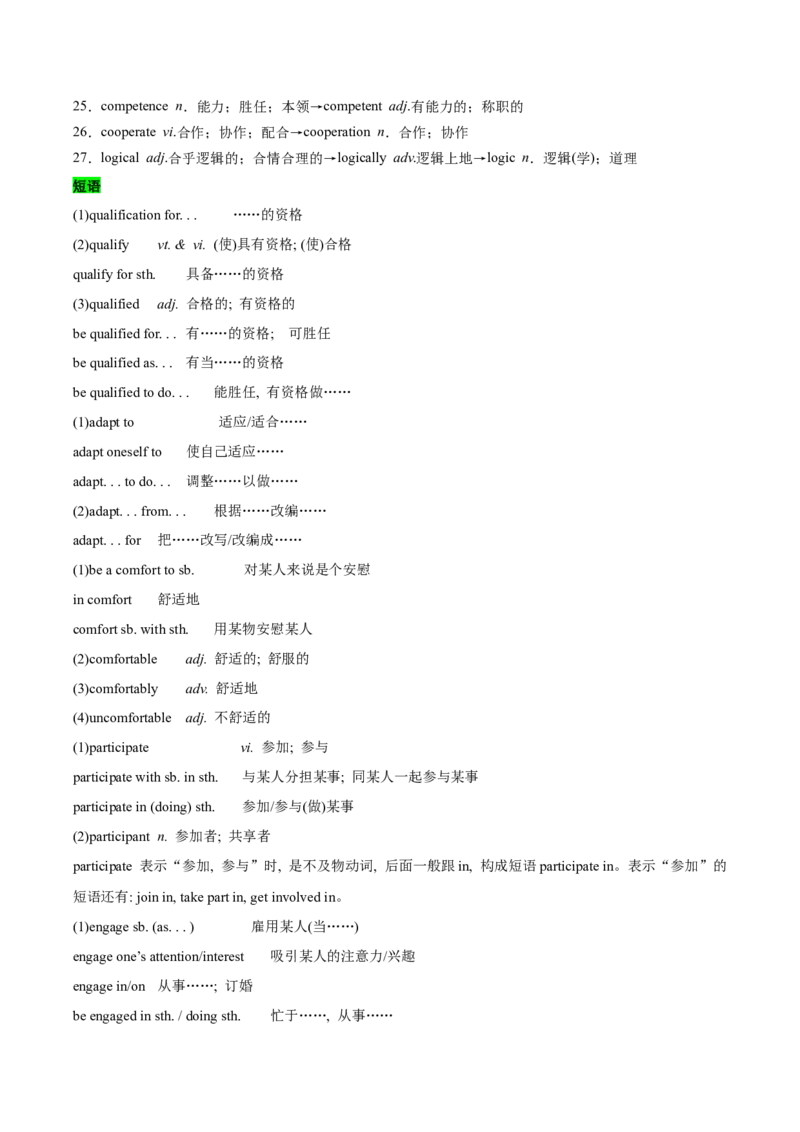
24.optimistic adj.乐观的→optimism n.乐观主义25.competence n.能力;胜任;本领→competent adj.有能力的;称职的
26.cooperate vi.合作;协作;配合→cooperation n.合作;协作
27.logical adj.合乎逻辑的;合情合理的→logically adv.逻辑上地→logic n.逻辑(学);道理
短语
(1)qualification for. . . ……的资格
(2)qualify vt. & vi. (使)具有资格; (使)合格
qualify for sth. 具备……的资格
(3)qualified adj. 合格的; 有资格的
be qualified for. . . 有……的资格; 可胜任
be qualified as. . . 有当……的资格
be qualified to do. . . 能胜任, 有资格做……
(1)adapt to 适应/适合……
adapt oneself to 使自己适应……
adapt. . . to do. . . 调整……以做……
(2)adapt. . . from. . . 根据……改编……
adapt. . . for 把……改写/改编成……
(1)be a comfort to sb. 对某人来说是个安慰
in comfort 舒适地
comfort sb. with sth. 用某物安慰某人
(2)comfortable adj. 舒适的; 舒服的
(3)comfortably adv. 舒适地
(4)uncomfortable adj. 不舒适的
(1)participate vi. 参加; 参与
participate with sb. in sth. 与某人分担某事; 同某人一起参与某事
participate in (doing) sth. 参加/参与(做)某事
(2)participant n. 参加者; 共享者
participate 表示“参加, 参与”时, 是不及物动词, 后面一般跟in, 构成短语participate in。表示“参加”的
短语还有: join in, take part in, get involved in。
(1)engage sb. (as. . . ) 雇用某人(当……)
engage one’s attention/interest 吸引某人的注意力/兴趣
engage in/on 从事……; 订婚
be engaged in sth. / doing sth. 忙于……, 从事……(2)engaged adj. 忙碌的, 订了婚的
(3)engagement n. 婚约; 约会
(1)involve sb. in (doing) sth. 使某人参与(做)某事; 将某人牵涉到(做)某事中
involve doing sth. 包括做某事
(2)get/be involved with 参加; 参与; 和……关系密切
speak up for 为……说话; 支持
speak highly of 高度赞扬
(1)apply vt. 涂; 敷; 搽; 应用; 运用
vi. 申请; 请求; 使用; 有效
apply sth. to 把……涂到; 把……运用到
apply oneself to 致力于; 集中精力于
apply to 适用于……
apply (to. . . )for. . . (向……)申请……
(1)expose . . . to . . . 使……暴露于……; 使……遭受……
be exposed to 暴露于; 接触
(2)exposure n. 接触; 体验; 暴露; 揭露
(1)behave well/badly to/towards sb. 对待某人好/不好
behave oneself守规矩; 表现得体
(2)well-behaved adj. 表现好的
badly-behaved adj. 表现差的
(3)behaviour n. [U]举止; 行为; 习性
4. surroundings n. [pl. ]环境; 周围的事物
It took me a few weeks to get used to my new surroundings.
我花了几周的时间才适应了新环境。
The surrounding small towns have been absorbed into the city.
四周的小城镇已并入这座城市。
(1)surrounding adj. 周围的; 附近的
(2)surround vt. 环绕; 围绕; (使)包围
surround. . . with. . . 以……环绕/包围……
be surrounded by/with. . . 被……包围/环绕
5. strengthen vi. &vt. 加强; 增强; 巩固
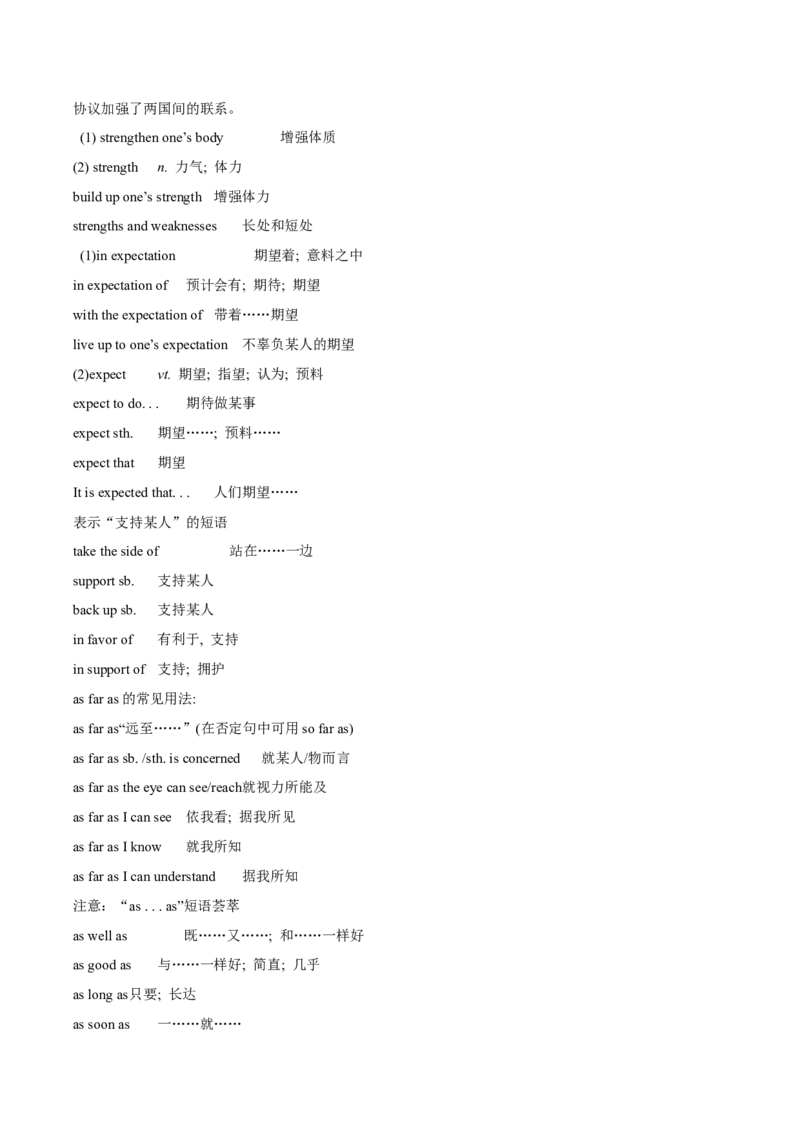
The agreement strengthened the bonds between the two countries.协议加强了两国间的联系。
(1) strengthen one’s body 增强体质
(2) strength n. 力气; 体力
build up one’s strength 增强体力
strengths and weaknesses 长处和短处
(1)in expectation 期望着; 意料之中
in expectation of 预计会有; 期待; 期望
with the expectation of 带着……期望
live up to one’s expectation 不辜负某人的期望
(2)expect vt. 期望; 指望; 认为; 预料
expect to do. . . 期待做某事
expect sth. 期望……; 预料……
expect that 期望
It is expected that. . . 人们期望……
表示“支持某人”的短语
take the side of 站在……一边
support sb. 支持某人
back up sb. 支持某人
in favor of 有利于, 支持
in support of 支持; 拥护
as far as的常见用法:
as far as“远至……”(在否定句中可用so far as)
as far as sb. /sth. is concerned 就某人/物而言
as far as the eye can see/reach就视力所能及
as far as I can see 依我看; 据我所见
as far as I know 就我所知
as far as I can understand 据我所知
注意:“as . . . as”短语荟萃
as well as 既……又……; 和……一样好
as good as 与……一样好; 简直; 几乎
as long as只要; 长达
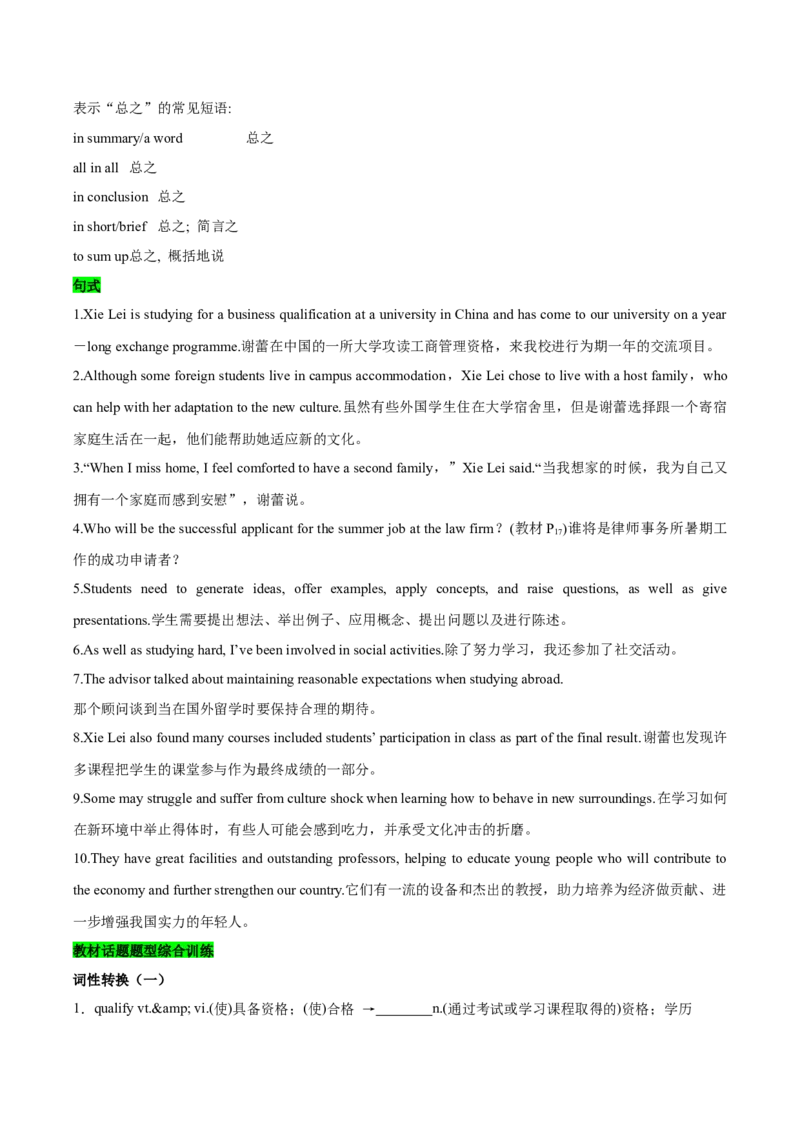
as soon as 一……就……表示“总之”的常见短语:
in summary/a word 总之
all in all 总之
in conclusion 总之
in short/brief 总之; 简言之
to sum up总之, 概括地说
句式
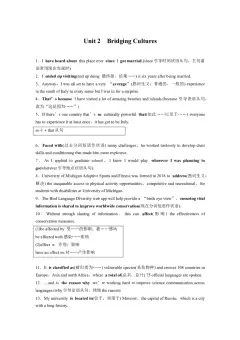
1.Xie Lei is studying for a business qualification at a university in China and has come to our university on a year
-long exchange programme.谢蕾在中国的一所大学攻读工商管理资格,来我校进行为期一年的交流项目。
2.Although some foreign students live in campus accommodation,Xie Lei chose to live with a host family,who
can help with her adaptation to the new culture.虽然有些外国学生住在大学宿舍里,但是谢蕾选择跟一个寄宿
家庭生活在一起,他们能帮助她适应新的文化。
3.“When I miss home, I feel comforted to have a second family,”Xie Lei said.“当我想家的时候,我为自己又
拥有一个家庭而感到安慰”,谢蕾说。
4.Who will be the successful applicant for the summer job at the law firm?(教材P )谁将是律师事务所暑期工
17
作的成功申请者?
5.Students need to generate ideas, offer examples, apply concepts, and raise questions, as well as give
presentations.学生需要提出想法、举出例子、应用概念、提出问题以及进行陈述。
6.As well as studying hard, I’ve been involved in social activities.除了努力学习,我还参加了社交活动。
7.The advisor talked about maintaining reasonable expectations when studying abroad.
那个顾问谈到当在国外留学时要保持合理的期待。
8.Xie Lei also found many courses included students’ participation in class as part of the final result.谢蕾也发现许
多课程把学生的课堂参与作为最终成绩的一部分。
9.Some may struggle and suffer from culture shock when learning how to behave in new surroundings.在学习如何
在新环境中举止得体时,有些人可能会感到吃力,并承受文化冲击的折磨。
10.They have great facilities and outstanding professors, helping to educate young people who will contribute to
the economy and further strengthen our country.它们有一流的设备和杰出的教授,助力培养为经济做贡献、进
一步增强我国实力的年轻人。
教材话题题型综合训练
词性转换(一)
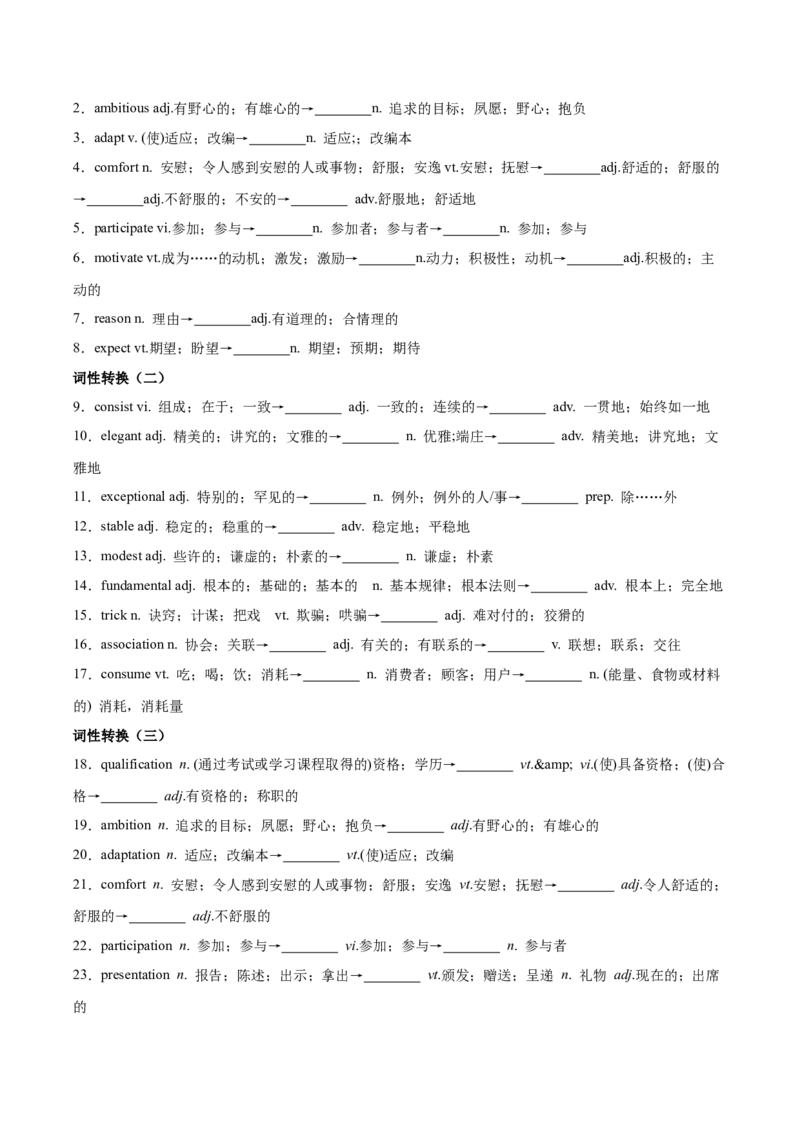
1.qualify vt.& vi.(使)具备资格;(使)合格 → n.(通过考试或学习课程取得的)资格;学历2.ambitious adj.有野心的;有雄心的→ n. 追求的目标;夙愿;野心;抱负
3.adapt v. (使)适应;改编→ n. 适应;;改编本
4.comfort n. 安慰;令人感到安慰的人或事物;舒服;安逸vt.安慰;抚慰→ adj.舒适的;舒服的
→ adj.不舒服的;不安的→ adv.舒服地;舒适地
5.participate vi.参加;参与→ n. 参加者;参与者→ n. 参加;参与
6.motivate vt.成为……的动机;激发;激励→ n.动力;积极性;动机→ adj.积极的;主
动的
7.reason n. 理由→ adj.有道理的;合情理的
8.expect vt.期望;盼望→ n. 期望;预期;期待
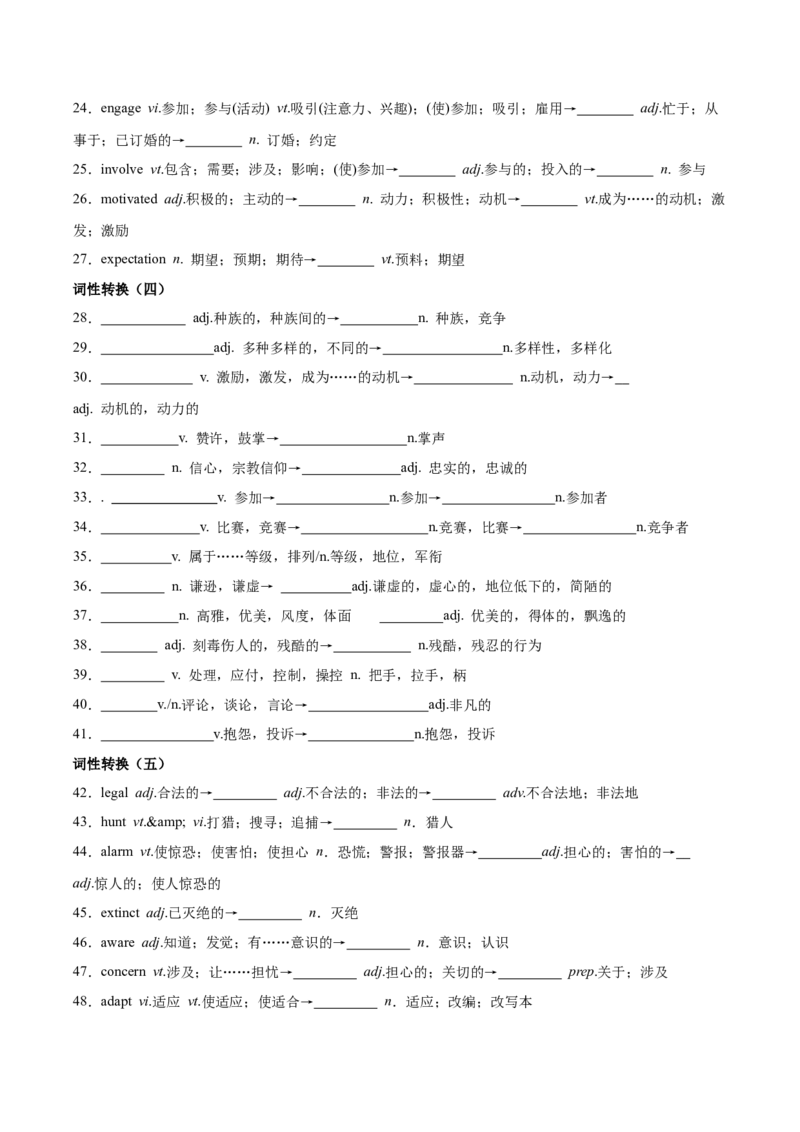
词性转换(二)
9.consist vi. 组成;在于;一致→ adj. 一致的;连续的→ adv. 一贯地;始终如一地
10.elegant adj. 精美的;讲究的;文雅的→ n. 优雅;端庄→ adv. 精美地;讲究地;文
雅地
11.exceptional adj. 特别的;罕见的→ n. 例外;例外的人/事→ prep. 除……外
12.stable adj. 稳定的;稳重的→ adv. 稳定地;平稳地
13.modest adj. 些许的;谦虚的;朴素的→ n. 谦虚;朴素
14.fundamental adj. 根本的;基础的;基本的 n. 基本规律;根本法则→ adv. 根本上;完全地
15.trick n. 诀窍;计谋;把戏 vt. 欺骗;哄骗→ adj. 难对付的;狡猾的
16.association n. 协会;关联→ adj. 有关的;有联系的→ v. 联想;联系;交往
17.consume vt. 吃;喝;饮;消耗→ n. 消费者;顾客;用户→ n. (能量、食物或材料
的) 消耗,消耗量
词性转换(三)
18.qualification n. (通过考试或学习课程取得的)资格;学历→ vt.& vi.(使)具备资格;(使)合
格→ adj.有资格的;称职的
19.ambition n. 追求的目标;夙愿;野心;抱负→ adj.有野心的;有雄心的
20.adaptation n. 适应;改编本→ vt.(使)适应;改编
21.comfort n. 安慰;令人感到安慰的人或事物;舒服;安逸 vt.安慰;抚慰→ adj.令人舒适的;
舒服的→ adj.不舒服的
22.participation n. 参加;参与→ vi.参加;参与→ n. 参与者
23.presentation n. 报告;陈述;出示;拿出→ vt.颁发;赠送;呈递 n. 礼物 adj.现在的;出席
的24.engage vi.参加;参与(活动) vt.吸引(注意力、兴趣);(使)参加;吸引;雇用→ adj.忙于;从
事于;已订婚的→ n. 订婚;约定
25.involve vt.包含;需要;涉及;影响;(使)参加→ adj.参与的;投入的→ n. 参与
26.motivated adj.积极的;主动的→ n. 动力;积极性;动机→ vt.成为……的动机;激
发;激励
27.expectation n. 期望;预期;期待→ vt.预料;期望
词性转换(四)
28. adj.种族的,种族间的→ n. 种族,竞争
29. adj. 多种多样的,不同的→ n.多样性,多样化
30. v. 激励,激发,成为……的动机→ n.动机,动力→
adj. 动机的,动力的
31. v. 赞许,鼓掌→ n.掌声
32. n. 信心,宗教信仰→ adj. 忠实的,忠诚的
33.. v. 参加→ n.参加→ n.参加者
34. v. 比赛,竞赛→ n.竞赛,比赛→ n.竞争者
35. v. 属于……等级,排列/n.等级,地位,军衔
36. n. 谦逊,谦虚→ adj.谦虚的,虚心的,地位低下的,简陋的
37. n. 高雅,优美,风度,体面 adj. 优美的,得体的,飘逸的
38. adj. 刻毒伤人的,残酷的→ n.残酷,残忍的行为
39. v. 处理,应付,控制,操控 n. 把手,拉手,柄
40. v./n.评论,谈论,言论→ adj.非凡的
41. v.抱怨,投诉→ n.抱怨,投诉
词性转换(五)
42.legal adj.合法的→ adj.不合法的;非法的→ adv.不合法地;非法地
43.hunt vt.& vi.打猎;搜寻;追捕→ n.猎人
44.alarm vt.使惊恐;使害怕;使担心 n.恐慌;警报;警报器→ adj.担心的;害怕的→
adj.惊人的;使人惊恐的
45.extinct adj.已灭绝的→ n.灭绝
46.aware adj.知道;发觉;有……意识的→ n.意识;认识
47.concern vt.涉及;让……担忧→ adj.担心的;关切的→ prep.关于;涉及
48.adapt vi.适应 vt.使适应;使适合→ n.适应;改编;改写本49.beauty n.美;美人;美好的东西→ adj.美丽的→ vt.使美化,使变美
50.press vi.& vt.按;压;逼迫→ n.压力;要求
51.observe vt.观察(到);注视;遵守→ n.观察→ n.观察者
52.remind vt.提醒;使想起→ n.起提醒作用的东西;提醒者
53.recover vi.恢复;康复 vt.找回;寻回→ n.恢复;复苏;康复
54.intend vi.& vt.打算;计划;想要→ n.打算;目的;意图
55.threat n.威胁→ vt.威胁;危及
完成句子
56.The teacher’s lively talk (吸引我们的注意). Everyone was immersed in it.
57.They provide guests with the best service to make them (舒服自在、不拘束).
58.Change requires you to step out of your (舒适区) and into the unknown.
59.Generally speaking, (多接触) the rest of the world will help you see things from different angles.
60.Finally, studying abroad provides a great (做贡献的机会)the development of our motherland.
61.It’s said that “No building can stand without ”. (坚实的基础)
62.Students should (抱有现实的期望)of lectures charging much money on the
Internet.
63.With each space mission comes greater insight, (从而激励) us to continue along the
same path of adventure.
64.The poster which we designed quickly was (不大成功).
65.What kind of difficulty will Mary and her sister have (适应生活)in this new city?
66.He eventually (实现了他的抱负) when he was awarded the Nobel Prize.
67.People commonly believe that a good soldier should (有成为……的雄心)a general.
翻译
68.他们的友善和热情让我无论走到哪里都有宾至如归的感觉。
69.学生们如果与一个相处不够融洽的人分组在一起可能会感到不那么有激情。
70.窗户上原来的洞找不到了,这真是一种莫大的安慰。
71.我坚信只有通过共同努力保护海洋我们才有美好的未来。72.我被告知我在写作比赛中获得一等奖,而且两天后有一个颁奖仪式。
73.我相信,只有每个人的贡献和参与,这场运动才能创造奇迹。
74.直到我参加了颁奖典礼并拿到了证书,我还是觉得很难相信。
75.另外,密切跟踪老师网络课堂内容是明智的,以便我们可以更加参与、聚焦和有动力。
阅读理解
In most Hollywood movies, the Native American Navajo s still fight on horses in the American Southwest.
But during World War II, a group of Navajos made their language into a weapon to protect the United States. They
were the Navajo Code Talkers, and it is one of the few unbroken codes in military history.
Navajo was the perfect choice for a secret language. It is very complex. One vowel (元音) can have up to ten
different pronunciations, changing the meaning of any word. In the 1940s, Navajo was unwritten language. No one
outside of the reservation (居留地) could speak it or understand it.
The Navajo Code team had to invent new words to describe military equipment. For example, they named
ships after fish: lotso-whale (battleship), calo-shark (destroyer), beshloiron-fish (submarine). When a Code Talker
received a message via radio, he heard a series of unrelated Navajo words. He would then translate the words into
English and use the first letter of each English word to spell the message. The Navajo words tsah (needle), wol-la-
chee (ant), ah-kh-di-glini (victor), and tsah-ah-dzoh (yucca) spelled NAVY.
The Code Talker kept the code a secret. They memorized everything. There were no code books. As a result,
no ordinary Navajo soldiers, if captured by the enemy, could understand the code. More than 3,600 Navajos served
in World War II, but only 420 were Code Talkers with the US Marines. They coded and decoded battlefield
messages better and faster than any machine. They could encode, transmit, and decode a three-line English message
in 20 seconds. Machines of the time required 30 minutes to perform the same job.
Even after the war the code remained top secret. When they were asked about their role, Code Talkers just
said: “I was a radioman.” War movies and histories came out without mentioning them. The code was never used
again and only in 1968 did the secret come out.
76.Why could Navajo be used as a military code?
A.It had a complex writing system. B.It was designed specifically for World War Ⅱ.
C.Only the Navajo s could understand it. D.Navajo words varied greatly in pronunciation.77.What would the Navajo Code team do right after receiving a message?
A.Put it into English in a secret way. B.Record it in Navajo letters.
C.Put the Navajo words in order. D.Submit it to the officer immediately.
78.What is paragraph 4 mainly about?
A.Heroic deeds of Navajo Code Talkers. B.Working contents of Navajo Code Talkers.
C.The difficulty of becoming a Navajo Code Talker. D.The professionalism of Navajo Code Talkers.
79.What can be inferred from the passage?
A.The Navajo Code Talkers can be found to fight on horses in US movies.
B.Around 12% Navajo soldiers were taken prisoners during World War Ⅱ.
C.War messages were translated into English through Navajo code books.
D.The Navajo language contributed a lot to the US army in World War Ⅱ.
七选五
Want to find out how you can learn a new language as fast as possible? If you commit to your new language,
work hard, and have an open mind about making mistakes, you can go from basic conversational skills to fluency
without the need for expensive classes and years of dedicated study. 80
Watch shows or movies.
81 Possibly the easiest thing you can do is watch television shows or movies in the language you
are trying to learn. To make things easier, try to watch shows or movies whose plots you are already familiar with
— like kids’ cartoons or dubbed versions of English movie. Knowing the plots will help you to identify the
meanings of words and phrases.
82
Study smarter, not harder. Mastering everyday conversation will let you hit the ground running. It’s more
important to master basic phrases you’ll use frequently than it is to start off by learning the alphabet or the perfect
sentence structure. For example, you can learn phrases like: Hello, Goodbye, How are you?, I’m doing well, What
is your name?, My name is…, and so on.
Don’t worry about perfect grammar.
83 The reason why most people can’t remember most of the language they spent years learning in
school is that school curricula tend to focus a huge amount of time on learning grammar and very little time on
speech. 84 The specifics of grammar will come later.
A.Learn how to greet.
B.Learn basic phrases.C.We’ll let you in on the easiest language-learning secrets.
D.Focus on conveying a message and being understandable.
E.Language learners are afraid of being laughed at by listeners.
F.If you want to learn a language quickly, you should learn how to talk first.
G.Immersion can help you quickly improve your listening and speaking skills.
完形填空
When I was 15 years old, I made my first visit to the United States. It wasn’t the first time I had been to a
foreign 85 . Like most English children I 86 French at school and I had often been too France, so I
was used to 87 a foreign language to people who didn’t understand English. But when I went to America I
was really looking forward to having a nice holiday without any 88 problems.
How wrong I was! The misunderstanding 89 at the airport. I was looking for a 90 telephone
to give my American friend Danny a 91 and told her that I had arrived. A friendly old man saw me looking
lost and asked if he could 92 me. “Yes”, I said, “I want to give my friend a ring”. “Well, that’s nice,” he
said. “Are you getting married? But aren’t you a bit 93 ?” “Who is talking about marriage?” I became a little
94 ,“I just want to give my friend a ring to tell her I have arrived. Can you tell me 95 there’s a phone
box?” “Oh!” he said, “there is a phone downstairs.”
When at last, we did meet up, I told Danny what 96 to me. Danny laughed, “I had so many 97
at first. There are lots of words which the Americans 98 differently in meaning from us British.” She said to
me, “But don’t worry. You’ll soon 99 to all the funny things they say. Most of the time British and
American people understand each other!”
85.A.city B.country C.house D.family
86.A.taught B.liked C.asked D.learned
87.A.saying B.talking C.speaking D.telling
88.A.language B.money C.time D.human
89.A.met B.began C.passed D.stopped
90.A.cheap B.nice C.public D.popular
91.A.note B.ring C.letter D.present
92.A.help B.find C.follow D.pay
93.A.active B.old C.tall D.young
94.A.angry B.excited C.upset D.worried
95.A.how B.why C.where D.when96.A.agreed B.listened C.turned D.happened
97.A.messages B.difficulties C.things D.questions
98.A.read B.think C.use D.write
99.A.get used B.look forward C.pay attention D.be famous
语法填空
100.It is necessary that initiatives calling for alternative transportation modes (support) to keep
company with these efforts, and unsustainable practices, such as reliance solely on private
vehicles, be disposed of in the near future.
101.Supported by the enthusiastic hosts, Allen won the silver medal out of (expect).
102.The traditional tea-making in China is a whole system (involve) knowledge, skills, and
practices about the management (manage) of tea plantations, picking of tea leaves, manual processing, drinking,
and sharing of tea.
103.They made their (depart) in the early morning.
104. reading habits have changed can be felt from the amount of time young people spend sweeping
through short videos on their smartphones.
105.They thought I was an inspiration as well as someone they could get (motivate) by.
106.They (behave) differently and shouted rudely when the assistant bent down
(comfort) a little girl.
107.Although some foreign students live in campus accommodation, Xie Lei chose to live with a host family,
can help with her (adapt) to the new culture.
108.He was an (ambition) man with a strong motive for doing something.
109.Young people in China today have their own strengths, as they are (ambition), innovative, and
also willing to contribute.
110.The (apply) were asked to fill in a form and went for their turn.
111.We worked hard in order to live up to our parents’ . (expect)
112. (expose) to freezing weather, courageous tourists and scientists still choose to visit Antarctica.
113.The young man with great had an plan to build a school in the poor village.(ambition)
114.Being to sunlight for too much time will do harm to one’s skin, so we should decrease the direct
to sunlight.(expose)
语篇填空
At the age of 10, I was once asked to deliver a speech 115 (title) “A Real Test in My Life” beforethe whole class! Just imagine how 116 (terrible) shy I was the moment I thought of that with so many
eyes fixed upon me. I had only one 117 (choose), though. First, I was to draft the speech and that was
just a piece of cake for me, because I was 118 good writer. But the hard part lay in my oral presentation.
To read from the paper was not allowed. I had to recite in front of such a big audience!
A real trial began when I stood on the platform with my legs 119 (tremble) and my mind blank. I
didn’t know how much time 120 (pass) by. My listeners were still waiting patiently and 121
any signs of rushing me. Gradually I found myself back, giving out my speech with 122 (difficult).
Finally I finished. After it seemed to be a hundred years, I found my audience applauding. I made 123 !
From then on, my fear of talking before an audience disappeared. Actually I now turn out to be a great speaker.
Looking back, I know the greatest difficulty on our way to success is our inner fear. Overcome it, 124
we will be able to achieve our goals.
应用文写作
假设你是学校科技社的李华,你校将举办主题为“生活中的人工智能”的英语演讲比赛。请你写一封邮件,
邀请你的同学参加这次比赛。内容包括:
1. 比赛的主题、时间、地点;2. 参赛的要求;3. 参赛的意义。
注意:
1. 写作词数应为80左右;2. 可适当增加细节,以使行文连贯。
Dear classmates,
I am Li Hua, a member of our school’s Technology Club.
____________________________________________________________________________________________
____________________________________________________________________________________________
____________________________________________________________________________________________
____________________________________________________________________________________________
_______________________________________________________________________________________
Sincerely,
Li Hua