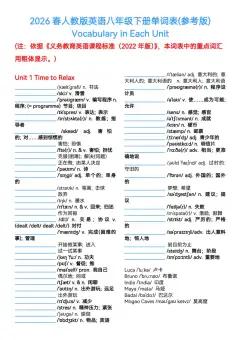
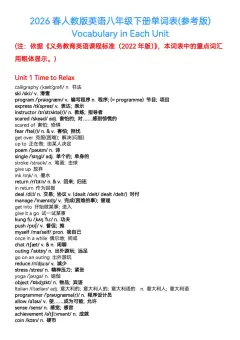
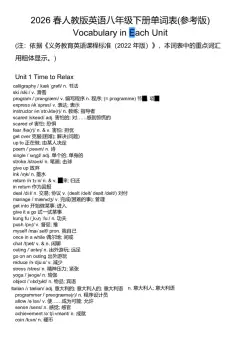
内容范围与教学序列
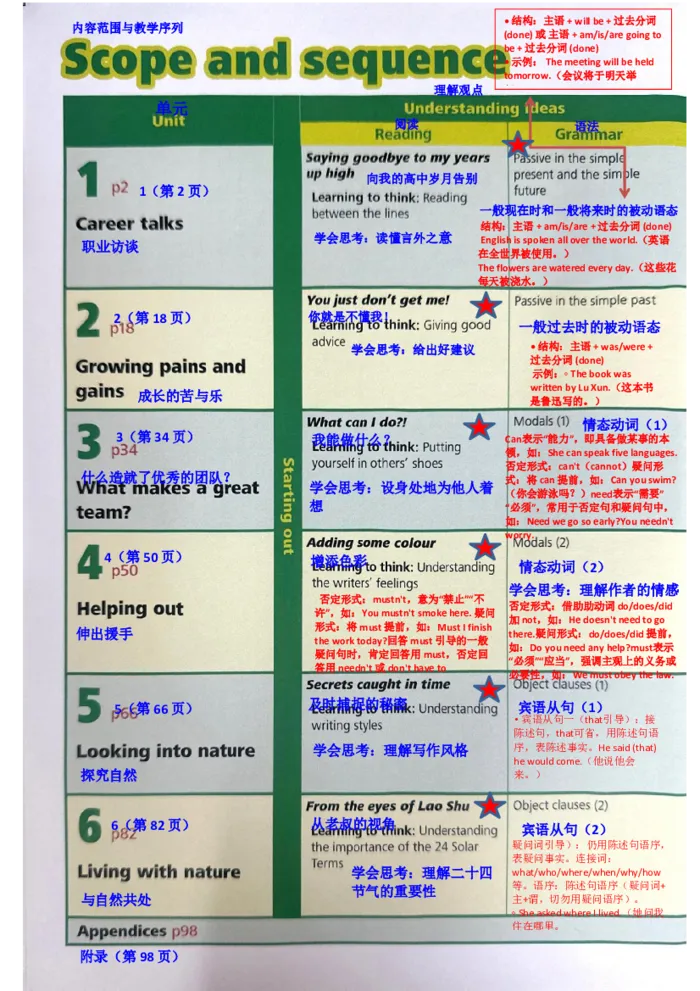
单元
理解观点
阅读
语法
1(第2 页)
职业访谈
向我的高中岁月告别
学会思考:读懂言外之意
一般现在时和一般将来时的被动语态
2(第18 页)
成长的苦与乐
你就是不懂我!
增添色彩
6(第82 页)
一般过去时的被动语态
情态动词(1)
伸出援手
学会思考:设身处地为他人着
想
5(第66 页)
我能做什么?
什么造就了优秀的团队?
4(第50 页)
学会思考:给出好建议
及时捕捉的秘密
探究自然
情态动词(2)
3(第34 页)
宾语从句(1)
学会思考:理解写作风格
学会思考:理解作者的情感
否定形式:借助助动词do/does/did
加not,如:He doesn't need to go
there.疑问形式:do/does/did 提前,
如:Do you need any help?must表示
“必须”“应当”,强调主观上的义务或
必要性,如:We must obey the law.
与自然共处
学会思考:理解二十四
节气的重要性
从老叔的视角
宾语从句(2)
附录(第98 页)
结构:主语+ am/is/are + 过去分词(done)
English is spoken all over the world.(英语
在全世界被使用。)
The flowers are watered every day.(这些花
每天被浇水。)
• 结构:主语+ was/were +
过去分词(done)
示例:◦The book was
written by Lu Xun.(这本书
是鲁迅写的。)
• 结构:主语+ will be + 过去分词
(done) 或主语+ am/is/are going to
be + 过去分词(done)
• 示例:The meeting will be held
tomorrow.(会议将于明天举
行
Can表示“能力”,即具备做某事的本
领,如:She can speak five languages.
否定形式:can't(cannot)疑问形
式:将can 提前,如:Can you swim?
(你会游泳吗?)need表示“需要”
“必须”,常用于否定句和疑问句中,
如:Need we go so early?You needn't
worry.
• 宾语从句一(that引导):接
陈述句,that可省,用陈述句语
序,表陈述事实。He said (that)
he would come.(他说他会
来。)
疑问词引导):仍用陈述句语序,
表疑问事实。连接词:
what/who/where/when/why/how
等。语序:陈述句语序(疑问词+
主+谓,切勿用疑问语序)。
◦She asked where I lived.(她问我
住在哪里。
否定形式:mustn't,意为“禁止”“不
许”,如:You mustn't smoke here. 疑问
形式:将must 提前,如:Must I finish
the work today?回答must 引导的一般
疑问句时,肯定回答用must,否定回
答用needn't 或don't have to
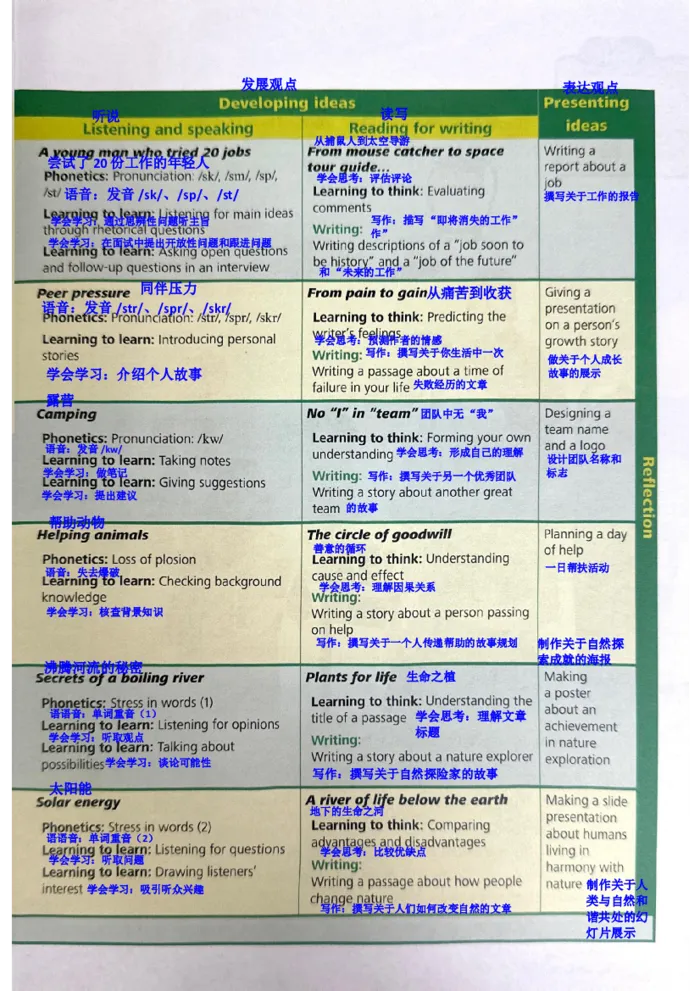
发展观点
听说
表达观点
读写
尝试了20 份工作的年轻人
学会学习:在面试中提出开放性问题和跟进问题
语音:发音/sk/、/sp/、/st/
同伴压力
和“未来的工作”
学会学习:通过思辨性问题听主旨
写作:描写“即将消失的工作”
作”
撰写关于工作的报告
学会思考:评估评论
从捕鼠人到太空导游
语音:发音/str/、/spr/、/skr/
学会学习:介绍个人故事
从痛苦到收获
学会思考:预测作者的情感
写作:撰写关于你生活中一次
失败经历的文章
做关于个人成长
故事的展示
露营
学会思考:形成自己的理解
语音:发音/kw/
团队中无“我”
学会学习:提出建议
学会学习:做笔记
设计团队名称和
标志
写作:撰写关于另一个优秀团队
的故事
太阳能
沸腾河流的秘密
帮助动物
写作:撰写关于人们如何改变自然的文章
学会思考:比较优缺点
地下的生命之河
制作关于人
类与自然和
谐共处的幻
灯片展示
学会学习:吸引听众兴趣
写作:撰写关于自然探险家的故事
制作关于自然探
索成就的海报
写作:撰写关于一个人传递帮助的故事规划
学会学习:听取问题
学会思考:理解文章
标题
学会学习:谈论可能性
一日帮扶活动
语语音:单词重音(2)
生命之植
学会学习:听取观点
学会思考:理解因果关系
语语音:单词重音(1)
善意的循环
学会学习:核查背景知识
语音:失去爆破
工作是人们生活中重要的一部分。在这个单元中,让我们探索不同类型的工作。
工作能带给我们什么?你梦想中的工作是什么样的?职业是如何随时间变化的?
本单元结束后,你将写一份关于一份某一职业的报告,
在完成本单元后,你将能够:
用本单元中的词汇和表达来谈论工作
使用一般现在时和一般将来时的被动语态来讲还关于工作的内容。·
解释工作在我们生活中的意义。
你会用哪些词来描述这些人
一般现在时的被动语态
(一)基本结构
肯定句:主语+ am/is/are + 过去分词(done)
否定句:主语+ am/is/are + not + 过去分词(done)
一般疑问句:Am/Is/Are + 主语+ 过去分词(done)?
特殊疑问句:特殊疑问词+ am/is/are + 主语+ 过去分词(done)?
(二)用法
表示现在经常性、习惯性的被动动作,或现阶段存在的被动状态。
• 例如:
◦肯定句:The classroom is cleaned every day.(教室每天都被打扫。)
◦否定句:The flowers aren't watered by him.(这些花不是被他浇的。)
◦一般疑问句:Is this book written by Lu Xun?(这本书是鲁迅写的吗?)
◦特殊疑问句:Where is the new bridge built?(这座新桥建在哪里?)
二、一般将来时的被动语态
(一)基本结构
结构1(常用):主语+ will/shall + be + 过去分词(done)
结构2:主语+ am/is/are + going to + be + 过去分词(done)
否定句:
• will/shall + not + be + 过去分词(done)
• am/is/are + not + going to + be + 过去分词(done)
一般疑问句:
• Will/Shall + 主语+ be + 过去分词(done)?
• Am/Is/Are + 主语+ going to + be + 过去分词(done)?
特殊疑问句:特殊疑问词+ will/shall + 主语+ be + 过去分词(done)?或特殊疑问词+ am/is/are + 主语+ going to + be + 过去分词
(done)?
(二)用法
表示将来某个时间要发生的被动动作,或将来存在的被动状态。
• 例如:结构1:The new library will be opened next month.(新图书馆将于下个月开放。)
◦结构2:A sports meeting is going to be held in our school next week.(下周我们学校将举办一场运动会。)
◦否定句:The work won't be finished tomorrow.(这项工作明天不会完成。)
◦一般疑问句:Will the project be completed on time?(这个项目会按时完成吗?)
特殊疑问句:When is the concert going to be held?(音乐会将在什么时候举办?)
三、注意事项
一般现在时被动语态中,要根据主语的人称和数选择“am/is/are”;一般将来时被动语态中,“shall”常用于第一人称,“will”可用
于各种人称。
• 过去分词的形式要准确,需牢记不规则动词的过去分词变化(如:do - done;go - gone等)。
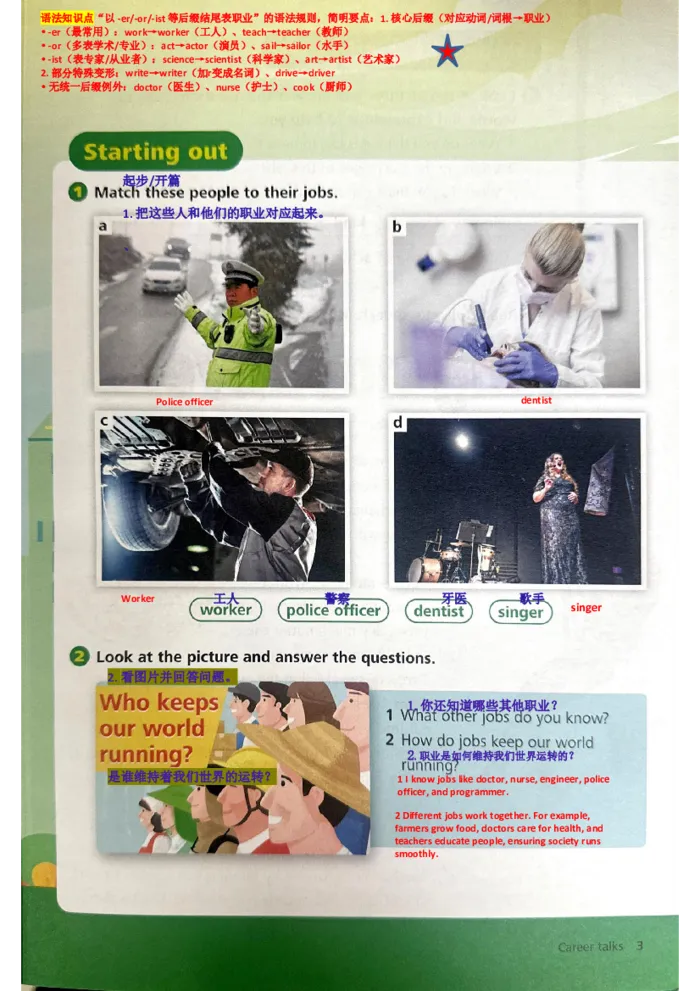
职业讲座
起步/开篇
1. 把这些人和他们的职业对应起来。
、
工人
警察
牙医
歌手
2. 看图片并回答问题。
是谁维持着我们世界的运转?
1.你还知道哪些其他职业?
2.职业是如何维持我们世界运转的?
Police officer
dentist
Worker
singer
语法知识点“以-er/-or/-ist 等后缀结尾表职业”的语法规则,简明要点:1. 核心后缀(对应动词/词根→职业)
• -er(最常用):work→worker(工人)、teach→teacher(教师)
• -or(多表学术/专业):act→actor(演员)、sail→sailor(水手)
• -ist(表专家/从业者):science→scientist(科学家)、art→artist(艺术家)
2. 部分特殊变形:write→writer(加r变成名词)、drive→driver
• 无统一后缀例外:doctor(医生)、nurse(护士)、cook(厨师)
1 I know jobs like doctor, nurse, engineer, police
officer, and programmer.
2 Different jobs work together. For example,
farmers grow food, doctors care for health, and
teachers educate people, ensuring society runs
smoothly.
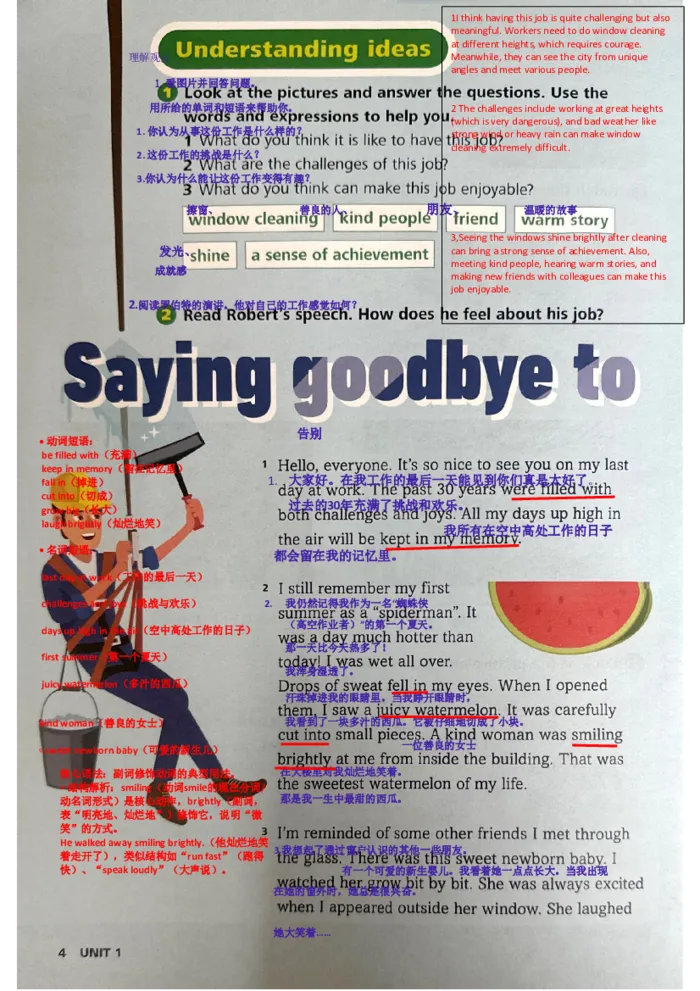
理解观点
1.看图片并回答问题。
用所给的单词和短语来帮助你。
1. 你认为从事这份工作是什么样的?
2. 这份工作的挑战是什么?
3.你认为什么能让这份工作变得有趣?
擦窗、
善良的人、
朋友、
温暖的故事
发光、
成就感
2.阅读罗伯特的演讲。他对自己的工作感觉如何?
告别
1.
大家好。在我工作的最后一天能见到你们真是太好了。
过去的30年充满了挑战和欢乐。
我所有在空中高处工作的日子
都会留在我的记忆里。
2.
我仍然记得我作为一名“蜘蛛侠
(高空作业者)”的第一个夏天。
那一天比今天热多了!
我浑身湿透了。
汗珠掉进我的眼睛里。当我睁开眼睛时,
我看到了一块多汁的西瓜。它被仔细地切成了小块。
一位善良的女士
在大楼里对我灿烂地笑着。
那是我一生中最甜的西瓜。
3.我想起了通过窗户认识的其他一些朋友。
有一个可爱的新生婴儿。我看着她一点点长大。当我出现
在她的窗外时,她总是很兴奋。
她大笑着……
• 动词短语:
be filled with(充满)
keep in memory(留在记忆里)
fall in(掉进)
cut into(切成)
grow big(长大)
laugh brightly(灿烂地笑)
• 名词短语:
last day at work(工作的最后一天)
challenges and joys(挑战与欢乐)
days up high in the air(空中高处工作的日子)
first summer(第一个夏天)
juicy watermelon(多汁的西瓜)
kind woman(善良的女士)
◦sweet newborn baby(可爱的新生儿)
核心语法:副词修饰动词的典型用法。
• 结构解析:smiling(动词smile的现在分词/
动名词形式)是核心动作,brightly(副词,
表“明亮地、灿烂地”)修饰它,说明“微
笑”的方式。
He walked away smiling brightly.(他灿烂地笑
着走开了),类似结构如“run fast”(跑得
快)、“speak loudly”(大声说)。
1I think having this job is quite challenging but also
meaningful. Workers need to do window cleaning
at different heights, which requires courage.
Meanwhile, they can see the city from unique
angles and meet various people.
2 The challenges include working at great heights
(which is very dangerous), and bad weather like
strong wind or heavy rain can make window
cleaning extremely difficult.
3,Seeing the windows shine brightly after cleaning
can bring a strong sense of achievement. Also,
meeting kind people, hearing warm stories, and
making new friends with colleagues can make this
job enjoyable.
我在高处的那些年
当时她家的猫还想“抓”我的刷子。后来,她画了一幅我的画像拿给我看!
快乐透过玻璃钻进了我的心里。
有一天,她妈妈举着一张便签给我看:
她们一家要搬家了。
我很难过,但也很开心我们曾是朋友。
4. 擦窗户通常不被认为是份好工作,但我从不后悔。我遇到过很多善良的人,也参与了不少温暖的
故事。我在这份工作里找到了成就感。
5. 今天,我要和自己的“蜘蛛侠”工作说再见了。
而你们即将开启在空中的日常。
这座城市因我们而
更加闪亮,
这份工作也会让我们自身发光。
祝你们所有人一切顺利!
职业分享
语法知识点解析
1. “drew a picture of me”
• 语法点:名词所有格/介词“of”表所属关系
• 解析:“of + 宾格”结构用于表示“……的(东西)”,此处“a picture of me”意为“我的一幅画像”,是英语中表达所属关
系的常见方式,区别于“my picture”(我的画,画属于我但不一定画的是我)。
2. “Happiness passed through the glass”
• 语法点:不及物动词“pass”的用法
• 解析:“pass”作不及物动词时,常加介词表示“穿过、通过”,“pass through”意为“穿过(立体空间)”,此处描述快乐
“穿过玻璃”的动作,体现不及物动词与介词的搭配规则。
3. “a sense of achievement”
• 语法点:名词所有格(of结构)表抽象概念所属
• 解析:“a sense of + 抽象名词”是固定结构,意为“……的感觉”,“a sense of achievement”即“成就感”,用于表达抽象的
心理感受或概念的所属关系。
4. “days up in the air”
• 语法点:副词短语作后置定语
• 解析:“up in the air”是副词短语,在句中作“days”的后置定语,修饰“days”的状态,说明是“在空中的日常”,体现副
词短语修饰名词时的后置用法。
5. “because of us”• 语法点:介词短语“because of”的用法解析:“because of”是介词短语,后接名词、代词或动名词,表
原因,此处“because of us”说明城市变亮的原因是“我们”,需注意与连词“because”(后接从句)的用法区别。
a photo of her(她
的一张照片)
a portrait of the
leader(这位领导
人的一幅肖像)
a sketch of the park
(公园的一幅速
写)
核心区别:词性和用法不同,a lot是副词短语,a lot of/lots of是形容词短语(可互换)。
• a lot of + 名词:修饰可数名词复数或不可数名词,表“许多”,用于肯定句(口语/书面语通用),例:a lot of books
(许多书)、a lot of water(许多水)。
最美好的祝愿,
1. Please accept my best wishes for your future happiness.(请接受我对你未来幸福的最美好祝愿。)
2. Best wishes to you and your family during the Spring Festival.(春节期间,向你和你的家人致以最美好的
祝愿。)
3. As you graduate, I send you best wishes for a successful career.(在你毕业之际,我祝你事业成功,送上
最美好的祝愿。)
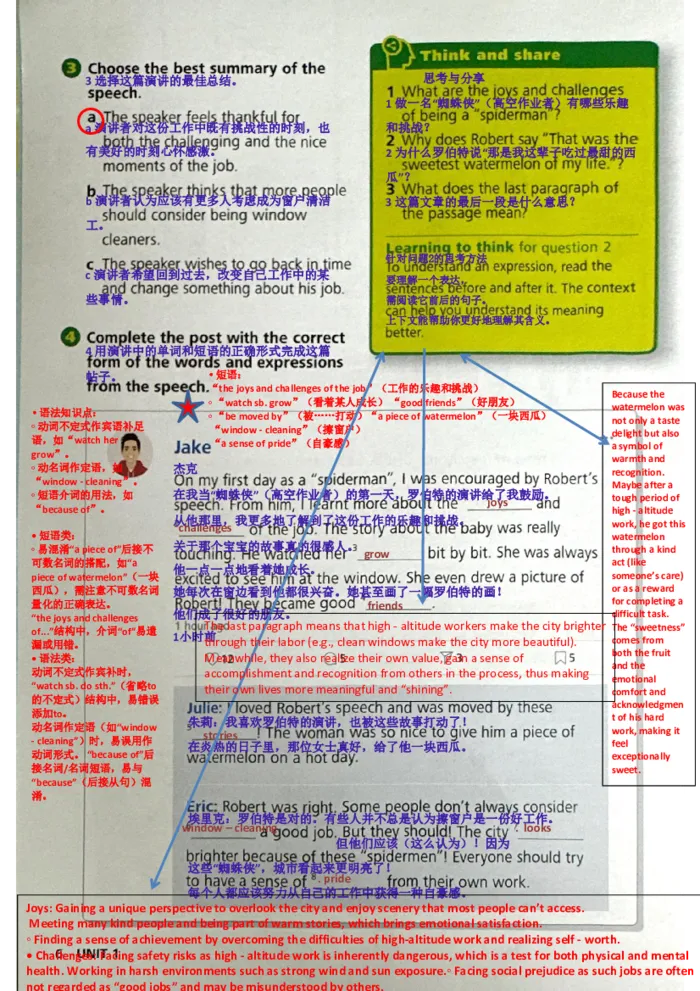
3 选择这篇演讲的最佳总结。
a 演讲者对这份工作中既有挑战性的时刻,也
有美好的时刻心怀感激。
b 演讲者认为应该有更多人考虑成为窗户清洁
工。
c 演讲者希望回到过去,改变自己工作中的某
些事情。
4 用演讲中的单词和短语的正确形式完成这篇
帖子。
思考与分享
1 做一名“蜘蛛侠”(高空作业者)有哪些乐趣
和挑战?
2 为什么罗伯特说“那是我这辈子吃过最甜的西
瓜”?
3 这篇文章的最后一段是什么意思?
针对问题2的思考方法
要理解一个表达,
需阅读它前后的句子。
上下文能帮助你更好地理解其含义。
joys
challenges
grow
friends
stories
. window – cleaning
. looks
. pride
杰克
在我当“蜘蛛侠”(高空作业者)的第一天,罗伯特的演讲给了我鼓励。
从他那里,我更多地了解到了这份工作的乐趣和挑战。
关于那个宝宝的故事真的很感人。
他一点一点地看着她成长。
她每次在窗边看到他都很兴奋。她甚至画了一幅罗伯特的画!
他们成了很好的朋友。
1小时前
朱莉:我喜欢罗伯特的演讲,也被这些故事打动了!
在炎热的日子里,那位女士真好,给了他一块西瓜。
埃里克:罗伯特是对的。有些人并不总是认为擦窗户是一份好工作。
但他们应该(这么认为)!因为
这些“蜘蛛侠”,城市看起来更明亮了!
每个人都应该努力从自己的工作中获得一种自豪感。
• 短语:
“the joys and challenges of the job”(工作的乐趣和挑战)
◦“watch sb. grow”(看着某人成长)“good friends”(好朋友)
◦“be moved by”(被……打动)“a piece of watermelon”(一块西瓜)
“window - cleaning”(擦窗户)
“a sense of pride”(自豪感)
• 语法知识点:
◦动词不定式作宾语补足
语,如“watch her
grow”。
◦动名词作定语,如
“window - cleaning”。
◦短语介词的用法,如
“because of”。
• 短语类:
◦易混淆“a piece of”后接不
可数名词的搭配,如“a
piece of watermelon”(一块
西瓜),需注意不可数名词
量化的正确表达。
“the joys and challenges
of...”结构中,介词“of”易遗
漏或用错。
• 语法类:
动词不定式作宾补时,
“watch sb. do sth.”(省略to
的不定式)结构中,易错误
添加to。
动名词作定语(如“window
- cleaning”)时,易误用作
动词形式。“because of”后
接名词/名词短语,易与
“because”(后接从句)混
淆。
Joys: Gaining a unique perspective to overlook the city and enjoy scenery that most people can’t access.
Meeting many kind people and being part of warm stories, which brings emotional satisfaction.
◦Finding a sense of achievement by overcoming the difficulties of high-altitude work and realizing self - worth.
• Challenges: Facing safety risks as high - altitude work is inherently dangerous, which is a test for both physical and mental
health. Working in harsh environments such as strong wind and sun exposure.◦Facing social prejudice as such jobs are often
not regarded as “good jobs” and may be misunderstood by others.
Because the
watermelon was
not only a taste
delight but also
a symbol of
warmth and
recognition.
Maybe after a
tough period of
high - altitude
work, he got this
watermelon
through a kind
act (like
someone’s care)
or as a reward
for completing a
difficult task.
The “sweetness”
comes from
both the fruit
and the
emotional
comfort and
acknowledgmen
t of his hard
work, making it
feel
exceptionally
sweet.
The last paragraph means that high - altitude workers make the city brighter
through their labor (e.g., clean windows make the city more beautiful).
Meanwhile, they also realize their own value, gain a sense of
accomplishment and recognition from others in the process, thus making
their own lives more meaningful and “shining”.
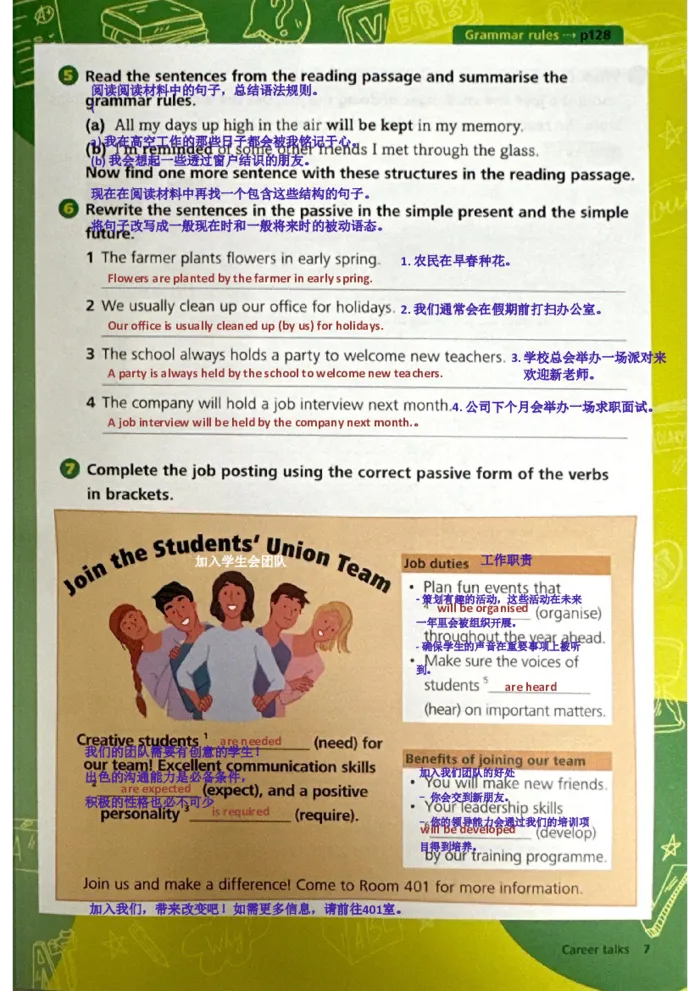
阅读阅读材料中的句子,总结语法规则。
(
a) 我在高空工作的那些日子都会被我铭记于心。
(b) 我会想起一些透过窗户结识的朋友。
现在在阅读材料中再找一个包含这些结构的句子。
将句子改写成一般现在时和一般将来时的被动语态。
1. 农民在早春种花。
2. 我们通常会在假期前打扫办公室。
3. 学校总会举办一场派对来
欢迎新老师。
4. 公司下个月会举办一场求职面试。
Flowers are planted by the farmer in early spring.
Our office is usually cleaned up (by us) for holidays.
A party is always held by the school to welcome new teachers.
A job interview will be held by the company next month.。
are needed
are expected
is required
我们的团队需要有创意的学生!
出色的沟通能力是必备条件,
积极的性格也必不可少
加入学生会团队
will be organised
are heard
will be developed
工作职责
- 策划有趣的活动,这些活动在未来
一年里会被组织开展。
- 确保学生的声音在重要事项上被听
到。
加入我们团队的好处
- 你会交到新朋友。
- 你的领导能力会通过我们的培训项
目得到培养。
加入我们,带来改变吧!如需更多信息,请前往401室。
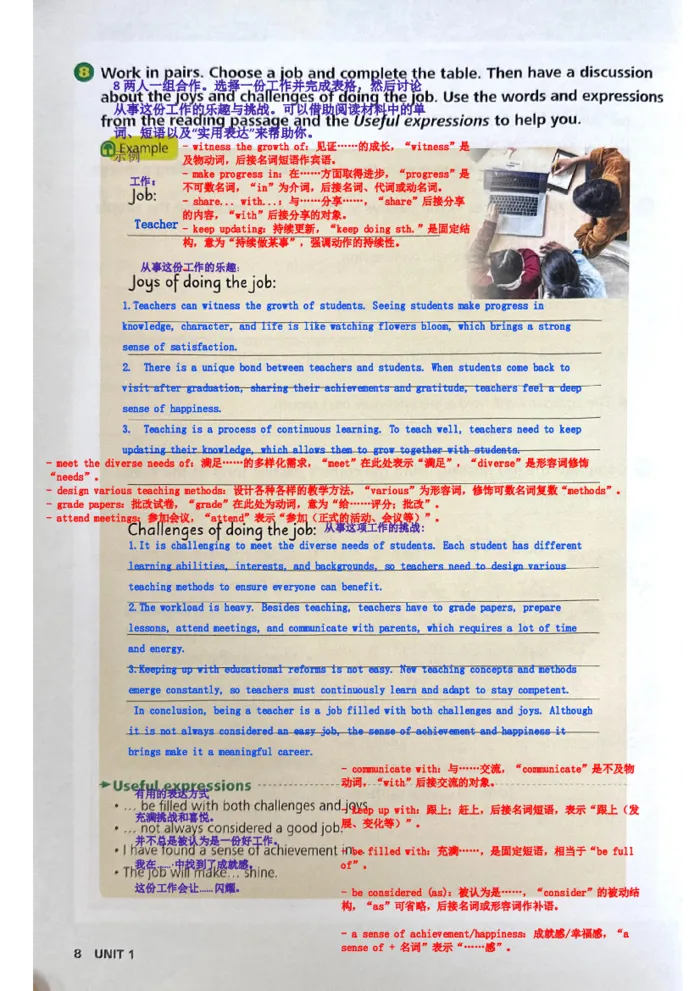
8 两人一组合作。选择一份工作并完成表格,然后讨论
从事这份工作的乐趣与挑战。可以借助阅读材料中的单
词、短语以及“实用表达”来帮助你。
示例
有用的表达方式
充满挑战和喜悦。
并不总是被认为是一份好工作。
我在……·中找到了成就感。
这份工作会让……闪耀。
从事这项工作的挑战:
Teacher
从事这份工作的乐趣:
工作:
1.It is challenging to meet the diverse needs of students. Each student has different
learning abilities, interests, and backgrounds, so teachers need to design various
teaching methods to ensure everyone can benefit.
2.The workload is heavy. Besides teaching, teachers have to grade papers, prepare
lessons, attend meetings, and communicate with parents, which requires a lot of time
and energy.
3.Keeping up with educational reforms is not easy. New teaching concepts and methods
emerge constantly, so teachers must continuously learn and adapt to stay competent.
In conclusion, being a teacher is a job filled with both challenges and joys. Although
it is not always considered an easy job, the sense of achievement and happiness it
brings make it a meaningful career.
1.Teachers can witness the growth of students. Seeing students make progress in
knowledge, character, and life is like watching flowers bloom, which brings a strong
sense of satisfaction.
2.
There is a unique bond between teachers and students. When students come back to
visit after graduation, sharing their achievements and gratitude, teachers feel a deep
sense of happiness.
3.
Teaching is a process of continuous learning. To teach well, teachers need to keep
updating their knowledge, which allows them to grow together with students.
- witness the growth of:见证……的成长,“witness”是
及物动词,后接名词短语作宾语。
- make progress in:在……方面取得进步,“progress”是
不可数名词,“in”为介词,后接名词、代词或动名词。
- share... with...:与……分享……,“share”后接分享
的内容,“with”后接分享的对象。
- keep updating:持续更新,“keep doing sth.”是固定结
构,意为“持续做某事”,强调动作的持续性。
-
- meet the diverse needs of:满足……的多样化需求,“meet”在此处表示“满足”,“diverse”是形容词修饰
“needs”。
- design various teaching methods:设计各种各样的教学方法,“various”为形容词,修饰可数名词复数“methods”。
- grade papers:批改试卷,“grade”在此处为动词,意为“给……评分;批改”。
- attend meetings:参加会议,“attend”表示“参加(正式的活动、会议等)”。
- communicate with:与……交流,“communicate”是不及物
动词,“with”后接交流的对象。
- keep up with:跟上;赶上,后接名词短语,表示“跟上(发
展、变化等)”。
- be filled with:充满……,是固定短语,相当于“be full
of”。
- be considered (as):被认为是……,“consider”的被动结
构,“as”可省略,后接名词或形容词作补语。
- a sense of achievement/happiness:成就感/幸福感,“a
sense of + 名词”表示“……感”。
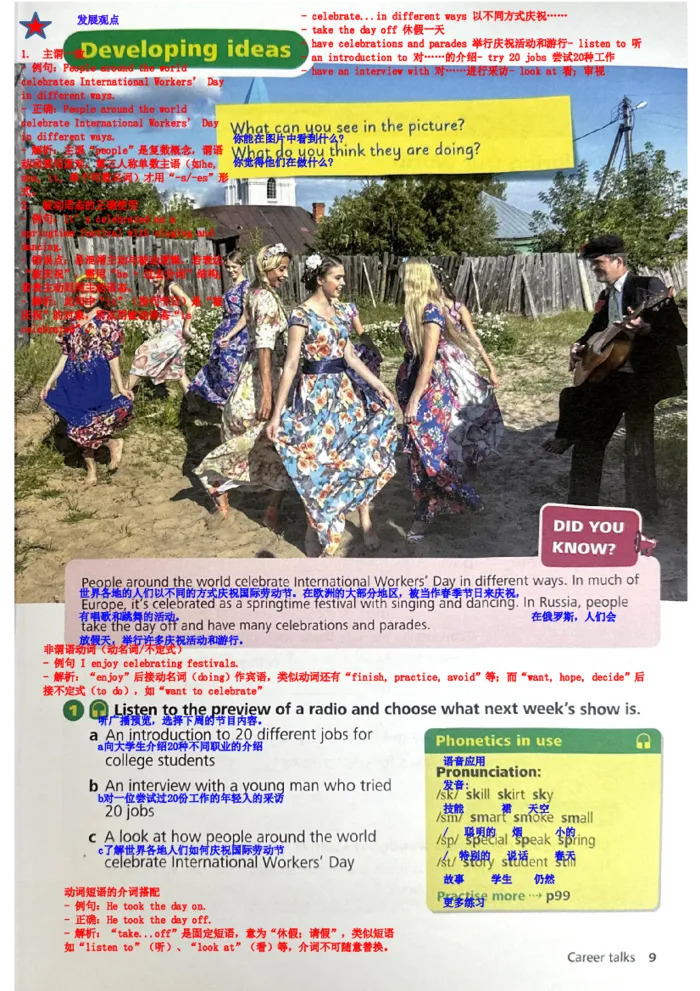
你能在图片中看到什么?
你觉得他们在做什么?
发展观点
世界各地的人们以不同的方式庆祝国际劳动节。在欧洲的大部分地区,被当作春季节日来庆祝,
有唱歌和跳舞的活动。
在俄罗斯,人们会
放假天,举行许多庆祝活动和游行。
听广播预览,选择下周的节目内容。
a向大学生介绍20种不同职业的介绍
b对一位尝试过20份工作的年轻人的采访
c了解世界各地人们如何庆祝国际劳动节
语音应用
发音:
技能
裙
天空
/
聪明的
烟
小的
/
特别的
说话
春天
故事
学生
仍然
更多练习
非谓语动词(动名词/不定式)
- 例句I enjoy celebrating festivals.
- 解析:“enjoy”后接动名词(doing)作宾语,类似动词还有“finish, practice, avoid”等;而“want, hope, decide”后
接不定式(to do),如“want to celebrate”
- celebrate...in different ways 以不同方式庆祝……
- take the day off 休假一天
- have celebrations and parades 举行庆祝活动和游行- listen to 听
- an introduction to 对……的介绍- try 20 jobs 尝试20种工作
- have an interview with 对……进行采访- look at 看;审视
动词短语的介词搭配
- 例句:He took the day on.
- 正确:He took the day off.
- 解析:“take...off”是固定短语,意为“休假;请假”,类似短语
如“listen to”(听)、“look at”(看)等,介词不可随意替换。
1.
主谓一致
- 例句:People around the world
celebrates International Workers’ Day
in different ways.
- 正确:People around the world
celebrate International Workers’ Day
in different ways.
- 解析:主语“people”是复数概念,谓语
动词要用原形,第三人称单数主语(如he,
she, it, 单个可数名词)才用“-s/-es”形
式。
2.
被动语态的正确使用
- 例句:It’s celebrated as a
springtime festival with singing and
dancing.
- 错误点:易混淆主动与被动逻辑,若表达
“被庆祝”,需用“be + 过去分词”结构;
若表主动则用主动语态。
- 解析:此句中“it”(指代节日)是“被
庆祝”的对象,所以用被动语态“is
celebrated”。
再听一遍并完成网页。
探索我们的世界
即将播出的节目
日期:
嘉宾:
严靖,一位
的年轻人。他在期间
尝试了20份工作。
内容:
我们会和你分享严靖精彩的
你能听
到
他学到的
学会学习
倾听主要观点当你提出一个修辞性的问题时,
你是带着不寻求答案的心态去问的。
它能向听众传达你的主要观点信息
你能从这个节目中收获帮你做出一些
的思路
May 1st
creative
one year
lessons
experiences
1.
一般过去时的使用
- 例句:He tried 20 jobs over a period
of time.
- 解析:“over a period of...”(在……
期间)常表示过去的时间段,句子描述过去
发生的动作,谓语动词要用一般过去式,
“try”的过去式是“tried”。
2.
定语从句中关系代词的使用
- 例句:You can hear about the lessons
he's learnt.
- 错误点:易遗漏关系代词“that/which”
(在从句中作宾语时可省略),若要明确体
现关系代词,需注意其与先行词的指代关
系。
- 解析:先行词“the lessons”是物,在定
语从句中作“learnt”的宾语,关系代词可
用“that”或“which”,且可省略。
3.
动词不定式作后置定语
- 例句:Some ideas for you making
career choices.
- 正确:Some ideas for you to make
career choices.
- 解析:“for sb. to do sth.”是动词不
定式的复合结构,在句中作后置定语,修饰
“ideas”,表示“供某人做某事的……”。
4.
主谓一致(现在完成时)
- 例句:Yan Jing, a young man, have
tried 20 jobs.
- 正确:Yan Jing, a young man, has
tried 20 jobs.
- 解析:主语“Yan Jing”是第三人称单
数,现在完成时的结构是“has + 过去分
词”,所以用“has tried”。
1
career choices
- listen again:再听一遍
- complete the webpage:完成网页
- share...with:与……分享
- hear about:听说;得知
- get from:从……中获得
- make...choices:做出……选择
听采访并完成图表。
严静的想法
Yan Jing尝试过的
部分工作
Yan Jing学到的教训
一位老师曾鼓励我们尝试
每份工作都意味着一个-
。
洋葱切片机
3_护理人员
所有工作都有
部分。
最重要的是:
和学会_并学习擅长它
学会学习
在面试中询问开放性问题及后续问题
开放性问题通常以"如何"、"什么和“为什么"等词语开头。这些问题需要不仅仅是简单的"是"或"否“回答。
在得到回答后,可以提出后续问题。这些问题能显示出你的兴趣,并帮助你获取更多信息
再听一遍。然后列出主持人提出的问题,
判断哪些是开放式问题,哪些是跟进式问题。
两人一组。互相采访并表演一段对话。判断哪些是开放式问题,哪些是跟进式问题。
翻到第101页。
翻到第102页。
谈谈你在本节中学到的关于找到理想工作的经验。
try new things.
- listen to the interview:听采访
- complete the diagram:完成图表
- encourage sb. to do sth.:鼓励某人做某事
- act out:表演;将……付诸行动
- ask open questions:问开放性问题
- ask follow - up questions:问后续问题
do your best.
face challenges
challenging
shrimp
new experience.
1.
动词不定式作宾语补足语
- 例句:A teacher once encouraged us to try new things.
- 解析:“encourage sb. to do sth.”是固定结构,意为“鼓励某人做
某事”,不定式“to do”作宾语补足语,不能省略“to”。
2.
主谓一致(一般现在时)
- 例句:All jobs have challenging parts.
- 解析:主语“all jobs”是复数形式,一般现在时中,复数主语后的谓
语动词用原形,所以用“have”,而不是第三人称单数形式“has”。
3.
it作形式主语的用法
- 例句:It's important to face challenges.
- 解析:“It's + 形容词+ to do sth.”是固定句型,其中“it”作形
式主语,真正的主语是后面的不定式短语,此句型中“it”和“is”不可
省略。
In this section, I have learned a lot about finding my dream job. First of all, it is necessary to have a deep understanding of my own interests,
strengths and values, which is the premise of finding a matching career. Secondly, I should take the initiative to explore different career fields
and gain a practical understanding of the daily work and development prospects of a career through internships, career interviews and other
methods. Moreover, it is necessary to continuously improve professional skills and comprehensive abilities, such as communication skills and
team collaboration skills, to make myself more competitive in job hunting. In addition, I can also learn from the career experiences of others.
阅读与写作
请看下面的图片并回答问题。使用提供的词汇和表达来帮助你。
1 你能在图片中看到哪些工作?
2 你认为这些工作未来可能会发生什么变化?
飞行员
收银员
导游
时装设计师
新需求
传统
消失
取代
涌现
新技术
阅读文章。作者对未来的就业持什么看法?
从捕鼠员到太空导游·
哪些工作将很快成为历史,而哪些正在兴起?
人们的职业在整个历史进程中一直在变化。
如果你生活在14世纪中期,你可能是一名捕鼠者。这个职业在几个世纪前备受尊敬,
但现在很少有人从事这一行。如今,技术发展速度甚至更快。
一些传统职业正在消失,但同时新的职业也在涌现,
以满足新的需求。
- look at:看
- answer the questions:回答问题
- change throughout history:纵观历史发生变化-
disappear:消失
- replace:取代- spring up:涌现
- read the passage:阅读文章
3.
主谓一致(现在进行时)
- 例句:New jobs are springing up.
- 解析:主语“new jobs”是复数形式,现在进行时的结构是“are + 现在分词”,所以用“are springing up”,4.
一般现在
时表客观事实
- 例句:People’s jobs change throughout history.
- 解析:“throughout history”(纵观历史)表示的是客观存在的规律,句子用一般现在时,主语“people’s jobs”是复数,
谓语动词用原形“change”。
1.
情态动词
的用法
- 例句::You
might think
about future
jobs.
- 解析:
“might”是情
态动词,后接动
词原形,不需要
加“to”,类似
的情态动词还有
“can, could,
should”等。
2.
现在进行时
表将来趋势
- 例句:Some
traditional
jobs are
disappearing.
- 解析:现在进
行时可以表示现
阶段正在进行的
动作,也可表示
按趋势即将发生
的动作,此处表
示传统工作正在
消失这一趋势,
用“are
disappearing”
更能体现动态变
化。
即将消失的工作
收银员
商店和超市的收银员在不久的将来可能不再必要。
他们可能会很快被机器取代。
人们可以在这些地方自行支付。
飞行员
自动驾驶仪早在一个多世纪前就首次用于飞机。随着新技术的发展,
未来或许将不再需要人类飞行员!
未来的工作岗位
太空导游
太空旅游始于20多年前。未来,前往太空旅行
的成本必将降低。需要太空导游
带领人们前往月球及更远的地方!
虚拟现实时装设计师
未来,更多人将在虚拟现实中工作和娱乐。
人们将需要酷炫时尚的服装。因此,VR时装设计师将被高度需求!
辛西娅263
JerryMc
在没有人类飞行员的情况下驾驶飞机的想法很可怕!
这项技术安全到哪里?飞行员的工作会烟消云散吗?
呃,请帮我报名太空旅行吧!
但如果我失去了收银员的工作怎么办? 我怎么赚到足够的钱来支付这次旅行的费用呢?
就业市场变化多快啊!我们不能只是坐在办公桌前,
指望事情保持不变。
1.
被动语态的正确使用
- 例句:Cashiers may soon be replaced by machines.
- 解析:“replace”是及物动词,“cashiers”是“被取代”的对象,需用被动语态“be
+ 过去分词”结构,此处“may”是情态动词,后接“be”原形。
2.
there be 句型的将来时
- 例句:Perhaps there will be no human pilots in the future.
- 解析:“there be”句型的将来时结构是“there will be”,表示“将会有”,不能与
“have”混用。
- be replaced by:被……取代
- pay on one's own:自主支付
- start over:始于
- be provided at a lower cost:以更低成本被提供
- lead...to:带领……到
- go up in smoke:化为乌有
in the near future(在不久的
将来)、over a century ago
(一个多世纪前)、over 20
years ago(20多年前)
there will be(将会有)、be replaced by(被……取
代)、be needed to(被需要去……)、go up in smoke
(烟消云散)
pay on one's own(自主支付)、lead people to(带领人们去……)、
work and play in virtual reality(在虚拟现实中工作和娱乐)
be history(成为历史)、with the development of...(随着……的发
展)、at a lower cost(以更低的成本)
• “What if...”表示“如果……怎么办/要是……会怎样”,可用于真实条件
(假设的情况可能发生)和虚拟条件(假设的情况不太可能发
生)。
回答问题。
“飞行员的1 Cynthia263说工作会烟消云
散吗?”是什么意思?
JZhang00说的“sit at ourdesks”是什么
意思?
JerryMc的评论是什么意思?
思考并分享
1.你认为为什么工作会随着时间而变化?
2 你最同意哪条评论?为什么?
3 我们如何跟上不断变化的就业市场?
学习思考问题2
阅读评论并思考人们观点背后的原因。
然后决定你最同意哪条评论,
并给出一个有充分支持的回应。
用文章中的单词和表达完成研究报告。
研究报告
更换工作
背景
history
Disappeared
have been created
replaced
check out
self-driving planes
space tour guides
VR designers
纵观历史,职业发生了巨大的变化。有些职业消失了,而另一些则被创造出来。
研究发现
随着技术以更快的速度发展,某些职业将被取代。技术也会催生新的职业。
例子
- 收银员将不再必要,因为人们可以在商店和超市自行结账。
- 随着自动驾驶飞机越来越先进,人类飞行员可能会被取代。
- 太空旅游将变得便宜得多,这催生了对太空导游的需求。
- 虚拟现实相关职业也在发展,因此需要更多的虚拟现实设计师。
- complete...with:用……完成
- change a lot:变化很大
- be replaced by:被……取代
- pay on one's own:自主支付
- meet the need for:满足对……的需求
1.
被动语态的正确使用
- 正确:Some traditional jobs will be replaced by new technology.
- 解析:“replace”是及物动词,“jobs”是“被取代”的对象,需用被动语态“be + 过去分词”结构,“will”后
接“be”原形。
2.
主谓一致(一般现在时)
- 正确:The number of jobs has changed a lot.
- 解析:“the number of + 复数名词”表示“……的数量”,作主语时,谓语动词用第三人称单数形式。
3.
情态动词后接动词
原形- 正确:People
can pay on their
own.
- 解析:“can”是情
态动词,后接动词原
形,无论主语是第几人
称、单复数,都用动词
原形。
4.
现在分词作伴随状
语
- 正确:Technology
progressing, new
jobs appear. 或As
technology
progresses, new jobs
appear.
- 解析:若用现在分词
作伴随状语,
“progress”的逻辑主
语是“technology”,
二者是主动关系,所以
用“progressing”;
也可用“as”引导时间
状语从句。
1,Cynthia263 means that pilots' jobs
may disappear. "Go up in smoke" here
implies that the jobs will vanish and no
longer exist, probably due to the
development of autopilot technology.
2,JZhang00 refers to the traditional office - based working
mode, where people work regularly at their desks in an office.
3,JerryMc’s comment probably focuses on the changes in future
occupations. It may be about how new technologies (such as virtual reality and
automation) will impact careers, or the comparison between traditional jobs
and emerging jobs like space tour guides and virtual reality fashion designers.
Technological
progress,
evolving societal
needs, and
economic
fluctuations
collectively drive
job changes over
time.
Assuming comments are about job security vs career
growth, I agree with prioritizing career growth as it
equips people to adapt in a changing job market.
Assuming comments are about job security vs career
We can keep up by continuously learning new skills,
networking with professionals, and staying adaptable
to new opportunities.
写一段描述“即将成为历史的工作”和“未来的工作”
步骤1
思考一个即将成为历史的旧工作和未来的新工作。使用以下图表作为帮助。
即将成为历史的工作
未来的工作
工人做什么?
工人将做什么?
为什么工作会消失?
为什么这份工作会变得普遍?
步骤2
借助图表编写职位描述。
步骤3
与另一位学生交换你的职业描述。对他的/她的职业描述写简短评论。
步骤4
检查。你是否:口提到步骤1中图表中的所有要点?
口使用阅读文章中的词汇和表达?
口给出你对换工作的看法?
- write descriptions of:写……的描述
- think about:思考;考虑
- disappear:消失
- become common:变得常见
- exchange...with:与……交换- write comments on:对……写评论- mention all the points:提及所有要点
- use words and expressions from:使用来自……的词汇和表达- give one's opinion about:给出关于……的观点
1
1. Job soon to be history - What does the worker do?
The traditional letter postman is mainly responsible for sorting letters, newspapers, and then
delivering letters, parcels, and newspapers door-to-door along a fixed route.
2. Job of the future - What will the worker do?
The drone delivery worker will be responsible for operating drones, sorting and loading
parcels, planning drone delivery routes, monitoring the flight status of drones, ensuring that
parcels can be delivered to customers quickly and safely, and also handling the daily
maintenance and troubleshooting of drones.
3. Why will the job disappear?
The job of the traditional letter postman will disappear because the popularity of email and
instant messaging software now makes people rarely send messages through letters. Moreover,
more efficient courier delivery methods in the logistics industry and the possible future
automatic delivery technologies such as drones and robots will replace the way of manually
delivering letters.
4. Why will the job become common?
The job of the drone delivery worker will become common because drone delivery has the
advantages of high efficiency, speed, and being unaffected by traffic congestion. As drone
technology continues to mature and regulations gradually improve, there will be widespread
demand in multiple fields such as logistics and medical emergency material transportation,
so a large number of drone delivery workers will be needed to operate and manage drone
delivery services.
呈现想法
写一篇关于工作的报告。
步骤1.
分组工作。搜索你感兴趣的工作信息,
并通过小组投票决定要描述的职业。思考以下内容:
主要职责
挑战
福利
职业的未来
步骤2.
借助以下提纲组织你的想法并撰写报告。
你可以使用本单元提供的语言提示,或寻找有用的表达和句子。
引言:介绍这份工作
这份工作是...
我想介绍一下这份工作...
结论
评论这份工作
它被认为是一项既放松又具有挑战性的工作。
这是我梦想的工作。
正文
描述关键职责
他们通常做...
他们需要.
他们花费大量时间...
描述益处和挑
战。他们(不)
赚很多钱,但
是人们可以在
工作中找到成
就感。它
预测未来的工作前景。这份工作将
(不会)被技术取代,因为..
未来可能没有……。
它将被广泛需要。
Report on the Job of a Software Developer
Introduction
This job is about designing, developing, and maintaining
software applications. I'd like to report on the job of a
software developer, which plays a crucial role in the
digital age.
Body
- work in groups:分组工作
- search for information:搜索信息
-
take a group vote:小组投票
- decide on:决定
- think about:思考
- organise ideas:组织思路
- write a report:写报告
- introduce the job:介绍工作
- describe key responsibilities:描述主要职责
- make a lot of money:赚很多钱- find a sense of achievement:找
到成就感- comment on:评论- predict the future:预测未来
- be replaced by:被……取代
Introduction
This job is about designing, developing, and
maintaining software applications. I'd like to
report on the job of a software developer,
which plays a crucial role in the digital age
Software developers usually
design software
architectures, write code in
programming languages like
Java, Python, or C++, and
test the software to ensure
it functions correctly. They
also debug issues and update
software to meet user needs.
Describing benefits and
challenges
They make a lot of money,
especially in leading tech
companies, and find a sense
They make a lot of money, especially in leading tech companies, and
find a sense of achievement when they see their software being used by
millions of people. However, they face challenges such as tight project
deadlines, the need to constantly learn new technologies, and solving
complex technical problems.
步骤3
练习并向全班展示你的报告。
步骤4
对最佳三个报告和最佳三个展示进行投票。
反思
·完成本单元后,我对工作在我们生活中的意义有了更深入的理解。
工作意义
每份工作都有其意义。
做某事需要付出努力。
为……做好准备。
每份工作都有其意义。为
了表达我的理解,我可以…..
口使用本单元中的词汇和表达来谈论工作:
在一般现在时和一般将来时中使用被动语态来讲述工作相关的故事。
解释工作在我们生活中的意义。
"
1=优秀,
2=良好,
3=尚未
我仍然需要改进:
future jobs.
do something.
成长可能同时充满刺激与艰辛。在本单元,让我们探索成长的话题。
你遇到过哪些家庭问题?你和同龄人相处得如何?你能从失败中学到什么?
本单元结束时,你将做一场关于个人成长故事的展示。
完成本单元的学习后,你将能够:
运用本单元的词汇和表达谈论成长话题。
用一般过去时的被动语态谈论成长过程中的挑战。
阐释成长的意义。
单元2
成长的烦恼与收获
本单元的重点语法:一般过去时的被动语态,具体如下:
一、结构
一般过去时被动语态的构成是“was/were + 及物动词的过去分词”。
- 当主语是单数时,用“was + 过去分词”;
- 当主语是复数时,用“were + 过去分词”。
二、用法
用于描述过去某个时间里,动作的承受者是句子主语的情况,强调动作是被谁执行的或动作的
承受者。
三、例句(来自本单元文本)
- A yellow band **was attached to her wrist.一条黄色的带子被系在了她的手腕上。
- She was taken home by a policewoman.她被一名女警察送回了家。
- The promise wasn't kept.这个承诺没有被遵守。
四、句式转换示例
主动句Betty's dad didn't allow her to have a lazy day.
被动句Betty wasn't allowed to have a lazy day (by her dad).
主动句Robert's mum turned down his idea.
被动句Robert's idea was turned down.(by his mum).
选择两个词来表达你对成长的理解,然后在班级里分享。
《绿山墙的安妮》
看图片并回答问题。
①你知道《绿山墙的安妮》这
本书吗?
②安妮的“成长烦恼” 有哪
些?
起步
这个女孩获得了什么?
挑战、幸福、失去、学习
自信、勇气、失败、希望
风险、错误、恐惧、责任
challenge
词性:n. 挑战;v. 向…… 挑战
face a challenge面对挑战
challenge sb. to do sth.挑战某人做某事
learning
词性:n. 学习;学问;v. learn 的现在分词
lifelong learning(终身学习)
learning resources(学习资源)
confidence
词性:n. 自信;信心
have confidence in sb./sth.(对某人/ 某事有信心)
build up confidence(树立信心)
courage
词性:n. 勇气;胆识
have the courage to do sth.有勇气做某事
moral courage道德勇气
responsibility
词性:n. 责任;职责
take responsibility for sth.对某事负责
sense of responsibility责任感
阅读短剧。母亲对她的儿子有什么期望?
理解观点
从列表中勾选。你的父母对你有什么期望?
□我应该始终遵守承诺。
□我绝不应该晚回家。
□我绝不应该让父母担心。
□我应该始终让父母感到骄傲。
《你就是不懂我!》
expect
词性:v. 期望;期待
expect sb. to do sth. 期望某人做某事
expect sth. from sb. 对某人寄予某期望
as expected 正如预期
promise
词性:n. 承诺;v. 许诺
keep a promise 遵守承诺
make a promise 许下承诺
promise to do sth. 承诺做某事
proud
词性:adj. 骄傲的;自豪的
be proud of sb./sth.(为某人/ 某事感到自豪
take pride in(同义短语,以…… 为傲)
[妈妈坐在客厅里,忧心忡忡。时钟显示晚上
10 点27 分。儿子气喘吁吁地跑进门。]
儿子:(喘着粗气)我回来了……
妈妈:看看时间!你还记得你的承诺吗?
儿子:(低声说)记得,我答应今晚9 点前回来。可是……
妈妈:(打断他)一言为定!你没遵守承诺,所以下次不能再晚归了。
儿子:妈妈,您听我说…… 我8 点30 分就往回走了。
妈妈:那你为什么回来这么晚?
儿子:在回来的路上,我发现手机落在佳成家了。我得回去拿。
妈妈:拿个手机怎么花了那么长时间?
儿子:往回走了一半,我看到路灯下有位老妇人。
她穿着单薄的女式短衫,天很冷。她脸色苍白。
我问她是否需要帮助。她说自己迷路了。
妈妈:所以你送她回家了?
儿子:没有!她没法告诉我她的地址。
妈妈:那你做了什么?
儿子:我看了一下,发现她手腕上戴着一个黄色手环,
上面有她的信息。但没有手机我没法给她家人打电话。
所以我把我的夹克给了她,然后带她去了最近的警察局。
我陪着她,直到一位女警察把她送回家。之后我跑去拿手机,
然后就回家了。
妈妈:哦,真是个不寻常的夜晚!我为刚才对你发脾气道歉。
不过你为什么不在警察局给我打个电话呢?我特别担心!
儿子:哦,我没想到这点…… 对不起,妈妈……
妈妈:现在我明白了。我为你感到非常骄傲。
worry
词性:v. 担心;n. 担忧
worry about sb./sth.(担心某人/ 某事
be worried about(同义短语,为…… 担忧)
worry sb.(使某人担心)
promise
词性:n. 承诺;v. 许诺
keep a promise 遵守承诺
make a promise 许下承诺
promise to do sth. 承诺做某事
proud
词性:adj. 自豪的;骄傲的
be proud of sb./sth.(为某人/ 某事感到自豪)
take pride in(同义短语,以…… 为傲)
should:表“应该”(责任/ 建议)
例:I should always keep my promises.(表责任)
You should call me next time.(表建议)
couldn’t:can’t 的过去式,表“不能(过去的能力/ 可能性)”。
例:She couldn’t tell me her address.(表过去没能力做)
I couldn’t finish the work yesterday.(表过去没可能完成)。
过去进行时
结构was/were + doing,表“过去某一时刻/ 时间段正在进行的动作”
b
3 为这部短剧选择另一个合适的标题。
a 记住我教你的事。
b 总要帮助老年人。
c 请听我解释。
4 用短剧中单词和表达的正确形式完成笔记。
场景
客厅
时钟显示晚上10 点27 分。
角色
儿子
妈妈
heading back
pale
old woman
call
picking up
took
worried
his phone
proud of
儿子8 点30 分正往回走。途中,他发现手机落在朋友家了。
他回去取手机时,注意到一位老妇人。她看起来苍白。
他没法联系她的家人。于是他带她去了警察局。
他取回手机后回了家,但已经很晚了。
妈妈起初很生气,还担心,但最后为儿子感到非常骄傲。
思考与分享
1 你认为这个儿子是什么样的人?2 你能给儿子和他的妈妈什么建议?学会思考(针对问题2)
要给别人好的建议,你应该试着理解他们的观点例如,他们的想法和感受是什么?他们的关键问
题是什么?
realize
词性:v. 意识到;认识到
realize one’s mistake(意识到自己的错误
realize one’s dream(实现梦想)
pick up
词性:短语动词,有“捡起;接(人)偶然学会;收听” 等含义
notice
词性:v. 注意到;n. 通知;布告
notice sb. doing sth. 注意到某人正在做某事
notice sb. do sth. 注意到某人做了某事,强调全过程
put up a notice 张贴通知
1I think the son is kind-hearted, responsible, and helpful.
When he noticed the old woman who looked pale, he tried his
best to help her even though it made him late. He showed
great empathy and a sense of duty, which finally made his
mother proud of him
2,For the son: You should communicate with your mother in
advance if you need to help others and might be late. Also,
pay attention to the time when you go out so that your
mother won’t worry too much.
• For the mother: You can try to understand your son’s
good intentions first before getting angry. Ask him about the
situation patiently, and then have a calm conversation with
him about time management and communication.
5 阅读阅读篇章中的句子并总结语法规则。
(a)我检查了一下,看到她手腕上戴着一个黄色手环。
(b)我陪着她,直到一位女警察把她送回家。
现在在阅读篇章中再找一个这种结构的句子。
Betty wasn’t allowed to have a lazy day on the sofa by her dad.
Robert’s idea of hiking alone in the mountains was turned down by his mum.
Sarah’s birthday presents were hidden in their bedroom by her parents.
文中另一个同结构句子:The promise wasn’t kept, so you can’t stay out late next time.
is drawn
is spent
was done
7 用括号内单词和表达的正确形式完成信息。
爸爸:
您不能就这么把我的手机拿走。
我实际上用它做很多
重要的事。
它帮我在放学后和朋友们保持联系。
但现在我和他们断联了!您还记得我上学期的太空项目吗?
很多研究是在我的手机上完成的。
而且我做得非常好。
请问我能把手机拿回来吗?
萨曼莎
am cut off
6 将句子改写成一般过去时的被动语态。
1 贝蒂的爸爸不允许她在沙发上悠闲地待一天。
2 罗伯特的妈妈拒绝了他独自去山里徒步的想法。
3 萨拉的父母把她的生日礼物藏在了他们的卧室里。
萨曼莎,很抱歉。
恐怕你太多时间花在手机上了。
这对你的眼睛很不好。有时,在家庭聚餐时你的注意力被分散了。
我们也需要优质的家庭时光。
这样如何?
我们每天都把手机放下一会儿,进行一次家庭谈话。你觉得呢?
爸爸
hide
词性:v. 隐藏;躲藏(过去式/ 过去分词:hid/hidden)
hide sth. from sb.(向某人隐瞒某事);hide away(躲藏起来)
turn down 词性:短语动词,意为“拒绝;调低(音量等)”
allow v. 允许;准许
allow sb. to do sth.(允许某人做某事)
allow doing sth.(允许做某事)
be allowed to do sth.(被允许做某事)
attach
v. 附上;系上;使依附
attach sth. to sth.(把某物附在某物上)
be attached to(喜爱;依附于)
8 写一个关于你和父母之间艰难经历的故事。使用阅读篇章中的词汇
和表达以及“有用表达” 来帮助你。
Last month, on a Saturday
evening
Last month, on a Saturday evening,
I want to participate in the
school's drama
performance, but my
parents are worried that it
will affect my studies.
We had an in-depth
communication, and my
parents finally supported
my decision.
whether I should take part in the school play. I promised to balance my
study and the rehearsal, but my parents thought that the play would take up too much of my
time and make my grades drop. The problem was caused by the misunderstanding between
us—they didn’t know how much the play meant to me, and I didn’t fully explain my plan to
manage time.
In the end, we sat down and had a calm talk. I showed them my study schedule and the effort I
would put into both. I’m sorry for not communicating with them earlier. After this
disagreement, I learnt that honest and patient communication can solve many problems. Now,
my parents not only support my participation in the play but also often ask about my rehearsal
progress, and our relationship has become closer.
I learned to patiently explain my
thoughts to my parents, and my
parents were also more willing to
listen to my heartfelt words.
发生时间
起因
起因
我的收获/ 我们的关系变化
与父母的一次艰难经历
▶有用表达
问题是由…… 引起的。
最后,我们……
我答应…… 但是……
我为…… 感到抱歉。
我父母认为……
这次分歧之后,我认识到……
resolve:v. 解决;决心
resolve a problem 解决问题
resolve to do sth. 决心做某事
argue:v. 争论;争辩
argue with sb. 与某人争论argue about/over sth. 就某事争论
argue for/against sth. 支持/ 反对某事
disagreement:n. 分歧;意见不合
have a disagreement with sb. 与某人有分歧
in disagreement 意见不合
积极
这张图展示了什么?
许多青少年都经历过同辈压力。
他们有时会做某件事,
只是因为
不想被排除在外。
有时同辈压力可能是好的,
但它也可能让你
因为和朋友不同而感到难过。
拓展思路
同辈压力
消极
你知道吗
听对话并选择科林的态度。
a 科林同意凯特关于爱好重要性的看法。
b 科林对自己奇怪的爱好感到难过。
c 科林已经决定改变自己的爱好。
语音运用
发音:
(奇怪的)
(春天)
(屏幕)
更多练习→第99 页
成长的烦恼与收获25
hobby:n. 爱好
develop a hobby(培养爱好)
hobby group(爱好小组)
outdoor hobby(户外爱好)
strange:adj. 奇怪的;陌生的
strange behavior(奇怪的行为)
feel strange(感觉不自在)
a strange place(陌生的地方)
experience:v. 经历;体验;n. 经历;经验
life experience 生活经历
practical experience 实践经验
experience difficulties 经历困难
negative:adj. 消极的;负面的;否定的;n. 否定词
negative emotion(负面情绪)
negative comment(负面评论)
in the negative(否定地)
positive:adj. 积极的;正面的;肯定的
positive energy 正能量
positive change 积极的改变
be positive about sth. 对某事持积极态度
pressure:n. 压力;压强
peer pressure 同辈压力
work pressure 工作压力
under pressure 处于压力之下
put pressure on sb. 给某人施压
2 再听一遍并填写申请表。
你生活中有什么问题吗?
尽管联系汉娜。她
随时为你提供帮助。
汉娜帮助
化忧虑为智慧!
申请表
laughed at
hobby
friends
different
fit in
sports
我被同学嘲笑,因为我的爱好是编织。
甚至我的一些朋友也不接受这件事。
你的姓名
补充信息
科林
你的问题
我朋友们的爱好完全不同,
比如运动或玩会儿电子设备。
我就是觉得自己不合群。
accept:v. 接受;认可
accept an invitation 接受邀请
accept the fact 接受事实
be accepted by 被…… 接受
different:adj. 不同的
be different from 与…… 不同
different kinds of 不同种类的
in different ways 以不同的方式
classmate:n. 同班同学
classmate relationship 同学关系
former classmate 以前的同学
friend:n. 朋友
close friend(亲密的朋友
childhood friend 儿时的朋友
make friends 交朋友
Friendship 友谊
help:v. 帮助;n. 帮助
help sb. (to) do sth. 帮助某人做某事
help with sth. 在某事上帮忙
ask for help 寻求帮助
offer help 提供帮助
problem:n. 问题;难题
solve a problem 解决问题
face a problem 面对问题
problem-solving 解决问题的
谈谈在本节中你学到了哪些关于应对同伴压力的知识。
has loved
laughed at
听广播并完成笔记
give up
thankful
work
Be proud of
control
再听一遍。然后谈谈
汉娜是如何介绍她朋友的故事的。
Share
B:让我告诉你关于…… 的事。
A:你经历过哪种同伴压力?
4 两人一组。谈谈你关于同伴压力的经历
有用表达…… 见第103 页
B:这并不容易。一开始……
A:你是怎么克服它的?
different
《汉娜的建议》
不要让同伴压力影响你。
相信自己。
和你的朋友分享你的爱好。
只需跟随你的心。
学习方法
介绍个人故事
个人故事能让演讲者以有效的方式
与听众建立联系。
我们可以使用
“让我和你分享……”
“那让我想起……”
等表达来介绍个人故事。
以特定方式着装
以特定方式加入某个俱乐部
参加特定课程
pressure(peer pressure 同辈压力)
词性:n. 压力;压强
under pressure(处于压力下)
put pressure on sb.(给某人施压)
relieve pressure(缓解压力)
谈谈在本节中你学到了哪些关于应对同伴压力的知识。
读写结合
1 看下面的图片并回答问题。
用所给单词和表达来帮助你。
1 你能看到哪些成长的烦恼?
2 他们能获得什么成长的收获?
失望的、受伤的
失败、成长
2 阅读短文。作者的烦恼是什么?
苦尽
2019 年10 月21 日
亲爱的日记:
我度过了非常糟糕的一天。我参加了
篮球队的选拔,但教练说
我不够高。这是我从小的梦想!
我练习了这么久,
今天一切都结束了。我感觉很糟糕……
2 阅读短文。作者的烦恼是什么?
甘来
2023 年9 月17 日
亲爱的日记:
1 我刚刚在看四年前的日记。
时间过得真快!那时候,我因为个子太矮,
没能进入篮球队,
感到非常失望。看到当时那些让人心碎的文字,我忍不住笑了。
篮球对我来说曾经是件大事。
但在那之后,情况很快就变了。
2 当时的失败让我很受伤,我的朋友们都很担心我。
“为什么不试试别的呢,比如游泳或者滑雪?” 我最好的朋友建议道。
一开始,我游泳只是为了转移注意力。但很快,我就彻底
爱上了这项运动。我现在已经赢得了几场比赛,还交了很多
朋友。我的人生有了不同的转折。
3 以全新的视角回顾自己的烦恼与收获,感觉很棒。
成长从来都不是一件容易的事。但我们需要以正确的方式看待挑战。
4 现在我明白了,失败是生活的一部分。它可能在我们人生的任何阶段降临。
从那以后,我还经历过很多其他糟糕的时刻。但
我再也没有感到过那么糟糕了。
我清楚地知道,失败只是暂时的。
当一扇门关闭时,另一扇门会打开。生活正带着许多其他惊喜在等待我们。
5 明天又是新的一天。
be disappointed at(对……失望)、can't help laughing(忍不住
笑)、take one's mind off things(使某人不再想某事)、take a
different turn(发生不同的转变)、pains and gains(得失)、
in time(及时)、in one's life(在某人的生活中)、look back
(回顾)、at any stage(在任何阶段)
a big deal(大事、很重要的事)、
on the team(加入队伍)、
grow up(成长)、
用文章中的单词和表达完成表格
现在
我赢得了比赛,还交了朋友。
我的生活发生了改变。我也
对自己的失败有了新的认识。
我意识到失败是
生活的一部分。但它只持续片刻。
tried out for
fell in love
disappointe
worried
tall
a moment
failure
failure
1.从“This has been my dream since I was little! I have
practised so much, and it all ended today. I feel very
bad…” 这些句子可以看出篮球对作者来说非常重要。
2.这取决于具体情况。有时它可能是坏事,因为会带来痛苦
或挑战;但有时它也可能是好事,因为能带来成长和新的机
会,就像作者的经历一样。
3.这句话的意思是,当一个机会或选择消失时,总会有另一
个新的机会或选择出现。它告诉我们不要因一时的挫折而气
馁,未来仍有希望和新的可能。
四年前
我参加了篮球队选拔。但
我因为不够高而失败了。
我对此感到非常失望。
甚至我的朋友都很担心。
然后我最好的朋友建议
我应该试试别的事情。我尝试
了游泳,很快就
爱上了这项运动。
4 回答问题
1 从哪些句子可以看出篮球对作者来说
非常重要?
2 如果有事情“降临” 到你身上,
你认为这是好事还是坏事?
3 “当一扇门关闭时,另一扇门会打。”
这句话是什么意思?
思考与分享
1 如果作者在游泳比赛中失败了,他会有什么感
受?为什么?
2 你有过糟糕的时刻吗?
和全班分享一下。
学会思考(针对问题1)
要预测作者的感受,你需要
考虑:四年前作者对失败有什么感受?
现在他对失败有什么感受?
这些年他学到了什么?
1He will likely feel calm because he has learned over the years that failure is a chance to grow, unlike
how he might have felt upset four years ago.
2Yes, I once failed a math exam. I felt sad but later worked hard and improved, which taught me
perseverance.
第三单元
对你来说痛苦是什么?
这让你有什么感受?
思考生活中的一次失败并回答以下问题
借助问题写一篇短文
发生了什么?
这让你有什么感受?
在这之后你有什么成长或改变?
A Failure That Made Me Grow
Step 3 检查
□回答了Step 1 中的所有问题:是
□使用了阅读文章中的单词和表达
□表达了对失败的看法:是
Looking back, this failure made me grow a lot. I became more confident and learned how to stay calm
under pressure. Now, I still love English speeches and even got a good result in a school-level English
activity. I realize that failure is just a moment, and when one door closes, another opens. It’s all about
how we face it.
Then, I talked to my English teacher. She told me that failure is a part of growth and encouraged me
not to give up. So, I decided to keep going. I started practicing my speech every day again, but this
time, I also focused on building my confidence. I joined the English corner and spoke English with
others as much as possible.
Last year, I tried out for the school English Speech Contest. I had prepared for it for a long time,
practicing my speech every day and asking my teacher for advice repeatedly. However, when I was
on stage during the audition, I was so nervous that I forgot some parts of my speech. Eventually, I
failed to get into the final round.
与全班分享你的短文
展示观点
就一个人的成长故事进行展示。
步骤1
分组活动。寻找人们的成长故事。可以是名人,也可以是你身边的人。
谈论他们的成长故事,然后小组投票决定要介绍的人物。
成长的烦恼
解决办法
成长的收获
结论
以对该人物故事的评价结束展示
我相信我们都能从…… 身上学到很多。
描述成长的收获
他/ 她现在是一名成功的……
他/ 她现在清楚地知道……
步骤2
借助以下提纲组织你的展示。你可以使用
以下语言提示,或从本单元中寻找有用的表达或句子。
描述解决办法
他/ 她相信自己。
他/ 她做了…… 来转移注意力。
引言
说明展示的目的
我想谈谈…… 以及他/ 她的成长故事。
主体
描述成长的烦恼
他/ 她曾被嘲笑……
他/ 她曾担心……
步骤3
练习并向全班进行展示。
deal with peer pressure
我们需要学会处理
家庭中的问题。
我们需要学会应对
同伴压力。
我们需要学会
从失败中成
长
成长需要什么?
grow from failure
反思
1 完成本单元后,我对成长的意义有了更多理解。
步骤4
投票选出三个最有趣的成长故事和三个最佳展示。
2 为了表达我的理解,我可以……
□使用本单元的单词和表达来谈论成长:_____
□使用一般过去时的被动语态来谈论成长的挑战。
□解释成长的意义。
1 = 优秀,
2 = 良好,3 = 尚未达到
3 我仍需改进:_____
第三单元
什么造就了一支优秀的团队
众人拾柴火焰高
什么是“团队”?在本单元,让我们探究团队的含义。
什么造就了
一支优秀的团队?什么是团队协作?什么造就了一支卓越的团队?
在本单元结束时,
你将设计一个团队名称和标志。
完成本单元后,你将能够:
运用本单元的词汇和表达谈论团队。
运用“should” 和“have to” 就团队管理提出建议。
运用本单元的词汇和表达谈论团队。
描述团队协作的价值。
情态动词是一类本身有一定词义,但不能单独作谓语,需和实义
动词原形一起构成谓语的动词,主要用来表达说话人的情感、态
度或语气等。以下是其核心语法知识点:
can/could• 表能力:can 表示现在的能力,could 表示过去的
能力。例如:“He can play the piano.”(他现在会弹钢
琴);“When he was young, he could run very fast.”(他
年轻时能跑得很快)。• 表许可:can 用于现在的许可,could
语气更委婉(过去的许可也可用could)。例如:“You can go
now.”(你现在可以走了);“Could I use your pen?”(我
能用下你的笔吗)。• 表推测:can 常用于否定句(can't,意
为“不可能”)和疑问句;could 可用于肯定、否定、疑问句,
且可能性比can 小。例如:“That can't be true.”(那不可
能是真的);“Could it rain tomorrow?”(明天可能下雨
吗)。
may/might
• 表许可:may 表示现在的许可,might 语气更委婉。例如:
“You may come in.”(你可以进来);“Might I ask a
question?”(我可以问个问题吗)。
表推测:may 表示“可能”,可能性比might 大;might 表示
的可能性较小。例如:“He may be at home.”(他可能在
家);“She might come late.”(她可能会迟到)。
must
• 表必须:表示义务、必要,其否定形式用needn't 或don't
have to,意为“不必”。例如:“We must finish the work
today.”(我们必须今天完成工作);“You needn't worry.”
(你不必担心)。
• 表推测:表示“一定、肯定”,仅用于肯定句,否定推测用
can't。例如:“He must be ill.”(他一定是生病了)。
need 作情态动词:主要用于否定句和疑问句,后接动词原形,
否定形式为needn't,意为“不必”。例如:“Need I go
now?”(我现在需要走吗);“You needn't do it again.”
(你不必再做了)。
- explore the meaning
of:探索……的意义
- talk about teams:谈论
团队
- learn management
skills:学习管理技能
- complete the unit:完成
本单元
- achieve more:取得更多
成就
你在图片里能看到什么?
开启探索
看图片并回答问题。
他们作为团队一起在做什么?
你还知道哪些其他类型的团队?
看图片并回答问题。
协作的力量
你知道三兄弟和筷子的故事吗?
和全班同学分享一下。
你能从这个故事中学到什么?
- look at the pictures:看图片
- answer the questions:回答问题
- do together as a team:作为团队一起做
- know other kinds of teams:了解其他类型的团队
- share...with the class:和全班分享……
- learn from the story:从故事中学习
1.
现在进行时的用法
- 用于描述图片中团队正在进行的动作,如“What are they doing
together as a team?”,结构为“am/is/are + 现在分词”,表示
此时此刻正在进行的动作。
2.
一般现在时的疑问句
- 含实义动词的一般现在时疑问句,需借助助动词“do/does”,如
“What other kinds of teams do you know?”(主语“you”是第
二人称,用“do”)、“Do you know the story...?”(助动词
“do”提前构成一般疑问句)。
3.
动词不定式作目的状语
- 如“Share it with the class to explain your idea.”(可补
充的结构),动词不定式“to explain your idea”作目的状语,说
明“share”的目的。
4.
“make + 宾语+ 形容词/名词”结构的潜在延伸
- 本单元围绕“优秀团队”展开,后续可能涉及“make a team
great”(使团队优秀)这类结构,“make”后接宾语和补足语,用于
描述团队的塑造。
Football teams, basketball teams, debate teams, business teams, and volunteer
teams.
1◦Yes, I know it. The story shows that
unity is strength. When chopsticks are
together, they are hard to break, but
when they are separate, they can be
broken easily. It tells us the
importance of working together.
看图片并回答问题。
团队leader(领导者)的职责是什么?
图片中的团队正在做什么?
用所学的词汇和表达来帮助你。
理解观点
团队成员
问题
团队工作
建议
我
能
做
什
么
?
阅读电子邮件,找出托尼的问题和怀特女士的建议。
亲爱的怀特女士,
发件人:托
收件人:怀特女士
主题:我该怎么办?
感谢您让我担任戏剧《白雪公主》的导演。
我该怎么办?您能给我提些建议吗?
然后整个团队都沉默了。我当领导的第一天糟透了!
我的沉默让莉萨很生气。“我退出!” 她大喊着愤然离开。
如果我伤害了莉萨的感情怎么办?
每个人都看着我,期望我做决定。但我只是僵住了。
我原本也觉得玛丽更好,但如果我错了呢?
团队里有些人认为玛丽更合适,另一些人则支持莉萨。
出现了一个问题。莉萨和玛丽都想扮演公主。
担任过领导职务。
但在第一项任务—— 分配角色时,
这对我来说是极大的荣幸。
我以前从未
您的,
托尼
宾语从句的用法
- 如“Some of the team thought Mary was better.”,“Mary was better”是宾语
从句,作“thought”的宾语,从句用陈述语序。
条件状语从句的用法
- 如“What if I was wrong? What if I hurt Lisa’s feelings?”,“what if”引
导条件状语从句,相当于“what will happen if...”,从句常用一般过去时表示假设
- find out:找出;查明
- make sb. director:让某人担任导演
- play the princess:扮演公主
- expect sb. to do sth.:期望某人做某事
- hurt one's feelings:伤害某人的感情
- storm off:怒气冲冲地离开
- advise sb.:给某人提建议
1. The team leader is guiding the team
members to discuss and solve problems, and
promoting teamwork by giving advice.
2. The responsibility of a team leader is to
organize team activities, coordinate team
members, provide guidance and advice, and
ensure the team works efficiently towards
its goals.
• Tony’s problems: He is the director of the
drama Snow White but has no leadership
experience. Lisa and Mary both want to play
the princess, and team members are divided
on who is more suitable, which makes him
confused about how to handle the role
assignment.
发件人:怀特女士
收件人:托尼
主题:回复:我该怎么办?
亲爱的托尼,
我完全理解你的难处。
有时候,
良好的团队协作很难实现!
所以在出现分歧时,
这是我的建议:
首先,你应该和莉萨讨论这件事。
她为什么想扮演白雪公主?
那么,为什么不让莉萨和玛丽都试一下这两个角色呢?
例如,白雪公主和王后。
所有团队成员
记住:你是导演,但你不必独自处理所有问题。
希望我的建议对你有帮助。
诚挚的祝福,
怀特女士
领导者应当承担责任。
她的优缺点是什么?你应该和她一起弄清楚这些问题。
可以为每个角色投票选出最合适的人。
你有整个团队,所以也可以向他们求助!
1.
情态动词“should”的用法
- 表示建议,后接动词原形,如“You should discuss the matter with Lisa.”“You should work with her to find out.”。
2.
“why not + 动词原形”结构
- 用于提出建议,如“Why not have Lisa and Mary both try two roles?”,是一种委婉的建议表达方式。
3.
并列句的使用
- 由“and”“but”“so”等连词连接两个或多个简单句,如“You have a whole team, so ask them, too!”(“so”表因果)、
“You’re the director, but you don’t have to deal with all the problems yourself.”(“but”表转折)。
4.
一般现在时的疑问句
- 含实义动词的一般现在时疑问句借助助动词
“do/does”,如“Why does she want to play
Snow White?”(主语“she”是第三人称单数,用
“does”)。
5.
动词不定式作目的状语
- 如“You should work with her to find out.”
中,“to find out”是动词不定式短语作目的状语,
说明“work with her”的目的。
- take responsibility:承担责任
- discuss the matter with:与……讨论此事
- work with sb. to find out:和某人一起弄清楚
- have sb. try roles:让某人尝试角色
- vote for:投票支持
- deal with problems:处理问题
- ask sb. for help:向某人求助
托尼做出了错误的选择,不觉得自己像个真正的领导者。
他在分配角色期间遇到了问题。
托尼作为团队领导者不够自信,怀特女士鼓励他。
team
托尼作为团队领导者遇到了问题,怀特女士提出了建议。
所有人都期望托尼做决定,但他只是僵住了。
giving out the roles.
托尼的问题
用电子邮件中的单词和表达的正确形式完成表格。
怀特女士的建议
一些团队成员认为玛丽更适合扮演白雪公主,但其他人支持莉萨。
团队领导者应当承担责任。
went with
托尼应当和莉萨讨论并找出她的优缺点。
team
托尼应当让玛丽和莉萨都试一下角色,团队成员可以投票。
angry
・莉萨很生气,想要退出。
advice
responsibility。
discuss
both try the role
你觉得哪条建议最有帮
助
“设身处地为他人着想”。也就是说,试着想象自己处在他/ 她的位置时的感受。
学会思考(问题1)
为了理解他人的感受,你需要
托尼为什么僵住了?
思考与分享
vote
动词不定式作目的状语
- 如“To understand another person’s feeling, you need to put yourself in that person’s shoes.”
中,“To understand another person’s feeling”是动词不定式短语作目的状语,说明“need to put...”的目
的。
宾语从句的用法
- 如“Some of the team thought Mary was better as Snow White.”,“Mary was better as Snow White”是
宾语从句,作“thought”的宾语,从句用陈述语序。
- make a wrong choice:做出错误的选择- feel like a real leader:感觉像一个真正的领导者- encourage sb.:鼓励某人
- have a problem as...:作为……有问题- make suggestions:提出建议- complete the table:完成表格
- give out the roles:分配角色- think...was better as...:认为……作为……更好
- expect sb. to do sth.:期望某人做某事- want out:想要退出
- take responsibility:承担责任
- find out strengths and weaknesses:找出优缺点- have sb. try roles:让某人尝试角色
- vote for:投票支持- freeze:僵住;不知所措
- put oneself in one's shoes:设身处地为某人着想
Question 1Tony froze because he was the director of the drama Snow White
but had no prior leadership experience. When it came to assigning the role of
the princess, Lisa and Mary both wanted it, and team members were split in
their opinions. He felt overwhelmed and didn't know how to resolve this
conflict, so he froze.
Question2 I find the advice that Tony should discuss the matter with Lisa to be
the most helpful. By having a conversation with Lisa, Tony can better
understand her motivations and strengths, which is crucial for making a fair
and informed decision about the role assignment. This approach promotes
communication and collaboration within the team.
阅读文章中的句子并总结。
但他不应该独自做所有决定。我们是一个团队,他应该随时可以向我们求助。
摩根说得对。托尼是个好领导,我们不必担心任何事。
杰克(6 月24 日):
他应该更有自信。他做得很好,不应该对自己太苛刻。
但有时他看起来有点害羞。
我认为
摩根(6 月22 日):
托尼愿意为团队承担责任,而且很了解我们的才能。
添加评论…
你觉得你们的新团队领导者托尼怎么样?
发表评论
用你学过的情态动词完成评论框。
唐娜不喜欢团队里的其他人质疑她的决定。
奥利弗队长在比赛中从不把球传给其他人。
首先,你应该和莉萨讨论这件事。
西蒙今天开会迟到了,所有团队成员都在等他。
阅读句子并用should (n't) 或(don't) have to 写下你的建议
在在阅读文章中找出更多带有这些结构的句子。
你是导演,但你不必独自处理所有问题。
shouldn't
should
shouldn't
should
- discuss the matter with:和……讨论这件事- deal with problems:处理问题- be late for the meeting:开会迟到
- wait for sb.:等待某人- pass the ball to others:把球传给其他人- question one's decisions:对某人的决定提出疑问
- take responsibility for:对……承担责任- have confidence:有自信- be hard on oneself:对自己苛刻
- turn to sb.:向某人求助
“should”与“don't have to”的用法混淆
- “should”表示“应该”,强调责任、建议或义务,
例如“You should finish your homework on time.”(你应该按时完成作
业)。
- “don't have to”表示“不必”,说明没有必要做某事,例如“You don't
have to come early tomorrow.”(你明天不必早来)。容易错误地用
“shouldn't”(不应该)来表达“不必”的意思。
Donna should let others in the team question her decisions.
Simon should be on time for the meeting. All the team members are waiting for him.
Captain Oliver should pass the ball to others in the match.
Tony is a dedicated leader. He should keep encouraging us to
collaborate, and we don’t have to be afraid to ask for help. He
shouldn’t hesitate to delegate tasks, and he should know that
we’re all here to support him.”
使用阅读文章中的词汇和表达以及实用表达来帮助你。
结对练习。讨论优秀领导者的品质。
示例
领导品质
我(不)这么认为。
我(不)同意你的观点。
以…… 为例。
一位优秀的团队领导者应该(不应该)……
他/ 她不必……
例如,……
实用表达
Empathy
责任
The leader should take responsibility
同理心
Communication
沟通
例如
例如
例如
应当承担责任。
in times of disagreement.
优秀的团队领导者应该具备
当团队出现分歧时,领导者
良好的沟通能力。
A good leader should have empathy.
possess good communication skills.
An excellent team leader should
好的领导者应该有同理心。
- discuss the qualities of:讨论……的
品质
- take responsibility:承担责任
- possess good communication skills:具
备良好的沟通能力
- have empathy:有同理心
- work in pairs:结对练习
- agree with sb.:同意某人
- disagree with sb.:不同意某人
- think so:这么认为
情态动词“should”“shouldn’t”的用法
- “should”表示“应该”,用于提出建议或说明责任,如“A good team leader should take responsibility.”“An
excellent team leader should possess good communication skills.”。
- “shouldn’t”表示“不应该”,用于建议不要做某事,如“A good team leader shouldn’t avoid problems.”。“have
to”的用法- 表示“必须;不得不”,强调客观需要,有人称和时态的变化,如“A leader has to listen to team
members.”。
Accountability (责任担当):
When a team failed to meet
the quarterly target, the
manager took responsibility
first, analyzed the root
cause with the team, and
adjusted strategies instead
of blaming individuals.
Supporting employees in
difficulty: Knowing a team member
was under great pressure due to
family illness, the manager
adjusted their workload
temporarily, allowed flexible
working hours, and offered
emotional comfort.
A team lead summarized project
progress, challenges, and proposed
solutions in a concise report,
presenting it to senior management
clearly, gaining approval for
additional resources.
Cross-departmental communication (跨
部门沟通)
the manager listened patiently,
verified the issue, and adjusted the
process, improving the employee’s
work satisfactio
发音:
新朋友。
他们还可以学习团队合作和解决问题。
露营时你可以做什么?
拓展思路
语音运用
她会给孩子们带食物和一个新帐篷。
露营在世界不同地区都很受欢迎。
人们可以探索野外并结交
听对话。艾米的妈妈打完电话后会做什么?
她会让孩子们以团队形式解决问题。
她会尽快把艾米带回家。
她稍后会打电话给亨利先生询问孩子们的情况。
quite(相当)
/kw/quick(快的)quiet(安静的)
更多练习…… 见99 页
- go camping:去露营
- explore the wild:探索野外
- make new
friends:结交新朋友
- learn to cooperate:学习合作- solve problems as a team:作为
团队解决问题
- bring sth. to sb.:给某人带某物- call back later:稍后回电-
check on sb.:查看某人的情况
1.
一般将来时的用法
- 结构为“will + 动词原形”,用于描述将来要发生的动作,如“What will Amy’s mother do after the call?” 选项
中的“will bring”“will let”“will call”等都体现了这一结构。容易错误地使用“be going to”和“will”的混淆,
“will”更侧重临时决定或客观将来,“be going to”侧重计划或有迹象的将来。
2.介词“after”的用法
- 用于表示“在……之后”,后接名词、代词或动名词,如“after the call”“after camping”。容易错误地在
“after”后接动词原形。
再听一遍并完成这条帖子
它们吃光了所有的食物,还把帐篷弄坏了!我非常担心。
格林女士
1 小时前
做笔记
笔记可以帮助
多么漫长的一天啊!
艾米和她的朋友们以及他们的向导亨利先生去露营了。
后来,
我接到了她的电话。
一些猴子闯进了营地。
我给亨利先生打了电话,决定把艾米接回来。
但亨利先生建议我不要这么做。
他说对孩子们来说,团队合作是一次
很好的机会。
他还承诺会确保他们是完全安全的。
我还是有点担心,但我相信他们会一起解决问题的。
camp
学会学习
call
food
人物及其行为。
bring
听的时候,记下
你记住重要信息。
safe
chance
(图片说明:向导亨利)
你还应该留意其他重要细节,
比如人物的关键点。
- get into
trouble:陷入麻
烦
- break the
tent:弄坏帐篷
- call back:回
电
- advise sb. not
to do sth.:建议
某人不要做某事
- work as a
team:作为团队工
作
- promise to do
sth.:承诺做某事
- work things
out together:
一起解决问题
- take notes:做
笔记- listen
for key
information:倾
听关键信息
1.
一般过去时的用法
- 描述过去发生的动作,如“Amy went camping with her friends...”“I got a
call from her...”“They got into trouble and broke the tent.” 等,动词用过
去式形式。
2.
一般将来时的用法
- 结构为“will + 动词原形”,用于描述将来的动作,如“I believe they will
work things out together.”
3.
动词不定式作宾语
- 如“advised me not to (come)”“promised to (keep them safe)”“decided to
(go back tomorrow)” 等,“advise”“promise”“decide”后接动词不定式作宾
语。
4.
“get + 过去分词”结构
- 表示被动含义,如“got into trouble”(陷入麻烦),“get”在这里起到类似
“be”的作用,构成被动结构。
问题
树上有水果。也许我们可以吃那个。
broken
听对话并完成图表
food
建议
我们没有食物。
帐篷坏了。
fruit
我们为什么不在河
里钓鱼呢?
fish
用这些胶带修帐篷怎么样?
学会学习
再听一遍。然后讨论青少年是如何提出建议的。
提出建议
尽量不要用
fix the tent
直接的语言提出建议。
人们可能
两人一组。选择一个场景并思考解决方案。表演对话。
会决定不遵循你的建议。
A:我不知道。如果…… 呢?
B:也许我们可以……?
A:我们该怎么办?
记住:你是在提建议,不是在发号施令。
有一名成员腿受伤了。
场景2:你们小组在外面做志愿工作,
但有一名成员生病了,无法完成她的部分。
场景1:你们小组明天要在课堂上做展示。
B:嗯,我们为什么不……?
什么造就了一支优秀的团队?第43 页
有谈谈你在这一部分学到的关于团队合作的知识。
有用表达→见103 页
- give suggestions:提出建议- fish in the river:在河里钓鱼
- fix the tent:修理帐篷- talk about:谈论
- choose a situation:选择一个场景- think of solutions:思考解决方案
- act out the conversation:表演对话
- give a presentation:做展示
there be”句型- 表示“存在有”,如“There is fruit on the trees.”,be动词的单复数由后面的名词决定。
动词不定式作目的状语- 如“using these tapes to fix the tent” 中,“to fix the tent”是动词不定式短语
作目的状语,说明“using these tapes”的目的。
他们在一堵30 米高的岩壁
“世界屋脊” 上。
顶部
队友
站立;忍受
1960 年5 月24 日中午,四名登山者独自站在
让队友踩在肩膀上
攀登
到达
全力以赴
查看文章标题和图片,然后预测发生了什么。使用以下单词和短语来帮助你。
阅读文章并检查你的答案。
读写结合
珠穆朗玛峰的峰顶似乎触手可及,
附近,
刘连满领路。他尝试了四次,
攀登过“第二台阶” 的最后几米。
这堵岩壁被称为“第二台阶”。
但此前从未有人
每次都摔回雪中。
稀薄的空气耗尽
于是他选择为队友当“人梯”!
无法再尝试了,” 他想。
了他的力气。
“我不够强壮,
他弯下身子,
让屈银华站在他的肩膀上。
(图片说明:中国登山队在北坡)
帮助屈攀登到顶部。每一秒都很痛苦,但刘
慢慢地,一点一点地,刘站了起来,
1
1.
一般过去时的运用
- 文中描述1960年登山事件,使用一般过去时,如“At noon on 24 May 1960, four climbers stood...”“He tried four
times...”“He fell back into the snow.” 等,动词用过去式形式。
2.
被动语态的使用
- 如“It was called the Second Step.”,结构为“was/were + 过去分词”,表示“被称为”。
3.
“let + 宾语+ 动词原形”结构
- 如“let Qu Yinhua stand on his shoulders”,“let”是使役动词,后接宾语和不带“to”的动词不定式作宾语补足
语。
4.
时间状语从句的引导词“as”
如“Slowly, but bit by bit, Liu stood up and helped Qu to the top, as all his teammates watched.”,“as”引
导时间状语从句,意为“当……的时候”。
- make every effort:尽一切努力
- shoulder one's teammate:让队
友站在肩上
- climb to the top:爬到顶端
- reach the top:到达顶端
- lead the way:领路
- take one's strength away:耗尽
某人的力气
- stand on one's shoulders:站在
某人的肩上
- look back on:回顾
然后他和王富洲用绳子爬了上去。
一动不动。他也为贡布做了同样的事。
但刘太累了,无法继续前进。
他们把所有的氧气都给了刘。
队员们很担心,但他们必须继续。
不携带氧气攀登是很危险的,
但他们知道刘需要它。
他们全力以赴挺过寒冷与黑
他们像英雄一样受到欢迎。
几个小时后,他们于5 月25 日凌晨4 点20 分到达了
当他们返回大本营时,
更重要的是,没有人在不使用氧气的情况下做到过!
他们也是第一批攀登险峻北坡的人。
他们是第一批完成这一壮举的中国人!
这座巍峨山峰的顶端。
踏入了中国登山史。
人们也为刘欢呼。
他没有
到达顶峰,
但他让队友们
1.too...to...结构:表示“太……而不能……”,如“But Liu was too tired to
keep going.”(但刘太累了,无法继续前进)。
2.it作形式主语:如“It was dangerous to climb without oxygen”(不携带氧气
攀登是危险的),其中“it”是形式主语,真正的主语是“to climb without
oxygen”。
3.一般过去时:文中描述过去发生的登山事件,动词多使用过去式,如“climbed”
“gave”“made”“reached”“returned”等。
4.被动语态:如“they were welcomed as heroes”(他们作为英雄被欢迎),
“were welcomed”是一般过去时的被动语态结构“was/were + 过去分词”。
5.并列句(but连接):如“He did not reach the top, but he shouldered his
team into China's mountaineering history.”(他没有到达顶峰,但他带领他的团
队载入了中国登山史),“but”连接两个并列的分句,表示转折关系。
1.climbed up with a rope(用绳子爬上去)2.
keep going(继续前进)
3.carry on(继续)
4.gave sb. sth.(给某人某物,此处为“gave Liu all their oxygen”)
5.make every effort(全力以赴,此处为“made every effort”)
6.reached the top of(到达……的顶部)
7.do so(这样做,此处为“no one had done so”)
8.returned to(返回)9.
were welcomed as(作为……被欢迎)10.
cheered for(为……欢呼)
11.shouldered his team into(带领他的团队进入)
完成关于这个故事的表格。
他们经历了哪些挑战?
团队起初发生了什么事?
故事发生在什么时候?
团队成员有谁?
团队中没有“我”
他们做了什么来克服这些挑战?
回答问题。
他们最终成功了吗?
“世界屋脊” 是什么?
作者所说的“人梯” 是什么意思?
你喜欢作者对这些表达的运用吗?为什么喜欢或为什么不喜欢?
你认为刘连满是个什么样的人?他在团队中扮演了什么角色?
思考与分享
学会思考(针对问题3)
比较不同故事中的团队,然后形成自己的理解,这一点很重要。
你还知道哪些类似的故事?与全班同学分享。
你认为这四名登山者组成了一支优秀的团队吗?为什么是或为什么不是?
3.
“do/does/did + 主语+ 动词原形”结构:用于一般疑问句,如“Do you like the writer’s use of these expressions?”“Do
you think the four climbers made a great team?”。
4.
名词所有格“of”结构:表示所属关系,如“the roof of the world”(世界屋脊)、“the story of the team”(团队的故事)。
5.
介词“in”的用法:表示“在……中”,如“in the team”(在团队中)、“in history”(在历史中);表示“在……方面”,如
“succeed in...”(在……方面成功)。
2.The "human ladder" means that team members helped each other by forming a structure
like a ladder with their bodies, allowing others to climb up, showing teamwork.
1.The "roof of the world" refers to Mount Qomolangma (Mount Everest).
1.一般过去时:故事类文本常使用一般过去时描述过去发生的事
件,如“Who were the team members?”“What happened to
the team at first?”中“were”“happened”均为过去式形
式。
2.特殊疑问句:以“what”“who”“when”“why”等疑问词引
导的特殊疑问句,用于询问人物、时间、事件、原因等,如文中
的“Who were the team members?”“When did the story
happen?”等
3.I know the story of Chinese scientists working together to develop the atomic bomb. They cooperated closely, shared
knowledge and resources, and finally succeeded.
1.Liu Lianman was a selfless person. Although he was too tired to continue, he was part of the
team's effort, and the team's success couldn't be separated from his participation and the
support he received from teammates.
3.Yes, I do. Because these expressions vividly show the spirit of teamwork and the difficulty of
climbing, making the story more touching.
2.Yes, I think so. Because they helped each other, shared oxygen, and worked together to overcome
difficulties, which is the sign of a great team.
They gave Liu all their oxygen and made every effort to help him, and then continued to climb up with a rope.
Yes, they did.
They faced the challenge of climbing without enough oxygen in the cold and dark.
At first, Liu Lianman was too tired to keep going.
It happened on May 25th.
1.complete the table(完成表格)
2 answer the questions(回答问题)
3.think and share(思考并分享)
4.climb the mountain(爬山,可拓展为“climb up the mountain”
“climb to the top”)
5.face challenges(面临挑战)
6.get through challenges(克服挑战)
7.succeed in doing sth.(成功做某事)
8.play a role in...(在……中扮演角色)
9.make a great team(组成一支优秀的团队)
10.share stories with...(与……分享故事)
The team members included Wang Fuzhou, Gon Bu and Liu Lianman.
写一个关于另一支优秀团队的故事
使用图表组织你的故事。
步骤1
故事是关于什么的?
关于一支优秀团队的故事
故事发生在哪里?
团队成员有谁?
开头发生了什么?
中间发生了什么?
表达了对这支优秀团队的看法?
与全班同学分享你的故事。
步骤4
使用了阅读文章中的单词和短语?
检查。你是否:
将故事的要点包含在步骤1 的图表中?
结尾发生了什么?
步骤3
借助图表撰写你的故事。
步骤2
为什么它是一支优秀的团队?
1.
一般现在时与一般过去时的运用:
在规划故事结构(如“Who are the
team members?”)时用一般现在时,
在叙述故事内容(如“What happened
at the beginning?”)时用一般过去
时,体现时态的区分使用。
2.
特殊疑问句结构:以“who”
“where”“what”“why”引导的特
殊疑问句,用于询问团队成员、故事发
生地、故事内容、团队优秀的原因等,
如“Who are the team members?”
“Where does the story happen?”
1.
write a story(写一个故事)2.
organize your story(组织你的故事)
3.
use the chart(使用图表)
4.
happen at the beginning/middle/end(在开头/中间/结尾发生)
5.
write your story with the help of...(在……的帮助下写你的故事)
6.
include the main points(包含要点)
7.
use words and expressions(使用单词和短语)
8.
give your opinion(表达你的观点)
9.
share your story with...(与……分享你的故事)
.
“with the help of...”结构:
表示“在……的帮助下”,如“Write
your story with the help of the
chart.”。
.
“Did you...?”一般疑问句结
构:用于检查故事创作的要点,如
“Did you include the main
points...?”,帮助确认动作是否完
成。
.
名词所有格与介词“of”的用法:
如“the main points of the
story”(故事的要点),表示所属关
系
设计一个团队名称和标志。
展示想法
步骤1
地点
形状
物体:
动物
人群
和标志的创意。通过集体投票选择一个物体和一个形容词。
以团队形式开展工作。进行讨论并选出一名领导者。
然后搜集关于团队名称
好的团队名称通常由两个以相同字母开头
形容词:
特质
步骤2
额外提示!
的单词构成,例如
“Perfect Pandas(完美熊猫)”。
借助以下大纲组织你的描述并制定设计方案。
你可以使用以下语言提示,或从本单元中寻找实用的表达或句子。
引言
说明你的选择
感谢给我机会……
很荣幸展示我们的团队名称和标志。
主体
它意味着我们作为团队协作。
中间有一个……
在标志的顶部/ 底部/ 前部,你可以看到……
它体现了一支…… 的团队。
我们选择使用…… 是因为……
阐释团队精神
描述名称和标志
一支优秀的团队应该……,我们的团队名称和标志体现了这种精神。
它体现了领导者对…… 负责。
结论
对名称和标志做总结性评价
1.
Design a team name and a logo(设计一个团队名称和标志)
2.
Work as a team(以团队形式开展工作)
3.
Have a discussion(进行讨论)
4.
Choose a leader(选出一名领导者)
5.
Search for ideas(搜集关于……的想法)
6.
Take a group vote(通过集体投票)
7.
Organise your description(组织你的描述)
8.
Make your design plan(制定你的设计方案)
9.
Use language tips(使用语言提示)
10.
Find useful expressions/sentences(寻找实用的表达/句子)
11.
Give me the chance to...(给我……的机会)
12.
Present our team’s name and logo(展示我们团队的名称和标志)
13.
Choose to use...(选择使用……)
14.
Show a spirit of...(展现……的精神)
15.
Work together as a team(作为团队共同协作)
16.
Take responsibility(承担责任)
4.
情态动词should的用法:如“A great team should... ”,用于表达建议或团队应具备的特质。
5.
并列结构:如“animals, groups of people, places, shapes”“characteristics”等并列名词,以及“two words starting with
the same letter”中现在分词作后置定语。
6.
形式主语it:如“It’s a great honour to present our team’s name and logo.”,“it”作形式主语,真正的主语是“to
present our team’s name and logo”。
3.
介词短语作定语/状语:如“at the top / bottom / front
of...”“in the centre”,用于描述位置;“with the help of...”
表示“在……的帮助下”。
1.
祈使句:用于给出指令或建议,如“Work as a team.”“Have
a discussion and choose a leader.”。
2.
原因状语从句(because引导):如“We chose to use...
because...”,用于解释选择的原因。
步骤4
步骤3
完成本单元后,我对优秀团队的意义有了更多理解。
向全班展示你们团队的名称和标志并介绍它们。
反思
Effective communication
对最佳三个团队名称、三个最具创意的标志和最佳三个展示进行投票。
一个好的领导者很重要。
什么造就了优秀的团队?
为了表达我的理解,我可以……
有效的沟通很重要。
使用本单元中的词汇和表达来谈论团队:
相互信任很重要。
1 = 优秀,2 = 良好,3 = 尚未达到
Mutual trust
使用should 和have to 对团队管理提出建议。
我仍需改进:
描述团队合作的价值。
1.
Present...to...and introduce them(向……展示……并介绍它们)
2.
Vote on(对……进行投票)3.
Complete this unit(完成本单元)
4.
Understand more about(对……有更多理解)5.
Express my understanding(表达我的理解)
6.
Use words and expressions to talk about(使用单词和短语谈论……)
7.
Give advice on(对……提出建议)8.
Describe the value of(描述……的价值)
9.
Need to improve(需要改进)
3.
名词所有格“of”结构:如“the meaning of a great team”
(优秀团队的意义)、“the value of teamwork”(团队合作的价
值),表示所属关系。
4.
并列结构:如“the best three team names, the three most
creative logos and the best three presentations”,多个并列的
名词短语用于说明投票对象。
1.
动名词作状语:如“After completing this unit”(完成本单元后),“completing”是动名词,用于表示时间。
2.
动词不定式作目的状语:如“To express my understanding”(为了表达我的理解),不定式结构用于说明动作的目的。
这张图片告诉你什么?
我们在社会中并不孤单。在本单元,让我们探索伸出援手的意义。
你曾经是别人阴霾中的彩虹,还是反过来(别人是你阴霾中的彩虹)?
你可以如何帮助他人?从帮助他人和被他人帮助中,你能学到什么?
在本单元结束时,你将规划一天的帮扶活动。
完成本单元后,你将能够:
使用本单元的单词和表达谈论帮助他人。
使用must、may 和can 表达帮助的意愿。
描述帮助他人的价值。
第四单元
伸出援手
value:n. 价值;v. 重视
the value of sth.(某物的价值)
valuable(adj. 有价值的)
value sb./sth.(重视某人/ 某物)
explore:v. 探索;探究
explore the meaning(探究意义)
explore new ideas(探索新想法)
explore a place(探索一个地方)
society:n. 社会
in society(在社会中)
social society(社会团体)
society responsibility(社会责任)
help:v. 帮助;n. 帮助
help sb. (to) do sth. 帮助某人做某事
help with sth. 在某事上帮忙
ask for help 寻求帮助
offer help 提供帮助
lend a helping hand 伸出援手
本单元主要涉及情态动词must、may、can 的用法,用于表达帮助他人时的意愿、推测和义务等,总结如下:
1. must
含义:表示义务、必要(“必须”),强调责任或必要性。
表示推测(“一定”),用于肯定句,推测可能性很大。
例句:We must help those in need.(我们必须帮助有需要的人。)
She must be a kind person.(她一定是个善良的人。)
2. may
含义:表示推测(“可能”),可能性一般,较委婉。
表示许可(“可以”),语气比can 更委婉。
例句:You may use my pen if you need.(如果你需要,你可以用我的笔。)
It may rain tomorrow.(明天可能下雨。)
3. can
含义:表示能力(“能,会”)。
表示许可(“可以”),语气直接。
表示推测(“可能”),常用于否定句或疑问句(can’t 表示“不可能”)。
例句:He can speak three languages.(他会说三种语言。)
You can join our volunteer activity.(你可以加入我们的志愿活动。)
That can’t be true.(那不可能是真的。)
语法运用场景(帮助他人主题)
表达“必须做的帮助行为”:We must donate money to the animal hospital.(我们必须给动物医院捐
款。)
表达“可能的帮助需求”:They may need food and water.(他们可能需要食物和水。)
表达“能够提供的帮助”:We can offer a helping hand to the elderly.(我们可以向老人伸出援手。)
开启单元
1 看图片并回答问题。
伸出援手
1 你知道哪些关于帮助他人的故事吗?2 你能和全班分享一个吗?
2 阅读名言并回答问题。
1 这些名言是什么意思?
2 你最认同哪句名言?为什么?
善意从不被浪费。—— 伊索
我们必须明白,没有什么比为他人做事更伟大的了。—— 马丁・路德・金
人的生命是有限的,可是为人民服务是无限的。—— 雷锋
伸出援手51
limit:n. 限制;界限;v. 限制
without limit 无限地
limit sth. to sth. 把某物限制在……范
围内limited(adj. 有限的)
kindness:n. 善良;善意
adj. kind(善良的)
act of kindness(善举)
show kindness to sb.(对某人表现出善意
kind-hearted(心地善良的)
serve:v. 服务;服役
n. service(服务)
serve the people(为人民服务
serve customers(服务顾客)
public service(公共服务)
“Man’s life is limited, but there is no limit to serving the people.”
该句包含并列句(由“but”连接两个分句),同时运用了“there is no limit to doing sth.”结构
(“to”为介词,后接动名词“serving”)。
- “We must learn that there is nothing greater than to do something for others.”
该句包含宾语从句(“that”引导的从句作“learn”的宾语),且运用了比较级“greater than”结
构。
1. Yes, I know some stories about
helping others.
2. Let me share a story. There was
a boy named Li Hua. One day, he
saw an old woman struggling to
carry heavy bags on the street.
Without hesitation, he went up to
help her carry the bags to her
home. The old woman was very
grateful. Li Hua felt happy
because he thought helping others
is a wonderful thing.
1. ◦“Man's life is limited, but there is no
limit to serving the people.”
“We must learn that there is nothing greater
than to do kindness for others.”
“A kindness is never wasted.”
2. I most agree with "Man's life is limited, but
there is no limit to serving the people."
Because Lei Feng's words inspire us to make the
most of our limited life to help others and
contribute to society. Every small act of
serving others, even though our life is short,
can bring warmth and make the world a better .
理解观点
1 看右侧的图片并回答问题。
用所给单词和表达来帮助你。
1 你在图片中能看到什么?
2 你能做些什么来帮助?
病人
医院
帮助
筹款
渡过
2 阅读短文。莉娅做了什么来帮助其他病人?
1 “打扰一下,请问可以给我一支紫色
蜡笔吗?” 五岁的莉娅问护士。
“我想给蝴蝶涂色。”
2 “抱歉,我找不到紫色的,”
护士说,“恐怕你得画一只灰色的
蝴蝶了。”
添彩
4 莉娅生来就患有严重的疾病,
她多次住院。“很多时候她都
非常痛苦,”
她的妈妈说,
“但涂色帮助她渡过了难关。”
莉娅不想让其他小患者也体会她的失望。
嗯,蜡笔可能携带病毒并传播疾病,
只能使用一次,
之后必须丢弃。医院每天都有很多
新病人,
根本负担不起给每个孩子都提供新蜡笔。
3 这段对话发生在阳光医院的候诊室里。
医院为小患者提供了涂色书,
但蜡笔总是不够。为什么呢?
以下是文中的固定短语及释义:
colour the butterfly:给蝴蝶涂色
provide...for...:为…… 提供……
raise money:筹钱
get through:度过
be born with:天生具有
disease:n. 疾病
serious disease(严重的疾病)
prevent disease(预防疾病)
disease control(疾病控制)
get through
短语动词,度过;通过;接通(电话)
get through difficulties(度过困难)
get through an exam(通过考试)
raise money
词性:短语动词,筹钱
raise money for sth.(为某事筹钱)
raise money through events(通过活动筹钱)
patient:n. 病人;adj. 有耐心的
hospital patient(医院病人)
be patient with sb.(对某人有耐心)
patience(n. 耐心)
“等待X 光检查和治疗可能很无聊。
我想让他们感觉好一些,”
她说,“我肯定能做点什么。”
5 莉娅计划为医院购买500 盒蜡笔。
然而,
她所有的零花钱只够买大约40 盒。
因为生病,
她也不能通过做家务来赚钱。
6 这听起来可能不太可能,但
莉娅没有放弃。
在家人和朋友的帮助下,她举办
了许多筹款活动。而且
她总会坐在轮椅上参与其中。
消息传播得很快,
莉娅的故事被公之于众。到目前为止,她
已经筹集了2675 盒蜡笔。
7 “她是个善良的女孩,” 一位护士说,
“她为这家医院增添了色彩。
候诊室现在满是
更快乐的孩子和更明亮的图画了!”
伸出援手53
固定短语
wait for:等待
raise money:筹钱
pocket money:零花钱
do chores:做家务
give up:放弃
with the help of:在…… 的帮助下
word spread fast:消息传得很快
go public:公开
so far:到目前为止
give up:短语动词,放弃
give up doing sth.(放弃做某事)
never give up(永不放弃)
collect:v. 收集;采集
n. collection(收集;收藏品)
collect money(收集资金)
collect information(收集信息)
spread:v. 传播;伸展;n. 传播;范围
spread news(传播消息)
spread out(伸展;展开)
the spread of sth.(某物的传播)
treatment:n. 治疗;对待
medical treatment(医疗治疗)
receive treatment(接受治疗)
treatment of sb./sth.(对某人/ 某事的对待)
3 为短文选择另一个合适的标题。
a 灰色地带
b 小小生活调色师
c 出乎意料
d 小女孩,大想法
思考与分享
1 作者为什么在结尾提到“更明亮的图画”?
2 你会用哪些词来描述莉娅?
学会思考(针对问题1)
有时
作者不会直接说出所有内容。
你需要
将特定的象征与作者的情感联系起来。
4 给作者的笔记添加标签,并用短文中的单词和表达完成笔记。
解决方案
问题成因
评论
Comments
Solutions
went public
filled with
with the help of
spread diseases
young patients.
pocket money.
Planned to
Causes of the problem
nurse
开头:
问题
医院为小患者们提供了涂色书。
蜡笔可能携带病毒并传播疾病。它们
只能使用一次。医院没有足够的钱为每个孩子购买新蜡笔。
五岁的莉娅向一位护士要一支
紫色蜡笔,想给蝴蝶涂色。但没有紫色的蜡笔。
主体:
问题的原因
解决方案
结尾:
评论
她是一个善良的女孩,现在候诊室里布满了更明亮的图画。
她计划为医院购买500 盒蜡笔,
但她没有足够的零花钱。
在家人和朋友的帮助下,她举办活动来筹集更多资金。
她的故事公开后,她已经收集到了2675 盒蜡笔。
spread:v.传播;伸展;n.传播
spread news(传播消息)
spread out(伸展)
comment:n. 评论;v. 评论
make a comment(发表评论)
comment on sth.(对某事评论)
cause词性:n. 原因;v. 导致
cause of sth.(某事的原因)
cause problems(导致问题)
solution:n. 解决办法;解答
solution to a problem(问题的解决办法)
find a solution(找到解决办法)
problem:n. 问题;难题
solve a problem(解决问题)
cause of the problem(问题的原因)
problem-solving(解决问题的)
2 I would use words like kind, creative, and
warm-hearted to describe Leah.
To symbolize hope and a positive future, connecting the symbol with his optimistic feelings towards what lies
ahead.
must
5 阅读短文中的句子并总结语法规则
(a) 嗯,蜡笔可能携带病毒并传播疾病。
(b) 等待X 光检查和治疗可能很无聊
(c) 我一定有事情可做。
must
must
may
must
may
can
can’t
can
语法规则总结:
may 表示“可能”,用于推测某事发生的可能性。
can 表示“可能;能够”,可描述事物特征或推测可能性。
must 表示“必须;一定”,用于表达必要性或较有把握的推测。
7 看图片并用情态动词的正确形式完成对话
6 用must、may 或can 完成句子
1.长跑之后你现在一定渴了。这有一瓶水给你。
2.你没带伞?拿我的吧。之后可能会下雨。
3.这是我的笔记本。考试后你必须还给我。
对白1
A: 看那个男人!他搬所有箱子一定很吃力!
B: 我们去帮他一把吧。
对白2
A: 那个女人看起来迷路了。她可能需要帮助。
B: 是的。我们可以过去问问她。
对白3
A: 那边的是莉莉吗?
B: 那不可能是她。她得了流感,必须待在家里。
A: 太可惜了。今天的课真的很重要。
B: 别担心。我们可以把笔记分享给她。
can表示“能,会”(能力);“可以”(许可);“可能”(推测,
常用于否定或疑问句)
can do sth.(能做某事;可以做某事)
can’t be…(不可能是……)
must表示“必须”(义务、必要);“一定”(推测,可能性很大
must do sth.(必须做某事)There must be…(一定有……)
8 两人一组。讨论可以做些什么来帮助你身边的人。使用
阅读短文中的单词和表达以及“有用表达” 来帮助你。
示例
伸出援手
谁需要你的帮助?
有用表达
…… 可能觉得…… 是个挑战。
…… 帮助…… 渡过……
…… 需要援手。
我肯定有能做的事,
也许我可以……
比如……
你能做些什么来帮助?
他们为什么需要帮助?
My classmate Wang Fang.
我的同学王芳。
She may find it a challenge to understand English articles
她英语听力不太好,可能觉得听懂英语文章是个挑战
need a helping hand。
在英语学习上需要援手。
(Perhaps I can do English listening exercises with her every day也许
我可以每天和她一起做英语听力练习)。(to help her get through the
difficult parts of the listening materials我也可以帮她分析听力材料中
的难点,帮助她渡过学习难关)。(There must be something for me to do,
such as sharing my listening skills with her and summarizing the
rules of frequently tested question types together我肯定有能做的事,
比如和她分享我的听力技巧,一起总结常考题型的规律)。
get through:短语动词,度过;通过
help...get through...(帮助……度过……)
get through difficulties(度过困难)
challenge:n. 挑战;v. 向…… 挑战
find it a challenge to do sth.
(发现做某事是个挑战)
face a challenge(面对挑战)
help:v. 帮助;n. 帮助
help sb. (to) do sth.(帮助某人做某事)
help with sth.(在某事上帮忙)
a helping hand(援手)
need a helping hand(需要帮助)
拓展观点
动物是我们的亲密朋友,它们也需要我们的帮助。截至2022 年,超过16000
种野生动物处于濒危状态。但我们应当注意—— 不仅野生动物需要帮助,
我们身边的动物也需要我们的关爱。
语音运用
爆破音失去爆破
有时像/t/、/d/、/p/、/b/、/k/ 和
/g/ 这样的两个音紧密相连。在这种情
况下,我们通常不发第一个音。
例如,last piece。
更多练习…… 见第99 页
1 听新闻并选择标题。
a 新的动物医院需要医生。
b 食物问题导致动物医院关闭。
c 学生帮助当地动物医院。
d 当地动物医院呼吁帮助。
protect:v. 保护;n. protection(保护)
protect animals(保护动物)
environmental protection(环境保护)
protect from danger(保护免受危险)
care:v. 关心;照顾;n. 关心;照顾
need care(需要照顾)
take care of(照顾)
care for animals(关爱动物)
danger:n. 危险;adj. dangerous(危险的)
in danger(处于危险中)
danger of sth.(某事的危险)
endangered animals(濒危动物)
再听一遍新闻并完成新闻大纲。
30%
certificate of appreciation
food
time
more volunteers
more volunteers
越来越多的流浪动物来到当地动物医院。
数量增加了¹30%。
医院没有足够的工作人员,他们需要更多志愿者。
他们呼吁³local residents(当地居民)提供帮助。
» 捐款、⁴ food(食物)、药品或你的
⁵time(时间)给医院。
» 你可以从医院获得⁶certificate of appreciation
(感谢信/ 证书)。volunteer:n. 志愿者;v. 自愿做
volunteer to do sth.(自愿做某事)
volunteer time(自愿付出时间)
call on:短语动词,呼吁;号召
call on sb. to do sth.(呼吁某人做某事)
call on the public(呼吁公众)
donate:v. 捐赠;n. donation(捐赠;捐款)
donate sth. to sb./sth.(向…… 捐赠某物)
make a donation(进行捐赠)
donate money/medicines(捐赠钱/ 药品)
increase:v. 增加;n. 增加
increase by(增加了)
increase to(增加到)
an increase in sth.(某物的增加)
听对话并完成海报
feel less lonely
Bring books
calm
treatments.
bond with
你能如何帮助?
来给动物读书。
⁵带书并捐赠给医院。
你也可以捐赠⁶钱款。
两人一组讨论帮助动物的举措
money
B: 真的吗?那太…… 了。我们能做些什
么来帮助?
目标是什么?
我们旨在帮助动物在人类身边¹ 减少孤独感。
(这可以² 让它们平静下来,以便接受³
治疗。)
这给了人们一个⁴ 与它们建立联系的机会。
再听一遍.然后,
谈谈说话者们关于
喝茶背景知识的表达方式.
A: 你听说过…… 吗?
谈谈你在本部分关于帮助动物的所学内容
有用表达…… 见第103 页
B: 好主意。我们还可以……
A: 我不知道。也许我们可以……?
difference:n. 不同;差异;影响
make a difference(产生影响;有所作为)
difference between A and B(A 和B 之间的差异)
aim:v. 旨在;目的是;n. 目标
aim to do sth.(旨在做某事)
aim at sth.(瞄准某物)
achieve one’s aim(实现目标)
donate:v. 捐赠;n. donation(捐赠;捐款)
donate sth. to sb./sth.(向…… 捐赠某物)
make a donation(进行捐赠)
核查背景知识
我们常向
他人询问信息,但对方可能不知道答案。
因此,我们可以先礼貌询问来确认,
例如可以问“你是否听说过...?
读写结合
善意的循环
1 当时是下午2 点30 分左右,
在我的家乡汶川。我正在学校上
音乐课。
突然,地面
剧烈震动,我被甩到了地上。
我周围的人都在大喊大叫。
我跳起来
冲到外面。
我震惊地发现,
其他所有的建筑物都成了一片废墟。
我吓得浑身发抖。
然后,一双
有力的手向我伸出援手—— 我被拯救了。
2 我永远不会忘记那些士兵、消防员、
医生和护士。他们日夜争分夺秒,
尽可能多地拯救生命。
我被他们的勇气和辛勤工作深深感动。
所以我下定决心要成为他们中的一员。
我做到了!我大学毕业,成为了一名护士。
2 阅读短文并检查你的答案。
1 看短文标题和图片,预测短文内容。用所给单词和表达辅助你。
伸出援手
拯救
争分夺秒
援手
提供
善意的循环
善意
kindness:n. 善良;善意;adj. kind(善良的)
act of kindness(善举)
show kindness to sb.(对某人表现出善意)
goodwill:n. 善意;goodwill 构成的短语
a circle of goodwill 意为“善意的循环”
a circle of goodwill(善意的循环)
act of goodwill(善举)
offer:v. 提供;n. 提议
offer help(提供帮助)
offer sth. to sb. 向某人提供某物
helping hand:援手;帮助
give a helping hand(伸出援手)
need a helping hand(需要帮助)
race against time:争分夺秒;与时间赛跑
race against time to do sth.(争分夺秒做某事)
save:v. 拯救;节省;n. 挽救
save sb.’s life(拯救某人的生命)
save time/money(节省时间/ 金钱)
race against time to save(争分夺秒地拯救)
reach out to:伸出援手;接触
reach out to sb.(向某人伸出援手)
reach out to help(伸手帮忙)
善意
3 有一天,我听说另一家医院
需要支援。我立刻报名前去帮忙。
我仍然记得12 年前那些援助之手带来的温暖。
现在轮到我伸出援手了。
4 这份工作绝非易事。护士长
叶曼给了我很多帮助。对我而言,
她既是耐心的老师,也是友善的朋友。
然而,我们的交集并非始于此
——12 年前,她也曾在汶川伸出援手。
你能想象我有多惊讶吗?
那时的她和我年纪相仿,也像我一样是一名新护士!
5 直到今天,我仍然觉得能在生活中
拥有这样一段奇妙的经历是幸运的。
爱催生爱,
从而形成了一个善意与仁慈的循环。
并列句
用法:由并列连词(如and, but, however 等)连接两个
或多个简单句,表达并列、转折等逻辑关系。
例句:
“Love leads to love, and so creates a circle of
goodwill and kindness.”
(and 连接两个并列的动作,表顺承)
“However, this wasn’t the beginning of our
connection. She had offered a helping hand to
Wenchuan 12 years ago.”
(however 表转折,连接前后两个语义相反的句子)
had offered 是过去完成时,强调过去的过去发生的动作
support:v. 支持;n. 支持
need support(需要支持)
give support(给予支持)
emotional support(情感支持)
heard 是hear 的过去式
offer:v. 提供;n. 提议
offer a helping hand(伸出援手)
offer support(提供支持)
make an offer(提出提议)
用短文中单词和表达的正确形式完成表格
saved
a nurse
helped
a lot of help
offered a helping hand
1.作者决定成为一名医疗工作者是因为在汶川地
震中,她被士兵、消防员、医生和护士的勇气与
辛勤工作深深触动,想要成为像他们一样的人,
去帮助他人。
2.她是一个** 善良(kind)、有决心
(determined)、懂得感恩(grateful)且乐于
助人(helpful)的人。
1.“jumped to my feet” 的意思是立刻站起来,形容在地震发生时迅速做出反应的动作。
2.士兵、消防员、医生和护士“争分夺秒(race against time)” 是因为地震后有很多人被困在废墟中,每一秒都至关
重要,他们需要尽快救出更多生命。3.类似含义的中文表达有**“争分夺秒”“与时间赛跑”“分秒必争”等。
作者在汶川地震
中被士兵、消防员、医生
和护士¹saved(拯救)。
她发现叶曼12 年前曾向汶川伸出援手。
思考与分享
1.作者为什么决定成为一名医疗工作者?
1. 你认为她是个什么样的人?
学习思考
有时两种观点之间存在因果关系。
这可能会帮助你理解某人的感受或决定。
回答问题
2. “jumped to my feet” 的意思是立刻站起
来。
3. 士兵、消防员、医生和护士“争分夺秒”
是因为地震后有大量人员被困,他们需要
尽快营救更多生命。
3.你知道哪些含义类似的中文表达?
她大学毕业,成为了²a nurse(一名护士)。
她大学毕业,成为了
²a nurse(一名护士)。
support:v. 支持;n. 支持
need support(需要支持)
give support(给予支持)
offer support(提供支持)
graduate:v. 毕业;n. 毕业生
graduate from(从…… 毕业)
college graduate(大学毕业生)
touch:v. 触动;触摸;n. 触摸
be touched by(被…… 触动)
touch sb.’s heart(触动某人的心灵)
1,Probably
because a medical
experience or
someone inspired
him, making him
want to help people
through medical
work.
She is kind, responsible, and
passionate about helping others.
步骤3
检查。你是否:
□包含了步骤1 表格中的所有信息?
□使用了阅读短文中的单词和表达?
□表达了你对提供帮助的看法?
写一个关于某人传递帮助的故事。
步骤1
组织你的故事并完成表格。
步骤2
借助表格写你的故事。
受助者
助人者
这个人什么时候受到帮助的?
这个人什么时候帮助他人的?
这个人在哪里受到帮助的?
这个人在哪里帮助他人的?
谁提供了帮助?
这个人帮助了谁?
别人做了什么来帮助这个人?
这个人做了什么来帮助他人?
这对这个人意味着什么?
这对这个人意味着什么?
你能从这个故事中学到什么?
步骤4
与全班分享你的故事。
learn:v. 学习;了解
learn from(从…… 学习)
learn about(了解)
learning experience(学习经历)
pass on:短语动词,传递;传承
pass on help(传递帮助)
pass on kindness(传递善意)
pass on knowledge(传递知识)
- 特殊疑问句结构
文中大量出现以“when/where/who/what”引导的特殊疑问句,用于梳理故事要素,如:
- When was the person helped?(这个人什么时候受到帮助的?)
- Where did the person help others?(这个人在哪里帮助他人的?)
- 一般过去时的被动语态
如“When was the person helped?” 中“was helped”体现了一般过去时的被动结构,用于
描述“人被帮助”的动作。
- 宾语从句潜在结构
在表达“从故事中学到什么”时,可运用宾语从句,如“What can you learn from the
story?” 若拓展表述,可出现“I can learn that...(我能了解到……)” 这类“that”引
导的宾语从句结构。
步骤1
分组活动。思考需要帮助的人群,讨论提供帮助的方式。然后进行组内投票,
决定帮扶对象。
时间和地点
人群
可能的结果
活动
挑战
可能的挑战
讨论活动可能面临的挑战
可能难以……
…… 仅够……
我们可能需要……
这份工作绝非易事。
活动描述帮扶活动
说明帮扶的时间和地点
我们肯定有能做的事。
我们可以在下周/ 明天/ 周末做。
我们计划……
我们将在…… 碰面。
基本信息
介绍需要帮助的人群
有/ 没有足够的……
…… 负担不起……
…… 正面临……
展示观点
规划一日帮扶活动
步骤2
借助以下大纲整理思路并制定计划。
你可以使用以下语言提示,或从本单元中寻找有用的表达或句子。
可能的结果
预测可能的结果
我们都可以从…… 中学到……
这将创造/ 带来……
present:v. 展示;呈现;n. 礼物;adj. 现在的
present ideas(展示观点)present a plan(呈现计划)
at present(目前)
result:n. 结果;v. 导致
possible results(可能的结果)
as a result(结果)
result in(导致)
challenge:n. 挑战;v. 向…… 挑战
possible challenges(可能的挑战)
face a challenge(面对挑战)
challenge sb. to do sth.(挑战某人做某事)
- there be 句型:There is / are not enough...(有/没有足够的……);
There must be something for us to do(我们肯定有能做的事)
- 情态动词用法
- 表可能性:It might be difficult to...(可能难以……)、We may need to...
(我们可能需要……)
- 表计划/建议:We could do it next week / tomorrow / at the weekend(我们
可以在下周/明天/周末做)、We plan to...(我们计划……)
- 否定表达... is only enough for...(仅够……)、The work is by no means
easy(这份工作绝非易事)
- 结果预测结构
We can all learn... from...(我们都能从……中学到……)、It will create /
lead to...(这将创造/导致……)
步骤4
投票选出最佳的三个计划和最佳的三个展示。
步骤3
练习并向全班展示你的计划。
反思
1 完成本单元后,我对帮助他人的意义有了更深的理解。
拓展
你可以在课后执行你
的计划,帮助让某人开心!
我们应该做些什么来帮助他人?
我仍需改进的地方:
2 为了表达我的理解,我可以……
□使用本单元的单词和表达来谈论帮助他人:1(优秀)
□使用must、may 和can 来表达帮助的意愿。
□描述帮助他人的价值。
1 = 优秀,2 = 良好,3 = 有待提高
我们应该传递善意与仁慈。
我们应该帮助濒危动物
我们应该帮助身边的人。
kindness and goodwill
animals in danger
value:n. 价值;v. 重视
the value of helping others(帮助他人的价值)
value sb.’s help(重视某人的帮助)
pass on:短语动词,传递;传承
pass on kindness(传递善意)
pass on the spirit(传承精神)
reflect:v. 反思;反射;n.
reflection(反思;倒影)
reflect on(反思)
self-reflection(自我反思)
understand:v. 理解;明白;n.
understanding(理解;谅解)
understand the meaning(理解意义)
come to understand(逐渐理解)
- 一般过去时的被动语态:如“When was the person helped?”中“was
helped”体现了一般过去时的被动结构,用于描述“人被帮助”的动作。
- 一般现在时的被动语态:如“A kindness is never wasted.”中“is wasted”
表示“被浪费”。
第5 单元探究自然
你对自然了解多少?在本单元,让我们探究自然探索。
我们该如何探索自然?它有哪些未解之谜?自然探索的精神是什么?
在本单元结束时,你将制作一张关于自然探索成就的海报。
完成本单元后,你将能够:
使用本单元的词汇和表达谈论自然探索。
使用由that、if 和whether 引导的宾语从句描述自然探索中的发现。
描述自然探索的精神。spirit:n. 精神;灵魂
spirit of exploration(探索精神)
team spirit(团队精神)
spiritual(adj. 精神的)
secret:n. 秘密;adj. 秘密的
unsolved secret(未解的秘密)
keep a secret(保守秘密)
secret of nature(自然的秘密)
explore:v. 探索;探究
explore nature(探索自然)
explore secrets(探究秘密)
exploration(n. 探索)
nature:n. 自然;天性
nature exploration(自然探索)
love of nature(对自然的热爱)
natural(adj. 自然的;天然的)
这张图片让你有什么感受?
自然的秘密
1 你知道哪些自然的秘密?
2 你想进一步探索哪一个?
开启征程
1 你对这些人了解多少?
1 你对这些人了解多少?
2 他们有什么共同点?
李时珍
查尔斯・达尔文
王贞仪
1 看图片并回答问题。
探究自然67
common:adj. 共同的;常见的;n. 公共用地
have... in common(有…… 共同之处)
common interest(共同兴趣)
common knowledge(常识)
文中的句子主要使用一般现在时,用于询问一般性的事实、状态或意愿,例如:
- “What do you know about these people?”(询问对人物的一般性了解)
- “What secrets of nature do you know?”(询问对自然奥秘的一般性认知)
- “Which one do you want to explore more?”(询问现在的意愿)
文中出现多个以“what”引导的特殊疑问句,用于询问信息,如:
- “What do you know about these people?”(你对这些人了解多少?)
- “What do they have in common?”(他们有什么共同之处?)
- “What secrets of nature do you know?”(你知道哪些自然界的奥秘?)
- “Which one do you want to explore more?”(你更想探索哪一个?)
理解观点
1 看标题和图片,推测短文内容。用词云辅助你。
2 阅读短文并检查你的答案。
揭开、发现
改变、证明、通往过去的窗口
关键、自然的秘密
时间封存的秘密
1 想象在远古森林中有一只恐龙,
它四处奔跑
寻找下一顿食物。
随着一声愤怒的吼叫,它张开嘴,
举起覆盖着美丽羽毛的手臂,然后……
2 等等,恐龙长羽毛?
数百年来,人们
一直认为恐龙看起来像巨型蜥蜴。
看看
书籍、电影和电视节目里的那些恐龙就知道了!
然而,多亏了一块
琥珀,科学家们现在
知道这个观点是错误的。
在来自东南亚的琥珀中,
他们发现了一条恐龙的尾巴
—— 带有羽毛。
discovery:n. 发现
make a discovery(做出发现)
scientific discovery(科学发现)
unlock:v. 揭开;解锁
unlock secrets(揭开秘密)
unlock knowledge(解锁知识)
prove:v. 证明;证实
prove sth. wrong/right(证明某事错误/ 正确)
prove a theory(证明一个理论)
- 现在分词作伴随状语
It is running around
looking for its next
meal. 中“looking for
its next meal”是现在分
词短语,作伴随状语,描
述恐龙“奔跑”时的伴随
动作。
- 宾语从句
scientists now know
that this idea is wrong
中“that this idea is
wrong”是宾语从句,作
“know”的宾语,说明科
学家认知的内容。
- 一般过去时的被动语态
people believed that
dinosaurs looked like
huge lizards 中
“believed”是一般过去
时,“dinosaurs looked
like...”是宾语从句,整
体表达过去人们的认知;
this idea is wrong 是一
般现在时的被动含义
(“idea”被证明错
误)。)
4 多亏了琥珀,已有超过300 种未知物种被发现。
在一块来自非洲的琥珀中,科学家发现了13 只
蚂蚁。研究表明它们是一个全新的物种。
科学家们过去认为蚂蚁起源于地球的北半球,
而这一非洲物种的发现改变了关于蚂蚁历史的旧有认知。
谁知道这块琥珀是否
还会告诉我们更多秘密呢?
5 作为通往过去的窗口,琥珀已经被深入研究,
但它仍未被完全理解。我们应该投入更多精力进行研究,
然后就能用这把“钥匙” 揭开更多自然的秘密。
3 这些美丽的金色石头静静地保存着过去的碎片。
它们能告诉
我们恐龙是否有羽毛,
但这还不是全部。它们还帮助
我们理解地球上的生命一直在变化。
例如,一块来自北欧的琥珀里保存着一朵花。
这个物种在该地区已经不再生长,
但这一发现证明它在3500 万年前确实生长在这里。
未来,琥珀或许还能帮助我们发现其他物种是否
随时间发生了变化。
secret:n. 秘密;adj. 秘密的
secrets of nature(自然的秘密)
unlock secrets(揭开秘密)
keep a secret(保守秘密)
discover:v. 发现;n. discovery(发现)
discover new species(发现新物种)
make a discovery(做出发现)
change:v. 改变;n. 改变
change over time(随时间改变)
bring about change(带来改变)
window:n. 窗户;窗口
a window on the past
(了解过去的窗口)
open a window(打开窗
户)
species:n. 物种(单复数同形)
new species(新物种)
endangered species(濒危物种)
- 宾语从句
- They can tell us whether dinosaurs had feathers 中“whether dinosaurs had feathers”是宾语从句,
作“tell”的宾语,表疑问含义。
- They also help us understand that life on earth has always changed 中“that life on earth has
always changed”是宾语从句,作“understand”的宾语,表陈述含义。
- Research shows that they are a completely new species 中“that they are a completely new
species”是宾语从句,作“shows”的宾语。
- Who knows whether this piece of amber will tell us more secrets? 中“whether this piece of amber
will tell us more secrets”是宾语从句,作“knows”的宾语。
- 现在完成时的被动语态
- more than 300 unknown species have been discovered 中“have been discovered”是现在完成时的被动语
态,强调“物种被发现”这一动作对现在的影响。
- amber has been much studied 中“has been much studied”是现在完成时的被动语态,说明“琥珀被研究”
的现状。
ants
unknown
grew
always
changed
proves
Thanks to
secrets
琥珀向我们展示了被时间封存的秘密。
window
3 选择你最有可能阅读这篇短文的地方
a 在关于自然发现的大众科学杂志上
b 在关于恐龙展览的报纸报道中
c 在一本关于穿越到1.6 亿年前的科幻书中
它帮助我们理解地球上的
生命一直在变化。
secrets of nature
多亏了一块琥珀,科学家们
知道恐龙长有羽毛。
思考与分享
1 你对第一段有什么感受?
作者为什么这样开头?
2 你还有哪些其他了解自然秘密的方式?
学习思考(针对问题1)
作家有不同的写作风格。他们
会用不同的方法来实现自己的目标,
这些目标包括让文本生动、
让论点有力、吸引读者注意力等。
4 用短文中单词和表达的正确形式完成图表
琥珀向我们展示了被时间封存
的秘密。
它帮助我们发现新物种。
一块琥珀证明,一种花
曾在3500 万年前生长于北欧。
已有超过300 种未知物种被发现。
科学家在一块琥珀中发现了一个新的蚂蚁物种。
琥珀是通往过去的窗口,
也是揭开更多自然秘密的钥匙。
if /whether 引导的宾语从句
用法:用于表达“是否” 的疑问含义,从句是一般疑问句,if 和whether 可互换(但在介词后或句首
常用whether)。
that 引导的宾语从句
用法:用于陈述事实,从句是陈述句,that 可省略(但在正式语境中常保留)。
The writer starts with such a question to grab
readers' attention instantly with a
controversial scientific topic. This not only
stimulates readers' interest in reading but also
naturally leads to the central theme that amber
is a window to explore the secrets of the past,
laying a foundation for explaining the
scientific value of amber in the following text.
Paragraph 1 is full of suspense as it raises the question of whether dinosaurs had
feathers. It immediately sparks my curiosity and makes me eager to find out the answer and
learn how amber reveals such ancient secrets.
2 Observing plants and animals in their natural habitats,Conducting
simple scientific experiments, Reading popular science books and
academic papers…
阅读阅读短文中的句子并总结语法规则
whether
if/whether
7 用that, if 或whether 完成信息
6 用that, if 或whether 连接句子
that
I'm not sure if/whether scientists will find the reason for dinosaurs dying out.
if/whether
that
that
John told his parents that he wanted to be a scientist and study plants.
Emily wants to know whether Mr Brown is interested in insects or birds.
科学家会找到恐龙灭绝的原因吗?我不确定。
句子(a) 中,that引导宾语从句,在从句中无实际意义,仅起连接作用,用于陈述事实。
句子(b) 中,whether引导宾语从句,意为“是否”,用于表达不确定性。
留言板
你好,
我今天去了你们的博物馆。你们的太阳系模型里漏掉了冥王星,
里面只有八颗行星。
我不知道
这是否是个错误。
亲爱的丹尼尔
过去,人们认为有九颗行星。
然而,关于冥王星是否是行星的疑问被提出。
2006 年,科学家们一致认为一颗真正的行星应具备以下条件:
1. 绕太阳运行
2. 是圆形(或近似圆形)
3. 能清除其轨道上的天体
冥王星不符合第三个条件。
因此,我们现在认为
太阳系中有八颗真正的行星。
这就是冥王星不在模型中的原因。
请让我知道你是否需要更多信息。
我不确定科学家是否会找到恐龙灭绝的原因。
科学家会找到恐龙灭绝的原因吗?我不确定。
约翰告诉他的父母他想成为一名科学家并研究植物。
(a)数百年来,人们认为恐龙看起来像大蜥蜴。
(b)它们可以告诉我们恐龙是否有羽毛,但这还不是全部。
现在在阅读短文中找出更多带有这些结构的句子。
艾米丽想知道布朗先生对昆虫还是鸟类感兴趣。
布朗先生对昆虫还是鸟类感兴趣?艾米丽想知道。
reason:n. 原因;v. 推理
the reason for...(…… 的原因)
reason with sb.(与某人讲道理)
planet:n. 行星
solar system planets(太阳系行星)
dwarf planet(矮行星)
believe:v. 相信;认为
believe that...(相信……)believe in sth.(相信某物的存在/ 价值)
whether / if:conj. 是否
whether/if... or not(是否……)wonder whether/if(想知道是否)
有用表达
数百年来,人们认为……
它证明了……
…… 有了一项惊人的发现。
它告诉我们……
通过……,…… 发现/ 意识到/ 看到……
研究表明……
上传你的短文
一些鲸鱼在游泳时会发出悠长低沉的声音。
人们常常想知道鲸鱼是否在“唱歌”。
通过仔细观察和聆听,科学家们发现……
通知
为我们撰稿!
我们杂志下个月的主题是探索自然,
我们希望由你来撰写相关内容!
请写一篇
关于自然探索发现的短文。
你的短文应描述:
发现是什么
谁做出了这一发现
它的神奇之处在哪里
你能从中学到什么
请于6 月30 日前上传你的短文。
8 结对练习。看通知并写一篇关于探索自然的短文。
用阅读短文中的单词和表达以及“有用表达” 来辅助你。
写
prove:v. 证明;证实
prove sth. true(证明某事真实)
prove a theory(证明一个理论)
research:n. 研究;v. 研究
do research(做研究)
research shows that(研究表明)
learn:v. 学习;了解
learn from(从…… 学习)
learn about(了解)
amazing:adj. 令人惊奇的;
v. amaze(使惊奇);n. amazement(惊奇)
amazing discovery(惊人的发现)
be amazed at(对…… 感到惊奇)
explore:v. 探索;n. exploration(探索)
explore nature(探索自然)
nature exploration(自然探索)
哪个秘密最让你感兴趣?
语音运用
单词重音(1)一个单词的重音可以
落在不同的音节上。如果我们
将重音落在第二个音节上,这个单词通常是
动词。例如,present(重音在第一个音节)
描述时间,而present(重音在第二个音节)描
述一个动作。
更多练习→第100 页
发展观点
1 听演讲并选择正确的主题。
a 南美洲一条消失的河流
b 亚马逊雨林中人们的生活
c 亚马逊雨林中的一条沸腾的河流
自然充满了秘密,正等待有人去解释。
这些秘密包括黑洞、
宇宙的起源、尼斯湖水怪和大脚怪。
它们
唤起我们的好奇心,驱使科学家更好地理解我们身边的奇迹。
awaken:v. 唤醒;唤起
awaken curiosity(唤起好奇心)
awaken interest(唤起兴趣)
wonder:n. 奇迹;v. 想知道
wonders of nature(自然奇观)
wonder about(想知道)
explain:v. 解释;n. explanation(解释)
explain secrets(解释秘密)
give an explanation(给出解释)
curiosity:n. 好奇心;adj. curious(好奇的)
awaken curiosity(唤起好奇心)
out of curiosity(出于好奇)
- there be 句型
Nature is full of secrets, and waiting for somebody to explain
them. 虽不是典型“there be”,但“is full of”表达“存在、充
满”的含义,类似“there be”的存在意义,说明大自然中存在很多秘
密。
- 不定式作后置定语
waiting for somebody to explain them 中“to explain them”是不
定式短语,作“somebody”的后置定语,修饰“somebody”的动作(去
解释秘密的人)。
- 并列结构
These include black holes, the Loch Ness Monster and bigfoot.
中“black holes, the Loch Ness Monster and bigfoot”是并列的名
词短语,用“and”连接,体现列举的语法结构。
- 宾语从句潜在结构
若拓展表达对“自然奥秘是否能被解释”的看法,可能出现“whether +
从句”的宾语从句,如“Whether these secrets can be explained is
unknown.”(这些秘密是否能被解释还未知)。
学会学习
聆听观点诸如“我认为”“我相信”“我猜测”
之类的短语表达了人们的观点。
记住:人们在
分享自己的想法,所以你不必认同,但你应该
聆听他人的观点并保持礼貌。
它是什么?
一条和水壶里的水一样热的¹沸腾的河流。
当地人用它做什么?
他们用它³做饭。
他们用它清洁。
他们用它制作⁴ 药物。
他们有时会在里面⁵游泳,但只在⁶检查温度之后。
演讲者的观点是什么?
它是雨林的⁷最伟大奇迹之一。
2 再听一遍并完成资料
cook
medicine
boiling
water from a kettle.
the greatest wonders
checking the temperature.
swim
wonder:n. 奇迹;v. 想知道
wonders of nature(自然奇观)
wonder about(想知道)
opinion:n. 观点;意见
share an opinion(分享观点)
in one’s opinion(在某人看
local:adj. 当地的;n. 当地人
local people(当地人)
local customs(当地习俗)
river词性:n. 河流
hot river(热水河)
river in the rainforest(雨林中的河流)
- 介词短语作后置定语
A boiling river as hot as water from a kettle 中“as hot as water from a kettle”是介词
短语,作“boiling river”的后置定语,修饰河流的热度特征。
- 并列谓语结构
They cook with it. They clean with it. They make medicine with it. 中多个“主语+ 谓语
+ 介词短语”的并列结构,清晰列举当地人对沸腾河流的利用方式。
- “one of + 形容词最高级+ 可数名词复数”结构
It’s one of the greatest wonders of the rainforest 中该结构表示“最……之一”,用于强
调沸腾河流的奇妙地位。
- 现在分词作伴随状语(隐含)
They sometimes swim in it but only after checking the temperature 中“checking the
temperature”可理解为现在分词短语,作“swim”的伴随状语,说明游泳前的动作。
太阳不太可能热这条河那么多。
古人的想法是有可能的。存在一些证据。
游客的想法
导游的观点
in the river
produce heat
3 听对话并完成表格
research
gets heated
some evidence
possible
700 kilometres
some evidence
也许这条河经过一座火山,然后被加热?
也许有一些化学物质在河里。
它们可以产生热量)。
那不是原因。最近的火山
大约在700 公里之外。
那是有可能的,但科学家还没有发现任何化
学物质。还需要更多研究。
学会学习
谈论可能性
“
could”“may” 和“might”
用于谈论可能性。“maybe” 和“perhaps” 之类的词
也会被用到。我们还可以使用“It’s certain / (un)
likely /possible that…” 的结构。
再听一遍,然后讨论说话者如何讨论可能性。
再听一遍,然后
讨论说话者如何讨论
可能性。
A: 你听说过…… 吗?
谈论你在本节中对自然秘密的所学内容。
有用表达→第104 页
A: 也许是因为……
B: 是的,这很奇怪。我对可能
的原因很好奇。
explanation:n. 解释;v. explain(解释)
give an explanation(给出解释)
seek explanation(寻求解释)
unlikely:adj. 不太可能的
it’s unlikely that...(…… 不太可能)
unlikely scenario(不太可能的场景)
possible:adj. 可能的;n. possibility(可能性)
it’s possible that...(…… 是可能的)
possible explanation(可能的解释)
opinion:n. 观点;意见
share an opinion(分享观点)
in one’s opinion(在某人看来)
1 大自然向我们展现了无尽的奇迹。
大多数人会对此产生兴趣
并提出问题,
但有一个人将这份兴趣一直延续到了田野之间。
他生于初夏的花季,将植物作为自己的毕生追求。
他历时70 余年,踏遍中国探索研究本国的植物。
这个人就是王文采。
2 王文采教授一生都在努力研究中国的植物世界。
他发现并命名了约1370 个新植物物种。
为了开展研究,他在荒山野林里
度过了数年时光。
有一次,他在云南进行
实地考察时身患重病,
虽九死一生,但从未停止工作。
83 岁时,他的右眼失明,却没有让任何人知道。他手
持放大镜,又继续研究了10 年。
一生的植物情缘
以读促写
1 观察植物的绘图和画家的照片,然后回答问题。
用所给单词和表达辅助你。
1 你认为这些绘图是用来做什么的?
2 这位画家可能是什么样的人?
2 阅读短文并检查你的答案
1. that 引导的宾
语从句
用法:用于陈述事
实,从句为陈述
句,that 可省略
(正式语境中常保
留)。
2. if /whether 引
导的宾语从句
用法:用于表达
“是否” 的疑问含
义,从句为一般疑
问句,if 和
whether 可互换
(介词后或句首常
用whether)。
lifelong:adj. 终身的
lifelong exploration(终身探索)
lifelong career(终身事业)
3.情态动词表可能性(could, may, might, possible, unlikely 等)
用法:用于描述自然探索中“可能/ 不可能” 的推测,常与it’s possible/unlikely that...、maybe、perhaps 等
结构搭配。
love of nature:短语,对自然的热爱
have a love of nature(热爱自然)
love of nature exploration(热爱自然探索)
carry on with:短语动词,继续进行
carry on with research(继续进行研究)
carry on with work(继续工作)
explore:v. 探索;n. exploration(探索)
explore nature(探索自然)
lifelong exploration(终身探索)
study:v. 研究;学习;n. 研究;学习
study plants(研究植物)
scientific study(科学研究)
discover:v. 发现;n. discovery(发现)
discover new species(发现新物种)
make a discovery(做出发现)
王文采1963 年8 月在四川采集植物
3 尽管成就斐然,王文采却很少考虑个人荣誉或财富。
虽然他两次获得国家自然科学奖一等奖,
但几乎从不提及。对他而言,
奖项属于团队,他只是在做自己的本职工作。事实上,
王文采总是对自己的成就保持低调。他是如此伟大
的科学家,但很长一段时间里,甚至他的孙女都对此一无所知。
4 植物随季节生长、休憩,王文采教授亦是如此。
他于96 岁那年,在秋叶凋零的时节离世。
当人们前来送别时,没有听到悲伤的旋律,
反而听到了贝多芬的《田园交响曲》。
这是王文采最爱的音乐,它轻柔地向人们诉说着
他毕生的探索和对自然的热爱。
王文采2011 年在北京研究植物
achievements:n. 成
就(复数);v.
achieve(取得)
scientific
achievements(科学
成就)
achieve success(取
得成功)
love of nature:短语,对自然的热爱
have a love of nature(热爱自然)
love of nature exploration(热爱自然探索)
exploration:n. 探索;v. explore(探索)
lifelong exploration(终身探索)
nature exploration(自然探索)
- 让步状语从句
- Despite his huge success, Wang seldom thought about personal honour or wealth. 中“Despite his
huge success”是介词短语作让步状语,表“尽管……”;
- Although he received the First Class Award of National Natural Science Awards twice, he hardly
mentioned it. 中“Although”引导让步状语从句,表“虽然……但是……”。
- 倒装句(“so + 助动词/系动词/情态动词+ 主语”结构)
Plants grow and sleep with the seasons. So did Professor Wang. 中“So did Professor Wang”是倒装结
构,表“王教授也是如此”,说明王教授的生活节奏与植物四季生长休眠的规律一致。
- 介词短语作伴随状语
He passed away at the age of 96 with the falling leaves of autumn. 中“with the falling leaves of
autumn”是介词短语,作伴随状语,描述他去世时的环境(秋叶飘落)。
3 用短文中的单词和表达完成图表
一生的植物情缘:
王文采历时70 余年,踏遍中国¹study(研究)本国的植物。
fell seriously ill
study
the team.
about 1,370
personal honour or wealth
worked hard
carried on with
had no idea
不在意⁶personal honour or wealth(个人荣誉或财富)
对他而言,国家自然科学奖属于⁷the team(团队)。
甚至他的孙女都⁸had no idea(一无所知)他的成就。
成就
他在中国发现并命名了**²about 1,370(约1370 个)新植物物种。
探索精神
他worked hard(努力工作)以研究中国的植物世界。
他在云南进行实地考察时⁴ fell seriously ill(身患重病),但从未停止工作。
他右眼失明,但仍⁵carried on with(继续进行)研究达10 年之久。
思考与分享1 短文的标题是什么意思?2 你会用哪些词来描述王
文采?
学会思考(针对问题1)标题不是结论,而是作者观点的总结。
从作者的视角思考可以帮助你更好地解标题。
4 回答问题1 “quiet about” 是什么意思?
2 短文中哪个表达有相似的意思?3 作者在最后一
段为什么提及季节?
carry on with:短语动词,继续进行
carry on with research(继续进行研究)
carry on with work(继续工作)
explore:v. 探索;n. exploration(探索)
explore plants(探索植物)
nature exploration(自然探索)
spirit:n. 精神;灵魂
spirit of exploration(探索精神)
team spirit(团队精神)
honour:n. 荣誉;v. 尊敬
personal honour(个人荣誉)
h
b
f
(因
尊敬某人)
2 The expression “not caring about personal honour or wealth” has a similar meaning, as both
reflect a lack of interest in personal fame and gain.
3 The writer mentions the seasons to connect Wang Wencai’s plant research with the natural
cycle of seasons. This highlights the lasting value of his work and its relevance to
understanding how plants interact with seasonal changes, thereby emphasizing the significance of
his contributions to the study of plants and life.
- 状语从句的省略与完整形式省略:while doing field work in Yunnan(完
整形式为“while he was doing field work in Yunnan”,省略了主语和系动
词)完整:but he never stopped his work
(“but”连接的并列句,完整呈现转折逻辑)
- 不定式作目的状语
Wang Wencai explored China to study plants of the country for over 70 years. 中
“to study plants...”是不定式短语,作目的状语,说明“探索中国”的目的。
1 It means
not seeking
attention or
not talking
much about
something,
indicating a
low-key
attitude
towards
personal
achievements
or fame.
It summarizes the writer’s key
ideas, and understanding it from
the writer’s perspective helps
grasp its meaning.
2Words like dedicated,
knowledgeable, and passionate
about his work can describe Wang
Wencai.
李阳(Li Yang),
一位年轻的植物学家Li Yang, a young botanist,
5 写一篇关于自然探索者的故事
2023 年夏季
中国西南的横断山区
1) 他计划探索该区域的珍稀高山花卉,寻找可能的新物种。
2) 他遇到了暴雨引发的泥石流、迷路,且在海拔4000 米处出现高原反应。
3) 他成功发现了一种从未被记录的蓝色报春花,并以“横断蓝星” 命名,还记录了
其生长习性和生态环境。
他勇敢、执着,对自然充满敬畏,是探索精神的践行者。
步骤2
借助表格撰写故事。
步骤3
检查。你是否:
□在步骤1 的表格中包含了故事的主要要点?
□使用了阅读短文中的单词和表达?
□表达了对探索精神的看法?
步骤1
构思一个关于自然探索者的故事并完成表格。
谁:
何时:
In the summer of 2023,
何地:
发生了什么:
他/ 她计划探索什么?
他/ 她遇到了什么困难?
结果如何?
你对他/ 她的看法是什么?
步骤4
与班级分享你的故事。
During his exploration, he encountered numerous
difficulties. A rainstorm triggered a mudslide,
leaving him lost. Moreover, at an altitude of
4,000 meters, he suffered from altitude sickness.
However, Li Yang didn’t give up.
opinion:n. 观点;意见
share an opinion(分享观点)
in one’s opinion(在某人看来)
result:n. 结果;v. 导致
get a result(得到结果)
result from(由…… 导致)
difficulty:n. 困难(复数difficulties)
meet difficulties(遇到困难)
overcome difficulties(克服困难)
explorer:n. 探索者
nature explorer(自然探索者)
famous explorers(著名探索者)
In my opinion, Li Yang is brave and persistent. He has great respect for
nature and is a practitioner of the spirit of exploration.
Finally, his perseverance paid off. He successfully discovered a blue primrose
that had never been recorded before and named it "Hengduan Blue Star". He also
documented its growth habits and ecological environment.
展示观点
制作一张关于自然探索成就的海报。
记住!
加入图画或照片,让你的海报
看起来更美观。
- 它有助于解释……
- 这一成就改变了……
实现它需要什么样的精神?
- …… 努力探索……
- …… 从未停止尝试新的方式/
方法……
- 凭借……,他/ 她继续进行研究。
- 要取得成就,我们应该准备好面对挑战。
海报标题
它是什么?
这是太空/ 陆地/ 海洋……
探索领域的一项重要成就。
谁取得了它?
-
这一成就最初由…… 取得。
-
取得这一成就的人是……
它为何重要?
- 它帮助我们理解……
- 它可以告诉我们……
- 它证明了……
- 多亏了……,我们现在知道……
- 这意味着我们可以……
步骤2
借助以下提纲组织思路并制作海报。
你可以使用以下语言提示,或从本单元中寻找有用的表达或句子。
步骤1
分组合作。搜索自然探索成就的相关信息,然后通过小组投票决定海报的主题成就。
它是什么?
它为何重要?
谁取得了这一成就?
实现这一成就需要什么样的精神?
present:v. 展示;呈现;n. 礼物;adj. 现在的
present ideas(展示观点)
present a poster(呈现海报)
achievement:n. 成就;v. achieve(取得)
scientific achievement(科学成就)
make an achievement(取得成就)
- 不定式作目的状语
Search for information about achievements in nature exploration to decide on the achievement for
your poster. 中“to decide on...”是不定式短语,作目的状语,说明“搜索信息”的目的。
- 被动语态
The achievement was first made by... 中“was made”是一般过去时的被动语态,强调“成就被谁首次取得”。
- 定语从句
The person who made the achievement is... 中“who made the achievement”是定语从句,修饰“the
person”,明确“取得成就的人”的身份。
- “help + (to) do”结构
It helps to explain... 、It helps us understand... 中“help”后接不定式(可省略to),表示“有助于做某
事”。
步骤3
练习并向班级展示你的海报。
2 为了表达我的理解,我可以……
□用本单元的单词和表达谈论自然探索:
□用带有that、if 和whether 的宾语从句描述自然探索中的发现:
□描述自然探索的精神:
1 = 优秀,2 = 良好,3 = 尚未达到
3 我仍需提高:____________________
取得突破需要付出巨大努力。
有很多未解的秘密。
我们有了许多发现。
自然探索
achieve breakthroughs.
unsolved secrets.
反思
1 完成本单元后,我对自然探索有了更多的理解。
步骤4
投票选出最佳三张海报和最佳三场演讲。
effort:n. 努力;v. effort 无动词形式,常用make an effort(努力)
great effort(巨大努力)
put effort into(投入努力到……)
discovery:n. 发现;v. discover(发现)
make a discovery(做出发现)
scientific discovery(科学发现)
exploration:n. 探索;v. explore(探索)
nature exploration(自然探索)
lifelong exploration(终身探索)
- 动名词作状语
After completing this unit, I understand more about nature exploration. 中“After completing this unit”是
动名词短语作时间状语,说明“理解自然探索”的时间背景。
- 宾语从句(that, if, whether 引导)
文中提到“use object clauses with that, if and whether to describe discoveries in nature
exploration”,例如:- We know that there are lots of undiscovered secrets in nature.(that 引导,
陈述自然有很多未发现秘密的事实)
- I wonder if we can make more discoveries in the future.(if 引导,表达对未来能否有更多发现的疑问)
- We are not sure whether it takes great effort to achieve breakthroughs.(whether 引导,说明对“取
得突破是否需要巨大努力”的不确定性)
- 不定式作目的状语
To express my understanding, I can... 中“To express my understanding”是不定式短语,作目的状语,说
明后续动作(use、describe 等)的目的。
第6单元与自然共处
。
1
- explore the relationship(探索关系)
- live with nature(与自然共处)
- use natural resources(使用自然资源)
- change nature(改变自然)
- make a slide presentation(制作幻灯片演示文
稿)
- talk about our relationship with nature(谈论
我们与自然的关系)
- live by the laws of nature(遵循自然规律生
活)
- live in harmony with nature(与自然和谐共处)
本单元重点语法为带有what、where、how、why和when
的宾语从句,用于谈论遵循自然规律的生活,例如可
以构造句子如“We should understand what the
laws of nature are.”(我们应该明白自然规律是什
么)、“Please tell me how we can live in
harmony with nature.”(请告诉我我们如何能与自
然和谐共处)等。
宾语从句核心语法点
1. 定义:充当宾语的从句,紧跟在及物动词、介词或
某些形容词后(如know, think, if, whether等)。
2. 连接词:陈述句连接:that(可省略),例:I
know (that) he is right.
◦一般疑问句连接:if/whether(“是否”,不可省
略),例:She asked if I would come.
◦特殊疑问句连接:what/who/where等疑问词(不可
省略),例:He wondered where she went.
3. 语序:必须用陈述语序(疑问词+主语+谓语),
例:Do you know what he likes?(而非what does
he like)
4. 时态一致:主句为过去时,从句用相应过去时态
(客观真理除外);主句为现在时,从句时态不受
限。
5. 否定转移:主句动词为think/believe/suppose
等,否定词转移到主句,例:I don’t think he
will come.
1
我们与自然有着非常密切的关系。
在本单元,让我们探索自然与我们之间的关系
我们使用哪些自然资源?
我们如何与自然共处?
使用带有what、where、how、why和when的宾语从句来谈论遵循自然规律的生活
完成本单元后,你将能够
我们是如何改变自然的?
使用本单元的词汇和表达来谈论我们与自然的关系
在本单元结束时,你将制作一个关于人类与自然和谐共处的幻灯片演示文稿。
- 描述我们如何能与自然和谐共处
你在图片里能看到什么?
see in the picture(在图片里看到)look at the picture(看图片)
answer the questions(回答问题)put...into three groups(把……分成三
组)enjoy nature(享受自然)use natural resources(利用自然资源)
change nature(改变自然)
1
本部分主要是一般现在时的特殊疑问句(如“What
poems about nature do you know?”“Which poem do
you like best?”)和祈使句(如“Look at the
picture and answer the questions.”“Look at the
pictures and put them into three groups.”)的运
用
板块
看图片并回答问题
利用自然资源
改变自然
享受自然
看图片并把它们分成三组。
你最喜欢哪首诗?为什么?
你知道哪些关于自然的诗歌?
关于自然的诗歌
b d
a
f
C
e
look at the picture(看图片)
- talk about...(谈论……)
- read the passage(阅读文章)
- check your answer(检查你的答案)
- guide farming/work(指导农耕/劳作
劳作
从老叔的视角
-- look at the picture(看图片)
- talk about...(谈论……)
- read the passage(阅读文章)
- check your answer(检查你的
答案)
- guide farming/work(指导农
耕/劳作)
- follow the 24 Solar Terms(遵
循二十四节气)
本部分运用了宾语从句,如
“talk about what you know
about the 24 Solar Terms”中,
“what you know about the 24
Solar Terms”作“talk about”
的宾语,用于引导对二十四节
气相关认知的表达。
- 同时涉及祈使句的使用,如
“Look at the picture...”
“Read the passage...”,
自然
指导
受欢迎的
遵循
日常生
活
农耕
看图片并谈论你对二十四节气的了解。
文化内涵
理解观点
使用所给词汇和表达来帮助你。
阅读文章并检查你的答案。
宾语从句:如
“help them
understand why
things happened
at certain
times, and how
they should
react”“didn't
know how popular
the paintings
would become”
“help people
understand why
nature works
this way”,分别
由why、how引导,
作“understand”
“know”的宾语,
用于表达对事物发
生原因、方式以及
事物
popularity、自然
运行方式的认知。
- 一般过去时与一
般现在时的结合:
文中回忆童年、过
去村民生活等用一
般过去时(如
“grew up”
“lived”“were
busy”),描述二
十四节气的现状和
普遍意义用一般现
在时(如“are
known as”
“help”
“bear”),体现
了时态在时间维度
上的区分运用。
- 现在进行时:如
“are taking a
new interest
in”“may be
moving away
from”,用于描述
当前人们对古老智
慧的兴趣变化以及
远离农耕的趋势。
sing sweetly(甜美地歌唱)
hurry to the fields(匆匆赶往田地)send sweet smells(送入甜香)
be busy cutting the wheat(忙着割小麦)race behind(在后面奔跑)pick up the ears(拾麦穗)grow up(长
大)live by farming(以务农为生)guide farming activities and daily lives(指导农耕活动和日常生活)
help understand(帮助理解)leave hometown(离开家乡)feel excited(感到兴奋)long to share(渴望分享)
take a new interest in(对……产生新的兴趣)share memories and feelings(分享回忆和感受)
move away from farming(远离农耕)stay close to hearts(贴近内心)be known as(被称为)
help understand(帮助理解)bear social and cultural meanings(承载社会和文化意义)celebrate arrival(庆祝
到来)eat spring pancakes/dumplings(吃春饼/饺子)disappear from life(从生活中消失)
孩子们在后面奔跑着拾麦穗。
大人们忙着割小麦
当我长大离开家乡后,二十四节气也伴随着我。
我当时不知道这些画会变得多受欢迎
二十四节气对他们意义重大。
风吹过,将甜香送入空中。
蓝天下,金色的田野像太阳一样闪耀。
村民们匆匆赶往田地。
活泼的鸟儿在树上甜美地歌唱
我渴望在我的绘画和诗歌中分享这些感受。
我很高兴许多人,尤其是年轻人,
对这门古老的智慧产生了新的兴趣。
节气帮助他们理解为何事物会在特定时间发生,
那里的大多数村民以务农为生。
这是我童年最美好的回忆之一。
节气的变化指导着他们的农耕活动和日常生活。
我在山东省的农村长大。
以及他们应如何应对。
每当一个新的节气即将开始时,我总是感到很兴奋。
那是芒种的一个清晨。
它们帮助人们理解大自然为何以这种方式运行。
在我帖子下方的数百条评论中,其他人分享了类似的回忆和感受。
二十四节气被称为“中国第五大发明”。
现在人们可能正远离农耕,
但这种划分时间的古老方式仍贴近我们的内心
二十四节气中的许多节气也承载着社会和文化意义。
例如,许多人在立春时仍然会吃春饼,
人们会用传统活动来庆祝它们的到来
在立冬时吃饺子。
这部古老的历法从未从中国人的生活中消失。
- choose...idea about...(选择关
于……的观点)
- understand the changing of
weather(了解天气的变化)
- stay part of people's lives(成为
人们生活的一部分)
- need to be studied by experts
(需要被专家研究)
- complete the notes(完成笔记)
- live by farming(以务农为生)
- guide farming activities and daily
lives(指导农耕活动和日常生
活)
- feel excited(感到兴奋)
- long to share feelings(渴望分享
感受)
- take a new interest in...(对……
产生新的兴趣)
- help understand(帮助理解)
- bear social and cultural meanings
(承载社会和文化意义)
daily lives。
许多人,尤其是年轻人对二十四节气产生了新的兴趣
用文章中的单词和短语完成笔
选择老叔关于二十四节气的观点。
被动语态:如“need to be studied by experts”,“be + 过去分词(studied)”结构,体现“被研
究”的被动含义。
c 大多数人不理解它们,所以需要由
b 即使从事农业的人更少了,
它们仍然是人们生活的一部分。
思考与分享
1
a 它们是了解一年中天气变化的唯一方式。
cultural
nature
二十四节气也承载着社会和文化意义。
老叔家乡的大多数村民务农为生
guided
excited
每当一个新的节气即将开始时,他总是感到_兴奋___。
paintings
二十四节气帮助人们理解自然为何以这种方式运行。
他渴望在他的绘画
和诗歌中分享这些感受。
farming activities。
二十四节气指导他们的农事活动和日常生活。
farming。
饮食、健康、天气以及许多其他领域使用它们的方式。
你应该了解人们在农业、
为问题1学会思考:
2 你对老叔关于二十四节气的画作有什么看法?
1 为什么二十四节气对老叔家乡的人们很重要?
老叔眼中的二十四节气
要理解二十四节气的重要性,
2 Lao Shu’s paintings are meaningful. They share his memories and feelings about the 24 Solar Terms, making many
people, especially the young, develop a new interest in this ancient wisdom. The paintings not only spread traditional
culture but also arouse people’s attention to the 24 Solar Terms, which is quite valuable.。
专家来研究。
1 Most villagers in Lao Shu’s hometown lived by farming. The 24 Solar Terms guided their
farming activities and daily lives, helping them arrange production and life reasonably.
阅读阅读文章中的句子并总结语法规
(b) 它们帮助人们理解大自然为何以这种方式运行。
He has told me that we shall meet in End of Heat.
用宾语从句写句子
“that”引导宾语从句(在口语和非正式文体中可省略),陈述我们将在处暑见面的
事实,从句用陈述语序“we shall meet in End of Heat”。
travel on the sea
(在海上航行);
understand the laws
of nature(了解自然
规律);live in
nature(在大自然中
生活)
多种连接词引导的宾
语从句:第7题中
“how the water
looked”(how引导,
表方式)、“why
they did this”
(why引导,表原
因)、“where they
lived”(where引
导,表地点)、
“what would happen
on the sea”(what
引导,作主语,表事
物)、“when it was
safe to go”(when
引导,表时间),体
现了不同连接词引导
宾语从句的用法。
why
where
how
when
what
I am not sure if we are going tomorrow for Minor Heat.
现在在阅读文章中再找一个带有这些结构的句子。
(a) 我不知道这些画会变得多受欢迎。
Have you decided what you want to do in Major Snow?
Do you know why people eat dumplings in Start of Winter?
I am curious about how Chinese people celebrate Rain Water.
用方框中的单词完成网页内容。
新西兰的毛利人有很多描述大海的术语
通过了解自然规律,人们可以更安全地在大自然中生活。
他们仔细观察海水样子,并使用不同的词汇,比如
“充满活力的”或者“危险的”。
毛利人对大海的描述词汇只是众多例子中的一个
很多人想知道他们为什么
这么做想想他们生活在哪里
他们周围有很多小岛。
他们经常在海上航行。
对他们来说,知道海上会发生什么以及什么时候去是安全的很重要
使用阅读文章中的词汇和表达以及有用的表达来帮助你。
可能会有问题……
- live by the laws of nature(遵循
自然规律生活)
- use words and expressions(使用
词汇和表达)
- tell us how nature works(告诉
我们自然如何运行)
- guide...(指导……)
5月至9月禁渔;
冬季冻果;
养蜂
- 宾语从句:如“talk about how people live by the laws of nature”中,“how people live by the laws of
nature”作“talk about”的宾语,用于引导对“人们如何遵循自然规律生活”这一内容的讨论;还有
“...tells us how nature works...”中,“how nature works”作“tells”的宾语,说明自然运行的方式。
- 一般现在时的运用:在描述自然规律、人们遵循规律的方式以及规律的作用时,普遍使用一般现在时
(如“live”“tell”“guide”),用于表达客观事实和普遍情况。
自然规律
它指
它是什么?
描述:
Laws of nature are the inherent,
universal rules that govern the
operation of all natural
phenomena, such as the growth
of plants, the cycle of seasons,
and the movement of celestial
bodies. They exist objectively
and remain consistent regardless
of human will
人们如何遵循它?
例子:
它如何帮助人们?
益处:
两人一组,讨论人们如何遵循自然规律生活。
- 根据……
……告诉我们自然如何运行……
对……来说很常见
对……有好处
有用的表达:
It helps people live in harmony with
nature. By following natural laws,
people can avoid ecological damage and
ensure the sustainable use of natural
resources. - It guides people to make
use of natural conditions for production
and life. For example, using winter cold
to freeze food or relying on bees to
produce honey brings practical benefits.
- It tells us how nature works, allowing
people to understand the world better
and make scientific decisions in
agriculture, industry, and daily life.
No fishing from May to September: People
follow the natural law of fish reproduction.
By banning fishing during this period, they
allow fish to breed and maintain the
balance of the aquatic ecosystem. - Frozen
fruit in winter: People make use of the low
temperature in winter, a natural law, to
freeze fruits. This not only preserves the
fruits but also creates a unique flavor. -
Bee-keeping: Beekeepers follow the
natural behavior and life cycle of bees.
They provide suitable environments for
bees to produce honey, relying on the
natural process of pollination and honey-
后来,人们学会使用不同的天然材料来获取能源,比如木材和石油。
这个项目是做什么的?
人们做出更清洁的选择。我们又回到了使用太阳的方式——以一种现代的方式
发展观点
- 一般过去时与一般现在时的结合:描述过去人们使用能源的方式(如
“learnt to use”)用一般过去时,描述现在气候变化的影响和人们的选
择(如“require”“are back to using”)用一般现在时,清晰区分时间
维度。
- 被动语态:文中虽未直接出现,但“be used”这类结构可用于描述能
源被使用的情况,属于潜在语法点。
- 复合名词重音规则:如“sunlight”这类复合名词,重音在第一个音节
- provide us with light and heat(为我们提供光和热)
- learn to use...(学会使用……)
- make cleaner choices(做出更清洁的选择)
- listen to the conversation(听对话)
- choose the main idea(选择主旨大意)
- cook food(烹饪食物)
- charge a phone(给手机充电)
- learn more about...(更多地了解……)
-
听对话并选择主旨大意。
如今,气候变化的影响要求
太阳是我们的第一个能源,为我们提供光和热。
单词重音(2)
重音通常在第一个音节。
!
对于复合名词,
a 迈克和他的爸爸在沙漠里度过一天,
语音运用
b 迈克和他的爸爸在沙漠里感觉很热
c 迈克和他的爸爸能够利用太阳烹饪食物和给手机充电。
d 迈克和他的爸爸想要更多地了解太阳能公园。
例如sunlight(阳光)。
2.
这个系统是如何运作的?
读写结合
survive in...climate(在……
气候中生存)
- include more than...wells
(包括超过……口井)
它被称为世界上最热的地区之一
阅读文章并检查你的答案。
炎热的
- 宾语从句:如“do you know where the real Flaming Mountains are?”中,“where the real
Flaming Mountains are”作“know”的宾语,用于询问火焰山的位置
1.
环境是什么样的?
看图片并回答问题。使用所给词汇和表达来帮助你。
沙漠
干燥的
1
发明
生存
气候
地下
井
困难
降雨
项目
缺水
保护
你可能从《西游记》中记得火焰山。
但你知道真正的火焰山在哪里吗?
它位于新疆维吾尔自治区东部的吐鲁番
这听起来可能很疯狂,但当地人可以在沙漠的沙子上煎鸡蛋。
盛夏时,沙漠的沙子温度可达80摄氏度,足以烫伤你的脚!
每20到30米就有一口,其中一些深达100米!
人们如何在如此恶劣的气候中生存?
吐鲁番的年降雨量只有16毫米,
是中国最干旱的地方之一。
秘密在于古老的坎儿井系统。
吐鲁番的坎儿井系统包括1000多口井
“one of + 可数名词复数”结构例句:“It's known as one of the hottest areas in the world.”和“It is one of
the driest places in China.”中,“one of + the + 形容词最高级+ 可数名词复数”表示“……中最……之
一”,用于描述某事物在某一范围内的属性排名。
“lie in”短语
◦例句:“The secret lies in the ancient karez system.”中,“lie in”表示“在于”,用于说明某事物的原因
或关键所在。
“enough to do sth.”结构
例句:“That's enough to make your feet burn!”中,
“enough”后接动词不定式“to make your feet burn”,表示
“足够……去做某事”,用于说明程度足以达成某一结果。
被动语态“It's
known as one
of the hottest
areas in the
world.”中,
“is known”
是“know”的
被动形式,构
成“be + 过去
分词”结构,
在这些井的下方是大型地下渠道
- fall into the wells(流入井中)
- run underground(在地下流动)
- keep cool(保持凉爽)
- grow plants(种植植物)
- complete with hand tools(用手工工具完
成)
- face a water shortage(面临缺水问题)
- solve problems(解决问题)
- play an important role(发挥重要作用)
- take action to protect(采取行动保护)
- carry into the future(传承到未来)
- 被动语态:如“It is kept cool and safe from the desert heat.”“all of this was completed with only hand tools”
“the centuries-old water system will surely be carried into the future”,通过“be + 过去分词”的结构,强调动
作的承受者(水、工程、水利系统),体现被动的语义。
- 让步状语从句:“Although modern technology is solving some problems, the karez system still plays an important
role.”中,“Although”引导让步状语从句,说明尽管现代技术在解决问题,但坎儿井系统仍有重要作用,体现
逻辑上的让步关系。
山上的水流入井中,然后在渠道的地下流动。
尽管现代技术正在解决一些问题,
来自山上的水减少了,
难怪它是中国古代三大工程之一
如今,该地区面临缺水问题。
令人惊讶的是,所有这些都是仅用手工工具完成的!
人们可以在这种恶劣的环境中种植供食用的植物
几乎和黄河一样长。
多亏了坎儿井系统
该地区有超过5000公里的地下渠道
被保持凉爽,免受沙漠高温的影响。
现在,越来越多的年轻人正在采取行动保护它。
降雨量降低了,用水量大幅增加
但坎儿井系统仍然发挥着重要作用
这个有着数百年历史的水利系统肯定会被传承到未来。
关于该地区
1From "almost as hot as a cook" and "cook an egg on the
desert", we can tell that Turpan is extremely hot, with
temperatures so high that it’s like a cooking
environment, and the desert sand is hot enough to cook an
egg.
你能了解到关于吐鲁番的什么情况?
你认为仍然有必要保留坎儿井系统吗?
- 每20 - 30米就有超过1000口井____。
坎儿井系统如何运作
展望未来
历史与重要性
hottest areas
用文章中的单词和短语完成表格
2From "nearly as long as the Yellow River", we can tell that the karez system (or the relevant project) is very
long, comparable in length to the Yellow River, one of the longest rivers in China.
3The writer uses these expressions to make the descriptions more vivid and intuitive. By comparing with
familiar things (like cooking, the Yellow River), readers can better understand the extreme heat of Turpan
and the great length of the project, thus leaving a deeper impression.
climate
对人们来说,在这样的环境中生存,当地的_气候___很恶劣。
underground
wells
wells
top three projects
water shortage
protect
回答问题。
- 形容词最高级:“Turpan is one of the hottest areas in the
world.”使用“one of + the + 形容词最高级+ 可数名词复数”结
构,表达“……是……中最……之一”。
- 被动语态:“The system was built with only hand tools.”采用
被动语态(“be + 过去分词”结构),强调系统是被(用手工
工具)建造的。
- 现在进行时:“Young people are
taking action to protect the karez
system.”使用现在进行时(“be +
现在分词”结构),表示正在进行
的动作。
吐鲁番是世界上_最热地区___之
那里的沙漠沙子在盛夏时温度可达80摄氏度。
- 井的下方是大型_地下___渠道
- 该系统仅用手工工具建造。
- 水流入井中,并在渠道中保持凉爽。
- 它是中国古代
之一。
- 该地区正面临水资源短缺。
3作者为什么使用这些表达?
年轻人正在采取行动保护坎儿井系统。
从“几乎和黄河一样长”
1从“在沙漠的沙子上煎鸡
2 你能了解到什么?
你觉得文章中哪个事实最有趣?为什么?
为什么有必要或为什么没有必要?
有了现代技术,
“思考与分享”
针对问题2的学习思考:
我们可以就其在现代社会的使用做出合理的决定。
比较古代技术的优缺点很重要。通过这种方式
Question 1
The fact that the karez system has lasted for centuries is most interesting, as it reflects ancient people's
wisdom in water management.
Question 2Yes, it’s necessary. The karez system is a cultural heritage and can still play a role in some areas
where modern technology can’t fully replace it.
想一个人类改造自然的例子。进行研究并找到一些有趣的事实。
写一篇关于人类如何改造自然的文章。
- 写文章:Write a passage - 思考例子:Think of an example
- 进行研究:Do research
- 找到事实:find some facts
- 写文章Write your passage - 引入主题:Introduce the topic- 进一步解释:further explain
- 分享重要性:Share the importance- 总结想法:summarise your thought
- 祈使句:文中大量使用祈使句表示
指令,如Write a passage、Think of
an example、Check 等,以动词原形
开头,用于提出要求、建议或指示。
- 疑问句:在步骤2的“开头”“主
体”“结尾”部分,使用了多个特殊
疑问句(以What、Where、When、
How 引导),用于引导写作思路,如
What is the system / idea of changing
nature?、How does the system / idea
work? 等。
- 一般疑问句:步骤3中使用了一般疑
问句Did you: ...?,用于自我检查写作
要点是否完成。
- 时态:涉及一般现在时(描述客观
要求、常规动作,如use the
words)、一般过去时(步骤3的Did
you 用于询问过去的动作是否完
成)、一般将来时(如Will people
keep it in the future? 询问未来的情
况)。
- 介词短语:如with the help of
(在……的帮助下)、from the
reading passage(来自阅读文章)
等,用于说明动作的伴随条件或来
源。
It’s the terraced fields, a brilliant creation of
humans transforming mountainous land for agriculture.
与全班分享你的文章。
在图表的帮助下写你的文章
步骤2
步骤1
它是什么时候开始的?
它在哪
改造自然的系统/理念是什么?
开头
引入主题
主体:
进一步解释该系统/理念。
有哪些惊人的事实?该系统/理念是如何运作
的
结尾:
分享该系统/理念的重要性并总结你的想法。
它有多重要?
未来人们会继续保留它吗?
步骤3
检查。你是否
清楚地解释了系统/理念的运作方式?
使用了阅读文章中的词汇和表达?
改造自然发表了你的观点?
- 步骤4:
It’s mainly in Yuanyang, Yunnan Province, China.
It began over 1,300 years ago.
The Yuanyang terraced fields cover over 16,000 hectares,
with altitudes ranging from 150m to 2,000m. When flooded,
they glitter like mirrors and are a UNESCO World Heritage
Site.
It’s an agricultural marvel that has sustained local
communities for generations. As a World Heritage Site, it
embodies the wisdom of human-nature harmony, with both
ecological and cultural significance.
Yes. As a cultural heritage and a symbol of sustainable
development, it will be preserved and passed down.
描述它如何尊重自然
我相信我们可以从这个例子中学到……
-
-
-
结论
以该例子的启示结束演示文稿
-- 多亏了……,人们可以……
首先,它……然后……
主体
- 情态动词用法:can(如we can learn)、
may(如You may use)表示许可或可能
性;allow us to、help (to) do
等固定搭配体现情态与动作的结合。
- 介词短语:如in harmony with(与……和
谐共处)、with the help of(在……的帮助
下)、thanks to(多亏了)等,用于说明关
系、条件或原因。
制作一个关于人类与自然和谐共处的幻灯片演示文稿。
- 制作演示文稿:Make a slide presentation
- 分组合作:Work in groups
- 查找信息:Search for information
- 进行投票:take a group vote
- 确定例子:decide on the example
- 创建演示文稿:Create your presentation-
- 组织描述:Organise your description
- 介绍例子:introduce an example
- 描述尊重自然的方式:Describing how it
respects nature
- 描述益处:Describing the benefits
- 结束演示文稿:Ending your presentation-
从……受益:benefit from
分组合作。
查找中国境内人类与自然和谐共处的例子,
步骤1
呈现观点
这些例子可以来自你的家乡、社区或中国其他地方。
借助以下大纲组织你的描述
找到与演示文稿内容配套的图片
然后进行小组投票,确定最终的例子。
- 它对人类有哪些益处?
- 例子是什么?
创建你的演示文稿
它对自然有哪些益处?
它被称为……
它包括……
通过……我们可以……
它是为了……而开发/建造的。
一个人类与自然和谐共处的例子。
- 它有……人口。
它位于/建于……
我将向你们介绍
引言
说明演示文稿的主题
你可以使用以下语言提示,或从本单元中寻找有用的表达或句子。
步骤2
-它如何尊重自然?
它让我们能够……
它帮助人们理解为什么/如何……
描述对人类和自然的益处
它有助于保护……
通过尊重自然,我们可以从……中受益。
步骤4
- 反思
- 步骤3
wet weather(潮湿的天气)、get wet(淋湿)
drop by顺便拜访drop off 放下;下车a drop of water一滴水
sweat heavily(大量出汗)、no sweat(轻而易举)
watermelon juice 西瓜汁、a slice of watermelon 一片西瓜
remind sb. of sth.(使某人想起某事)
remind sb. to do sth.(提醒某人做某事)
newborn baby(新生婴儿)、newborn animal(新生动物)
hair brush(发刷)、brush teeth(刷牙)
give a speech(发表演讲)、speech contest(演讲比赛)
a challenging task(一项有挑战性的任务)
challenging work(有挑战性的工作)
in the context of 在……的背景下、social context 社会背景
start a company(创办公司)、company culture(公司文化)
job interview(工作面试)、interview sb.(采访某人)
communication skills(沟通技巧)
effective communication(有效沟通)
language skills(语言技能)、practical skills(实用技能)
personality trait 性格特质outgoing personality 外向的性格
require attention(需要关注)
require sb. to do sth.(要求某人做某事)
organise an event组织一场活动、organise a meeting组织一次会
议
throughout the year全年、throughout the country全国范围内
benefit from从……中受益、for the benefit of为了…… 的利益
leadership style领导风格、leadership position领导职位
training course(培训课程)、on-the-job training(在职培训)
it's necessary to do sth.(做某事是必要的)
necessary condition(必要条件)
replace sth. with sth.(用…… 替换……)
replace an old machine(更换旧机器)
human being(人类)、human rights(人权)
airline pilot(航空公司飞行员)、pilot a plane(驾驶飞机)
tourism industry 旅游业、tourism destination 旅游目的地
provide sb. with sth.(为某人提供某物)
provide for sb.(供养某人)
low price(低价)、low temperature(低温)
beyond doubt(毫无疑问)、beyond control(无法控制)
virtual reality(虚拟现实)、virtual meeting(虚拟会议)
in reality(事实上)、escape from reality(逃避现实)
fashionable clothes 时髦的衣服、fashionable trend 流行趋势
market demand(市场需求)、market research(市场调研)
make a promise(许下承诺)、keep a promise(遵守承诺)
break a promise(违背承诺)
interrupt a conversation(打断谈话)
interrupt sb. rudely(粗鲁地打断某人)
realise one's dream(实现某人的梦想)
realise a mistake(意识到一个错误)
table lamp(台灯)、floor lamp(落地灯)
pale face(苍白的脸)、pale colour(浅色)
attach importance to(重视)、attach a file(附加一个文件)
wrist watch(手表)、wrist injury(手腕受伤)
elderly people(老年人)、elderly care(老年护理)
story plot(故事情节)、plot development(情节发展)
key point(关键点)、make a point(表明观点)
lazy afternoon(慵懒的午后)、lazy person(懒人)
sofa bed(沙发床)、on the sofa(在沙发上)
school term(学期)、in the long term(从长远来看)
have a conversation 进行谈话、daily conversation 日常对话
in disagreement意见不合、resolve a disagreement 解决分歧
peer pressure(同辈压力)、peer group(同辈群体)
work pressure(工作压力)、under pressure(在压力下)
be disappointed with对……失望、disappointed look失望的神情
fail an exam(考试不及格)、fail to do sth.(未能做某事)
heartbreaking news(令人心碎的消息)
heartbreaking story(令人心碎的故事)
go skiing(去滑雪)、skiing equipment(滑雪装备)
completely different 完全不同、completely agree 完全同意
once upon a time(从前)、depend upon(依靠)
see clearly(清楚地看到)、speak clearly(清楚地说话)
film director(电影导演)、department director(部门主任)
drama series(电视剧)、drama club(戏剧社)
team leader(团队领导)、political leader(政治领袖)
play a role(扮演角色)、role model(榜样)
freeze up(僵住)、freeze to death(冻死)
in silence(沉默地)、break the silence(打破沉默)
awful weather(糟糕的天气)、awful smell(难闻的气味)
advise sb. to do sth.(建议某人做某事)
advise doing sth.(建议做某事)
yours sincerely敬启,用于书信结尾
a friend of yours(你的一个朋友)
good teamwork(良好的团队合作)、teamwork spirit(团队合作精神)
strengths and weaknesses(优缺点)、physical strength(体力)
admit one's weakness(承认自己的弱点)
weakness in English英语方面的不足
Queen of England(英国女王)、queen bee(蜂后)
vote for(投票支持)、vote against(投票反对)
make a suggestion(提出建议)、follow a suggestion(听从建议)
hold a meeting(召开会议)、staff meeting(员工会议)
team captain(队长)、captain of a ship(船长)
summer camp(夏令营)、camp site(露营地)
tape recorder(录音机)、sellotape(透明胶带,英式用法)
voluntary work(志愿工作)、voluntary organization(志愿组织)
international cooperation国际合作、close cooperation密切合作
shy girl(害羞的女孩)、be shy of doing sth.(羞于做某事)
have confidence in(对……有信心)、confidence level(置信水平)
at noon(在中午)、noon break(午休)
mountain climber(登山者)、rock climber(攀岩者)
roof garden(屋顶花园)、under one's roof(在某人家里)
a thirty - metre - high building(一座三十米高的建筑)
climb a ladder(爬梯子)、ladder of success(成功的阶梯)
support one's teammate(支持队友)、former teammate(前队友)
lower the price(降低价格)、lower one's voice(压低声音)
painful experience(痛苦的经历)、painful memory(痛苦的记忆)
jump rope(跳绳)、tie with a rope(用绳子捆)
effort to do sth.(做某事的努力)、spare no effort(不遗余力)
north:North Pole(北极)、in the north of(在…… 的北部)
military base(军事基地)、research base(研究基地)
mountaineering equipment(登山装备)
love mountaineering(热爱登山运动)
excuse oneself为自己辩解;请求离开、find an excuse找借口
purple flower(紫色的花)、purple dress(紫色的连衣裙)
crayon drawing(蜡笔画)、a box of crayons(一盒蜡笔)
a five-year-old boy(一个五岁的男孩)
in the sunshine(在阳光下)
sunshine state(阳光之州,美国佛罗里达州的别称)
computer virus(计算机病毒)、virus infection(病毒感染)
afford to buy(买得起)、afford a house(买得起房子)
to one's disappointment(令某人失望的是)
great disappointment(极大的失望)
X-ray machine(X 光机)、take an X-ray(拍X 光片)、
medical treatment(医疗治疗)、treatment plan(治疗方案)
pocket size(口袋大小)、pocket knife(口袋刀)
serious illness(重病)、suffer from an illness(患病)
in a wheelchair(坐轮椅)、wheelchair basketball(轮椅篮球)
public place(公共场所)、public opinion(公众舆论)
mention sth. to sb.向某人提及某事、not to mention更不用说
directly opposite(正对面)、answer directly(直接回答)
solution to a problem问题的解决办法、water solution水溶液
glass bottle(玻璃瓶)、bottle up(抑制;把…… 装入瓶中)
a bottle of:a bottle of water(一瓶水)
a bottle of wine(一瓶葡萄酒)
final exam(期末考试)、take an exam(参加考试)
dialogue box 对话框,计算机用语、have a dialogue 进行对话
flu season(流感季节)、flu vaccine(流感疫苗)
homeless people(无家可归的人)、homeless shelter(收容所)
soldier on(坚持下去)、army soldier(陆军士兵)
fireman's pole(消防滑杆、a brave fireman勇敢的消防队员)
play against(与…… 比赛)、against the law(违法)
graduate from(从…… 毕业)、graduate school(研究生院)
college student(大学生)、community college(社区学院)
goodwill gesture善意的表示、goodwill ambassador亲善大使
the warmth of the sun(太阳的温暖)、human warmth(人情味)
means of transport(交通工具)、by all means(当然可以)
lucky number(幸运数字)、feel lucky(觉得幸运)
dinosaur fossil(恐龙化石)、dinosaur park(恐龙公园)
feather duster(鸡毛掸子)、feather bed(羽绒床)
a feather-covered bird(一只羽毛覆盖的鸟)
a small lizard(一只小蜥蜴)、lizard skin(蜥蜴皮)
amber necklace(琥珀项链)、amber color(琥珀色)
whether or not(是否)、whether to go(是否去)
endangered species(濒危物种)、plant species(植物物种)
unknown artist 不知名的艺术家、remain unknown 仍然未知
northern city(北方城市)、northern hemisphere(北半球)
African country(非洲国家)、African culture(非洲文化)
religious belief(宗教信仰)、strong belief(坚定的信念)
fully aware(完全意识到)、fully prepared(充分准备)
unlock a door(开门锁)、unlock potential(释放潜力)
research finding(研究发现)、new finding(新发现)
local newspaper(当地报纸)、newspaper article(报纸文章)
writing skill(写作技巧)、creative writing(创意写作)
fashion style(时尚风格)、writing style(写作风格)
teaching method(教学方法)、scientific method(科学方法)
stay alive(活下去)、come alive(变得生动)
make an argument 提出论点、argument over sth.关于某事的争论
notice board(布告栏)、on board(在船上/ 飞机上)
model plane(模型飞机)、role model(榜样)
solar planet(太阳系行星)、planet Earth(地球行星)
true friend(真正的朋友)、come true(实现)
clear the table(清理桌子)、clear up(放晴;整理)
upload a file(上传文件)、upload photos(上传照片)
blue whale(蓝鲸)、whale watching(观鲸)
boiling water(沸水)、boiling point(沸点)
chemical reaction(化学反应)、chemical industry(化学工业)
react to(对…… 作出反应)、react with(与…… 起反应)
endless possibilities(无限可能)、endless sea无边无际的海)
foreign country(外国)、country music(乡村音乐)
at first sight(乍一看)、out of sight(看不见)
anybody else(其他人)、not anybody(没有人)
magnifier glass(放大镜,同magnifying glass)
wealth of knowledge(知识财富)、create wealth(创造财富)
state government州政府/ 国家政府、state of mind精神状态
prize winner(获奖者)、first prize(一等奖)
hardly ever(几乎从不)、hardly any(几乎没有)
belong to sb.(属于某人)、belong in(应归入)
my granddaughter(我的孙女)
sing softly(轻声唱歌)、speak softly(轻声说话)
smile sweetly(甜甜地微笑)、sing sweetly(悦耳地歌唱)
local villager(当地村民)、villager life(村民生活)
wheat field(麦田)、wheat flour(小麦粉)
childhood memory(童年记忆)、happy childhood(快乐童年)
in the countryside(在乡下、countryside scenery乡村风景)
Chinese province(中国的省)、rural province(农村省份)
especially important(尤其重要)
like sth. especially(特别喜欢某物)
wisdom teeth(智齿)、traditional wisdom(传统智慧)
below zero(零下)、see below(见下文)
on arrival(一到达)、arrival time(到达时间)
calendar year(日历年)、desk calendar(台历)
create a webpage(创建网页)、webpage design(网页设计)
energetic person(精力充沛的人)
energetic activity(充满活力的活动)
land safely(安全着陆)、drive safely(安全驾驶)
accord with(与…… 一致)
energy saving(节能)、renewable energy(可再生能源)
building material(建筑材料)、raw material(原材料)
desert landscape(沙漠景观)、Sahara Desert(撒哈拉沙漠)
charge a battery(给电池充电)、in charge of(负责)
protect the environment(保护环境)
natural environment(自然环境)
human resource(人力资源)
probably right(很可能正确)、will probably do(很可能做)
West China(中国西部)、go west(向西走)
East Asia(东亚)、in the east(在东部)
crazy about(对…… 着迷)、go crazy(发疯)
annual rainfall(年降雨量)、heavy rainfall(强降雨)
survive an accident(在事故中幸存、survive on(靠…… 生存)
underground station(地铁站)、underground river(地下河)
Grand Canal(大运河)、shipping canal(航运运河)
amazingly beautiful(惊人地美丽、amazingly fast(快得惊人)
among us(在我们之中)、among others(其中包括)
water shortage(水资源短缺)、shortage of food(食物短缺)
increase by(增加了)、increase in(在…… 方面增加)
夸克群
群满加Q
秘塔
QQ群
AI
【温馨提示】本页为广告页,打印前可以把这页删掉
群
满
或
未
通
过
:
请
至
左
侧
资
料
库
文
档
获
取
最
新
二
维
码
防失联渠道二:https://link3.cc/xbjf
防失联渠道一