Tiger Times 01
理性选民为什么是神话?
讲师丨一零 来源丨The Myth of the Rational Voter 日期丨2020.11.04 Wed.
▶ Bryan Caplan 为什么认为民主会导致坏的政策?为何选民在日常生活
中能做出理性决策,在投票时却忽然不理性了?
▶ 什么是精英政治(epistocracy)?对投票权的限制出于何种目的?这
种方法有什么问题?
▶ Danial Bell 认为中国政治是何种模式?
扫码听课
听课笔记
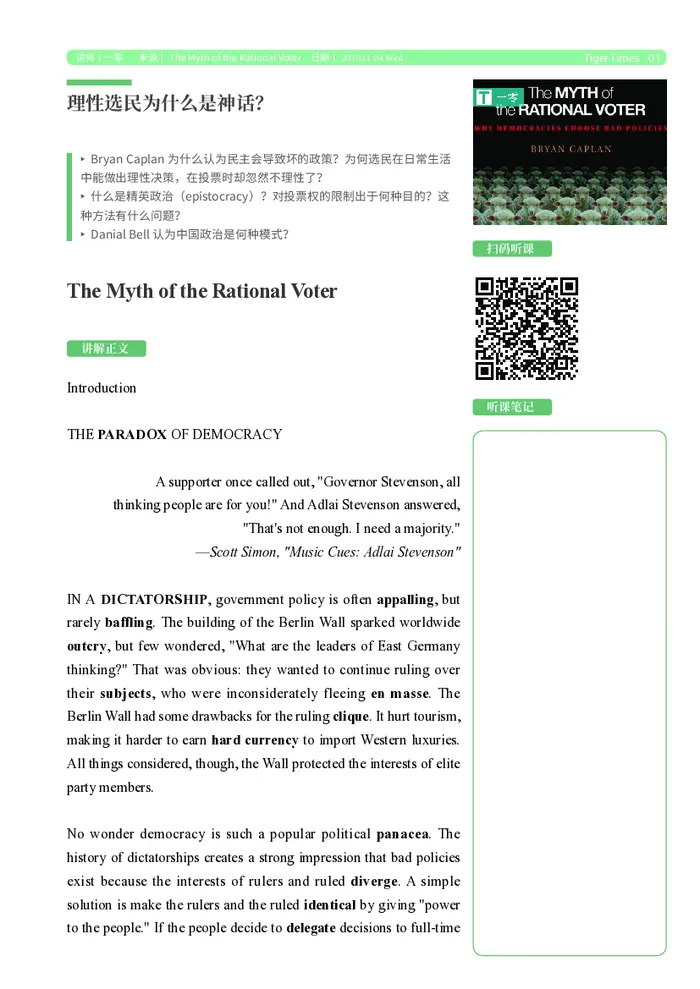
The Myth of the Rational Voter
讲解正文
Introduction
THE PARADOX OF DEMOCRACY
A supporter once called out, "Governor Stevenson, all
thinking people are for you!" And Adlai Stevenson answered,
"That's not enough. I need a majority."
—Scott Simon, "Music Cues: Adlai Stevenson"
IN A DICTATORSHIP, government policy is often appalling, but
rarely baffling. The building of the Berlin Wall sparked worldwide
outcry, but few wondered, "What are the leaders of East Germany
thinking?" That was obvious: they wanted to continue ruling over
their subjects, who were inconsiderately fleeing en masse. The
Berlin Wall had some drawbacks for the ruling clique. It hurt tourism,
making it harder to earn hard currency to import Western luxuries.
All things considered, though, the Wall protected the interests of elite
party members.
No wonder democracy is such a popular political panacea. The
history of dictatorships creates a strong impression that bad policies
exist because the interests of rulers and ruled diverge. A simple
solution is make the rulers and the ruled identical by giving "power
to the people." If the people decide to delegate decisions to full-time
politicians, so what? Those who pay the piper—or vote to pay the
piper—call the tune.
This optimistic story is, however, often at odds with the facts.
Democracies frequently adopt and maintain policies harmful for
most people. Protectionism is a classic example. Economists across
the political spectrum have pointed out its folly for centuries, but
almost every democracy restricts imports. Even when countries
negotiate free trade agreements, the subtext is not, "Trade is mutually
beneficial," but, "We'll do you the favor of buying your imports if
you do us the favor of buying ours." Admittedly, this is less appalling
than the Berlin Wall, yet it is more baffling. In theory, democracy is
a bulwark against socially harmful policies, but in practice it gives
them a safe harbor.
How can this Paradox of Democracy be solved? One answer is
that the people's "representatives" have turned the tables on them.
Elections might be a weaker deterrent to misconduct than they seem
on the surface, making it more important to please special interests
than the general public. A second answer, which complements the
first, is that voters are deeply ignorant about politics. They do not
know who their representatives are, much less what they do. This
tempts politicians to pursue personal agendas and sell themselves to
donors.
A diametrically opposed solution to the Paradox of Democracy
is to deny that it regularly delivers foolish policies. You could
insist that the public is right and "the experts" are wrong, openly
defending the merits of protection, price controls, and so on. That
is straightforward, but risky: It is akin to putting your client on the
stand and opening him up to cross-examination. A less direct but
safer stance—analogous to keeping your client from testifying—is to
pick holes in the alleged mechanisms of democratic failure. You don't
have to show that your client is innocent if the prosecution lacks
a coherent account of how the crime was committed. In the same
way, you need not show that a policy is good if there is no coherent
account of how it could be bad.
Tiger Times
02
有一种完全相反的解决民主悖论的方式:否认民主政治常常出
台愚蠢的政策。你可以坚持民众是对的而“ 专家” 是错的,公开
为贸易保护、价格管制叫好。那样做最直接省事,但却很危险:
这就好比你让你的客户站到被告席上接受盘问。另一种没那么
直接但更安全的方式—— 类似于使你的客户免于出庭作证——
是从被控告的民主失灵的机制上找漏洞。如果起诉书缺乏对犯
罪过程的连冠陈述,你不需要证明你的当事人是无辜的。同样的,
如果没有人能条理清晰地解释政策是如何变糟糕的,那你就不
需要证明它是好的。
Democracy's cleverest enthusiasts usually take this safer route.
Especially in recent years, their strategy has been successful despite
the intuitive appeal of stories about electorally safe politicians and
ignorant voters. For reasons we will soon explore, these stories
buckle or even break when critically analyzed. Without a credible
account of how democracy falls short of its promise, the insight that
it does fall short lives on borrowed time.
民主最聪明的拥护者通常采取了这一更安全的策略。尤其在最
近几年,尽管“ 选举安全的政客” 和“ 无知选民” 这种叙述对人
有着天然的吸引,这些政策也很成功。然而,由于我们即将谈
到的原因,上述设想是经不起严格推敲的。我们需要对民主远
离其初衷提供一个具有说服力的解释,否则,关于民主确有缺
陷的现有解释都不过是自欺欺人罢了。
This book develops an alternative story of how democracy fails.
The central idea is that voters are worse than ignorant; they are, in
a word, irrational—and vote accordingly. Economists and cognitive
psychologists usually presume that everyone "processes information"
to the best of his ability. Yet common sense tells us that emotion and
ideology—not just the facts or their "processing"—powerfully sway
human judgment. Protectionist thinking is hard to uproot because it
feels good. When people vote under the influence of false beliefs that
feel good, democracy persistently delivers bad policies. As an old
computer programming slogan goes, GIGO—Garbage in, garbage
out.
Tiger Times
03
Across-the-board irrationality is not a strike against democracy
alone, but all human institutions. A critical premise of this book is
that irrationality, like ignorance, is selective. We habitually tune out
unwanted information on subjects we don't care about. In the same
vein, I claim that we turn off our rational faculties on subjects where
we don't care about the truth. Economists have long argued that voter
ignorance is a predictable response to the fact that one vote doesn't
matter. Why study the issues if you can't change the outcome? I
generalize this insight: Why control your knee-jerk emotional and
ideological reactions if you can't change the outcome?
This book has three conjoined themes. The first: Doubts about the
rationality of voters are empirically justified. The second: Voter
irrationality is precisely what economic theory implies once we adopt
introspectively plausible assumptions about human motivation. The
third: Voter irrationality is the key to a realistic picture of democracy.
In the naive public-interest view, democracy works because it does
what voters want. In the view of most democracy skeptics, it fails
because it does not do what voters want. In my view, democracy fails
because it does what voters want. In economic jargon, democracy
has a built-in externality. An irrational voter does not hurt only
himself. He also hurts everyone who is, as a result of his irrationality,
more likely to live under misguided policies. Since most of the cost
of voter irrationality is external—paid for by other people, why not
indulge? If enough voters think this way, socially injurious policies
win by popular demand.
When cataloging the failures of democracy, one must keep things
in perspective. Hundreds of millions of people under democratic
rule enjoy standards of living that are, by historical standards,
amazingly good. The shortcomings of the worst democracies pale in
comparison with those of totalitarian regimes. At least democracies
do not murder millions of their own citizens. Nevertheless, now that
democracy is the typical form of government, there is little reason
to dwell on the truisms that it is "better than Communism," or
Tiger Times
04
"beats life during the Middle Ages." Such comparisons set the bar
too low. It is more worthwhile to figure out how and why democracy
disappoints.
不过,在为民主失灵定位时,应该对其有一个客观的评判。生
活在民主规则下的亿万人民,按照历史标准来看,其生活水平
是十分富足的。即便是最糟糕的民主国家,与极权统治相比,
其缺陷也是微不足道的。至少,民主国家不会戕杀上百万自己
的百姓。但是,既然民主现在是普遍的统治形式,就没有理由
对其比“Communism” 或“ 中世纪的野蛮生活” 更优越这一事实
过于津津乐道。这种比较的标准太低了。相形之下,我们更有
必要研究一下,民主为何,又是如何产生令人失望的结果的。
In the minds of many, one of Winston's Churchill's most famous
aphorisms cuts the conversation short: "Democracy is the worst form
of government, except all those other forms that have been tried from
time to time." But this saying overlooks the fact that the governments
vary in scope as well as form. In democracies the main alternative to
majority rule is not dictatorship, but markets.
在很多人的脑子里,温斯顿· 丘吉尔(Winston Churchill)的那
句著名格言似乎可以为民主一锤定音,即“ 民主是最糟糕的统
治形式,除了其他所有已被反复试验过的统治形式之外”。但是,
这句格言忽略了这样一个事实,即无论在范围上还是形式上,
政府之间各不相同。在民主国家中,多数人统治之外的主要选
择不是独裁,而是市场。
Democracy enthusiasts repeatedly acknowledge this. When they
lament the "weakening of democracy," their main evidence is
that markets face little government oversight, or even usurp the
traditional functions of government. They often close with a "wake-
up call" for voters to shrug off their apathy and make their voice
heard. The heretical thought that rarely surfaces is that weakening
democracy in favor of markets could be a good thing. No matter
what you believe about how well markets work in absolute terms,
if democracy starts to look worse, markets start to look better by
comparison.
Tiger Times
05
民主的拥护者们已经不止一次地承认了这一事实。当他们惊呼
“ 民主的式微” 时,他们的主要证据就是市场几乎没有遭遇政府
监管,甚至还取代了政府的传统职能。他们常常向选民发出“ 警
钟式的呼吁”,让他们摒除对政治的冷漠,让他们的呼声得以被
听见。然而,一个很少被提及的“ 异端” 想法是,弱化民主而强
化市场可能恰恰是一件好事。无论你是否相信市场的绝对力量,
如果民主使事情变得更糟,那么相应地,市场往往看起来更好。
Economists have an undeserved reputation for "religious faith"
in markets. No one has done more than economists to dissect the
innumerable ways that markets can fail. After all their investigations,
though, economists typically conclude that the man in the street—
and the intellectual without economic training—underestimates how
well markets work. I maintain that something quite different holds for
democracy: it is widely over-rated not only by the public but by most
economists too. Thus, while the general public underestimates how
well markets work, even economists underestimate markets' virtues
relative to the democratic alternative.
经济学家有一个“ 迷信” 市场的名不副实的名声。而事实上,没
有人比经济学家更彻底地解析过市场失灵的无数种可能性。但
是,经过反复检验后,经济学家通常得出的结论是,普通百姓——
以及那些缺乏经济学训练的知识分子们—— 低估了市场运行有
多优秀。在我看来,民主则获得了截然不同的待遇。那就是,
它的作用不仅被公众,而且被绝大多数经济学家所高估。因此,
不仅普通大众低估了市场的作用,就连经济学家也低估了市场
相对于民主制度的优越性。
Tiger Times
06
Tiger Times
07
paradox /'pærədɒks/ n. 自相矛盾(的情况);悖论,似非
而是的说法
○ a situation that seems strange because it involves two ideas
or qualities that are very different
○ e.g. It's a paradox that in such a rich country there can be
so much poverty. 在如此富有的国家却有这么多的贫穷现
象,真是矛盾。
○ a statement that seems impossible because it contains two
opposing ideas that are both true
○ e.g. The paradox is that fishermen would catch more fish if
they fished less. 悖论就是:如果渔夫减少捕鱼,反而会打
到更多的鱼。
dictatorship /dɪk'teɪtəʃɪp/ n. 独裁国家;独裁,专制,专政
○ a country that is ruled by one person who has complete
power
○ government by a ruler who has complete power
appalling /ə'pɔːlɪŋ/ adj. 骇人听闻的,令人震惊的,可怕的
○ very unpleasant and shocking
○ e.g. She suffered appalling injuries. 她伤势非常严重。
baffle /'bæf(ə)l/ v. 使困惑,难住
○ to confuse sb. completely; to be too difficult or strange for
sb. to understand or explain
○ e.g. His behaviour baffles me. 他的行为使我难以琢磨。
○ baffling /ˈbæflɪŋ/ adj. 令人困惑的,难解的
○ e.g. a baffling mystery 难解之谜
outcry /'aʊtkraɪ/ n. 呐喊,怒吼,强烈的抗议
○ a reaction of anger or strong protest shown by people in
public
○ e.g. The new tax provoked a public outcry. 新税项引起了
公众的强烈抗议。
subject /ˈsʌbdʒɪkt/ n.(尤指君主制国家的)国民,臣民
○ a person who has the right to belong to a particular coun
try, especially one with a king or queen
○ e.g. a British subject 英国国民
en masse /ˌɒn ˈmæs/ adv. 一起,全体
○ (from French) all together, and usually in large numbers
○ e.g. The management team resigned en masse. 管理层全
体辞职了。
clique /kliːk/ n. 派系;私党;小集团;小圈子
○ (often disapproving) a small group of people who spend
their time together and do not allow others to join them
○ e.g. a ruling clique of officials 统治集团中的官员
hard currency 硬通货,强势货币(币值稳定,容易兑换)
○ money that is from a country that has a strong economy
and is therefore unlikely to lose its value
panacea /ˌpænə'si:ə/ n.(解决所有问题的)万应灵丹,万
全之策
○ something that people think will make everything better
and solve all their problems
○ e.g. There is no panacea for the country's economic prob
词汇
lems. 解决该国经济问题没有万应灵丹。
diverge /daɪ'vɜːdʒ/ v. 分歧;相异
○ (formal) (of opinions, views, etc.) to be different
○ e.g. Opinions diverge greatly on this issue. 在这个问题上
意见分歧很大。
identical /aɪ'dentɪk(ə)l/ adj. 完全相同的;非常相似的
○ exactly the same, or very similar
○ e.g. Nutritionally, infant formulas are almost identical to
breast milk. 从营养方面来说,婴儿配方奶粉和母乳几乎
一样。
delegate /ˈdelɪɡeɪt/ v. 授(权);把(工作、权力等)委托(给
下级)
○ to give part of your work, power or authority to sb. in a
lower position than you
○ e.g. Some managers find it difficult to delegate. 有些经理
认为难以做到下放权力。
piper /ˈpaɪpə(r)/ n. 吹笛人;风笛吹奏者
○ someone who plays a pipe or the bagpipes
○ sb. who pays the piper calls the tune 花钱的人说了算;
财大者气粗
○ (saying) the person who provides the money for sth. can
also control how it is spent
call the shots/tune 控制,操纵;发号施令
○ (informal) to be the person who controls a situation
○ (informal) to be in a position of authority so that you can
give orders and make decisions
○ e.g. It was a job in which she was able to call the tune. 这
是一份她可以说了算的工作。
be at odds (with sb.) (over/on sth.) (就某事)(与某人)
有分歧
○ to disagree with sb. about sth.
○ e.g. He's always at odds with his father over politics. 他在
政治上总是与他父亲的意见相左。
bulwark /'bʊlwək/ n. 保障,堡垒,保护物
○ something that protects you from an unpleasant situation
○ e.g. a bulwark against dictatorship 反对独裁的堡垒
deterrent /dɪˈterənt/ n. 制止物,威慑物,威慑力量
○ something that makes someone less likely to do something,
by making them realize it will be difficult or have bad results
○ e.g. The small fines for this type of crime do not act as
much of a deterrent. 对于这种罪行,小额罚金起不到多大
的威慑作用。
please /pliːz/ v. 使高兴,使欢喜;使满意,讨好
○ to make someone happy or satisfied
○ e.g. She did everything she could to please him. 她千方百
计讨好他。
complement /ˈkɒmpləment/ v. 补充,补足,使完美,使更
具吸引力
○ to add to sth. in a way that improves it or makes it more
Tiger Times
08
attractive
○ e.g. The excellent menu is complemented by a good wine
list. 佳肴佐以美酒,堪称完美无缺。
tempt /tempt/ v. 引诱,诱惑;劝诱,鼓动,怂恿,利诱
○ to attract sb. or make sb. want to do or have sth., even if
they know it is wrong
○ e.g. I was tempted by the dessert menu. 甜点菜单馋得我
垂涎欲滴。
○ to persuade or try to persuade sb. to do sth. that you want
them to do, for example by offering them sth.
○ e.g. Nothing would tempt me to live here. 什么也吸引不
了我到这里居住。
diametrically /ˌdaɪəˈmetrɪkli/ adv. 完全(不同);截然(相反)
○ completely different
○ e.g. We hold diametrically opposed views. 我们的观点大
相径庭。
akin /ə'kɪn/ adj. 相似的;类似的
○ ~ to sth. (formal) similar to
○ e.g. What he felt was more akin to pity than love. 他感受
到的更像怜悯,而不是爱。
analogous /əˈnæləɡəs/ adj. 相似的,类似的
○ (formal) similar to another situation or thing so that a com
parison can be made
○ e.g. Sleep has often been thought of as being in some way
analogous to death. 人们常常认为睡眠在某种意义上来说
类似死亡。
prosecution /ˌprɒsɪˈkjuːʃən/ n.(被)起诉,检举,诉讼
○ the process of trying to prove in court that sb. is guilty of a
crime (= of prosecuting them); the process of being officially
charged with a crime in court
○ e.g. Prosecution for a first minor offence rarely leads to im
prisonment. 因初犯轻罪被控者很少被判监禁。
intuitive /ɪn'tjuːɪtɪv/ adj. 凭直觉得到的,直觉的
○ (of ideas) obtained by using your feelings rather than by
considering the facts
○ e.g. He had an intuitive sense of what the reader wanted.
他能直觉地感到读者需要什么。
buckle /ˈbʌkl/ v.(被)压垮,压弯;屈服,让步
○ to become crushed or bent under a weight or force; to
crush or bend sth. in this way
○ e.g. (figurative) A weaker man would have buckled under
the pressure. 意志薄弱的人在这种压力下可能就垮了。
○ to do something that you do not want to do because a diffi
cult situation forces you to do it
○ e.g. He refused to buckle. 他拒绝屈服。
fall short of sth. 未达到...;不足...;未满...
○ to be less than the amount or standard that is needed or that
you want
○ e.g. He would sack any of his staff who fell short of his
high standards. 他会将任何没有达到他高标准的员工开除
掉
sway /sweɪ/ v. 影响(某人);使改变看法 n. 统治;势力;
支配;控制;影响
○ to influence someone so that they change their opinion
○ e.g. Don't allow yourself to be swayed by his promises. 你
可不要听了他的许诺就改变主意呀。
○ (literary) power or influence over sb.
○ e.g. Rebel forces hold sway over much of the island. 该岛
很大一部分控制在叛军手里。
○ e.g. He was quick to exploit those who fell under his sway.
他毫不犹豫地利用受他控制的那些人。
across-the-board adj. 全面的,包括一切的
○ affecting everyone or everything in a situation or organiza
tion
○ e.g. an across-the-board pay increase 集体加薪
premise /'premɪs/ n. 前提;假定
○ (formal) a statement or an idea that forms the basis for a
reasonable line of argument
○ e.g. the basic premise of her argument 她的论证的基本前
提
tune sb./sth. ↔ out 不理睬,置之不理
○ (informal) to ignore or stop listening to someone or some
thing
○ e.g. I learned to tune out the background noise. 我学着不
去理会背景杂音。
in a ... vein (说话、写作)以... 的风格
○ in a particular style of speaking or writing about something
○ e.g. There was more humour, in much the same vein. 风格
差不多,只是更幽默了。
○ vein /veɪn/ n. 静脉
○ one of the tubes which carries blood to your heart from
other parts of your body
○ e.g. the pulmonary vein 肺静脉
faculty /'fæklti/ n. 官能,天赋;才能,能力
○ any of the physical or mental abilities that a person is born
with
○ e.g. the faculty of sight 视觉
○ e.g. She retained her mental faculties (= the ability to think
and understand) until the day she died. 她直到去世那天一直
保持着思维和理解能力。
○ (formal) a particular ability for doing sth
○ e.g. the faculty of understanding complex issues 理解复杂
问题的能力
knee-jerk /ˈniː dʒɜːk/ adj. 本能地做出的;未经思考做出的
○ [only before noun] (disapproving) produced automatically,
without any serious thought
○ e.g. It was a knee-jerk reaction on her part. 这是她未加思
索做出的反应。
empirical /ɪmˈpɪrɪkl/ adj. 以实验(或经验)为依据的;经
验主义的
○ [usually before noun] (formal) based on experiments or
experience rather than ideas or theories
○ e.g. an empirical study 经验式研究
○ empirically /ɪmˈpɪrɪkli/ adv. 以经验为主地
○ e.g. Such claims need to be tested empirically. 这类断言需
要实践来检验。
plausible /ˈplɔːzəbl/ adj. 貌似有理的;似乎是真的
Tiger Times
09
○ reasonable and likely to be true or successful
○ e.g. His story certainly sounds plausible. 他的叙述听上去
当然很合理。
naive /naɪˈiːv/ adj. 缺乏经验的,幼稚的,无知的,轻信的
○ (disapproving) lacking experience of life, knowledge or
good judgement and willing to believe that people always tell
you the truth
○ e.g. to be politically naive 对政治一无所知
jargon /ˈdʒɑːɡən/ n.(难懂的)行话,术语〔常含贬义〕
○ words and expressions used in a particular profession or
by a particular group of people, which are difficult for other
people to understand – often used to show disapproval
○ e.g. documents full of legal jargon 通篇都是法律术语的
文件
externality /ˌekstɜːˈnæləti/ n. 外部性,界外效应(工商业
活动所产生的影响,但不通过市场价格反映)
○ (economics) a consequence of an industrial or commer
cial activity which affects other people or things without this
being reflected in market prices
○ e.g. Pollution is a negative externality that imposes a
cost—reduced happiness—on the victims. 污染是一种负面
外部效应,使部分人的幸福被牺牲而成为受害者。
○ external /ɪkˈstɜːnl/ adj. 外部的;外面的
○ connected with or located on the outside of sth./sb.
○ e.g. the external walls of the building 建筑物的外墙
perspective /pəˈspektɪv/ adj.(对事物的)合理判断,正确
认识
○ a sensible way of judging and comparing situations so that
you do not imagine that something is more serious than it
really is
○ e.g. The figures have to be put into perspective. 必须正确
认识这些数字。
○ get/keep something in perspective 正确判断某事物的重
要性
○ to judge the importance of something correctly
pale in/by comparison 相形见绌;显得逊色
○ to seem less important when compared with sth. else
○ e.g. Last year's riots pale in comparison with this latest
outburst of violence. 去年的骚乱与最近这次暴乱相比,可
说是小巫见大巫。
totalitarian /təʊˌtæləˈteəriən/ adj. 极权主义的
○ (disapproving) (of a country or system of government)
in which there is only one political party that has complete
power and control over the people
○ e.g. a totalitarian state/regime 极权主义国家/ 政权
dwell on/upon sth. 老是想着,唠叨(尤指最好应忘记的事)
○ to think or talk a lot about sth., especially sth. it would be
better to forget
○ e.g. So you made a mistake, but there's no need to dwell on
it. 你是错了,不过不必老是想着这事儿。
truism /ˈtruːɪzəm/ n. 不言而喻的道理,自明之理,老生常
谈
○ a statement that is clearly true and does not therefore add
anything interesting or important to a discussion
○ e.g. His speech was just a collection of clichés and truisms.
他的演说就是一堆陈词滥调和自明之理。
Communism /ˈkɒmjənɪzəm/ n. 共产主义(制度)
○ a political system in which the government controls the
production of all food and goods, and there is no privately
owned property
aphorism /ˈæfərɪzəm/ n. 格言,警句
○ (formal) a short phrase that contains a wise idea
lament /ləˈment/ v. 对… 感到悲痛;痛惜;对… 表示失
望
○ (formal) to feel or express great sadness or disappointment
about sb./sth.
○ e.g. In the poem he laments the destruction of the country
side. 在那首诗里他对乡村遭到的破坏流露出悲哀。
usurp /juːˈzɜːp/ v. 篡夺,夺取(权力、地位、工作等)
○ (formal) to take someone else's power, position, job etc.
when you do not have the right to
○ e.g. There were a couple of attempts to usurp the young
king. 屡次有人企图篡夺那位年轻国王的王位。
shrug sth. ↔ off 对... 满不在乎,对... 不屑一顾
○ to treat something as unimportant and not worry about it
○ e.g. We can't just shrug these objections off. 我们不能不
理会这些反对意见呀。
apathy /ˈæpəθi/ n. 冷漠;淡漠
○ the feeling of not being interested in or enthusiastic about
something, or things in general
○ e.g. There is widespread apathy among the electorate. 选民
普遍态度冷淡。
heretic /ˈherətɪk/ n. 异教徒,异端分子
○ someone who is guilty of heresy
○ e.g. Cranmer was put to death as a heretic. 克兰默被当成
异教徒处死。
○ heretical /həˈretɪkl/ adj. 异教的,异端的
○ e.g. heretical beliefs 异端信仰
undeserved /ˌʌndɪˈzɜːvd/ adj. 不应得的,冤枉的,不公正
的
○ that sb. does not deserve and therefore unfair
○ e.g. The criticism was totally undeserved. 这批评纯属冤
枉人。
dissect /dɪˈsekt/ v. 剖析,仔细分析〔某事物〕
○ to examine something carefully in order to understand it
○ e.g. books in which the lives of famous people are dissect
ed 剖析名人生平的书籍
innumerable /ɪˈnjuːmərəbəl/ adj. 很多的,不可胜数的
○ very many, or too many to be counted
○ e.g. She's served on innumerable committees. 她在多个委
员会担任委员。
virtue /ˈvɜːtʃuː/ n. 优点,长处,用处
○ an attractive or useful quality
○ e.g. The plan has the virtue of simplicity. 这项计划的优点
是简单。
Tiger Times
10
今日习题
1. 根据英文释义写出文中出现的对应单词
_________: very unpleasant and shocking
_________: something that makes someone less likely to do something, by making them realize it will be
difficult or have bad results
_________: (formal) a statement or an idea that forms the basis for a reasonable line of argument
2. 一词多义
Which of the following underlined words is closest in meaning to the one in the sentence "Elections might
be a weaker deterrent to misconduct than they seem on the surface, making it more important to please
special interests than the general public."? ____
A. Please don't leave me here alone.
B. You can't please everybody.
C. She always does exactly as she pleases.
D. He just walked in and sat down, as bold as you please.
3. 翻译:根据给定中文回译英文
理论上,民主是一道防御社会有害政策的堡垒,但在实践中,民主却为它提供了一个安全的避风港。
_____________________________________________________________________________________
_________________________________________________________________
习题答案
1. appalling; deterrent; premise
2. B
3. In theory, democracy is a bulwark against socially harmful policies, but in practice it gives them
a safe harbor.
编辑丨雨洁