1
2021 年下教师资格笔试高中英语模拟卷一
一、单项选择题(本大题共30 小题,每小题2 分,共60 分)
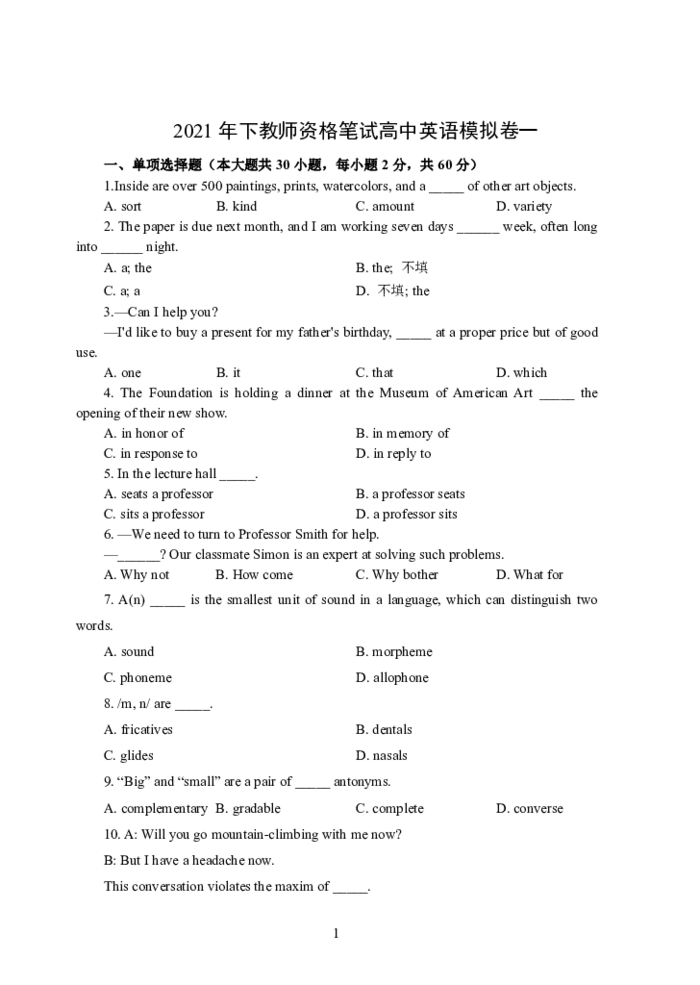
1.Inside are over 500 paintings, prints, watercolors, and a _____ of other art objects.
A. sort
B. kind
C. amount
D. variety
2. The paper is due next month, and I am working seven days ______ week, often long
into ______ night.
A. a; the
B. the; 不填
C. a; a
D. 不填; the
3.—Can I help you?
—I'd like to buy a present for my father's birthday, _____ at a proper price but of good
use.
A. one
B. it
C. that
D. which
4. The Foundation is holding a dinner at the Museum of American Art _____ the
opening of their new show.
A. in honor of
B. in memory of
C. in response to
D. in reply to
5. In the lecture hall _____.
A. seats a professor
B. a professor seats
C. sits a professor
D. a professor sits
6. —We need to turn to Professor Smith for help.
—______? Our classmate Simon is an expert at solving such problems.
A. Why not
B. How come
C. Why bother
D. What for
7. A(n) _____ is the smallest unit of sound in a language, which can distinguish two
words.
A. sound
B. morpheme
C. phoneme
D. allophone
8. /m, n/ are _____.
A. fricatives
B. dentals
C. glides
D. nasals
9. “Big” and “small” are a pair of _____ antonyms.
A. complementary B. gradable
C. complete
D. converse
10. A: Will you go mountain-climbing with me now?
B: But I have a headache now.
This conversation violates the maxim of _____.
2
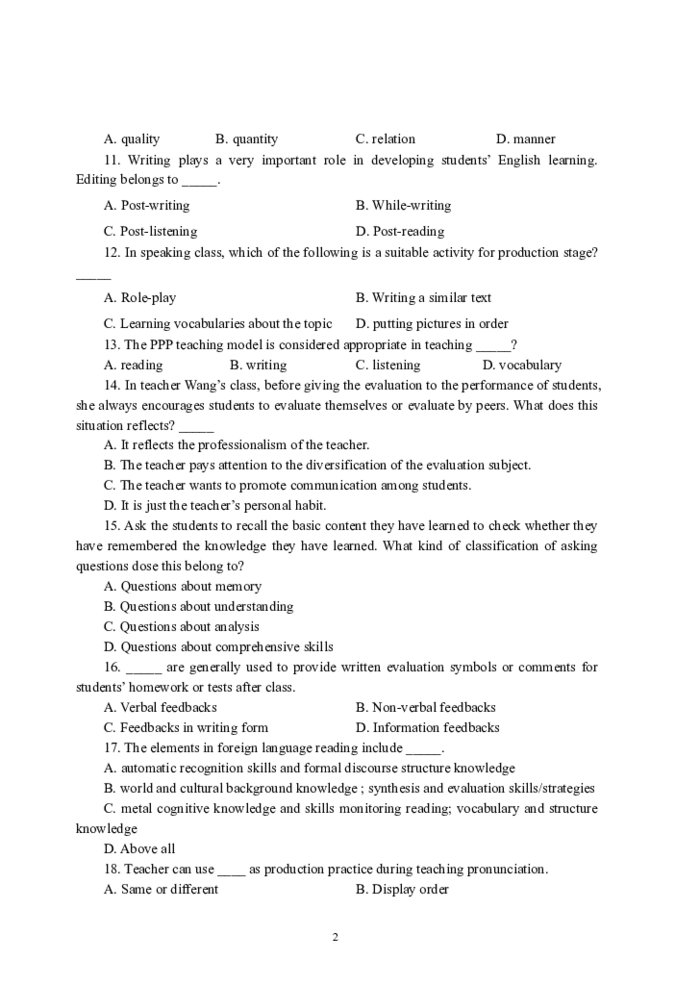
A. quality
B. quantity
C. relation
D. manner
11. Writing plays a very important role in developing students’ English learning.
Editing belongs to _____.
A. Post-writing
B. While-writing
C. Post-listening
D. Post-reading
12. In speaking class, which of the following is a suitable activity for production stage?
_____
A. Role-play
B. Writing a similar text
C. Learning vocabularies about the topic
D. putting pictures in order
13. The PPP teaching model is considered appropriate in teaching _____?
A. reading
B. writing
C. listening
D. vocabulary
14. In teacher Wang’s class, before giving the evaluation to the performance of students,
she always encourages students to evaluate themselves or evaluate by peers. What does this
situation reflects? _____
A. It reflects the professionalism of the teacher.
B. The teacher pays attention to the diversification of the evaluation subject.
C. The teacher wants to promote communication among students.
D. It is just the teacher’s personal habit.
15. Ask the students to recall the basic content they have learned to check whether they
have remembered the knowledge they have learned. What kind of classification of asking
questions dose this belong to?
A. Questions about memory
B. Questions about understanding
C. Questions about analysis
D. Questions about comprehensive skills
16. _____ are generally used to provide written evaluation symbols or comments for
students’ homework or tests after class.
A. Verbal feedbacks
B. Non-verbal feedbacks
C. Feedbacks in writing form
D. Information feedbacks
17. The elements in foreign language reading include _____.
A. automatic recognition skills and formal discourse structure knowledge
B. world and cultural background knowledge ; synthesis and evaluation skills/strategies
C. metal cognitive knowledge and skills monitoring reading; vocabulary and structure
knowledge
D. Above all
18. Teacher can use ____ as production practice during teaching pronunciation.
A. Same or different
B. Display order
3
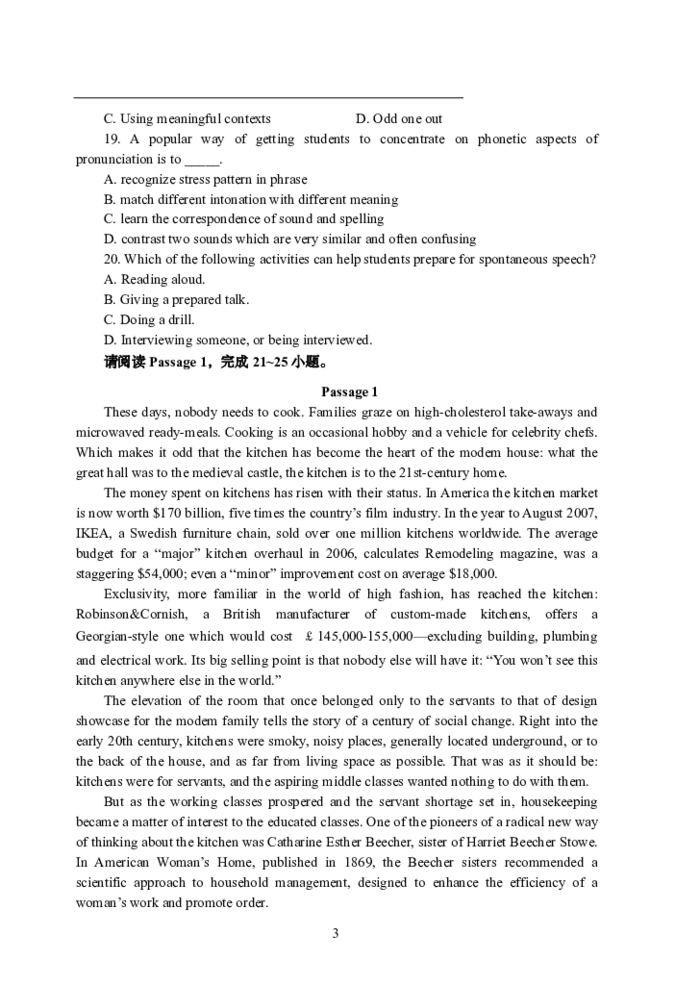
C. Using meaningful contexts
D. Odd one out
19. A popular way of getting students to concentrate on phonetic aspects of
pronunciation is to _____.
A. recognize stress pattern in phrase
B. match different intonation with different meaning
C. learn the correspondence of sound and spelling
D. contrast two sounds which are very similar and often confusing
20. Which of the following activities can help students prepare for spontaneous speech?
A. Reading aloud.
B. Giving a prepared talk.
C. Doing a drill.
D. Interviewing someone, or being interviewed.
请阅读Passage 1,完成21~25 小题。
Passage 1
These days, nobody needs to cook. Families graze on high-cholesterol take-aways and
microwaved ready-meals. Cooking is an occasional hobby and a vehicle for celebrity chefs.
Which makes it odd that the kitchen has become the heart of the modem house: what the
great hall was to the medieval castle, the kitchen is to the 21st-century home.
The money spent on kitchens has risen with their status. In America the kitchen market
is now worth $170 billion, five times the country’s film industry. In the year to August 2007,
IKEA, a Swedish furniture chain, sold over one million kitchens worldwide. The average
budget for a “major” kitchen overhaul in 2006, calculates Remodeling magazine, was a
staggering $54,000; even a “minor” improvement cost on average $18,000.
Exclusivity, more familiar in the world of high fashion, has reached the kitchen:
Robinson&Cornish,
a
British
manufacturer
of
custom-made
kitchens,
offers
a
Georgian-style one which would cost £145,000-155,000—excluding building, plumbing
and electrical work. Its big selling point is that nobody else will have it: “You won’t see this
kitchen anywhere else in the world.”
The elevation of the room that once belonged only to the servants to that of design
showcase for the modem family tells the story of a century of social change. Right into the
early 20th century, kitchens were smoky, noisy places, generally located underground, or to
the back of the house, and as far from living space as possible. That was as it should be:
kitchens were for servants, and the aspiring middle classes wanted nothing to do with them.
But as the working classes prospered and the servant shortage set in, housekeeping
became a matter of interest to the educated classes. One of the pioneers of a radical new way
of thinking about the kitchen was Catharine Esther Beecher, sister of Harriet Beecher Stowe.
In American Woman’s Home, published in 1869, the Beecher sisters recommended a
scientific approach to household management, designed to enhance the efficiency of a
woman’s work and promote order.
4
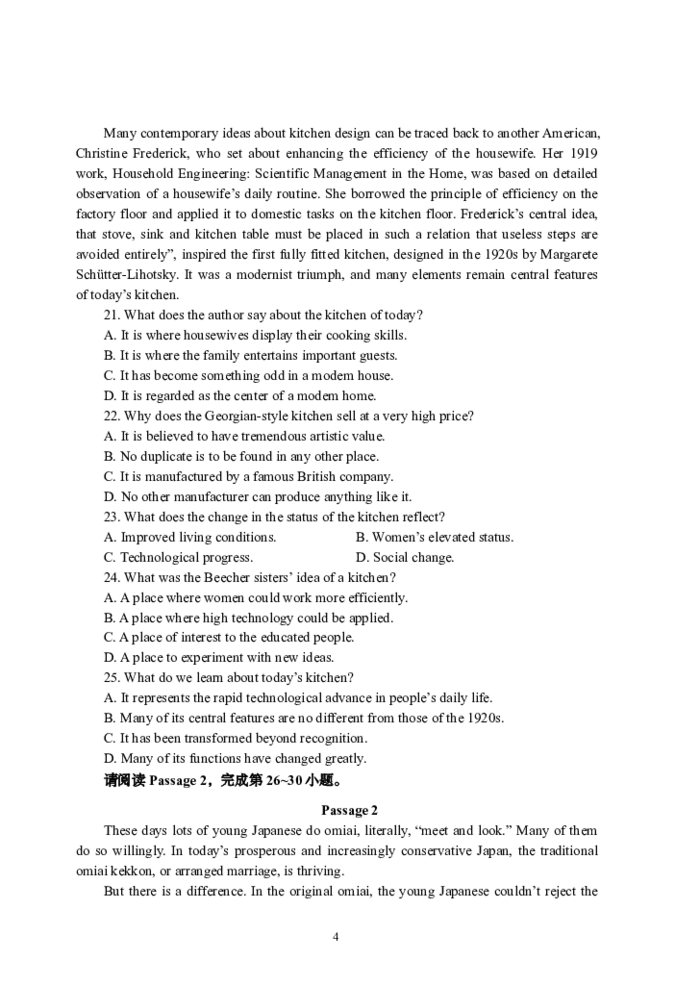
Many contemporary ideas about kitchen design can be traced back to another American,
Christine Frederick, who set about enhancing the efficiency of the housewife. Her 1919
work, Household Engineering: Scientific Management in the Home, was based on detailed
observation of a housewife’s daily routine. She borrowed the principle of efficiency on the
factory floor and applied it to domestic tasks on the kitchen floor. Frederick’s central idea,
that stove, sink and kitchen table must be placed in such a relation that useless steps are
avoided entirely”, inspired the first fully fitted kitchen, designed in the 1920s by Margarete
Schütter-Lihotsky. It was a modernist triumph, and many elements remain central features
of today’s kitchen.
21. What does the author say about the kitchen of today?
A. It is where housewives display their cooking skills.
B. It is where the family entertains important guests.
C. It has become something odd in a modem house.
D. It is regarded as the center of a modem home.
22. Why does the Georgian-style kitchen sell at a very high price?
A. It is believed to have tremendous artistic value.
B. No duplicate is to be found in any other place.
C. It is manufactured by a famous British company.
D. No other manufacturer can produce anything like it.
23. What does the change in the status of the kitchen reflect?
A. Improved living conditions.
B. Women’s elevated status.
C. Technological progress.
D. Social change.
24. What was the Beecher sisters’ idea of a kitchen?
A. A place where women could work more efficiently.
B. A place where high technology could be applied.
C. A place of interest to the educated people.
D. A place to experiment with new ideas.
25. What do we learn about today’s kitchen?
A. It represents the rapid technological advance in people’s daily life.
B. Many of its central features are no different from those of the 1920s.
C. It has been transformed beyond recognition.
D. Many of its functions have changed greatly.
请阅读Passage 2,完成第26~30 小题。
Passage 2
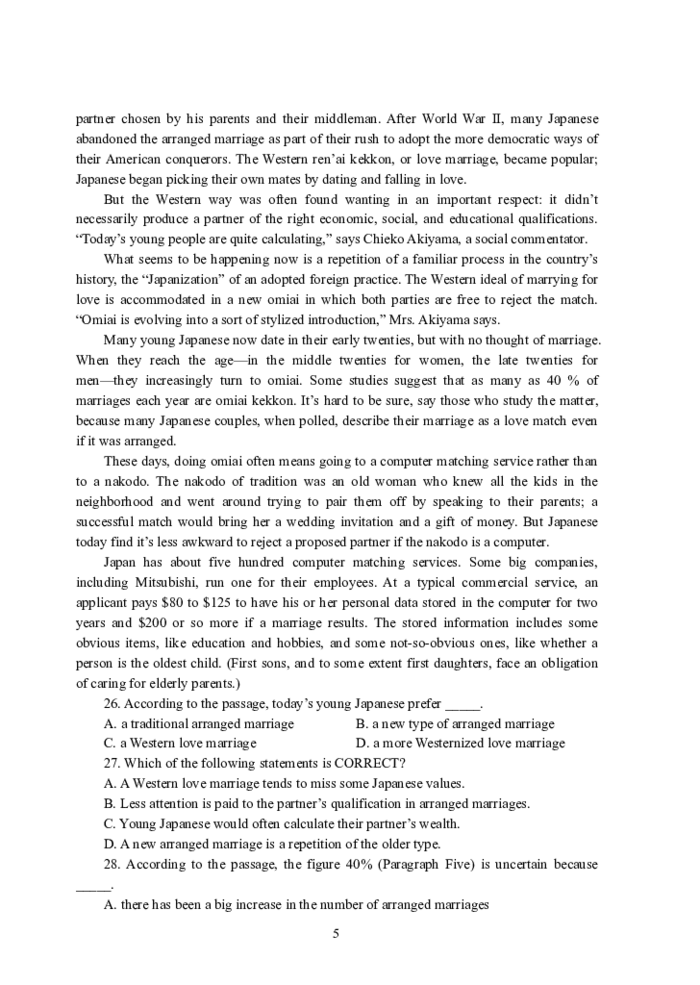
These days lots of young Japanese do omiai, literally, “meet and look.” Many of them
do so willingly. In today’s prosperous and increasingly conservative Japan, the traditional
omiai kekkon, or arranged marriage, is thriving.
But there is a difference. In the original omiai, the young Japanese couldn’t reject the
5
partner chosen by his parents and their middleman. After World War II, many Japanese
abandoned the arranged marriage as part of their rush to adopt the more democratic ways of
their American conquerors. The Western ren’ai kekkon, or love marriage, became popular;
Japanese began picking their own mates by dating and falling in love.
But the Western way was often found wanting in an important respect: it didn’t
necessarily produce a partner of the right economic, social, and educational qualifications.
“Today’s young people are quite calculating,” says Chieko Akiyama, a social commentator.
What seems to be happening now is a repetition of a familiar process in the country’s
history, the “Japanization” of an adopted foreign practice. The Western ideal of marrying for
love is accommodated in a new omiai in which both parties are free to reject the match.
“Omiai is evolving into a sort of stylized introduction,” Mrs. Akiyama says.
Many young Japanese now date in their early twenties, but with no thought of marriage.
When they reach the age—in the middle twenties for women, the late twenties for
men—they increasingly turn to omiai. Some studies suggest that as many as 40 % of
marriages each year are omiai kekkon. It’s hard to be sure, say those who study the matter,
because many Japanese couples, when polled, describe their marriage as a love match even
if it was arranged.
These days, doing omiai often means going to a computer matching service rather than
to a nakodo. The nakodo of tradition was an old woman who knew all the kids in the
neighborhood and went around trying to pair them off by speaking to their parents; a
successful match would bring her a wedding invitation and a gift of money. But Japanese
today find it’s less awkward to reject a proposed partner if the nakodo is a computer.
Japan has about five hundred computer matching services. Some big companies,
including Mitsubishi, run one for their employees. At a typical commercial service, an
applicant pays $80 to $125 to have his or her personal data stored in the computer for two
years and $200 or so more if a marriage results. The stored information includes some
obvious items, like education and hobbies, and some not-so-obvious ones, like whether a
person is the oldest child. (First sons, and to some extent first daughters, face an obligation
of caring for elderly parents.)
26. According to the passage, today’s young Japanese prefer _____.
A. a traditional arranged marriage
B. a new type of arranged marriage
C. a Western love marriage
D. a more Westernized love marriage
27. Which of the following statements is CORRECT?
A. A Western love marriage tends to miss some Japanese values.
B. Less attention is paid to the partner’s qualification in arranged marriages.
C. Young Japanese would often calculate their partner’s wealth.
D. A new arranged marriage is a repetition of the older type.
28. According to the passage, the figure 40% (Paragraph Five) is uncertain because
_____.
A. there has been a big increase in the number of arranged marriages
6
B. Western love marriage still remains popular among young Japanese
C. young Japanese start dating very early in their life in a Western tradition
D. the tendency for arranged marriages could be stronger than is indicated
29. One of the big differences between a traditional nakodo and its contemporary
version lies in the way _____.
A. wedding gifts are presented
B. a proposed partner is refused
C. formalities are arranged
D. the middleman/woman is chosen
30. What is the purpose of the last paragraph?
A. To tell the differences between an old and modern nakodo.
B. To provide some examples for the traditional nakodo.
C. To offer more details of the computerized nakodo.
D. To sum up the main ideas and provide a conclusion.
二、简答题(本大题1 小题,20 分)
31.学起于思,思起于疑,疑解于问。教学是一门艺术,而课堂提问是组织课堂教
学的中心环节。请简述常见问题的分类有哪些?提问的重要性体现在哪些方面?
三、教学情境分析题(本大题1 小题,30 分)
32.请根据下面的教学实录片段,回答问题。
T: Since we have learnt the attributive clause, let’s do some exercises. Please fill in the
blanks on the screen. Two minutes for you, start!
…
T: Look at the first two sentences. Any volunteer?
S1: For the first one, I’ll never forget the day that my hometown was liberated. The
second one is…(教师打断)
T: I’m sorry, please stop. Pay attention to the antecedent “day” and the part it plays in
the clause. Do you think it is a subject, an object or an adverbial?(老师语速放慢,并以目
光示意该学生继续回答问题。)
S1: Oh, “day” is an adverbial of time in a clause. I’ll never forget the day when my
hometown was liberated. The second one is …
T: Well done. How about the next two?
S2: The third one is: She is the man who lives next door. The fourth one is: The train
7
which has just left is for Shenzhen.
T: SHE(?) is the MAN(?) who lives next door?
S2: Oh, he is the man who lives next door.
(1)请指出片段中两名学生所犯的错误。
(2)针对学生的不同错误,老师采取了哪种纠错方法?
(3)该教师遵循了课堂纠错的哪些原则?
四、教学设计题(本大题1 小题,40 分)
33.根据提供的信息和语言素材设计教学方案,用英文作答。
设计任务:请阅读下面学生信息和语言素材,设计一节20 分钟的英语语法课的教
案。教案没有固定格式,但须包含下列要点:
●Teaching objectives
●Teaching contents
●Key and difficult points
●Major steps and time allocation
●Activities and justifications
教学时间:20 分钟
学生概况:某城镇普通高一年级第二学期学生40 人。多数学生已经达到《普通高
中英语课程标准(2017 年版)》五级水平。学生课堂参与积极性一般。
8
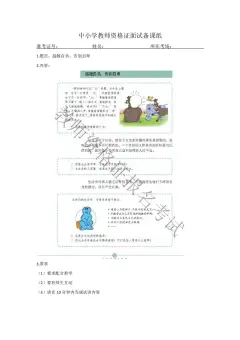
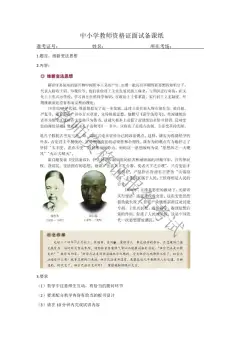
语言素材:
(来源:选自外研版教材)
9