ARTICLE · 1043824
小学英语语法学习重点全梳理!超详细框架助力孩子轻松学语法

点击蓝字 关注我们
小学是英语学习的关键启蒙阶段,语法作为英语学习的重要基石,掌握好它能让孩子的英语学习事半功倍。今天,就为大家带来小学英语语法的完整框架,助力孩子高效学习英语语法~
🌟
一、语法占比分布
从整体占比来看
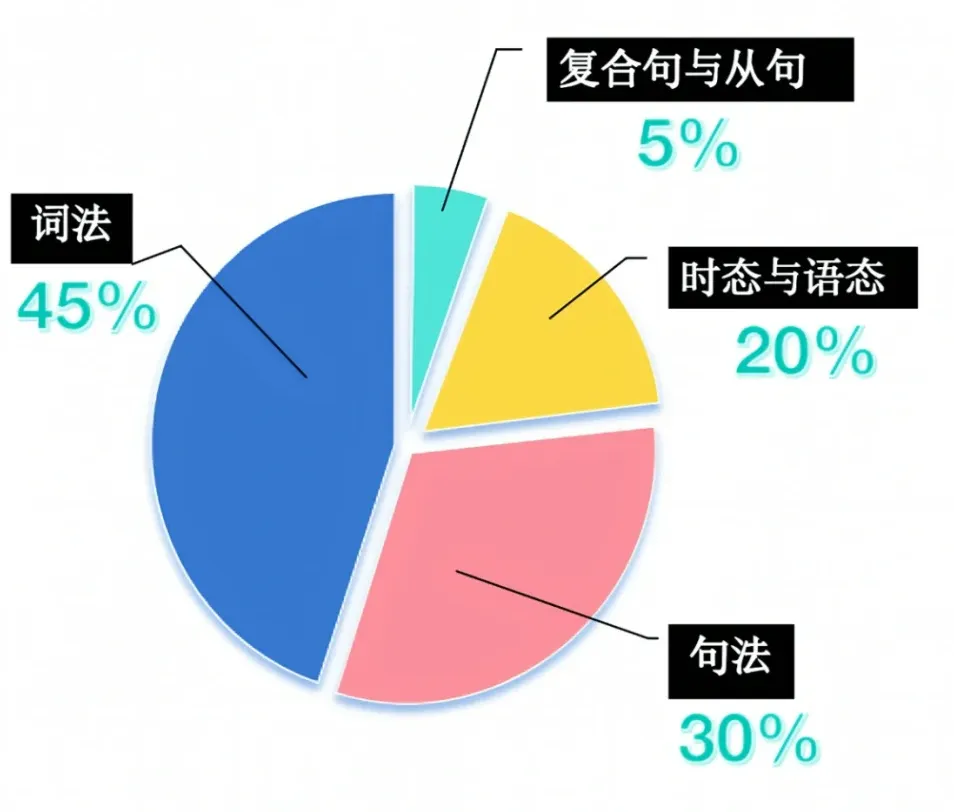
词法占比 45%,是小学英语语法学习的重点;
句法占 30%,帮助孩子构建句子逻辑;
时态与语态占 20%,是日常交流和考试的核心;
复合句和从句占比 5%,为初中学习提前铺垫。
🌟
二、各板块详细解析
(一)45% 词法:低年级重点,关乎造句与表达
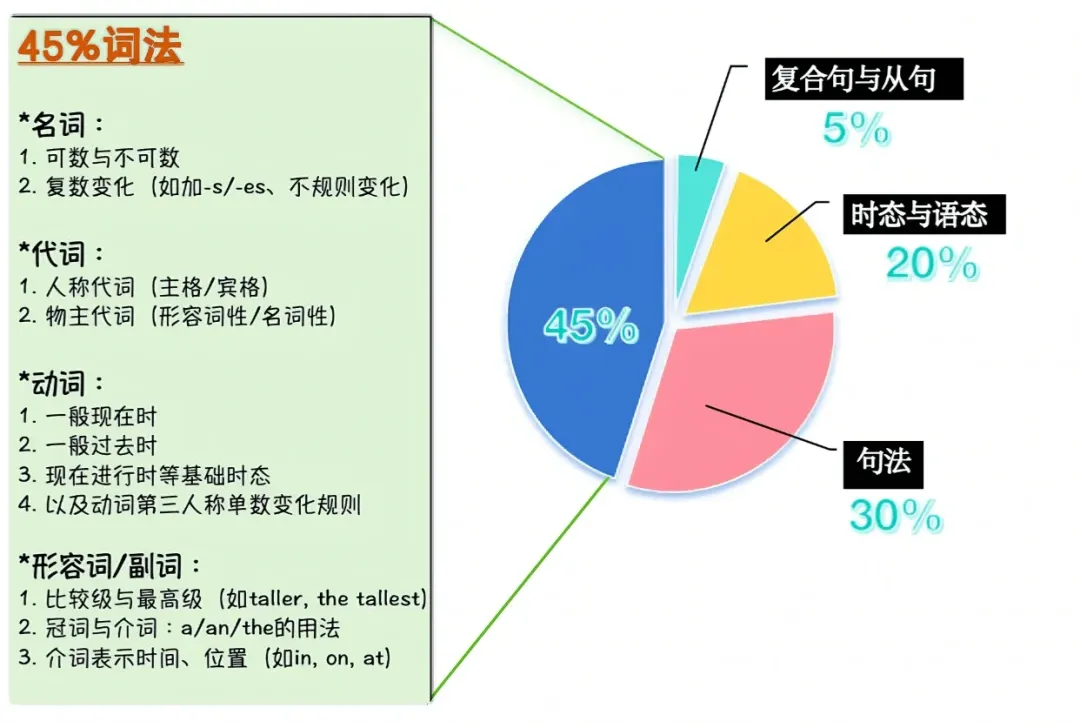
词法是低年级(1 - 3 年级)的重点,占语法学习近一半比例,直接影响学生造句和日常表达能力。
名词
可数与不可数:可数名词可用数字直接计量,有单复数形式,如 “an apple → two apples(苹果);a book → three books(书)”;不可数名词表示抽象概念或无法分割的物质,无复数形式,如 “water(水);information(信息)”。
复数变化:规则变化是加 - s /- es,如 “bus→buses;box→boxes”;不规则变化如 “child→children(孩子);foot→feet(脚)”。
代词
人称代词:主格(作主语)有 I, you, he, she, it, we, they,例:“She is reading a book.”;宾格(作宾语)有 me, you, him, her, it, us, them,例:“Give the pen to him.”。
物主代词:形容词性物主代词有 my, your, his, her, its, our, their,例:“This is my bag.”;名词性物主代词有 mine, yours, his, hers, ours, theirs,例:“The red car is hers.”。
动词
一般现在时:表示习惯或事实,第三人称单数加 - s /- es,例:“He walks to school every day.”。
一般过去时:动词加 - ed(规则变化)或用不规则形式,例:“She played tennis yesterday. / They went to the park.”。
现在进行时:be 动词(am /is/are) + 动词 - ing 形式,例:“The cat is sleeping now.”。
第三人称单数变化规则:以 - s, - x, - ch, - sh 结尾的动词加 - es,例:“watch→watches;fix→fixes”。
形容词 / 副词
比较级与最高级:单音节词如 “tall→taller→tallest”;多音节词如 “beautiful→more beautiful→the most beautiful”;不规则变化如 “good→better→best”。
冠词用法:a /an 泛指单数可数名词,如 “a cat /an apple”;the 特指已知事物,如 “the sun /the book on the table”。
介词表示时间 / 位置:时间方面,in 接年份(如 in 2024)、on 接某天(如 on Monday)、at 接具体时刻(如 at 7:00);位置方面,in 表内部(如 in the room)、on 表表面(如 on the desk)、at 表点位置(如 at the door)。
(二)30% 句法:中高年级强化,理解句子逻辑
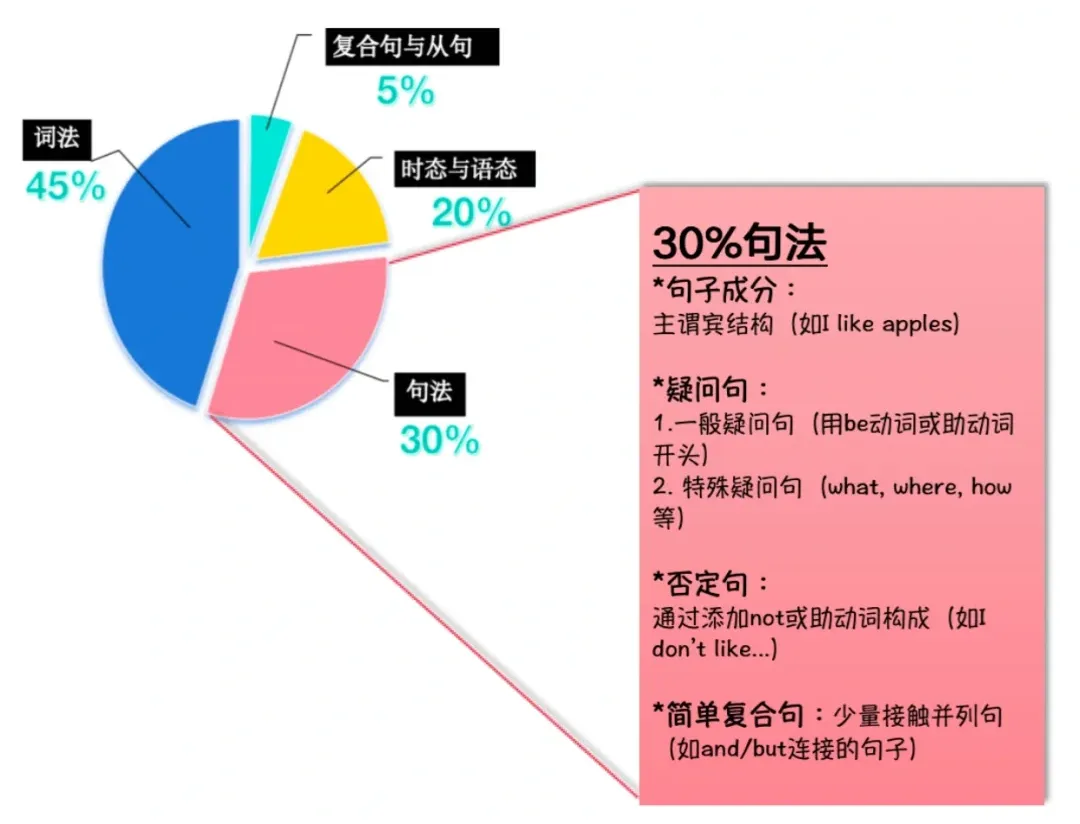
中高年级(4 - 6 年级)逐步强化句法训练,帮助学生理解句子逻辑关系。
句子成分:主谓宾结构构成是主语(动作发出者) + 谓语(动作) + 宾语(动作承受者)。例 1:“She plays the piano.”,主语(She) + 谓语(plays) + 宾语(the piano);例 2:“The students cleaned the classroom.”,主语(The students) + 谓语(cleaned) + 宾语(the classroom)。
疑问句类型
一般疑问句:结构为 Be 动词 / 助动词 + 主语 + 实义动词...? 例 1:“Are you hungry?”(be 动词开头);例 2:“Did they finish homework?”(助动词 did 开头)。
特殊疑问句:结构为疑问词 + 一般疑问句式。例 1:“Where is the library?”(询问地点);例 2:“How do you spell "restaurant"? ”(询问方式)。
否定句构成
1)be 动词否定:主语 + be + not + 表语,例:“I am not tired.(不累)”。
2)实义动词否定:主语 + 助动词 + not + 动词原形,例:“They don't eat meat.(不吃肉)”;“She didn't watch the movie.(没看电影)”。
简单复合句(并列句)连接方式为独立分句 + 并列连词 + 独立分句。例 1:“I want to go hiking, but it's raining outside.”,表转折关系(but 连接两个相反情况);例 2:“He opened the door and turned on the light.”,表顺承关系(and 连接连续动作)。
拓展与注意可尝试改写句子结构:
肯定句 → 否定句 → 一般疑问句 → 特殊疑问句。
如 “Tom reads novels.” 可改写为 “Tom doesn't read comics.”“Does Tom read novels?”“What does Tom read?”。
特殊疑问句中,疑问词作宾语时结构为 “疑问词 + 助动词 + 主语 + 动词”(如:“What did you buy?”);并列连词 but 强调转折,and 强调并列,别混淆,错误示例 “ I like tea and I don't like coffee.”,正确示例 “ I like tea but I don't like coffee.”。
(三)20% 时态与语态:交流与考试核心
时态是考试和日常交流的核心,尤其注重一般现在时和过去时的应用。
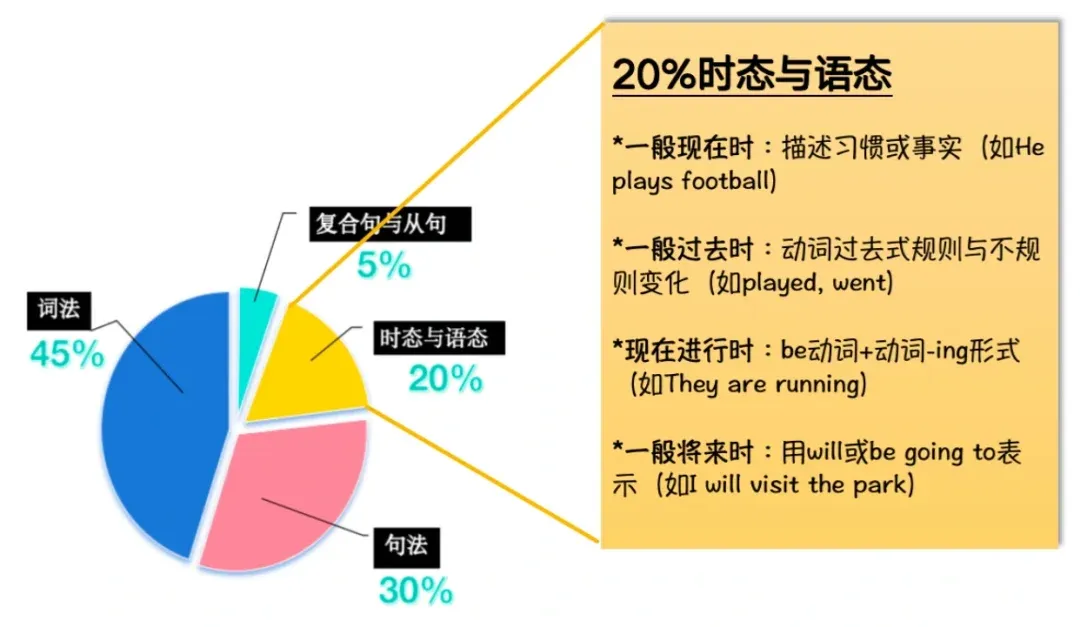
一般现在时 (Simple Present Tense)核心用法是描述习惯性动作(常出现频率副词)和陈述客观事实 / 普遍真理,结构为动词原形(第三人称单数加 - s /- es)。习惯类例子:“She reads a chapter of a novel every night before bed.”(体现规律性);事实类例子:“Water boils at 100 degrees Celsius.”(科学事实)。
一般过去时 (Simple Past Tense)动词变化分规则与不规则,规则变化是动词 + ed,以 e 结尾加 d(如 “live → lived”),辅音 + y 结尾变 i + ed(如 “study → studied”);不规则变化需单独记忆,如 “go → went, eat → ate, see → saw”。规则动词例子:“He baked a chocolate cake for his sister's birthday.”(bake → baked,过去动作);不规则动词例子:“They swam across the river yesterday.”(swim → swam,过去动作)。
现在进行时 (Present Continuous Tense)结构为 be 动词 (am /is/are) + 动词 - ing 形式,使用场景是此刻正在发生的动作或近期计划好的未来安排。当前动作例子:“The children are laughing at a funny cartoon in the living room.”(are + laughing,正在笑);未来计划例子:“I'm meeting my professor at 3 PM tomorrow.”(am meeting,已安排会面)。
一般将来时 (Simple Future Tense)有 “will + 动词” 和 “be going to” 两种结构,“will + 动词” 用于临时决定 / 预测 / 承诺,语气较中性;“be going to” 用于事先计划 / 有迹象表明将发生的事,确定性更强。“will” 用法例子:“The phone is ringing! I'll answer it.”(临时决定接电话);“be going to” 用法例子:“Look at those dark clouds! It's going to rain soon.”(乌云预示下雨)。
时态对比与注意以描述同一个人不同时间状态为例,现在时:“Lisa walks her dog in the park every morning.”(每日习惯);过去时:“Lisa walked her dog in the rain yesterday.”(昨天事件);进行时:“Lisa is walking her dog right now.”(此刻发生);将来时:“Lisa will walk her dog after finishing her work.”(未来发生)。注意小学仅涉及主动语态。
(四)5% 复合句与从句:高年级铺垫,助力初中学习
高年级(5 - 6 年级)逐步引入,为初中学习打下基础,占比最低。
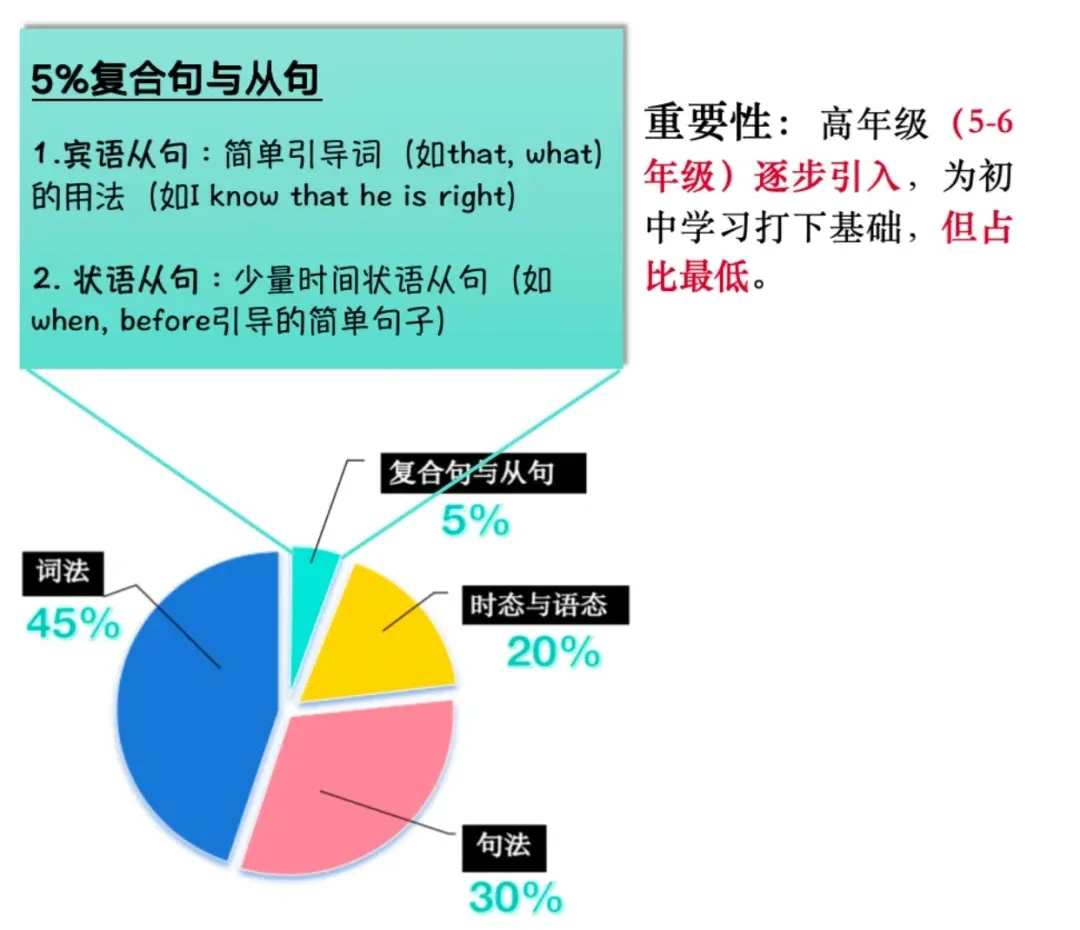
宾语从句(简单引导词 that, what 的用法)概念是宾语从句在句子中充当动词或介词的宾语,用简单引导词(如 that, what)连接主句和从句。
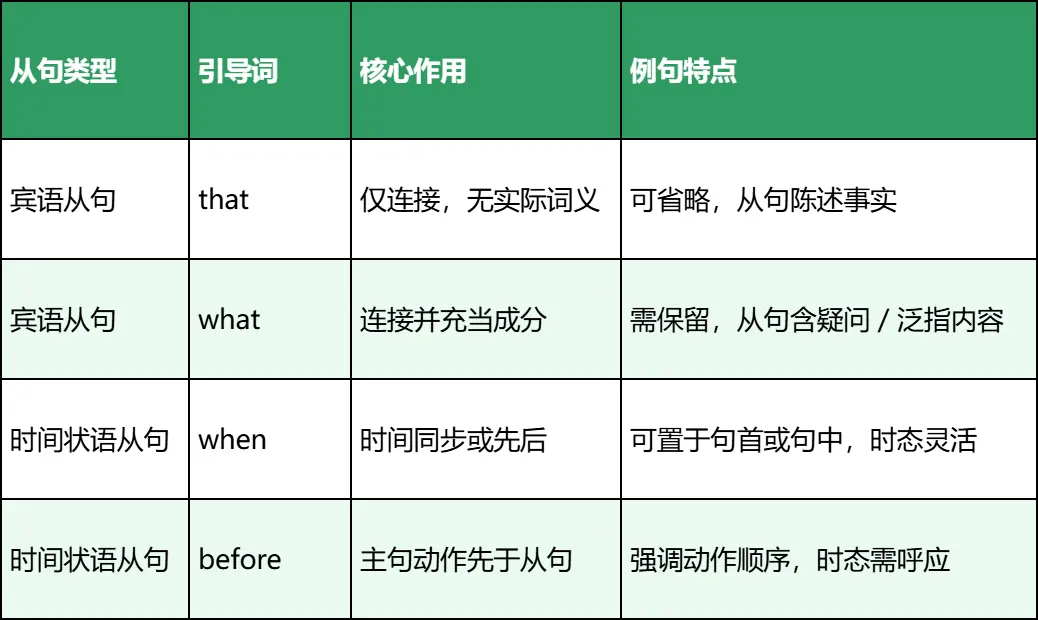
1)引导词 that:仅起连接作用,无实际词义,在从句中不充当成分,口语中可省略。例句:“I know (that) he is right. 我知道他是对的。”(主句:I know;从句:he is right);“She admitted (that) she forgot the keys. 她承认自己忘了带钥匙。”
2)引导词 what:既连接主从句,又在从句中充当成分(主语 / 宾语),意为 “所…… 的事 / 话”。例句:“I don’t understand what you mean. 我不明白你的意思。”(what 在从句中作宾语,指 “你所表达的意思”);“What he said surprised everyone. 他的话让所有人震惊。”(what 在从句中作宾语,指 “他说的话”)。
时间状语从句(when, before 的用法)概念是时间状语从句用连词(如 when, before)说明主句动作发生的时间或条件。
1)引导词 when:表示 “当…… 时”,主从句动作可能同时或先后发生。例句:“When the rain stopped, we went outside. 雨停时,我们出去了。”(从句动作 “雨停” 先于主句动作 “出去”);“I was reading when the phone rang. 电话响时,我正在看书。”(主句动作 “阅读” 持续,从句动作 “电话响” 打断)。
2)引导词 before:表示 “在…… 之前”,强调主句动作先于从句动作。例句:“Turn off the lights before you leave the room. 离开房间前请关灯。”(主句 “关灯” 需在从句 “离开房间” 前完成)。
对比总结
掌握好小学英语语法,能让孩子在英语学习的道路上走得更稳更远。家长们可以根据这个框架,辅助孩子针对性学习,为后续英语学习筑牢基础。
END