高考英语语法词汇专项突破:01 重点语法易错易混点(被动语态、by+Ving 和情态动
词)
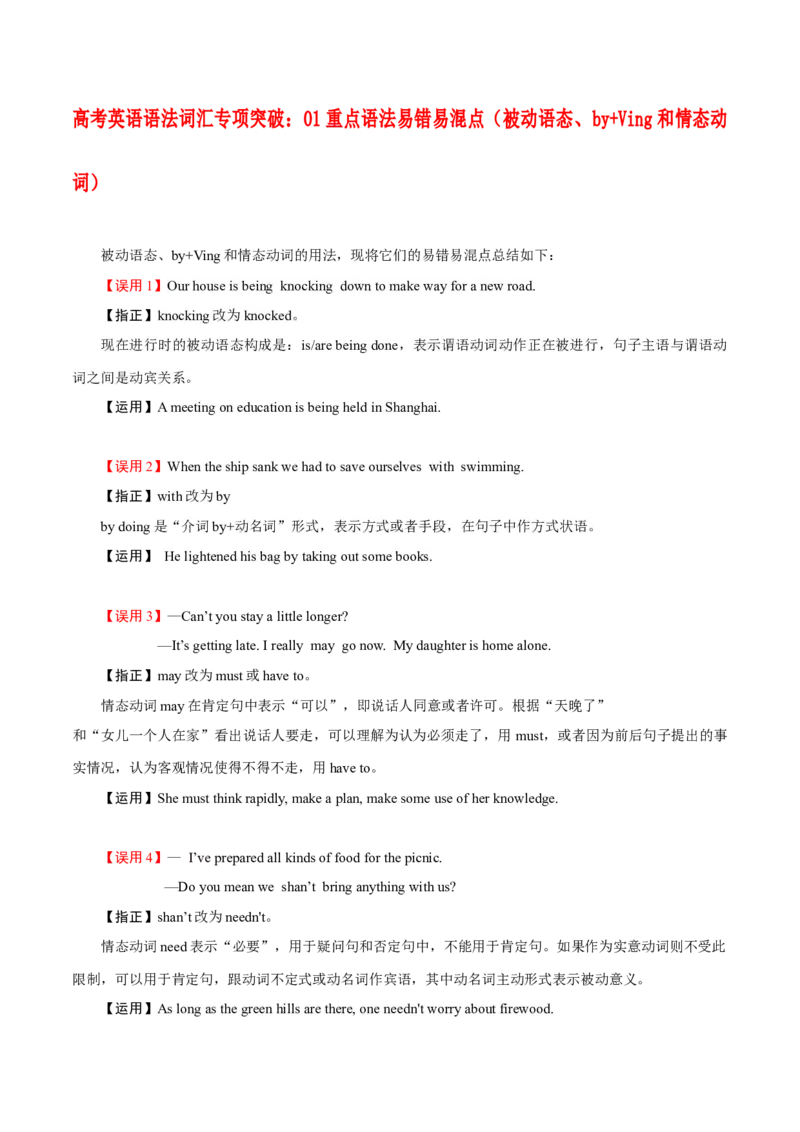
被动语态、by+Ving和情态动词的用法,现将它们的易错易混点总结如下:
【误用1】Our house is being knocking down to make way for a new road.
【指正】knocking改为knocked。
现在进行时的被动语态构成是:is/are being done,表示谓语动词动作正在被进行,句子主语与谓语动
词之间是动宾关系。
【运用】A meeting on education is being held in Shanghai.
【误用2】When the ship sank we had to save ourselves with swimming.
【指正】with改为by
by doing是“介词by+动名词”形式,表示方式或者手段,在句子中作方式状语。
【运用】 He lightened his bag by taking out some books.
【误用3】—Can’t you stay a little longer?
—It’s getting late. I really may go now. My daughter is home alone.
【指正】may改为must或have to。
情态动词may在肯定句中表示“可以”,即说话人同意或者许可。根据“天晚了”
和“女儿一个人在家”看出说话人要走,可以理解为认为必须走了,用 must,或者因为前后句子提出的事
实情况,认为客观情况使得不得不走,用have to。
【运用】She must think rapidly, make a plan, make some use of her knowledge.
【误用4】— I’ve prepared all kinds of food for the picnic.
—Do you mean we shan’t bring anything with us?
【指正】shan’t改为needn't。
情态动词need表示“必要”,用于疑问句和否定句中,不能用于肯定句。如果作为实意动词则不受此
限制,可以用于肯定句,跟动词不定式或动名词作宾语,其中动名词主动形式表示被动意义。
【运用】As long as the green hills are there, one needn't worry about firewood.You need to be fluent in English and be good at using computers.
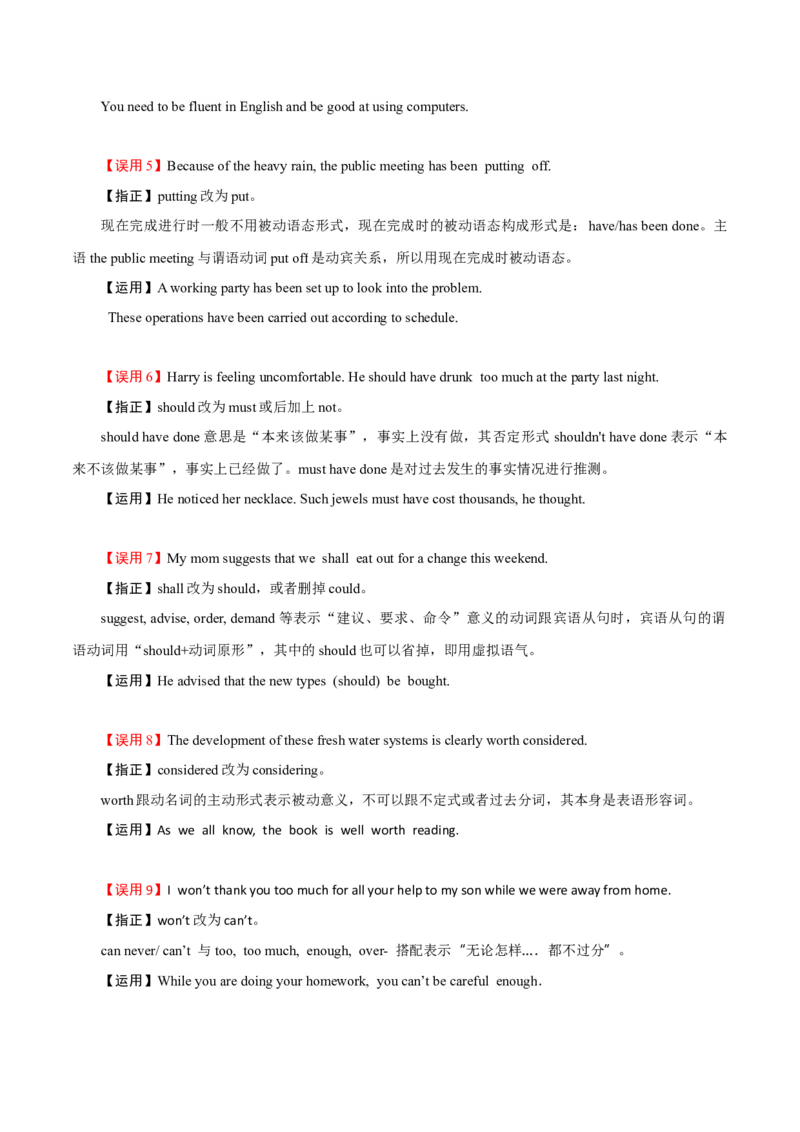
【误用5】Because of the heavy rain, the public meeting has been putting off.
【指正】putting改为put。
现在完成进行时一般不用被动语态形式,现在完成时的被动语态构成形式是:have/has been done。主
语the public meeting与谓语动词put off是动宾关系,所以用现在完成时被动语态。
【运用】A working party has been set up to look into the problem.
These operations have been carried out according to schedule.
【误用6】Harry is feeling uncomfortable. He should have drunk too much at the party last night.
【指正】should改为must或后加上not。
should have done意思是“本来该做某事”,事实上没有做,其否定形式 shouldn't have done表示“本
来不该做某事”,事实上已经做了。must have done是对过去发生的事实情况进行推测。
【运用】He noticed her necklace. Such jewels must have cost thousands, he thought.
【误用7】My mom suggests that we shall eat out for a change this weekend.
【指正】shall改为should,或者删掉could。
suggest, advise, order, demand等表示“建议、要求、命令”意义的动词跟宾语从句时,宾语从句的谓
语动词用“should+动词原形”,其中的should也可以省掉,即用虚拟语气。
【运用】He advised that the new types (should) be bought.
【误用8】The development of these fresh water systems is clearly worth considered.
【指正】considered改为considering。
worth跟动名词的主动形式表示被动意义,不可以跟不定式或者过去分词,其本身是表语形容词。
【运用】As we all know, the book is well worth reading.
【误用9】I won’t thank you too much for all your help to my son while we were away from home.
【指正】won’t改为can’t。
can never/ can’t 与too, too much, enough, over- 搭配表示“无论怎样….都不过分”。
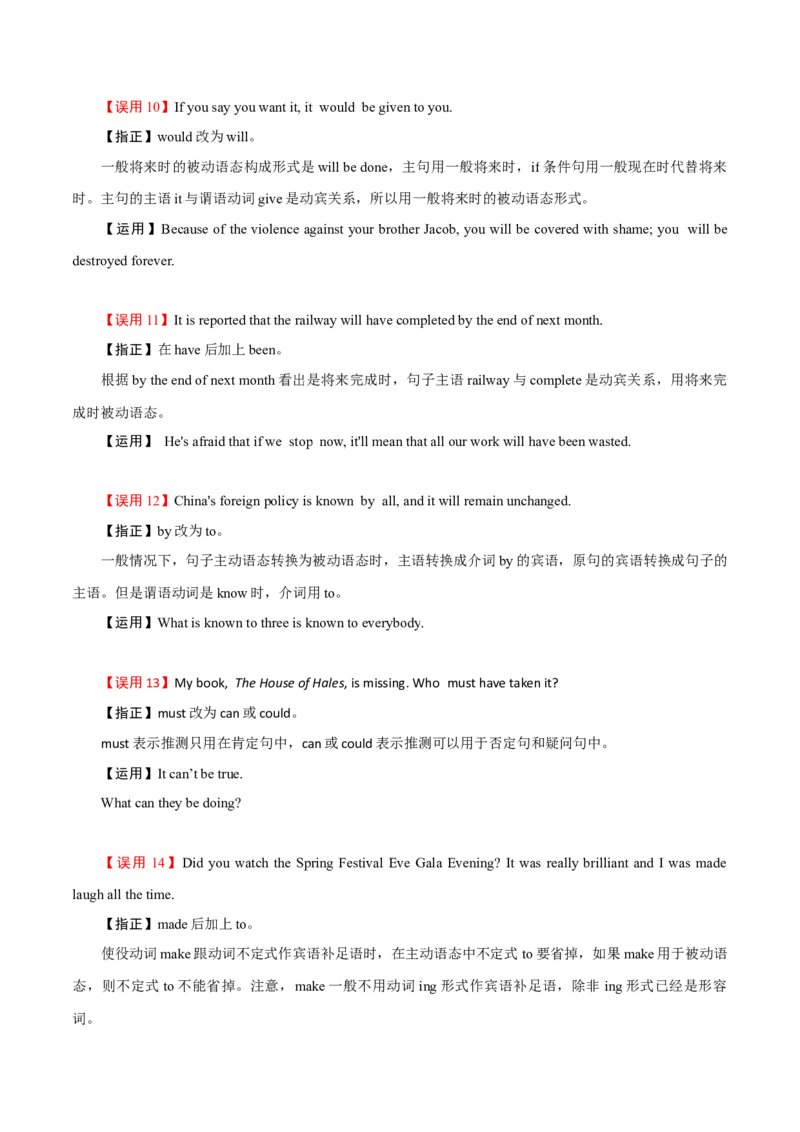
【运用】While you are doing your homework, you can’t be careful enough.【误用10】If you say you want it, it would be given to you.
【指正】would改为will。
一般将来时的被动语态构成形式是will be done,主句用一般将来时,if条件句用一般现在时代替将来
时。主句的主语it与谓语动词give是动宾关系,所以用一般将来时的被动语态形式。
【运用】Because of the violence against your brother Jacob, you will be covered with shame; you will be
destroyed forever.
【误用11】It is reported that the railway will have completed by the end of next month.
【指正】在have后加上been。
根据by the end of next month看出是将来完成时,句子主语railway与complete是动宾关系,用将来完
成时被动语态。
【运用】 He's afraid that if we stop now, it'll mean that all our work will have been wasted.
【误用12】China's foreign policy is known by all, and it will remain unchanged.
【指正】by改为to。
一般情况下,句子主动语态转换为被动语态时,主语转换成介词by的宾语,原句的宾语转换成句子的
主语。但是谓语动词是know时,介词用to。
【运用】What is known to three is known to everybody.
【误用13】My book, The House of Hales, is missing. Who must have taken it?
【指正】must改为can或could。
must表示推测只用在肯定句中,can或could表示推测可以用于否定句和疑问句中。
【运用】It can’t be true.
What can they be doing?
【误用 14】Did you watch the Spring Festival Eve Gala Evening? It was really brilliant and I was made
laugh all the time.
【指正】made后加上to。
使役动词make跟动词不定式作宾语补足语时,在主动语态中不定式to要省掉,如果make用于被动语
态,则不定式to不能省掉。注意,make一般不用动词ing形式作宾语补足语,除非 ing形式已经是形容
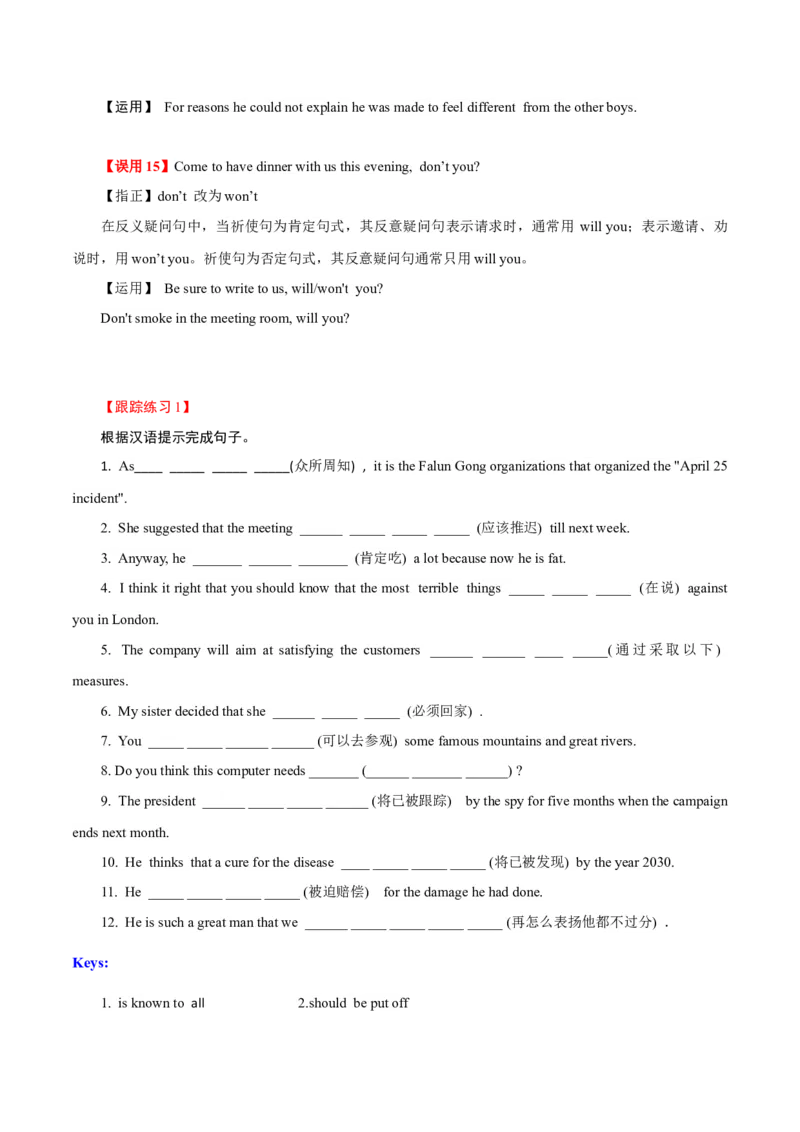
词。【运用】 For reasons he could not explain he was made to feel different from the other boys.
【误用15】Come to have dinner with us this evening, don’t you?
【指正】don’t 改为won’t
在反义疑问句中,当祈使句为肯定句式,其反意疑问句表示请求时,通常用 will you;表示邀请、劝
说时,用won’t you。祈使句为否定句式,其反意疑问句通常只用will you。
【运用】 Be sure to write to us, will/won't you?
Don't smoke in the meeting room, will you?
【跟踪练习1】
根据汉语提示完成句子。
1. As____ _____ _____ _____(众所周知) , it is the Falun Gong organizations that organized the "April 25
incident".
2. She suggested that the meeting ______ _____ _____ _____ (应该推迟) till next week.
3. Anyway, he _______ ______ _______ (肯定吃) a lot because now he is fat.
4. I think it right that you should know that the most terrible things _____ _____ _____ (在说) against
you in London.
5. The company will aim at satisfying the customers ______ ______ ____ _____(通过采取以下)
measures.
6. My sister decided that she ______ _____ _____ (必须回家) .
7. You _____ _____ ______ ______ (可以去参观) some famous mountains and great rivers.
8. Do you think this computer needs _______ (______ _______ ______) ?
9. The president ______ _____ _____ ______ (将已被跟踪) by the spy for five months when the campaign
ends next month.
10. He thinks that a cure for the disease ____ _____ _____ _____ (将已被发现) by the year 2030.
11. He _____ _____ _____ _____ (被迫赔偿) for the damage he had done.
12. He is such a great man that we ______ _____ _____ _____ _____ (再怎么表扬他都不过分) .
Keys:
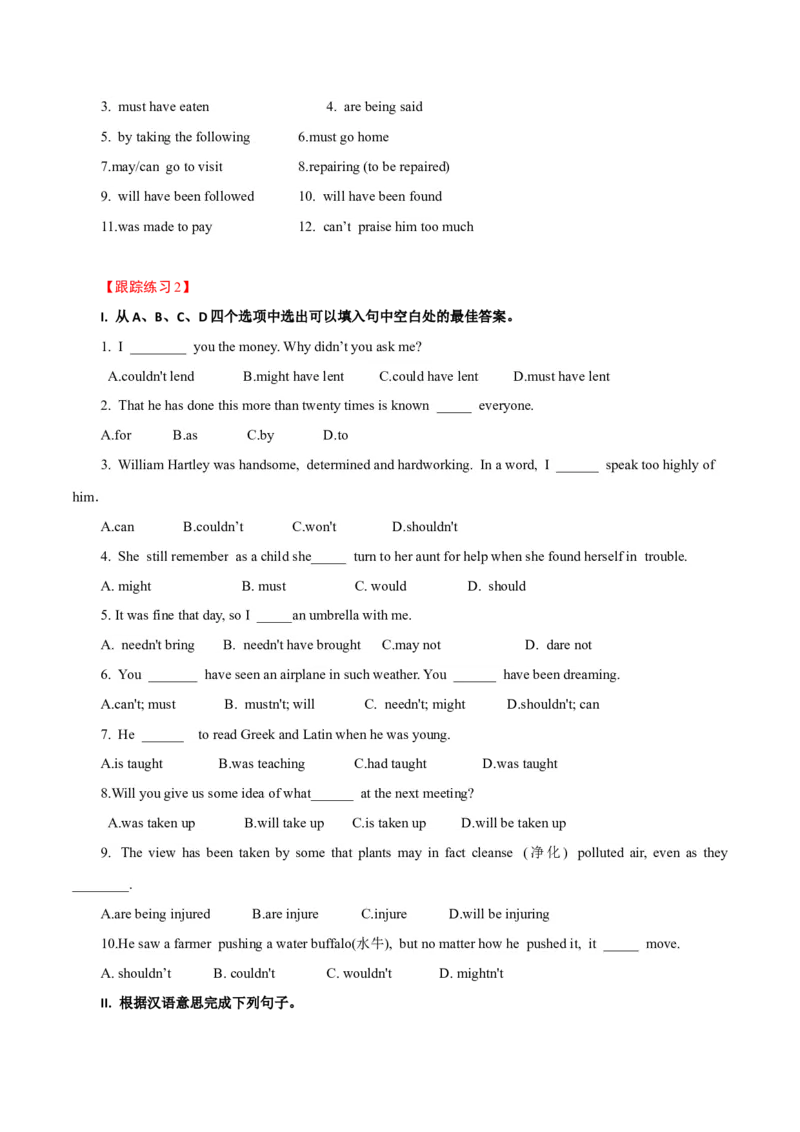
1. is known to all 2.should be put off3. must have eaten 4. are being said
5. by taking the following 6.must go home
7.may/can go to visit 8.repairing (to be repaired)
9. will have been followed 10. will have been found
11.was made to pay 12. can’t praise him too much
【跟踪练习2】
I. 从A、B、C、D四个选项中选出可以填入句中空白处的最佳答案。
1. I ________ you the money. Why didn’t you ask me?
A.couldn't lend B.might have lent C.could have lent D.must have lent
2. That he has done this more than twenty times is known _____ everyone.
A.for B.as C.by D.to
3. William Hartley was handsome, determined and hardworking. In a word, I ______ speak too highly of
him.
A.can B.couldn’t C.won't D.shouldn't
4. She still remember as a child she_____ turn to her aunt for help when she found herself in trouble.
A. might B. must C. would D. should
5. It was fine that day, so I _____an umbrella with me.
A. needn't bring B. needn't have brought C.may not D. dare not
6. You _______ have seen an airplane in such weather. You ______ have been dreaming.
A.can't; must B. mustn't; will C. needn't; might D.shouldn't; can
7. He ______ to read Greek and Latin when he was young.
A.is taught B.was teaching C.had taught D.was taught
8.Will you give us some idea of what______ at the next meeting?
A.was taken up B.will take up C.is taken up D.will be taken up
9. The view has been taken by some that plants may in fact cleanse (净化) polluted air, even as they
________.
A.are being injured B.are injure C.injure D.will be injuring
10.He saw a farmer pushing a water buffalo(水牛), but no matter how he pushed it, it _____ move.
A. shouldn’t B. couldn't C. wouldn't D. mightn't
II. 根据汉语意思完成下列句子。1. 值得庆幸的是以往的错误--对资源缺乏了解和使用不当--今日正在南部得到纠正。
Luckily, the old errors, the misuse and misunderstanding of resources, __________ in the south today.
2. 我们只有通过说英语才能学会说英语,而不能通过别人告诉我们怎么学英语。
We learn to speak English _________ it and _________ about it.
3. 他旋动把手, 但门就是打不开。
She turned the handle but ___________ .
4. 大火扑灭之后,工厂只剩下个空架子了。
Only the shell of the factory is left after the fire____________ .
5. 我不会相信他会主动干那种事, 一定是有些年龄大的男孩子叫他干的.
I ______ believe he'd do a thing like that on his own. He __________ do it _______ some of the older
boys.
6. 现在不需保存蕃茄,一年四季都能吃到。
You _______ save tomatoes. You ________ them every season in a year.
7. 你眼睛为什么红了?你昨晚上肯定没有睡好。
Why are your eyes so red? You _______________ well last night.
8. 我们本来是能够一起面对困难的,可是当时你为什么不告诉我呢?
We ___________ the difficulty together, but why didn’t you tell me?
9. 我们的其中一条校规就是每位在校生都要穿校服。
One of our rules is that __________ school uniform while at school.
10. 你看! 这些男孩子没什么事可做,只是整天在街上闲荡。
Look! the boys _________ but walk around in the streets all day long.
Keys:
I.1-5 CDBCB 6-10 ADDAC
II. 1.are being corrected 2.only by speaking; not by being told
3.the door wouldn't open 4. has been put out
5. can't; must have been made to;by 6.needn't; can have/eat
7.can't/couldn't have slept 8. could have faced
9.every student shall wear 10. have nothing to do
【跟踪练习3】
I. 用适当的连词(每空一词)或所给词的适当形式填空。1. ―What about 10 o’clock tomorrow morning?
―I’m afraid I can’t make it. I _____ (take) an exam then.
2. My baby sister never cries ______ she is hungry.
3. _______ much we pretend to be free, we know it is only for a time.
4.______ you had taken my advice, you would not have failed in the test.
5. The news is almost certainly true_____ it is not official.
6. _______ studies science and technology knows ______ important learning a foreign language is.
7. _______ ______ ______ you’re happy, it doesn’t matter what you do.
8. _______ _______ I hadn't seen my classmate for many years, I recognized him immediately.
9. _______ _____ ______ your first language is, you should treasure it all your life.
10. No matter ______ we are, ______ we are, or ______ we do, we are all dependent on water.
II. 改正下列句子中的错误。
1. If you will watch carefully, you will see how to do it.
2. Let’s take a walk after supper, don't we?
3. Do sure to write to us, will you?
4. Taking care of the pence and the pounds will take care of themselves.
5. In case of I forget,please remind me about it.
6. Supposed he doesn't come, what shall we do?
7. He can answer the question how hard it is.
8. Come to have dinner with us this evening, aren't you?
9. We wanted to dance, not matter what the music was.
10. She was English indeed if she spoke more like an Italian.
11. All law-breakers, no matter who they may be, will be punishing.
12. What happened, she was proud of the love and friendship everyone had shown her.
III. 从A、B、C、D四个选项中选出可以填入句中空白处的最佳答案。
1. ---The movie 2012 will be on at 8 pm. What about picking you up at 7 pm?
---All right. I will have come back from work by then, and I _________ you at home.
A. will wait for B. have been waiting for
C. will be waiting for D. am waiting for
2. ______ it were to rain tomorrow, the meeting would be put off.
A.Whether B.Unless C.When D.If3. She is never happy ______she succeeds in knocking the bill down by a few pence.
A.if B.as C.unless D.because
4.No matter who comes here, ______ him never to touch the switch.
A.tell B.telling C.told D.to tell
5. Please ______me up before you come, or we might be out.
A.calling B.to call C.call D.called
6. I am asking you to make him part of ours, _______ difficult that may seem to you at first.
A.how B.however C.no matter D. whatever
7. —I will come to attend your lecture at 10:00 tomorrow.
—I’m sorry, by then my lecture will have ended and I______my guests in my office.
A. had met B. will meet C. will be meeting D. will have met
8. _______ it is always welcome, it is not necessary to bring flowers or a gift when you are invited to lunch
or dinner.
A.As B. Although C.If D.What
9. ______ he goes, he always goes to visit the local beauty spots and places of historical interest.
A.where B.No matter C.Which D.Wherever
10.He listened attentively to ______ was being said on the telephone.
A.whatever B.no matter what C. which D.however
IV. 根据汉语意思完成下列句子。(每空一词)
1. 好好学习,天天向上。
_____ ______ and you will make progress every day.
2. 这是件爱屋及乌之事,她不会去除非他被邀请了。
It was a case of "love me, love my dog". She wouldn't go _____ _____ _____ ______.
3. 面值10美分的硬币比5美分面值的硬币小,虽然价值是它的一倍。
The 10-cent coin is smaller than the 5-cent coin, _____ _____ _____ ______ twice as much.
4. 不管谁到这儿来,告诉他千万别按按钮。
______ comes here, _____ him or her _____ ______ _______ the button .
5. 把她弄走,注意可别让我瞧见她。
_____ ____ _____, and _____ careful that I never set eyes on her.
6. 别管我们吃的还是用的,都是劳动人民生产的。
______ ______ ______ we eat or use, it is produced by the working people.7. 在室内不得高声谈笑,不准吃零食或吸烟,不得在地上乱扔纸屑。
_____ ______ or laugh loudly; ____ _____ or eat; don't litter the floor with waste paper.
8. 我们别去那里游泳了吧。
_____ ______ ______ swimming there.
9. 假若你当时听我的话,你现在就会好多了。
You would be much better now _____ _____ ______ taken my advice.
10. 如果他离开,我没有问题,前往其他地方对他而言是比较好的。
I have no problems _____ _____ ______. It is better for him to go somewhere else.
V. 用所给动词的适当形式填空。
Now they are sitting in their classroom. They ___1____ (listen) to a tape. This time tomorrow they
____2____ (sit) in the cinema. They ___3_____ (watch) a film. On Saturday there is no class. So on Saturday
they ____4____ (not sit) in the classroom. They _____5_____ (do) other things. Bill ____6___ (play)
tennis. Ann ____7____ (shop) . George ____8_____ (still have) breakfast.
Keys:
I. 1.will be taking 2. unless
3.However 4.If
5.though/ although 6. Whoever; how
7. As long as/ So long as/ On condition that 8.Even though/Even if
9. No matter what 10. who; where; what
II. 1. 删掉if从句的will 2.don't改为shall 3. Do改为Be
4. Taking改为Take 5.删掉of 6.Supposed改为Suppose/Supposing (that)/If
7. how改为however 8.aren't改为won't或will 9. not改为no
10. If前加上even 11.punishing改为punished 12. What改为Whatever
III.1-5 CDCAC 6-10 BCBDA
IV. 1. Study/Work hard 2.unless he was invited 3. though/ although it is worth
4. Whoever; tell; never to press 5. Take her away; be 6. No matter what
7. Don't talk; don't smoke; 8.Let's not go 9. if you had
10. if he leaves
V. 1. are listening 2.will be sitting 3. will be watching4.will not be sitting 5. will be doing 6.will be playing
7.will be shopping 8. will still be having