ARTICLE · 1079153
教学研究:AI赋能高中英语词汇教学的实践与探究
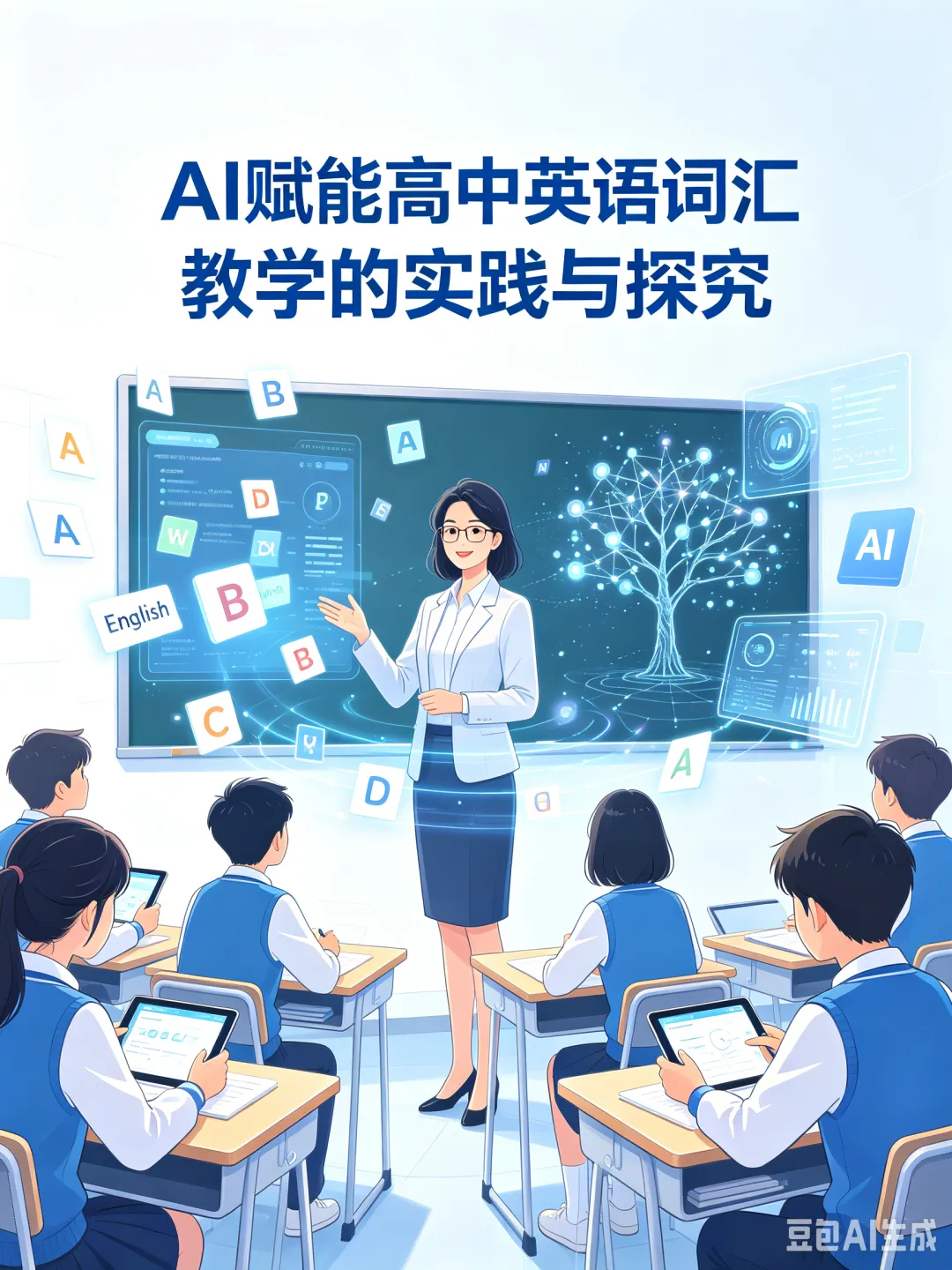
AI赋能高中词汇教学的核心优势,在于打破传统教学的时空局限与模式桎梏,实现个性化、情境化、高效化教学。首先,AI能够实现分层个性化精准教学。依托大数据分析技术,AI教学系统可精准检测每位学生的词汇基础、薄弱单词、记忆短板和学习习惯,自动生成个性化词汇学习清单。针对学困生,系统侧重基础词汇释义、发音、简单搭配的巩固训练;针对中等生,强化词汇语境运用、近义词辨析练习;针对优等生,推送高阶词汇拓展、长难句应用、话题词汇积累内容,彻底解决传统教学“一刀切”的弊端,让每位学生都能适配自身学习节奏稳步提升。
其次,AI构建沉浸式语境教学,破解词汇“死记硬背”难题。传统词汇教学孤立讲解单词,学生难以理解词汇的语境含义、搭配规则和语用场景。AI技术可结合高中教材单元主题,搭建多元化真实语言场景,通过虚拟对话、情境短文、影视片段、主题任务等多模态素材,让学生在具体语境中感知词汇用法。例如在传统文化主题单元教学中,AI可生成文化解说、场景对话等素材,引导学生运用 heritage、preserve、tradition 等核心词汇完成表达练习,同时实时纠正学生发音偏差、搭配错误,帮助学生建立“词汇—语境—运用”的关联思维,提升词汇迁移应用能力。
此外,AI实现教学闭环,提升教学效率与评价精准度。传统词汇教学反馈滞后,教师难以全面掌握每位学生的词汇掌握情况,课后巩固、查漏补缺缺乏针对性。AI系统可实时记录学生词汇背诵、练习、测试数据,自动生成学情分析报告,精准定位班级共性薄弱词汇和学生个性化问题。教师可依托数据报告优化课堂教学,针对性开展重难点词汇专项讲解;学生可根据系统错题反馈、记忆曲线提醒,精准开展复盘巩固,大幅降低词汇遗忘率,构建“精准诊断—个性化学习—实时反馈—靶向巩固”的完整教学闭环。
当前AI赋能词汇教学的实践过程中,仍存在部分亟待解决的问题。部分教师过度依赖AI工具,弱化自身教学主导作用,缺乏对学生学习过程的人文引导;部分AI教学素材与高中教材适配度不足,重难点贴合度低,难以对接新课标教学要求;同时,部分学生过度依赖智能辅助,缺乏主动思考和自主记忆过程,不利于语言思维的长期培养。为优化教学效果,教师需树立“AI辅助、教师主导”的教学理念,合理筛选适配教材单元、贴合学情的AI教学资源,将AI技术与课堂互动、小组合作、主题探究等传统教学模式有机融合。同时,借助AI数据优势优化分层教学,兼顾知识传授与思维培养,引导学生主动运用AI工具查漏补缺,培养自主学习能力。
综上,AI技术为高中英语词汇教学改革注入了全新活力,有效弥补了传统教学的短板,实现了词汇教学的个性化、情境化、精准化升级。在新课标背景下,教师应合理运用人工智能技术,扬长避短,将智能工具与传统教学优势深度融合,优化词汇教学模式,帮助学生高效掌握词汇、灵活运用词汇,切实提升高中生英语核心素养,为高中英语教学高质量发展赋能。
English Version
Vocabulary is the cornerstone of English learning and a core prerequisite for senior high school students to improve their comprehensive abilities in listening, speaking, reading and writing. The new curriculum standard of senior high school English puts forward higher requirements on students’ vocabulary volume, accuracy of vocabulary use and contextual transfer ability. However, the traditional vocabulary teaching model still has many shortcomings that restrict the improvement of teaching quality. Traditional teaching mostly adopts the fixed model of "teacher-led reading, mechanical memorization and dictation", which separates vocabulary learning from real contexts. Students only master word definitions but cannot apply them flexibly in oral communication and writing. Meanwhile, unified teaching ignores individual differences among students. Excellent students lack expanded vocabulary training, while underachievers fail to keep up with the teaching rhythm, resulting in low memorization efficiency and high forgetting rate, forming a vicious cycle of repeated memorization and forgetting. The popularization of artificial intelligence (AI) provides a new way to solve the pain points of senior high school vocabulary teaching and build an intelligent and personalized teaching system, effectively promoting the transformation of vocabulary teaching from homogeneous indoctrination to accurate empowerment.
The core advantage of AI-enabled senior high school vocabulary teaching is breaking the temporal and spatial limitations and institutional shackles of traditional teaching, realizing personalized, contextual and efficient teaching. Firstly, AI supports hierarchical and personalized accurate teaching. Relying on big data analysis technology, AI teaching systems can accurately detect each student’s vocabulary foundation, weak words, memory shortcomings and learning habits, and automatically generate personalized vocabulary learning lists. For underachievers, the system focuses on consolidating the definition, pronunciation and simple collocation of basic vocabulary. For medium-level students, it strengthens the practice of contextual application and synonym discrimination. For top students, it pushes advanced vocabulary expansion, complex sentence application and topic vocabulary accumulation, completely solving the one-size-fits-all problem of traditional teaching and enabling every student to progress steadily at their own learning pace.
Secondly, AI builds immersive contextual teaching to solve the problem of rote memorization. Traditional vocabulary teaching explains words in isolation, making it difficult for students to understand the contextual meanings, collocation rules and pragmatic scenarios of vocabulary. Combined with the unit themes of senior high school textbooks, AI technology can build diverse real language scenarios, and enable students to perceive vocabulary usage in specific contexts through multimodal materials such as virtual dialogues, contextual passages, film and television clips, and thematic tasks. For example, in the teaching unit of traditional culture, AI can generate materials such as cultural explanations and situational dialogues, guiding students to use core vocabulary such as heritage, preserve and tradition for expression practice. It can also correct students’ pronunciation deviations and collocation errors in real time, helping students build the associative thinking of "vocabulary-context-application" and improve vocabulary transfer ability.
In addition, AI realizes a complete teaching loop and improves teaching efficiency and evaluation accuracy. Traditional vocabulary teaching has lagged feedback, making it difficult for teachers to fully grasp students’ vocabulary mastery, and after-school consolidation and error correction lack pertinence. The AI system can real-timely record students’ data of vocabulary recitation, exercises and tests, automatically generate academic situation analysis reports, and accurately locate the common weak vocabulary of the whole class and personalized problems of individual students. Teachers can optimize classroom teaching based on data reports and carry out targeted special explanation on key and difficult vocabulary. Students can conduct targeted review and consolidation according to system error feedback and memory curve reminders, which greatly reduces the vocabulary forgetting rate and builds a complete teaching loop of accurate diagnosis, personalized learning, real-time feedback and targeted consolidation.
However, there are still some problems in the current practice of AI-enabled vocabulary teaching. Some teachers over-rely on AI tools, weaken their leading role in teaching, and lack humanistic guidance for students’ learning process. Some AI teaching materials are poorly adapted to senior high school textbooks, with low fit with key and difficult points, failing to meet the requirements of the new curriculum standard. Meanwhile, some students rely excessively on intelligent assistance, lacking active thinking and independent memorization, which is not conducive to the long-term cultivation of language thinking. To optimize the teaching effect, teachers should establish the teaching concept of "AI assistance and teacher leadership", reasonably select AI teaching resources adapted to textbook units and student learning situations, and deeply integrate AI technology with traditional teaching modes such as classroom interaction, group cooperation and thematic inquiry. At the same time, teachers should optimize hierarchical teaching with the help of AI data advantages, balance knowledge teaching and thinking cultivation, guide students to actively use AI tools to check and fill gaps, and cultivate independent learning ability.
In conclusion, AI technology has injected new vitality into the reform of senior high school English vocabulary teaching, effectively made up for the shortcomings of traditional teaching, and realized the personalized, contextual and accurate upgrading of vocabulary teaching. Under the background of the new curriculum standard, teachers should rationally apply artificial intelligence technology, foster strengths and circumvent weaknesses, and deeply integrate intelligent tools with the advantages of traditional teaching. By optimizing the vocabulary teaching model, teachers can help students master and apply vocabulary efficiently and flexibly, effectively improve senior high school students’ core English literacy, and empower the high-quality development of senior high school English teaching.