ARTICLE · 1244892
雅思阅读精读|考场真题Part2: The origin and development of applause 掌声的历史
✍️ 上期打卡答案
上期我们留的表达是:
walk a fine line between A and B 在A与B之间谨慎保持平衡
参考答案:
Teachers often walk a fine line between encouraging students and putting too much pressure on them.
教师常常需要在鼓励学生和给他们施加过多压力之间谨慎把握分寸。
常见错误:
❌ walk a fine line between encouragement to pressure
✅ walk a fine line between encouragement and pressure
📖 今日真题
The origin and development of applause|掌声的历史
Whether you clap, cheer or whistle a great public performance, you are following a long tradition.
Reading Passage 2|(考场真题)
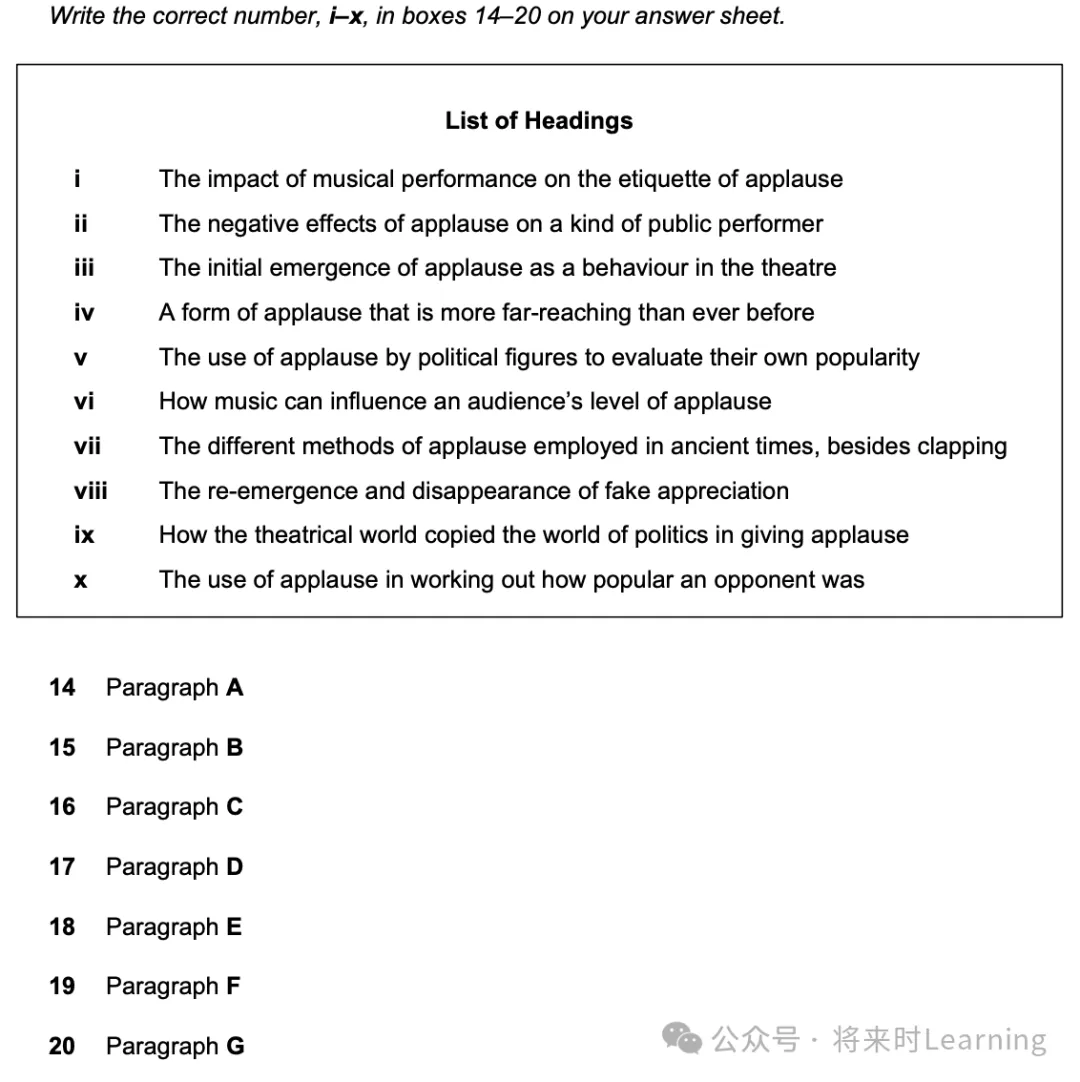
Questions 14–20:标题匹配题
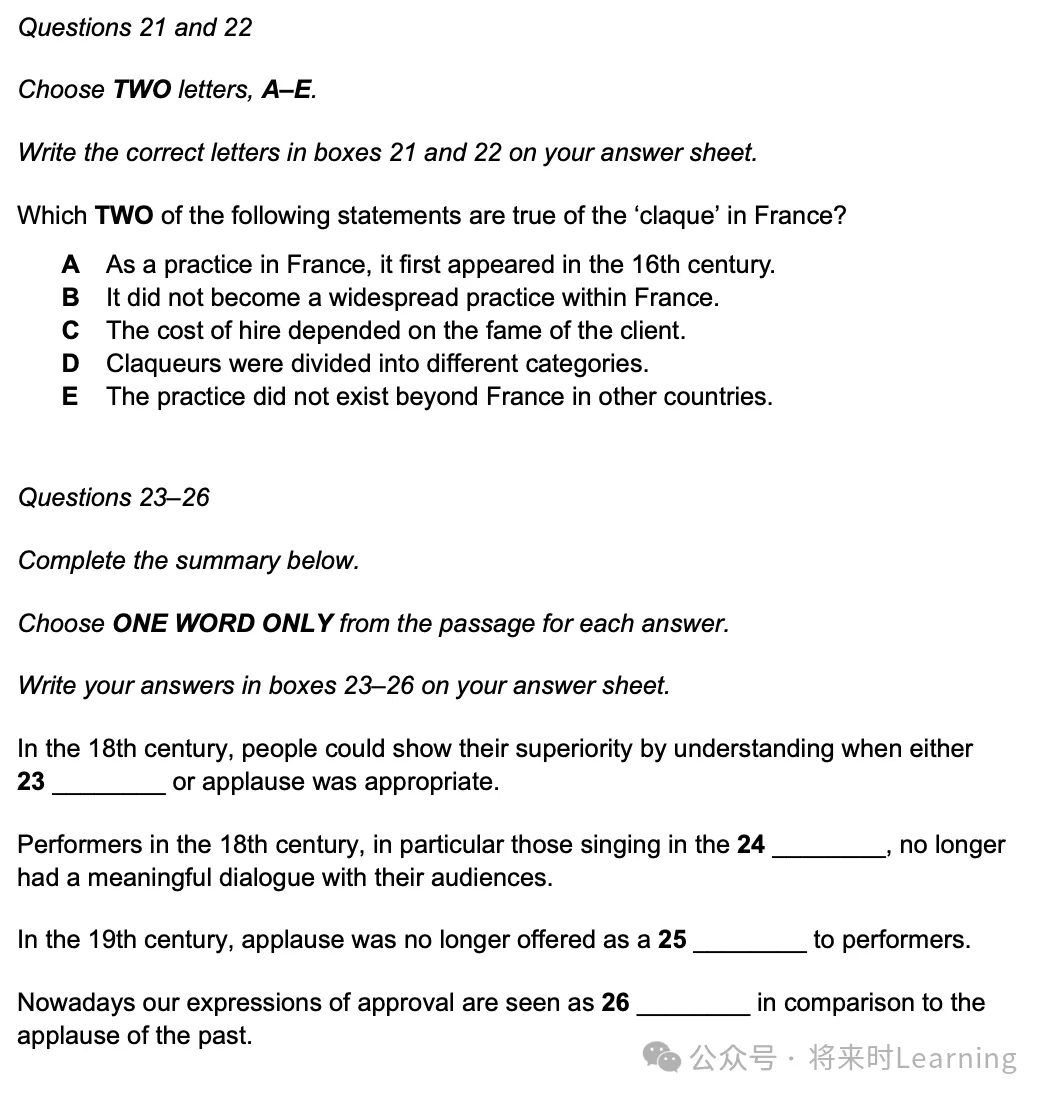
Questions 21–22:多选题
Questions 23–26:填空题
建议:先限时20m完成整篇,再回来一起逐段精读。
逐段精读
Paragraph A|从剧场礼仪,到花钱雇人鼓掌
Scholars aren’t quite sure about the origins of applause, but the form that is still most common, clapping the hands together, was formalized in Western culture during and after performances. During the time of the Roman Republic (509 BC – 27 BC) the common way to end a play was for the chief actor to yell ‘Valete et plaudite!’ (‘Goodbye and applause!’) thus signaling to the audience that it was time for them to give praise by striking hands and making explosive noise. It’s no surprise, then, that this became a means of crowd manipulation. Rome saw the rise of a professional class of applauders, or ‘people who clapped for their dinner’, hired to infiltrate crowds and manipulate their reaction to performances. Actors would hire a dozen or so people to spread out among their audiences and prolong the applause, or, if they were feeling especially bold, to start ‘spontaneous’ chants and shouts of praise.
段落大意|古罗马剧场让鼓掌成为固定的赞赏行为,也催生了受雇带动观众反应的职业鼓掌者。
formalize 使正式化;确立为惯例。
give praise 表达赞赏。
a means of 一种……的手段;means单复数同形。
crowd manipulation 对人群反应的操控。
infiltrate crowds 混入人群。
a dozen or so 大约十二个。
spread out 分散开来。
prolong 延长。
spontaneous 自发的;文中引号暗示这种“自发”其实经过安排。
chants 有节奏的呼喊。
the form that is still most common, clapping the hands together, was formalized in Western culture during and after performances
主干是the form was formalized。that从句限定form;clapping the hands together是同位语,说明这种形式就是拍手。开头承认起源不明,随后讨论拍手如何成为表演中的固定习惯,不能读成“学者已经确定掌声由罗马人发明”。
thus signaling to the audience that it was time for them to give praise by striking hands and making explosive noise
thus signaling…表示前面演员喊话带来的结果;that引出传递给观众的信息。by doing说明表达赞赏的方式。it was time for somebody to do something表示某人该做某事了。
Actors would hire a dozen or so people to spread out among their audiences and prolong the applause…
would在此表示过去惯常的行为,不是将来时。to spread out与prolong说明雇人的目的。段末进一步写制造“自发”的欢呼,揭示掌声也可能被操控。
Q14|iii
定位: was formalized in Western culture during and after performances
标题iii:The initial emergence of applause as a behaviour in the theatre(掌声作为剧场行为的最初出现)。本段从剧场中鼓掌成为惯例写起,再讲它如何被操控。E段的viii要求同时出现“重新兴起”和“消失”,A段没有这一完整过程;ix所说剧场模仿政治领域也没有依据。
学者们并不十分确定掌声的起源,但至今最常见的形式——双手相拍——在西方文化中逐渐成为表演进行期间及结束后的固定惯例。在罗马共和国时期(公元前509年至公元前27年),一出戏通常由主演喊出“Valete et plaudite!”(“再见,请鼓掌!”)来结束,以此告诉观众,该拍手发出响亮的声音来表达赞赏了。因此,这种行为后来成为操控人群的手段,也就不足为奇。罗马出现了一个职业鼓掌者群体,也就是“靠鼓掌吃饭的人”:他们受雇混入人群,操控观众对表演的反应。演员们会雇大约十来个人,让他们分散在观众中,延长掌声;如果胆子更大些,还会让他们带头发出“自发”的齐声呼喊和赞美。
Paragraph B|听掌声,判断自己有多受欢迎
The Roman Republic came to an end and was replaced by the Roman Empire (27 BC – 476 AD) where applause became a way for leaders to interact directly with their citizens. One of the chief methods they used to estimate their standing with the people was gauging the greetings they got when they entered the arena. Leaders became astute at reading the volume, the rhythm, and the length of the crowd’s claps for clues about how well they were doing as officials and lawmakers. ‘We should think of it as an ancient type of opinion poll,’ says Greg Aldrete, a professor of history. ‘This is how you gauge the people.’ Roman leaders were gathering data about people by listening to applause.
段落大意|罗马帝国的领导者通过掌声的音量、节奏和持续时间,评估自己在民众中的支持度。
come to an end 结束。
interact directly with 与……直接互动。
standing 地位;声望,不是“站立”。
gauge 衡量;估计。
arena 竞技场。
be astute at 善于敏锐地判断或处理……。
clues 线索。
lawmakers 立法者。
opinion poll 民意调查。
One of the chief methods they used to estimate their standing with the people was gauging the greetings they got when they entered the arena.
主干是One of the chief methods was gauging the greetings。they used…修饰methods;they got…修饰greetings。to estimate their standing说明目的:评估自己在民众心中的地位。这里used后接目的不定式,不是“过去常常”的used to结构。
Leaders became astute at reading the volume, the rhythm, and the length of the crowd’s claps for clues about how well they were doing as officials and lawmakers.
reading不指读文字,而是解读掌声。三项并列信息是音量、节奏、时长;how well…说明他们想得到怎样的线索。主语Leaders与their standing、they were doing形成同一条指代链,判断对象始终是领导者自己。
We should think of it as an ancient type of opinion poll.
think of A as B把A看作B。民意调查的类比,将“听掌声”解释为收集公众态度信息,而不是只追求热闹气氛。
Q15|v
定位: estimate their standing with the people
标题v:The use of applause by political figures to evaluate their own popularity(政治人物用掌声评估自己的人气)。their standing和how well they were doing都指领导者本人,不能选讲对手人气的x。opinion poll是对这一用途的概括。
罗马共和国结束后,被罗马帝国(公元前27年至公元476年)取代,掌声在这一时期成了领导者与公民直接互动的一种方式。领导者评估自身民间声望的主要方法之一,就是观察自己进入竞技场时受到怎样的欢迎。他们逐渐善于从人群鼓掌的音量、节奏和持续时间中寻找线索,判断自己作为官员和立法者做得如何。历史学教授格雷格·奥尔德雷特说:“我们应该把它看作一种古代的民意调查。这就是了解民意的方式。”罗马领导者通过聆听掌声来收集民众态度的信息。
Paragraph C|掌声也能暴露对手的人气
Clever leaders of the ancient world researched their rivals, too. Cicero, the Roman lawyer, would send friends to stand around outside the arena, taking notes to see what kind of greeting each official got when he entered, the better to see who was beloved by the people, and who was not. They had a lot of information to assess. ‘Ancient crowds were more interactive than they are today,’ Aldrete points out. ‘There was a lot of back and forth between speakers and crowds. And particularly in the Greco-Roman world, crowds, especially in cities, were really good at communicating messages through rhythmic clapping, sometimes coupled with shouts.’ The coding was, he says, invaluable when assessing an orator’s fortunes.
段落大意|领导者还会记录竞争对手获得的欢迎,利用人群有节奏的掌声和呼喊判断对方的声望。
rivals 竞争对手。
take notes 做记录。
beloved 深受喜爱的。
assess 评估。
back and forth 来回互动。
rhythmic clapping 有节奏的鼓掌。
be coupled with 与……相结合。
invaluable 极有价值的;不是“没有价值”。
orator 演说家。
fortunes 命运;发展前景,此处不是“财富”。
Clever leaders of the ancient world researched their rivals, too.
too承接B段,但rivals改变了研究对象。B段是“自己是否受欢迎”,C段是“对手是否受欢迎”。标题匹配时,同样出现leaders和applause并不能把两段当成一回事。
taking notes to see what kind of greeting each official got when he entered, the better to see who was beloved by the people, and who was not
taking notes补充朋友们在场外做的事;what kind of greeting…是see的宾语。the better to see表示“以便更好地判断”,后面的两个who从句形成受欢迎与不受欢迎的对照。
The coding was, he says, invaluable when assessing an orator’s fortunes.
he says是插入语。coding指前面节奏性掌声与呼喊所传递的约定信息;when assessing…说明这些信息的用途。中间关于人群互动的细节,最终仍回到判断演说者声望与前景。
Q16|x
定位: Clever leaders of the ancient world researched their rivals, too.
标题x:The use of applause in working out how popular an opponent was(用掌声判断对手是否受欢迎)。rivals对应opponent,who was beloved对应how popular。中间的人群互动和节奏掌声,是获取这些信息的方式。
古代聪明的领导者也会研究竞争对手。罗马律师西塞罗会派朋友守在竞技场外做记录,观察每位官员入场时受到怎样的欢迎,以便更好地判断谁深受民众喜爱,谁不受欢迎。他们有大量信息可供评估。奥尔德雷特指出:“古代人群的互动性比今天更强。演说者与人群之间有很多来回交流。尤其在希腊—罗马世界,人群,特别是城市中的人群,很擅长通过有节奏的鼓掌传递信息,有时还会配合呼喊。”他说,这套表达暗码对评估演说者的前景极有价值。
Paragraph D|不只拍手:响指、衣角与手帕
Around the first century AD, those systems of applause became more and more elaborate. Applause no longer meant, simply, ‘claps’. While Greco-Roman audiences certainly smacked their palms together the same way we do today, their overall strategies of applause were much more varied than clapping alone. Crowds expressed degrees of approval of the person or persons before them, ranging from claps, to snaps (of the finger and thumb), to waves (of the edge of the toga). The emperor Aurelian decided to replace this gesture by waving a special handkerchief instead, a prop which he then distributed to all Roman citizens, so they would never be without a way to praise him.
段落大意|古代的赞赏方式逐渐丰富,人群用拍手、打响指或挥动物品表达不同程度的认可。
elaborate 复杂精细的。
smack their palms together 双掌相击。
varied 多种多样的。
degrees of approval 不同程度的认可。
range from A to B 从A到B不等。
snap 打响指。
toga 古罗马长袍。
gesture 手势;动作。
prop 道具。
distribute 分发。
While Greco-Roman audiences certainly smacked their palms together the same way we do today, their overall strategies of applause were much more varied than clapping alone.
While在这里表示“虽然”,不是“当……时”。前半句承认古今都拍手,后半句才是重点:古代的赞赏形式远不止拍手。这一让步结构帮助确定整段主旨。
Crowds expressed degrees of approval…ranging from claps, to snaps…to waves…
ranging from…to…列出不同表达方式,三项对应拍手、打响指、挥动衣角。applause在本段的范围比clapping大,是各种表示喝彩和赞赏的行为。
a prop which he then distributed to all Roman citizens, so they would never be without a way to praise him
a prop与前面的handkerchief同位,which从句解释手帕被分发给谁。so引出结果或目的:让所有人随时都有办法赞颂皇帝。never be without是双重否定,强调总有可用的方式。
Q17|vii
定位: their overall strategies of applause were much more varied than clapping alone
标题vii:The different methods of applause employed in ancient times, besides clapping(古代除拍手外的不同赞赏方式)。snaps、waves、handkerchief都在扩展表达方式。皇帝发手帕是例子,不足以把主旨改成评估政治人气。
大约在公元一世纪,这些表达赞赏的方式变得越来越复杂。掌声不再仅仅意味着“拍手”。虽然希腊—罗马时代的观众当然也像今天的我们一样双掌相击,但他们整体的赞赏方式远比单纯拍手丰富。人群通过各种方式向面前的人表达不同程度的认可:从拍手,到用拇指和另一根手指打响指,再到挥动长袍的衣角。奥勒良皇帝决定用挥动一种特制手帕来代替挥衣角的动作。他随后把这种道具分发给所有罗马公民,让他们随时都有办法赞颂自己。
Paragraph E|职业捧场团:从复兴到失势
Although style of applause may have changed over the centuries, the need to manipulate remained. 16th-century French poet Jean Daurat is credited with bringing back the Roman practice of hiring professional applauders. In France, this group became known as a ‘claque’. Daurat handed out tickets to his own performances to people who promised to applaud at the end. By the early 1820s, claques had become institutionalized, with an agency in Paris specializing in the distribution of the claqueurs’ services. The historian William B. Cohen describes the intricate price lists agencies of this kind would hand out to potential patrons: polite clapping would cost this many francs, enthusiastic applause would cost this many. The claque also underwent a kind of classification: the rieurs (laughers) would laugh loudly at the jokes; the pleureurs (criers) would feign tears in reaction to performances; the commissaires (officers) would learn a play or a piece of music by heart and then call attention to its best parts. This practice spread to Milan, to Vienna, and to London before falling out of fashion. The claque lost its power once people became aware of its tricks.
段落大意|法国让雇人喝彩的旧做法重新兴起,并发展出定价和专业分工;人们识破套路后,它逐渐失去影响。
be credited with doing 被认为做了……;因做某事而获得认可。
bring back 恢复;重新引入。
claque 受雇的捧场团。
institutionalized 制度化、组织化的。
specialize in 专门从事。
intricate 复杂细致的。
patrons 资助者;顾客。
undergo a classification 经历分类。
feign tears 假装流泪。
learn…by heart 熟记;背下来。
call attention to 引起对……的注意。
fall out of fashion 不再流行。
Although style of applause may have changed over the centuries, the need to manipulate remained.
Although先承认形式变化,主句强调操控需求依旧。may have changed表示对过去变化的判断,不是对未来的猜测。此句把D段的“方式多样”转到E段的“人为安排”。
16th-century French poet Jean Daurat is credited with bringing back the Roman practice of hiring professional applauders.
be credited with后接动名词bringing,不接to bring。bringing back强调恢复旧做法;这里说法国在16世纪重新引入,不是说全世界的职业鼓掌者最早出现于16世纪。
The claque also underwent a kind of classification: the rieurs…; the pleureurs…; the commissaires…
冒号后的三类成员分别负责笑、哭、提醒精彩之处,具体解释classification。记住功能差异,比只记三个法语名称更能帮助判断选项。
This practice spread…before falling out of fashion. The claque lost its power once people became aware of its tricks.
before交代先传播、后衰落;once表示“一旦”。首尾的bringing back与lost its power构成完整发展过程,标题必须同时覆盖复兴和消退。
Q18|viii
定位: bringing back the Roman practice of hiring professional applauders
标题viii:The re-emergence and disappearance of fake appreciation(虚假赞赏的重新出现与消退)。bringing back对应re-emergence;段末falling out of fashion和lost its power对应disappearance。法国捧场团的发展贯穿整段,定价与分工都是其中的细节。
Q21|A
定位: 16th-century French poet Jean Daurat is credited with bringing back the Roman practice
21–22共选A、D,两题顺序可互换。A限定As a practice in France:在法国,这种做法于16世纪被引入。原文同时说它源自古罗马,两者不冲突;不要把“法国的起点”读成“世界上首次出现”。
Q22|D
定位: The claque also underwent a kind of classification
D的divided into different categories对应classification,后面分别列出负责笑、哭和提醒精彩部分的人。B说在法国未广泛发展,不符合文中已有专门机构、定价和分工的描述;C说收费取决于客户名气,原文只给出礼貌鼓掌、热烈鼓掌等不同服务的价目;E说未传到国外,与Milan、Vienna、London直接矛盾。
虽然几个世纪以来表达赞赏的方式可能发生了变化,但操控观众的需求始终存在。16世纪法国诗人让·多拉被认为重新引入了古罗马雇用职业鼓掌者的做法。在法国,这种群体被称为“claque”,即捧场团。多拉把自己演出的门票发给那些承诺在结束时鼓掌的人。到了19世纪20年代初,捧场团已经组织化,巴黎还有一家机构专门安排职业捧场者的服务。历史学家威廉·B.科恩描述了这类机构会交给潜在顾客的详细价目表:礼貌地鼓掌收多少法郎,热烈鼓掌又收多少。捧场团还出现了分类:“笑者”在笑话处大声发笑;“哭者”假装被表演感动得流泪;“指挥者”会熟记戏剧或音乐作品,然后提醒观众注意其中最精彩的部分。这种做法传播到了米兰、维也纳和伦敦,随后才逐渐过时。当人们识破其中的把戏后,捧场团便失去了影响力。
Paragraph F|音乐厅里的掌声,变成了一套礼仪
And clapping itself evolved. In the 18th century, symphonies and concerts became more serious, aligning themselves with the reverence and spirituality associated with religious ceremonies. Knowing when to maintain silence, as well as when to clap, became a mark of sophistication, a kind of code for audiences to learn. Applause became a matter of ‘do’ or ‘don’t’, so losing many old shades of meaning. Those changes changed performers, too. Applause became much less of a true dialogue with an audience, especially so with opera, where the singers saw it as part of a basic transaction with the crowd. So by the time the 19th century arrived, applause had become standardized and institutionalized, and had become an expectation rather than the reward it used to be.
段落大意|严肃音乐塑造了何时安静、何时鼓掌的规范;掌声逐渐从真实交流和奖励,变成表演者的惯常期待。
evolve 逐渐演变。
align…with 使……与……一致或相契合。
reverence 敬畏;崇敬。
spirituality 精神性;宗教精神。
maintain silence 保持安静。
a mark of sophistication 有教养、懂礼仪的标志。
shades of meaning 细微的意义差别。
transaction 交易;交换。
standardized 标准化的。
expectation / reward 期待/奖励。
Knowing when to maintain silence, as well as when to clap, became a mark of sophistication, a kind of code for audiences to learn.
Knowing…是动名词短语作主语。两个when to…并列:什么时候安静、什么时候鼓掌。a kind of code进一步解释这种礼仪标志,code在这里是观众需要掌握的行为规则。
Applause became a matter of ‘do’ or ‘don’t’, so losing many old shades of meaning.
“鼓掌还是不鼓掌”逐渐成为二选一的规范,过去掌声所传达的细微态度因此减少。so losing…说明前面变化的结果。
Applause became much less of a true dialogue…especially so with opera, where the singers saw it as part of a basic transaction with the crowd.
less of a true dialogue说明真实交流减弱;especially so承接这一判断,指出歌剧中尤其如此。where引出歌剧情境下的情况,it指applause。
had become an expectation rather than the reward it used to be
rather than对照“现在的期待”和“过去的奖励”。it used to be修饰reward;填空题若问“不再是什么”,要填旧角色reward,不能填新角色expectation。
Q19|i
定位: Knowing when to maintain silence, as well as when to clap, became a mark of sophistication
标题i:The impact of musical performance on the etiquette of applause(音乐表演对鼓掌礼仪的影响)。音乐会趋于严肃,使何时鼓掌、何时保持安静成为规范。vi说音乐影响掌声的热烈程度,偏离礼仪主线;ii只覆盖表演者受影响的局部,不能概括整段。
Q23|silence
定位: Knowing when to maintain silence, as well as when to clap
either…or…连接silence与applause两种反应,空格需要名词。show their superiority在这里对应a mark of sophistication,指通过懂礼仪表现教养,不能只盯着superiority找同形词。答案取原文silence,只有一词。
Q24|opera
定位: especially so with opera, where the singers saw it as part of a basic transaction with the crowd
in particular对应especially,singing对应singers。原文明确点出歌剧中真实交流的减弱,填opera;不要被同段前面的symphonies或concerts带偏。
Q25|reward
定位: had become an expectation rather than the reward it used to be
题干no longer offered as a…问掌声不再充当的角色。rather than后面给出旧角色reward;expectation是变化后的新角色。a后用单数名词reward,符合一词限制。
鼓掌本身也在演变。18世纪,交响乐和音乐会变得更加严肃,逐渐与宗教仪式中的敬畏感和精神性相契合。知道什么时候该保持安静、什么时候该鼓掌,成为有教养的标志,也成为观众需要学习的一套规则。掌声变成了“该不该鼓”的问题,从而失去了许多过去的细微含义。这些变化也改变了表演者。掌声越来越不像与观众的真实对话,在歌剧中尤其如此:歌唱者把掌声视为与观众之间基本交换的一部分。因此,到19世纪到来时,掌声已变得标准化、制度化,成了一种理所期待的反应,而不再是过去的那种奖励。
Paragraph G|点赞和分享,让掌声留下更久
In the 21st century we’re reinventing applause, to make it what it used to be: a coded form of communication. More and more the digital world allows us to link and like and share through our devices. By connecting with others in this way, we become part of the performance by participating in it, demonstrating our appreciation by amplifying and extending the show through commenting and praising. Our kind of applause matters more now, in many ways, because it is no longer momentary and short-lived, but is far more permanent instead.
段落大意|数字时代的点赞、评论与分享重新让观众参与传播,也让赞赏比现场掌声更持久、影响更远。
reinvent 重新创造;赋予新形式。
a coded form of communication 一种带有约定含义的交流方式。
participate in 参与。
demonstrate appreciation 表达赞赏。
amplify 放大;扩大影响。
extend 延伸;扩大。
matter 要紧;有影响,此处作动词。
momentary / short-lived 瞬间的/短暂的。
permanent 长久的;持久的。
we’re reinventing applause, to make it what it used to be: a coded form of communication
to make…说明目的。what it used to be表示“它过去的样子”,冒号后的短语解释这种样子。新技术让掌声恢复交流功能,并不是完全照搬古代鼓掌动作。
By connecting with others in this way, we become part of the performance…demonstrating our appreciation by amplifying and extending the show through commenting and praising.
句首By doing说明成为表演一部分的方式;demonstrating…补充参与者的行为。评论、赞美和分享扩大了表演的传播,使观众从接收者变为参与者。
because it is no longer momentary and short-lived, but is far more permanent instead
because解释数字“掌声”为何更有分量。no longer…but…构成旧与新的对照;far修饰比较结构more permanent,强调持续性增强。这是在比较新旧赞赏方式,不是在断言每一条网络内容都永远不会消失。
Q20|iv
定位: by amplifying and extending the show through commenting and praising
标题iv:A form of applause that is more far-reaching than ever before(一种比以往影响更深远的掌声形式)。数字互动既扩大传播,也使赞赏更持久。末句far more permanent进一步支持“影响深远”,不只是换了鼓掌的工具。
Q26|permanent
定位: it is no longer momentary and short-lived, but is far more permanent instead
Nowadays对应21st century的数字时代;expressions of approval概括点赞、评论与分享。空格在are seen as后面,需要形容词,填permanent。momentary和short-lived被no longer否定,方向相反;原文more不能一起抄入,因为限一词。
在21世纪,我们正在重新创造掌声,让它恢复过去的功能:成为一种带有约定含义的交流方式。数字世界越来越多地让我们通过设备建立联系、点赞和分享。通过这种方式与他人连接,我们参与其中,成为表演的一部分;我们通过评论和赞美扩大并延伸表演的影响,以此表达欣赏。在许多方面,我们今天的这种“掌声”变得更有分量,因为它不再是转瞬即逝、短暂的反应,而是更为持久的表达。
答案汇总
标题匹配题14 iii15 v16 x17 vii18 viii19 i20 iv
多选题21–22 A、D
填空题23 silence24 opera25 reward26 permanent
同义替换
Q15 evaluate their own popularity↔ estimate their standing with the people
Q16 an opponent↔ their rivals
Q17 besides clapping↔ more varied than clapping alone
Q18 re-emergence↔ bringing back
Q18 disappearance↔ falling out of fashion
Q20 more far-reaching↔ amplifying and extending the show
Q22 divided into different categories↔ underwent a kind of classification
Q23 show their superiority↔ a mark of sophistication
Q24 in particular↔ especially so
Q25 was no longer offered as↔ rather than the reward it used to be
10 个值得带走的词 / 短语
01 a means of 一种……的手段
02 spread out 分散开来
03 be astute at doing 善于敏锐地判断或处理……
04 be coupled with 与……相结合
05 range from A to B 从A到B不等
06 be credited with doing 被认为做了……;因做某事而获得认可
07 specialize in 专门从事
08 learn something by heart 熟记;背下来
09 call attention to 引起对……的注意
10 align A with B 使A与B相契合
✍️ 今日打卡
今天用下面这个表达造一句:
be credited with doing被认为做了……;因做某事而获得认可
把你的句子留在评论区,明天我们会放参考答案和常见错误。
📚 雅思阅读想提分?
如果你刷了不少题,分数却一直上不去,可能真正需要解决的不是“刷题量”,而是找到自己的卡分点。
关注公众号发送“阅读”两个字,了解🌟 阅读训练营&🌟 阅读 1 对 1
这里是「将来时」
每天用真实雅思材料一起练:
阅读精读 | 听力精听 | 写作拆解 | 口语表达
不只是知道答案。
更重要的是:
读懂原文,也看懂雅思怎么从原文变成题目的。
将来时,从现在开始。