ARTICLE · 1352613
雅思写作真题|为什么全世界都在穿西装和牛仔裤,我们自己的衣服去哪儿了
哈喽刷题搭子们👋
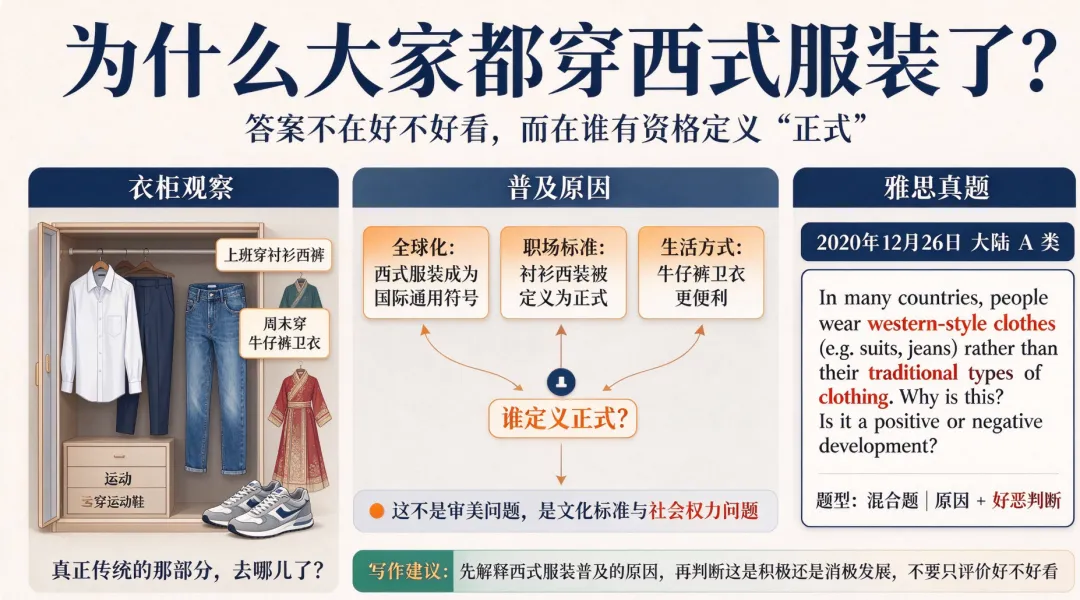
摘要:一道雅思题问「为什么大家都穿西式服装了」。答案不在好不好看,在谁有资格定义「正式」。
打开任何一个衣柜,你会发现一件很奇怪的事:
我们很少穿「自己的衣服」了。
上班穿衬衫西裤,周末穿牛仔裤卫衣,运动穿运动鞋。这些全都不是从我们自己的传统里长出来的。
而真正传统的那部分——它去哪儿了?
雅思 2020 年 12 月 26 日考过这道题。它的答案,比「好不好看」复杂得多。
这题,雅思真考过
2020年12月26日 大陆 A 类(题库原件逐字核对,台账查过,此前没写过)
In many countries, people wear western-style clothes (e.g. suits, jeans) rather than their traditional types of clothing. Why is this? Is it a positive or negative development?
题型:混合题(原因 + 好恶判断)
三个审题坑,先排掉
坑一:这是混合题,两问都要答
题干先问 why,再问 positive or negative。只写原因不表态,或者只表态不写原因,都直接掉档。混合题的分值,一半在结构上。
坑二:别把「西式」当成「西方文化入侵」的快餐式批判
题干举的例子是 suits and jeans——西装和牛仔裤。这两样东西的流行路径完全不同:西装靠的是权力与职业规范,牛仔裤靠的是反叛与大众化。把它们笼统归成一种「西方文化」,是论证上偷懒,也是国内素材最常见的通病。
坑三:别急着判好坏
「传统服装消失」听起来像坏事。但如果传统服装本身就是束缚(缠足鞋、束腰、行动不便的长裙),那它的消退就未必是损失。这一层跳出来,文章立刻高一个档次。
我的答案:大部分是积极的,但有一个前提——换掉的是衣服,不该是「谁有资格定义正式」这件事本身。
一个不一样的角度:这不是审美问题,是「标准问题」
这一节是这篇的核心。
西装赢的不是好看,是「通用」
为什么全世界的商务场合都穿西装?
不是因为它最好看,而是因为它最不容易出错。
在一个跨文化、跨语言的商业环境里,你需要一套所有人都能读懂的服装信号:这个人重视这次会面。
西装提供的正是这个:一套被普遍承认的「正式」编码。 学者把它叫做 dress code as a coordination standard(作为协调标准的着装规范)——它的价值不在于美,而在于通用、可预期、不冒犯人。
这跟语言是一个道理:全世界做生意用英语,不是英语最高级,而是它最通用。
牛仔裤赢的是另一件事
牛仔裤的路径完全相反。
它原本是给矿工穿的工装,结实、便宜、耐脏。后来它变成了一种「平民化」的宣言——穿着它出席的场合越多,「正式」这个词的门槛就越低。
所以牛仔裤的胜利,其实是等级制度的松动。 老板和实习生穿同一条裤子,这件事本身就是一种平等。
那传统服装呢?它输在哪
真实原因是三件事,跟「好不好看」没关系:
1. 成本:手工制作、需要专门保养、不能机洗,日常穿不起
2. 场合:传统服装往往有严格的礼节规定,穿着门槛高,穿错会尴尬
3. 配套:一套传统服装要配鞋、配包、配发型,脱离整套就不成立;而衬衫可以配任何东西
结论:传统服装不是被「审美淘汰」的,是被日常效率淘汰的。
但这里有一个真正值得警惕的东西
衣服可以换,定义权不能让。
如果「正式」永远只有一个模板,那所有非西方社会的人,在自己的重要场合里,永远是客人。
这也是为什么很多国家会在婚礼、节庆、毕业典礼上特意穿回传统服装——不是复古,是把「我也可以定义正式」这件事拿回来。
范文(308 词)
The spread of suits and jeans in place of traditional dress is often explained as a matter of taste, but the causes lie elsewhere. I regard the shift as largely positive, provided that what is adopted is a form of clothing rather than a monopoly over what counts as formal.
The first cause is coordination. In business settings that cross borders, participants need a signal of seriousness that everyone can read without instruction, and a suit supplies exactly that: a widely recognised code whose value lies in being predictable rather than beautiful. This is the same logic by which one language becomes the medium of trade; it wins not by superiority but by being the one everybody has already learned.
The second cause is cost and convenience. Traditional garments are frequently handmade, difficult to clean and dependent on an entire set of accessories, so wearing them daily is impractical, and where they also carry strict rules about rank and occasion, getting them wrong is embarrassing in a way a shirt never is.
These causes suggest the change is positive: clothing that is cheap, washable and interchangeable has removed a daily burden, and jeans in particular have flattened a visible hierarchy, since a manager and an intern can now wear the same garment without either losing standing. Nevertheless, there is a defensible objection. If one template monopolises the formal, people from other traditions are permanently guests at their own ceremonies, which is why many societies deliberately wear traditional dress at weddings and graduations — not out of nostalgia, but to retain the authority to define what formal means.
In conclusion, I consider the trend positive mainly because standardised clothing is efficient and socially levelling, as well as because it relieves individuals of an expensive daily code. What should be guarded is not the fabric but the right to choose it.
🕊 白鸟老师小课堂
三个词,一条链:衣服是信号 → 信号要通用 → 通用久了就成了标准。
① sartorial —— 与衣着有关的(书面、高级)。
大白话:一个比 clothes 高级的词,用在服装话题上很加分。
② dress code —— 着装规范,什么场合穿什么。
大白话:规矩不在纸上,在你穿错时会被人看一眼。
③ cultural homogenisation —— 文化同质化,大家越来越像。
大白话:全世界商场一楼卖的东西都差不多,这就是同质化。
✍️造例
A suit functions less as ==sartorial== preference than as a ==dress code== everyone can read; that is why it spread faster than any garment that merely looked better. The risk is ==cultural homogenisation==: efficiency gained, distinctiveness lost.
中文翻译:西装与其说是衣着品味,不如说是人人读得懂的着装规范;这就是它比任何「更好看」的衣服传播得都快的原因。风险在于文化同质化:效率得到了,独特性丢了。
高分搭配:wins not by superiority but by being the one everybody has learned(赢不靠优越,靠大家都学过)/flatten a visible hierarchy(拉平看得见的等级)/retain the authority to define(保留定义权)
🔗 延伸一组(文化类通用,考试直接搬)
standardisation 标准化 → soft power 软实力 → hybridity 混杂性
==Standardisation== is efficient but flattening. ==Soft power== works precisely by making one's own forms feel neutral, and the healthiest response is not rejection but ==hybridity== — adopting what works while keeping the authority to define one's own formal.
中文:标准化有效率,但会把差异磨平。软实力的运作方式,恰恰是让自家的形式显得「中性」;最健康的回应不是拒绝,而是混杂——采用好用的部分,同时留住定义自家「正式」的权力。
最后一句,说点不客气的
你可能会说:汉服现在不是挺火的吗?
火。但注意它在什么场合火——拍照、节庆、演出。
它没有回到办公室,也没有回到日常。 这说明什么?
说明我们接受的是「传统服装作为一种展示」,而还没接受「传统服装作为一种日常」。这不是失败,这是分工:效率和意义,各管一段。
真正该警惕的不是穿什么,而是觉得「正式」这件事只能由别人定义。
写作文也一样。「西式服装流行是文化入侵」是立场;「西装赢在通用编码、牛仔裤赢在拉平等级、传统服装输在日常效率」才是论证。后者考官才给分。
三问,你挑一个回我
1. 你衣柜里有传统服装吗?上一次穿是什么场合?
2. 如果你女儿的毕业典礼要求穿传统服装,你支持吗?
3. 「正式」这个词,你觉得该由谁来定义?
回在评论区,我挑几个明天拆。
身份分流:纸笔考生,把 Body1「西装赢在通用编码,不是赢在好看」那一段背下来,文化类和全球化类通用;机考考生,重点记 sartorial / dress code / cultural homogenisation 三词搭配;口语 part 3 问 clothes or globalisation,直接搬这条链。
通用模板(背走就能用):
A suit is less a sartorial choice than a dress code everyone can read, and jeans won by flattening a visible hierarchy. The gain is efficiency; the risk is cultural homogenisation — what must be kept is not the fabric but the right to define what formal means.
雅思写作范文系列已经更了很久了,全是机考和纸笔的实考真题,一道没编;每道都逐字核过题库,先拆审题坑再动笔。关键词“范文”,合集直接发你。
关注不迷路。 你的搭子下次还在。
Grace 在努力 ♡