ARTICLE · 1409198
2027届模拟试卷速递45:2巴蜀中学2027届11月适应性月考(四)+答案+听力文本+解析(word版本+音频下载)
开学了,推荐高中英语学习必备书:最新2026版应用文写作和读后续写:
2026年7月第10版《新高考英语应用文写作+读后续写+人教版单元词块整理三驾马车》来啦!
试卷下载链接:
我用夸克网盘给你分享了「巴蜀中学2027届11月适应性月考(四)试题含答案.docx」,点击链接或复制整段内容,打开「夸克APP」即可获取。
链接:https://pan.quark.cn/s/98193a5950b7
音频下载链接:
我用夸克网盘给你分享了「听力(16).mp3」,点击链接或复制整段内容,打开「夸克APP」即可获取。
链接:https://pan.quark.cn/s/f5ec12554fcc
第一部分听力(共两节,满分30分)
第一节(共5小题:每小题1.5分,满分7.5分)
听下面5段对话。每段对话后有一个小题,从题中所给的A、B、C三个选项中选出最佳选项。听完每段对话后,你都有10秒钟的时间来回答有关小题和阅读下一小题。每段录音读两遍。
1. What is the man probably doing?
A. Driving a car.B. Riding a bike.C. Walking.
2. How does the man feel now?
A. Guilty.B. Annoyed.C. Embarrassed.
3. What is the man stopped for?
A. Breaking traffic rules.B. Getting a parking fine.C. Receiving wrong tickets.
4. When is the project supposed to be finished?
A. At 10: 00.B. At 11: 00.C. At 12: 00.
5. What will the man do today?
A. Watch a movie.B. Attend a wedding.C. Buy the woman a dress.
第二节(共15小题:每小题1.5分,满分22.5分)
听下面5段对话或独白。每段对话或独白后有几个小题,从题中所给的A、B、C三个选项中选出最佳选项。听每段对话或独白前,你将有时间阅读各个小题,每小题5秒钟;听完后,各小题将给出5秒钟的作答时间。每段录音读两遍。
听下面的录音,回答第6和第7小题。
6. What type of room did the man reserve?
A. A king room.B. A single room.C. A double room.
7. Why was the man’s room type changed?
A. The receptionist made a mistake.
B. The booking system was out of order.
C. The room type he wanted was fully booked.
听下面的录音,回答第8至第10小题。
8. What caused the delay of the TV play last week?
A. Some unknown reasons.B. Other popular programs.C. Problems with the contract.
9. When did the man start to wait for the second season of the TV play?
A. A week ago.B. A month ago.C. A few months ago.
10. What has replaced the man’s favorite talent show?
A. A cartoon.B. A news program.C. A talk show.
听下面的录音,回答第11至第13小题。
11. What is the primary requirement for choosing the place?
A. Stay quiet all the time.
B. Offer affordable tickets.
C. Be suitable for disabled people.
12. How much do the museum tickets cost in total?
A. $200.B. $210.C. $290.
13. How can the woman be described?
A. Thoughtful.B. Hesitant.C. Ambitious.
听下面的录音,回答第14至第17小题。
14. What do the speakers mainly talk about?
A. Energy production.B. Information safety.C. Smart cities.
A. Traffic relief.B. Equality promotion.C. Data management.
16. What does the man mean in the end?
A. Data leakage will never happen.
B. Greater security can be achieved.
C. Personal information is easy to secure.
17. Who might the woman be?
A. A journalist.B. A professor.C. A scientist.
听下面的录音,回答第18至第20小题。
18. Why is Roz on the deserted island?
A. She is on an adventure.
B. She is involved in an accident.
C. She wants to rescue the animals.
19. When did Christopher Sanders direct The Croods?
A. In 2010.B. In 2013.C. In 2007.
20. What message does The Wild Robot send to audiences?
A. Life is full of dangers.B. Fighting is unavoidable.C. Love requires self-change.
第二部分阅读理解(共两节,满分50分)
第一节(共15小题:每小题2.5分,满分37.5分)
阅读下列短文,从每题所给的A、B、C和D四个选项中,选出最佳答案。
A
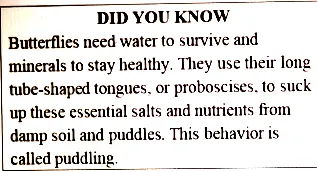
Butterfly Puddle Station
Have you ever noticed butterflies gathering on puddles after a rainstorm? You can help create a healthy habitat for these important pollinators (传粉者) by creating an artificial mud puddle station for your yard or garden.
MATERIALS
• Pie pan or other wide shallow dish
• Dirt
• Measuring spoon
• Salt (sea salt is best)
• Small rocks
• Water
PROCEDURE
1. Fill your pan or dish with dirt. Add 1 teaspoon of salt and mix to combine.
2. Slowly add water until the dirt has a thick, muddy consistency. Place some small rocks on top of the mud to create a dry area for butterflies to land on.
3. Place your mud puddle station outside, preferably near flowering plants.
4. Observe your mud puddle station over several days. What butterflies do you notice using it? What other insects or wildlife are benefiting from it?
5. Add more water as needed if dirt dries out. Refresh with additional salt and compost approximately once a month.
TRY THIS
• Add a butterfly food area by placing a small dish next to your mud puddle station. Fill the dish with some pieces of overripe fruit, like bananas, apples, and oranges. As the fruits become mushier, what do you notice about the number or rate of butterflies using your station?
• Research pollinator-friendly plants to attract more beneficial butterflies and bees to your garden.
• Use the Seek app to identify butterflies and other insects that you notice at your mud puddle station. Share your observations through the iNaturalist app. This lets you connect with other naturalists and help professional researchers learn more about the types of local pollinators in your area.

Show us how you’re being curious! Share your results with us.
21. Which picture shows the second step to build a butterfly puddle station?

22. What is the purpose of adding a fruit-feeding station?
A. To imitate natural habitats.B. To test its effects on puddling.
C. To compare species of butterflies.D. To attract more types of butterflies.
23. What is the text intended to do?
A. Promote citizen science apps.B. Advocate pollinator protection.
C. Explain a biological phenomenon.D. Guide readers through a DIY project.
B
The Great Plains is one of the world’s largest agricultural areas with thousands of miles of green, brown, and golden crop fields. You could see it as a food factory — or, if you are artistic and creative, as a giant art canvas (画布).
Born in 1950 in Protection, Kansas and raised in the heart of the Great Plains, Stanley J. Herd never took its splendor and vastness for granted. The area was formerly the hunting grounds of the Kiowa, a native North American people. He is indebted to his childhood spent there, not just for his “strong values”, but for the way his art manifests itself. “The background story of mankind’s relationship to the earth is what the act of creating the work is about.” He explains how he starts his monumental project by sketching on paper before the land is surveyed and measured. From there, he removes plants and grass with machinery and then decides on which crops to plant. The plains are his canvas, the farming tools his paintbrushes, and the colours the crops.
Herd draws inspiration from the landscape and its people. When he sees the plains, he also sees the Kiowa people and their roaming life before the arrival of Europeans. His first artwork, completed in 1979, was an image of Satanta, a Kiowa war chief who heroically resisted the European takeover of their land. His concern for native people’s struggle to maintain their culture is also shown in Little Girl in the Wind(1990), which presents the hardships and suffering of native women from Kansas.
A collection of over 65 images of Herd’s earthworks has been published. Photographs matter because the art changes as it is eventually erased by winter’s merciless cold and the passing of crops. Herd believes his works should be temporary since we are only called to care for the earth briefly. “My earth pieces prove you can do something beautiful and in tune with our planet and yet leave no trace. To me, that is the art.”
24. How does Herd create his artworks?
A. Building lasting land sculptures.B. Photographing seasonal changes.
C. Painting on canvas with paintbrushes.D. Planting crops in designed arrangements.
25. Which word best describes Herd’s works mentioned in paragraph 3?
A. Humanistic.B. Conventional.C. Environmental.D. Revolutionary.
26. Why is photographing essential for Herd’s creation?
A. It records crop changes on the plains.B. It preserves the short-lived art pieces.
C. It brings his works to public attention.D. It represents his intended artistic approach.
27. What do Herd’s words in the last paragraph center on?
A. The creativity in art.B. Human wonder about nature.
C. The evolution of art.D. Humanity’s duty to the earth.
C
As a mum to a two-year-old in 2026 there is no shortage of things to make me feel bad about my capabilities as a parent. His snacks aren’t always organic. Some of his toys are plastic and noisy. And — most hateful of all — he is sometimes allowed screen time.
I try to approach “consciously”. We watch together, and we have a strict time-limit of 20 minutes. But more important than how he is watching is what he is watching. I have joined a growing number of parents who almost exclusively choose 90s TV for their children, the very same shows we watched as kids. These shows feel different — slower, less frantic.
The problem with some modern programmes isn’t the content. It’s the pacing. Just flick on popular shows such as PAW Patrol or Blippi: choppy (支离破碎的) editing, vivid colours and dizzyingly repetitive soundtracks. If this is overwhelming to a tired mother, what does it do to a child? Studies have found that fast-paced cartoons can directly impact a young child’s attention and “executive function” — things like self-regulation and memory.
Earlier this year, the government issued its first screen time guidance for under-fives. Much of the focus was on the clock: how long children should spend in front of screens. But what if we’re counting the wrong thing? Two children can watch 20 minutes of TV and have completely different experiences. As Natalia Kucirkova, a professor of early childhood education, identified in an earlier article: “Good children’s media gives a child time to respond, time to wonder, time to ask questions, to predict and to imagine.” That is not overstimulating. That’s co-regulation.
Choosing older, slower shows has become a simple form of parental control. The reality is that parents are being asked to make complex judgements about media, while they are already stretched thin by work and childcare. Yet the media itself is only getting better at capturing attention. We are wrestling with our own screen addictions. We cannot allow media companies to apply those same addictive principles to the content they create for society’s most vulnerable brains.
28. What does the underlined word “frantic” in paragraph 2 probably mean?
A. Fast and chaotic.B. Dull and repetitive.
C. Fun and educational.D. Peaceful and relaxing.
29. What is the purpose of the example of “two children” in paragraph 4?
A. To argue for the government’s guidance.
B. To suggest an appropriate viewing duration.
C. To prove the harm of excessive screen time.
D. To indicate the importance of content quality.
30. What does the author imply about parents in the last paragraph?
A. They are free from media influence.B. They are treated unfairly by society.
C. They are overconfident about media.D. They cannot solve the problem alone.
31. What is the best title for the text?
A. The Hidden Harm of Modern Cartoons
B. Moving Beyond the Limits of Children’s Screen Time
C. A Mother’s Complaint about Screen Addiction
D. Challenging Government Screen-Time Limits for Children
D
Land subsidence, the gradual sinking of the ground surface, affects many global cities. When too much water is pumped out from the underground aquifer (含水层), the ground above sinks. While it is widely acknowledged that improved groundwater management is key to slowing or stopping the process, little is known about how the ground responds when long-term aquifer recovery happens. Does it rise up uniformly? Or is the response more complicated?
Osaka provided the perfect setting to explore this. Heavy groundwater extraction (1920s-1960s) lowered the city’s aquifer levels by up to 30 meters and sank land over 2 meters, leading to strict Japanese groundwater regulations in the early 1960s. To assess these outcomes, Jesse Kearse, a research fellow at Victoria University of Wellington, analysed data from 44 monitoring wells and measured subtle ground-elevation changes via InSAR, a technique involving the repeat acquisition of satellite radar images of the Earth’s surface.
The results are striking. Across Osaka, the ground is rising, and fast. The uplift rate averaged about four millimetres a year, and groundwater levels have been steadily rising by up to a metre a year. Where water levels climbed fastest, so did the land. But the map of uplift was spotty. One block could uplift rapidly, while 100 metres away it could be much slower. These abrupt changes aren’t random. They form narrow but continuous corridors running across the city. Kearse’s team soon realised: these corridors mapped onto known tectonic fault lines (地壳断层线).
Picture a fault as a curtain underground, cutting through the aquifer. It blocks water flow and functions as a dam. On one side of Osaka’s Uemachi Fault, groundwater levels rise three times faster than on the other side. This pattern occurs across other city-wide faults. Water dams on the fault’s “upstream” side, where it can’t easily flow through, driving faster groundwater recovery and uplift, while the “downstream” side lags behind.
The findings point to a potential opportunity for coastal cities adapting to sea-level rise. In a warming world, keeping coastal cities from sinking may matter as much as holding back the sea.
32. What research question is raised in paragraph 1?
A. Land response to aquifer recovery.B. The regulation of underground water.
C. Consequences of land subsidence.D. The severity of groundwater pumping.
33. What is the second paragraph mainly about?
A. Osaka’s pumping and sinking history.B. The study site and research methods.
C. Reasons and background of a case study.D. Groundwater management and its results.
34. What do Kearse’s findings reveal?
A. Faults are continuously distributed.B. Land sinks where water levels rise fast.
C. Groundwater levels rise at the same rate.D. Uplift patterns follow underground faults.
35. How do tectonic faults affect groundwater recovery?
A. They channel water to the ground.
B. They trap water and create uneven recovery.
C. They help store water in the aquifer.
D. They speed water flow and lower water levels.
第二节(共5小题;每小题2.5分,满分12.5分)
阅读下面短文,从短文后的选项中选出能填入空白处的最佳选项。选项中有两项为多余选项。
For some children, mathematical difficulties aren’t solved by simply doing more maths. A pupil may complete worksheet after worksheet but still approach a familiar calculation as though seeing it for the first time. For educators, the key is recognising when a pupil needs a different route towards the same mathematical understanding. Sometimes they find repetition is reinforcing frustration rather than learning. 36.________
Build relationships.
Making mathematical relationships visible is key. One useful starting point is to stop treating number facts as hundreds of unrelated pieces of information. 37.________ Give children counters or cubes and ask them to represent 54 in three different multiplicative ways and then ask: which model makes 6×9 easiest to see? What other facts can you see within it?
Ask what changed.
Rather than presenting a page of unrelated calculations, reveal these one at a time:
4×6=24; 5×6=?; 10×6=?; 9×6=?
Ask: What changed? What stayed the same? Which previous fact can help you? A pupil struggling to retrieve 9×6 may succeed by reasoning from 10×6 and subtracting one group of six. 38._____ It can also reduce the amount of information pupils need to process at once.
39.______
Try a “hidden part” activity: make nine with a bead string, cover some and show that six remain. Ask the pupil to predict the hidden quantity. Or use a representation relay: one pupil makes a number on a 10-frame (say, eight). The next child in the group is tasked with representing the number with rods. And a third records the different representations. The group names what changed and what stayed the same. 40.________
A. Try a “build three ways” activity.
B. Let pupils choose the representation.
C. Pupils may keep misunderstanding the same idea.
D. Activities like that help develop their number sense.
E. Mathematical problems won’t be solved by repeated practice.
F. This kind of structured comparison makes relationships visible.
G. In that case, they should change the route into the mathematics.
第三部分语言知识运用(共两节,满分30分)
第一节(共15小题;每小题1分,满分15分)
阅读下面短文,从短文后各题所给的A、B、C、D四个选项中,选出可以填入空白处的最佳选项。
The building is warm and smells like hot, buttered popcorn. Even with some modern updates, I feel as though I’m 41 to the early 2000s every time I enter the movie theatre.
The lights dim and the premovie chatter (闲聊) 42 until silence envelops the room. I’m by myself but I 43 the fellowship that comes with being in a room full of 44 . We’ve never met and yet, here we are, sharing a moment of joy or sadness.
Movies have always been, and remain a(n) 45 part of my life. It’s how I learned English when my family immigrated to Canada. And although I do believe my ESL classes helped, I give most of the 46 to watching movies. Dad would take my brother and me to a video rental store twice weekly. I remember how excited we’d be to 47 the endless rows of VHS tapes. It quickly wove itself into a family night 48 in our home. Watching a movie for us went beyond simply evoking a deep sense of emotion. It also served as a 49 into a different language and culture altogether. In many ways, it helped us 50 the new country we found ourselves trying to call home. When I find a movie that’s intensely 51 and I see myself in one of its characters, it feels like striking gold.
Maybe this all sounds 52 but it’s how I learned a language and what constantly leaves me inspired and, ultimately, 53 who I am.
As the image 55 , the chatter begins again and people 54 their way out. I leave the theatre floating on air, as I always do.
41.A. restrictedB. devotedC. transportedD. accustomed
42.A. echoes backB. dies downC. breaks inD. picks up
43.A. appreciateB. doubtC. recallD. lack
44.A. friendsB. familiesC. strangersD. professionals
45.A. sorrowfulB. minorC. essentialD. fresh
46.A. energyB. careC. blameD. credit
47.A. keepB. exploreC. sortD. donate
48.A. traditionB. dutyC. dreamD. tour
49.A. breakupB. gatewayC. roadblockD. comeback
50.A. establishB. fleeC. navigateD. guard
51.A. awkwardB. relatableC. artificialD. predictable
52.A. practicalB. extremeC. pointlessD. helpful
53.A. deniesB. representsC. acceptsD. shapes
54.A. flashesB. shiftsC. fadesD. freezes
55.A. struggleB. pushC. slipD. make
第二节(共10小题;每小题1.5分,满分15分)
阅读下面短文,在空白处填入1个适当的单词或括号内单词的正确形式。
At the 2026 Venice Biennale (双年展), one building appears to be challenging gravity and architectural logic all at once. Leaning 56.________(dramatic) at nearly a 40-degree angle, Hugh Hayden’s Huff and Puff Chapel (小教堂) has emerged as the most visually fascinating installation in Venice this year.
The sharply leaning chapel does not simply stand in the Venetian landscape. It looks as if it has been caught mid-collapse. Visitors approach cautiously, instinctively questioning whether the structure is stable 57.________ moments away from falling into the water.
Unlike traditional religious architecture designed to symbolize permanence and spiritual certainty, Hayden’s chapel embodies instability. From 58.________ distance, the building resembles a collapsing house 59.________(freeze) in time. Up close, the angle creates a dramatic sight. People pause, shift their footing, and stare upward at the leaning bell tower, trying to understand how the structure 60.________(remain) standing.
The title “Huff and Puff” references The Three Little Pigs, where homes 61.________(test) against damaging force. Hayden, 62.________was originally trained as an architect, turns that childhood metaphor 63.________ an architectural warning about institutions under pressure. He often uses structures to explore vulnerability and social pressure. Here, architecture becomes storytelling. The chapel reflects a world struggling 64.________(stay) upright among instability.
The choice of Venice makes the installation even more symbolic. A city historically associated with fragility, flooding, and 65.________(preserve) now hosts a chapel permanently leaning toward collapse.
第四部分写作(共两节,满分 40 分)
第一节(满分 15 分)
假定你是校学生会主席李华,你校计划面向全校学生招募校园健康运动推广大使(Health & Sports Ambassadors)。请你写一则招募通知,发布在校英文网站上。内容包括:(1)招募目的;(2)工作内容;(3)报名方式。
注意:(1)写作词数应为 80 左右。(2)请按如下格式在答题卡的相应位置作答。
Notice
____________________________________________________________________________________________________________________________________________________________________
The Student Union
第二节(满分 25 分)
阅读下面材料,根据其内容和所给段落开头语续写两段,使之构成一篇完整的短文。
When Simon caught sight of the giant squid (鱿鱼) in the glass container, he shrugged. “I guess I was expecting something bigger like in Monster Quest, level four.”
“I try to show you something interesting after school, and you just think of video games,” Mum said with a sigh.
Dad was already home when they got back from the museum, eager to challenge Simon to Monster Quest. Mum grabbed the controllers before either of them could start. “We can do something together as a family,” Mum suggested. “Something that doesn’t involve a screen or a controller.”
The next day, Simon found himself packed into the car with hiking boots and backpacks. They parked at a national park. The name Sacred Mount was written in yellow against a green sign. Dad studied the information board. “One and a half hours return,” he said. “Let the game begin.”
The walk started. When the track started climbing, Simon could feel his shirt starting to stick to his back. Then the track wove its way through the tall trees with bent branches. Simon was grateful for the shade. Now the path began to twist and turn as it climbed the steep hill. They stopped at a bench for a much-needed break.
“You can’t tell me you get anything like this in Monster Quest,” said Mum. Simon kept silent. Mum checked her watch again and when Simon wasn’t looking she winked at Dad and Dad smiled quietly.
Was it his imagination or was the forest below them getting darker? Simon looked up. There were no clouds and the light was fading over the leaves. He had never seen anything like this — not even on a screen.
Simon’s heart began to beat faster. Now, Dad grabbed his arm and pulled him down the hill. “We need to get out of here!” Dad shouted. Mum rushed down towards them. “Here, put these on quickly,” said Mum. She handed him a pair of glasses. They had a picture of the sun printed on them and the words “Solar eclipse (日食) viewer” printed over the front.
注意:(1)续写词数应为 150 左右。(2)请按如下格式在答题卡的相应位置作答。
Paragraph 1: “Surprise!” said Mum with a huge grin.________
Paragraph 2: “Look, the sun’s coming out again,” said Dad.________
英语参考答案
第一部分听力(共两节,满分 30 分)
1-5 ABACB6-10 BCCCB11-15 CBACA16-20 BABBC
第二部分阅读(共两节,满分 50 分)
第一节(共 15 小题;每小题 2.5 分,满分 37.5 分)
21-25 BBDDA26-30 BDADD31-35 BABDB
第二节(共 5 小题;每小题 2.5 分,满分 12.5 分)
36-40 GAFBD
第三部分语言运用(共两节,满分 30 分)
第一节(共 15 小题;每小题 1 分,满分 15 分)
41-45 CBACC46-50 DBABC51-55 BBDCD
第二节(共 10 小题;每小题 1.5 分,满分 15 分)
56. dramatically57. or58. a59. frozen60. remains61. are tested62. who
63. into64. to stay65. preservation
第四部分写作(共两节,满分 40 分)
第一节(满分 15 分)
【参考范文】
Notice
To help students develop a healthy lifestyle, our school is now recruiting Health & Sports Ambassadors among all students.
Ambassadors are tasked with advocating healthy living among fellow students. They are supposed to serve as role models, assist in organizing school sports events such as jogging clubs and fitness-sharing sessions, and share practical tips on our school website. Besides, they are expected to collect students’ feedback on sports activities and pass it on to the Student Union.
“If you are interested, please download the application form from the school website and submit it to the Student Union office by next Friday. Feel free to contact us for further information.”
The Student Union
第二节(满分 25 分)
【参考范文】
“Surprise!” said Mum with a huge grin. Confused, Simon put on the glasses and glanced upward. To his amazement, a large dark circle was covering most part of the sun, turning the bright sky dim. It was the solar eclipse that caused the strange fading light. The world fell into a mysterious twilight. Simon held his breath, totally absorbed in the incredible sight, forgetting all about his favourite video game Monster Quest. Never had he witnessed such a breathtaking natural phenomenon in real life.
“Look, the sun’s coming out again,” said Dad. Gradually, the shadow slid off the sun, and golden sunlight streamed through the tree leaves once more. Birds began to sing again as if waking up from a short sleep. On their way back down the hill, Simon could hardly tear his thoughts away from the amazing experience. He admitted to his parents that nothing in video games could match the magic of nature. Though tired from the long hike, Simon felt thrilled. This unexpected adventure gave him a brand-new view of the world beyond screens.
【解析】
第二部分阅读
第一节
A
【语篇导读】本文是一篇操作指南类说明文,介绍了蝴蝶聚集在雨后水洼边吸水吸盐的现象,并分步骤指导读者搭建“蝴蝶泥潭站”,为蝴蝶等传粉者营造栖息地。
21. B理解具体信息。第 2 步要求 “Slowly add water until the dirt has a thick, muddy consistency. Place some small rocks on top of the mud”,即先慢慢加水使泥土呈浓稠泥状,再在泥面上摆放小石子。B 图同时呈现“加水”与“摆放小石子”两个动作,与第 2 步吻合,故选 B。
22. B理解具体信息。TRY THIS 部分要求在泥潭站旁放置一碟过熟水果,并观察 “As the fruits become mushier, what do you notice about the number or rate of butterflies using your station?”,可见增设水果喂食区的目的是检验水果对蝴蝶使用泥潭站情况的影响,即测验其对蝴蝶聚集的效果,故选 B。
23. D理解文章意图。全文以 MATERIALS(材料)、PROCEDURE(步骤)、TRY THIS(拓展活动)的体例展开,逐一说明如何动手制作并使用蝴蝶泥潭站,属于典型的手工实践指导,故选 D。
B
【语篇导读】本文是一篇人物特写,介绍了美国大地艺术家 Stanley J. Herd 创作巨型大地艺术的故事。文章讲述其创作方式、创作灵感来源,以及他坚持作品“不留痕迹”的艺术理念。
24. D理解具体信息。根据第二段“he removes plants and grass with machinery and then decides on which crops to plant. The plains are his canvas, the farming tools his paintbrushes, and the colours the crops” 可知,Herd 用机械清除杂草后按设计种植不同作物,“画”出图像,故选 D。A 项“建造永久性大地雕塑”与末段作品终会消失的说法相悖;C 项是普通画布绘画,与“大平原为画布”的比喻不符。
25. A推理判断。第三段写他从风景与人中获取灵感,关注基奥瓦人的游牧生活、抵抗土地被占的酋长 Satanta,以及原住民女性维系自身文化的艰难,作品聚焦人的命运与文化处境,故 humanistic(人文主义的)最贴切,故选 A。
26. B理解具体信息。根据末段“Photographs matter because the art changes and is eventually erased by winter’s merciless cold and the passing of crops.” 可知,大地艺术会随季节与作物更替而消失,照片的价值正在于保存这些终将消逝的作品,故选 B。
27. D推理判断。末段 Herd 说 “we are only called to care for the earth briefly”,并强调作品可以很美、与地球和谐相处却“不留痕迹”,落点在于人只是地球的短暂守护者,应尽照看之责,故选 D。
C
【语篇导读】本文是一篇议论文。作者以母亲的身份反思幼儿屏幕时间问题,指出真正关键的并非“看多久”,而是“看什么”:现代动画节奏过快、剪辑破碎,会影响幼儿的注意力与自控力,因此她转而选择节奏舒缓的 90 年代节目,并呼吁家长与媒体监管共同为儿童把关。
28. A词义猜测。根据第二段“These shows feel different — slower, less frantic.” 可知,frantic 与 slower 语义相反;再结合第三段对现代节目 “choppy editing, vivid colours and dizzyingly repetitive soundtracks” 的描述,可知 frantic 指节奏快而混乱,故选 A。
29. D推理判断(写作意图)。第四段以“Two children can watch 20 minutes of TV and have completely different experiences.” 说明同样时长的观看可能带来完全不同的结果,意在指出政府只盯时长是“算错了东西”,真正重要的是内容质量,故选 D。
30. D推理判断。末段提到家长“已被工作和育儿弄得筋疲力尽”,却仍被要求对媒介内容作出复杂判断,而媒体捕捉注意力的手段越来越强,作者因此强调 “We cannot allow media companies to apply those same addictive principles...”,暗示单靠家长无法解决问题,需要外部约束,故选 D。
31. B主旨大意。文章从家长对“屏幕时长”的焦虑切入,指出更应关注节目内容与节奏,主张跳出“时长限制”的框架去为孩子挑选更慢、更友好的节目,B 项“超越儿童屏幕时长的限制”最能概括全文,故选 B。
D
【语篇导读】本文是一篇科研报道。文章以大阪为案例,介绍研究者借助 44 口监测井与 InSAR 卫星雷达技术,发现长期抽取地下水造成的地面沉降在含水层恢复后出现“回升”,且回升沿地壳断层形成带状走廊,并指出这对沿海城市应对海平面上升有重要意义。
32. A
理解具体信息。首段先说明地面沉降的成因,随后指出“little is known about how the ground responds when long-term aquifer recovery happens. Does it rise up uniformly? Or is the response more complicated?”,即本文提出的研究问题是含水层恢复后地面如何响应,故选 A。
33. B理解段落大意。第二段先说明大阪因大量抽取地下水而沉降、进而催生严格法规,属于研究地点的选取依据;随后重点介绍 Kearse 分析 44 口监测井数据并借助 InSAR 技术测量地面高程变化,即研究地点与研究方法,故选 B。
34. D理解具体信息。根据第三段“the map of uplift was spotty… They form narrow but continuous corridors running across the city. Kearse’s team soon realised: these corridors mapped onto known tectonic fault lines” 可知,地面回升的分布并不均匀,而是沿已知断层形成条带,即回升格局与地下断层一致,故选 D。
35. B理解具体信息。第四段把断层比作“地下帘幕”和“dam”,指出“It blocks water flow”,水在断层“上游”一侧受阻积聚,恢复速度是另一侧的三倍,另一侧则滞后,可见断层拦蓄地下水并造成不均衡的恢复,故选 B。
第二节
【语篇导读】本文是一篇说明文,针对部分学生“反复做题却收效甚微”的数学学习困境,提出应改变进入数学的路径,并从建立数之间的联系、追问“什么变了”、让学生自主选择并动手操作表征三个方面,给出具体可行的教学策略。
36. G承上启下。空前说教师发现“重复只是在强化挫败感,而非促进学习”,G 项“In that case, they should change the route into the mathematics.”中的“In that case”正指这一情形,同时呼应上文的“a different route”,并自然引出下文三条具体路径,故选 G。
37. A举例印证。空后“Give children counters or cubes and ask them to represent 54 in three different multiplicative ways”正是“用三种方式建构同一个数”的活动,A 项“Try a ’build three ways’ activity.”先点明活动名称,下文再交代具体做法,衔接自然,故选 A。
38. F逻辑衔接。空前以 10×6 推出 9×6 为例,说明这种“有结构的比较”能让学生看清数之间的联系;F 项“This kind of structured comparison makes relationships visible.”正是对这一做法的总结,且与空后“It can also reduce…”构成“其一……其二……”的递进,故选 F。
39. B小标题。本段所给活动(用珠串遮住一部分猜隐藏数量、一人摆 10 帧图另一人用木棒表征)都要求学生在具体操作中选择并使用不同的表示方式,B 项“Let pupils choose the representation.”概括本段主旨,且与另外两个小标题同为祈使句,故选 B。
40. D总结本段。D 项“Activities like that help develop their number sense.”中“Activities like that”指代上文“藏起来的部分”和“表示方式接力”两个活动,随后点明其作用,收束全段,故选 D。
第三部分语言运用
第一节
【语篇导读】本文是一篇记叙文。作者回忆一家人移民加拿大后,父亲每周两次带他们去录像店租片的经历,讲述电影如何帮助自己学英语、融入新国家,并表达在影院与陌生人共享光影的归属感,以及电影对自己身份认同的塑造。
41. C考查动词。空处所在句意为“每次走进影院,我都仿佛被带回二十一世纪初”,be transported to 意为“被带到、仿佛置身于”,与“feel as though”相呼应,故选 C。restricted(受限制)、accustomed(习惯于)均不合语境。
42. B考查动词短语。句意:灯暗下来,开映前的闲聊声“逐渐平息”,直到寂静笼罩全场。dies down 意为“逐渐减弱、平息”,故选 B。echoes back(回声)、breaks in(打断)、picks up(增强)均不合逻辑。
43. A考查动词。句意:虽然独自前来,但我“享受/珍视”满场观众带来的那种归属感,appreciate 符合语境,故选 A。
44. C考查名词。空后“We’ve never met and yet, here we are, sharing a moment…”说明彼此素不相识,故填 strangers,故选 C。
45. C考查形容词。下文讲述电影如何帮作者学英语、融入新国家,可见电影一直是生活中“不可或缺的”部分,essential 符合语境,故选 C。
46. D考查名词。作者承认 ESL 课程有帮助,但把大部分“功劳”归于看电影,give the credit to 意为“把功劳归于”,故选 D。
47. B考查动词。句意:回想当年在录像店里“翻看、探寻(explore)”一排排看不到尽头的 VHS 录像带时的兴奋,故选 B。
48. A考查名词。句意:看电影很快成为了我们家一项晚间家庭传统(tradition),故选 A。
49. B考查名词。句意:看电影不只是唤起情感,更成为通往另一种语言与文化的“门户”,gateway 意为“通道、门户”,与 into 搭配,故选 B。
50. C考查动词。电影在许多方面帮助一家人“艰难适应、应对”这个他们努力称之为家的新国家,navigate 意为“找到出路、应付(陌生环境)”,故选 C。
51. B考查形容词。当作者找到一部让自己产生强烈“共鸣”的电影,并在角色身上看到自己时,那种感觉如同淘到金子,relatable 意为“令人有共鸣的”,故选 B。
52. B考查形容词。作者自嘲“这一切听起来也许有些夸张”,但它确实是自己学一门语言的方式,extreme 意为“极端的、过分的”,符合自谦语气,故选 B。
53. D考查动词。电影不断给作者灵感,并最终“塑造”了现在的自己,shapes 与“who I am”搭配,故选 D。
54. C考查动词。句意:影片画面“渐渐淡去”,闲聊声再次响起,人们陆续退场,fades 意为“(画面)变暗、淡出”,故选 C。
55. D考查动词短语。make one’s way out 意为“朝外走、离开”,与“I leave the theatre floating on air”衔接自然,故选 D。
第二节
【语篇导读】本文是一篇说明文,介绍 2026 年威尼斯双年展上 Hugh Hayden 的装置作品《Huff and Puff Chapel》。小教堂以近 40 度的倾角“摇摇欲坠”,与传统宗教建筑所象征的永恒与稳定形成反差,借《三只小猪》的童话隐喻探讨机构承受压力时的脆弱,并因选址于以脆弱、洪水著称的威尼斯而更具象征意味。
56. dramatically考查副词。空处修饰现在分词“Leaning”,说明倾斜的程度,应用副词,故填 dramatically。
57. or考查连词。whether…or…为固定结构,此处表示“这结构是稳固的,还是随时会坠入水中”,故填 or。
58. a考查冠词。from a distance 为固定搭配,意为“从远处”,故填 a。
59. frozen考查非谓语动词。“house”与 freeze 之间是被动关系,且表示“被定格的状态”,用过去分词作后置定语,故填 frozen。
60. remains考查谓语动词。remains standing 意为“仍然矗立”,根据上下文语境应使用一般现在时。
61. are tested考查动词的时态和语态。“where”引导定语从句,先行词“homes”与 test 之间为被动关系;此处陈述《三只小猪》故事中的普遍情形,用一般现在时的被动语态,故填 are tested。
62. who考查定语从句。先行词为“Hayden”,先行词为人,在从句中做主语,故填 who。
63. into考查介词。这里考查固定短语,turn…into…,意为“把……转变为……”。
64. to stay考查非谓语动词。struggle to do sth. 意为“努力做某事”,故填 to stay。
65. preservation 考查名词。空处与 “fragility” “flooding” 并列作介词 “with” 的宾语,需用名词形式,故填 preservation。
听力原文
Text 1
W: Slow down, Matthew! We’re coming near a school.
M: I know, Mom. I’m going eight miles an hour. Look! A bike just passed us.
Text 2
M: I can’t believe it! Someone took my lunch delivery!
W: Are you sure? The delivery guy didn’t contact you?
M: I missed his call. So he left my order downstairs and sent me a photo.
Text 3
M: Hello, officer. Is there a problem?
W: Yes, I stopped you because you ran a red light. Here’s your ticket, and the fine is $150.
M: Sorry, I’ll be more careful next time.
Text 4
W: It’s already 10 o’clock now. Let’s send out for something to eat.
M: But the project is due in two hours.
W: I can’t believe we’ve worked for 11 hours straight.
Text 5
M: You’re all dressed up. I won’t dress formally on such a relaxing Saturday.
W: We’ll go to Barbara’s wedding ceremony today. Do not tell me you forgot it.
M: Oh my! It totally slipped my mind. I’ll return the movie ticket right now.
Text 6
W: May I help you, sir?
M: Hi, I reserved a single room for tonight under the name of Samuel Dennis.
W: Let me check. Sir, our system shows that your room has been upgraded to a king room.
M: Why is that? Is there an issue with your booking system?
W: Well, there is a large conference in town this week, so all of our single and double rooms are fully booked.
M: Are you going to charge me more for it?
W: It’s a free upgrade. We won’t charge you anything extra. Just sign the register here.
M: OK.
Text 7
M: The second season of this TV play is going to start tonight. It has been postponed twice and I can’t wait to see it now.
W: Is that the TV play with more than 100 episodes?
M: Yes. It’s one of my favorite TV plays.
W: Then I’m sorry to tell you it has been pushed back again.
M: How could it be? It was because of contract consultation affairs last week. Then what is it this time?
W: I have no idea. But there must be some complicated reasons. They keep doing that all the time, replacing it by other programs.
M: I’ve been waiting for it for a couple of months. Forget it. I’m going to see my favorite talent show.
W: That show is cancelled, too. A news program is on TV now.
M: Are you kidding me? I’m not going to watch TV anymore.
Text 8
W: I need your advice about planning the school trip for our students. It’s important to make it enjoyable for everyone.
M: What are the key things you’re considering?
W: Well, some students use wheelchairs, so the place must be completely accessible. We also need quiet areas for anyone who struggles with loud environments.
M: That makes sense. Have you chosen a location yet?
W: I think so. There’s a local science museum which is quite suitable. It provides entry and a guided tour for just $10 per child.
M: That sounds reasonable. How many students are going?
W: Twenty students, and we also need two staff members for support. Staff tickets cost half the price of the children’s tickets.
M: And transport?
W: A bus costs $90 for the day, and that isn’t cheap. I need to double-check the budget, but I think it’ll work.
M: It sounds like you’ve got things covered. The kids will love it.
Text 9
W: Professor Thompson, could you please share your thoughts on building smart cities?
M: Thank you, Karen. I’ve been looking forward to our interview for some time.
W: First, in what ways do you believe that smart cities will work for the development of human beings?
M: As a technological optimist, my research focuses on finding efficiencies in waste management and the implications for energy production, as well as using AI and automation to relieve heavy traffic.
W: Great! Going beyond sustainability, do you believe smart cities will boost equality and tolerance?
M: I do, but those questions are a bit outside of my wheelhouse. Fortunately, there are some great minds dealing with them as we speak.
W: What about the claim that smart cities are data leakage waiting to happen?
M: They are not unreasonable concerns. Our personal information can never be 100% secure. But by harmonizing our system to work together effectively, we can provide greater security.
W: Thank you for accepting our interview, Professor Thompson!
Text 10
M: Hello, everyone! Welcome to Animation Classics. Today, we’re celebrating an animated film that has earned a lasting place in our hearts. The movie The Wild Robot is based on a best-selling book by Peter Brown. It tells the story of a robot named Roz, who is washed up on a deserted island by the sea waves because the ship she is on sinks. At first, the animals of the island treat her poorly. But Roz is kind to them. She rescues them in times of need, and learns about herself in the process. Eventually, when Roz is in trouble, the animals work together as they try to save her and their home. Director Christopher Sanders, who directed How to Train Your Dragon in 2010 and The Croods three years later, says that one of the movie’s major themes is love. “We all need to change ourselves to love those around us,” he says. “Roz quickly realizes she’s going to have to change herself all the time.” Through a nail-biting adventure, The Wild Robot sends this message. As Sanders says, it reminds viewers of their “great ability to fight for one another.”