 夜雨聆风
夜雨聆风今日相关 / Relevant Today
AI4Protein 前沿追踪
AI 深度解读
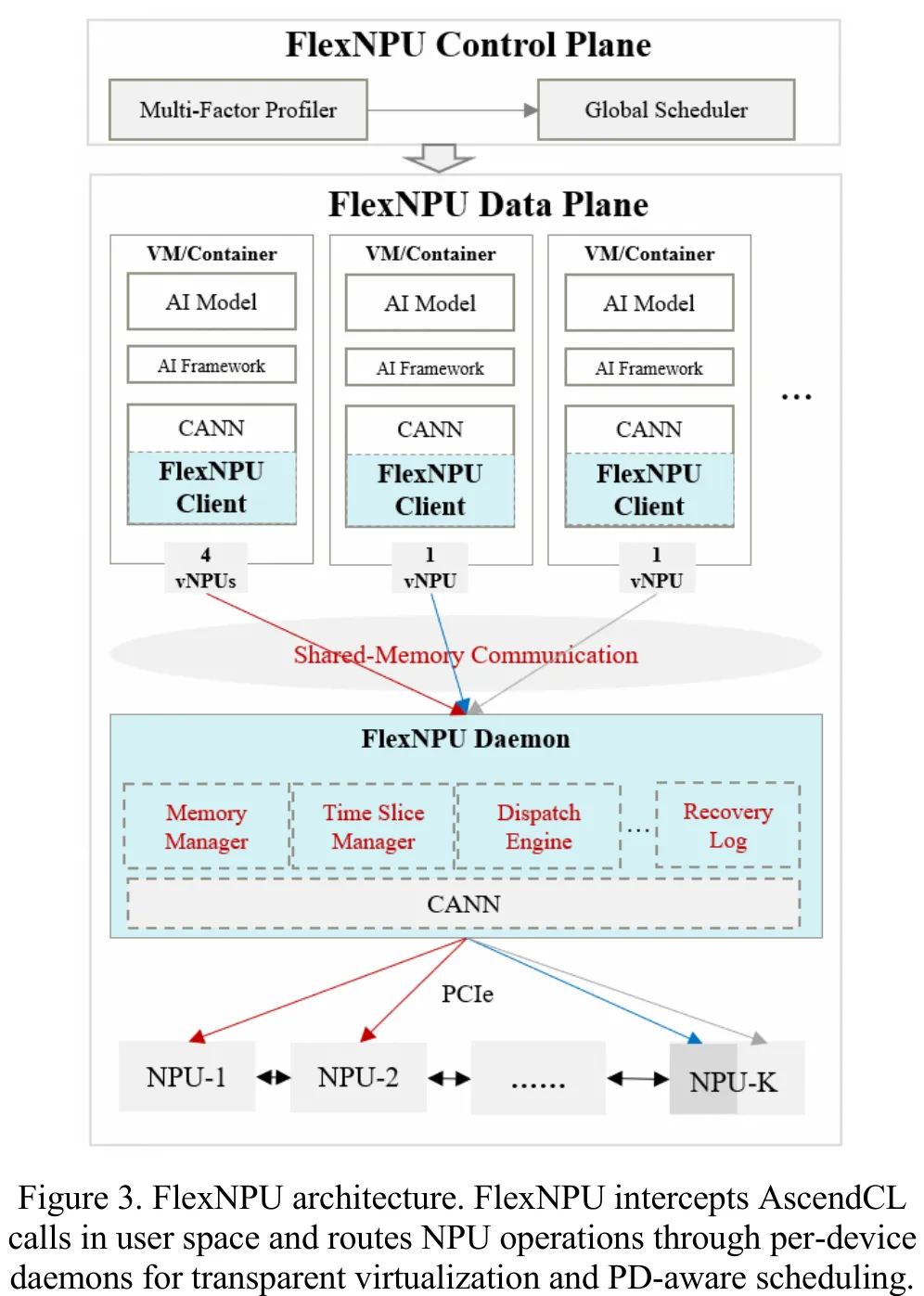
针对异构计算环境中 GPU 共享与调度技术的现状,现有工作如 gShare、Nixie 等虽在 GPU 资源解耦、时间复用及内存管理上取得了显著成效,但其高度依赖 CUDA 拦截、SM 级调度或 MIG 分区等 GPU 专有机制,难以直接迁移至架构迥异的 Ascend NPU 平台。此外,在 LLM 推理服务领域,尽管 Prism、InSS 等系统通过模型感知调度优化了资源效率,而 Splitwise、MuxServe 等则探索了预填充(Prefill)与解码(Decode)阶段的分离或共置策略,但这些方案多基于 GPU 生态,缺乏对 NPU 运行时特性的适配。FlexNPU 旨在填补这一空白,其核心设计在于构建一个基于 AscendCL 运行时接口的透明用户态虚拟化层。该层通过虚拟化管理运行时对象并利用用户态守护进程路由操作,在不修改模型代码、AI 框架或驱动的前提下,实现了对 NPU 执行的透明控制。在此基础上,FlexNPU 进一步支持动态的预填充与解码共置(PD co-location)策略,能够根据运行时负载动态调整执行策略,有效缓解资源不平衡问题。研究结果表明,该虚拟化层具备低开销特性,能够在保障应用透明性的同时,显著提升基于 Ascend NPU 的 LLM 推理吞吐量,为异构加速器的高效共享与调度提供了新的运行时基座。
中文摘要
摘要:现代人工智能服务日益依赖 NPU 进行传统推理和大语言模型(LLM)服务。然而,当前的 NPU 部署通常将物理设备直接暴露给应用程序,这限制了运行时对调度的控制能力,并使得难以根据阶段级的 workload 行为调整执行策略。这一局限性在 LLM 服务中尤为明显:预填充(prefill)阶段计算密集,而解码(decode)阶段往往受限于内存带宽和 KV 缓存访问。静态的预填充 - 解码(PD)分离虽能减少阶段间的干扰,但可能引入资源不平衡和不必要的数据传输。我们提出了 FlexNPU,这是一个面向昇腾(Ascend)NPUs 的透明用户态虚拟化层。FlexNPU 拦截 AscendCL API,并通过每台设备的守护进程路由 NPU 操作,在不修改模型代码、AI 框架或 NPU 驱动的情况下,将未修改的 NPU 设备与虚拟化层解耦。该运行时边界使 FlexNPU 能够虚拟化 NPU 对象、控制算子分发,并支持针对 LLM 服务的阶段感知调度。特别是,FlexNPU 实现了动态 PD 共置,能够根据预填充和解码阶段互补的资源特征自适应调整调度策略。我们在华为昇腾 NPU 上实现了 FlexNPU,并使用典型的 LLM 工作负载进行了评估。与直接 NPU 透传相比,FlexNPU 未引入可测量的推理开销,并在某些场景下略微提升了吞吐量。在部署 384 张昇腾 910C 卡运行 DeepSeek-R1 时,FlexNPU 相比静态 PD 分离将吞吐量提升了 5.15% 和 26.33%。在 Qwen2.5-7B 上,与静态 PD 共置相比,FlexNPU 在保持相近吞吐量的同时,将测试工作负载的首次令牌生成时间(TTFT)降低了超过 92%,而令牌生成时间(TPOT)几乎未变。这些结果表明,透明的 NPU 虚拟化是实现高效且响应迅速的 LLM 服务的实用基础。
Paper Key Illustration
原文
FlexNPU: Transparent NPU Virtualization for Dynamic LLM Prefill-Decode Co-location
Abstract: Modern AI serving increasingly relies on NPUs for conventional inference and large language model serving. However, current NPU deployments commonly expose physical devices directly to applications, which limits runtime control over scheduling and makes it difficult to adapt execution to phase-level workload behavior. This limitation is particularly evident in LLM serving, where the prefill phase is compute-intensive while the decode phase is often constrained by memory bandwidth and KV-cache accesses. Static prefill-decode (PD) disaggregation reduces phase interference, but can introduce resource imbalance and unnecessary data movement. We present FlexNPU, a transparent user-space virtualization layer for Ascend NPUs. FlexNPU interposes on AscendCL APIs and routes NPU operations through per-device daemons, decoupling unmodified from physical NPU devices without modifying model code, AI frameworks, or NPU drivers. This runtime boundary allows FlexNPU to virtualize NPU objects, control operator dispatch, and support phase-aware scheduling for LLM serving. In particular, FlexNPU enables dynamic PD co-location, which adapts scheduling between prefill and decode according to their complementary resource characteristics. We implement FlexNPU on Huawei Ascend NPUs and evaluate it with typical LLM workloads. Compared with direct NPU passthrough, FlexNPU introduces no measurable inference overhead and slightly improves throughput in some scenarios. On a 384-card Ascend 910C deployment of DeepSeek-R1, FlexNPU improves throughput over static PD disaggregation by 5.15% and 26.33%. On Qwen2.5-7B, compared with static PD co-location, FlexNPU maintains comparable throughput while reducing TTFT by over 92% across tested workloads with nearly unchanged TPOT. These results show that transparent NPU virtualization is a practical substrate for efficient and responsive LLM serving.
链接:https://arxiv.org/pdf/2606.04415
AI 深度解读
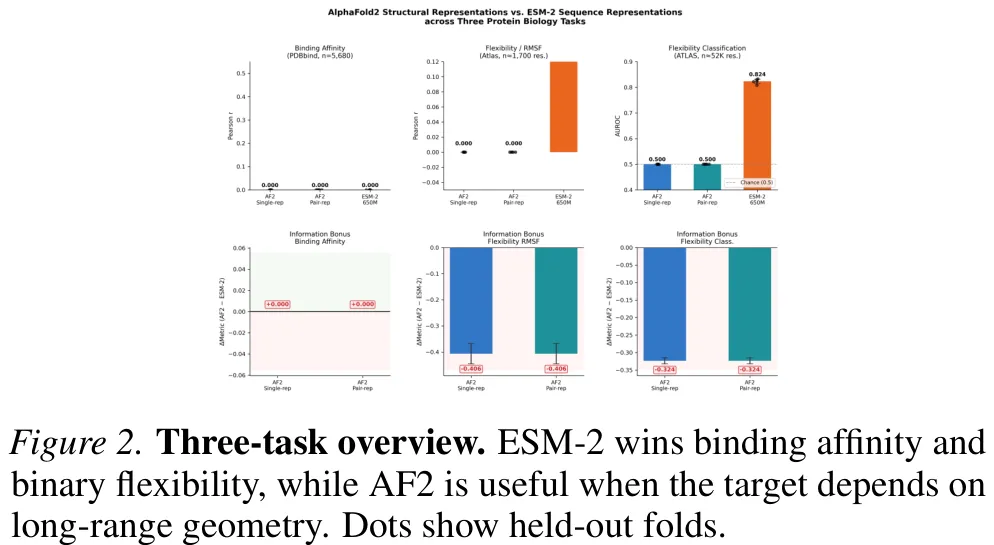
本研究旨在解决在蛋白质科学任务中,何时应使用计算成本较高的 AlphaFold2 (AF2) 结构表征,而非仅依赖进化信息丰富的 ESM-2 序列嵌入。研究通过三个核心任务——残基柔性预测(RMSF)、二元柔性分类及变构位点识别,系统评估了不同表征的信息增益(Information Bonus, IB)。关键发现表明,在由进化约束主导的任务(如柔性预测)中,ESM-2 表现优异,而 AF2 并未提供显著的额外信息;但在变构识别任务中,AF2 凭借其对三维几何通信网络的编码能力,提供了唯一具有统计学意义的正向信号。研究还揭示了严重的评估偏差:若按残基而非蛋白质进行数据划分,会导致性能虚高 27-39%,从而误导模型选择。结论强调,结构表征不应作为默认选项,而应视为一种针对特定物理机制(如长程几何通信)的‘缺失变量’,其应用需基于明确的任务机制判断。
中文摘要
摘要:AI 科学家系统在选择实验之前,越来越倾向于选择生物基础模型。在蛋白质计算流程中,这提出了一个具体的工程与科学问题:在何种情况下,支付结构推断的成本相对于仅使用序列的廉价模型是值得的?我们引入了信息增益(IB),这是一种任务级别的指标,用于衡量在蛋白质层面的交叉验证下,冻结的单序列 AlphaFold2 Evoformer 表示相较于冻结的 ESM-2 嵌入所具有的线性可访问优势。在结合亲和力回归(PDBbind, n=5,680)、构象柔性(ATLAS 分子动力学,268 种蛋白质)以及变构位点分类(AlloSigDB, n=9,925 个残基)等任务中,IB 值表现出强烈的机制依赖性。ESM-2 在结合亲和力(IB=-0.141;Pearson r=0.449 vs. 0.307)和二元柔性(IB=-0.060;AUROC 0.824 vs. 0.764;p=0.0017)方面占据主导地位。AF2 单序列表示提供了唯一超越随机猜测的变构预测(IB=+0.064;AUROC 0.548 vs. 0.485),揭示了仅从序列中无法恢复的长程几何信号。我们还发现了一种残基层面的泄漏伪影:根据所使用的不同表示,简单的残基划分会使 RMSF 性能虚增 27%-39%,足以逆转不同表示的排名。这些结果将表示选择转化为 AI 驱动科学系统中的可量化决策。
Paper Key Illustration
原文
When Does Structure Help? The Information Bonus of AlphaFold2 Representations over Protein Language Models
Abstract: AI scientist systems increasingly choose biological foundation models before they choose experiments. In protein pipelines, this creates a concrete engineering and scientific question: when is the cost of structural inference worth paying over a cheaper sequence-only model? We introduce the information bonus (IB), a task-level metric that measures the linearly accessible advantage of frozen single-sequence AlphaFold2 Evoformer representations over frozen ESM-2 embeddings under protein-level cross-validation. Across binding affinity regression (PDBbind, n=5,680), conformational flexibility (ATLAS molecular dynamics, 268 proteins), and allosteric-site classification (AlloSigDB, n=9,925 residues), IB is sharply mechanism-dependent. ESM-2 dominates binding affinity (IB=-0.141; Pearson r=0.449 vs. 0.307) and binary flexibility (IB=-0.060; AUROC 0.824 vs. 0.764; p=0.0017). AF2 single representations give the only above-chance allostery predictions (IB=+0.064; AUROC 0.548 vs. 0.485), revealing long-range geometric signal not recovered from sequence alone. We also identify a residue-level leakage artifact: naive residue splits inflate RMSF performance by 27-39% depending on the representation, enough to reverse representation rankings. These results turn representation selection into a measurable decision for AI-for-science systems.
链接:https://arxiv.org/pdf/2606.04228
AI 深度解读
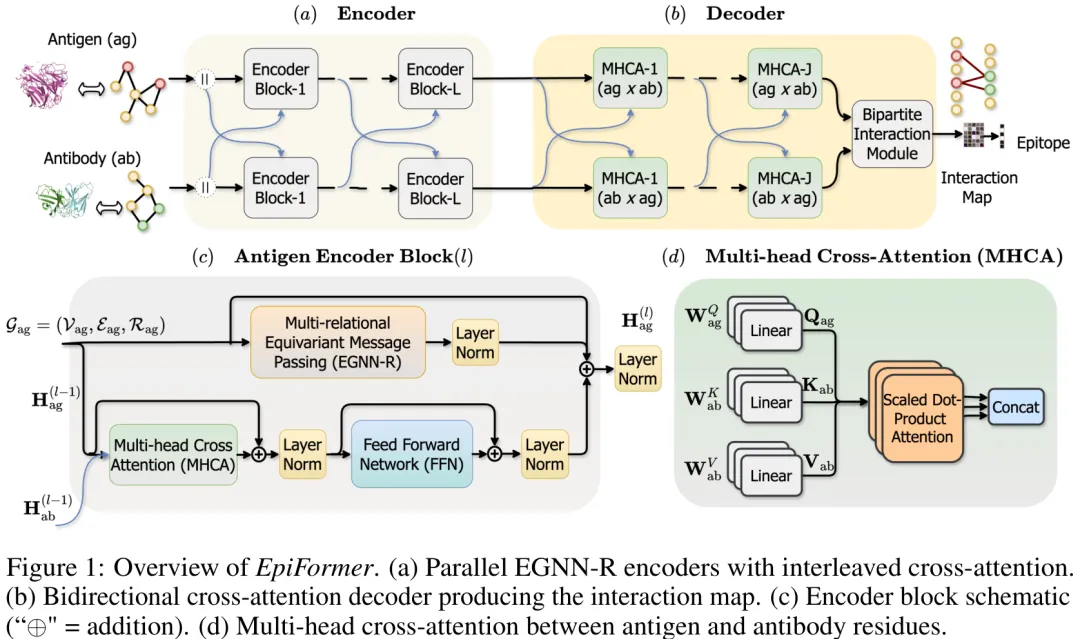
该研究针对抗体 - 抗原复合物中的表位预测问题,提出了一种名为 EpiFormer 的模型。针对表位预测中存在的严重类别不平衡及结构先验利用不足的挑战,EpiFormer 构建了联合训练目标,整合了三个核心组件:首先,在节点分类损失中,结合重加权二元交叉熵、Dice 损失以及稀疏性正则化,以同时处理类别不平衡、优化分割效果并匹配表位残基数量;其次,在边预测损失中,对所有抗原 - 抗体残基对应用重加权二元交叉熵,以重建二部图结构;最后,引入辅助几何分类损失,将残基间距离划分为离散区间进行分类,以增强模型对空间距离特征的感知能力。实验基于 AsEP 数据集,采用表位比例划分和表位组划分两种策略进行评估。结果显示,EpiFormer 在表位预测任务中取得了优于 EpiGraph、EpiScan、MIPE 等现有最先进方法的表现,特别是在 AUPRC 和 F1 分数等关键指标上显著领先,证明了其在处理复杂表位预测任务及泛化到新型结合位点方面的有效性。
中文摘要
摘要:抗体通过与称为表位的特定表面区域结合来中和外来抗原。计算表位预测对于理解免疫识别和指导抗体工程至关重要。然而,现有方法面临三个基本挑战:抗体感知模型独立编码每条链,仅在后期阶段进行组合,无法捕捉定义结合界面的协同结构特征;而严重的类别不平衡和已知抗体 - 抗原复合物的稀缺使得标准训练目标失效。我们提出了 EpiFormer,这是一种通用编码器 - 解码器框架,能够同时解决这些挑战。我们的关键设计原则是在图神经网络(GNN)编码层内采用交错交叉注意力机制,使表征学习过程中抗原与抗体之间的信息流实现双向流动,而非仅在输出阶段进行。这一早期融合原则与骨干网络无关,在从简单 GCN 到等变模型的各种 GNN 架构中均能带来一致的增益。我们进一步表明,当与早期融合架构配对使用时,稀疏感知目标对于表位预测任务是有效的。在标准基准测试中,EpiFormer 的 F1 分数比之前的最佳方法提高了 40% 以上,展现了其泛化能力和跨数据集迁移能力。值得注意的是,EpiFormer 将已知的生物学原理作为端到端训练的涌现行为发现出来:学习到的交叉注意力门控倾向于促进从抗原到抗体的信息流,这与结合界面处两条链的非对称角色一致;且模型对几何特征而非进化特征的偏好,也与表位残基在进化上并不保守这一既定发现相吻合。源代码地址为:https://github.com/mansoor181/epiformer.git
Paper Key Illustration
原文
EpiFormer: Learning Antigen-Antibody Interactions for Epitope Prediction via Geometric Deep Learning
Abstract: Antibodies neutralize foreign antigens by binding to specific surface regions called epitopes. Computational epitope prediction is critical for understanding immune recognition and guiding antibody engineering. However, existing methods face three fundamental challenges: antibody-aware models encode each chain independently and combine them only at a late stage, failing to capture co-dependent structural features that define binding interfaces, whereas severe class imbalance and scarcity of known antibody-antigen complexes render standard training objectives ineffective. We propose EpiFormer, a general encoder-decoder framework that addresses these challenges jointly. Our key design principle is interleaved cross-attention within GNN encoding layers, enabling bidirectional antigen-antibody information flow throughout representation learning rather than only at the output. This early-fusion principle is backbone-agnostic, providing consistent gains across GNN architectures from simple GCNs to equivariant models. We further show that sparsity-aware objectives are effective when paired with early-fusion architectures for the epitope prediction task. EpiFormer improves over the previous best method by over 40% in F1 score on standard benchmarks, demonstrating generalizability and cross-dataset transferability. Notably, EpiFormer discovers known biological principles as emergent behaviors of end-to-end training, where the learned cross-attention gates favor antigen-to-antibody information flow, consistent with the asymmetric roles of the two chains at the binding interface, and the model's preference for geometric over evolutionary features aligns with the established finding that epitope residues are not evolutionarily conserved. The source code is available at: https://github.com/mansoor181/epiformer.git
链接:https://arxiv.org/pdf/2606.04154
AI 深度解读
该研究提出了一种名为 DegradoMap 的深度学习架构,旨在预测蛋白质降解效率及其与 E3 连接酶的兼容性。研究针对 PROTAC 药物开发中的核心挑战,即如何准确评估靶蛋白在特定细胞背景下被降解的能力。方法上,模型首先通过图神经网络(SUG)编码器处理蛋白质结构,利用赖氨酸加权池化机制捕捉共价连接位点的关键空间分布,并采用 SE(3) 不变架构以兼顾旋转平移不变性与计算效率;其次,引入双向多头交叉注意力机制,将蛋白质表征与仅包含 10 种 E3 连接酶的嵌入向量进行交互,以学习不同连接酶对底物的特异性识别模式;同时,模型整合了来自 DepMap 数据库的 59 项细胞背景特征(如基因表达、拷贝数变异等),通过分组 MLP 进行编码。在融合阶段,利用门控机制自适应地加权结构、连接酶及细胞背景信息,最终输出二分类降解概率与连续降解效率值。实验结果表明,该架构在解决数据泄漏问题(如蛋白质大小偏差)后,在未见目标上的 AUROC 提升至 0.657,显著优于基线模型,证明了其在学习蛋白质 - 连接酶相互作用及细胞环境依赖性方面的有效性,为 PROTAC 药物的理性设计提供了强有力的计算工具。
中文摘要
摘要:蛋白水解靶向嵌合体(PROTACs)能够选择性降解致病蛋白,然而预测哪些靶点适合降解仍是一个关键瓶颈:现有的计算方法需要完整的 PROTAC 分子结构,而这些信息在合成前无法获得。我们提出了 DegradoMap,一种图神经网络,仅需蛋白质结构和 E3 连接酶身份即可预测 PROTAC 介导的降解性——这正是靶点选择阶段可用的最小信息量。该模型通过基于赖氨酸加权的图池化及每蛋白归一化编码生物物理先验,利用交叉注意力机制建模蛋白与 E3 连接酶的兼容性,并整合来自癌症依赖图谱(Cancer Dependency Map)的细胞背景信息。在 PROTAC-8K 基准测试(3,101 个样本、155 个靶点、10 种 E3 连接酶)中,DegradoMap 在未见靶点评估中达到 0.646±0.124 的 AUROC(最佳种子为 0.7449),在 CRBN 至 VHL 的 E3 未见迁移中达到 0.811 的 AUROC,优于图神经网络和机器学习基线。此外,该模型推荐最优 E3 连接酶的 Hit@3 准确率达 74%。两项发现具有更广泛的启示意义:对于此类标量预测任务,E(3)-等变架构的表现不如更简单的不变设计;ESM-2 嵌入仅在谨慎正则化下才能提升峰值性能,而简单整合则失败。DegradoMap 为合成前提供降解性评估的计算指导;其经过良好校准的置信度分数(未见靶点评估下 ECE = 0.029)使研究人员能够优先选择高置信度预测进行实验跟进。然而,较高的种子方差(标准差 = 0.124)和有限的 E3 覆盖范围要求采用集成方法以实现可靠部署。

Paper Key Illustration
原文
Structure-Aware Prediction of PROTAC-Mediated Protein Degradability via Graph Neural Networks
Abstract: Proteolysis-targeting chimeras (PROTACs) can selectively degrade disease-causing proteins, yet predicting which targets are amenable to degradation remains a critical bottleneck: existing computational methods require the complete PROTAC molecular structure, information unavailable before synthesis. We present DegradoMap, a graph neural network that predicts PROTAC-mediated degradability from protein structure and E3 ligase identity alone -- the minimal information available at the target selection stage. The model encodes biophysical priors through lysine-weighted graph pooling with per-protein normalization, models protein-E3 compatibility via cross-attention, and integrates cellular context from the Cancer Dependency Map. On the PROTAC-8K benchmark (3,101 samples, 155 targets, 10 E3 ligases), DegradoMap achieves 0.646+-0.124 AUROC on target-unseen evaluation (best seed: 0.7449) and 0.811 AUROC on CRBN->VHL E3-unseen transfer, outperforming GNN and machine learning baselines. The model additionally recommends optimal E3 ligases with 74% Hit@3 accuracy. Two findings carry broader implications: E(3)-equivariant architectures underperform the simpler invariant design for this scalar prediction task, and ESM-2 embeddings improve peak performance only with careful regularization -- naive integration fails. DegradoMap provides pre-synthesis computational guidance for degradability assessment; its well-calibrated confidence scores (ECE = 0.029, target-unseen) enable practitioners to prioritize high-confidence predictions for experimental follow-up. However, the high seed variance (std = 0.124) and limited E3 coverage require ensembling for reliable deployment.
链接:https://arxiv.org/pdf/2606.04021
今日热门 / Popular Today
ArXiv 高热度精选
AI 深度解读
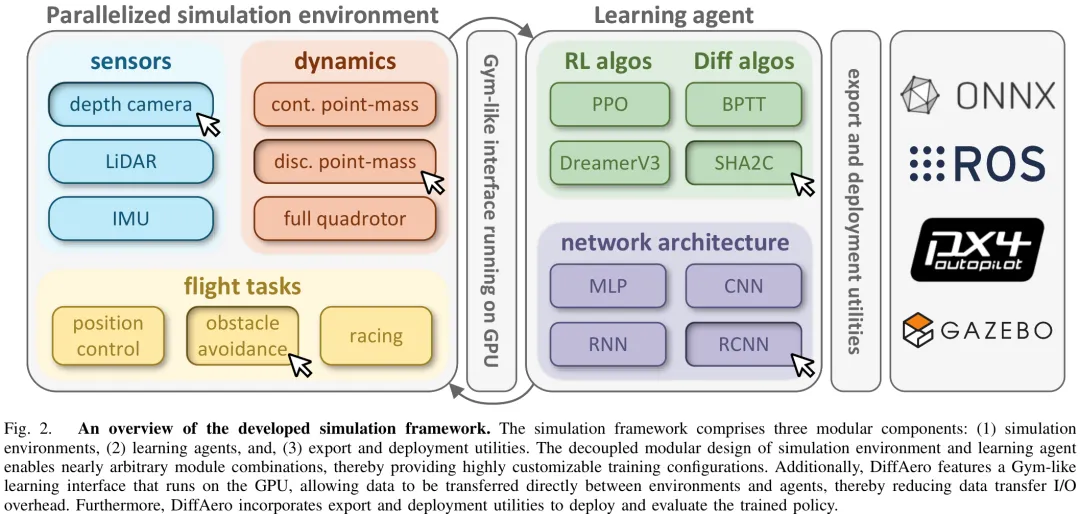
DiffAero 是一个专为四旋翼无人机设计的高性能仿真框架,旨在解决现有通用物理引擎在四旋翼控制任务中不匹配的问题。该框架采用模块化设计,解耦了仿真环境与学习代理,支持 GPU 并行计算以加速训练。在动力学建模方面,DiffAero 提供了四种不同保真度的模型:从包含完整旋转动力学的高保真模型,到简化旋转自由度以加速梯度回传的质心动力学模型,再到极简化模型,以适应不同任务对计算速度和精度的需求。传感器栈部分,框架集成了 IMU、深度相机和 LiDAR 三种模态,并针对低分辨率场景优化了射线投射算法,显著提升了渲染效率,同时支持通过配置噪声参数模拟 IMU 漂移。在飞行任务上,框架实现了位置控制等任务,用于评估动力学模型的保真度及强化学习算法(如 DreamerV3、BPTT 等)的有效性。该框架通过 PyTorch 实现,支持端到端策略学习,并提供了便捷的策略导出与部署工具,能够高效地在其他仿真器或真实平台上验证控制策略性能。
中文摘要
摘要:本文介绍了 DiffAero,这是一个专为高效四旋翼控制策略学习而设计的轻量级、GPU 加速且完全可微分的仿真框架。DiffAero 支持环境级和智能体级并行,并在统一的、原生支持 GPU 的训练接口中集成了多种动力学模型、可定制的传感器栈(惯性测量单元、深度相机和激光雷达)以及多样化的飞行任务。通过将物理模拟和渲染完全并行化至 GPU,DiffAero 消除了 CPU 与 GPU 之间的数据传输瓶颈,显著提升了仿真吞吐量。与现有仿真器相比,DiffAero 不仅提供高性能仿真,还作为一个研究平台,支持探索可微分及混合学习算法。广泛的基准测试和实际飞行实验表明,结合 DiffAero 与混合学习算法,可在消费级硬件上数小时内学习到鲁棒的飞行策略。代码已开源,地址为:https://github.com/flyingbitac/diffaero。
Paper Key Illustration
原文
DiffAero: A GPU-Accelerated Differentiable Simulation Framework for Efficient Quadrotor Policy Learning
Abstract: This letter introduces DiffAero, a lightweight, GPU-accelerated, and fully differentiable simulation framework designed for efficient quadrotor control policy learning. DiffAero supports both environment-level and agent-level parallelism and integrates multiple dynamics models, customizable sensor stacks (IMU, depth camera, and LiDAR), and diverse flight tasks within a unified, GPU-native training interface. By fully parallelizing both physics and rendering on the GPU, DiffAero eliminates CPU-GPU data transfer bottlenecks and delivers orders-of-magnitude improvements in simulation throughput. In contrast to existing simulators, DiffAero not only provides high-performance simulation but also serves as a research platform for exploring differentiable and hybrid learning algorithms. Extensive benchmarks and real-world flight experiments demonstrate that DiffAero and hybrid learning algorithms combined can learn robust flight policies in hours on consumer-grade hardware. The code is available at https://github.com/flyingbitac/diffaero.
链接:https://arxiv.org/pdf/2509.10247
AI 深度解读
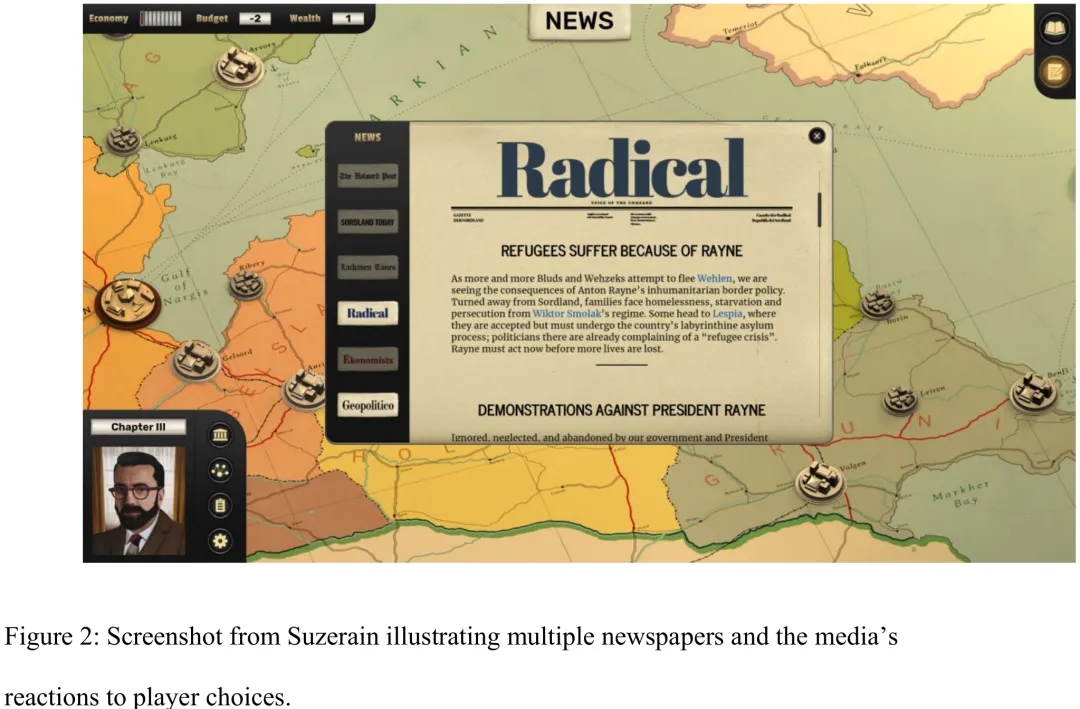
本研究旨在构建一种整合系统思维、设计思维与叙事方法的跨学科教育框架,以应对复杂的社会生态问题(即‘棘手问题’)。研究指出,单一的数字技术无法激发深层学习,必须依托基于真实世界问题的、经过精心设计的交互式数字叙事(IDNs)作为脚手架。在方法论上,研究将系统思维(用于识别反馈回路与整体关联)、设计思维(用于迭代实验与以人为本的解决方案)以及叙事学(用于情感共鸣与视角转换)有机结合。具体而言,系统思维帮助学习者从宏观与微观两个层面理解问题全貌;设计思维提供实验与创新的机制;而叙事则通过角色扮演和互动,将抽象的系统概念具象化,引导学习者在情感投入与理性分析之间保持平衡,避免陷入未经审视的同理心偏见。该框架借鉴科尔布的体验学习模型与双环学习理论,强调在 IDNs 中通过具体行动、反思与实验的循环流动来培养批判性思维与系统能力。研究认为,理想的 IDNs 应区别于仅用于娱乐的商业游戏,需针对教学目标进行精简与定制,以适配课堂时间并引发有意义的讨论。最终,该整合框架为教育者提供了一套可操作的工具,使其能够在现有课程限制下,利用交互式数字叙事有效培养学生的系统思考能力、创新设计及解决全球性复杂挑战的素养。
中文摘要
摘要:本文探讨了交互式数字叙事(IDNs)如何支持学习者发展应对复杂社会挑战(即所谓“棘手问题”)所需的关键素养,例如气候变化、流行病和社会不平等等。尽管数字技术为获取叙事和数据提供了广泛途径,但也助长了错误信息的传播和对相互关联问题的过度简化。IDNs 使学习者能够驾驭非线性、交互式的故事,从而促进更深层次的理解与参与。我们提出了“系统学习交互式叙事”(Systemic Learning IDNs):一种专门设计以帮助学习者探索复杂系统及其相互依赖关系的交互式叙事体验。为指导其创作与应用,我们提出了 CLASS 框架,这是一个整合系统思维、设计思维和叙事讲述的结构化模型。这种跨学科方法支持学习者培养好奇心、批判性思维及协作解决问题的能力。聚焦于课堂情境,我们将 CLASS 应用于两个案例:一个商业叙事模拟和一个教育原型,提供比较分析并就未来的设计与实施提出实用建议。通过结合叙事、系统映射与参与式设计,本文强调了 IDNs 如何成为日益复杂世界中变革性、系统导向学习的有力工具。
Paper Key Illustration
原文
Stories and Systems: Educational Interactive Storytelling to Teach Media Literacy and Systemic Thinking
Abstract: This paper explores how Interactive Digital Narratives (IDNs) can support learners in developing the critical literacies needed to address complex societal challenges, so-called wicked problems, such as climate change, pandemics, and social inequality. While digital technologies offer broad access to narratives and data, they also contribute to misinformation and the oversimplification of interconnected issues. IDNs enable learners to navigate nonlinear, interactive stories, fostering deeper understanding and engagement. We introduce Systemic Learning IDNs: interactive narrative experiences explicitly designed to help learners explore and reflect on complex systems and interdependencies. To guide their creation and use, we propose the CLASS framework, a structured model that integrates systems thinking, design thinking, and storytelling. This transdisciplinary approach supports learners in developing curiosity, critical thinking, and collaborative problem-solving. Focusing on the classroom context, we apply CLASS to two cases, one commercial narrative simulation and one educational prototype, offering a comparative analysis and practical recommendations for future design and implementation. By combining narrative, systems mapping, and participatory design, this paper highlights how IDNs can become powerful tools for transformative, systems-oriented learning in an increasingly complex world.
链接:https://arxiv.org/pdf/2508.11059
AI 深度解读
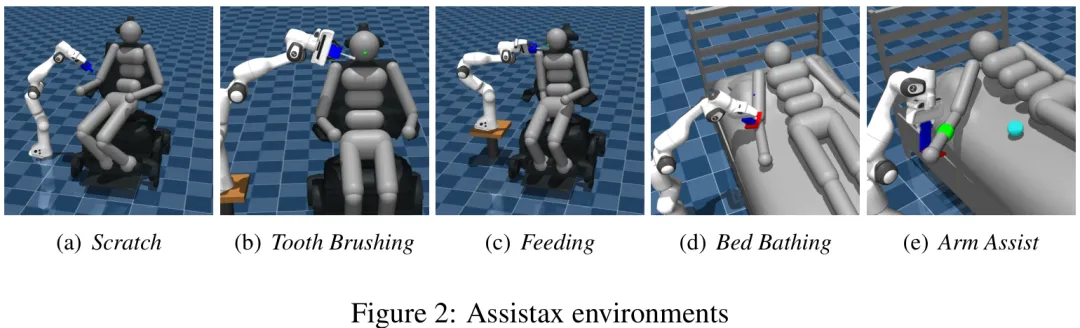
该研究针对辅助机器人领域中的非协作团队(Ad-hoc Teamwork)挑战,提出了名为 Assistax 的开源框架。研究旨在解决现有基准测试在连续动作空间、三维环境及复杂人机交互方面的不足,特别是如何使机器人在面对未知队友类型时实现零样本协调。Assistax 基于 JAX 构建,集成了 MuJoCo 模拟器,提供了五个模拟真实辅助任务的强化学习环境:手臂抓痒、刷牙、喂食、床上洗澡及手臂辅助。这些环境不仅包含物理交互,还引入了模拟震颤、关节无力等人体生理限制。为量化人机协作偏好,研究设计了包含接触力、速度和接触次数三个维度的偏好奖励机制,并将其与任务奖励融合。在算法层面,框架支持并行化训练,并提供了多种多智能体强化学习基线(如 PPO、SAC)及数千个预训练队友策略,旨在构建一个可扩展的端到端训练管线,以推动辅助机器人在复杂动态环境中的实际应用。
中文摘要
摘要:强化学习(RL)算法的发展在很大程度上是由雄心勃勃的挑战性任务和基准测试所推动的。由于游戏具有相关性挑战、运行成本低且易于理解,因此长期主导着 RL 基准测试领域。尽管围棋和雅达利等游戏推动了诸多突破,但它们往往难以直接转化为现实世界中的具身化应用。鉴于认识到需要多样化 RL 基准测试,并解决具身交互场景中出现的复杂性,我们提出了 Assistax:一个开源基准测试,旨在应对辅助机器人任务中的挑战。Assistax 利用 JAX 的硬件加速功能,在基于物理的仿真中显著提升了学习速度。在开环墙钟时间方面,相较于基于 CPU 的替代方案,Assistax 在将训练运行向量化时速度最快可达 370 倍。Assistax 利用多智能体 RL 概念化辅助机器人与主动人类患者之间的交互,训练出一群多样化的伙伴智能体,用于测试具身机器人智能体的零样本协调能力。对流行的连续控制 RL 和多智能体 RL 算法进行了广泛的评估和超参数调优,提供了可靠的基线,并将 Assistax 确立为推动辅助机器人领域 RL 研究的实用基准测试。代码可在以下地址获取:https://github.com/assistive-autonomy/assistax。
Paper Key Illustration
原文
Assistax: A Hardware-Accelerated Reinforcement Learning Benchmark for Assistive Robotics
Abstract: The development of reinforcement learning (RL) algorithms has been largely driven by ambitious challenge tasks and benchmarks. Games have dominated RL benchmarks because they present relevant challenges, are inexpensive to run and easy to understand. While games such as Go and Atari have led to many breakthroughs, they often do not directly translate to real-world embodied applications. In recognising the need to diversify RL benchmarks and addressing complexities that arise in embodied interaction scenarios, we introduce Assistax: an open-source benchmark designed to address challenges arising in assistive robotics tasks. Assistax uses JAX's hardware acceleration for significant speed-ups for learning in physics-based simulations. In terms of open-loop wall-clock time, Assistax runs up to 370× faster when vectorising training runs compared to CPU-based alternatives. Assistax conceptualises the interaction between an assistive robot and an active human patient using multi-agent RL to train a population of diverse partner agents against which an embodied robotic agent's zero-shot coordination capabilities can be tested. Extensive evaluation and hyperparameter tuning for popular continuous control RL and MARL algorithms provide reliable baselines and establish Assistax as a practical benchmark for advancing RL research for assistive robotics. The code is available at: https://github.com/assistive-autonomy/assistax.
链接:https://arxiv.org/pdf/2507.21638
AI 深度解读
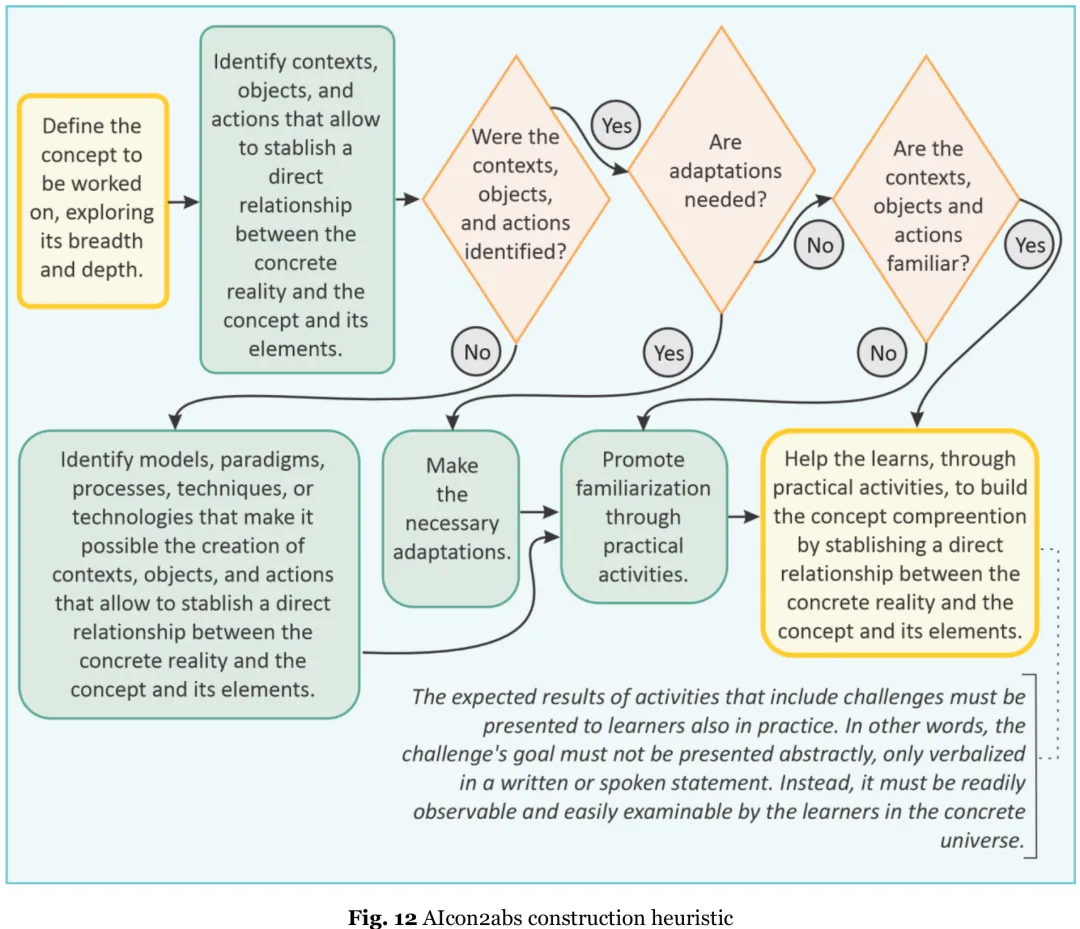
本研究旨在通过实证评估 AIcon2abs 方法,验证其是否适合不同年龄和背景的受众(特别是 8 岁及以上群体)以简单易懂的方式理解机器学习的基本概念。研究采用设计科学研究(DSR)方法论,遵循 Dresch 等人(2015)提出的框架并整合 Pimentel 等人(2019)的 DSR 地图元素,构建了包含 14 个步骤的完整研究流程。AIcon2abs 方法的核心设计基于多项理论假设,包括通过具象化实践促进抽象概念学习、利用可视化算法增强非专家理解、采用基于代理的方法区分传统程序与学习程序,以及利用图灵测试理念辅助理解人工智能。该方法需满足多项严格要求:适配不同抽象能力水平的用户、集成可可视化且支持在线学习的机器学习算法、提供兼容低成本机器人平台的积木式编程环境、融入主动学习策略(如叙事、游戏),并确保在无需 GPU 或网络连接的低成本计算机上运行。研究不仅评估了开发出的功能原型是否满足既定需求,还验证了理论假设的有效性,并正式化了该方法的构建与应急启发式规则。预期成果包括帮助受众掌握基础编程结构、通过游戏化活动复现机器学习算法步骤,并深刻理解机器从示例中学习的过程。
中文摘要
摘要:本研究是对先前工作的扩展,旨在评估 AIcon2abs 方法(AI from Concrete to Abstract: Demystifying Artificial Intelligence to the general public,即“从具体到抽象:向公众普及人工智能”),这是一种旨在提升公众(包括儿童)对机器学习(ML)理解力的创新方法。该方法采用 WiSARD 算法,这是一种以简洁性和用户友好性著称的无权重神经网络。WiSARD 无需互联网连接,使其非常适合非技术用户和资源受限的环境。该方法使参与者能够通过引人入胜的动手活动,直观地可视化并交互体验机器学习过程,仿佛他们本身就是算法。通过实践活动,用户能够直观地理解和掌握训练与分类的内部过程。由于 WiSARD 的功能不依赖互联网连接,它仅需极小的数据集甚至单个示例即可有效学习。这一特性使用户能够观察机器在接收更多数据后如何逐步提高准确率。此外,WiSARD 会生成代表其所学内容的心理图像,突出分类数据的关键特征。AIcon2abs 方法通过一项为期六小时的远程课程进行了测试,参与者包括 34 名巴西人,其中 5 名儿童、5 名青少年和 24 名成年人。数据分析从两个角度进行:混合方法预实验(包括假设检验)和定性现象学分析。几乎所有参与者都对 AIcon2abs 给予了积极评价,研究结果显示出在实现预期目标方面具有高度的满意度。本研究已获得 CEP-HUCFF-UFRJ 研究伦理委员会的批准。
Paper Key Illustration
原文
How do machines learn? Evaluating the AIcon2abs method
Abstract: This study is an expansion of a previous work aiming to evaluate the AIcon2abs method (AI from Concrete to Abstract: Demystifying Artificial Intelligence to the general public), an innovative method aimed at increasing the public (including children) understanding of machine learning (ML). The approach employs the WiSARD algorithm, a weightless neural network known for its simplicity, and user accessibility. WiSARD does not require Internet, making it ideal for non-technical users and resource-limited environments. This method enables participants to intuitively visualize and interact with ML processes through engaging, hands-on activities, as if they were the algorithms themselves. The method allows users to intuitively visualize and understand the internal processes of training and classification through practical activities. Once WiSARDs functionality does not require an Internet connection, it can learn effectively from a minimal dataset, even from a single example. This feature enables users to observe how the machine improves its accuracy incrementally as it receives more data. Moreover, WiSARD generates mental images representing what it has learned, highlighting essential features of the classified data. AIcon2abs was tested through a six-hour remote course with 34 Brazilian participants, including 5 children, 5 adolescents, and 24 adults. Data analysis was conducted from two perspectives: a mixed-method pre-experiment (including hypothesis testing), and a qualitative phenomenological analysis. Nearly all participants rated AIcon2abs positively, with the results demonstrating a high degree of satisfaction in achieving the intended outcomes. This research was approved by the CEP-HUCFF-UFRJ Research Ethics Committee.
链接:https://arxiv.org/pdf/2401.07386
AI 深度解读
针对人工智能(AI)基础教育领域的研究现状,现有文献主要聚焦于利用外部机器学习模型来训练学生并评估其分类效果。Hitron 等人(2018, 2019)的研究证实,10-13 岁的儿童能够理解数据标注、模型评估等基础概念,并通过手势识别等分类任务直观感知机器学习过程,尽管特征提取和模型选择等复杂环节常被简化。Sakulkueakulsuk 等人(2018)在泰国将机器学习、游戏化与社会情境融入 STEM 教育,利用 RapidMiner 平台让学生通过芒果纹理和颜色特征训练模型以预测口味。Druga(2018)则通过 Cognimates.me 平台,结合 Clarifai 和 Uclassify 等工具,使 7-14 岁儿童能够训练图像或文本模型并将其集成到 Scratch 程序中,甚至扩展至控制智能音箱等外部设备。在面向公众和青少年的资源方面,NVIDIA 的
中文摘要
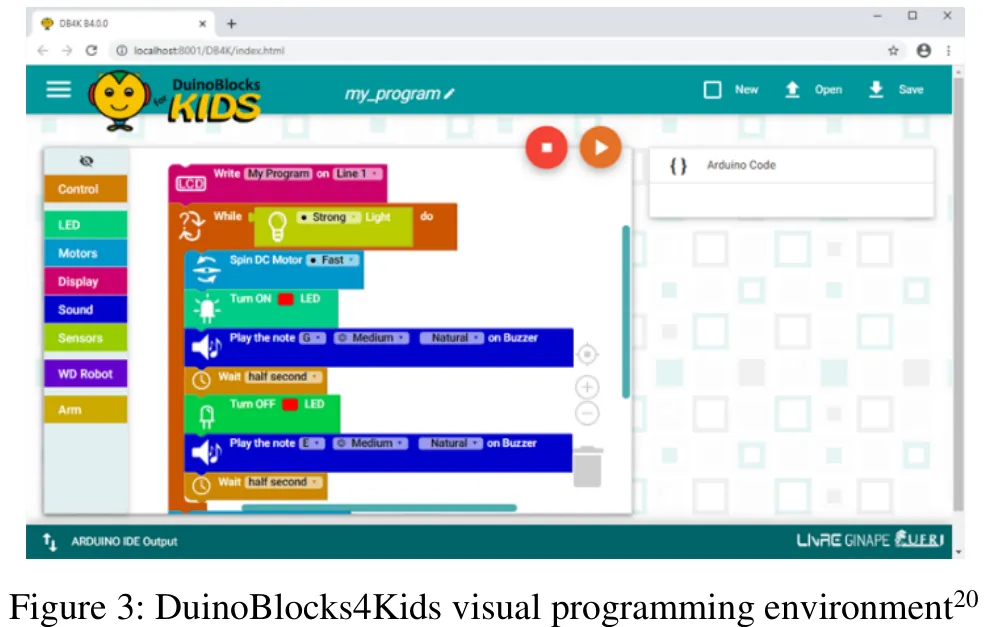
摘要:人工智能(AI)已广泛应用于众多领域。这表明,亟需开发手段,使普通民众能够具备对人工智能含义的基本理解。本文结合可视化编程与 WiSARD 无权重人工神经网络,提出了一种名为“从具体到抽象的人工智能”(AIcon2abs)的新方法论,旨在帮助普通大众(包括儿童)实现这一目标。该方法的主要策略是通过开展与学习机器开发相关的实践活动,以及观察其学习过程,来破除人工智能的神秘感。因此,参与者能够获得相关技能,从而在涉及采用人工智能机制的辩论与决策中成为具有洞察力的行动者。目前,通过编程教授基础人工智能概念的方法通常将机器智能视为外部元素或模块;训练完成后,该外部模块被耦合到学习者开发的主要应用程序中。而在本文提出的方法论中,训练与分类任务均作为构成主程序的基本模块,与其他编程构造无异。作为 AIcon2abs 的有益副产品,具备从数据中学习能力的程序与传统计算机程序之间的差异变得更为明显。此外,WiSARD 无权重人工神经网络模型的简洁性,使得训练与分类任务的内部实现易于可视化与理解。
Paper Key Illustration
原文
AI from concrete to abstract: demystifying artificial intelligence to the general public
Abstract: Artificial Intelligence (AI) has been adopted in a wide range of domains. This shows the imperative need to develop means to endow common people with a minimum understanding of what AI means. Combining visual programming and WiSARD weightless artificial neural networks, this article presents a new methodology, AI from concrete to abstract (AIcon2abs), to enable general people (including children) to achieve this goal. The main strategy adopted by is to promote a demystification of artificial intelligence via practical activities related to the development of learning machines, as well as through the observation of their learning process. Thus, it is possible to provide subjects with skills that contributes to making them insightful actors in debates and decisions involving the adoption of artificial intelligence mechanisms. Currently, existing approaches to the teaching of basic AI concepts through programming treat machine intelligence as an external element/module. After being trained, that external module is coupled to the main application being developed by the learners. In the methodology herein presented, both training and classification tasks are blocks that compose the main program, just as the other programming constructs. As a beneficial side effect of AIcon2abs, the difference between a program capable of learning from data and a conventional computer program becomes more evident. In addition, the simplicity of the WiSARD weightless artificial neural network model enables easy visualization and understanding of training and classification tasks internal realization.
链接:https://arxiv.org/pdf/2006.04013
Subscribe to arXiv's Daily Preprint Notifications