2009 年贵州省贵阳市中考英语试题
第一卷(选择题,共100分)
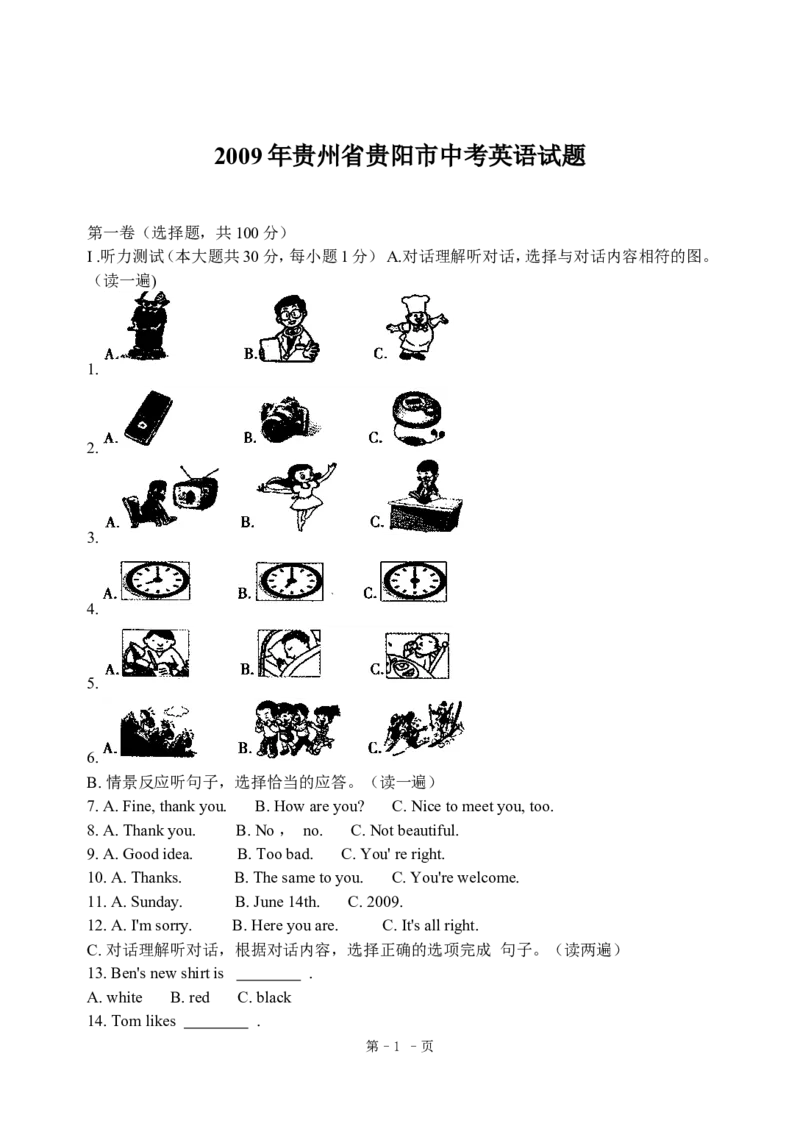
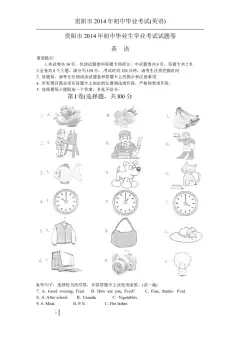
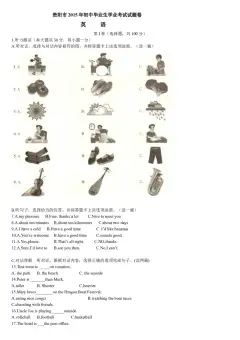
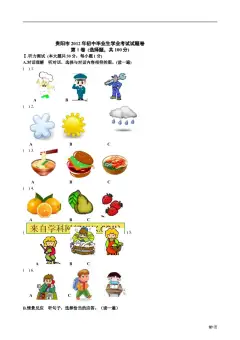
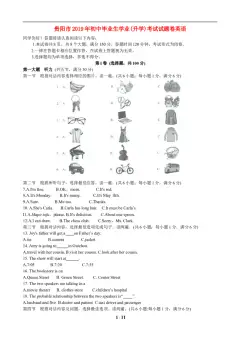
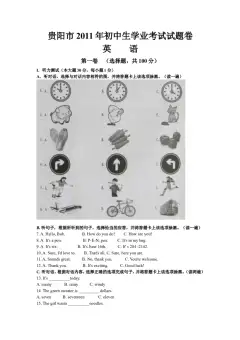
I .听力测试(本大题共30分,每小题1分) A.对话理解听对话,选择与对话内容相符的图。
(读一遍)
1.
2.
3.
4.
5.
6.
B. 情景反应听句子,选择恰当的应答。(读一遍)
7. A. Fine, thank you. B. How are you? C. Nice to meet you, too.
8. A. Thank you. B. No , no. C. Not beautiful.
9. A. Good idea. B. Too bad. C. You' re right.
10. A. Thanks. B. The same to you. C. You're welcome.
11. A. Sunday. B. June 14th. C. 2009.
12. A. I'm sorry. B. Here you are. C. It's all right.
C. 对话理解听对话,根据对话内容,选择正确的选项完成 句子。(读两遍)
13. Ben's new shirt is .
A. white B. red C. black
14. Tom likes .
第–1 –页A. baseball B. basketball C. football
15. Linda's brother is a .
A. worker B. teacher C. writer
16. Anna's MPS is .
A. 25 yuan B. 255 yuan C. 250 yuan
17. Nick often does some on weekends.
A. homework B. schoolwork C. housework
18. Steve was at when the UFO landed.
A. his home B. the barber' s C. school
D. 对话理解听对话及问题,根据对话内容,选择正确答案。(读两遍)
19. A. By bus. B. On foot. C. By bike.
20. A. She has a fever. B. She feels tired. C. She is stressed out.
21. A. To the library. B. To the bank. C. To the park.
22. A. Because it's cool. B. Because it, s nice. C. Because it's fun.
23. A. Apples and noodles. B. Eggs and milk. C. Eggs and noodles.
24. A. The twins. B. The boys. C. The girls.
E.短文理解听短文及问题,根据短文内容,选择正确答 案。(读三遍)
25. A. They're workers. B. They're students. C. They' re doctors.
26. A. 2 hours. B. 3 hours. C. 4 hours.
27. A. To read. B. To write. C. To dance.
28. A. Alice. B. Mike. C. Jack.
29. A. It's great. B. It's expensive. C. It's famous.
30. A. A volunteer school. B. A volunteer project. C. A volunteer hospital.
II.单项选择(本大题共15分,每小题1分) 根据句意或语境,选择可以填入句子的最佳选
项。
31. "Do you want to go to action movie?" " No, I don 't want to."
A. a B. an C. /
32. Hello, this is Tom speaking.
A. Who are you? B. Who 's that? C. What's your name?
33. " Have you read today ' s newspaper?"" Not yet. Is there ?"
A. anything important B. nothing interesting C. important anything
34. " Our class won the table tennis match. " " Congratulations ! You proud of it."
A. can be B. may be C. must be
35. " What time do you usually get up, John?" " I usually get up at ."
A. half past six B. half to six C. half after six
36. Billy can make hamburgers, he can* t make sal ad.
A. so B. but C. and
37. Frank' s mother told him too much sugar because it is bad for his teeth.
A. to eat B. not to eat C. eat
第–2 –页38. " What do you think Joe will be five years?" " He will be a policeman."
A. in B. on C. at
39. After the meeting, we will have a party. If you
free, come and join us.
A. are B. will be C. were
40. Judy likes music very much. She likes music she can dance to.
A. what B. who C. that
41. In China students greet the teachers when classes begin.
A. are supposed to B. are suppose to C. suppose to
42. Jimmy can't buy any new books because he has his money.
A. sold out B. run out of C. come out
43. " What do you think is invention in the world?" "Computer, I think."
A. useful B. more useful C. the most useful
44. " Would you mind the door? It' s cold outside.""Sorry, I' ll do it right away."
A. opening B. closing C. cleaning
45. " Do you know have our summer holiday?" " Next week."
A. when will we B. when are we C. when we will
I.情景交际(本大题共10分,每小题1分)
A. 从右栏中找出左栏各句的答语。
46. May I borrow your pen? A. You ' d better buy a new
47. How do you study for a pair.test? B.Sounds interesting. Let's go.
48. Let 's go to the mall, C. Sure, here you are. shall we?
D. Don't be afraid.
49. My shoes are too small. E. By doing exercises.
50. What do you think of F. Wonderful. I like it very pop music? much.
B. 补全对话通读对话,从所给的选项中选择句子完成 对话。
A: You are so excited about leaving for Japan tomorrow, Dan!
B: Yeah, I am. But I'm a little nervous, too.
A: 51
B : Well , for one thing , I don't know how to use chopsticks very well , and I don't know
how to behave at the dinner table.
A: Oh, I see. 52
B: Really? That would be great !
A: Let me see. One difference is that sometimes it's polite to
make noise when you , re eating , especially when you , reeating noodles. 53
B:
A. And you shouldn't point at anyone with your chopsticks.
B. Nervous about what?
C. I'll go with you.
D. It shows that you like the food.
E. I'd like to give you some advice.
F. That' s interesting. 第–3 –页
G. That' s too bad.Really? 54 But in the United States you can't do that.
A: Yeah, I know. OK, so here are some chopstick rules: it's rude to stick your chopsticks into
your food. 55
B: OK. I won't.
A : And also , this isn't about table manners exactly, but you should know that it' s rude to eat
or drink while walking down the street.
B: Yes. I will remember all the things you ' ve told me. Thanks for helping.
A : You' re welcome.
IV.完形填空(本大题共15分,每小题1分)
通读短文,理解大意,根据其内容,从各题所给的选项 中选择可填入短文的最佳选项。
A
Jack and Tom worked for a builder. When this story hap pened ,they were working on a
very large building. Their job was to pick up all the 56 , put it in wheelbarrows and take it to
the rubbish place. It was not difficult work, but it was a little 57 They had to walk under the
place where men were working. Sometimes these men 58 their tools. Then the tools fell down
from the top of the building to the ground.
One morning, Jack was pushing his wheelbarrow towards the rubbish place when a voice
shouted , " Look out !" But Jack did not "look out" . He 59 up. And as he did so, a saw fell
down from the top of the building. As the saw passed
Jack' s head, it cut off one of his 60 . Immediately he put his hand to his ear and cried out
, "I've lost an ear. Help ! Help!"
Tom ran up to help his 61 " Look for my ear," Jack told Tom. "It's on the ground
somewhere."
While Jack held a handkerchief to his 62 to stop the bleeding, Tom looked everywhere
for the missing ear. At last he found an ear on the ground. He picked it up and carried it to Jack.
" Here you are “, he said. "I've found 63 ."
Jack looked at it carefully. "No, that's not my ear," he said. " Mine had a cigarette behind
it."
56. A. rubbish B. building C. tools
57. A. funny B. exciting C. dangerous
58. A. carried B. dropped C. took
59. A. looked B. woke C. put
60. A. feet B. hands C. ears
61. A. friend B. builder C. worker
62. A. foot B. stomach C. head
63. A. it B. them C. that
B
If you are hungry, what do you do? Have your favorite meal and stay quiet?
Just like your stomach, your mind can be 64 , too, but it never lets you know because
第–4 –页you keep it busy 65 about your dream lover , favorite star and a number of other sil ly things.
So it silently pays attention to your needs and never lets itself grow. When the mind 66 its
freedom to grow , creativity stops. Well , this is the result of using our brains to think of
unimportant things.
The hunger of the mind can be satisfied through wide 67 . Reading is a kind of useful
tool which we have used since childhood. We have to read to get help.
When you read a book , you don't just run your eyes across the lines. You should put
your 68 into it while you are reading. The interesting part of the book is stored in your mind as a
seed. This seed will be unknowingly 69 in the future when you develop new ideas. If it is used
many times, the seed can 70 you link a lot of things together which you would never have
thought of before ! This is nothing but creativity.
64. A. angry B. hungry C. tired
65. A. thinking B. talking C. hearing
66. A. has B. gets C. loses
67. A. writing B. reading C. listening
68. A. mind B. book C. line
69. A. made B. used C. caused
70. A. help B. take C. follow
V.阅读理解(本大题共30分,每小题2分)
A.阅读短文或材料,根据其内容,选择最佳答案。
(A)
The nine-year-old Marc Yu is called Little Mozart. He is too short to reach the pedals of a
piano , yet will perform with Chinese pianist Lang Lang. Marc, who is from California, says ,
" The problem is that my legs aren't straight. They bend a little , so I have to get very close to
the piano before they can reach."
Marc owes his musical talent to his 34-year-old mother, who is single until recently. She
played Beethoven CDs to him when she was pregnant (怀孕).He was bom with perfect pitch (音
调),a talent shared by only one in 10,000 people. Marc started playing the piano at a friend' s
birthday party in Los Angeles when he was only two. As the other children were singing
Twinkle , Twinkle , Little Star , he walked over to the pi ano and started playing the song. It
astonished his mother, Jen ny , because that was the first time he' d been near a piano.
Marc gave his first public performance, playing Beetho ven, at six ― the same age as
Mozart, who gave his first per formance in 1762. After this concert, Marc won a £ 25 ,000
university scholarship. At present, he practices the piano eight hours a day.
He also studies music composition part-time at the famous Colbum Music School in Los
Angeles, and flies once a month to China for lessons at Shanghai Music School.
Marc says , " I like playing the piano because it makes me have a lot of different
feelings ― sadness , excitement , happi ness and so on. I like playing difficult pieces ,
especially those that my teacher says I shouldn't."
第–5 –页71. The nine-year-old Marc Yu is from .
A. China B. the United States C. France
72. Marc started playing the piano at the age of at a friend' s birthday party.
A. six B. nine C. two
73. At present Marc practices playing the piano .
A. once a month B. eight hours a day C. in his part time
74. According to the passage, the underlined word astonished means .
A.使……惊奇 B.使……担心 C.使……理解
75. What Marc said in the last paragraph tells us that .
A. Marc likes challenge
B. Marc doesn't like challenge
C. Marc is afraid of challenge
(B)
British Study Tours
Using the wonderful railway system, we offer an unusual holiday, sports and study
programme. Your hotel is a train : eat and sleep on the train and spend each day in a
different part of Britain.
Summer School in France
We offer summer school for students between the age of 12 and 16. Live with a French
family and choose from different activities including horse-riding, football and swimming.
Summer in Australia
We will arrange a programme for your students. All our courses take place at the college in
Sydney. Morning classes are held in Chinese ; evening classes on Australian history are
in English. We offer an exciting programme of evening activi ties including music ,
dance and theatre.
Holiday Programmes in Germany
We offer morning classes in German at all levels from beginners on up. In the afternoon ,
you are free to join in our mountain walks or go shopping in the nearby town. In the
evening, we organize a full programme for fun. All ages are welcome.
76. If you like traveling by train, you can go to .
A. Summer School in France B. Summer in Australia C. British Study Tours
77. If you want to improve your English, which of the following will you choose?
A. Holiday Programmes in Germany and British Study Tours
B. Summer in Australia and Summer School in France
C. British Study Tours and Summer in Australia
78. The difference between Summer School in France and the other three is that .
A. you can go at any time of the year
B. you can stay with a local family
C. you can do many kinds of sports
第–6 –页79. Which programme offers study for all ages?
A. Holiday Programmes in Germany
B. Summer in Australia
C. Summer School in France
80. The passages were written to encourage people to .
A. have a holiday abroad B. join their programmes
C. study foreign languages
B.句子还原通读短文,从所给的选项中选择5个句子填 入短文空白处,使其文理通顺。
I believe listening is powerful medicine. Studies have shown it takes a doctor about 18
seconds to interrupt a patient after he begins talking.
It was Sunday. 81 I got into her room. She was an old woman, sitting at the edge of the
bed, trying to put socks on her feet. When she saw me , she asked if I could help put on her
socks. Usually I asked my patients something like this : "How are you feeling? The nurse said
your son is visiting you today. 82 "
She stopped me with a serious voice. " Sit down, doctor. This is my story, not your
story."
I was surprised and embarrassed. I sat down. 83 She began to tell me that her only son
lived around the comer from her, but she had not seen him for five years. She believed her health
problems were worse because of the stress of missing her son. After hearing her story and
putting on her socks , I asked if there was anything else I could do for her. 84 All she wanted
me to do was to listen.
Each story is different. Some are clear ; others are not. Some have a beginning, middle,
and end. Others wander with out a clear ending. Some are true ; others are not. 85 What matters
to the storyteller is that the story is heard ― with out interruption or judgment.
Listening to someone 's story costs less than expensive di agnostic testing but is key to
healing (康复).I often thought of what that woman taught me , and I reminded myself of the im
portance of stopping, sitting down and truly listening.
For as long as I could, I continued to see patients. I still teach my students and other
health care professionals , but now from the view of doctor and patient , I tell them I believe
in the power of listening.
A. Yet all those things do not really matter.
B. I helped her with the socks.
C. I had one last patient to see.
D. Your sugars and blood pressure were high but they ' re worse
today.
E. I believe you really look forward to seeing him.
F. She shook her head anrl smiled.
第二卷(非选择题,共50分)
VI.基础知识与运用(本大题共10分,每小题1分) A.根据句意,用所给词的适当形式填空。
86. My are not in my bag. Can you help me look for them? (key)
第–7 –页87. " Did you have fun in the park yesterday?" "Yes, we en joyed . " (our)
88. I don't think students should be to go out on school nights. ( allow)
89. Henry gets on well with everyone in our class. He's al ways to all of us. (friend)
90. about language etiquette is very important for language learners. (learn )
B.根据语境,在句子空白处填入一个适当的词,使句子意思完整 。
91. My mom added some salt in the soup but it still wasn't salty .
92. The traffic is so busy; you should be when you go across the road.
93. "I'm sorry I my homework at home. " " It' s OK. You may bring it tomorrow."
94. Singapore is a small island country. It is not too far China.
95. Xiao Ming got up too late so he to run to school all the way.
VII.任务型阅读(本大题共20分,每小题2分) A.阅读下面新闻报道,整理信息,完成表格。
Swine flu has happened in Mexico in the last few weeks. Some people have died from
swine flu. Many of those who died were young adults.
Until May 6th, students stay at home. Restaurants and churches are closed. The government
also stopped people from going to sports, concerts and similar events. But many Mexi cans have
criticized the country' s health measures.
The disease has spread to at least 7 countries and is sus pected in others. The United States
has more than 48 con firmed cases in 5 states. But no one has died from swine flu in this
country. The United States government agreed the use of federal money and the use of flu
medicines in federal storage. American officials so far have released about 12 million treat ments
of Tami flu and sent them to the states. They say addi tional supplies are available if needed.
President Obama has said officials are being watchful , not fearful. The United States Centers
for Disease Control and Prevention is advising people to avoid travel to Mexico. This is the news
from VOA.
(Xinhua) updated 2009 -04 -29 14:09
Beijing : Though no swine flu case has been reported on the Chinese mainland , the
Ministry of Health ( MOH) has set up a working team to coordinate with the Ministry of Agricul
ture and GAQSIQ to monitor the situation and deal with any emergency.
China will offer humanitarian aid worth $ 5 million to Mexico, the Foreign Ministry said
on Wednesday. The emer gency humanitarian assistance comes in the wake of the epi demic of
swine flu , and includes $ one million in cash and material aid worth $ 4 million, the ministry
said.
Countries Information
Swine flu has happened 96 . Some people died;
Mexico
among them, there were many 97 .
More than 98 are reported in 5 states but no one
the United States has died. Government are be ing watchful, and
people are advised not 9 9 .
第–8 –页China A lot of money and other things are 100 .
B.阅读短文,根据短文内容,完成短文后的句子。
This is a story of myself. When I was young, my father had to go from ranch to ranch to
train horses. So I often couldn't go to school. One day , My teacher Mrs Black asked me to
write about my dream.
That night , I wrote a very long paper. I wrote that I wan ted to have a horse ranch. I
even wrote about how many horses
I wanted to have and how large my ranch would be. It took me hours to finish it. The next
day, I gave the paper to Mrs Black. Two days later, she gave it back to me. She wrote a large red
F on the paper.
After class I went to see Mrs Black and asked , " Why did I get an F?" She said, "This is
unrealistic for you. You have no money. There 's no way you could do it. Write it again."
I went home and thought about it long and hard. I asked my father what I should do. My
father said, " Mike, you have to make a decision on this. I think it is a very important deci sion
for you."
At last , I gave the same paper to Mrs Black and made no changes at all. I said , " You
can keep the F and I’ll keep my dream."
Now I have my own horse ranch. I still have that school paper in my bedroom.
Two years ago, Mrs Black brought 30 kids to visit my ranch. When she left, she said, "
Mike, I can tell you this now. When I was your teacher, I was a dream stealer. During those
years , I stole a lot of kids' dreams. Now I should say sorry."
So you see : Don't let anyone steal your dreams. Keep them , no matter what happens.
101. The story was told by .
102. In the paper, Mike wrote that he .
103. Mike asked Mrs Black why .
104. Mike for many years.
105. From the story we know that we .
VIII.书面表达(本大题共20分,A部分每小题2分,共10 分;B部分10分)
A.看图写话观察图片,根据图示和所给的词,各写一句 话。(每幅图限写一句话,所给的词
都必须用上。)
106. nurse, be, she 107. what, day 108. kids, now 109. yesterday, go 110. next Sunday, fish
106. 107. 108. 109. 110.
B.根据提示,写一篇80词左右的短文,要求条理清楚,文理 通顺,意思连贯。
近年来,传染性疾病不断发生,威胁人类的健康。为了 使自己少受疾病的危害,日常生活中
第–9 –页我们应该怎么办?应 注意哪些问题?请你就这一问题,给《学生英文报》写一篇 80词左
右的征文,谈谈自己的想法。要点如下:
1. 疾病对人们生活的影响;
2. 在家、在学校等公共场所应该注意哪些问题;
3. 日常生活中应该如何养成良好的生活习惯和卫生 习惯。
参考词汇:infectious disease传染性疾病 infect传染
第–10 –页2009 年贵州省贵阳市中考英语试题参考答案和听力材料
1—5 BCBCA 6—10 ACAAB 11—15 BAABC 16—20 BCBBA 21—25 BCCAB 26—30
BACAB
31. B本题考查冠词。不定冠同a,an用于可数名词的单数形式前,a用于以辅音音素开头的
单词前,而an则用于以元音音素开头 的单词前。action以元音音素开头,故选B。
32. B本题考查交际用语。在,话中问对方是谁用"Who's that(speaking) ?",而不用"What 's
your name?"或"Who are you?", 正确答案是B。
33. A本题考查形容词作后置定语。形容词修饰不定代词时要后置,可先排除C。 anything
常用于疑问句或否定句,B项不合语境, 故选A。
34. C 本题考查情态动词。由"Our class won the table tennis match."和"Congratulations !"可
知选C 。
35. A本题考查时间的表达。6:30可用half past six或six thirty .,正确答案是A。
36. B本题考查连词。前后句是转折关系,故选B。
37. B本题考查非谓语动词。tell sb to do sth意为"告诉某人做某事",tell sb not to do sth意二
为"告诉某人不要做某事",由be cause it is bad for his teeth可知应选B。
38. A本题考查介词。"in +时间段"意为"多长时间之后",常用于一般将来时,故选A。
39. A本题考査时态。当主句是一般将来时、祈使句或含情态动词时,条件状语从句用一般
现在时,正确答案是A。
40. C本题考查定语从句。当先行词是物时,关系代词一般用that或which,.的先行词是
music,故选Co
41. A本题考查固定搭配。be supposed to do sth意为"被期望做某事,应该做某事",正确答案
是A。
42. B本题考査动同短语。sell out"卖完",run out of"用完",comeout"出版",正确答案是B。
43. C本题考查比较等级。由in the world可知用最高级,useful的最高»式是the most useful
,正确答案是C
44. B本题考查动词。由"It's cold outside."可知正确答案是B。
45. C本题考査宾语从句。宾语从句要用陈述句语序,故选C。 46—50 CEBAF 51—55
BEDFA
56. A 由put it in wheelbarrows and take it to the rubbish place可知他们的工作是拾建筑垃圾,
故选A。
57. C 从"They had to walk under the place where men were working."以及"Then the tools fell
down from the top of the building to the gmund."可知他们的工作有点危险,故选C。
58. B 由"Then the tools fell down from the top of the building to thegmund."可知有时工人会
把他们的工具弄掉下来,故选B。
59. A look up意为"向上看",wake up意为"唤醒,醒来",put up意为"张贴,數"。根据后文可
知选A。
60. C由下文的"I've lost an ear. Help! Help!"可知锯把他的一只耳朵切掉了,故选C。
第–11 –页61. A根据语境可知,A项最符合。
62. C耳朵长在脑袋上,故选C。
63. A由"Here you are"可知Jack找到了那只被切掉的耳朵,用it来指代,故选A
64. B 由第一段及Just like your stomach可知选B
65. A从mind可知选A。
66. C creativity stops可知选C。
67. B从下文的Reading is a kind of useful tool可知这里是指"通过广泛的阅读",故选B。
68. A 根据下文的"The interesting part of the book is stored in yourmind as a seed."可知,你应
该把注意力集中到你所阅读的东西上,故选A。
69. B 由下文的If it is used many times可知选B。
70. A这颗种子会帮助你把许多你以前从未想到的东西联系在一起,故选A。
71. B 由"Marc, who is from California"可知Marc来自美国,故选B。
72. C 从"Marc started playing the piano at a friend 's birthday party inLos Angeles when he
was only two."可知选C
73. B 从"At present, he practices the piano eight hours a day."可知选B。
74. A 由because that was the first time he'd been near a piano以及上文he walked over to the
piano and started playing the song可知, 这使他母亲震惊,故选A。
75. A 根据"I like playing difficult pieces, especially those that myteacher says I shouldn't."可
知A。
76. C 由"Using the wonderful railway system, we offer an unusual holiday, sports and study
programme."可知选C。
77. C 四个广告中只有British Study Tours和Summer in Australia与英语有关,其他两个广
告分别与法语和德语有关,故选C。
78. B Summer School in France中的Live with a French family是其他三个广告中没有的,
故选B。
79. A 由"All ages are welcome."可知选A。
80. B通读四个广告的内容可知选B。
81. C 由上文的"It was Sunday."以及下文的"I got into her room."可知选C
82. E 从"The nurse said your son is visiting you today."可知选E。
83. B根据上文的"she asked if I could help put on her socks'"以及"I
sat down."可知选B。 ;
84. F 根据上文的"I asked if there was anything else I could do for her"以及下文" All she
wanted me to do was to listen."可知选F
85. A 由下文的"What matters to the storyteller is that the story is heard―without interruption
or judgment."可知选A
86. keys 87. ourselves 88. allowed 89. friendly
90. Learning/To learn 91. enough 92. careful 93. left 94. from 95. had 96. in Mexico 97.
young adults 98.48 confirmed cases 99. to travel/go to/visit Mexico
100. going to be offered/given/sent to Mexico
第–12 –页101. Mike
102. wanted to have a (large horse) ranch (with many horses)
103. he got an F/Mrs Black gave him an F
104. has kept his/that/the paper
105. can't/shouldn't/mustn't give up our dreams (no matter what hap pens)
must/should keep our dreams (no matter what happens)
106. She is a nurse. /She wants to be a nurse./She used to be a nurse.
107. What a fine/sunny/nice day !
108. The kids are having a class/singing/reading now.
109. They went skating yesterday.
100. I'm/He's going fishing next Sunday. I'll / He'll go fishing next Sunday.
One possible version:
The infectious diseases influence our daily life and health. What' s more , it can make people
die. What can we do to stop it? I think when we are at home, we need to sweep the floor, clean
our houses every day. At school, we should keep our classroom clean and tidy. We must clean
our classroom every day and open the windows every morn ing. In public , we shouldn't spit or
drop litter.
In order to protect ourselves from the diseases, we should have good habits. It' s important for us
to eat more vegetables and fruit. Never or seldom eat junk food. We should have good habits and
healthy life manners. We should go to bed early and get up early and sleep 8 hours every night.
We should do more exercise and play sports. We should keep ourselves clean. We should wash
hands before meals , take showers, change and wash clothes often. Also it is good to keep in
happy mood and be happy every day.
If we do like that, we’ll have a happy and healthy life.
贵阳听力材料:
Part A
1. A:Tim, what do you want to be when you grow up?
B:I want to be a doctor.
2. A:Can I help you, Madam?
B: Yes. I'd like to buy a CD player.
3. A: Kate, can you dance?
B:Yes, I can.
4. A: What's the time, Lily?
Brit's six o'clock.
5. A:What's Tom doing?
B: He is doing his homework.
6. A:It's sunny today. Would you like to go hiking?
第–13 –页B:That's great.
Part B
7. Hi, Jim. Nice to meet you.
8. Mary, how beautiful your dress is!
9. Alan, shall we go to the park?
10. Betty, happy new year to you!
11. When is your birthday, John?
12. Tina, you're late again!
Parte
13. A:Ben, What color is your new shirt?
B:It's white.
14. A:Tom, do you like basketball?
B: Yes, I do. I play it after school every day.
15. A: Linda, who's this young man in the picture?
B:It's my brother, he's a writer.
16. A: Anna, how much is your MPS?
B:It's 255 yuan.
17. A:Nick, what do you usually do on weekends?
B:I often help my parents with some housework.
18. A : Steve, what were you doing when the UFO landed?
B:I was sitting in the barber's chair.
Part D
19. A:Jenny, how do you usually go to work?
B:I usually go to work on foot.
A:Me, too. It's good for health.
Question : How does Jenny go to work?
20. A:What's wrong with you, Judy?
B:I have a fever.
A ..I'm sorry to hear that. You'd better have a rest.
B:Yes. I will.
Question: What's the matter with Judy?
21. A : Excuse me. Is there a bank near here?
B: Yes. It's near the library on Center Street.
A : Thank you.
Question : Where does the woman want to go?
22. A:Ted, what's your favorite subject?
B:P. E.
A : Why do you like it?
B: Because it's fun.
第–14 –页Question: Why does Ted like P. E. ?
〖23. A:Bob, what did you have for breakfast this morning?
B:I ate eggs and noodles.
A:Wow, that's a lot.
Question: What did Bob have for breakfast?
24. A:Look! The twins are over there. They look the same.
B:No, Mike is taller and Maria is heavier.
A: Really?
Question: Who are they talking about?
Part E
Alice and Jack are middle school students. They volunteer their time to help other people. The
volunteer work takes them 3 hours a week. Alice loves reading. She often works in the after-
school care center and helps young children to read. Jack likes animals. He wants to be a vet
after he leaves school. Every Saturday morning he goes to work in an animal hospital. He says
he has learned a lot about animals. Alice and Jack both think volunteering is great. They feel
good about helping other people. They spend time doing what they love to do. Both of them
plan to set up a student volunteer project at their school.
Questions
25. What are Alice and Jack?
26. How long do they spend on volunteer work every week?
27. What does Alice help young children do?
28. Who likes animals?
29. What do they think of volunteering?
30. What project do they plan to set up?
第–15 –页