机密 启用前
★
言蹊联考 届新高三毕业班适应性检测
2026
英语试题卷
2025.8
【命题、审题:宗政杰、梁雨轩、赵坤、冯秀粤、莫一凡、张朔、黄定安】
注意事项:
考生领到试题卷 答题卡后 请仔细核对试题卷 答题卡是否为当堂考试科目 检查
1. 、 , 、 ;
无误后 请务必在规定区域内填写本人的姓名 准考证号
, 、 。
回答选择题时 在选出每小题答案后 需用 铅笔将答题卡上对应的字母涂黑
2. , , 2B 。
改动时 清除已有答案后再选涂其他答案标号 回答非选择题时 须将答案写在答
, 。 ,
题卡上 写在试题卷 草稿纸上无效
。 、 。
考试结束后答题卡需在规定时间内统一上传 后续发布统一渠道查阅个人成绩
3. 。 。
第一部分 听力(共两节,满分30 分)
做题时 先将答案标在试卷上 录音内容结束后 你将有两分钟的时间将试卷上的答
, 。 ,
案转涂到答题卡上
。
第一节 共 小题 每小题 分 满分 分
( 5 ; 1.5 , 7.5 )
听下面 段对话 每段对话后有一个小题 从题中所给的 三个选项中选出最
5 。 , A、B、C
佳选项 听完每段对话后 你都有 秒钟的时间来回答有关小题和阅读下一小题 每段
。 , 10 。
对话仅读一遍
。
例
:How much is the shirt?
A.£ 19.15. B.£ 9.18. C.£ 9.15.
答案是
C。
1.What is the charge for breakfast at the moment?
$ $ $
A. 8. B. 6 C. 5
2.What will the man have to do?
A.Cancela plan B.Arrange an appointnent C.Invite the man for dinner.
3.Who gave the woman the gifts today?
A.Her sister B.Her neighor C.Herfather
英语试题 第 1 页(共14 页)4.Where are the speakers?
A.In a shop B.Inataxi C.On a plane
5.What are the speakers mainly talking about?
A.Aband B.A singer C.A program
第二节 共 小题 每小题 分 满分 分
( 15 ; 1.5 , 22.5 )
听下面 段对话或独白 每段对话或独白后有几个小题 从题中所给的 三个
5 。 , A、B、C
选项中选出最佳选项 听每段对话或独白前 你将有时间阅读各个小题 每小题 秒钟
。 , , 5 ;
听完后 各小题将给出 秒钟的作答时间 每段对话或独白读两遍
, 5 。 。
听第 段材料 回答第 题
6 , 6、7 。
6.What is the man' s problem?
A.He misplaced his keys.
B.He failed to catch the bus.
C.His vehicle suffered a mechanical breakdown.
7.What transportation will the man choose to get to work?
A.By taxi. B.By subway. C.By bike.
听第 段材料 回答第 至 题
7 , 8 10 。
8.What is the woman's objective?
A.Lease an apartment.
B.Purchase a residence.
C.Put her apartment up for sale.
9.What is the preferred number of bedrooms for the woman?
A.One. B.Two. C.Three.
10.What can be inferred from the man's description of the apartment located on Green Street?
A.It has just been newly decorated.
B.It is situated adjacent to a park.
C.It features a spacious balcony.
英语试题 第 2 页(共14 页)听第 段材料 回答第 至 题
8 , 11 13 。
11.What is the relationship between the speakers?
A.Classmates. B.Teacher and student. C.Colleagues
12.What accounted for the woman's absence from the lecture?
A.She was ill.
B.She lost track of time.
C.She participated in a different event.
13.What assistance will the man offer to the woman?
A.Lend her his notes.
B.Help her with the homework.
C.Elucidate the challenging aspects.
听第 段材料 回答第 至 题
9 , 14 17 。
14.What kind of plan are the speakers discussing?
A.A birthday party. B.A graduation ceremony. C.A class reunion.
15.Who is most likely to be in charge of food preparation?
A.The woman' s mother. B.The man' s sister. C.The speakers themselves.
16.At which location will the event take place?
A.In a restaurant. B.In the school hall. C.In the woman' s garden.
17.What proposal does the man put forward?
A.Extending invitations to additional guests.
B.Engaging in some recreational games.
C.Taking group photos.
听第 段材料 回答第 至 题
10 , 18 20 。
18.What is the central topic of the speaker's discussion?
A.A school club. B.A weekend activity. C.A volunteer program.
19.What will volunteers NOT do during the activity?
A.Clean up the park benches.
B.Plant flowers in the park.
C.Feed the birds in the park.
20.What items are the listeners required to bring?
A.Gloves. B.Snacks. C.Drinks.
英语试题 第 3 页(共14 页)第二部分 阅读理解(共两节,满分50 分)
第一节 共 小题 每小题 分 满分 分
( 15 ; 2.5 , 37.5 )
阅读下列短文 从每题所给的 四个选项中选出最佳选项
, A、B、C、D 。
A
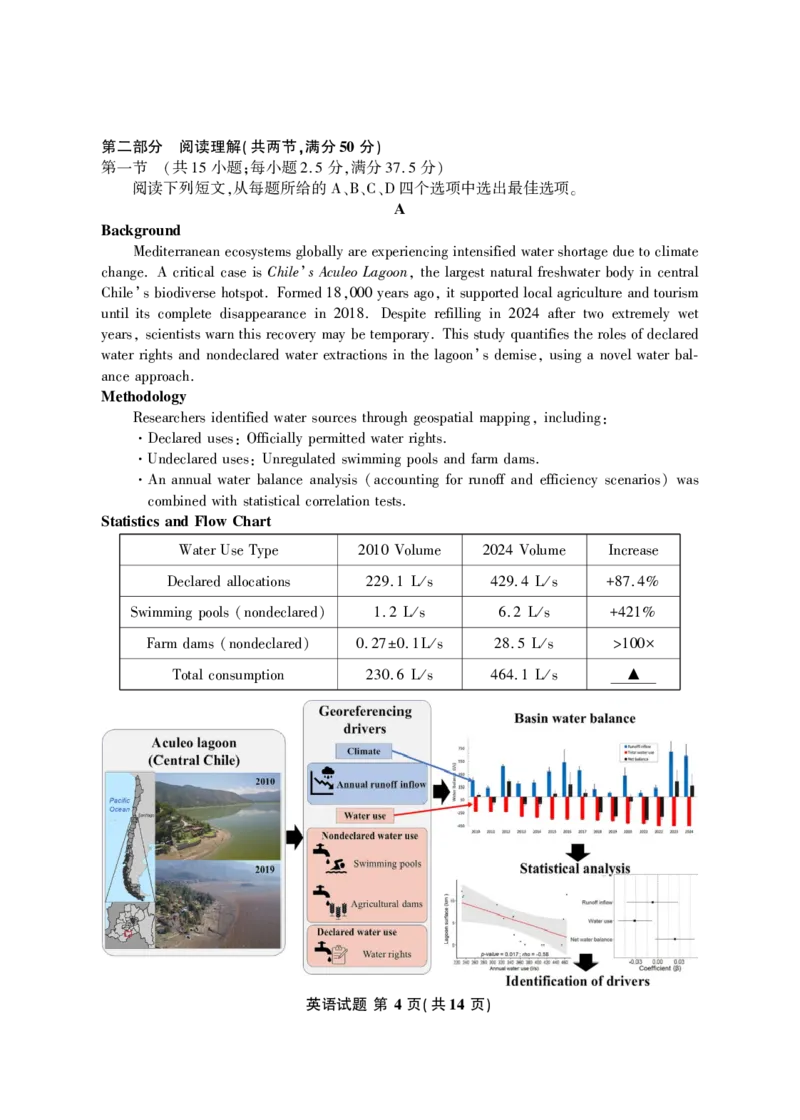
Background
Mediterranean ecosystems globally are experiencing intensified water shortage due to climate
Chile s Aculeo Lagoon
change. A critical case is ’ , the largest natural freshwater body in central
Chile’s biodiverse hotspot. Formed18,000 years ago, it supported local agriculture and tourism
until its complete disappearance in 2018. Despite refilling in 2024 after two extremely wet
years, scientists warn this recovery may be temporary. This study quantifies the roles of declared
water rights and nondeclared water extractions in the lagoon’s demise, using a novel water bal-
ance approach.
Methodology
Researchers identified water sources through geospatial mapping, including:
·Declared uses: Officially permitted water rights.
·Undeclared uses: Unregulated swimming pools and farm dams.
·An annual water balance analysis (accounting for runoff and efficiency scenarios) was
combined with statistical correlation tests.
Statistics and Flow Chart
Water Use Type 2010 Volume 2024 Volume Increase
Declared allocations 229.1 L/s 429.4 L/s +87.4%
Swimming pools (nondeclared) 1.2 L/s 6.2 L/s +421%
Farm dams (nondeclared) 0.27±0.1L/s 28.5 L/s >100×
Total consumption 230.6 L/s 464.1 L/s ▲
英语试题 第 4 页(共14 页)Critical Conclusions
·No significant correlation found between lagoon area and runoff (p > 0.05)
·Strong negative correlation with total water use (p = 0.017)
·Post-2024 risk remains extreme:
◆Water demand still exceeds 450 L/s
◆Climate models predict 30% less runoff by 2030
Ecological Implications
As a key biodiversity refuge, the lagoon’s potential re-drying threatens 17 endemic spe-
人为的
cies. This case demonstrates how climate change intensifies anthropogenic ( ) pressures,
urging immediate policy interventions on illegal extractions.
21.What may cause the lagoon refilling?
A.Human over-exploitation. B.La Nina phenomenon.
C.Mediterranean ecosystems. D.El Nino phenomenon.
22.Why did they combine water balance approach with geospatial mapping?
A.To prove that rainfall alone determines the lagoon’s water levels.
B.To quantify if runoff inflow depends on Water use and Net water balance.
C.To analyze how climate variability and water use affect basin water balance.
D.To visually demonstrate the negative correlation between lagoon area and runoff.
23.What is the percentage increase in total water consumption from 2010 to 2024?
A.+101.3%. B.+231.34%. C.+49.68%. D.+46.15%
B
令人窒息的
Jammed roads, loud noises, suffocating( ) smog. For some people, living in
the city can be stressful. But a growing body of research shows some city birds can be more ag-
gressive than their rural twins, suggesting they too feel the pressures of city life.
Generally, animals that live in cities tend to be bolder and more aggressive — both charac-
teristics that enable them to survive in such complex habitats. “Individuals that can't deal with
constant disturbance, such as noise, people, cars, etc., would be unlikely to thrive in an urban
habitat, ” says Jeremy Hyman, a professor and department chair of biology at Western Carolina
University.
Some birds may become more aggressive because cities are rich in food sources — and so
there’s strong competition to establish a foothold. “Only the most aggressive males can manage
to hold a territory in this place where lots and lots of birds would like to have a territory, ” says
Hyman.
But food scarcity may also make some urban species more aggressive, and so birds have to
fight an awful lot in order to maintain a large enough territory to get the resources that they need.
英语试题 第 5 页(共14 页)High levels of stress caused by noise and other factors might also play a role in making birds
more aggressive, notes Hyman.
In some cases, aggression seems to be “a worthwhile cost,” says Sarah Foltz, a behavioral
ecologist at Radford University. However, a big unanswered question is whether birds learn to
be aggressive during their lifetime. But what scientists do know is that some birds can be highly
adaptable. “Aggression definitely has a genetic component to it, ”says Foltz. “But also, we
know that when we change environmental factors, birds change their aggression. ”
密
Overall, Foltz says scientists are still trying to understand just how much urban density(
度
) different species can tolerate and which characteristics of an urban environment influence
aggressiveness the most. “We've got all these little pieces, ” she says, “But it's still coming to-
gether to make a bigger picture, so it's sort of an unfinished puzzle. ”
24.Why are birds in the city more aggressive?
A.They need to adapt the environment. B.They are annoyed by city’s disturbance.
C.They have such characteristics in the rural.D.They hate people in the city.
25.What can be inferred from Hyman’s statements?
A.Birds in the urban will die out.
B.Male birds will occupy all the urban habitats.
C.Conflict will always exist despite sufficient food.
D.Stress plays a more critical role in bird’s aggressiveness.
26.What plays a role in birds’ aggression?
A.Gene and environment. B.Evolution and structure.
C.Body and environment. D.Gene and structure.
27.What does Foltz think of the research?
A.Promising B.Common C.Critical D.Meaningless
C
In a revealing experiment, researchers placed fleas in a glass jar sealed with a lid. The in-
sects repeatedly jumped toward freedom, striking the unyielding barrier above them. After 72
–
hours, the scientists removed the lid. Remarkably, the fleas continued to jump but never a-
透明
gain reached the height necessary to escape their transparent ( ) prison. This phenomenon,
known as the flea effect, offers profound insights into human psychology.
Consider the case of a secondary student named Elena. After receiving low marks on two
writing assignments, she concluded, “I’m hopeless at composition.” This belief appeared in a-
voidance: skipping writing practice, dismissing vocabulary building and performing worse on
内
subsequent tasks ultimately. Like the fleas conditioned by the jar’s lid, Elena internalized (
化
) artificial restrictions that bore little relation to her true capabilities.
Neuroscience suggests that breaking free from such psychological limitations requires delib-
英语试题 第 6 页(共14 页)erate strategy that includes three phases. Individuals must identify their limiting beliefs, much
like Elena eventually acknowledged, “I avoid writing because I fear criticism, not because I
lack ability.” The second phase involves systematic desensitization through manageable challen-
–
ges. Elena started by writing three-sentence journal entries daily a task too small to spark
significant anxiety. Successively, she expanded to paragraphs, then full essays. The final phase
celebrates increasing progress; each completed writing session strengthened her growing compe-
tence. Within four months, Elena earned her first distinction in English composition.
The journey from self-imprisonment to liberation parallels the fleas’ unrealized potential.
Behavioral scientists emphasize that the most solid barriers are often those we construct in our
minds. As researcher Dr. Karen Hughes notes, “The ceiling above us exists only until we
stretch beyond yesterday’s reach.” Both fleas and humans possess the inborn capacity for ex-
–
traordinary leaps if only they dare to rediscover the height of their own potential.
28.How did the fleas perform after the lid was removed by researchers?
A.They escaped from the jar immediately. B.They jumped higher than before.
C.They stayed in the jar after endless tries. D.They stopped fleeing out of exhaustion.
29.Which of the following can best describe Elena’s method of regaining passion for writing?
A.Gradual and steady. B.Skillful and speedy.
C.Painful and slow. D.Easy and undemanding.
30.What does the underlined word “parallels” in paragraph 4 mean?
A.Mirrors. B.Shows. C.Matches. D.Follows.
31.What can be the best title for the article?
A.How Your Bliefs Trap You? B. How You Limit Yourself Mindlessly?
C.How Fleas Eascape from The Jar? D. What’s The Purpose of Flea’s Bounce?
D
磁场
The strength of Earth’s magnetic field ( ) seems to rise and fall hand-in-hand with
the amount of oxygen in its atmosphere, a study of geological records spanning the last half bil-
lion years has found. Published in Science Advances, this correlation puzzles scientists. Benja-
min Mills, a co-author of the study from the University of Leeds, admits, “We don’t really
have a good explanation for it.”
While oxygen only began to slowly accumulate in the atmosphere after photosynthetic organ-
光合生物
isms( )began to evolve, around 2.5 billion years ago, breathable concentrations for
most animals emerged only in the last 540 million years.
There is no direct way to measure the composition of the atmosphere in the deep past, but
geochemists can use indirect clues (e.g. wildfire frequency traced through ancient charcoal de-
posits) to reconstruct oxygen levels and paired this with geomagnetic data from volcanic rocks
–
containing “frozen compasses” magnetic crystals aligned with Earth’s field during eruptions.
英语试题 第 7 页(共14 页)To better compare two long records, Mills teamed up with NASA scientists, discovering ox-
ygen levels and geomagnetic intensity have increased over the past million years, and some of
the major fluctuations in both measures occur in the same geological eras.
Several possible explanations are also proposed. One possibility is the magnetic field’s
shielding effect, deflecting solar wind to prevent oxygen escape into space. Another links plate
tectonic movements—formations and breakups of supercontinents, which release nutrients that
藻类
boost oxygen-producing algae( )—to disturbances in Earth’s liquid core where magnetism
originates. “If things like the spreading rate [of the oceanic crust] influence the magnetic field,
the tectonic cycle could be driving oxygenation — but also the magnetic field,” Mills says.
Sanja Panovska, a geophysicist at the Helmholtz Centre for Geoscience in Potsdam, Germa-
ny, says that the study is convincing, but it introduces more questions than it answers.
Yet, the discovery could feed into a long-standing debate on whether a strong magnetic
field is essential for complex life to evolve on a planet. “It’s very expensive to observe exoplan-
ets, and you need to choose which ones to observe,” says Mills. “What this kind of work would
inform is the kind of places you’d look.”
32.What does the term "frozen compasses" (paragraph 3) refer to?
A.Devices used in ancient navigation.
B.Crystals preserving magnetic directions.
C.Tools for measuring oxygen concentration.
D.Instruments recording geomagnetic statistics.
33.How do geochemists determine historical oxygen levels?
A.By measuring volcanic rocks directly.
B.By observing plate tectonic movements.
C.By studying photosynthetic organisms.
D.By analyzing indicators like wildfire remains.
34.Which could suggest a shared origin for both increases in paragraph 4?
A.Oxygen accumulated after organisms began to evolve.
B.An unknown third factor is pulling the strings behind.
C.Plate motions affect magnetism and oxygen production.
D.The Shielding Effect captures oxygen and prevents its release.
NOT TRUE
35.Which of the following is according to the passage?
A.Oxygen-rich planets are less likely to have strong magnetism.
B.Sanja Panovska holds a cautious attitude to the results of the study.
C.The study is of certain significance in terms of exoplanet research.
D.The researchers actually propose some hypotheses for the reasons.
英语试题 第 8 页(共14 页)第二节 共 小题 每小题 分 满分 分
( 5 ; 2.5 , 12.5 )
阅读下面短文 从短文后的选项中选出可以填入空白处的最佳选项 选项中有两项
, 。
为多余选项
。
Fathers cherish reading stories to their children, sharing worlds of elephants, dinosaurs,
骑士
and knights( ) 36 Beyond reading, when fathers share their own childhood stories
— their friendships, favorite toys, victories and failures — they offer a unique gift. It allows
children to know their fathers intimately, expanding the child’s own life story.
Research shows children who hear family stories develop richer storytelling skills, stronger
应对
self-esteem, and better coping( ) abilities. Renowned pediatrician, Donald Woods Winni-
The Child The Family and the Outside World
cott, author of , , maintained that mothers provided
children with the inside emotional story and fathers, the outside world story. 37 —
with best friends, school struggles, and childhood incidents. Stories become co-created in the
listener’s mind, made unforgettable by the emotional connection between parent and child.
Family members often reveal fragments of a father’s past:“ 38 ” When others
share these moments, fathers should embrace them. Children crave these details and will ask,
“Dad, is that true?”
Secrets can distance us from loved ones and what is not said, but acted upon, questions
and impacts children. One clinician shares that it was only when her father gave her the written
version of his story of the Holocaust that her father's emotions and behavior made sense to her.
39
On Father's Day, ask your child:“ 40 ” The answer may surprise you. For chil-
dren who've lost fathers, stories from loved ones become precious reminders — keeping memo-
ries alive at any age. In giving and receiving these stories, fathers and children create bonds that
endure.
A.Did you know your Dad once dropped ice cream on my head?
B.What’s your favorite story I’ve told?
C.Unspoken pain can create distance; sharing it builds bridges.
D.What's your favorite story about me?
E.Children tend to act like their parents after hearing stories.
F.These nighttime routines often lead to “one more story” before bedtime.
G.Children are fascinated to imagine their parents as children.
英语试题 第 9 页(共14 页)第三部分 语言运用(共两节,满分30 分)
第一节 共 小题 每小题 分 满分 分
( 15 ; 1 , 15 )
阅读下面短文 从每题所给的 四个选项中选出可以填入空白处的最佳选
, A、B、C、D
项
。
–
Three months into my job at QuickBites, I’d learned to fear apartment deliveries espe-
cially in this aging complex with its broken elevator and twinkling hallway lights.
粥
Mrs. Chen’s order 41 immediately. Hers was congee ( ), a 30-minute drive a-
–
way. The delivery notes 42 :“Ring bell 3x I move slow. Will tip cash.”
When I finally reached her door, I followed the 43 . The woman who appeared was
–
44 five feet tall one hand 45 a walking stick; the other trembled reaching for the food.
“Come in, come in,” she 46 . As I stepped inside, a wall of framed photos caught my eye
–
a younger Mrs. Chen in a nurse’s uniform, standing beside a man at a ceremony.
She noticed my 47 . “My husband,” she said. “He passed last winter.” Then, she
48 the congee into two portions. One she placed on the dining table; the other she pushed
toward me. “Eat, you are too 49 for carrying heavy bags.” she said. When I protested a-
bout my next delivery, she waved a 50 hand. “Five minutes won’t kill anybody.”
Her congee order became our 51 every Thursday. Through her, I met others the orders
代币
never showed me: the night-shift gatekeeper who 52 in subway tokens ( ), the single
dad who’d order one burger to split between three kids.
Now in 53 school, when classmates complain about “difficult patients”, I tell them a-
诊断 –
bout the woman who taught me that 54 isn’t just in the diagnosis ( ) it’s in the five
症状
extra minutes you take to hear the story 55 the symptoms ( ).
41.A.broke in B.brought up C.stood out D.called off
42.A.wrote B.said C.asked D.read
43.A.bill B.instruction C.information D.delivery
44.A.absolutely B.barely C.rarely D.precisely
45.A.gripped B.twisted C.lifted D.touched
46.A.declined B.shouted C.insisted D.ordered
47.A.gaze B.puzzle C.expression D.feeling
48.A.cooked B.divided C.consumed D.gathered
49.A.slim B.short C.strong D.skinny
50.A.smooth B.pale C.wrinkled D.thin
51.A.routine B.agreement C.habit D.appointment
52.A.ordered B.paid C.bought D.tipped
53.A.technical B.medical C.academical D.classical
54.A.delivering B.driving C.healing D.working
55.A.behind B.ahead C.before D.beside
英语试题 第 10 页(共14 页)第二节 共 小题 每小题 分 满分 分
( 10 ; 1.5 , 15 )
阅读下面短文 在空白处填入 个适当的单词或括号内单词的正确形式
, 1 。
荔枝
The lychee ( ), whose name in English was originated from the Cantonese “lai6 zi1”,
with its rough, pink-red shell hiding sweet, is a jewel of the fruit world. Native 56
the forests of southern China, it has been planted there for millennia. The fruit features striking-
ly in Chinese culture and literature, often 57 (symbolise) romance and luxury.
Early European amazed at this alien fruit and 58 (possible) brought some seeds
back during their voyages to southern China. However, the lychee is particularly picky; it re-
quires very specific subtropical conditions, 59 distinct cool period to initiate flowering,
and does not tolerate frost or sustained high wetness poorly.
By the early 19th century, the lychee 60 (arrive) in India and Burma. From In-
dia, it spread further to the West Indies, notably Jamaica, 61 it found suitable grow-
ing conditions.
The lychee was introduced to Florida in the late 19th century, later to California, Hawaii, and
America. Despite these introductions, large-scale 62 (commerce) production outside
Asia remained limited for a long time due to the tree’s demanding nature. However, dedicated
cultivation efforts, especially in the late 20th century, have led to significant lychee harvests in
places 63 Florida, South Africa, Australia, and Israel.
Today, while China remains the 64 (world) largest producer, the lychee is no
longer an exclusively Chinese treasure. Its journey from southern China to tables worldwide is a
fascinating story of botanical 65 (explore), colonial trade networks, and human per-
sistence in culturing beauty and flavour.
英语试题 第 11 页(共14 页)第四部分 写作(共两节,满分40 分)
第一节 满分 分
( 15 )
假定你是李华 你的英国笔友 来信询问你校近期举办的 校园生活技能大赛 相
, Peter “ ”
关情况 请你根据以下提示给他回一封信
。 :
大赛目的
1. ;
比赛项目
2. ;
你的收获与感受
3. 。
注意
:
词数 左右
1. 80 ;
可适当增加细节 使行文连贯
2. , ;
开头和结尾已为你写好 不计入总词数
3. , 。
Dear Peter
,
I m glad to receive your letter asking about our school s Campus Life Skills Competition .
' ' “ ”
Looking forward to hearing about your school activities.
Yours
,
Li Hua.
第二节 满分 分 (选择其中一篇写即可)
( 25 )
A
Alan Austen, heart pounding with a mix of apprehension and desperate hope, went up the
creaky stairs tucked away near Pell Street. The dim hallway smelled of dust and time. After a
long moment of squinting, his finger traced a faded name on a worn door.
Pushing it ajar as instructed, he entered a cramped space. Bare walls, save for a couple of
shelves holding an assortment of unremarkable objects: smooth stones, dried leaves, a few sim-
ple clay pots. Only a plain table, a rocking chair, and a single straight-backed chair furnished
the room.
英语试题 第 12 页(共14 页)An old man rocked gently, eyes scanning a newspaper. Silently, Alan offered the card that
had led him here. “Sit, Mr. Austen,” the old man said and folded the paper, his gaze direct
but not unkind.
“They said… they said you might have something,” Alan began, the words tumbling out.
“Something that could… change things? Make a difference?”
The old man’s eyes held Alan’s for a moment, seeming to weigh the unspoken burden be-
hind the question. “Change? Difference?” He mused, a thoughtful crease forming beside his
eye. “My shelves hold little that shouts its purpose.” He gestured towards the collection. “No
miracles in jars here, young man. Only quiet companions, often overlooked.”
He rose slowly, his movements deliberate, and walked to the shelves. He didn’t reach for
a bottle, but picked up a small, unglazed clay pot. Inside was nothing but ordinary-looking
soil. He placed it gently on the table before Alan.
Alan leaned closer, puzzled. “Soil?”
“Look closer,” the old man urged softly.
Alan peered into the pot. Nestled within the dark earth, barely visible, lay a single,
small, very ordinary-looking seed. It looked utterly insignificant.
“This?” Alan couldn’t mask his disappointment. “A seed? But…how can this help me?”
The old man s smile was faint but held a depth of understanding.
’
Dear me that s it cried Alan with a dawning clarity.
“ , ’ !” ,
B
Chris Hart was no ordinary16-year-old. At6 feet8 inches tall and260 pounds, he was a
talented football player with a bright future. But during his junior year, his life changed when
doctors told him his cancer had returned and he might not have much time left.
That Christmas, a local radio station held a contest to make special wishes come true. A
kind woman from our church wrote a letter for Chris, and his three wishes were granted. First,
he received a brand-new stereo system for his truck. Next, he got to see his favorite team, the
英语试题 第 13 页(共14 页)Dallas Cowboys, play live—even meeting some players in the locker room. His third wish was
more personal: he wanted a date with a redheaded girl.
That’s how I got involved. My dad, a minister, told me about Chris’s story and his final
wish. Though I didn’t know him, I agreed to go on a date with him. When we first met, I was
surprised by his size and his bald head from chemotherapy, but he was polite and kind. To
make things easier, I brought a friend along. We went for pizza, and despite the stares from
strangers, we had a nice time.
After that, Chris started visiting me after school. We talked about life, watched movies,
and listened to music. He missed playing football but never complained.
Later, a newspaper wrote about Chris’s wishes and included a photo of us. When kids
from school saw the article and picture, they made comments. I tried to ignore them, but then
one day, one of the popular seniors said to me, "Hey, I guess that guy couldn't find anybody
better to date.
It really hurt.
That night when he came to pick me up I found he was weaker than before.
,
英语试题 第 14 页(共14 页)