专题 12 阅读理解说明文
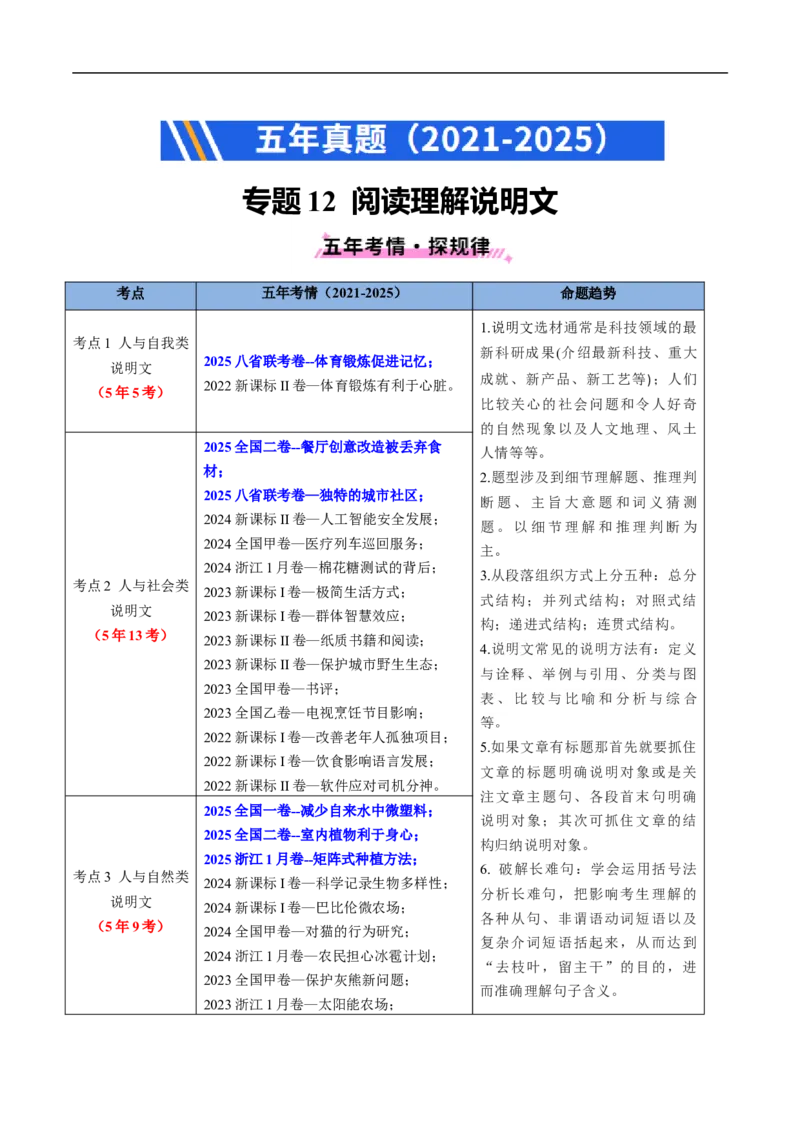
考点 五年考情(2021-2025) 命题趋势
1.说明文选材通常是科技领域的最
考点1 人与自我类
新科研成果(介绍最新科技、重大
2025八省联考卷--体育锻炼促进记忆;
说明文
成就、新产品、新工艺等);人们
2022新课标II卷—体育锻炼有利于心脏。
(5年5考)
比较关心的社会问题和令人好奇
的自然现象以及人文地理、风土
2025全国二卷--餐厅创意改造被丢弃食
人情等等。
材;
2.题型涉及到细节理解题、推理判
2025八省联考卷—独特的城市社区;
断题、主旨大意题和词义猜测
2024新课标II卷—人工智能安全发展;
题。以细节理解和推理判断为
2024全国甲卷—医疗列车巡回服务;
主。
2024浙江1月卷—棉花糖测试的背后;
3.从段落组织方式上分五种:总分
考点2 人与社会类
2023新课标I卷—极简生活方式;
式结构;并列式结构;对照式结
说明文
2023新课标I卷—群体智慧效应;
构;递进式结构;连贯式结构。
(5年13考)
2023新课标II卷—纸质书籍和阅读;
4.说明文常见的说明方法有:定义
2023新课标II卷—保护城市野生生态;
与诠释、举例与引用、分类与图
2023全国甲卷—书评;
表、比较与比喻和分析与综合
2023全国乙卷—电视烹饪节目影响;
等。
2022新课标I卷—改善老年人孤独项目;
5.如果文章有标题那首先就要抓住
2022新课标I卷—饮食影响语言发展;
文章的标题明确说明对象或是关
2022新课标II卷—软件应对司机分神。
注文章主题句、各段首末句明确
2025全国一卷--减少自来水中微塑料;
说明对象;其次可抓住文章的结
2025全国二卷--室内植物利于身心;
构归纳说明对象。
2025浙江1月卷--矩阵式种植方法;
6. 破解长难句:学会运用括号法
考点3 人与自然类
2024新课标I卷—科学记录生物多样性;
分析长难句,把影响考生理解的
说明文
2024新课标I卷—巴比伦微农场;
各种从句、非谓语动词短语以及
(5年9考)
2024全国甲卷—对猫的行为研究;
复杂介词短语括起来,从而达到
2024浙江1月卷—农民担心冰雹计划;
“去枝叶,留主干”的目的,进
2023全国甲卷—保护灰熊新问题;
而准确理解句子含义。
2023浙江1月卷—太阳能农场;2022全国甲卷—凤头鹦鹉会识别形状。
考点01 人与自我类说明文
【2025八省联考卷】
Want to learn a new language or get A’s in college exams? Previous studies have shown that exercise can help
stimulate the areas of the brain that convert (转换) new information into long-term memory. A new study has taken
this information one step further and found the best time when exercise can help maximize learning.
Building upon past research that found exercise releases biochemicals that improve mental function, scientists
at Radboud University and the University of Edinburgh conducted a study to determine when exercise was most
beneficial to learning.
Participants — 72 healthy male and female adults — were first asked to perform a computer test that
challenged their visual and spatial learning. After the test, all of the subjects watched nature documentaries, but
two-thirds of them also exercised. Half of the exercisers did circuit training on an exercise bike for 35 minutes
immediately after the test. The other half did the same exercise but not until four hours after they had been tested.
Two days later, all of the participants returned to the lab for a recall test, and they were connected to MRI (磁
共振成像) machines to assess their brain activity. The participants who exercised four hours after taking the
computer test were able to recall what they had learned most accurately. Their brainwaves also showed more
consistent levels of activity, indicating that their brains were less taxed to remember what they had learned.
According to this research, the best time to exercise to improve learning is four hours after studying. But why?
That’s one question the researchers have yet to answer. Another question left unanswered is the level of exercise
that might best improve learning. I’ve run enough marathons to prove the fact that my brain is anything but sharp
during or after a tough workout. But the researchers noted that light workouts might not give the brain enough of a
biochemical boost to improve learning.
32. What did the new study aim to explore?
A. When exercise is best for learning. B. What biochemicals are good for health.
C. How brainwaves should be measured. D. Which area of the brain is the most active.
33. What were all the participants asked to do during the experiment?
A. Train on bicycles. B. Do mathematics exercises.
C. Play computer games. D. Watch films about nature.
34. Why did the participants return to the lab two days later?
A. To do a medical examination. B. To have their memory tested.
C. To get their workouts recorded. D. To finish their previous tasks.
35. What might the author’s marathon running prove?
A. The findings of the study are reliable. B. Long-distance runners are often smart.
C. Studies on the marathon are not enough. D. Hard exercise may not sharpen the brain.【2022新课标II卷】
As we age, even if we’re healthy, the heart just isn’t as efficient in processing oxygen as it used to be. In most
people the first signs show up in their 50s or early 60s. And among people who don’t exercise, the changes can start
even sooner.
“Think of a rubber band. In the beginning, it is flexible, but put it in a drawer for 20 years and it will become
dry and easily broken,” says Dr. Ben Levine, a heart specialist at the University of Texas. That’s what happens to
the heart. Fortunately for those in midlife, Levine is finding that even if you haven’t been an enthusiastic exerciser,
getting in shape now may help improve your aging heart.
Levine and his research team selected volunteers aged between 45 and 64 who did not exercise much but were
otherwise healthy. Participants were randomly divided into two groups. The first group participated in a program of
nonaerobic (无氧) exercise—balance training and weight training—three times a week. The second group did high-
intensity aerobic exercise under the guidance of a trainer for four or more days a week. After two years, the second
group saw remarkable improvements in heart health.
“We took these 50-year-old hearts and turned the clock back to 30-or 35-year-old hearts,” says Levine. “And
the reason they got so much stronger and fitter was that their hearts could now fill a lot better and pump (泵送) a lot
more blood during exercise.” But the hearts of those who participated in less intense exercise didn’t change, he
says.
“The sweet spot in life to start exercising, if you haven’t already, is in late middle age when the heart still has
flexibility,” Levine says. “We put healthy 70-year-olds through a yearlong exercise training program, and nothing
happened to them at all.”
Dr. Nieca Goldberg, a spokeswoman for the American Heart Association, says Levine’s findings are a great
start. But the study was small and needs to be repeated with far larger groups of people to determine exactly which
aspects of an exercise routine make the biggest difference.
32. What does Levine want to explain by mentioning the rubber band?
A. The right way of exercising. B. The causes of a heart attack.
C. The difficulty of keeping fit. D. The aging process of the heart.
33. In which aspect were the two groups different in terms of research design?
A. Diet plan. B. Professional background.
C. Exercise type. D. Previous physical condition.
34. What does Levine’s research find?
A. Middle-aged hearts get younger with aerobic exercise.
B. High-intensity exercise is more suitable for the young.
C. It is never too late for people to start taking exercise.
D. The more exercise we do, the stronger our hearts get.
35. What does Dr. Nieca Goldberg suggest?
A. Making use of the findings.
B. Interviewing the study participants.C. Conducting further research.
D. Clarifying the purpose of the study.
【2020全国I卷】
Some parents will buy any high-tech toy if they think it will help their child, but researchers said puzzles help
children with math-related skills.
Psychologist Susan Levine, an expert on mathematics development in young children the University of
Chicago, found children who play with puzzles between ages 2 and 4 later develop better spatial skills. Puzzle play
was found to be a significant predictor of cognition(认知) after controlling for differences in parents’ income,
education and the amount of parent talk, Levine said.
The researchers analyzed video recordings of 53 child-parent pairs during everyday activities at home and
found children who play with puzzles between 26 and 46 months of age have better spatial skills when assessed at
54 months of age.
“The children who played with puzzles performed better than those who did not, on tasks that assessed their
ability to rotate(旋转) and translate shapes,” Levine said in a statement.
The parents were asked to interact with their children as they normally would, and about half of children in the
study played with puzzles at one time. Higher-income parents tended to have children play with puzzles more
frequently, and both boys and girls who played with puzzles had better spatial skills. However, boys tended to play
with more complex puzzles than girls, and the parents of boys provided more spatial language and were more
active during puzzle play than parents of girls.
The findings were published in the journal Developmental Science.
24. In which aspect do children benefit from puzzle play?
A. Building confidence. B. Developing spatial skills.
C. Learning self-control. D. Gaining high-tech knowledge.
25. What did Levine take into consideration when designing her experiment?
A. Parents’ age. B. Children’s imagination.
C. Parents’ education. D. Child-parent relationship.
26. How do boy differ from girls in puzzle play?
A. They play with puzzles more often. B. They tend to talk less during the game.
C. They prefer to use more spatial language. D. They are likely to play with tougher puzzles.
27. What is the text mainly about?
A. A mathematical method. B. A scientific study.
C. A woman psychologist. D. A teaching program.
【2020全国I卷】
Returning to a book you’ve read many times can feel like drinks with an old friend. There’s a welcome
familiarity — but also sometimes a slight suspicion that time has changed you both, and thus the relationship. But
books don’t change, people do. And that’s what makes the act of rereading so rich and transformative.
The beauty of rereading lies in the idea that our bond with the work is based on our present mental register. It’strue, the older I get, the more I feel time has wings. But with reading, it’s all about the present. It’s about the now
and what one contributes to the now, because reading is a give and take between author and reader. Each has to pull
their own weight.
There are three books I reread annually. The first, which I take to reading every spring is Ernest Hemingway’s
A Moveable Feast. Published in 1964, it’s his classic memoir of 1920s Paris. The language is almost intoxicating
(令人陶醉的), an aging writer looking back on an ambitious yet simpler time. Another is Annie Dillard’s Holy the
Firm, her poetic 1975 ramble (随笔) about everything and nothing. The third book is Julio Cortazar’s Save
Twilight: Selected Poems, because poetry. And because Cortazar.
While I tend to buy a lot of books, these three were given to me as gifs, which might add to the meaning I attach
to them. But I imagine that, while money is indeed wonderful and necessary, rereading an author’s work is the
highest currency a reader can pay them. The best books are the ones that open further as time passes. But
remember, it’s you that has to grow and read and reread in order to better understand your friends.
24. Why does the author like rereading?
A. It evaluates the writer-reader relationship.
B. It’s a window to a whole new world.
C. It’s a substitute for drinking with a friend.
D. It extends the understanding of oneself.
25. What do we know about the book A Moveable Feast?
A. It’s a brief account of a trip.
B. It’s about Hemingway’s life as a young man.
C. It’s a record of a historic event.
D. It’s about Hemingway’s friends in Paris.
26. What does the underlined word “currency” in paragraph 4 refer to?
A. Debt. B. Reward. C. Allowance. D. Face value.
27. What can we infer about the author from the text?
A. He loves poetry. . He’s an editor. C. He’s very ambitious. D. He teaches reading.
【2020全国I卷】
Race walking shares many fitness benefits with running, research shows, while most likely contributing to
fewer injuries. It does, however, have its own problem.
Race walkers are conditioned athletes. The longest track and field event at the Summer Olympics is the 50-
kilometer race walk, which is about five miles longer than the marathon. But the sport’s rules require that a race
walker’s knees stay straight through most of the leg swing and one foot remain in contact (接触) with the ground at
all times. It’s this strange form that makes race walking such an attractive activity, however, says Jaclyn Norberg,
an assistant professor of exercise science at Salem State University in Salem, Mass.
Like running, race walking is physically demanding, she says, According to most calculations, race walkers
moving at a pace of six miles per hour would burn about 800 calories (卡路里) per hour, which is approximately
twice as many as they would burn walking, although fewer than running, which would probably burn about 1,000or more calories per hour.
However, race walking does not pound the body as much as running does, Dr. Norberg says. According to her
research, runners hit the ground with as much as four times their body weight per step, while race walkers, who do
not leave the ground, create only about 1.4 times their body weight with each step.
As a result, she says, some of the injuries associated with running, such as runner’s knee, are uncommon among
race walkers. But the sport’s strange form does place considerable stress on the ankles and hips, so people with a
history of such injuries might want to be cautious in adopting the sport. In fact, anyone wishing to try race walking
should probably first consult a coach or experienced racer to learn proper technique, she says. It takes some
practice.
28. Why are race walkers conditioned athletes?
A. They must run long distances. B. They are qualified for the marathon.
C. They have to follow special rules. D. They are good at swinging their legs.
29. What advantage does race walking have over running?
A. It’s more popular at the Olympics. B. It’s less challenging physically.
C. It’s more effective in body building. D. It’s less likely to cause knee injuries.
30. What is Dr. Norberg’s suggestion for someone trying race walking?
A. Getting experts’ opinions. B. Having a medical checkup.
C. Hiring an experienced coach. D. Doing regular exercises.
31. Which word best describes the author’s attitude to race walking?
A. Skeptical. B. Objective. C. Tolerant. D. Conservative.
考点02 人与社会类说明文
【2025全国二卷】
Does your soul die a little every time you throw away unused food? Mine does. Maybe that feeling comes
from growing up in South Africa, where the phrase “there are children starving in Africa” was more of an
uncomfortable reminder of fact than a prayer at dinner time.
Food waste is a growing concern in the restaurant, supermarket, and supply chain industries. From
technological solutions to educational campaigns, food producers and sellers are looking for ways to use more of
what we’re already growing. But last month, one popular New York City restaurant tried a different way: It
changed its menu to exclusively (专门) offer food that would otherwise be thrown away.
For two weeks in March, Greenwich Village’s Blue Hill restaurant was renamed wastED, and served items
like fried skate cartilage, a juice pulp burger, and a dumpster diver’s vegetable salad. Each dish was tailor-made to
raise awareness regarding food waste.
A study by the Food Waste Alliance determined that the average restaurant generates 33 pounds of food waste
for every $1,000 in revenue (收入), and of that waste only 15.7% is donated or recycled. Up to 84.3% is simply
thrown out. Restaurants like Silo in the UK have experimented with zero-waste systems, but wastED took the
concept to its logical conclusion.It should be noted that none of the items on wastED’s menu was technically made from garbage. Instead, all
the ingredients (配料) used were examples of meat cuts and produce that most restaurants would never consider
serving. Things like kale ribs, fish collars, rejected sweet potatoes, and cucumber butts were all re-appropriated and,
with the help of a number of good chefs, turned into excellent cuisine.
Though wastED received enthusiastic reviews, it was designed from the start as a short-lived experiment; Blue
Hill has since returned to its regular menu. Nevertheless, it serves as a reminder that there are many ways to address
problems of sustainability, and that you can make an amazing meal out of almost anything.
32. What can be inferred about the author’s early life?
A. He witnessed food shortage. B. He enjoyed the local cuisine.
C. He donated food to Africans. D. He helped to cook at home.
33. Why did Blue Hill carry out the experiment?
A. To customize dishes for guests. B. To make the public aware of food waste.
C. To test a food processing method. D. To improve the UK’s zero-waste systems.
34. What is paragraph 5 mainly about?
A. Why the ingredients were used. B. Which dishes were best liked.
C. What the dishes were made of. D. Where the ingredients were bought.
35. What can we learn about wastED?
A. It has ended as planned. B. It is creating new jobs.
C. It has regained popularity. D. It is criticized by top chefs.
【2025浙江1月卷】
A novel design approach to gardening has been gaining in popularity worldwide. Referred to as matrix
planting, this approach aims for nature to do a lot more of the heavy lifting in the garden, and even some of the
designing. Eschewing fertilizers (化肥) and power tools, it’s based on an elegantly simple principle: to garden
more like nature does.
The concept was born when German city planners sought to plant large areas of parkland after World War II in
a reproducible way that would need minimal maintenance. Planners created planting mixes that could be used
modularly (模块化). In a matrix garden, plants with similar cultural needs are grouped so that they will grow
together above and below ground, forming a cooperative ecosystem that conserves water and discourages weeds.
Dutch plantsman and designer Piet Oudolf’s gardens popularized this style, adding artistic flavors to the
planting mixes while playing with color and form, including four-season interest and serving the needs of wildlife.
Beautiful year-round, they invite you to enjoy the smallest detail, from the sound of grasses in the gentle wind to
the sculpture of odd-looking seed heads.
It takes a lot of thought to look this natural. While matrix gardens appear wild, they are carefully planned, with
cultural needs the first consideration. Led by the concept of “right plant, right place,” they match plants that enjoy
the same soil, sun and weather conditions, and arrange them according to their patterns of growth.
The benefits are substantial for both gardener and planet. With human inputs dramatically reduced, the
garden’s ecology can develop well. Established matrix gardens should not need the life support we give mostgardens: fertilizer, dividing, regular watering. Compared to traditional garden plots, they increase carbon
absorption, reduce storm water runoff and boost habitat and biodiversity significantly.
28. What does the underlined word “Eschewing” in the first paragraph mean?
A. Running out of. B. Keeping away from.
C. Putting up with. D. Taking advantage of.
29. Why was the idea of matrix planting introduced?
A. To control weeds in large gardens. B. To bring in foreign species of plants.
C. To conserve soil and water resources. D. To develop low-maintenance parkland.
30. Which of the following best describes Piet Oudolf’s gardens?
A. Traditional. B. Odd-looking.
C. Tasteful. D. Well-protected.
31. Which of the following can be a suitable title for the text?
A. The future of gardening is WILD B. Nature treats all lives as EQUALS
C. Matrix gardens need more CARE D. Old garden plots work WONDERS
【2025八省联考卷】
Jane Jacobs spent her working life advancing a distinct vision of the city — in particular focusing on what
makes a successful urban community. At the heart of her vision is the idea that urban life should be an energetic and
rich affair, whereby people are able to interact with one another in dense (稠密) and exciting urban environments.
She prefers disorder to order, walking to driving, and diversity to uniformity.
For Jacobs, urban communities are organic beings that should be left to grow and change by themselves and
not be subject to the grand plans of so-called experts and officials. The best judges of how a city should be — and
how it should develop — are the local residents themselves. Jacobs argues that urban communities are best placed
to understand how their city functions, because city life is created and sustained through their various interactions.
Jacobs notes that the built form of a city is crucial to the life of an urban community, especially the sidewalks.
The streets in which people live should be a tight pattern of crossed sidewalks, which allow people to meet, talk,
and get to know one another. Such a complex but ultimately enriching set of encounters helps individuals know
their neighbours and neighbourhood better.
Diversity and mixed-use of space are also, for Jacobs, key elements of this urban form. The commercial,
business, and residential elements of a city should not be separated out but instead be side by side, to allow for
greater integration of people. There should also be a diversity of old and new buildings, and people's interactions
should determine how buildings get used and reused.
Finally, urban communities grow better in places where a critical mass of people live, work, and interact. Such
high-density spaces are, she feels, engines of creativity and vitality. They are also safe places to be, because the
higher density means that there are more “eyes on the street”: shopkeepers and locals who know their area and
maintain a close watch over the neighbourhood.
28. What does Jacobs find most important for a successful urban community?
A. Efficient public transport. B. Strong interaction between people.C. Uniform style of buildings. D. A comparatively large population.
29. Who does Jacobs think should make decisions on urban development?
A. Local residents. B. Government officials.
C. City planners. D. Construction workers.
30. How does Jacobs suggest sidewalks be built?
A. Lined with plants. B. Painted with clear signs.
C. Tightly connected. D. Convenient for the old.
31. According to Jacobs, the “eyes on the street” bring a sense of _______.
A. pride B. comfort C. security D. urgency
【2024新课标II卷】
Given the astonishing potential of AI to transform our lives, we all need to take action to deal with our AI-
powered future, and this is where AI by Design: A Plan for Living with Artificial Intelligence comes in. This
absorbing new book by Catriona Campbell is a practical roadmap addressing the challenges posed by the
forthcoming AI revolution (变革).
In the wrong hands, such a book could prove as complicated to process as the computer code (代码) that
powers AI but, thankfully, Campbell has more than two decades’ professional experience translating the heady into
the understandable. She writes from the practical angle of a business person rather than as an academic, making for
a guide which is highly accessible and informative and which, by the close, will make you feel almost as smart as
AI.
As we soon come to learn from AI by Design, AI is already super-smart and will become more capable,
moving from the current generation of “narrow-AI” to Artificial General Intelligence. From there, Campbell says,
will come Artificial Dominant Intelligence. This is why Campbell has set out to raise awareness of AI and its future
now-several decades before these developments are expected to take place. She says it is essential that we keep
control of artificial intelligence, or risk being sidelined and perhaps even worse.
Campbell’s point is to wake up those responsible for AI-the technology companies and world leaders-so they
are on the same page as all the experts currently developing it. She explains we are at a “tipping point” in history
and must act now to prevent an extinction-level event for humanity. We need to consider how we want our future
with Al to pan out. Such structured thinking, followed by global regulation, will enable us to achieve greatness
rather than our downfall.
AI will affect us all, and if you only read one book on the subject, this is it.
32. What does the phrase “In the wrong hands” in paragraph 2 probably mean?
A. If read by someone poorly educated. B. If reviewed by someone ill-intentioned.
C. If written by someone less competent. D. If translated by someone unacademic.
33. What is a feature of AI by Design according to the text?
A. It is packed with complex codes. B. It adopts a down-to-earth writing style.
C. It provides step-by-step instructions. D. It is intended for AI professionals.
34. What does Campbell urge people to do regarding AI development?A. Observe existing regulations on it.
B. Reconsider expert opinions about it.
C. Make joint efforts to keep it under control.
D. Learn from prior experience to slow it down.
35. What is the author’s purpose in writing the text?
A. To recommend a book on AI. B. To give a brief account of AI history.
C. To clarify the definition of AI. D. To honor an outstanding AI expert.
【2024全国甲卷】
The Saint Lukas train doesn’t accept passengers—it accepts only the sick. The Saint Lukas is one of five
government-sponsored medical trains that travel to remote towns in central and eastern Russia. Each stop lasts an
average of two days, and during that time the doctors and nurses on board provide rural(乡村)populations with
basic medical care, X-ray scans and prescriptions.
“People started queuing to make an appointment early in the morning,” says Emile Ducke, a German
photographer who traveled with the staff of the Saint Lukas for a two-week trip in November through the vast
regions(区域)of Krasnoyarsk and Khakassia.
Russia’s public health care service has been in serious need of modernization. The government has struggled
to come up with measures to address the problem, particularly in the poorer, rural areas east of the Volga River,
including arranging doctor’s appointments by video chat and expanding financial aid programs to motivate doctors
to practice medicine in remote parts of the country like Krasnoyarsk.
The annual arrival of the Saint Lukas is another attempt to improve the situation. For 10 months every year,
the train stops at about eight stations over two weeks, before returning to the regional capital to refuel and
restock(补给). Then it starts all over again the next month. Most stations wait about a year between visits.
Doctors see up to 150 patients every day. The train’s equipment allows for basic checkups. “I was very
impressed by the doctors and their assistants working and living in such little space but still staying focused and
very concerned,” says Ducke. “They were the best chance for many rural people to get the treatment they want. ”
28. How is the Saint Lukas different from other trains?
A. It runs across countries. B. It reserves seats for the seniors.
C. It functions as a hospital. D. It travels along a river.
29. What can we infer from paragraph 3 about Krasnoyarsk?
A. It is heavily populated. B. It offers training for doctors.
C. It is a modern city. D. It needs medical aid.
30. How long can the Saint Lukas work with one supply?
A. About a year. B. About ten months.
C. About two months. D. About two weeks.
31. What is Ducke’s attitude toward the Saint Lukas’ services?
A. Appreciative. B. Doubtful C. Ambiguous. D. Cautious.【2024浙江1月卷】
The Stanford marshmallow (棉花糖) test was originally conducted by psychologist Walter Mischel in the late
1960s. Children aged four to six at a nursery school were placed in a room. A single sugary treat, selected by the
child, was placed on a table. Each child was told if they waited for 15 minutes before eating the treat, they would be
given a second treat. Then they were left alone in the room. Follow-up studies with the children later in life showed
a connect ion between an ability to wait long enough to obtain a second treat and various forms of success.
As adults we face a version of the marshmallow test every day. We’ re not tempted (诱惑) by sugary treats, but
by our computers, phones, and tablets — all the devices that connect us to the global delivery system for various
types of information that do to us what marshmallows do to preschoolers.
We are tempted by sugary treats because our ancestors lived in a calorie-poor world, and our brains developed
a response mechanism to these treats that reflected their value — a feeling of reward and satisfaction. But as we’ve
reshaped the world around us, dramatically reducing the cost and effort involved in obtaining calories, we still have
the same brains we had thousands of years ago, and this mismatch is at the heart of why so many of us struggle to
resist tempting foods that we know we shouldn’t eat.
A similar process is at work in our response to information. Our formative environment as a species was
information-poor, so our brains developed a mechanism that prized new information. But global connectivity has
greatly changed our information environment. We are now ceaselessly bombarded (轰炸) with new information.
Therefore, just as we need to be more thoughtful about our caloric consumption, we also need to be more
thoughtful about our information consumption, resisting the temptation of the mental “junk food” in order to
manage our time most effectively.
32. What did the children need to do to get a second treat in Mischel’s test?
A. Take an examination alone.
B. Show respect for the researchers.
C. Share their treats with others.
D. Delay eating for fifteen minutes.
33. According to paragraph 3, there is a mismatch between ___________.
A. the calorie-poor world and our good appetites
B. the shortage of sugar and our nutritional needs
C. the rich food supply and our unchanged brains
D. the tempting foods and our efforts to keep fit
34. What does the author suggest readers do?
A. Absorb new information readily.
B. Be selective information consumers.
C. Use diverse information sources.
D. Protect the information environment.
35. Which of the following is the best title for the text?
A. Eat Less, Read More B. The Bitter Truth about Early HumansC. The Later, the Better D. The Marshmallow Test for Grownups
【2023新课标I卷】
The goal of this book is to make the case for digital minimalism, including a detailed exploration of what it
asks and why it works, and then to teach you how to adopt this philosophy if you decide it’s right for you.
To do so, I divided the book into two parts. In part one, I describe the philosophical foundations of digital
minimalism, starting with an examination of the forces that are making so many people’s digital lives increasingly
intolerable, before moving on to a detailed discussion of the digital minimalism philosophy.
Part one concludes by introducing my suggested method for adopting this philosophy: the digital declutter.
This process requires you to step away from optional online activities for thirty days. At the end of the thirty days,
you will then add back a small number of carefully chosen online activities that you believe will provide massive
benefits to the things you value.
In the final chapter of part one, I’ll guide you through carrying out your own digital declutter. In doing so, I’ll
draw on an experiment I ran in 2018 in which over 1,600 people agreed to perform a digital declutter. You’ll hear
these participants’ stories and learn what strategies worked well for them, and what traps they encountered that you
should avoid.
The second part of this book takes a closer look at some ideas that will help you cultivate (培养) a sustainable
digital minimalism lifestyle. In these chapters, I examine issues such as the importance of solitude (独处) and the
necessity of cultivating high-quality leisure to replace the time most now spend on mindless device use. Each
chapter concludes with a collection of practices, which are designed to help you act on the big ideas of the chapter.
You can view these practices as a toolbox meant to aid your efforts to build a minimalist lifestyle that words for
your particular circumstances.
8. What is the book aimed at?
A. Teaching critical thinking skills. B. Advocating a simple digital lifestyle.
C. Solving philosophical problems. D. Promoting the use of a digital device.
9. What does the underlined word “declutter” in paragraph 3 mean?
A. Clear-up. B. Add-on. C. Check-in. D. Take-over.
10. What is presented in the final chapter of part one?
A. Theoretical models. B. Statistical methods.
C. Practical examples. D. Historical analyses.
11. What does the author suggest readers do with the practices offered in part two?
A. Use them as needed. B. Recommend them to friends.
C. Evaluate their effects. D. Identify the ideas behind them.
【2023新课标I卷】
On March 7, 1907, the English statistician Francis Galton published a paper which illustrated what has come
to be known as the “wisdom of crowds” effect. The experiment of estimation he conducted showed that in some
cases, the average of a large number of independent estimates could be quite accurate.
This effect capitalizes on the fact that when people make errors, those errors aren’t always the same. Somepeople will tend to overestimate, and some to underestimate. When enough of these errors are averaged together,
they cancel each other out, resulting in a more accurate estimate. If people are similar and tend to make the same
errors, then their errors won’t cancel each other out. In more technical terms, the wisdom of crowds requires that
people’s estimates be independent. If for whatever reasons, people’s errors become correlated or dependent, the
accuracy of the estimate will go down.
But a new study led by Joaquin Navajas offered an interesting twist (转折) on this classic phenomenon. The
key finding of the study was that when crowds were further divided into smaller groups that were allowed to have a
discussion, the averages from these groups were more accurate than those from an equal number of independent
individuals. For instance, the average obtained from the estimates of four discussion groups of five was
significantly more accurate than the average obtained from 20 independent individuals.
In a follow-up study with 100 university students, the researchers tried to get a better sense of what the group
members actually did in their discussion. Did they tend to go with those most confident about their estimates? Did
they follow those least willing to change their minds? This happened some of the time, but it wasn’t the dominant
response. Most frequently, the groups reported that they “shared arguments and reasoned together.” Somehow,
these arguments and reasoning resulted in a global reduction in error. Although the studies led by Navajas have
limitations and many questions remain the potential implications for group discussion and decision-making are
enormous.
12. What is paragraph 2 of the text mainly about?
A. The methods of estimation. B. The underlying logic of the effect.
C. The causes of people’s errors. D. The design of Galton’s experiment.
13. Navajas’ study found that the average accuracy could increase even if ________.
A. the crowds were relatively small B. there were occasional underestimates
C. individuals did not communicate D. estimates were not fully independent
14. What did the follow-up study focus on?
A. The size of the groups. B. The dominant members.
C. The discussion process. D. The individual estimates.
15. What is the author’s attitude toward Navajas’ studies?
A. Unclear. B. Dismissive. C. Doubtful. D. Approving.
【2023新课标II卷】
Reading Art: Art for Book Lovers is a celebration of an everyday object — the book, represented here in
almost three hundred artworks from museums around the world. The image of the reader appears throughout
history, in art made long before books as we now know them came into being. In artists’ representations of books
and reading, we see moments of shared humanity that go beyond culture and time.
In this “book of books,” artworks are selected and arranged in a way that emphasizes these connections
between different eras and cultures. We see scenes of children learning to read at home or at school, with the book
as a focus for relations between the generations. Adults are portrayed (描绘) alone in many settings and poses —
absorbed in a volume, deep in thought or lost in a moment of leisure. These scenes may have been painted hundredsof years ago, but they record moments we can all relate to.
Books themselves may be used symbolically in paintings to demonstrate the intellect (才智), wealth or faith of
the subject. Before the wide use of the printing press, books were treasured objects and could be works of art in
their own right. More recently, as books have become inexpensive or even throwaway, artists have used them as the
raw material for artworks — transforming covers, pages or even complete volumes into paintings and sculptures.
Continued developments in communication technologies were once believed to make the printed page
outdated. From a 21st-century point of view, the printed book is certainly ancient, but it remains as interactive as
any battery-powered e-reader. To serve its function, a book must be activated by a user: the cover opened, the pages
parted, the contents reviewed, perhaps notes written down or words underlined. And in contrast to our increasingly
networked lives where the information we consume is monitored and tracked, a printed book still offers the chance
of a wholly private, “off-line” activity.
8. Where is the text most probably taken from?
A. An introduction to a book. B. An essay on the art of writing.
C. A guidebook to a museum. D. A review of modern paintings.
9. What are the selected artworks about?
A. Wealth and intellect. B. Home and school.
C. Books and reading. D. Work and leisure.
10. What do the underlined words “relate to” in paragraph 2 mean?
A. Understand. B. Paint.
C. Seize. D. Transform.
11. What does the author want to say by mentioning the e-reader?
A. The printed book is not totally out of date.
B. Technology has changed the way we read.
C. Our lives in the 21st century are networked.
D. People now rarely have the patience to read.
【2023全国甲卷】
I was about 13 when an uncle gave me a copy of Jostein Gaarder’s Sophie’s World. It was full of ideas that
were new to me, so I spent the summer with my head in and out of that book. It spoke to me and brought me into a
world of philosophy (哲学).
That love for philosophy lasted until I got to college. Nothing kills the love for philosophy faster than people
who think they understand Foucault, Baudrillard, or Confucius better than you — and then try to explain them.
Eric weiner’s The Socrates Express: In Search of Life Lessons from Dead Philosophers reawakened my love
for philosophy. It is not an explanation, but an invitation to think and experience philosophy.
Weiner starts each chapter with a scene on a train ride between cities and then frames each philosopher’s work
in the context (背景) of one thing they can help us do better. The end result is a read in which we learn to wonder
like Socrates, see like Thoreau, listen like Schopenhauer, and have no regrets like Nietzsche. This, more than a
book about undestanding philosophy, is a book about learning to use philosophy to improve a life.
He makes philosophical thought an appealing exercise that improves the quality of our experiences, and hedoes so with plenty of humor. Weiner enters into conversation with some of the most important philosophers in
history, and he becomes part of that crowd in the process by decoding (解读) their messages and adding his own
interpretation.
The Socrates Express is a fun, sharp book that draws readers in with its apparent simplicity and gradually pulls
them in deeper thoughts on desire, loneliness, and aging. The invitation is clear: Weiner wants you to pick up a
coffee or tea and sit down with this book. I encourage you to take his offer. It’s worth your time, even if time is
something we don’t have a lot of.
28. Who opened the door to philosophy for the author?
A. Foucault. B. Eric Weiner.
C. Jostein Gaarder. D. A college teacher.
29. Why does the author list great philosophers in paragraph 4?
A. To compare Weiner with them.
B. To give examples of great works.
C. To praise their writing skills.
D. To help readers understand Weiners book.
30. What does the author like about The Socrates Express?
A. Its views on history are well-presented.
B. Its ideas can be applied to daily life.
C. It includes comments from readers.
D. It leaves an open ending.
31. What does the author think of Weiners book?
A. Objective and plain.
B. Daring and ambitious.
C. Serious and hard to follow.
D. Humorous and straightforward.
【2023全国乙卷】
What comes into your mind when you think of British food? Probably fish and chips, or a Sunday dinner of
meat and two vegetables. But is British food really so uninteresting? Even though Britain has a reputation for less-
than-impressive cuisine, it is producing more top class chefs who appear frequently on our television screens and
whose recipe books frequently top the best seller lists.
It’s thanks to these TV chefs rather than any advertising campaign that Britons are turning away from meat-
and-two-veg and ready-made meals and becoming more adventurous in their cooking habits. It is recently reported
that the number of those sticking to a traditional diet is slowly declining and around half of Britain’s consumers
would like to change or improve their cooking in some way. There has been a rise in the number of students
applying for food courses at UK universities and colleges. It seems that TV programmes have helped change what
people think about cooking.
According to a new study from market analysts, 1 in 5 Britons say that watching cookery programmes on TV
has encouraged them to try different food. Almost one third say they now use a wider variety of ingredients (配料)than they used to, and just under 1 in 4 say they now buy better quality ingredients than before. One in four adults
say that TV chefs have made them much more confident about expanding their cookery knowledge and skills, and
young people are also getting more interested in cooking. The UK’s obsession (痴迷) with food is reflected through
television scheduling. Cookery shows and documentaries about food are broadcast more often than before. With an
increasing number of male chefs on TV, it’s no longer “uncool” for boys to like cooking.
28. What do people usually think of British food?
A. It is simple and plain. B. It is rich in nutrition.
C. It lacks authentic tastes. D. It deserves a high reputation.
29. Which best describes cookery programme on British TV?
A. Authoritative. B. Creative.
C. Profitable. D. Influential.
30. Which is the percentage of the people using more diverse ingredients now?
A. 20%. B. 24%. C. 25%. D. 33%.
31. What might the author continue talking about?
A. The art of cooking in other countries. B. Male chefs on TV programmes.
C. Table manners in the UK. D. Studies of big eaters.
【2022新课标I卷】
The elderly residents (居民) in care homes in London are being given hens to look after to stop them feeling
lonely.
The project was dreamed up by a local charity (慈善组织) to reduce loneliness and improve elderly people’s
wellbeing, It is also being used to help patients suffering dementia, a serious illness of the mind. Staff in care homes
have reported a reduction in the use of medicine where hens are in use.
Among those taking part in the project is 80-year-old Ruth Xavier. She said: “I used to keep hens when I was
younger and had to prepare their breakfast each morning before I went to school. ”
“I like the project a lot. I am down there in my wheelchair in the morning letting the hens out and down there
again at night to see they’ve gone to bed.”
“It’s good to have a different focus. People have been bringing their children in to see the hens and residents
come and sit outside to watch them. I’m enjoying the creative activities, and it feels great to have done something
useful.”
There are now 700 elderly people looking after hens in 20 care homes in the North East, and the charity has
been given financial support to roll it out countrywide.
Wendy Wilson, extra care manager at 60 Penfold Street, one of the first to embark on the project, said:
“Residents really welcome the idea of the project and the creative sessions. We are looking forward to the benefits
and fun the project can bring to people here.”
Lynn Lewis, director of Notting Hill Pathways, said: “We are happy to be taking part in the project. It will
really help connect our residents through a shared interest and creative activities.”
28. What is the purpose of the project?A. To ensure harmony in care homes.
B. To provide part-time jobs for the aged.
C. To raise money for medical research.
D. To promote the elderly people’s welfare.
29. How has the project affected Ruth Xavier?
A. She has learned new life skills.
B. She has gained a sense of achievement.
C. She has recovered her memory.
D. She has developed a strong personality.
30. What do the underlined words “embark on” mean in paragraph 7?
A. Improve. B. Oppose.
C. Begin. D. Evaluate.
31. What can we learn about the project from the last two paragraphs?
A. It is well received. B. It needs to be more creative.
C. It is highly profitable. D. It takes ages to see the results.
【2022新课标I卷】
Human speech contains more than 2,000 different sounds, from the common “m” and “a” to the rare clicks of
some southern African languages. But why are certain sounds more common than others? A ground-breaking, five-
year study shows that diet-related changes in human bite led to new speech sounds that are now found in half the
world’s languages.
More than 30 years ago, the scholar Charles Hockett noted that speech sounds called labiodentals, such as “f”
and “v”, were more common in the languages of societies that ate softer foods. Now a team of researchers led by
Damián Blasi at the University of Zurich, Switzerland, has found how and why this trend arose.
They discovered that the upper and lower front teeth of ancient human adults were aligned (对齐), making it
hard to produce labiodentals, which are formed by touching the lower lip to the upper teeth. Later, our jaws
changed to an overbite structure (结构), making it easier to produce such sounds.
The team showed that this change in bite was connected with the development of agriculture in the Neolithic
period. Food became easier to chew at this point. The jawbone didn’t have to do as much work and so didn’t grow
to be so large.
Analyses of a language database also confirmed that there was a global change in the sound of world
languages after the Neolithic age, with the use of “f” and “v” increasing remarkably during the last few thousand
years. These sounds are still not found in the languages of many hunter-gatherer people today.
This research overturns the popular view that all human speech sounds were present when human beings
evolved around 300,000 years ago. ”The set of speech sounds we use has not necessarily remained stable since the
appearance of human beings, but rather the huge variety of speech sounds that we find today is the product of a
complex interplay of things like biological change and cultural evolution,” said Steven Moran, a member of the
research team.
32. Which aspect of the human speech sound does Damián Blasi’s research focus on?A. Its variety. B. Its distribution. C. Its quantity. D. Its development.
33. Why was it difficult for ancient human adults to produce labiodentals?
A. They had fewer upper teeth than lower teeth.
B. They could not open and close their lips easily.
C. Their jaws were not conveniently structured.
D. Their lower front teeth were not large enough.
34. What is paragraph 5 mainly about?
A. Supporting evidence for the research results.
B. Potential application of the research findings.
C. A further explanation of the research methods.
D. A reasonable doubt about the research process.
35. What does Steven Moran say about the set of human speech sounds?
A. It is key to effective communication.
B. It contributes much to cultural diversity.
C. It is a complex and dynamic system.
D. It drives the evolution of human beings.
【2022新课标II卷】
Over the last seven years, most states have banned texting by drivers, and public service campaigns have tried
a wide range of methods to persuade people to put down their phones when they are behind the wheel.
Yet the problem, by just about any measure, appears to be getting worse. Americans are still texting while
driving, as well as using social networks and taking photos. Road accidents, which had fallen for years, are now
rising sharply.
That is partly because people are driving more, but Mark Rosekind, the chief of the National Highway Traffic
Safety Administration, said distracted(分心)driving was "only increasing, unfortunately."
"Big change requires big ideas." he said in a speech last month, referring broadly to the need to improve road
safety. So to try to change a distinctly modern behavior, lawmakers and public health experts are reaching back to
an old approach: They want to treat distracted driving like drunk driving.
An idea from lawmakers in New York is to give police officers a new device called the Textalyzer. It would
work like this: An officer arriving at the scene of a crash could ask for the phones of the drivers and use the
Textalyzer to check in the operating system for recent activity. The technology could determine whether a driver
had just texted, emailed or done anything else that is not allowed under New York's hands-free driving laws.
"We need something on the books that can change people's behavior,” said Félix W. Ortiz, who pushed for the
state's 2001 ban on hand-held devices by drivers. If the Textalyzer bill becomes law, he said, "people are going to
be more afraid to put their hands on the cell phone."
28. Which of the following best describes the ban on drivers' texting in the US?
A. Ineffective. B. Unnecessary.
C. Inconsistent. D. Unfair.29. What can the Textalyzer help a police officer find out?
A. Where a driver came from. B. Whether a driver used their phone.
C. How fast a driver was going. D. When a driver arrived at the scene.
30. What does the underlined word "something" in the last paragraph refer to?
A. Advice. B. Data. C. Tests. D. Laws.
31. What is a suitable title for the text?
A. To Drive or Not to Drive? Think Before You Start
B. Texting and Driving? Watch Out for the Textalyzer
C. New York Banning Hand-Held Devices by Drivers.
D. The Next Generation Cell Phone: The Textalyzer.
考点03 人与自然类说明文
【2025全国一卷】
Microplastics have become a common source of pollution across the Earth — they have settled in the deep sea
and on the Himalayas, stuck inside volcanic rocks, filled the stomachs of seabirds and even fallen in fresh Antarctic
snow. They are even appearing inside humans.
Now, new research suggests that a simple, cheap measure may significantly reduce the level of microplastics
in water from your tap (水龙头): boiling and filtering (过滤) it. In a study published Wednesday in Environmental
Science & Technology Letters, researchers from China found that boiling tap water for just five minutes — then
filtering it after it cools — could remove at least 80 percent of its microplastics.
Crucially, this process relies on the water containing enough calcium carbonate (碳酸钙) to trap the plastics.
In the study, boiling hard water containing 300 milligrams of calcium carbonate led to an almost 90 percent drop in
plastics. But in samples with less than 60 milligrams of calcium carbonate, boiling reduced the level of plastics by
just 25 percent. Additionally, the research didn’t include all types of plastics. The team focused only on three
common types — polystyrene, polyethylene and polypropylene — and they didn’t study other chemicals previously
found in water such as vinyl chloride.
Still, the findings show a potential path forward for reducing microplastic exposure — a task that’s becoming
increasingly difficult. Even bottled water, scientists found earlier this year, contains 10 to 1,000 times more
microplastics than originally thought.
Scientists are still trying to determine how harmful microplastics are — but what they do know has raised
concerns. The new study suggests boiling tap water could be a tool to limit intake. “The way they demonstrated
how microplastics were trapped through the boiling process was nice,” Caroline Gauchotte-Lindsay, an
environmental engineer of the University of Glasgow in Scotland who was not involved in the research, tells New
Scientist. “We should be looking into upgrading drinking water treatment plants so they remove microplastics.”
32. How does the author present the issue in the first paragraph?
A. By quoting an expert. B. By defining a concept.
C. By giving examples. D. By providing statistics.
33. What determines the effectiveness of trapping microplastics in water?A. The hardness of water. B. The length of cooling time.
C The frequency of filtering. D. The type of plastic in water.
34. What does the author try to illustrate by mentioning bottled water in paragraph 4?
A. The importance of plastic recycling. B. The severity of the microplastic problem.
C. The danger in overusing pure water. D. The difficulty in treating polluted water.
35. What is Gauchotte-Lindsay’s suggestion about?
A. Choice of new research methods. B. Possible direction for further study.
C. Need to involve more researchers. D. Potential application of the findings.
【2025全国二卷】
When Sonja Detrinidad opened her online shop selling houseplants, she didn’t have high hopes for it. But the
opposite happened: She was flooded, shipping out 1,200 orders in June of 2020 alone. In the past year, Detrinidad
sent out more than 70,000 plants. Her success is just one example of increased time at home leading to an explosion
in the houseplant industry.
“Plants are in fashion right now,” says Dr. Melinda Knuth, a researcher from the University of Florida.
“People who live in plant-rich environments report a higher life satisfaction rating, ” she says. “Adding more nature
to our environment can change our mood and how we think.” Plants can improve our state of mind in a few ways
but the biggest is by decreasing our level of cortisol, the stress hormone (激素) in our body.
“Students who are around plants perform better academically than students who are in a classroom without
plants,” says Knuth. “This productivity also translates into the workplace for adults. Our study showed that there
was a 30% decrease in sick leave for people who were in plant-rich workplaces.”
If you’re among the groups of people who are enjoying the mental and physical health benefits of surrounding
yourself with plants, don’t beat yourself up if one (or a few!) doesn’t make it. “Doctors practice medicine and
lawyers practice law and you should allow yourself the practice it takes to sustain a plant. Tending to plants is an
exercise in patience and learning. Be invested in taking care of it, but if it dies, go get another one,” Detrinidad
says.
28. How was Detrinidad’s business when it started?
A. It faced tough competition. B. It suffered a great loss.
C. It got lots of financial support. D. It went surprisingly well.
29. What is one of Knuth’s findings about plants?
A. They appeal more to students. B. They purify the environment.
C. They raise the cortisol level. D. They enhance productivity.
30. What does Detrinidad try to explain by mentioning doctors and lawyers?
A. The necessity of social skills. B. The meaning of sustainability.
C. The importance of repeated efforts. D. The value of professional opinions.
31. What can be a suitable title for the text?
A. Time to Replace Houseplants B. Plants Boost Your Mood
C. Tips on Choosing Houseplants D. Plants Brighten Your Home【2024新课标I卷】
In the race to document the species on Earth before they go extinct, researchers and citizen scientists have
collected billions of records. Today, most records of biodiversity are often in the form of photos, videos, and other
digital records. Though they are useful for detecting shifts in the number and variety of species in an area, a new
Stanford study has found that this type of record is not perfect.
“With the rise of technology it is easy for people to make observations of different species with the aid of a
mobile application,” said Barnabas Daru, who is lead author of the study and assistant professor of biology in the
Stanford School of Humanities and Sciences. “These observations now outnumber the primary data that comes
from physical specimens (标本), and since we are increasingly using observational data to investigate how species
are responding to global change, I wanted to know: Are they usable?”
Using a global dataset of 1.9 billion records of plants, insects, birds, and animals, Daru and his team tested
how well these data represent actual global biodiversity patterns.
“We were particularly interested in exploring the aspects of sampling that tend to bias (使有偏差) data, like
the greater likelihood of a citizen scientist to take a picture of a flowering plant instead of the grass right next to it,”
said Daru.
Their study revealed that the large number of observation-only records did not lead to better global coverage.
Moreover, these data are biased and favor certain regions, time periods, and species. This makes sense because the
people who get observational biodiversity data on mobile devices are often citizen scientists recording their
encounters with species in areas nearby. These data are also biased toward certain species with attractive or eye-
catching features.
What can we do with the imperfect datasets of biodiversity?
“Quite a lot,” Daru explained. “Biodiversity apps can use our study results to inform users of oversampled
areas and lead them to places – and even species – that are not well-sampled. To improve the quality of
observational data, biodiversity apps can also encourage users to have an expert confirm the identification of their
uploaded image.”
32. What do we know about the records of species collected now?
A. They are becoming outdated. B. They are mostly in electronic form.
C. They are limited in number. D. They are used for public exhibition.
33. What does Daru’s study focus on?
A. Threatened species. B. Physical specimens.
C. Observational data. D. Mobile applications.
34. What has led to the biases according to the study?
A. Mistakes in data analysis.
B. Poor quality of uploaded pictures.
C. Improper way of sampling.
D. Unreliable data collection devices.
35. What is Daru’s suggestion for biodiversity apps?
A. Review data from certain areas.B. Hire experts to check the records.
C. Confirm the identity of the users.
D. Give guidance to citizen scientists.
【2024新课标I卷】
We all know fresh is best when it comes to food. However, most produce at the store went through weeks of
travel and covered hundreds of miles before reaching the table. While farmer’s markets are a solid choice to reduce
the journey, Babylon Micro-Farm (BMF) shortens it even more.
BMF is an indoor garden system. It can be set up for a family. Additionally, it could serve a larger audience
such as a hospital, restaurant or school. The innovative design requires little effort to achieve a reliable weekly
supply of fresh greens.
Specifically, it’s a farm that relies on new technology. By connecting through the Cloud, BMF is remotely
monitored. Also, there is a convenient app that provides growing data in real time. Because the system is
automated, it significantly reduces the amount of water needed to grow plants. Rather than watering rows of soil,
the system provides just the right amount to each plant. After harvest, users simply replace the plants with a new
pre-seeded pod (容器) to get the next growth cycle started.
Moreover, having a system in the same building where it’s eaten means zero emissions ( 排放) from
transporting plants from soil to salad. In addition, there’s no need for pesticides and other chemicals that pollute
traditional farms and the surrounding environment.
BMF employees live out sustainability in their everyday lives. About half of them walk or bike to work. Inside
the office, they encourage recycling and waste reduction by limiting garbage cans and avoiding single-use plastic.
“We are passionate about reducing waste, carbon and chemicals in our environment,” said a BMF employee.
28. What can be learned about BMF from paragraph 1?
A. It guarantees the variety of food. B. It requires day-to-day care.
C. It cuts the farm-to-table distance. D. It relies on farmer’s markets.
29. What information does the convenient app offer?
A. Real-time weather changes. B. Current condition of the plants.
C. Chemical pollutants in the soil. D. Availability of pre-seeded pods.
30. What can be concluded about BMF employees?
A. They have a great passion for sports.
B. They are devoted to community service.
C. They are fond of sharing daily experiences.
D They have a strong environmental awareness.
31. What does the text mainly talk about?
A. BMF’s major strengths. B. BMF’s general management.
C. BMF’s global influence. D. BMF’s technical standards.
【2024全国甲卷】Animals can express their needs using a lot of ways. For instance, almost all animals have distinct vocals (声
音)that they rely on to either ask for help, scare away any dangerous animals or look for shelter. But cats are
special creatures who possess amazing vocalization skills. They are able to have entire conversations with humans
using meows and you're able to interpret it. If a pet cat is hungry, it will keep meowing to attract attention and find
food. However, when a cat is looking for affection, they tend to produce stretched and soft meows. Meowing starts
as soon as a baby cat is brought to life and uses it to get the mother's attention and be fed.
Cats have many heightened senses, but their sense of smell is quite impressive. They use their noses to assess
their environment and look out for any signs of danger. They will sniff out specific areas before they choose a place
to relax. However, another way the cats are able to distinguish between situations is by looking for familiar smells.
Your cat will likely smell your face and store the smell in its memory and use it to recognize you in the future.
That's why most pet cats are able to tell immediately if their owners were around any other cats, which they don't
usually like.
Dogs are known for their impressive fetching habit, but cats take this behavior up a notch. Many cats will find
random objects outside and bring them to their owners. This is a very old habit that's been present in all kinds of
predators (食肉动物). Cats bring gifts for their owners to show they love you. These adorable little hunters are just
doing something that it's been in their nature since the beginning of time. So just go along with it!
24. What can be learned about cats' meowing from the first paragraph?
A. It's a survival skill. B. It's taught by mother cats.
C. It's hard to interpret. D. It's getting louder with age.
25. How does a pet cat assess different situations?
A. By listening for sounds. B. By touching familiar objects.
C. By checking on smells. D. By communicating with other cats.
26. Which best explains the phrase "take. . . up notch" in paragraph 3?
A. Perform appropriately. B. Move faster.
C. Act strangely. D. Do better.
27. What is a suitable title for the text?
A. Tips on Finding a Smart Cat B. Understanding Your Cat's Behavior
C. Have Fun with Your Cat D. How to Keep Your Cat Healthy
【2024浙江1月卷】
On September 7, 1991, the costliest hailstorm (花暴) in Canadian history hit Calgary’s southern suburbs. As a
result, since 1996 a group of insurance companies have spent about $2million per year on the Alberta Hail
Suppression Project. Airplanes seed threatening storm cells with a chemical to make small ice crystals fall as rain
before they can grow into dangerous hailstones. But farmers in east-central Alberta — downwind of the hail project
flights — worry that precious moisture (水分) is being stolen from their thirsty land by the cloud seeding.
Norman Stienwand, who farms in that area, has been addressing public meetings on this issue for years
“Basically, the provincial government is letting the insurance companies protect the Calgary-Edmonton urban area
from hail,” Mr. Stienwan d says, “but they’re increasing drought risk as far east as Saskatchewan.”
The Alberta hail project is managed by Terry Krauss, a cloud physicist who works for Weather ModificationInc. of Fargo, North Dakota. “We affect only a very small percentage of the total moisture in the air, so we cannot
be cousing drought.” Dr. Krauss says. “In fact, we may be helping increase the moisture downwind by creating
wetter ground.”
One doubter about the safety of cloud seeding is Chuck Doswell, a research scientist who just retired from the
University of Oklahoma. “In 1999, I personally saw significant tornadoes (龙卷风) form from a seeded storm cell
in Kansas,” Dr. Doswell says. “Does cloud seeding create killer storms or reduce moisture downwind? No one
really knows, of course, but the seeding goes on.”
Given the degree of doubt, Mr. Stienwand suggests, “it would be wise to stop cloud seeding.” In practice,
doubt has had the opposite effect. Due to the lack of scientific proof concerning their impacts, no one has succeeded
in winning a lawsuit against cloud-seeding companies. Hence, private climate engineering can proceed in relative
legal safety.
28. What does the project aim to do?
A. Conserve moisture in the soil.
B. Prevent the formation of hailstones.
C. Forecast disastrous hailstorms.
D. Investigate chemical use in farming.
29. Who are opposed to the project?
A. Farmers in east-central Alberta.
B. Managers of insurance companies.
C. Provincial government officials.
D. Residents of Calgary and Edmonton
30. Why does Dr. Doswell mention the tornadoes he saw in 1999?
A. To compare different kinds of seeding methods.
B. To illustrate the development of big hailstorms.
C. To indicate a possible danger of cloud seeding.
D. To show the link between storms and moisture.
31. What can we infer from the last paragraph?
A. Scientific studies have proved Stienwand right.
B. Private climate engineering is illegal in Canada.
C. The doubt about cloud seeding has disappeared.
D. Cloud-seeding companies will continue to exist.
【2023新课标II卷】
As cities balloon with growth, access to nature for people living in urban areas is becoming harder to find. If
you’re lucky, there might be a pocket park near where you live, but it’s unusual to find places in a city that are
relatively wild.
Past research has found health and wellness benefits of nature for humans, but a new study shows that
wildness in urban areas is extremely important for human well-being.The research team focused on a large urban park. They surveyed several hundred park-goers, asking them to
submit a written summary online of a meaningful interaction they had with nature in the park. The researchers then
examined these submissions, coding (编码) experiences into different categories. For example, one participant’s
experience of “We sat and listened to the waves at the beach for a while” was assigned the categories “sitting at
beach” and “listening to waves.”
Across the 320 submissions, a pattern of categories the researchers call a “nature language” began to emerge.
After the coding of all submissions, half a dozen categories were noted most often as important to visitors. These
include encountering wildlife, walking along the edge of water, and following an established trail.
Naming each nature experience creates a usable language, which helps people recognize and take part in the
activities that are most satisfying and meaningful to them. For example, the experience of walking along the edge
of water might be satisfying for a young professional on a weekend hike in the park. Back downtown during a
workday, they can enjoy a more domestic form of this interaction by walking along a fountain on their lunch break.
“We’re trying to generate a language that helps bring the human-nature interactions back into our daily lives.
And for that to happen, we also need to protect nature so that we can interact with it,” said Peter Kahn, a senior
author of the study.
12. What phenomenon does the author describe at the beginning of the text?
A. Pocket parks are now popular.
B. Wild nature is hard to find in cities.
C. Many cities are overpopulated.
D. People enjoy living close to nature.
13. Why did the researchers code participant submissions into categories?
A. To compare different types of park-goers.
B. To explain why the park attracts tourists.
C. To analyze the main features of the park.
D. To find patterns in the visitors’ summaries.
14. What can we learn from the example given in paragraph 5?
A. Walking is the best way to gain access to nature.
B. Young people are too busy to interact with nature.
C. The same nature experience takes different forms.
D. The nature language enhances work performance.
15. What should be done before we can interact with nature according to Kahn?
A. Language study.
B. Environmental conservation.
C. Public education.
D. Intercultural communication.
【2023全国甲卷】
Grizzly bears, which may grow to about 2.5 m long and weigh over 400 kg, occupy a conflicted corner of theAmerican psyche-we revere (敬畏) them even as they give us frightening dreams. Ask the tourists from around the
world that flood into Yellowstone National Park what they most hope to see, and their answer is often the same: a
grizzly bear.
“Grizzly bears are re-occupying large areas of their former range,” says bear biologist Chris Servheen. As
grizzly bears expand their range into places where they haven’t been seen in a century or more, they’re increasingly
being sighted by humans.
The western half of the U.S. was full of grizzlies when Europeans came, with a rough number of 50,000 or
more living alongside Native Americans. By the early 1970s, after centuries of cruel and continuous hunting by
settlers, 600 to 800 grizzlies remained on a mere 2 percent of their former range in the Northern Rockies. In 1975,
grizzlies were listed under the Endangered Species Act.
Today, there are about 2,000 or more grizzly bears in the U.S. Their recovery has been so successful that the
U.S. Fish and Wildlife Service has twice attempted to delist grizzlies, which would loosen legal protections and
allow them to be hunted. Both efforts were overturned due to lawsuits from conservation groups. For now, grizzlies
remain listed.
Obviously, if precautions (预防) aren’t taken, grizzlies can become troublesome, sometimes killing farm
animals or walking through yards in search of food. If people remove food and attractants from their yards and
campsites, grizzlies will typically pass by without trouble. Putting electric fencing around chicken houses and other
farm animal quarters is also highly effective at getting grizzlies away. “Our hope is to have a clean, attractant-free
place where bears can pass through without learning bad habits,“ says James Jonkel, longtime biologist who
manages bears in and around Missoula.
32. How do Americans look at grizzlies?
A. They cause mixed feelings in people.
B. They should be kept in national parks.
C. They are of high scientific value.
D. They are a symbol of American culture.
33. What has helped the increase of the grizzly population?
A. The European settlers’ behavior.
B. The expansion of bears’ range.
C. The protection by law since 1975.
D. The support of Native Americans.
34. What has stopped the U. S. Fish and Wildlife Service from delisting grizzlies?
A. The opposition of conservation groups.
B. The successful comeback of grizzlies.
C. The voice of the biologists.
D. The local farmers’ advocates.
35. What can be inferred from the last paragraph?
A. Food should be provided for grizzlies.
B. People can live in harmony with grizzlies.C. A special path should be built for grizzlies.
D. Technology can be introduced to protect grizzlies.
【2023浙江1月卷】
According to the Solar Energy Industry Association, the number of solar panels installed(安装)has grown
rapidly in the past decade, and it has to grow even faster to meet climate goals. But all of that growth will take up a
lot of space, and though more and more people accept the concept of solar energy, few like large solar panels to be
installed near them.
Solar developers want to put up panels as quickly and cheaply as possible, so they haven’t given much
thought to what they put under them. Often, they’ll end up filling the area with small stones and using chemicals to
control weeds. The result is that many communities, especially in farming regions, see solar farms as destroyers of
the soil.
“Solar projects need to be good neighbors,” says Jordan Macknick, the head of the Innovative Site Preparation
and Impact Reductions on the Environment(InSPIRE)project. “They need to be protectors of the land and
contribute to the agricultural economy.” InSPIRE is investigating practical approaches to “low-impact” solar
development, which focuses on establishing and operating solar farms in a way that is kinder to the land. One of the
easiest low-impact solar strategies is providing habitat for pollinators(传粉昆虫).
Habitat loss, pesticide use, and climate change have caused dramatic declines in pollinator populations over
the past couple of decades, which has damaged the U.S. agricultural economy. Over 28 states have passed laws
related to pollinator habitat protection and pesticide use. Conservation organizations put out pollinator-friendliness
guidelines for home gardens, businesses, schools, cities—and now there are guidelines for solar farms.
Over the past few years, many solar farm developers have transformed the space under their solar panels into
a shelter for various kinds of pollinators, resulting in soil improvement and carbon reduction. “These pollinator-
friendly solar farms can have a valuable impact on everything that’s going on in the landscape,” says Macknick.
32. What do solar developers often ignore?
A. The decline in the demand for solar energy.
B. The negative impact of installing solar panels.
C. The rising labor cost of building solar farms.
D. The most recent advances in solar technology.
33. What does InSPIRE aim to do?
A. Improve the productivity of local farms.
B. Invent new methods for controlling weeds.
C. Make solar projects environmentally friendly.
D. Promote the use of solar energy in rural areas.
34. What is the purpose of the laws mentioned in paragraph 4?
A. To conserve pollinators. B. To restrict solar development.C. To diversify the economy. D. To ensure the supply of energy.
35. Which of the following is the best title for the text?
A. Pollinators: To Leave or to Stay B. Solar Energy: Hope for the Future
C. InSPIRE: A Leader in Agriculture D. Solar Farms: A New Development
【2022全国甲卷】
Goffin’s cockatoos, a kind of small parrot native to Australasia, have been shown to have similar shape-
recognition abilities to a human two-year-old. Though not known to use tools in the wild, the birds have proved
skilful at tool use while kept in the cage. In a recent experiment, cockatoos were presented with a box with a nut
inside it. The clear front of the box had a “keyhole” in a geometric shape, and the birds were given five differently
shaped “keys” to choose from. Inserting the correct “key” would let out the nut.
In humans, babies can put a round shape in a round hole from around one year of age, but it will be another
year before they are able to do the same with less symmetrical (对称的) shapes. This ability to recognize that a
shape will need to be turned in a specific direction before it will fit is called an “allocentric frame of reference”. In
the experiment, Goffin’s cockatoos were able to select the right tool for the job, in most cases, by visual recognition
alone. Where trial-and-error was used, the cockatoos did better than monkeys in similar tests. This indicates that
Goffin’s cockatoos do indeed possess an allocentric frame of reference when moving objects in space, similar to
two-year-old babies.
The next step, according to the researchers, is to try and work out whether the cockatoos rely entirely on
visual clues (线索), or also use a sense of touch in making their shape selections.
24. How did the cockatoos get the nut from the box in the experiment?
A. By following instructions. B. By using a tool.
C. By turning the box around. D. By removing the lid.
25. Which task can human one-year-olds most likely complete according to the text?
A. Using a key to unlock a door. B. Telling parrots from other birds.
C. Putting a ball into a round hole. D. Grouping toys of different shapes.
26. What does the follow-up test aim to find out about the cockatoos?
A. How far they are able to see. B. How they track moving objects.
C. Whether they are smarter than monkeys. D. Whether they use a sense of touch in the test.
27. Which can be a suitable title for the text?
A. Cockatoos: Quick Error Checkers B. Cockatoos: Independent Learners
C. Cockatoos: Clever Signal-Readers D. Cockatoos: Skilful Shape-Sorters
【2020全国I卷】
The connection between people and plants has long been the subject of scientific research. Recent studies
have found positive effects. A study conducted in Youngstown, Ohio, for example, discovered that greener areas
of the city experienced less crime. In another,employees were shown to be 15% more productive when their
workplaces were decorated with houseplants.
The engineers at the Massachusetts Institute of Technology (MIT)have taken it a step further changing theactual composition of plants in order to get them to perform diverse, even unusual functions. These include plants
that have sensors printed onto their leaves to show when they’re short of water and a plant that can detect harmful
chemicals in groundwater. “We’re thinking about how we can engineer plants to replace functions of the things that
we use every day,”explained Michael Strano, a professor of chemical engineering at MIT.
One of his latest projects has been to make plants grow(发光) in experiments using some common
vegetables. Strano’s team found that they could create a faint light for three-and-a-half hours. The light,about
one-thousandth of the amount needed to read by, is just a start. The technology, Strano said, could one day be used
to light the rooms or even to turn tree into self-powered street lamps.
In the future, the team hopes to develop a version of the technology that can be sprayed onto plant leaves in a
one-off treatment that would last the plant’s lifetime. The engineers are also trying to develop an on and off"
switch"where the glow would fade when exposed to daylight.
Lighting accounts for about 7% of the total electricity consumed in the US. Since lighting is often far
removed from the power source(电源) —such as the distance from a power plant to street lamps on a remote
highway-a lot of energy is lost during transmission(传输).
Glowing plants could reduce this distance and therefore help save energy.
32. What is the first paragraph mainly about?
A. A new study of different plants.
B. A big fall in crime rates.
C. Employees from various workplaces.
D. Benefits from green plants.
33. What is the function of the sensors printed on plant leaves by MIT engineer?
A. To detect plants’ lack of water.
B. To change compositions of plants.
C. To make the life of plants longer.
D. To test chemicals in plants.
34. What can we expect of the glowing plants in the future?
A. They will speed up energy production.
B. They may transmit electricity to the home.
C. They might help reduce energy consumption.
D. They could take the place of power plants.
35. Which of the following can be the best title for the text?
A. Can we grow more glowing plants?
B. How do we live with glowing plants?
C. Could glowing plants replace lamps?
D. How are glowing plants made pollution-free?
【2020全国II卷】
When you were trying to figure out what to buy for the environmentalist on your holiday list, fur probably
didn’t cross your mind. But some ecologists and fashion (时装) enthusiasts are trying to bring back the market forfur made from nutria(海狸鼠).
Unusual fashion shows in New Orleans and Brooklyn have showcased nutria fur made into clothes in different
styles. “It sounds crazy to talk about guilt-free fur unless you understand that the nutria are destroying vast
wetlands every year”, says Cree McCree, project director of Righteous Fur.
Scientists in Louisiana were so concerned that they decided to pay hunters $5 a tail. Some of the fur ends up in
the fashion shows like the one in Brooklyn last month.
Nutria were brought there from Argentina by fur farmers and let go into the wild. “The ecosystem down there
can’t handle this non-native species(物种). It’s destroying the environment. It’s them or us." says Michael Massimi,
an expert in this field.
The fur trade kept nutria check for decades,but when the market for nutria collapsed in the late 1980s, the
cat-sized animals multiplied like crazy.
Biologist Edmond Mouton runs the nutria control program for Louisiana. He says it’s not easy to convince
people that nutria fur is green, but he has no doubt about it. Hunters bring in more than 300,000 nutria tails a year,
so part of Mouton’s job these days is trying to promote fur.
Then there’s Righteous Fur and its unusual fashion. Morgan says,“To give people a guilt-free option that
they can wear without someone throwing paint on them—I think that’s going to be a massive thing, at least here in
New York.” Designer Jennifer Anderson admits it took her a while to come around to the opinion that using nutria
fur for her creations is morally acceptable. She is trying to come up with a label to attach to nutria fashions to show
it is eco-friendly.
28. What is the purpose of the fashion shows in New Orleans and Brooklyn?
A. To promote guilt-free fur. B. To expand the fashion market.
C. To introduce a new brand. D. To celebrate a winter holiday.
29. Why are scientists concerned about nutria?
A. Nutria damage the ecosystem seriously. B. Nutria are an endangered species.
C. Nutria hurt local cat-sized animals. D. Nutria are illegally hunted.
30. What does the underlined word “collapsed” in paragraph 5 probably mean?
A. Boomed. B. Became mature.
C. Remained stable. D. Crashed.
31. What can we infer about wearing fur in New York according to Morgan?
A. It’s formal. B. It’s risky.
C. It’s harmful. D. It’s traditional.