关注公众号:陆陆高分冲刺 ~领取:最新版“小中高考-总复习”、最新试卷下载
动词时态、语态考点聚焦和精讲
【中考动词时态、语态和非谓语动词考点聚焦】
1、动词的基本形式;
2、动词的8种时态;
3、被动语态;
一 动词的基本形式
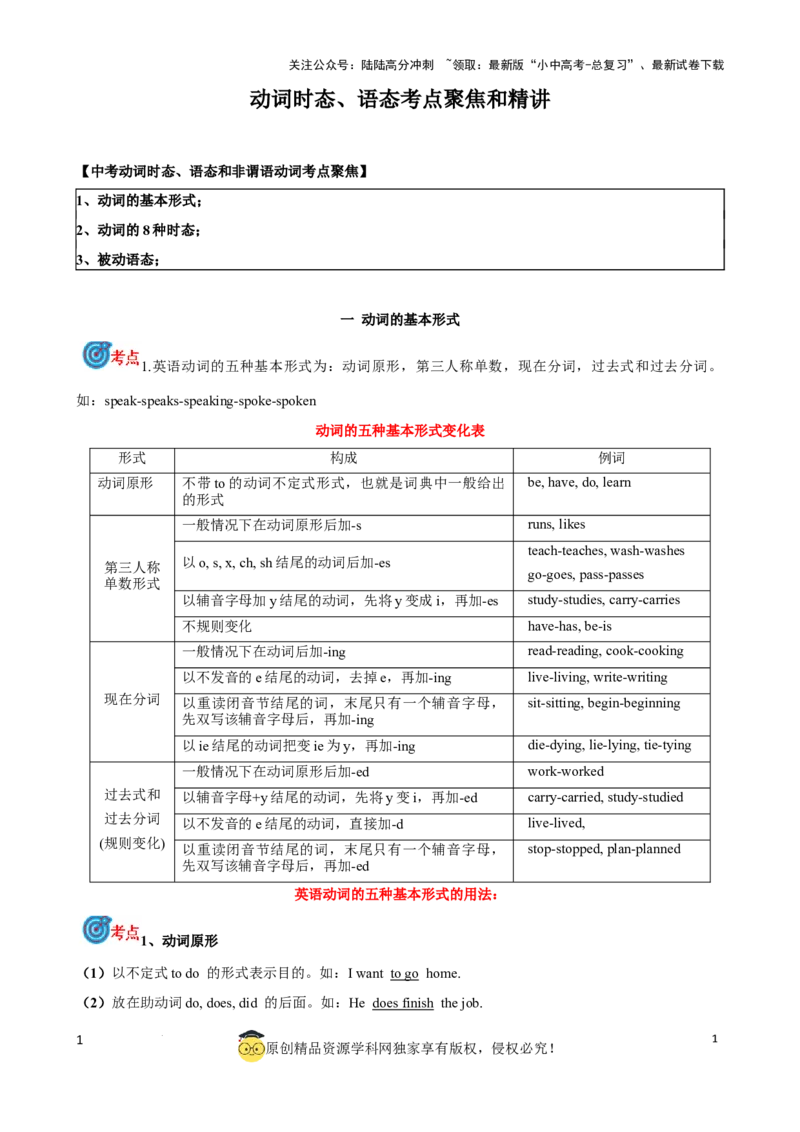
1.英语动词的五种基本形式为:动词原形,第三人称单数,现在分词,过去式和过去分词。
如:speak-speaks-speaking-spoke-spoken
动词的五种基本形式变化表
形式 构成 例词
动词原形 不带to的动词不定式形式,也就是词典中一般给出 be, have, do, learn
的形式
一般情况下在动词原形后加-s runs, likes
teach-teaches, wash-washes
第三人称 以o, s, x, ch, sh结尾的动词后加-es
go-goes, pass-passes
单数形式
以辅音字母加y结尾的动词,先将y变成i,再加-es study-studies, carry-carries
不规则变化 have-has, be-is
一般情况下在动词后加-ing read-reading, cook-cooking
以不发音的e结尾的动词,去掉e,再加-ing live-living, write-writing
现在分词
以重读闭音节结尾的词,末尾只有一个辅音字母, sit-sitting, begin-beginning
先双写该辅音字母后,再加-ing
以ie结尾的动词把变ie为y,再加-ing die-dying, lie-lying, tie-tying
一般情况下在动词原形后加-ed work-worked
过去式和 以辅音字母+y结尾的动词,先将y变i,再加-ed carry-carried, study-studied
过去分词
以不发音的e结尾的动词,直接加-d live-lived,
(规则变化)
以重读闭音节结尾的词,末尾只有一个辅音字母, stop-stopped, plan-planned
先双写该辅音字母后,再加-ed
英语动词的五种基本形式的用法:
1、动词原形
(1)以不定式to do 的形式表示目的。如:I want to go home.
(2)放在助动词do, does, did 的后面。如:He does finish the job.
1 1
原创精品资源学科网独家享有版权,侵权必究!
学科网(北京)股份有限公司关注公众号:陆陆高分冲刺 ~领取:最新版“小中高考-总复习”、最新试卷下载
(3)放在情态动词的后面。如:We can have a long holiday.
(4)用于一般现在时(除第三人称单数外)。如:I like playing the piano.
2、第三人称单数形式:用于主语为第三人称单数的一般现在时。如:Tom often goes to school
by bus.
3、现在分词:用于进行时态,包括现在进行时,过去进行时等。如:
The students are reading the books now. // When the storm was coming, I was sleeping.
4、过去式:用于一般过去时态,表示过去某一时刻或某一段时间内所发生的动作或情况。通
常一般过去式带有表示动作时间状语的词,词组或从句。如 yesterday, the day before last, last week, two
days ago 等,上下文清楚时可以不带时间状语。如:
I was late yesterday. // They went to see a film two days ago. // The man smoked a lot in the past.
5、过去分词:用于被动语态和完成时。如:
A new bridge will be built next year. // He has told me the sports meet might be put off.
二 动词的8种时
英语中动词共有16种时态。初中阶段共出现了8种,它们是:一般现在时、一般过去时、一般将来
时、现在进行时、现在完成时、过去进行时、过去完成时和过去将来时。中考重点考查一般现在时、一
般过去时、一般将来时、现在进行时、过去进行时和现在完成时六种时态。
1、一般现在时
(1)谓语构成:是由“动词原形”或“动词第三人称单数形式”(当主语为第三人称单
数)、“be动词(am/is/are)”构成。
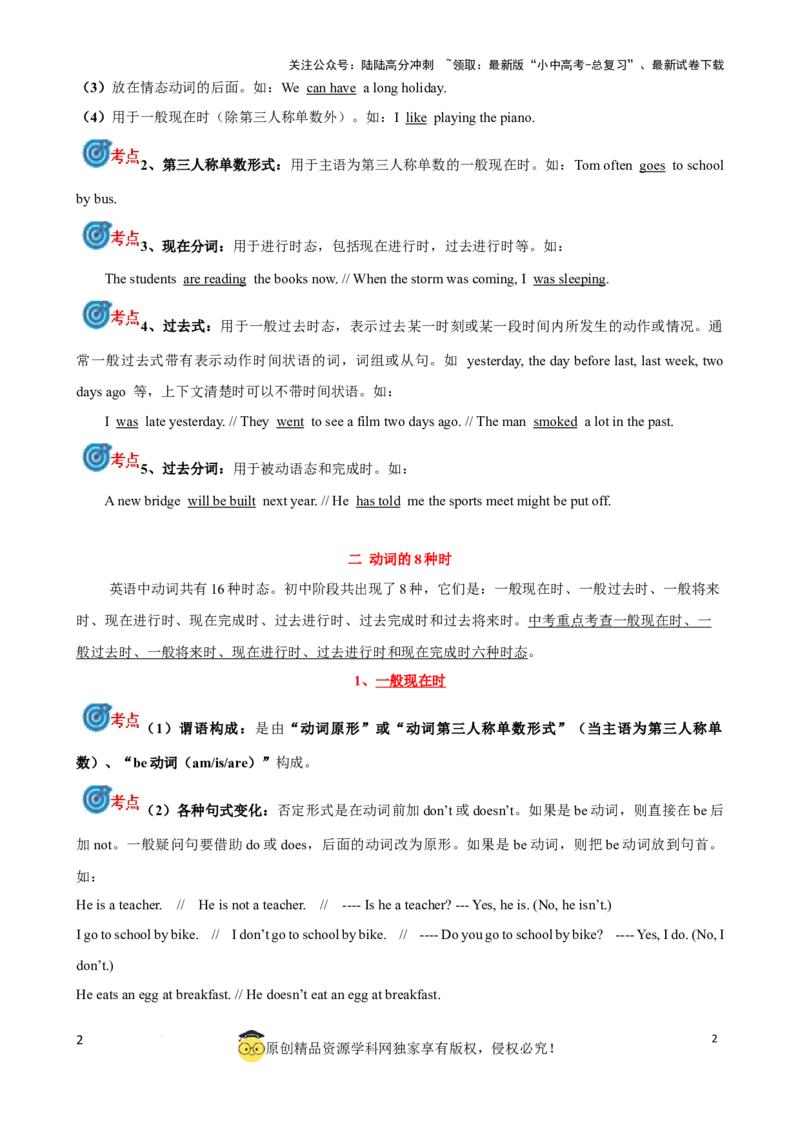
(2)各种句式变化:否定形式是在动词前加don’t或doesn’t。如果是be动词,则直接在be后
加not。一般疑问句要借助do或does,后面的动词改为原形。如果是be动词,则把be动词放到句首。
如:
He is a teacher. // He is not a teacher. // ---- Is he a teacher? --- Yes, he is. (No, he isn’t.)
I go to school by bike. // I don’t go to school by bike. // ---- Do you go to school by bike? ---- Yes, I do. (No, I
don’t.)
He eats an egg at breakfast. // He doesn’t eat an egg at breakfast.
2 2
原创精品资源学科网独家享有版权,侵权必究!
学科网(北京)股份有限公司关注公众号:陆陆高分冲刺 ~领取:最新版“小中高考-总复习”、最新试卷下载
---- Does he eat an egg at breakfast? ---- Yes, he does. (No, he doesn’t)
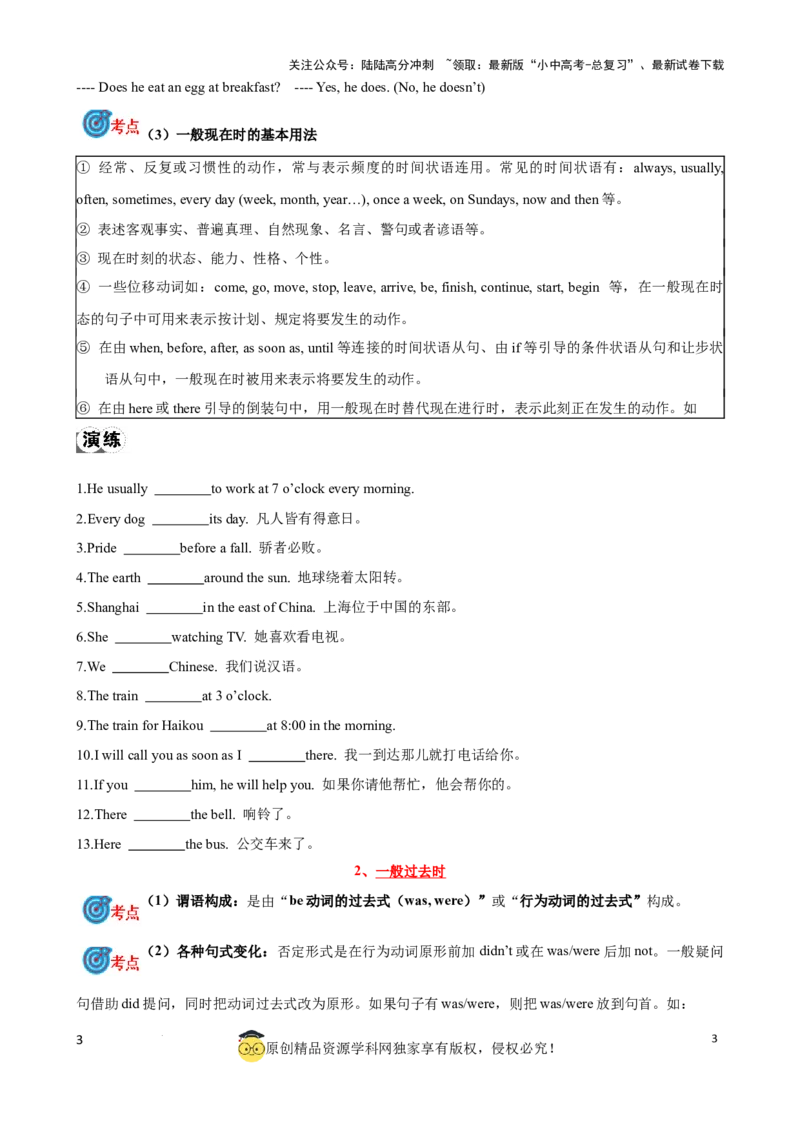
(3)一般现在时的基本用法
① 经常、反复或习惯性的动作,常与表示频度的时间状语连用。常见的时间状语有:always, usually,
often, sometimes, every day (week, month, year…), once a week, on Sundays, now and then等。
② 表述客观事实、普遍真理、自然现象、名言、警句或者谚语等。
③ 现在时刻的状态、能力、性格、个性。
④ 一些位移动词如:come, go, move, stop, leave, arrive, be, finish, continue, start, begin 等,在一般现在时
态的句子中可用来表示按计划、规定将要发生的动作。
⑤ 在由when, before, after, as soon as, until等连接的时间状语从句、由if等引导的条件状语从句和让步状
语从句中,一般现在时被用来表示将要发生的动作。
⑥ 在由here或there引导的倒装句中,用一般现在时替代现在进行时,表示此刻正在发生的动作。如
1.He usually to work at 7 o’clock every morning.
2.Every dog its day. 凡人皆有得意日。
3.Pride before a fall. 骄者必败。
4.The earth around the sun. 地球绕着太阳转。
5.Shanghai in the east of China. 上海位于中国的东部。
6.She watching TV. 她喜欢看电视。
7.We Chinese. 我们说汉语。
8.The train at 3 o’clock.
9.The train for Haikou at 8:00 in the morning.
10.I will call you as soon as I there. 我一到达那儿就打电话给你。
11.If you him, he will help you. 如果你请他帮忙,他会帮你的。
12.There the bell. 响铃了。
13.Here the bus. 公交车来了。
2、一般过去时
(1)谓语构成:是由“be动词的过去式(was, were)”或“行为动词的过去式”构成。
(2)各种句式变化:否定形式是在行为动词原形前加didn’t或在was/were后加not。一般疑问
句借助did提问,同时把动词过去式改为原形。如果句子有was/were,则把was/were放到句首。如:
3 3
原创精品资源学科网独家享有版权,侵权必究!
学科网(北京)股份有限公司关注公众号:陆陆高分冲刺 ~领取:最新版“小中高考-总复习”、最新试卷下载
It wasn’t rainy yesterday. // ---- Was it rainy yesterday? ---- Yes, it was. (No, it wasn’t.)
He watched TV last night. // ---- Did he watched TV last night? ---- Yes, he did. (No, he didn’t.)
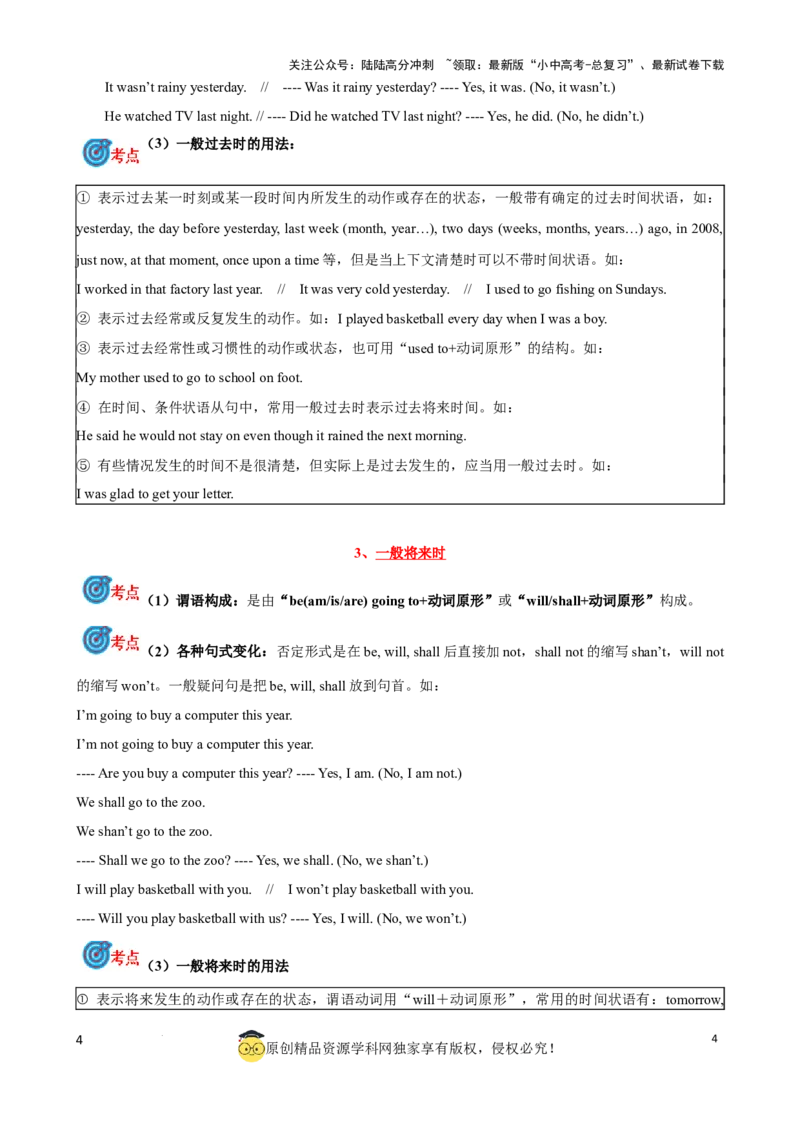
(3)一般过去时的用法:
① 表示过去某一时刻或某一段时间内所发生的动作或存在的状态,一般带有确定的过去时间状语,如:
yesterday, the day before yesterday, last week (month, year…), two days (weeks, months, years…) ago, in 2008,
just now, at that moment, once upon a time等,但是当上下文清楚时可以不带时间状语。如:
I worked in that factory last year. // It was very cold yesterday. // I used to go fishing on Sundays.
② 表示过去经常或反复发生的动作。如:I played basketball every day when I was a boy.
③ 表示过去经常性或习惯性的动作或状态,也可用“used to+动词原形”的结构。如:
My mother used to go to school on foot.
④ 在时间、条件状语从句中,常用一般过去时表示过去将来时间。如:
He said he would not stay on even though it rained the next morning.
⑤ 有些情况发生的时间不是很清楚,但实际上是过去发生的,应当用一般过去时。如:
I was glad to get your letter.
3、一般将来时
(1)谓语构成:是由“be(am/is/are) going to+动词原形”或“will/shall+动词原形”构成。
(2)各种句式变化:否定形式是在be, will, shall后直接加not,shall not的缩写shan’t,will not
的缩写won’t。一般疑问句是把be, will, shall放到句首。如:
I’m going to buy a computer this year.
I’m not going to buy a computer this year.
---- Are you buy a computer this year? ---- Yes, I am. (No, I am not.)
We shall go to the zoo.
We shan’t go to the zoo.
---- Shall we go to the zoo? ---- Yes, we shall. (No, we shan’t.)
I will play basketball with you. // I won’t play basketball with you.
---- Will you play basketball with us? ---- Yes, I will. (No, we won’t.)
(3)一般将来时的用法
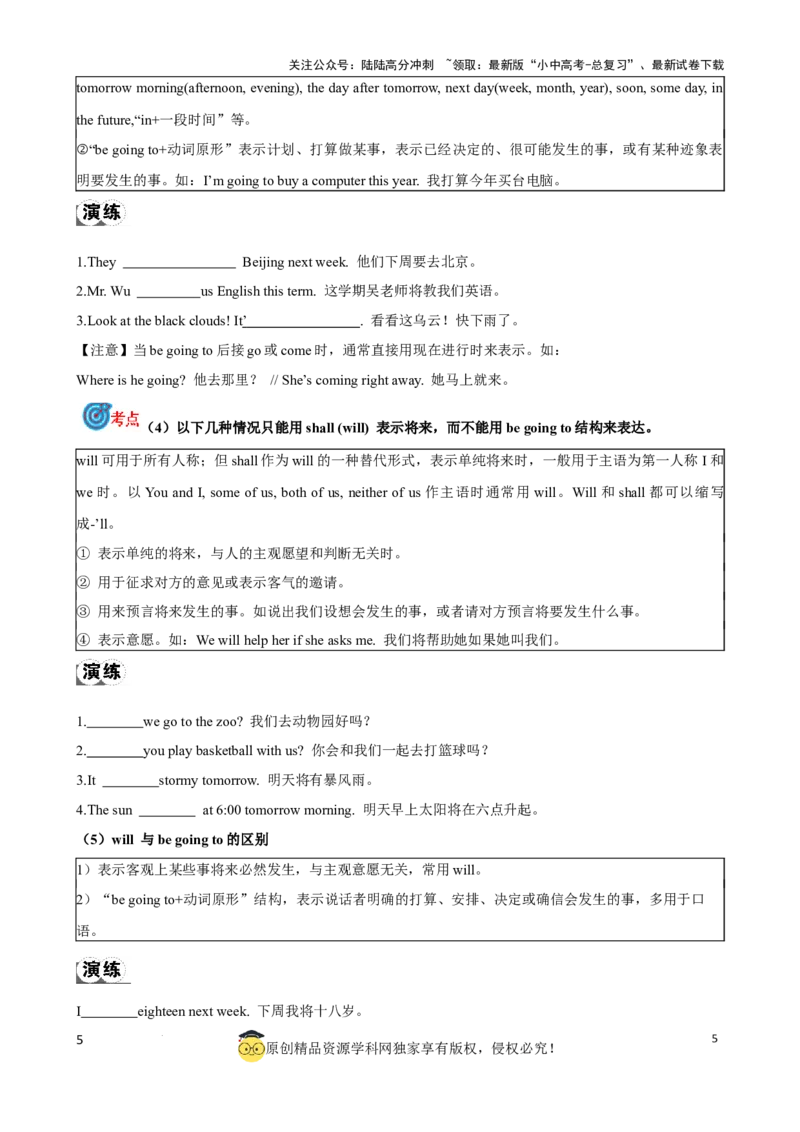
① 表示将来发生的动作或存在的状态,谓语动词用“will+动词原形”,常用的时间状语有:tomorrow,
4 4
原创精品资源学科网独家享有版权,侵权必究!
学科网(北京)股份有限公司关注公众号:陆陆高分冲刺 ~领取:最新版“小中高考-总复习”、最新试卷下载
tomorrow morning(afternoon, evening), the day after tomorrow, next day(week, month, year), soon, some day, in
the future,“in+一段时间”等。
②“be going to+动词原形”表示计划、打算做某事,表示已经决定的、很可能发生的事,或有某种迹象表
明要发生的事。如:I’m going to buy a computer this year. 我打算今年买台电脑。
1.They Beijing next week. 他们下周要去北京。
2.Mr. Wu us English this term. 这学期吴老师将教我们英语。
3.Look at the black clouds! It ’ . 看看这乌云!快下雨了。
【注意】当be going to后接go或come时,通常直接用现在进行时来表示。如:
Where is he going? 他去那里? // She’s coming right away. 她马上就来。
(4)以下几种情况只能用shall (will) 表示将来,而不能用be going to结构来表达。
will可用于所有人称;但shall作为will的一种替代形式,表示单纯将来时,一般用于主语为第一人称 I和
we时。以You and I, some of us, both of us, neither of us 作主语时通常用will。Will和shall都可以缩写
成-’ll。
① 表示单纯的将来,与人的主观愿望和判断无关时。
② 用于征求对方的意见或表示客气的邀请。
③ 用来预言将来发生的事。如说出我们设想会发生的事,或者请对方预言将要发生什么事。
④ 表示意愿。如:We will help her if she asks me. 我们将帮助她如果她叫我们。
1. we go to the zoo? 我们去动物园好吗?
2. you play basketball with us? 你会和我们一起去打篮球吗?
3.It stormy tomorrow. 明天将有暴风雨。
4.The sun at 6:00 tomorrow morning. 明天早上太阳将在六点升起。
(5)will 与be going to的区别
1)表示客观上某些事将来必然发生,与主观意愿无关,常用will。
2)“be going to+动词原形”结构,表示说话者明确的打算、安排、决定或确信会发生的事,多用于口
语。
I eighteen next week. 下周我将十八岁。
5 5
原创精品资源学科网独家享有版权,侵权必究!
学科网(北京)股份有限公司关注公众号:陆陆高分冲刺 ~领取:最新版“小中高考-总复习”、最新试卷下载
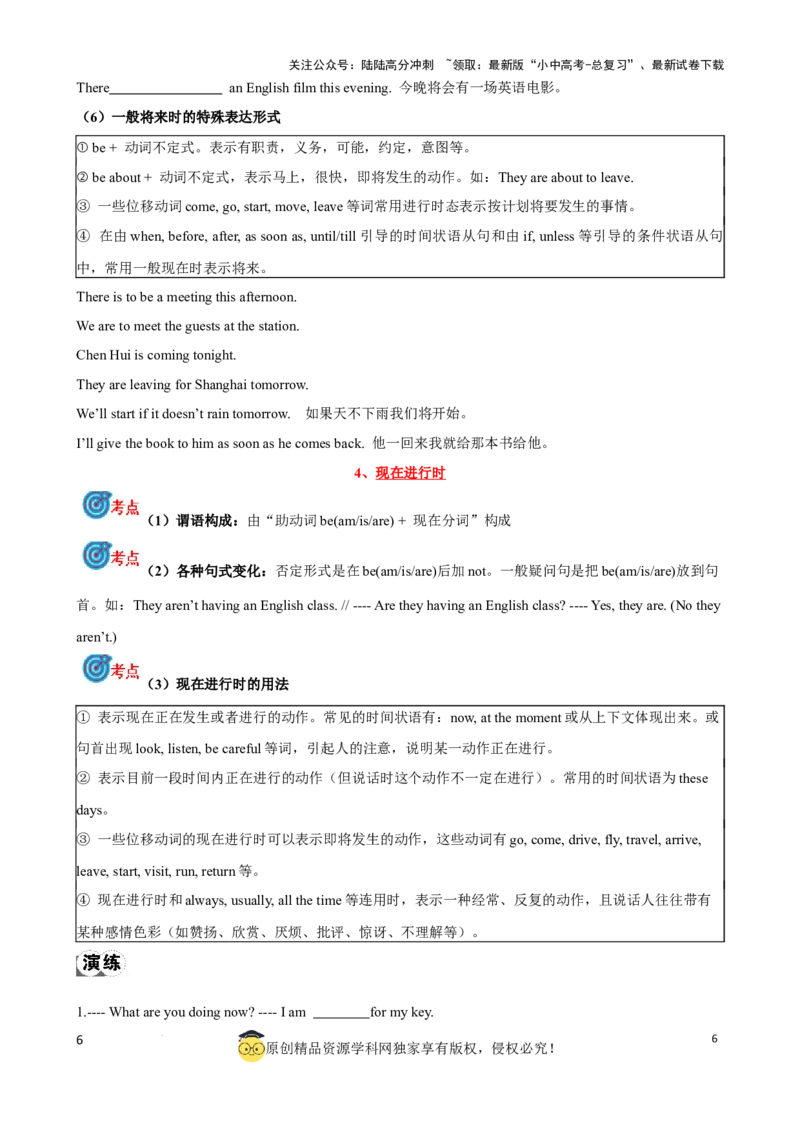
There an English film this evening. 今晚将会有一场英语电影。
(6)一般将来时的特殊表达形式
① be + 动词不定式。表示有职责,义务,可能,约定,意图等。
② be about + 动词不定式,表示马上,很快,即将发生的动作。如:They are about to leave.
③ 一些位移动词come, go, start, move, leave等词常用进行时态表示按计划将要发生的事情。
④ 在由when, before, after, as soon as, until/till引导的时间状语从句和由if, unless等引导的条件状语从句
中,常用一般现在时表示将来。
There is to be a meeting this afternoon.
We are to meet the guests at the station.
Chen Hui is coming tonight.
They are leaving for Shanghai tomorrow.
We’ll start if it doesn’t rain tomorrow. 如果天不下雨我们将开始。
I’ll give the book to him as soon as he comes back. 他一回来我就给那本书给他。
4、现在进行时
(1)谓语构成:由“助动词be(am/is/are) + 现在分词”构成
(2)各种句式变化:否定形式是在be(am/is/are)后加not。一般疑问句是把be(am/is/are)放到句
首。如:They aren’t having an English class. // ---- Are they having an English class? ---- Yes, they are. (No they
aren’t.)
(3)现在进行时的用法
① 表示现在正在发生或者进行的动作。常见的时间状语有:now, at the moment或从上下文体现出来。或
句首出现look, listen, be careful等词,引起人的注意,说明某一动作正在进行。
② 表示目前一段时间内正在进行的动作(但说话时这个动作不一定在进行)。常用的时间状语为these
days。
③ 一些位移动词的现在进行时可以表示即将发生的动作,这些动词有go, come, drive, fly, travel, arrive,
leave, start, visit, run, return等。
④ 现在进行时和always, usually, all the time等连用时,表示一种经常、反复的动作,且说话人往往带有
某种感情色彩(如赞扬、欣赏、厌烦、批评、惊讶、不理解等)。
1.---- What are you doing now? ---- I am for my key.
6 6
原创精品资源学科网独家享有版权,侵权必究!
学科网(北京)股份有限公司关注公众号:陆陆高分冲刺 ~领取:最新版“小中高考-总复习”、最新试卷下载
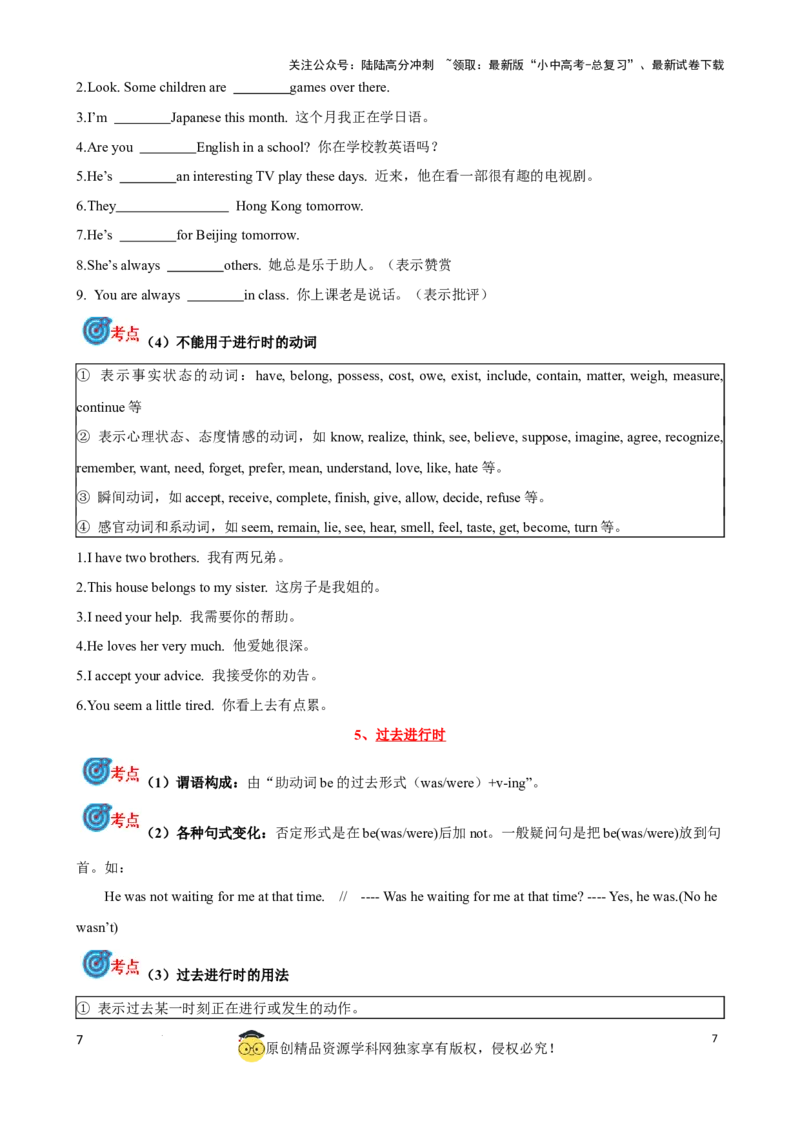
2.Look. Some children are games over there.
3.I’m Japanese this month. 这个月我正在学日语。
4.Are you English in a school? 你在学校教英语吗?
5.He’s an interesting TV play these days. 近来,他在看一部很有趣的电视剧。
6.They Hong Kong tomorrow.
7.He’s for Beijing tomorrow.
8.She’s always others. 她总是乐于助人。(表示赞赏
9. You are always in class. 你上课老是说话。(表示批评)
(4)不能用于进行时的动词
① 表示事实状态的动词:have, belong, possess, cost, owe, exist, include, contain, matter, weigh, measure,
continue等
② 表示心理状态、态度情感的动词,如know, realize, think, see, believe, suppose, imagine, agree, recognize,
remember, want, need, forget, prefer, mean, understand, love, like, hate等。
③ 瞬间动词,如accept, receive, complete, finish, give, allow, decide, refuse等。
④ 感官动词和系动词,如seem, remain, lie, see, hear, smell, feel, taste, get, become, turn等。
1.I have two brothers. 我有两兄弟。
2.This house belongs to my sister. 这房子是我姐的。
3.I need your help. 我需要你的帮助。
4.He loves her very much. 他爱她很深。
5.I accept your advice. 我接受你的劝告。
6.You seem a little tired. 你看上去有点累。
5、过去进行时
(1)谓语构成:由“助动词be的过去形式(was/were)+v-ing”。
(2)各种句式变化:否定形式是在be(was/were)后加not。一般疑问句是把be(was/were)放到句
首。如:
He was not waiting for me at that time. // ---- Was he waiting for me at that time? ---- Yes, he was.(No he
wasn’t)
(3)过去进行时的用法
① 表示过去某一时刻正在进行或发生的动作。
7 7
原创精品资源学科网独家享有版权,侵权必究!
学科网(北京)股份有限公司关注公众号:陆陆高分冲刺 ~领取:最新版“小中高考-总复习”、最新试卷下载
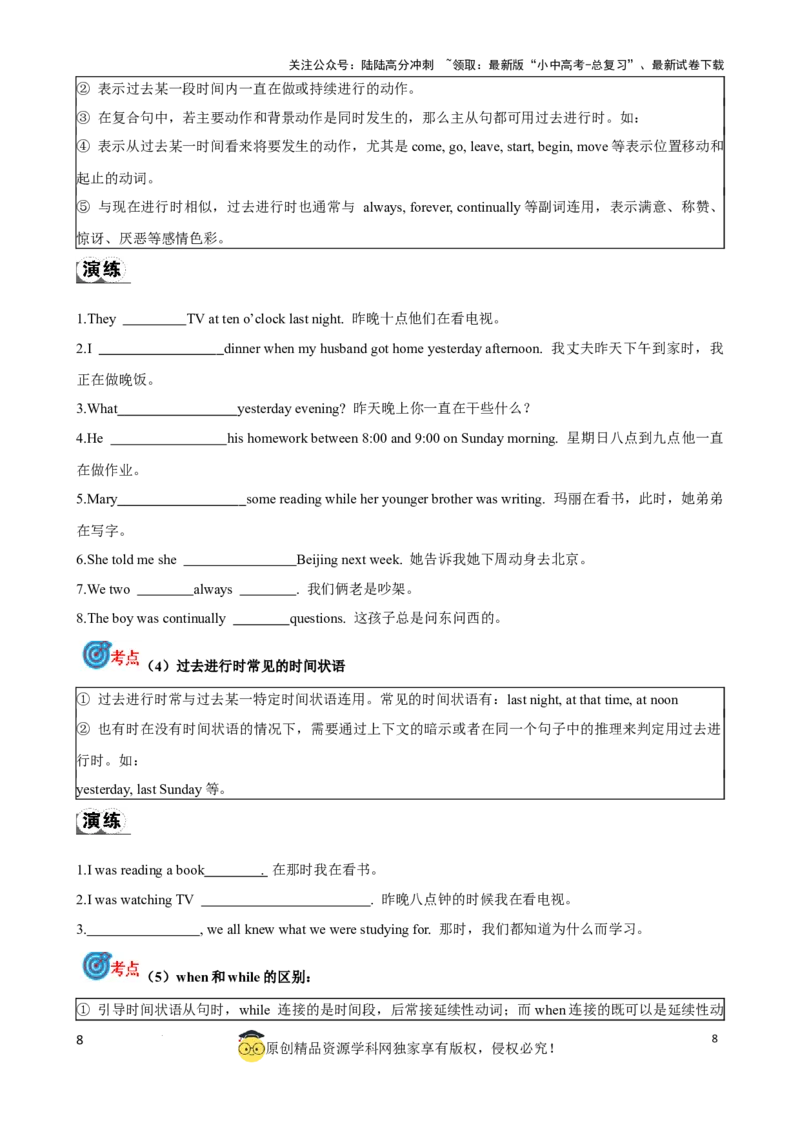
② 表示过去某一段时间内一直在做或持续进行的动作。
③ 在复合句中,若主要动作和背景动作是同时发生的,那么主从句都可用过去进行时。如:
④ 表示从过去某一时间看来将要发生的动作,尤其是come, go, leave, start, begin, move等表示位置移动和
起止的动词。
⑤ 与现在进行时相似,过去进行时也通常与 always, forever, continually等副词连用,表示满意、称赞、
惊讶、厌恶等感情色彩。
1.They TV at ten o’clock last night. 昨晚十点他们在看电视。
2.I dinner when my husband got home yesterday afternoon. 我丈夫昨天下午到家时,我
正在做晚饭。
3.What yesterday evening? 昨天晚上你一直在干些什么?
4.He his homework between 8:00 and 9:00 on Sunday morning. 星期日八点到九点他一直
在做作业。
5.Mary some reading while her younger brother was writing. 玛丽在看书,此时,她弟弟
在写字。
6.She told me she Beijing next week. 她告诉我她下周动身去北京。
7.We two always . 我们俩老是吵架。
8.The boy was continually questions. 这孩子总是问东问西的。
(4)过去进行时常见的时间状语
① 过去进行时常与过去某一特定时间状语连用。常见的时间状语有:last night, at that time, at noon
② 也有时在没有时间状语的情况下,需要通过上下文的暗示或者在同一个句子中的推理来判定用过去进
行时。如:
yesterday, last Sunday等。
1.I was reading a book . 在那时我在看书。
2.I was watching TV . 昨晚八点钟的时候我在看电视。
3. , we all knew what we were studying for. 那时,我们都知道为什么而学习。
(5)when和while的区别:
① 引导时间状语从句时,while 连接的是时间段,后常接延续性动词;而when连接的既可以是延续性动
8 8
原创精品资源学科网独家享有版权,侵权必究!
学科网(北京)股份有限公司关注公众号:陆陆高分冲刺 ~领取:最新版“小中高考-总复习”、最新试卷下载
词也可以是非延续性动词。
② while可以连接两个并列的句子,而when不可以。
③ when可作特殊疑问词,对时间进行提问;while 不能。
1. were you born? 你是什么时候出生的?
2.What was your father doing your mother was cooking?你妈妈做饭的时候,你爸爸在干什么呢?
3.What was your mother doing you came back? 当你回来时,你妈妈在干什么呢?
4.I was trying my best to finish my work my sister was watching TV. 我当时正在尽力完成作业,而
我的妹妹正在看电视。
(6)过去进行时和一般过去时的用法比较
① 过去进行时往往表示动作的未完成性,而一般过去时则往往表示动作已完成。
②过去进行时侧重说明动作持续时间的长度,而一般过去时则侧重说明事实。
1.He his homework in the afternoon. (没有言明作业是否完成)
2.He his homework in the afternoon. (作业已做完)
3. It all night. (只说明下雨事实)
6、现在完成时
(1)谓语构成:由 “助动词 have/has + 过去分词” 构成。在人称代词后have, has可以缩写
为’ve或’s, have not 缩写haven’t, has not 缩写hasn’t。
(2)各种句式变化:否定形式是在have/has后加not。一般疑问句是把have/has放到句首。
如:
He has eaten breakfast. // He hasn’t eaten breakfast. //---- Has he eaten breakfast? ---- Yes, he has. (No, he
hasn’t.)
【注意】过去分词变化规则基本与过去式变化相同,有些特殊变化需单独记忆。
(3)现在完成时的用法
① 表示在说话之前已经完成或刚完成的动作对现在产生的影响或结果,常与 already, ever, never, just, yet,
before 等词连用。
9 9
原创精品资源学科网独家享有版权,侵权必究!
学科网(北京)股份有限公司关注公众号:陆陆高分冲刺 ~领取:最新版“小中高考-总复习”、最新试卷下载
② 表示动作从过去开始持续到现在,或还有可能持续下去的动作或状态。常与 for和since引导的短语或
从句连用。动词必须是延续性动词。
1.I have just bought a ten-speed bicycle.
2.They have already cleaned the classroom.
3.We have lived here since 1976.
4.They have waited for more than two hours.
(4)一般过去时与现在完成时的区别
一般过去时表示过去某时发生的动作或单纯叙述过去的事情,强调动作;现在完成时为过去发生
的,但强调过去的事情对现在的影响,强调的是影响;一般过去时常与具体的过去时间状语连用。现在
完成时属于现在时态范围,因此不能和表示过去时间的状语连用。试比较:
I saw this film yesterday.(强调看的动作发生过了,不涉及现在)
I have seen this film. (强调对现在的影响,电影的内容已经知道了。)
(5)瞬间动词,如come, go, arrive, die, buy, borrow, leave, join, marry, begin, finish, end 等不
能与for, since状语连用。但可以改变为其他表示相同意思的延续性动词。如:
误:The old man has died for a few years.
正:The old man has been dead for a few years. // The old man has been dead since a few years ago.
The old man died a few years ago. // It is a few years since the old man died.
A few years has passed since the old man died.
瞬间动词的变化:
瞬间性动词的完成时 延续性动词或状态动词的完成时
have (already) gone to… have been in / at … for (two years)
has come to… has been here since (1990)
(had) left… (had) been away from…
arrived… been in…
died → been dead
begun been on
ended been over
bought... had…
borrowed… kept…
joined… been in …
10 10
原创精品资源学科网独家享有版权,侵权必究!
学科网(北京)股份有限公司关注公众号:陆陆高分冲刺 ~领取:最新版“小中高考-总复习”、最新试卷下载
(6)have/has been to, have/has gone to和have/has been in的区别:
have/has gone to意为“到某地去了”,说话时该人不在现场。一般只用第三人称作主语。have/has been to
意为“曾经去过某地”,表示一种经历,含有“现在已离开那儿”之意,后可接次数(如once,twice,
three times等)表示“去过某地几次”,也可和just,never,ever等连用。have been in表示“到某地多长
时间了”,常与时间段连用。
1.I the Great wall. 我从未去过长城。
2.---- Where is Tom? ---- He the UK.(即现在不在这儿)
3.I Australia for three years. 我到澳大利亚已有三年了。
(7) 句型:
It is / has been + (多久)+ since + 主语(人)+谓语(过去时)+……+过去时间状
语
[注意] 在其它的时态中也存在类似问题,记住,关键是:瞬间动词不能和表达一段时间的状语连用。
How long may I keep the book?(这本书我能借多久?)(句子中keep取代了borrow)
7、过去将来时
(1)过去将来时表示从过去的某一时间看来将要发生的动作或存在的状态,过去将来时常用在宾语从句
中,过去将来时的谓语部分由“助动词would\should+动词原形”构成。
(2)be going to+动词原形;be+动词不定式;be about+动词不定式,变成过去式后,都相当于过去将来
时。(3)过去进行时表示过去将来的概念,常用于位置转移的动词,如come, go, start, move, leave等。
(4)在时间、条件状语从句中用一般过去时表示过去将来时。
1.I knew you agree. 我知道你将同意。
2.She her old car and buy a new one. 她将卖她的旧车并且买一辆新车。
3.He told me he in an hour. 他告诉他说,他一小时后离开。
4.They said they us know if they heard any news about him.
8、过去完成时
(1)过去完成时的用法
① 过去完成时表示过去某一时间或某一动作发生之前已经完成的动作。简言之,过去完成时所表示的时
间是“过去的过去”,过去完成时的谓语部分“助动词had + 过去分词”构成。
11 11
原创精品资源学科网独家享有版权,侵权必究!
学科网(北京)股份有限公司关注公众号:陆陆高分冲刺 ~领取:最新版“小中高考-总复习”、最新试卷下载
② 过去完成时常用于宾语从句中、after引导的从句中,或者从句是before引导的主句中。
③ 用于hardly/scarcely...when; no sooner ...than句型中,主句用过去完成时,从句用一般过去时。
④ 动词hope, expect, think, intend, mean, want, suppose, plan 用过去完成时,表示未实现的愿望、打算和意
图。
1.I remembered that I this book. 我记得我看过这本书了。
2.He lunch when I came to his house. 当我到他家时他已经吃过午饭了。
3.After I my shoes and hat, I walked into the darkness.
4.I hardly my work when he came to see me.
5.No sooner I home than the telephone rang.(注意倒装)
(2)过去完成时的时间状语
过去完成时时间状语有:by last week, by then, by the end of (last…)或者由when, before等引出状语从
句。有时句子中会有already, just, once, ever, never等词语,也会有for… 或since…构成的时间状语。如:
The woman had left before he realized she was a cheat.
They had already finished cleaning the classroom when their teacher came.
三 被动语态
语态是动词的一种形式,表示主语和谓语的关系。英语中的动词有两种语态:主动语态和被动语
态。当主语是动作的执行者时用主动语态(某人做某事);当主语是动作的承受者时,用被动语态(某
事被某人做)。
1、各种时态的被动语态
被动语态由“主语+助动词be+及物动词的过去分词”构成,助动词有时态、人称和数的变化。
结 构 例 句
一般现在时:主语+am/is/are+过去分词 The classroom is cleaned every day. 教室每天都打扫。
一般过去时:主语+was/were+过去分词 Our school was built in 1998. 我们的学校在1998年建造。
一般将来时:主语+shall/will+be+过去分
The sports meeting will be held tomorrow. 运动会明天举行。
词
A new factory is going to be built in our city. 一个新工厂将在我市
主语+be going to+be+过去
建成。
分词
现在进行时:主语+am/is/are +being+过去
The car is being repaired. 这辆汽车正在修理中。
分词
过去进行时:主语+was/were +being+过去
The machine was being painted then. 那时那台机器正在上油漆。
分词
12 12
原创精品资源学科网独家享有版权,侵权必究!
学科网(北京)股份有限公司关注公众号:陆陆高分冲刺 ~领取:最新版“小中高考-总复习”、最新试卷下载
现在完成时:主语+has/have +been+过去
The bank has been built. 银行已经建成了。
分词
I had been invited to visit Japan before I came here.
过去完成时:主语+had +been+过去分词
在来这儿之前我已经被邀请访问日本了。
过去将来时:主语+should/ would+be+过Ann told me she would be sent to America. 安告诉我她将被派往美
去分词 国。
含有情态动词的被动语态:主语+情态动
The bike can’t be put here. 这辆自行车不能被放在这里。
词+be+过去分词
初中阶段应该掌握的被动语态结构有三种:一般现在时的被动语态;一般过去时的被动语态;一般
将来时的被动语态。中考题出现的关于被动语态的题目,一般会从上述三种情况中出;其他几种时态的
被动语态了解即可,它们一般会在阅读题目中出现。
2、被动语态的用法
(1)不知道动作的执行者,只知道承受者的情况。如:Silk is produced in Suzhou.
(2)不必说出动作的执行者的情况。如:Such books are written for children.
(3)需要突出和强调动作的承受者的情况。如:She is liked by everyone.
(4)句子的主语是物。如:Many Houses were destroyed in the earthquake in Wenchuan.
3、主动语态变被动语态的方法
记忆歌诀:主谓宾,要分清,宾变主,主变宾,by短语后面跟。谓语动词变被动,be后“过分”来使
用。
主动句变为被动句所遵循的5个步骤:
(1)先确定主动句的主、谓、宾,找出其中的谓语动词。
(2)把主动句中谓语动词后面的宾语变为被动句的主语,若宾语是人称代词,应把宾格变为主格。
(3)把主动句中的谓语动词变为“助动词be+及物动词的过去分词”,但时态不能改变。
(4)把主动句中谓语动词前面的主语变为被动句中介词 by的宾语(没必要说出动作的执行者时可省
略),若主语是人称代词时,应把主格变为宾格。
(5)其它的成分(定语、状语)不变。如:They make the bikes in the factory. →The bikes are made by
them in the factory.
4、被动语态的几种特殊形式
(1)带有复合宾语的动词变为被动语态时,只须把宾语变为被动语态的主语,而宾语补足语仍保留在原
处,作主语补足语。
(2)主动句中感官动词see/hear/watch/feel/notice等和使役动词make/let/have等后跟省略to的动词不定式
13 13
原创精品资源学科网独家享有版权,侵权必究!
学科网(北京)股份有限公司关注公众号:陆陆高分冲刺 ~领取:最新版“小中高考-总复习”、最新试卷下载
作宾语补足语时,主动语态中不带to,在变被动语态时,to必须还原。
1.We call him Xiao Wang.→He Xiao Wang.
2.He cut his hair short.→His hair short.
3.They told him to help me. →He to help me.
4.We find English very useful. →English very useful.
5.I saw him fall off the tree. →He the tree.
6.They watched the children sing that morning.→The children that morning.
【注意】后接现在分词作宾语补足语的动词变为被动语态时,宾补部分不变。
对比:We heard Jim playing the guitar in his room. →Jim was heard playing the guitar in his room.
(3)含有双宾语的主动句改为被动句时,一种情况是把间接宾语(指人)变为主语,直接宾语(指物)不变。
另一种情况是把直接宾语(指物)变为主语,间接宾语(指人) 用介词 to 或 for 引导。常用加to的动词
give, show, send, bring, read, pass, lend, leave(留给), hand(交给), tell, return, write, throw(仍), promise(答应),
refuse(拒绝)等;常用加for的动词make, buy, do, get, play(演奏), order(命令), sing, pay(支付), draw等。
(4)短语动词在变为被动语态时,短语中的介词或副词不能省去。常见的这类短语动词有:take care of,
look after, take off, look at, send for, look up, think of, work out, laugh at等。
1.My father gave me a new book on my birthday. →I was given a new book (by my father) on my birthday. (间接
宾语作了主语)→A new book was given to me (by my father) on my birthday. (直接宾语作了主语)
2.My father bought a new bike for me yesterday. →A new bike was bought for me yesterday. (直接宾语作了主
语)
→I was bought a new bike yesterday. (间接宾语作了主语)
3.We can’t laugh at him.→He can’t be laugh at by us. // John turned on the radio.→The radio was turned on.
5、主动结构表示被动意义
(1)feel, look, sound, smell, taste等系动词的主动语态表示被动含义。
(2)当主语为物时,动词sell, write, cut, open, lock, read, clean, wash, burn, drive等作不及物动词时,用主
动形式表被动意义,用来表示某物的性质、特征。
(3)不及物动词和某些动词短语没有被动语态。这类的动词(短语)有happen, take place, break out, last,
cost, spread 等。
(4)不定式在一些形容词(如easy, difficult, hard, good, impossible, heavy 等)之后,且与主语有动宾关系
时,要用主动形式表被动意义。如:This question is easy to answer. 这个问题很容易回答。// This box is
heavy to carry. 这个箱子扛起来很重。
(5)sth. need/ want/ require doing相当于sth. need/ want/ require to be done (不定式的被动结构)。
14 14
原创精品资源学科网独家享有版权,侵权必究!
学科网(北京)股份有限公司关注公众号:陆陆高分冲刺 ~领取:最新版“小中高考-总复习”、最新试卷下载
(6)be worth doing (值得做) 中的doing表示被动含义。
1.This kind of drink strange. 这种饮料尝起来味道很怪。
2.Our teacher younger than she is. 我们老师看起来比实际年龄小。
3.The book well. 这本书很畅销。
4.An accident near here yesterday. 昨天这附近发生了一起事故。
5.Great changes in our city in the past few years. 在过去的几年时间里,我们城市发生了
很大的变化。
6.Your room cleaning. = Your room needs to be cleaned. 你的房间需要打扫了。
7.The movie by everyone. 这部电影值得所有人看一看。
6、不用被动语态的情况
(1)主动句的谓语动词是系动词(feel, look, sound, seem, become等)、不及物动词(happen, take, please,
disappear等)、表示状态的及物动词(have, rise, hold等)或某些动词短语(come true; fall asleep; keep
quiet; take place等)时,不能用于被动语态。
如:This was happened in 1989.(错)This happened in 1989.(对)
The trees have been become green.(错)The trees have become green.(对)
(2)主动句的宾语是不定式或动名词时,不能用作被动语态的主语。如:
My brother enjoys watching TV. 我弟弟喜欢看电视。→不能变成:Watching TV is enjoyed by my
brother.(误)
He asked to have a try. 他请求试一试。→不能变成:To have a try was asked by him.(误)
(3)主动句的宾语是反身代词或each other时,不能用作被动语态的主语。如:
The woman introduced herself as Mrs. Li. 那个妇女自我介绍说她是李夫人。
不能变成:Herself was introduced herself as Mrs. Li.(误)
They help each other to study English. 他们互相帮助学习英语。
不能变成:Each other is helped to study English.(误)
7、被动语态与系表结构的区别
“be+动词的过去分词”表示动作时是被动语态;“be+动词的过去分词”表示主语所处的状态时是系表结
构。
(1)含有“by+宾语”结构强调动作执行者,此时为被动语态。如:
The window is broken. 窗户坏了。(系表结构)// The window is broken by me. 窗户是我打破的。
15 15
原创精品资源学科网独家享有版权,侵权必究!
学科网(北京)股份有限公司关注公众号:陆陆高分冲刺 ~领取:最新版“小中高考-总复习”、最新试卷下载
(被动语态)
(2)句中有地点、频率或时间状语时,一般是被动语态。如:
The door was closed. 门是关着的。(系表结构)// The door was closed at 9: 00. 九点钟关的门。(被
动语态)
(3)系表结构中常用介词搭配,被动语态中没有介词搭配。如:We’re worried about the boy. 我们担心那
个男孩。
(4)系表结构的过去分词可以被副词修饰。如:I’m really surprised at the news. 我对这个消息真的感到很
惊讶。
(5)系表结构通常只有一般现在时和一般过去时,而被动语态可用于多种时态。
题组1 动词的时态
一、填空题
1.While I was watching TV, the doorbell r .
2.Mike often (收集)stamps and plays basketball in his spare time.
3.The child (cry)over there. What's wrong with him?
4.Next year, they (make) a CD of their songs and start a charity.
5.And then it just (grow) and makes the world a better place.
6.But surely, people believe, his dream (come) true in the near future.
7.Luckily, he was discovered and picked up by a London-bound (开往伦敦的) ship. So he (land)
in London by accident.
8.While we (eat)breakfast, Claudio went upstairs to collect his things.
9.Although I (上学,参加)a class last year, my Spanish is still terrible!
10.He says that many summer camps (wait) for instructions from the government now.
11.And we never (忘记)the lunch or the dinner, though, which we all made together over
campfires.
12.We can see clearly that Mongolia (位于) between China and Russia on the map.
13.After a long day, Tom l down on the bed and went to sleep.
14.He (save)up about 300 dollars already.
15.When I told him running for president would be much work, he (promise)that he would help
me.
题组2 被动语态
一、填空题
1.If we don't protect the environment well, we'll be (惩罚)sooner or later.
16 16
原创精品资源学科网独家享有版权,侵权必究!
学科网(北京)股份有限公司关注公众号:陆陆高分冲刺 ~领取:最新版“小中高考-总复习”、最新试卷下载
2.They live in huts—little “houses”. These houses (make)of wood and grass.
3.It (invent) for people to see each other while talking online.
4.When he was little, he (influence) by his mother who was interested in literature.
5.Alone and hungry, he walked on the streets of the city. Unexpectedly, he (call) into a big house.
6.Mark Quinn hit upon the idea after studying how a person's happiness could be (影响)by social
media(媒体).
7.Most programs will not (allow)to have more than 30 kids.
8.“Why? Your bright sunny smile (love) by everybody, not how many hairs you have!”Miss
Beautiful smiled.
9.I've found a friendly guide here and yesterday I (show) around the city.
10.For example, it mentioned that the zipper was (invent)by Whitcomb Judson in 1893.
11.First of all, I think more bike lanes should (build).
12.The read-a-thons are (举行)not only to raise money, but also to encourage teenagers to read.
13.After hearing about sacrifices(牺牲)made by firemen, she (move)by the risks they face, so
Savannah made 200 thank-you cards for them.
题组3 综合练习
一、填空题
1.Chinese people are so angry that they have (惩罚) some Western companies, including H&M and
Nike, by refusing to buy their products since March, 2021.
2.The professor smiled and said, “Please describe what you see in the test paper.” The students tried hard as they
(tell).
3.Some people have pointed out that this kind of quiet environment should (offer) in all carriages.
4.As early as the Shang Dynasty, bamboo (use)in ancient people's daily lives.
5.For the coming yard sale, we have d to each sell five things that we no longer use.
6.By now, I think I (实现)my dream, coming here and seeing my family and all the friends I have
made over the years.
7.Their artistic effects cannot (复制)by any other pens.
8.From now on, I want you (think) about the big picture more often.
9.Passengers who are willing to obey the rules can choose the quiet carriages when (book) their
tickets online.
10.When facing difficult situations, people are encouraged (hold) on by the effect of bamboo
culture.
17 17
原创精品资源学科网独家享有版权,侵权必究!
学科网(北京)股份有限公司关注公众号:陆陆高分冲刺 ~领取:最新版“小中高考-总复习”、最新试卷下载
11.Papermaking technology was improved day by day, and more and more kinds of paper were developed
(提供) different using choices.
12.We (throw) tons of rubbish away in our daily life so far, and we have to make a change from
now on.
13.Though 20 years old, the book is still r as the best work by people from all over the world.
14.Along the way, he (help) by some with food and by some with shelter(住所).
15.After e him, the doctor told him that there was nothing serious.
16.Ann likes traveling to the seaside and she thinks l on the beach is really comfortable.
17.His body temperature keeps r . We need to send for a doctor at once.
18.The man had no choice and was made (stay)on the bus till the bus reached its terminus.
19.—We are now busy p for the Senior High School Entrance Examination.
—I see. Just take it easy.
20.I spent 24 hours a week (develop) my skills.
题组4 选择题
1.(2023·湖北十堰·统考中考真题)Mr. Smith ________ at the Natural History Museum for more than 10
years, so he knows a lot about insects.
A.is working B.has worked C.was working D.will work
2.(2023·江苏徐州·中考真题)I saw Harry in February and I ________ him since then.
A.didn’t see B.won’t see C.haven’t seen D.don’t see
3.(2023·辽宁丹东·统考中考真题)— Where’s your brother, Bob?
— Look! He ________ the car in the yard.
A.is cleaning B.cleaned C.cleans D.will clean
4.(2023·湖北恩施·中考真题)—I called you last night, but nobody answered. What were you doing at this
time yesterday?
—Oh, sorry! I ________ the piano.
A.was playing B.played C.would play
5.(2023·江苏宿迁·统考中考真题)— My father and I ________ a lot of photos at the same place in the past
ten years.
— Those photos must be your valuable memories.
A.have taken B.will take C.take D.were taking
6.(2023·北京·统考中考真题)—Lucy, what are you doing?
—I ________ a model ship.
18 18
原创精品资源学科网独家享有版权,侵权必究!
学科网(北京)股份有限公司关注公众号:陆陆高分冲刺 ~领取:最新版“小中高考-总复习”、最新试卷下载
A.make B.made C.am making D.was making
7.(2023·北京·统考中考真题)The Shenzhou-15 astronauts ________ to Earth safely on June 4, 2023.
A.return B.returned C.will return D.have returned
8.(2023·北京·统考中考真题)If you go to the concert with us tomorrow, you ________ a great time there.
A.have B.had C.will have D.have had
9.(2023·北京·统考中考真题)Eric ________ many things since he became interested in science.
A.is learning B.was learning C.will learn D.has learned
10.(2023·北京·统考中考真题)—Lily, can you tell me ________ during the Dragon Boat Festival this year?
—Sure. We ate zongzi and watched a dragon boat race.
A.what you will do B.what you did C.what will you do D.what did you do
11.(2023·辽宁抚顺·统考中考真题)At 4 o’clock yesterday afternoon, my father ________ for me outside the
school gate.
A.waits B.waited C.was waiting D.is waiting
12.(2023·吉林长春·统考中考真题)Could you please turn down the TV? Your father _______ on his article.
A.was working B.worked C.is working D.works
13.(2023·江苏无锡·统考中考真题)Hey, Aunt Jenny! It’s you! I didn’t expect you ________ over. What a
nice surprise!
A.had come B.have come C.would come D.will come
14.(2023·辽宁沈阳·统考中考真题)After this exam, you ________ a wonderful holiday next month. Take it
easy!
A.have B.have had C.had D.will have
15.(2023·黑龙江牡丹江·统考中考真题)—Nancy, where is your brother?
—He ________ for the physical experiment (物理实验) exam in the laboratory.
A.prepares B.is preparing C.was preparing
考点2 动词的语态
1.(2023·黑龙江绥化·统考中考真题)The students ________ how to do eye exercises just now.
A.was taught B.were taught C.taught
2.(2023·黑龙江齐齐哈尔·统考中考真题)— Why do the elephants in Thailand have to ________?
— Because humans there catch them for their ivory to make money.
A.protect B.be protected C.are protected
3.(2023·四川乐山·统考中考真题)—Who’s the little girl in the photo?
19 19
原创精品资源学科网独家享有版权,侵权必究!
学科网(北京)股份有限公司关注公众号:陆陆高分冲刺 ~领取:最新版“小中高考-总复习”、最新试卷下载
—It’s me. The photo ________ when I was five years old.
A.took B.was taken C.is taken
4.(2023·湖南株洲·统考中考真题)Panda Ya Ya ________ back to Beijing about three weeks ago.
A.was brought B.is brought C.brought
5.(2023·湖北孝感·统考中考真题)— Have you heard of the UN Chinese Language Day?
— Of course. Chinese ________ by more and more people around the world nowadays.
A.spoke B.is spoken C.speaks D.was spoken
6.(2023·湖南郴州·统考中考真题)Many trees and flowers ________ every year to make our environment
more beautiful.
A.plant B.are planted C.were planted
7.(2023·福建·统考中考真题)Modern technologies ________ in the 19 Asian Games in September, 2023.
A.were used B.are using C.will be used
8.(2023·辽宁·统考中考真题)The boys ________ the exciting soccer game when the teacher came in.
A.talked about B.talk about C.were talking about D.will talk about
9.(2023·黑龙江牡丹江·统考中考真题)The 19th Asian Games ________ in Hangzhou from September 23
to October 8, 2023.
A.was held B.will hold C.will be held
10.(2023·辽宁营口·中考真题)—Students ________ a few open questions in Ms. Li’s class, did you notice
that?
—Yes, I think she wanted to train their ability of creative thinking.
A.are asked B.were asked C.will be asked D.should be asked
题组5 语法选择
I knocked into a stranger as he walked by me.“Oh, excuse me,” I said.He 1 with a smile and said,
“Please excuse me too. I wasn't watching out for you.” We apologized and left.
Later that day, when I 2 , my daughter was standing too close to me. When I turned to reach for some
milk, I nearly knocked her over. “You should 3 out of the way!” I shouted. She walked away sadly. But I
4 feel that I had to apologize to her.
While I was in bed that evening, my husband said to me, “While dealing with a stranger, you were polite, but
with the one you 5 , you were unkind. Your daughter brought you some flowers that she picked herself this
afternoon. You 6 them in the kitchen by the door. Have you 7 the tears in her eyes?”
I quietly went and knelt down by my daughter's bed.“Honey, I am so sorry. Are these the flowers you picked
for me?” I said. “I found them by the tree. I picked them for you. I knew you 8 like them, especially the
20 20
原创精品资源学科网独家享有版权,侵权必究!
学科网(北京)股份有限公司关注公众号:陆陆高分冲刺 ~领取:最新版“小中高考-总复习”、最新试卷下载
blue ones,” she said.
I tearfully replied, “Sweetie, I'm really sorry for the way I 9 today. I shouldn't have shouted at you.”
“It's okay. I love you anyway,” she said as she kissed me on my cheek.
If we 1 0 be polite to strangers, why can't we do the same for the ones we love?
1.A.reply B.replies C.replied D.is replying
2.A.cook B.cooks C.cooked D.was cooking
3.A.move B.moving C.moves D.moved
4.A.weren't B.don't C.won't D.didn't
5.A.love B.loves C.loved D.will love
6.A.find B.finds C.will find D.found
7.A.see B.seen C.sees D.saw
8.A.did B.would C.could D.had
9.A.act B.acted C.am acting D.was acting
10.A.can B.could C.may D.might
题组6 短文填空
One day, a wise old man 1 (walk) in the yard when he saw his grandson having an argument with his
wife. He asked his grandson, “Why do you raise your voice every time you argue with your wife?”
His grandson answered, “I 2 my voice so that my voice is heard.”
“Your wife is close enough for her to hear you when you say the same sentence in a calm manner. Why do
you have to raise your voice?” the grandfather 3 .
“Perhaps because I need to let off some steam (发泄一些怒火) by raising my voice,” his grandson replied.
“The steam 4 (go) out in the same way if you whisper (小声说) to her. So why do that?”
“I've already 5 her what I think, but it seems that she doesn't understand my point of view,” the man
said unwillingly (不情愿地).
“But you are hurting your wife's feeling while you are shouting at her,” the old man said angrily. “In fact, if
you whisper softly, you can both hear each other clearly. So stop raising your voice when you talk to her.” His
grandson nodded his head.
1. 2. 3. 4. 5.
题组7 语法选择
I live in a very old town which 1 by beautiful woods. It's a scenic spot.
On Sundays, hundreds of people come from the city to see our town and to walk through the woods. Visitors
21 21
原创精品资源学科网独家享有版权,侵权必究!
学科网(北京)股份有限公司关注公众号:陆陆高分冲刺 ~领取:最新版“小中高考-总复习”、最新试卷下载
are asked to keep the woods clean. Litter baskets 2 under the trees, but rubbish 3 everywhere by
people as usual.
Last Wednesday, I went for a walk in the woods. What I saw made me very sad.
I found seven old cars and three old refrigerators. The litter baskets were empty and the ground 4 with
pieces of paper, cigarette ends, old tyres, empty bottles and rusty tins...
Among the rubbish, I found a sign which said, “All the rubbish 5 into the baskets. Anyone who leaves
litter in these woods 6 .”
1.A.surround B.surrounds C.is surrounded D.will be surrounded
2.A.placed B.is placed C.was placed D.have been placed
3.A.throw B.is thrown C.threw D.are thrown
4.A.cover B.covered C.was covered D.was covering
5.A.must put B.must be put C.must be putted D.must putting
6.A.will be punished B.are punishedC.punish D.punished
题组8 短文填空
There are ancient (古代的) stories that can remind us of the power of words. Yan Zi's Visit to the State of
Chu is one of them.
Yan Zi was the ambassador (大使) of the State of Qi. Once, he went to visit the State of Chu. The king of
Chu 1 (plan) to insult (侮辱) Yan Zi.
Yan Zi was short. The king ordered his soldiers to close the city gate but leave a hole for dogs open. Yan Zi
2 (ask) to enter through the hole. But Yan Zi was not angry. He said:“I 3 (ask) to enter through a hole for
dogs only when I visit a dog state. Is Chu such a state?”
When the king of Chu heard this, he had to open the gate and welcome Yan Zi in. After the king met Yan Zi,
he asked:“Aren't there any capable (能干的) men in Qi? Why was a dwarf (侏儒) sent here?”
“Your Majesty (陛下), Qi is never short of capable men. But there is a rule in Qi:First-class ambassadors
4 (send) to first-class states, and lower-class ones to lower-class states. I am the most incapable man. That's why
I am here,” Yan Zi answered.
The king was speechless. He could not look down on Yan Zi any more.
Yan Zi's story 5 us that a few words can safeguard(保卫) one's dignity(尊严). That's how powerful
they are.
1. 2. 3. 4. 5.
22 22
原创精品资源学科网独家享有版权,侵权必究!
学科网(北京)股份有限公司关注公众号:陆陆高分冲刺 ~领取:最新版“小中高考-总复习”、最新试卷下载
23 23
原创精品资源学科网独家享有版权,侵权必究!
学科网(北京)股份有限公司