2023 届高三期初质量监测
英 语
参考答案
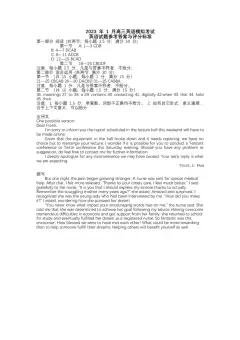
参考答案:
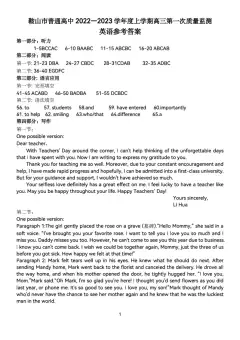
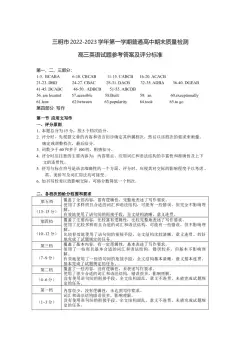
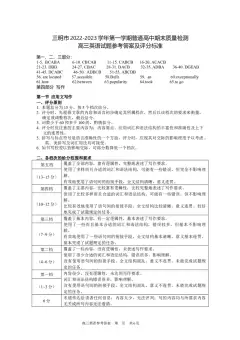
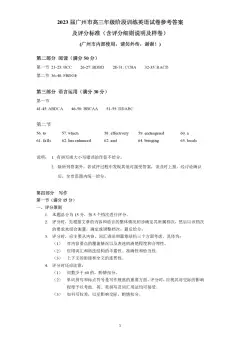
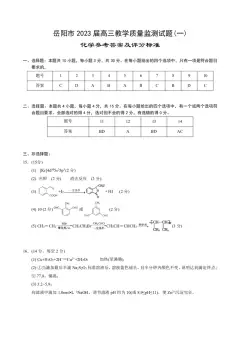
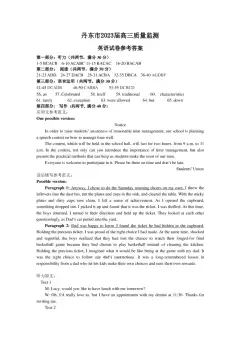
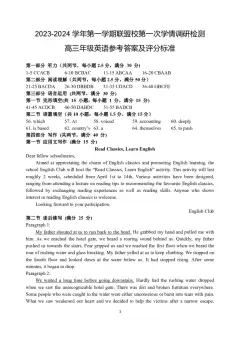
1-5BCCBA 6-10CAACA 11-15CBCBA 16-20BAABC
21-25DABAC 26-30BDABD 31-35CCDBC 36-40GBAFD
41-45BDBAC 46-50DCBAD 51-55BCAAD
56.isaimed 57.assuming 58.togo 59.held 60.Accompanied
61.motivational 62.that/which 63.gently 64.about/against 65.a
应用文
Laboristhemostglorious
To stimulate the students’ enthusiasm for labour, our class held a class meeting with the
theme—LaboristhemostgloriouslastWednesdayafternoon.
The class meeting, consisting of three parts, began with a touching video about a student
beingavolunteer inhis community.After that, wetalkedaboutthe topicfreelyin groups.Finally,
somestudentssharedtheirstoriesofdoinghouseworkathome.
Through the class meeting, not only do I better understand the value of labour, but we try to
buildabeautifulsocietywithourhands.
读后续写
With hope, I started to train myself. For the first few days, I nearly gave up. Pushing my
wheelchair made me feel great pain in my back and shoulders, but my love for Marshall kept me
going. Instead oflistening to my body,I focused onthe voice in my heart.When I was training, I
thought to myself. “One more lap.You can do this. Don't stop. Marshall needs you.”After weeks
ofdailytraining,Icouldfinishallfifteenmiles.
ThebigdayfinallycameandIwentoutat6:30a.m.Thefirstfewlapswerelongandlonely.
Slowlythedonorsandneighborscametowatch.Some evencheeredasIpassedthem.Withevery
mile, more people came and donated money. There was hope after all. Donations from the
neighbors continued. Many hours passed, and I finished all fifteen miles. I succeeded in raising
enough money for Marshall’s operation. I could never have made it without these kind people’s
support.
写作评分说明
语法填空:
完全按照参考答案给分;
第一节: 应用文写作(满分15分)
一、评分原则
1. 本题总分为15分,按5个档次给分。
2. 评分时,先根据文章的内容和语言初步确定其所属档次,然后以该档次的要求衡量、确
定或调整档次,最后给分。3.词数少于60或多于100的,酌情扣分。
4. 评分时,应注意的主要内容为:内容要点、应用词汇和语法结构的丰富性和准确性及上
下文的连贯性。
5. 拼写与标点符号是语言准确性的一个方面,评分时,应视其对交际的影响程度予以考虑。
英美拼写及词汇用法均可接受。
6. 如书写较差,以至影响交际,将分数降低一个档次。
二、各档次的给分范围和要求
第五档 (13-15分) 完全完成了试题规定的任务。完全达到了预期的写作目的。
1. 覆盖所有内容要点。
2. 应用了较多的语法结构和词汇。
3. 语法结构或词汇方面有些许错误,但为尽力使用较复杂结构或较高级词汇所致;具备较
强的语言运用能力。
4. 有效地使用了语句间的连接成分,使全文结构紧凑。
第四档 (10-12分) 完成了试题规定的任务。 达到了预期的写作目的。
1. 虽漏掉一、二个次重点,但覆盖所有主要内容。
2. 应用的语法结构和词汇能满足任务的要求。
3. 语法结构或词汇方面应用基本准确,些许错误主要是因尝试较复杂语法结构或词汇所致。
4. 应用简单的语句间的连接成分,使全文结构紧凑。
第三档 (7-9分) 基本完成了试题规定的任务。 整体而言,基本达到了预期的写作目的。
1. 虽漏掉一些内容,但覆盖所有主要内容。
2. 应用的语法结构和词汇能满足任务的要求。
3. 有一些语法结构或词汇方面的错误,但不影响理解。
4. 应用简单的语句间的连接成分,使全文内容连贯。
第二档 (4-6分) 未恰当完成试题规定的任务。 信息未能清楚地传达给读者。
1. 漏掉或未描述清楚一些主要内容,写了一些无关内容。
2. 语法结构单调、词汇项目有限。
3. 有一些语法结构或词汇方面的错误,影响了对写作内容的理解。
4. 较少使用语句间的连接成分,内容缺少连贯性。
第一档 (1-3分) 未完成试题规定的任务。 信息未能传达给读者。
1. 明显遗漏主要内容,写了一些无关内容,原因可能是未理解试题要求。
2. 语法结构单调、词汇项目有限。
3. 较多语法结构或词汇方面的错误,影响对写作内容的理解。
4. 缺乏语句间的连接成分,内容不连贯。
不得分:(0分)
未能传达给读者任何信息:内容太少,无法评判;写的内容均与所要求内容
无关或所写内容无法看清。
第二节 读后续写(满分25分)
一、评分说明
1. 评分原则:
本题总分为25分,按5个档次给分。
给分公平、公正;宽严并济,不能过严或过松;得分有理,扣分有据。
2. 评分标准:立意积极、情节合理、语言水平、书写美观。
三个逻辑一致原则:续写部分与所给短文之间的逻辑;续写两段内容之间的逻辑;续写
部分与所给开头语之间的逻辑。3. 评分程序:
阅读第1遍:根据续写总体情节及重点内容描写,初步确定所属档次。
阅读第2遍:根据写作语言(修辞、句式、词汇等),确定或调整档次。
阅读第3遍:看词数(少于130个,从总分中扣2分);
看书写(书写及卷面较差的建议降为三档或三档以下)。
二、各档次的给分范围和要求
档次 描述
1. 与所给短文融洽度高,与所提供各段落开头语衔接合理。
第五档 2. 内容丰富。
3. 所使用语法结构和词汇丰富、准确,可能有少数错误,但完全不影响
(21—25)
意义表达。
4. 有效地使用了语句间的连接成分,使所续写短文结构紧凑。
1. 与所给短文融洽度较高,与所提供各段落开头语衔接较为合理。
第四档 2. 内容比较丰富。
3. 所使用语法结构和词汇较为丰富、准确,可能有些许错误,但不影响
(16—20)
意义表达。
4. 比较有效地使用了语句间的连接成分,使所续写的短文结构紧凑。
1. 与所给短文关系较为密切,与所提供各段落开头语有一定程度的衔接。
第三档 2. 写出了若干有关内容。
3. 应用的语法结构和词汇能满足任务的要求,虽有一些错误,但不影响
(11—15)
意义表达。
4. 应用简单的语句间连接成分,使全文内容连贯。
1. 与所给短文有一定的关系,与所提供各段落开头语有一定程度的衔接。
第二档 2. 写出了一些有关内容。
3. 语法结构单调,词汇项目有限,有些语法结构和词汇方面的错误,影
(6—10)
响了意义的表达。
4. 较少使用语句间的连接成分,全文内容缺少连贯性。
1. 与所提供短文和开头语的衔接较差。
第一档 2. 产出内容较少。
3. 语法结构单调,词汇项目很有限,有较多语法结构和词汇方面的错误,
(1—5)
严重影响了意义的表达。
4. 缺乏语句间的连接成分,全文内容不连贯。
白卷、内容太少无法评判或所写内容与所提供内容无关。
0录音原文:
Text1
M: Should we bring a salad or some meat to the barbecue tonight? I don’t want to arrive
empty-handed.
W:Italkedtomymother,andshesaidtheywilltakecareofeverything. Wejust havetopickup
somedrinks.(1)
Text2
W:MayIhelpyou,sir?
M:Yes,Iseemtohavelostmyroomkey.
W:Inthatcase,youneedtogotothefrontdesktogetanotherone.(2)
Text3
M:Ican’tfindmypen.Ineedittowritealetter.
W:Oh, justlook for itlater.Right now,I needyoutohelp me fixthis bookshelf beforeI paint
it.(3)
Text4
W:Excuseme?Doyouhaveanyextramustardatyourtable?Wedon’thaveany.
M: Sorry, my friend just used the last of it. You should ask the waitress for some the next
timeshecomesby.(4)
Text5
W:Iwanttomakehatsandsellthemonline.Whatdoyouthink?
M:Youshouldmakesomethingelse,too—likescarves.
W: Good idea. I’ll have this whole summer to make them, (5) and I can sell them through the
winter.
Text6
W:Doyouhaveadriver’slicense,Roy?
M:Yes,butIamnotagooddriveryet.Idon’tlikedriving,especiallyduringrushhour.(6)
W:Icangiveyoualiftforafewdaysuntilyouimprove.(6)
M:Thankyou.Wecansharethecostofgas.
W:Youaresoconsiderate.I’llthinkaboutit.Gaspricesarerisingeveryday.
M:That’strue.Andourqualityoflifeisgoingdown.
W:Whenandwhereshouldwemeetbeforeandafterwork?
M: Let’s meet at the gate of Central Park at 7:30 in the morning, and again at 5:40 in the
eveningintheparkinglotofmycompany.(7)
W:IsyourcompanynearRenminUniversity?
M:Yes.Hereistheaddressofmycompany.
Text7
M: Thanks for coming on our show, Dr. Lee. Dr. Lee is here to tell us about “man’s best
friend” — dogs.
W: Thanks for havingme. Dogsarewonderfulanimals. (8)There’sareasonwhy they’re called
“man’sbestfriend”—they’reveryloyal.Thisisbecausetheyusedtoliveinpacksinthewild.
They feel strong commitment to anyone in their “pack” or family.That’s why they’ll learn to
obeycommandsfromthe“topdog”orleaderintheirhome.They’reverysmartanimals.(8)
M: That makes sense. Now I have a question for you… Are dogs really colorblind? I’ve heard
peoplesaythat,butIdon’tknowifit’strue.
W:Alotof people askme that.No, dogs aren’t completely colorblind.They don’tsee only black,white,andgray.Theymostlyseeshadesofyellow,blue,andpurple.(9)
M:Interesting!Thanksforclearingupthatmystery.
Text8
M: Mom, the new neighbors have just arrived. Look, the moving truck is backing up their
driveway.SarahandIshouldgotosayhello.Ithinktheyhavechildrenourage.
W:Theydo.ImettheJones’whentheyfirstcametolookatthehouseonemonthago.
M:Doyouknowthekids’names?
W:Thegirl’snameisLisaandtheboy’snameisPeter.Therearefourpeopleintheirfamily.
M:Whatarewewaitingfor?Let’sgo!
W:Notsofast!They’reprobablyverytiredfromtheirtrip.Givethemtimetorelaxalittleandget
organized.
M:Butwecouldhelpthemcarrytheirthingsin.(10)
W:That’sverykindofyou.(10)Allright,butbecarefulnottogetintheway,OK?Andtostart
with,wecanbringthemsomethingcooltodrink.(11)Theymustbethirstyaftertheirtrip.
M:That’safineidea.Weshoulddoallwecantomakethemfeelwelcome.
W:Everyonewasverykindwhenwemovedheretwoyearsago.(12)It’sgoodtofeelwelcome
inanewneighborhood.
Text9
W:SoRon,theteacherhasaskedustowritedownwhatwewoulddoifwewonamilliondollars.
M:Whatdidourotherpartnerssay?
W: Spencer said he would spend it on the people he cared about. (13) (14) He would buy his
parentsahouseandpayforhissister’suniversityeducation.
M:Icouldhaveguessedhe’dsaythat.IalreadyknowwhatIwoulddo,too.Iwouldbuyacar,a
boatandahouse.Whatwouldyoudo,Alicia?(13)
W: I would put half of it in the bank, donate a quarter to charity, and use the other quarter for
school and an apartment. Our other partner was away, so we’re still waiting on her
answers.(13)
M:OK.Thenwhat?
W:Second,weneedtowritewhatwewoulddoifweonlyhadahundreddollars.Thenwehaveto
writeaboutthedifferencesbetweenourtwoanswers.
M:Whendowehavetohanditin?
W: We can take the next two days to think about our answers. But when we come back on
Monday,wehaveonefinaltask:wehavetopretendourgroupisafamilyandanswerthe
questionsagain.(15)(16)We’llbepresentingeverythingtotheclassthenextday.(16)
M:Interesting.IguessIshouldchangemyanswers,then!
Text10(第17题为总结题)
These days, most people in Britain and the U.S. do not wear formal clothes. (20) But
sometimes it is important to wear the right thing. Many British people don’t think about
clothes very much. When they go out to have fun, they can wear almost anything. (18)At
theaters, cinemas, and concerts you can put on anything you like: from beautiful suits and
dresses to jeans and sweaters. Anything goes, as long as you look clean and tidy. But in
Britain, as well as in the U.S., men in offices usually wear suits and ties, and women wear
dresses or skirts. Doctors and business people always wear formal clothes. (19) And in
some hotels and restaurants, men have to wear ties and women have to wear tidy dresses.
In many ways, Americans are less formal than British people, but they are more careful
with their clothes. At home or on holiday, most Americans wear informal sports clothes. Butwhen they go out in the evening, they like to look nice. In good hotels and restaurants, men
have to wear jackets and ties, and women have to wear pretty clothes.
It is difficult to say exactly what people wear in Britain and the U.S., because everyone is
different. If you are not sure what to wear, watch what other people do and then do the same.
You’ll feel fine if you don’t look too different from everyone else.