八年级下册英语 Unit 5 知识点与语法精讲精练
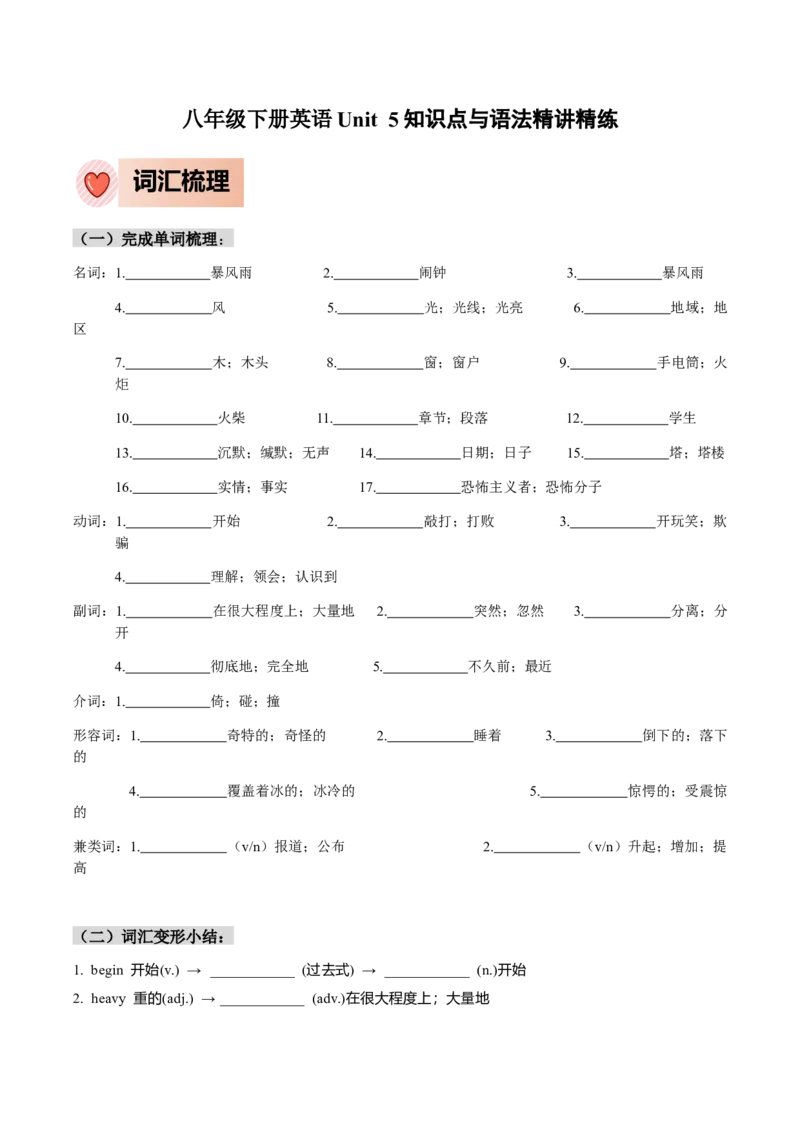
词汇梳理
(一)完成单词梳理:
名词:1. 暴风雨 2. 闹钟 3. 暴风雨
4. 风 5. 光;光线;光亮 6. 地域;地
区
7. 木;木头 8. 窗;窗户 9. 手电筒;火
炬
10. 火柴 11. 章节;段落 12. 学生
13. 沉默;缄默;无声 14. 日期;日子 15. 塔;塔楼
16. 实情;事实 17. 恐怖主义者;恐怖分子
动词:1. 开始 2. 敲打;打败 3. 开玩笑;欺
骗
4. 理解;领会;认识到
副词:1. 在很大程度上;大量地 2. 突然;忽然 3. 分离;分
开
4. 彻底地;完全地 5. 不久前;最近
介词:1. 倚;碰;撞
形容词:1. 奇特的;奇怪的 2. 睡着 3. 倒下的;落下
的
4. 覆盖着冰的;冰冷的 5. 惊愕的;受震惊
的
兼类词:1. (v/n)报道;公布 2. (v/n)升起;增加;提
高
(二)词汇变形小结:
1. begin 开始(v.) → ____________ (过去式) → ____________ (n.)开始
2. heavy 重的(adj.) → ____________ (adv.)在很大程度上;大量地3. sudden 突然的(adj.) → ____________ (adv.)突然
4. strange 陌生的(adj.) → ____________ (n.)陌生人
5. wind 风(n.) → ____________ (adj.)多风的
6. report 报告(v.) → ____________ (n.)记者
7. match 火柴(n.) → ____________ (复数)
8. beat 敲打(v.) → ____________ (过去式)
9. sleep 睡觉(v.) → ____________ (过去式) → ____________(adj.)睡着的→ ____________ (adj.)困倦
的
10. fall 下降;落下(v.) → ____________ (过去式) → ____________ (adj.)倒下的;落下的
11. ice 冰(n.) → ____________ (adj.)冰冷的
12. complete 完整的(adj.) → ____________ (adv.)彻底地;完全地
13. silent 沉默的(adj.) → ____________ (adv.)沉默地 → ____________ (n.)沉默
14. recent 最近的(adj.) → ____________ (adv.)最近
15. true 正确的(adj.) → ____________ (adv.)确实→ ____________ (n.)实情;事实
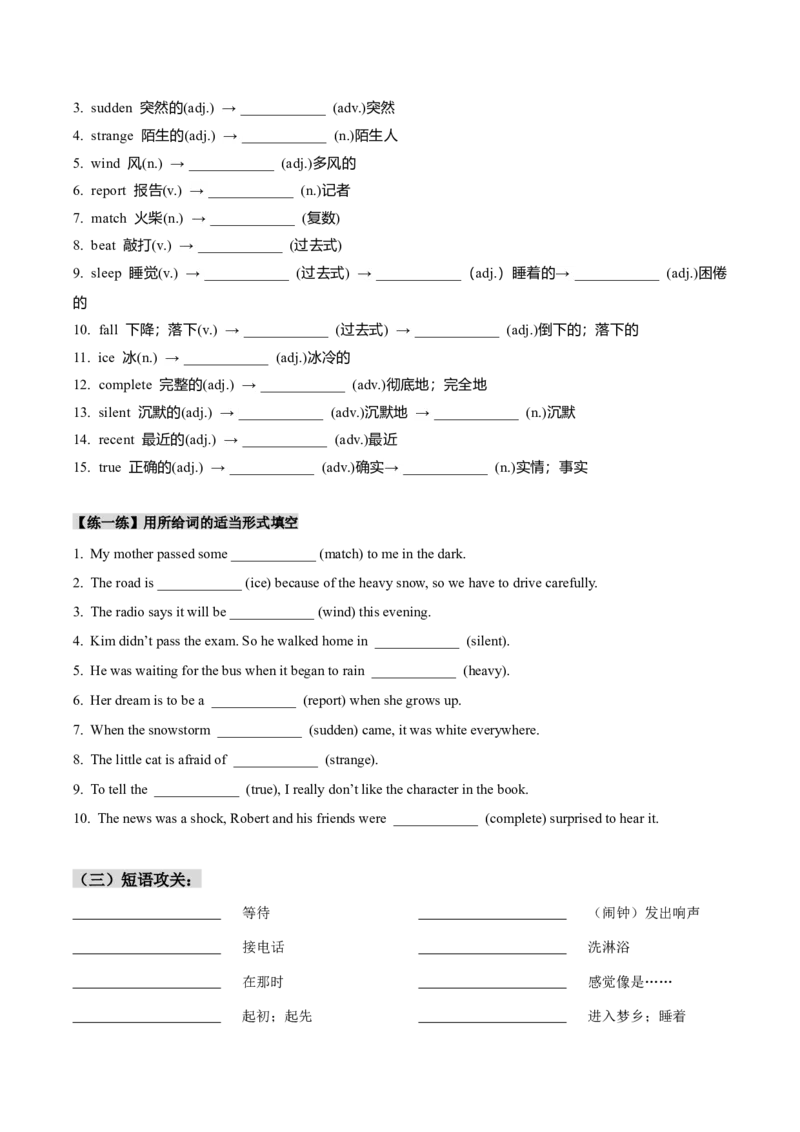
【练一练】用所给词的适当形式填空
1. My mother passed some ____________ (match) to me in the dark.
2. The road is ____________ (ice) because of the heavy snow, so we have to drive carefully.
3. The radio says it will be ____________ (wind) this evening.
4. Kim didn’t pass the exam. So he walked home in ____________ (silent).
5. He was waiting for the bus when it began to rain ____________ (heavy).
6. Her dream is to be a ____________ (report) when she grows up.
7. When the snowstorm ____________ (sudden) came, it was white everywhere.
8. The little cat is afraid of ____________ (strange).
9. To tell the ____________ (true), I really don’t like the character in the book.
10. The news was a shock, Robert and his friends were ____________ (complete) surprised to hear it.
(三)短语攻关:
等待 (闹钟)发出响声
接电话 洗淋浴
在那时 感觉像是……
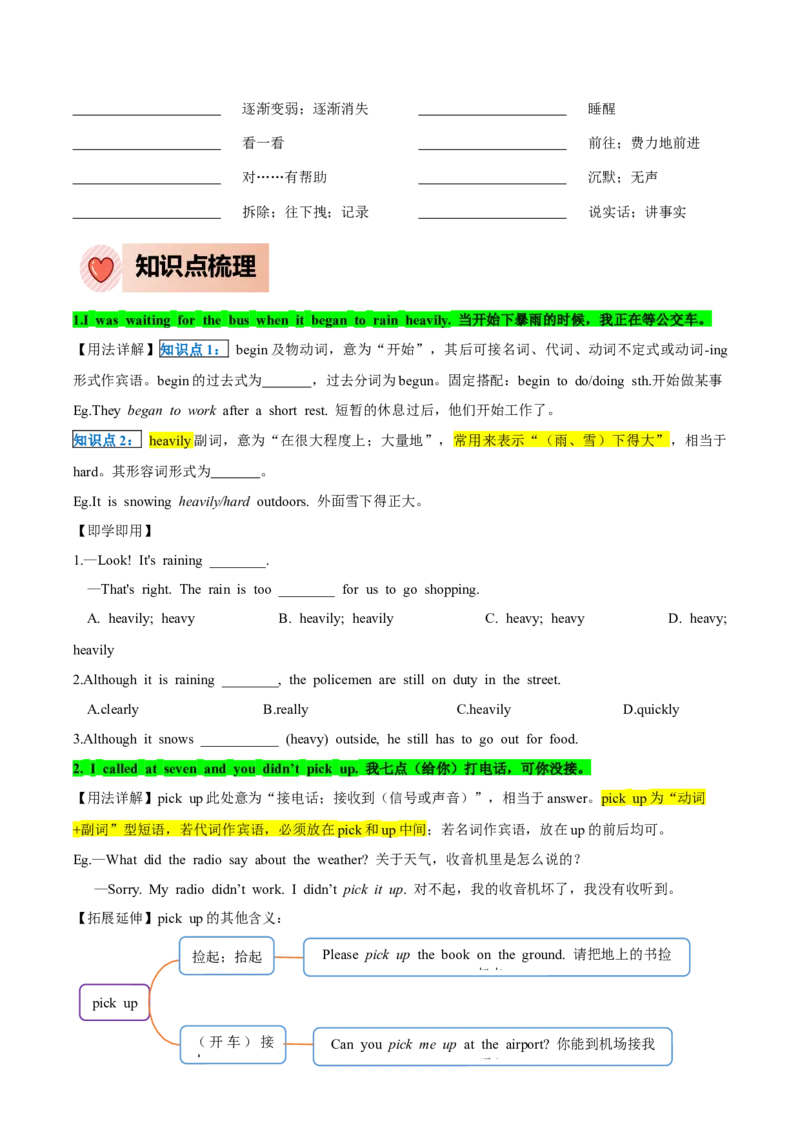
起初;起先 进入梦乡;睡着逐渐变弱;逐渐消失 睡醒
看一看 前往;费力地前进
对……有帮助 沉默;无声
拆除;往下拽;记录 说实话;讲事实
知识点梳理
1.I was waiting for the bus when it began to rain heavily. 当开始下暴雨的时候,我正在等公交车。
【用法详解】知识点1: begin及物动词,意为“开始”,其后可接名词、代词、动词不定式或动词-ing
形式作宾语。begin的过去式为 ,过去分词为begun。固定搭配:begin to do/doing sth.开始做某事
Eg.They began to work after a short rest. 短暂的休息过后,他们开始工作了。
知识点2: heavily副词,意为“在很大程度上;大量地”,常用来表示“(雨、雪)下得大”,相当于
hard。其形容词形式为 。
Eg.It is snowing heavily/hard outdoors. 外面雪下得正大。
【即学即用】
1.—Look! It's raining ________.
—That's right. The rain is too ________ for us to go shopping.
A. heavily; heavy B. heavily; heavily C. heavy; heavy D. heavy;
heavily
2.Although it is raining ________, the policemen are still on duty in the street.
A.clearly B.really C.heavily D.quickly
3.Although it snows ___________ (heavy) outside, he still has to go out for food.
2. I called at seven and you didn’t pick up. 我七点(给你)打电话,可你没接。
【用法详解】pick up此处意为“接电话;接收到(信号或声音)”,相当于answer。pick up为“动词
+副词”型短语,若代词作宾语,必须放在pick和up中间;若名词作宾语,放在up的前后均可。
Eg.—What did the radio say about the weather? 关于天气,收音机里是怎么说的?
—Sorry. My radio didn’t work. I didn’t pick it up. 对不起,我的收音机坏了,我没有收听到。
【拓展延伸】pick up的其他含义:
捡起;拾起 Please pick up the book on the ground. 请把地上的书捡
起来。
pick up
(开车)接 Can you pick me up at the airport? 你能到机场接我
人 吗?【即学即用】
1.This afternoon, on the way home he found some money on the ground and ________.
A. picked them up B. picked it up C. picked up them D.
picked up it
2.When he saw a wallet, he ________ at once.
A.picked it up B. gave it up C. picked up it D. picked
up
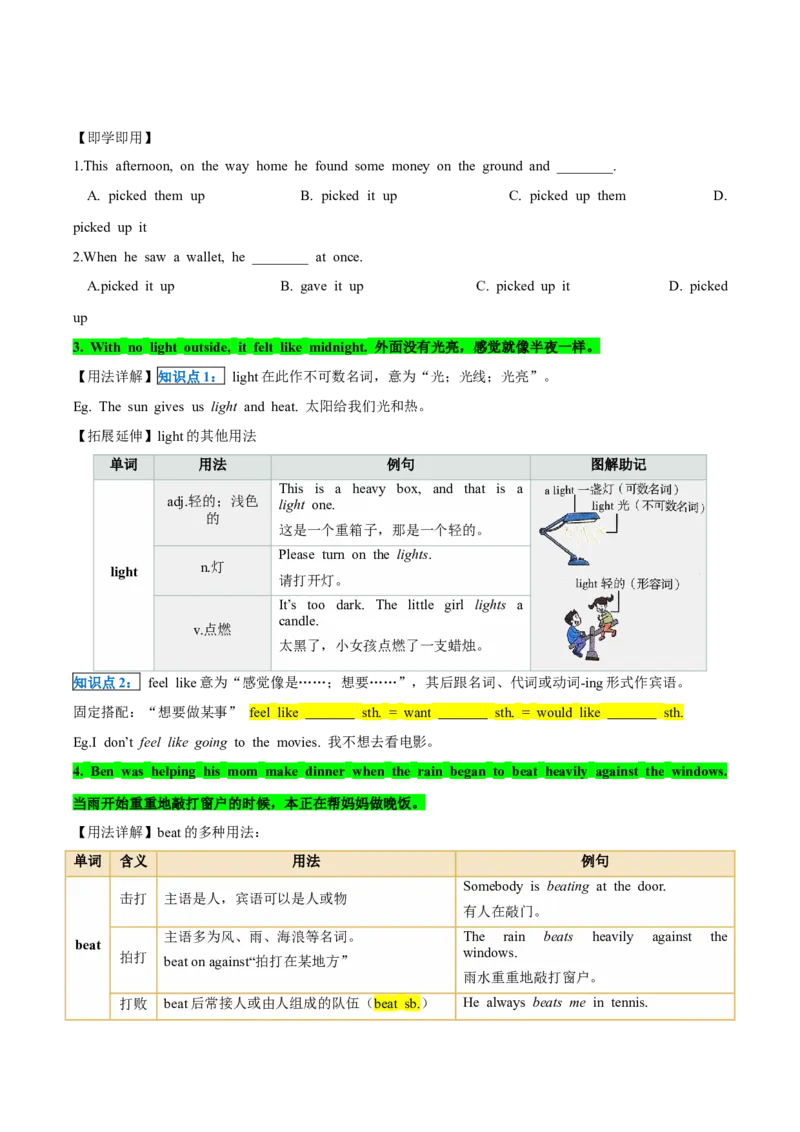
3. With no light outside, it felt like midnight. 外面没有光亮,感觉就像半夜一样。
【用法详解】知识点1: light在此作不可数名词,意为“光;光线;光亮”。
Eg. The sun gives us light and heat. 太阳给我们光和热。
【拓展延伸】light的其他用法
单词 用法 例句 图解助记
This is a heavy box, and that is a
adj.轻的;浅色
light one.
的
这是一个重箱子,那是一个轻的。
Please turn on the lights.
n.灯
light
请打开灯。
It’s too dark. The little girl lights a
candle.
v.点燃
太黑了,小女孩点燃了一支蜡烛。
知识点2: feel like意为“感觉像是……;想要……”,其后跟名词、代词或动词-ing形式作宾语。
固定搭配:“想要做某事” feel like sth. = want sth. = would like sth.
Eg.I don’t feel like going to the movies. 我不想去看电影。
4. Ben was helping his mom make dinner when the rain began to beat heavily against the windows.
当雨开始重重地敲打窗户的时候,本正在帮妈妈做晚饭。
【用法详解】beat的多种用法:
单词 含义 用法 例句
Somebody is beating at the door.
击打 主语是人,宾语可以是人或物
有人在敲门。
主语多为风、雨、海浪等名词。 The rain beats heavily against the
beat
拍打 beat on against“拍打在某地方” windows.
雨水重重地敲打窗户。
打败 beat后常接人或由人组成的队伍(beat sb.) He always beats me in tennis.他打网球总是赢我。
win 表示赢得比赛、奖牌、奖杯等,通常 If we win the match, we will be the
match, competition, game, prize 等搭配(win champion.如果我们赢了比赛,我们就是冠
sth.) 军。
【拓展延伸】against介词,意为“倚;碰;撞”,还可表示“反对;对抗”,其反义词为for。常用搭配:
be against (doing) sth.“反对(做)某事”;play against sb. “与某人比赛”。
Eg.He stood against the door. 他倚着门站着。
Are you for or against the plan? 你是支出还是反对这个计划?
She is against smoking at home. 她反对在家抽烟。
【即学即用】
1.I’m _________ buying the coat because it is too expensive.
A.against B.upon C.for D.at
2.—What was the result of the soccer game yesterday?
—Our team finally ________ the one from another school.
A.broke B.won C.developed D.beat
3.Our school basketball team will _________ (win/beat) the next match if they practise more.
4.I'm against _________ (make) a plan like this.
5. He finally fell asleep when the wind was dying down at around 3:00 a.m.大约在凌晨三点风逐渐减
弱的时候,他总算睡着了。
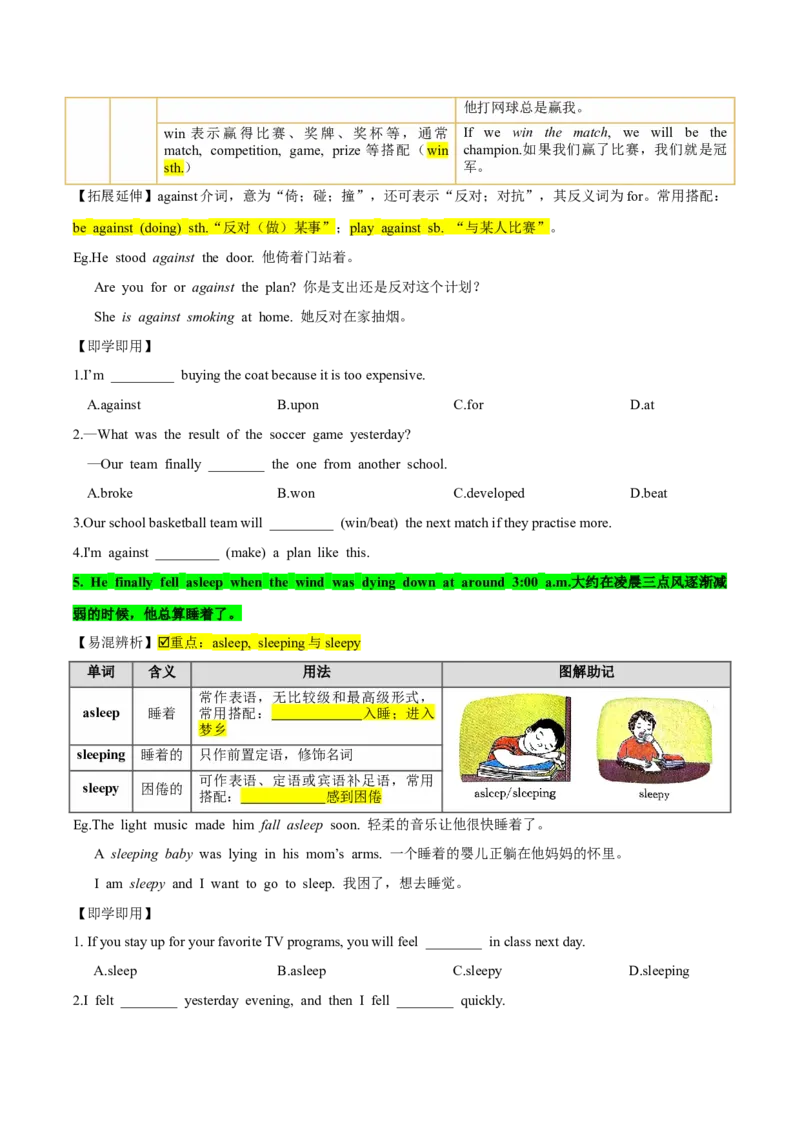
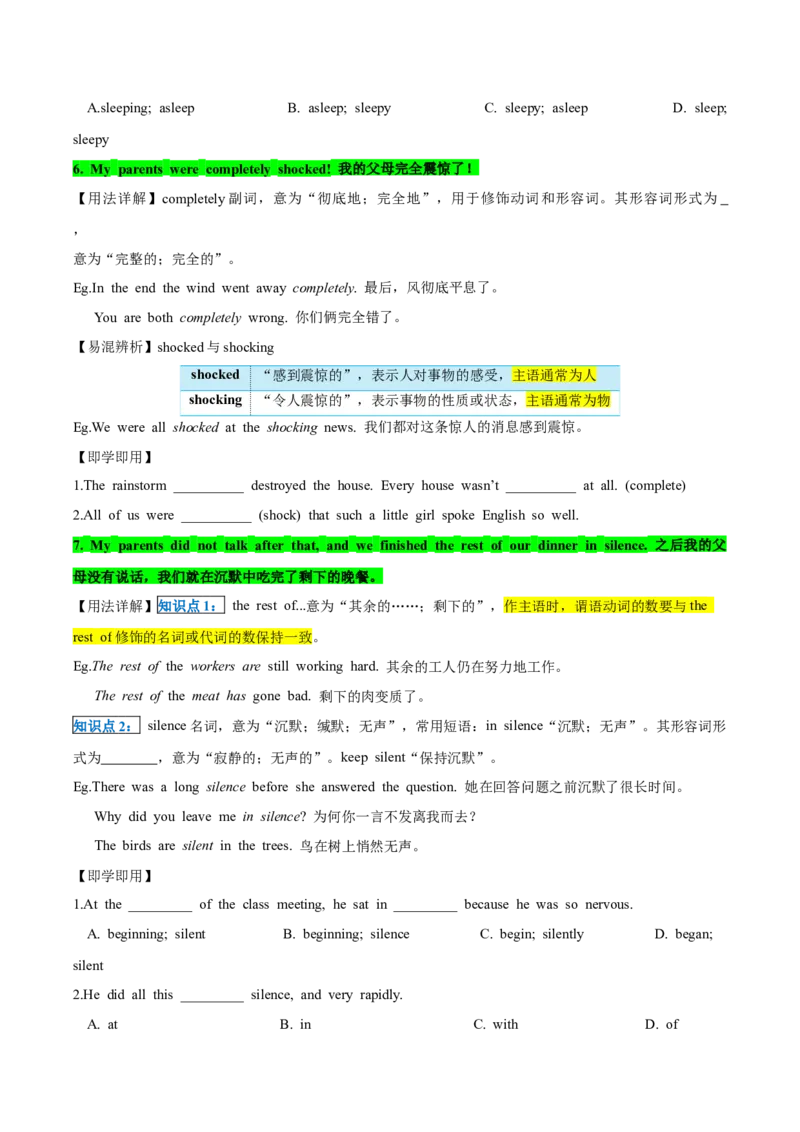
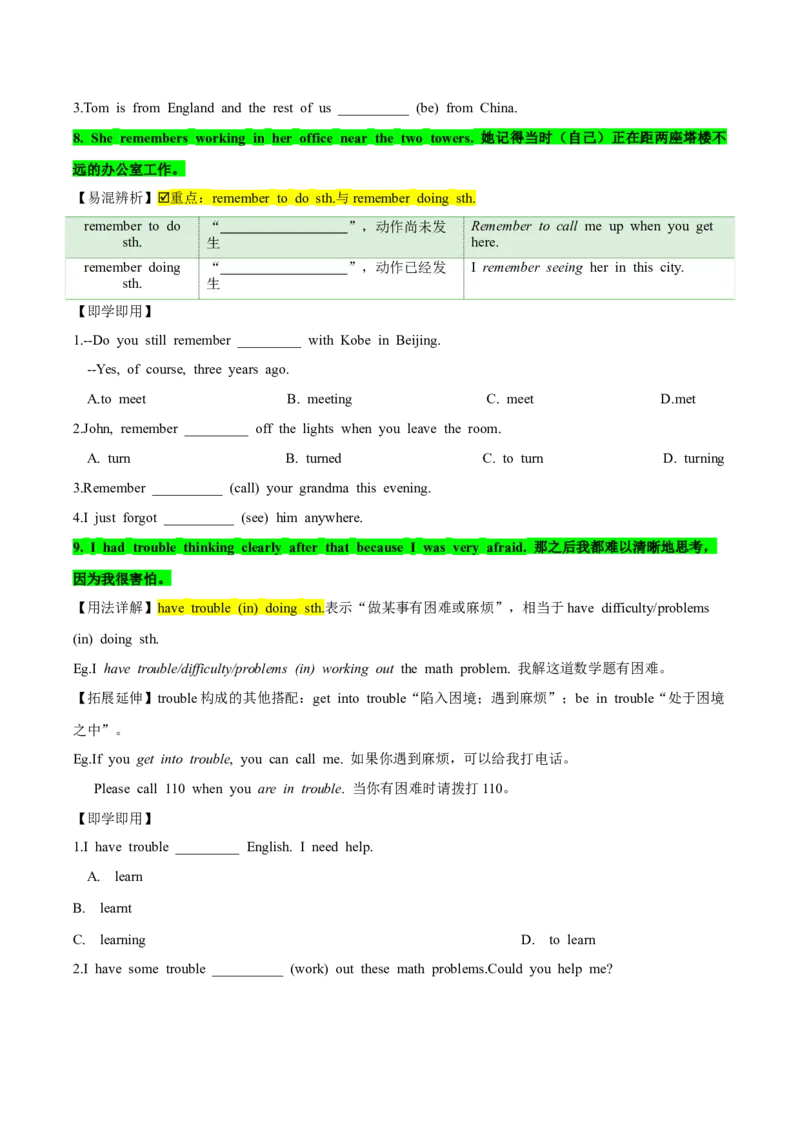
【易混辨析】重点:asleep, sleeping与sleepy
单词 含义 用法 图解助记
常作表语,无比较级和最高级形式,
asleep 睡着 常用搭配: 入睡;进入
梦乡
sleeping 睡着的 只作前置定语,修饰名词
可作表语、定语或宾语补足语,常用
sleepy 困倦的
搭配: 感到困倦
Eg.The light music made him fall asleep soon. 轻柔的音乐让他很快睡着了。
A sleeping baby was lying in his mom’s arms. 一个睡着的婴儿正躺在他妈妈的怀里。
I am sleepy and I want to go to sleep. 我困了,想去睡觉。
【即学即用】
1. If you stay up for your favorite TV programs, you will feel ________ in class next day.
A.sleep B.asleep C.sleepy D.sleeping
2.I felt ________ yesterday evening, and then I fell ________ quickly.A.sleeping; asleep B. asleep; sleepy C. sleepy; asleep D. sleep;
sleepy
6. My parents were completely shocked! 我的父母完全震惊了!
【用法详解】completely副词,意为“彻底地;完全地”,用于修饰动词和形容词。其形容词形式为
,
意为“完整的;完全的”。
Eg.In the end the wind went away completely. 最后,风彻底平息了。
You are both completely wrong. 你们俩完全错了。
【易混辨析】shocked与shocking
shocked “感到震惊的”,表示人对事物的感受,主语通常为人
shocking “令人震惊的”,表示事物的性质或状态,主语通常为物
Eg.We were all shocked at the shocking news. 我们都对这条惊人的消息感到震惊。
【即学即用】
1.The rainstorm __________ destroyed the house. Every house wasn’t __________ at all. (complete)
2.All of us were __________ (shock) that such a little girl spoke English so well.
7. My parents did not talk after that, and we finished the rest of our dinner in silence. 之后我的父
母没有说话,我们就在沉默中吃完了剩下的晚餐。
【用法详解】知识点1: the rest of...意为“其余的……;剩下的”,作主语时,谓语动词的数要与the
rest of修饰的名词或代词的数保持一致。
Eg.The rest of the workers are still working hard. 其余的工人仍在努力地工作。
The rest of the meat has gone bad. 剩下的肉变质了。
知识点2: silence名词,意为“沉默;缄默;无声”,常用短语:in silence“沉默;无声”。其形容词形
式为 ,意为“寂静的;无声的”。keep silent“保持沉默”。
Eg.There was a long silence before she answered the question. 她在回答问题之前沉默了很长时间。
Why did you leave me in silence? 为何你一言不发离我而去?
The birds are silent in the trees. 鸟在树上悄然无声。
【即学即用】
1.At the _________ of the class meeting, he sat in _________ because he was so nervous.
A. beginning; silent B. beginning; silence C. begin; silently D. began;
silent
2.He did all this _________ silence, and very rapidly.
A. at B. in C. with D. of3.Tom is from England and the rest of us __________ (be) from China.
8. She remembers working in her office near the two towers. 她记得当时(自己)正在距两座塔楼不
远的办公室工作。
【易混辨析】重点:remember to do sth.与remember doing sth.
remember to do “ ”,动作尚未发 Remember to call me up when you get
sth. 生 here.
remember doing “ ”,动作已经发 I remember seeing her in this city.
sth. 生
【即学即用】
1.--Do you still remember _________ with Kobe in Beijing.
--Yes, of course, three years ago.
A.to meet B. meeting C. meet D.met
2.John, remember _________ off the lights when you leave the room.
A. turn B. turned C. to turn D. turning
3.Remember __________ (call) your grandma this evening.
4.I just forgot __________ (see) him anywhere.
9. I had trouble thinking clearly after that because I was very afraid. 那之后我都难以清晰地思考,
因为我很害怕。
【用法详解】have trouble (in) doing sth.表示“做某事有困难或麻烦”,相当于have difficulty/problems
(in) doing sth.
Eg.I have trouble/difficulty/problems (in) working out the math problem. 我解这道数学题有困难。
【拓展延伸】trouble构成的其他搭配:get into trouble“陷入困境;遇到麻烦”;be in trouble“处于困境
之中”。
Eg.If you get into trouble, you can call me. 如果你遇到麻烦,可以给我打电话。
Please call 110 when you are in trouble. 当你有困难时请拨打110。
【即学即用】
1.I have trouble _________ English. I need help.
A. learn
B. learnt
C. learning D. to learn
2.I have some trouble __________ (work) out these math problems.Could you help me?课堂小测
一、单项选择
1.–Tom, why were you late again?
–I was late because my alarm clock didn’t _______.
A.go out B.go off C.go back D.go away
2.—Why didn't you come to my birthday party yesterday?
—Sorry, I was so busy that I _______ forgot it.
A. suddenly B. completely C. recently D. quietly
3.–Does Zhou Qi play _______ the Houston Rockets?
–Yes, and his team is going to play _______ the Lakers next week.
A.for; with B.with; for C.for; against D.against; for
4.–You look very tired.
–Yeah. Last night I went to _______ very early, but I didn’t fall _______ until 12:00p.m.
A.sleep; sleep B.asleep; asleep C.sleep; asleep D.asleep;
sleep
5.—Jack, remember _______ your umbrella with you and don’t forget _______ it home.
—OK, Mom.
A. taking; bringing B. take; bring C. to bring; to take D. to take;
to bring
6.The Chinese national women’s badminton team _______ the Japanese team by 3:1 on May.
A.won B.wins C.beat D.beats
7.–Would you mind _______ the eraser for me?
–No, not at all.
A. pick up B. putting up C. put up D. picking
up
8.---Look!It's raining _______.
---That's right. The rain is too _______ to go shopping.A. heavily; heavy B. heavily; heavily C. heavy; heavy D. heavy;
heavily
9.I have trouble _______ the work without help.
A. finish B. to finish C. finishing D. finished
10.–I saw a UFO land in my garden last night!
-- _______! It must be in your dreams!
A. That’s nothing B. You’re lucky C. Isn’t that usual D. You’re
kidding
11.—I didn't _______ that Jim was unhappy when I left.
—That's not a big deal. But you have to explain to him later.
A. cause B. guess C. push D. realize
12.The teacher told us a piece of bad news. When we heard the news, we were all _______ silence.
A.for B.in C.with D.by
13.We were all _______ when we heard that a plane crashed with 132 people on it.
A.interested B.shocking C.hungry D.shocked
14.—There aren't many tickets left for the concert. You’d better _______ to get one today.
—I'll go to the book office at once.
A. take part B. get down C. make sure D. pick up
15.—Is it _______ that he missed the bus?
—No, he didn't tell the _______. He was late because he got up late.
A. true; truth B. real; truth C. true; matter D. real;
matter
二、用所给词的适当形式填空
1. She also put some candles and ___________ (match) on the table.
2. Ben was helping his mom make dinner when the rain began to beat ___________ (heavy) against the
windows.
3. The little kid was so tired that he fell ___________ (sleep) right away.
4. I will tell you the ___________(true) when you come to my office next time.
5. The baby is sleeping. You should walk into the room in ___________ (silent).
6. The boy ___________(sudden) fell onto the ground and cried loudly.
7. I had trouble ___________ (think) clearly after that because I was very afraid.8. It was snowing when we made ___________ (we) way to my grandpa’s house.
9. After the rainstorm, ___________ (fall) trees and broken windows were everywhere.
10. I remembered ___________ (see) him somewhere in Shanghai.
三、完形填空
I looked at my watch. It was ten to six. There was just ten minutes left before we 1 leave for home.
Suddenly the earth began to shake. In no time the shake became very 2 . “Earthquake (地震)!” someone
shouted. I 3 the others to the door but we couldn’t get out. I stayed under a desk, covering my head and neck
with my arms. “Will someone save me 4 the building falls down? Is this the end for me?” I kept thinking
about that.
Several minutes 5 the shake stopped. Two of my workmates tried to open the door again, and they made
it! We ran quickly to the street. It was such a(n) 6 that we couldn’t believe our eyes — the street was full of
debris (碎片) and broken wood. More and more people came out and many were injured (受伤的). Lots of them
did 7 but look up into the sky in shock.
We walked a long way home not saying much. Some were praying (祈祷) and some were crying. 8 in
such a situation was difficult. Our phones didn’t work because of the earthquake. So it was 9 to find out if
our friends were okay. I had no way of letting my family in China 10 that I was still alive (活着) . I just
hoped that they wouldn’t hear about the earthquake until tomorrow.
( )1. A. could B. couldn’t C. need D. needn’t
( )2. A. tall B. far C. strong D. easy
( )3. A. helped B. allowed C. followed D. waited
( )4. A. since B. while C. until D. if
( )5. A. ago B. before C. later D. after
( )6. A. mess B. accident C. problem D. mistake
( )7. A. everything B. anything C. something D. nothing
( )8. A. Communication B. Notice C. Discussion D. Report
( )9. A. normal B. impossible C. necessary D. important
( )10. A. feel B. remember C. imagine D. know
四、阅读理解
When I was young, I liked to play jokes on people I knew, especially on my parents and friends.
One day my mother was cooking and I was playing with my younger brother Tony. Suddenly I ran to
my mother and said: “Tony fell from the open window!”She was very worried and ran out of thekitchen. Then I said:“Don’t worry, I’m just joking.”My mother shouted at me,“If you do it again, I’ll
hit you.”
Another day I went swimming with my friends in the sea. I wanted to play a joke on them. In the
beginning I swam fast and I called out“Help!”All my friends came to help me. However, they found
that I was joking. But half an hour later I wasn’t joking. I was so fast, soon I got tired and couldn’t
swim on in water. I tried my best to call my friends for help, but this time nobody came to help me.
In the end they found I was telling the truth. They came and saved my life. They took me to the
hospital. This is the best lesson in my life. From then on I haven’t joked on anyone.
( )1. When he was young, the writer liked to _________.
A. play with his brother B. help his mother cook
C. play jokes on people D. go swimming with his friends
( )2. What happened when the writer was playing with his brother?
A. He got tired. B. He played a joke on his mother.
C. Tony fell from the open window. D. His mother hit him.
( )3. In the beginning, all his friends came to help him because he _________.
A. swam fast B. called for help
C. would sink in water D. couldn’t swim on in the water
( )4. When the writer called his friends for help for the second time, they _________.
A. took him to the hospital at once B. came and saved him immediately
C. thought at first he was joking again D. did nothing because the writer had lied to
them
( )5. The story tells us that _________.
A. swimming is dangerous
B. the writer is a naughty boy
C. one can play jokes only on people he knows
D. if someone always tells lies, others won’t trust (信任) him
五、将下列句子中汉语部分译成英语,注意使用适当形式。
1.The wind _________________ when I got up this morning.(逐渐变弱)
2.My alarm didn’t _________________ so I got ump late.(发出响声)
3.When the rainstorm came, I _________________ to school.(费力地前进)
4.My parents always tell me to eat meals _________________.(无声)5. I called at seven and you didn’t _________________.(接电话)
6.We _________________ the Chinese dream will come true in the near future.(确信)
7. _________________, I dislike English and thought it was difficult. But now I am interested in it.(起
初)
8.It’s said that people will _________________ that old building.(拆除)
9.I finally _________________ when the rain stopped.(进入梦乡)
10.He isn’t an honest man, and he still doesn’t _________________ about the event.(说出事实)
语法精讲
过去进行时
一、语法概述
过去进行时表示过去某一时刻或某一阶段正在进行的动作,其基本结构为“was/were+动词-ing形式”。
二、过去进行时的基本句式
句式 构成 例句
主语+ +其他 The girl was shopping when I saw
肯定句
her.
主语+ +其他 The girl wasn’t shopping when I saw
否定句
her.
___________ +主语+ ___________ +其他? —Was the girl shopping when I saw
her?
肯定回答 Yes, 主语+ ______/______.
一般疑问句
—Yes, she was.
否定回答 No, 主语+ ______/______.
No, she wasn’t.
特殊疑问词+ was/were +主语+动词-ing 形式+其 What was the girl doing when I saw
特殊疑问句
他? her?
三、过去进行时的基本用法
用法 时间标志
表示过去某一段时间内 常用时间状语:this morning, the whole morning/night, all day yesterday, all
正在进行的动作 night, from 10:00 to 12:00 yesterday, in those days等
表示过去某一时刻正在 常用时间状语:at that time, at this time yesterday, at 3 o’clock yesterday
发生的动作 afternoon等
表示过去某个动作发生 与when引导的时间状语从句连用(主句用 时,从句用
时,另一个动作正在进 时)行 与while引导的时间状语从句连用(主句用 时,从句用
时)
表示过去某两个延续性
多与while引导的时间状语从句连用
动作同时进行
Eg.I was watching TV the whole night. 整个晚上我都在看电视。
Miss Li was shopping at this time yesterday. 昨天这个时候李小姐正在购物。
The students were reading when the teacher came in. 老师进来时学生们正在读书。
While he was reading, the telephone rang. 他正在看书时电话铃响了。
I was cleaning my bedroom while my mother was cooking. 我打扫卧室的时候妈妈在做饭。
四、过去进行时的特殊用法
用法 示例
与go, come, leave, start等瞬间动词 She was leaving for Shanghai then. 那时候她就要动身去上海
连用时,过去进行时表示过去即将 了。
发生的动作
He said the early bus was coming. 他说早班车就要来了。
与 always, often 等频度副词连用 The baby was always crying. 那个婴儿总是哭。(表示抱怨)
时,表示对过去某件事的埋怨、讨
Why were you always getting up late last week? 你上周怎么
厌、赞扬或喜爱,并不强调动作正
老是起床很晚?(表示埋怨)
在进行
【即学即用】
一、句型转换,每空一词。
1.The girl was talking with her classmates. Her mother called her. (合并为一句)
The girl ________ ________ with her classmates ________ her mother ________ her.
2.David was writing a report at ten yesterday morning.(改为否定句)
David ________ ________ a report at ten yesterday morning.
3.The children were laughing loudly at that time.(改为一般疑问句,并作肯定回答)
________ the children ________ loudly at that time?
Yes, ________ ________. .
4.We were waiting for the bus at the time of the rainstorm.(对画线部分提问)
________ ________ you ________ at the time of the rainstorm?
5.They took a walk in the park yesterday.(用at 7:00 yesterday evening改写句子)
They ________ ________ a walk in the park at 7:00 yesterday evening.
二、根据汉语意思及英文提示翻译句子
1.昨天下午三点半,我们正在上音乐课。(lesson)
_______________________________________________________________________________.
2.当我看到他的时候,他正在给他的妈妈打电话。(saw, calling)_______________________________________________________________________________.
3.昨天晚上七点,他们正在家里看电视。(watching)
_______________________________________________________________________________.
语法小测
一、单项选择
1.I _______ on the computer when Frank called me last night.
A.work B.will work C.was working D.am
working
2.—I called you yesterday afternoon, but you didn't pick up.
—Sorry. I _______ an online class at that time.
A.take B.took C.is taking D.was taking
3.While the lights _______ to red, a car suddenly appeared around the corner.
A.change B.have changed C.were changing D.will
change
4.The Greens _______TV together from 5:00 to 7:00 yesterday evening.
A.is watching B.are watching C.was watching D.were
watching
5.The woman with her daughter _______ in that mall when she saw the boy fall down.
A.shopped B.was shopping C.were shopping D.is
shopping
6. _______ Linda’s mother was reading newspaper, her father was doing dishes.
A.When B.While C.Before D.Until
7.(湖北裹阳中考)—Lucy, what were you doing at nine last night?
—I _______ the piano. I usually practice the piano at that time.
A.play B. played C. was playing D. am playing
8._______ we came back to school, Dale was playing the violin.
A. When B. While C. Until D. After
9.—Were you eating dinner at the time of the rainstorm?
—_______. I was reading a book about plants.
A. Yes, I did B. No, I wasn’t C. Yes, I was D. No, I didn’t
10.My father was reading a newspaper while my mother _______ dinner.A. is cooking B. cooks C. was cooking D. will cook
11.–What was your brother doing at this time yesterday?
- He was reading a magazine _______ I was writing an e-mail at home.
A. as soon as B. after C. until D. while
12.Listen, our teachers _______ Red Songs in the next room.
A. sings B. are singing C. is singing D.
sang
13.—_______ I was doing my homework, what were you doing?
—I was _______ a hot shower.
A.While; taking B.Before; taking C.When; take D.When;
took
14.—What was your dad doing at nine yesterday?
—He was reading a book _______ I was playing the piano.
A.until B.while C.because D.if
15.(黑龙江齐齐哈尔中考) -What were you doing at this time yesterday?
-I _______ a movie named Lost in Russia directed by Xu Zheng.
A. was seeing B. saw C. am seeing
二、用所给词的适当形式填空
1.My father ___________ (read) a book at nine o'clock yesterday evening.
2.While I ___________ (shop) in the supermarket, my sister called me.
3.The old man was walking across the street slowly when I ___________ (see) him.
4.The girl ___________ (have) lunch with her friend at 11:45 a.m. yesterday.
5.Our teacher ___________ (give) us a lesson when Mario came into the classroom.
6.Look! Barry and Jim ___________ (wait) for the bus there.
7.I ran to the bus stop quickly but I still ___________ (miss) the bus.
8.What were you doing when the rainstorm ___________ (come)?
9.We didn't hear your phone because we ___________ (sing) then.
10.The rain was ___________ (beat) heavily against the window.
三、书面表达
某英文报社正在举办以“An Unforgettable Experience”为题的征文活动,请根据下列提示投稿,讲述一
下自己最难忘的经历。提示:When did it happen?Where did it happen?What were you doing?What were the others doing?Why
was it important?
要求:1.词数80词左右;
2.书写工整,句式规范,条理清楚,标点符号使用正确。