【赢在高考·黄金8卷】备战2024年高考英语模拟卷(广东专用)
黄金卷05
第一部分 阅读理解(共两节,满分50分)
第一节 (共15小题;每小题2.5分,共37.5分)
阅读下列短文,从每题所给的A、B、C和D四个选项中选出最佳选项。
A
Why pay for expensive language softwares when you can use dozens of language learning websites for free?
These websites can help you learn a new language just as expensive programs do.
Duolingo
Duolingo is one of the best places for learning a new language for free. The website is clear and easy to grasp
and you're motivated to learn through a virtual currency (货币) . At any time, you can switch to a different
language to start that course without losing your place in your current one.
Languages you can learn: English, German, Greek, Chinese.
Memrise
Memrise provides techniques for remembering each and every concept you run across. Some of these courses
are provided by Memrise and others are created by users like you. You collect points as you complete courses, and
there's a leaderboard you can use as inspiration to keep learning and compete with other members.
Languages you can learn: English, French, Duteh, Japanese.
Busuu
Busuu features beginner, elementary, and intermediate language learning lessons. You can skip to any lesson
you want and easily monitor the progress of all of them from one page. There's also a social tool that lets you chat
with native speakers of the language you're learning.
Languages you can learn: English, Italian, Korean, Russian.
123TeachMe
123TeachMe lets you learn Spanish for free with games, quizzes, lessons, and audio files. A Spanish
placement test can tell you where you should start learning if you're unsure. There are lots of free language
learning resources here, but if you want no ads and extra features, you can subscribe to the Premium Content
package.
Language you can learn: Spanish.
1. What can you do on Memrise?
A. Learn through a virtual currency. B. Establish your own courses.
C. Chat with a native speaker. D. Subscribe to a content package.
2. What can we learn about 123TeachMe?A. It is not free. B. It provides points.
C. It only offers Spanish. D. It requires membership.
3. Which website will those who interested in Greek choose?
A. Duolingo. B. Memrise. C. Busuu. D. 123TeachMe.
B
Frances McGlannan grew up in Baltimore, Maryland, and moved to Miami in the early 1950s with her
husband. The couple had two children, Michael and Genevieve, and by the time Michael entered elementary
school it was clear that he had difficulty reading.
She decided to tackle it and find out what it was herself because she wasn’t getting any answers to the
questions she was asking. McGlannan searched the library for information and started working at the University
of Miami Reading Clinic, where she tutored children and helped conduct research. She also founded the Dade
Reading Foundation, a volunteer group that shared information about dyslexia (阅读障碍) with teachers, parents
and the local school board.
In the early 1960s, McGlannan traveled to Europe, where she learned new techniques to help children
overcome learning disabilities. She also adapted multi-sensory techniques to help dyslexic children learn to read.
In 1964, MeGlannan founded the McGlannan School for children with dyslexia and related learning difficulties.
McGlannan did all of this while raising two children and often worked past midnight to get everything done.
However, balancing work and family wasn’t the only challenge McGlannan faced. She was also ridiculed by
educators and doctors who believed children with dyslexia couldn’t be taught. But McGlannan was not
discouraged. In addition to running the school, she convinced a publisher to start a scientific journal devoted to the
study of learning disabilities, where she served as one of the editors. She also helped pass the 1975 Education for
All Handicapped Children Act, which established the rights of children with disabilities. And in the 1980s,
McGlannan reached out to teachers and publications in Latin America to share information about dyslexia and
teaching techniques in Spanish.
McGlannan’s tireless efforts affected thousands of children in South Florida. Her legacy (遗产) continues
through her family and through her school. Her daughter Genevieve is an educator, and Michael and his wife help
run the McGlannan School. One of her grandchildren, who has dyslexia, even attended the school as a child.
4. What can we infer from the first two paragraphs?
A. McGlannan found a way to help her son out.
B. People knew little about dyslexia in the 1950s.
C. McGlannan was the first to study learning disabilities.
2
原创精品资源学科网独家享有版权,侵权必究!D. The Dade Reading Foundation funded research on dyslexia.
5. What was the attitude of experts to McGlannan’s work?
A. Unclear. B. Dismissive. C. Tolerant. D. Uncaring.
6. What is paragraph 4 mainly about?
A. The challenges that McGlannan had to face in her research.
B. McGlannan’s plans to change people’s attitude to education.
C. McGlannan’s efforts to help children with learning disabilities.
D. The measures that McGlannan took to teach children with dyslexia.
7. What is the purpose of the text?
A. To introduce a special school. B. To raise awareness of dyslexia.
C. To show the power of teamwork. D. To remember an education pioneer.
C
Wonder was published in February of 2012 and was R.J. Palacio’s first novel. One day Palacio took her son
to buy ice cream and saw him cry when a girl with facial birth deformities (畸形) sat next to him. Later, while
listening to Natalie Merchant’s song “Wonder”, Palacio reflected on the situation and began writing the novel,
hoping that a tense scene from her own life could turn into a valuable lesson.
The story centers around Auggie, a ten-year-old boy. Auggie doesn’t look like the rest of us. He was born
with a facial deformity that has caused the first person who ever sees him to faint (晕倒). When Auggie’s parents
sent him to a regular school, he must face the challenges of fitting in with his classmates and dealing with bullying
(霸凌) and exclusion. Along the way. Auggie makes new friends, learns to cope with his condition, and teaches
others about the power of acceptance and kindness.
The book is divided into several parts, each told by a different character, allowing the reader to see the events
through the eyes of various characters. The themes of acceptance, kindness, and family relationships are central to
the book’s messages. However, some readers may find the plot predictable, and others might want a more diverse
and inclusive cast of characters.
Despite this, Wonder is a beautifully written and deeply affecting book that offers a powerful message of
sympathy and acceptance. By exploring the experiences of Auggie and those around him, the book encourages
readers to see beyond appearances and embrace our differences. Its themes and messages are both timely and
timeless, and its impact on readers of all ages is undeniable.
8. Where did R.J. Palacio’s inspiration for Wonder come from?
A. Her son’s love for ice cream. B. A song for kids with deformities.
C. A story she read in a newspaper. D. Her encounter with a disabled girl.
9. What can we learn about Auggie from paragraph 2?A. He suffered a lot at school. B. He used to be a school bully.
C. He is unsociable at school. D. He dislikes the regular school.
10. What does the underlined word “this” in paragraph 4 refer to?
A. The simple theme. B. Wonder’s being beautifully written.
C. The predictable plot. D. Readers’ having different opinions.
11. What does the author think of Wonder?
A. Objective and plain. B. Touching and instructive.
C. Serious and hard to follow. D. Humorous and straightforward.
D
In agricultural, pre-industrial Europe, “you’d want to wake up early, start working with the sunrise, have a
break to have the largest meal, and then you’d go back to work,” says Ken Albala, a professor of history at the
University of the Pacific. “Later, at 5 or 6, you’d have a smaller supper.”
This comfortable cycle, in which the rhythms of the day helped shape the rhythms of the meals, gave rise to
the custom of the large midday meal, eaten with the extended family. “Meals are the foundation of the family,”
says Carole Counihan, a professor at Millersville University in Pennsylvania, “so there was a very important
interconnection between eating together and strengthening family ties.”
Since industrialization, maintaining such a slow cultural metabolism has been much harder, with the long
midday meal shrinking to whatever could be stuffed into a lunch bucket or bought at a food stand. Certainly, there
were benefits. Modern techniques for producing and shipping food led to greater variety and quantity, including a
dramatic increase in the amount of animal protein and dairy products available, making us stronger than our
ancestors.
Yet plenty has been lost too, even in cultures that still live to eat. Take Italy for example. It’s no secret that
the Mediterranean diet is healthy, but it was also a joy to prepare and eat. Italians, says Counihan, traditionally
began the day with a small meal. The big meal came at around 1 p.m. In between the midday meal and a late,
smaller dinner came a small snack. Today, when time zones have less and less meaning, there is little tolerance for
offices’ closing for lunch, and worsening traffic in cities means workers can’t make it home and back fast enough
anyway. So the formerly small supper after sundown becomes the big meal of the day, the only one at which the
family has a chance to get together. “The evening meal carries the full burden that used to be spread over two
meals,” says Counihan.
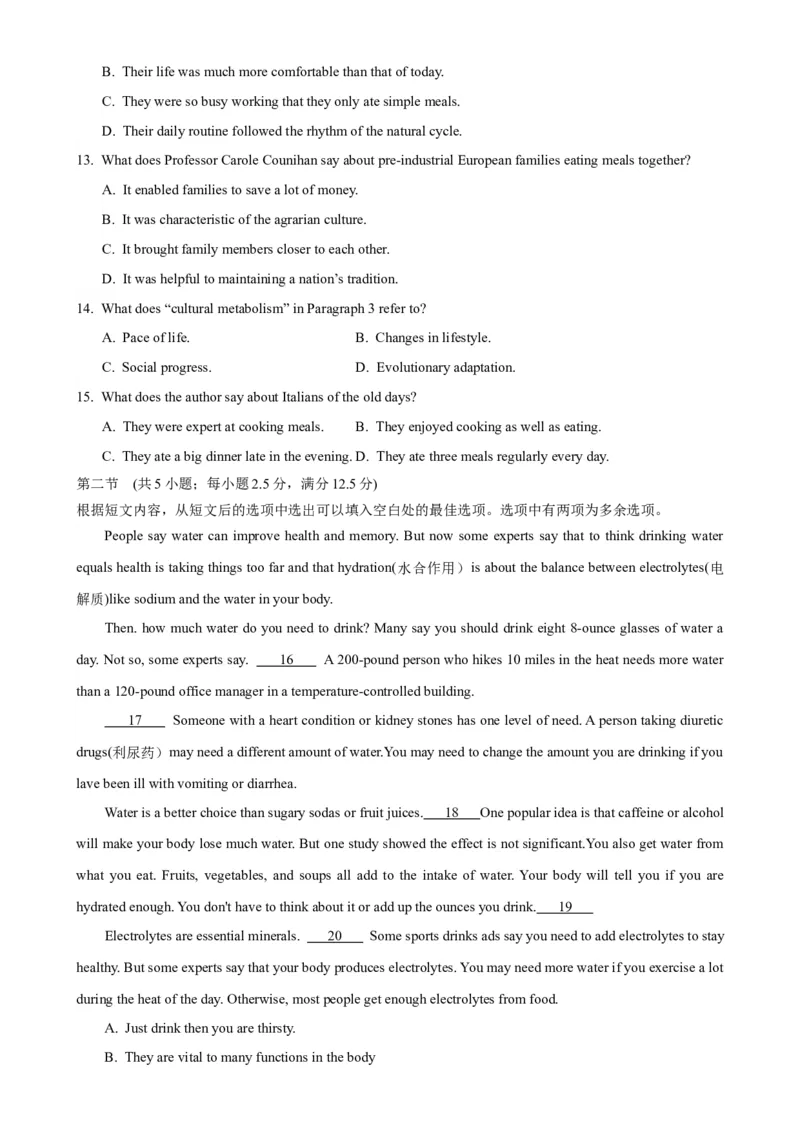
12. What do we learn about people in pre-industrial Europe?
A. They had to work from early morning till late at night.
4
原创精品资源学科网独家享有版权,侵权必究!B. Their life was much more comfortable than that of today.
C. They were so busy working that they only ate simple meals.
D. Their daily routine followed the rhythm of the natural cycle.
13. What does Professor Carole Counihan say about pre-industrial European families eating meals together?
A. It enabled families to save a lot of money.
B. It was characteristic of the agrarian culture.
C. It brought family members closer to each other.
D. It was helpful to maintaining a nation’s tradition.
14. What does “cultural metabolism” in Paragraph 3 refer to?
A. Pace of life. B. Changes in lifestyle.
C. Social progress. D. Evolutionary adaptation.
15. What does the author say about Italians of the old days?
A. They were expert at cooking meals. B. They enjoyed cooking as well as eating.
C. They ate a big dinner late in the evening.D. They ate three meals regularly every day.
第二节 (共5小题;每小题2.5分,满分12.5分)
根据短文内容,从短文后的选项中选出可以填入空白处的最佳选项。选项中有两项为多余选项。
People say water can improve health and memory. But now some experts say that to think drinking water
equals health is taking things too far and that hydration(水合作用)is about the balance between electrolytes(电
解质)like sodium and the water in your body.
Then. how much water do you need to drink? Many say you should drink eight 8-ounce glasses of water a
day. Not so, some experts say. 16 A 200-pound person who hikes 10 miles in the heat needs more water
than a 120-pound office manager in a temperature-controlled building.
17 Someone with a heart condition or kidney stones has one level of need. A person taking diuretic
drugs(利尿药)may need a different amount of water.You may need to change the amount you are drinking if you
lave been ill with vomiting or diarrhea.
Water is a better choice than sugary sodas or fruit juices. 18 One popular idea is that caffeine or alcohol
will make your body lose much water. But one study showed the effect is not significant.You also get water from
what you eat. Fruits, vegetables, and soups all add to the intake of water. Your body will tell you if you are
hydrated enough. You don't have to think about it or add up the ounces you drink. 19
Electrolytes are essential minerals. 20 Some sports drinks ads say you need to add electrolytes to stay
healthy. But some experts say that your body produces electrolytes. You may need more water if you exercise a lot
during the heat of the day. Otherwise, most people get enough electrolytes from food.
A. Just drink then you are thirsty.
B. They are vital to many functions in the bodyC. It gives you more energy and makes you look good.
D. Instead, your body and the activities you attend matter.
E. It is also necessary to set a timetable about when to drink water.
F. The amount of water you need in a day also depends on your health.
G. But when it comes to hydration, any drink can add water to your system.
第二部分 语言运用(共两节,满分30分)
第一节(共15小题;每小题1分,满分15分)
The last attempt of Ken Campbell to run could trace back to high school. When his wife, Susan, injured her
foot, she needed 21 to rejoin her running group, so Campbell went along to keep her company in the
22 . “We were just walking at the beginning,” he says, “I was heavy, and weighed over 90kg.” But as the weeks
and months passed, the weight fell away, Susan recovered and Campbell’s 23 grew. At the age of 63, he
ran 50km, and at 70, he 24 a 100km ultramarathon.
So how does someone with no 25 experience of running become an ultradistance runner in his 60s
and 70s? Susan had run marathons before her 26 , but for Campbell, the turning point came when Susan’s
Fleet Feet running group started the trails in the Sierra Nevada foothills near their home.
Campbell went out to visit Susan’s group, and “the trails were a terrible 27 . It had been raining, and I
was slipping, sliding and 28 . But I thought, well, I like this a lot.” What he liked above all was the feeling
of “being wrapped by the trail, being 29 by the closeness of the vegetation (植被) and the nearness of the
river”.
Running the 100km ultramarathon took Campbell 16 hours. When Campbell 30 the finish line at 3
am, Susan handed him a 100km sticker to 31 on the back of his truck. He already had a 50km one on
there. “It is a public 32 that you are part of this community,” he says. “Wherever we park, I see a line of
vehicles with their various stickers and I feel that we are a tribe (部落).”
Campbell suffered from arthritis (关节炎) before he started running, and was “a(n) 33 for knee
replacement”, but for now, he no longer needs a surgery. It can 34 the running ― but the “sense of well-
being and accomplishment will carry me on forever”, he says, “If I can’t run, I will 35 .”
21. A. arrangement B. operation C. confidence D. support
22. A. progress B. treatment C. recovery D. diagnosis
23. A. talent B. abilities C. experiences D. health
24. A. completed B. managed C. won D. joined
25. A. precious B. previous C. special D. sufficient
6
原创精品资源学科网独家享有版权,侵权必究!26. A. graduation B. growth C. injury D. attendance
27. A. practice B. atmosphere C. dream D. mess
28. A. sighing B. falling C. complaining D. moving
29. A. appreciated B. appealed C. embraced D. buried
30. A. approached B. accomplished C. divided D. crossed
31. A. remain B. advertise C. locate D. display
32. A. statement B. reminder C. truth D. expectation
33. A. target B. alternative C. candidate D. survivor
34. A. put an end to B. get involved in C. keep an eye on D. take advantage of
35. A. die B. walk C. stop D. cry
第二节 (共10小题;每小题1.5分,满分15分)
阅读下面短文,在空白处填入1个适当的单词或括号内单词的正确形式。
Machines work well at a constant speed ― and the faster the better. Whether they are spinning cotton 36
dealing with numbers, regular, repetitive actions are what they excel at.
Increasingly, our world is being designed by machines and for machines. We adapt to machines and hold
ourselves to their standards: People 37 (judge) by the speed at which they respond, not the quality of
their response. “Always on” becomes something to take pride 38 . When I ask people 39 they
are doing, they almost always answer “busy”. Ticking things off the “to do” list becomes 40 means of
defining ourselves. 41 (occupy) if not with work then with family or our social networks, most of us
feel exhausted.
A few years ago, I became very interested in what it meant 42 (pause). I started to notice where
pauses show up in my own work and life. For example, I realized when I was writing, a short walk was a(n) 43
(effective) way to focus than concentrating harder. The small walk acted as a pause, 44 (enable) me to
rest, reflect or refresh, appreciate and break a block in my 45 (creative). I realized that pause is not
nothing!
A minute eating ice-cream is not the same as a minute doing push-ups. Even time itself isn’t a uniform raw
material ― as the physics of Einstein shows.
第三部分 写作(共两节,满分40分)
第一节(满分15分)
46. 假定你是李华,你校准备在教学楼开设英文阅读吧 (English reading bar),请你给新西兰笔友Simon写
一封电子邮件,内容包括:
1. 说明情况:
2. 征求建议。
注意:1. 写作词数应为80左右;
2. 请在答题卡的相应位置作答。
Dear Simon,
___________________________________________________________________________________________
___________________________________________________________________________________________
___________________________________________________________________________________________
___________________________________________________________________________________________
___________________________________________________________________________________________
____________________
Yours,
Li Hua
第二节(满分25分)
阅读下面材料,根据其内容和所给段落开头语续写两段,使之构成一篇完整的短文。
The boy sat on his chair, with his hand above the keyboard. He thought about what to write.
He recalled that the competition deadline was merely a week away. But he still had not even started on his
piece. He looked at the brochure again. “WRITING COMPETITION!” the title read. His mom had encouraged
him to enter the writing competition, and now he was taking it on as his personal task for the holidays.
As the boy reflected on his previous writing efforts, he realized how hopeless his task of winning was. Every
story he ever wrote was based on other stories. He had little imagination, and unfortunately, imagination was the
key to writing.
Suddenly, he had a brainwave. This time, he came up with an original and imaginative story.
The words shot towards him like a storm of leaves. Words were coming easily, flowing through him, faster
than he could type. He typed faster than he ever had before. He continued to type, amazed at how easy writing this
story was. The boy could not stop writing. He looked at the word count and saw the number “248” staring right
back at him. He was not even halfway yet.
Then he heard the call of his mother saying time for bed. He continued writing the piece, ignoring her. He
had to make up for the time he had lost thinking about a topic to write. Finally, he finished. The word count now
read “498”.
“Perfect,” he thought, “just under the word limit.” He knew this was the story that would win.
He went onto Google and searched for the competition. He found the page but there was no “Enter” button.
Confused, he then re-read the page again. It read COMPETITION CLOSED.
注意:1. 续写词数应为 150 左右;
8
原创精品资源学科网独家享有版权,侵权必究!2. 请按如下格式在答题卡相应位置作答。
Paragraph 1:
After a few seconds, the boy eagerly checked the deadline of the COMPETITION on the website.
___________________________________________________________________________________________
___________________________________________________________________________________________
___________________________________________________________________________________________
___________________________________________________________________________________________
____________________________________
Paragraph 2:
His mother came up and comforted him.
___________________________________________________________________________________________
___________________________________________________________________________________________
___________________________________________________________________________________________
___________________________________________________________________________________________
____________________________________