绝密★启用前
2001年全国硕士研究生招生考试
英语
(科目代码:201)
☆考生注意事项☆
1. 答题前,考生须在试题册指定位置上填写考生编号和考生姓名;在答题卡
指定位置上填写报考单位、考生姓名和考生编号,并涂写考生编号信息点。
2. 考生须把试题册上的“试卷条形码”粘贴条取下,粘贴在答题卡的“试卷
条形码粘贴位置”框中。不按规定粘贴条形码而影响评卷结果的,责任由
考生自负。
3. 选择题的答案必须涂写在答题卡相应题号的选项上,非选择题的答案必须
书写在答题卡指定位置的边框区域内。超出答题区域书写的答案无效;在
草稿纸、试题册上答题无效。
4. 填(书)写部分必须使用黑色字迹签字笔书写,字迹工整、笔迹清楚;涂
写部分必须使用2B铅笔填涂。
5. 考试结束,将答题卡和试题册按规定交回。
(以下信息考生必须认真填写)
考生编号
考生姓名2001 年全国硕士研究生入学统一考试英语试题
Section I Use of English
Directions:
For each numbered blank in the following passage, there are four choices marked [A], [B], [C], and
[D]. Choose the best one and mark your answer on ANSWER SHEET 1 by blackening the
correspondingletterinthebracketswithapencil.(10points)
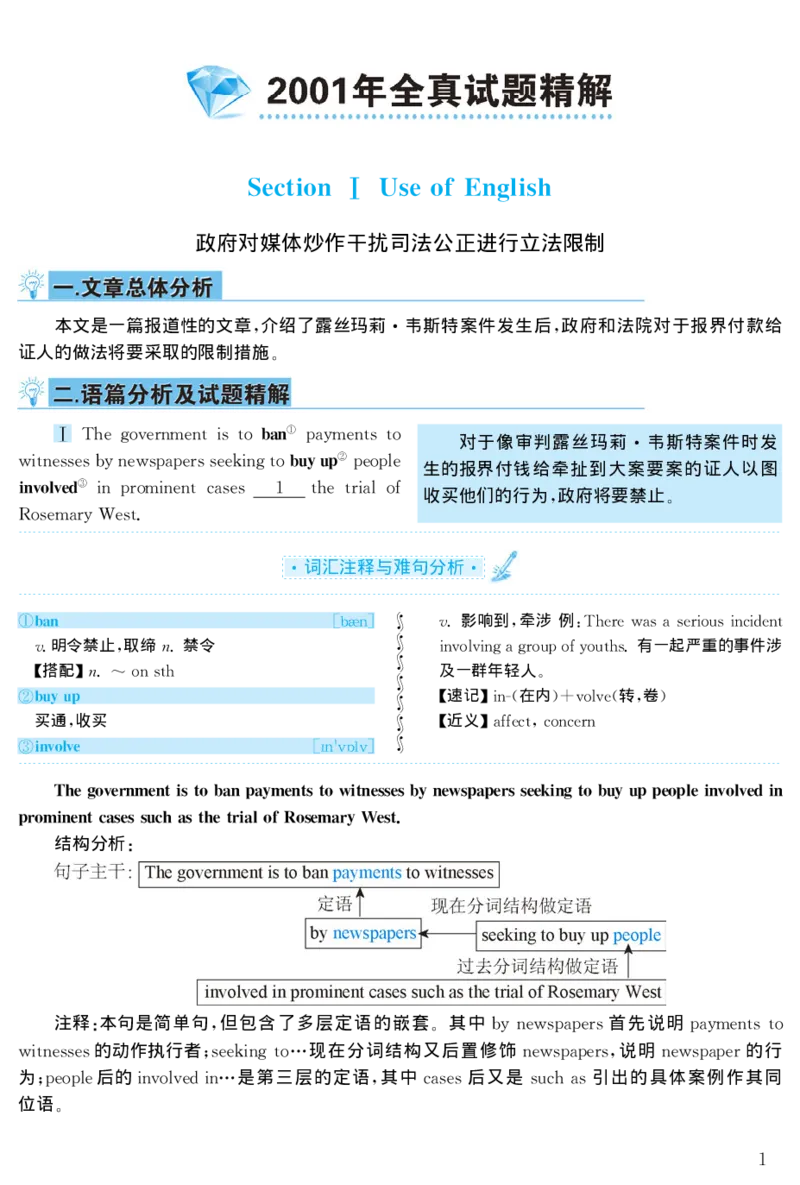
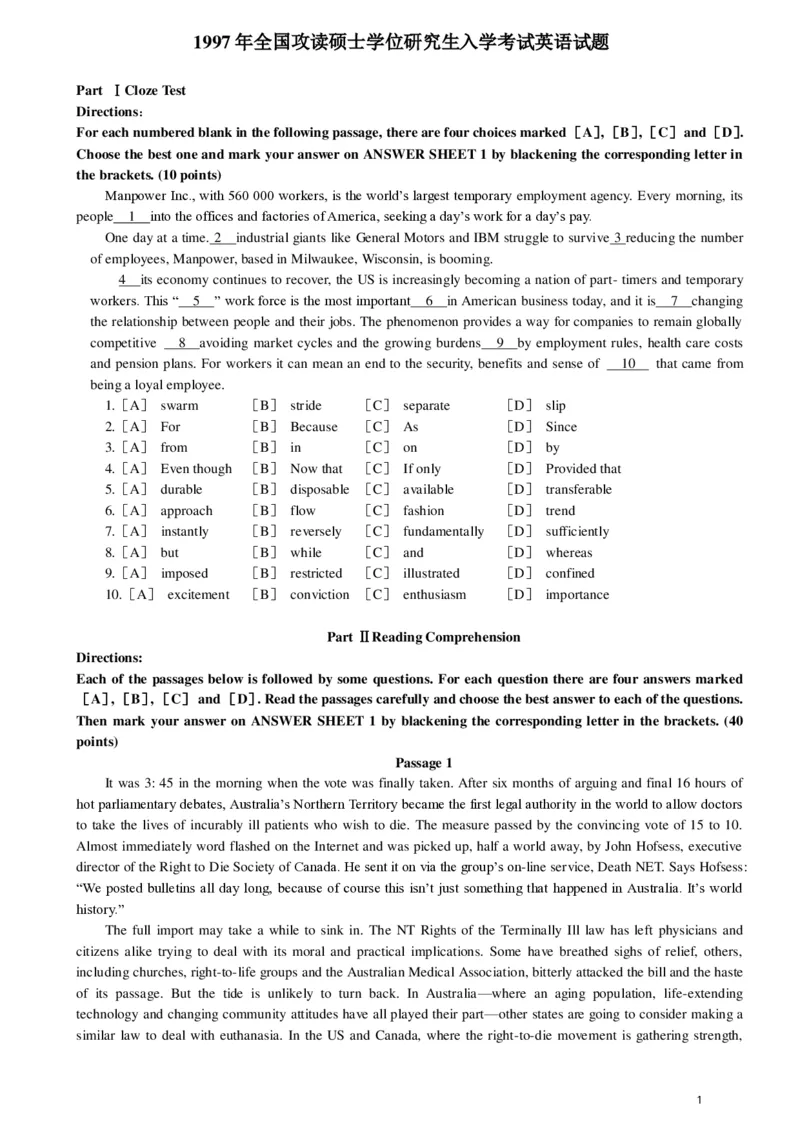
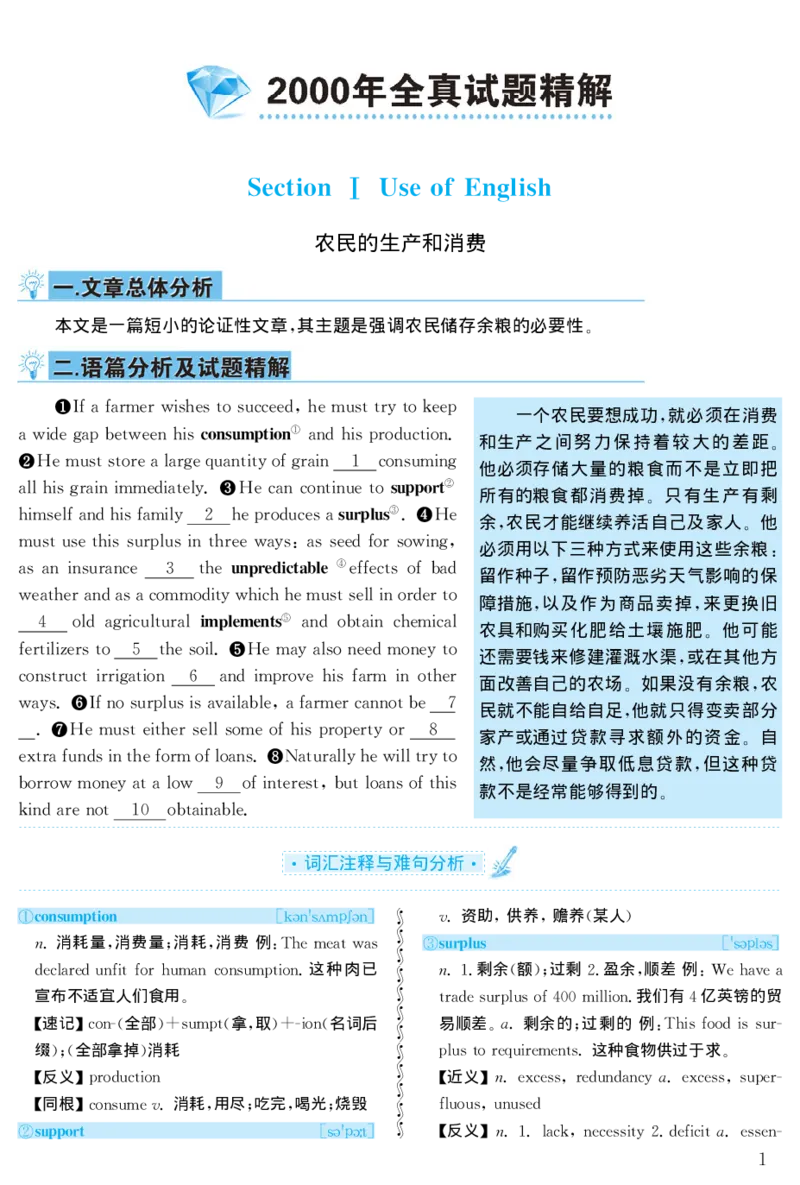
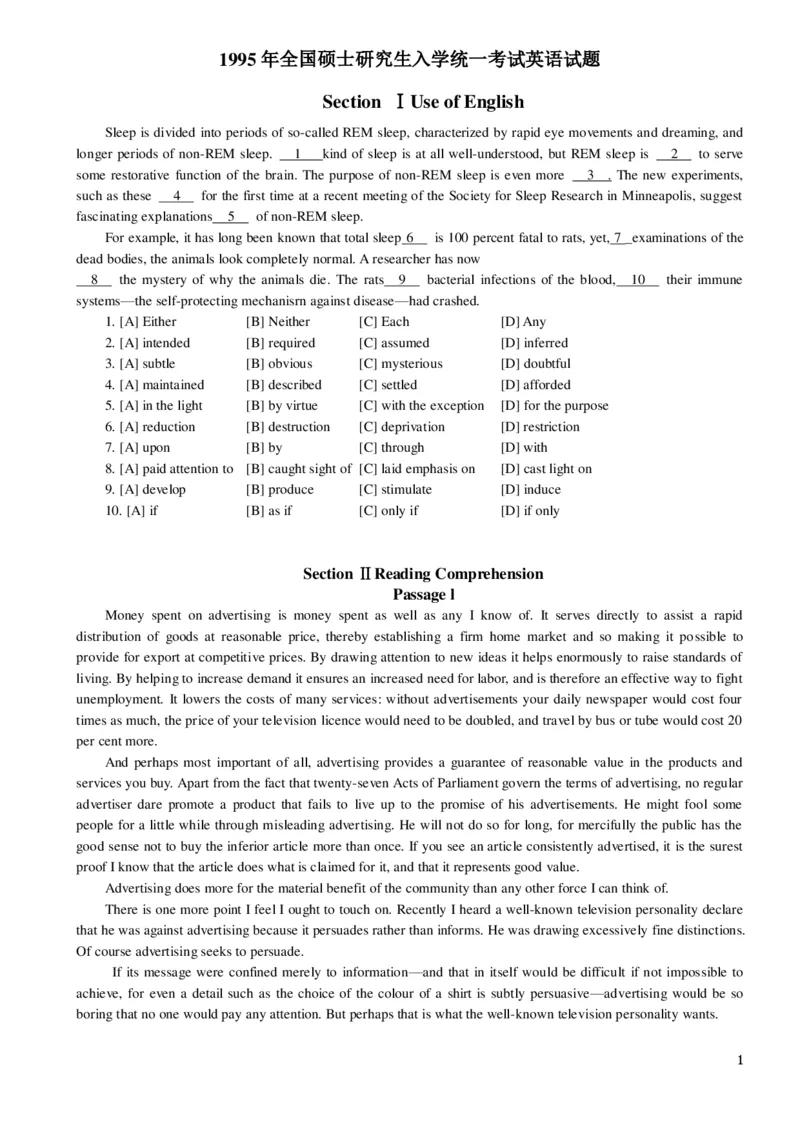
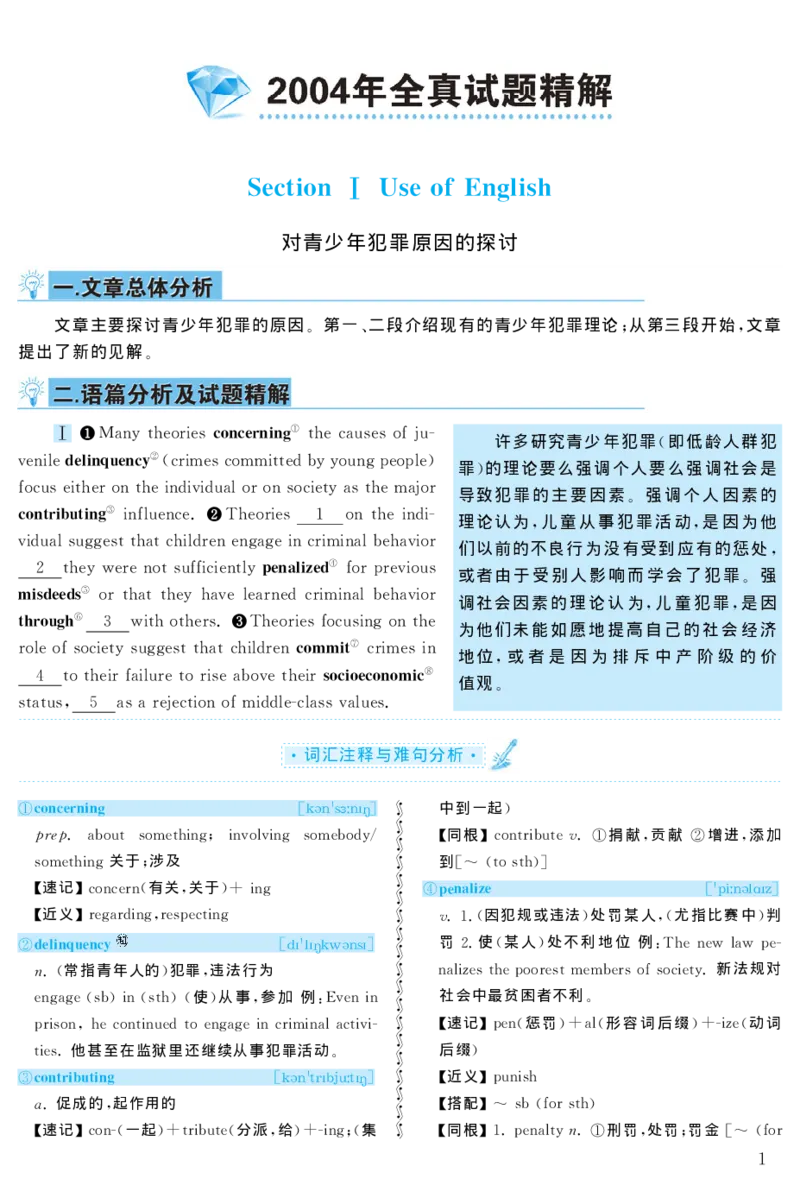
The government is to ban payments to witnesses by newspapers seeking to buy up people
involvedinprominentcases 1 thetrialofRosemaryWest.
In a significant 2 of legal controls over the press, Lord Irvine, the Lord Chancellor, will
introduce a 3 bill that will propose making payments to witnesses 4 and will strictly control
theamountof 5 thatcanbegiventoacase 6 atrialbegins.
In a letter to Gerald Kaufman, chairman of the House of Commons media select committee, Lord
Irvine said he 7 with a committee report this year which said that self regulation did not 8
sufficientcontrol.
9 of the letter came two days after Lord Irvine caused a 10 of media protest when he
said the 11 of privacy controls contained in European legislation would be left to judges 12 to
Parliament.
The Lord Chancellor said introduction of the Human Rights Bill, which 13 the European
Convention on Human Rights legally 14 in Britain, laid down that everybody was 15 to
privacyandthatpublicfigurescouldgo tocourttoprotectthemselvesandtheirfamilies.
“Pressfreedomswillbeinsafe hands 16 ourBritishjudges,”hesaid.
Witnesspaymentsbecamean 17 afterWest wassentenced to10 life sentencesin1995.Up to
19 witnesses were 18 to have received payments for telling their stories to newspapers. Concerns
were raised 19 witnesses might be encouraged exaggerate their stories in court to 20 guilty
verdicts.
英语试题 . 1 . (共 14 页)1.[A]asto [B]forinstance [C]inparticular [D]suchas
2.[A]tightening [B]intensifying [C]focusing [D]fastening
3.[A]sketch [B]rough [C]preliminary [D]draft
4.[A]illogical [B]illegal [C]improbable [D]improper
5.[A]publicity [B]penalty [C]popularity [D]peculiarity
6.[A]since [B]if [C]before [D]as
7.[A]sided [B]shared [C]complied [D]agreed
8.[A]present [B]offer [C]manifest [D]indicate
9.[A]Release [B]Publication [C]Printing [D]Exposure
10.[A]storm [B]rage [C]flare [D]flash
11.[A]translation [B]interpretation [C]exhibition [D]demonstration
12.[A]betterthan [B]otherthan [C]ratherthan [D]soonerthan
13.[A]changes [B]makes [C]sets [D]turns
14.[A]binding [B]convincing [C]restraining [D]sustaining
15.[A]authorized [B]credited [C]entitled [D]qualified
16.[A]with [B]to [C]from [D]by
17.[A]impact [B]incident [C]inference [D]issue
18.[A]stated [B]remarked [C]said [D]told
19.[A]what [B]when [C]which [D]that
20.[A]assure [B]confide [C]ensure [D]guarantee
Section Ⅱ Reading Comprehension
PartA
Directions:
Each of the passages below is followed by some questions. For each question there are four answers
marked [A], [B], [C] and [D]. Read the passages carefully and choose the best answer to each of the
questions. Then mark your answer on theANSWER SHEET 1 by blackening the corresponding letter
inthebrackets.(40points)
英语试题 . 2 . (共 14 页)Text 1
Specialisation can be seen as a response to the problem of an increasing accumulation of scientific
knowledge. By splitting upthesubject matterintosmallerunits,one man could continueto handlethe
information and use it as the basis for further research. But specialisation was only one of a series of
related developments in science affecting the process of communication. Another was the growing
professionalisationofscientificactivity.
No clear-cut distinction can be drawn between professionals and amateurs in science: exceptions
can be found to any rule. Nevertheless, the word “amateur” does carry a connotation that the person
concerned is not fully integrated into the scientific community and, in particular, may not fully share
its values. The growth of specialisation in the nineteenth century, with its consequent requirement of a
longer, more complex training, implied greater problems for amateur participation in science. The
trend was naturally most obvious in those areas of science based especially on a mathematical or
laboratory training, and can be illustrated in terms of the development of geology in the United
Kingdom.
Acomparison of British geological publications over the last century and a half reveals not simply
an increasing emphasis on the primacy of research, but also a changing definition of what constitutes
an acceptable research paper. Thus, in the nineteenth century, local geological studies represented
worthwhile research in their own right; but, in the twentieth century, local studies have increasingly
become acceptable to professionals only if they incorporate, and reflect on, the wider geological
picture.Amateurs, on theother hand,have continued to pursuelocal studiesin theoldway.Theoverall
result has been to make entrance to professional geological journals harder for amateurs, a result that
has been reinforced by the widespread introduction of refereeing, first by national journals in the
nineteenth century and then by several local geological journals in the twentieth century.As a logical
consequence of this development, separate journals have now appeared aimed mainly towards either
professional or amateur readership. A rather similar process of differentiation has led to professional
geologists coming together nationally within one or two specific societies, whereas the amateurs have
tendedeithertoremaininlocalsocietiesortocometogethernationallyinadifferentway.
Although the process of professionalisation and specialisation was already well under way in
British geology during the nineteenth century, its full consequences were thus delayed until the
twentieth century. In science generally, however, the nineteenth century must be reckoned as the
crucialperiodfor thischangeinthestructureofscience.
英语试题 . 3 . (共 14 页)21. The growth of specialisation in the 19th century might be more clearly seen in sciences such as
_______.
[AJsociologyandchemistry
[B]physicsandpsychology
[C]sociologyandpsychology
[D]physicsandchemistry
22. Wecaninferfromthepassagethat_______.
[A]thereislittledistinctionbetweenspecialisationandprofessionalisation
[B]amateurscancompetewithprofessionalsinsomeareasofscience
[C]professionalstendtowelcomeamateursintothescientificcommunity
[D]amateurshavenationalacademicsocietiesbutnolocalones
23. Theauthorwritesofthedevelopmentofgeology todemonstrate______ .
[A]theprocessofspecialisationandprofessionalisation
[B]thehardshipofamateursinscientificstudy
[C]thechangeofpoliciesinscientificpublications
[D]thediscriminationofprofessionalsagainstamateurs
24. Thedirectreasonforspecialisationis_______.
[A]thedevelopmentincommunication
[B]thegrowthofprofessionalisation
[C]theexpansionofscientificknowledge
[D]thesplittingupofacademicsocieties
英语试题 . 4 . (共 14 页)Text 2
A great deal of attention is being paid today to the so-called digital divide — the division of
the world into the info (information) rich and the info poor. And that divide does exist today. My wife
and I lectured about this looming danger twenty years ago. What was less visible then, however, were
the new, positive forces that work against the digital divide. There are reasons to be optimistic.
There are technological reasons to hope the digital divide will narrow. As the Internet becomes
more and more commercialized, it is in the interest of business to universalize access — after all,
the more people online, the more potential customers there are. More and more governments, afraid
their countries will be left behind, want to spread Internet access. Within the next decade or two, one
to two billion people on the planet will he netted together. As a result, I now believe the digital
divide will narrow rather than widen in the years ahead. And that is very good news because the
Internet may well be the most powerful tool for combating world poverty that we’ve ever had.
Of course, the use of the Internet isn’t the only way to defeat poverty. And the Internet is not the
only tool we have. But it has enormous potential.
To take advantage of this tool, some impoverished countries will have to get over their outdated
anti-colonial prejudices with respect to foreign investment. Countries that still think foreign investment
is an invasion of their sovereignty might well study the history of infrastructure(the basic structural
foundations of a society)in the United States. When the United States built its industrial infrastructure,
it didn’t have the capital to do so. And that is why America’s Second Wave infrastructure-including
roads, harbors, highways, ports and so on-were built with foreign investment. The English, the
Germans, the Dutch and the French were investing in Britain’s former colony. They financed them.
Immigrant Americans built them. Guess who owns them now? The Americans. I believe the same
thing would be true in places like Brazil or anywhere else for that matter. The more foreign capital you
have helping you build your Third Wave infrastructure, which today is an electronic infrastructure, the
better off you’re going to be. That doesn't mean lying down and becoming fooled, or letting foreign
corporations run uncontrolled. But it does mean recognizing how important they can be in building the
energy and telecom infrastructures needed to take full advantage of the Internet.
英语试题 . 5 . (共 14 页)25. Digitaldivideissomething_______.
[A]gettingworsebecauseoftheInternet
[B]therichcountriesareresponsiblefor
[C]theworldmustguardagainst
[D]consideredpositivetoday
26. GovernmentsattachimportancetotheInternetbecauseit_______.
[A]offerseconomicpotentials
[B]canbringforeign funds
[C]cansoonwipeoutworldpoverty
[D]connectspeopleallover theworld
27. ThewritermentionedthecaseoftheUnitedStatestojustifythepolicyof_______.
[A]providingfinancialsupportoverseas
[B]preventingforeigncapital’scontrol
[C]buildingindustrialinfrastructure
[D]acceptingforeign investment
28. It seemsthatnowacountry’seconomydepandsmuchon______.
[A]howwell-developeditiselectronically
[B]whetheritisprejudicedagainstimmigrants
[C]whetheritadoptsAmerica’sindustrialpattern
[D]howmuchcontrolithasoverforeign corporations
英语试题 . 6 . (共 14 页)Text 3
Why do so many Americans distrust what they read in their newspapers? The American Society of
Newspaper Editors is trying to answer this painful question. The organization is deep into a long
self-analysis known as the journalism credibility project.
Sad to say, this project has turned out to be mostly low-level findings about factual errors and
spelling and grammar mistakes, combined with lots of head-scratching puzzlement about what in
the world those readers really want.
But the sources of distrust go way deeper. Most journalists learn to see the world through a set of
standard templates (patterns) into which they plug each day’s events. In other words, there is a
conventional story line in the newsroom culture that provides a backbone and a ready-made narrative
structure for otherwise confusions news.
There exists a social and cultural disconnect between journalists and their readers which helps
explain why the “standard templates”of the newsroom seem alien many readers. In a recent survey,
questionnaires were sent to reporters in five middle size cities around the country, plus one large
metropolitan area. Then residents in these communities were phoned at random and asked the same
questions.
Replies show that compared with other Americans, journalists are more likely to live in upscale
neighborhoods, have maids, own Mercedeses, and trade stocks, and they’re less likely to go to church,
do volunteer work, or put down roots in community.
Reporters tend to be part of a broadly defined social and cultural elite, so their work tends to
reflect the conventional values of this elite. The astonishing distrust of the news media isn’t rooted in
inaccuracy or poor reportorial skills but in the daily clash of world views between reporters and their
readers.
This is an explosive situation for any industry, particularly a declining one. Here is a troubled
business that keeps hiring employees whose attitudes vastly annoy the customers. Then it sponsors lots
of symposiums and a credibility project dedicated to wondering why customers are annoyed and
fleeing in large numbers. But it never seems to get around to noticing the cultural and class biases that
so many former buyers are complaining about. If it did, it would open up its diversity program, now
focused narrowly on race and gender, and look for reporters who differ broadly by outlook, values,
education, and class.
英语试题 . 7 . (共 14 页)29. Whatisthepassagemainlyabout?
[A]needsofthereadersallovertheworld.
[B]causesofthepublicdisappointmentaboutnewspapers.
[C]originsofthedecliningnewspaperindustry.
[D]aimsofajournalismcredibilityproject.
30. Theresultsofthejournalismcredibilityprojectturnedouttobe______.
[A]quitetrustworthy
[B]somewhatcontradictory
[C]veryilluminating
[D]rathersuperficial
31.Thebasicproblemofjournalistsaspointedoutbythewriterliesintheir______.
[A]workingattitude
[B]conventionallifestyle
[C]worldoutlook
[D]educationalbackground
32. Despiteitsefforts, thenewspaperindustrystillcannotsatisfythereadersowingtoits_______.
[A]failuretorealizeitsrealproblem
[B]tendencytohireannoyingreporters
[C]likelinesstodoinaccuratereporting
[D]prejudiceinmattersofraceandgender
英语试题 . 8 . (共 14 页)Text 4
The world is going through the biggest wave of mergers and acquisitions ever witnessed. The
process sweeps from hyperactive America to Europe and reaches the emerging countries with
unsurpassed might. Many in these countries are looking at this process and worrying: "Won't the wave
ofbusinessconcentrationturnintoanuncontrollableanti-competitiveforce?"
There's no question that the big are getting bigger and more powerful. Multinational corporations
accounted for less than 20% of international trade in 1982. Today the figure is more than 25% and
growing rapidly. International affiliates account for a fast-growing segment of production in
economies that open up and welcome foreign investment. In Argentina, for instance, after the reforms
of the early 1990s, multinationals went from 43% to almost 70% of the industrial production of the
200 largest firms. This phenomenon has created serious concerns over the role of smaller economic
firms,ofnationalbusinessmenandovertheultimatestabilityoftheworldeconomy.
I believe that the most important forces behind the massive M&Awave are the same that underlie
the globalization process: falling transportation and communication costs, lower trade and investment
barriers and enlarged markets that require enlarged operations capable of meeting customers' demands.
All these are beneficial, not detrimental, to consumers. As productivity grows, the world's wealth
increases.
Examples of benefits or costs of the current concentration wave are scanty. Yet it is hard to
imagine that the merger of a few oil firms today could re-create the same threats to competition that
were feared nearly a century ago in the U.S., when the Standard Oil trust was broken up. The mergers
of telecom companies, such as WorldCom, hardly seem to bring higher prices for consumers or a
reduction in the pace of technical progress. On the contrary, the price of communications is coming
down fast. In cars, too, concentration is increasing-witness Daimler and Chrysler, Renault and
Nissan-butitdoesnotappearthatconsumersarebeinghurt.
Yet the fact remains that the merger movement must be watched. A few weeks ago, Alan
Greenspan warned against the megamergers in the banking industry. Who is going to supervise,
regulate and operate as lender of last resort with the gigantic banks that are being created? Won't
multinationals shift production from one place to another when a nation gets too strict about
infringements to fair competition? And should one country take upon itself the role of “defending
competition”onissuesthataffectmanyothernations,asintheUS.vs.Microsoftcase?
英语试题 . 9 . (共 14 页)33.Whatisthetypicaltrendofbusinessestoday?
[A]totakeinmoreforeignfunds.
[B]toinvestmoreabroad.
[C]tocombineandbecomebigger.
[D]totradewithmorecountries.
34. Accordingtotheauthor,oneofthedrivingforcesbehindM&Awaveis______.
[A]thegreatercustomerdemands.
[B]asurplussupplyfor themarket.
[C]agrowing productivity.
[D]theincreaseoftheworld'swealth.
35. Fromparagraph4wecaninferthat______ .
[A]theincreasingconcentrationiscertaintohurtconsumers
[B]WorldComservesasagood exampleof bothbenefitsandcosts
[C]thecostsoftheglobalizationprocessareenormous
[D]theStandardOiltrustmighthavethreatenedcompetition
36. Towardthenewbusinesswave, thewriter'sattitudecanhesaidtobe_______.
[A]optimistic
[B]objective
[C]pessimistic
[D]biased
英语试题 . 10 . (共 14 页)Text 5
When I decided to quit my full time employment it never occurred to me that I might become a
part of a new international trend. A lateral move that hurt my pride and blocked my professional
progress prompted me to abandon my relatively high profile career although, in the manner of a
disgraced government minister, I covered my exit by claiming “I wanted to spend more time with my
family”.
Curiously, some two-and-a-half years and two novels later, my experiment in what theAmericans
term “downshifting”has turned my tired excuse into an absolute reality. I have been transformed from
a passionate advocate of the philosophy of “having it all”, preached by Linda Kelsey for the past
sevenyearsinthepagesofShemagazine,intoawomanwhoishappytosettlefor abitofeverything.
I have discovered, as perhaps Kelsey will after her much-publicized resignation from the
editorship of She after a build-up of stress, that abandoning the doctrine of “juggling your life”, and
making the alternative move into “downshifting” brings with it far greater rewards than financial
success and social status. Nothing could persuade me to return to the kind of life Kelsey used to
advocate and I once enjoyed: 12-hour working days, pressured deadlines, the fearful strain of office
politicsandthelimitationsofbeingaparenton“qualitytime”.
In America, the move away from juggling to a simpler, less materialistic lifestyle is a
well-established trend. Downshifting-also known in America as “voluntary simplicity” has, ironically,
even bred a new area of what might be termed anticonsumerism. There are a number of bestselling
downshifting self-help books for people who want to simplify their lives; there are newsletter's, such
as The Tightwad Gazette, that give hundreds of thousands of Americans useful tips on anything from
recycling their cling-film to making their own soap; there are even support groups for those who want
toachievethemid-'90sequivalentofdroppingout.
While in America the trend started as a reaction to the economic decline— after the mass
redundancies caused by downsizing in the late’80s—and is still linked to the politics of thrift, in
Britain, at least among the middle-class downshifters of my acquaintance, we have different reasons
forseekingtosimplifyourlives.
For the women of my generation who were urged to keep juggling through the’80s, downshifting
in the mid-'90s is not so much a search for the mythical good life—growing your own organic
vegetables,andriskingturningintoone—asapersonalrecognitionofyourlimitations.
英语试题 . 11 . (共 14 页)37.Whichofthefollowingistrueaccordingtoparagraph1?
[A]Full-timeemploymentisanewinternationaltrend.
[B]Thewriterwascompelledbycircumstancestoleaveherjob.
[C]“Alateralmove”meanssteppingoutoffull-timeemployment.
[D]Thewriterwasonlytooeagertospendmoretimewithherfamily.
38.Thewriter’sexperimentshowsthatdownshifting .
[A]enableshertorealizeherdream
[B]helpshermoldanewphilosophyoflife
[C]promptshertoabandonherhighsocialstatus
[D]leadshertoacceptthedoctrineofShemagazine
39.“Jugglingone’slife”probablymeanslivingalifecharacterizedby .
[A]non-materialisticlifestyle
[B]abitof everything
[C]extremestress
[D]anti-consumerism
40.Accordingtothepassage,downshiftingemergedintheU.S.asaresultof .
[A]thequickpaceofmodernlife
[B]man’sadventurousspirit
[C]man’ssearchfor mythicalexperiences
[D]theeconomicsituation
英语试题 . 12 . (共 14 页)PartB
Directions:
Read the following text carefully and then translate the underlined segments into Chinese. Your
translationshouldbewrittenclearlyonANSWERSHEET2.(15points)
In less than 30 years’ time the Star Trek holodeck will be a reality. Direct links between the
brain’s nervous system and a computer will also create full sensory virtual environments, allowing
virtualvacationslikethoseinthefilmTotalRecall.
41)There will be television chat shows hosted by robots, and cars with pollution monitors that
willdisablethemwhen theyoffend. 42)Childrenwillplaywithdollsequippedwithpersonality chips,
computers with in-built personalities will be regarded as workmates rather than tools, relaxation will
beinfront ofsmelltelevision,anddigitalagewillhavearrived.
According to BT’s futurologist, Ian Pearson, these are among the developments scheduled for the
first few decades of the new millennium(a period of 1,000 years), when supercomputers will
dramaticallyaccelerateprogressinallareasoflife.
43)Pearsonhaspiecedtogetherthework ofhundredsof researchersaroundtheworldtoproduce
a unique millennium technology calendar that gives the latest dates when we can expect hundreds of
key breakthroughs and discoveries to take place. Some of the biggest developments will be in
medicine, including an extended life expectancy and dozens of artificial organs coming into use
betweennowand2040.
Pearson also predicts a breakthrough in computer-human links. “By linking directly to our
nervous system, computers could pick up what we feel and, hopefully, simulate feeling too so that we
can start to develop full sensory environments, rather like the holidays in Total Recall or the Star Trek
holodeck, ” he says. 44)But that, Pearson points out, is only the start of man-machine integration: “It
will be the beginning of the long process of integration that will ultimately lead to a fully electronic
humanbeforetheendofthenextcentury.”
Through his research, Pearson is able to put dates to most of the breakthroughs that can be
predicted. However, there are still no forecasts for when faster-than-light travel will be available, or
when human cloning will be perfected, or when time travel will be possible. But he does expect social
problemsas a result of technological advances.Aboom in neighborhood surveillance cameras will, for
example, cause problems in 2010, while the arrival of synthetic lifelike robots will mean people may
notbeabletodistinguishbetweentheirhumanfriendsandthedroids.
45)And home appliances will also become so smart that controlling and operating them will result in
thebreakoutofanewpsychologicaldisorder—kitchenrage.
英语试题 . 13 . (共 14 页)Section Ⅲ Writing
46. Directions:
Among all the worthy feelings of mankind, love is probably the noblest, but everyone has his/her
ownunderstandingofit.
There has been a discussion recently on the issue in a newspaper.Write an essay to the newspaper
to
1)showyourunderstandingofthesymbolicmeaningofthepicturebelow.
2)giveaspecificexample,and
3)giveyour suggestionastothebestwaytoshowlove.
英语试题 . 14 . (共 14 页)