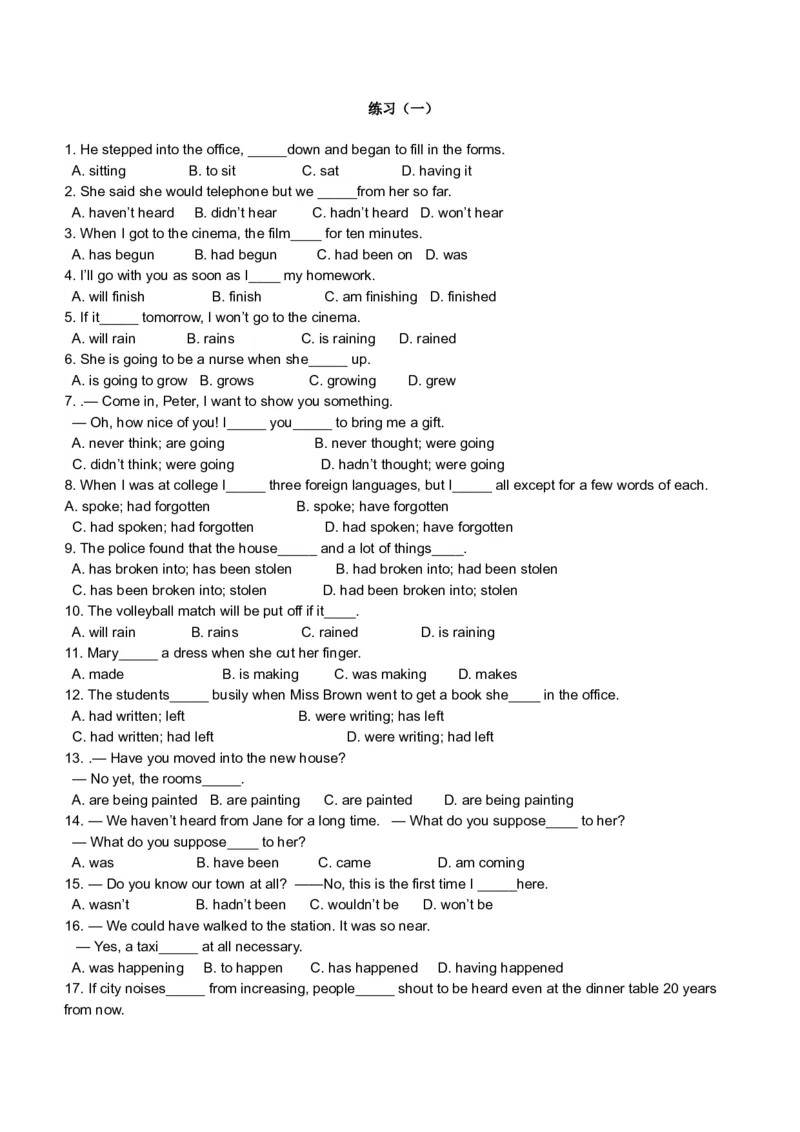
练习(一)
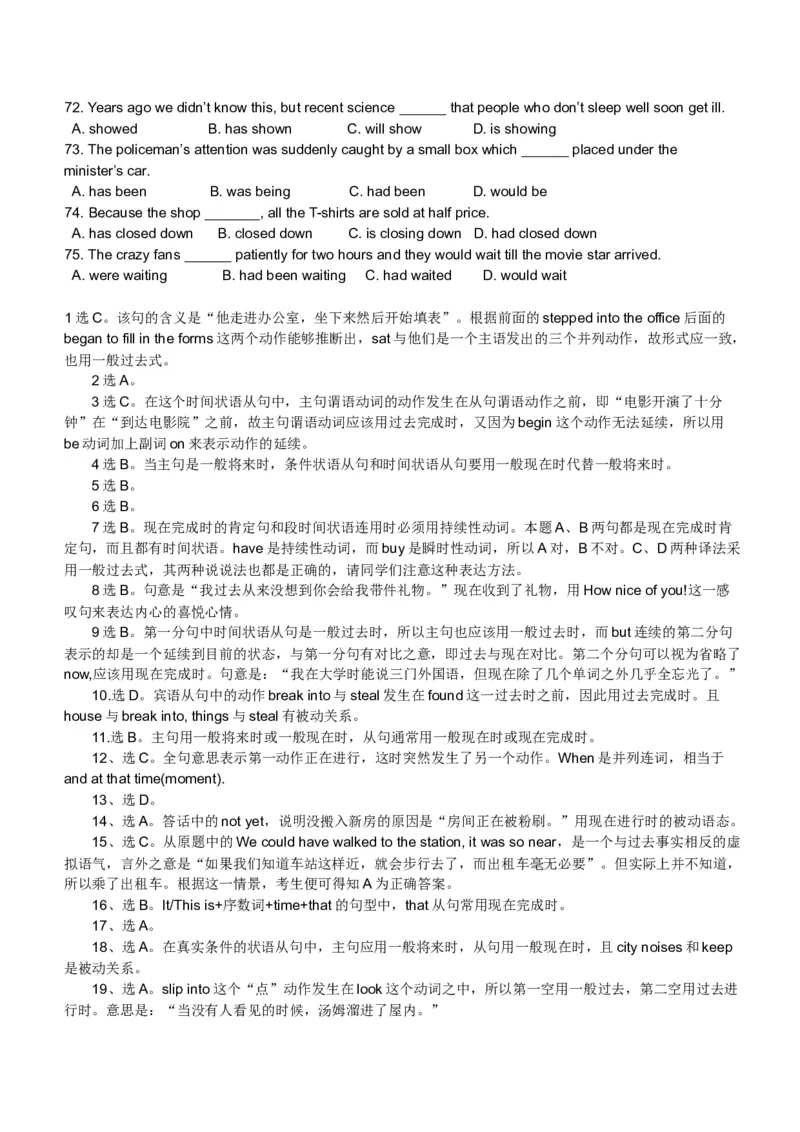
1. He stepped into the office, _____down and began to fill in the forms.
A. sitting B. to sit C. sat D. having it
2. She said she would telephone but we _____from her so far.
A. haven’t heard B. didn’t hear C. hadn’t heard D. won’t hear
3. When I got to the cinema, the film____ for ten minutes.
A. has begun B. had begun C. had been on D. was
4. I’ll go with you as soon as I____ my homework.
A. will finish B. finish C. am finishing D. finished
5. If it_____ tomorrow, I won’t go to the cinema.
A. will rain B. rains C. is raining D. rained
6. She is going to be a nurse when she_____ up.
A. is going to grow B. grows C. growing D. grew
7. .— Come in, Peter, I want to show you something.
— Oh, how nice of you! I_____ you_____ to bring me a gift.
A. never think; are going B. never thought; were going
C. didn’t think; were going D. hadn’t thought; were going
8. When I was at college I_____ three foreign languages, but I_____ all except for a few words of each.
A. spoke; had forgotten B. spoke; have forgotten
C. had spoken; had forgotten D. had spoken; have forgotten
9. The police found that the house_____ and a lot of things____.
A. has broken into; has been stolen B. had broken into; had been stolen
C. has been broken into; stolen D. had been broken into; stolen
10. The volleyball match will be put off if it____.
A. will rain B. rains C. rained D. is raining
11. Mary_____ a dress when she cut her finger.
A. made B. is making C. was making D. makes
12. The students_____ busily when Miss Brown went to get a book she____ in the office.
A. had written; left B. were writing; has left
C. had written; had left D. were writing; had left
13. .— Have you moved into the new house?
— No yet, the rooms_____.
A. are being painted B. are painting C. are painted D. are being painting
14. — We haven’t heard from Jane for a long time. — What do you suppose____ to her?
— What do you suppose____ to her?
A. was B. have been C. came D. am coming
15. — Do you know our town at all? ——No, this is the first time I _____here.
A. wasn’t B. hadn’t been C. wouldn’t be D. won’t be
16. — We could have walked to the station. It was so near.
— Yes, a taxi_____ at all necessary.
A. was happening B. to happen C. has happened D. having happened
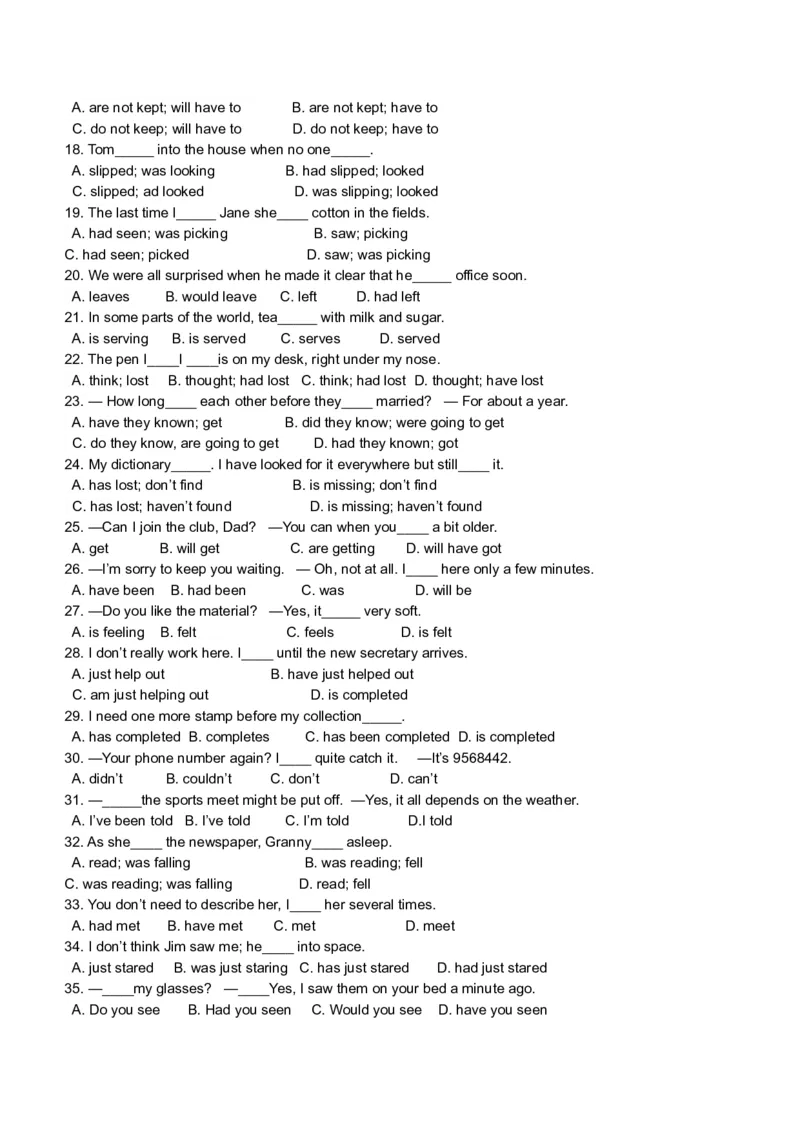
17. If city noises_____ from increasing, people_____ shout to be heard even at the dinner table 20 years
from now.A. are not kept; will have to B. are not kept; have to
C. do not keep; will have to D. do not keep; have to
18. Tom_____ into the house when no one_____.
A. slipped; was looking B. had slipped; looked
C. slipped; ad looked D. was slipping; looked
19. The last time I_____ Jane she____ cotton in the fields.
A. had seen; was picking B. saw; picking
C. had seen; picked D. saw; was picking
20. We were all surprised when he made it clear that he_____ office soon.
A. leaves B. would leave C. left D. had left
21. In some parts of the world, tea_____ with milk and sugar.
A. is serving B. is served C. serves D. served
22. The pen I____I ____is on my desk, right under my nose.
A. think; lost B. thought; had lost C. think; had lost D. thought; have lost
23. — How long____ each other before they____ married? — For about a year.
A. have they known; get B. did they know; were going to get
C. do they know, are going to get D. had they known; got
24. My dictionary_____. I have looked for it everywhere but still____ it.
A. has lost; don’t find B. is missing; don’t find
C. has lost; haven’t found D. is missing; haven’t found
25. —Can I join the club, Dad? —You can when you____ a bit older.
A. get B. will get C. are getting D. will have got
26. —I’m sorry to keep you waiting. — Oh, not at all. I____ here only a few minutes.
A. have been B. had been C. was D. will be
27. —Do you like the material? —Yes, it_____ very soft.
A. is feeling B. felt C. feels D. is felt
28. I don’t really work here. I____ until the new secretary arrives.
A. just help out B. have just helped out
C. am just helping out D. is completed
29. I need one more stamp before my collection_____.
A. has completed B. completes C. has been completed D. is completed
30. —Your phone number again? I____ quite catch it. —It’s 9568442.
A. didn’t B. couldn’t C. don’t D. can’t
31. —_____the sports meet might be put off. —Yes, it all depends on the weather.
A. I’ve been told B. I’ve told C. I’m told D.I told
32. As she____ the newspaper, Granny____ asleep.
A. read; was falling B. was reading; fell
C. was reading; was falling D. read; fell
33. You don’t need to describe her, I____ her several times.
A. had met B. have met C. met D. meet
34. I don’t think Jim saw me; he____ into space.
A. just stared B. was just staring C. has just stared D. had just stared
35. —____my glasses? —____Yes, I saw them on your bed a minute ago.
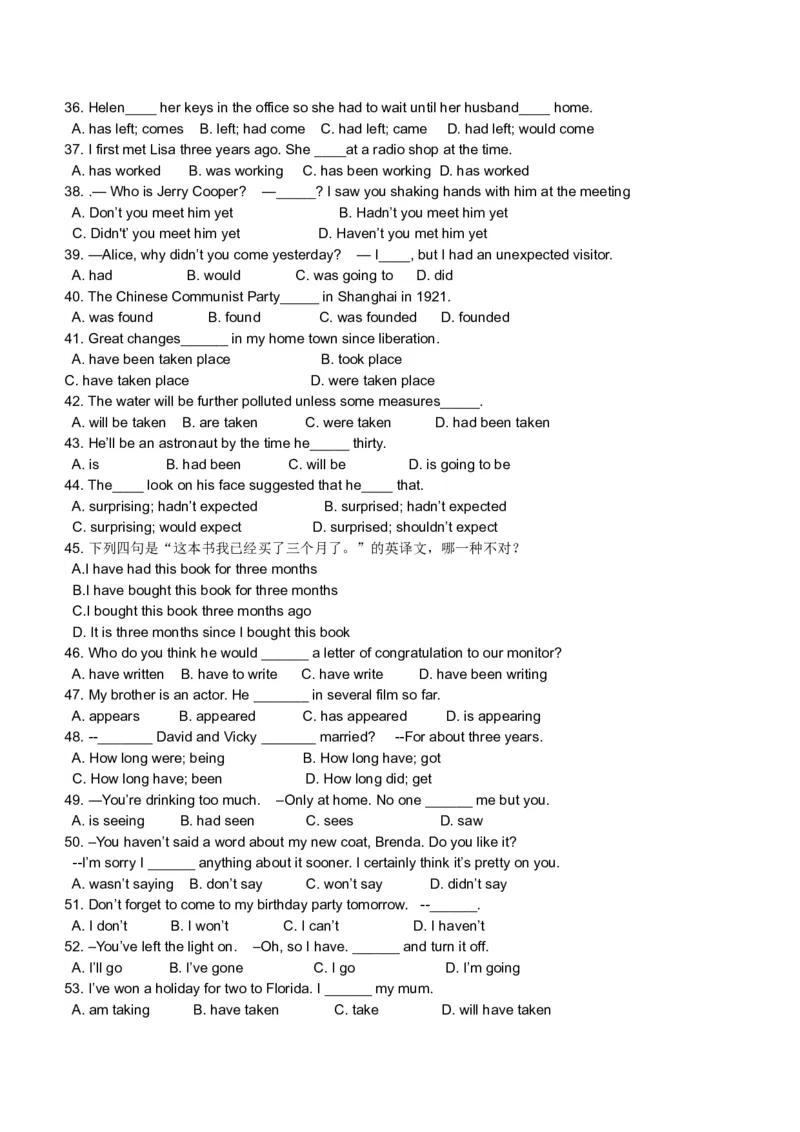
A. Do you see B. Had you seen C. Would you see D. have you seen36. Helen____ her keys in the office so she had to wait until her husband____ home.
A. has left; comes B. left; had come C. had left; came D. had left; would come
37. I first met Lisa three years ago. She ____at a radio shop at the time.
A. has worked B. was working C. has been working D. has worked
38. .— Who is Jerry Cooper? —_____? I saw you shaking hands with him at the meeting
A. Don’t you meet him yet B. Hadn’t you meet him yet
C. Didn't’ you meet him yet D. Haven’t you met him yet
39. —Alice, why didn’t you come yesterday? — I____, but I had an unexpected visitor.
A. had B. would C. was going to D. did
40. The Chinese Communist Party_____ in Shanghai in 1921.
A. was found B. found C. was founded D. founded
41. Great changes______ in my home town since liberation.
A. have been taken place B. took place
C. have taken place D. were taken place
42. The water will be further polluted unless some measures_____.
A. will be taken B. are taken C. were taken D. had been taken
43. He’ll be an astronaut by the time he_____ thirty.
A. is B. had been C. will be D. is going to be
44. The____ look on his face suggested that he____ that.
A. surprising; hadn’t expected B. surprised; hadn’t expected
C. surprising; would expect D. surprised; shouldn’t expect
45. 下列四句是“这本书我已经买了三个月了。”的英译文,哪一种不对?
A.I have had this book for three months
B.I have bought this book for three months
C.I bought this book three months ago
D. It is three months since I bought this book
46. Who do you think he would ______ a letter of congratulation to our monitor?
A. have written B. have to write C. have write D. have been writing
47. My brother is an actor. He _______ in several film so far.
A. appears B. appeared C. has appeared D. is appearing
48. --_______ David and Vicky _______ married? --For about three years.
A. How long were; being B. How long have; got
C. How long have; been D. How long did; get
49. ―You’re drinking too much. –Only at home. No one ______ me but you.
A. is seeing B. had seen C. sees D. saw
50. –You haven’t said a word about my new coat, Brenda. Do you like it?
--I’m sorry I ______ anything about it sooner. I certainly think it’s pretty on you.
A. wasn’t saying B. don’t say C. won’t say D. didn’t say
51. Don’t forget to come to my birthday party tomorrow. --______.
A. I don’t B. I won’t C. I can’t D. I haven’t
52. –You’ve left the light on. –Oh, so I have. ______ and turn it off.
A. I’ll go B. I’ve gone C. I go D. I’m going
53. I’ve won a holiday for two to Florida. I ______ my mum.
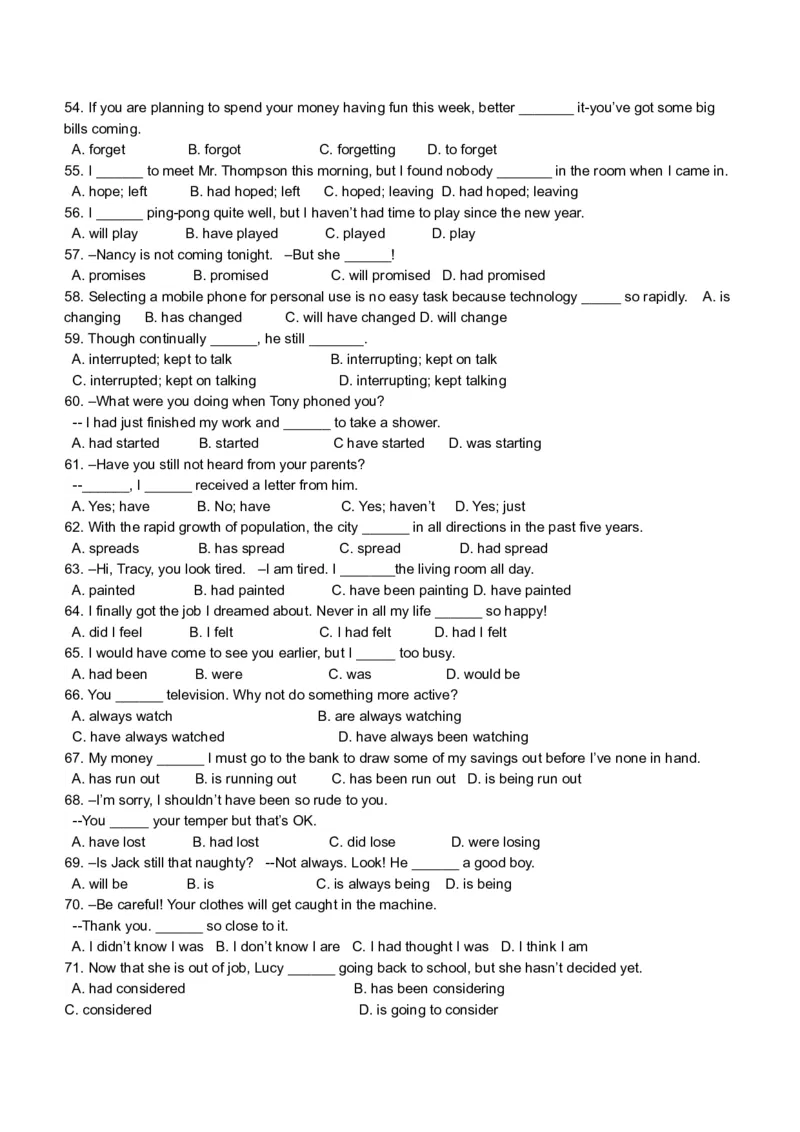
A. am taking B. have taken C. take D. will have taken54. If you are planning to spend your money having fun this week, better _______ it-you’ve got some big
bills coming.
A. forget B. forgot C. forgetting D. to forget
55. I ______ to meet Mr. Thompson this morning, but I found nobody _______ in the room when I came in.
A. hope; left B. had hoped; left C. hoped; leaving D. had hoped; leaving
56. I ______ ping-pong quite well, but I haven’t had time to play since the new year.
A. will play B. have played C. played D. play
57. –Nancy is not coming tonight. –But she ______!
A. promises B. promised C. will promised D. had promised
58. Selecting a mobile phone for personal use is no easy task because technology _____ so rapidly. A. is
changing B. has changed C. will have changed D. will change
59. Though continually ______, he still _______.
A. interrupted; kept to talk B. interrupting; kept on talk
C. interrupted; kept on talking D. interrupting; kept talking
60. –What were you doing when Tony phoned you?
-- I had just finished my work and ______ to take a shower.
A. had started B. started C have started D. was starting
61. –Have you still not heard from your parents?
--______, I ______ received a letter from him.
A. Yes; have B. No; have C. Yes; haven’t D. Yes; just
62. With the rapid growth of population, the city ______ in all directions in the past five years.
A. spreads B. has spread C. spread D. had spread
63. –Hi, Tracy, you look tired. –I am tired. I _______the living room all day.
A. painted B. had painted C. have been painting D. have painted
64. I finally got the job I dreamed about. Never in all my life ______ so happy!
A. did I feel B. I felt C. I had felt D. had I felt
65. I would have come to see you earlier, but I _____ too busy.
A. had been B. were C. was D. would be
66. You ______ television. Why not do something more active?
A. always watch B. are always watching
C. have always watched D. have always been watching
67. My money ______ I must go to the bank to draw some of my savings out before I’ve none in hand.
A. has run out B. is running out C. has been run out D. is being run out
68. –I’m sorry, I shouldn’t have been so rude to you.
--You _____ your temper but that’s OK.
A. have lost B. had lost C. did lose D. were losing
69. –Is Jack still that naughty? --Not always. Look! He ______ a good boy.
A. will be B. is C. is always being D. is being
70. –Be careful! Your clothes will get caught in the machine.
--Thank you. ______ so close to it.
A. I didn’t know I was B. I don’t know I are C. I had thought I was D. I think I am
71. Now that she is out of job, Lucy ______ going back to school, but she hasn’t decided yet.
A. had considered B. has been considering
C. considered D. is going to consider72. Years ago we didn’t know this, but recent science ______ that people who don’t sleep well soon get ill.
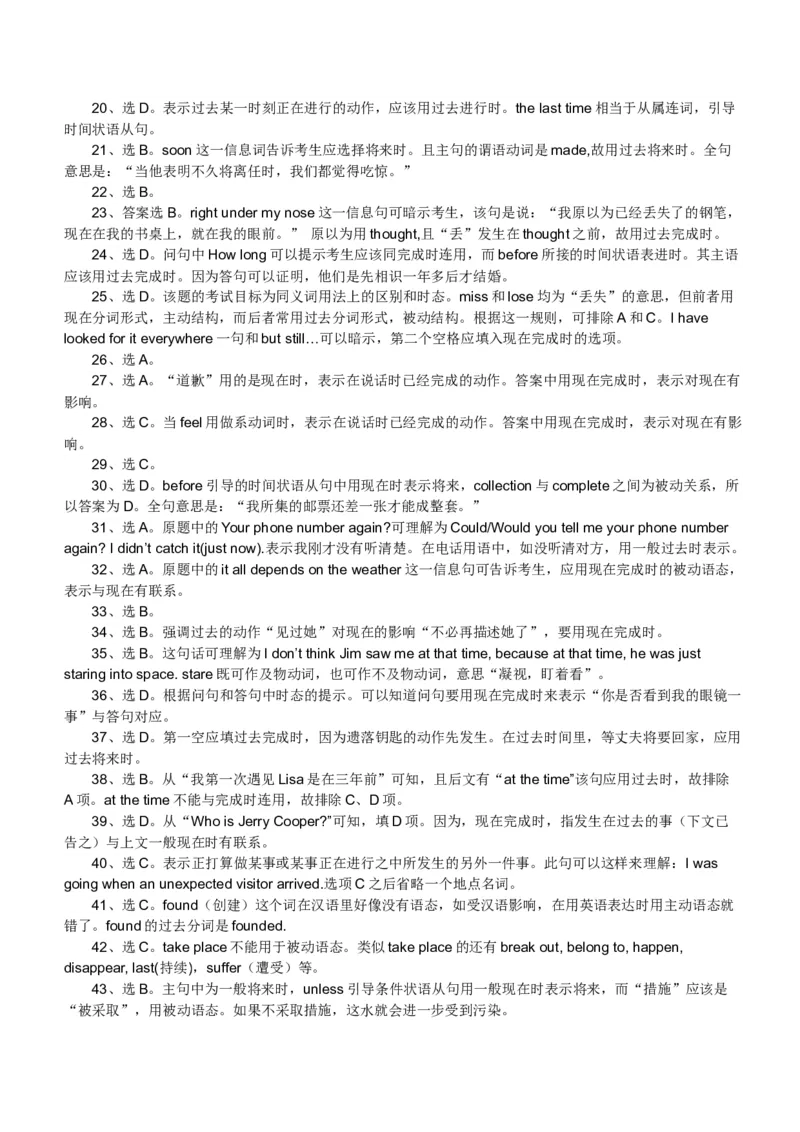
A. showed B. has shown C. will show D. is showing
73. The policeman’s attention was suddenly caught by a small box which ______ placed under the
minister’s car.
A. has been B. was being C. had been D. would be
74. Because the shop _______, all the T-shirts are sold at half price.
A. has closed down B. closed down C. is closing down D. had closed down
75. The crazy fans ______ patiently for two hours and they would wait till the movie star arrived.
A. were waiting B. had been waiting C. had waited D. would wait
1选C。该句的含义是“他走进办公室,坐下来然后开始填表”。根据前面的stepped into the office后面的
began to fill in the forms这两个动作能够推断出,sat与他们是一个主语发出的三个并列动作,故形式应一致,
也用一般过去式。
2选A。
3选C。在这个时间状语从句中,主句谓语动词的动作发生在从句谓语动作之前,即“电影开演了十分
钟”在“到达电影院”之前,故主句谓语动词应该用过去完成时,又因为begin这个动作无法延续,所以用
be动词加上副词on来表示动作的延续。
4选B。当主句是一般将来时,条件状语从句和时间状语从句要用一般现在时代替一般将来时。
5选B。
6选B。
7选B。现在完成时的肯定句和段时间状语连用时必须用持续性动词。本题A、B两句都是现在完成时肯
定句,而且都有时间状语。have是持续性动词,而buy是瞬时性动词,所以A对,B不对。C、D两种译法采
用一般过去式,其两种说说法也都是正确的,请同学们注意这种表达方法。
8选B。句意是“我过去从来没想到你会给我带件礼物。”现在收到了礼物,用How nice of you!这一感
叹句来表达内心的喜悦心情。
9选B。第一分句中时间状语从句是一般过去时,所以主句也应该用一般过去时,而but连续的第二分句
表示的却是一个延续到目前的状态,与第一分句有对比之意,即过去与现在对比。第二个分句可以视为省略了
now,应该用现在完成时。句意是:“我在大学时能说三门外国语,但现在除了几个单词之外几乎全忘光了。”
10.选D。宾语从句中的动作break into与steal发生在found这一过去时之前,因此用过去完成时。且
house与break into, things与steal有被动关系。
11.选B。主句用一般将来时或一般现在时,从句通常用一般现在时或现在完成时。
12、选C。全句意思表示第一动作正在进行,这时突然发生了另一个动作。When是并列连词,相当于
and at that time(moment).
13、选D。
14、选A。答话中的not yet,说明没搬入新房的原因是“房间正在被粉刷。”用现在进行时的被动语态。
15、选C。从原题中的We could have walked to the station, it was so near,是一个与过去事实相反的虚
拟语气,言外之意是“如果我们知道车站这样近,就会步行去了,而出租车毫无必要”。但实际上并不知道,
所以乘了出租车。根据这一情景,考生便可得知A为正确答案。
16、选B。It/This is+序数词+time+that的句型中,that从句常用现在完成时。
17、选A。
18、选A。在真实条件的状语从句中,主句应用一般将来时,从句用一般现在时,且city noises和keep
是被动关系。
19、选A。slip into这个“点”动作发生在look这个动词之中,所以第一空用一般过去,第二空用过去进
行时。意思是:“当没有人看见的时候,汤姆溜进了屋内。”20、选D。表示过去某一时刻正在进行的动作,应该用过去进行时。the last time相当于从属连词,引导
时间状语从句。
21、选B。soon这一信息词告诉考生应选择将来时。且主句的谓语动词是made,故用过去将来时。全句
意思是:“当他表明不久将离任时,我们都觉得吃惊。”
22、选B。
23、答案选B。right under my nose这一信息句可暗示考生,该句是说:“我原以为已经丢失了的钢笔,
现在在我的书桌上,就在我的眼前。” 原以为用thought,且“丢”发生在thought之前,故用过去完成时。
24、选D。问句中How long可以提示考生应该同完成时连用,而before所接的时间状语表进时。其主语
应该用过去完成时。因为答句可以证明,他们是先相识一年多后才结婚。
25、选D。该题的考试目标为同义词用法上的区别和时态。miss和lose均为“丢失”的意思,但前者用
现在分词形式,主动结构,而后者常用过去分词形式,被动结构。根据这一规则,可排除A和C。I have
looked for it everywhere一句和but still…可以暗示,第二个空格应填入现在完成时的选项。
26、选A。
27、选A。“道歉”用的是现在时,表示在说话时已经完成的动作。答案中用现在完成时,表示对现在有
影响。
28、选C。当feel用做系动词时,表示在说话时已经完成的动作。答案中用现在完成时,表示对现在有影
响。
29、选C。
30、选D。before引导的时间状语从句中用现在时表示将来,collection与complete之间为被动关系,所
以答案为D。全句意思是:“我所集的邮票还差一张才能成整套。”
31、选A。原题中的Your phone number again?可理解为Could/Would you tell me your phone number
again? I didn’t catch it(just now).表示我刚才没有听清楚。在电话用语中,如没听清对方,用一般过去时表示。
32、选A。原题中的it all depends on the weather这一信息句可告诉考生,应用现在完成时的被动语态,
表示与现在有联系。
33、选B。
34、选B。强调过去的动作“见过她”对现在的影响“不必再描述她了”,要用现在完成时。
35、选B。这句话可理解为I don’t think Jim saw me at that time, because at that time, he was just
staring into space. stare既可作及物动词,也可作不及物动词,意思“凝视,盯着看”。
36、选D。根据问句和答句中时态的提示。可以知道问句要用现在完成时来表示“你是否看到我的眼镜一
事”与答句对应。
37、选D。第一空应填过去完成时,因为遗落钥匙的动作先发生。在过去时间里,等丈夫将要回家,应用
过去将来时。
38、选B。从“我第一次遇见Lisa是在三年前”可知,且后文有“at the time”该句应用过去时,故排除
A项。at the time不能与完成时连用,故排除C、D项。
39、选D。从“Who is Jerry Cooper?”可知,填D项。因为,现在完成时,指发生在过去的事(下文已
告之)与上文一般现在时有联系。
40、选C。表示正打算做某事或某事正在进行之中所发生的另外一件事。此句可以这样来理解:I was
going when an unexpected visitor arrived.选项C之后省略一个地点名词。
41、选C。found(创建)这个词在汉语里好像没有语态,如受汉语影响,在用英语表达时用主动语态就
错了。found的过去分词是founded.
42、选C。take place不能用于被动语态。类似take place的还有break out, belong to, happen,
disappear, last(持续),suffer(遭受)等。
43、选B。主句中为一般将来时,unless引导条件状语从句用一般现在时表示将来,而“措施”应该是
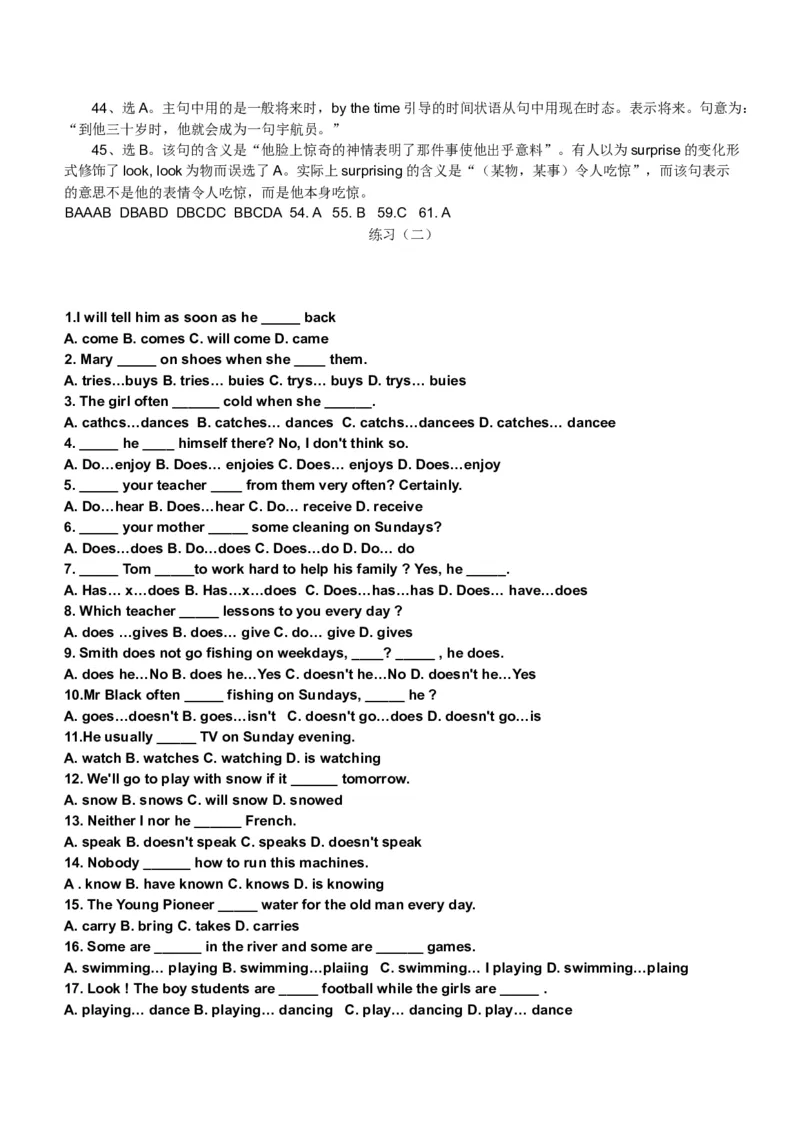
“被采取”,用被动语态。如果不采取措施,这水就会进一步受到污染。44、选A。主句中用的是一般将来时,by the time引导的时间状语从句中用现在时态。表示将来。句意为:
“到他三十岁时,他就会成为一句宇航员。”
45、选B。该句的含义是“他脸上惊奇的神情表明了那件事使他出乎意料”。有人以为surprise的变化形
式修饰了look, look为物而误选了A。实际上surprising的含义是“(某物,某事)令人吃惊”,而该句表示
的意思不是他的表情令人吃惊,而是他本身吃惊。
BAAAB DBABD DBCDC BBCDA 54. A 55. B 59.C 61. A
练习(二)
1.I will tell him as soon as he _____ back
A. come B. comes C. will come D. came
2. Mary _____ on shoes when she ____ them.
A. tries…buys B. tries… buies C. trys… buys D. trys… buies
3. The girl often ______ cold when she ______.
A. cathcs…dances B. catches… dances C. catchs…dancees D. catches… dancee
4. _____ he ____ himself there? No, I don't think so.
A. Do…enjoy B. Does… enjoies C. Does… enjoys D. Does…enjoy
5. _____ your teacher ____ from them very often? Certainly.
A. Do…hear B. Does…hear C. Do… receive D. receive
6. _____ your mother _____ some cleaning on Sundays?
A. Does…does B. Do…does C. Does…do D. Do… do
7. _____ Tom _____to work hard to help his family ? Yes, he _____.
A. Has… x…does B. Has…x…does C. Does…has…has D. Does… have…does
8. Which teacher _____ lessons to you every day ?
A. does …gives B. does… give C. do… give D. gives
9. Smith does not go fishing on weekdays, ____? _____ , he does.
A. does he…No B. does he…Yes C. doesn't he…No D. doesn't he…Yes
10.Mr Black often _____ fishing on Sundays, _____ he ?
A. goes…doesn't B. goes…isn't C. doesn't go…does D. doesn't go…is
11.He usually _____ TV on Sunday evening.
A. watch B. watches C. watching D. is watching
12. We'll go to play with snow if it ______ tomorrow.
A. snow B. snows C. will snow D. snowed
13. Neither I nor he ______ French.
A. speak B. doesn't speak C. speaks D. doesn't speak
14. Nobody ______ how to run this machines.
A . know B. have known C. knows D. is knowing
15. The Young Pioneer _____ water for the old man every day.
A. carry B. bring C. takes D. carries
16. Some are ______ in the river and some are ______ games.
A. swimming… playing B. swimming…plaiing C. swimming… I playing D. swimming…plaing
17. Look ! The boy students are _____ football while the girls are _____ .
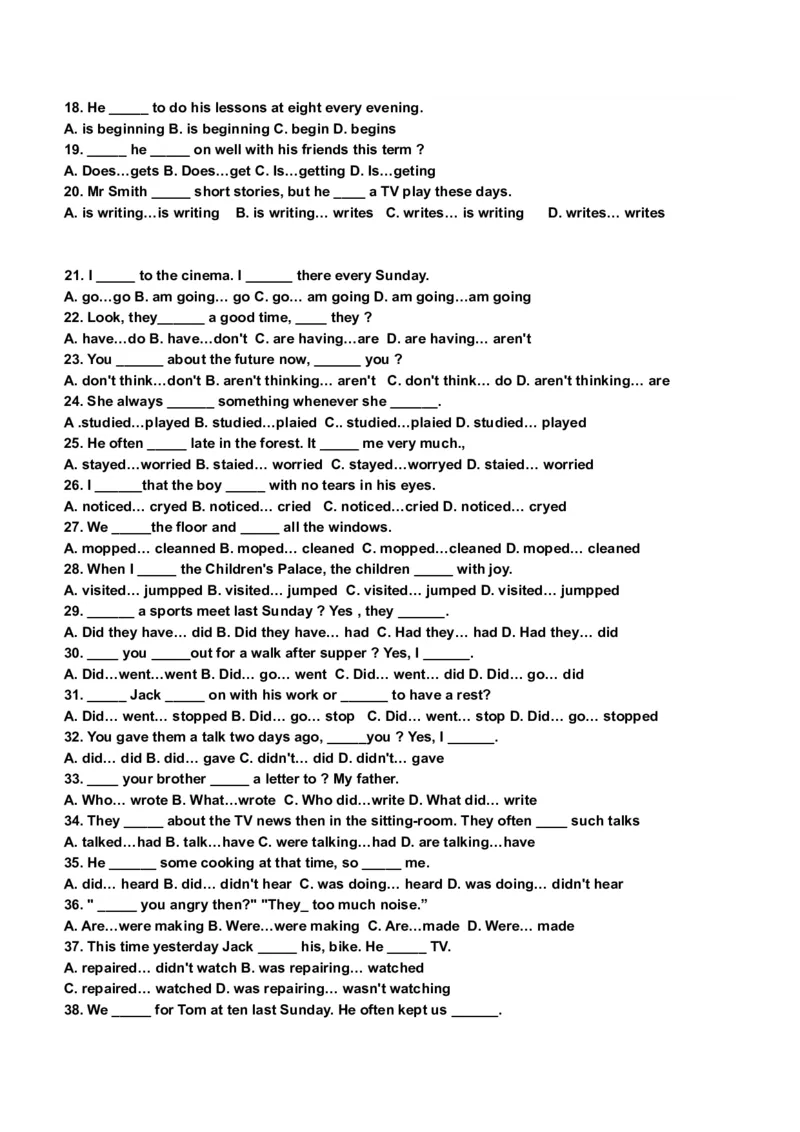
A. playing… dance B. playing… dancing C. play… dancing D. play… dance18. He _____ to do his lessons at eight every evening.
A. is beginning B. is beginning C. begin D. begins
19. _____ he _____ on well with his friends this term ?
A. Does…gets B. Does…get C. Is…getting D. Is…geting
20. Mr Smith _____ short stories, but he ____ a TV play these days.
A. is writing…is writing B. is writing… writes C. writes… is writing D. writes… writes
21. I _____ to the cinema. I ______ there every Sunday.
A. go…go B. am going… go C. go… am going D. am going…am going
22. Look, they______ a good time, ____ they ?
A. have…do B. have…don't C. are having…are D. are having… aren't
23. You ______ about the future now, ______ you ?
A. don't think…don't B. aren't thinking… aren't C. don't think… do D. aren't thinking… are
24. She always ______ something whenever she ______.
A .studied…played B. studied…plaied C.. studied…plaied D. studied… played
25. He often _____ late in the forest. It _____ me very much.,
A. stayed…worried B. staied… worried C. stayed…worryed D. staied… worried
26. I ______that the boy _____ with no tears in his eyes.
A. noticed… cryed B. noticed… cried C. noticed…cried D. noticed… cryed
27. We _____the floor and _____ all the windows.
A. mopped… cleanned B. moped… cleaned C. mopped…cleaned D. moped… cleaned
28. When I _____ the Children's Palace, the children _____ with joy.
A. visited… jumpped B. visited… jumped C. visited… jumped D. visited… jumpped
29. ______ a sports meet last Sunday ? Yes , they ______.
A. Did they have… did B. Did they have… had C. Had they… had D. Had they… did
30. ____ you _____out for a walk after supper ? Yes, I ______.
A. Did…went…went B. Did… go… went C. Did… went… did D. Did… go… did
31. _____ Jack _____ on with his work or ______ to have a rest?
A. Did… went… stopped B. Did… go… stop C. Did… went… stop D. Did… go… stopped
32. You gave them a talk two days ago, _____you ? Yes, I ______.
A. did… did B. did… gave C. didn't… did D. didn't… gave
33. ____ your brother _____ a letter to ? My father.
A. Who… wrote B. What…wrote C. Who did…write D. What did… write
34. They _____ about the TV news then in the sitting-room. They often ____ such talks
A. talked…had B. talk…have C. were talking…had D. are talking…have
35. He ______ some cooking at that time, so _____ me.
A. did… heard B. did… didn't hear C. was doing… heard D. was doing… didn't hear
36. " _____ you angry then?" "They_ too much noise.”
A. Are…were making B. Were…were making C. Are…made D. Were… made
37. This time yesterday Jack _____ his, bike. He _____ TV.
A. repaired… didn't watch B. was repairing… watched
C. repaired… watched D. was repairing… wasn't watching
38. We _____ for Tom at ten last Sunday. He often kept us ______.A. were waiting… waiting B. were waiting… wait C. waited… waiting D. waited… wait
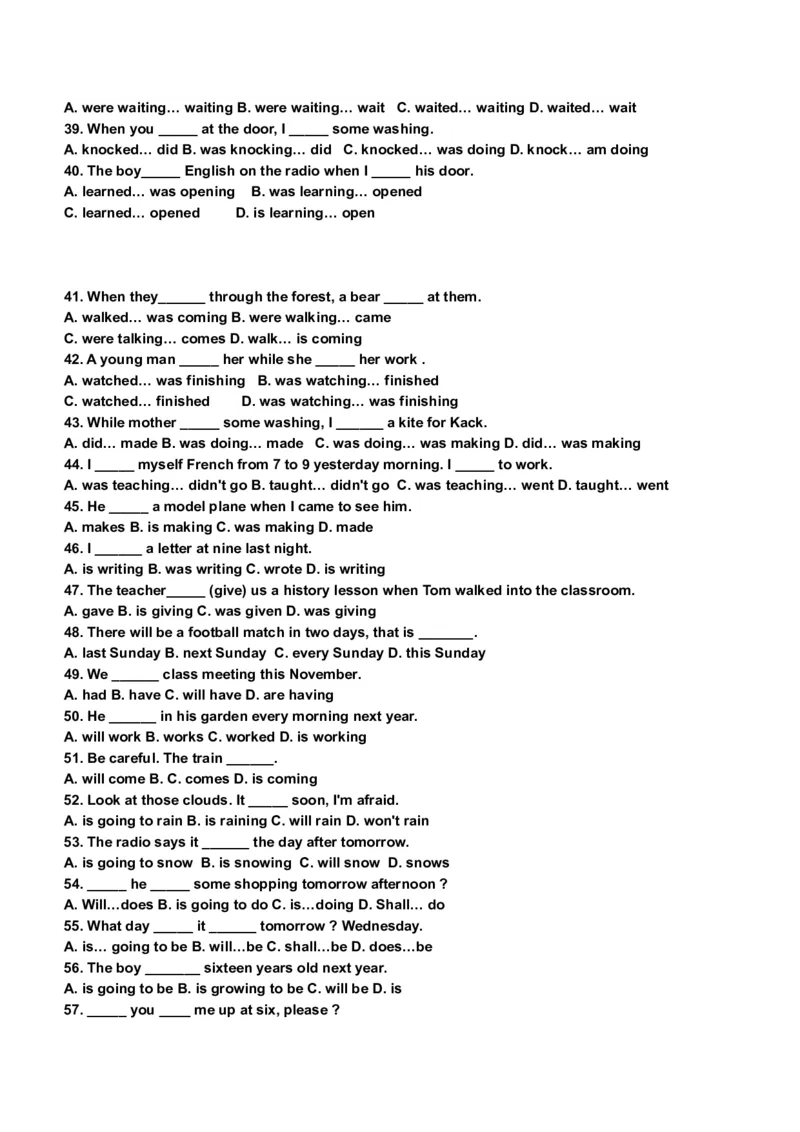
39. When you _____ at the door, I _____ some washing.
A. knocked… did B. was knocking… did C. knocked… was doing D. knock… am doing
40. The boy_____ English on the radio when I _____ his door.
A. learned… was opening B. was learning… opened
C. learned… opened D. is learning… open
41. When they______ through the forest, a bear _____ at them.
A. walked… was coming B. were walking… came
C. were talking… comes D. walk… is coming
42. A young man _____ her while she _____ her work .
A. watched… was finishing B. was watching… finished
C. watched… finished D. was watching… was finishing
43. While mother _____ some washing, I ______ a kite for Kack.
A. did… made B. was doing… made C. was doing… was making D. did… was making
44. I _____ myself French from 7 to 9 yesterday morning. I _____ to work.
A. was teaching… didn't go B. taught… didn't go C. was teaching… went D. taught… went
45. He _____ a model plane when I came to see him.
A. makes B. is making C. was making D. made
46. I ______ a letter at nine last night.
A. is writing B. was writing C. wrote D. is writing
47. The teacher_____ (give) us a history lesson when Tom walked into the classroom.
A. gave B. is giving C. was given D. was giving
48. There will be a football match in two days, that is _______.
A. last Sunday B. next Sunday C. every Sunday D. this Sunday
49. We ______ class meeting this November.
A. had B. have C. will have D. are having
50. He ______ in his garden every morning next year.
A. will work B. works C. worked D. is working
51. Be careful. The train ______.
A. will come B. C. comes D. is coming
52. Look at those clouds. It _____ soon, I'm afraid.
A. is going to rain B. is raining C. will rain D. won't rain
53. The radio says it ______ the day after tomorrow.
A. is going to snow B. is snowing C. will snow D. snows
54. _____ he _____ some shopping tomorrow afternoon ?
A. Will…does B. is going to do C. is…doing D. Shall… do
55. What day _____ it ______ tomorrow ? Wednesday.
A. is… going to be B. will…be C. shall…be D. does…be
56. The boy _______ sixteen years old next year.
A. is going to be B. is growing to be C. will be D. is
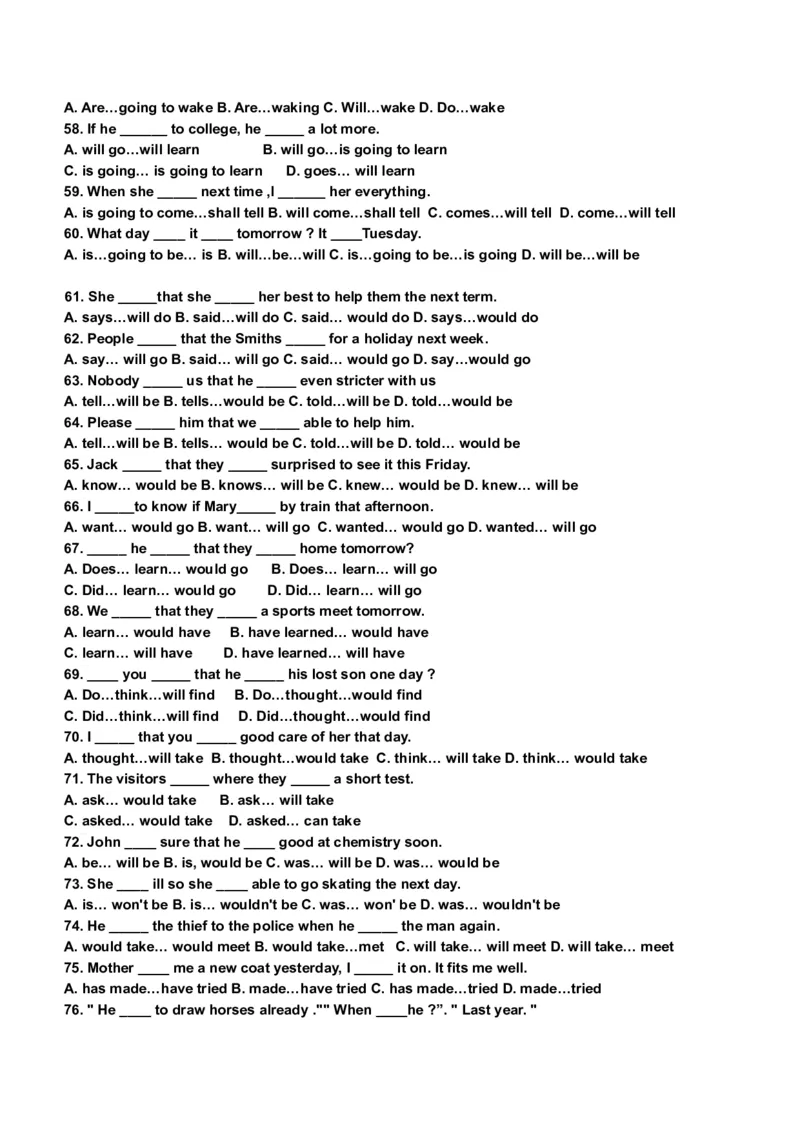
57. _____ you ____ me up at six, please ?A. Are…going to wake B. Are…waking C. Will…wake D. Do…wake
58. If he ______ to college, he _____ a lot more.
A. will go…will learn B. will go…is going to learn
C. is going… is going to learn D. goes… will learn
59. When she _____ next time ,l ______ her everything.
A. is going to come…shall tell B. will come…shall tell C. comes…will tell D. come…will tell
60. What day ____ it ____ tomorrow ? It ____Tuesday.
A. is…going to be… is B. will…be…will C. is…going to be…is going D. will be…will be
61. She _____that she _____ her best to help them the next term.
A. says…will do B. said…will do C. said… would do D. says…would do
62. People _____ that the Smiths _____ for a holiday next week.
A. say… will go B. said… will go C. said… would go D. say…would go
63. Nobody _____ us that he _____ even stricter with us
A. tell…will be B. tells…would be C. told…will be D. told…would be
64. Please _____ him that we _____ able to help him.
A. tell…will be B. tells… would be C. told…will be D. told… would be
65. Jack _____ that they _____ surprised to see it this Friday.
A. know… would be B. knows… will be C. knew… would be D. knew… will be
66. I _____to know if Mary_____ by train that afternoon.
A. want… would go B. want… will go C. wanted… would go D. wanted… will go
67. _____ he _____ that they _____ home tomorrow?
A. Does… learn… would go B. Does… learn… will go
C. Did… learn… would go D. Did… learn… will go
68. We _____ that they _____ a sports meet tomorrow.
A. learn… would have B. have learned… would have
C. learn… will have D. have learned… will have
69. ____ you _____ that he _____ his lost son one day ?
A. Do…think…will find B. Do…thought…would find
C. Did…think…will find D. Did…thought…would find
70. I _____ that you _____ good care of her that day.
A. thought…will take B. thought…would take C. think… will take D. think… would take
71. The visitors _____ where they _____ a short test.
A. ask… would take B. ask… will take
C. asked… would take D. asked… can take
72. John ____ sure that he ____ good at chemistry soon.
A. be… will be B. is, would be C. was… will be D. was… would be
73. She ____ ill so she ____ able to go skating the next day.
A. is… won't be B. is… wouldn't be C. was… won' be D. was… wouldn't be
74. He _____ the thief to the police when he _____ the man again.
A. would take… would meet B. would take…met C. will take… will meet D. will take… meet
75. Mother ____ me a new coat yesterday, I _____ it on. It fits me well.
A. has made…have tried B. made…have tried C. has made…tried D. made…tried
76. " He ____ to draw horses already ."" When ____he ?”. " Last year. "A. learned…has B. learned…did C. has learned…has D. has learned…did
77. Tom ____ up into the tree. Look, he _____ high up there !
A. has got… is B. has climbed… was C. got… was D. climbed… is
78. _____you _____ the text yet ? Yes, we _____ it two hours ago.
A. Did…copy…did B. Have… copied…have C. Have… copied… did D. Did …copy…had
79. "Why she angry?" "Because he _____ at he just now.
A. did… get, shouted B. has…got…shouted
C. did… get… has shouted D. has…got…has shouted
80. _____ you ______ the film before ? Where ____ you _____ it ?
A. Have… seen… did… see B. Did…see…die…watch
C. Have…seen… have… seen D. Did…see…have…seen
81. You _____ me waiting for two hours. I _____ for you since five.
A. Kept…waited B. have kept…waited C. kept…have waited D. have kept…have waited
82. Where _____John _____? To the library. He _____ there for an hour.
A. has… been … has gone B. has…gone…has been C. did… go… went D. did…be…went
83. _____ the baby still _____ ? No, it ______ crying.
A. Has… cried… has stopped B. Is…crying…stopped
C. Did… cry… stopped D. Is…crying…has stopped
84. I _____ the way. I ______ here for quite many years.
A. knew… have lived B. knew… live C. know… have lived D. know… live
85. _____ you ever _____America ? Yes, I have.
A. Have… gone to B. Have… gone in C. Have… been to D. Have… been in
86. My brother _______ college for over three years.
A. has gone to B. has been to C. has been in D. has been for
87. He _____ the Army by the end of 1992. He ____ in the army since then.
A. joined…is B. has joined…has been C. had joined…is D. has joined… has been
88. By the time I _____ back they ____ up ten metres.
A. came…have climbed B. came…had climbed C. come…have climbed D. had come…climbed
89. Jack ____ over five lessons by seven o'clock. Then he____ a test.
A. went…took B. went…had taken C. had gone…took D. had gone…had taken
90. We _____ out by that time that he ____ a thief for a long time.
A. had found…had been B. had found…was C. found…had been D. found…was
91. Before the new _____ him, he ____ to know about it.
A. reaches… has got B. reached…had got C. reached… got D. had reached…got
92. I _____ him a second letter before I _____ from him.
A. wrote… heard B. wrote… had heard C. had written… heard D. have written… hear
93. We _____ in a good harvest because we ______ enough rain.
A. didn't get… had had B. got… had had C. had got… had bad D. got… hadn't had
94. They ____for five hours when they ____ in New York.
A. flew…arrived B. had flown…had arrived C. flew…had arrived D. had flown…arrived
95. She ____ that ____ it for two days by that day.
A. says…has rained B. says…had rained C. said… had rained D. said…rained
96. John _____ there since the year before, so he ____ them.
A. had worked…knew B. had worked….had known C. worked…knew D. worked…had known'97. He _____ angry because he _____ for a long time.
A. had got…had waited B. got…waited C. had got…waited D. got…had waited
98. Paper _____ first invented in China.
A. is B. are C. was D. were
99. The Greens _____ China for five years.
A. has been in B. have been in C. went to D. has gone to
100.There _____ an eraser under the desk. Is it yours ?
A. is B. has C. was D. had
参考答案:1—5 BABDB 6—10 CDDBA 11—15 BBCCD 16—20 CBDCC
参考答案:21-25 BDDDA 26—30 BCBAD 31—35 BCCCD 36—40 BDACB
参考答案:41-45 BDCAC 46—50 BDDCA 51—55 DACBB 56—60 CCDCD
参考答案:61-65 CADAB 66—70 CBDAB 71—75 CDDBB 76—80 DACBA
参考答案:81-85 DBDCC 86—90 DDBCA 91—95 BCBDC 96-100 ADCBA
练习(三)
初中英语时态语态练习100题
1. The sun ________ in the east.
A. is always rising B. always is rising C. rises always D. always rises
2. He often ________ his clothes on Sundays.
A. washing B. washes C. has washed D. wash
3. I’m Japanese. Where ________ from?
A. do you come B. you are coming C. you come D. are you coming
4. A mother who ________ her son will do everything for his happiness.
A. is loving B. loves C. loved D. has loved
5. ________ at a higher temperature than water?
A. Has milk boiled B. Is milk boiling C. Does milk boil D. Was milk boiling
6. He signed to us with his hand, “The lesson is over. You ________.”
A. dismissed B. are dismissed C. have dismissed D. were dismissed
7. I haven’t met him for ages, but his mother ________ him sometimes.
A. had still seen B. still sees C. has still seen D. still saw
8. We will start as soon as our team leader________ .
A. comes B. will come C. come D. is coming
9. I think Jack ________ the answer.
A. has known B. does know C. is knowing D. knows
10. My father ________ George quite well; they were introduced at a party.
A. is knowing B. was knowing C. knows D. had been knowing
11. Where ________ ?
A. Mary works B. works Mary C. does Mary works D. does Mary work
12. I think this question ________ to answer.
A. easy B. is easy C. was easy D. Both A and B
13. ________ oil or butter when you cook it ?
A. Do you use B. Did you use C. Were you using D. Have you used
14. I ________ some newspaper at seven yesterday evening.
A. am reading B. read C. was reading D. will read
15. Now he ________ a book about New York. I don’t think he will finish it.A. writes B. wrote C. has written D. is writing
16. Zhang Hua does a lot of housework every evening, but now he ________ his schoolmates with their
lessons.
A. help B. is helping C. helps D. has helped
17. Mother washes the girl’s hair. Look, she ________ .
A. is washing it now B. washes it
C. is washing them now D. washes them now
18. He usually listens to the radio, but at the present moment he ________ television.
A. watches B. is watching C. has watched D. had watched
19. How long ago ________ playing with soldiers?
A. have you stopped B. had you stopped C. did you stop D. do you stop
20. Look at John! What ________ ?
A. does he B. he is doing C. is he doing D. does he do
21. It ________ hard when I left my house.
A. is raining B. rains C. was raining D. will rain
22.The railway ________ in three years.
A. is complete B. will completed C. has completed D. will be completed
23. Don’t talk so loudly. Your father ________ .
A. sleeps B. is sleeping C. slept D. had slept
24. ----- What are you doing under the table?
----- I ________ to find my pen.
A. tried B. had tried C. try D. am trying
25. Jane and Tom ________ the door.
A. are walking at B. walk at C. walks to D. are walking to
26. How many people does the doctor know ________ of the disease?
A. are dying B. is dying C. has died D. dies
27. He ________ thin.
A. was getting B. is getting C. will getting D. had been got
28. Our team ________ every match so far this year, but we still have three games to play.
A. was winning B. has won C. had won D. wins
29. I shall tell you what he ____at three o’clock yesterday afternoon.
A. has done B. has been done C. had been doing D. was doing
30. I ________ my homework now.
A. finish B. finished C. have finished D. had finished
31. I ________ this coat for very long. It still looks quite new.
A. wasn’t having B. haven’t had C. hadn’t D. haven’t been having
32. ________ reading the book yet?
A. Have you finished B. Were you finishing
C. Had you finished D. Are you finishing
33. The evening party ________ .You are a little late.
A. just began B. just has begun C. has just begun D. has begun just now
34. The dog is still wet. It ________ out of the rain.
A. only just comes B. has only just coming
C. was only just come D. has only just come35. Where did you study before you ________ to this middle school?
A. come B. came C. are coming D. will come
36. He ________ home for nearly three weeks.
A. has gone away from B. has left C. has been away from D. went away from
37. ----- Did your brother go to America last year? ----- ________ .
A. No, he has never go there B. No, he has never gone here
C. No, he never was there D. No, he’s never been there
38. My uncle ________ in that factory since 1958.
A. worked B. had worked C. is working D. has worked
39. I ________ her since she was a little girl.
A. knew B. know C. had known D. have known
40. He ________ for three years.
A. has joined B. has been in the army C. joined D. has served the army
41. His grandfather ________ for thirty years.
A. died B. was dead C. has been dead D. has died
42. I ________ a college student for more than a year.
A. became B. have become C. was D. have been
43. I ________ this radio for two years.
A. used B. use C. have used D. am used
44. I ________ from my brother for a long time.
A. not have heard B. have not heard C. have heard not D. do not hear
45. Since you don’t want to go, I ________ alone.
A. will go B. go C. went D. have gone
46. He________ his watch. Have you seen it anywhere?
A. lost B. lose C. has lost D. had lost
47. I ________ the exhibition on the life and work of Lenin.
A. see B. saw C. have seen D. am seeing
48. When I was a little boy my father ________ me the earth is round.
A. tells B. has told C. had told D. told
49. You ________ your homework..
A. haven’t done B. have doing C. have not doing D. not done
50. Our teacher ________ to Beijing three times.
A. went B. had done C. has gone D. has been
51. It’s time you ________ a holiday.
A. had B. have C. will have D. have had
52. The young engineer he ________ is a friend of his.
A. is talking B. is going to talk C. talked D. is talking to
53. He ________ in Shanghai in 196o.
A. lives B. lived C. has lived D. is living
54. Robert ________ in England a few weeks ago.
A. arrives B. has arrived C. could arrive D. arrived
55. How long ago ________ in Fujian?
A. has he arrived B. did he arrive C. could he arrive D. arrived
56. Jack ________ a letter to his parents last night.A. writes B. wrote C. write D. has written
57. His parent did not know why ________ his homework.
A. did he not do B. did he not to do
C. he had not done D. he had done not
58. Last week John ________ his leg.
A. felt and broken B. fell and broke
C. feels and breaks D. fallen and broken
59. Wang Jinsi ________ the whole nation as Iron Man.
A. was known by B. is known to C. knew D. has known
60. They ________ to a new house last month.
A. moves B. move C. moved D. have moved
61. I’ll let you know as soon as he ________ .
A. arrives B. will arrive C. arrive D. reach
62. ________ last year and is now earning his living as a newsboy.
A. He left the school B. He has left the school
C. He had left school D. He left school
63. Mike is now in New York. He ________ there since six days ago.
A. was B. is C. had been D. has been
64. Yesterday Mary ________ to me with a problem.
A. came B. goes C. went D. come
65. Where ________ yesterday?
A. went you B. was you C. have you been D. were you
66. Yesterday a man ________ my car.
A. hite B. hat C. hitted D. hit
67. The sun ________ when we got there.
A. raised B. had raised C. had risen D. rises
68. When did you ________ to see me last?
A. go B. went C. came D. come
69. ________ the news last night?
A. Heard you B. Did you heard C. Did you hear D. Were you hear
70. This book ________ everybody.
A. is known by B. is known for
C. is known to D. knows
71. I am sure he’ll come to see me before he ________ Beijing.
A. leave B. left C. will leave D. leaves
72. Jack ________ his thick coat because it was snowing.
A. puts on B. put on C. takes on D. took on
73. He ________ his coat and went out.
A. takes on B. put on C. takes on D. took on
74. How many people ________ the lecture on basic chemistry?
A. attended B. is attending C. do they attend D. did attend
75. Look at the clock! It’s time ________ home.
A. we’ll go B. we went C. we’re going D. we should go
76. He ________ you later.A. will see B. may will see C. wills see D. will sees
77. ________ breakfast in the morning?
A. Will she be B. Will she cooks C. Will she cook D. Will she be cook
78. You ________ her again in a few days.
A. will see B. have seen C. had seen D. have been seen
79. My parents ________ me to become a doctor.
A. hoped B. wanted C. decided D. suggested
80. If we study hard, ________ .
A. we had passed the exam B. We are passing the exam
C. we have passed the exam D. we will pass the exam
81. She has been here ________ .
A. after 1978 B. for 1978 C. in 1978 D. since 1978
82. Your shirt is dirty. ________ it for you?
A. Am I going to wash B. Will I wash C. Am I washing D. shall I wash
83. ----- The clock is slow.
----- It isn’t slow, it ________ .
A. is stopping B. will stop C. has stopped D. stopped
84.They wanted to know when they ________ have an examination.
A. had gone to B. were going to C. would be going D. had been going
85. My sister ________ to see me. She’ll be here soon.
A. comes B. is coming C. had come D. came
86. When ________ , I’ll talk to him.
A. does Peter come B. Peter will come C. Peter comes D. can Peter come
87. He will pay a visit to the exhibition when he ________ time.
A. has B. will have C. has D. is going to have
88. I will go home for the vacation as soon as I ________ my exams.
A. will finish B. finish C. finishing D. finished
89. If ________ , we’ll stay at home.
A. it will rain B. it’s to rain C. it rains D. it’ll be raining
90. It ________ hard when we left.
A. is raining B. has rained C. was raining D. rained
91. What ________ when I saw you yesterday?
A. did you do B. were you doing C. you were doing D. you did
92. Bill said that he ________ his homework at half past seven yesterday evening.
A. did B. was doing C. will do D. has done
93. They ________ a meeting from 2 to 4 yesterday afternoon.
A. were having B. had C. would have D. have
94. Yesterday afternoon some students ________ wheat on the farm.
A. had sowing B. sowed C. have sown D. were sowing
95. She ________ at seven o’clock this morning.
A. is writing B. write C. writes D. was writing
96. By the end of last term we ________ English for two years.
A. have studied B. have been studied C. would studied D. had studied
97. He ________ quite a lot in his work.A. use to travel B. is used to travel C. used to travel D. was used to travel
98. He ________ out when somebody called at his office.
A. has just gone B. had just gone C. just went D. just now went
99. When the teacher came into the classroom, the pupils ________ their exercises.
A. have done B. were doing C. are doing D. has done
100. When we arrived, the dinner ________ .
A. already began B. has already begun
C. had already begun D. was just begun
1. D 2. B 3. A 4. B 5. C 6. B 7. B 8. A 9. D 10. C 11. D 12. D 13. A 14. C 15. D 16. B 17. A 18. B 19. C 20. C
21. C 22. D 23. B 24. D 25. D 26. A 27. B 28. B 29. D 30. C 31. B 32. A 33. C 34. D 35. B 36. C 37. D 38. D
39. D 40. B 41. C 42. D 43. C 44. B 45. A 46. C 47. C 48. D 49. A 50. D 51. A 52. D 53. B 54. D 55. B 56. B
57. C 58. B 59. B 60. C 61. A 62. D 63. D 64. A 65. D 66. D 67. C 68. D 69. C 70. C 71. D 72. B 73. B 74. A
75. B 76. A 77. C 78. A 79. B 80. D 81. D 82. D 83. C 84. B 85. B 86. C 87. A 88. B 89. C 90. C 91. B 92. B
93. A 94. D 95. D 96. D 97. C 98. B 99. B 100 C
16种英语时态总结归纳
时态(Tense)是表示行为、动作和状态在各种时间条件下的动词形式。因此,当我们说时态结构的时候,指
的是相应时态下的动词形式。
英语时态分为16种:一般现在、一般过去、一般将来、过去将来时,以及这四者的进行时、完成时和完
成进行时。
1. 一般现在时
用法:
A) 表示现在发生的动作、情况、状态和特征。
B) 习惯用语。
C) 经常性、习惯性动作。
例:He always helps others. (他总是帮助别人。)
D) 客观事实和普遍真理。尤其要注意,如果前后文不是一般现在时,则无法保持 主句、从句时态一致。
E) 表示一个按规定、计划或安排要发生的动作,(仅限于某些表示“来、去、动 、停、开始、结束、继
续”等的动词 )可以与表示未来时间的状语搭配使用 。常见的用法是:飞机、火车、轮船、汽车等定期定点
运行的交通方式。
例:The next train leaves at 3 o'clock this afternoon.
(下一趟火车今天下午3点开车。)
How often does this shuttle bus run? (这班车多久一趟?)F) 在时间和条件状语从句里经常用一般现在(有时也用现在完成时)表示将来事 情。
例:When you have finished the report, I will have waited for about 3 hours.(等你完成这份报告的时候,
我就已经等了将近3个小时了。)
2. 现在进行时(be doing)
用法:现在正在进行的动作。
3. 现在完成时(have done)
用法:
A) 表示动作到现在为止已经完成或刚刚完成。
例:I bought a new house, but I _________ my old one yet, so at the moment I have two houses.
A) didn't sell B) sold C) haven't sold D) would sell
答案是C) haven't sold。
B) 表示从过去某时刻开始,持续到现在的动作或情况,并且有可能会继续延续下去。此时经常用延续性
动词。时间状语常用since加一个过去的时间点,或for 加一段时间,或by加一个现在时间。
例:Great as Newton was, many of his ideas ___________ today and are being modified by the work of
scientists of our time.
A) are to challenge C) have been challenged
B) may be challenged D) are challenging
全句的意思是:“虽然牛顿是个伟大的人物,但他的许多见解直到今天还在受到挑战,并且被现代科学家
的工作所修正。”challenge是及物动词,在本句中应当是被动语态;其动作延续到今天,所以要用现在完成
时态。可见答案是C) have been challenged。A) are to challenge和D) are challenging都是主动语态,不可
能是答案。B) may be challenged虽然是被动语态,但意思与全句内容不合,所以不对。
C) 表示发生在过去,但对现在仍有影响的动作或情况。通常用点动词,如:arrive, begin, find, give, lose
等。
例:John has broken his left leg.(约翰摔断了左腿。)
注意事项
A) 现在完成时是联系过去和现在的纽带。现在完成时和过去时的区别在于:现在完成时强调动作的动态,
或受动态的影响,是动态的结果,对现在有影响;过去时只表示过去的某个具体时间里发生的动作,与现在没
有联系。
例:He worked in that hospital for 8 years.(他曾经在那家医院工作了8年。这只是讲述一个过去的事实,
他现在已经不在那家医院了。)
He has worked in that hospital for 8 years.(他已经在那家医院里工作了8年。表示他从过去开始工作,
一直工作到现在,现在仍在那家医院工作。)
B) 因为含有for加一段时间或since加一个时间点这样的时间状语的完成时,有动态和延续性的特点,所
以不能使用终端动词或瞬间动词。
例:My sister has been married for 5 years.(过去分词做表语表示状态,可以延续)
My sister has married. Don't disturb her.(终端动词)
C) 在"this is the first/ second/ third…… time that……"句型里要求用完成时。
例:This is the second time that the products of our company have been shown in the International
Exhibition.(这是我公司产品第二次参加国际展览会。)
D) 句型"It is/ has been……since"所使用的两种时态都正确。
例:It is/ has been 10 years since I last saw him.(从我上次见到他以来已经10年了。)
E) 在"no sooner than"、"hardly/ scarcely ……when"、"before"、"prior to"等句型中,主句要求完成时。例:I haven't met that professor prior to today.(以前我从未见过那位教授。)
4. 现在完成进行时(have been doing)
用法:表示某一动作开始于过去某一时间,延续或重复地出现至今,或将继续延续至将来。
例:We have been working on this project for over a month now.(到目前为止,我们一直在处理那个项
目,已经花了一个多月时间了。)
注意事项:与现在完成时相比,现在完成进行时更强调:在从过去到现在的时间里,动作或状态一直持续
或一直反复出现。
例:1997年6月四级第45 题
It seems oil ___________ from this pipe for some time. We'll have to take the machine apart to put it
right.
A) had leaked B) is leaking
C) leaked D) has been leaking
从本题上下文看,这两个句子的意思是:“看来,这个管道漏油已有一段时间了,我们将不得不拆卸机器
排除故障。”第二句表示将要采取的措施。第一句动作发生在第二句之前,并且延续到现在为止仍在继续。因
此,空格中需用现在完成时或现在完成进行时。D) has been leaking是现在完成进行时,因此是本题的答案。
有11%的考生误选了B) is leaking。由于本句有时间状语for some time,表示谓语动作延续,谓语不能用现在
进行时,必须用和完成时有关的时态。有些考生误选了C) leaked或A) had leaked。是因为他们没有注意到本
题第二句是一般将来时,所以第一句的谓语不能用过去时或过去完成时。
5. 一般过去时
用法:
A) 表示过去某个时间发生的动作或情况。
B) 表示过去习惯性动作。特别是由would/ used to do表达的句型,本身表示的 就是过去时。
例:The old man would sit on a bench in the quiet park and look at others for hours without doing
anything or talking to anybody.(老人过去常常坐在宁静的公园里的一条长椅上,看着其他的人,一坐就是数
个小时,什么也不干,也不和任何人交谈。)
He used to visit his mother once a week.(他以前总是每周看望一次他的母亲。)
C) 有时可代替一般现在时,表达一种婉转、客气、礼貌、商量的语气。
例:I wanted to ask you if I could borrow your car?(我想向您借车用一用,可以吗?)
Would you mind my sitting here?(您介意我坐在这里吗?)
注意事项:
A) 注意时间状语的搭配。一般过去时的时间状语应该是表示过去某个时间的词或词组,如:yesterday,
last month, in 1999, two days ago等,绝对不可与recently, in the past 10 years, this month等连用,因为这
样的时间状语都与现在有关系,应该用现在完成时或一般现在时。
B) used to do的否定形式和疑问形式很特别:你怎么写都正确。以否定形式为例:used not to do, didn't
used to do, didn't use to do都对。
Used to do经常与 be used to doing sth/ sth结构进行对比。前者表示"过去常常或过去曾经",要求加动
词原形;后者表示"习惯于",要求加名词或动名词。
6. 过去完成时(had done)
用法:表示在过去的某个时间或动作以前已经发生的动作或已经存在的状态。就是我们常说的:表示"过
去的过去的动作或状态"。
Until then, his family _________ from him for six months.A) didn't hear C) hasn't heard B) hasn't been hearing D) hadn't heard
全句的意思是:“到那时为止,他家里已经有六个月没得到他的消息了。”由此可以看出,谓语动词的动
作延续到过去的某一时刻才完成,因此谓语要用过去完成时。答案是D)。其它选项中:A) didn't hear,因为
一般过去时只表示过去发生的事情或存在的状态,所以不能与时间状语for six months连用。B) hasn't been
hearing,现在完成进行时表示过去某时刻继续到现在或现在还在进行的动作,与题意不符。C) hasn't
heard,现在完成时表示从过去某一时刻到现在为止发生的动作。而题中的then只表示过去的某一时刻,不能
表示现在时间。
注意事项:“过去的过去”这种逻辑关系常通过上下文体现出来,而不一定受某个时间状语的限制。
例:There had been some one in our room just now, because I noticed a burning cigarette end on the
floor when we opened the front door.(刚才有人在我们的房间里,因为我们打开前门进来时,我注意到地板
上有一支仍在燃烧的香烟。)
分析:虽然时间状语是just now,似乎应该使用一般过去时,但是“在房间里”这个状态是在"开门"和"注
意"这两个过去的动作之前就存在的,所以应该用过去完成时。
7. 过去将来时(would/ should do)
用法:表示从过去的某个时间看将要发生的事。
例:I said on Thursday I should see my friend the next day.(我星期四说我将于第二天拜访我的朋
友。)
注意事项:由于过去将来时是由过去时和将来时组合而成的,所以其注意事项可以参考过去时和将来时的
相关注意事项。
8. 过去进行时(was/ were doing)
用法:
A) 表示在过去一个比较具体的时间正在发生的动作。
例:Mary was listening to light music 10 minutes ago.(10分钟前,玛丽正在听轻音乐。)
B) 如果when, while这样的时间状语引导词所引导的主从句之一是一般过去时,则另一个句子常用过去进
行时。
例:I was washing my hair when you knocked at the front door.(你敲前门时我正在洗头发。)
注意事项:其它与将来时有关的事项请参见下面所讲的一般将来时。
9. 一般将来时
用法:
A) 基本结构是will / shall do。
例:We shall send her a glass hand-made craft as her birthday gift.(我们将送给她一个玻璃的手工制品,
作为给她的生日礼物。)
B) 有些动词,如:arrive, be close, come, do, done, go, have, leave, open, play, return, sleep, start, stay
等,用于一般进行时,并且通常与一个表示将来时间的时间状语连用,可以表示将来时。
例:My mother is coming to visit me next week and is staying here until May.(我妈妈下周将来看我,并
会呆到5月。)
C) 表示“打算去……,要……”时,可用be going to do。
例:This is just what I am going to say.(这正是我想说的。)
D) 表示“即将、正要”时,可用be about to do。强调近期内或马上要做的事。
例:Don't worry, I am about to make a close examination on you.(别担心,我马上就给你做一次仔细的
检查。)E) "be to do"的5种用法:
a) 表示“按计划、安排即将发生某事或打算做某事”。
例:She is to be seen in the lab on Monday.(星期一你准会在实验室见到她。)
b) 该做或不该做的事情(语气上接近于should, must, ought to, have to),表示一种命令、规劝性语气。
例:You are to go to bed and keep quiet, kids. Our guests are arriving in less than 5 minutes.(孩子们,
你们必须 上床睡觉,不准吵闹。我们的客人5分钟之内就要到了。)
c) 能或不能发生的事情(接近can, may)
例:How am I to pay such a debt?(我怎么可能还得起这么大的一笔债呢?)
d) 不可避免将要发生的事情,后来将要发生的事情。
例:I assure you that the matter _______ as quickly as possible. Have a little patience.
A. will be attended B. will be attended to
C. is attended D. is attended to
will be attended to关键的一点是:attend表示“处理,解决”时是不及物动词,必须与to连用。另外,
从上下文看,事情显然尚未解决,所以应该用将来时的被动语态。答案是B。
e) 用于条件从句“如果……想,设想”(接近if ……want to,或if ……should)
例:Greater efforts to increase agricultural production must be made if food shortage ____________
avoided.
A) is to be B) can be C) will be D) has been
答案是A) is to be。全句的意思是:“如果要避免食品短缺,就必须作出更大努力来增加农业产量。”
F) 同样可以表示“正要、将要”的意思的句型是be on the point of doing。
例:The coach is on the point of giving up the game because our team has been scored 7 points.(教练
想要放弃这场比赛了,因为对方已经射进了7个球。)
例:1999年6月四级第65题
I was _______ the point of telephoning him when his letter arrived.
A) in B) to C) at D) on
答案是D)。on the point of doing 是固定词组,意思是“正要、打算”。全句的意思是:“当他的信到的
时候我正要打电话给他。”
注意事项:
在以if, when, as long as, as soon as, after, before, in case, until, unless等连词以及具有连词作用的副词
(immediately, the moment, directly)等引导的状语从句,一般用现在时代替将来时。强调延续性或动态时,
可用完成时。
例:I hope his health will have improved by the time you come back next year.(我希望到明年你回来的
时候,他的身体已经好多了。)
10. 将来进行时(will be doing)
用法:强调在将来的某个具体时间正在发生的动作或事情。
例:Don't worry, you won't miss her. She will be wearing a red T-shirt and a white skirt at that time.(别
担心,你不会认不出她的。她到时会穿一件红色的T恤衫和一条白色的短裙。)
注意事项:由于本时态是由将来时和进行时融合在一起的,所以关于本时态的注意事项,可参考"一般将
来时"和"现在进行时"的有关注意事项。
11. 将来完成时(will have done)
用法:表示从将来的某一时间开始、延续到另一个将来时间的动作或状态,或是发生在某个将来时间,但
对其后的另一个将来时间有影响的动作或状态。就好象把现在完成时平移到时间轴的将来时时段一样。其用法
从和过去及现在有关,变成了和将来及将来的将来有关。例:1997年1月四级第22题
The conference __________ a full week by the time it ends.
A) must have lasted B) will have lasted
C) would last D) has lasted
本题考核谓语动词的时态。全句的意思是:“会议从开始到结束将持续整整一个星期。”句中by the
time it ends表示动作要延续到将来某一时刻,因此要用将来完成时。答案是B) will have lasted。如果选A),
因为情态动词must后面接动词不定式的完成时形式表示对已经发生的事情的一种肯定推测,而本句的时间状
语是by the time it ends而非by the time it ended,所以犯了时态不呼应的错误。Would虽可以表示推测或可
能性,但would last不能表示延续到将来某一时刻的动作,所以C) would last错误。因为D) has lasted是现
在完成时,表示到现在为止已经完成的动作,不能表示延续到将来某一时刻的动作,所以也不正确。
注意事项:由于本时态是由将来时和完成时融合在一起的,所以关于本时态的注意事项,可以参考“一般
将来时”和“现在完成时”的有关注意事项。
12)将来完成进行时:shall have been doing ,will have been doing
例:By the end of next month, the project will have been being worked for 3 years. (到下个月底为止,
这项工程就已经不停地进行了3年了。)(被动语态)
13)过去完成进行时:had been doing
例:The old clock had been being taken apart of and fixed up again for several times by my 10-year old
son before I came back home.(我回到家之前,我10岁大的儿子已经把这个旧钟表拆卸并重新组装了好几回
了。)(此处强调“拆卸”和“组装”这两个过去的过去的动作一直在反复进行。)(被动语态)
14) 过去将来进行时:should be doing , would be doing
例:The government promised that a new highway would be being built next July.(政府承诺说第二年7
月将有一条新的高速公路正在修建。)(此句的时间状语是具体的将来时间,所以最好用将来进行时。)(此
句为被动语态)
15) 过去将来完成时:should have done , would have done
例:I believed by the end of that year an advanced version of that software would have been
developed, but I was wrong.(我坚信到那年年底为止,那个软件的新版本将被开发出来。但是我错了。)
(此句为被动语态)
16) 过去将来完成进行时:should have been doing , would have been doing
例:They said that by the end of the following month, the project would have been being worked for 3
years. (他们说到第二个月底为止,这项工程就已经不停地进行了3年了。)
中考英语动词时态复习七大考点
时态是初中英语语法难点,也是中考的重要考点,其考点主要集中在以下几个方面:
【考点1】一般现在时的用法考查
一般现在时主要有如下几点用法:1、经常性或习惯性的动作。例如:It seldom snows in Suqian now.
2、现在的特征或状态。例如:He loves sports. 3、普遍真理,一般规律。例如:Light travels faster than
sound./ Fish soon goes bad in hot weather. 4、可以用来表示一个按规定,计划,安排或时刻表要发生的
情况,一般都有一个表示未来时间的状语。通常用来表示学期什么时候要开学、结束;飞机、火车、汽车、船
只等交通工具什么时候要到达,什么时候要离开等时刻表上已有安排的活动。动词一般限于少数几个,如:
begin, start, stop, arrive, come, go, leave, return, open, close, be等。例如:My plane leaves at 11a.m. tomorrow./ School begins the day after tomorrow. 5、在if, when, as soon as, until, after, before
等连接词引导的时间或条件状语从句中,从句中谓语动词要用一般现在时,主句要用将来时。例如:Turn off
the light before you leave./ We will start as soon as you are ready.
关于一般现在时应注意以下几点:a. 在间接引语中,如果转述的是客观真理,一般规律,谚语俗语,一
般现在时时态保持不变。例如:He said the earth is round. b. if引导的条件状语从句中用一般现在时表示
将来的情况;但if作为"是否"意思时,其引导的宾语从句如果表示将来的情况则用一般将来时。When作
为"当、、时候",引导状语从句时,从句用一般现在时表示将来的情况,如:When he comes, I will let you
know;如果引导的是宾语从句,表示"什么时候",则将来的情况仍然用一般将来时,如:I don't know
when he will visit me. c. 一些时间副词如seldom, usually, sometimes, often, never, every day等既可以
用于过去时,也可以用于一般现在时。要注意区分。例如:He often goes swimming. / He often went
swimming in 1999.
【中考链接】
1.Mum, _______ shall we have lunch?
We will have it when your dad_________.(2007年连云港)
A. when; returns B. where; returns C. where; will return D. when; will return
简析:A。when在后半句中表示"当、、、时候",状语从句中用一般现在时表示将来情况,根据后半句
应该是问时间的,第一空用时间疑问词when.
2.Tomorrow will be Father's Day. What will you do for your father?
I will say "I love you, Daddy" as soon as he _______ up. (2007年南通)
A. will wake B. is waking C. wakes D. woke
简析:C。as soon as"一、、就、、",引导时间状语从句。从句中一般现在时表示将来的情况。
3. Our teacher said light________ faster than sound. (2007年宿迁)
A. travelled B. has travelled C. is travelling D. travels
简析:D。"光比声音传播速度快"是科学真理,在间接引语中一般现在时保持不变。
4.Let's go fishing if it _______ this weekend.
But nobody knows if it_______.(2006年扬州)
A. is fine, will rain B. will be fine, rains C. is fine, rains D. will be fine, will rain
简析:A。前半句中if引导的是条件状语从句,从句用一般现在时表示将来;后半句if的意思是"是否",
引导宾语从句,周末下不下雨是未来的事情,用一般将来时。
5.Is your father a doctor?
Yes, he is. He________ in Town Hospital. (2006年武汉)
A. has worked B. had worked C. works D. worked
简析:C。一般现在时在此句中表示现在的一种状态。即"爸爸现在在这所医院工作。"
【考点2】现在进行时的用法考查
现在进行时主要有以下用法:1、表示现在或现在这一阶段正在进行的动作。常见的时间状语:right
now, at present, at the moment, now.常见的标志性动词如:look, listen等。例如:Someone is asking
for you on the phone. 2、表示一个在最近按计划或安排要进行的动作。多有一个表示未来时间的状语。这种
情况仅限于少量动词,如:go, come, leave, start, arrive, work, have, stay, play, return等。例如:--Tom,
supper is ready. Come quickly. -OK. I'm coming.
注意:表示状态和感觉的动词如果指现在情况的话,一般不用于进行时,而要用一般现在时。这样的动词
有:love, like, hate, want, hope, need, wish, know, understand, remember, belong, hear, see, seem,
have(有), sound(听起来), taste(尝起来)等。
【中考链接】
1.Where's your mother, Helen?She________ the flowers in the garden. (2007年镇江)
A. waters B. watered C. is watering D. has watered
简析:C。谈话中问妈妈现在在哪儿,可知妈妈正在花园里给花浇水。
2.Hurry up! It's time to leave. --OK, ________.(2006年孝感)
A. I'm coming B. I'll come C. I've come D. I come
简析:A。"I'm coming"意思是"我就来"。现在进行时表示最近按安排要进行的动作。
3.Shall we invite Tom to play football now?
Oh, no. He his clothes.(2006年泸州)
A. is washing B. washes C. has washed D. washed
简析:A。上半句对方表示要现在邀请Tom踢足球,但另外一个人说不行,显然,他正在洗衣服现在脱
不开身。
【考点3】一般过去时的用法考查
一般过去时主要有以下用法:1、表示过去某时发生的动作或情况(包括习惯性动作)。常见的时间状语
有:yesterday, last night/week, a month ago/ ten years ago和具体的过去时间in 1990, in 2006等。例如:
She often came to help me when I was in trouble. 2、发生的时间不是很清楚,但实际上是过去发生的。
例如:How nice to see you here! I thought you were out.
要注意区分一般过去时和过去进行时。一般过去时表示过去发生的事情,侧重结果;而过去进行时只表示
过去某段时间正在进行的动作,而不涉及结果。例如:He was writing a letter last night.(不知道是否写完
了) / He wrote a letter last night. (结果写完了)
【中考链接】
1. Simon________ his fingers when he was cooking the dinner. (2007年盐城)
A. burnt B. was burning C. has burnt D. had burnt
简析:A。burn此处为瞬间动词,表示"烫着","当他在做饭的时候,他烫着了手指",一般过去时在此处
表示结果。
2.I'm sorry you have missed the bus. It_________ five minutes ago.
What a pity! (2006年徐州)
A. was leaving B. has left C. left D. leaves
简析:C。根据"five minutes ago"可知是指过去的事情,且表示的是结果,用一般过去时。
3.Mr. Johnson, we have found your watch.
My watch!Thank you. Where____ it?(2006年绍兴)
A. do you find B. have you found C. did you find D. were you finding
简析:C。"发现"的动作为过去的事情,表示过去的结果,故用一般过去时。
【考点4】过去进行时的用法考查
过去进行时主要有以下用法: 1、谈论过去的某个时刻或某段时间正在进行的事。例如:I was reading
the newspaper at 6.30 this morning. 2、当过去某一件事情发生时,另外一个动作正在进行。此时,延续性
动词用过去进行时,瞬间动词用一般过去时。例如:The earthquake started while I was doing some
shopping. 3、可以表示从过去某个时候看来将要发生的事。例如:When his son arrived, the old man was
dying.
【中考链接】
1.I came to your home yesterday afternoon, but nobody was in.
Oh, we_______ some shopping in the supermarket.(2007年南通)
A. have done B. did C. were doing D. are doing
简析:C。根据对话,可知在对方到他们家时,他们当时正在超市购物。2.What do you think of the colour of my new dress?
Sorry, but what did you say? I_________ about something else. (2007年扬州)
A. think B. thought C. am thinking D. was thinking
简析:D。第二个说话者没有听见对方说什么,可知对方说话时,此人正在考虑别的事情。过去进行时表
示一个动作发生时,另外一个动作正在进行。
3. I _______my homework while my parents TV last night.(2006年南京)
A. did; have watched B. was doing; were watching
C. had done; were watching D. would do; were watching
简析:B。做作业和看电视均为延续性动词,而且是在过去同时进行的两个动作,所以都用过去进行时。
【考点5】现在完成时的用法考查
现在完成时主要有以下用法:1、谈论开始于过去某个时候而且持续到现在的一个动作。例如:Eddie
has lived with Millie since he was born. 2、谈论过去发生的动作,并且和现在存在联系。即过去的某个动
作对现在产生影响。Eddie has eaten my food. (Eddie ate the food and now Hobo has nothing to eat.)
但是如果单纯谈一个过去的动作,不涉及它对现在的影响时,通常用一般过去时。
现在完成时常见的时间状语有:for+一段时间;since+过去的某个时间;so far, yet, recently, over/in
the last/past +一段时间;(once, twice, )three…times, never, ever, up to now, these days例如:I
haven't seen him these days./ Have you ever seen each other before?
【中考链接】
1.Hello,this is Lily speaking.Could I speak to Mr. Black?
Sorry.He______ the Xuanwu Lake Park.(2007年南京)
A. has been to B. went to C. has gone to D. will go to
简析:C。说话者此时不在,说明此时已去了玄武湖公园,用现在完成时表示到目前为止还在持续的动作。
has been to表示已去过某个地方,而现在不在那个地方了。
2.Would you like to see the film with me?
I'm sorry I __________it twice. (2007年北京)
A. see B. will see C. have seen D. am seeing
简析:C。从twice可知说话者已看过这部电影两次了。表示到目前的结果,用现在完成时。
3. In the past few years there great changes in my hometown.(2007年天津)
A. have been B. were C. had been D. are
简析:A。over/in the last/past +一段时间为现在完成时的时间状语。
4.Kitty, will you go to see the film -Cold Mountain this evening?
No, I won't. I it already. (2006年南京)
A. saw B. have seen C. see D. will see
简析:B。用现在完成时表示过去的行为对现在造成影响。不去看电影的原因是因为已经看过了。
【考点6】过去完成时的用法考查
过去完成时表示过去某个行为或某件事发生之前就已经发生的动作或情况。例如:Hepburn had been a
model before she became a Hollywood superstar.
【中考链接】
1.Did you see Mr. Chen yesterday afternoon?
No. When I got to school, he_______ already. (2006年扬州)
A. left B. has left C. was leaving D. had left
简析:D。到达学校为过去的动作,在这个行为发生之前陈老师已离开了。过去完成时表示过去的过去。
【考点7】将来时的用法考查表示将来时态的结构很多。主要有以下几类:1、be going to do…表示计划, 打算做某事,例如:I'm
going to visit my grandparents next Friday evening.也可以表示根据目前情况很可能要发生的事。例如:
It's cloudy. It's going to rain. 2、一般现在时,可以用来表示一个按规定,计划,安排或时刻表要发生的情
况,一般都有一个表示未来时间的状语。例如:My cousin finishes school next year. 3、现在进行时可以
表示一个在最近按计划或安排要进行的动作。例如:Are you going to the wetlands photo show next
week? 4、一般将来时,will/ shall do..,在第一人称I/ We的句子中,可以用shall引导;各种人称都可以用
will表示一般将来时。
注意:1、时间,条件状语从句中,从句一般用一般现在时表示将来,而主句要用一般将来时。例如:I
will go shopping when I am free. 2、临时决定要做某事通常用一般将来时。例如:--Tom is ill in hospital.
-Oh, I'm sorry to hear that. I will go and see him. 3、将来时态常见的时间状语有:常见的时间状语:next
Tuesday, next week, the coming Sunday, this afternoon, tomorrow, tonight等。
【中考链接】
1."Ann is in hospital."
"Yes, I know. I________ her tomorrow." (2007年盐城)
A. visit B. used to visit C. will visit D. am going to visit
简析:D。从Yes, I know.可知对方事先已知道Ann生病的消息,已有了去看望她的计划和打算。be
going to do表示计划打算做某事。
2. Mr. Smith__________ a talk on country music next Monday. (2007年北京)
A. give B. gave C. has given D. will give
简析:D。next Monday为一般将来时的时间状语。
3.You've left the light on.
Oh, sorry._______and turn it off.(2006年泰州)
A. I've gone B. I'11 go C. I went D. I'm going
简析:B。经人提醒才知道,应为临时决定要去做某事,用一般将来时。
4.Joan, you are late! --Sorry, I ______ next time. (2006年浙江)
A. don't B. won't C. am not D. haven't
简析:B。next time是将来的时间状语。表示以后不会再迟到了,所以应用一般将来时。
动词时态自测练习题(一)
请用正确的动词和时态填入下列各词:
1. He __________ back a month ago. (come)
2. My mother often tells me __________ in bed. (not read)
3. I must take it back the day after tomorrow. You can only __________ it for 24 hours. (保存)
4. Why have you kept me __________ here for so long a time? (wait)
5. Please come to our meeting if you __________ free tomorrow. (be)
6. She __________ to the Great Wall several times. (goes)
7. In his letter, he said that he __________ us very much. (miss)
8. The film __________ for nearly fifteen minutes when I got to the cinema. (be)
9. He said he became __________ in physics. (interest)
10. This film is worth __________. (see)
11. He went to school instead of __________ home. (go)
12. In the old days it was difficult for the poor to __________ a job. (找)
13. It's cold outside, so you'd better __________ your coat. (穿上)
14. He is hungry. Please give him something __________. (eat)15. Please don't waste time __________ TV every evening. You should word hard at English. (watch)
16. We found the window __________. (break)
17. You have dropped your pencil. __________. (拾起来)
18. Mother often tells me __________ too late. (not come home)
19. You had better __________ by bus, or you will be late. (go)
20. I will __________ Li Ming the good news as soon as I see him. (告诉)
21. Great changes __________ in our country since 1978. (take place)
22. I __________ my daughter since last month. (hear from)
23. It __________ me two days to write the article. (花费)
24. Don't touch that __________ child. (sleep)
25. Every time he tried to start the car, the wheels __________ deepersintosthe mud. (sink)
26. When I got home, I found that my room __________ breaksintosand a lot of things __________.
(steal)
27. If I had arrived there earlier, I __________ him. (meet)
28. I didn't remember __________ her the book before. (give)
29. He called at every door, __________ people the exciting news. (tell)
30. Yesterday Mary couldn't finish her homework, so she has to go on __________ it this afternoon. (do)
31. We __________ football when it began to rain. We had to stop and go home. (play)
32. Xiao Lin __________ from here for about two hours. (be away)
33.swheres__________? Can you find your birth place on the map?
Sorry, I can't. (be born)
34. Last night we __________ back home until the teacher left school. (not go)
35. Comrade Li Dazhao __________ in prison in 1927. (put)
36.swheresis professor Lee?
He __________ to the library. He'll come back soon. (go)
37. We could not help __________ after we heard the story. (laugh)
38. Would you please __________ me an English-Chinese dictionary when you come? (bring)
39. He told me that he __________ the Great Wall the year before. (visit)
40. I'll tell him the news as soon as he __________ back. (come)
41. The boy __________ by the door is my brother. (stand)
42. Do you remember __________ the film last year? (see)
43. There __________ a physics test next Monday. (be)
44. __________ I finish my homework in class? (必须)
No, you needn't.
45. I'm sorry you've missed the last bus. It __________ ten minutes ago. (leave)
46. Wei Fang is heard __________ English every morning. (hear)
47. John stopped __________ a rest (have) because he __________ for three hours. (work)
48. I'm sorry to have kept you __________. (wait)
49. A new theatre __________ now. (build)
50. The boys __________ basketball on the playground are my classmates. (play)
51. I regretted answering like that, I was sorry __________ so. (do)
52. Can't you see I'm busy __________? (cook)
53. He __________ worried when comingsintosthe teacher's office. (look)
54. __________ come beef! (随便吃点)55. It's a great shame for me __________ in front of so many people. (laugh at)
答案
1. came
2. not to read
3. keep
4. waiting
5. are
6. has been
7. missed
8. had been on
9. interested
10. seeing
11. going
12. find
13. put on
14. to eat
15. watching
16. broken
17. Pick it up
18. not to come home
19. go
20. tell
21. have taken place
22. have heard from
23. took
24. sleeping
25. sank
26. had been broken in to / stolen
27. would have met
28. giving /shavingsgiven
29. telling
30. doing
31. were playing
32. has been away
33. were you born
34. didn't go
35. was put
36. has gone
37. laughing
38. bring
39. had visited
40. comes
41. standing
42. seeing43. is going to be
44. Must
45. left
46. to read
47. to have…had worked
48. waiting
49. is being built
50. playing
51. to do / to have done
52. cooking
53. looked
54. Help yourself to
55. to be laughed at
动词时态自测练习题(二)
( )1.I will tell him as soon as he _____ back
A. come B. comes C. will come D. came
( )2. Mary _____ on shoes when she ____ them.
A. tries…buys B. tries… buies C. trys… buys D. trys… buies
( )3. The girl often ______ cold when she ______.
A. catch…dances B. catches… dances C. catchs…dances D. catches… dance
( )4. _____ he ____ himself there? No, I don't think so.
A. Do…enjoy B. Does… enjoies C. Does… enjoys D. Does…enjoy
( )5. -_____ your teacher ____ from them very often? -Certainly.
A. Do…hear B. Does…hear C. Do… receive D. receive
( )6. _____ your mother _____ some cleaning on Sundays?
A. Does…does B. Do…does C. Does…do D. Do… do
( )7. -_____ Tom _____to work hard to help his family ? -Yes, he _____.
A. Has… x…does B. Has…x…does C. Does…has…has D. Does… have…does
( )8. Which teacher _____ lessons to you every day ?
A. does …gives B. does… give C. do… give D. gives
( )9. Smith does not go fishing on weekdays, ____? _____ , he does.
A. does he…No B. does he…Yes C. doesn't he…No D. doesn't he…Yes
( )10.Mr Black often _____ fishing on Sundays, _____ he ?
A. goes…doesn't B. goes…isn't C. doesn't go…goes D. doesn't go…is
( )11.He usually _____ TV on Sunday evening.
A. watch B. watches C. watching D. is watching
( )12. We'll go to play with snow if it ______ tomorrow.
A. snow B. snows C. will snow D. snowed
( )13. Neither I nor he ______ French.
A. speak B. doesn't speak C. speaks D. doesn't speak
( )14. Nobody ______ how to run(操纵) this machine.
A . know B. have known C. knows D. is knowing
( )15. The Young Pioneer _____ water for the old man every day.
A. carry B. bring C. takes D. carries( )16. Some are ______ in the river and some are ______ games.
A. swimming…plaiing B.swiming…playing C.swimming…playing D. swimming…plaing
( )17. Look ! The boy students are _____ football while the girls are _____ .
A. playing… dance B. playing… dancing C. play… dancing D. play… dance
( )18. He _____ to do his lessons at eight every evening.
A. is beginning B. is beginning C. begin D. begins
( )19. _____ he _____ on well with his friends this term ?
A. Does…gets B. Does…get C. Is…getting D. Is…geting
( )20. Mr Smith _____ short stories, but he ____ a TV play these days.
A. is writing…is writing B. is writing…writes C. writes…is writing D. writes… writes
( )21. I _____ to the cinema. I ______ there every Sunday.
A. go…go B. am going… go C. go… am going D. am going…am going
( )22. Look, they______ a good time, ____ they ?
A. have…do B. have…don't C. are having…are D. are having… aren't
( )23. You ______ about the future now, ______ you ?
A. don't think…don't B. aren't thinking… aren't C. don't think… do D. aren't thinking… are
( )24. She always ______ something whenever she ______.
A .studied…played B. studied…plaied C.. studied…plaied D. studyed… played
( )25. He often _____ late in the forest. It _____ me very much.,
A. stayed…worried B. staied… worried C. stayed…worryed D. staied… worried
( )26. I ______that the boy _____ with no tears in his eyes.
A. noticed… cryed B. noticed… cried C. noticd…cried D. noticed… cryed
( )27. We _____the floor and _____ all the windows.
A. mopped…cleanned B. moped…cleaned C. mopped…cleaned D. moped…cleaned
( )28. When I _____ the Children's Palace, the children _____ with joy.
A. visitd… jumpped B. visite… jumped C. visited… jumped D. visited… jumpped
( )29. ______ a sports meet last Sunday ? Yes , they ______.
A. Did they have…did B. Did they have…had C. Had they…had D. Had they…did
( )30. ____ you _____out for a walk after supper ? Yes, I ______.
A. Did…went…went B. Did… go… went C. Did… went… did D. Did… go…did
( )31. _____ Jack _____ on with his work or ______ to have a rest?
A. Did…went…stopped B. Did…go…stop C. Did…went…stop D. Did… go… stopped
( )32. You gave them a talk two days ago, _____you ? Yes, I ______.
A. did… did B. did… gave C. didn't… did D. didn't… gave
( )33. -____ your brother _____ a letter to ? - My father did.
A. Who… wrote B. What…wrote C. Who did…write D What did… write
( )34. They ___ about the TV news then in the sitting-room. They often ____ such talks
A. talked…had B. talk…have C. were talking…had D. are talking…have
( )35. He ______ some cooking at that time, so he _____ me.
A. did…heard B. did…didn't hear C. was doing…heard D. was doing…didn't hear
( )36. " _____ you angry then?" "They______ too much noise.”
A. Are…were making B. Were…were making C. Are…made D. Were… made
( )37. This time yesterday, Jack _____ his bike. He _____ TV. A. repaired…didn't watch
B. was repairing…watched C. repaired…watched D. was repairing… wasn't watching( )38. We _____ for Tom at ten last Sunday. He often kept us ______.
A. were waiting…waiting B. were waiting…wait C. waited…waiting D. waited… wait
( )39. When you ____ at the door, I _____ some washing.
A. knocked(敲)…did B. was knocking…did C. knocked…was doing D. knock…am doing
( )40. The boy_____ English on the radio when I _____ his door.
A. learned…was opening B. was learning… openedC. learned…opened D. is learning…open
( )41. When they______ through the forest, a bear _____ at them.(come at:袭击)
A. walked…was coming B. were walking… came C. were walking…comes D. walk…is coming
( )42. A young man _____ her while she _____ her work .
A. watched… was doing B. was watching… didC. watched… did D. was watching… was doing
( )43. While mother _____ some washing, I ______ a kite for Kack.
A. did… made B. was doing… made C. was doing… was making D. did… was making
( )44. I _____ myself French from 7 to 9 yesterday morning. I _____ to work.
A. was teaching… didn't go B. taught… didn't go C. was teaching… went D. taught… went
( )45. He _____ a model plane when I came to see him.
A. makes B. is making C. was making D. made
( )46. I ______ a letter at nine last night.
A. is writing B. was writing C. wrote D. is writing
( )47. The teacher_____ us a history lesson when Tom walked into the classroom.
A. gave B. is giving C. was given D. was giving
( )48. There will be a football match in two days, that is _______.
A. last Sunday B. next Sunday C. every Sunday D. this Sunday
( )49. We ______ a class meeting this November.
A. had B. have C. will have D. are having
( )50. He ______ in his garden every morning next year.
A. will work B. works C. worked D. is working
参考答案
1—5 BABDB 6—10 CDDBA 11—15 BBCCD 16—20 CBDCC 21-25 BDDDA
26—30 BCBAD 31—35 BCCCD 36—40 BDACB 41-45 BDCAC 46—50 BDDCA
动词时态自测练习题(三)
I. 单项填空。
1.When will you come to see me, Dad?
I will go to see you when you ________ the training course.
A. finished B. finish C. are finishing D. will finish
2.Where's your brother?
He ________ for France for further studies.
A. had left B. has left C. 1eft D. will leave
3. If you _______ him tomorrow, please ask him if he_______ to work on the farm with us.
A. see; goes B. will see; goes C. will see; will go D. see; will go
4.I won't go to bed until the TV play ________ over.
You'd better not do that.
A. is B. was C. will D. will be
5.They________about the coming Olympic Games in Beijing. Let's join them.
Good idea.A.talk B.are talking C.have talked D.talked
6.Where did you put your bag?
Oh, I_______ I put it on the chair because the phone rang as I_______ in.
A. remembered; come B. remembered; was coming
C. remember; come D. remember; was coming
7.When______ you_______ the e-dictionary?
Last month.
A. have; bought B. had; bought C. do; buy D. did; buy
8.Is that Mr. Lu speaking?
Sorry, he isn't in. He________abroad on business.
A. goes B. went C. has gone D. will go
9.I knocked into a tree when I went to the railway station to meet my friend.
I suppose you________ too fast.
A. drive B. are driving C. drove D. were driving
10. Henry speaks Chinese very well. He ________________ in China since ten years ago.
A. stays B. stayed C. is staying D. has stayed
11.Don't turn on my computer while I'm away.
________ .
A. I shouldn't B. I haven't C. I won't D. I don't
12.What do you do?
I'm a salesman. I_______ in a company in Nanjing. I like my job a lot.
A. work B. had worked C. will work D. worked
13.When are you leaving?
My plane__________ at 10:30.
A. takes off B. took off C. has taken off D. will take off
14.Have you ever been to Australia?
Yes, I_________ there alone three times in 2006.
A. have been B. have gone C. went D. had gone
15. He works as a teacher now, but he________ on a farm for three years.
A. worked B. has worked C. had worked D. works
II. 用括号中单词的适当形式填空。
1. The children will climb the hill if it_____________ (not rain) tomorrow.
2. Mr. King told his students that the sun_________ (go) up in the east.
3. Haven't I told you I like coffee without sugar?
Sorry, but I only___________(put) a little.
4. Don't be noisy. Mum____________(talk) with the guest in the sitting room.
5.Why didn't you come and open the door for me, dear?
Oh, sorry, I _______________ (cook) in the kitchen. I didn't hear you.
6.How can you start playing games so soon, Tom?
I______________(finish) my homework, Mom.
7.Do you want to see the film"Harry Potter II"?
The film "Harry Potter II"? I______(see) it. It's really wonderful.
8. By the time he arrived at the stop, the 8 o'clock bus_____________(leave). So he had to wait for thenext bus.
9. I wonder if he______________(join) us in the discussion tonight.
10. When I arrived, he________________(leave). So we only had a few words together..
参考答案:
I.1-5BBDAB 6-10DDCDD 11-15CAACA
II.1. doesn't rain 2. goes 3. put 4. is talking 5. was cooking 6. have finished 7. have seen 8. had left 9.
will join 10. was leavin
根据试题统计,动词语法占语法考题中的50%左右,其内容主要包括动词的时态、语态、要掌握英语的时态
和语态,必须掌握好英语中的助动词(do, be, have)和时间状语这两个核心问题。现将各考点分别归纳如下。
1. 一般现在时
主要用来表示人、事物的现在状况和特点;表示经常或习惯性的动作,句子中常有 often, always, from time
to time 等时间状语;表示客观规律和永恒真理等。
He usually goes to work at 7 o’clock every morning.
She has a brother who lives in New York. The earth goes around the sun.
Guangzhou is situated in the south of China.
考点一:表示永恒的真理,即使出现在过去的语境中,仍用一般现在时。如:
I learned that the earth goes around the sun when I was in primary school.
考点二:在时间和条件状语从句中,代替一般将来时,常用的引导词有:
时间:when, until, after, before, as soon as, once, the moment / minute / day / year
条件:if, unless, provided If he accepts the job, he will get more money soon.
考点三:在make sure (certain), see to it, mind, care, matter +宾语从句中,从句用一般现在时代替一般
将来时。
So long as he works hard, I don’t mind when he finishes the experiment.
只要他努力工作,我不介意他什么时候做完试验。
考点四:在the more… the more … (越…越…) 句型中, 若主句是一般将来时, 从句通常用一般现在时。
The harder you study, the better results you will get.
2. 现在进行时表说话时或目前一段时间内正在进行的活动;与频率副词,如always,constantly,continually,again等
连用,表示说话人的某种感情色彩(赞叹、厌烦、埋怨等)。
We are having English class. The house is being built these days.
The little boy is always making trouble.
考点一:在时间状语或条件状语从句中表示将来正在进行的动作。
Look out when you are crossing the street.
Don't wake him up if he is still sleeping at 7 tomorrow morning.
考点二: 表示在最近按计划或安排要进行的动作(这时多有表示将来的时间状语)。
Marry is leaving on Friday.
3. 现在完成时
表示动作发生在过去,完成在过去,但强调与现在情况仍有联系,其结果或影响仍存在。现在完成时有一些标
志性的时间状语。
考点一:for + 时间段;since + 时间点
They have lived in Beijing for five years.
They have lived in Beijing since 1995. I have learned English for ten years.
考点二:常见的不确定的时间状语:lately, recently, just, already, yet, up to now; till now; so far, these
days
Has it stopped raining yet?
考点三:在表示“最近几世纪/年/月以来……”时间状语中,谓语动词用现在完成时。
in the past few years/months/weeks/days, over the past few years, during the last three months, for
the last few centuries, through centuries, throughout history 等
In the past 30 years China has made great advances in socialist construction.
考点四:表示“第几次做某事,”或在 “It is the best (worst, most interesting ) +名词+that” 后面用现在
完成时。
This is my first time that I have visited China. That is the only book that he has written.This is the most interesting film I have ever seen.
4.一般过去时
表在过去某个特定时间发生且完成的动作,或过去习惯性动作,不强调对现在的影响,只说明过去。常与明确
的过去时间状语连用,如:yesterday, last week, in 1945, at that time, once, during the war, before, a
few days ago, when。
考点一:used to + do 表示过去经常但现在已不再维持的习惯动作。to为不定式符号,后接动词原形。
比较:be / become / get used to + doing 表示习惯于
He used to smoke a lot. He has got used to getting up early.
考点二:在时间和条件状语从句中,代替过去将来时。
He promised to buy me a computer if he got a raise
5. 过去进行时
表示过去某个时间点或某段时间内正在发生的动作。
The boy was doing his homework when his father came back from work.
He was taking a walk leisurely by the lake when he heard someone shouted for help.
What were you doing at nine last night?
The radio was being repaired when you called me.
6. 过去完成时
表示过去某个时间之前已经完成的动作,即过去完成时的动作发生在“过去的过去”,句中有明显的参照动作
或时间状语,这种时态从来不孤立使用。
There had been 25 parks in our city up till 2000.
By the end of last term we had finished the book.
They finished earlier than we had expected.
考点一:用于hardly/scarcely...when; no sooner ...than句型中,主句用过去完成时,从句用一般过去时。
I had hardly finished my work when he came to see me.I had no sooner got into the room than it began to snow.
No sooner had I arrived home than the telephone rang. (注意倒装)
考点二:表示“第几次做某事”,主句用过去时,从句用过去完成时。
That was the second time that she had seen her grandfather.
考点三:动词hope, expect, think, intend, mean, want, suppose, plan 用过去完成时,表示未实现的愿望、
打算和意图。
I had hoped that I could do the job. I had intended to see you but I was too busy.
7. 一般将来时
表示在将来某个时间发生的动作或情况。常和tomorrow, next year, in 2008等表示将来的时间状语连用,其
表现形式多达5种。
考点一:一般将来时总是用在一些时间状语从句或条件状语从句的主句中。
We will begin our class as soon as the teacher comes.
(主句用一般将来时,从句中一定要用一般现在时替代一般将来时。)
考点二:某些表示短暂性动作的动词如arrive, come, go, leave, start等,用现在进行时形式表示将来。
I am leaving for Beijing tomorrow.
考点三:“祈使句 + and / or + 句子”,这种结构中and后面的句子谓语用一般将来时。
Use your head and you will find a way.
考点四:“be going to + 动词原形”,表示打算要做的事或可能要发生的事。
“be about to + 动词原形”表示按照预定计划或打算准备着手进行的动作。
“be to + 动词原形”表示必须、必然或计划将要做的事。
They are to be married in May.
8. 将来进行时
表示将来某个时间正在发生的动作,或按计划一定会发生的事情。I’ll be doing my homework this time tomorrow. 明天这会我正在写作业。
The President will be meeting the foreign delegation at the airport.
9. 将来完成时
表示在将来某时刻之前业已完成的事情,时间状语非常明显。
考点一:常用的时间状语一般用by + 将来时间 ,如:by the end of this year, by 8 o’clock this evening,
by March next year以及由by the time…, before或when等引导的从句。
By the end of next month, he will have traveled 1000 miles on foot.
By the time you reach the station, the train will have left.
By next Tuesday, I will have got ready for the exams.
考点二:在时间和条件状语从句中,将来完成时则由现在完成时表示。
The children will do their homework the moment they have arrived back from school.
10. 动词的语态
一般用于强调受者,做题时谓语动词后通常不再有名词或宾语。动词的语态一般不单独考,而是和时态、语气
和非谓语动词一起考,需要注意以下考点。
考点一:不能用于被动语态的动词和词组
come true, consist of, take place, happen, become, rise, occur, belong, break out, appear, arrive, die,
fall, last, exist, fail, succeed
It took place before liberation.
考点二:下列动词的主动语态表示被动意义, 而且常与well, quite, easily, badly等副词连用:lock, wash,
sell, read, wear, blame, ride , write
Glass breaks easily. 玻璃容易破碎。 The car rides smoothly. 这车走起来很稳。
The case locks easily. 这箱子很好锁。 The book sells well. 这本书很畅销。
考点三:一些常用经典被动句型
It is said…, It is reported…, It is widely believed…,It is expected…, It is estimated…,这些句子一般翻译为“据说…”,“人们认为…”,而“以前人们认为…”则应该说:It was believed…, It
was thought…。
动词时态标志词
1.一般现在时
(1) always, usually, often, sometimes
(2) every day, every morning, every Saturday, every time
(3) in the morning, on Saturdays
(4) once a week, three times a day, twice a year
2.一般过去时
(1) yesterday, the day before yesterday, yesterday morning (evening, afternoon)
(2) last time, last Friday, last term, last month
(3) 2 hours ago, a week ago, 3 years ago
(4) just now = a moment ago
(5)in 1989
(6)at the age of 5, one day, long long ago, once upon a time
(7) in the past
3.现在进行时
(1)now. nowadays
(2)these days / at present
(3)Look. Listen.
4.过去进行时
(1)at that time.at that moment.this time yesterday evening
(2)以when引导的谓语动词是一般过去时的时间状语
5.一般将来时
(1) tomorrow, the day after tomorrow, tomorrow morning (evening, afternoon)
(2) next time, next Friday, next term, next month
(3) in +一段时间
in + 一段时间 ' s + time
(4) soon = right away = at once
(5) by the end of + 将来时间
6.过去将来时
(1)the next time/ Friday/ term/ month
(2)the following month (week…),
7..现在完成时
(1) already, yet, ever, never, just, before
(2) for + 一段时间,
since + 过去某一点时间 ;
since +从句 (一般过去式);
since + 一段时间 + ago
in / during the past / last + 一段时间
(3)recently ,lately
(4)so far
8..过去完成时(1).by, by the time (of), by the end of + 过去时间
(2)when. before. after…….+过去时间
(3)up till then (直到时); up until last night(直到昨晚)等。
(4)already, just, ever, yet 等。
英语单选常见时态类标志词
1. It’s the first time that……….
(从句中用现在完成时)
It was for the first time that………
(强调句,对状语for the first time进行强调)
It’s (high) time that……..
(从句中用过去时或should do)
2. It’s the same with sb. / So it is with sb.表示某人也如此
(用于前句中既有肯定又有否定或两个不同类的谓语动词)
3.…be about to do / be doing……when…….
正要做/正在做……就在那时…….
4 A is twice / three times as +原级+as B
A is twice / three times the n. of B.
A is twice / three times +比较级+than B
5. It’s a waste of time / money doing / to do…
It’s no use / good doing………
It’s possible / probable / (un) likely that……….
It makes great / no sense to do……做某事很有/没意义
6. There’s no use / good doing…….
There’s no sense / point (in) doing……
There is no need for sth. / to do…….
There is (no) possibility that…………(同位语从句)
7.The+比较级…….., the+比较级………越…….., 越…….
注意:前半句为从句,用一般现在时代替将来时;
8. It seems / appears ( to sb. ) that sb…….
在某人看来某人………
= Sb. seems / appears to be / to do / to be doing / to have done……..
It seems / looks as if……….好象/似乎……..
9.It (so) happened that sb. ……..某人碰巧……..
= Sb. happened to be / to do / to be doing / to have done…..
10.It is said / thought / believed / hoped / supposed …….that sb………
=Sb. is said to be / to do / to be doing / to have done……….
(注意:这种句型里如带动词hope则不能变成简单句,因为无hope sb. to do结构)
12 …….such…….that…….如此…….以致于
(引导结果状语从句)
…….such……..as……像……..的这种……
(as为关系代词,引导定语从句,在从句里充当主、宾、表)
13. Do you mind if I do sth.? / Would you mind if I did sth.?14. The chance is that……../ (The )Chances are that……….很可能…….
15.Check / Make sure / See to it / See that……..
(从句中常用一般现在时) 确信/务必……..
16. depend on it that……..取决于
see to it that…….负责/设法做到…….
注意:除了except / but / in等介词可以直接接that从句,其它介词后必须用it做形式宾语;
17. It is / was +介词短语/ 从句/ 名词/代词等+that………
How / When / Where / Why is / was it that………..?
注意:此句型为强调句,当被强调的为表示人的词时,还可用who连接;强调主语时,从句后的谓语动词应
与前面的主语保持一致;注意与定语从句的区别)
18 .How is it that……..
(这几个句型都表示“怎么会…….?” “怎么 发生的?”)
How come+从句?
How does / did sth. come about? ( How did it come about that…….?)
如:How come you are late again?
19. There seems / appears / happens to be / must be / can’t be / is (are, was, were) said to be / is (are,
was, were) thought to be…….
表示 “.似乎有/碰巧有/一定有/不可能有/ 据说有/认为有……..”
介词(如of )there being
want / wish / expect there to be要/希望/期待有……..
adj. / adv. enough for there to be…….足够…….会有…….
注意:there being / there to be为there be的非谓语形式;
It is said / thought that there is / are……=There is / was / are / were said (thought) to be…….
如:
I have never dream of there being such a good chance for me.
It won’t be cold enough for there to be a frost tonight.
20. 疑问词+插入语+陈述语序?
Who do you think he’ll have attend the meeting?
21. But for + n. / pron., sb. / sth. would (not) have done…..要不是……., 某人早就……
(表示虚拟语气)=If it had not been for…..,……./ If there had not been ……., ……..
22. It won(’t) be long before +从句
(从句中用一般现在时)不久/很久就要…….
It was (not) long before+从句
(从句中用一般过去时)不久/很久才……..
23. Those who………….
(从句及主句中谓语动词用复数形式).
Anyone who…………= Whoever………..
(从句及主句中谓语动词用单数形式)
24…….主句(一般现在时或过去时)…...when从句….(might / should do 或might / should have done) 表
示”对比”,意思为 “本该……(可)而却”,主句中为陈述语气,从句里为虚拟语气,
如:
Why are you here when you should be in school?你本该上学的怎么在这儿?
He stopped trying when he might have succeeded .本该已成功了他却停止努力了.
25. There is ./ Sb. have no doubt that………(同位语从句,that不可省略)
There is / Sb. have some doubt whether……..
(同位语从句不可用if)
Sb. doubt if / whether…….
Sb. don’t doubt that………
26 . immediately / directly / instantly / the moment +从句
on / upon + n. / doing
No sooner had sb. done than …….(过去时)
Hardly had sb. done when……..(过去时)
注意:这几个结构都表示“一…….就”;
27. every time / each time / the last time / the first time / next time +从句
(名词性短语引导时间状语句)
anywhere / everywhere +从句
(相当于wherever引导的地点状语从句)
You can go anywhere you like.
Next time you come, please bring your son along.
28.If only / I wish +从句
(用过去类时态) 表示虚拟语气, “要是…….就好了” “但愿……就好了!”
29 .Considering + n. 或 pron. 或 that从句 / Seeing that……….考虑到/鉴于…….
Given + n. / pron作状语,表示 “在有……的情况下” “如果有” “假定”,有时也表示”考虑到”
Seeing (that) he refused to help us, there is no reason why we should help him now.
Given good health, I hope to finish the work this year.
Given their inexperience / that they are inexperienced, they’ve done a good job.
30.There was a time when…….曾经有那么一度……….
31.other than与no, not, none等否定词连用,表示肯定意思,如:
It was none other than Mr. Smith.这正是Smith先生.
32. Not until…….did / do/ does / will sb. do……
It was / is not until ……that sb………
33.It’s (un) like sb. to do / to have done……
做某事很像某人/ 做某事可不像某人
34.It remains to be seen Wh--words ……..
是否…….还有待于看.(不用that, if作连接词)
35.It only remains for sb. to do……
剩下的只是要某人做某事.
We’ve got everything ready. It only remains for you to come to dinner.
36.One moment……., and now………
刚才一会儿还在做……而现在却……..
37.Not all / both / everyone………表示部分否定
38. Such is / are……..这(些)就是…….
(谓语动词单复数由后面名词决定)
39. I’d rather (not) do / have done……我宁愿…..
I’d rather +从句(从句中用过去时或过去完成时)
40. It’s important / necessary / strange / surprising….+that……
(用陈述语气或should do)41. I like / hate / appreciate it that / when等从句
(it表示后面从句的这种情况)
I appreciate it if you will give me a hand.
42. By the time +从句(一般现在时/过去时),主句(将来完成时/过去完成时)
43………., as is often the case with sb. / as is usual with sb.
(as引导非限制性定语从句)
44 in case / lest / for fear that…….
(从句中用陈述语气或should do)
45.While置于句首可表示As long as 或 Although
While there is life there is hope.
While I admit his good points, I can see his bad ones.
46. can not ( never) ……too +adj. (adv. ) / adj. (adv.) + enough “越……越好”“非常”
too + adj. ( anxious / eager / willing / ready / glad等)+to do….表示肯定意思
I can’t thank you enough.我非常感激你.
He was too glad to see his father.=He was very glad to see his father.
47. not / neve等表示否定的词与比较级连用表示最高级,如:
-----Do you agree with his suggestion?
-------I can’t agree more.
48. What if……..要是…….怎么办?
What if he doesn’t come tomorrow?
49. more……..than与其…….不如……..
He is more nervous than frightened.
50. It is / has been +一段时间+since从句
(从句中如为延续性动词,则实际表示的意思相反)
It is two years since he drank.他不喝酒已两年了.
巧用时态标志
任何一种时态都有潜在的标志,巧用这些标志可以妙解时态试题。
一,巧用特定时间点,妙解进行时试题
进行时往往表示某一特定动作在特定时间点正在进行。过去进行时表示某一动作在过去某一特定时间点正在进
行,这一过去特定时间点就是过去进行时存在的标志。过去特定时间点可由just now,at eight o’clock
yesterday evening,just at that time,at the time,at this time yesterday等直接时间状语和when,while,
as引导的时间状语从句体现,也可由上下文语境体现。 ——Did you see a man in black pass by just
now?
——No,sir. I ____ a newspaper.(NMET2007四川)
A. readB. was readingC. would readD. am reading
析:B。just now暗示空档表达“刚才正在读”的动作概念,为过去进行时标志,因此该空应填was
reading。
——It was really very kind of you to give me a lift home.
——Oh,don’t mention it. I ____ past your house anyway.
(NMET2007北京)
A. was comingB. will comeC. had comeD. have come
析:A。分析语境逻辑可知,空档表达“刚才正路过”的动作概念,为过去进行时的标志,因此该空应填
was coming。
——Is there anything wrong,Bob? You look sad.——Oh,nothing much. In fact,I ____ of my friends back home. (NMET2007全国卷Ⅱ)
A. have just thoughtB. was just thinking
C. would just thinkD. will just be thinking
析:B。分析语境逻辑可以推出空档表达“刚才正在想念”的动作概念,因此应用过去进行时。 现在
进行时表示某一动作现在正在进行,因此现在这一特定时间点就是现在进行时存在的标志。现在这一特定时间
点常由now,at present等时间状语或上下文语境体现。
——What’s that terrible noise?
——The neighbors ____ for a party. (NMET2004北京)
A. have preparedB. are preparing
C. prepareD. will prepare
析:B。What’s that terrible noise?暗示邻居此刻正在为晚会做准备,它实际上是该句运用现在进行时的
标志,因此该空应填are preparing。 将来进行时表示某一动作在将来某一特定时间点正在进行,因此将
来某一特定时间点就是将来进行时存在的标志。将来某一特定时间点可由at six o’clock tomorrow morning,at
this time tomorrow等时间状语或上下文语境体现。 At this time tomorrow ____ over the Atlantic.
(NMET2003北京)
A. we’re going to flyB. we’ll be flying
C. we’ll flyD. we’re to fly
析:B。at this time tomorrow属未来特定时间点,为将来进行时标志,因此该空应填we’ll be flying。
二,巧用标准对照时间点,妙解完成时试题 众所周知,现在完成时表示某一动作相对于现在来说已经完成,
或发生在过去某一时刻的动作一直延续到现在,因此现在是现在完成时标准对照时间点,寻找这一标准对照时
间点可以妙解现在完成时试题。
Danny ____ hard for long to realize his dream and now he is popular.(NMET2007福建)
A. worksB. is workingC. has workedD. worked
析:C。and now he is popular表明Danny自过去某一时刻开始努力工作的动作到现在为止已有很长时
间,因此该空应用现在完成时。
——____ you ____ him around the museum yet?
——Yes. We had a great time there. (NMET2007江苏)
A. Have; shownB. Do; showC. Had; shownD. Did; show
析:A。yet暗示问句表示“到现在为止你领他参观了博物馆吗?”,因此空档应用现在完成时。 过去
完成时表明某一动作相对于过去某一特定时刻来说已经完成,或发生在过去某一时刻的动作一直延续到过去另
一时刻,其标准对照时间点为过去某一特定时刻,寻找这一标准对照时间点可以妙解过去完成时试题。
I ____ there little more than a week when I set to work with the scientist.(NMET2007陕西)
A. would beB. have beenC. had beenD. will be
析:C。分析语境逻辑可知,题干表示“开始和这个科学家工作时我已经在那儿呆了一个星期多一点”,
因此空档应用过去完成时。
——Did Alan enjoy seeing his old friends yesterday?
——Yes,he did. He ____ his old friends for a long time.
(NMET2007重庆)
A. didn’t seeB. wouldn’t seeC. hasn’t seenD. hadn’t seen
析:D。分析语境逻辑可知,该空表示“昨天以前没有看到”,因此应用过去完成时。
They became friends again that day. Until then,they ____ to each other for nearly two years.
(NMET2007安徽)
A. didn’t speakB. hadn’t spoken
C. haven’t spokenD. haven’t been speaking析:B。由语境逻辑可以推出空档表示“在became friends所表示的时间之前几乎两年没有讲话”,因
此应用过去完成时。 现在/过去完成进行时往往表示发生在过去某一特定时刻的动作一直延续到现在/过去
另一特定时刻,并且在这段时间之内动作一直没有停止过,因此现在/过去某一特定时刻也是现在/过去完成进
行时的标准对照时间点。
——I have got a headache.(NMET2007江西)
——No wonder. You ____ in front of that computer too long.
A. workB. are working
C. have been workingD. worked
析:C。分析语境逻辑可知,空档表示在到现在为止too long所体现的时间范围之内主人公工作的动作一
直没有停止过,因此应用现在完成进行时。 The crazy fans ____ patiently for two hours,and they would
wait till the movie star arrived. (NMET2004重庆)
A. were waitingB. had been waiting
C. had waitedD. would wait
析:B。由语境逻辑可以推出到would wait所体现的动作为止疯狂的影迷两小时以来一直在耐心等待电影
明星的到来,因此空档应用过去完成进行时。
Cathy is taking notes of the grammatical rules in class at Sunshine School,where she ____ English for a
year. (NMET2007湖南)
A. studiesB. studied
C. is studyingD. has been studying
析:D。从一年前到现在,Cathy学英语的动作一直在进行着,因此空档应用现在完成进行时。 三巧用
未来时间标志,妙解将来时试题
一般/过去将来时往往表示某一动作在现在/过去某一时刻的将来发生,因此分析语境逻辑寻找以现在/过
去某一时刻为标准的未来时间标志,可以妙解一般/过去将来时试题。以现在为标准的未来时间标志可由
tomorrow,the day after tomorrow,in a month,next year等时间状语体现,也可由上下文语境体现;以过
去某一时刻为标准的未来时间标志可由the next month,after a week等时间状语或上下文语境体现。
——How can I apply for an online course?(NMET2007北京)
——Just fill out this form and we ____ what we can do for you.
A. seeB. are seeingC. have seenD. will see
析:D。由语境逻辑可以推出空档表示“相对于现在来说将要看”,因此应用一般将来时。
——Tom,you didn’t come to the party last night?
——I ____,but I suddenly remembered I had homework to do.
(NMET2007全国卷Ⅱ)
A. had toB. didn’tC. was going toD. wouldn’t
析:C。由but I suddenly remembered I had homework to do的语境逻辑可以推出空档表示“(相对于过
去某一时刻来说)正准备来”,因此应用过去将来时。条件?时间状语从句应用一般现在/过去时代替一般/过去
将来时;come,go,leave,arrive,start,fly,drive,open,close等动词常用一般现在时/过去时或现在/过
去进行时代替一般/过去将来时。
The number of deaths from heart disease will be reduced greatly if people ____ to eat more fruit and
vegetables. (NMET2004上海)
A. persuadeB. will persuadeC. be persuadedD. are persuaded
析:D。 will be reduced表明空档为一般将来时,但因所在句为条件状语从句,因此应由一般现在时代
替。
Because the shop ____,all the T-shirts are sold at half price. (NMET2004浙江)
A. has closed downB. closed downC. is closing downD. had closed down
析:C。 由all the T-shirts are sold at half price可以推出空档表示“(相对于现在来说)即将关闭”,因此
可以用现在进行时代替一般将来时。 四?巧用经常性动作标志,妙解一般时试题
一般时往往表示经常性、习惯性动作,寻找现在/过去经常性动作标志可以妙解一般现在/过去时。现
在/过去经常性动作标志常由always,usually,often,sometimes,seldom,never等表示时间的频度副词体
现,也可以由上下文语境体现;过去经常性动作标志也可由last month,in 2000等过去性时间状语体现。一
般过去时也可以表示过去的一次性动作或状态。
We live day by day,but in the great things,the time of days and weeks ____ so small that a day is
unimportant. (NMET2007湖南)
A. isB. areC. has beenD. have been
析:A。空档后面的is暗示空档应用一般现在时。
——Has your father returned from Africa yet?
——Yes,but he ____ here for only three days before his company sent him to Australia. (NMET2007
辽宁)
A. wasB. has beenC. will beD. would be
析:A。由before his company sent him to Australia的语境逻辑可以推出空档表示“过去待在”,因此
应用一般过去时。
I know a little bit about Italy as my wife and I ____ there several years ago. (NMET2007全国卷I)
A. are goingB. had beenC. wentD. have been
析:C。several years ago为纯粹过去时间状语,因此空档应用一般过去时,表示过去一次性动作。
巩固性练习:
1. ——You should have come to my birthday party last night,
but you didn’t.
——Oh,sorry. I ____ an important conference.
A. was attending B. am attending
C. attendedD. have attended
2. ——Tom,where does the great noise come from?
——Don’t you know two classes ____ an important football match on the playground?
A. are playing B. were playing C. playedD. had played
3. If you don’t go there to visit the local village,I ____,either.
A. don’tB. didn’tC. won’tD. haven’t
4. I don’t know when they ____,but when they ____,I’ll tell them the news.
A. will come,come B. come,will come
C. will come,will come D. come,come
5. ——What’s wrong with you? You look worn out.
——I ____ all the afternoon.
A. am working B. have been working
C. had been working D. had worked
6. Why do you know her so well? It seems that you ____ her quite a
few times.
A. met B. have met C. had met D. meet
7. To be honest,I ____ of Mary before she was introduced to me.
A. don’t hear B. didn’t hear C. haven’t heard D. hadn’t heard
8. ——Can I come to see you at three o’clock tomorrow afternoon?——You’d better not,because I ____ my homework.
A. will do B. do C. have done D. will be doing
9. Her sister wrote to tell me that she ____ from college the next month.
A. will graduate B. would graduate C. is graduating D. had graduated
10. How long will it be before your father and mother ____ back from abroad?
A. will come B. are coming C. come D. had come
11. The girl told me she wanted to relax herself because she ____ her exercises all the morning.
A. has done B. has been doing
C. had been doing D. was doing
12. ——I met your younger sister in the park yesterday.
——Oh,it’s strange. She ____ there much.
A. doesn’t go B. didn’t go C. hasn’t gone D. hadn’t gone
13. ——Mary,have you seen this wonderful movie?
——Yes,of course. I ____ it on the evening of last Wednesday.
A. have seen B. had seen C. saw D. was seeing
14. ——Tom,can you tell me something about this magazine?
——Why ____ it yet? I read it the day before yesterday.
A. don’t you read B. didn’t you read
C. haven’t you read D. hadn’t you read
15. The bus ____ very soon,so please get ready to get on it.
A. is arriving B. was arriving C. has arrived D. had arrived
16. ——I finished my homework forty-five minutes ago.
——Did you? I ____ my homework yet.
A. didn’t finish B. hadn’t finishedC. don’t finish D. haven’t finished
17. As we all know,agriculture and industry ____ very fast all over our country.
A. are developing B. were developing
C. had developed D. had been developing
18. His mother ____ in America for a few days,before long,she flew to England for business.
A. had stayed B. stay C. have stayed D. stayed
19. Hurry up,shall we? I’m sure our parents ____ for us anxiously.
A. are waiting B. wait C. waited D. have waited
20. ——I phoned you at ten o’clock last night,but you didn’t answer me.——Oh,I’m sorry; I ____.
A. am sleeping B. was sleeping
C. have slept D. have been sleeping
Key: 1.A 2.A 3.C 4.A 5.B 6.B 7.D 8.D 9.B 10.C 11.C 12.A 13.C 14.C 15.A 16.D 17.A 18.D 19.A 20.B
一般现在时的功能
1.表示事物或人物的特征、状态。如:The sky is blue.天空是蓝色的。
2.表示经常性或习惯性的动作。如:I get up at six every day.我每天六点起床。
3.表示客观现实。如:The earth goes around the sun.地球绕着太阳转。
一般现在时的构成
1. be动词:主语+be(am,is,are)+其它。如:
I am a boy.我是一个男孩。
2.行为动词:主语+行为动词(+其它)。如:
We study English.我们学习英语。当主语为第三人称单数(he, she,it)时,要在动词后加"-s"或"-es"。如:Mary likes Chinese.玛丽喜欢汉语。
一般现在时的变化
1. be动词的变化。
否定句:主语+ be + not +其它。 如:He is not a worker.他不是工人。
一般疑问句:Be +主语+其它。 如:-Are you a student? -Yes. I am. / No, I'm not.
特殊疑问句:疑问词+一般疑问句。如:Where is my bike?
2.行为动词的变化。
否定句:主语+ don't( doesn't ) +动词原形(+其它)。如: I don't like bread.
当主语为第三人称单数时,要用doesn't构成否定句。如: He doesn't often play.
一般疑问句:Do( Does ) +主语+动词原形+其它。如:
- Do you often play football? - Yes, I do. / No, I don't.
当主语为第三人称单数时,要用does构成一般疑问句。如:
- Does she go to work by bike? - Yes, she does. / No, she doesn't.
特殊疑问句:疑问词+一般疑问句。如:How does your father go to work?
动词+s的变化规则
1.一般情况下,直接加-s,如:cook-cooks, milk-milks
2.以s. x. sh. ch. o结尾,加-es,如:guess-guesses, wash-washes, watch-watches, go-goes
3.以“辅音字母+y”结尾,变y为i, 再加-es,如:study-studies
现在进行时
1.现在进行时表示现在正在进行或发生的动作,也可表示当前一段时间内的活动或现阶段正在进行的动作。
2.现在进行时的肯定句基本结构为be+动词ing.
3.现在进行时的否定句在be后加not。
4.现在进行时的一般疑问句把be动词调到句首。
5.现在进行时的特殊疑问的基本结构为:疑问词+ be + 主语 + 动词ing?
但疑问词当主语时其结构为: 疑问词+ be + 动词ing?
动词加ing的变化规则
1.一般情况下,直接加ing,如:cook-cooking
2.以不发音的e结尾,去e加ing,如:make-making, taste-tasting
3.如果末尾是一个元音字母和一个辅音字母,双写末尾的辅音字母,再加ing,如:run-running, stop-
stopping
一般过去时
1.一般过去时表示过去某个时间发生的动作或存在的状态,常和表示过去的时间状语连用。一般过去时也表
示过去经常或反复发生的动作感谢。
2.Be动词在一般过去时中的变化:主+were/was +其它成分
⑴am 和is在一般过去时中变为was。(was not=wasn’t)
⑵are在一般过去时中变为were。(were not=weren’t)
⑶带有was或were的句子,其否定、疑问的变化和is, am, are一样,即否定句在was或were后加not,
一般疑问句把was或were调到句首。
3.句中没有be动词的一般过去时的句子 主+过去式 +其它成分
否定句:didn’t +动词原形,如:Jim didn’t go home yesterday.
一般疑问句:在句首加did,句子中的动词过去式变回原形。如:Did Jim go home yesterday?
特殊疑问句:⑴疑问词+did+主语+动词原形?如: What did Jim do yesterday?
⑵疑问词当主语时:疑问词+动词过去式?如:Who went to home yesterday?
动词过去式变化规则:1.一般在动词末尾加-ed,如:pull-pulled, cook-cooked
2.结尾是e加d,如:taste-tasted
3.末尾只有一个元音字母和一个辅音字母的重读闭音节,应双写末尾的辅音字母,再加-ed,如:stop-
stopped
4.以“辅音字母+y”结尾的,变y为i, 再加-ed,如:study-studied
5.不规则动词过去式:
am,is-was, are-were, do-did, see-saw, say-said, give-gave, get-got, go-went, come-came, have-had,
eat-ate, take-took, run-ran, sing-sang, put-put, make-made, read-read, write-wrote, draw-drew, drink-
drank, fly-flew, ride-rode, speak-spoke, sweep-swept, swim-swam, sit-sat
过去进行时态精讲 主+were(was)+现在分词 +其它成分
一、概念和用法:
1) 概念:表示过去某时正在进行的状态或动作。
2) 过去进行时的主要用法是描述一件事发生的背景;一个长动作发生的时候,另一个短动作发生。
3) 常用的时间状语this morning, the whole morning, all day yesterday, from nine to ten last evening,
when, while例如:We were watching TV from seven to nine last night. 昨天晚上七点到九点的时候我们
在看电视。
What was he researching all day last Sunday? 上周日他一整天都在研究什么?
My brother fell while he was riding his bicycle and hurt himself. 我哥哥骑自行车的时候从车上摔下
来,受伤了。
It was raining when they left the station. 他们离开车站的时候天正在下雨。
When I got to the top of the mountain, the sun was shining. 当我到达山顶的时候,阳光灿烂。
二、 过去进行时可以表示在过去某个时间点发生的事情。时间点可以用介词短语、副词或从句来表示。如:
What was she doing at nine o'clock yesterday? 昨天晚上九点她在做什么? (介词短语表示时间点)
When I saw him he was decorating his room. 当我看见他的时候他正在装饰房间。 (when从句表示时间
点)
三、 在复合句中,如果主要动作和背景动作都是延续的或同时发生的,那么主从句的动词都可用过去进行时。
例如:
While he was waiting for the bus, he was reading a newspaper.他边等车边看报。 (两个动作都是延续
的)
He was cleaning his car while I was cooking. 他擦车时我在做饭。(两个动作同时进行)
四、 通常不能用于过去进行时的动词主要有:agree, be, believe, belong, care, forget, hate, have(拥有),
hear, know, like, love, mean, mind, notice, own, remember, seem, suppose, understand, want, wish等。
例如:
误:I was knowing the answer.
正:I knew the answer. 我知道答案。
误:I wasn't understanding him.
正:I didn't understand him. 我不明白他的意思。
五、典型例题
1) Mary ___ a dress when she cut her finger.
A. made B. is making C. was making D. makes
答案C. 割伤手指是已发生的事情,应用过去时。同 时,when表时间的同时性,"玛丽在
做衣服时"提供事情发生的背景,因此用过去进行时。
2) As she ___ the newspaper, Granny ___ asleep.
read; was falling B. was reading; fell C. was reading; was falling D. read;fell答案B.句中的as = when, while,意为"当……之时"。描述一件事发生的背景时,用过去进行;一个长动作
发生的时候,另一个短动作发生。句意为 "在她看报纸时,奶奶睡着了。"句中的 fell (fall的过去时),是系动
词,后跟形容词,如:fall sick。
一般将来时
一。主+will+v.+其它
二.主+be going to+v.+其它
三.主+be +v.ing+其它, 此类常为移位动词。如:go,come ,leave,arrive,move,leave for,fly(飞),
take off,(起飞)set off,drive等
结构用法精讲
一、be going to 的用法点拨 :be going to 是一种固定结构,它后面要接动词原形。含有be going to 结构
的句子中往往有表示将来的时间状语,如:tomorrow, next week等。
1、用来表示按计划或安排要发生的动作,有“准备;打算”的意思。这种主观意图,一般已做过事先安排,
故其实现的可能性较大,其主语常是人。
We are going to have a class meeting this afternoon.今天下午我们打算开班会。(安排)
2、表示根据现有情况、某种迹象,判断将要或即将发生的动作。此时不含有主观意图,只是表示说话人对
客观事态发展的判断或推测,此时主语可以是人,也可以是物。例如:
Look at the black clouds. It's going to rain.看那些乌云,快要下雨了。(推测)
I”m not feeling well, I”m going to be ill. 我感觉不是很好,可能要生病了。(表示说话人的感觉而已)
若表示客观现象则只能用主+will+v.+其它,如: I will be 18 years old next year.
It will be sunny tomorrow.
二、be going to 在肯定句中的形式
be going to 结构中的助动词be很少用原形,be随主语人称和数的变化而变化,它一般有三种形式,am , is
,
are 。而going to 固定不变。即:当主语是 I 时用am ;当主语是第三人称单数时用is;当主语是其他人
称时用are。
I am going to buy something tomorrow morning.明天早上我要去买些东西。
She is going to see Mr. Wang this afternoon.她打算今天下午去看望王先生。
三、含be going to 的句子变否定句和一般疑问句的变法
由于句子中有助动词be,因此be going to 的否定句和一般疑问句的构成很容易,即在be (am, is, are) 的
后面加上not 就构成了否定句;把be (am, is, are) 放到句首,在句末加问号就构成了一般疑问句,其答语为:
Yes, 主语+ am/is/are. / No, 主语+ isn't/aren't. / No, I'm not.不过 I am... 在改为一般疑问句时常常改为
“Are you ....?”。例如:
They are going to see the car factory next week. (肯定句)
They are not going to see the car factory next week. (否定句)
—Are they going to see the car factory next week?
—Yes, they are. (No, they aren't.) (一般疑问句及其回答)
四、使用be going to 应注意的两点
1.There be 句型的be going to 结构为:There is / are going to be... (注意句型中going to 后面的be不
能改为have。) 常用来表示将有某事发生。例如:
There is going to be a football match next Saturday in our school.
下周六我们学校将有一场足球比赛。
2.come, go, leave, arrive等表示位置移动的动词常用现在进行时表示将要发生的动作,它们很少与be
going to 结构连用。例如:Miss Sun is coming tonight.今晚孙小姐要来。
They are going to the park next Friday. 下星期五他们打算去公园。
4. “be going to +动词原形”结构与表示将来的时间状语是否连用,在意思上有所差别。如果其后有明确的时
间状语,则表示该动作或状态发生的可能性较大;反之,则表示一种推测,表示未来可能发生的事情。例如:
There is going to be a film in our school this evening. 今晚我们学校将有一场电影。(一定会发生)
Hurry up! We are going to be late. 快点!我们要迟到了。(仅表示一种推测)
现在完成时的用法 主+have(has)+过去分词 +其它成分
1.现在完成时用来表示现在之前已发生活或完成的动作或状态,但其结果却和现在有联系,也就是说,动作或状态
发生在过去但它的影响现在还存在.
I have lost my wallet.(含义是:现在我没有钱花了.)
Jane has laid the table.(含义是:已可以吃饭了.)
Michael has been ill.(含义是:现在仍然很虚弱)
He has returned from abroad. (含义是:现在已在此地)
2. 现在完成时可以用来表示发生在过去某一时刻的,持续到现在的情况,常与for ,since连用.
Mary has been ill for three days.
I have lived here since 1998.
3. 现在完成时往往同表示不确定的过去时间状语连用,如already, yet, just, before, recently, lately等:
He has already obtained a scholarship.
I haven't seen much of him recently (lately).
We have seen that film before.
Have they found the missing child yet
4. 现在完成时常常与表示频度的时间状语连用,如often, some times, ever, never, twice, on several
occasion等:
Have you ever been to Beijing
I have never heard Bunny say anything against her.
I have used this pen only three times. It is still good.
George has met that gentleman on several occasions.
5. 现在完成时还往往可以同包括现在时间在内的时间状语连用,如now, up to these few
days/weeks/months/years, this morning/week/month/year, now, just, today, up to present, so far等:
Peter has written six papers so far.
Man has now learned to release energy from the nucleus of the atom.
There has bee too much rain in San Francisco this year.
The friendly relations and cooperation between our two countries have been enhanced in the past
few years.
Up to the present everything has been successful.
6. 现在完成时表示现在之前业已完成的动作,虽然其效果或影响仍然存在但已不再继续,但是有一些现在完成时
的句子,在后面加上for+一段时间,则现在完成时的动作就表示延续性.
Thomas has studied Russian. (现在不再学俄语)
Thomas has studied Russian for three years. (=Thomas began to study Russian three years ago,
and is still studying it now.(同第2点用法第一个例句)
7. 现在完成时还可以用来表示过去的一个时间到现在这段时间内重复发生的动作.
We have had four texts this semester.
===================现在完成时的“完成用法”和“未完成用法”
1.现在完成时的"完成用法"
现在完成时的"完成用法"指的是动作发生在过去某一时刻并已结束,但该动作对现在产生了影响,与现在情
况具有因果关系。
例如:He has turned off the light.他已把灯关了。(动作结束于过去,但说明的是现在的情况--灯现在不亮
了。)
现在完成时"完成用法"的特点是动作不延续,因此,该时态只能与表示不定的过去时间状语 (如:already,
yet,before,recently等)、频度时间状语(如:never,ever,once等)、包括现在时刻在内的时间状 语(如:
this morning / month /year...,today等)连用。
例如: Have you found your pen yet?你已找到你的钢笔了吗?
2.现在完成时的"未完成用法"
现在完成时的"未完成用法"指的是动作开始于过去某一时刻,一直延续到现在,或可能还要继续下去。
例如:He has lived here since 1978.自从1978年以来,他一直住在这儿。(动作起始于1978年,一直住到
现在,可能还要继续住下去。)
I have been in the army for more than 5 years.我在部队已经呆了五年多了。(动作开始于5年前,一直延
续至今,有可能还要继续下去。)
此种用法的句中常需一个表示一段时间的状语(由since或for引导),或表示与现在时刻相连的时间状语(如:
up to now,so far)等。
例如:I have heard nothing from him up to now.到目前为止我没有他的任何消息。
注意:(1)现在完成时的未完成用法只适用于延续性动词,不可用于终止性动词,即瞬间完成或延续时间很短
的动词。如:come,go,arrive,leave,join,become,die等。
(2)现在完成时常见两种句型:
①主语+have / has been+for短语
②It is+一段时间+ since从句
例如:He has been in the League for three years.或It is three years since he joined the League. 他入
团已三年了过去完成时态
总体上说它属于“过去”这一时间段内发生的事情,它表达的是在某个过去动作或时间点之前发生的动作,简
单地说就是“过去的过去”发生的事情。
过去完成时的构成很简单,即 had + 动词的过去分词。例如:had done, had gone, had built 等等。
一、过去完成时的主要用法
1、表示在过去动作之前已经发生的动作或存在的状态。比如说,A事件发生在一个月前,而B事件发生两个
月前,那么B事件比A事件还要早发生,它就要使用过去完成时。
例如:Most of the guest had left when he arrived at the party. (即:客人在他到之前已经离开了。)
They had already had breakfast before they arrived at the hotel.(即:吃饭在先,他们到达在后。)
注意:在上面两个例句,虽然表达时间的连词不同(when当……时;before在……前),但两件事发生的
先后顺序很明显。请同学们不要被when, before之类的词搞混淆了,关键要抓住两件事情的先后关系。
2、表达在过去某个确定的时间之前发生的事或状态。
例如:How many English films had you seen by the end of last term ?
在这个例句中,没有两个事件作比较。但是,它有一个明确的时间作参考,即last year明确了告诉我们是
“过去”时间,而 by the end of last year说的是在last year之前完成的动作,因此它也是“过去的过去”,
可以用过去完成时。 请同学们仔细阅读下面的例句,注意时间的先后关系和动作的先后顺序:I had finished
writing my composition by 10:00 this morning.(今天上午10:00点以前,我已经写完了我的作文。)She had searched the internet for two hours when she found an ad for the Canon digital camera.(当
她找到了佳能数码照相机的广告时,她已经在因特网上查询了两个小时。)
I went over what I had written again and again so that I wouldn't make any mistakes.(我一遍又一遍地
检查了我所写的内容,以至我没有出现任何错误。)
The film had already begun when I got to the cinema . ( 当我到电影院时,电影已经开始了。)
过去完成时还可以表示从过去某一时间开始,持续到过去另一时间的动作或状态。例如:
He had worked in the factory for five years before he moved here . ( 在他搬到这儿以前,他已经在那
家工厂工作了五年。)
I saw Li Ping yesterday . We had not seen each other since I left Beijing . ( 我昨天看见李平了。自从
我离开北京,我们就没见过面。)
By the time I got there, it had already finished.
When she got to the check-out, she realized she had left her purse at home.
He said he had never seen Xiao Wang before.
Ann had lived in a cottage for sixty years ever since she was born.
He arrived at 2∶30. He had been told to wait in the VIP lounge.
3、在told, said, knew, heard, thought等动词后的宾语从句。
She said (that) she had never been to Paris.
4、①when引导的从句(注:从句谓语动词为过去式) ②by短语 ③by the time引导的从句(注:从句谓语动
词为过去式) ④before引导的从句(注:从句谓语动词为过去式)
简单句、复合句及并列句
1. 简单句:
(1)定义:只有一个主语(或并列主语)和一个谓语(或并列谓语)的句子叫简单句,如:We learn
English . 我们学英语。(一个主语和一个谓语)
Both Xiao Zhang and Xiao Wang are from Beijing .
小张和小王都是北京人。(一个并列主语和一个谓语)
He once lived and worked here .
他曾经在这里居住和工作过。(一个主语和一个并列谓语)
My father and mother go to work at seven in the morning and come back home at eight in the
evening . 我父母早上七点上班,晚上八点回家。(一个并列主语和一个并列谓语)
(2)分类:上次我们对简单句按照句子基本结构分出的5种类型做了阐述;另外,根据句子的功能或使用目
的,简单句可分四类:陈述句、疑问句、祈使句、感叹句。
2. 并列句:
(1)定义:用并列连接词连接起来的两个或两个以上简单句叫做并列句。
(2)并列句的构成:简单句+连接词+简单句
(3)连接并列句常用的连接词:and , but , or , so , not only … but also , however , neither…nor ,
either…or , still等。eg.
I help her and she helps me . 我帮她,她帮我。
He is very old but he is in good health . 他年纪很大了,但他身体很好。
We must hurry or we’ll be late . 我们得赶快走,不然就晚了。
This girl did her work carefully , so she never made any mistakes .这个姑娘工作认真,从不出差错。
Jim not only wrote to me last week but also came to see me yesterday .
吉姆上星期不但写信给我,而且昨天还来看过我。
Neither could theory do without practice, nor could practice do without theory .理论没有实践不行,实践没有理论也不行。
Either he is to blame or I am . 不是他该受责备,就是我该受责备。
注意:连接词so除起连接并列句作用外,兼有结果意味;有时so在后一句中代替前一句中某一句中成分。
例如:
He can swim , so can I . 他会游泳,我也会。(so代替swim)
Iron is a kind of matter , so are water and air . 铁是一种物质,水和空气也是物质。(so在后一句中起表
语作用)
3. 主从复合句
(1)定义:主从复合句是由一个主句和一个或一个以上的从句构成的。主句是句子的主体,从句可视作句子
的一个成分。从句在主从复合句中可起主语、宾语、表语、定语、状语作用。从句在全句中起什么作用,就叫
什么从句。
(2)状语从句:状语从句在句中起状语作用,修饰主句中的谓语动词、形容词或副词。在初中阶段我们主要
学习了以下几种状语从句:
① 时间状语从句:常见引导词:when(当……时),as(一边……一边,当……时),while(在……过程
中),before(在……以前),after(在……之后),since(自从……以来),till(until)(直到……,直
到……才),as soon as(一……就……)等。
进入高中阶段之后,我们还会再见到另外一些常用的连接词。在由以上连接词或词组连接的主从复合句中,主
句谓语动词所表示的动作和从句谓语动词所表示的动作有时是同时发生、有时是先后发生。因此,在理解和运
用带时间状语从句的主从复合句时,要根据连接词所表示的不同时间意义,特别注意主句和从句的谓语动词的
时态。这是掌握时间状语从句的关键。
② 原因状语从句:常由because(因为),since(既然),as(由于)等连接词引导。
eg.He didn’t hear the knocking at the door because he was listening to the radio . 他没听见敲门声,因
为他正在听收音机。
Since you are free today , you had better help me with my English . 既然你今天休息,你最好帮我学习
英语。
As the day was fine , they decided to go on a trip . 由于天气好,他们决定作一次短途旅行。
③ 地点状语从句:常由where(在……地方),wherever(无论……在哪儿)等连接词引导。
如:I’ll go where work conditions are difficult . 我愿意到工作条件困难的地方去。
Wherever you are , you should work for the people heart and soul .
无论你在哪里工作,你都应该全心全意为人民服务。
④ 条件状语从句:常由if(假如,如果),unless(除非)等连接词或连接词组引导。如:
If I go to the Great Wall tomorrow , would you like to come along ?如果明天我去长城,你会和我一起去
吗?
He is sure to come unless he has some urgent work to do at home . 除非他家里有急事要办,不然他一
定会来的。
⑤ 比较或方式状语从句:常由as…as(像…一样),than(比),the…the(越……就越),as(正如),
as if(似乎,好象)等引导。如:
I know you better than she does . 我比她更了解你。
The more you practice , the more knowledge you will get . 你实践得越多,你得到的知识就越多。
You should study English as hard as Mary does . 你应该像玛丽那样努力学习英语。
The old man runs very fast as if he were a young man . 这位老人跑得很快,简单像个年轻人。(在以as
if连接的从句中,谓语动词用过去式,系动词were可用于所有人称,表示虚拟语气,而不是真实情况。)
⑥ 目的状语从句:常由so(使得),that(以便),so that(为了,使得),in order that(这样……就)
等来引导。如:They set out early that they might arrive at the station in time . 他们很早出发,以便及时赶到车站。
She takes notes carefully in class so that she may use them when she reviews her lessons after
class . 她在课上认真记笔记,以便能在课下利用它们复习功课。
⑦ 结果状语从句:常由so(结果),so that(结果),so…that(such…that)(如此……以致……)等
连接词引导。如:
Everybody lent a hand , so the work was done in time . 人人帮忙,结果工作及时完成。
He finished his homework so well that his teacher praised him in class .
他作业完成得很好,结果他的老师在班上表扬了他。
The film was so interesting that I enjoyed it very much .
这部电影这么有趣(以致于)我非常喜欢它。
It is such a heavy box that nobody can move it away . 这是一个很重的箱子,谁也搬不走。
⑧ 让步状语从句:常由though(although)(虽然……但……),even if(即使),however(不管怎
样),whatever(无论什么),no matter how(who…)(不管多么……)(无论谁……)等连接词或连
接词组引导。如:
He went to school , though he was ill . 虽然他病了,但还是去上学了。(注意:有(al)though的句子,
就有“虽……但是”的含义,不能在主句中用but,但可接yet,still等。)
She carried on the job even if she had a bad cold . 即使她患了重感冒,她还是坚持工作。
However much I tried , I failed to work out the maths problem .
无论我怎么做,都算不出这道数学题来。
Whatever you say , I will not change my mind . 不论你怎么说,我都不会改变主意。
He keeps taking physical training in winter no matter how cold it is .
不论天气多冷,他都坚持在冬天进行体育锻炼。
No matter who asks her for help , she is ready to help . 无论谁请她帮忙,她都愿意帮助。
(3)定语从句:
在复合句中修饰名词或代词的从句叫做定语从句。被定语从句修饰的名词或代词叫做先行词,定语从句必须放
在先行词之后。
引导定语从句的关系代词有who , whom , whose , which , that等。这些是我们在初中已学习过的,对于它
们的用法已经在以前的讲解中多次提到过,主要掌握它们指代人还是物,在句中可以充当什么成分。
引导定语从句的关系副词有where , when , why等,这些是高中要学习的内容,在后面的讲解中我们会渗透
其用法及定语从句其他内容。
(4)名词性从句:宾语从句
引导名词性从句的关联词有:连接词that , whether , if;疑问代词who , what , which , whose;疑问副词
when , where , how , why等。
if和whether的区别.
(1)if和whether都可以引导宾语从句,常常可以互换,表示“是否”。如:
I don’t know whether(=if)I should tell him.
我不知道是否应该告诉他。
(2)但两者也有微妙的差别,请注意 whether可与or not连用,而if不可以在句首时用whether,而不用
if;在介词后用whether,而不用if;表示“如果”时用if,而不用whether。如:
I don’t know whether he will come or not. 我不知道他是否会来。
Whether you take part in or not the result will be the same. 你参不参加结果都是一样的。
It depends on whether he can solve the problem. 那取决于他能否解决这个问题。
He can’t decide whether to visit her or not. 他决定不出是否去看她。
Whether he will come is still a question. 他是否会来还是一个疑问。引语转换时的各种相应变化
(3)祈使句的间接引语
直接引语如果是祈使句,变成间接引语后,叫间接祈使句。
①祈使句表示命令时,要把直接引语的动词say变成command, order, tell等动词,被转述的部分改为动词
不定式。否定祈使句改为not to do结构。
“Stay where you are,” she said. 她说:“呆在原地。”
à She told me to stay where I was. 她告诉我呆在原地。
“Don’t smoke in the room,” he said. 他说:“别在房间里抽烟。”
à He told me not to smoke in the room. 她叫我别在房间里抽烟。
②祈使句表示请求时,常把直接引语的动词say变成ask, beg, request, urge等动词。
She said to me, “Please wait till I return, will you?” 她说:“请你一直等到我回来,好吗?”
à She begged me to wait till she returned. 她请求我一直要等到她回来。
③以Let’s开头的祈使的句,通常将引述动词改为suggest,然后再接that从句。
John said to Bill, “Let’s go hiking tomorrow.”约翰对比尔说,“我们明天去徒步旅行吧。”
à John suggested to Bill that they (should) go hiking the next day. 约翰向比尔提议第二天去徒步
旅行。
(1)动词时态的变化
① 如果引述动词为现在时态,间接引语的动词可以保持原来的时态。
He says, “I have been writing a novel.” 他说:“我一直在写一本小说。”
à He says that he has been writing a novel. 他说他一直在写一本小说。
② 如果引述动词为过去时态,间接引语中的时间就要往后推,即现在时间推至过去时间,过去时间推至过去
的过去,将来时间推至过去将来时间。具体变化见下表:
直接引语时态 间接引语时态
一般现在时 一般过去时
现在进行时 过去进行时
现在完成时 过去完成时
现在完成进行时 过去完成进行时
一般过去时 过去完成时
过去完成时 过去完成时
一般将来时 过去将来时
将来进行时 过去将来进行时
直接引语 间接引语
that day
this morning/ afternoon/evening that morning / afternoon / evening
yesterday the day before, the previous day
yesterday morning /afternoon etc. the previous morning / afternoon etc.
the morning before, the afternoon before
the day before yesterday two days before
tomorrow the next day, the following day
the day after tomorrow in two days’ time, two days after
next week / month / year etc. the next week / month / year, etc.
the following week / month / year etc.
last night / month / year, etc. the previous night / month / year etc.
the night before, the month before etc.
two weeks / months / years ago the weeks before, two months before
by then
in 1990 in 1990
初中英语时态语态练习100题
1. The sun ________ in the east.
A. is always rising B. always is rising C. rises always D. always rises
2. He often ________ his clothes on Sundays.
A. washing B. washes C. has washed D. wash3. I’m Japanese. Where ________ from?
A. do you come B. you are coming C. you come D. are you coming
4. A mother who ________ her son will do everything for his happiness.
A. is loving B. loves C. loved D. has loved
5. ________ at a higher temperature than water?
A. Has milk boiled B. Is milk boiling C. Does milk boil D. Was milk boiling
6. He signed to us with his hand, “The lesson is over. You ________.”
A. dismissed B. are dismissed C. have dismissed D. were dismissed
7. I haven’t met him for ages, but his mother ________ him sometimes.
A. had still seen B. still sees C. has still seen D. still saw
8. We will start as soon as our team leader________ .
A. comes B. will come C. come D. is coming
9. I think Jack ________ the answer.
A. has known B. does know C. is knowing D. knows
10. My father ________ George quite well; they were introduced at a party.
A. is knowing B. was knowing C. knows D. had been knowing
11. Where ________ ?
A. Mary works B. works Mary C. does Mary works D. does Mary work
12. I think this question ________ to answer.
A. easy B. is easy C. was easy D. Both A and B
13. ________ oil or butter when you cook it ?
A. Do you use B. Did you use C. Were you using D. Have you used
14. I ________ some newspaper at seven yesterday evening.
A. am reading B. read C. was reading D. will read
15. Now he ________ a book about New York. I don’t think he will finish it.
A. writes B. wrote C. has written D. is writing
16. Zhang Hua does a lot of housework every evening, but now he ________ his schoolmates with their
lessons.
A. help B. is helping C. helps D. has helped
17. Mother washes the girl’s hair. Look, she ________ .
A. is washing it now B. washes it
C. is washing them now D. washes them now
18. He usually listens to the radio, but at the present moment he ________ television.
A. watches B. is watching C. has watched D. had watched
19. How long ago ________ playing with soldiers?
A. have you stopped B. had you stopped C. did you stop D. do you stop
20. Look at John! What ________ ?
A. does he B. he is doing C. is he doing D. does he do
21. It ________ hard when I left my house.
A. is raining B. rains C. was raining D. will rain
22.The railway ________ in three years.
A. is complete B. will completed C. has completed D. will be completed
23. Don’t talk so loudly. Your father ________ .
A. sleeps B. is sleeping C. slept D. had slept24. ----- What are you doing under the table?
----- I ________ to find my pen.
A. tried B. had tried C. try D. am trying
25. Jane and Tom ________ the door.
A. are walking at B. walk at C. walks to D. are walking to
26. How many people does the doctor know ________ of the disease?
A. are dying B. is dying C. has died D. dies
27. He ________ thin.
A. was getting B. is getting C. will getting D. had been got
28. Our team ________ every match so far this year, but we still have three games to play.
A. was winning B. has won C. had won D. wins
29. I shall tell you what he ____at three o’clock yesterday afternoon.
A. has done B. has been done C. had been doing D. was doing
30. I ________ my homework now.
A. finish B. finished C. have finished D. had finished
31. I ________ this coat for very long. It still looks quite new.
A. wasn’t having B. haven’t had C. hadn’t D. haven’t been having
32. ________ reading the book yet?
A. Have you finished B. Were you finishing
C. Had you finished D. Are you finishing
33. The evening party ________ .You are a little late.
A. just began B. just has begun C. has just begun D. has begun just now
34. The dog is still wet. It ________ out of the rain.
A. only just comes B. has only just coming
C. was only just come D. has only just come
35. Where did you study before you ________ to this middle school?
A. come B. came C. are coming D. will come
36. He ________ home for nearly three weeks.
A. has gone away from B. has left C. has been away from D. went away from
37. ----- Did your brother go to America last year? ----- ________ .
A. No, he has never go there B. No, he has never gone here
C. No, he never was there D. No, he’s never been there
38. My uncle ________ in that factory since 1958.
A. worked B. had worked C. is working D. has worked
39. I ________ her since she was a little girl.
A. knew B. know C. had known D. have known
40. He ________ for three years.
A. has joined B. has been in the army C. joined D. has served the army
41. His grandfather ________ for thirty years.
A. died B. was dead C. has been dead D. has died
42. I ________ a college student for more than a year.
A. became B. have become C. was D. have been
43. I ________ this radio for two years.
A. used B. use C. have used D. am used44. I ________ from my brother for a long time.
A. not have heard B. have not heard C. have heard not D. do not hear
45. Since you don’t want to go, I ________ alone.
A. will go B. go C. went D. have gone
46. He________ his watch. Have you seen it anywhere?
A. lost B. lose C. has lost D. had lost
47. I ________ the exhibition on the life and work of Lenin.
A. see B. saw C. have seen D. am seeing
48. When I was a little boy my father ________ me the earth is round.
A. tells B. has told C. had told D. told
49. You ________ your homework..
A. haven’t done B. have doing C. have not doing D. not done
50. Our teacher ________ to Beijing three times.
A. went B. had done C. has gone D. has been
51. It’s time you ________ a holiday.
A. had B. have C. will have D. have had
52. The young engineer he ________ is a friend of his.
A. is talking B. is going to talk C. talked D. is talking to
53. He ________ in Shanghai in 196o.
A. lives B. lived C. has lived D. is living
54. Robert ________ in England a few weeks ago.
A. arrives B. has arrived C. could arrive D. arrived
55. How long ago ________ in Fujian?
A. has he arrived B. did he arrive C. could he arrive D. arrived
56. Jack ________ a letter to his parents last night.
A. writes B. wrote C. write D. has written
57. His parent did not know why ________ his homework.
A. did he not do B. did he not to do
C. he had not done D. he had done not
58. Last week John ________ his leg.
A. felt and broken B. fell and broke
C. feels and breaks D. fallen and broken
59. Wang Jinsi ________ the whole nation as Iron Man.
A. was known by B. is known to C. knew D. has known
60. They ________ to a new house last month.
A. moves B. move C. moved D. have moved
61. I’ll let you know as soon as he ________ .
A. arrives B. will arrive C. arrive D. reach
62. ________ last year and is now earning his living as a newsboy.
A. He left the school B. He has left the school
C. He had left school D. He left school
63. Mike is now in New York. He ________ there since six days ago.
A. was B. is C. had been D. has been
64. Yesterday Mary ________ to me with a problem.A. came B. goes C. went D. come
65. Where ________ yesterday?
A. went you B. was you C. have you been D. were you
66. Yesterday a man ________ my car.
A. hite B. hat C. hitted D. hit
67. The sun ________ when we got there.
A. raised B. had raised C. had risen D. rises
68. When did you ________ to see me last?
A. go B. went C. came D. come
69. ________ the news last night?
A. Heard you B. Did you heard C. Did you hear D. Were you hear
70. This book ________ everybody.
A. is known by B. is known for
C. is known to D. knows
71. I am sure he’ll come to see me before he ________ Beijing.
A. leave B. left C. will leave D. leaves
72. Jack ________ his thick coat because it was snowing.
A. puts on B. put on C. takes on D. took on
73. He ________ his coat and went out.
A. takes on B. put on C. takes on D. took on
74. How many people ________ the lecture on basic chemistry?
A. attended B. is attending C. do they attend D. did attend
75. Look at the clock! It’s time ________ home.
A. we’ll go B. we went C. we’re going D. we should go
76. He ________ you later.
A. will see B. may will see C. wills see D. will sees
77. ________ breakfast in the morning?
A. Will she be B. Will she cooks C. Will she cook D. Will she be cook
78. You ________ her again in a few days.
A. will see B. have seen C. had seen D. have been seen
79. My parents ________ me to become a doctor.
A. hoped B. wanted C. decided D. suggested
80. If we study hard, ________ .
A. we had passed the exam B. We are passing the exam
C. we have passed the exam D. we will pass the exam
81. She has been here ________ .
A. after 1978 B. for 1978 C. in 1978 D. since 1978
82. Your shirt is dirty. ________ it for you?
A. Am I going to wash B. Will I wash C. Am I washing D. shall I wash
83. ----- The clock is slow.
----- It isn’t slow, it ________ .
A. is stopping B. will stop C. has stopped D. stopped
84.They wanted to know when they ________ have an examination.
A. had gone to B. were going to C. would be going D. had been going85. My sister ________ to see me. She’ll be here soon.
A. comes B. is coming C. had come D. came
86. When ________ , I’ll talk to him.
A. does Peter come B. Peter will come C. Peter comes D. can Peter come
87. He will pay a visit to the exhibition when he ________ time.
A. has B. will have C. has D. is going to have
88. I will go home for the vacation as soon as I ________ my exams.
A. will finish B. finish C. finishing D. finished
89. If ________ , we’ll stay at home.
A. it will rain B. it’s to rain C. it rains D. it’ll be raining
90. It ________ hard when we left.
A. is raining B. has rained C. was raining D. rained
91. What ________ when I saw you yesterday?
A. did you do B. were you doing C. you were doing D. you did
92. Bill said that he ________ his homework at half past seven yesterday evening.
A. did B. was doing C. will do D. has done
93. They ________ a meeting from 2 to 4 yesterday afternoon.
A. were having B. had C. would have D. have
94. Yesterday afternoon some students ________ wheat on the farm.
A. had sowing B. sowed C. have sown D. were sowing
95. She ________ at seven o’clock this morning.
A. is writing B. write C. writes D. was writing
96. By the end of last term we ________ English for two years.
A. have studied B. have been studied C. would studied D. had studied
97. He ________ quite a lot in his work.
A. use to travel B. is used to travel C. used to travel D. was used to travel
98. He ________ out when somebody called at his office.
A. has just gone B. had just gone C. just went D. just now went
99. When the teacher came into the classroom, the pupils ________ their exercises.
A. have done B. were doing C. are doing D. has done
100. When we arrived, the dinner ________ .
A. already began B. has already begun
C. had already begun D. was just begun
1. D 2. B 3. A 4. B 5. C 6. B 7. B 8. A 9. D 10. C 11. D 12. D 13. A 14. C 15. D 16. B 17. A 18. B 19. C 20. C
21. C 22. D 23. B 24. D 25. D 26. A 27. B 28. B 29. D 30. C 31. B 32. A 33. C 34. D 35. B 36. C 37. D 38. D
39. D 40. B 41. C 42. D 43. C 44. B 45. A 46. C 47. C 48. D 49. A 50. D 51. A 52. D 53. B 54. D 55. B 56. B
57. C 58. B 59. B 60. C 61. A 62. D 63. D 64. A 65. D 66. D 67. C 68. D 69. C 70. C 71. D 72. B 73. B 74. A
75. B 76. A 77. C 78. A 79. B 80. D 81. D 82. D 83. C 84. B 85. B 86. C 87. A 88. B 89. C 90. C 91. B 92. B
93. A 94. D 95. D 96. D 97. C 98. B 99. B 100 C一)一般现在时。(do/does, am/is/are, 情态动词)
a. 一般现在时表示的是客观事实或平时反复做的事情通常有频率副词always,usually,often,
sometimes,seldom,once a week,every day等。
如:The earth goes around the sun.
Japan lies east of China.
He is never late for school.
He often gets up at six every day.
Cats can climb trees.
I hear they have moved into a new house.
He writes to his father once a year.
b.一般现在时还可以表示、安排好的,或即将发生的事,通常使用瞬间动词come,start,begin,
return,leave等。
如:My plane leaves at 6:00 a.m..
Is there any meeting today?
The game starts at 8:00.
(二)现在进行时。(am/is/are doing)
a.现在进行时表示现在或最近正在做的事情,后面一般接延续性的动词,都表示动作没有进行完。
如:Look! The boy is dancing.
He is watching a football game.
What are you doing now?
They are preparing for the exam recently.
b.还常与always,usually,constantly,forever,continually等词连用表示一种语气,“总是,老
是…”,
如:He is always working late.
Why are you always making this kind of mistake?
He is continually getting into trouble with the police.
c.后面接暂转动词时表示正在反复的动作,或表示将来时(一般只有go, come, leave和have)
如:The monkeys are jumping.
They are hitting the tree.
表将来:We are going swimming this afternoon.
They are leaving here.
They are having an English class tomorrow.
试比较:
He is doing his homework until his parents come to take him home.
He will do his homework until his parents come to take him home.
注:表示知觉、感觉、看法、认识、情感或愿望的动词和大部分暂转动词不能用现在进行时。如:see, hear,
smell, taste, feel, like, hate, dislike, want, love, hate, want, know, forget, remember, understand,
believe, suppose, mean, wish, hope, need, believe, refuse, suppose, have, fit, seem, fear, own等
(三)现在完成时
a.现在完成时中用瞬间动词表示说话时已经完成的动作,而且这个动作对现在还有影响,句中的时间副词
主要有already, yet, now, by this time, by now等;用延续动词表示过去已经开始持续到现在而且还有可能
继续持续下去的动作,句中的时间副词主要有this week, in the past/last/recent few years, since…,for…。
如:He has already finished his homework.
He hasn’t arrived here yet.
They have been here for ten years.
He has waited here since he came.
*与一般过去时比较,看下面一段对话:
A: Have you seen my book? I think I have lost it.
B: Yes, I ______ (see) it on your table just now. But it ______(not be) there any longer. Where
and when ______ you ______(lose) it?
A: I think I ______ (lose) it yesterday.
B: ______ you ______ (find) it?
A: ______.(Yes./No.)
b.现在完成时中的瞬间动词与延续动词的相互转化:
have finished/stopped/ended → have been over
have started/begun → have been on
have joined → have been in/a member of
have turned/become/got → have been
have left → have been away from
have arrived/reached/got to → have been
have died → have been dead
have married/got married to sb. → have been married to sb.
(四)一般将来时。(will/shall do, am/is/are going to do, am/is/are doing, am/is/are about to do)
a.一般将来时表示将要发生或打算做的事情,
如:He will come back in two days.
When will he give the book back to me?
It’s going to rain.
We are going to hold a sports meeting next week.
They are leaving for New York.
He is about to leave.
(五)一般过去时。(did, was/were, 情态动词过去式)
a.一般过去时表示在过去的某个时间发生的具体事情,一般都要有表示过去的时间状语,
如:He went to school by bike yesterday.
We had a good time last night.
He could count to 1000 when he was three.
He was a teacher before.
注意:在直接引语转换成间接引语时时间状语的变化:
如:He said, “I did it yesterday.”→ He said he did it the day before.
today → that day
yesterday → the/a/one day before
the day before yesterday → 2 days before
last week → the week before
2 weeks ago → 2 week beforetomorrow → the next day/the day after或one/a day later
the day after tomorrow → 2 days after/later
in a week/next week → the next week
in 2 weeks → 2 weeks after/later
(六)过去进行时。(was/were doing)
a.过去进行时表示在过去的某个具体时间里正在发生的事情,
如:He was reading newspaper at seven yesterday evening.
The Smiths are watching TV at nine last night.
When he got home, his mother was cooking.
b.或过去的某段时间里持续发生的事情,
如:I was studying English in London from 1990 to 1992.
He was washing the dishes from seven o’clock to seven thirty.
(七)过去完成时
a.表示在过去的一个动作之前就已经完成的动作,即过去之过去。注意与现在完成时不同的是过去完成
时必须要有具体的时间状语。
如:The train had left before she got to the station.
They had learnt 2000 words by the end of last month.
He had been a doctor for 3 years before he came here.
He got back the book that he had left in the classroom.
No sooner had he got to the cinema than the film began.
Hardly had he got to the cinema when the film began.
注意:如果两个或几个动作连续发生且衔接紧密时用一连串的一般过去式即可。
如:He locked the door and went away.
Mr.Smith went to the market, bought some flowers and went to see his friends.
He sent a telegraph home before he left Paris.
(八)过去将来时。(would/should, was/were going to do, was/were doing)
a.过去将来时表示在过去某时就打算做的事情,或相对于过去将要发生的事情。
如:They were going swimming when I met them.
He said he would go to New York.
Yesterday he said it was going to rain, but it didn’t.
(九)复合时态。高中阶段所学到的复合时态主要有:完成进行时,将来完成时和将来进行时。
A.完成进行时表示到目前为止一直在做某事。过去完成进行时还可以表示刚刚结束的进行动作。
如:He has been painting the house the whole morning.
They have been promising us to rise our salary these years.
They had been doing their homework for 3 hours before I came.
I asked him what he had just been doing?
He had just been sleeping before I got there.
B.将来完成时表示,到将来某时即将结束的动作。
如:We will have learnt 3000 English words by the end of next term.They will have finished it by 12:00 tomorrow.
C.将来进行时表示将来某时正在进行的动作。
如:We will be sleeping at this time tomorrow.
She will be waiting there at 8 a.m. if you ask her to.
区别:
一、现在进行时与一般现在时的区别
(1) 现在进行时强调目前正在进行的动作,而一般现在时强调经常性或习惯性的动作。如:
I’m reading a story now. 我在看一个故事。(目前正在干的事情)
I read stories in my spare time. 我有空时看故事。(经常性的行为)
(2) 现在进行时强调现阶段一直在进行的动作,而一般现在时只表示动作的重复,而不表示动作的持续。
如:
What are you doing these days? 这几天你在干什么?
They are learning English in the summer holiday. 他们暑假在学英语。
They read English every day. 他们每天读英语。
They play volleyball every Sunday. 他们每周星期天都打排球。
(3) 表示短促动作的动词(如 jump, knock, beat, pick, skip等)的进行时,表示动作的重复。如:
The girls are jumping over there. 女孩子们在那边跳。
His heart is beating fast. 他的心脏跳得很快。
(4) 某些表示希望或想法的动词(如hope, wonder, want等)的进行时可以表示委婉客气。如:
I’m wondering whether you can help us now. 我不知道你现在能否帮我们一下。
I’m hoping that you will succeed.希望你能成功。
二、过去进行时与一般过去时的区别
(1) 过去进行时强调动作在过去某时刻正在进行或持续,而一般过去时表示动作的完成。如:
He was writing his composition last night. 他昨晚在写作文。(不一定写完)
He wrote his composition last night. 他昨晚写了一篇作文。(已经写完)
(2) 表示过去的状态、感觉及心理活动的静态动词(如be, like, love, hate, fear, own, hear, see, know,
want, notice)可用于一般过去时,但通常不用于进行时。如:
I hated it when a man spoke with his mouth full of food. 我讨厌人们说话时口里含着
食物。
(3) 一般过去时与always, constantly, forever, continually等连用,表示过去经常性、习惯性的动作;
而过去进行时与always, constantly, forever, continually 等连用,表示动作的重复,常带有感情色彩。如:
He always got up at six. 他过去总是6点起床。
He was always thinking of his work. 他总是一心想着工作。
(4) 有时过去进行时可以用来替换一般过去时,但一般过去时表示主语的行为是经过认真考虑的;而过去
进行时表示一种较随便或没有进行仔细考虑的行为。如:
I thought that he would agree with us. 我认为他会同意我们的观点。I was thinking of persuading him to follow my advice. 我想要说服他接受我们的建
议。
三、现在完成时与一般过去时的区别
现在完成时强调动作的结果对现在的影响,属于现在时的范畴;一般过去时强调动作所发生的时间,
属于过去时的范畴。因此,过去时需跟过去时间连用或有表过去时间的上下文连用,而现在完成时不能与过去
时间连用。如:
I read the book two weeks ago. 我两周前读了这本书。
I have read the book for two weeks. 这本书我读了两周了。
四、现在完成时与现在进行时
现在完成时强调动作持续到现在,并且还有可能持续下去,或动作刚结束;而现在进行时只强调目
前的状态。如:
They have talked for about two hours. 他们谈了大约两个小时。(强调动作的持续)
They are talking. 他们在谈话。 (强调目前的状态)
五、过去完成时与一般过去时的区别
(1) 过去完成时表示以过去某时间为起点以前所发生的动作或存在的状态,即:过去完成时强调
“过去的过去”,而一般过去时只表示以现在时间为起点以前所发生的事情或存在的状态。如:
He studied there two years ago. 他在那儿学习了两年。(离现在两年)
He said he had studied there two years ago. 他说他在那儿学习了两年。(离他说话时
两年)
(2) 表示过去某个时间以前所连续发生的两个或两个以上的动作时,一般用and, then, but按照动
作的先后顺序连接,此时通常用一般过去时而不用过去完成时。如:
He said he went the shop and bought some food. 他说他去商店买了一些食品。
六、现在完成进行时与现在完成时的区别
(1) 现在完成时强调动作的完成,而现在完成进行时强调动作的延续。因此,表示动作的完成,只
能用现在完成时,而不能用现在完成进行时。如:
He has changed his idea. 他改变了想法。
(2) 在表示动作的延续时,虽然既可用现在完成时,也可用现在完成进行时,但现在完成进行时强
调动作的进行。因此在需要明确表示动作还要持续下去时,应用现在完成进行时。如:
We have been studying here for two years. 我们在这儿已经学习两年了。
(3) 有些延续性动词(如 keep, learn, live, stay, study, work等),用于现在完成时或现在完成进
行时的区别不大。如:
I have lived here for many years.
=I have been living here for many years. 我在这儿住了多年了。
一、一般现在时
1.一般现在时表示经常发生、习惯性动作、客观真理、科学事实、格言,目前的特征、
状态、能力等。
2.主句是一般将来时,时间、条件状语从句中用一般现在时表示将来。如:I?ll go there after I finish my work./ If it rains tomorrow,I won?t go there.
3.在以here,there开头的句子里,go,come等少数动词的一般在时表示正在发生的动作。例如:There
goes the bell.铃响了。There comes the bus.汽车来了。Here she comes.她来了。
二、现在进行时
1.表示正在进行的动作。
2.表示按计划安排即将发生的动作。例如:She is leaving for Beijing.她要去北京。
He is working as a teacher tomorrow.从明天起他要做老师。My father is coming to see me this
Saturday.这个星期六我爸爸要来看我。
3.代替一般现在时,描绘更加生动。例如:The Changjiang River is flowing into the east.江水滚滚向东
流。The sun is rising in the east.太阳从东方冉冉升起。
4.大多数动词可用于进行时,但也有些动词不用于进行时。常见的有:
exist,live,understand,mean,owe,belong to ,know,doubt,suppose,remember,forget,
believe,trust,want,wish,refuse,like,hate,dislike,prefer,mind,hope等。
三、现在完成时
1.表示过去发生的动作对现在产生的影响或结果,或说话时已完成的动作。例如:I have finished the
report./ She has cleand the room.
2.表示从过去开始,待续到现在的动作或状态,往往和“for…”, “since…”表述的一段时间状语连用。例如:
He has learned English for six years./ They have worked here since they left college.
3.现在完成时与一般过去时的区别:
1)用两种时态来表述发生在过去的某一动作,现在完成时强调这一过去动作对现在产生的影响或结果,而
一般过去时只表达过去的动作或状态,和现在关系不大。例如:She has cleaned the room.It?s very clean
now.(此句has cleaned就不能改为cleaned.一是因为cleaned与现状无关,二是因为一般过去时不可突然跳
到It?s…这样的一般现在时。)
2)汉语中的“了”、“过”、“曾”等词常用完成表达,如:I have seen that film.(我看过那部电影
了。)但是如果是在特定的过去时间“看了”、“做过”,就不可用完成时而必须用一般过去进来表达。例如:
When did you see that film? I saw it yesterday.(你什么时候看了那部电影?我昨天看的。)不能说:When
have you seen that film?I have seen it yesterday.
4.表示“曾经到过某地(人已回来)”用“have/has been to”,表示“到某地去了(还未回来)”用
“have/has gone to”.例如:
——Where is Li Hua? -He has gone to the reading-room.
——She knows a lot about Shanghai.-She has been there.
5.短暂动词(即瞬间动词),join,lose,buy,borrow,leave,go,come,arrive,die,marry,
finish,complete,begin,start,break out等,在完成时态中,其肯定式不能和表示一段时间的状语连用。例如
不能说:He has finished the work for three hours.要翻译“他已完成工作三小时了。”可采用1)“ago
法”:He finished the work three hours ago.2)“延续法”:He has been through(with)the work for
three hours.3)“since法”:It is/has been three hours since he finished the work.
四、现在完成进行时
1.用来表示从过去某一时刻开始一直持续到现在(或今后还要继续一去)的动作。例如:He has been
doing the maths problems since 8:00./ It has been raining for two days.
2.凡是不能用于现在进行时的动词均不能用于现成完成进行时。
五、一般过去时
表达特定的过去时间内发生的动作或存在的状况,或过去某一时间内经常发生或反复发生的动作或行为。
六、过去进行时
1.表示过去某一时刻或某一段时间内正在进行的动作(这一过去时间须用时间状语表示)。例如:He waspreparing his lecture all day yesterday.
2.表示动作在另一过去动作发生时进行。例如:They were still working when I left.
3.用在两个过去进行时动作同时发生。例如:I was writing while he was watching TV.
4.表示过去将来动作。例如:He said she was arriving the next day.
七、过去完成时
1.表示在过去某一时间以前已经完成的动作。例如:He had shut the door before the dog came up./
Everything had been all right up till this morning.
2.表示动作或状态从过去某个时刻开始一直延续到另一个过去时刻才完成,甚至还要继续下去。例如:At
the age of ten,he had learned 500 English words.He had been ill for a week when we learned about it.
3.常用hope,expect,think,intend,want,suppose等动词的过去完成时来表示未实现的希望、打算或意图。
例如:We had expected that you would be able to win the match.
八、一般将来时
一般将来时表示将来要发生的动作和存在的状况。有下列一些形式:
1.will/shall do (侧重将来行为,不突出计划安排去做某事)
2.be going to do (主观上打算或客观上可能发生)
3.be doing (按计划将要发生,常和表示最近的将来时间连用)
4.be about to do (按计划即将发生)
九、将来完成时
用来表示在将来某个时刻(前)将完成的动作。常和by短语,when,before引起的时间状语连用。例如:
We will have finished senior Book 2 by the end of this term.
时态考点分析
1.——Can I join your club,dad?
——You can when you______a bit older. (NMET)
A.get B.will get C.are getting D.will have got
析:“You can”是将来意,when引导的时间状语从句要用一般现在时表将来所以此题答案为A.
2.——Oh,it’s you!I______you.
——I’ve just had my hair cut and I’m wearing new glasses.
A.didn’t recognize B.hadn’t recognized
C.haven’t recognized D.don’t recongnize
析:从“Oh,it’s you!”可知说话时已认出对方。“没有认出”是在此之前为过去情况,所以应选A.
3.I don’t think Jim saw me;he______into space. (NMET)
A.just stared B.was just staring C.has just stared D.had just stared
析:在空白处应选一个与“saw”相配,能解释Jim didn’t see me 这一原因的选项,只有着眼于A、B。若选
A不能体观他“当时正在做”某事,故排除A而选B。这样因为“他正在望宇宙天空”所以“未看到我”。
4.——______my glasses?
——Yes,I saw them on your bed a minute ago. (NMET)
A.Do you see B.Had you seen C.Would you see D.Have you seen
析:现在完成时可表过去发生的事情对现在产生的影响或结果,问话人以这样的时态发问可作现焦急的心情。
故答案为D。
5.You don’t need to describe her.I______her several times. (NMET)
A.had met B.have met C.met D.meet
析:答案B。道理同4。6.——Do you know our town at all?
——No,this is the first time I______here.
A.was B.have been C.came D.am going
析:根据this/it is the first/second/…time sb.has done sth.句型,可定答案为B。又如:This is the
second time he has visited the Great Wall.
7.I don’t really work here.I______until the new secretary arrives. (NMET)
A.just help out B.have just helped out
C.am just helping out D.will just help out
析:根据I don?t really work here.以及…until the new secretary arrives,可知说话人所要做的事是计划安
排行为,C、D两个选项都表将来动作,但D非计划安排,C则体现按计划去做,所以此题答案为C。
8.——Is this raincoat yours?
——No,mine______there behind the door. (NMET)
A.is hanging B.has hung C.hangs D.hung
析:此题的“悬挂”是指现状而言,故表过去“挂”的B、D项可排除。C项虽指“现在挂”,但侧重在常规,
习惯。为了突出“你所指的那件雨衣不是我的,我的正挂在门后”这一意思,选A是极为合情理的。
被动语态
一、被动语态的句型
1.常见句式是:主语(受动者)+be+过去分词+(by+施动者)
例如:He was scolded by the English teacher.
2.主语+get+过去分词+其它成分
例如:The boy got drowned last summer./ She got fired because of her faults.
注意:使用这种结构不能带有“by+施动者”
3.带有双宾语(直接宾语和间接宾语)的主动句变为动句,其主语可以是直接宾语,也可以是间接宾语。例
如:She lent me a bike.?被动:1)I was lent a bike(by her).
2)A bike was lent to me(by her).
4.情态动词+be+过去分词
例如:This problem must be worked out in half an hour.
5.双重被动式:主语+被动式谓语+不定式的被动式+其它成分
例如;These magazines are not allowed to be taken out of the reading-room./The murderer was
ordered to be shot.
二、主动表示被动的几种情况
1.不及物动词与状语连用,用以表示主语的品质和状态。常见动词是:
cut,sell,read,write,fill,cook,lock,wash,drive,keep等。例如:This knife cuts well.这把刀好切。These
books sell well.这些书好卖。The pen writes smoothly.这支笔写起来流畅。Meat won?t keep long in
such hot weather.肉在这样热的天气里放不长久。The cloth washes well.这种布好洗。
2.一些连系动词的主动式+形容词。常见动look,smell,taste,sound,feel,prove,turn out等。例如:The
apples taste good./The flower smells wonderful./The news proved/turned out true./Cotton feels soft.
注:prove也可用于被动式,如:His answer(was) proved right.
3.不定式在某些形容词之后,且与主语有动宾关系。常见形容词有:
hard,defficult,easy,heavy,fit,good,comfortable,convenient,impossible等。例如:The problem is easy
to do./The question is difficult to answer./The box is heavy to carry./The project is impossible to
complete in a year.比较:The problem is to be done./The question is to be answered.没有形容词时,虽然不定式与主语是动宾关系,但必须用被动式。
三、容易误用被动语态的几种情况:
1.I teach myself French.不可变为Myself is taught French.因为反身代词不可作主语。
2.We help each other/one another.不可变为Each other/One another is helped by us.因为相互代词不
可作主语。
3.He lost heart.不可变为Heart was lost by him.因为象lose heart,make a face,keep silence,lose in
thought这类动宾结构的固定短语只能用于主动式,不能用被动式。
4.She took part in the sports meet.不能变为The sports meet was taken part in by her.因为象take
part in,belong to ,own,have,hate,fail,contain等表状态动词没有被动语态。
被动语态考点分析
1.I need one more stamp before my collection______. (NMET)
A.has completed B.completes C.has been completed D.is completed
析:complete是及物动词,“邮集”是被人完成的,须从表被动意的C、D中选择。又因before等引导的时
间状语从句中谓语要用一般现在时表将来,所以此题答案为D。
2.——Do you like the material?
——Yes,it______very soft. (NMET)
A.is feeling B.felt C.feels D.is felt
析:观察题干,空白线后无宾语,可知feel是不及物动词,表“(某物)摸起来…”意思,是连系动词,不能
用于被动式,也不用进行时。根据此题对话情景,是指某种材料的常规特性,要用一般现在时,不能用过去时,
故答案为C。feel作“感觉”、“认为”、“摸”等意时是及物动词,可带宾语,有时态,语态等变化。
3.Great changes______in the city,and a lot of factories______. (NMET)
A.have been taken place…have been set up
B.have taken place…have been set up
C.have taken place…have set up
D.were taken place…were set up
析:take place(发生)是不及物动词,不可用于被动语态,于是可排除A、D,又因set up(建造)是及物动
词,在此题中应该用被动式,故排除C,答案为B。
4.Most of the artists______to the party were from South Africa. (NMET)
A.invited B.to invite C.being invited D.had been invited
析:首先可排除B。因为它不表示“被邀请”。又因D项少引导词who,也应排除。A项=who were
invited,C项=who were being invited,由象invite这类短暂动词的现在分词被动式不可作后置定语,故也应
排除。因而可定答案为A。
5.I don?t know the restaurant,but it?s______to be quite a good one.(NMET)
A.said B.told C.spoken D.talked
析:根据“某人/某物据说…”英文句式为“sb/sth.is said…”可定答案为A。又如:He is said to be a
clever boy.据说他是一个聪明的男孩。
6.The police found that the house______and a lot of things______.(NMET)
A.has broken into…has been stolen B.has broken into…had been stolen
C.has been broken into…stolen D.had been broken into…stolen
析:“房屋被人闯入”,“东西被偷”都是被动语态,故可排除A、B。因C项中的has been broken into
不能置于found之后,则答案只能是D。7.I promise that the matter will______. (NMET)
A.be taden care B.be taken care of C.take care D.take care of
析:take care of…是固定短语,若无of则不可带宾语,只能跟that从句。所以此题答案为B。
8.If city noises______from increasing,people____shout to be heard even at the dinner table 20
years from now. (NMET)
A.are not kept…will have to B.are not kept…have to
C.do not keep…will have to D.do not keep…have to
析:观察题干,第一处必须用被动式,答案只能在A、B中选一。条件句用一般现在时,主句应为一般将来时,
故答案为A。
9.The Olympic Games,____in 776 BC,did not include women players until 1912.(NMET)
A.first playing B.to be first played C.first played D.to be first playing
析;要表达“被举行”,只能在B、C中选。B意“将要首次举行”。显然不合in 776 BC这一过去时间,只
有C,first played(=which was first played)才合用。故答案为C。
10.This sentence needs______.
A.a improvement B.improve C.improving D.improved
析:初看此题似手A、C皆可,但improvement是元音开头词,其前要用an,故排除。need作实义动词,和
require,want一样,后面可跟doing或to be done 表“需要被…”意。如:The door
needs/wants/requires painting/to be painted.(这扇门需要漆一下。)
11.I should very much like to have gone to the party,but I______invited.
A.am not B.haven?t been C.was not D.will not be
析:should/would like to have done sth.意“本想做某事”,例如:I should like to have seen the
film,but it wasn?t possible.由于这种句式表示“过去想”,所以but后的句子也应该是过去时态与之相配合,
故此题答案是C。
12.——______the note______to Mr Smith?
——No,It is still in my pocket.
A.Is…being given B.Was…given C.Has…been given D.Hasn?t…been given
析:根据问句与答句,问话人显然是注重结果,故要用现在完成时。似乎D作为反诘句“难道条还没给史密
斯先生吗?”也成立,但若是这种口气发问,答话人就应答“Sorry.It is still in my pocket.”,所以此题答案应
为C。
13.We heard it______that he had gone to New York.
A.say B.said C.to say D.be said
析:It was said that…可以改为We heard it said that…(都表示“据说…”之意)。前一种说法中It 是形式主
语,后一种说法中it是形式宾语。故此题答案为B。
动词时态、语态专练
1.The maths problem can be______.
A.easy worked out B.easy to be worked out
C.easily worked out D.easily to work out
2.Every possible means______,but none proves successful.
A.has been tried B.tried C.is being tried D.has tried
3.The girl is to______a rich man.
A.marry with B.be married C.marry to D.be married to
4.He received a telegram that______“Mother sick”.
A.wrote B.says C.reads D.read5.Who can you imagine______to his wedding party?
A.inviting B.being invited C.was invited D.to be invited
6.I______ten minutes to decide whether I should reject the offer.(NMET)
A.gave B.was given C.was giving D.had given
7.——Will somebody go and get Dr.White?
——He?s already been______.(NMET)
A.asked for B.sent for C.called for D.looked for
8.A conductor______to keep us in time in the singing yesterday.
A.needs B.is needing C.was needed D.has been needed
9.When and where to build the new factory______yet.
A.is not decided B.are not decided C.has not decided D.have not decided
10.Ways______to stop pollution by now.
A.must find B.will be found C.are found D.have been found
11.I don?t want anything______about it.
A.to say B.said C.saying D.having said
12.——______that the sports meet might be put off.
——Yes,it all depends on the weather.
A.I?ve been told B.I?ve told C.I?m told D.I told
13.A library with five thousand books______to the nation as a gift.(NMET)
A.is offered B.has offered C.are offered D.have offered
14.Betty has never been heard _______ill of others.
A.speak B.spoken C.to speak D.was said
15.Tom______to have delivered the speech in their theatre room.
A.said B.says C.is said D.was said
16.——What do you think of the book?
——Oh,excellent.It?s worth______a second time.(NMET)
A.to read B.to be read C.reading D.being read
17.Little Jim should love______to the theatre this evening.(NMET)
A.to be taken B.to take C.being taken D.taking.
18.______more attention,the trees could have grown better.(NMET)
A.Given B.to give C.Giving D.Having given
19.——where______the book?I can’t see it anywhere.
——I______it right here but now it’s gone.
A.did you put;have put B.have you put;put
C.had you put;was putting D.were you putting;have put
20.He would not fail so long as he______hard the next term.
A.studied B.would study C.had studied D.studies
21.How long______the English party______?
A.has;been lasted B.did;last C.was;lasted D.will;be lasted
22.What______you______this time next Friday?
A.will;do B.have;been doing C.are;doing D.will;be doing
23.Hardly______the bell______when the teacher came in.A.did;ring B.would;ring C.has;rung D.had;rung
24.It______and the streets were still wet.
A.had been raining B.rained C.had been rained D.would rain
25.The book______on the ground for ten minutes but no noe has picked it up.
A.is lying B.has lain C.lay D.has been lying
26.We______there when it______to rain.
A.were getting;would begin B.were about to get;began
C.had got;had begun D.would get;began
27.The teacher said we______ten lessons by the end of this term.
A.should have studied B.were going to study
C.have studied D.should study
28.——she told me she had met you in London last year.
——______you______her since?
A.Had;met B.Did;see C.Would;meet D.Have;seen
29.——When______again?
——When he______,I’ll let you know.
A.will he come;will come B.will he come;come
C.he comes;comes D.will he come;comes
30.Tom______for more than a week.
A.has left B.had gone away C.went away D.has been away
31.——What happened to her teeth?
——She______the apple more than she could chew.
A.has bitten B.bit C.had been bitting D.bites
32.Shakespeare was said______37 famous plays in his lifetime.
A.finishing writing B.to finish writing
C.having written D.to have written
33. ——You’ve agreed to go.So why aren’t you getting ready?
——But I______that you______me to start at once.
A.don’t realize;want B.don’t realize;wanted
C.haven’t realized;want D.didn’t realize;wanted
34. ——I missed the lecture last night.
——Oh,what a pity!I wish______.
A.you heared it B.you had heard it
C.you never heard it D.you hadn’t heard it
35.I’ll return the book to the library as soon as I______it.
A.finished B.am going to finish C.will finish D.have finished
36. ——Your phone number again?I______quite catch it.
——It’s 9586442.(NMET)
A.didn’t B.couldn’t C.don’t D.can’t
37. ——I’m sorry to keep you waiting.
——Oh,not at all.I______here only a few minutes.
A.have been B.had been C.was D.will be
38.When I was at college.I______three foreign languages,but I______all except a few words of each.
A.spoke;had forgotten B.spoke;have forgottenC.had spoedn;had forgotten D.had spoken;have forgotten
39.The new secretary is supposed to report to the manager as soon as she______.
A.will arrive B.arrives C.is going to arrive D.is arriving (NMET)
40. ——Who is Jerry Cooper?
——______?I saw you shaking hands with him at the meeting.(NMET)
A.Don’t you meet him yet B.Hadn’t you met him yet
C.Didn’t you meet him yet D.Haven’t you met him yet
41. ——We could have walked to the station.It was so near.
——Yes,a taxi______at all necessary.(NMET)
A.wasn’t B.hadn’t been C.wouldn’t be D.won’t be
42.We haven’t heard from Jane for a long time.What do you suppose______to her?(NEMT)
A.was happening B.to happen C.has haqqend D.having happened
43.On Saturday afternoon,Mrs Green went to the market,______some bananas and visited her
cousin.(NMET)
A.bought B.buying C.to buy D.buy
44.As she______the newspaper,Granny______asleep.(NMET)
A.read;was falling B.was reading;fell
C.was reading;was falling D.read;fell
45.I______the bad cold for a week,still I can’t get rid of it.
A.caught B.have caught C.have D.have had
46.I______the time______so quickly.
A.didn’t realize;had passed B.don’t realize;passed
C.haven’t realized;passed D.hadn’t realized;had passed
47.——My watch______twelve o’clock.It’s so late. ——Let’s hurry up.
A.is said B.says C.is told D.tells
48.Helen______her key in the office so she had to wait her husband_____home.(NMET)
A.has left;comes B.left;had come C.had left;came D.had left;would come
49.The pen I______I______is on my desk,right under my nose.(NMET)
A.think;lost B.thought;had lost C.think;had lost D.thought;have lost
50.——Jane has just arrived. ——I didn’t know she______.
A.is coming B.was coming C.had been coming D.will come
动词时态、语态专练答案
1-5 C A D D C 6-10 B B C A D 11-15 B A A C C 16-20 C A A B A
21-25 B D D A D 26-30 B A D D D 31-35 B D D B D 36-40 A A B B D
41-45 A C A B D 46-50 A B C B B
时态是英语学习中一个至关重要的内容,广大初中学生在实际运用时,往往对时态总是倍感棘手,下面我们就
归纳复习一下这几种时态。一、一般现在时:
概念:
经常、反复发生的动作或行为及现在的某种状况。
时间状语:
always, usually, often, sometimes, every week (day, year, month…), once a week, on Sundays, etc.
基本结构
:① be动词;②行为动词
否定形式:① am/is/are+not; ②此时态的谓语动词若为行为动词,则在其前加 don't,如主语为第三人称单数,
则用 doesn't,同时还原行为动词。
一般疑问句:①把 be动词放于句首;②用助动词 do提问,如主语为第三人称单数,则用 does,同时,还
原行为动词。
二、一般过去时:
概念:
过去某个时间里发生的动作或状态;过去习惯性、经常性的动作、行为。
时间状语: ago, yesterday, the day before yesterday, last week(year, night, month…), in 1989, just now, at
the age of 5, one day, long long ago, once upon a time, etc.
基本结构: ① be动词;②行为动词
否定形式:① was/were+not; ②在行为动词前加 didn't,同时还原行为动词。
一般疑问句:① was或 were放于句首;②用助动词 do的过去式 did提问,同时还原行为动词。
三、现在进行时
:
概念:
表示现阶段或说话时正在进行的动作及行为。
时间状语: now, at this time, these days, etc.
基本结构: am/is/are+doing
否定形式: am/is/are+not+doing.
一般疑问句:把 be动词放于句首。
四、过去进行时:
概念:
表示过去某段时间或某一时刻正在发生或进行的行为或动作。
时间状语: at this time yesterday, at that time或以 when引导的谓语动词是一般过去时的时间状语等。
基本结构: was/were+doing
否定形式: was/were + not + doing.
一般疑问句:把 was或 were放于句首。
五、现在完成时:
概念:
过去发生或已经完成的动作对现在造成的影响或结果,或从过去已经开始,持续到现在的动作或状态。
时间状语
: recently, lately, since…for…,in the past few years, etc.
基本结构: have/has + done
否定形式: have/has + not +d one.
一般疑问句: have或 has。
六、过去完成时:
概念:以过去某个时间为标准,在此以前发生的动作或行为,或在过去某动作之前完成的行为,即“过去的过去”。
时间状语: before, by the end of last year(term, month…),etc.
基本结构: had + done.
否定形式: had + not + done.
一般疑问句: had放于句首。
七、一般将来时:
概念:
表示将要发生的动作或存在的状态及打算、计划或准备做某事。
时间状语: tomorrow, next day(week, month, year…),soon, in a few minutes,
by…, the day after tomorrow, etc.
基本结构: ① am/is/are/going to + do;② will/shall + do.
否定形式:① was/were + not; ②在行为动词前加 didn't,同时还原行为动词。
一般疑问句:① be放于句首;② will/shall提到句首。
八、过去将来时:
概念:
立足于过去某一时刻,从过去看将来,常用于宾语从句中。
时间状语: the next day(morning, year…),the following month(week…),etc.
基本结构: ① was/were/going to + do;② would/should + do.
否定形式:① was/were/not + going to + do; ② would/should + not + do.
一般疑问句:① was或 were放于句首;② would/should提到句首。
Ⅱ .几种常见时态的相互转换
英语中的几种时态在一定情况下可以互相转换,以下是几种常见的转换形式:
一、一般过去时与现在完成时的转换
在现在完成时中,延续性动词能与表示一段时间的状语连用,瞬间动词却不能。但是,可用别的表达方式:①
瞬间动词用于“一段时间 + ago ”的一般过去时的句型中;②瞬间动词可改成与之相对应的延续性动词及短语,
与一段时间连用;③瞬间动词用于“ It is +一段时间 + since +一般过去时”的句型中,表示“自从 ……以来
有 ……时间”的意思,主句一般用 it is来代替 It has been; ④瞬间动词用于“ Some time has passed
since +一般过去时”的句型中。请看:
A. He joined the League two years ago.
B. He has been in the League for two years.
C. It is two years since he joined the League.
D. Two years has passed since he joined the League.
二、一般现在时与现在进行时的转换
在一般现在时中, at加上名词表示“处于某种状态”,如 at work(在工作) , at school(上学、上课)等。
此短语可与进行时态转换。请看:
Peter is at work, but Mike is at play.
Peter is working, but Mike is playing.
三、现在进行时与一般将来时的转换
在现在进行时态中 go, come, leave, start, arrive等动词常与表示将来的时间状语连用表示将要发生的动作。
如: I am coming, Mum!意为“我就来,妈妈!”请看:
The train is leaving soon.
The train will leave soon.
四、“ be going to+动词原形”与“ will(shall)+动词原形”结构的转换
“ be going to+动词原形”、表示打算、计划要做的事;将来时“ will(shall)+动词原形”结构在书面语中,当主语为第一人称时,常用助动词 shall。在口语中,所有人称都可以用 will。请看:
We are going to visit the Great Wall next Sunday.
We shall visit the Great Wall next Sunday.
Ⅲ .中考动词时态考点分析
一、
根据时间状语确定时态的原则
1. Hurry up! The play for ten minutes . (2002辽宁 )
A. has begun B. had begun C. has been on D. began
[析 ] 1. C。 since后接时间的起点, for后接时间段,主句动词用现在完成时,应注意瞬间动词与延续性动词
的使用。
二、
在复合句根据时态呼应确定时态的原则
2. Do you know if back next week? If he back, please let me know. (2002黑龙江 )
A. he comes; will come B. will he come; comes
C. he will come; comes D. will he come; will come
[析 ] 2. C。 if既可引导宾语从句,也可引导状语从句。充当宾语从句的连接词时,相当于 whether,词义是
“是否”。充当状语从句的连接词时,词义是“如果”。从时态看, if
引导宾语从句时谓语动词的时态应根据主句的时态作相应的变化;引导表示将来动作或状态的条件句时,若主
句用一般将来时,则从句通常用一般现在时表示将来。
三、
根据上下文已有时态信息点确定时态的原则
3. –When this kind of computer ?
--Last year. (2002天津 )
A. did; use B. was; used C. is; used D. are; used
[析 ] 3. B。此例由下句的时间状语推断出一般过去时态,并且要考虑到被动语态。
四、
利用上下文语意确定时态的原则
4. –Hi! Lin Tao. I didn't see you at the party.
--Oh, I ready for the maths exam. (2002江西 )
A. am getting B. was getting C. got D. have got
[析 ] 4. B。此例由 didn't, at the party推断出应用过去进行时。
五、
时态中的“特殊”对策的原则
5. The teacher told us yesterday that December 25 Christmas Day. (2002辽宁 )
A. is B. was C. has been D. will be
[析 ] 5. A。
有些动词其动词的时态是“违背常理”的。如宾语从句表示的是一个客观事实或客观真理时,其时态不受主句
限制而用一般现在时表示。
Ⅳ .中考实战题练兵
Fill in the blanks with the right forms of the verb tense:
1. Mr Brown will go fishing if it (not rain) tomorrow. (2002徐州市 )
2. I think he (be) back in a week. (2002南京市 )3. –Who (knock) at the door?
--I don't know. Let me go and see. (2002连云港市 )
4. Bill is strict with himself. He never (leave) today's work for
tomorrow. (2002连云港市 )
5. -- your uncle (return) the video tapes to Mr Fox?
--No. They're still in his bedroom. (2002南通市 )
6. By the end of last term, they (work) there for ten years. (2002辽宁 )
7. Mr. Wang (read) a newspaper in the office at this time yesterday. (2002上海市 )
8. Mr. Green and his wife (live) in London for a few years before they
(come) to work in China in 2001. (2002曲靖市 )
9. They never knew what (happen) to the world in a hundred years. (2002南充 )
10. About 400 years ago, Galileo(伽利略 ) proved that the earth (go) around the sun. (2002陕西 )