Unit 2 Ways to go to school
教材分析 本单元学习的主题是交通方式和交通规则。教学内容主要是通过展示教材主要人物上学路
上交通出行的情景来展开的。教学重点是能够听、说、读、写核心句型“—How do you come to
school? —I usually/sometimes/often come/go…”“Don’t…”“I/You must…”;能够听、说、读、
写单词和词组:by plane, by train, by taxi, by ship, on foot, by bus, by subway, wait, slow
down, go, stop
教学内容
·听、说、读、写句型“—How do you come to school? —I usually/sometimes/often come
on foot.”“Don’t go at the red light.”“I must pay attention to the traffic lights.”
·在情景中运用句型“—How do you come/go…? —I usually/sometimes/often come/go…”
谈论交通方式
·在情境中运用句型“Don’t…”“I/You must…”谈论交通规则
·在图片的帮助下正确理解并按照正确的意群及语音、语调朗读杂志里有关上学交通
方式的报道,运用本单元所学核心句型给同伴提出安全出行的建议,同时仿照范例绘
制自己的交通规则海报
·听、说、读、写单词和词组:by plane, by train, by taxi, by ship, on foot, by bus, by subway,
wait, slow down, go, stop
·正确使用上述单词和词组谈论或描述交通方式和交通规则
·知道英语句子中单词之间的连读现象
课时安排 第一课时: Part A Let’s try & Let’s talk
第二课时: Part A Let’s learn & Write and say
第三课时: Part B Let’s try & Let’s talk
第四课时: Part B Let’s learn & Role-play
第五课时: Part B Read and write
第六课时: Part B Let’s check & Let’s wrap it up & Part C Story time
3The first period(第一课时)
Part A Let’s try & Let’s talk
教学内容
▶
Let’s try ·读懂题目要求,对听力部分的重点内容进行预测
·通过听录音,运用基本的听力技巧完成Let’s try板块的听力任务
Let’s talk ·通过观察、谈论Let’s talk板块的图片,在PPT和老师的帮助下理解对话大意,并回答对话下面
的问题
·通过听录音,学会按照正确的意群及语音、语调朗读对话,并能够在小组中进行角色
表演
·听、说、读、写并在情景中恰当运用句型“—How do you come to school? —I
usually/sometimes/often come…”提问及作答
教学重点
▶
1. 能够理解和掌握本课时重点词汇及句型。
2. 能够在情景中运用句型“—How do you come to school? —I usually/sometimes/often
come…”提问及作答。
教学难点
▶
能够在情景中恰当运用句型“—How do you come to school? —I usually/sometimes/often
come…”提问及作答。
教学准备
▶
1.预习《状元大课堂》《创优作业100分》《状元作业本》中本课时的相关内容。
2.PPT课件、课文录音、视频、卡片等。
教学过程
▶ Teaching purpose①
Step 1: Warm-up & Lead-in
歌曲热身,借用歌曲激
1. Greetings. 发学生的学习兴趣,同时帮
2. Let’s watch and sing.① 助学生预习将要学习的词汇
和句型,为后面的学习做好
Play the video of the song in Unit 2—How do you get there?
铺垫。
(出示课件)
T:What can you see in the video? Teaching purpose②
Ss:Subway, taxi, airplane, ship...
通过问题引导学生观察
T:Yes, you are right. There are many ways to go to some 并讨论图片,借助图片预测
places. 本单元教学内容,培养学生
的观察能力和逻辑推理能力。
3. Look and predict.②
Show the picture of the main scene of Unit 2 in the
textbook. (课件出示:Unit 2主情景图) Let students look at the
picture carefully. Then ask some questions to lead them to predict
the main idea of the dialogues.
4The questions are like these:
① Where are they? (They are at a crossroads/at school.)
②What can you see? (Four people and a subway station. /
Amy, Mike and many bikes.)
③What are they talking about? (Ways to go to school.)
T:Yes! In this unit we’re going to talk about “Ways to go
to school”.
Write down the topic “Unit 2 Ways to go to school” on the
blackboard.
Step 2: Presentation
Teaching purpose③
1. Listen and tick or cross.③
引导学生在听录音之
(1)Students read the sentences of “Let’s try” by themselves and get
前预测听力内容,培养学生
the information:
的观察能力和逻辑思维能
Who?(Amy and Mike.)/Where?(At school.)/When? (This 力。
morning.)
(2)Show the sentences on the PPT. Let students predict and
guess the answers. (课件出示:教材P14 Let’s try板块的内容)
(3)The teacher plays the recording of “Let’s try”. (出示课
件) Students try to tick or cross the sentences.
(4)The teacher plays the recording again. Students read the
dialogue and check the answers. (课件出示:教材P14 Let’s try 板
块的音频、听力材料及答案)
2. Look, guess and chant.④
Teaching purpose④
Show the pictures of the part of the bike, the car and the bus.
图片生动形象,帮助学
(课件出示:自行车、小汽车和公共汽车的一些局部图片) Let
生直观理解词汇含义,并利
students guess.
用chant帮助学生操练核心
Teach the words and the phrases “ bike, car, bus , by 词汇和句型,为接下来的学
bike/car/bus” with the pictures.(出示课件) 习做好铺垫。教师设计不同
T: I come to school by car. 的活动,逐步引导学生学习,
从单词到词组再到句型结
Lead students to make sentences: I come to school by bike
构,层层递进。
/car /bus.
Then students read a chant together. (课件出示:与交通方式有
关的歌谣)
3. Learn the new dialogue.
(1)Use the teacher’s language to penetrate the sentences. Then teach
the sentence “How do you come to school?”
T:Today, I come to school at 7:00. I’m early. I come to
school by bike. How do you come to school?
S1:I come to school by car.
5T:How about you?
S2:I come to school by bike.
T:That’s good exercise. Well, do you know how Mike, Amy
and Mrs Smith come to school? Now, let’s have a look.
(2)Show the picture of “Let’s talk”. (课件出示:教材P14
Let’s talk 板块的图片) Let students predict the main idea of the
Teaching purpose⑤
dialogue.
引导学生带着问题观
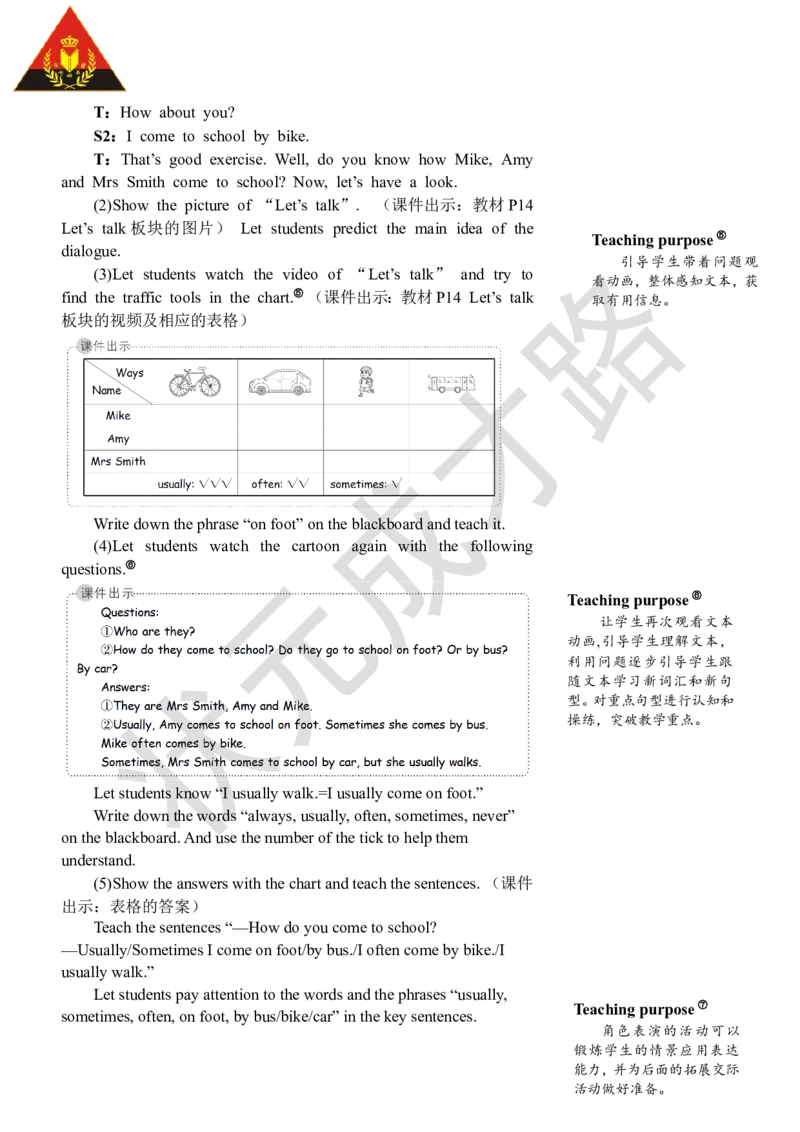
(3)Let students watch the video of “Let’s talk” and try to
看动画,整体感知文本,获
find the traffic tools in the chart.⑤ (课件出示:教材P14 Let’s talk 取有用信息。
板块的视频及相应的表格)
Write down the phrase “on foot” on the blackboard and teach it.
(4)Let students watch the cartoon again with the following
questions.⑥
Teaching purpose⑥
让学生再次观看文本
动画,引导学生理解文本,
利用问题逐步引导学生跟
随文本学习新词汇和新句
型。对重点句型进行认知和
操练,突破教学重点。
Let students know “I usually walk.=I usually come on foot.”
Write down the words “always, usually, often, sometimes, never”
on the blackboard. And use the number of the tick to help them
understand.
(5)Show the answers with the chart and teach the sentences. (课件
出示:表格的答案)
Teach the sentences “—How do you come to school?
—Usually/Sometimes I come on foot/by bus./I often come by bike./I
usually walk.”
Let students pay attention to the words and the phrases “usually,
Teaching purpose⑦
sometimes, often, on foot, by bus/bike/car” in the key sentences.
角色表演的活动可以
锻炼学生的情景应用表达
6 能力,并为后面的拓展交际
活动做好准备。4. Read and act.⑦
(1)Let students read after the recording(. 出示课件) Lead them to
pay attention to the pronunciation and the intonation.
(2)Let students practice the dialogue in roles in groups.
(3)Let students act out.
Step 3: Practice⑧
Teaching purpose⑧
1. Use the word cards to practice the words and the sentences.
利用单词卡片,帮助
(1)Show the word cards one by one. Ask students to read the cards.
学生操练核心词汇和句型。
(2)Sharp eyes.
角色表演的活动,锻炼学生
Show the word cards quickly. Ask students to read the cards as fast
的情景应用表达能力,并为
as they can. 后面的拓展交际活动做好
2. Ask and answer in pairs. 准备。
Make a model: (出示课件)
T:How do you come/go to school?
Ss: I usually/sometimes/often come/go…
Students make dialogues in pairs like the model.
3. Show time.
The teacher gives stickers to the students who do a good job.
Step 4: Consolidation & Extension⑨
Teaching purpose⑨
1. Do a survey.
通过创设真实的情境
Students ask their classmates and teachers, “How do you come to
让学生根据自己的实际情
school?” Then finish the chart below the dialogue of “Let’s talk” on page
况运用所学句型来对话并
14 according to the results.
展示,培养学生的语言综合
2. Make a report.. 运用能力。最后拓展一些根
The teacher makes a model report like this: Three students usually 据距离选择的合适的交通
come to school by car. Two students sometimes come to school by bus… 方式,丰富学生的课外知识。
Students try to make a report to the class.
3. Different ways of travelling.
Show pictures to introduce more ways to go to different
places. (课件出示:多种类型的交通方式)
7板书设计
▶
作业设计
▶
1. Ask your parents, “How do you go to work?”
2. Read the dialogue after the recording.
3. Do the exercises. (见“状元成才路”系列丛书《创优作业100分》或《状元作业本》对
应课时作业)
教学反思
▶
1. 由歌曲引入,带领学生预习新知,轻快的节奏激发学生的学习兴趣。
2. 呈现活动设计丰富,易操作,且具备层次感,有效地提升了学生的核心素养。以学生为本,以
解决问题为导向,引导学生自主学习。
3. 突出语用功能,联系学生生活中的实际情况,设置多个环节,环环相扣,层层深入,帮助学生
在真实情景中自然地使用所学语言。
▶Teaching Contents
Let’s try
·Predict the main content of the listening part by reading the sentences.
·Understand the recording and finish the task.
Let’s talk
·Understand the main idea of the dialogue by observing and talking about the picture. Answer the
questions about the dialogue.
·Read the dialogue fluently and act out.
·Use the sentence structures “—How do you come to school? —I usually/sometimes/often
come… ” to ask and answer about each other’s ways to go to school properly.
▶Teaching Priorities
·Be able to understand and master the key words and the sentence structures of this lesson.
8·Be able to use the sentence structures “—How do you come to school?
—I usually/sometimes/often come…” to ask and answer about each other’s ways to go to
school.
▶Teaching Difficulties
·Be able to use the sentence structures “—How do you come to school? —I usually/sometimes/often
come… ” to ask and answer about each other’s ways to go to school properly.
▶Teaching Procedures
Teaching Teacher’ s Activities Students Activities Teaching Purposes
Stages
Warm-up 1. Greetings. 1. Greetings. Stimulate students’
& 2. Watch and sing—How do you 2. Watch and sing. interest in learning and
Lead-in get there? 3. Observe the picture lead in the topic of
3. Look and predict. and answer the “Ways to go to school”
questions. and prepare for the
following study.
Presentation 1. Listen and tick or cross. (1)Read the sentences and Lead students to predict
(1)Let students read the get useful information. the listening content
sentences of “Let’s try” and (2)Predict and guess the before listening to the
get the information. answers. recording. Cultivate
(2)Show the sentences of (3)Listen and tick or cross students’ ability of
“Let’s try” on the PPT. Let the answers. observation and logical
students predict and guess the (4)Read the dialogue and thinking.
answers. check the answers.
(3)Play the recording.
(4)Play the recording again and
check the answers.
2. Look, guess and chant. Look and guess the traffic Help students
Teach the words and the tools. Learn the words and understand the new
phrases with the pictures. the phrases. words and the new
Lead students to make Make sentences. Then read phrases by the pictures.
sentences. Then show a chant. a chant. Use the chant to help
students practice the
key words and sentence
structures and prepare
for the next study.
9Teaching
Teacher’ s Activities Students’ Activities Teaching Purposes
Stages
Presentation 3. Learn the new dialogue. (1)Talk with the Lead students to learn new
(1)Teach the sentence “How teacher. words and sentence structures
do you come to school?” Learn the sentence. gradually by designing
(2)Show the picture of (2)Predict the main idea different tasks. Help students
“Let’s talk”. of the dialogue. understand the text and get
(3)Let students watch the (3)Watch the video and useful information. Reduce
video of “Let’s talk” and fill in the chart and the difficulty of learning.
try to find the traffic tools learn the phrase “on
in the chart. foot”.
(4)Let students watch the (4)Watch the video again
cartoon again with the and answer the
questions. questions.
(5)Show the answers with (5)Check the answers
the chart and teach the and learn the new
sentences. sentences.
4. Read and act. Read after the recording Practice students’ ability of
and pay attention to the expressing in scenes and
pronunciation and the prepare for further
intonation. Practice in communication activities.
roles and act out.
Practice 1. Use the word cards to 1. Practice the words and Help students practice the key
practice the words and the sentences with the words and sentence
the sentences. word cards. structures. Train students’
2. Ask and answer in pairs. 2. Make dialogues in ability of expressing in
3. Show time. pairs. scenes, and prepare for the
3. Act out the dialogues. expansion of communication
activities.
Consolidation 1. Do a survey. 1. Do a survey and finish Create a natural and real
& 2. Make a report. the chart on page 14. situation to develop
Extension 3. Different ways of 2. Make a report to the students’ comprehensive
travelling. class. language using ability.
3. Look at the pictures, Expand some ways of
and learn more about travelling to enrich
the ways to go to students’ extracurricular
different places. knowledge.
1. Ask your parents, “How do you go to work?”
Homework 2. Read the dialogue after the recording.
3. Do the exercises.
10