【一轮复习讲义】2024年高考英语高频考点题型归纳与方法总结(新高考通用)
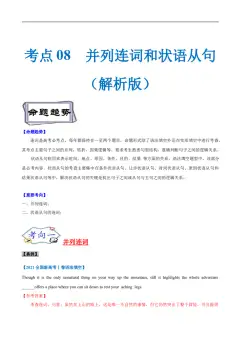
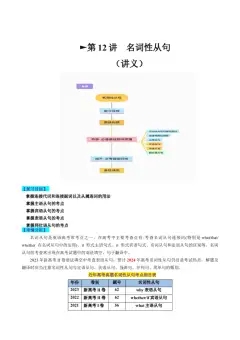
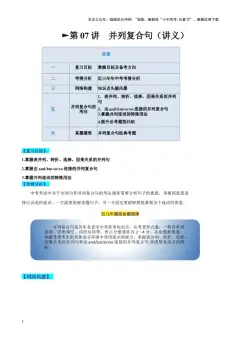
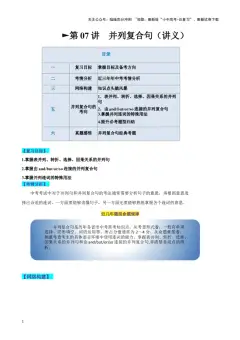
第 08 讲 并列句和状语从句(精讲)
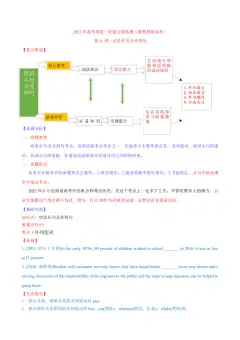
题型目录一览
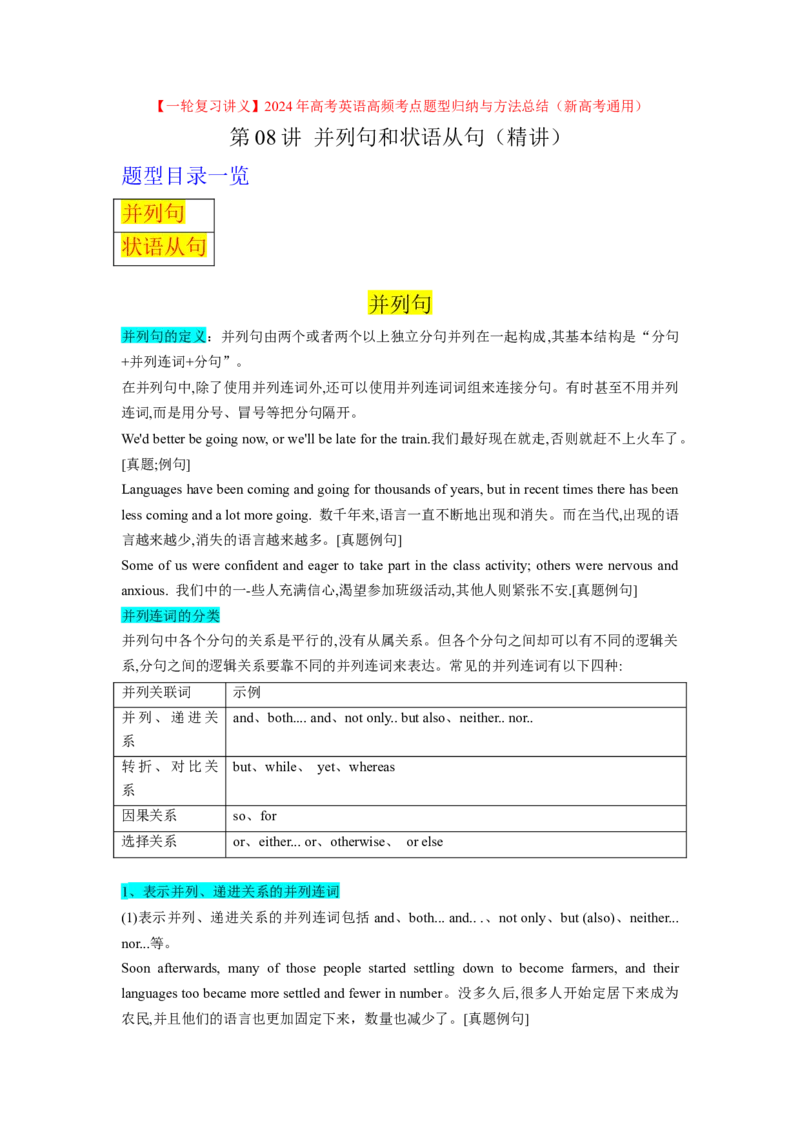
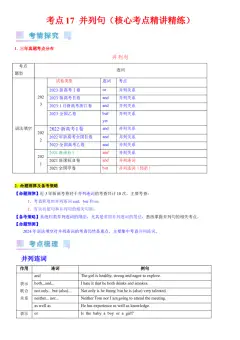
并列句
状语从句
并列句
并列句的定义:并列句由两个或者两个以上独立分句并列在一起构成,其基本结构是“分句
+并列连词+分句”。
在并列句中,除了使用并列连词外,还可以使用并列连词词组来连接分句。有时甚至不用并列
连词,而是用分号、冒号等把分句隔开。
We'd better be going now, or we'll be late for the train.我们最好现在就走,否则就赶不上火车了。
[真题;例句]
Languages have been coming and going for thousands of years, but in recent times there has been
less coming and a lot more going. 数千年来,语言一直不断地出现和消失。而在当代,出现的语
言越来越少,消失的语言越来越多。[真题例句]
Some of us were confident and eager to take part in the class activity; others were nervous and
anxious. 我们中的一-些人充满信心,渴望参加班级活动,其他人则紧张不安.[真题例句]
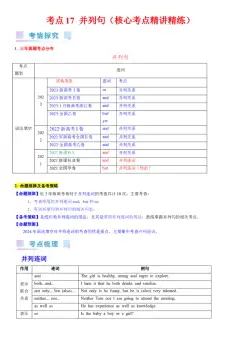
并列连词的分类
并列句中各个分句的关系是平行的,没有从属关系。但各个分句之间却可以有不同的逻辑关
系,分句之间的逻辑关系要靠不同的并列连词来表达。常见的并列连词有以下四种:
并列关联词 示例
并列、递进关 and、both.... and、not only.. but also、neither.. nor..
系
转折、对比关 but、while、 yet、whereas
系
因果关系 so、for
选择关系 or、either... or、otherwise、 or else
1、表示并列、递进关系的并列连词
(1)表示并列、递进关系的并列连词包括 and、both... and.. .、not only、but (also)、neither...
nor...等。
Soon afterwards, many of those people started settling down to become farmers, and their
languages too became more settled and fewer in number。没多久后,很多人开始定居下来成为
农民,并且他们的语言也更加固定下来,数量也减少了。[真题例句]分析:句中and连接两个并列分句,分句1为“主语+谓语+宾语”的结构,分句2为“主
语+系动词+表语"的结构。
It's more likely that none of us start a conversation because it’s awkward and challenging, or we
think it's a annoying and unnecessary更有可能的是,我们没有与人主动攀谈,因为主动攀谈既
尴尬又有挑战,又或者我们认为这烦人并且没必要。[真题例句」
分析:Because引导的原因状语从句中,or连接两个并列分句,分句1为 “主语+系动词
+表语" 的结构,分句2为“主句+省去that的宾语从句”的结构。
Not only did he refuse the gift, he also severely criticized the sender。
他不但拒绝接收礼物,还严厉批评了寄件人。
分析:句中not only... but (also)连接两个并列分句,当not only...位于句首,前一个分句常用
倒装来表示强调,而but (also)后的分句仍用陈述语序。
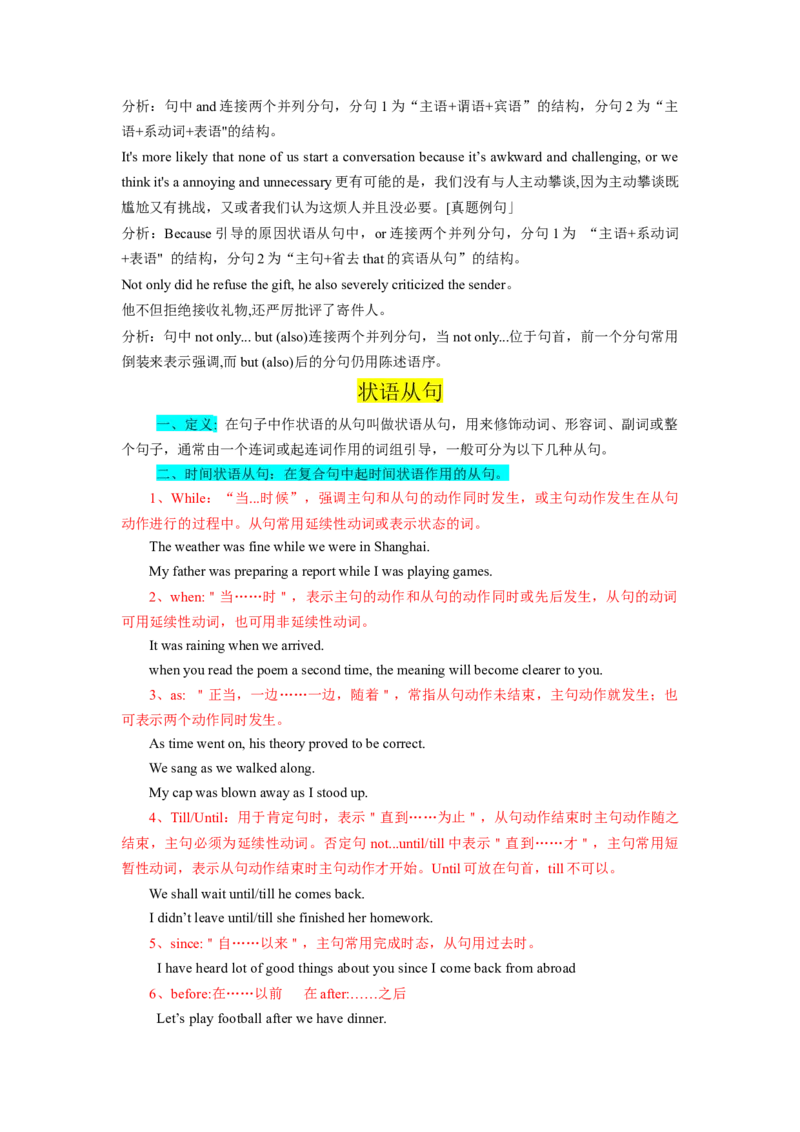
状语从句
一、定义: 在句子中作状语的从句叫做状语从句,用来修饰动词、形容词、副词或整
个句子,通常由一个连词或起连词作用的词组引导,一般可分为以下几种从句。
二、时间状语从句:在复合句中起时间状语作用的从句。
1、While:“当...时候”,强调主句和从句的动作同时发生,或主句动作发生在从句
动作进行的过程中。从句常用延续性动词或表示状态的词。
The weather was fine while we were in Shanghai.
My father was preparing a report while I was playing games.
2、when:"当……时",表示主句的动作和从句的动作同时或先后发生,从句的动词
可用延续性动词,也可用非延续性动词。
It was raining when we arrived.
when you read the poem a second time, the meaning will become clearer to you.
3、as: "正当,一边……一边,随着",常指从句动作未结束,主句动作就发生;也
可表示两个动作同时发生。
As time went on, his theory proved to be correct.
We sang as we walked along.
My cap was blown away as I stood up.
4、Till/Until:用于肯定句时,表示"直到……为止",从句动作结束时主句动作随之
结束,主句必须为延续性动词。否定句 not...until/till中表示"直到……才",主句常用短
暂性动词,表示从句动作结束时主句动作才开始。Until可放在句首,till不可以。
We shall wait until/till he comes back.
I didn’t leave until/till she finished her homework.
5、since:"自……以来",主句常用完成时态,从句用过去时。
I have heard lot of good things about you since I come back from abroad
6、before:在……以前 在after:……之后
Let’s play football after we have dinner.7、 no sooner…than hardly…when 一…就...
I had no sooner gone to the bed when my parents returned
He had hardly got there when it began to rain.
三、地点状语从句:在复合句中起地点状语作用的从句。
1、where/wherever 常用的引导词
We live where the roads across the river.
He must go wherever we send him.
四、原因状语从句:在复合句中起原因状语作用的从句。
1、because:“因为”语气最强,表示已知或未知的事实,引导的从句常位于主句之
后,表示强调时也可位于主句之前。
He was punished because he broke the law.
2、as: 语气最弱,较口语化,所表达的原因比较明显或是已知的事实,引导的句子多
位于主句之前。
As it was a public holiday, all the shops were shut.
3、since:语气也较弱,常表示对方已知的事实,意为“既然”,从句多位于主句之前。
Since he was busy, he didn’t come.
五、目的状语从句:在复合句中起目的状语作用的从句。
1、so that,in order that 引导目的状语从句,构成复合句,表示“以便、为了”。从句
中常使用can,could,may,might,will,would,should等情态动词或助动词。
Speak clearly so that everybody can understand you.
I hurried through my work in order that I could be in time for TV program.
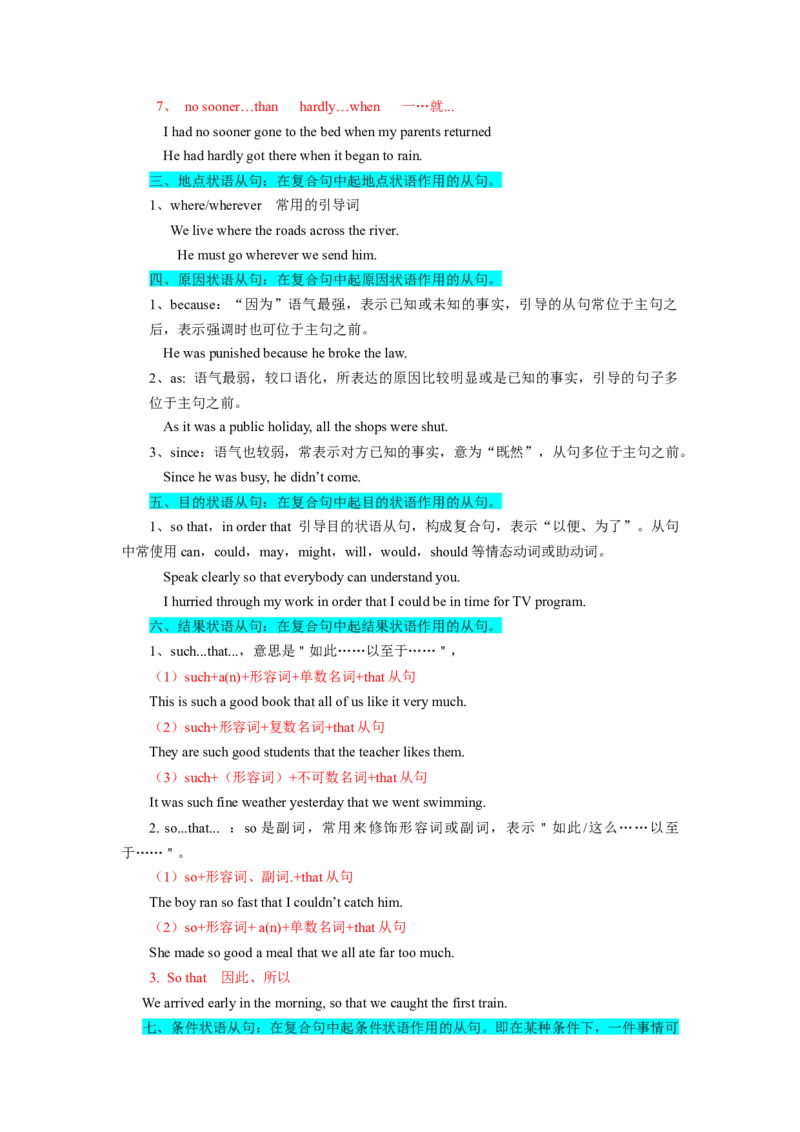
六、结果状语从句:在复合句中起结果状语作用的从句。
1、such...that...,意思是"如此……以至于……",
(1)such+a(n)+形容词+单数名词+that从句
This is such a good book that all of us like it very much.
(2)such+形容词+复数名词+that从句
They are such good students that the teacher likes them.
(3)such+(形容词)+不可数名词+that从句
It was such fine weather yesterday that we went swimming.
2. so...that... :so是副词,常用来修饰形容词或副词,表示"如此/这么……以至
于……"。
(1)so+形容词、副词.+that从句
The boy ran so fast that I couldn’t catch him.
(2)so+形容词+ a(n)+单数名词+that从句
She made so good a meal that we all ate far too much.
3. So that 因此、所以
We arrived early in the morning, so that we caught the first train.
七、条件状语从句:在复合句中起条件状语作用的从句。即在某种条件下,一件事情可能发生。条件状语从句中,主从句的时态要遵循"主将从现"的原则。即,主句是将来时
态时,从句用一般现在时代替将来时态。
1.if:意为“如果”表示在某种条件下某事很可能发生。
If we pay much attention to the earth, we’ll have a better world.
2. unless:意为"如果不,除非"。
You will fail in English unless you work hard.
Unless it rains, the game will be played.
3. as /so long as:意为“只要" .
You may borrow my book as long as you keep it clean.
八、让步状语从句:在复合句中起让步状语作用的从句。
1、though/although :意为“尽管”,不能与but 连用。
Although/though she works hard,she makes very slow progress.
2、even if: 意为“即使、就算、哪怕”,引导从句的内容多为假设性
Even if I have to walk all the day, I will get there.
3、Even though:意为“尽管、虽然”,引导从句的内容往往是真实的
Even though it was raining, he still went out.
九、比较状语从句:在复合句中起比较状语作用的从句。
1、Than: 表示“比...更...”
He was more successful than we had expected.
She can earn no more money than you can.
2、as(so)...as: 表示“和...一样”
He speaks English as well as you do.
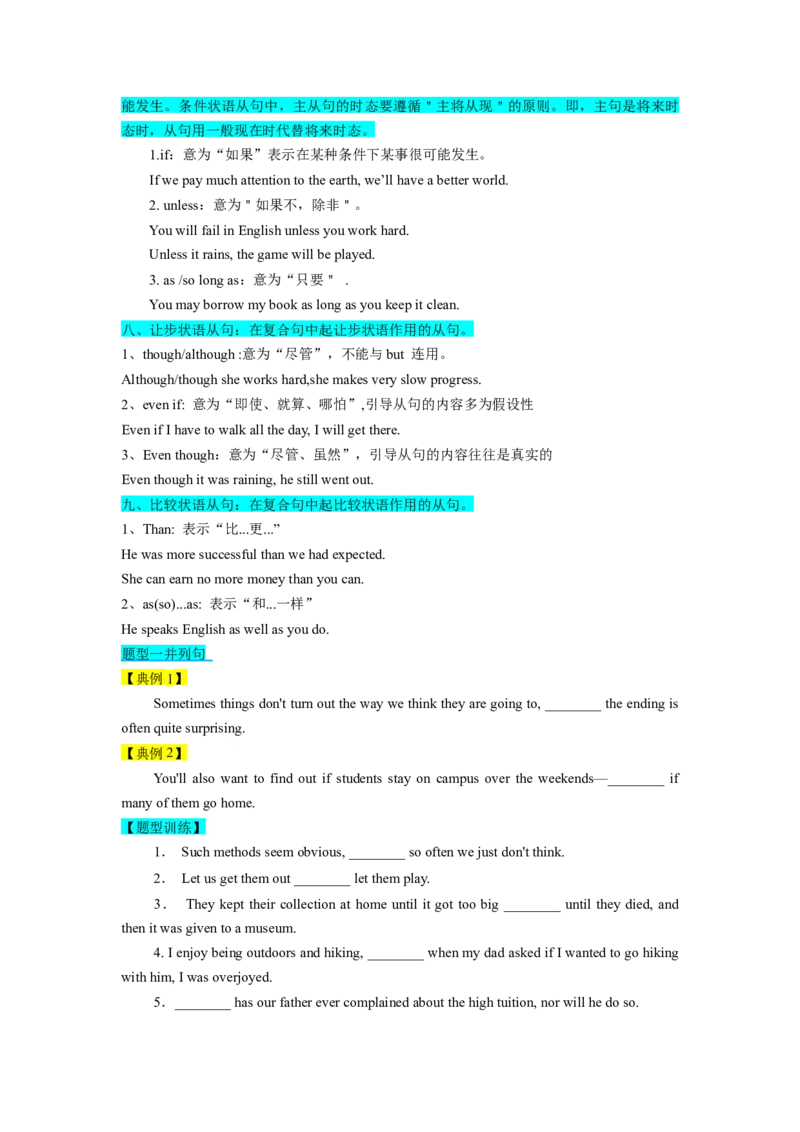
题型一并列句
【典例1】
Sometimes things don't turn out the way we think they are going to, ________ the ending is
often quite surprising.
【典例2】
You'll also want to find out if students stay on campus over the weekends—________ if
many of them go home.
【题型训练】
1. Such methods seem obvious, ________ so often we just don't think.
2. Let us get them out ________ let them play.
3. They kept their collection at home until it got too big ________ until they died, and
then it was given to a museum.
4. I enjoy being outdoors and hiking, ________ when my dad asked if I wanted to go hiking
with him, I was overjoyed.
5.________ has our father ever complained about the high tuition, nor will he do so.6. You need a proper schedule for yourself, ________ things go against your wishes.
7. Chinese is not only a rich language with a long literary tradition, ________ it has also
emerged as an influential worldwide language.
8. Boredom is unavoidable, and you can either allow it to take over ________ you can
manage it.
9. Seize every chance ________ you will start an amazing journey to learn.
10. Stop pollution and save water, ________ we cannot survive on the earth.
11. My family loves me not for my no-longer-shiny hair ________ because the role
I'm playing, that is my husband's wife and my kids' mom.
12. Spices can add a pleasant smell or remove some smells, ________ it is the salt that is
crucial to the flavor.
13. It's all up to you: ________ plan your travel dates around them, or arrive early enough
to jump into the festive atmosphere!
14. Poverty isn't an aesthetic (美感), ________ is it something to take style inspiration
from.
15. Wearing medical masks makes us feel less worried or frightened, ________ we feel
more positive towards the wearer.
16. By visiting a museum, not only will you be doing something good for yourself,
________ also museums will slowly but surely become part of your identity.
17. For years I'd been suffering vision disorder, ________ in New York my symptoms
worsened.
题型二 状语从句
【典例1】
But ___________ it was, don’t be too hard on yourself. (用适当的词填空)
【典例2】
He says that if it __________(rain) tomorrow, he won᾿t go fishing. (所给词的适当形式填空)
【题型训练】
1.________ the economy enters a “new normal” and growth slows, China’s economy will rely
more on creativity to drive its growth.
A.Although B.As C.Before D.Until
2.It’s worth noticing that________the media promotes, teenagers always follow it.
A.whatever B.whichever C.however D.whenever
3._____ this is only a small village, it’s crowded with tourists who come here all year round.
A.Since B.Unless C.Once D.Although
4.—Do you know a new shopping mall opened in our town yesterday?
—Yes. Why don’t we pay a visit ______ we have time?
A.since B.though C.until D.unless5.There is a rule in the library that one is required to put the book ______ it is after finishing
reading it.
A.what B.how C.where D.when
6.The procedure appealed to the staff a lot________it was introduced to them in January.
A.since B.until C.when D.though
7.______ online shopping has changed our life, not all of its effects have been positive.
A.After B.If C.While D.Unless
8.Ariana was leaving the dorm ________ she realized she forgot something important. (用适
当的词填空)
9.Dale Carnegie rose from the unknown of a Missouri farm to international fame ________ he
found a way to satisfy a universal human need. (用适当的词填空)
10.Much_______ I like it, I won’t buy it. .(用适当的词填空)