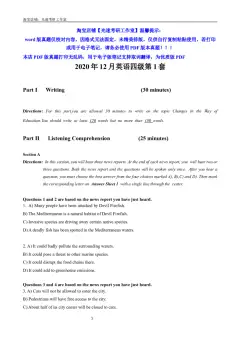
淘宝店铺:光速考研工作室
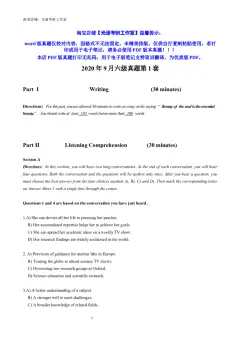
淘宝店铺【光速考研工作室】温馨提示:
word版真题仅校对内容,因格式不无法固定,未精美排版,仅供自行复制粘贴使用,若打
印或用于电子笔记,请务必使用PDF版本真题!!!
本店PDF版真题打印无乱码,用于电子版笔记支持取词翻译,为优质版PDF。
2020 年 12 月英语六级第 1 套
Part I Writing (30 minutes)
Directions: For this part, you are allowed 30 minutes to write an essay on why students should be
encouraged to develop creativity.You should write at least 150 words but no more than 200 words.
Part II Listening Comprehension (30 minutes)
Section A
Directions: In this section, you will hear two long conversations. At the end of each conversation, you will hear
four questions. Both the conversation and the questions will be spoken only once. After you hear a question, you
must choose the best answer from the four choices marked A), B), C) and D). Then mark the corresponding letter
on Answer Sheet 1 with a single line through the centre.
Questions 1 to 4 are based on the conversation you have just heard.
1. A) Her house has not been repaired in time.
B) She has failed to reach the manager again.
C)Her claim has been completely disregarded.
D) She has not received any letter from the man.
2. A) The ground floor of their cottage was flooded.
B) Their caravan was washed away by the flood.
C) Their entire house was destroyed by the flood.
D) The roof of their cottage collapsed in the flood.
3. A) The woman’s misreading of the insurance company’s letter.
B) The woman’s ignorance of the insurance company’s policy.
C) The woman’s inaccurate description of the whole incident.
D) The woman’s failure to pay her house insurance in time.
4. A) File a lawsuit against the insurance company.
B) Talk to the manager of Safe House Insurance.
1淘宝店铺:光速考研工作室
C) Consult her lawyer about the insurance policy.
D) Revise the terms and conditions of the contract.
Questions 5 to 8 are based on the conversation you have just heard.
5. A) They work in different fields of AI technology.
B) They disagree about the future of Al technology.
C) They differ greatly in their knowledge of modern technology.
D) They are both worried about the negative impact of technology.
6. A) Simply writing Al software.
B) Stimulating and motivating.
C)Less time-consuming and focusing on creation.
D) More demanding and requiring special training.
7. A) There could be jobs nobody wants to do.
B) Digital life could replace human civilization.
C) Humans would be tired of communicating with one another.
D) Old people would be taken care of solely by unfeeling robots.
8. A) Life will become like a science fiction film.
B) It will take away humans’ jobs altogether.
C) Chips will be inserted in human brains.
D) It will be smarter than human beings.
Section B
Directions: In this section, you will hear two passages. At the end of each passage, you will hear three or four
questions. Both the passage and the questions will be spoken only once. After you hear a question, you must
choose the best answer from the four choices marked A), B), C) and D). Then mark the corresponding letter on
Answer Sheet 1 with a single line through the centre.
Questions 9 to 11 are based on the passage you have just heard.
9. A) Restrain themselves from high-risk investments.
B) Save one-fifth of their net monthly income.
C)Invest shrewdly in lucrative businesses.
D) Try to earn as much money as possible.
10.A) Start by doing something small. C) Try to stick to their initial plan.
B)Ask a close friend for advice. D) Cut 20% of their daily spending.
11.A) An optimistic attitude. C) A proper mindset.
B) An ambitious plan. D) A keen interest.
2淘宝店铺:光速考研工作室
Questions 12 to 15 are based on the passage you have just heard.
12.A)She was uninterested in advertising. C) She was unhappy with fashion trends.
B) She found her outfit inappropriate. D) She often checked herself in a mirror.
13.A)To save the trouble of choosing a unique outfit every day.
B) To meet the expectations of fashion-conscious clients.
C) To keep up with the current trends.
D) To save the expenses on clothing.
14.A) It enhances people’s ability to work independently.
B) It helps people succeed in whatever they are doing.
C) It matters a lot in jobs involving interaction with others.
D) It boosts one’s confidence when looking for employment.
15.A) Design their own uniform to appear unique.
B) Wear classic pieces to impress their clients.
C)Fight the ever-changing trends in fashion.
D) Do whatever is possible to look smart.
Section C
Directions: In this section, you will hear three recordings of lectures or talks followed by three or four questions.
The recordings will be played only once. After you hear a question, you must choose the best answer from the four
choices marked A), B), C) and D). Then mark the corresponding letter on Answer Sheet 1 with a single line
through the centre.
Questions 16 to 18 are based on the recording you have just heard.
16.A) Their obsession with consumption. C) The ever-increasing costs of housing.
B) Their failure to accumulate wealth. D) The deterioration of the environment.
17.A) Things that are rare to find. C) Things that boost efficiency.
B) Things that cost less money. D) Things that we cherish most.
18.A) They serve multiple purposes. C) They are mostly durable.
B) They benefit the environment. D) They are easily disposable.
Questions 19 to 22 are based on the recording you have just heard.
19.A) All respondents were afraid of making a high expense claim.
B) A number of respondents gave an average answer of 400 miles.
C) Over 10% of the respondents lied about the distance they drove.
D) Most of the respondents got compensated for driving 384 miles.
20.A) They responded to colleagues’ suspicion.
3淘宝店铺:光速考研工作室
B) They cared about other people’s claims.
C) They wanted to protect their reputation.
D) They endeavored to actually be honest.
21.A) They seem positive. C) They are illustrative.
B) They seem intuitive. D) They are conclusive.
Questions 23 to 25 are based on the recording you have just heard.
22.A) Deterioration in the quality of new music.
B) Insights into the features of good music.
C) Older people’s changing musical tastes.
D) Older people’s aversion to new music.
23.A) They no longer listen to new music.
B) They find all music sounds the same.
C) They can make subtle distinctions about music.
D) They seldom listen to songs released in their teens.
24.A) The more you are exposed to something, the more familiar it’ll be to you.
B) The more you are exposed to something, the deeper you’ll understand it.
C) The more you experience something, the longer you’ll remember it.
D) The more you experience something, the better you’ll appreciate it.
25.A) Teenagers’ memories are more lasting.
B) Teenagers’ emotions are more intense.
C)Teenagers are much more sensitive.
D) Teenagers are much more sentimental.
Part III Reading Comprehension (40 minutes)
Section A
Directions: In this section, there is a passage with ten blanks. You are required to select one word for each blank
from a list of choices given in a word bank following the passage. Read the passage through carefully before
making your choices. Each choice in the bank is identified by a letter. Please mark the corresponding letter for
each item on Answer sheet 2 with a single line through the centre. You may not use any of the words in the bank
more than once.
The idea of taxing things that are bad for society has a powerful allure. It offers the possibility of a
double benefit— 2 6 harmful activities, while also providing the government with revenue.
Take sin taxes. Taxes on alcohol make it more expensive to get drunk, which reduces excessive
drinking and 27 driving. At the same time, they provide state and local governments with billions
4淘宝店铺:光速考研工作室
of dollars of revenue. Tobacco taxes, which generate more than twice as much, have proven 28 in
the decline of smoking, which has saved millions of lives.
Taxes can also be an important tool for environmental protection, and many economists say taxing
carbon would be the best way to reduce greenhouse gas emissions. Economic theory says that unlike
income or sales taxes, carbon taxes can actually increase economic efficiency; because companies that
__ 29 _ carbon dioxide into the sky don’t pay the costs of the climate change they cause, carbon taxes
would restore the proper 30 to the market.
In reality, carbon taxes alone won’t be enough to halt global warming, but they would be a useful
part of any climate plan. What’s more, the revenue from this tax, which would 31 be hundreds of
billions of dollars per year, could be handed out to citizens as a 32 or used to fund green
infrastructure projects.
Similarly, a wealth tax has been put forward as a way to reduce inequality while raising revenue.
The revenue from this tax, which some experts 33 will be over $4 trillion per decade, would be
designated for housing, child care, health care and other government benefits. If you believe, as many
do, that wealth inequality is 34 bad, then these taxes improve society while also 35
government coffers (金库).
A) discouraging
I) initially
B) dividend
J) instrumental
C) emotional
K) merging
D) fragments
L) predict
E) impaired
M) probably
F) imprisoned
N) pump
G) incentives
O) swelling
H) inherently
Section B
Directions: In this section, you are going to read a passage with ten statements attached to it. Each statement
contains information given in one of the paragraphs. Identify the paragraph from which the information is
derived. You may choose a paragraph more than once. Each paragraph is marked with a letter. Answer the
questions by marking the corresponding letter on Answer sheet 2.
The Challenges for Artificial Intelligence in Agriculture
A) A group of corn farmers stands huddled around an agronomist (农学家)and his computer on the
side of an irrigation machine in central South Africa. The agronomist has just flown over the field with a
hybrid unmanned aerial vehicle (UAV) that takes off and lands using propellers yet maintains distance
and speed for scanning vast hectares of land through the use of its fixed wings.
B) The UAV is fitted with a four spectral band precision sensor that conducts onboard processing
immediately after the flight, allowing farmers and field staff to address, almost immediately, any crop
abnormalities that the sensor may have recorded, making the data collection truly real-time.
5淘宝店铺:光速考研工作室
C) In this instance, the farmers and agronomist are looking to specialized software to give them an
accurate plant population count. It’s been 10 days since the corn emerged and the farmer wants to
determine if there are any parts of the field that require replanting due to a lack of emergence or wind
damage, which can be severe in the early stages of the summer rainy season.
D) At this growth stage of the plant’s development, the farmer has another 10 days to conduct any
replanting before the majority of his fertilizer and chemical applications need to occur. Once these have
been applied, it becomes economically unviable to take corrective action, making any further collected
data historical and useful only to inform future practices for the season to come.
E) The software completes its processing in under 15 minutes producing a plant population count map.
It’s difficult to grasp just how impressive this is, without understanding that just over a year ago it would
have taken three to five days to process the exact same data set, illustrating the advancements that have
been achieved in precision agriculture and remote sensing in recent years. With the software having
been developed in the United States on the same variety of crops in seemingly similar conditions, the
agronomist feels confident that the software will produce a near accurate result.
F) As the map appears on the screen, the agronomist’s face begins to drop. Having walked through the
planted rows before the flight to gain a physical understanding of the situation on the ground, he knows
the instant he sees the data on his screen that the plant count is not correct, and so do the farmers, even
with their limited understanding of how to read remote sensing maps.
G) Hypothetically, it is possible for machines to learn to solve any problem on earth relating to the
physical interaction of all things within a defined or contained environment by using artificial
intelligence and machine learning.
H) Remote sensors enable algorithms (算法)to interpret a field’s environment as statistical data that
can be understood and useful to farmers for decision-making. Algorithms process the data, adapting and
learning based on the data received. The more inputs and statistical information collected, the better the
algorithm will be at predicting a range of outcomes. And the aim is that farmers can use this artificial
intelligence to achieve their goal of a better harvest through making better decisions in the field.
I) In 2011, IBM, through its R&D Headquarters in Haifa, Israel, launched an agricultural cloud-
computing project. The project, in collaboration with a number of specialized IT and agricultural
partners, had one goal in mind—to take a variety of academic and physical data sources from an
agricultural environment and turn these into automatic predictive solutions for farmers that would assist
them in making real-time decisions in the field.
J) Interviews with some of the IBM project team members at the time revealed that the team believed it
6淘宝店铺:光速考研工作室
was entirely possible to “algorithm” agriculture, meaning that algorithms could solve any problem in
the world. Earlier that year, IBM’s cognitive learning system, Watson, competed in the game Jeopardy
against former winners Brad Rutter and Ken Jennings with astonishing results. Several years later,
Watson went on to produce ground-breaking achievements in the field of medicine.
K) So why did the project have such success in medicine but not agriculture? Because it is one of the
most difficult fields to contain for the purpose of statistical quantification. Even within a single field,
conditions are always changing from one section to the next. There’s unpredictable weather, changes in
soil quality, and the ever-present possibility that pests and diseases may pay a visit. Growers may feel
their prospects are good for an upcoming harvest, but until that day arrives, the outcome will always be
uncertain.
L) By comparison, our bodies are a contained environment. Agriculture takes place in nature, among
ecosystems of interacting organisms and activity, and crop production takes place within that ecosystem
environment. But these ecosystems are not contained. They are subject to climatic occurrences such as
weather systems, which impact upon hemispheres as a whole, and from continent to continent.
Therefore, understanding how to manage an agricultural environment means taking literally many
hundreds if not thousands of factors into account.
M) What may occur with the same seed and fertilizer program in the United States’ Midwest region is
almost certainly unrelated to what may occur with the same seed and fertilizer program in Australia or
South Africa. A few factors that could impact on variation would typically include the measurement of
rain per unit of a crop planted, soil type, patterns of soil degradation, daylight hours, temperature and so
forth.
N) So the problem with deploying machine learning and artificial intelligence in agriculture is not that
scientists lack the capacity to develop programs and protocols to begin to address the biggest of
growers’ concerns; the problem is that in most cases, no two environments will be exactly alike, which
makes the testing, validation and successful rollout of such technologies much more laborious than in
most other industries.
O) Practically, to say that AI and Machine Learning can be developed to solve all problems related to
our physical environment is to basically say that we have a complete understanding of all aspects of the
interaction of physical or material activity on the planet. After all, it is only through our understanding
of “the nature of things” that protocols and processes are designed for the rational capabilities of
cognitive systems to take place. And, although AI and Machine Learning are teaching us many things
about how to understand our environment, we are still far from being able to predict critical outcomes in
fields like agriculture purely through the cognitive ability of machines.
P) Backed by the venture capital community, which is now investing billions of dollars in the sector,
most agricultural technology startups today are pushed to complete development as quickly as possible
and then encouraged to flood the market as quickly as possible with their products.
Q) This usually results in a failure of a product, which leads to skepticism from the market and delivers
a blow to the integrity of Machine Learning technology. In most cases, the problem is not that the
7淘宝店铺:光速考研工作室
technology does not work, the problem is that industry has not taken the time to respect that agriculture
is one of the most uncontained environments to manage. For technology to truly make an impact on
agriculture, more effort, skills, and funding is needed to test these technologies in farmers’ fields.
R) There is huge potential for artificial intelligence and machine learning to revolutionize agriculture by
integrating these technologies into critical markets on a global scale. Only then can it make a difference
to the grower, where it really counts.
36. Farmers will not profit from replanting once they have applied most of the fertilizer and other
chemicals to their fields.
37. Agriculture differs from the medical science of the human body in that its environment is not a
contained one.
38. The agronomist is sure that he will obtain a near accurate count of plant population with his
software.
39. The application of artificial intelligence to agriculture is much more challenging than to most other
industries.
40. Even the farmers know the data provided by the UAV is not correct.
41. The pressure for quick results leads to product failure, which, in turn, arouses doubts about the
applicability of AI technology to agriculture.
42. Remote sensors are aimed to help farmers improve decision-making to increase yields.
43. The farmer expects the software to tell him whether he will have to replant any parts of his farm
fields.
44. Agriculture proves very difficult to quantify because of the constantly changing conditions
involved.
45. The same seed and fertilizer program may yield completely different outcomes in different places.
Section C
Directions: There are 2 passages in this section. Each passage is followed by some questions or unfinished
statements. For each of them there are four choices marked A), B), C) and D). You should decide on the best
choice and mark the corresponding letter on Answer Sheet 2 with a single line through the centre.
8淘宝店铺:光速考研工作室
Passage One
Questions 46 to 50 are based on the following passage.
What is the place of art in a culture of inattention? Recent visitors to the Louvre report that tourists
can now spend only a minute in front of the Mona Lisa before being asked to move on. Much of that
time, for some of them, is spent taking photographs not even of the painting but of themselves with the
painting in the background.
One view is that we have democratised tourism and gallery-going so much that we have made it
effectively impossible to appreciate what we’ve travelled to see. In this oversubscribed society,
experience becomes a commodity like any other. There are queues to climb Mt. Jolmo Lungma as well
as to see famous paintings. Leisure, thus conceived, is hard labour, and returning to work becomes a
well-earned break from the ordeal.
What gets lost in this industrialised haste is the quality of looking. Consider an extreme example,
the late philosopher Richard Wollheim. When he visited the Louvre he could spent as much as four
hours sitting before a painting. The first hour, he claimed, was necessary for misperceptions to be
eliminated. It was only then that the picture would begin to disclose itself. This seems unthinkable
today, but it is still possible to organise. Even in the busiest museums there are many rooms and many
pictures worth hours of contemplation which the crowds largely ignore. Sometimes the largest crowds
are partly the products of bad management; the Mona Lisa is such a hurried experience today partly
because the museum is being reorganised. The Uffizi in Florence, another site of cultural pilgrimage,
has cut its entry queues down to seven minutes by clever management. And there are some forms of art,
those designed to be spectacles as well as objects of contemplation, which can work perfectly well in the
face of huge crowds.
Olafur Eliasson’s current Tate Modern show, for instance, might seem nothing more than an
entertainment, overrun as it is with kids romping (喧闹地玩耍 )in fog rooms and spray mist
installations. But it’s more than that: where Eliasson is at his most entertaining, he is at his most serious
too, and his disorienting installations bring home the reality of the destructive effects we are having on
the planet — not least what we are doing to the glaciers of Eliasson’s beloved Iceland.
Marcel Proust, another lover of the Louvre, wrote: “ It is only through art that we can escape from
ourselves and know how another person sees the universe, whose landscapes would otherwise have
remained as unknown as any on the moon.”If any art remains worth seeing, it must lead us to such
escapes. But a minute in front of a painting in a hurried crowd won’t do that.
46. What does the scene at the Louvre demonstrate according to the author?
A) The enormous appeal of a great piece of artistic work to tourists.
B) The near impossibility of appreciating art in an age of mass tourism.
C) The ever-growing commercial value of long-cherished artistic works.
D) The real difficulty in getting a glimpse at a masterpiece amid a crowd.
47. Why did the late philosopher Richard Wollheim spend four hours before a picture?
9淘宝店铺:光速考研工作室
A) It takes time to appreciate a piece of art fully.
B) It is quite common to misinterpret artistic works.
C) The longer people contemplate a picture, the more likely they will enjoy it.
D) The more time one spends before a painting, the more valuable one finds it.
48. What does the case of the Uffizi in Florence show?
A) Art works in museums should be better taken care of.
B) Sites of cultural pilgrimage are always flooded with visitors.
C) Good management is key to handling large crowds of visitors.
D) Large crowds of visitors cause management problems for museums.
49. What do we learn from Olafur Eliasson’s current Tate Modern show?
A) Children learn to appreciate art works most effectively while they are playing.
B) It is possible to combine entertainment with appreciation of serious art.
C) Art works about the environment appeal most to young children.
D) Some forms of art can accommodate huge crowds of visitors.
50. What can art do according to Marcel Proust?
A) Enable us to live a much fuller life.
B) Allow us to escape the harsh reality.
C) Help us to see the world from a different perspective.
D) Urge us to explore the unknown domain of the universe.
Passage Two
Questions 51 to 55 are based on the following passage.
Every five years, the government tries to tell Americans what to put in their bellies. Eat more
vegetables. Dial back the fats. It’s all based on the best available science for leading a healthy life. But
the best available science also has a lot to say about what those food choices do to the environment, and
some researchers are annoyed that new dietary recommendations of the USDA (United States
Department of Agriculture) released yesterday seem to utterly ignore that fact.
Broadly, the 2016 - 2020 dietary recommendations aim for balance: More vegetables, leaner meats
and far less sugar.
But Americans consume more calories per capita than almost any other country in the world. So the
things Americans eat have a huge impact on climate change. Soil tilling releases carbon dioxide, and
delivery vehicles emit exhaust. The government’s dietary guidelines could have done a lot to lower that
climate cost. Not just because of their position of authority: The guidelines drive billions of dollars of
food production through federal programs like school lunches and nutrition assistance for the needy.
On its own, plant and animal agriculture contributes 9 percent of all the country’s greenhouse gas
emissions. That’s not counting the fuel burned in transportation, processing, refrigeration, and other
waypoints between farm and belly. Red meats are among the biggest and most notorious emitters, but
10淘宝店铺:光速考研工作室
trucking a salad from California to Minnesota in January also carries a significant burden. And
greenhouse gas emissions aren’t the whole story. Food production is the largest user of fresh water,
largest contributor to the loss of biodiversity, and a major contributor to using up natural resources.
All of these points and more showed up in the Dietary Guidelines Advisory Committee’s scientific
report, released last February. Miriam Nelson chaired the subcommittee in charge of sustainability for
the report, and is disappointed that eating less meat and buying local food aren’t in the final product.
“Especially if you consider that eating less meat, especially red and processed, has health benefits,” she
says.
So what happened? The official response is that sustainability falls too far outside the guidelines’
official scope, which is to provide “nutritional and dietary information.”
Possibly the agencies in charge of drafting the decisions are too close to the industries they are
supposed to regulate. On one hand, the USDA is compiling dietary advice. On the other, their clients are
US agriculture companies.
The line about keeping the guidelines’ scope to nutrition and diet doesn’t ring quite right with
researchers. David Wallinga, for example, says, “ In previous guidelines, they’ve always been
concerned with things like food security — which is presumably the mission of the USDA. You
absolutely need to be worried about climate impacts and future sustainability if you want secure food in
the future.”
51. Why are some researchers irritated at the USDA's 2016-2020 Dietary Guidelines?
A) It ignores the harmful effect of red meat and processed food on health.
B) Too much emphasis is given to eating less meat and buying local food.
C) The dietary recommendations are not based on medical science.
D) It takes no notice of the potential impact on the environment.
52. Why does the author say the USDA could have contributed a lot to lowering the climate cost
through its dietary guidelines?
A) It has the capacity and the financial resources to do so.
B) Its researchers have already submitted relevant proposals.
C) Its agencies in charge of drafting the guidelines have the expertise.
D) It can raise students’ environmental awareness through its programs.
53. What do we learn from the Dietary Guidelines Advisory Committee’s scientific report?
A) Food is easily contaminated from farm to belly.
B) Greenhouse effect is an issue still under debate.
C) Modern agriculture has increased food diversity.
D) Farming consumes most of our natural resources.
54. What may account for the neglect of sustainability in the USDA’s Dietary Guidelines according to
the author?
11淘宝店铺:光速考研工作室
A) Its exclusive concern with Americans’ food safety.
B) Its sole responsibility for providing dietary advice.
C) Its close ties with the agriculture companies.
D) Its alleged failure to regulate the industries.
55. What should the USDA do to achieve food security according to David Wallinga?
A) Give top priority to things like nutrition and food security.
B) Endeavor to ensure the sustainable development of agriculture.
C) Fulfill its mission by closely cooperating with the industries.
D) Study the long-term impact of climate change on food production.
Part IV Translation (30 minutes)
Directions: For this part, you are allowed 30 minutes to translate a passage from Chinese into English. You
should write your answer on Answer Sheet 2.
青藏铁路是世界上最高最长的高原铁路,全长1 956公里,其中有960公里在海拔4 000多米之上,是连
接西藏和中国其他地区的第一条铁路。由于铁路穿越世界上最脆弱的生态系统, 在建设期间和建成后都采取
了生态保护措施,以确保其成为一条“绿色铁路”。青藏铁路大大 缩短了中国内地与西藏之间的旅行时间。
更重要的是,它极大地促进了西藏的经济发展,改善 了当地居民的生活。铁路开通后,愈来愈多的人选择乘
火车前往西藏,这样还有机会欣赏沿线的美景。
12淘宝店铺:光速考研工作室
2020 年 12 月英语六级第 2 套
Part I Writing (30 minutes)
Directions: For this part, you are allowed 30 minutes to write an essay on why students should be
encouraged to effective communication skills. You should write at least 150 words but no more than
200 words.
Part II Listening Comprehension (30 minutes)
Section A
Directions: In this section, you will hear two long conversations. At the end of each conversation, you will hear
four questions. Both the conversation and the questions will be spoken only once. After you hear a question, you
must choose the best answer from the four choices marked A), B), C) and D). Then mark the corresponding letter
on Answer Sheet 1 with a single line through the centre.
Questions 1 to 4 are based on the conversation you have just heard.
1. A) A driving test. C) Traffic routes.
B) A video game. D) Cargo logistics.
2. A) He found it instructive and realistic.
B) He bought it when touring Europe.
C) He was really drawn to its other versions.
D) He introduced it to his brother last year.
3. A) Traveling all over the country.
B) Driving from one city to another.
C) The details in the driving simulator.
D) The key role of the logistics industry.
4. A) Clearer road signs.
B) More people driving safely.
C) Stricter traffic rules.
D) More self-driving trucks on the road.
Questions 5 to 8 are based on the conversation you have just heard.
5. A) It isn’t so enjoyable as he expected.
B) It isn’t so motivating as he believed.
C)It doesn’t enable him to earn as much money as he used to.
D) It doesn’t seem to offer as much freedom as he anticipated.
6. A) Not all of them care about their employees’ behaviors.
B) Few of them are aware of their employees’ feelings.
13淘宝店铺:光速考研工作室
C) Few of them offer praise and reward to their employees.
D) Not all of them know how to motivate their employees.
7. A) Job satisfaction. C) Autonomy.
B) Self-awareness. D) Money.
8. A) The importance of cultivating close relationships with clients.
B) The need for getting recommendations from their managers.
C) The advantages of permanent full-time employment.
D) The way to explore employees’ interests and talents.
Section B
Directions: In this section, you will hear two passages. At the end of each passage, you will hear three or four
questions. Both the passage and the questions will be spoken only once. After you hear a question, you must
choose the best answer from the four choices marked A), B), C) and D). Then mark the corresponding letter on
Answer Sheet 1 with a single line through the centre.
Questions 9 to 11 are based on the passage you have just heard.
9. A) Consumers visualize their activities in different weather.
B) Good weather triggers consumers’ desire to go shopping.
C) weather conditions influence consumers’ buying behavior.
D) Consumers’ mental states change with the prices of goods.
10.A) Active consumption. C) Individual association.
B) Direct correlation. D) Mental visualization.
11.A) Enabling them to simplify their mathematical formulas.
B) Helping them determine what to sell and at what price.
C) Enabling them to sell their products at a higher price.
D) Helping them advertise a greater variety of products.
Questions 12 to 15 are based on the passage you have just heard.
12.A) A naturally ventilated office is more comfortable.
B)A cool office will boost employees’ productivity.
C) Office air-conditioning should follow guidebooks.
D) Air-conditioning improves ventilation in the office.
13.A) People in their comfort zone of temperature are more satisfied with their productivity.
B) People in different countries vary in their tolerance to uncomfortable temperatures.
C) Twenty-two degrees is the optimal temperature for office workers.
D) There is a range of temperatures for people to feel comfortable.
14.A)It will have no negative impact on work.
B) It will be immediately noticeable.
C) It will sharply decrease work efficiency.
D) It will cause a lot of discomfort.
14淘宝店铺:光速考研工作室
15.A) They tend to favor lower temperatures.
B) They suffer from rapid temperature changes.
C) They are not bothered by temperature extremes.
D) They become less sensitive to high temperatures.
Section C
Directions: In this section, you will hear three recordings of lectures or talks followed by three or four questions.
The recordings will be played only once. After you hear a question, you must choose the best answer from the four
choices marked A), B), C) and D). Then mark the corresponding letter on Answer Sheet 1 with a single line
through the centre.
Questions 16 to 18 are based on the recording you have just heard.
16.A) It overlooked the possibility that emotions may be controlled.
B) It ignored the fact that emotions are personal and subjective.
C) It classified emotions simply as either positive or negative.
D) It measured positive and negative emotions independently.
17.A) Sitting alone without doing anything seemed really distressing.
B) Solitude adversely affected the participants’ mental well-being.
C) Sitting alone for 15 minutes made the participants restless.
D) Solitude had a reductive effect on high-arousal emotions.
18.A) It proved hard to depict objectively.
B) It went hand in hand with sadness.
C) It helped increase low-arousal emotions.
D) It tended to intensify negative emotions.
Questions 19 to 21 are based on the recording you have just heard.
19.A) It uses up much less energy than it does in deep thinking.
B) It remains inactive without burning calories noticeably.
C) It continues to burn up calories to help us stay in shape.
D) It consumes almost a quarter of the body’s total energy.
20.A) Much of the consumption has nothing to do with conscious activities.
B) It has something to do with the difficulty of the activities in question.
C) Energy usage devoted to active learning accounts for a big part of it.
D) A significant amount of it is for performing difficult cognitive tasks.
21.A) It is believed to remain basically constant.
B) It is a prerequisite for any mental activity.
C) It is conducive to relieving mental exhaustion.
D) It is thought to be related to food consumption.
Questions 22 to 25 are based on the recording you have just heard.
22.A) Job candidates rarely take it seriously.
B) Job seekers tend to have a ready answer.
C) Job seekers often feel at a loss where to start in answering it.
15淘宝店铺:光速考研工作室
D) Job candidates can respond freely due to its open-ended nature.
23.A) Follow their career coaches’ guidelines.
B) Strive to take control of their narrative.
C) Do their best to impress the interviewer.
D) Repeat the information on their resume.
24.A) To reflect on their past achievements as well as failures.
B) To produce examples for different interview questions.
C) To discuss important details they are going to present.
D) To identify a broad general strength to elaborate on.
25.A) Getting acquainted with the human resources personnel.
B) Finding out why the company provides the job opening.
C) Figuring out what benefits the company is able to offer them.
D) Tailoring their expectations to the company’s long-term goal.
Part III Reading Comprehension (40 minutes)
Section A
Directions: In this section, there is a passage with ten blanks. You are required to select one word for each blank
from a list of choices given in a word bank following the passage. Read the passage through carefully before
making your choices. Each choice in the bank is identified by a letter. Please mark the corresponding letter for
each item on Answer sheet 2 with a single line through the centre. You may not use any of the words in the bank
more than once.
Virtually every activity that entails or facilitates in-person human interaction seems to be in the
midst of a total meltdown as the coronavirus (冠状病毒)outbreak erases Americans’ desire to travel.
Amtrak says bookings are down 50 percent and cancelations are up 300 percent. Hotels in San Francisco
are experiencing 26 rates between 70 and 80 percent. Broadway goes dark on Thursday night.
Universities, now emptying their campuses, have never tried online learning on this 27 _. White-
collar companies like Amazon, Apple, and the New York Times are asking employees to work from
home for the 2 8 future.
But what happens after the coronavirus?
In some ways, the answer is: All the old normal stuff. The pandemic(大流行病)will take
lives, 29 economies and destroy routines, but it will pass. Americans will never stop going to
basketball games. They won’t stop going on vacation. They’ll meet to do business. No decentralizing
technology so far — not telephones, not television, and not the internet — has dented that human
desire to shake hands, despite technologists’ 3 0 to the contrary.
Yet there are real reasons to think that things will not return to the way they were last week. Small
31 create small societal shifts; big ones change things for good. The New York transit strike of 1980
is 32 with prompting several long-term changes in the city, including bus and bike lanes, and
women wearing sports shoes to work. The Spanish flu pandemic of 1918 prompted the development of
national health care in Europe.
Here and now, this might not even be a question of 33 . It’s not clear that the cruise industry
will 3 4 . Or that public transit won’t go broke without 3 5 assistance. The infrastructure might
not even be in place to do what we were doing in 2019.
16淘宝店铺:光速考研工作室
A) credentials I) scale
B) credited J) strangle
C) cumulative K) subtle
D) disruptions L) summoned
E) federal M) survive
F) foreseeable N) vacancy
G) predictions O) wedge
H) preference
Section B
Directions: In this section, you are going to read a passage with ten statements attached to it. Each statement
contains information given in one of the paragraphs. Identify the paragraph from which the information is
derived. You may choose a paragraph more than once. Each paragraph is marked with a letter. Answer the
questions by marking the corresponding letter on Answer sheet 2.
Slow Hope
A) Our world is full of—mostly untold—stories of slow hope, driven by the idea that change
is possible. They are ‘slow’ in their unfolding, and they are slow because they come with
setbacks.
B) At the beginning of time—so goes the myth—humans suffered, shivering in the cold and
dark until the titan (巨人)Prometheus stole fire from the gods. Just as in the myth, technology
—first fire and stone tools, and later farming, the steam engine and industry, fossil fuels,
chemicals and nuclear power—has allowed us to alter and control the natural world. The myth
also reminds us that these advances have come at a price: as a punishment for Prometheus’
crime, the gods created Pandora, and they gave her a box filled with evils and curses. When
Pandora’s box was opened, it unleashed swarms of diseases and disasters upon humankind.
C) Today we can no longer ignore the ecological curses that we have released in our search
for warmth and comfort. In engineering and exploiting and transforming our habitat, we have
opened tens of thousands of Pandora’s boxes. In recent decades, environmental threats have
expanded beyond regional boundaries to have global reach and, most hauntingly, are multiplying
at a dizzying rate. On a regular basis, we are reminded that we are running out of time. Year
after year, faster and faster, consumption outpaces the biological capacity of our planet. Stories
of accelerated catastrophe multiply. We fear the breakdown of the electric grid, the end of non-
renewable resources, the expansion of deserts, the loss of islands, and the pollution of our air
and water.
17淘宝店铺:光速考研工作室
D) Acceleration is the signature of our time. Populations and economic activity grew slowly for
much of human history. For thousands of years and well into early modern times, world
economies saw no growth at all, but from around the mid-19th century and again, in particular,
since the mid-20th, the real GDP has increased at an enormous speed, and so has human
consumption. In the Middle Ages, households in Central Europe might have owned fewer than
30 objects on average; in 1900, this number had increased to 400, and in 2020 to 15,000. The
acceleration of human production, consumption and travel has changed the animate and
inanimate spheres. It has echoed through natural processes on which humans depend. Species
extinction, deforestation, damming of rivers, occurrence of floods, the depletion of ozone, the
degradation of ocean systems and many other areas are all experiencing acceleration. If
represented graphically, the curve for all these changes looks rather like that well-known hockey
stick: with little change over millennia (数千年) and a dramatic upswing over the past decades.
E) Some of today’s narratives about the future seem to suggest that we too, like Prometheus,
will be saved by a new Hercules, a divine engineer, someone who will mastermind, manoeuvre
and manipulate our planet. They suggest that geoengineering, cold fusion or faster-than-light
spaceships might transcend once and for all the terrestrial constraints of rising temperatures,
lack of energy, scarcity of food, lack of space, mountains of waste, polluted water—you name
it.
F) Yet, if we envisage our salvation to come from a deus ex machina (解围之神),from a divine
engineer or a tech solutionist who will miraculously conjure up a new source of energy or another cure-
all with revolutionary potency, we might be looking in the wrong place. The fact that we now imagine
our planet as a whole does not mean that the ‘rescue’ of our planet will come with one big global stroke
of genius and technology. It will more likely come by many small acts. Global heating and
environmental degradation are not technological problems. They are highly political issues that are
informed by powerful interests. Moreover, if history is a guide, then we can assume that any major
transformations will once again be followed by a huge set of unintended consequences. So what do we
do?
G) This much is clear: we need to find ways that help us flatten the hockey-stick curves that reflect our
ever-faster pace of ecological destruction and social acceleration. If we acknowledge that human
manipulation of the Earth has been a destructive force, we can also imagine that human endeavours can
help us build a less destructive world in the centuries to come. We might keep making mistakes. But we
will also keep learning from our mistakes.
H) To counter the fears of disaster, we need to identify stories, visions and actions that work quietly
towards a more hopeful future. Instead of one big narrative, a story of unexpected rescue by a larger-
than-life hero, we need multiple stories: we need stories, not only of what Rob Nixon of Princeton
University has called the ‘slow violence’ of environmental degradation (that is, the damage that is often
invisible at first and develops slowly and gradually), but also stories of what I call ‘slow hope’.
I) We need an acknowledgement of our present ecological plight but also a language of positive
change, visions of a better future. In The Principle of Hope (1954-1959), Ernst Bloch, one of the
leading philosophers of the future, wrote that ‘the most tragic form of loss...is the loss of the capacity to
imagine that things could be different’. We need to identify visions and paths that will help us imagine a
18淘宝店铺:光速考研工作室
different, more just and more ecological world. Hope, for Bloch, has its starting point in fear, in
uncertainty, and in crisis: it is a creative force that goes hand in hand with utopian (乌托邦的)‘wishful
images’. It can be found in cultural products of the past — in fairy tales, in fiction, in architecture, in
music, in the movie — in products of the human mind that contain ‘the outlines of a better world’.
What makes us ‘authentic’ as humans are visions of our ‘potential’. In other words: living in hope
makes us human.
J) The power of small, grassroots movements to make changes that spread beyond their place of
origin can be seen with the Slow Food movement, which began in Italy in the 1980s. The rise of fast-
food restaurants after the Second World War produced a society full of cheap, industrially made
foodstuffs. Under the leadership of Carlo Petrini, the Slow Food movement began in Piedmont, a region
of Italy with a long history of poverty, violence and resistance to oppression. The movement
transformed it into a region hospitable to traditional food cultures — based on native plants and breeds
of animals. Today, Slow Food operates in more than 160 countries, poor and rich. It has given rise to
thousands of projects around the globe, representing democratic politics, food sovereignty, biodiversity
and sustainable agriculture.
K) The unscrupulous (无所顾忌的)commodification of food and the destruction of foodstuffs
will continue to devastate soils, livelihoods and ecologies. Slow Food cannot undo the
irresistible developments of the global food economy, but it can upset its theorists, it can‘speak
differently’, and it can allow people and their local food traditions and environments to flourish.
Even in the United States—the fast-food nation—small farms and urban gardens are on the rise.
The US Department of Agriculture provides an Urban Agriculture Toolkit and, according to a
recent report, American millennials (千禧一代)are changing their diets. In 2017, 6 per cent of
US consumers claimed to be strictly vegetarian, up from 1 per cent in 2014. As more people
realise that ‘eating is an agricultural act’, as the US poet and environmental activist Wendell
Berry put it in 1989, slow hope advances.
36.It seems some people today dream that a cutting-edge new technology might save them from the
present ecological disaster.
37.According to one great thinker, it is most unfortunate if we lose the ability to think differently.
38.Urgent attention should be paid to the ecological problems we have created in our pursuit of a
comfortable life.
39.Even in the fast-food nation America, the number of vegetarians is on the rise.
40.The deterioration of the ecological system is accelerating because of the dramatic increase of human
production and consumption.
41.It is obvious that solutions must be found to curb the fast worsening environment and social
acceleration.
42.Many people believe changing the world is possible, though it may take time and involve setbacks.
19淘宝店铺:光速考研工作室
43.It might be wrong to expect that our world would be saved at one stroke with some miraculous
technology.
44.It is human nature to cherish hopes for a better world.
45.Technology has given us humans the power to change the natural world, but we have paid a price for
the change.
Section C
Directions: There are 2 passages in this section. Each passage is followed by some questions or unfinished
statements. For each of them there are four choices marked A), B), C) and D). You should decide on the best
choice and mark the corresponding letter on Answer Sheet 2 with a single line through the centre.
Passage One
Questions 46 to 50 are based on the following passage.
Vegetarians would prefer not to be compelled to eat meat. Yet the reverse compulsion (强迫)is
hidden in the proposals for a new plant-based “planetary diet.” Nowhere is this more visible than in
India.
Earlier this year, the EAT-Lancet Commission released its global report on nutrition and called for a
global shift to a more plant-based diet and for “substantially reducing consumption of animal source
foods.” In countries like India, that call could become a tool to aggravate an already tense political
situation and stress already undernourished populations.
The EAT report presumes that “traditional diets” in countries like India include little red meat,
which might be consumed only on special occasions or as minor ingredients in mixed dishes.
In India, however, there is a vast difference between what people would wish to consume and what
they have to consume because of innumerable barriers around class, religion, culture, cost, geography,
etc. Policymakers in India have traditionally pushed for a cereal-heavy “vegetarian diet” on a meat-
eating population as a way of providing the cheapest sources of food.
Currently, under an aggressive Hindu nationalist government, Muslims, Christians, disadvantaged
classes and indigenous communities are being compelled to give up their traditional foods.
None of these concerns seem to have been appreciated by the EAT-Lancet Commission’s
representative, Brent Loken, who said “India has got such a great example” in sourcing protein from
plants.
But how much of a model for the world is India’s vegetarianism? In the Global Hunger Index 2019,
the country ranks 102nd out of 117. Data from the National Family Health Survey indicate that only 10
percent of infants of 6 to 23 months are adequately fed.
Which is why calls for a plant-based diet modeled on India risk offering another whip with which to
beat already vulnerable communities in developing countries.
A diet directed at the affluent West fails to recognize that in low-income countries undernourished
children are known to benefit from the consumption of milk and other animal source foods, improving
cognitive functions, while reducing the prevalence of nutritional deficiencies as well as mortality.
EAT-Lancet claimed its intention was to “spark conversations” among all Indian stakeholders. Yet
vocal critics of the food processing industry and food fortification strategies have been left out of the
debate. But the most conspicuous omission may well be the absence of India’s farmers.
The government, however, seems to have given the report a thumbs-up. Rather than addressing
20淘宝店铺:光速考研工作室
chronic hunger and malnutrition through an improved access to wholesome and nutrient-dense foods,
the government is opening the door for company-dependent solutions, ignoring the environmental and
economic cost, which will destroy local food systems. It’s a model full of danger for future generations.
46. What is more visible in India than anywhere else according to the passage?
A) People’s positive views on the proposals for a “planetary diet”.
B) People’s reluctance to be compelled to eat plant-based food.
C) People’s preferences for the kind of food they consume.
D) People’s unwillingness to give up their eating habits.
47. What would the EAT-Lancet Commission’s report do to many people in countries like India?
A) Radically change their dietary habits.
B) Keep them further away from politics.
C) Make them even more undernourished.
D) Substantially reduce their food choices.
48. What do we learn from the passage about food consumption in India?
A) People’s diet will not change due to the EAT-Lancet report.
B) Many people simply do not have access to foods they prefer.
C) There is a growing popularity of a cereal-heavy vegetarian diet.
D) Policymakers help remove the barriers to people’s choice of food.
49. What does the passage say about a plant-based diet modeled on India?
A) It may benefit populations whose traditional diet is meat-based.
B) It may be another blow to the economy in developing countries.
C) It may help narrow the gap between the rich and poor countries.
D) It may worsen the nourishment problem in low-income countries.
50. How does the Indian government respond to the EAT-Lancet Commission’s proposals?
A) It accepts them at the expense of the long-term interests of its people.
B) It intends them to spark conversations among all Indian stakeholders.
C) It gives them approval regardless of opposition from nutrition experts.
D) It welcomes them as a tool to address chronic hunger and malnutrition.
Passage Two
Questions 51 to 55 are based on the following passage.
Back in 1964, in his book Games People Play, psychiatrist Eric Berne described a pattern of
conversation he called “ Why Don’t You——Yes But”,which remains one of the most irritating
21淘宝店铺:光速考研工作室
aspects
of everyday social life. The person adopting the strategy is usually a chronic complainer. Something is
terrible about their relationship, job, or other situation, and they moan about it ceaselessly, but find some
excuse to dismiss any solution that’s proposed. The reason, of course, is that on some level they don’t
want a solution; they want to be validated in their position that the world is out to get them. If they can
“win” the game—dismissing every suggestion until their interlocutor(对话者)gives up in annoyance—
they get to feel pleasurably righteous (正当的)in their resentments and excused from any obligation to
change.
Part of the trouble here is the so-called responsibility/fault fallacy (谬误). When you’re feeling
hard done by—taken for granted by your partner, say, or obliged to work for a half-witted boss—it’s
easy to become attached to the position that it’s not your job to address the matter, and that doing so
would be an admission of fault. But there’s a confusion here. For example, if I were to discover a
newborn at my front door, it wouldn’t be my fault, but it most certainly would be my responsibility.
There would be choices to make, and no possibility of avoiding them, since trying to ignore the matter
would be a choice. The point is that what goes for the baby on the doorstep is true in all cases: even if
the other person is 100% in the wrong, there’s nothing to be gained, long-term, from using this as a
justification to evade responsibility.
Should you find yourself on the receiving end of this kind of complaining, there’s an ingenious way
to shut it down—which is to agree with it, ardently. Psychotherapist Lori Gottlieb describes this as “
over-validation ”. For one thing, you’ll be spared further moaning, since the other person’s motivation
was to confirm her beliefs, and now you’re confirming them. But for another, as Gottlieb notes, people
confronted with over-validation often hear their complaints afresh and start arguing back. The notion
that they’re utterly powerless suddenly seems unrealistic—not to mention rather annoying—so they’re
prompted instead to generate ideas about how they might change things.
“And then, sometimes, something magical might happen,” Gottlieb writes. The other person
“might realise she’s not as trapped as you are saying she is, or as she feels.” Which illustrates the irony
of the responsibility/fault fallacy: evading responsibility feels comfortable, but turns out to be a prison;
whereas assuming responsibility feels unpleasant, but ends up being freeing.
51. What is characteristic of a chronic complainer, according to psychiatrist Eric Berne?
A) They only feel angry about their ill treatment and resent whoever tries to help.
B) They are chronically unhappy and ceaselessly find fault with people around them.
C) They constantly dismiss others,proposals while taking no responsibility for tackling the
problem.
D) They lack the knowledge and basic skills required for successful conversations with their
interlocutors.
52. What does the author try to illustrate with the example of the newborn on one’s doorstep?
A) People tend to think that one should not be held responsible for others’ mistakes.
B) It is easy to become attached to the position of overlooking one’s own fault.
C) People are often at a loss when confronted with a number of choices.
D) A distinction should be drawn between responsibility and fault.
53. What does the author advise people to do to chronic complainers?
A) Stop them from going further by agreeing with them.
22淘宝店铺:光速考研工作室
B) Listen to their complaints ardently and sympathetically.
C) Ask them to validate their beliefs with further evidence.
D) Persuade them to clarify the confusion they have caused.
54. What happens when chronic complainers receive over-validation?
A) They are motivated to find ingenious ways to persuade their interlocutor.
B) They are prompted to come up with ideas for making possible changes.
C) They are stimulated to make more complaints.
D) They are encouraged to start arguing back.
55. How can one stop being a chronic complainer according to the author?
A) Analysing the so-called responsibility/fault fallacy.
B) Avoiding hazardous traps in everyday social life.
C) Assuming responsibility to free oneself.
D) Awaiting something magical to happen.
Part IV Translation (30 minutes)
Directions: For this part, you are allowed 30 minutes to translate a passage from Chinese into English. You
should write your answer on Answer Sheet 2.
港珠澳大桥(Hong Kong-Zhuhai-Macau Bridge)全长55公里,是我国一项不同寻常的工程 壮
举。大桥将三个城市连接起来,是世界上最长的跨海桥梁和隧道系统。大桥将三个城市之间 的
旅行时间从3小时缩短到30分钟。这座跨度巨大的钢筋混凝土大桥充分证明中国有能力建 造创
纪录的巨型建筑。它将助推区域一体化,促进经济增长。大桥是中国发展自己的大湾区总 体规
划的关键。中国希望将大湾区建成在技术创新和经济繁荣上能与旧金山、纽约和东京的湾 区相
媲美的地区。
23淘宝店铺:光速考研工作室
2020 年 12 月英语六级第 3 套
Part I Writing (30 minutes)
Directions: For this part, you are allowed 30 minutes to write an essay on why students should be
encouraged to develop the ability to meet challenges. You should write at least 150 words but no
more than 200 words.
Part II Listening Comprehension (30 minutes)
特别说明
六级考试每次仅考两套听力,第三套听力试题同第一套或第二套试题一致
Part III Reading Comprehension (40 minutes)
Section A
Directions: In this section, there is a passage with ten blanks. You are required to select one word for
each blank from a list of choices given in a word bank following the passage. Read the passage through
carefully before making your choices. Each choice in the bank is identified by a letter. Please mark the
corresponding letter for each item on Answer sheet 2 with a single line through the centre. You may not
use any of the words in the bank more than once.
Social distancing is putting people out of work, canceling school and tanking the stock market. It
has been 26 by fear, and it is creating even more fear as money problems and uncertainty grow.
However, at its core is love, and a sacrifice to protect those most 27 to the coronavirus (冠状病
毒)effects — the elderly, people with compromised immune systems, and those whose life-saving
resources would be used up by a 2 8 epidemic.
Americans make life-saving decisions every day as a matter of course. We cut food into bite-sized
pieces, we wear seatbelts, and we take care not to exceed the speed limit. But social distancing
is 29 in that it is completely self-sacrificing. Those who will benefit may be the elderly relatives
of the 3 0 person we didn’t pass in Starbucks, on the subway, or in the elevator.
Social distancing is millions of people making hundreds of sacrifices to keep the elderly alive. It
doesn’t include the 31 to run from society or make an excuse to avoid one’s obligations — such
as life-saving medical work or the parental obligation to buy groceries. What it does include is applying
love through caution. And in doing so, it offers an 32 opportunity for those who care about the
elderly to find new ways to love them.
If we’re not 33 as much in our normal work or school, we have extra time to call parents and
grandparents. We can also ask elderly relatives how to best support them 3 4 and use our sacrifices
as an opportunity to bring us, our community and the world 3 5 .
24淘宝店铺:光速考研工作室
A) amazing I) sentimentally
B) closer J) spiritually
C) driven K) temptations
D) engaged L) thriftier
E) malignant M) tickled
F) oppressing N) unique
G) premises O) vulnerable
H) random
Section B
Directions: In this section, you are going to read a passage with ten statements attached to it. Each
statement contains information given in one of the paragraphs. Identify the paragraph from which the
information is derived. You may choose a paragraph more than once. Each paragraph is marked with a
letter. Answer the questions by marking the corresponding letter on Answer sheet 2.
Why Lifelong Learning Is the International Passport to Success
A) Picture yourself at a college graduation day, with a fresh cohort (一群)of students about to set sail
for new horizons. What are they thinking while they throw their caps in the air? What is it with this thin
sheet of paper that makes it so precious? It’s not only the proof of acquired knowledge but plays into the
reputation game of where you were trained. Being a graduate from Harvard Law School carries that
extra glamour, doesn’t it? Yet take a closer look, and the diploma is the perfect ending to the modern
tragedy of education.
B) Why? Because universities and curricula are designed along the three unities of French classical
tragedy: time, action, and place. Students meet at the university campus (unity of place) for classes
(unity of action) during their 20s (unity of time). This classical model has traditionally produced
prestigious universities, but it is now challenged by the digitalisation of society—which allows
everybody who is connected to the internet to access learning — and by the need to acquire skills in
step with a fast-changing world. Universities must realise that learning in your 20s won’t be enough. If
technological diffusion and implementation develop faster, workers will have to constantly refresh their
skills.
C) The university model needs to evolve. It must equip students with the right skills and knowledge to
compete in a world ‘where value will be derived largely from human interaction and the ability to
invent and interpret things that machines cannot’,as the English futurist Richard Watson puts it. By
teaching foundational knowledge and up-to-date skills, universities will provide students with the
future-proof skills of lifelong learning, not just get them ‘job-ready’.
25淘宝店铺:光速考研工作室
D) Some universities already play a critical role in lifelong learning as they want to keep the
value of their diplomas. This new role comes with a huge set of challenges, and needs largely
to be invented. One way to start this transformation process could be to go beyond the ‘five-
year diploma model’ to adapt curricula to lifelong learning. We call this model the lifelong
passport.
E) The Bachelor’s degree could be your passport to lifelong learning. For the first few years,
students would ‘learn to learn’ and get endowed with reasoning skills that remain with them
for the rest of their lives. For instance, physics allows you to observe and rationalise the
world, but also to integrate observations into models and, sometimes, models into theories or
laws that can be used to make predictions. Mathematics is the language used to formulate the
laws of physics or economy, and to make rigorous computations that turn into predictions.
These two disciplines naturally form the foundational pillars of education in technical
universities.
F) Recent advances in computational methods and data science push us into rethinking science
and engineering. Computers increasingly become principal actors in leveraging data to formulate
questions, which requires radically new ways of reasoning. Therefore, a new discipline blending
computer science, programming, statistics and machine learning should be added to the
traditional foundational topics of mathematics and physics. These three pillars would allow you
to keep learning complex technical subjects all your life because numeracy (计算)is the
foundation upon which everything else is eventually built.
G) According to this new model, the Master of Science (MSc) would become the first stamp
in the lifelong learning journey. The MSc curriculum should prepare students for their
professional career by allowing them to focus on acquiring practical skills through projects.
H) Those projects are then interwoven with fast-paced technical modules (模块)learned ‘on-the-
fly ’ and ‘at will’ depending on the nature of the project. If, for instance, your project is
developing an integrated circuit, you will have to take a module on advanced concepts in
microelectronics. The most critical skills will be developed before the project even starts, in the
form of boot camps (短期强化训练),while the rest can be fostered along with the project,
putting them to immediate use and thus providing a rich learning context.
I) In addition to technical capabilities, the very nature of projects develops social and
entrepreneurial skills, such as design thinking, initiative taking, team leading, activity reporting
or resource planning. Not only will those skills be actually integrated into the curriculum but
they will be very important to have in the future because they are difficult to automate.
J) After the MSc diploma is earned, there would be many more stamps of lifelong learning over the
years. If universities decide to engage in this learning model, they will have to cope with many
organisational challenges that might shake their unity of place and action. First, the number of students
would be unpredictable. If all of a university’s alumni (往届毕业生)were to become students again,
the student body would be much bigger than it is now, and it could become unsustainable for the campus
in terms of both size and resources. Second, freshly graduated students would mix with professionally
experienced ones. This would change the classroom dynamics, perhaps for the best. Project-based
learning with a mixed team reflects the reality of the professional world and could therefore be a better
preparation for it.
K) Sound like science fiction? In many countries, part-time studying is not exceptional: on
average across OECD countries, part-time students in 2016 represented 20 per cent of enrolment
in tertiary education. In many countries, this share is higher and can exceed 40 per cent in
26淘宝店铺:光速考研工作室
Australia, New Zealand and Sweden.
L) If lifelong learning were to become a priority and the new norm, diplomas, just like
passports, could be revalidated periodically. A time-determined revalidation would ease
administration for everybody. Universities as well as employers and employees would know
when they have to retrain. For instance, graduates from the year 2000 would have to come
back in 2005.
M) This could fix the main organisational challenges for the university, but not for the learners,
due to lack of time, family obligations or funds. Here, online learning might be an option
because it allows you to save your ‘travel time’, but it has its limits. So far, none of the
major employers associated with online learning platforms such as Coursera and Udacity has
committed to hire or even interview graduates of their new online programmes.
N) Even if time were not an issue, who will pay for lifelong learning? That’s the eternal
debate: should it be the learner’s responsibility, that of his employer, or of the state? For
example, in Massachusetts, the healthcare professions require continuing education credits, which
are carefully evidenced and documented. Yet the same state’s lawyers don’t require continuing
legal education, although most lawyers do participate in it informally. One explanation is that
technology is less of a factor in law than it is in healthcare.
O) Europe has many scenarios, but the French and Swiss ones are interesting to compare. In
France, every individual has a right to lifelong learning organised via a personal learning
account that is credited as you work. In Switzerland, lifelong learning is a personal
responsibility and not a government one. However, employers and the state encourage
continuing education either by funding parts of it or by allowing employees to attend it.
P) Universities have a fundamental role to play in this journey, and higher education is in for
a change. Just like classical theatre, the old university model produced talent and value for
society. We are not advocating its abolition but rather calling for the adaptation of its
characteristics to meet the needs of today.
36.Students should develop the key skills before they start a project.
37.By acquiring reasoning skills in the first few years of college, students can lay a foundation for
lifelong learning.
38.The easy access to learning and rapid technological changes have brought the traditional model of
education under challenge.
39.Unbelievable as it may seem, part-time students constitute a considerable portion of the student body
in many universities across the world.
40.Some social and managerial skills, which are not easily automated, will be of great importance to
students’ future careers.
41.A new model of college education should provide students with the knowledge and skills that will
make them more inventive and capable of lifelong learning.
27淘宝店铺:光速考研工作室
42.A mixed student body may change the classroom dynamics and benefit learning.
43.The question of who will bear the cost of lifelong learning is a topic of constant debate.
44.To the traditional subjects of math and physics should be added a new discipline which combines
computer science with statistics and other components.
45.Students who are burdened with family duties might choose to take online courses.
Section C
Directions: There are 2 passages in this section. Each passage is followed by some questions or
unfinished statements. For each of them there are four choices marked A), B), C) and D). You should
decide on the best choice and mark the corresponding letter on Answer Sheet 2 with a single line
through the centre.
Passage One
Questions 46 to 50 are based on the following passage.
Why does social media trigger feelings of loneliness and inadequacy? Because instead of being real
life, it is, for the most part, impression management, a way of marketing yourself, carefully choosing
and filtering the pictures and words to put your best face forward.
Online “friends” made through social media do not follow the normal psychological progression of
an interpersonal relationship. You share neither physical time nor emotional conversations over the
Internet. You simply communicate photographs and catchy posts to a diverse group of people whom you
have “friended” or “followed” based on an accidental interaction. This is not to say that your social
media friends can’t be real friends. They absolutely can, but the two are not synonymous.
Generally speaking, there are no unfiltered comments or casually taken photos on our social media
pages. And, rightfully so, because it wouldn’t feel safe to be completely authentic and vulnerable with
some of our “ friends ” whom we don’t actually know or with whom trust has yet to be built.
Social media can certainly be an escape from the daily grind, but we must be cautioned against the
negative effects, such as addiction, on a person’s overall psychological well-being.
As humans, we yearn for social connection. Scrolling (滚动)through pages of pictures and
comments, however, does not provide the same degree of fulfillment as face-to-face interactions do.
Also, we tend to idealize others’ lives and compare our downfalls to their greatest accomplishments,
ending in feelings of loneliness and inadequacy.
Social media can lead people on the unhealthy quest for perfection. Some people begin to attend
certain events or travel to different places so that they can snap that “ perfect ” photo. They begin to
seek validation through the number of people who “ like ” their posts. In order for it to play a
psychologically healthy role in your social life, social media should supplement an already healthy
social network. Pictures and posts should be byproducts of life’s treasured moments and fun times, not
28淘宝店铺:光速考研工作室
the planned and calculated image that one is putting out into cyberspace in an attempt to fill insecurities
or unmet needs.
Ultimately, social media has increased our ability to connect with various types of people all over
the globe. It has opened doors for businesses and allowed us to stay connected to people whom we may
not otherwise get to follow. However, social media should feel like a fun experience, not one that
contributes to negative thoughts and feelings. If the latter is the case, increasing face-to-face time with
trusted friends, and minimizing time scrolling online, will prove to be a reminder that your social
network is much more rewarding than any “ like,” “ follow ” or “ share ” can be.
46. What does the author imply social media may do to our life?
A) It may facilitate our interpersonal relationships.
B) It may filter our negative impressions of others.
C) It may make us feel isolated and incompetent.
D) It may render us vulnerable and inauthentic.
47. Why do people post comments selectively on social media?
A) They do not find all their online friends trustworthy.
B) They want to avoid offending any of their audience.
C) They do not want to lose their followers.
D) They are eager to boost their popularity.
48. What are humans inclined to do according to the passage?
A) Exaggerate their life’s accomplishments.
B) Strive for perfection regardless of the cost.
C) Paint a rosy picture of other people’s lives.
D) Learn lessons from other people’s downfalls.
49. What is the author’s view of pictures and posts on social media?
A) They should record the memorable moments in people’s lives.
B) They should be carefully edited so as to present the best image.
C) They should be shown in a way that meets one’s security needs.
D) They should keep people from the unhealthy quest for perfection.
50. What does the author advise people to do when they find their online experience unconstructive?
A) Use social media to increase their ability to connect with various types of people.
B) Stay connected to those whom they may not otherwise get to know and befriend.
C) Try to prevent negative thoughts and feelings from getting into the online pages.
D) Strengthen ties with real-life friends instead of caring about their online image.
29淘宝店铺:光速考研工作室
Passage Two
Questions 51 to 55 are based on the following passage.
Imagine that an alien species landed on Earth and, through their mere presence, those aliens caused
our art to vanish, our music to homogenize, and our technological know-how to disappear. That is
effectively what humans have been doing to our closest relatives — chimps (大猩猩).
Back in 1999, a team of scientists led by Andrew Whiten showed that chimps from different parts
of Africa behave very differently from one another. Some groups would get each other’s attention by
rapping branches with their knuckles (指关节),while others did it by loudly ripping leaves with their
teeth. The team identified 39 of these traditions that are practiced by some communities but not
others — a pattern that, at the time, hadn’t been seen in any animal except humans. It was evidence,
the team said, that chimps have their own cultures.
It took a long time to convince skeptics that such cultures exist, but now we have plenty of
examples of animals learning local traditions from one another.
But just when many scientists have come to accept the existence of animal cultures, many of those
cultures might vanish. Ammie Kalan and her colleagues have shown, through years of intensive
fieldwork, that the very presence of humans has eroded the diversity of chimp behavior. Where we
flourish, their cultures wither. It is a bitterly ironic thing to learn on the 20th anniversary of Whiten’s
classic study.
“ It’s amazing to think that just 60 years ago, we knew next to nothing of the behavior of our sister
species in the wild,” Whiten says. “ But now, just as we are truly getting to know our primate(灵长
类)cousins, the actions of humans are closing the window on all we have discovered.”
“ Sometimes in the rush to conserve the species, I think we forget about the individuals,” says Cat
Hobaiter, a professor at the University of St. Andrews. “ Each population, each community, even each
generation of chimps is unique. An event might only have a small impact on the total population of
chimps, but it may wipe out an entire community — an entire culture. No matter what we do to restore
habitat or support population growth, we may never be able to restore that culture.”
No one knows whether the destruction of chimp culture is getting worse. Few places have tracked
chimp behavior over long periods, and those that have are also more likely to have protected their
animals from human influence.
Obviously, conservationists need to think about saving species in a completely new way—by
preserving animal traditions as well as bodies and genes. “ Instead of focusing only on the
conservation of genetically based entities like species, we now need to also consider culturally
based entities,” says Andrew Whiten.
51. What does the author say we humans have been doing to chimps?
A) Ruining their culture. C) Treating them as alien species.
B) Accelerating their extinction. D) Homogenizing their living habits.
30淘宝店铺:光速考研工作室
52. What is the finding of Andrew Whiten’s team?
A) Chimps demonstrate highly developed skills of communication.
B) Chimps rely heavily upon their body language to communicate.
C) Chimps behave in ways quite similar to those of human beings.
D) Different chimp groups differ in their way of communication.
53. What did Ammie Kalan and her colleagues find through their intensive fieldwork?
A) Whiten’s classic study has little impact on the diversity of chimp behavior.
B) Chimp behavior becomes less varied with the increase of human activity.
C) Chimps alter their culture to quickly adapt to the changed environment.
D) It might already be too late to prevent animal cultures from extinction.
54. What does Cat Hobaiter think we should do for chimp conservation?
A) Try to understand our sister species’ behavior in the wild.
B) Make efforts to preserve each individual chimp community.
C) Study the unique characteristics of each generation of chimps.
D) Endeavor to restore chimp habitats to expand its total population.
55. What does the author suggest conservationists do?
A) Focus entirely on culturally-based entities rather than genetically-based ones.
B) Place more stress on animal traditions than on their physical conservation.
C) Conserve animal species in a novel and all-round way.
D) Explore the cultures of species before they vanish.
Part IV Translation (30 minutes)
Directions: For this part, you are allowed 30 minutes to translate a passage from Chinese into English. You
should write your answer on Answer Sheet 2.
北京大兴国际机场位于天安门广场以南46公里处,于2019年9月30日投入使用。该巨型
工程于2014年开工建设,高峰时工地上有4万多工人。航站楼设计紧凑,可以允许最大数量的
飞机直接停靠在最靠近航站楼中心的位置,这给乘客提供了极大的方便。航站楼共有 82个登机
口,但乘客通过安检后,只需不到 8分钟就能抵达任何一个登机口。机场的设计可确保每小时
300架次起降。机场年客运量2040年将达到1亿人次,有望成为世界上最繁忙的机场。
31