Unit 3 Same or Different?
授课时
科目 英语 年级 八年级 班级
间
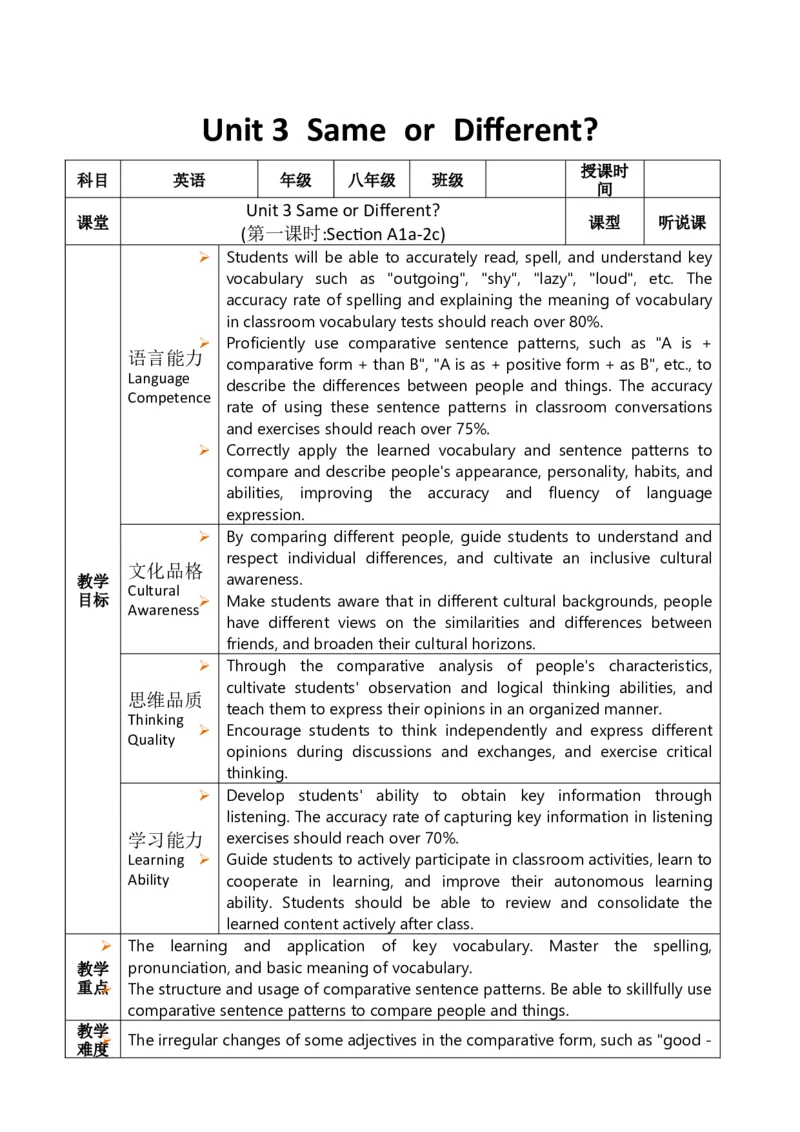
Unit 3 Same or Different?
课堂 课型 听说课
(第一课时:Section A1a-2c)
Students will be able to accurately read, spell, and understand key
vocabulary such as "outgoing", "shy", "lazy", "loud", etc. The
accuracy rate of spelling and explaining the meaning of vocabulary
in classroom vocabulary tests should reach over 80%.
Proficiently use comparative sentence patterns, such as "A is +
语言能力
comparative form + than B", "A is as + positive form + as B", etc., to
Language
describe the differences between people and things. The accuracy
Competence
rate of using these sentence patterns in classroom conversations
and exercises should reach over 75%.
Correctly apply the learned vocabulary and sentence patterns to
compare and describe people's appearance, personality, habits, and
abilities, improving the accuracy and fluency of language
expression.
By comparing different people, guide students to understand and
respect individual differences, and cultivate an inclusive cultural
文化品格
教学 awareness.
Cultural
目标 Make students aware that in different cultural backgrounds, people
Awareness
have different views on the similarities and differences between
friends, and broaden their cultural horizons.
Through the comparative analysis of people's characteristics,
cultivate students' observation and logical thinking abilities, and
思维品质
teach them to express their opinions in an organized manner.
Thinking
Encourage students to think independently and express different
Quality
opinions during discussions and exchanges, and exercise critical
thinking.
Develop students' ability to obtain key information through
listening. The accuracy rate of capturing key information in listening
学习能力 exercises should reach over 70%.
Learning Guide students to actively participate in classroom activities, learn to
Ability cooperate in learning, and improve their autonomous learning
ability. Students should be able to review and consolidate the
learned content actively after class.
The learning and application of key vocabulary. Master the spelling,
教学 pronunciation, and basic meaning of vocabulary.
重点 The structure and usage of comparative sentence patterns. Be able to skillfully use
comparative sentence patterns to compare people and things.
教学
The irregular changes of some adjectives in the comparative form, such as "good -
难度better", "bad - worse", etc. Students need to accurately remember and apply
them.
In real - life situations, flexibly use comparative sentence patterns for accurate and
natural expressions, and avoid grammar mistakes and inappropriate expressions.
教具
Multimedia equipment, PPT courseware, word cards
准备
教学方法
教学内容及过程
及手段
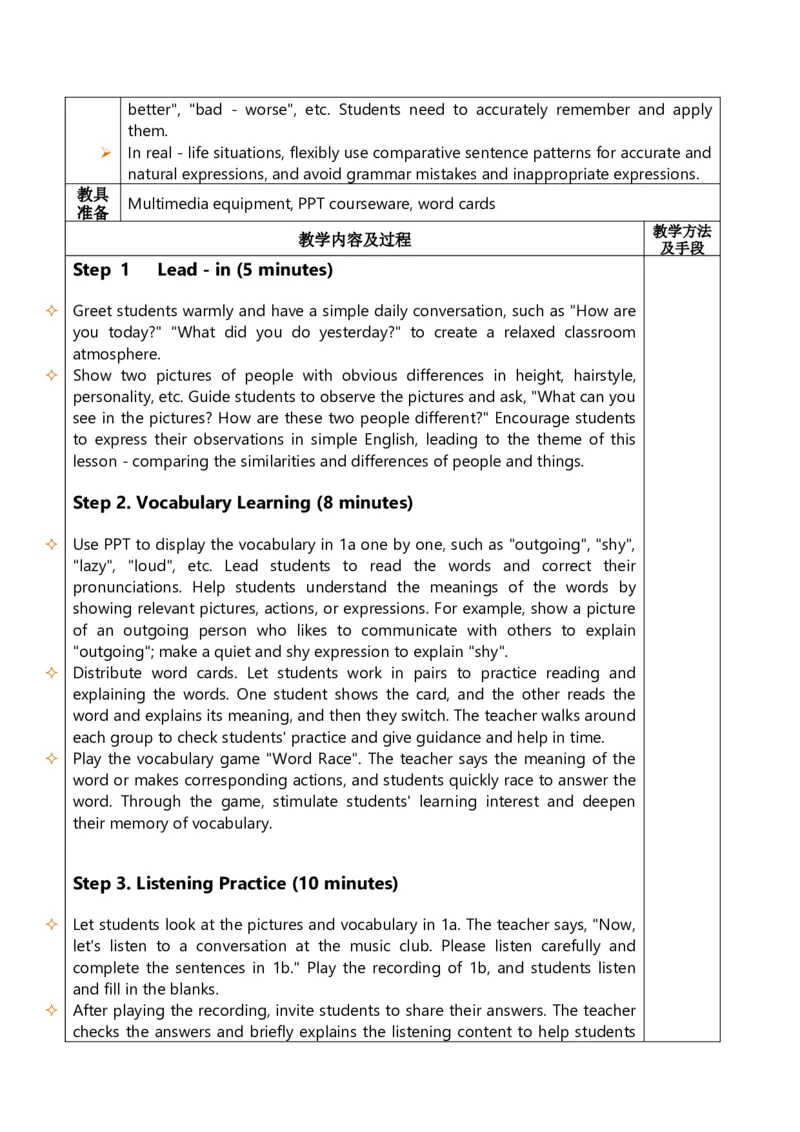
Step 1 Lead - in (5 minutes)
Greet students warmly and have a simple daily conversation, such as "How are
you today?" "What did you do yesterday?" to create a relaxed classroom
atmosphere.
Show two pictures of people with obvious differences in height, hairstyle,
personality, etc. Guide students to observe the pictures and ask, "What can you
see in the pictures? How are these two people different?" Encourage students
to express their observations in simple English, leading to the theme of this
lesson - comparing the similarities and differences of people and things.
Step 2. Vocabulary Learning (8 minutes)
Use PPT to display the vocabulary in 1a one by one, such as "outgoing", "shy",
"lazy", "loud", etc. Lead students to read the words and correct their
pronunciations. Help students understand the meanings of the words by
showing relevant pictures, actions, or expressions. For example, show a picture
of an outgoing person who likes to communicate with others to explain
"outgoing"; make a quiet and shy expression to explain "shy".
Distribute word cards. Let students work in pairs to practice reading and
explaining the words. One student shows the card, and the other reads the
word and explains its meaning, and then they switch. The teacher walks around
each group to check students' practice and give guidance and help in time.
Play the vocabulary game "Word Race". The teacher says the meaning of the
word or makes corresponding actions, and students quickly race to answer the
word. Through the game, stimulate students' learning interest and deepen
their memory of vocabulary.
Step 3. Listening Practice (10 minutes)
Let students look at the pictures and vocabulary in 1a. The teacher says, "Now,
let's listen to a conversation at the music club. Please listen carefully and
complete the sentences in 1b." Play the recording of 1b, and students listen
and fill in the blanks.
After playing the recording, invite students to share their answers. The teacher
checks the answers and briefly explains the listening content to help studentsunderstand the key information in the listening material.
Play the recording of 1b again, and let students follow the reading, imitating
the pronunciation and intonation in the recording to get more familiar with the
listening content.
Step 4. Oral Practice (7 minutes)
The teacher sets an example: "Look at Ella and Emma. Ella is shorter than
Emma. Emma has longer hair than Ella." Guide students to observe the pictures
and use the learned vocabulary and comparative sentence patterns to describe
the differences between Ella and Emma.
Let students work in pairs. According to the pictures and vocabulary in 1a,
practice conversations and describe the differences between the people in the
pictures to each other. The teacher walks around each group, encourages
students to speak actively, and corrects students' grammar mistakes and
pronunciation problems in time.
Invite several pairs of students to show their conversations. Other students
listen carefully and give evaluations. The evaluation includes aspects such as
accurate vocabulary use, correct sentence patterns, and fluent expressions. The
teacher summarizes and gives feedback on students' performances, gives
affirmation and encouragement, and also puts forward improvement
suggestions.
Step 5. Pronunciation Practice (5 minutes)
Play the pronunciation practice audio. Display the phonetic symbol
classification, such as /ɜː/ (term, person, etc.), /ɪə/ (early, learn, etc.), etc. Let
students follow and imitate, paying attention to the mouth shape and tongue
position of pronunciation.
Play the audio again. Students follow the reading, and the teacher emphasizes
the rhythm and intonation of the sentences. Invite individual students to
imitate and read. The teacher corrects and guides to help students master the
correct pronunciation skills.
Step 6. Listening and Oral Expansion (10 minutes)
Play the conversation recording in 2a. Let students listen and think about the
question: "How are Emma and Ella different?" After playing, invite students to
answer the question.
Play the recording again. Students follow the reading, imitating the
pronunciation and intonation. Then let students work in pairs, read the
conversation in roles, paying attention to the pronunciation, intonation, and
emotional expression.
Invite several pairs of students to show their performances. Other students
listen carefully and evaluate. The teacher finally summarizes and givesfeedback. Guide students to pay attention to the use of comparatives in the
conversation and encourage students to use comparative sentence patterns
flexibly in real - life communication.
Recite the key vocabulary learned in this class. Ask parents to sign to confirm, and
there will be a word quiz the next day.
Use the comparative sentence patterns learned to describe the differences
布置
between yourself and a classmate, with no less than 5 sentences.
作业
Preview the content of 3a - 3c in Section A and try to understand the general idea
of the article.
1. Key Vocabulary
outgoing shy
lazy loud
quiet hard - working
2. Comparative Sentence Patterns
板书
设计
A is + comparative form + than B.
A is as + positive form + as B.
3. Pronunciation Practice
/ɜː/ term person
/ɪə/ early learn