文档文本内容
教学设计说明
本单元学生将要学习礼貌地发出、接受、拒绝邀请,谈论自己必须做的事情,并合理安排自己
的活动。在本单元的第一课时,学生已经初步了解了如何向别人发出邀请的“Can you...?”句
型,如何接受邀请“Sure,I'd love to.”和拒绝邀请“I'm sorry.I have to ...”的句型。本课时,学
生将继续练习如何在真实的语境中运用本课的话题。
我的教学思路是:从生活中的话题入手,设计任务,层层推进,激发学生继续学习的兴趣,培
养学生综合运用语言的能力。
[来源:学.科.网Z.X.X.K]
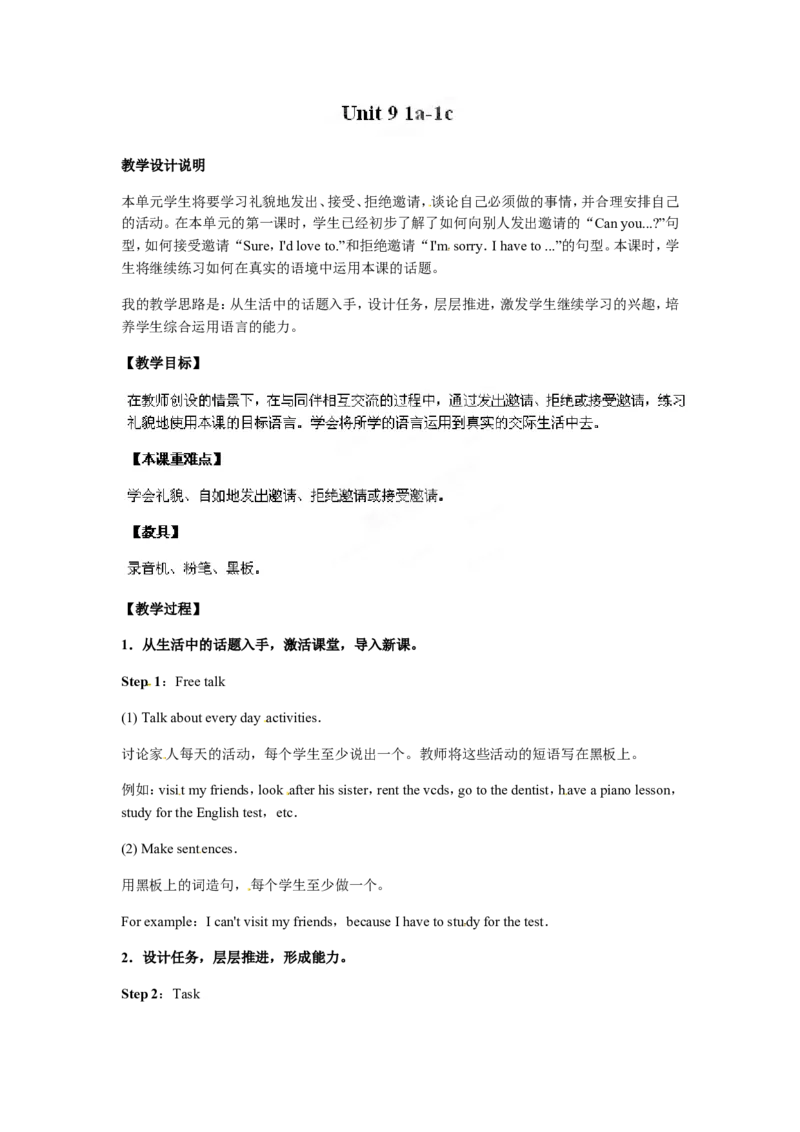
【教学目标】
[来源:学*科*网]
【教学过程】
1.从生活中的话题入手,激活课堂,导入新课。
Step 1:Free talk
(1) Talk about every day activities.
讨论家人每天的活动,每个学生至少说出一个。教师将这些活动的短语写在黑板上。
例如:visit my friends,look after his sister,rent the vcds,go to the dentist,have a piano lesson,
study for the English test,etc.
(2) Make sentences.
用黑板上的词造句,每个学生至少做一个。
For example:I can't visit my friends,because I have to study for the test.
2.设计任务,层层推进,形成能力。
Step 2:Task
[来源:学_科_网Z_X_X_K]Pre-task
(1) Listening 1b
(2) Pairwork
Student A invites his/her partner to do something.Student B declines he/her invitation and give
reasons.
Task circle:Every student invites at least five classmates to do something.
每个学生至少成功邀请 5 个同学做事情,如邀请不成功,需写被拒绝的理由,最后完成下表。
Name Reason
Mary has to help her parents
Lucy Sure
... ...
... ...
... ...
完成任务所需要的语言结构:
Can you come to ...?
Sure,I'd love to.
Sorry,I can't.I have to ...
[来源:Zxxk.Com]
That's too bad.Maybe another time.
Thanks for asking.
Post-task:
(1) Tell your neighbor who accepts your invitation and who refuses your invitation.Why?
(2) Write a short passage.
For example:
Mary can't come to my home,because she has to help her parents.But Lucy can come here.She
is free.