文档内容
英美概况
英国国家概况
概述
o
地理位置
Great Britain and Ireland, and hundreds of small islands
Three political divisions: England, Scotland and Wales.
国旗
the Union Flag or Union Jack; contains colors of red, white and
blue
国歌
God Save the Queen/King, first performed in 1745
国花
England — Rose, Scotland — Thistle, Wales — Daffodil,
Northern Ireland — Shamrock
地理
o
特征
an island country, lies in the North Atlantic Ocean off the north
coast of Europe
separated from the rest of Europe by the English Channel in the
south and the North Sea in the east
the north and west : highlands; the east and southeast:
lowlands
highest mountain: Ben Nevis (1,343m)
河流与湖泊
Thames River(346km): the second longest and most important
river Lough(loch) Neagh(396 square kilometers): the largest lake,
located in Northern Ireland
Snowdonia(1,085m): the highest mountain in Wales
气候
has a favorable maritime climate(海洋性气候)
主要城市
London, Birmingham, Manchester(Cottonopolis), Liverpool, York,
Oxford
历史
o
早期历史
Ancient Britain 古代不列颠
Roman Britain(55BC — 410AD)罗马人统治下的英国
The Anglo-Saxons Conquest (446 — 871)盎格鲁—撒克逊人占领
Viking and Danish invasions 维京人与丹麦人入侵
The Norman Conquest 诺曼征服
The Great Charter 《大宪章》
Origins of the Parliament 议会的起源
The Hundred Year's War(1337-1453) 英法百年战争
资产阶级革命
Wars of the Roses (1455-1485) 玫瑰战争:从1455年到1485年,
以红玫瑰为象征的兰开斯特大家族和以白玫瑰为象征的约克家族之间
的战争
The Reformation 宗教改革
1527年,亨利八世改革的目的是摆脱英国教会与教皇的联
o
系,成立独立的英格兰教会
1534年,议会规定英王为英国教会之首,英国国教确立。亨
o
利八世的改革强调了君主权利 Enclosure Movement圈地运动:18世纪末,19世纪初,《圈地
法》颁布,“开放田地”结束
English Renaissance文艺复兴运动
开始于1485年的都铎家族的继位,在伊丽莎白一世时期达到
o
顶峰
英国文艺复兴主要是文艺方面而不是哲学和学术方面
o
该时期孕育了被认为是英国最伟大的人文主义者、最杰出的戏
o
剧家和诗人威廉·莎士比亚
Civil Wars(1642-1651)英国内战
战争开始于1642年8月22日,结束于1651年。又称清教徒
o
革命
英国内战不仅推翻了英国的封建制度,而且动摇了欧洲封建经
o
济的基础。通常被看作是现代世界史的开端
The Restoration 王朝复辟
Glorious Revolution 光荣革命:1688年11月15日威廉在托尔比登
陆并占领伦敦
Whigs and Tories 辉格党和托利党
政治
o
a constitutional monarchy君主立宪制国家
The Monarchy 君主政体:Constitutional monarchy began after
the Glorious Revolution in 1688.
Parliament 议会:consists of the Sovereign, the House of Lords
and the House of Commons.
The Cabinet and Ministry 首相内阁制
Government Department and the Civil Service 政府部门及公务员
the Treasury 财务部
o
the House of office 内务部
o
the Foreign and Commonwealth office 外交部
othe Ministry of Defence 国防部
o
Local Government 本地政府
counties and the smaller districts 两级地方政府制——郡和
o
比郡小的区
England and Wales: 53 counties (369 districts)
o
Greater London: 32 boroughs
o
Brexit 英国脱欧
经济
o
Manufacturing 制造业
one of the world's major steel-producing nations 产钢大国
textile industry: used to be the most important light industry
纺织品业曾是重要轻工业
motor-vehicle production: an important part of industrial base
汽车类产品的生产在工业中占主导
other important industrial production: locomotives, telegraph
and telephone apparatus, computer controlled machine tools,
and robots(机车、电信和电话设备、电脑控制机器工具和机械人)
Agriculture 农业
Farming
largely mechanized
o
wheat and barley 小麦和大麦
o
Fishing
Tertiary industries 第三产业(服务业)
produces 65% of national wealth
70% of the workforce are employed in the service sector.
教育与文化
o
Education System 教育体系
Compulsory Education 义务教育资
源
公
众
号
:
b
ig
u
o
25
extends from 5 to 16 years old, including primary
o
education and secondary education.
Further Education 继续教育
Students can get General Certificate of Education,
o
Advanced Level (GCE A-Levels), General National
Vocational Qualification (GNVQ), or other such
qualifications.
Higher Education 高等教育
The Most famous universities are Oxford (the oldest in
o
Britain) and Cambridge.
Education System in Scotland 苏格兰的教育系统
7 years of primary education and 4 years of compulsory
o
secondary education
students aged 15 to 16 may take the Scottish Certificate
o
of Education (SCE)
Main Festivals 主要节日
New Year's Day(Jan.1st), Valentine's Day(Feb. 14th),
Easter(March 22nd to April 25th), Halloween(Oct 31st),
Christmas(Dec. 25th)
Sports 运动
Football or "soccer", Cricket, tennis, golf
Major forms of art 艺术形式
Museums, music, drama, art festival
Mass Media
BBC, Reuters (路透社), Press Association (新闻联合社简称
o
“PA”)资
源
公
众
号
:
b
ig
u
o
25
Newspapers: The Times 《泰晤士报》, The Guardian《卫
o
报》, Financial Times《金融时报》, The Observer《观察家
报》
Periodical(期刊): The Economist《经济学家》, The
o
Spectator《旁观者》,The Woman's Own《妇女界》
美国国家概况
概述
o
性质:a federal constitutional republic comprising fifty states and a
federal district
国旗:“Stars and Stripes”,consisting of 13 stripes and 50 stars, with
colors of white, red and blue
国歌:The Star-Spangled Banner
国庆日:July 4, is commonly known as Independence Day
国花:Rose
地理
o
Geographic Features地理特征
a land area of 9.3 million square kilometers, the fourth largest
country in the world in size
seven geographical regions:
Alaska is the largest in area and Rhode Island the
o
smallest.
But on the mainland, Texas is the largest state of the
o
country.
Natural Resources自然资源
The Rockies落基山脉:北美大陆的脊梁,也被称为大陆分水岭
Appalachian Range阿巴拉契亚山脉:位于美国东部,全长2,400公
里资
源
公
众
号
:
b
ig
u
o
25
Mississippi River密西西比河:北美最长水系,也是世界第四大长河;
被称作“众水之父”或“老人河”
Five Great Lakes北美五大湖
Lake Superior, Lake Michigan, Lake Huron, Lake Eire and
o
Lake Ontario苏必利尔湖,密歇根湖,休伦湖,伊利湖和安大
略湖
苏必利尔湖为世界最大淡水湖,密歇根湖完全在美国境地内
o
Niagara Falls尼亚加拉瀑布:仅次于非洲南部的维多利亚瀑布,是全
球第二大瀑布,也是世界第一大跨国瀑布
Yellowstone National Park黄石国家公园:绝大部分位于怀俄明州
(Wyoming),被认为是世界上第一个国家公园
Grand Canyon大峡谷:位于美国亚利桑那州(Arizona)西北部,是地
球上“七大自然奇观”之一
Major Cities 重要城市:Washington D.C., New York City, Boston,
Chicago, Detroit, Los Angles, San Francisco
历史
o
The Colonial Period殖民地时期
“最早的美国人”是印地安人
The War of Independence 独立战争时期
Boston Tea Party波士顿倾茶事件(1773)
First Continental Congress第一届大陆会议(1774)
The Battle of Lexington and Concord莱克星顿的枪声(1775)
The Declaration of Independence《独立宣言》:由托马斯·杰弗逊
起草,1783年9月签订《巴黎和约》,正式独立
Adopting of the Constitution制宪会议(1787)
The United States in the 19th Century19世纪的美国
Civil War(1861—1865)美国内战
1860年林肯废除了奴隶制度;1861年内战爆发
o资
源
公
众
号
:
b
ig
u
o
25
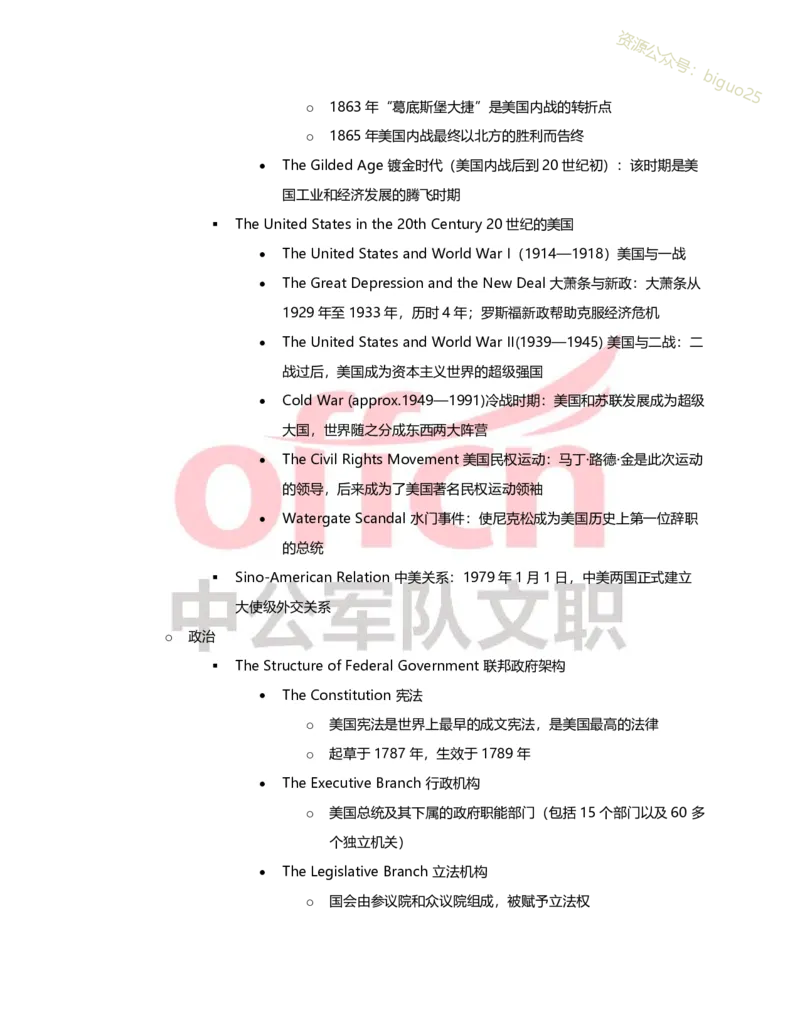
1863年“葛底斯堡大捷”是美国内战的转折点
o
1865年美国内战最终以北方的胜利而告终
o
The Gilded Age 镀金时代(美国内战后到20世纪初):该时期是美
国工业和经济发展的腾飞时期
The United States in the 20th Century 20世纪的美国
The United States and World War I(1914—1918)美国与一战
The Great Depression and the New Deal 大萧条与新政:大萧条从
1929年至1933年,历时4年;罗斯福新政帮助克服经济危机
The United States and World War II(1939—1945) 美国与二战:二
战过后,美国成为资本主义世界的超级强国
Cold War (approx.1949—1991)冷战时期:美国和苏联发展成为超级
大国,世界随之分成东西两大阵营
The Civil Rights Movement 美国民权运动:马丁·路德·金是此次运动
的领导,后来成为了美国著名民权运动领袖
Watergate Scandal 水门事件:使尼克松成为美国历史上第一位辞职
的总统
Sino-American Relation 中美关系:1979年1月1日,中美两国正式建立
大使级外交关系
政治
o
The Structure of Federal Government 联邦政府架构
The Constitution 宪法
美国宪法是世界上最早的成文宪法,是美国最高的法律
o
起草于1787年,生效于1789年
o
The Executive Branch 行政机构
美国总统及其下属的政府职能部门(包括15个部门以及60 多
o
个独立机关)
The Legislative Branch 立法机构
国会由参议院和众议院组成,被赋予立法权
o资
源
公
众
号
:
b
ig
u
o
25
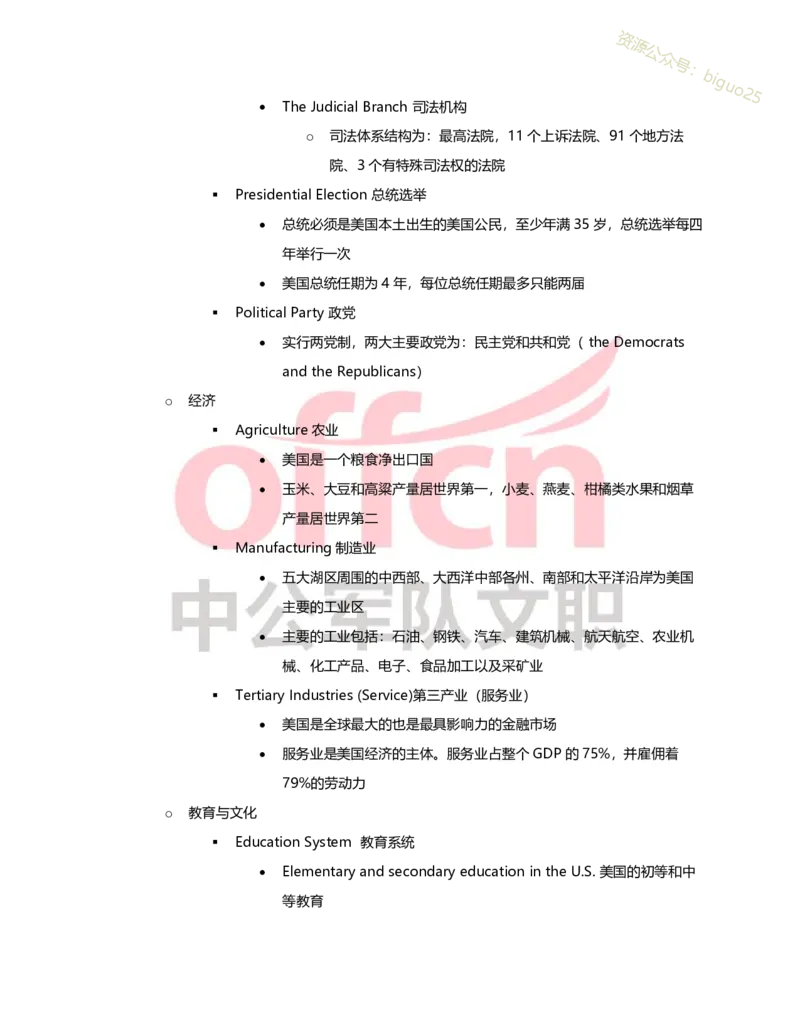
The Judicial Branch 司法机构
司法体系结构为:最高法院,11个上诉法院、91个地方法
o
院、3个有特殊司法权的法院
Presidential Election 总统选举
总统必须是美国本土出生的美国公民,至少年满35岁,总统选举每四
年举行一次
美国总统任期为4年,每位总统任期最多只能两届
Political Party 政党
实行两党制,两大主要政党为:民主党和共和党( the Democrats
and the Republicans)
经济
o
Agriculture农业
美国是一个粮食净出口国
玉米、大豆和高粱产量居世界第一,小麦、燕麦、柑橘类水果和烟草
产量居世界第二
Manufacturing制造业
五大湖区周围的中西部、大西洋中部各州、南部和太平洋沿岸为美国
主要的工业区
主要的工业包括:石油、钢铁、汽车、建筑机械、航天航空、农业机
械、化工产品、电子、食品加工以及采矿业
Tertiary Industries (Service)第三产业(服务业)
美国是全球最大的也是最具影响力的金融市场
服务业是美国经济的主体。服务业占整个GDP的75%,并雇佣着
79%的劳动力
教育与文化
o
Education System 教育系统
Elementary and secondary education in the U.S. 美国的初等和中
等教育资
源
公
众
号
:
b
ig
u
o
25
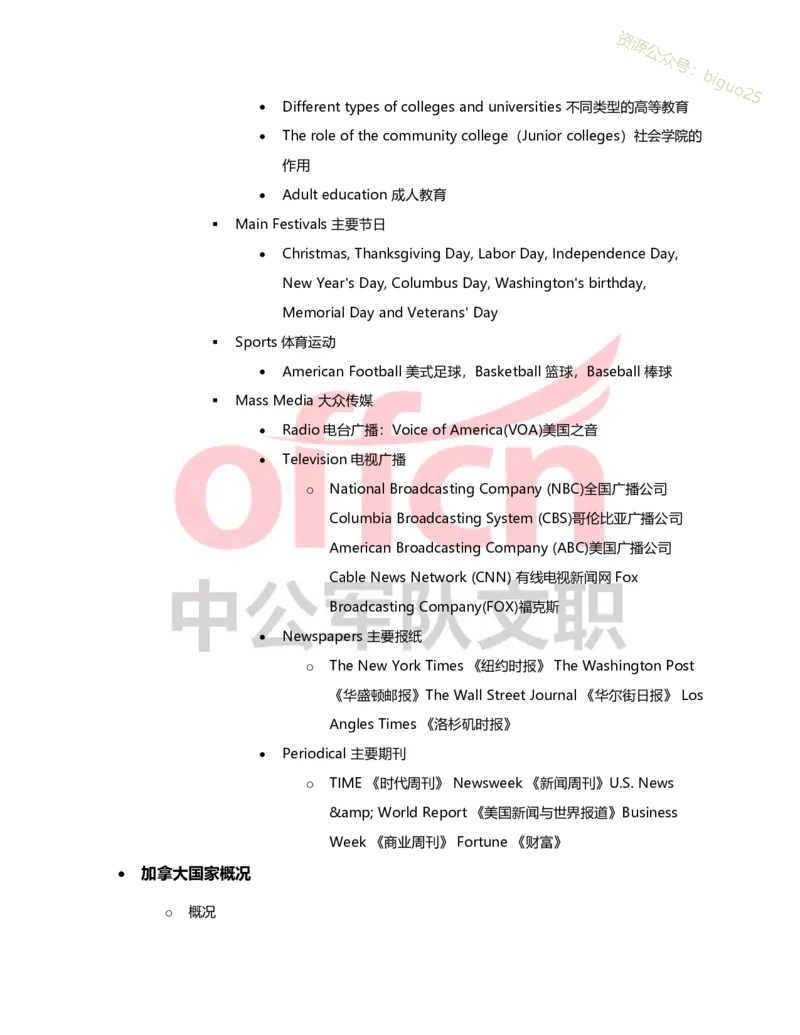
Different types of colleges and universities 不同类型的高等教育
The role of the community college(Junior colleges)社会学院的
作用
Adult education 成人教育
Main Festivals 主要节日
Christmas, Thanksgiving Day, Labor Day, Independence Day,
New Year's Day, Columbus Day, Washington's birthday,
Memorial Day and Veterans' Day
Sports体育运动
American Football 美式足球,Basketball 篮球,Baseball 棒球
Mass Media 大众传媒
Radio电台广播:Voice of America(VOA)美国之音
Television电视广播
National Broadcasting Company (NBC)全国广播公司
o
Columbia Broadcasting System (CBS)哥伦比亚广播公司
American Broadcasting Company (ABC)美国广播公司
Cable News Network (CNN) 有线电视新闻网Fox
Broadcasting Company(FOX)福克斯
Newspapers 主要报纸
The New York Times 《纽约时报》 The Washington Post
o
《华盛顿邮报》The Wall Street Journal 《华尔街日报》 Los
Angles Times 《洛杉矶时报》
Periodical 主要期刊
TIME 《时代周刊》 Newsweek 《新闻周刊》U.S. News
o
& World Report 《美国新闻与世界报道》Business
Week 《商业周刊》 Fortune 《财富》
加拿大国家概况
概况
o资
源
公
众
号
:
b
ig
u
o
25
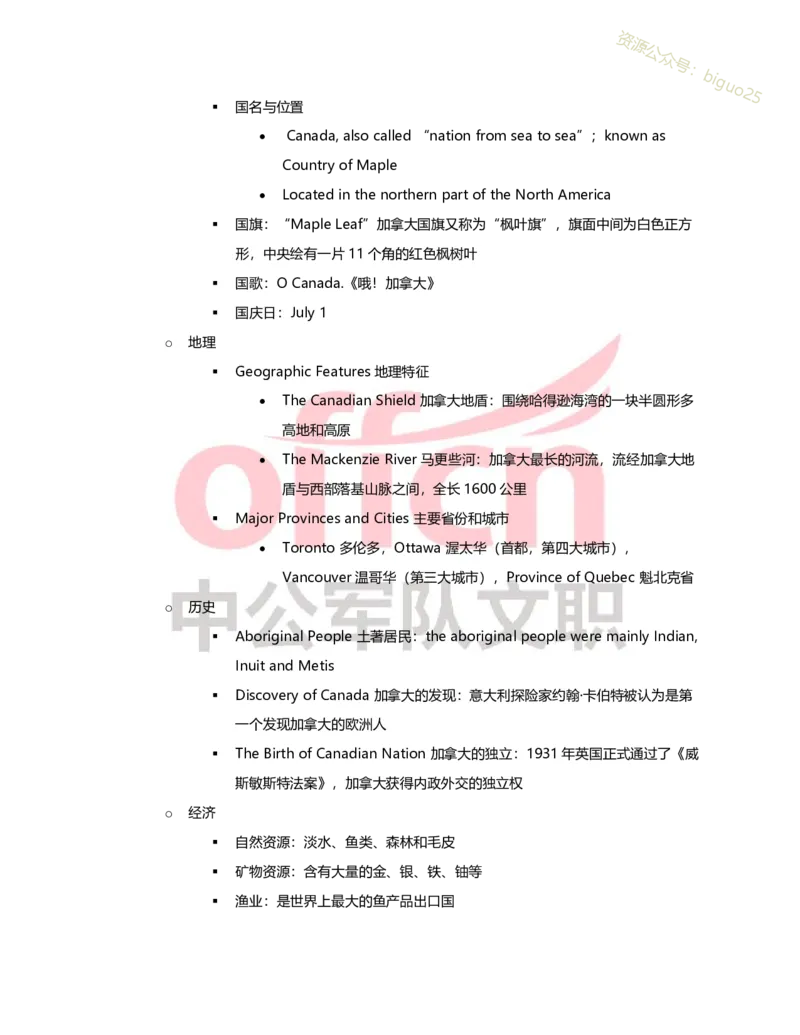
国名与位置
Canada, also called “nation from sea to sea”;known as
Country of Maple
Located in the northern part of the North America
国旗:“Maple Leaf”加拿大国旗又称为“枫叶旗”,旗面中间为白色正方
形,中央绘有一片11个角的红色枫树叶
国歌:O Canada.《哦!加拿大》
国庆日:July 1
地理
o
Geographic Features地理特征
The Canadian Shield加拿大地盾:围绕哈得逊海湾的一块半圆形多
高地和高原
The Mackenzie River马更些河:加拿大最长的河流,流经加拿大地
盾与西部落基山脉之间,全长1600公里
Major Provinces and Cities 主要省份和城市
Toronto 多伦多,Ottawa 渥太华(首都,第四大城市),
Vancouver温哥华(第三大城市),Province of Quebec 魁北克省
历史
o
Aboriginal People 土著居民:the aboriginal people were mainly Indian,
Inuit and Metis
Discovery of Canada 加拿大的发现:意大利探险家约翰·卡伯特被认为是第
一个发现加拿大的欧洲人
The Birth of Canadian Nation 加拿大的独立:1931年英国正式通过了《威
斯敏斯特法案》,加拿大获得内政外交的独立权
经济
o
自然资源:淡水、鱼类、森林和毛皮
矿物资源:含有大量的金、银、铁、铀等
渔业:是世界上最大的鱼产品出口国资
源
公
众
号
:
b
ig
u
o
25
农业:全球最大的粮食输出国之一,出口农作物尤以小麦及其他谷物居多
政治
o
Head of State 国家元首
加拿大是君主立宪制国家,政府实行联邦议会制。国家元首为英国女
王
加拿大的政府分三级:national (federal), provincial, and
local( municipal)国家(联邦)、省级和市级
Legislative Branch 立法机构:联邦议会是国家的立法机构,由英国女王、参
议院(上议院)和众议院(下议院)组成
Executive Branch 行政机构:加拿大的政府首脑是总理,任期5年;政府内
阁由总理领导,负责制定政府实施方案,对众议院负责
Judicial Branch 司法机构:加拿大最高级别的法院是加拿大最高法院,由1
名大法官和8名陪审法官组成
Constitution宪法:至今没有一部完整的宪法
Major Political Parties主要政党:the Liberal Party and the Conservative
Party of Canada自由党和加拿大保守党
大众传媒
o
Broadcasting广播:Canadian Broadcasting Corporation (CBC)加拿大广
播公司
Newspaper (English)英语报纸:The Toronto Star 《多伦多星报》,The
Globe and Mail 《环球邮报》
Newspaper(French)法语报纸:Le Journal De Montreal 《蒙特利尔日
报》
Periodical 主要期刊:Maclean's 《麦克林斯》,Newsweek 《新闻周刊》
澳大利亚国家概况
概况
o
位置:an island and a continent is located in the Southern Hemisphere,
between Indian Ocean and the South Pacific Ocean资
源
公
众
号
:
b
ig
u
o
25
国旗: three elements on a blue background: the Union Jack, the
Commonwealth Star and the South Cross.
国歌: 《前进,美丽的澳大利亚》Advance Australia Fair, proclaimed in
1984
国庆日:January 26
国花:Gold wattle 金合欢树
地理
o
Natural Resources 自然资源
墨累河 The Murray River: the longest river in Australia.
艾尔湖Lake Eyre: the largest lake in Australia.
大堡礁Great Barrier Reef: it contains the world's largest
collection of coral reefs.
best-known plants:eucalypts and wattles(桉树和金合欢树);
best-known animals: kangaroos and emus(袋鼠和鸸鹋)
States, Territories and Cities 州、自治领和城市
Capital: Canberra
divided into 6 states and 2 major mainland territories
历史
o
Discovery of Australia澳大利亚的发现:荷兰人威廉·詹茨(Willem
Janszoon)英国人威廉·丹皮尔(William Dampier)
Colonial Period 殖民地时代:1778年1月26日,由菲利普船长建立起英国
的第一个殖民区
Independence独立:1901年1月1日,澳大利亚联邦正式成立。1931
年,英国议会通过《威斯敏斯特法案》,澳大利亚独立
经济
o
世界上最大的羊毛和牛肉出口国;全球最大的焦煤(coking coal)出口国
政治
o
Head of State 国家元首资
源
公
众
号
:
b
ig
u
o
25
澳大利亚也是君主立宪制国家,政府实行联邦议会制。英女王是澳大
利亚的国家元首
三级政府:联邦政府、州政府、当地(市)政府(Federal, State and
Local)
Legislative Branch 立法机构:议会是国家的立法机构,由英女王、参议院
(上议院)和众议院(下议院)组成
Executive Branch 行政机构:政府首脑是总理,总理任期为3年。
Judicial Branch 司法机构:澳大利亚高等法院( the High Court of
Australia)是澳大利亚的最高司法机构
Constitution 宪法:澳大利亚有一部成文的宪法,于1901年正式生效
Major Political Parties主要政党
两大主要政党:澳大利亚工党和自由党 the Labor Party (the oldest
party in Australia) and the Liberal Party
第三大党:澳大利亚国家党The National Party of Australia
大众传媒
o
Broadcasting 广播:Australian Broadcasting Company(ABC) , Australian
Broadcasting Authority(ABC) , Special Broadcasting Service(SBS)
Newspapers 报纸
The Australians《澳大利亚人报》—the most influential
newspaperThe Sydney Morning Herald《悉尼先驱晨报》 The
Age《世纪报》The Australian Financial Review《金融评论报》
Canberra Times《堪培拉时报》
Periodical 期刊:The Australian Woman's Weekly《澳大利亚妇女周刊》
Sydney Gazette《公报》资
源
公
众
号
:
b
ig
u
o
25
英美文学
英国文学
中古时期
o
Beowulf: the first English national epic
The Robin Hood Ballad: the most famous ballads in the 15th century
Geoffrey Chaucer: Father of English Poetry; masterpiece: The
Canterbury Tales
William Langland: long narrative poem Piers Plowman《农夫皮尔斯》
文艺复兴时期 (14—17世纪)
o
16 Century, Overview
poetry and poetic drama: the most outstanding literary forms
Elizabethan Drama (the 16th-early 17th century) : the golden
age of English drama.
Essay: Francis Bacon was the best known essayist in this period.
17 Century, Overview
The greatest poet is John Milton
the Cavalier poets, influenced by Ben Johnson
Metaphysical poets, influenced by John Donne
Writers and Masterpieces
William Shakespeare
Tragedies: King Lear, Macbeth, Hamlet, OthelloComedies:
o
A Midsummer Night's Dream, As You Like It, The
Merchant of Venice, Twelfth Night Tragicomedy: Romeo
and Juliet Historical plays: Richard III, Henry IV, Henry
V, Henry VII
John Milton: Paradise Lost, Paradise Regained, Samson
Agonistes《力士参孙》资
源
公
众
号
:
b
ig
u
o
25
18世纪英国文学
o
Overview
Representative writers of Neoclassical School
John Dryden; Alexander Pope ; Samuel Johnson
o
novel: the summit of 18th century English literature
Daniel Defoe: Robinson Crusoe
o
Jonathan Swift: Gulliver's Travels
o
Henry Fielding: Tom Jones
o
Romantic Poets: William Blake and Robert Burns
Writers and Masterpieces
Alexander Pope: generally regarded as the greatest English poet
of the eighteenth century
Daniel Defoe: the “Father of English and European Novels”.
Henry Fielding: an English novelist; The History of Tom Jones
Jonathan Swift: an Anglo-Irish novelist, satirist; Gulliver's Travels
Richard Sheridan: Irish playwright; School of Scandal
Oliver Goldsmith: English novelist; Vicar of Wakefield《威克菲尔
德牧师传记》
Laurence Sterne: an English novelist; Tristram Shandy《商第传》
Thomas Gray: an English poet; Elegy Written in a Country
Churchyard《墓畔哀歌》
浪漫主义时期
o
Overview
Two generations of Romantic poets
The Lake Poets (including Wordsworth, Coleridge and
o
Southey)
young poets (including Byron, Shelley and Keats)
o
The only two great novelists: Walter Scott and Jane Austen. Writers and Masterpieces
William Blake: an English poet; Song of Innocence and Song of
Experience.
William Wordsworth: a major English Romantic poet ; Lyrical
Ballads《抒情歌谣集》
Samuel Taylor Coleridge: an English poet; The Rime of the
Ancient Mariner《古舟子颂》and Kubla Khan《忽必烈汗》
George Gordon Byron: an English poet and a leading figure;
Childe Harold's Pilgrimage《恰尔德·哈罗尔德游记》and Don Juan
《唐璜》
Percy Bysshe Shelley: English Romantic poets; Ode to the West
Wind, To a Skylark《致云雀》, Prometheus Unbound《解放了的
普罗米修斯》
Mary Shelley (玛丽•雪莱): a British novelist; Frankenstein《弗兰肯
斯坦》
John Keats: an English poet; Ode on a Grecian Urn《希腊古瓮
颂》and Ode to a Nightingale《夜莺颂》
Jane Austen: an English novelist, Sense and Sensibility, Pride
and Prejudice, Emma.
Walter Scott (司各特): a prolific Scottish historical novelist;
Ivanhoe《艾凡赫》
维多利亚时期
o
Overview
Realism
Novel: a golden period of novel; novelists include Dickens,
Thackeray and George Eliot
Poetry: “at least temporary decline of English poetry”
Writers and Masterpieces Bronte sisters 勃朗特姐妹: Charlotte, Emily and Anne; Charlotte's
Jane Eyre, Emily's Wuthering Heights and Anne's Agnes Grey
《艾格妮斯·格雷》
George Elliot: an English novelist; The Mill on the Floss《佛洛斯
河上的磨坊》, Middlemarch《米德尔玛契》
Charles Dickens: an English novelist; A Tale of Two Cities, Oliver
Twist, David Copperfield, Great Expectation, Hard Times
William Makepeace Thackeray (萨克雷): an English novelist;
Vanity Fair《名利场》
Mrs. Gaskell (盖斯凯尔夫人): an English novelist ; Mary Barton
Thomas Hardy: an English novelist; Far from the Madding
Crowd 《远离尘嚣》, Jude the Obscure《无名的裘德》
20世纪和现代主义英国文学
o
Overview
greatest modernist writers: Ezra Pound, T. S. Eliot, James Joyce
and W. B. Yeats
Stream of Consciousness
Symbolism
Writers and Masterpieces
Bernard Shaw (萧伯纳): an Irish playwright; Mrs Warren's
Profession《华伦夫人的职业》, Major Barbara《芭芭拉上校》,
Pygmalion《皮革马力翁》
John Galsworthy (高尔斯华绥): novelist, a Nobel Prize winner;
Forsyte Saga《福尔赛世家》
Joseph Conrad (康拉德): an English novelist; Lord Jim《吉姆爷》
and The Heart of Darkness
James Joyce (乔伊斯): An Irish born novelist; Ulysses《尤利西斯》,
Finnegan's Wake《芬尼根彻夜祭》, Dubliners《都柏林人》 T. S. Eliot: American poet, 1948 Nobel Prize winner for literature;
The Waste Land;
William Butler Yeats (叶芝): an Irish poet and awarded Nobel
Prize for literature; Sailing to Byzantium《驶向拜占庭》 and Leda
and Swan《利达和天鹅》
Iris Jean Murdoch (默多克): English female novelist; Black Prince,
The Sea, the Sea and Unicorn《独角兽》
Muriel Spark(斯帕克): English female novelist; The Prime of
Miss Jean Brodie《布罗迪小姐的青春》
美国文学
殖民地时期
o
Overview
Influenced by puritanism, American literature had the
characteristics of simplicity, plainness of rhetoric and indication
to the Holy Bible.
Personal literature, like diaries, journals, letters and sermons etc.,
occupied a major position
Thomas Paine's the Age of Reason is a representative of the
Deism.
Authors and Works
Benjamin Franklin: one of American founding fathers;
Autobiography, Poor Richard's Almanack 《穷人理查年鉴》
Jonathan Edwards: a colonial theologian and writer; Sinners in
the Hands of an Angry God《落在忿怒之神手中的罪人》
Thomas Paine: an English-born American pamphleteer;
Common Sense
Thomas Jefferson: the third President of the United States;
Declaration of Independence Federalists' Papers 《联邦党人文集》: Alexander Hamilton, John
Jay, James Madison.
浪漫主义时期
o
Overview
Principal literary forms: novels, short stories, and poems
New England transcendentalism: the summit of American
romanticism
Two important representatives of transcendentalism: Emerson
and Thoreau
Authors and Works
Washington Irving: American romantic novelist; novel:“The
Legend of Sleepy Hollow” and “Rip Van Winkle”, book: The
Sketch Book《见闻札记》
James Fenimore Cooper: American romantic novelist;
Leatherstocking Tales 《皮袜子故事》 (The Pioneer《拓荒者》,
Deer Slayer《猎鹿者》, Pathfinder《探路人》, Prairie《大草原》,
The Last of the Mohicans《最后的莫西干人》)
Walt Whitman: American romantic poet, father of free verse(自
由诗); Leaves of Grass 《草叶集》
Ralph Waldo Emerson: leader of the transcendentalism; Nature
《论自然》,The American Scholar《美国学者》
Henry David Thoreau: American romantic writer best known for
his book Walden, a reflection upon simple living.
Herman Melville: American novelist, best known for his novel
Moby Dick.
Nathaniel Hawthorne: American novelist; The Scarlet Letter 《红
字》, The House of the Seven Gables 《七个尖尖角的房子》, The
Blithedale Romance《福谷传奇》, The Marble Faun《玉石人像》 Harriet Beecher Stowe : American female novelist, whose
famous novel is Uncle Tom's Cabin.
现实主义及自然主义文学
o
Overview
Three great masters of American Realism are: Howells, Henry
James and Mark Twain.
American Naturalism: Maggie, a Girl of the Streets by Stephen
Crane, McTeague by Frank Norris, Sister Carrie by Theodore
Dreiser
Authors and Works
Mark Twain: American novelist; The Adventures of Tom Sawyer
and Adventures of Huckleberry Finn, Life on the Mississippi
River, Connecticut Yankee in King Arthur's Court, The Gilded
Age《镀金时代》
Henry James: American realist novelist;The American, The
Europeans, The Portrait of a Lady, The Wings of the Dove, The
Ambassadors
O. Henry: American novelist ; Cop and Anthem and Gift of
Magie
William Dean Howells: American realist novelist and literary
critic; The Rise of Silas Lapham 《赛拉斯·拉帕姆的发迹》
Theodore Dreiser: American novelist and journalist; Sister Carrie ,
An American Tragedy , The Financier《金融家》, The Titan 《巨
头》, The Stoic《斯多葛》
Stephen Crane: an American novelist; The Red Badge of
Courage《红色的英勇勋章》
Frank Norris: American novelist; McTeague《麦克提格》, The
Octopus《章鱼》 Jack London: American novelist; Martin Eden, The Call of the
Wild
现代主义文学
o
Overview
Representatives of imagism include: T. E. Hulme's Autumn, F. S.
Flint's The Swan, William Carlos Williams' the Red wheelbarrow
Drama: the most important playwrights: Tennessee Williams,
Arthur Miller and Edward Albee
The Lost Generation; The Beat Generation
Authors and Works
T. S. Eliot: American poet, 1948 Nobel Prize winner for literature;
The Waste Land
Ezra Pound: American imagist poet; Cantos《诗章》, Hugh
Selwyn Maubery, Cathay
Robert Frost: American poet. He is highly regarded for his
realistic depictions of rural life in New England.
Wallace Stevens: American poet; Anecdote for the Jar
Allen Ginsberg: American poet of Beat Generation; Howl《嚎》
Ernest Hemingway: American novelist; The Sun also Rises, A
Farewell to Arms, The Old Man and the Sea, For Whom the Bell
Tolls
Fitzgerald: American novelist; The Great Gatsby
William Faulkner: American novelist, winner of Nobel Prize for
literature; The Sound and the Fury《喧哗与骚动》, Sartoris《家族
小说》, Go Down, Moses 《去吧,莫西》, Light in August 《八月
之光》, Absalom, Absalom!《押沙龙,押沙龙!》, Sanctuary《圣
地》 John Steinbeck: American novelist, Nobel Prize winner; The
Grapes of Wrath《愤怒的葡萄》
Saul Bellow: American novelist, Nobel Prize winner; The
Adventures of Augie March, Herzog, Seize the Day, Humboldt's
Gift
James Baldwin: black American novelist; Go Tell It on the
Mountain 《向苍天呼吁》
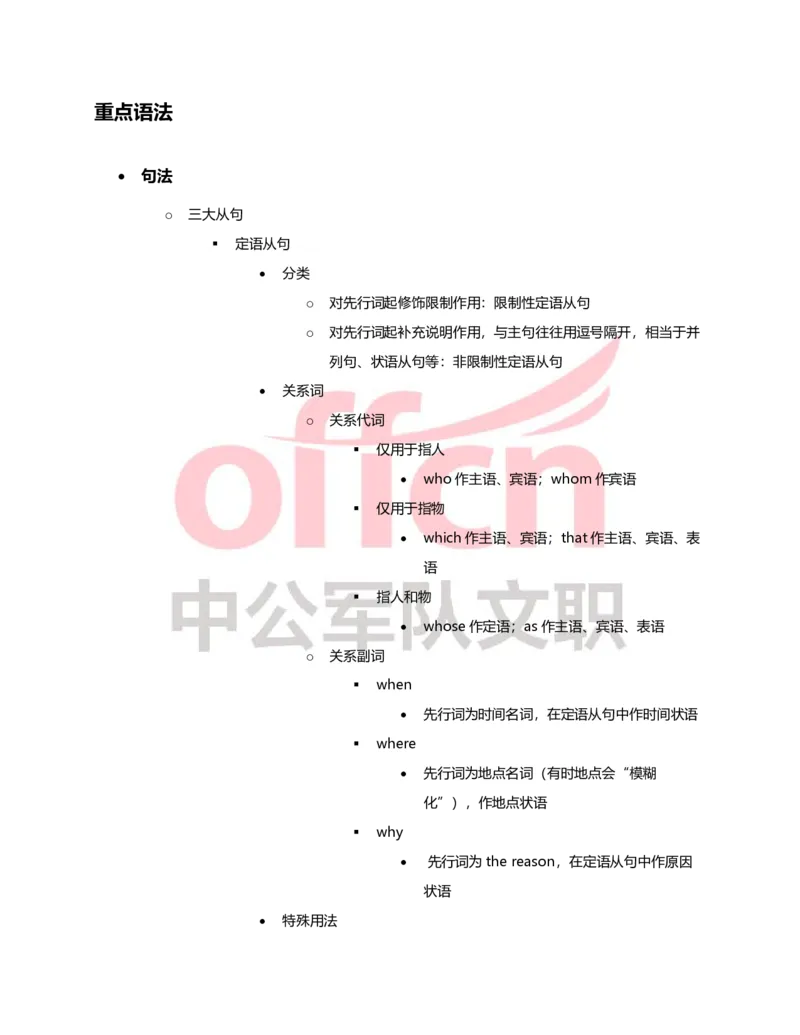
重点语法
句法
三大从句
o
定语从句
分类
对先行词起修饰限制作用:限制性定语从句
o
对先行词起补充说明作用,与主句往往用逗号隔开,相当于并
o
列句、状语从句等:非限制性定语从句
关系词
关系代词
o
仅用于指人
who作主语、宾语;whom作宾语
仅用于指物
which作主语、宾语;that作主语、宾语、表
语
指人和物
whose作定语;as作主语、宾语、表语
关系副词
o
when
先行词为时间名词,在定语从句中作时间状语
where
先行词为地点名词(有时地点会“模糊
化”),作地点状语
why
先行词为the reason,在定语从句中作原因
状语
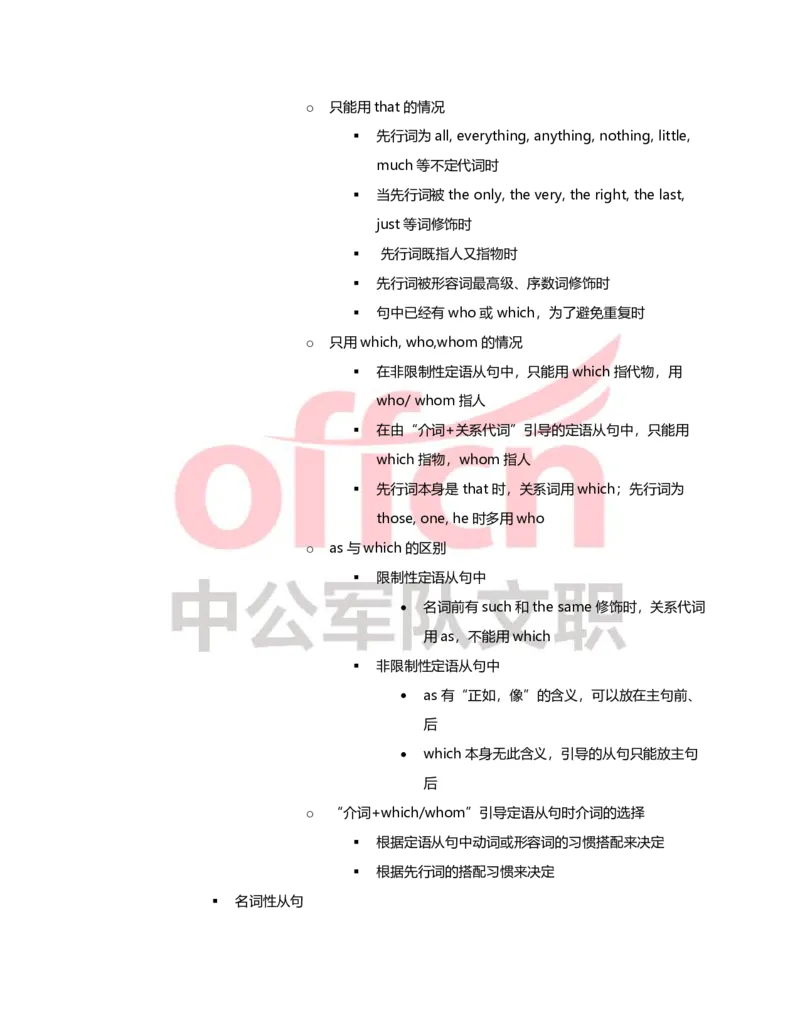
特殊用法只能用that的情况
o
先行词为all, everything, anything, nothing, little,
much等不定代词时
当先行词被the only, the very, the right, the last,
just等词修饰时
先行词既指人又指物时
先行词被形容词最高级、序数词修饰时
句中已经有who或which,为了避免重复时
只用which, who,whom的情况
o
在非限制性定语从句中,只能用which指代物,用
who/ whom指人
在由“介词+关系代词”引导的定语从句中,只能用
which指物,whom指人
先行词本身是that时,关系词用which;先行词为
those, one, he时多用who
as与which的区别
o
限制性定语从句中
名词前有such和the same修饰时,关系代词
用as,不能用which
非限制性定语从句中
as有“正如,像”的含义,可以放在主句前、
后
which本身无此含义,引导的从句只能放主句
后
“介词+which/whom”引导定语从句时介词的选择
o
根据定语从句中动词或形容词的习惯搭配来决定
根据先行词的搭配习惯来决定
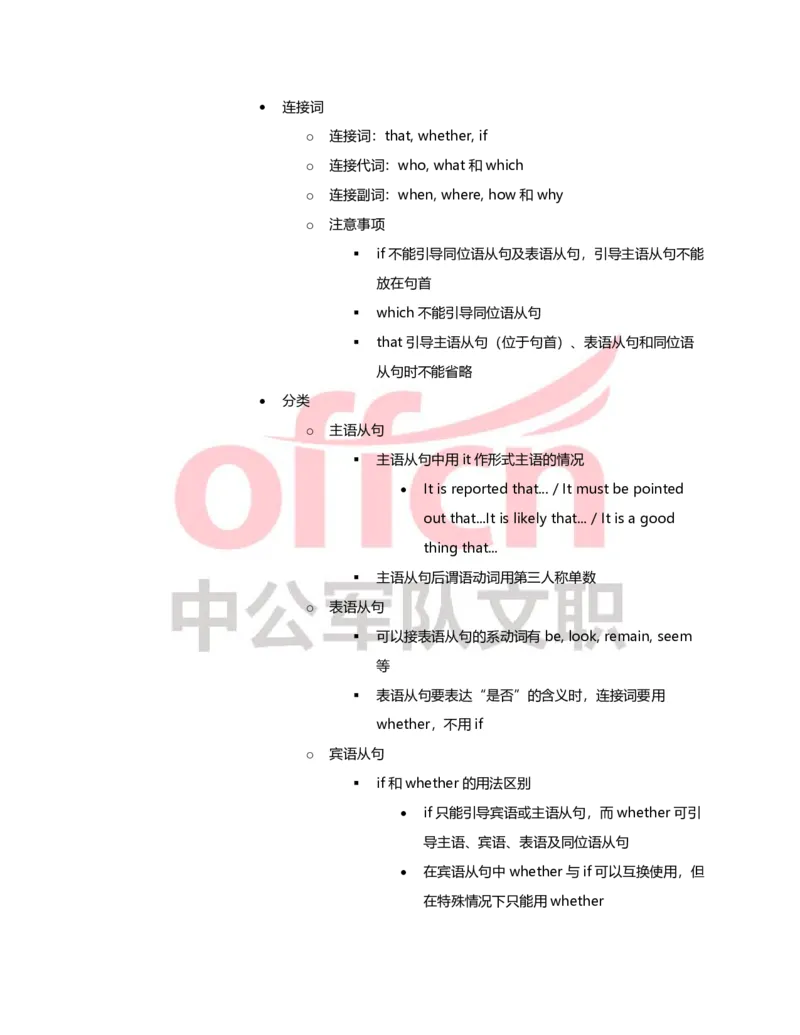
名词性从句 连接词
连接词:that, whether, if
o
连接代词:who, what和which
o
连接副词:when, where, how和why
o
注意事项
o
if不能引导同位语从句及表语从句,引导主语从句不能
放在句首
which不能引导同位语从句
that引导主语从句(位于句首)、表语从句和同位语
从句时不能省略
分类
主语从句
o
主语从句中用it作形式主语的情况
It is reported that... / It must be pointed
out that...It is likely that... / It is a good
thing that...
主语从句后谓语动词用第三人称单数
表语从句
o
可以接表语从句的系动词有be, look, remain, seem
等
表语从句要表达“是否”的含义时,连接词要用
whether,不用if
宾语从句
o
if和whether的用法区别
if只能引导宾语或主语从句,而whether可引
导主语、宾语、表语及同位语从句
在宾语从句中whether与if可以互换使用,但
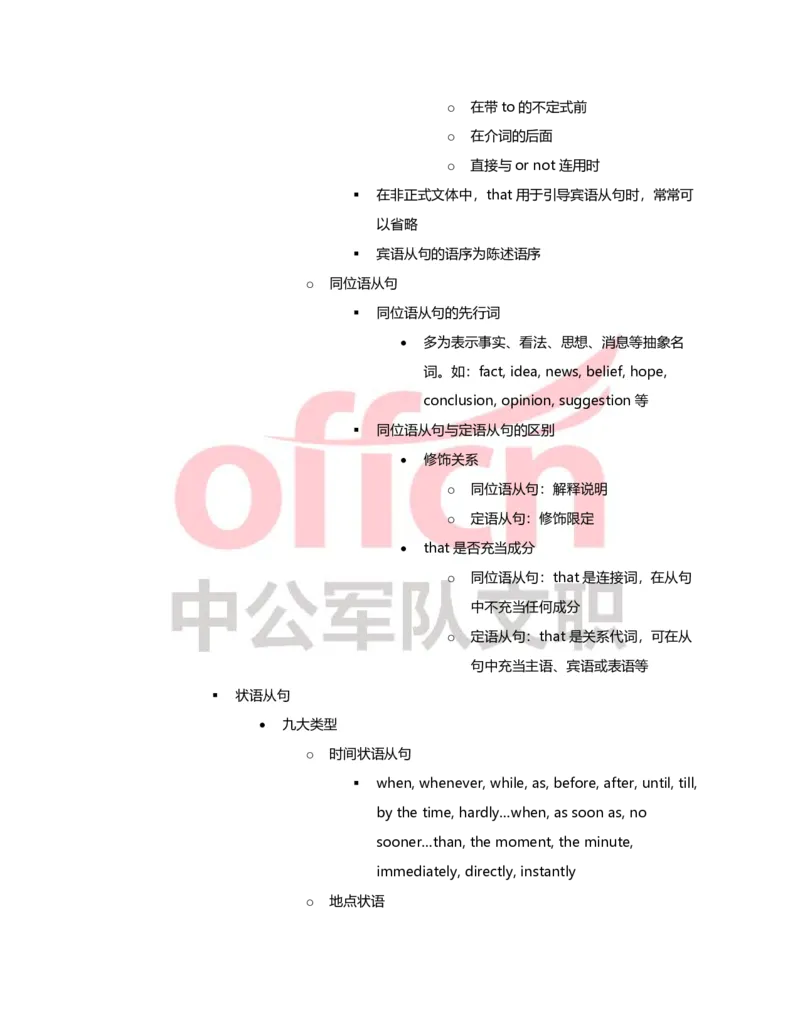
在特殊情况下只能用whether在带to的不定式前
o
在介词的后面
o
直接与or not连用时
o
在非正式文体中,that用于引导宾语从句时,常常可
以省略
宾语从句的语序为陈述语序
同位语从句
o
同位语从句的先行词
多为表示事实、看法、思想、消息等抽象名
词。如:fact, idea, news, belief, hope,
conclusion, opinion, suggestion等
同位语从句与定语从句的区别
修饰关系
同位语从句:解释说明
o
定语从句:修饰限定
o
that是否充当成分
同位语从句:that是连接词,在从句
o
中不充当任何成分
定语从句:that是关系代词,可在从
o
句中充当主语、宾语或表语等
状语从句
九大类型
时间状语从句
o
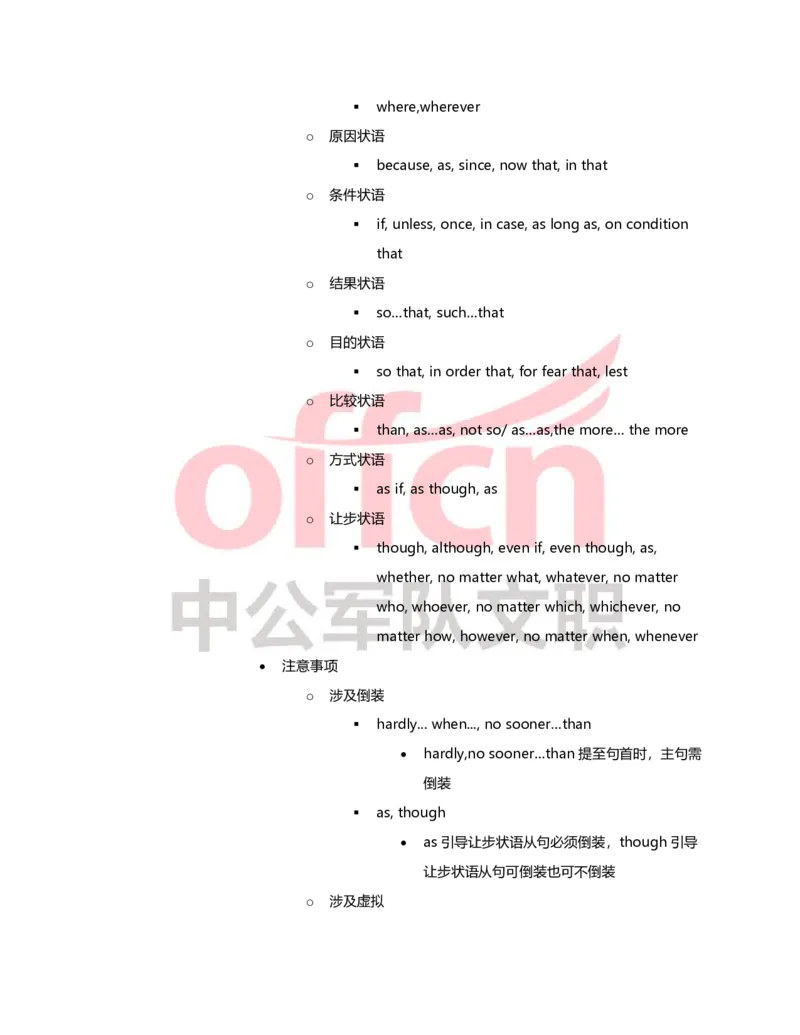
when, whenever, while, as, before, after, until, till,
by the time, hardly…when, as soon as, no
sooner…than, the moment, the minute,
immediately, directly, instantly
地点状语
o where,wherever
原因状语
o
because, as, since, now that, in that
条件状语
o
if, unless, once, in case, as long as, on condition
that
结果状语
o
so…that, such…that
目的状语
o
so that, in order that, for fear that, lest
比较状语
o
than, as…as, not so/ as…as,the more… the more
方式状语
o
as if, as though, as
让步状语
o
though, although, even if, even though, as,
whether, no matter what, whatever, no matter
who, whoever, no matter which, whichever, no
matter how, however, no matter when, whenever
注意事项
涉及倒装
o
hardly... when..., no sooner…than
hardly,no sooner…than提至句首时,主句需
倒装
as, though
as引导让步状语从句必须倒装,though引导
让步状语从句可倒装也可不倒装
涉及虚拟
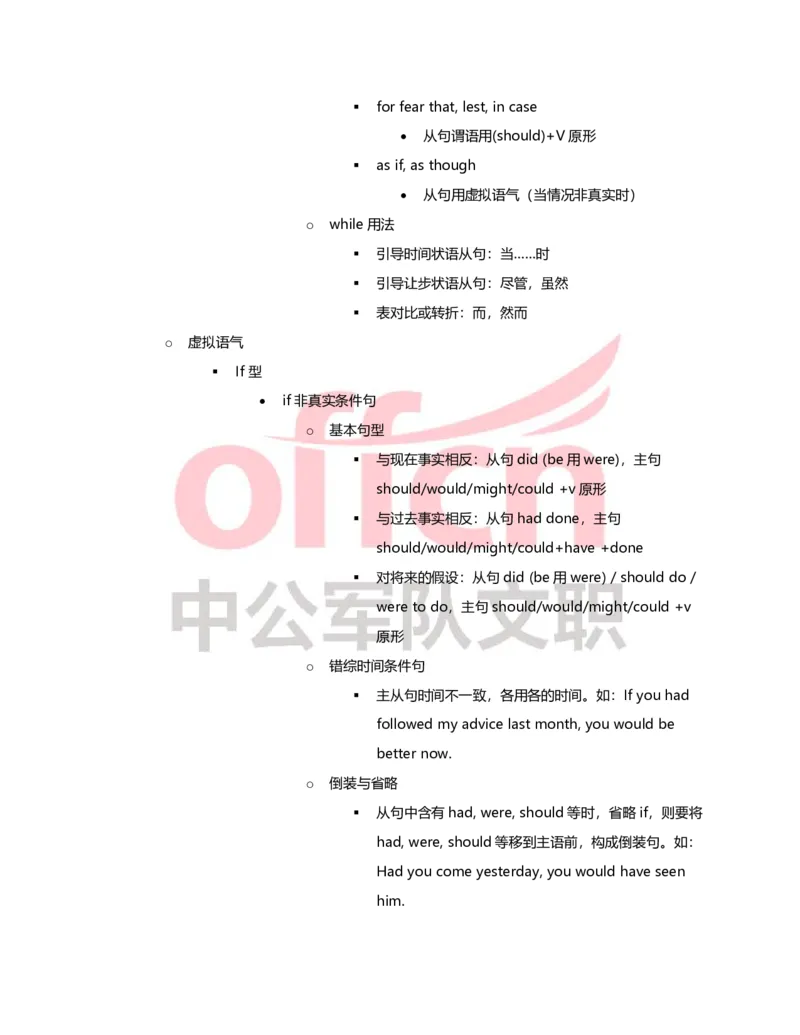
o for fear that, lest, in case
从句谓语用(should)+V原形
as if, as though
从句用虚拟语气(当情况非真实时)
while用法
o
引导时间状语从句:当……时
引导让步状语从句:尽管,虽然
表对比或转折:而,然而
虚拟语气
o
If 型
if非真实条件句
基本句型
o
与现在事实相反:从句did (be用were),主句
should/would/might/could +v原形
与过去事实相反:从句had done,主句
should/would/might/could+have +done
对将来的假设:从句did (be用were) / should do /
were to do,主句should/would/might/could +v
原形
错综时间条件句
o
主从句时间不一致,各用各的时间。如:If you had
followed my advice last month, you would be
better now.
倒装与省略
o
从句中含有had, were, should等时,省略if,则要将
had, were, should等移到主语前,构成倒装句。如:
Had you come yesterday, you would have seen
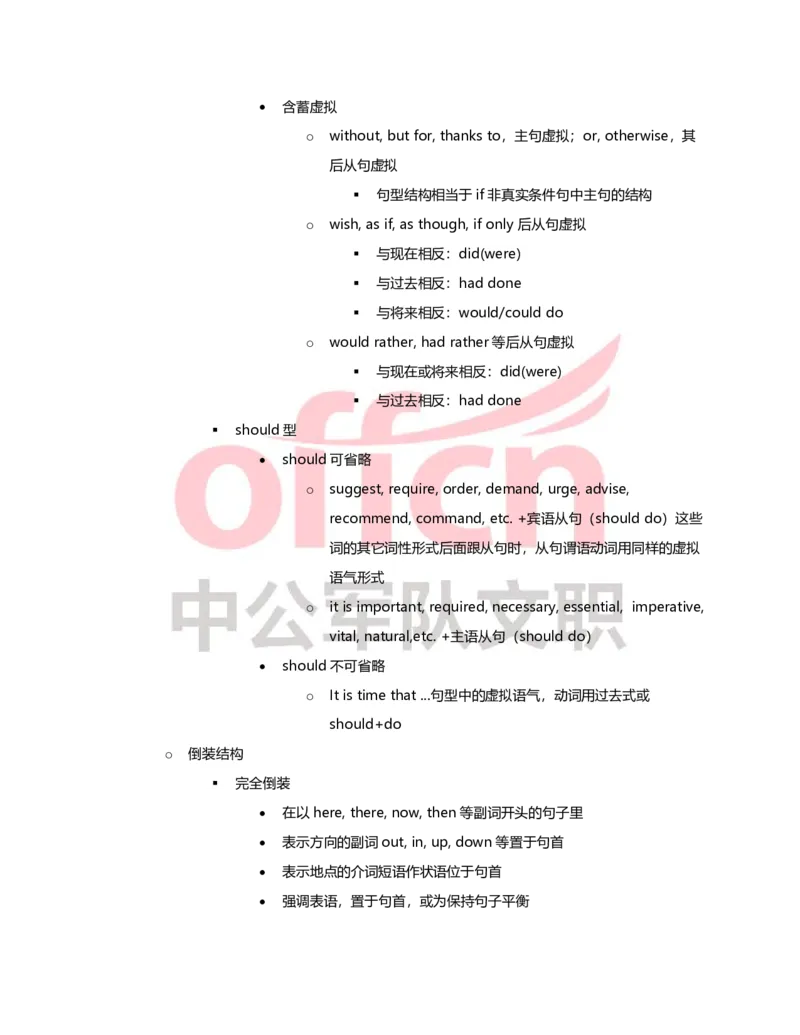
him. 含蓄虚拟
without, but for, thanks to,主句虚拟;or, otherwise,其
o
后从句虚拟
句型结构相当于if非真实条件句中主句的结构
wish, as if, as though, if only 后从句虚拟
o
与现在相反:did(were)
与过去相反:had done
与将来相反:would/could do
would rather, had rather等后从句虚拟
o
与现在或将来相反:did(were)
与过去相反:had done
should型
should可省略
suggest, require, order, demand, urge, advise,
o
recommend, command, etc. +宾语从句(should do)这些
词的其它词性形式后面跟从句时,从句谓语动词用同样的虚拟
语气形式
it is important, required, necessary, essential, imperative,
o
vital, natural,etc. +主语从句(should do)
should不可省略
It is time that ...句型中的虚拟语气,动词用过去式或
o
should+do
倒装结构
o
完全倒装
在以here, there, now, then等副词开头的句子里
表示方向的副词out, in, up, down等置于句首
表示地点的介词短语作状语位于句首
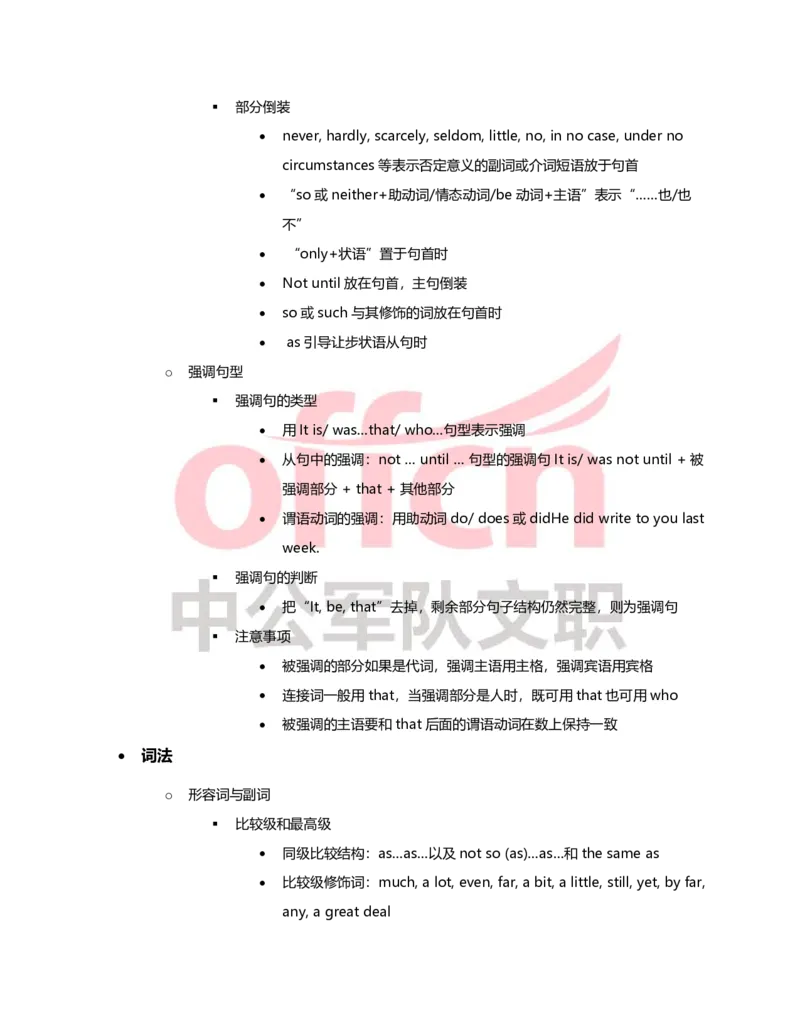
强调表语,置于句首,或为保持句子平衡 部分倒装
never, hardly, scarcely, seldom, little, no, in no case, under no
circumstances等表示否定意义的副词或介词短语放于句首
“so或neither+助动词/情态动词/be动词+主语”表示“……也/也
不”
“only+状语”置于句首时
Not until放在句首,主句倒装
so或such与其修饰的词放在句首时
as引导让步状语从句时
强调句型
o
强调句的类型
用It is/ was…that/ who…句型表示强调
从句中的强调:not … until … 句型的强调句It is/ was not until + 被
强调部分 + that + 其他部分
谓语动词的强调:用助动词do/ does或didHe did write to you last
week.
强调句的判断
把“It, be, that”去掉,剩余部分句子结构仍然完整,则为强调句
注意事项
被强调的部分如果是代词,强调主语用主格,强调宾语用宾格
连接词一般用that,当强调部分是人时,既可用that也可用who
被强调的主语要和that后面的谓语动词在数上保持一致
词法
形容词与副词
o
比较级和最高级
同级比较结构:as…as…以及not so (as)…as…和the same as
比较级修饰词:much, a lot, even, far, a bit, a little, still, yet, by far,
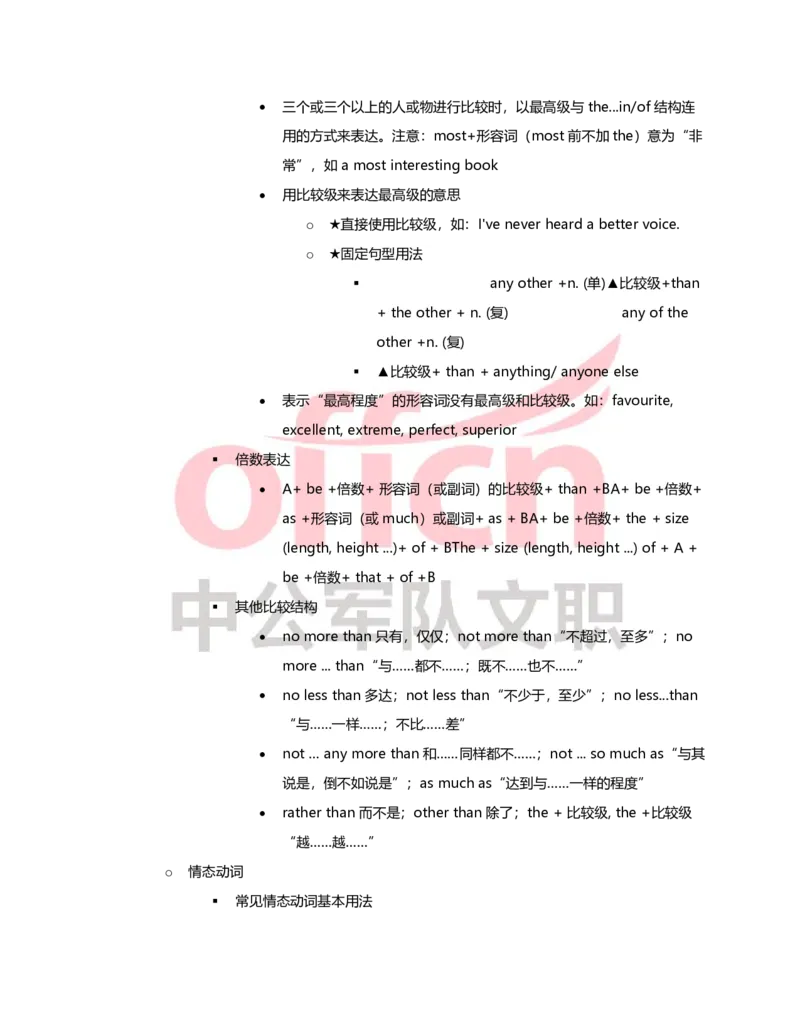
any, a great deal 三个或三个以上的人或物进行比较时,以最高级与the...in/of结构连
用的方式来表达。注意:most+形容词(most前不加the)意为“非
常”,如 a most interesting book
用比较级来表达最高级的意思
★直接使用比较级,如:I've never heard a better voice.
o
★固定句型用法
o
any other +n. (单)▲比较级+than
+ the other + n. (复) any of the
other +n. (复)
▲比较级+ than + anything/ anyone else
表示“最高程度”的形容词没有最高级和比较级。如:favourite,
excellent, extreme, perfect, superior
倍数表达
A+ be +倍数+ 形容词(或副词)的比较级+ than +BA+ be +倍数+
as +形容词(或much)或副词+ as + BA+ be +倍数+ the + size
(length, height ...)+ of + BThe + size (length, height ...) of + A +
be +倍数+ that + of +B
其他比较结构
no more than只有,仅仅;not more than“不超过,至多”;no
more ... than“与……都不……;既不……也不……”
no less than多达;not less than“不少于,至少”;no less...than
“与……一样……;不比……差”
not … any more than和……同样都不……;not ... so much as“与其
说是,倒不如说是”;as much as“达到与……一样的程度”
rather than而不是;other than除了;the + 比较级, the +比较级
“越……越……”
情态动词
o
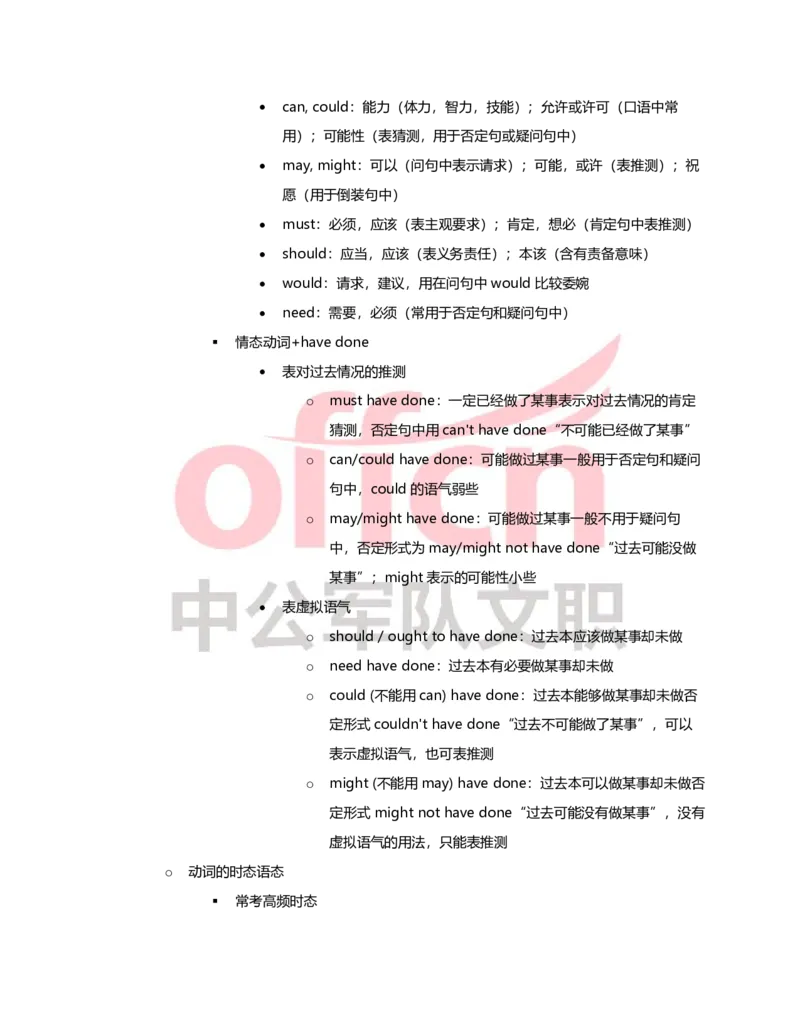
常见情态动词基本用法 can, could:能力(体力,智力,技能);允许或许可(口语中常
用);可能性(表猜测,用于否定句或疑问句中)
may, might:可以(问句中表示请求);可能,或许(表推测);祝
愿(用于倒装句中)
must:必须,应该(表主观要求);肯定,想必(肯定句中表推测)
should:应当,应该(表义务责任);本该(含有责备意味)
would:请求,建议,用在问句中would比较委婉
need:需要,必须(常用于否定句和疑问句中)
情态动词+have done
表对过去情况的推测
must have done:一定已经做了某事表示对过去情况的肯定
o
猜测,否定句中用can't have done“不可能已经做了某事”
can/could have done:可能做过某事一般用于否定句和疑问
o
句中,could的语气弱些
may/might have done:可能做过某事一般不用于疑问句
o
中,否定形式为may/might not have done“过去可能没做
某事”;might表示的可能性小些
表虚拟语气
should / ought to have done:过去本应该做某事却未做
o
need have done:过去本有必要做某事却未做
o
could (不能用can) have done:过去本能够做某事却未做否
o
定形式couldn't have done“过去不可能做了某事”,可以
表示虚拟语气,也可表推测
might (不能用may) have done:过去本可以做某事却未做否
o
定形式 might not have done“过去可能没有做某事”,没有
虚拟语气的用法,只能表推测
动词的时态语态
o
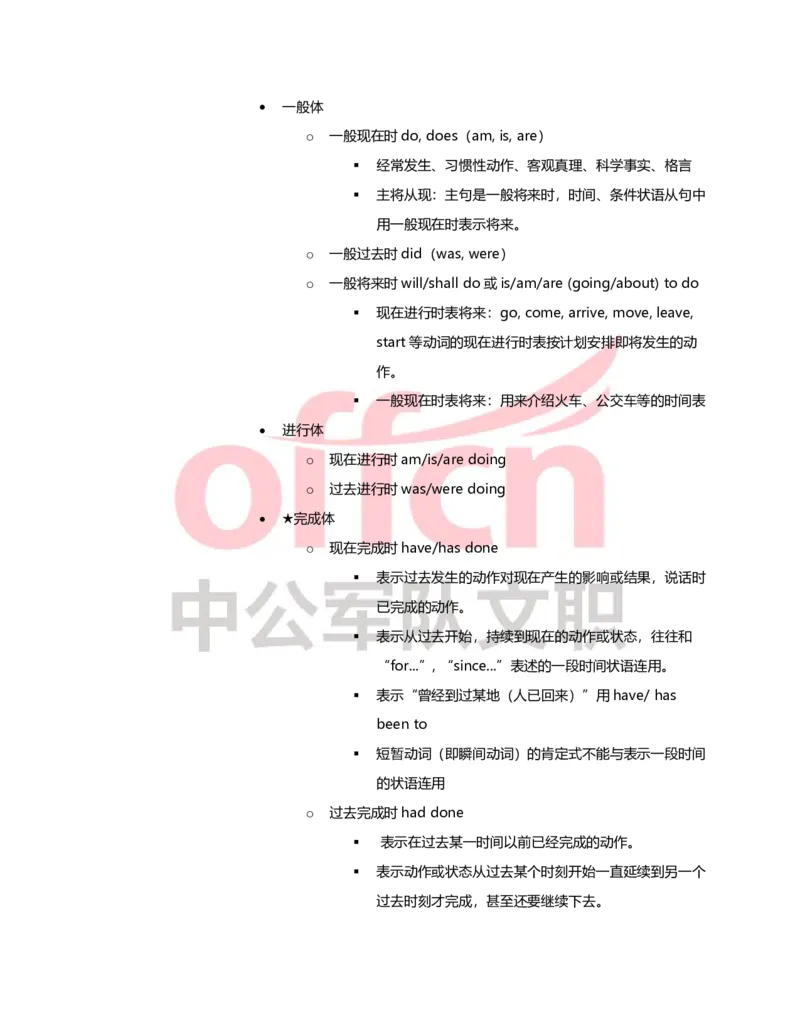
常考高频时态 一般体
一般现在时do, does(am, is, are)
o
经常发生、习惯性动作、客观真理、科学事实、格言
主将从现:主句是一般将来时,时间、条件状语从句中
用一般现在时表示将来。
一般过去时did(was, were)
o
一般将来时will/shall do或is/am/are (going/about) to do
o
现在进行时表将来:go, come, arrive, move, leave,
start等动词的现在进行时表按计划安排即将发生的动
作。
一般现在时表将来:用来介绍火车、公交车等的时间表
进行体
现在进行时am/is/are doing
o
过去进行时was/were doing
o
★完成体
现在完成时have/has done
o
表示过去发生的动作对现在产生的影响或结果,说话时
已完成的动作。
表示从过去开始,持续到现在的动作或状态,往往和
“for...”, “since...”表述的一段时间状语连用。
表示“曾经到过某地(人已回来)”用have/ has
been to
短暂动词(即瞬间动词)的肯定式不能与表示一段时间
的状语连用
过去完成时had done
o
表示在过去某一时间以前已经完成的动作。
表示动作或状态从过去某个时刻开始一直延续到另一个
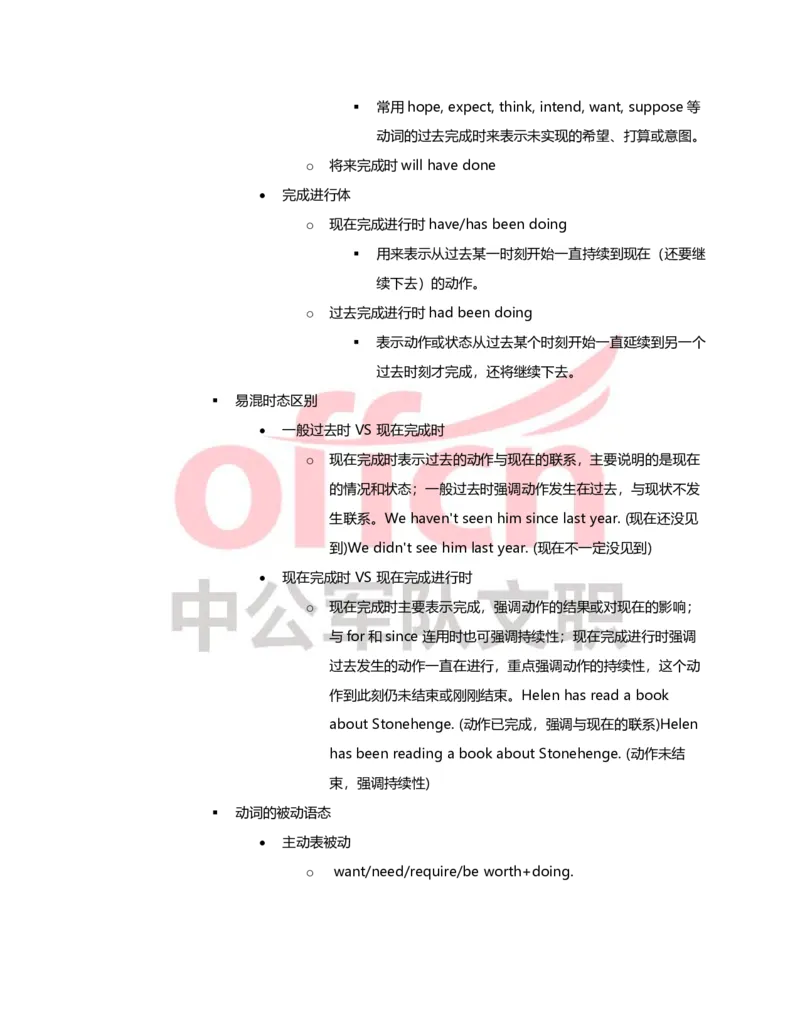
过去时刻才完成,甚至还要继续下去。 常用hope, expect, think, intend, want, suppose等
动词的过去完成时来表示未实现的希望、打算或意图。
将来完成时will have done
o
完成进行体
现在完成进行时have/has been doing
o
用来表示从过去某一时刻开始一直持续到现在(还要继
续下去)的动作。
过去完成进行时had been doing
o
表示动作或状态从过去某个时刻开始一直延续到另一个
过去时刻才完成,还将继续下去。
易混时态区别
一般过去时 VS 现在完成时
现在完成时表示过去的动作与现在的联系,主要说明的是现在
o
的情况和状态;一般过去时强调动作发生在过去,与现状不发
生联系。We haven't seen him since last year. (现在还没见
到)We didn't see him last year. (现在不一定没见到)
现在完成时 VS 现在完成进行时
现在完成时主要表示完成,强调动作的结果或对现在的影响;
o
与for和since连用时也可强调持续性;现在完成进行时强调
过去发生的动作一直在进行,重点强调动作的持续性,这个动
作到此刻仍未结束或刚刚结束。Helen has read a book
about Stonehenge. (动作已完成,强调与现在的联系)Helen
has been reading a book about Stonehenge. (动作未结
束,强调持续性)
动词的被动语态
主动表被动
want/need/require/be worth+doing.
ocut, sell, read, write, fill, cook, lock, wash等动词在表示主语
o
的内在品质或性能时,用主动表被动,不能变为被动。
感官动词:look, smell, taste, sound, feel, 及系动词remain,
o
prove, turn out等。
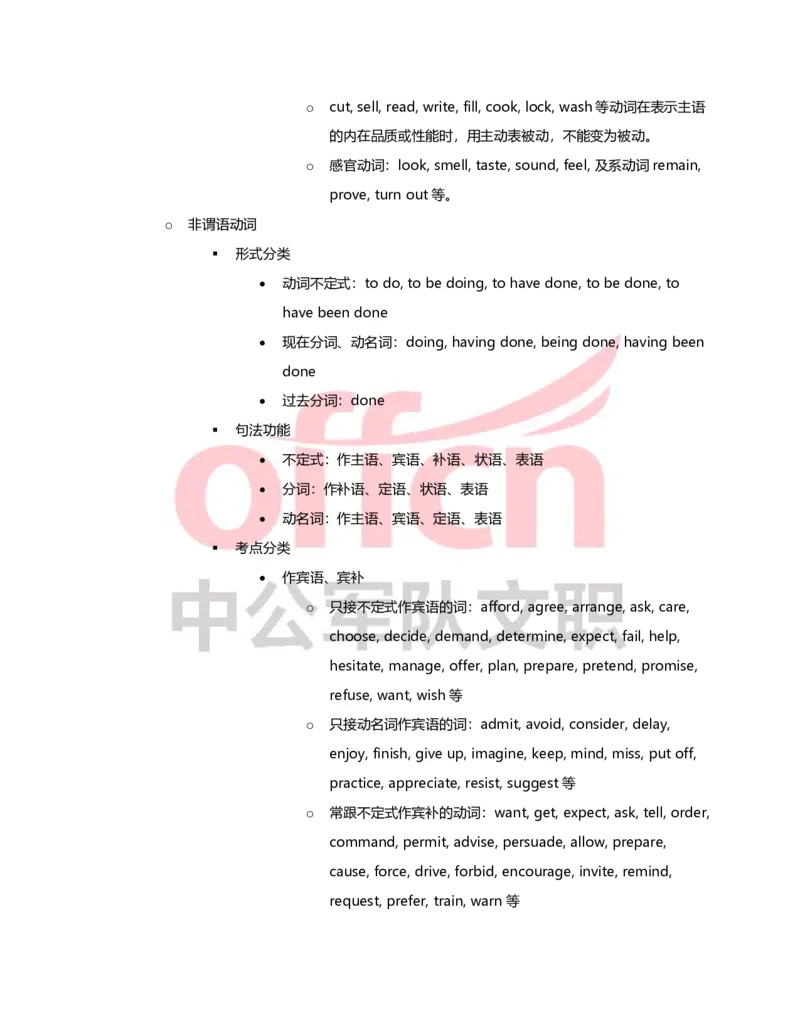
非谓语动词
o
形式分类
动词不定式:to do, to be doing, to have done, to be done, to
have been done
现在分词、动名词:doing, having done, being done, having been
done
过去分词:done
句法功能
不定式:作主语、宾语、补语、状语、表语
分词:作补语、定语、状语、表语
动名词:作主语、宾语、定语、表语
考点分类
作宾语、宾补
只接不定式作宾语的词:afford, agree, arrange, ask, care,
o
choose, decide, demand, determine, expect, fail, help,
hesitate, manage, offer, plan, prepare, pretend, promise,
refuse, want, wish等
只接动名词作宾语的词:admit, avoid, consider, delay,
o
enjoy, finish, give up, imagine, keep, mind, miss, put off,
practice, appreciate, resist, suggest等
常跟不定式作宾补的动词:want, get, expect, ask, tell, order,
o
command, permit, advise, persuade, allow, prepare,
cause, force, drive, forbid, encourage, invite, remind,
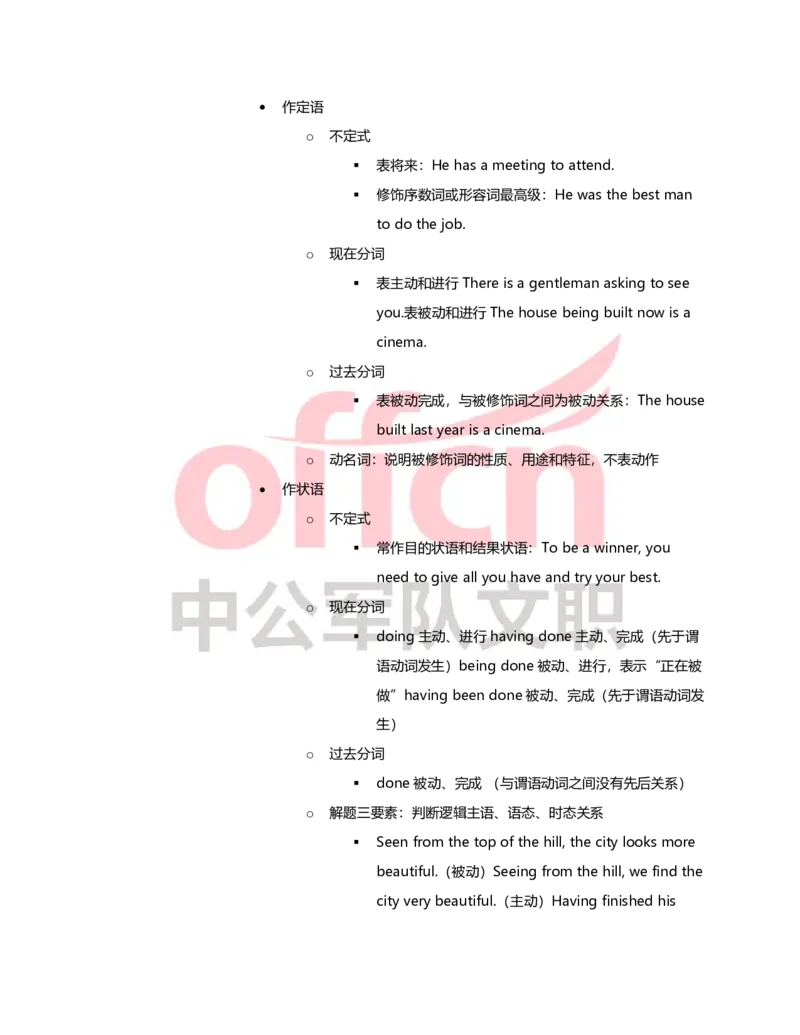
request, prefer, train, warn等 作定语
不定式
o
表将来:He has a meeting to attend.
修饰序数词或形容词最高级:He was the best man
to do the job.
现在分词
o
表主动和进行There is a gentleman asking to see
you.表被动和进行The house being built now is a
cinema.
过去分词
o
表被动完成,与被修饰词之间为被动关系:The house
built last year is a cinema.
动名词:说明被修饰词的性质、用途和特征,不表动作
o
作状语
不定式
o
常作目的状语和结果状语:To be a winner, you
need to give all you have and try your best.
现在分词
o
doing主动、进行having done主动、完成(先于谓
语动词发生)being done被动、进行,表示“正在被
做”having been done被动、完成(先于谓语动词发
生)
过去分词
o
done被动、完成 (与谓语动词之间没有先后关系)
解题三要素:判断逻辑主语、语态、时态关系
o
Seen from the top of the hill, the city looks more
beautiful.(被动)Seeing from the hill, we find the
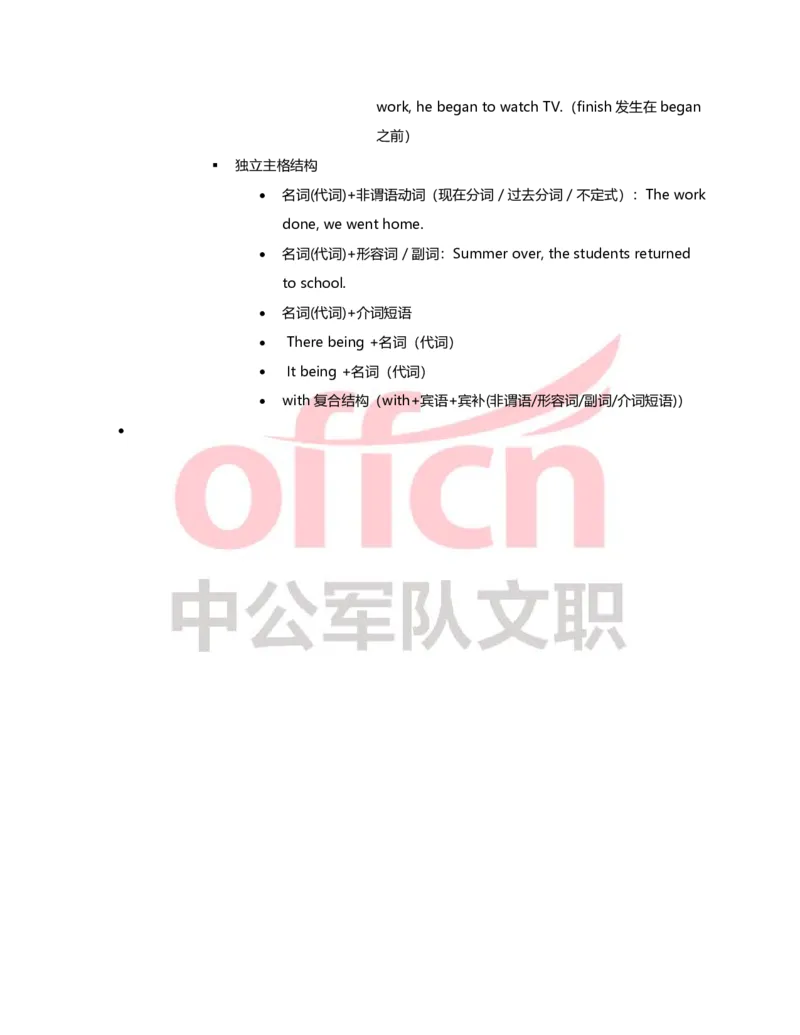
city very beautiful.(主动)Having finished hiswork, he began to watch TV.(finish发生在began
之前)
独立主格结构
名词(代词)+非谓语动词(现在分词 / 过去分词 / 不定式):The work
done, we went home.
名词(代词)+形容词 / 副词:Summer over, the students returned
to school.
名词(代词)+介词短语
There being +名词(代词)
It being +名词(代词)
with复合结构(with+宾语+宾补(非谓语/形容词/副词/介词短语))