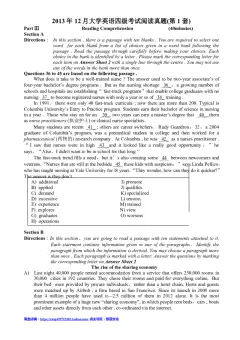
2013年6月大学英语四级考试阅读真题(第1套)
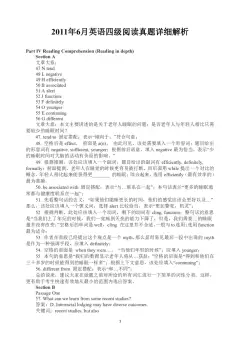
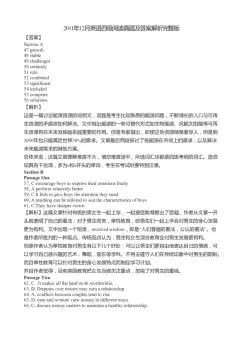
PartIV Reading Comprehension (Reading inDepth) (25 minutes)
SectionA
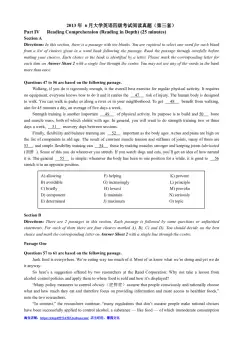
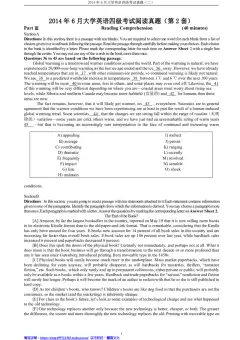
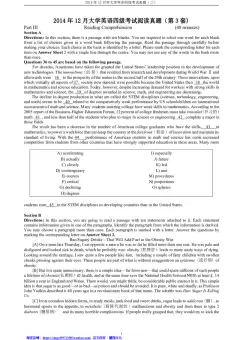
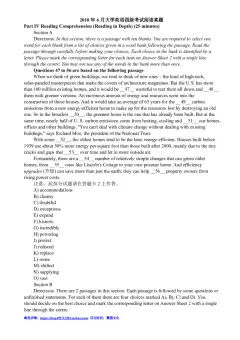
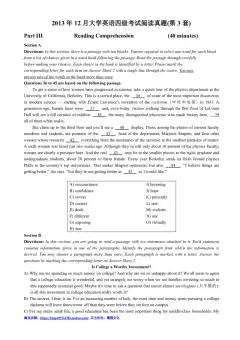
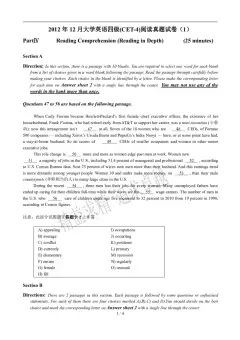
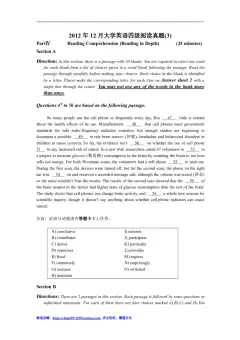
Directions: In this section, there is a passage with ten blanks. You are required to select one word
for each blank from a list of choices given in a word bank following the passage. Read the passage
through carefully before making your choices. Each choice in the bank is identified by a letter.
Please mark the corresponding letter for each item on Answer Sheet 2 with a single line through
thecentre. Youmaynot useanyofthewordsin thebankmorethanonce.
Questions47to 56arebased onthefollowing passage.
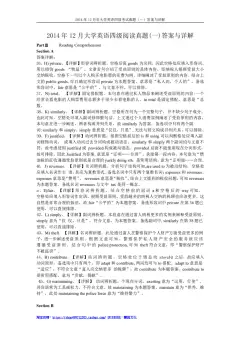
Just when you had figured out how to manage fat in your diet, researchers are now warning
against another common mealtimepitfall(陷阱)—salt.
A study by researchers at the University of California, San Francisco (UCSF), Stanford
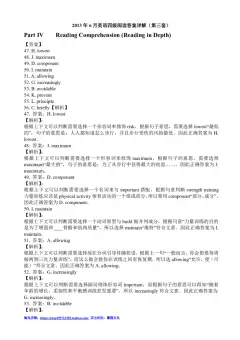
University and Columbia University shows that even a 47 decrease in daily salt intake (摄入)
can lead to dramatic health benefits. The authors 48 an annual drop of as many as 120,000 cases
of heart disease, 66,000 49 of stroke and 99,000 heart attacks 50 by high blood pressure
after a3-g-per-day reduction in salt.
The advantages, not surprisingly, were greater for African Americans, who are more likely to
51 high blood pressure than other ethnic groups, and for the elderly, since blood vessels stiffen
withage, which can lead tohigher blood pressure.
“Everyone in the U.S. is consuming salt far in 52 of what is good for them,” says lead
author Dr. Kirsten Bibbins-Domingo of UCSF. “What we are suggesting is that a population-wide
effort to reduce salt intake, even 53 ,willhave health benefits. ”
The team conducted a computer-based analysis to determine the 54 of a 3-g-per-day
reduction in salt intake on rates of heart disease and death. They also calculated the cost savings
emerging from the amount of disease that would be 55 because of lower blood pressure. The
conclusion: by cutting salt intake nationwide, the U.S. could save $10 billion to $24 billion 56
inhealth care costs.
注意:此部分试题请在答题卡2上作答。
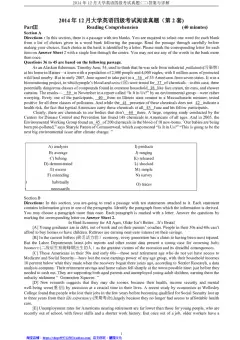
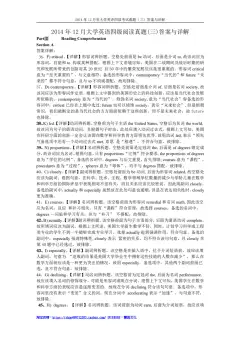
A)accidents F)develop K)instances
B) annually G)documented L) modest
C)avoided H)dramatically M)revised
D)caused I)excess N)slightly
E)considerable J) impact O)undertake
SectionB
Directions: There are 2 passages in this section. Each passage is followed by some questions or
unfinished statements. For each of them there are four choices marked A), B), C) and D). You
should decide on the best choice and mark the corresponding letter on Answer Sheet 2 with a
singlelinethrough thecentre.
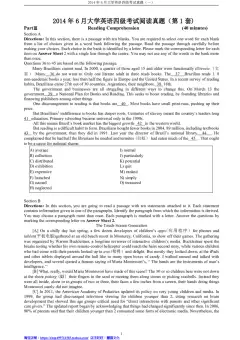
Passage One
Questions57to 61arebased onthefollowing passage.
The Gatais used to frown when they received power bills that routinely topped $200. Last
September the couple moved into a 1,500-square-foot home in Premier Gardens, a subdivision of
95 “zero-energy homes” (ZEH) just outside town. Now they’re actually eager to see their electricity
bills. The grand total over the 10 months they’ve lived in the three-bedroom house: $75. For the
淘宝店铺:https://shop499712503.taobao.com/ 店主旺旺:慧园文化pasttwo months they haven’tpaid acent.
ZEH communities are the leading edge of technologies that might someday create houses that
produce as much energy as they consume. Premier Gardens is one of a half-dozen subdivisions in
California where every home cuts power consumption by 50%, mostly by using low-power
appliances and solarpanels.
Aside from the panels on the roof, Premier Gardens looks like a community of conventional
homes. But inside, special windows cut power bills by blocking solar heat in summer and retaining
indoorwarmth in winter.
The rest of the energy savings comes from the solar units. They don’t just feed the home they
serve. If they generate more power than the home is using, the excess flows into the utility’s power
grid (电网). The residents are billed by “net metering”: they pay for the amount of power they tap
off the grid, less the kilowatts (千瓦) they feed into it. If a home generates more power than it uses,
thebillis zero.
That sounds like a bad deal for the power company, but it’s not. Solar homes produce the most
power on the hot sunny afternoons when everyone rushes home to turn up the air conditioner. “It
helps us lower usage at peak power times,” says solar expert Mike Keesee. “That lets us avoid
buildingcostly plantsor buying expensivepower at peak usage time.”
What’s not to like? Mostly the costs. The special features can add $25,000 or more to the
purchase price of a house. Tax breaks bring the cost down, especially in California, but in many
states ZEHs can be prohibitively expensive. For the consumer, it’s a matter of paying now for the
hardwareto save later ontheutilities.
注意:此部分试题请在答题卡2上作答。
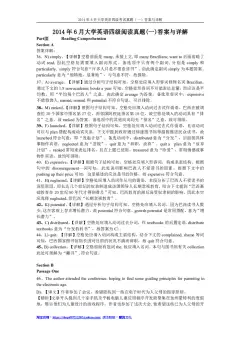
57.Why are theGatais eager tosee theirelectricity billsnow?
A)They want tosee howmuch they havesaved.
B)They want tocut down theirutility expenses.
C)They want toknow ifthey are ableto pay.
D)They want toavoid being overcharged.
58.What is special about theZEHcommunities?
A)They have created cutting-edge technologies.
B)They aim tobeself-sufficient inpower supply.
C)They are subdivided into halfa dozensections.
D)They are builtin harmony with theenvironment.
59. Howare theresidents intheZEH communities billedfor electricityuse?
A)They are only charged fortheamount of power they consumeonrainy days.
B)They needn’t pay a singlecent for theirpower consumptiononsunny days.
C)They onlypay forthe excess power that flows intotheutility’s power grid.
D)They pay fortheelectricity from the grid less theirhome-generated power.
60.What does the“net metering”practice mean to thepower company?
A) Morepressure at peak time. C)Increased electricityoutput.
B) Less profits intheshort term. D)Reduced operational costs.
61.Theauthorbelieves that buying ahouse ina ZEHcommunity____________.
A) isbut adream for average consumers
B) gives theowner substantial tax benefits
C)is aworthy investment in thelong run
D) contributes to environmental protection
PassageTwo
淘宝店铺:https://shop499712503.taobao.com/ 店主旺旺:慧园文化Questions62to 66arebased onthefollowing passage.
Romantic love has clear evolutionary roots but our views about what makes an ideal
romantic relationship can be swayed by the society we live in. So says psychologist Maureen
O’Sullivan from the University of San Francisco. She suggests that humans have always tried to
strengthen thepair-bond to maximise(使最大化)reproductivesuccess.
Many societies throughout history and around the world today have cultivated strong
pressures to stay married. In those where ties to family and community are strong, lifelong
marriages can be promoted by practices such as the cultural prohibition of divorce and arranged
marriages that are seen as a contract between two families, not just two individuals. In modern
western societies, however, the focus on individuality and independence means that people are less
concerned about conforming to (遵守) the dictates of family and culture. In the absence of societal
pressures to maintain pair-bonds, O’Sullivan suggests that romantic love has increasingly come to
be seen as the factor that should determine who we stay with and for how long. “That’s why
historically we see an increase in romantic love as a basis for forming long-term relationships,” she
says.
According to O’Sullivan culture also shapes the sorts of feelings we expect to have, and
actually do experience, when in love. Although the negative emotions associated with romantic
love—fear of loss, disappointment and jealousy—are fairly consistent across cultures, the positive
feelings can vary. “If you ask Japanese students to list the positive attributes they expect in a
romantic partner, they rate highly things like loyalty, commitment and devotion,” says O’Sullivan.
“If you ask American college women, they expect everything under the sun: in addition to being
committed, partners have tobeamusing, funny and afriend.”
We judge a potential partner according to our specific cultural expectations about what
romantic love should feel like. If you believe that you have found true romance, and your culture
tells you that this is what a long-term relationship should be based on, there is less need to rely on
social orfamily pressures to keep couples together,O’Sullivan argues.
注意:此部分试题请在答题卡 2上作答。
62.What does theauthorsay about people’s views ofan ideal romantic relationship?
A)They vary from culture toculture.
B)They ensure thereproductive success.
C)They reflect theevolutionary process.
D)They are influenced bypsychologists.
63.Wecan infer from the passagethat strong family and communityties .
A) largely rely onmarriage contracts
B) can contribute tostable marriages
C)often run counter toromanticlove
D)makedivorces virtually unacceptable
64.Withoutsocial pressures to keep pair-bonds, romanticlove .
A) willbea substitutefor marriage in human relationships
B) plays a key role in maintaininglong-term relationships
C)islikely to replace the dictates offamily and society
D)is away todevelop individualityand independence
65. O’Sullivan believes that when peoplefrom different cultures fallin love, .
A) they expect different things from theirpartner
B) they tend to exaggerate each other’spositivequalities
C)they often fail to see each other’s negativequalities
D)they lay more emphasis oncommitment and devotion
淘宝店铺:https://shop499712503.taobao.com/ 店主旺旺:慧园文化66.Wecan conclude from thepassagethat .
A) cultural differences often tear apart afamily builtonromantic love
B) marriages are hard tosustain without social orfamily pressures
C)romanticloveis becoming increasingly importantin family relationships
D)romanticlove tends toyield where family orsocial pressures are strong
淘宝店铺:https://shop499712503.taobao.com/ 店主旺旺:慧园文化