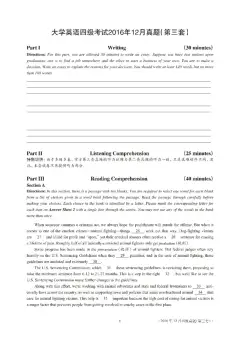
大学英语四级考试2016 年12 月真题(第一套)
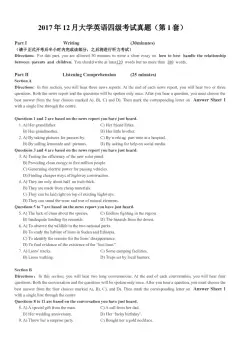
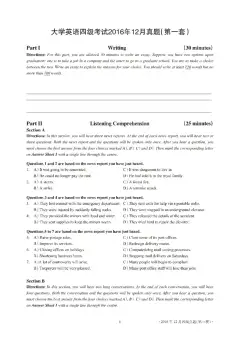
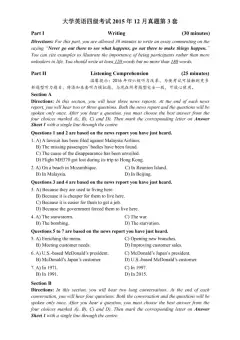
Part I Writing (30 minutes)
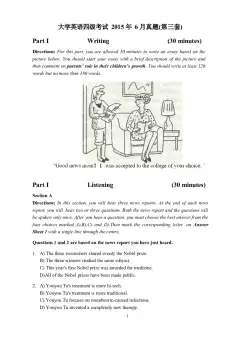
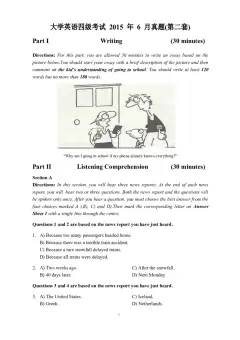
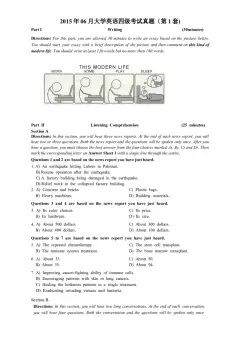
Directions: For this part, you are allowed 30 minutes to write an essay. Suppose you have two options upon graduation: one
is to take a job in a company and the other to go to a graduate school. You are to make a choice between the two. Write an
essay to explain the reasons for your choice. You should write at least 120 words but no more than 180 words.
Part II Listening Comprehension (25 minutes)
Section A
Directions: In this section, you will hear three news reports. At the end of each news report, you will hear two or three
questions. Both the news report and the questions will be spoken only once. After you hear a question, you must choose the
best answer from the four choices marked A), B), C) and D). Then mark the corresponding letter on Answer Sheet 1 with a
single line through the centre.
Questions 1 and 2 are based on the news report you have just heard.
1. A) It was going to be renovated. C) It was dangerous to live in.
B) He could no longer pay the rent. D) He had sold it to the royal family.
2. A) A storm. C) A forest fire.
B) A strike. D) A terrorist attack.
Questions 3 and 4 are based on the news report you have just heard.
3. A) They lost contact with the emergency department. C) They sent calls for help via a portable radio.
B) They were injured by suddenly falling rocks. D) They were trapped in an underground elevator.
4. A) They provided the miners with food and water. C) They released the details of the accident.
B) They sent supplies to keep the miners warm. D) They tried hard to repair the elevator.
Questions 5 to 7 are based on the news report you have just heard.
5. A) Raise postage rates. C) Close some of its post offices.
B) Improve its services. D) Redesign delivery routes.
6. A) Closing offices on holidays. C) Computerizing mail sorting processes.
B) Shortening business hours. D) Stopping mail delivery on Saturdays.
7. A )A lot of controversy will arise. C) Many people will begin to complain.
B) Taxpayers will be very pleased. D) Many post office staff will lose their jobs.
Section B
Directions: In this section, you will hear two long conversations. At the end of each conversation, you will hear four
questions. Both the conversation and the questions will be spoken only once. After you hear a question, you must choose the
best answer from the four choices marked A), B), C) and D). Then mark the corresponding letter on Answer Sheet 1 with a
single line through the centre.
1 •2016年12月四级真题(第一套),Questions 8 to 11 are based on the conversation you have just heard.
8. A) He will lose part of his pay. C) He will be given a warning.
B) He will go through retraining. D) He will be kept from promotion.
9. A) He is an experienced press operator. C) He is always on time.
B) He is a trustworthy guy. D) He is on good terms with his workmates.
10. A) She is a trade union representative. C) She is better at handling such matters.
B) She is a senior manager of the shop. D) She is in charge of public relations.
11. A) He is always trying to stir up trouble. C) He is very close to the manager.
B) He is skilled and experienced. D) He is always complaining about low wages.
Questions 12 to 15 are based on the conversation you have just heard.
12. A)Open. C) Selfish.
B) Reserved. D) Friendly.
13. A)They read a book. C) They stay quiet.
B) They talk about the weather. D) They chat with fellow passengers.
14. A)She was unwilling to make friends with workmates. C) She was eager to visit an English castle.
B) She was never invited to a colleague's home. D) She was always treated as a foreigner.
15. A)Houses are much more quiet. C) They want a garden of their own.
B) They want to have more space. D) Houses provide more privacy.
Section C
Directions: In this section, you will hear three passages. At the end of each passage, you will hear three or four questions.
Both the passage and the questions will be spoken only once. After you hear a question, you must choose the best answer
from the four choices marked A), B), C) and D). Then mark the corresponding letter on Answer Sheet 1 with a single line
through the centre.
Questions 16 to 18 are based on the passage you have just heard.
16. A) They will automatically be given hiring priority. C) They are likely to get much higher pay.
B) They don't have to go through job interviews. D) They don't have much choice of jobs.
17. A) Visit the school careers service. C) Look at school bulletin boards.
B) Ask their professors for help. D) Go through campus newspapers.
18. A) Providing students with information about the library.
B) Helping students arrange appointments with librarians.
C) Supervising study spaces to ensure a quiet atmosphere.
D) Helping students find the books and journals they need.
Questions 19 to 21 are based on the passage you have just heard.
19. A) It tastes better. C) It is easier to grow.
B) It may be sold at a higher price. D) It can better survive extreme weathers.
20. A) It can grow in drier soil. C) It will replace green tea one day.
B) It is immune to various diseases. D) It is healthier than green tea.
21. A) It does not have a stable market. C) It does not bring the promised health benefits.
B) It has made tea farmers5 life easier. D) It has been well received by many tea drinkers.
Questions 22 to 25 are based on the passage you have just heard.
22. A) They care more about environment. C) They prefer unique objects of high quality.
B) They decorate their homes themselves. D) They need decorations to show their status.
• 2016年12月四级真题(第一套)• 223. A) They made great contributions to society. C) They were proud of their creations.
B) They could only try to create at night. D) They focused on the quality of their products.
24. A) Identify fake crafts. C) Design handicrafts themselves.
B) Make wise choices. D) Learn the importance of creation.
C) To arouse public interest in crafts.
25. A) To attract foreign investments.
D) To boost the local economy.
B) To preserve the traditional culture.
Part III Reading Comprehension (40 minutes)
Section A
Directions: In this section, there is a passage with ten blanks. You are required to select one word for each blank from a
list of choices given in a word bank following the passage. Read the passage through carefully before making your choices.
Each choice in the bank is identified by a letter. Please mark the corresponding letter for each item on Answer Sheet 2 with
a single line through the centre. You may not use any of the words in the bank more than once.
Many men and women have long bought into the idea that there are “male” and “female” brains, believing that
explains just about every difference between the sexes. A new study 26 that belief questioning whether brains really can
be distinguished by gender.
In the study, Tel Aviv University researchers 27 for sex differences throughout the entire human brain.
And what did they find? Not much. Rather than offer evidence for 28 brains as “male” or “female,” research shows
that brains fall into a wide range, with most people falling right in the middle.
Daphna Joel, who led the study, said her research found that while there are some gender-based 29 , many different
types of brain can't always be distinguished by gender.
While the “average” male and “average” female brains were 30 different, you couldn't tell it by looking at individual
brain scans. Only a small 31 of people had “all-male“ or “all-female” characteristics.
Larry Cahill, an American neuroscientist (神经科学家),said the study is an important addition to a growing body
of research questioning 32 beliefs about gender and brain function. But he cautioned against concluding from this study
that all brains are the same, 33 of gender.
“There's a mountain of evidence 34 the importance of sex influences at all levels of brain function,n he told The
Seattle Times.
If anything, he said, the study 35 that gender plays a very important role in the brain一"even when we are not clear
exactly how.”
A) abnormal I) regardless
B) applied J) searched
C) briefly K) similarities
D) categorizing L) slightly
E) challenges M) suggests
F) figure N) tastes
G) percentage O) traditional
H) proving
Section B
Directions: In this section, you are going to read a passage with ten statements attached to it. Each statement contains
information given in one of the paragraphs. Identify the paragraph from which the information is derived. You may choose
a paragraph more than once. Each paragraph is marked with a letter. Answer the questions by marking the corresponding
letter on Answer Sheet 2.
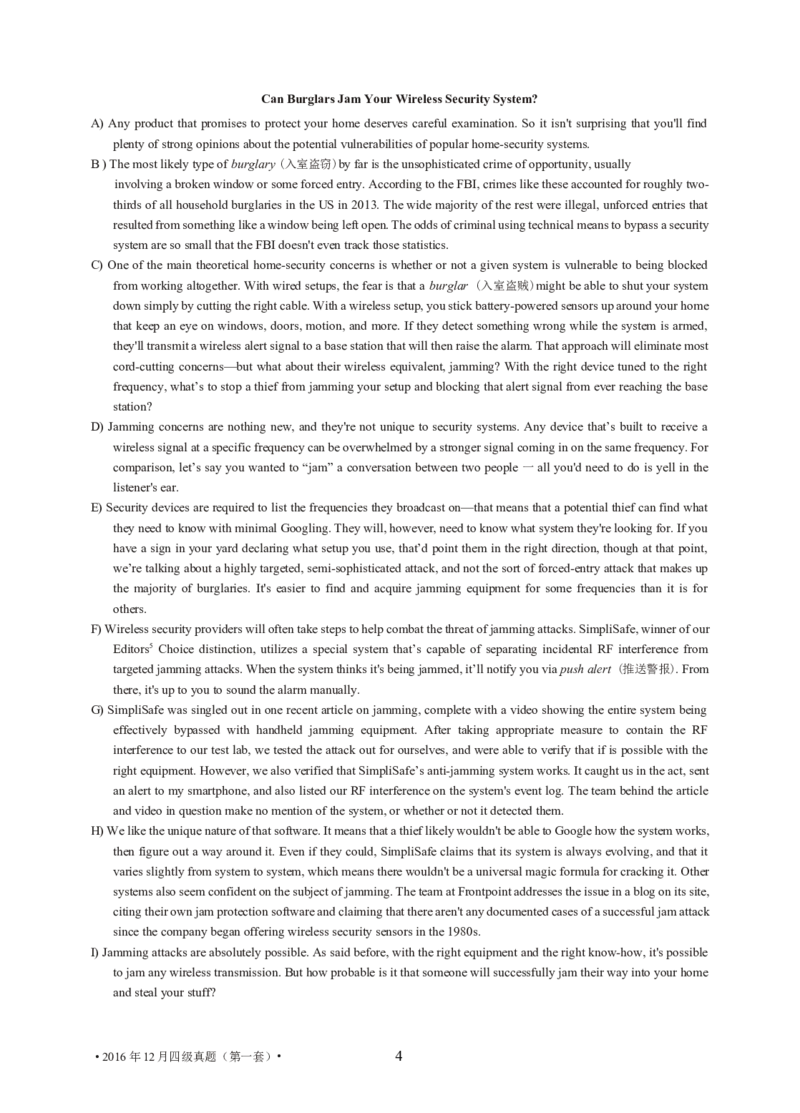
3 •2016年12月四级真题(第一套),Can Burglars Jam Your Wireless Security System?
A) Any product that promises to protect your home deserves careful examination. So it isn't surprising that you'll find
plenty of strong opinions about the potential vulnerabilities of popular home-security systems.
B ) The most likely type of burglary (入室盗窃)by far is the unsophisticated crime of opportunity, usually
involving a broken window or some forced entry. According to the FBI, crimes like these accounted for roughly two-
thirds of all household burglaries in the US in 2013. The wide majority of the rest were illegal, unforced entries that
resulted from something like a window being left open. The odds of criminal using technical means to bypass a security
system are so small that the FBI doesn't even track those statistics.
C) One of the main theoretical home-security concerns is whether or not a given system is vulnerable to being blocked
from working altogether. With wired setups, the fear is that a burglar (入室盗贼)might be able to shut your system
down simply by cutting the right cable. With a wireless setup, you stick battery-powered sensors up around your home
that keep an eye on windows, doors, motion, and more. If they detect something wrong while the system is armed,
they'll transmit a wireless alert signal to a base station that will then raise the alarm. That approach will eliminate most
cord-cutting concerns—but what about their wireless equivalent, jamming? With the right device tuned to the right
frequency, what’s to stop a thief from jamming your setup and blocking that alert signal from ever reaching the base
station?
D) Jamming concerns are nothing new, and they're not unique to security systems. Any device that’s built to receive a
wireless signal at a specific frequency can be overwhelmed by a stronger signal coming in on the same frequency. For
comparison, let’s say you wanted to “jam” a conversation between two people一all you'd need to do is yell in the
listener's ear.
E) Security devices are required to list the frequencies they broadcast on—that means that a potential thief can find what
they need to know with minimal Googling. They will, however, need to know what system they're looking for. If you
have a sign in your yard declaring what setup you use, that’d point them in the right direction, though at that point,
we’re talking about a highly targeted, semi-sophisticated attack, and not the sort of forced-entry attack that makes up
the majority of burglaries. It's easier to find and acquire jamming equipment for some frequencies than it is for
others.
F) Wireless security providers will often take steps to help combat the threat of jamming attacks. SimpliSafe, winner of our
Editors5 Choice distinction, utilizes a special system that’s capable of separating incidental RF interference from
targeted jamming attacks. When the system thinks it's being jammed, it’ll notify you via push alert (推送警报). From
there, it's up to you to sound the alarm manually.
G) SimpliSafe was singled out in one recent article on jamming, complete with a video showing the entire system being
effectively bypassed with handheld jamming equipment. After taking appropriate measure to contain the RF
interference to our test lab, we tested the attack out for ourselves, and were able to verify that if is possible with the
right equipment. However, we also verified that SimpliSafe’s anti-jamming system works. It caught us in the act, sent
an alert to my smartphone, and also listed our RF interference on the system's event log. The team behind the article
and video in question make no mention of the system, or whether or not it detected them.
H) We like the unique nature of that software. It means that a thief likely wouldn't be able to Google how the system works,
then figure out a way around it. Even if they could, SimpliSafe claims that its system is always evolving, and that it
varies slightly from system to system, which means there wouldn't be a universal magic formula for cracking it. Other
systems also seem confident on the subject of jamming. The team at Frontpoint addresses the issue in a blog on its site,
citing their own jam protection software and claiming that there aren't any documented cases of a successful jam attack
since the company began offering wireless security sensors in the 1980s.
I) Jamming attacks are absolutely possible. As said before, with the right equipment and the right know-how, it's possible
to jam any wireless transmission. But how probable is it that someone will successfully jam their way into your home
and steal your stuff?
• 2016年12月四级真题(第一套)• 4J) Let’s imagine that you live in a small home with a wireless security setup that offers a functional antijamming
system. First, a thief is going to need to target your home, specifically. Then, he's going to need to know the technical
details of your system and acquire the specific equipment necessary for jamming your specific setup. Presumably, you
keep your doors locked at night and while you're away, so the thief will still need to break in. That means defeating
the lock somehow, or breaking a window. He'll need to be jamming you at this point, as a broken window or opened
door would normally release the alarm. So, too, would the motion detectors in your home, so the thief will need to
continue jamming once he's inside and searching for things to steal. However, he'll need to do so without tripping the
anti-jamming system, the details of which he almost certainly does not have access to.
K) At the end of the day, these kinds of systems are primarily designed to protect against the sort of opportunistic
smash-and-grab attack that makes up the majority of burglaries. They're also only a single layer in what should ideally
be a many-sided approach to securing your home, one that includes common sense things like sound locks and proper
exterior lighting at night. No system is impenetrable, and none can promise to eliminate the worst case completely.
Every one of them has vulnerabilities that a knowledgeable thief could theoretically exploit. A good system is one that
keeps that worst-case setting as improbable as possible while also offering strong protection in the event of a less-
extraordinary attack.
36. It is possible for burglars to make jamming attacks with the necessary equipment and skill.
37. Interfering with a wireless security system is similar to interfering with a conversation.
38. A burglar has to continuously jam the wireless security device to avoid triggering the alarm, both inside and outside
the house.
39. SimpliSafe provides devices that are able to distinguish incidental radio interference from targeted jamming attacks.
40. Only a very small proportion of burglaries are committed by technical means.
41. It is difficult to crack SimpliSafe as its system keeps changing.
42. Wireless devices will transmit signals so as to activate the alarm once something wrong is detected.
43. Different measures should be taken to protect one's home from burglary in addition to the wireless security system.
44. SimpliSafe’s device can send a warning to the house owner’s cellphone.
45. Burglars can easily get a security device's frequency by Internet search.
Section C
Directions: There are 2 passages in this section. Each passage is followed by some questions or unfinished statements.
For each of them there are four choices marked A), B), C) and D). You should decide on the best choice and mark the
corresponding letter on Answer Sheet 2 with a single line through the centre.
Passage One
Questions 46 to 50 are based on the following passage.
As a person who writes about food and drink for a living, I couldn't tell you the first thing about Bill Perry or whether
the beers he sells are that great. But I can tell you that I like this guy. That’s because he plans to ban tipping in favor of
paying his servers an actual living wage.
I hate tipping.
I hate it because it's an obligation disguised as an option. I hate it for the post-dinner math it requires of me. But mostly,
I hate tipping because I believe I would be in a better place if pay decisions regarding employees were simply left up to
their employers, as is the custom in virtually every other industry.
Most of you probably think that you hate tipping, too. Research suggests otherwise. You actually love tipping! You
like to feel that you have a voice in how much money your server makes. No matter how the math works out, you
persistently view restaurants with voluntary tipping systems as being a better value, which makes it extremely difficult for
restaurants and bars to do away with the tipping system.
5 •2016年12月四级真题(第一套),One argument that you tend to hear a lot from the pro-tipping crowd seems logical enough: the service is better when
waiters depend on tips, presumably because they see a benefit to successfully veiling their contempt for you. Well, if this
were true, we would all be slipping a few 100-dollar bills to our doctors on the way out their doors, too. But as it turns out,
waiters see only a tiny bump in tips when they do an exceptional job compared to a passable one. Waiters, keen observers
of humanity that they are, are catching on to this; in one poll, a full 30% said they didn't believe the job they did had any
impact on the tips they received.
So come on, folks: get on board with ditching the outdated tip system. Pay a little more up-front for your beer or
burger. Support Bill Perry’s pub, and any other bar or restaurant that doesn't ask you to do drunken math.
46. What can we learn about Bill Perry from the passage?
A) He runs a pub that serves excellent beer. C) He gives his staff a considerable sum for tips.
B) He intends to get rid of the tipping practice. D) He lives comfortably without getting any tips.
47. What is the main reason why the author hates tipping?
A) It sets a bad example for other industries. C) It forces the customer to compensate the waiter.
B) It adds to the burden of ordinary customers. D) It poses a great challenge for customers to do math.
48. Why do many people love tipping according to the author?
A) They help improve the quality of the restaurants they dine in.
B) They believe waiters deserve such rewards for good service.
C) They want to preserve a wonderful tradition of the industry.
D) They can have some say in how much their servers earn.
49. What have some waiters come to realize according to a survey?
A) Service quality has little effect on tip size. C) Tips make it more difficult to please customers.
B) It is in human nature to try to save on tips. D) Tips benefit the boss rather than the employees.
50. What does the author argue for in the passage?
A) Restaurants should calculate the tips for customers.
B) Customers should pay more tips to help improve service.
C) Waiters deserve better than just relying on tips for a living.
D) Waiters should be paid by employers instead of customers.
Passage Two
Questions 51 to 55 are based on the following passage.
In the past, falling oil prices have given a boost to the world economy, but recent forecasts for global growth have
been toned down, even as oil prices sink lower and lower. Does that mean the link between lower oil prices and growth has
weakened?
Some experts say there are still good reasons to believe cheap oil should heat up the world economy. Consumers have
more money in their pockets when they're paying less at the pump. They spend that money on other things, which stimulates
the economy.
The biggest gains go to countries that import most of their oil like China, Japan, and India. But doesn't the extra money
in the pockets of those countries’ consumers mean an equal loss in oil-producing countries, cancelling out the gains? Not
necessarily, says economic researcher Sara Johnson. “Many oil producers built up huge reserve funds when prices were
high, so when prices fall they will draw on their reserves to support government spending and subsidies (补贴)for their
consumers,”
But not all oil producers have big reserves. In Venezuela, collapsing oil prices have sent its economy into freefall.
Economist Carl Weinberg believes the negative effects of plunging oil prices are overwhelming the positive effects of
cheaper oil. The implication is a sharp decline in global trade, which has plunged partly because oilproducing nations can't
afford to import as much as they used to.
• 2016年12月四级真题(第一套)• 6Sara Johnson acknowledges that the global economic benefit from a fall in oil prices today is likely lower than it was
in the past. One reason is that more countries are big oil producers now, so the nations suffering from the prices drop
account for a larger share of the global economy.
Consumers, in the U.S. at least, are acting cautiously with the savings they're getting at the gas pump, as the memory
of the recent great recession is still fresh in their mind. And a number of oil-producing countries are trimming their gasoline
subsidies and raising taxes, so the net savings for global consumers is not as big as the oil price plunge might suggest.
51. What does the author mainly discuss in the passage?
A) The reasons behind the plunge of oil prices.
B) Possible ways to stimulate the global economy.
C) The impact of cheap oil on global economic growth.
D) The effect of falling oil prices on consumer spending.
52. Why do some experts believe cheap oil will stimulate the global economy?
A) Manufacturers can produce consumer goods at a much lower cost.
B) Lower oil prices have always given a big boost to the global economy.
C) Oil prices may rise or fall but economic laws are not subject to change.
D) Consumers will spend their savings from cheap oil on other commodities.
53. What happens in many oil-exporting countries when oil prices go down?
A) They suspend import of necessities from overseas.
B) They reduce production drastically to boost oil prices.
C) They use their money reserves to back up consumption.
D) They try to stop their economy from going into free-fall.
54. How does Carl Weinberg view the current oil price plunge?
A) It is one that has seen no parallel in economic history.
B) Its negative effects more than cancel out its positive effects.
C) It still has a chance to give rise to a boom in the global economy.
D) Its effects on the global economy go against existing economic laws.
55. Why haven't falling oil prices boosted the global economy as they did before?
A) People are not spending all the money they save on gas.
B) The global economy is likely to undergo another recession.
C) Oil importers account for a larger portion of the global economy.
D) People the world over are afraid of a further plunge in oil prices.
Part IV Translation (30 minutes)
Directions: For this part, you are allowed 30 minutes to translate a passage from Chinese into English. You should write
your answer on Answer Sheet 2.
在中国文化中,红色通常象征着好运、长寿和幸福。在春节和其他喜庆场合,红色到处可见。人们把现
金作为礼物送给家人或亲密朋友时,通常放在红信封里。红色在中国流行的另一个原因是人们把它与中国 革命
和共产党相联系。然而,红色并不总是代表好运和快乐。因为从前死者的名字常用红色书写,用红墨水 书写中
国人名被看成是一种冒犯行为。
7 •2016年12月四级真题(第一套),