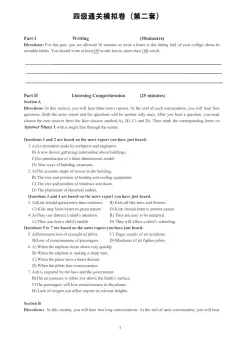
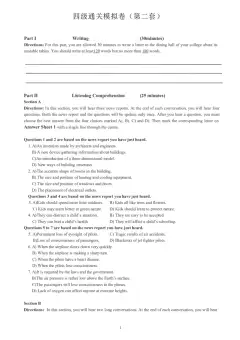
六级通关模拟卷(第二套)
PartI Writing (30minutes)
Directions: For this part, you are allowed 30 minutes to write an essay entitled The Value of Details by
commenting onthe remark “One ant-holemay causethe collapseof a thousand-lidam.”Youcancite examples to
illustrateyourpoint.Youshouldwriteatleast150wordsbutnomorethan200words.
PartII ListeningComprehension (30minutes)
SectionA
Directions: In this section, you will hear three news reports.At the end of each conversation, you will hear four
questions. Both the conversation and the questions will be spoken only once.After you hear a question, you must
choose the best answer from the four choices marked A), B), C) and D). Then mark the corresponding letter on
AnswerSheet 1withasinglelinethroughthecentre.
Questions1to4arebasedontheconversationyouhavejustheard.
1.A)Hewantstogettheheatingfixedinhisroom.
B)Hewantstocallroomservice.
C)Hewantstopraisethehallporter.
D)Hewantstogethismoneyrefunded.
2.A)Heistoooldtoknowhowtorespecttheothers.
B)Heistreatedunjustlybyallcustomers.
C)Hedoesn’tknowhowtorespectthecustomers.
D)Heisverymuchqualifiedforhisworkinthehotel.
3.A)Heissatisfiedexceptthebadfood.
B)Heisn’tsatisfiedwiththerestaurant.
C)Hethinksthewaitersarehelpful.
D)Hefeelsbeingcheatedbythemanager.
4.A)Heisn’tsatisfiedwiththemoneycharged.
B)Helikestothrowhisweightaround.
C)Heiscriticaloftheothers.
D)Helosespatiencewiththewoman.
Questions5to8arebasedontheconversationyouhavejustheard.
5.A)Isishotnow. C)Iswashotandsunnythismorning.
B)Iswascoldthismorning. D)Isissunnynow.
6.A)Surprised.
B)Skeptical.
C)Disgusted.
D)Alarmed.
7.A)Theycanusethelightmoreeffectively.
B)Theyarestrongerthanthecommonmaterials.
C)Theycanstoreandreleaseheat.
D)Theycanabsorbwaterifnecessary.
18.A)Theybecomelighterwhenthetemperatureislow.
B)Theirchemicalcompositionchangeswiththetemperature.
C)Theircolordarkenswhenthetemperatureishigh.
D)Theirstructuresarerearrangedasthetemperaturefluctuates.
SectionB
Directions:In this section, you will hear two long conversations.At the end of each conversation, you will hear
four questions. Both the conversation and the questions will be spoken only once.After you hear a question, you
must choosethe bestanswer fromthe four choices markedA), B), C), andD).Then mark thecorresponding letter
onAnswerSheet 1withasinglelinethroughthecentre.
Questions9to12arebasedonthepassageyouhavejustheard.
9.A)Itguaranteesfederalinvestmentinschools.
B)Itisauniversallawthatappliestoeveryuniversity.
C)Itstopsgenderdiscriminationinmanyschools.
D)Ithelpstosavefederalmoneyoneducationprograms.
10.A)TitleNinemakesgirlsjoininsportsprograms.
B)TitleNinehasaverygoodeffectonsports.
C)TitleNineisveryeffectiveinhighschools.
D)TitleNineiswellobeyedbyhighschools.
11.A)Participationinsportsisrelevanttopositiveeffects.
B)Participationinsportsincreasefemalecollegeattendance.
C)Participationinsportspreventsobesityamongadults.
D)Participationvaryamongdifferentstatesandages.
12.A)Theygivegirlsachancetoleveltheplayingfield.
B)TheyrevealthatTitleNineisaseffectiveaspeoplethink.
C)Farmoreboysthangirlsjoinsportsteams.
D)Theyshowthetrendofgirls’participationinsports.
PassageTwo
Questions13to15arebasedonthepassageyouhavejustheard.
13.A)Setalimittothemoneyspenteachdaybychildren.
B)Makesurechildrendon’tspenditatonce.
C)Learnaboutwhatchildrenwanttopayforwiththemoney.
D)Teachchildrentomakeabudgetfromtheirexperience.
14.A)Childrencanlearnhowabusinessworksinsociallife.
B)Childrenmayunderstandwhatanormalfamilylifeis.
C)Childrenmaylearntosavemoneyratherthanspendit.
D)Childrencan’texpectanotherallowanceinashorttime.
15.A)Theywillbemorecarefulinbuyingpresents.
B)Theywilllearnhowtobudgetandinvestinthefuture.
C)Theywillbemorelikelytosetgoalsfortheirlife.
D)Theywillknowhowtobargainwhendoingbusiness.
SectionC
Directions: In this section, you will hear three recordings of lectures or talks followed by three or four questions.
Therecordingswillbeplayedonlyonce.Afteryouhearaquestion,youmustchoosethebestanswerfromthefour
choices marked A), B), C), D). Then mark the corresponding letter on Answer Sheet 1 with a single line
throughthecentre.
2Questions16to19arebasedontherecordingyouhavejustheard.
16.A)Theyareaboutphilosophyinlife.
B)Theyadvisepeopletolearnphilosophy.
C)Theyintroducesomedifficultjargons.
D)Theyteachsomejargonsusedinlife.
17.A)Everybodywillfeelcentered.
B)Nobodywillgetbored.
C)Everybodywilltalkalot.
D)Everybodywilltalkalot.
18.A)Othersmayfollowyourstep. C)Otherswillloseinterestinphilosophy.
B)Othersmaynotunderstandyou. D)Otherswillnotdiscussphilosophywithyou.
19.A)Explainenoughaboutwhatwethought.
B)Sumupourthoughtsandletotherstalk.
C)Letotherstalkfirstandwegivecomments.
D)Keepourwordsquickandsimple.
Questions20to22arebasedontherecordingyouhavejustheard.
20.A)Lookinthemirroranddotheself-talk.
B)Getwellpreparedbeforemakinganychange.
C)Makelittlechangesintheirlifestyle.
D)Changeanythingthatmakesthemunhappy.
21.A)Helpothersfornothinginreturn. C)Trytomakemoremoney.
B)Savemoneytohelpothers. D)Gethelpfromtherichones.
22.A)Theycaretoomuchaboutpeopletheylove
B)Theyaretroubledbywhatotherssay.
C)Theyaremoreeasilytoberatedbyothers.
D)Theytendtobetheobjectofenvy.
Questions23to25arebasedontherecordingyouhavejustheard.
23.A)Therightbrainhemisphereremainsawakeallnightlong.
B)Bothhemispheresofthebrainremainactiveallnightlong.
C)Theleftbrainhemisphereremainsawakeduringdeepsleep.
D)Onebrainhemisphereremainsmoreawakethantheotherduringdeepsleep.
24.A)Sixtimes. C)Fourteentimes.
B)Twotimes. D)Seventomes.
25.A)Therewasnothingdifferentinalertnessoractivityineitherhemisphere.
B)Therewasnoobviousdifferencebetweenbothbrainhemispheres.
C)Thelefthemisphereremainedactiveindeepsleepphase.
D)Therighthemisphereremainedactiveindeepsleepphase.
PartⅢ Reading Comprehension (40minutes )
SectionA
Directions: In this section, there is a passage with ten blanks.You are required to select one word for each blank
from a list of choices given in a word bank following the passage. Read the passage through carefully before
making your choices. Each choice in the bank is identified by a letter. Please mark the corresponding letter for
each item on Answer Sheet 2 with a single line through the centre. You may not use any of the words in the
bankmorethanonce.
Questions26to35arebasedonthefollowingpassage.
3Until recently, the medical community believed that most hearing loss was caused by hear cells in the ear
degrading as we age. But evidence is emerging that sound levels at sporting events, concerts, nightclubs and on
personal devices can cause lasting damage to the connections between hear cells in the ear and the nerves
that__26__sounds to the brain. Over 1.1 billion teenagers and young adults worldwide could be at risk of hearing
loss as a result of __27___to unsafe levels of recreational noise, according to a recentWorld Health Organization
report.To make matters worse,this kind ofhearingloss doesn’tshow upon__28__tests. Researchersarecalling it
a hidden epidemic. “Wethink this problem is __29__prevalent, butit’s difficult to measure because the tools we
have available today are not sensitive enough,” says Konstantina Stankovic, an auditory neuroscientist and
surgeonatMassachusettsEyeandEar,andHarvardMedicalSchool,inBoston.
Stankovic is now working with colleagues at the Swiss Federal Institute of Technology in Lausanne to
develop imaging___30__that would allow us to see this kind of neural damage in living brains. This could help
with early diagnosis. Others are developing drugs that could help__31__the connections between the ear and the
brain.
Toproperly__32__ourears,loudnoisesshould bebannedin many publicplacesjustassmoking is now,says
Stankovic. Some countries have laws in place to protect__33_in bars and clubs by monitoring noise levels. Last
year,MinneapolisCityCouncilmadeit__34__forbarsandclubstoofferfreeearbudstopatrons.Stankovicthinks
more will need to change__35__accepted norms around recreational noise. “I think it will require a public health
effort similar to the efforts for limiting smoking, because of the peer pressure associated with loud music and
noisyenvironments,”shesays.
A)compulsory I)socially
B)condense J)standard
C)exposure K)techniques
D)incredibly L)transmit
E)independently M)treat
F)protection N)uneasy
G)restore O)workers
H)safeguard
SectionB
Directions: In this section, you are going to read a passage with ten statements attached to it. Each statement
containsinformationgiveninoneoftheparagraphs.Identifytheparagraphfromwhichtheinformationisderived.
You may choose a paragraph more than once. Each paragraph is marked with a letter. Answer the questions by
markingthecorrespondingletteronAnswerSheet2.
WhyDepressionNeedsaNewDefinition
[A]Many psychiatrists believe thatanew approachtodiagnosing andtreating depression—linking individual
symptoms to their underlying mechanisms—is needed for research to move forward. In his Aphorisms,
Hippocrates defined melancholia(忧郁症),an early understanding of depression, as a state of “fears and losing
courage, if they last a long time.” It was caused, he believed, by an excess of bile(胆汁)in the body(the word
“melancholia”isancientGreekfor“blackbile”).
[B]Ever since then, doctors have struggled to create a more precise and accurate definition ofthe illness that
still isn’t well understood. In the 1920s, the German psychiatrist Kurt Schneider argued that depression could be
divided into two separate conditions, each requiring a different form of treatment: depression that resulted from
changesinmood,whichhecalled“innerdepression”,anddepressionresultingfromreactionstooutsideevents,or
“reactivedepression”.His theorywas challengedin1926,whentheBritish psychologistEdwardMapother argued
intheBritishMedicalJournalthattherewasnoevidencefortwodistincttypesofdepression,andthattheapparent
differencesbetweendepressionpatientswerejustdifferencesintheseverityofthecondition.
4[C]Today, Schneider’s subtypes have largely fallen out of favor, but over the years, many more definitions
were offered in their place. In 1969, theAmerican psychologist Rollo May wrote in his book Love and Will that
“depressionis theinability toconstructafuture,”while thecognitive psychologistAlbertEllis arguedin1987that
depression, unlike “appropriate sadness”, stemmed from “irrational beliefs” that left sufferers ill-equipped to deal
withevenmildsetbacks.
[D]In 1952, the American Psychiatric Association tried to standardize the definitions of mental illnesses,
including depression, by creating a taxonomy(分类法) of mental illnesses. In the first edition of the Diagnostic
and Statistical Manual, depression was listed under the broad category of “disorders without clearly defined
physical cause”. The DSM-III, published in 1980, was theAPA’s first attempt to clarify the definitions of specific
disorders by listing their symptoms; the new edition included guidelines for differentiating depression from other
disorders, and outlined eight symptoms of depression, included “poor appetite or significant weight loss” and
“complaints orevidenceofdiminishedability tothinkorconcentrate”.If anadultmetfouroftheeight symptoms,
the manual counseled, heor she wouldmeet the criteria forclinical depression.In the DSM-V,published in 2013,
depressivedisorders werefinally allocated their ownchapter.Thediagnostic criteria were mostly unchanged,with
the exception of one additional symptom: “Depressed mood most of the day, nearly every day, as indicated by
eithersubjectivereport(e.g.,feelssadorempty)orobservationmadebyothers(e.g.,appearstearful).”
[E] Some scientists believe that the DSM-V definition is still too vague.As the psychiatrist Daniel Goldberg
noted in the journal World Psychiatry in 2011, many of the DSM symptoms are opposites, which can make it
difficult for researchers working to develop a more precise understanding of the condition. “A patient who has
psychomotorretardation(精神运动性阻滞),hypersomnia(嗜睡),andgainingweightisscoredashavingidentical
symptomsasanotherwhoisagitated,sleepingbadly,andhasweightloss,”Goldbergwrote.
[F]Many recent studies have verified Goldberg’s concerns. In 2000, for example, a group of researchers at
Johns Hopkins University attempted to identify subtypes of depression by studying the symptoms of
nearly2,000patients. However, the researchers were unable to find much of a pattern connecting gender, family
history, symptoms, and the degree of the condition(mild to severe). “Depression is of different kind,” they
concluded, adding that “the severity of an episode appears to be more informative than the pattern of symptoms.”
Andin2010, researchersinGermanytestingthevalidity oftheDSM-IVdefinition foundthatthe criteriacaptured
a huge population of patients with “widely varying associations with the pattern of co-morbidity(共病),
personality traits, features of the depressive episode and demographic characteristics.” The results, they argued.
“challengeourunderstandingofmajordepressionasasimilarcategoricalentity.”
[G]Partoftheproblem,saidScottMonroe,aprofessorofpsychologyattheUniversityofNotreDame,isthat
inmedicalterm, depressionis considereda syndrome rather thana disease.While a diseaseis a specific condition
characterizedbyacommonunderlyingcauseandconsistentphysicaltraits,asyndromeisacollectionofsignsand
symptoms known tofrequently appeartogether,butwithout asingle known cause. In apaperpublished in Junein
the journal Current Directions in Psychological Science, Monroe called for scientists to begin defining depression
with more precision. “It is in this vague and imprecise realm that problems can arise,” he wrote, “and vague
insightsbasedonimperfectsimilaritiesanddifferenceseventuallymayprovetobeclearoversights.”
[H]Partof thereason thatscientists are stillworking in the“vague andimprecise realm”. as Monroe putit, is
becausetheystilldon’thaveaclearanswerforwhatcausesdepression.Inthe1960s,thedominanthypothesiswas
that it stemmed from a chemical imbalance in the brain, specifically from lower levels of the neurotransmitter
serotonin(血清素).As a result, drug companies poured resources into developing “selective serotonin reuptake
inhibitors”(SSRIs),drugs thatincreasedtype ofantidepressant—despitethefactthatresearchhasshownthatlower
ofserotonin donotnecessarily causedepressionfor allindividuals.Andin 2010, areview of three decades’worth
of studies on antidepressants found that while SSRIs can be helpful for severely depressed people, their
effectiveness“maybeminimalornonexistent”inthosewithmildormoderatedepression.
[I]Bruce Cuthbert, the director of adult translational(平动)research and treatment development at the
NationalInstituteofMentalHealth(NIMH),thinksthatpartoftheproblemisthatresearchershavelargelyfocused
5their attention on finding a one-size-fits-all treatment that doesn’t exist. “When you do a clinical trial, you’re
getting a bunch of people who are ‘depressed’, but they’re actually very different,” he said. “It’s like comparing
apples, pears, and oranges. You’re not going to see a significant effect. You’re not going to be able to say, ‘This
treatment works for fruits.’” Trying to create a singular treatment for depression, Cuthbert said, is like trying to
createonefor cancer:too unspecificto actuallybehelpful.“Ourcurrentdiagnostic systemis runningoutofsteam
forresearch,”“While DSM hasbeendescribedasa‘Bible’forthe field,itis, atbest,adictionary,creatingasetof
labelsanddefiningeach,”theNIMHdirectorTomInselwrotein2013.
[J]In 2010, Insel invited Cuthbert, who was then working as a psychology professor at the University of
Minnesota, to help the NIMH develop a new framework for defining mental illness. The result, unveiled in 2013,
was the Research Domain Criteria(RDoC),a system created to flip the way researchers think about mental
disorders. Unlike the DSM, RDoC isn’t organized by disorder; instead, it’s organized around specific symptoms,
likefear,anhedonia(theinability tofeelpleasure),andwillingness orunwillingness to work.The system alsolists
thegenes,neuralcircuits,physicalresponse,andself-reportedbehaviorassociatedwitheachsymptom.
[K]The theory behind this RDoC system is that treating a specific symptom will produce better results than
treating a broad category of illness. Many depression patients exhibit anhedonia, for example, but many others
don’t. But if researchers took a group of patients who all displayed anhedonia, regardless of their diagnosis(it’s
also a common symptom of schizophrenia) and tested treatments for that very specific symptom, they would get
betterresultsfortreatinganhedonia.
[L]The current definition of depression, Cuthbert explains, has largely stemmed from scientists observing
patients and then developing lists of symptoms based on what they saw. “The belief was that if you described the
disorder well enough, you would be able to define it,” he said. But it’s becoming increasingly clear, he said, that
by relying on describing the disorder, scientists are only skimming the surface in terms of understanding it.
Cuthbert hopes that the RDoC system will challenge researchers to look at the mechanics of each symptom more
closely,andintheprocess,comeupwithmorewell-informedideasaroundhowtodiagnosementalillness.“We’re
starting over with how wethink aboutmentaldisorders,” Cuthbertsaid.“Our currentdiagnostic system is running
out of steam for research.” “Our current concept of depression is left over from times when we didn’t really
understand it very much,” he added. “We know so much so much more about it now—physically, genetically,
neurochemically—andweshouldbeusingthat.”
36. A particular psychiatrist believed that there were two distinct types of depression which should be treated
differently.
37.It hasbeenconfirmed thatantidepressantsare effectivein acutedepressionbutof littleornoeffectivenessin
mildormoderatedepression.
38.It was impossible for researchers to find similar characteristics in patients suffering the same degree of
depressionintheearly21stcentury.
39.Oneauthoritativefigurethinksthatresearchersarelookinginthewrongdirectionintreatingdepression.
40. Scientists only scratch the surface of the problem in understanding depression because relying on mere
descriptionoftheillnessisinsufficient.
41.Onetheory goes thatseeking treatments fora specificdisease is more effective thanseeking treatments for a
categoryofdisease.
42.The definite cause of depression still remains unknown, which is in part why scientists are still working on
it.
43.Classifying depression into subtypes has already been in disfavor and replaced by many more new
definitions.
44.The definition of depression in the Diagnostic and Statistical Manual went through several editions over the
pastsixdecades.
45.Farfrombeingthepsychiatrists’authoritativemasterpiece,DSMisconsideredasalexiconatbest.
6SectionC
Directions: There are 2 passages in this section. Each passage is followed by some questions or unfinished
statements. For each of them there are four choices marked A), B), C) and D). You should decide on the best
choiceandmarkthecorrespondingletteronAnswerSheet 2withasinglelinethroughthecentre.
PassageOne
Questions46and50arebasedonthefollowingpassage.
Gulliver has a friend who recently gave up his job to study for “The Knowledge”, the notoriously difficult
programme that London’s black-taxi drivers must pass through before getting a license. Would-be cabbies must
first gain an encyclopedic(百科全书式的)knowledge of the capital’s central district—some 25,000 streets and
approximately 20,000 landmarks—and be able to recite the best way of navigating between them. Studying for
“TheKnowledge”typicallytakesfromtwotofouryears.
The sacrifice usedto beworth it.Although driving a taxi for a living is undoubtedly hardwork, cabbies earn
a decent wage, choose their own hours and usually manage to spend a few weeks a year at their holiday villas in
Spain.Alas, for Gulliver’s friend,itis nolonger a jobwith prospects.Leaving asidethatlearning routesbyrote in
an era of satellite navigation is a waste of everyone’s time, the reason that cabbies put themselves through such a
tough selection process is so they can earn the privilege of picking up passengers off the street, which only they
arelegallyallowedtodo.
Uber is making this privilege increasingly irrelevant. The firm uses a smartphone platform to bring
passengers and drivers together. It is on its way to cornering the world taxi market—although, like many cabbies,
it is taking a circuitous(迂回的) route. Several American cities, including Portland, have ordered the firm to
suspendoperations,wholecountries,suchasGermany,haveoutlawedit.
Still, these are mere bumps in the road. The latest report by Certify, which tracks business-expense claims,
found that for the first time the majority of “ground transportation receipts” were for rides in Uber cars. In the
secondquarter of 2015,55%of suchbusinessexpenses emanated(起源)from thatsingle company,compared with
43% on all other taxi services.According to Certify, whose respondents are overwhelminglyAmerican, the cities
inwhichbusinessmenaremostlikelytouseanUbercarareSanFrancisco(79%),followedbyDallas(60%)andLos
Angeles(54%).It is easy to see why.Uber is cheap, reliable and easy to use.You know which driver is coming for
you and the driver knows you. There is no need to play a game of hailing leapfrog(交替前进)with competitors
alongbusystreets,inthehopeoffindingataxiwith alighton.
OnarecenttriptoNewYork,Gulliver’syoungdaughter wasdesperatetotakearideinayellow taxibecause
shehadseen them onposters. So we tooka ride as atourist attraction.Whenit came to pulling our suitcases back
to JFK, though, it was much more convenient to call an Uber car. Gulliver worries for his friend’s choice of new
career.How long will it be before he becomes little more than a curiosity for those wanting to experience ye olde
England?
46.Whatdoweknowabout“Theknowledge”?
A)ItisanencyclopediaaboutLondonstreets.C)Itisanavigationbetweenthelandmarks.
B)Itisanexamwould-becabbiesmustpass.D)Itisalicensefortheprofession.
47.Accordingtothepassage,“Thesacrifice”(Line1,Para.2)refersto______.
A)theexpenseofspendingluxuriousholidaysinSpain
B)thewasteoftimetorememberingLondonstreets
C)theeffortsofgraspingthetransportationknowledge
D)thehardshipoflivingasaLondontaxidriver
48.Accordingtotheauthor,whichofthefollowingstatementsaboutUberisTRUE?
A)Ithasaprivilegetouseasmartphoneplatform.
B)ItprovidesillegalserviceinAmericancities.
C)Itmaybecompletelysuspendedinthenearfuture.
D)Ithasmetsomeobstaclesinitsfastbooming.
749.ThedatamentionedinParagraph4impliesthat______.
A)Uber’smarketsharehasalreadysurpassedthatofallothertaxicompanies
B)UberismostpopularwithbusinessmeninAmericancities
C)Uberhasboughtmostofthegroundtransportationreceipts
D)Uberisprovidingclientswithcheapandconvenientservices
50.Whatdoestheauthorthinkofthetraditionaltaxiservice?
A)ItwillbereplacedbyUbersoon.
B)Itwillbecomeatouristattraction.
C)Itwillnotbeapromisingcareeranymore.
D)ItwillbecomeasymboloftheoldEngland.
PassageTwo
Questions51to55arebasedonthefollowingpassage.
Educationin mostofthe developingworld is shocking. Half ofchildren in SouthAsia and athird ofthosein
Africa who complete four years of schooling cannot read properly. Most governments have promised to provide
universal primary education and to promote secondary education. But even when public schools exist, they often
fail.
Thefailure ofstateeducation,combinedwiththeshiftinemergingeconomiesfromfarmingtojobsthatneed
atleastamodicum(少量)ofeducation,hascausedaprivate-schoolboom.AccordingtotheWorldBank,acrossthe
developing world a fifth of primary-school pupils are enrolled in private schools, twice as many as 20 years ago.
Somanyprivateschoolsareunregisteredthattherealfigureislikelytobemuchhigher.
Byandlarge,politiciansandeducationalists areunenthusiastic. Governmentsseeeducationasthestate’sjob.
NGOs tend to be ideologically opposed to the private sector. The U.N. special rapporteur(报告人)on education,
Kishore Singh, has said that “for-profit education should not be allowed in order to safeguard the noble cause of
education”.
This attitude harms those whom educationalists claim to serve: children. The boom in private education is
excellentnewsforthemandtheircountries,forthreereasons.
First, itisbringinginmoney—notjustfromparents,butalsofrominvestors,some insearchofaprofit.Most
private schools in the developing world are single operators thatcharge a few dollars a month, butchainsare now
emerging.
Second, private schools are often better value for money than state ones. Measuring this is hard, since the
children who go to private schools tend to be better off, and therefore likely to perform better. But a rigorous
four-yearstudyof6,000pupilsinAndhraPradesh,insouthernIndia,suggestedthatprivatepupilsperformedbetter
inEnglish andHindithan public-schoolpupils,and theprivate schools achieved theseresults ata third ofthe cost
ofthepublicschools.
Lastly, private schools are innovative. Since technology has great(though as yet mostly unrealized) potential
in education, this could be important. Bridge gives teachers tablets linked to a central system that provides
teaching materials and monitors their work. Suck robo-teaching may not be ideal, but it is better than lessons
withouteithermaterialsormonitoring.
Theprivatesectorhasproblems.Butthealternativeisoftenapublicschoolthatisworse—ornoschoolatall.
The growth of private schools is a manifestation of the healthiest of instincts: parents’ desire to do the best for
their children. Governments should therefore be asking nothow to discourage private education,buthow to boost
it. Ideally, they would subsidize(以津贴补助)private schools, preferably through a voucher(凭证)which parents
couldspendattheschooloftheirchoiceandtopup;theywouldregulateschoolstoensurequality;theywouldrun
publicexamstohelpparentsmakeinformedchoices.
851.Accordingtotheauthor,thestategovernmentsindevelopingcountriesfailto________.
A)providepropereducationforalltheschoolagechildren
B)fulfilltheirpromisesbyestablishingenoughpublicschools
C)improveeducationqualityoftheexistingpublicschools
D)speedupthesocialshiftfromfarmingtomanufacturing
52.TheauthormentionsKishoreSinghinordertoshow_________.
A)howstategovernmentsdislikeprivateeducation
B)whyNGOsaresomuchopposedtoprivatesectors
C)howweshouldsafeguardthenobilityofeducation
D)whatthesocialmainstreamthinksoftheprivateschools
53.Privateschoolssurpassthepubliconesinthat_______.
A)theycanobtainmoremoneyfromparents
B)theyhaveachievedbetterteachingquality
C)theymakebetteruseofmoneyandinnovate
D)theycanusetabletstoassistteaching
54.Whatdoestheauthorthinkoftheprivateeducation?
A)Itmeetstheneedofsocialdevelopment.
B)Itshouldbesuspendedandreorganized.
C)Itshouldnotberunpurelyafterhighprofits.
D)Itisencouragedtoreplacepubliceducation.
55.Whichofthefollowingcanbethetitleofthepassage?
A)WhyArePrivateSchoolsBoomingSoFast?
B)ShouldPrivateEducationBeHelpedorCurbed?
C)HowShouldtheGovernmentImproveEducation?
D)WhatShouldtheStateDowithPublicSchools?
PartⅣ Translation (30 minutes)
Directions:Forthispart,youareallowed30minutestotranslateapassagefromChineseinto
English.YoushouldwriteyouransweronAnswerSheet2.
灯笼作为民间传统工艺(craftwork),现在仍受到全国各地的欢迎。灯笼艺术,作为中国珍贵传统文
化的一部分,在民间仍被继承(inherit)着。我们可以说灯笼在中国悠久的历史中发挥着巨大而不可替代
的作用,它象征着灿烂的中国文化。中国灯笼不但在中国历史上扮演着重要的角色,在国际发明、发展上
也做出了巨大的贡献。一些西方国家通过传教士(missionary)活动和对外贸易,掌握了中国灯笼的设计及
制作技巧,极大地促进了其社会发展。
9