襄阳四中 2025 级高一年级期中学情质量检测
英语试题
第一部分 听力(共两节,满分 30 分)
做题时,先将答案标在试卷上。录音内容结束后,你将有两分钟的时间将试卷上的答案转涂
到答题卡上。
第一节 (共 5 小题;每小题 1.5 分,满 7.5 分)
听下面 5 段对话。每段对话后有一个小题,从题中所给的 A、B、C 三个选项中选出最佳选项。
听完每段对话后,你都有 10 秒钟的时间来回答有关小题和阅读下一小题。每段对话仅读一遍。
1. Where are the speakers?
A. At the station.
B. At the airport.
C. At the theatre.
2. What will the speakers do this weekend?
A. Clean the house.
B. Attend a meeting.
C. Visit the man’s uncle.
3. How many degrees will it be in Chicago this weekend?
A. 8℃.
B. 10℃.
C. 15℃.
4. What does the man advise the woman to do?
A. To stop skating.
B. To practice more.
C. To wear something protective.
5. What can we learn about Sally?
A. She is likely to come back soon.
B. She is still in hospital at present.
C. She will have an operation next week.
第二节(共 15 小题:每小题 1.5 分;满分 22.5 分)
听下面 5 段对话或独白。每段对话或独白后有几个小题,从题中所给的 A、B、C 三个选项中选
出最佳选项。听每段对话或独白前,你将有时间阅读各个小题,每小题 5 秒钟;听完后, 各小题将
给出 5 秒钟的作答时间, 每段对话或独白读两遍。
听第 6 段材料,回答第 6、7 题。
6. Why is the woman stopped by the police?
A. She was caught speeding.
B. She went through a red light.
C. She parked in the wrong place.
第 1 页/共 12 页
7. What will the woman do next?
A. Pay an extra $30.
B. Pay the fine immediately.
C. Check the speed record.
听下面一段对话,回答以下小题。
8. How often is the man supposed to eat meat?
A. Once a day.
B. Once a week.
C. Once a month.
9. Why does the woman refuse to buy beef?
A. The man is on a diet.
B. She dislikes the taste.
C. They had it yesterday.
听下面一段对话,回答以下小题。
10. What is the probable relationship between the speakers?
A. Husband and wife.
B. Teacher and student.
C. Brother and sister.
11. What are the speakers doing?
A. Making a shopping list.
B. Designing a study schedule.
C. Talking about tomorrow’s plan.
12. Which subject does Martin need help with?
A. Math.
B. History.
C. Chemistry.
13. When should the man and Dave get to the gym?
A. At 6:00 p.m.
B. At 5:40 p.m.
C. At 6:20 p.m.
听下面一段对话,回答以下小题。
14. What does Sam say about his son Leo?
A. He dislikes his new school.
B. He uses the laptop too much.
C. He hates doing his homework.
15. What is Sam’s attitude toward Screen-free Days?
A. Uncertain.
B. Supportive.
C. Doubtful.
16. What can be learned about Sam and his wife?
A. They have little time to watch over Leo.
B. They often help Leo with his homework.
第 2 页/共 12 页
C. They make strict rules on screen time at home.
听下面一段独白,回答以下小题。
17. Who are the intended listeners?
A. Kids.
B. Teachers.
C. Parents.
18. How many camps are mentioned?
A. 3.
B. 2.
C. 1.
19. What can kids do in Summer Dance Camp?
A. Join team competitions.
B. Create their own works.
C. Practice with top teachers.
20. What is the purpose of the speech?
A. To explain camp rules.
B. To introduce summer camps.
C. To lecture on camp activities.
第二部分 阅读(共两节,满分 50 分)
第一节 (共 15 小题;每小题 2.5 分,满分 37.5 分)
阅读下列短文,从每题所给的 A、B、C 和 D 四个选项中选出最佳选项。
A
Whether you are writing a business email or a long research essay, the dictionary can be a powerful tool to
assist you in becoming a better writer in English.
You can use the main A-Z of the dictionary to help you:
Choose your words carefully. Many words in English have similar or related meanings, but they are used in
different contexts or situations. Look carefully at the example sentences provided in the entries for words you want
to use. If you need academic vocabulary, look for the AW symbol.
Combine words naturally and effectively. In English, certain pairs of words go together and sound natural to
native speakers (for example, heavy rain) — and others do not (strong rain). Information on which words can be
paired with one another can be found in the example sentences in the dictionary entries.
Become more flexible. Rather than repeating the same word or phrase many times in your work, try to find
other ways to express your ideas. Look for SYN symbol to find synonyms(同义词) and also study the synonym
notes. Look for word families and try using words in the same family that are different parts of speech (e.g.
different, adjective and differ, verb).
Edit and check your work. You can use your dictionary to check any problem areas such as spelling, parts of
第 3 页/共 12 页
speech, irregular forms, grammar, phrasal verbs, and prepositions.
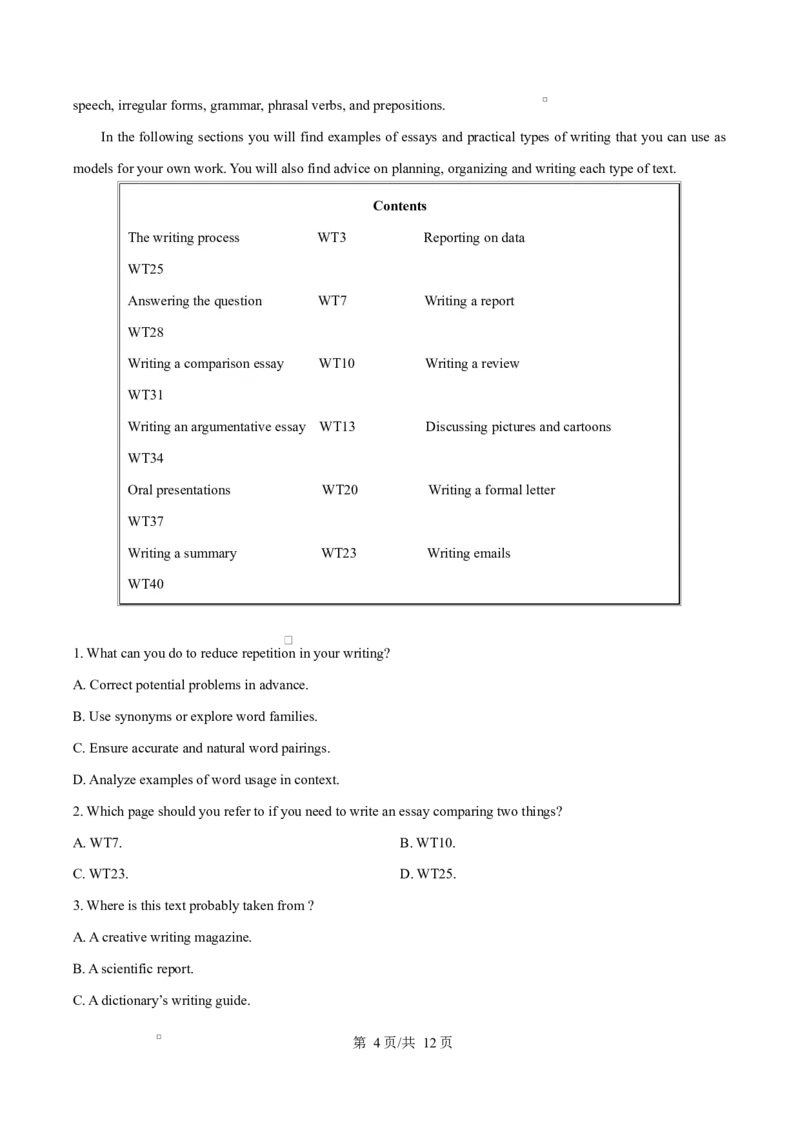
In the following sections you will find examples of essays and practical types of writing that you can use as
models for your own work. You will also find advice on planning, organizing and writing each type of text.
Contents
The writing process
WT3
Reporting on data
WT25
Answering the question
WT7
Writing a report
WT28
Writing a comparison essay
WT10
Writing a review
WT31
Writing an argumentative essay WT13
Discussing pictures and cartoons
WT34
Oral presentations
WT20
Writing a formal letter
WT37
Writing a summary
WT23
Writing emails
WT40
1. What can you do to reduce repetition in your writing?
A. Correct potential problems in advance.
B. Use synonyms or explore word families.
C. Ensure accurate and natural word pairings.
D. Analyze examples of word usage in context.
2. Which page should you refer to if you need to write an essay comparing two things?
A. WT7.
B. WT10.
C. WT23.
D. WT25.
3. Where is this text probably taken from ?
A. A creative writing magazine.
B. A scientific report.
C. A dictionary’s writing guide.
第 4 页/共 12 页
D. A promotion handbook.
B
Getting all the things ready to make my favorite sandwich takes time. Certainly more than 10 seconds — the
time my fridge allows me to quietly search inside. After those 10 seconds, a series of loud beeps (机器鸣叫声)
begin — an alarm to remind forgetful humans to close its doors. My belief is that the alarm, which cannot
be stopped, was designed to stop my late-night search in the fridge — my wife has long warned me that midnight
snacking is bad for my weight.
The frightening fridge is just one example of the creations by engineer-designers who are convinced that
seniors like me can’t survive without beeping reminders. My car beeps often, particularly when I get out. There is
simply no way to stop it. At first, I thought the car was just too sad to see me go.
It is not just the fridge and the car. Once I started paying attention, I realized our environment is filled with
reminder noises. The stove (炉灶) sings too — leave a burner on and it performs its own little concert. As for my
phone, even after turning off every notification (通知) I can find, calendar reminders still get through.
So I went online looking for a solution—and found a video of an equally frustrated man taking apart the
beeper on the exact same fridge model. I can handle the fix. But now the question is: Do I really want to? What if I
leave the fridge door partly open and ruin a costly roast? What if I miss the notification that reminds me of an
appointment (约会) I may forget? The results of an unbeeped life may be too serious to risk.
Finally, tool in hand, I stand before the fridge. If there were a silence option, I might leave it alone. But there
isn’t — and I’ve had enough. I’ll remove the noise-maker and put a sticky note on the door instead, reminding me
to close it. The reward of a successful late-night search for a delicious sandwich is definitely worth it.
4. How does the author sound in paragraph 1 and paragraph 2?
A. Frightened.
B. Bored.
C. Humorous.
D. Friendly.
5. Why are the stove and the phone mentioned in the passage?
A. To show that elderly people often have a good memory.
B. To prove that modern machines are usually poorly designed.
C. To explain how technology is changing seniors’ living habits.
D. To give examples of how beeping alarms are unavoidable in daily life.
6. What can be inferred about the author from paragraph 4?
A. He fails to find a way to stop the noise.
第 5 页/共 12 页
B. He considers the online video unhelpful.
C. He worries about life without reminders.
D. He is unable to fix the fridge by himself.
7. What does the author finally decide to do about the fridge?
A. Buy a much quieter fridge.
B. Bear the disturbing noise.
C. Avoid late-night searches in it.
D. Replace the alarm with a note.
C
The grammar school boy from Stratford-Upon-Avon has made headlines again after a groundbreaking study
showed that Shakespeare does benefit children’s literacy and emotional development, but only if they can act him
out.
The study found that a drama-based approach to teaching Shakespeare broadened children’s vocabulary,
improved the quality of their writing, and enhanced their emotional understanding. “The way actors work makes a
big difference to how children use language and how they think about themselves,” said Jacqui O’Hanlon, lead
researcher of the study.
The random trial involved hundreds of Year 5 pupils (aged nine and ten) at 45 state primary schools. The
children were divided into a target group and a control group. Both groups read a passage from Romeo and Juliet
and were asked to write a letter as Romeo after being separated from Juliet. Before writing, the target group took
part in a 30-minute drama-based activity, while the control group did not.
It was shown that pupils in the target group drew on a wider vocabulary, used more complicated or rarer
words, and wrote at greater length. They also appeared more comfortable writing in role. While pupils in the
control group imagined how they themselves would react to being separated from a loved one, children in the target
group put themselves in Romeo’s shoes and expressed that character’s emotion.
O’Hanlon said she had been most surprised by the emotional understanding evident in the children’s writing,
and that they showed deeper empathy and expressed emotions more vividly. “It is probably related to the
drama-based process, where you are used to trying to think and feel as the character,” she added.
But could the results be reproduced with any old dramatists? O’Hanlon said more research would be needed
but suggested that Shakespeare’s use of 20,000 words, compared with the everyday 2,000 words, gave a massive
expansion of language into children’s lives, which was combined with children using their whole bodies to bring
第 6 页/共 12 页
words to life.
8. What does the study encourage children to do?
A. Perform Shakespeare’s works.
B. Write their own original plays.
C. Learn Shakespeare’s lines by heart.
D. Watch professional acting on stage.
9. Which aspect of the study does paragraph 3 mainly talk about?
A. Its procedure.
B. Its background.
C. Its purpose.
D. Its significance.
10. What impressed O’Hanlon most about the target group’s writing?
A. Passage fluency.
B. Emotional depth.
C. Word complexity.
D. Plot imagination.
11. What can be learned from the text?
A. Practice makes perfect.
B. Learning by doing works best.
C. Reading makes a full man.
D. Words are the voice of the mind.
D
How is it December already? Where did 2025 go? And how did we suddenly go from eating Easter eggs to
putting up Christmas trees? To understand why our feeling of time seems to change, we need to first learn how our
brains sense time. The term “time perception (感 知 )” is actually a bit misleading, because time itself is not
something “outside” that we can directly sense.
When we see colors, hear sounds, taste flavors or feel touches, special body parts pick up signals from the
environment: like light waves entering our eyes, sound waves in our ears, chemicals in food, or the pressure of
objects on our skin. But there’s no special part for sensing time—no “time particles (微粒)” that the brain can
detect.
Our brains don’t feel time directly; they guess it. Just like a clock, the brain judges how much time has passed
by following changes. But unlike a clock, it has no regular ticks (滴答声). To guess time, the brain simply counts
how many things happen. If you fill your time with interesting activities, it seems to last longer. In experiments, a
flashing picture feels longer than a still one of the same time. Brains tell time by tracking changes.
This explains why exciting or scary events (like car accidents) make time seem to slow down. In a famous
study, people fell backwards into a net from over 30 meters high. When asked how long the experience lasted, they
said it was 30% longer than watching others fall. Strong emotions make people pay more attention, so the brain
stores more detailed memories.
第 7 页/共 12 页
To know why 2025 passed so fast, we need to tell two ways of judging time: looking back (how much time
passed) and feeling in the moment (how fast time goes). Waiting at the dentist feels slower than playing with a new
toy. The key is what you focus on. The more you pay attention to time itself, the slower it seems to pass.
12. What does the underlined word “detect” in Paragraph 2 probably mean?
A. Discover.
B. Ignore.
C. Doubt.
D. Stand.
13. How do our brains judge the passing of time?
A. By picking up special “time particles”.
B. By following the regular ticks like a clock.
C. By sensing the number of things that happen.
D. By feeling the pressure from the environment.
14. Why is the famous study mentioned in Paragraph 4?
A. To show falling from high places is scary.
B. To show people often slow time in danger.
C. To prove watching others fall takes more time.
D. To prove strong emotions slow time perception.
15. What is the main idea of the passage?
A. How people make time pass slowly.
B. What time perception studies tell us.
C. Why our perception of time changes.
D. When people sense time going quickly.
第二节 (共 5 小题;每小题 2.5 分,满分 12.5 分)
根据短文内容,从短文后的选项中选出能填入空白处的最佳选项。选项中有两项为多余选项。
When traveling, many find themselves in places where the local language is unfamiliar. Once, travelers relied
on phrasebooks, but the spread of English has reduced this need. However, most people worldwide still don’t speak
English. ____16____ Increasingly, travelers use free translation apps. These apps allow users to speak into their
phones and receive spoken translations almost instantly, bridging language gaps effectively.
____17____ Google Translate, a well-known name, often makes mistakes. For instance, translating “my wife
is gluten-free (不能吃面筋)” into French or Italian as “my wife is without gluten” misses the intended meaning:
However, competitors offer better alternatives. ____18____ It offers no direct translations, but imitates a native
第 8 页/共 12 页
speaker’s input.
While AI tools make travel easier, some worry they discourage language learning. Douglas Hofstadter, a
language expert, argues that relying on machines for communication robs people of meaningful experiences and
accomplishments. However, others believe most people don’t need fluency for casual travel. ____19____
As AI translation gains popularity, people may divide into two groups: those eager to learn languages for
cultural experience and mental challenge, and those who see it as unnecessary effort. This issue is particularly
pressing for English speakers, as many schools in English-speaking countries reduce foreign language programs.
____20____ Direct communication, even if imperfect, brings up deeper connections than relying on technology.
A. Yet, these tools aren’t perfect.
B. And they prefer the convenience of AI.
C. It is a paraphrase rather than a translation.
D. Travel has long been a motivator for study.
E. Despite this, the social significance of language remains.
F. This leads them to rely on gestures, patience, or technology.
G. ChatGPT stands out by creating natural-sounding paraphrases.
第三部分 语言运用(共两节,满分 30 分)
第一节 (共 15 小题;每小题 1 分,满分 15 分)
阅读下面短文,从每题所给的 A、B、C 和 D 四个选项中选出可以填入空白处的最佳选项。
Last summer, my grandfather suggested I spend a week with him, helping to restore an old community garden.
I was initially hesitant (犹豫的), as I had no ____21____ in gardening and feared failure.
The garden was in a ____22____ state; weeds were everywhere, and the few remaining plants looked weak.
On the first morning, Grandpa simply handed me a pair of gloves and said, “We start by pulling these weeds.
Remember, every big change begins with a small ____23____.” I worked slowly, my back aching under the hot
sun. I wanted to ____24____, but seeing my grandfather’s steady devotion kept me going. ____25____ the
physical labor was tough, the mental barrier was higher. I had to constantly fight the voice in my head telling me I
couldn’t ____26____ it. Grandpa noticed my ____27____. “Don’t focus on the whole garden,” he advised
____28____. “Just focus on clearing one small area at a time.”
Upon this simple advice, I changed my approach. I ____29____ looking at the seemingly impossible task and
concentrated on one square meter of soil. Afterwards, I was ____30____ making progress. A local news reporter
even visited, writing a wonderful article about our project. This attracted several volunteers, who brought fresh
第 9 页/共 12 页
energy and ____31____.
By the week’s end, the change was ____32____. Neat rows of new seedlings stood where weeds once ruled.
The community’s gratitude was immeasurable. This experience taught me that courage isn’t the absence of fear, but
the decision to act ____33____it. True strength comes from ____34____ your comfort zone and trusting the
process. We all possess an inner strength; we just need to take that first step to ____35____ it.
21. A. regret
B. luck
C. experience
D. intention
22. A. peaceful
B. messy
C. modern
D. empty
23. A. step
B. accident
C. event
D. theory
24. A. give away
B. give in
C. give out
D. give up
25. A. Although
B. Unless
C. Because
D. Since
26. A. take
B. make
C. get
D. try
27. A. struggle
B. pain
C. willingness
D. puzzle
28. A. angrily
B. proudly
C. gently
D. nervously
29. A. tried
B. stopped
C. continued
D. kept
30. A. possibly
B. suddenly
C. hardly
D. gradually
31. A. tools
B. complaints
C. money
D. excuses
32. A. impossible
B. noticeable
C. similar
D. acceptable
33. A. from
B. as
C. despite
D. like
34. A. stepping out of
B. looking for
C. holding onto
D. thinking about
35. A. hide
B. doubt
C. discover
D. forget
第二节 (共 10 小题;每小题 1.5 分,满分 15 分)
阅读下面材料,在空白处填入适当的内容(1 个单词)或括号单词的正确形式。
Hutongs in Beijing are narrow streets formed by lines of “siheyuan”, traditional Chinese courtyard residences.
Here are three ____36____(protect) hutongs in Beijing’s Xicheng district.
The 1,500-meter-long Dongjiao Minxiang is the longest of the three, which is home ____37____ a few
high-end restaurants and luxury stores as well as some cheap eating places and common shops. But ____38____
most important attractions are a number of well-preserved Western-style buildings, which ____39____(be) once
some foreign officials’ homes.
The 496-meter-long Yangmeizhu West Street, ____40____ is the second longest among them, is originally
famous for ____41____(it) 600-year-old architecture. It also attracts tourists for several ____42____(culture)
第 10 页/共 12 页
figures, such as Shen Congwen, a late 20th-century Chinese author and scholar. Walking down the hutong, you will
see Beijing locals ____43____(play) Chinese chess or talking about their own ideas on arts and life.
Different from the above two hutongs, Gongmenkou Ertiao is much ____44____(short), but it is where Lu
Xun Museum _____45_____(locate). It is also filled with history, culture and innovations.
第四部分 写作(共两节,满分 40 分)
第一节(满分 15 分)
46. 假定你是李华,你校部分学生常以各种理由请假,不参加课间跑活动。为此,请写一篇短文向校英文报
投稿,内容包括:
(1)陈述现象;
(2)提出劝告和建议。
注意:
(1)写作词数应为 80 左右;
(2)可适当增加细节,使内容充实、行文连贯。
Show up for Inter-class Running
____________________________________________________________________________________________
____________________________________________________________________________________________
____________________________________________________________________________________________
____________________________________________________________________________________________
____________________________________________________________________________________________
第二节(满分 25 分)
47. 阅读下面材料,根据其内容和所给段落开头语续写两段,使之构成一篇完整的短文。
Emily and Zoe had been best friends since second grade. They went to the same school, played on the same
soccer team, and even wore matching bracelets (手链). Everyone around them said they were like two sides of the
same coin. They believed nothing could come between them. But things started to change when a new girl Daisy
came to their class.
One day, their teacher, Mr. Lynn, announced a big group project. “Pick a partner,” he said. Emily immediately
turned to Zoe, expecting her usual smile and a quick “yes.” But to her surprise. Zoe was already talking to Daisy. “I’
m going to work with Daisy this time,” Zoe said to Emily, almost too casually. Emily felt like the air had been
knocked out of her. She nodded and forced a smile, but inside, she was confused and hurt. That night, she stared at
her phone screen, hoping for a message that never came.
第 11 页/共 12 页
Over the next few days, she avoided Zoe. Their texts stopped, they no longer sat together during lunch, and the
bracelets they once wore daily were now left at home. Even during class, Emily found it hard to focus, her mind
replaying the moment when Zoe chose someone else.
Weeks passed. The school organized a three-day camping trip in the mountains. Students were divided into
several groups. Emily and Zoe ended up in the same one, along with Daisy and two other classmates. Though they
barely spoke, they worked together to put up tents and gather firewood. Their conversations were limited to short,
polite exchanges — nothing like before.
On the second night, dark clouds rolled in and heavy rain soon followed. Everyone rushed into their own tents.
Emily quickly discovered that hers was leaking. Cold and upset, she went outside, seeking for help. The wind
howled around her, and each raindrop felt like a tiny needle against her skin.
注意:
1. 续写词数应为 150 左右;
2. 请按如下格式在答题卡的相应位置作答。
Just then, she saw a flashlight approaching.
____________________________________________________________________________________________
____________________________________________________________________________________________
____________________________________________________________________________________________
____________________________________________________________________________________________
____________________________________________________________________________________________
With Zoe’s help, they soon fixed the tent.
____________________________________________________________________________________________
____________________________________________________________________________________________
____________________________________________________________________________________________
____________________________________________________________________________________________
____________________________________________________________________________________________
第 12 页/共 12 页